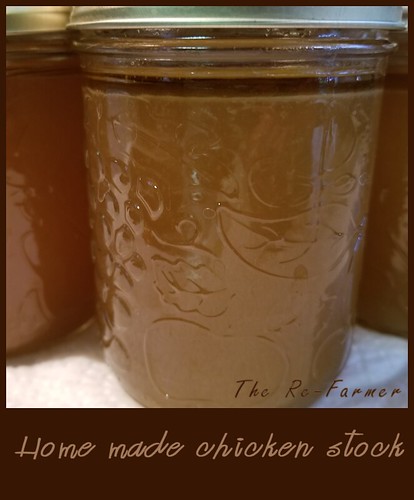
Home Made Chicken Stock

The following is a “use watcha got” recipe to use up the carcasses of your cooked chicken (or turkey).  This stock is cooked down to be more concentrated, and should result in a rather firm, gel-like consistency when cool.

Decide ahead of time how you will store your stock, and prepare in advance as needed.  I used pint sized canning jars and sterilized the canning funnel, jars, lids and rings during the last hour or so of cooking.  You could also pour the stock into ice cube trays for freezing, or use freezer bags.

You will also need a colander and bowl large enough to hold your stock, plus a sieve and cheesecloth for straining.  Having a giant measuring cup is also very handy to stain into, making it easier to pour the stock into jars.

Ingredients:

bones and skin from roasted chickens (or turkey)
pan drippings
onion and/or leeks
garlic cloves
vegetables such as carrots, celery (including leaves), celeriac, parsnips
herbs such as rosemary, thyme, savory, sage, bay leaves, ginger, parsley or dill
peppercorns
salt; optional
cold water
optional additions: lemon or orange zest, a splash of apple cider vinegar or white wine vinegar
homemade.chicken.stockNote: Quantities will depend on how many carcasses you are using.   For 3 carcasses, I used 1 large onion, a whole head of garlic, 4 carrots, and whatever herbs I had handy in my cupboard.

Seasonings will also depend on how the chickens were seasoned when cooked.  When I roasted ours, I first rubbed them with lemon juice and put the lemon pieces, with some bay leaves, into the cavities.  I also rubbed lemon salt, paprika, pepper and oil into the skin.  Because of this, I was able to be light on the salt and pepper when making the stock.  What salt I did use was lemon salt.

  1. Place your chicken bones and skin into a large stock pot.  Scrape pan drippings in (cooled pan drippings may be gelled, which is awesome).
  2. Add onions, cut into large pieces (skin can be left on, if you wish), or leeks cut into 2 inch or so chunks.
  3. Crush garlic cloves with the side of a large knife (skins can be left on, but I like to remove them) and add to the pot.
    Note: If you don’t have fresh onions or garlic, dried can be used.
  4. Vegetables do not need to be peeled.  Just scrub them, and remove the root ends.  Chop them into about 2 inch pieces, then add to the pot.
  5. Add fresh or dried herbs and other seasonings of your choice.
  6. Add peppercorns (or ground pepper, if that’s what you have) and salt.  If you’re not sure about the salt, leave it for later, after tasting.
  7. Add enough cold water to cover everything by about 1 or 2 inches.
  8. Bring to a boil, then reduce to simmer.  Do not stir, as that will make your stock cloudy.
  9. Simmer for about 3-4 hours.
  10. Place a colander over a large bowl.  Carefully pour everything in the stock pot, into the colander.  Gently lift out the colander, allowing to drain, and set aside.  Colander contents can be discarded.
  11. Wash the stock pot out and place back on the stove.  Pour the stock, through a sieve, back into the stock pot.
  12. Taste for seasonings.  Adjust as desired.
  13. Bring the stock to a boil.  Reduce heat and continue to simmer the stock down until reduced by 1/3rd.
  14. Line a sieve with several layers of cheesecloth and place over a bowl or large measuring cup.
  15. Gently ladle the stock into the lined sieve.
  16. Fill prepared containers with strained stock (in batches, if need be) and seal.
  17. Refrigerate or freeze, as desired.


Using the carcasses of 3 chickens, I was able to fill 11 pint sized canning jars (all the ones I had available), plus have 3 cups of stock left over.

The second cooking down of the stock concentrates it a bit; if you wanted to, you could continue to cook it down more, for an even more concentrated stock.  Keep this in mind when you use it, as you may need to water it down a bit.

Enjoy!

The Re-Farmer

Brined Turkey with bacon

I was interrupted while making our Thanksgiving dinner today. I got a call from home care, telling me that there had been a sick call, and no one would be able to do the meal assist with my mother.  I did confirm that she would still be getting her bed time assist, then said that I could go over to do the meal assist.  So I turned all over to the girls to finish, and headed out to help out my mother.

Everything was ready by the time I got back, so we went straight to setting up for dinner.  I half carved the turkey before I realized I forgot to take a photo! :-D  So here is half of our bacon covered, brined turkey! Continue reading

Makin’ Mayo

Today, my daughters cracked open a new jar of mayonnaise that we bought just a couple of days ago, and discovered the seal was cracked.

Which means it had been sitting in our cupboard, with the vacuum seal broken.

So, that got thrown out.

Since we weren’t about to drive into town just to buy a jar of mayonnaise, and I happened to have the ingredients, I made a quick batch.

This is an easy mayonnaise recipe from the home economics cookbook I got from when I was in junior high school – a cookbook that is still one of my most used, because it’s filled with basic recipes like this one.

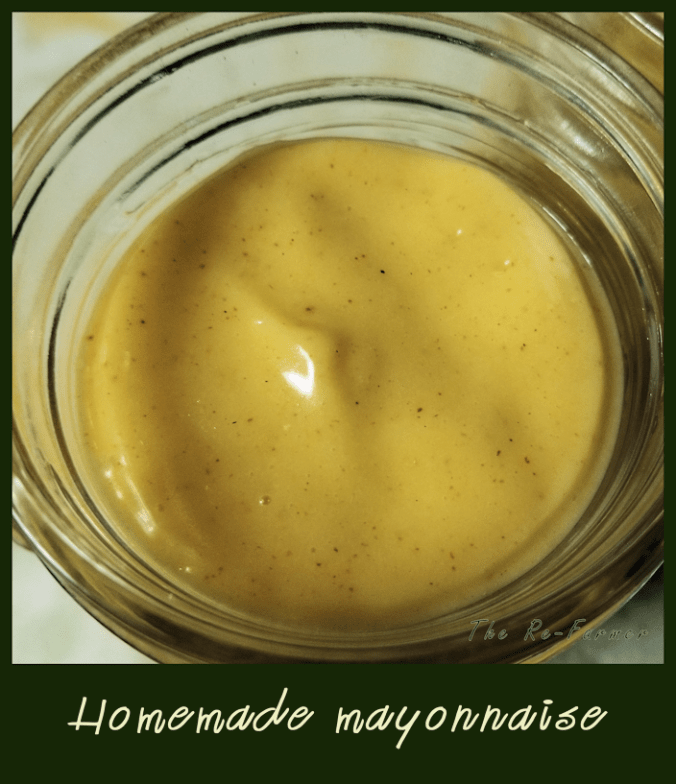
Homemade Mayonnaise

I also have these handy little pint canning jars to use to store it, too. :-)  Since this is an uncooked version, I sterilized them first.

mayonnaise ingredients

The ingredients are pretty basic; dry mustard, salt, paprika (that is the amount in the recipe; when I’ve made it in the past, I usually used just a pinch), a large egg, vinegar and oil.

While you can adjust how much paprika is used, to taste, the quantities of the rest of the ingredients should stay the same.  That doesn’t mean you can’t get creative, though!  I’ve made this using olive oil, and avocado oil can be used as well.  You can use one egg, or two egg yolks.  Instead of white vinegar, try another light vinegar, such as white wine vinegar.  I wouldn’t use a dark vinegar, such as balsamic, as it would be overpowering, but go ahead and try it, if you want.  I’ve even successfully used prepared mustard instead of dry (not the bright yellow kind, but there are a lot of flavourful Dijon mustards out there that will work quite well).

The important thing about making mayonnaise is in creating the emulsion.  The original recipe was written before electric mixers were common, and the instructions say to add the oil, one drop at a time, while beating vigorously until it thickens!  Even with an electric mixer, it’s important to add the oil slowly.  Just a thin drizzle.

The need to thoroughly beat in the oil, as it is slowly being added, requires a bowl that is small and deep.  I used my 4 cup measuring cup, because even the bowl that came with my stand mixer was too big for a single recipe.  If I had doubled it, it would have worked fine.

If you are using a blender, immersion blender or food processor, however, the blades turn so quickly, it emulsifies before you know it!  Just add the oil in a steady stream.

Here is the original recipe, with my modifications added in [brackets].

Mayonnaise

1 tsp dry mustard [can use equal amount of prepared mustard, such as a dijon]
1 tsp salt
1/2 tsp paprika [can be reduced to taste, or none at all for an almost white mayonnaise]
1 large egg or 2 yolks
1 cup salad oil [can be any vegetable oil, olive oil, or avocado oil]
2 Tbsp vinegar [white vinegar or any light vinegar of choice]

  1. In a small but deep bowl, mix spices and egg
  2. Add oil one drop at a time, beating constantly until and emulsion forms (mixture thickens). [If using an electric mixer, pour the oil in a steady stream no larger than a pencil.]
  3. Beat in 1 Tbsp vinegar and the remaining oil in larger quantities. [Using an electric mixer, you can add all the vinegar now, or after all the oil has been added.]
  4. Add remaining vinegar and beat vigorously. [Pour into sterilized container.] Refrigerate.


Hint: let the egg come to room temperature, first.

Note: if the emulsion refuses to form and “breaks” (one of the reasons buying mayonnaise can be preferred!), it might still be rescued.  Take an egg yolk and beat it in another small, deep bowl.  Then, slowly add the broken mayonnaise, a little bit at a time, while beating vigorously.

If that still doesn’t work… well… there’s always the grocery store! :-D

The Re-Farmer

Making Chokecherry Vinegar

The original recipe for this can be found here.

I adjusted the original recipe for my quantity of chokecherries.

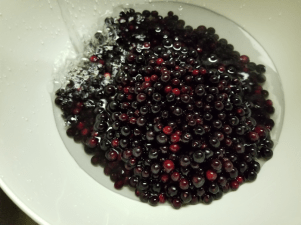
Chokecherry Vinegar20180802.washing.chokecherries
Soaking time: 24 hours
First boil: 5 minutes
Second boil: 2 minutes

5 cups chokecherries
1 2/3 cups vinegar
1 2/3 cups water
sugar

Wash and mash the berries.  Place them in a glass bowl (I mashed the washed berries in the bowl).

Combine vinegar and water.  Pour over the mashed berries.

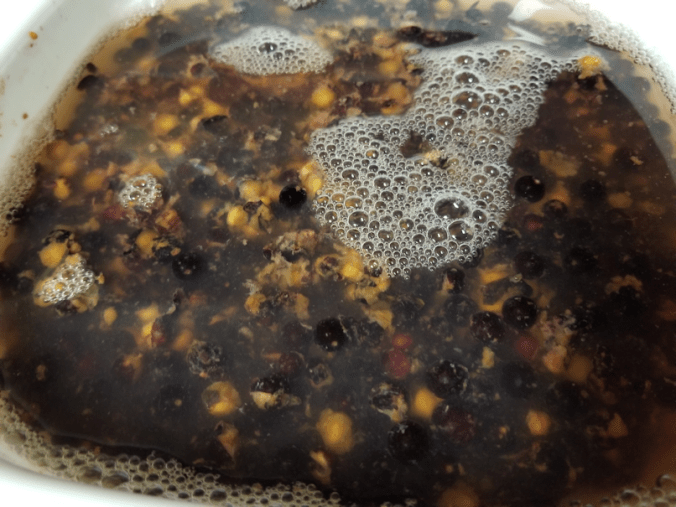
20180802.chokecherry.vinegar2

Vinegar and water solution poured over mashed chokecherries.

Let stand for 24 hours.

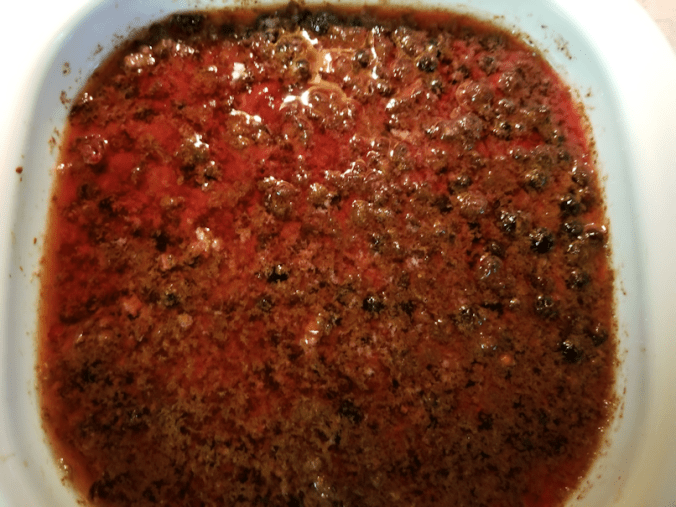
20180802.chokecherry.vinegar3

Chokecherry and vinegar mix, after 24 hours.

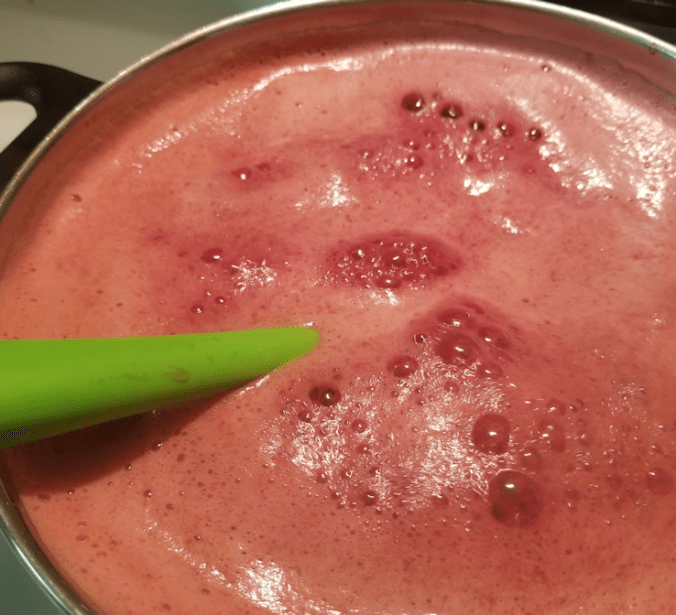
Place in a large saucepan and slowly bring to a boil.

20180802.chokecherry.vinegar4

Make sure to use a large enough pot to give the chokecherry mixture room to expand as it boils.

Boil for 5 minutes.

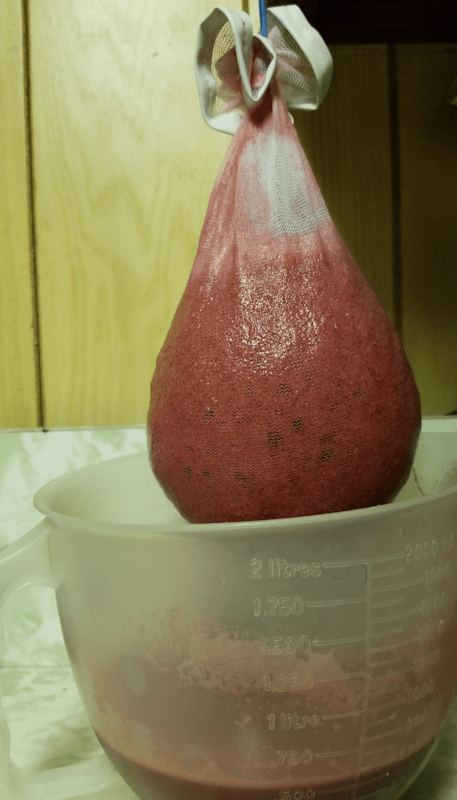
Strain through jelly bag.  Do not squeeze.

20180802.chokecherry.vinegar5

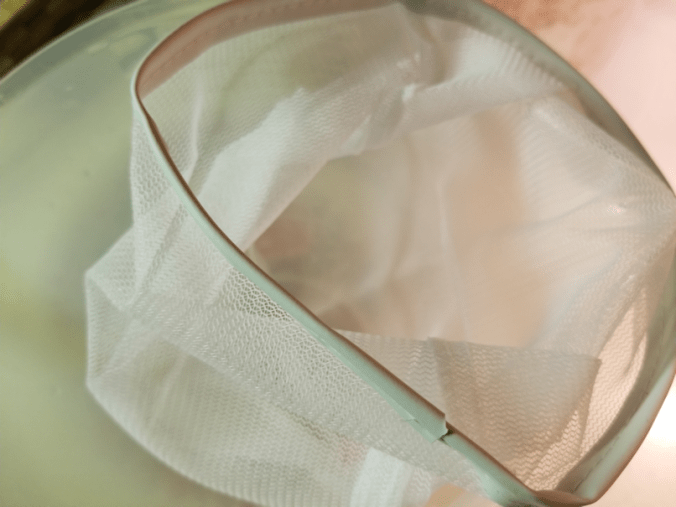
I placed a moistened jelly roll bag into a large measuring cup.  Layers of cheese cloth can be used instead.

20180802.chokecherry.vinegar6

I used an elastic band to close up the bag and hang it over the measuring cup.

Measure 1 cup of sugar for each cup of juice.

20180802.chokecherry.vinegar7

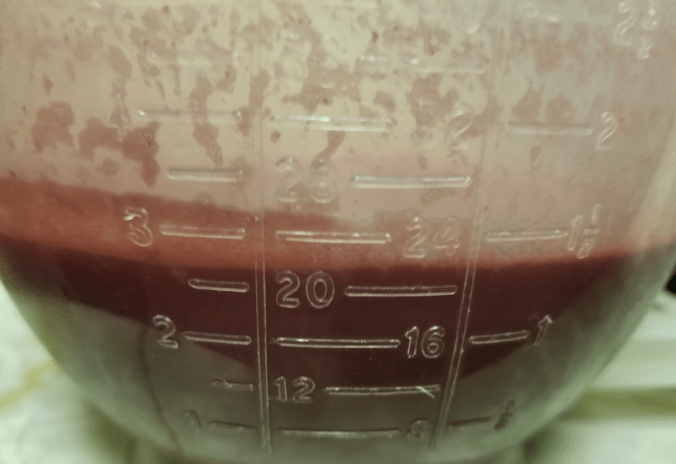
I got just under 3 cups of liquid from the 5 cups of berries.

Combine chokecherry liquid and sugar into a large saucepan.  Bring to a boil and boil for 2 minutes.

20180802.chokecherry.vinegar8

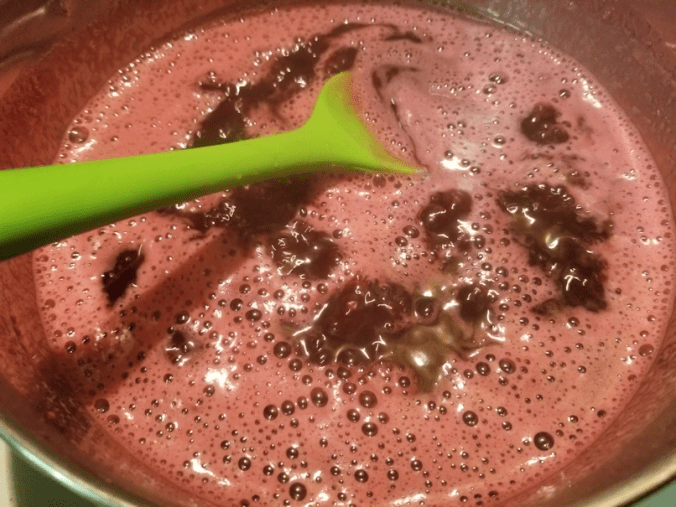
While boiling the berry liquid with the sugar, I could really smell the vinegar!

After boiling for 2 minutes, allow to settle.

Bottle, let cool, and refrigerate for up to 6 months.

20180802.chokecherry.vinegar9

I sterilized a quart jar and a small pitcher with a liquid tight seal to store the chokecherry vinegar.  The pitcher will be a gift for my mother.

To use: put ice in a glass.  Add 2-4 tablespoons of chokecherry vinegar.  Fill with water, club soda, ginger ale or sparkling water.

Enjoy!

The Re-Farmer

Flame Roasted Potatoes

I roasted potatoes in yesterday’s cookout, and I thought I’d share. :-D

To make these, you will need;

20180604.fire.roasted.potatoes1

  • Large potatoes (1 per person)
  • Butter and seasonings
  • heavy duty aluminum foil, pieces sized to wrap each potato in a double layer
  • fire

Start by thoroughly scrubbing the unpeeled potatoes, then stabbing them all over with a fork.

For the butter and seasoning, you can use plain butter, then add coarse salt (how we usually do it), or you can make a flavored butter using whatever 20180604.fire.roasted.potatoes2seasonings you like.  This time, I added paprika, fresh ground pink Himalayan salt and fresh ground pepper, dill and garlic powder.

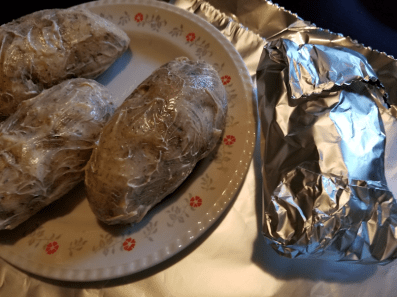
Generously cover the potatoes with the butter and seasonings.  Tightly wrap each potato in a double thickness of heavy duty aluminum foil.

Don’t skimp on the foil.  ;-)

Time to go outside!

Prep a small fire and let it burn down.  When you have a layer of coals, place the foil wrapped potatoes directly on top of the hot coals.

Build the fire up again on top of the potatoes.

Enjoy your fire for about an hour, letting it burn down to coals. Gently move the foil wrapped potatoes out of the coals and remove to a container that can handle high temperatures.

The time is completely a judgement call.  A lot depends on the size of the potatoes and how hot the fire gets.  You might want to try for 45 minutes the first time you do it, and adjust for the next cookout.

Because there will be another cookout! :-D

20180604.fire.roasted.potatoes7

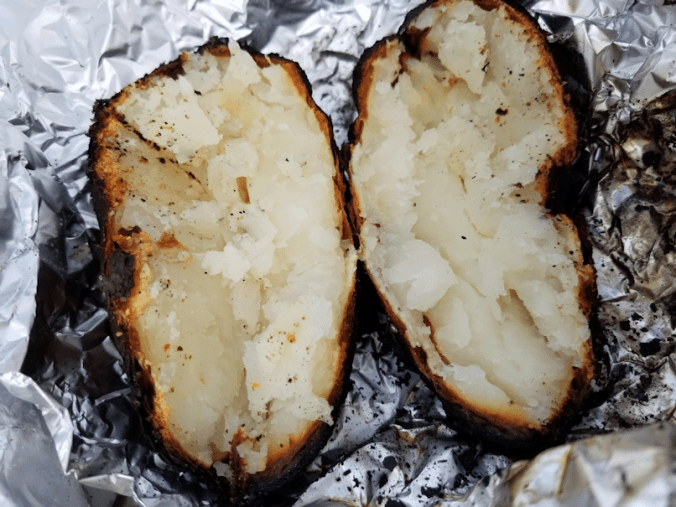
Carefully unwrap the foil (I used two forks) and cut a potato in half.

As you can see, this potato was VERY well done!  Which I’m okay with, as the skin serves as a bowl.

While the potato is cooling, roast some wieners over the fire.

20180604.fire.roasted.potatoes8

Add flavorings to taste.  I had some of the flavored butter used on the outside of the potatoes left, so I put some of that on one half, and sour cream on the other.  Then I used a fork to mix in the flavorings, in the skin “bowl”.

I think, the next time we do this, I’ll roast 2 potatoes per person instead of one!  It was SO good!

These can also be left to cool and eaten later.  Just unwrap and reheat in the microwave, or chop into cubes to use to make hash browns, or to make a potato salad.

Enjoy!  And please remember to exercise fire safety precautions, at all times.

The Re-Farmer

Black Olive and Chickpea Salad

This is one of my favourites; a hearty salad that I will sometimes have as a meal.

Today, it was made extra special, thanks to a care package a dear friend sent me – who knows me oh, so well!  It has been AGES since I’ve had truffle salt or truffle oil!  Not that I couldn’t find them; they’re just normally incredibly expensive.

20180430.care.package

Every now and then, though, they show up at Winners at affordable prices and, apparently, they had quite a variety of truffle products available!

And yes.  It’s always time for tea.

I have the best friends!

A few dashes of truffle oil and a sprinkle of truffle salt to my salad brought it to a whole new level!  It’s still delicious with just olive oil and regular salt, though. :-)

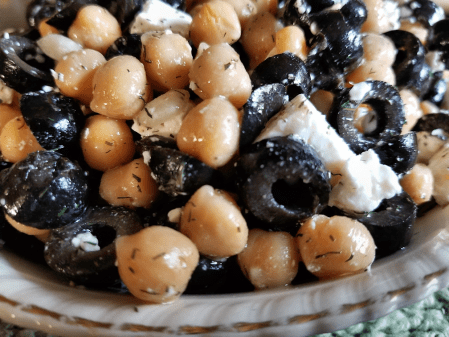
Black Olive and Chickpea Salad with FetaBlack Olive and Chickpea salad

Ingredients

1 can chickpeas, drained, rinsed
1 can black olives, whole or sliced
about 1/2 cup feta, cubed or crumbled
about 1/4 tsp dried dillweed or 1/2 tsp fresh
extra virgin olive oil
salt and pepper


  1. After draining and rinsing the chickpeas, shake off as much water as possible, or let them sit to drain more moisture out for a while.
  2. Combine chickpeas, black olives and feta into bowl medium bowl.
  3. Add dillweed, salt and pepper to taste, and enough olive oil to moisten.
  4. Stir or toss to combine thoroughly and serve.

Optional: use different types of salt (smoked salt is great!) or flavoured oil.

This can be made ahead and chilled in the refrigerator before serving.  I have no idea how long it’ll last in the fridge, because it disappears so quickly!

Garlic Soup

Well, I’ve gone from having an irritating cough to a full blown spring cold.

Ugh.

As I was sitting with my lemon tea, feeling awful, it occurred to me that I had all the ingredients to make garlic soup.

This is a recipe that my late mother-in-law shared with me, many years ago.  She told me that it was an old pioneer recipe that was especially made in the late winter/early spring, when everyone was getting low on energy.  This was a time of year when people’s stores of preserved food was probably starting to get low, too, so between the long winters, lack of sunlight, lack of vitamins, and nary a fresh vegetable to be seen, people were getting worn down.  This soup would be made and apparently resulted in a big boost of health and energy.

Oh, how blessed we are to be able to get fresh fruits and vegetables, any time of year!

I don’t know about it being a boost to energy, but garlic has long been known to help fight off colds and boost the immune system.

Plus, it’s easy and tasty.  What more can you ask?

Quantities are pretty loosey-goosey, so this is more general instructions than a recipe.  You will need:

garlic.soup.1

garlic cloves; about 5 per person (I used a whole head, just for myself)
butter (enough to brown the garlic)
milk (about a cup or two per person; I used 2 cups this time)
bread (1 slice per person – I used a thick slice of sourdough bread)
shredded cheese (cheddar or whatever kind you like; about 1/2 – 3/4 cup per person)
seasoning to taste (this time around, I used onion salt, pepper and a dash of paprika)

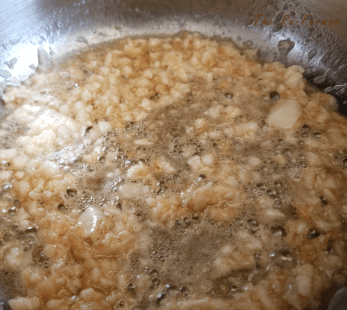
  1. Peel and prep the garlic.  It can be whole, crushed, chopped, minced or whatever you wish.  I like to pass it through a garlic press.  Then scrap all the bits stuck to the press into the pot, too.  Big pieces are not a problem, here! :-D
  2. Melt the butter on the bottom of a saucepan on medium heat.  Add the garlic and cook gently until transparent.
  3. Add the milk and heat until scalding.  Do not boil!garlic.soup.2
  4. Season as desired.
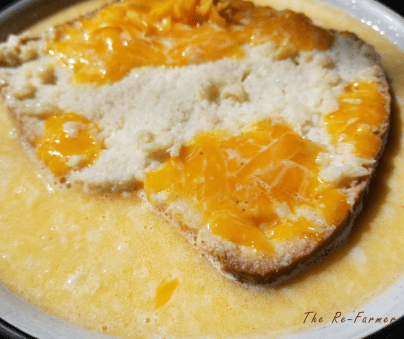
  5. Place a slice of bread on the bottom of a bowl.  Top with shredded cheese.garlic.soup.3
  6. Pour the hot soup over the bread and cheese.  garlic.soup.4
  7. Eat while as hot as you can handle it.

You can also give the bread time to soak up some soup, then break it apart and add more shredded cheese to the top.  I had to do that, just to be able to fit all the soup into the bowl. :-D

garlic.soup.text

Now that I’ve had my bowl of soup, I think I’m going to go back to bed.

The Re-Farmer

Overnight Sourdough Rye Bread

overnight.sourdough.rye.fresh.baked

Fresh out of the oven!

This is a bread that needs a LOT of time!  The finished result, with its tangy sourdough flavour, is well worth it.

Begin by preparing the starter the evening before.  We used our rye starter, The Rye of SourOn, but a regular starter can be used as well.

Overnight Sourdough Rye Bread

Overnight starter:
1 cup sourdough starter
2 cups warm water
2 1/2 cups rye flour

  1. Mix the ingredients in a large bowl.  Cover and let stand overnight in a warm place, such as the oven with the light on.overnight.sourdough.rye.sliced

Ingredients:

Overnight starter
1 cup milk
3 Tbsp butter
3 Tbsp sugar
2 tsp salt
1 Tbsp active dry yeast
1/4 cup warm water
3 cups rye flour, or 2 1/2 cups rye flour, 1/2 cup flax meal
3 – 5 cups all purpose flour
1/8 cup crushed sunflower seeds, to coat top of loaves (optional)
(place roasted, salted sunflower seeds into a slide lock freezer bag and crush with a rolling pin)

The night before: prepare overnight starter

The next morning:

  1. Pour the milk into a saucepan and scald.  Add the butter to melt, then stir in salt and sugar. Set aside to cool for about 10 minutes.
  2. Sprinkle yeast over warm water and let stand for about 5 minutes.
  3. Stir yeast and cooled milk mixture into the overnight starter.  Stir well.
  4. Mix in optional flax meal and rye flour.  Beat thoroughly until batter is smooth.
  5. Cover lightly and set in a warm, draft free place to rise until almost doubled in size; about 30-40 minutes.

    overnight.sourdough.rye.risen.loaves

    Shaped loaves after rising.

  6. Stir down dough.  Add all purpose flour, a little at a time, until a medium stiff dough begins to form.  Turn onto a floured surface and knead in more flour, as needed.  Continue kneading for another 8-10 minutes, or until soft and elastic.
  7. Divide dough in half, cover lightly and let rest for 10 minutes.
  8. Prepare baking sheet or loaf pans.
  9. Shape the dough into loaves.  Place crushed sunflower seeds onto kneading surface and press tops of the loaves into the seeds before placing on the baking sheet/into loaf pans.
  10. Cover lightly and let rise for about 1 hour in a warm, draft free place.
  11. Preheat oven to 375F.  Bake for about 45 minutes.  Note: if the bread is a golden brown at 30 minutes, tend with foil to prevent further browning.
  12. Place baked loaves on cooling racks.

overnight.sourdough.rye.sliced.title


Multi-Grain Bread

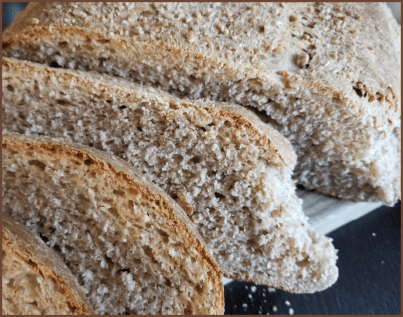
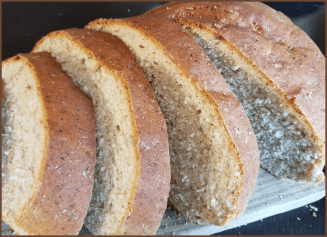
Today was a bread baking day.  For the past while, we’ve been making our basic multigrain.bread.slicedsourdough bread, but I felt like experimenting this time.  That’s one of the beauties of a good, basic bread recipe; it’s easy to modify and make interesting!
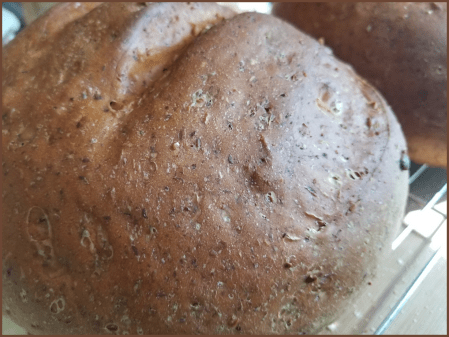
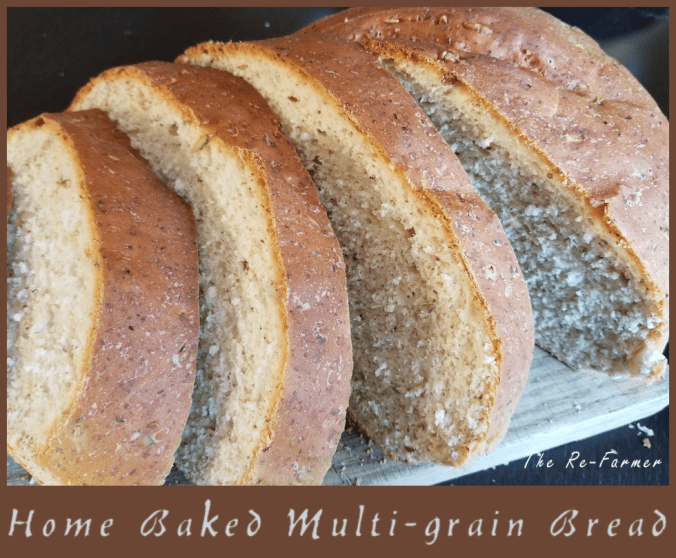
I actually did two different breads today, with an overnight sourdough rye that I will post the recipe for separately.  I started this one while the sourdough was having its first of 3 risings (not counting the overnight starter).  Even though the other one was started much earlier, this one was finished first!

Multi-Grain Breadmultigrain.bread.fresh.baked

Ingredients

1 Tbsp yeast
1/2 cup warm water
1 cup milk
1 cup water
3 Tbsp sugar
2 Tsp salt
1/4 cup butter
1/2 – 1 cup thick cut oatmeal
3/4 – 1 cup flax meal
3/4 – 1 cup rye
4 – 5 cups all purpose flour
1/4 cup pumpkin seeds, crushed*
1/8 cup sunflower seeds, crushed*

  1. Heat the water and milk together to scalding temperatures.  Add the butter to melt.  Pour into a large bowl, stir in sugar and salt, and let cool slightly.
  2. Sprinkle yeast over warm water and let soften for about 5 minutes.
  3. Add the oatmeal to the milk mixture to soften.  Stir in yeast.
  4. Mix in the flax meal, rye and enough all purpose flour to make about 3 cups total.  Beat thoroughly.   Mix in pumpkin and sunflower seeds.
  5. Add more flour, a little at a time, until a soft dough forms.  Turn onto floured surface and knead, adding more flour as needed, until dough is soft and pliable.
  6. Place into well oiled bowl, turning to coat all sides.  Cover and set in a warm, draft free place to rise until doubled; about 1 hour.
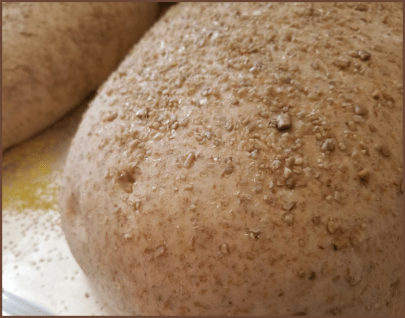
  7. Prepare baking sheet or loaf pans by oiling well.  Cornmeal can be added to the baking sheet as well.multigrain.bread.risen.loaves
  8. When doubled, punch down dough and turn onto lightly floured surface.  Knead lightly and divide into two pieces.  Form into loaves and place on prepared baking sheet or loaf pans.   Slash the tops of the loaves with a knife, if desired.
  9. Cover and let rise until loaves reach the top of the loaf pans, or about half an hour.
  10. Bake in oven preheated to 375F for about 40 minutes.
  11. Set loaves on racks to cool.  Lightly brush surface with oil for a softer crust.

*Hint: to crush the seeds, put them in a slide lock freezer bag, then use a heavy rolling pin to crush them to the desired amount.  I used roasted and salted seeds, but unsalted can also be used.

multigrain.bread.sliced.title


Basic Sourdough Rye Bread

The following is the Rogers Basic Rye Bread recipe, modified into a sourdough version.

We have never used lemon juice in bread baking before, but the packaging for our rye flour recommends it as a conditioner for no-additive flour.  In fact, the packaging is very enthusiastic about the use of lemon juice in bread baking! :-D

We did not use the optional caraway seeds.

This time around, I decided to use our pizza stone.  It’s been ages since I used it, and I wanted to see how it worked for bread baking.  The stone cannot be oiled, so the surface is dusted with only corn meal to prevent sticking.

Basic Sourdough Rye Breadsourdough.rye.prep

1/2 cup warm water
1 tsp molasses
1 Tbsp Yeast

  1. Dissolve yeast and honey in warm water and let stand for 10 minutes.

2 Tbsp molasses
1/4 cup vegetable oil
1 Tbsp salt
1 cup water
1 cup rye sourdough starter
1 Tbsp lemon juice
3 cups rye flour
2 1/2 – 3 1/2 cups all purpose flour

Optional: 1 Tbsp caraway seeds
Optional: egg wash (1 egg beaten in about 1 Tbsp water)

Note: honey can be used in place of molasses

  1. In a large bowl, mix molasses, oil, salt, optional seeds, warm water, lemon juice and starter.  Add the yeast mixture and mix well.
  2. Add the rye flour and beat with an electric mixer on low for 2 minutes, or by hand for about 200 strokes.
  3. Add all purpose flour by the half cup full until a stiff dough is formed.
  4. Turn the dough onto a floured surface and knead thoroughly, adding more flour as needed.  Knead for about 5 minutes, or until dough is smooth and elastic.
  5. Form the dough into a ball and place into a greased bowl, turning the dough to coat all sides with oil.  Cover and place in a warm spot to rise until doubled; about 1 – 2 hours.
  6. Punch down the dough and divide into two pieces for regular sized loves, or four pieces for mini loaves.
  7. Lightly knead and shape the pieces into loaves and place onto prepared baking pans.  Cover and let rise for about 20 minutes.  Score the loaves with a sharp knife.  Add optional egg wash.
  8. Place in centre rack of oven preheated to 350F.  Bake for about 40 – 45 minutes for regular sized loaves or about 25-30 minutes for mini-loaves.
  9. Allow finished loaves to cool on rack.

sourdough.rye.baked