At the time this scheduled post is published, I should be on the road, headed to court. Because I have to leave so early, I won’t be able to do my usual stuff in the garden until later, but I wanted to have something positive to start the day with!
So here is an evening harvest to share in the morning. 😊
I was checking on the ground cherries while doing my evening rounds when I noticed one that had ripened since I checked them this morning.
I ate it.
Then I started weeding and found several others that had ripened enough to fall to the ground.
I brought those in for the family to taste test. 😁 I know they’ve had them before, since we grew them in a container in the city, but when the first of my daughters tried one, she sounded really surprised when she commented on how good it was. Looks like I’ll be fighting over them, as they ripen! 😂
There were a couple of Magda squash I could have grabbed, but I left the smaller one to get a bit bigger.
I picked the red onions because they were starting to fall over. Though they look the same, the bigger one is a Red of Florence onion, while the other, smaller one, is a Tropeana Lunga.
The yellow onion is from sets. Somehow, a few Black Nebula carrot seeds ended up around the onion, so I pulled all of them. The carrots were just wisps, so I tried pulling the biggest one I could reach, and… well… that’s what you see in the picture. Really long, really skinny.
The pale yellow carrot is an Uzbek Golden carrot that we got as a freebie. The two orange ones are napoli carrots using seeds left over from last year. I tried pulling a Kyoto Red, too, but it turned out to be really tiny. There are so few of them, I didn’t want to try another.
The shallot is one of the “spare” sets we planted in the retaining wall blocks of the old kitchen garden. Sadly, we lost most of the shallots in the bed by the chain link fence. Though the bed was raised a few inches when we added the bricks around it, it wasn’t enough at one end. There was just too much flooding this spring, and they rotted out. The ones planted in the retaining wall blocks aren’t doing much better, but that probably has more to do with cats rolling on them. The one I picked had lost most of its greens, so I decided to pick it before it started going soft. The other that was planted with it had lost all its greens and had gone mushy.
A nice little variety of things to try! Still lots of growing to do, though. 🥕🧅
With a steady rain all night, we’ve got a lot of standing water and mud in the yard again. The straw mulch where we will be planting our 5kg bags of potatoes got well soaked, though, so I don’t mind.
This afternoon, I finally had a chance to work on the garden again, and I’ve got some thing figured out, too.
The spinach sown in the high raised bed has started to sprout. There was room for one more row of spinach, so that got planted today.
Then it was time to work on the low raised beds.
We are well behind on direct sowing our cool weather crops, so I focused on the 2 1/2 low raised beds that my daughter and I had gone through, pulling out as many roots and rhizomes as we could. A few that we missed started growing again (there will always be some of those!), so I pulled out some more, before leveling the beds out. I decided to use the stove pellets as mulch for these beds. After leveling the soil in one bed (the back of a fan rake is great for leveling the soil), I’d scatter some pellets as evenly as I could over the bed, soak them with the hose, then work on the next bed. It generally took about 3 soaks before the pellets had expanded and broken up enough to be spread evenly with the back of the rake.
It always surprises me just how much sawdust is packed into those tiny pellets!
Once those were done, I gave them one last spray with the hose, then moved on to what will be a deep mulch bed for the 1kg package of potatoes. We had considered planting those in the low raised bed by the compost heap, but have decided the kulli corn will go in there. It’ll be easier for us to put a barrier around the wooden frame to keep the critters out. Potatoes need no such barrier.
In our second summer here, we started preparing an area for future gardening by mulching the area heavily with straw, and trying to kill off as many weeds as possible. You can read about those preparations here, here, here, and here.
Yeah. It was a big job, spread over months.
The next summer, we had our first garden, and all along the north side, we planted a row of birdhouse gourds. We’d started them indoors, but I thought our last frost date was May 28, the same as a town to the east of us, only for us to get hit with a frost on June 2 – which was the last frost date for a town to the north of us (our own little hamlet is too small to be on any of the frost date lists). The gourds didn’t really survive, and since then, this particular area has not been planted in.
The straw you see raked aside in the above photo has been there for 4 years.
The area was still mostly clear of crab grass, though I spent some time pulling those out. With the straw layer, the rhizomes tended to be running across the surface of the soil, so that made it easier to get them.
I knew we had a few moving boxes left in the basement. I thought there was three left, so I cleared an area to roughly match how much I thought those three boxes, opened flat in a single layer, would cover.
I was wrong.
There was 5 boxes left, so I laid them down folded in half, to get a double thick layer. This should be more than enough for the smaller amount of potatoes.
After soaking the cardboard, I put most of the old, wet straw back, then topped it with some newer straw to get a good, thick later.
This bed is now ready for potato planting.
While I was working on this, the girls got the fire pit going, and I finished just in time for a wiener roast. :-D
We’ve used that fire pit in the past month, almost than we’ve been able to in the past 4 years. No fire bans, this spring!
After the girls made sure I was fueled up, it was back to the low raised beds. Time to do some planting!
Look how big that garlic is!! They are just thriving, here.
For this half-bed, I marked out a grid, but planted in rectangular boxes. I started with some spinach – a variety called Space – planted around the middle of the bed. There are still some seeds of this spinach variety left, if we want to sow some for a fall harvest.
One those were in, the outer perimeter, I planted some onions. These are Red of Florence; the last of the onions we started from seed.
The centre of the bed was left empty. Later on, we’ll put in plants that we won’t be harvesting leaves from, or harvesting many times. Perhaps we’ll put some eggplants or peppers in the middle. There’s room for only a few plants in this half-bed.
There will be more room in the next bed.
The centre row was marked, but nothing is planted in it. On one side of the centre line, a third variety of spinach, Lakeside, was sown. On the other side, Tokyo Silky Sweet turnips were planted. Then, all around the perimeter the last of the Red of Florence onions were planted.
The onions being planted around the perimeter like this is to dissuade critters at least a bit. That is not our first defense, though.
These will be covered with netting. I’m not sure the bamboo stakes will hold those hoops very well, though. Trying to push them into the ground, I kept hitting rocks. In one spot, right at a corner, I just couldn’t get around a rock, so that one is more shallow than I would prefer. A couple of stakes broke while I was trying to push them into the ground. Since I couldn’t get them very deep, I ended up having to break the tops off of the rest, to be able to put the hoops on them.
Later, bamboo poles will be tied to the centre of the hoops to hold them steady and hold up the netting when it’s added on. Not until after something has been transplanted in the middle.
For the long bed, I grabbed pieces from the canopy tent that was dismantled. Those were easier to pound into the soil. Literally. I had a piece of would I could use as a mallet, and got them in pretty deep.
With the logs bordering the bed, the supports aren’t spaced very well. For the ones in the middle, most had to be squeezed into the spaces between logs. Which is fine. After something is transplanted in the middle, cord will be strung through the holes in the supports around the perimeter, then criss crossing across the middle to support the netting. With them so oddly spaced, it’ll be wonky, but it’ll work.
The ground staples will be used to tack the net down , but we still want to be able to easily life the sides, to harvest greens as needed.
The third bed was left for tomorrow. We have 2 more varieties of turnips to plant, or I might do carrots, first. They should have been sown about a week or more ago!
Beds will continue to be bordered by onions from sets. I’ve got 2 boxes of yellow onions and one of red onions, so there is plenty to go! :-)
The other thing that really needs to get done are the two varieties of peas. Hopefully, it won’t get too hot for peas over the next while! Meanwhile, we need to get those potatoes into the ground.
The next few weeks are going to be very busy in the garden! Lots to go in, in a very short time.
One of the first things I do in the morning is check on the seedlings, turn on the lights, and do any tending they might need.
The newly transplanted and potted up plants seem to be doing very well – with one possible exception.
The Wonderberry we have left from the first planting is just too big for the top of the mini greenhouse.
I mean, look at this beast! It’s getting huge!
And what’s that I see???
Yup. Those are flower buds!!
I planted these really early, after doing some online research, but it seems it was too early.
So what do I do with the poor thing? We can’t leave it out, or the cats will destroy it.
The only safe place for it is in the sun room.
Except…
Yeah. It’s too big for the shelve space, too.
There was only one thing left to do.
I now have it sitting in the window on the other side of the door, which is a pair of smaller windows with a shelf in between. It’s actually a great spot for a plant like this. The problem is mostly the temperature, though it also gets less light. In the other shelf, there is at least the lights provide a bit of warmth. This spot is too far away for that to be any help.
I don’t think the sun room dipped below freezing last night. When I first looked in, in the morning, it was at about 8C/46F, but I expect it to get above 20C/68F in there as the day warms up. However, we’re supposed to start cooking down again, with a high of -5C/23F by Thursday – and more snow on Wednesday, Thursday and Friday. The Southern parts of the province are even getting weather alerts, as a Colorado Low swoops in, potentially bringing as much as 20cm/8in of snow. That, in turn, is leading to flooding alerts in regions to the North.
None of which is anywhere near us, but we’ll still be affected by the system with cooler temperatures and more snow.
At least the current warm weather is reducing the amount of snow we have now, so if we do end up with more, it’s not going to be as much of an issue.
The receding snow is starting to reveal that we are going to be picking up quite a lot of fairly large branches, once we’re able to do the spring yard cleanup.
The new beds along the chain link fence are now clear of snow, including the asparagus bed. Which, unfortunately, has a lot of grass and weeds already starting to grow. There’s less than half an inch of thawed soil on the top, but that’s enough for the weeds.
There was a surprise, though.
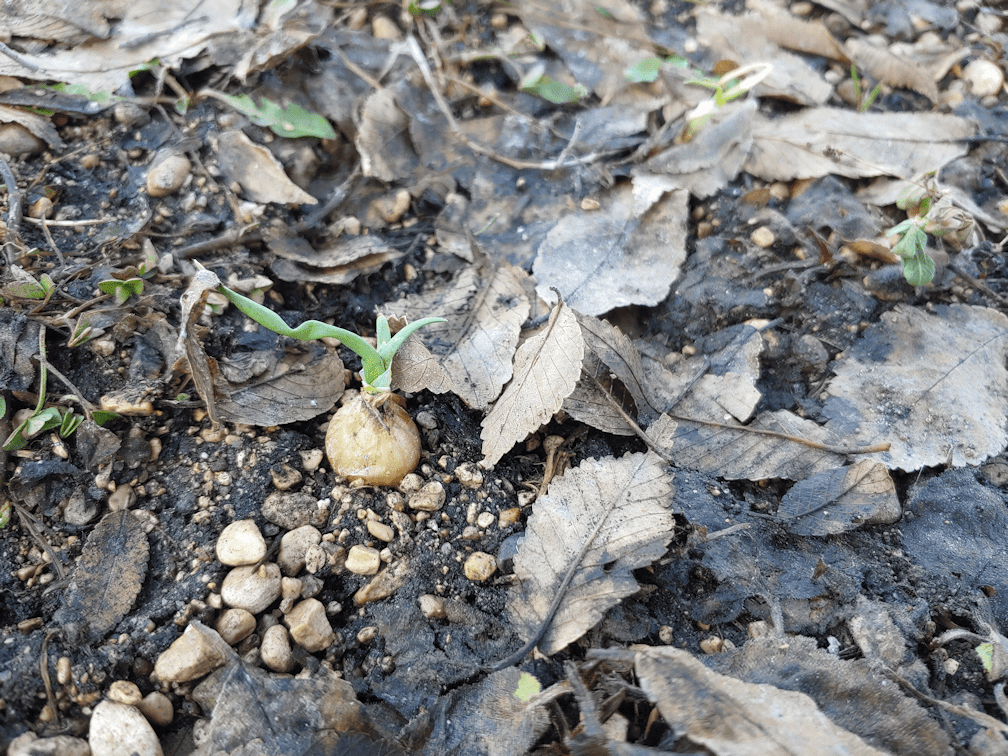
There are onions growing!
We had transplanted the tiniest of seedlings around the asparagus bed last year, mostly because I didn’t want to toss them. They established themselves, but hardly grew at all, and we just left them. Even when cleaning up in the fall, we just let them be.
I found about 8 or 10 of them, starting to grow!
It should be interesting to see how they do. As this would be their second year, if we leave them, they should go to seed.
Speaking of onions and seeds, the seedlings we moved to the sun room seem to be doing rather well.
In fact, I think they’re actually perking up and getting stronger. Well. Maybe not the shallots. It’s really hard to tell with what’s left of those! But the red and yellow onions seem to be getting bigger and stronger.
We might have something to transplant, after all!
I might still get sets, though. In this household, we just can’t really have too many onions! :-D
Last might, my daughter and I moved some seedlings around.
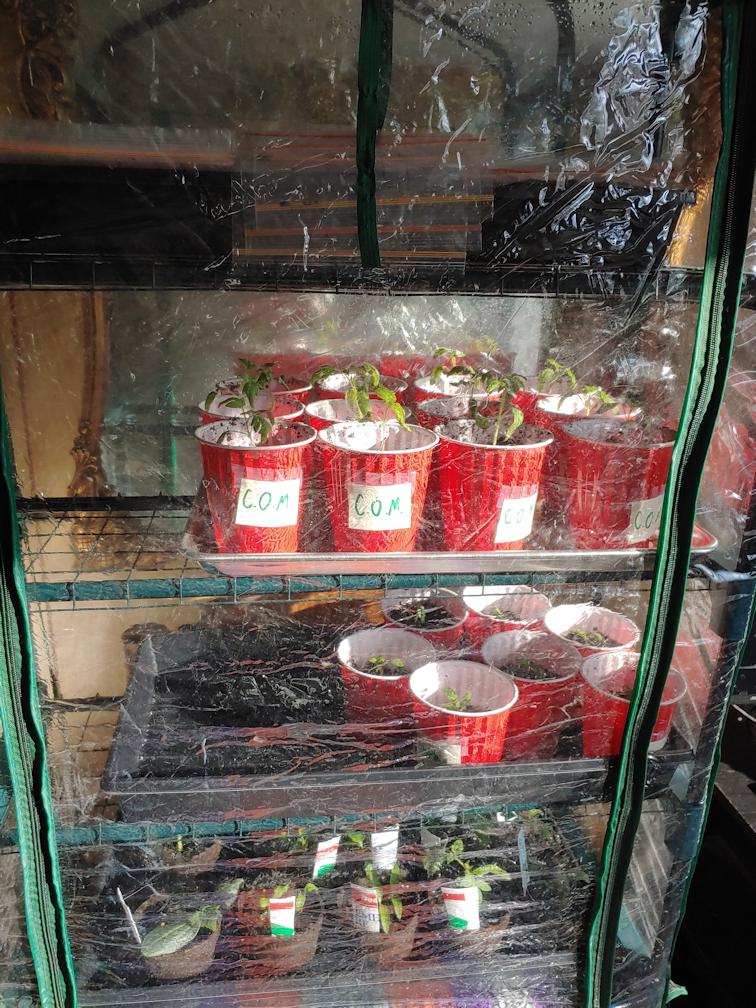
The tray from the big aquarium greenhouse is now on the bottom shelf of the mini-greenhouse. The Cup of Moldova tomatoes in particular, were getting so big, they were getting too close to the lights. Plus, they really needed to be off the heat mat.
The bottom three shelves of the mini-greenhouse get direct sunlight in the mornings, so the tray with the tree seeds got moved to the top shelf, which gets no direct sunlight at all. The downside with this set up is that we no longer have a way to provide artificial light, so we’ll have to keep an eye on them, and rotate the trays as needed.
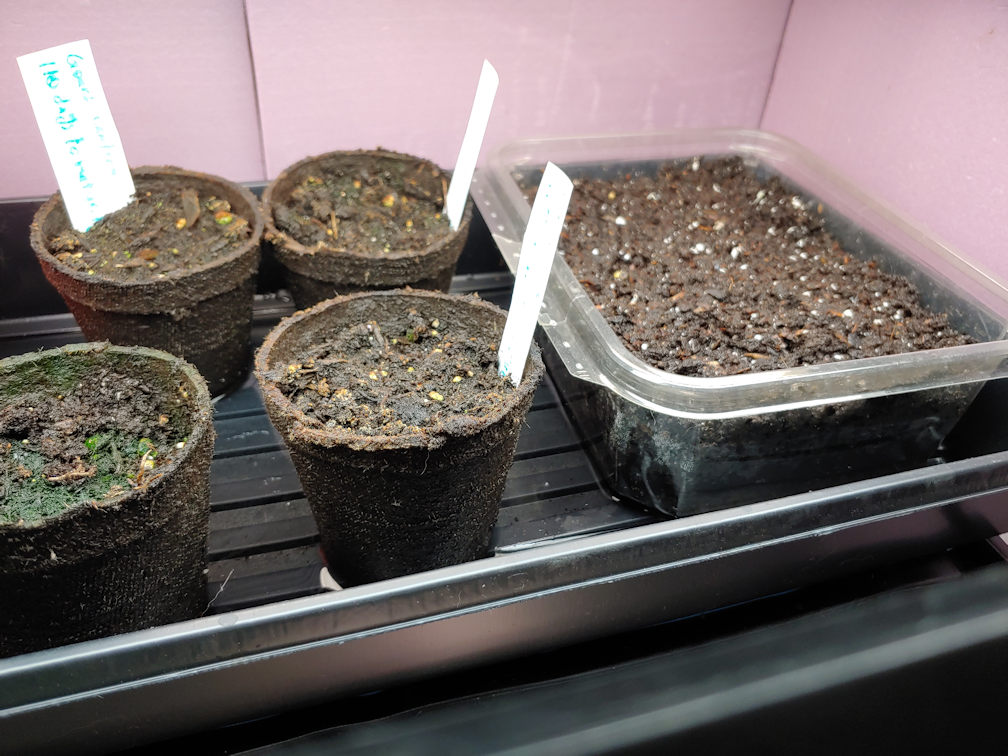
The pots with gourd seeds that did not germinate yet (including the one with just leaf starting to show along the side) got transferred to a new tray and remain on the heat mat. There is still only one Wonderberry sprout, so I took the outer cups off and put them in with the remaining gourd pots. Hopefully, the added warmth will help with those. I also transferred the shallots tray under the lights. There are two tiny sprouts showing!
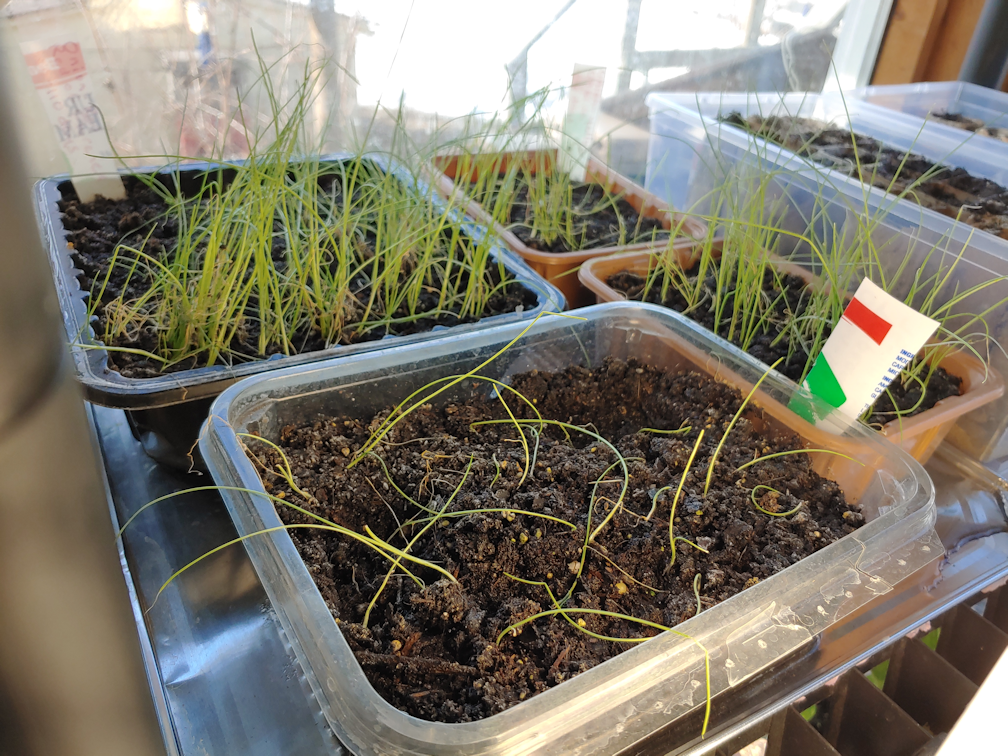
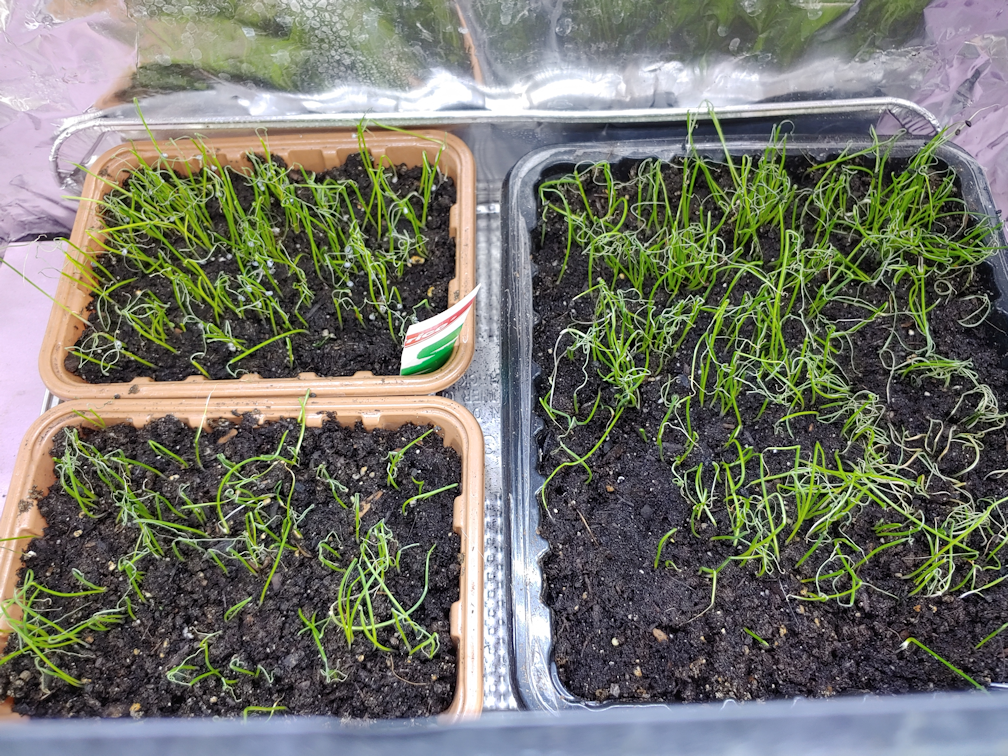
I’m a bit perplexed over the bulb onions, in the small tank. They all seem to have dried tips. Especially the ones in the larger tray, where one entire spot of seedlings seems to be drying up. In one tray, most of the tips still have their seed cases on them, but the ones that don’t, have the dried tips. I’ve lowered the whole thing, so they’re not as close to the light, though I don’t see how this light could be the problem.
Any onion growers that have experienced this? Last year, we did have the one type that survived to be transplanted, and I don’t remember having issues like this at all, though it was in the other tank. I’m making sure the soil is hydrated, but not too wet, and the light on this tank isn’t as bright as the others, nor does it get as warm as one of the light fixtures on the big tank, so they’re not getting “burned”. We also put a fan on the tank, for air circulation and to help keep the seedlings from getting too leggy. We have just the one little fan, so it gets alternated between the two tanks.
As long as they keep growing, I’m not too worried. Eventually, they’ll be getting hair cuts, anyhow. But if they all start shrivelling away, I’d like to know why! We used all the seeds in the packets in these trays, so it’s not like we can start over, either.
First, to follow up on my previous post, I was able to get my mother’s car started. I left it to run for a bit before moving it to the other part of the garage – and plugging it back in again!
While it was running, I decided to use the time to dig out another cat path.
Because I’m a suck that way.
This is a path to a shed that’s slowly collapsing, and is in view of the security camera live feed. I constantly see the cats struggling through the snow to get through. I got about 3/4s of it dug out before moving the car, then finished it almost the rest of the way.
I left the shovel at the end for scale. There’s probably about 2 inches or so of snow on the ground.
I didn’t dig any further, because I know there are things buried underneath, and the snow level starts to drop there, anyhow. It was actually an easy dig. Once I broke through the harder packed top layer of snow, the snow under it was very loose and crystalline, making it light and easy to shovel.
I had closed up the doors to the garage, and the doors where my mother’s car normally gets parked have a old tire in front, to keep them from opening (I really hope we can replace those doors this summer!). The tire warms up nicely in the sun, so it’s a favourite spot for cats to hang out, out of the snow.
Potato Beetle was sitting on it as I started my way back, so I paused to pet him, immediately noticing what looked like fresh blood in the fur in an ear! It took me a while to find it, but he has what looks like a fresh wound on the side of his neck. All I could really see was a dark patch in his fur. It wasn’t actively bleeding, and I couldn’t look too closely, but I am concerned.
Potato Beetle seems to now be at the bottom of the pecking order, and a target. After talking about it with the family, I turned the power bar back on in the sun room, for the light, heat bulb and heated water bowl. There is still food in there, and I’d been letting cats in while doing my rounds, to nibble on it. Potato Beetle has been the one that tends to go in there the longest. He was born in there, so he’s very comfortable with the sun room.
One of my daughters has brought in a litter pan, and we’ve set the box nests up again. Now, we just have to find him again. We will bring him into the sun room for his own protection, and to hopefully get a better look at the wound.
Spring cannot come soon enough. Potato Beetle is on the adoption list, but the outside cats aren’t going to be done until the inside cats are adopted out.
As I am writing this, I can see cat after cat on the security camera live feed, using the path I dug out!
Let us now think of spring, and green and growing things.
Like onions!
This is the tray that first starting showing sprouts, but only now are they big enough to actually show in a photo. I got mixed up about which onions these were. These are the Red of Florence onions, not the yellow bulb onions I got in my head for some reason. I mean, it’s not like we forgot to label them or anything! LOL
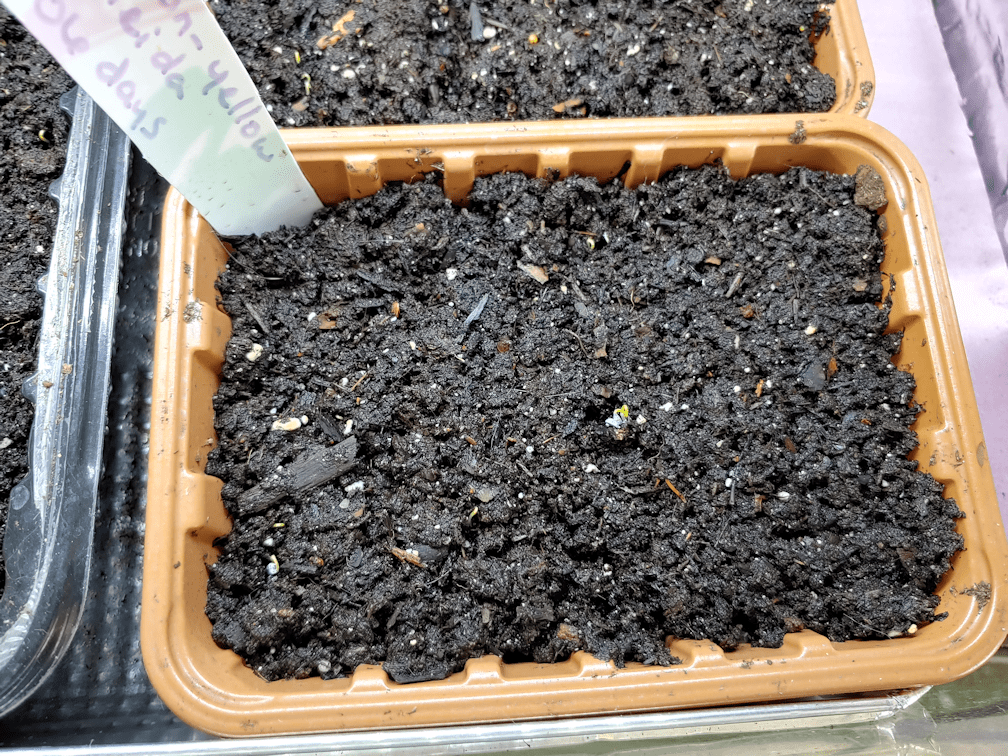
Just this morning, we finally saw sprouts in the other two trays. Here, you can see a little clump of Oneida onions sprouting in the middle, and a couple more little sprouts in the bottom left corner.
It’s really hard to spot the sprouting Tropeana Lunga in this tray. Again, bottom left corner of the tray.
You can even see an Oneida sprout near the edge of the other tray.
I must say, having things sprouting right now is a huge psychological boost!
Having said that, I just got some messages from people I was going to meet at the grocery store this evening, and it’s just been cancelled, due to the blizzard conditions we are supposed to have by then.
So it looks like I’ll either be driving in now, or waiting until Sunday.
I needed some garden therapy today, so I got some onion seeds started.
We have seeds for 3 types of bulb onions, 1 of shallots and 1 of bunching onions. Today, I focused on the bulb onions.
Last year, we planted our alliums in Jiffy Pellets, repurposed K-cups and cardboard flats from eggs (don’t use those. They suck. Literally. The cardboard sucked all the moisture out of the growing medium!) before finally using doubled Red Solo cups to try and make up for losses.
This year, we’re doing things very differently. I’m going to try bulk sowing. Here are a couple of videos about that.
This next video shows the transplanting.
Obviously, we are in a much colder zone than he is, so I’m adjusting accordingly.
We already had our small aquarium greenhouse prepped. The first thing I needed to do was see how many seeds we had of each type.
The Red of Florence had the most seeds in its packet. The grey seeds from Veseys are Oneida, a yellow onion. The fewest are the rarer Tropeana Lunga which, like the Red of Florence, are an elongated red onion.
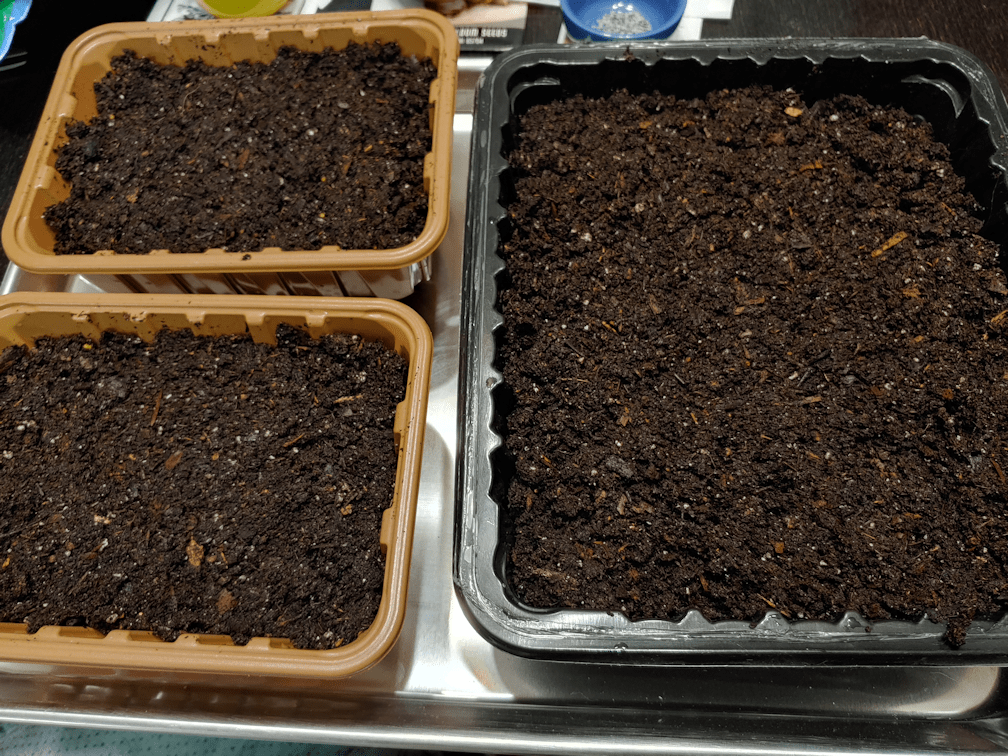
We are using re-purposed trays from the grocery store this year. The smaller ones were from mushrooms. I think the big one was from ground beef. We’ve had it for a while, so I can’t quite remember.
They got a good cleaning, and drainage holes were punched into the bottoms, then they were set into a baking pan.
They were filled with pre-moistened seed starting mix; I just dumped the remains of a bag into my largest mixing bowl and mixed in warmish water until it was evenly damp. Onions don’t need things as warm as other seeds, so no heat mat needed, but our house is on the cold side. I figured slightly warmer water would not go amiss.
The seed starting mix was pressed down just enough to make sure there would be no air pockets.
Then it was time to scatter the seeds.
Gosh, it feels so weird to sow them this densely!
I like that the grey seeds of the Oneida are so nice and visible. :-)
The seeds got a very fine misting at this point.
Then they were topped with about a quarter inch of seed starting mix, again gently pressing to get rid of air gaps. The tops got another misting, and water was added to the baking tray and left to be absorbed, while I cleaned up.
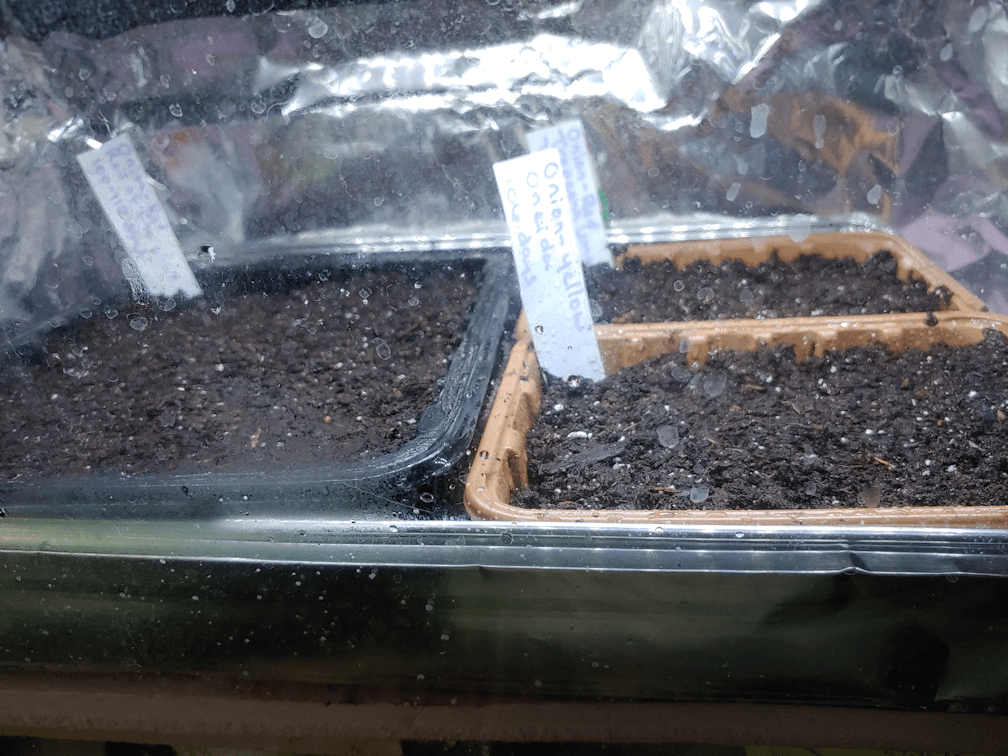
Finally, they went into the small aquarium greenhouse. The three trays fit perfectly in the oven liner tray folded into the bottom. More water was added to the oven liner tray, to water from below.
This tank has aluminum foil around the sides because the light we have for the tank is not as bright as on the big tank, and all that reflective light will help keep them from getting leggy. At least, that’s the theory!
This leaves the shallots to start next. Their days to maturity is a bit shorter than for the bulb onions. The Red Baron bunching onions need only 60-65 days to maturity, so they can be started much later.
I’m not sure how we’re going to be able to work it with the shallots, as far as space in the aquarium greenhouses goes. We’ve got some time to figure it out before they need to be started, but not much.
As for the other seeds we have in the big aquarium greenhouse, they seem to be doing fine, so far. Nothing has germinated yet, of course, so it’s too early to tell if the heat mat is making a difference. We just keep checking and adding water to the tray and misting the tops, as needed. The tray over the mat has been needing refills regularly, but today is the first time I added more water to the outer cups of the Wonderberry.
We need to get the rest of those Cup of Moldova tomato seeds started, since we want to grow a lot more of the paste tomatoes. I’ll likely start those using the doubled Red Solo cups, though we’d have to find a cat safe place to move the aloe vera pots, to make room for more seed starts. Which is a shame, because they are doing so well under the lights of the tank! So are my daughter’s orchids, one of which is blooming very enthusiastically right now, but we should be able to leave those in the tank until it gets warm enough to safely hand them in front of a window again. The aloe, however… the cats just love digging them up! :-(
Ah, well. We’ll figure it out. The main thing is that the bulb onions are started.
Plus, garden therapy was done its job. I’m feeling much more positive, now. :-)











 The Re-Farmer