Today, I finally got around to starting our onion seeds.
Usually, I start onions by densely sowing them in trays. Onion roots can handle quite a bit of abuse. When it’s time to transplant, I just pull them apart as I go. The problem with that, is, the roots do get pretty tangled together, and there have been times when I’ve even had to use water to wash away the growing medium in order to get individual seedlings out.
This time, I wanted to try something different.
I’ve been seeing the “seed snail” method that got me curious. Basically, seed starting mix it laid out on a strip of something – plastic, cardboard, paper towel, etc. – and rolled up. Seeds are planted at depth at the top, covered with more seed starting mix, and it’s done. When it’s time to transplant, the roll is undone and there is less root disturbance when accessing the plants. If the plants need to be “potted up”, it can be unrolled, more starting mix added, then rolled back up again.
In looking it up more, I see people using this method for pretty much everything, including things with very large seeds that grow pretty big. I’m not so sure the method lives up to the hype for larger things in particular, but something like onions? It seems perfect.
The thing that I was most curious about was, the material used to make the roll. One article I read, which was not positive towards the method, used paper towel. I can’t imagine using something that practically dissolves in water, over time! Others described using heavy paper or cardboard. I don’t really have anything like that, in the size and shape needed. I’ve also found that using paper products tends to wick moisture out of the growing medium, away from the plants, and need more watering. Even with the biodegradable pots, I’ve found the pots themselves need to be kept wet, or they start drawing moisture away from the plants.
One thing mentioned as working well was the thin foam sheets used to wrap breakables for packing.
Did I still have some?
I quick look in a storage bin in the root cellar, and I found I had plenty!
So that’s what I used.
Before I started on that, though, I prepped the last of my seed starting mix from last year. It had quite a lot of pieces of wood and such, which would be more of a problem with a seed snail. I wanted to sift it, but didn’t have a sifter. In the end, I used a metal colander with finer holes all over, and sifted it into a giant mixing bowl.
I got quite a bit of larger material out. I also had some concern that I might not have enough sifted started mix for the project.
I had four seed options. There were our own saved seed, which is a mix of red and yellow bulb onions. Then there were the seeds I got from MI Gardener. Red Long of Tropea, which are very much like the Tropeana Longa onions we’ve successfully grown before. Red Wethersfield, which we tried but did NOT successfully grow before, and Red Beard Bunching onion.
I was at first thinking to do the bunching onions later, but they are 110 days to maturity, while the other two are 100 days to maturity, so I prepped four strips. I taped shorter pieced together for the length, then folded and cut them in half lengthwise. That resulted in two strips of about 31 inches, and two of about 29 inches long, and about 6″ wide.
That sifted seed starting mix was absolutely beautiful to work with! So soft and fluffy!
Each strip got a layer of starting mix about a quarter inch thick, laid out right to the edge of one end and the bottom. The top had about an inch empty, and the other end had about 8″ empty. I had my work surface covered with a repurposed clear garbage bag, which actually made it easier to roll them up. I could lift the plastic up against the base of the snail, to keep starter mix from falling out.
I prepped masking tape ahead of time. Four were labelled. After rolling up the snails, I used a black piece of tape to hold it together near the bottom, before tucking it into a bin. After they were all rolled, I sowed the seeds and added the labelled strips of tape to hold it together near the tops.
In the first picture here, the seeds are sown, more seed starting mix was set on top and every so gently tamped down to get rid of any air gaps. In the next picture, they’ve been topped with vermiculate.
Once topped with vermiculate, they got a very thorough watering with a spray bottle, then more water was added to the bottom of the bin they’re in, so they can be watered through capillary action, too. Last of all, the bin’s lid was laid on top to act as a moisture dome.
This was all done in our basement dungeon. I don’t have any of the grow lights, the heat mat, trays, etc. ready. I won’t need them for quite some time yet. So these went upstairs to the cat free zone (aka: the living room). It’s not particularly warm there, but warm enough. Plus, the window gets full sun only for a few hours in the morning, so we have supplementary light above.
It should be interesting to see how this method works out.
In the past, when densely sowing seeds in trays, I would usually finish off the package. This time, there are seeds left in all three packets – plus there is lots of our saved seed. So there is the possibility of trying again, if this doesn’t work, as long as they get started early enough.
Anyhow. The main thing for now is, the onion seeds are started!
For the next while, I’ll be going through my old posts and videos about our 2024 garden, looking at how things worked out, and use that information to decide what we will do in our 2025 garden.
These are some things that turned out pretty different from our plans. Especially the tomatoes!
I’ll start, however, with the alliums.
Garlic, onions and shallots – how it started
The garlic, of course, was planted in the fall. They went where I had the space prepared and available, which was the old kitchen garden. The long, narrow bed along the chimney block retaining wall was filled, as well as the tiny raised bed along the south side. The short section of the L shaped wattle weave bed was filled, and the last cloved were planted down the centre of the larger rectangular bed, which still had tomatoes growing in it.
With all of these, I tried to plant the cloves a fair distance away from the walls of the beds. In planting garlic in raised beds previously, most of them disappeared, while the ones planted in ground in the main garden area did really well. My conclusion is that the ones in the raised beds simply froze. Even though they were well mulched on top, there was nothing extra insulating them around the sides.
The onions and shallots were started early, indoors. The yellow bulb onions were a variety called Frontier, which was new to us, along with a new variety of shallots called Creme Brulee. For red onions, we were going to try Red Wethersfield again.
With the seedlings, the onions and shallots did well, though the Red Wethersfield onions had a rougher time of it. In the end, though, we did have quite a few seedlings to transplant.
How it went
Hit and miss.
As with everything else, the garlic was delayed. In fact, it was so long before they broke ground that I started to fear we’d lost them all. As the season progressed, however, they did very well, and we got to enjoy plenty of garlic scapes when they finally appeared!
For the onions, I try to interplant them with other things in hopes that they will deter deer and other critters from eating the things they are planted with, or in some cases, just to fill in gaps.
With fewer Red Wethersfield seedlings, I tried transplanting them among the tomatoes in the old kitchen garden, then spread the last of the seedlings in the wattle weave bed.
The yellow onions were interplanted with tomatoes in the main garden area, before the last of them went into one of the newly shifted beds, filling a little more than half of it.
For some reason, I got it in my head that the Red Wethersfield were interplanted with the sweet peppers in the high raised bed. Those were the shallots. The last few shallots went into the same bed as the last of the yellow onions. I planted them at the far end of the bed, with a space in between, so there would be no confusions over what was where, with the space in between getting direct sown with summer squash.
The unexpected surprise, however, was all the onions we found while shifting and cleaning up various beds.
While reworking the long bed at the chain link fence, I found a number of onions that survived the winter. Those got transplanted to one of the low raised beds in the East yard.
As we were weeding and eventually shifting the beds in the main garden area, we ended up finding a lot of Red Wethersfield onions we’d planted the previous year, around the Roma VF tomatoes, that just disappeared. We assumed they all died.
In weeding and shifting the other beds, more surviving onions were found, and even a couple of shallots. All of these got transplanted into the newest low raised bed, where most of the Summer of Melons were transplanted. As onions are biannual, I was very excited by this, as it meant they would be going to seed, which we could collect for next year, instead of buying more.
All of these transplanted onions took and most of them did very well. We found ourselves with many onions blooming.
How the harvest went
More hit and miss!
With the onions that were allowed to go to seed, we found ourselves with many, many flower clusters. They bloomed and bloomed and bloomed!
They bloomed for so long, I wasn’t sure we’d get any finishing their cycle so we could have seed to collect! I did end up being able to collect quite a few flower clusters that had dried on their stems and set them to continue drying out in the cat free zone. I collected the last of them, some of which were still rather green, and set them to dry in the cat free zone, after we had our first frost, which onions can handle.
Every flower in those seeds heads have three seeds in them.
We got quite a lot of seeds, just from the first batch harvested. The second batch took longer to dry out, but they eventually did, and I was able to separate out the seeds. Which meant I have seeds from yellow bulb onions from previous years (Oneida, I believe), Red Wethersfield onions, plus some shallots from previous years (I can’t remember the names of the varieties we tried before, just now), all mixed together!
The Red Wethersfield onions we planted this year, though, were a complete loss.
The cats killed them.
The yard cats just love the garden beds in the old kitchen. They loved to go in between the tomatoes in the larger rectangular bed and just chill, or they would roll around luxuriously – all over the onions! Even when I tried sticking plastic forks into the soil beside them, hoping the tines would deter the cats, they just squeezed in between them and rolled around, anyhow. When I finally cleaned up that bed at the end of the season, I did find a few tiny survivors, though. I saved them, and they can be transplanted in the spring.
The yellow bulb onions and the shallots that shared the bed with them also had cat issues! They actually grew quite well, and we did get a couple of decent sized bulbs out of them. Those where the ones that didn’t get rolled on by cats! At least, not right away. We simply could not keep the cats off that bed, and they really, really liked to lie on the onions or roll in the soil. They didn’t kill the onions, but broke the stems, which meant the bulbs could not grow any bigger.
The shallots had cats rolling on them, too, but they had the extra problem of fighting for resources. While I tried to remove as many of the elm roots that invaded the soil, it doesn’t take them long to grow back, and they send their capillary roots up into the softer, moister soil. They will even force their way through the bottoms of grow bags, as we discovered last year.
The yellow onions that were interplanted with the tomatoes fared better, even though the tomato plants ended up completely overshadowing them. More on that when I talk about how the tomatoes did, in another post.
Still, we managed to get a decent harvest, which was cured and braided, and we now have plenty in the root cellar.
The real success, though, where the shallots that were planted with the peppers. I did not really expect to have a good harvest from them, but when I started reaching around the pepper plants to pull them, I found a lot of nice, big shallots!
These, too, we left to cure, then braided, and are now in the cat free zone, where we can access them more easily to use in our cooking.
Oh, and then there was the garlic.
Usually, they would have been ready to harvest in June or maybe July.
They weren’t ready to harvest until the fall!
We did have really good bulbs, though. Not the biggest, perhaps, but certainly not small. In fact, there were enough good sized bulbs to make them worth planting!
Conclusion, and plans for next year.
Things are going to be pretty different, next year!
One thing will stay the same, and that is the garlic. Those are already planted in the bed where most of the yellow onions were. After spacing them out, I changed my mind and started them at the north end of the bed, where the shallots were, instead of the south. The south end of the bed gets shade for longer periods of the day, because of the trees closer to the house. Starting from the north end means the soil will warm up faster, in the spring.
I was really, really happy with how the shallots turned out this year. We’ve struggled to grow shallots every year, but this year they did fantastic in the high raised bed, in between the sweet peppers. As for the red and yellow onions, it was disappointing that the cats did so much damage – especially for the Red Wethersfield onions. At least we got a harvest with the yellow onions!
BUT…
We have seeds.
Lots of seeds.
This year, we are trying the winter direct sowing. I ended up making a couple of different mixes of seeds, and included onion seeds in the shakers. In the last bed that got winter sown, it got shallot seeds added in, too. So we now have several beds already sown with onions and shallots. Being cold hardy plants, they should start germinating before the other seeds in the mixes do which, hopefully, will go a long way in keeping critters away when the other seeds start to sprout.
If they sprout.
We’ll find out in the spring!
There are still plenty of seeds left, so we have the option of starting some indoors as well, if we want, but I don’t think so. We do want to keep growing onions and shallots, and if the winter sown seeds don’t survive, not starting any indoors means none to be had at all. Their growing season is just too long. I will take that change this year, though.
Onion seeds are only good for about a year. I might end up giving the rest of the seeds away or something, so they don’t go to waste.
Once onions go to seed in their second year, however, they go to seed every year.
In getting the bed ready to plant the garlic, however, I found more onions and shallots that got missed. The bed that had onions interplanted with tomatoes now has summer squash winter sown in it, and I found more missed onions while preparing that bed, too.
The Summer of Melon’s bed that had the transplanted onions in it got half-prepped for the winter. Just the side that had the onions and bush beans. (The other half will wait until spring)
All of the onions that were in there, plus the others I found in preparing other beds, were replanted in the cleaned up half of the bed. I was even able to separate them out by colour, and found myself with half the bed now planted with Red Wethersfield, and the other half with yellow onions, plus a few shallots in the very middle, as a divider.
We should have plenty more onions going to seed for us next year, too!
In the end, for all the issues we had, I would say this was one of the best years for garlic, onions and shallots we’ve had yet.
I hold out home that, with the winter sowing, next year will be even better.
Today is October 10, and yes, we have garden progress!
Last month, the 10 was our average first frost date, so I took garden tour video. I might do that again, later today, depending on how other things go. I might also leave it for the middle of the month. We shall see!
While doing my rounds this morning, I finally pulled the red onions in the high raised bed and set them to cure.
The strong fence wire on this cover was perfect to hang them on! Only a few didn’t have enough greens to hang them, so they got set out on the frame to cure.
After I took this photo, I also gathered the whole three shallots that were left by the summer squash, and hung them on the frame wire, too.
I am perplexed by these onions. As far as I can remember, these were supposed to be the Red Wethersfield onions, which have a round, flattish shape. These look more like the Tropeana Lunga or Red of Florence onions we grew before, but we didn’t have seeds for those this year.
So I decided to look at my old post about planting in this bed.
Well, that explains it.
These aren’t onions.
They are the Creme Brulé shallots.
I completely forgot that I planted shallots in this bed. I was sure I’d planted Red Wethersfield in here!
It’s a good thing I use this blog as a gardening journal!
So… those shallots are HUGE! Their size was another reason I didn’t think they could be shallots. Particularly since the ones planted in the bed with the yellow onions and summer squash were so much smaller.
Which had me wondering…
Where are all my Red Wethersfield?
Well… I did know where some of them were, but did they survive?
I had planted some of them among the Forme De Couer tomatoes, but we weren’t able to keep the cats off of them. This was all I could find. A few got planted in the wattle weave bed, but I could see no sign of those.
I was sure I had more transplants than this, though!
Ah, well.
I will be keeping these. As we clean up and prepare the beds for the winter, I will find a place to transplant them, then mulch them over the winter. Hopefully, they will survive the winter and go to seed next year, and we can try again.
As for the bean pods with the onions, those are the Carminat purple pole beans I’d left to go to seed. There had been at least a couple more pods, but I couldn’t find them. With one, I did find the torn remains of the pod, so I’d say the racoons were at it again.
These are all the seeds that were in the bods. It looks like only one is damaged.
They will sit in the cat free zone to dry a bit more, now that they are out of their pods, then I’ll package them up for next year. These do grow very well here, so when we plant them again, I want to mark off one or two plants to specifically leave for growing more seed.
Meanwhile, it’s getting close to the time to plant garlic for next year. I will select our largest heads of garlic in the root cellar, rather than buying more.
Which means we will have onion seeds (with still more to collect from the garden), pole bean seeds, and garlic from our own garden for next year. I’ve also saved seed from that blue squash we had to harvest when it broke off its own stem, and we plan to save seed from that one big Crespo squash. There is the possibility of cross pollination with the Wild Bunch Mix winter squash we grew, though, so any seed we save there may not be true to the parent, even if I was able to hand pollinate from the same plant.
It doesn’t look like those Uzbek Golden carrots that bloomed are producing any seed. The flowers are died off, but there’s no seed. Perhaps because these are first year blooms? I don’t know.
We are slowly getting to the point where we will be able to save more and more of our own seed. I don’t expect to be 100% using our own seed, if only because I like to try new things, and we are still working out what varieties we like best in some things, but I do expect to be able to grow at least 90% of our garden from our own seed within a few years.
Just a little big closer to our goal of being as self sufficient as possible!
Yesterday, I had my eye appointment, which included pupil dilation, so I had my daughter there to drive me home. I’ll have another field of vision test in 6 months, though probably not the dilation. This will be my third field of vision test, which will give a solid baseline to compare with in the future. For now, the miniscule hemorrhages she can see in my eyes have not really changed, and we’re still in the monitoring stage. As for my regular eye test, my left eye has changed, but not enough to be worth getting new glasses.
All that went well, and I took a break from stuff to give my eyes time to recover. So I can’t blame that for my rough night. I was just getting pains in different places at different times, making it impossible to get comfortable, nor stay asleep for very long. So my daughters did the morning cat feeding and kitten cuddling for me while I tried to sleep in.
Tried to.
This time, it was cats that kept me awake! Butterscotch, after months of hiding under a chair, now likes to sleep with me. Or on me. She still won’t leave my room, but this is progress! She gets along with most of the cats, but some of them have decided to be aggressive towards her, so every time she sees them, even if they’re just walking by, she starts snarling and growling. Then there’s Ghosty, who likes to lick my nose, and Shadow, who tries to eat my buttons. Or Cheddar and Clarence, who get aggressively cuddly!
It’s better than being kept awake by pain, at least!
In the end, my having a late start turned out to be a good thing. I was inside for the call from Home Care about my mother and her wanting to move to a nursing home. We’ve dealt with this guy before, and he has assessed my mother in the past, which didn’t help her any. They can’t provide the help she needs. He was somewhat confused about getting the fax from her doctor to do a panel on my mother. It turns out, this is basically the opposite of how it usually works. Typically, someone has a fall or some other incident that puts them into the hospital. That’s when Home Care does their panel, the doctors do the other tests, and the person usually doesn’t go home from the hospital, but straight to long term care.
Which is not what we were told. When my brother called the nursing home my mother wants to move to (which is where her sister and my father, as well as many of their friends, spent their final months and years), he was told we needed to get a doctor’s recommendation. Which we now have. We didn’t know Home Care would be involved until that appointment. Home Care and a brain MRI are the last things that need to be done.
As he was explaining it to me, he felt that, since my mother hasn’t actually put herself in the hospital or had any falls, he doesn’t expect his assessment to amount to much. We already know this is basically putting her on a waiting list, but when I mentioned this, his response was that “waiting list” is basically too generous a term. More like an “indefinite list”.
She’s coming up on 93. I really don’t think that’s going to be an issue.
At one point, I called out the absurdity of the situation. Basically, because my mother is being so careful about things like NOT falling down and hurting herself, she’s being penalized for it? He sort of walked that back but, really, that’s what it comes down to.
Anyhow. The appointment was made for Monday, which is nice and fast. I will be there for this one. The assessment should take 1 1/2-2 hours.
Once I got off the phone with him, I called my mother to give her the appointment time and explain some of the things he told me. I suggested she write down the things that concern her the most, just so nothing is forgotten. It’s not just about her physical difficulties, but we also talked about how she’s noticed problems with her memory, too, and that needs to be taken into account.
Then I sent an email to the family to keep them in the loop. It would be ideal if my brother could be there, too, since he’s got a longer history of helping my mother out, plus he has Power of Attorney, but there’s no way he can get off work for it.
Well, part of the deal for us living here is that I am now able to take on this stuff for my mother. My schedule is the most flexible, and we live the closest to her.
I was eventually able to get outside and get some things done. We had scattered showers, but that’s it. The yard still has water pooling all over, so mowing the lawn is still out of the question. We were also getting high winds, which were blowing the plastic on the box frame over the eggplant and hot peppers loose. I kept putting the weights back on the bottoms, but in the end, just before I came back in for the day, I ended up tying twine all the way around, on two levels, to keep the plastic in place. If the sheets had been long enough to overlap, it would not have been an issue, but it is what it is. I also finally anchored the T posts holding the netting for the snap peas to climb. Some of them are getting long enough to actually start climbing, and the weight of them would eventually pull the posts inwards. Now, they are secure.
But that was at the end of things.
I decided the place to start today was in the wattle weave bed.
I’ve already transplanted the Forme de Couer tomatoes in the rectangular bed. There were only six Black Cherry tomatoes, so I decided those could go in the old kitchen garden, too. They got their protective plastic rings, as well, each with a pair of bamboo stakes to hold the rings in place and, eventually act as supports for the tomatoes.
I had two pots of luffa, but they each had three plants in them. I considered just planting them in groups of three, but decided to split them, so we now have six luffa plants. I put them in the same area as last year, right around the turn of the L shape. They also got the protective plastic rings, but just one bamboo stake. These were positioned closer to the wall, so that the luffa can be trained up them, until they can reach the lilac above.
Then, because there was still space, I transplanted the last of the Red Wethersfield onions, and the German Winter Thyme. There is self seeded chamomile coming up in between some of the strawberries, with room for the thyme beside it. More chamomile is coming up in the path, too!
There is still a small space that can have something planted into it, closer to where the garlic is in this bed, but I have not decided what to put in there. Most of the transplants we have are things that will get rather large, so they would not be appropriate for that spot. I should look through my seeds for direct sowing for something to go there.
Once everything was transplanted, I used some of the grass clipping mulch that had been removed from the other beds in the spring, and mulched around everything. Especially right up against the wattle weave walls, since a lot of stuff growing outside the bed makes its way through there.
At this point, the only tomatoes left to transplant are the San Marzano – and I have no idea where those are going to go!
What really needed to get in the ground, probably more than anything else, was the Trader mulberry. They’ve been in their pots for too long, and were not looking very healthy.
These went on the north side of the main garden area. These can get quite large, so I didn’t want them casting shade over places we want to grow vegetables. Plus, they will act as a wind break from the North winds.
For now, however, they need to be protected.
The first one went in front of a gap in the lilac hedge that the deed have been getting through. I used the loppers to clear away some lilac and little poplars. There was also a dead poplar on the fence side of the hedge. It’s been dead for a long time, so I was able to basically tear it loose from the ground. I laid it across the gap, near the fence (it’s an old barbed wire fence that’s slowly collapsing), which should also deter the deer from using this spot.
Of course, as soon as I started digging a hold for the mulberry, I started hitting rocks and gravel. I added nothing to the soil, though. The planting instructions for these specifically stated to NOT add anything to the soil when transplanting.
Normally, I would have set them slightly above grade, but this area is higher than other parts of the yard, and tend to get very dry. For this reason, I actually want water to pool a bit around the trees before it drains away. Once the sapling was in place, I emptied a 5L watering can around it, to settled in the soil and the roots. Next, thick cardboard was placed around the sapling as a first layer of mulch. At this size, they need to be protected from critters. I had some wire mesh that was used for something else last year. It was taller enough that I could cut it in half. I put bamboos stakes through the wire, then into the ground through holes in the carboard, so they would hold both in place.
Then I walked about 10 paces to the West for the second sapling. There was no gap in the lilacs there, so I cut away some of it to make a little protective hollow. This time, when digging the hole, I was hitting both rocks and roots! The loppers had to be used a few times to cut through the roots.
Once the second sapling was done, they both got their final mulch. They each got an entire wheelbarrow load. Most of it went outside the wire mesh, but I carefully added some to the inside, too, making sure there was nothing too close to the saplings themselves.
By the time this was done, the winds were picking up again. I could actually hear it roaring at times, but where I was working was well sheltered! Tucking them close to the lilacs should protect them from the worst of the elements, until they get larger. They will still get the full sun that they need, too. These will eventually grow 15-20 ft/4.5-6m tall. The berries are edible, of course, but apparently the leaves can be used for a tea that helps control blood sugars. It should take 2-3 years before they start producing fruit. We got these last spring, but they were out of the 2 year old saplings, so instead of the one we ordered, we got two, teeny tiny 1 year old saplings that I didn’t dare plant outdoors yet! I don’t know if that will make a difference in how long before they produce fruit, but I’ll just assume it’ll take 3 years.
Assuming they survive in the first place!
We shall see.
We’re supposed to be a bit more rain this evening, but none at all tomorrow. The high should also be cooler, too. That means I should be able to get back to working on shifting those last three beds to their permanent locations. What really needs to be transplanted next are the winter squash and gourds. Especially the Crespo squash. They are getting really tall, I’ve already pinched off flower buds, and more are appearing! So I might first make small raised bed, just for them, behind the compost pile. We made a small bed there last year, but the few things planted there didn’t survive. Right now, it’s very wet, so it would need to be made into a low raised bed, anyhow. I do have a 4’x4′ frame, much like the one that’s around the strawberries planted this spring, that can be repurposed for this, then we can add a few loads of garden soil from what’s left of the pile. We haven’t even uncovered that, yet. That this location is very wet right now would actually be a benefit, since the Crespo squash are supposed to get very large, and they need a lot of water to reach their full potential.
This will be the… third? year we’ve tried to grow them. I just looked at some of my old posts. The first year we grew them was in 2021. So this will be our 4th year trying! They did amazing, the first year, until they got eaten by deer and groundhogs. They recovered so well, with many fruit developing, only to run out of season. We did a large squash patch in 2022, but that was the year we flooded, so just about everything was a loss. Last year, they got their own patch out by the old squash tunnel that still needs to be dismantled. They did quite poorly. This was close to where the mulberry have been planted, and it seems that the spot actually got too much sun and heat. We did get a squash to harvest, but much smaller than it should have been. It started developing so late, it never reached full maturity. So, this year, I am taking that into account in choosing where to plant them. The spot I have in mind still gets full sun, but is shaded in the morning, and doesn’t get baked like the north east of the main garden area does.
The other winter squash will need plenty of room to grow, too, so they’ll probably take up a couple of the beds that I’m working on now, at least. I’m planning to put melons in the trellis bed that was built last year, along the side the trellis will be attached, but those are small enough that they can stay in their pots a bit longer. We might have to get creative in finding space for all of them, though. A good problem to have, I suppose!
I plant to put the peppers in the high raised bed, but they, too, are small enough that they can handle staying in their pots a bit longer, while I work on the remaining beds.
I have three pots that we planted herbs in last year. I think I’ll direct sow summer squash in those. That way, we’ll at least have some, even if we end up not having room in any of the main garden beds!
So many things to plant, and so few beds ready to plant in!
It is really wet out there, but we’re not supposed to get more rain today. I was torn between continuing on shifting the beds or starting transplanting. We have quite a few things that are more than ready to get set out.
After looking at the weather forecast, and the state of our transplants, transplanting won. In particular, tomatoes. It’s either that or pot them up, and that would be a silly thing to do at this, when they would do much better out in the garden.
The first thing I did was go through my trays and see how many I had of each type. When I saw I had 8 chocolate cherry, I decided they should go into the 8 chimney block planters at the chain link fence.
I then cut some of our many distilled water bottles to create rings for the transplants. With my husband needing distilled water for his CPAP humidifier, we have LOTS of these gallon/4L jugs. I had a few rings left over from last year, but a lot of them seem to have disappeared over the winter.
I had some of the tomato transplants in individual pots, and some in a large celled tray. There were three rows of four Chocolate Cherry, Black Cherry and Forme de Couer, and the remaining cells got San Marzano. Those ones are the strongest and healthiest San Marzano. The deep celled tray with just San Marzano ended up in the sun room too early – we needed the space – and has only a few sad tomatoes left.
The tomatoes in the tray were so big and bushy, it wasn’t until I was taking the Chocolate Cherry out (they were in the middle row, of course) that I saw one had died off. I completely forgot we’d lost one in that tray. So, we have 7 Chocolate Cherry tomatoes at the chain link fence, and an open space for something else.
Once transplanted, they each got a ring around them. This is to protect them from the wind for the first while, and from the cats that like to go under the netting. The netting was draped back over the blocks and will remain until the elm trees are done dropping their seeds. As the tomatoes grow, the chain link fence will be their trellis support.
There were 10 Forme de Coure tomatoes, so I decided they should go into the rectangular raised be in the old kitchen garden. This bed already has a soaker hose set up. There is garlic growing down the middle, though not very many. This bed got the last garlic cloves, so some of them were pretty small and did not survive the winter. The garlic will be ready to harvest before the tomatoes are fully mature, so they should be okay together.
These tomatoes got their protective rings around them, which are being held in place by pairs of bamboo stakes – the rings blow away if they’re not anchored – which will become their trellis supports as they the tomatoes grow.
Once those were in, I saw there was space enough to transplant some onions. Because I’ve got those started in repurposed mixed vegetable trays, it was quite easy to pop out onion starts in just one section and bring them over. I started with Red Wethersfield, because they were the largest, and I have the fewest in the trays. They were planted at each end of the bed and in between the tomatoes, with a few extras tucked in among the garlic. I think I got half the Red Wethersfield onions done.
There was room enough along the south side of the bed to add a row of the smaller shallots – planting a larger bulb onion might have been a bit too crowded. I didn’t try to plant some on the north side of the bed, as there wasn’t quite as much space, plus I figured they would end up getting shaded out by the tomatoes.
All that took about 3 hours or so. I decided to take a break, and will get back at it, later. The next bed I want to work on is the empty bed in the East yard, next to the peas, spinach and carrots. I will be putting the eggplant in there, and want to try something different to protect these heat loving plants. I will probably be planting the hot peppers with them.
After that, I have some space in the wattle weave bed. I think I’ll put the luffa next to the double lilac again; they did well there last year. Peppers did well there, too, but I might put the Black Cherry tomatoes there, instead. Some of the peppers can go into the high raised bed. The first of the trellis beds, however, is being saved for the melons, and I think the winter squash will be going into the two beds we are shifting, with our without their walls in place. The Crespo squash in particular really needs to be transplanted, but it needs a LOT of space. I might just make a whole new squash hill, just for them. Then there are the mulberry, which are way overdue for transplanting.
Much to do, that’s for sure! Tomorrow is going to be a write off for me, as I’m getting my field of vision test done, which includes pupil dilation. My vision is going to be messed up for quite a while, so I want to get back out there and get as much done today as possible.
I just finished doing my evening rounds – it is so gorgeous out there right now! – which gave me a chance to see how far my daughter got on the garden bed she was weeding.
Before I left this morning, she asked me which beds needed to be worked on, and if there were any surprised to watch out for, like fall plantings of some kind. I said no, we did the fall garlic in the old kitchen garden beds this year, and those were the only fall plantings we had.
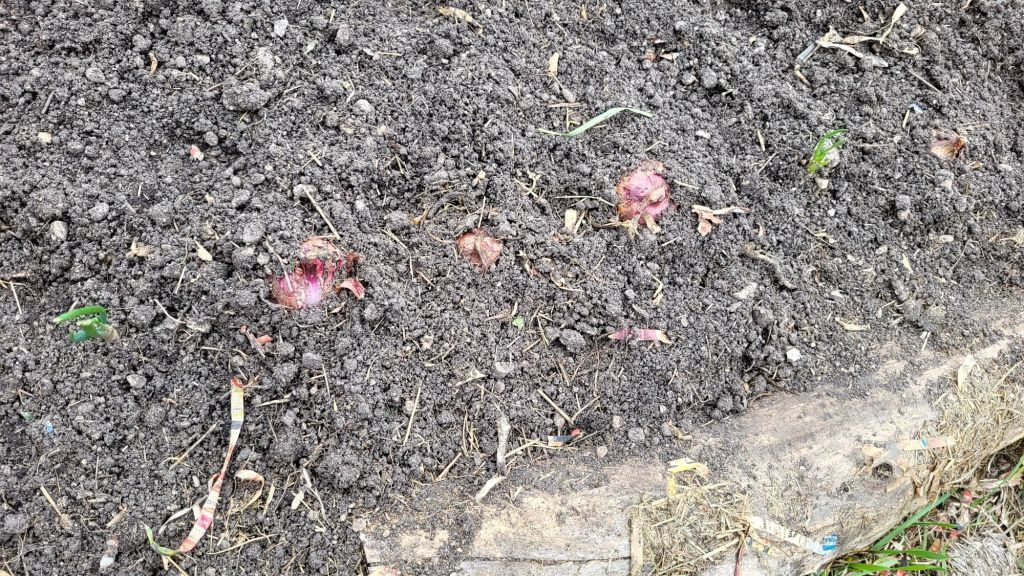
The bed she started on is where we planted the Roma VF and Red Wethersfield onions, last year. The tomatoes ended up not very healthy, and seemed to get blight near the end, but the onions… they just disappeared. The seedlings I transplanted around the perimeter seemed to be doing well at first, and then they were gone. Not dug up. Just died away. So I definitely had plans for amending this bed, and we were most definitely not going to be planting tomatoes in it, again.
Imagine my surprise – and probably hers! – when I looked today and saw this.
All along the perimeter, Red Wethersfield onions are growing! There are so many crab grass rhizomes in there, my daughter has basically been digging them up and transplanting them.
I am totally amazed. Onions I thought had died off, with no evidence of them to be seen when that bed was harvested and the diseased looking tomato plants pulled for burning, had been there, all along, and survived the winter!
We started more Red Wethersfield onion seeds this year, too. I was going to give them one more try before giving up on them, at least for a few years. Now, it looks like we’re going to have plenty!
The bed is only about a quarter finished; it took my daughter a lot longer then usual, since she was both weeding and transplanting all the onions she was finding. Even through the crab grass growing around the edges, I can see more little onion bulbs pushing their way through!
Onions are biannual. Which means that these onions, if left alone, will go to seed, which we should be able to save.
I was able to head outside this evening and finish the transplanting I didn’t get to do this morning.
My daughter had mulched the tomatoes with shredded paper for me while I was out. I made a trench in the mulch and transplanted the Red Wethersfield onions. Almost the entire tray of onions made it into the bed. All the other beds are bordered with the yellow Talon onion. That leaves the Red of Florence onions to transplant, and there are a lot of those! We’ll squeeze them in where we can, where they can help protect other plants from insects and deer.
I hope.
So this bed is now done!
Now we have to get other beds prepared. I’m really hoping we get a good rain tonight, to help cool things down and reduce the humidity!



 The Re-Farmer