I headed out early this morning, while it was still relatively cool, to do the watering and make use of the grass clippings that had been collected and spread out on the black tarp.
I was getting near the end of watering in the main garden area, about to move on to the strawberry bed, when I realized…
I have to admit, I was complacent. I’d seen a deer around the garden area a few times, but it never went to any of the beds and stayed in the tall grass. We’ve got spinners and flashy things and other distractions all over. It seemed they were making a difference…
Now, this.
Obviously, it’s late in the game, but I put a net around the bed so it won’t happen again. The plants will recover, and the runners are still there and rooting themselves. The main thing with the netting is to be able to lift it, as needed, to tend the bed. It’s held down with ground staples in the corners
*sigh*
The next time I can get to a Dollarama, I will see if I can pick up more of those green, plastic coated support posts. They are very handy!
The netting was put up last of all, though. Before that, as soon as the watering was done, I started filling the wheelbarrow with grass clippings and mulching things.
First I laid a pretty thick layer around the edges of the tomato and onion bed. Then I did the onion, shallot and summer squash bed. Setting handfuls of grass clippings between every onion took a while!
These two beds took up most of the grass clippings, but there was maybe half a wheelbarrow left, so I mulched around the onions going to seed, and around some melons at the end of the bed where the bush beans are trying to recover.
After that, I just had to get some photos of the huge vines we’ve got now!
The pumpkins are blooming enthusiastically, and I even hand pollinated a couple more. There’s one pretty large pumpkin developing, plus a few smaller ones. I got a picture of just the largest one.
There are lots of drum gourd flowers, but no female flowers, yet.
The winter squash that are developing right now are getting so big, so fast! So far, the only one I can identify – I think – is what is likely a Turk’s Turban squash. It will probably be a while before we can identify the others – two of which I think are the same variety. I was able to hand pollinate a couple of winter squash, too.
I also got some photos of the Forme de Coure tomatoes.
I think having the sump pump hose draining at one end of the bed is making a difference. A lot of the water does end up flowing down one of the paths, but the bed itself is benefiting from being watered indirectly like this. The tomato plants are lush and bushy, and the tomatoes seem to be growing much faster than other varieties.
It was about 17C/63F when I headed out to water the garden beds, at about 6:30-7am. It’s now coming up on 11, and we are at 24C/75F with the humidex putting us at 27C/81F. We are expected to reach a high of 29C/84F, with highs of around 30C/86F starting tomorrow and staying at or near that range into August.
Which means I’ll be out watering the garden in the cool of the morning pretty regularly.
Most of the prairies are under heat warnings and/or air quality warnings. We’ve got an increase in wildfires up north, but really, we’re doing all right, all things considered. Alberta is being hit hard, and Jasper had to be evacuated and seems to have mostly burned down! Thank God, there don’t appear to be any injuries or loss of life. The most recent article I can find, as of this writing, is here. (link will open in a new tab)
And that is why having a “bug out bag” is a good idea! As well as having emergency supplies in your vehicle, if you have one.
So we will do what we can with our own heat, and be thankful that it’s all we have to deal with!
Well, my computer is pretty much useless right now. I have been able to get to booted, but so many things just won’t work. Even my mouse suddenly stopped working. Then, when I was able to manually open the start menu and select shut down, it wouldn’t.
*sigh*
So much for making a little gardening video. I’m supposed to be able to use the software on my phone, but that would drive me insane.
So here are some photos, instead.
There were not a lot of seeds in the onion packets, but still decent. The Red Wethersfield had the fewest seeds. Those are this year’s red onions. The yellow onions are Frontier and the shallots are Creme Brulee. There wasn’t space to fit the three containers into the large aquarium greenhouse, so one went into the little one.
I used one of the new large-cell trays for the next seeds. The hot Cheyenne peppers were the last seeds from last year. There were only 9 seeds left, for the 7 cells in the row.
The Classic Eggplant were also the last of the seeds from last year. There were 14 left, which worked out well.
Hopefully, we will have at least a few germinate. If we had just two or three plants of these, that would be enough.
The last row is the Little Finger eggplant. I got a new packet of those, but last year’s packet still had 12 seeds. I put two in each of six cells, then added three new seeds in the last one, plus one more in each of the other cells. So, at the very least, we should have a decent number of Little Finger eggplant this year.
This tray is now on the heat mat; something the onions don’t particularly need.
When I did the onions, I had a smaller bag of Jiffy brand seed starting mix. I moistened the entire bag in a huge bowl, first, then filled the repurposed fruit and vegetable trays.
When filling the tray with the larger cells, I finished off that bag. I had a larger bag of Miracle-Gro seed starting mix and moistened about half of it to finish filling the tray. I am curious to see if there is any difference.
As for the aquarium set up, I’m going to have to look for new bulbs. The big aquarium has two sets of lights. The original set that came with the tank lay flat on the glass lids. The lids were constantly getting algea growing on them, under the warmth of the lights. When the hinges on the lids broke, we just took them off completely, but too much moisture was getting on the light cover. So we found a fixture with ends that hold it higher above the tank.
Now that we use the tanks for seed starting, we use both light fixtures. The higher one, however, now has a burnt out bulb. I need to confirm the size of bulb needed, then see what I can replace it with. I’m sure I can find some full spectrum bulbs that will be better for the plants. If they are affordable, I hope to get extras.
The light fixture on the small tank has two LED bulbs. It still works, but is slowly getting dimmer, so it will be time to replace those soon, too.
So there we have it! Our first seeds started for this year’s garden.
Here’s another great video from Gardening in Canada. With so many people looking to garden to feed themselves, because grocery prices are getting so high, it helps to know what’s actually cheaper to grow!
There are, of course, always outliers. With the dry beans, for example. It may be cheaper to buy them at the store, but you can grow varieties that you won’t find in stores at all. Similar for things like potatoes, which don’t even make her list. For example, there’s not much point growing your basic white, red, or yellow potatoes that are common in stores. For the space they need, you could grow other more cost-effective vegetables instead. But there are many varieties of potatoes you’ll never see in a grocery store, or if you do, they are much more expensive “gourmet” items.
But then, a novice gardener looking to save on the grocery budget probably wouldn’t be after special varieties. That’s the time to focus on tried and true varieties that will grow in their area, not experiment. We are fortunate to have lots of space to convert into garden beds. Most people don’t have that.
I still say it’s good to grow at least one thing, just for fun!
The plan for today had been to get the ends onto the trellis bed. Just before I headed outside, however, the power went out.
All I’ve got is an electric chainsaw, so cutting logs to size was out.
Which was fine. I needed to strip the logs of bark, first. I can see into the house from where I’m working, so I could keep an eye out for any lights back on again, letting me know the power was back.
Three hours later…
I started with the 2 dead spruces intended for the end pieces, one of which you can see on the saw horse. Then I started stripping the poplar that will be the vertical supports.
The poplar was much easier to work with, for the most part. The spruces have been dead for quite a while, so much of the barks is dried stuck to the wood. The poplar is still quite green. The draw knife could slide between the bark and the wood quite nicely, and just glide through.
Except for the branch nubs and damaged bits!
I ended up stripping them completely, as I could see critters were already getting under the bark and causing damage. The shorter lengths made them easier to handle, too, though I ended up putting the larger of the spruce logs back on the saw horse, just to stabilize it. With the lighter logs, there wasn’t enough weight to counter using the draw knife, and the darn thing kept rocking back and forth, and threatening to tip over.
Once stripped of bark, I lay them across the log walls to stay dry. Some of the logs I picked up were so damp from the grass, the undersides were covered with slugs!
After I got 9 of them done, my back was telling me it was time to do something else. So I grabbed a rope and dragged over the last 3 posts, then went back for the odd pieces. Those were light enough that I could drag 2 or 3 at a time, so that was done faster. These odd ones may or may not be usable as part of the trellis. If not, they will go into the bases of the trellis beds and buried, to break down over time.
I had just finished dragging over the last pair of odd sized logs when I saw a light on in the house. By then, I was done with this job for the day. I’ll continue tomorrow.
As for the power outage, it was likely due to high winds. Not long after ours was back on, my house sitting daughter let us know the power went out at my brother’s place, too. He’s got multiple back up generators, though, so she is just fine!
The power loss was just for 3 hours this time, but it’s a reminder on how we need to get our back ups done. Like the outdoor kitchen. With the high winds we had today, we could not have done any outdoor cooking, if it came to that. The outdoor kitchen we have planned will allow us to cook outdoors in pretty much any weather conditions.
The other thing is to get that old well checked. If all we need is new leathers for the hand pump, we’re set for water, too. Plus the outhouse will do until we build the more comfortable outdoor bathroom with a composting toilet we have planned.
I had to go to the nearest Walmart to get cat kibble this morning, and took advantage of the trip to get a few more little things. It was insanely busy with people. We’re coming up on a long weekend which, for many people, is the traditional time to put in their gardens. It’s also when a lot of people open up their cottages for the summer, so it was busy everywhere! All the garden centres and greenhouses are open now.
For us, today is 2 weeks to our last frost date. That means it’s time to sow our Montana Morado corn!
Which, of course, is never as simple as just putting things in the ground!
I chose to plant these in the low raised bed we grew summer squash in, last year. As with just about everything else, the squash did very poorly last year. It was, however, the bed that needed the least amount of work done on it before I could sow.
Not by much, mind you.
After removing the grass mulch from last year, I had a whole lot of weeds to dig out. Mostly crab grass. That stuff is brutal!
The entire bed got worked over with a garden fork to loosen the soil. Then I had to go back over it to pull out as many weeds and roots as I could. Aside from using the fork to loosen the soil even more to get the roots and rhizomes out, it was very handy to support myself as I worked. I also used a board across the bed to step on, so I wasn’t stepping directly on the soil.
We really need to get more high raised beds built. This was very hard on the back. I suppose it would have been easier if I could kneel down to work, but my knees are shot, so I’m bending from the waist, for the most part.
While working towards the north end of the bed, I started finding more tree roots, from the nearby trees that my mother allowed to grow in what used to be garden space.
More reason to get those high raised beds done!
When the weeding was done, I went to get the seeds and a rake to level the bed. I brought a container to pour the seeds into and see how many there were. There was supposed to be at least 75 seeds.
I counted 94!
Once the bed was leveled, I took the board I had to support my foot while weeding, and used it to mark off three long rows. I wanted to stay well away from the edges. The crab grass is the worst along there, as the roots make their way under the log edging. Then I used the handle end of the rake to punch holes along the rows every 6 inches or so. Typically, it’s recommended to plant 2 or 3 seeds every 12 inches, but I’m doing dense block planting. I also hate wasting seed, so I planted one seed every 6 or so inches. This should be good for pollinating, and if some of the seeds don’t germinate, the resulting gaps won’t be too large.
I lost a seed while planting, though, so there’s “only” 93 in. 😄
Everything was well watered, of course. I always water before putting the seeds in, then again once they’re done.
Once planted, I put a thick layer of grass clippings all around the edges. The ends don’t have logs to hold the soil in, so hopefully the grass clippings will help keep it in place, too. Mostly, it’s to try and keep the weeds from creeping in from the edges. Once that was done, I put a very light mulch of grass clippings over the planted area. Basically, I just shook bunches of grass and let the wind blow it on. I wanted enough clippings to protect the soil, but still keep it light enough that the corn won’t have any problem pushing through.
Once the corn is up, I will might interplant some bush beans in between the rows. Maybe. I did that with the kulli corn we planted last year, and they got huge, but never reached the point of producing cobs. I now think that there was too much nitrogen in the soil in that bed. High nitrogen leads to lots of plant growth, but can result in lower yield. Or, in our case, none at all. With how densely these are planted, though, interplanting with something like beans might be too much.
Once that was done, I decided to take a chance and do some transplanting.
The Sweet Chocolate peppers that were started back in February have gotten nice and big. Normally, I wouldn’t dare transplant them before our last frost date, but I’ve been eyeballing the forecasts and decided to take the chance. It was either plant them now, or pot them up. The German Winter thyme that was started at the same time were also quite ready to be planted.
While I was transplanting, I got my daughter to cut the tops and bottoms off of some distilled water jugs for me. Since my husband needs to use distilled water for his CPAP humidifier, we have lots of those! Hopefully, they will help protect the peppers during any cool nights. In this bed, they will be easy to use row covers if we get frost warnings, too.
I had three pots with thyme to transplant – a fourth one was transplanted into a pot to stay in the house. I don’t think they’ll need any protective covers unless we get actual frost.
Eventually, I want to plant the chamomile in here, though it’ll be a while before those are big enough to do that. The spearmint and oregano we started from seed are not doing well. I might buy oregano transplants, which would also go into this bed. Spearmint is not something I usually see in stores as transplants, so we might skip those this year and try again next year. The second variety of thyme we planted at the same time as the chamomile doesn’t seem to be doing as well as the German Winter thyme has. We’ll see how they do over the next couple of weeks.
Once again, while working in this bed, I was quite impressed by how moist the soil was under the wood chips. The mulch is really doing its job!
Oh, there was one thing about transplanting the peppers that has made for a learning experience.
We started the seeds in bio-gradable pots that are designed so that they can be transplanted directly into the soil, pot and all, with no root disturbance. When the peppers needed to be potted up, they went into the larger Red Solo cups that way – except for a couple that were thinned by transplanting.
When taking the peppers out of the cups, the ones that were still in those bio-degradable pots… were still in the bio-degradable pots! They were actually rootbound inside a pot within a pot. So when I transplanted them, I removed the shells of pots they were in. The pots were very soft and easy to break off, but hardly any roots had tried to grow into them.
I still have some of these pots and seed start trays. I’ll use them but, in the future, I think we’ll skip buying those. A bio-degradable pot isn’t much use if the roots can’t get through them after being potted up!
So this is now done. The first corn is planted, and the first peppers and herbs are transplanted.
The corn is meant to be planted at this time. I just hope I didn’t jump the gun with those peppers!
I didn’t have time to post this before heading into the city. We had an excellent visit, and ended up leaving an hour or so later than we should have. It was dark by the time we left, and with all the reflections on the damp roads, it was extremely difficult to see where the lanes were. We also very quickly realized we needed to stop as soon as possible and clean our headlights! Thankfully, there is a gas station just outside the city on our route – and the prices were 5 cents cheaper than when we filled on the way out. Gas prices were really weird. In the town my mother lives in, where we usually stop for gas, the prices had gone up from 154.9 cents/liter to 160.9. Usually, the prices are cheaper in the city, but we were passing gas stations at 169.9! This one station outside the city is usually a penny or two higher than inside the city, so it was very strange to see it lower than everywhere else. My daughter was a sweetheart and cleaned all the headlights and windows while I got the gas, and my goodness, did it make a difference! It was still very cautious driving, though. Not because of road conditions – those were great. It was being on constant lookout for deer! Thankfully, we only saw one, running away from the road, but there are so many of the around this time of year, I consider that very lucky.
So what did I find that I would have posted about before leaving?
This lovely surprise!
When I turn the lights on in the morning, I would always lift the dome on this tray to check the pots while getting the condensation to drip into the tray a bit. There wasn’t a single sprout this morning. After making our second basket and putting it in the living room for safe keeping, I took the time to look at the tray that had been moved off the neat mat, to see if any more peppers had sprouts. None had, but I realized I was seeing green through the condensation of the dome on the new tray. I couldn’t believe how many tomatoes has sprouted in such a short time! I’m also surprised they sprouted earlier than the herbs. Those seeds are so tiny, they are practically surface sown, so I figured they would be visible first, for sure. Nope. Not a single herb seed has germinated yet.
With the tomatoes sprouting, though, the dome now stays off.
Now, if only more of those peppers – and any of the Classic eggplant – would start sprouting!
This morning, I headed out to start mowing the lawn before things got too hot.
I was too late.
I suppose 22C/72F isn’t too bad to start, but by the time I was done for the day, just a couple of hours later, we were already at 29C/84F. Depending on where we look, our high of the day is expected to be anywhere from 29C/84F to 32C/90F.
Just to make it even more interesting, the humidity is quite high. It’s just past 1pm as I write this, and the grass is still wet with dew! I managed to get the south and east yards done, but the north and west yards, the garden area, and the outer yard, will all have to wait. Tomorrow is supposed to be cooler.
The good thing about not being able to mow for so long is, there is lots of grass clippings. I’m not using the grass catcher, because I’d be stopping to empty it way too often. Plus, with how damp the grass was, it has a chance to dry a bit before I get the girls to rake it up for me this evening, and I can use it to continue mulching the squash and corn bed, tomorrow.
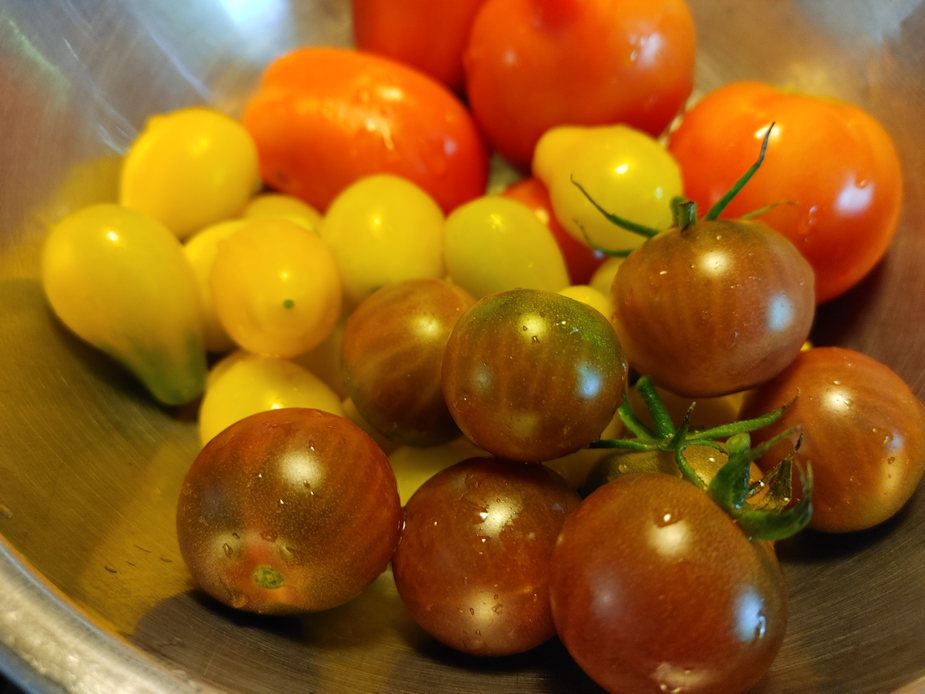
While I was mowing, I was going past the chocolate cherry and yellow pear tomato beds and could see there were some that could be picked. Once the mowing was done for the day, I went tomato picking.
Our very first Chocolate Cherry tomatoes! There are not going to be a lot of them, altogether; the plants have not been very productive. I don’t know if that’s because of the variety, or because of the growing conditions. These were grown just for fresh eating, though, so that’s okay.
I look forward to my daughters trying them, and letting me know how they like them.
The weather predictions have been just insane for the past few days.
There is a Colorado low that’s supposed to sweep through in a couple of days, with the worst of the storm happening on Wednesday and Thursday, then petering off on the Friday (it is Monday, as I write this).
When I first started seeing the forecasts, they were saying up to 10cm/4in accumulated snow. That’s over 3 days, so not too bad.
That went up to 20cm/8in.
Then 30cm/12in.
Last night, it went up to a possible 40cm/16in.
This morning, it had changed to up to 50cm/20in in some places!!
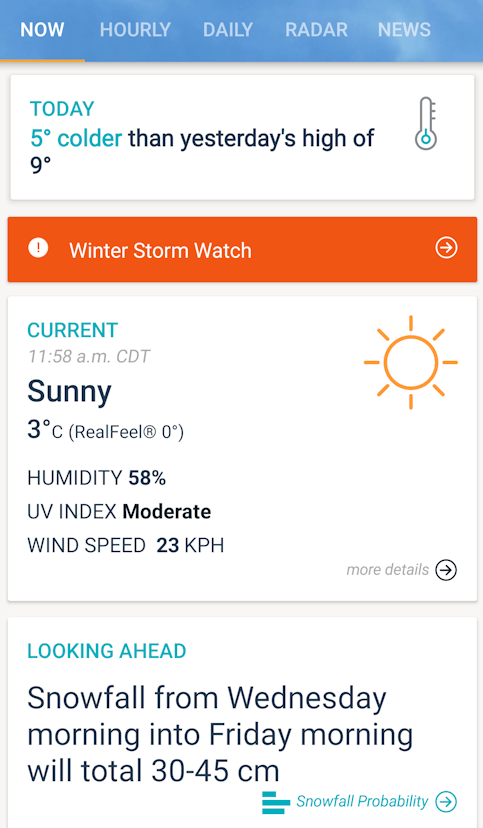
Locally, they’re saying up to 45cm/18in over the three days. I took this screencap just before noon today.
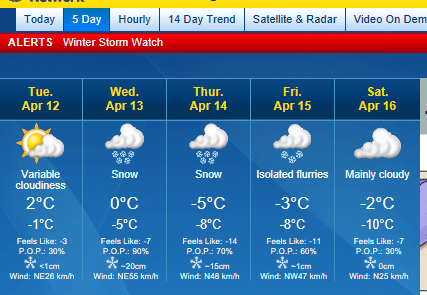
Of course, different apps say different things. The above image is from AccuWeather. This one is from The Weather Network.
Which forecasts up to about 35cm/14in over the three days.
Both advisories to the Government of Canada alerts, which current reads as follows.
ALERTS IN EFFECT
Winter Storm Watch
Issued at 04:34 Monday 11 April 2022
Major spring blizzard poised to wallop southern Manitoba and southeastern Saskatchewan mid-week…with widespread snowfall accumulations of 30-50 cm accompanied by northerly winds gusting 70-90 km/h giving zero visibility at times in snow and blowing snow.
A Colorado low will move towards Minnesota Tuesday night bringing a heavy swath of snow from southeastern Saskatchewan through most of southern Manitoba. The snow will start early Tuesday evening near the International border then push northward throughout the night. By Wednesday morning heavy snow will be falling in much of the area as the storm continues to push northward, and snow accompanied by strong northerly winds is expected to continue right through to early Friday morning as the low slowly pivots through Minnesota on it’s way into northwestern Ontario. By Friday morning widespread snowfall accumulations of 30 to 50 cm are expected…with possible accumulations approaching 80 cm in the higher terrain of western Manitoba and the western Red River Valley.
Travel will become increasingly difficult as the day progresses Wednesday, with widespread highway closures a near-certainty. By Wednesday evening even travel within communities may become impossible as the heavy snow and strong winds continue… and more of the same is expected on Thursday.
Do not plan to travel – this storm has the potential to be the worst blizzard in decades. Stock up on needed supplies and medications now. Power outages are likely, rural areas in particular should be prepared for extended outages.
Conditions should begin to improve on Friday as the winds taper off and the heaviest snow moves into northern Ontario…although the clean-up after this storm will likely last well into next week.
I bolded some of the text myself, not the site. Yes, they are predicting up to 80cm/32in in some places!!!!
Typically, these weather warnings may suggest that roads might be closed, etc. They don’t usually use terms like “near certainly” for road closures, and they don’t usually say “stock up now” nor include warnings for extended power outages.
Right now, there’s basically nothing at all on the weather radar, over almost all of Canada. Looking at the animated radar forecast, there’s a system making its way quickly, through Nevada, Utah, Idaho and Wyoming. It should hit Montana by this evening. That’s the system that’s heading our way. Sort of.
Here’s the thing.
We aren’t that far South. In fact, we’re far enough North that the storm might miss us entirely.
Or, we’ll get those 45cm/18in.
This?
This is why we work to maintain our supplies for at least a month at a time, while shooting for even longer. This is why we’re working towards having a well with a hand pump. This is why we’re working towards being able to make do without electricity (though we do need at least a way to power my husband’s CPAP so he can sleep! Something we don’t have, yet). If the storm hits as predicted, we likely won’t be able to go anywhere for days.
About all we can do right now is pray that the storm will dissipate and not be as severe as predicted. We can certainly still use more moisture, so some rain or even snow is desirable. Just not a blizzard of this magnitude!
But just in case it doesn’t, we’ll be okay. There are many others we are far more concerned about.
Hmm. My sister just took my mother for her grocery shopping a few days ago. I think maybe I should arrange for another trip for her tomorrow, even though the grocery store is just a couple of blocks away for her.
For at least a decade, there has been an increase in people who have decided to move out of the cities, get themselves an acreage, and live as self-sufficiently as possible.
Which is basically, how I grew up.
Things have really changed, though, and modern homesteaders have a lot more resources, options and choices than was available when I was a kid, 50 years ago, never mind what our pioneers had. I found this very encouraging to see.
A couple of decades ago, while part of an online homeschooling support group – pre-social media, when everything was by email (and dinosaurs roamed the earth) – I often saw people waxing poetic about how we all need to go “back to the land”, and live these organic, subsistence lives, and all our food would be free and we would barter for everything else, and so on. It had a lot more to do with ideology than anything else. Going back to the farm was a dream of mine since I moved away in my late teens, so I could appreciate many of the sentiments they expressed. Unfortunately, this romanticized view was wildly unrealistic, and I found myself trying to remind people that there are reasons people, including farmers, moved away from that life.
Most of them didn’t get it.
Once we moved to the farm, 4 years ago, in a caretaker role, how things were done when I was a kid just wasn’t an option, and I’m quite okay with that. Most of the land is rented out, so we just have our corner to work on. My mother had a massive garden that had been slowly neglected for many years, as my parents retired from farming and age reduced their mobility, no matter how much my siblings tried to help. We can finally work on our dream to be as self-sufficient as possible, but we have to do a lot of things differently than how we did it when I was a kid.
It was in researching this that I found this dynamic and growing homesteading community. These were people who may have gone in starry eyed, but were also realistic and determined, and they were making it work. The aging hippies I couldn’t get through to all those years ago, with their ideological blinders, could never have done what these awesome people were doing. It was very exciting!
Then, the last couple of years happened.
As people saw their jobs disappearing, their livelihoods destroyed, prices skyrocketing, and government restrictions stifling people’s ability to do some of the most basic things, a lot of people are suddenly having real concerns about being able to feed themselves and their families.
During WWII, governments actively encouraged families to grow Victory Gardens, and even gave out information and resources to help people do it. That sort of thing isn’t happening now. Instead, we are having to rely on each other to figure out how to grow what, for too many people, are literally survival gardens.
Whatever your reasons for wanting to start growing as much food for yourself as you can, I heartily encourage you! You won’t get any sermons or lectures from me. I do hope that I can, at the very least, provide some information and inspiration.
Start where you’re at
Your circumstances are going to be unique to you. If you’re already on an acreage, great. If all you’ve got to work with is a hall closet and some makeshift grow lights, great. You can start where you’re at, even if it’s just poking some holes in a bag of potting soil to grow some greens in a sunny window. Little by little, it’ll get done!
What I will be sharing here is going to be geared mostly to people living in colder climates – and by that, I meant Zone 2 or 3 (depending on what Canadian zone maps are being used, we live in either 3a or 2b).
I will add one thing I’ve heard quite a number of very experienced, prolific gardeners say. If they had to depend on their gardens for survival, they’d starve! It takes a lot to grow enough food to actually provide enough for even one person to last from preservation to the next year’s harvest, and it will still need to be supplemented with other things. I’m still somewhat amused and perplexed by my mother trying to lure us out here by saying we could grow a garden and not have to buy groceries anymore. Even as big as her garden was, plus having chickens and cows, sometimes pigs, turkeys and geese, a root cellar and lots of canning and freezing, we still had to buy groceries.
So you’re still going to need to buy stuff. Hopefully, just a lot less!
With that in mind, as you plan what to grow in your own personal survival garden, here are some things to consider when making decisions.
Grow what you will eat.
I’ve looked at so many lists out there, for things like what to grow to feed a family for a year, or what to grow in your climate, and so on, and frankly, a lot of stuff on those lists are foods I just don’t like. Others, I can’t eat. There are four of us in our household, and we have very different tastes. Which means that our focus will be more on growing things all of us enjoy eating, then including smaller amounts of things only one or two of us like to eat. As wonderful and appetizing as I find tomatoes and bell peppers, they both make gag, but two people in our household enjoy eating them, and all of us can eat processed tomatoes. Now, those two people REALLY like their tomatoes, so growing more of those than peppers for fresh eating makes sense, as well as growing a lot of tomatoes that are good for making tomato paste to last us for months. It’s a sort of juggling game.
Try new things
What we find in the grocery stores is there because those varieties can handle large scale growing and transportation. When you’re growing your own, you can have a lot more choices. This is a time to grow new varieties of things you know you like, and if you have the space and resources for it, grow something you’ve always wanted to try, but couldn’t for one reason or another. Which kinda ties in with my next point to consider.
Grow at least one thing for fun
Yes, growing food to ensure your family has something to eat when times are tough is serious business. The whole point of the list I’ll be presenting to you is to be able to get as much bang for your buck as you can. At the same time, growing something just for fun is a great morale booster. As you go through what various seed companies and nurseries have to offer, you’re bound to find something that just puts a smile on your face. If you have the space and resources for it, go for it!
Keep in mind your region, climate and particular circumstances.
While the zone maps are very handy, that doesn’t mean there aren’t exceptions. There are things my mother successfully grew in our Zone 3 that were rated at Zone 5. She didn’t even doing anything different for them, either! This is a good time to find and get involved with a community of people in your region and zone, online or off, to learn from. If you are growing outdoors, look at what is rated for your zone, but also consider whether you can create microclimates. If you have only a balcony or patio, there are lots of places where you can learn about container gardening or vertical gardening. If you are growing indoors, there are resources geared specifically for that.
Storage and preservation
If you’re growing food to feed your family, and trying to grow as much as possible in your space, it’s not going to be much good if you grow more than you can eat, but can’t preserve it! There are many options available; freezing, dehydrating, water bath canning, pressure canning and even freeze drying, if you can afford the machine! You might even be able to create a root cellar in some corner of your home. Refrigerator pickling and fermenting are options, if you don’t have canning equipment.
If you’re going to store and preserve food, you’ll need somewhere to put it. What methods you have available to save your food will help you decide what makes the most sense for you to grow.
Things will go wrong. Do it anyway
One thing that is going to happen is, there will be failures at some point. It’s inevitable. Sometimes, you’ll make a mistake. Sometimes, there will be circumstances completely out of your control. It happens. The beauty is, you can still fail “up”. Honestly, you’ll probably learn more from the failures than the successes! Of course, it’s always a good idea to learn from others as much as you can to avoid failures, but it’s still going to happen. Since being here at the farm for 4 years, and only gardening for 2, we knew we were trying to grow in far from ideal conditions, and had some setbacks, yet we still managed to have food from our own garden that we could enjoy.
When it came to making a list of things that might work well in a survival garden, I looked for things that could be grown in colder climates, had high yields, and could be stored or preserved, while also keeping time in mind. So let’s start with the fastest growing things, first!
There are quite a few things that can go from seed to plate in less than a month. Some in less than 10 days! Micro-greens and sprouts can be grown very quickly, can be grown indoors in trays or jars, continually throughout the year. Many seed companies now has sections for sprouts, and quite a variety of things can be grown for their sprouts. Many sprouts can be grown in jars – alfalfa, mung beans, lentils, radishes, and more. Gelatinous seeds, such as flax, chia, cress, arugula and psyllium, can be sprouted in trays. For microgreens, you can try beets, swiss chard, broccoli, cress, peas, radishes and sunflowers.
If you want to give things a bit more time, leafy greens such as pretty much any type of leaf lettuce, spinach, chard, kale, bok choi and radishes can be grown and harvested very quickly. Many of these don’t like heat much, so they can be planted outdoors early in the spring and sowed successively until the heat of summer, then sowed again for a fall crop.
These quick growing plants are nutritional power houses, but they don’t have a lot of calories. They’re not going to keep anyone going for long, so it’s good to think of these as a supplement, and something that can provide nutrition until other foods can be harvested.
Short term
By “short term”, I am talking about the things we typically think of in our annual vegetable gardens. These are things that can take a few months before you can start harvesting anything, and can potentially keep feeding you and your family throughout the winter, with proper storage and preservation.
Root vegetables: carrots, parsnips, beets, radish bulbs, turnips, rutabagas… there are many to choose from, and many varieties of each! Stored properly, they can last for months on their own, but they can also be pickled, pressure canned, frozen, and dehydrated. With these, they are one seed, one plant (except beets; their seeds are actually clusters of seeds), but they produce so many seeds, most packets will provide more than needed for a typical household.
Bulbs and tubers: potatoes, sunchokes/Jerusalem artichokes, sweet potatoes – yes, there is a cold hardy variety of sweet potatoes out there! – bulb fennel, celeriac and more.
There are many varieties of potatoes, some more prolific than others, and some better for storage than others. A good source of seed potatoes will give that information. Potatoes also come in determinate and indeterminate varieties. Indeterminates are good for potato bags and towers, while determinate are good for hilling or Ruth Stout growing methods. Sunchokes will grow in just about any type of soil, and can be so prolific, they are sometimes considered invasive.
Special mention: the alliums are excellent bulbs to grow, but tend to require a lot more time, unless you are starting onions and shallots from sets, or spring garlic. Hard neck garlic needs to be planted in the fall, while onions and shallots from seed – which gives a lot more choice in varieties – need to be started indoors very early. In my garden groups, I’ve found Zone 3 gardeners that start their onions from seed as early as January! Onions also come in long day and short day varieties. If you are in a northern Zone, look for long day varieties. Of course, some varieties store longer than others but, properly cured and stored, they can last a very long time! Onion greens can be eaten as the bulbs mature, and hard neck garlic produces scapes that need to be removed to produce bigger bulbs, and they are delicious, making them dual crops to grow.
Summer squash and zucchini: There are many varieties of summer squash, and they all tend to be quite prolific. Just a couple of plants can provide plenty of baby squash that mature fairly quickly, and if they are left to grow larger, some varieties can be stuffed and baked. Most summer squash start to get tough as they get larger, and are not a storage vegetable, but they can be pickled, canned, frozen and dehydrated. Zucchini is a bit of an exception, in that it can be used as both a summer squash while small, or a winter squash if allowed to grow to full size.
Winter squash and pumpkins: These are squash that can grow to sometimes colossal sizes, but there are also varieties that are small, fast maturing and very prolific. Once they reach maturity, the fruits are cured and can be stored for the winter months. Some varieties reach their best flavour after weeks or months in storage. They can also be frozen, canned, shredded and dehydrated.
Legumes: there are few vegetables out there that provide more bang for your buck than legumes! Especially beans. Bush beans can be grown for their pods, and when they’re done producing is about when pole beans are ready for harvesting, and of course there are shelling beans, which are grown for their fully mature and dry seeds. Peas, chick peas and lentils can also provide a lot of food from just a few plants. Dried legumes, stored properly, can last for years, making them one of the most efficient foods to grow.
We could fit about a hundred of these tiny Spoon tomatoes into a single Red Solo cup.
Tomatoes: tomatoes are a fruit that deserve their own category. The varieties available is staggering! However, if you are looking to get the most pounds per plant, look at growing a mid sized variety. Aside from fresh eating, they can be frozen, canned or dehydrated on their own, or be used as an ingredient for sauces and salsas, and so much more.
Cucumbers: As with tomatoes, there are a really amazing number of cucumber varieties available, but most fall into one of two categories; slicers, for fresh eating, and picklers, for preserving. They all tend to be fast growing and very prolific, too.
Peppers: I wasn’t sure about including peppers on this list. They are excellent producers, but growing them in our colder climate seems to be touch and go. I’ve heard from people who have had great success with them, while others have tried for many years, but have never had a harvest. Peppers can be canned, preserved in oil, frozen, dehydrated, pickled and made into relishes.
While being able to grow food quickly is important, it is also useful to consider the long haul. If you have the space for it, there are things that may take several years before they begin producing, but once they do, the harvests will be bounteous!
Asparagus: asparagus can be grown from seed or you can buy crowns to transplant into trenches. It can take three years before they can be harvested, and even then, for the first year or two, harvests should be minimal. Once they are established, however, asparagus will keep producing for up to 20 years!
Raspberries, currants, gooseberries and haskaps: Haskaps are the new berries on the block, and are exceptionally cold hardy. They require male and female plants to produce, and can potentially begin producing berries in their first year. Raspberries are available as regular cane (new canes produce berries in their second year, then die back) or primal cane (new canes produce berries in their first year). Choosing varieties that mature at different times can give you fresh berries for months. Currants and gooseberries, once established, can produce fruit for many years. Berry bushes can provide a great deal of fruit per plant. Along with being used fresh, frozen or dehydrated, as well as made into jams and jellies, they can be used to make vinegars, syrups and wines.
Grapes: yes, there are Zone 3 grape varieties. I’ve even seen a Zone 2 variety. Grape vines are very long lived, and have the potential to provide fresh and frozen fruit, jelly, and wines for many years.
Hedge bushes and trees: There are a number of larger berry bushes that can double as shelter belts and natural boarders. Some, like sea buckthorn and bison berry, do well in poor soils, and while they may be considered invasive in warmer climates, they tend not to be, in our Zone 3. The Rugosa rose produces large edible hips, and their flower petals are edible, too. Saskatoons are a more of a tree than a bush, and absolutely delicious. Chokecherries produce many berries, but are better used in syrups, vinegars, etc. than eaten fresh. Many of these will provide enough berries not only for your own use, but for birds as well!
Now we’re really going for the long haul! Here, we are looking at things that can take five or ten years before they start producing food – but once they do, they will continue for decades to come.
Fruit trees: there are a remarkable number of fruit trees that can grow in colder zones. Apples, pears, apricots, cherries and plums can all be grown here. While a single mature tree can provide enough fruit for the entire family, many need to be planted with a pollinator, which can be a different variety.
Nut trees: there are not a lot of nut trees that can grow in Zone 3, but some, like the Korean Pine, are hardy to Zone 2! Hazelberts and beaked hazelnuts are also very hardy. Others, such as the black walnut, can grow in Zone 3, but the nuts may not have enough for a growing season to fully mature.
Okay, so all this is a lot more than just a “survival” garden, but we all start somewhere, right? :-) Little by little, it’ll get done!
I hope you find these useful in working out what are the best things for you to start growing in your own particular situation.
For those who have already been doing this for a while, please feel free to leave a comment, sharing your own experiences. What worked best for you? What didn’t work? Is there anything you would tell someone who is just starting out now? Let us know!
Before I catch up on things, I just had to share this photo.
This is Little Braveheart, now known as Tissue, cuddling with “grandma”.
That is the protective foam insert that came with the new washing machine. Our old mama cat has claimed it as her favorite bed, but she doesn’t mind a kitten joining her for cuddles!
They do like to chew on it, though. :-D
Meanwhile…
Yesterday, I bit the bullet and headed out to do some bigger shopping. It’s really mostly cat food and litter, where the price difference makes it worth the cost of gas to drive so far to get it. That, and supply. Locally, not only are the prices higher, but they just don’t have the space for much inventory or selection. After hearing about what people have gone though in the city, where we usually go, I wasn’t sure it was safe for me, so I went to the smaller city instead. It’s big enough to have a Walmart. :-D It’s a small store, but it carries what I need, and they don’t bat an eye when I walk in with a shield instead of a mask. I did remember to bring our pulse oximeter, and was glad to have it. It still amazes me that even a shield causes my blood oxygen levels to drop like that. The kitties are now well stocked in kibble again, though. :-)
I had a bit of a surprise later on, when looking up the tracking numbers for various orders that we have numbers for. Our new trail cam is supposed to arrive today, along with some other stuff – maybe. Lots of stuff are now coming up as delayed, as Canada Post is overwhelmed. When checking this time, though, I realized the trail cam wasn’t being sent by mail. It’s being shipped by UPS! So now I’ve got the garage security camera aimed at the gate, with the sound on, to keep an eye out for the delivery. Assuming they even find our place. We don’t exactly show up on GPS. :-/ The first time we tried to have something delivered by UPS, they had the hardest time finding us. The last time, they left the parcel at the general store/post office for us to pick up. So I’m not sure what will happen.
I don’t like ordering things online, and this is another reason why. It’s just that much harder to actually physically get things out here! I’d much rather get things locally, but so many things just aren’t available here.
I look forward to getting to a point of self-sufficiency, where we don’t have to depend on questionable delivery services, supply chains and such. It’ll take quite a few years to accomplish, but with all the stuff going on right now, it’s really been hitting home, how necessary that goal is for us, out here in the boonies. It’s hard enough to get things we need at the best of times, and these are not the best of times!







 The Re-Farmer