Our 2022 garden: tomatoes, squash onions, and food forest additions

While I spent most of my time with the kulli corn, my daughters took care of other things.

My younger daughter got the sea buckthorn planted. These saplings are quite a bit larger than the silver buffalo berry! This will eventually close the gap of the hedge along the north fence line, where the deer jump through. Hopefully, we have both male and female plants, and will have berries. We do plant to get more, over time, but it will probably be another year or two before we know for sure.

The only trees left to plant now are the Korean Pine.

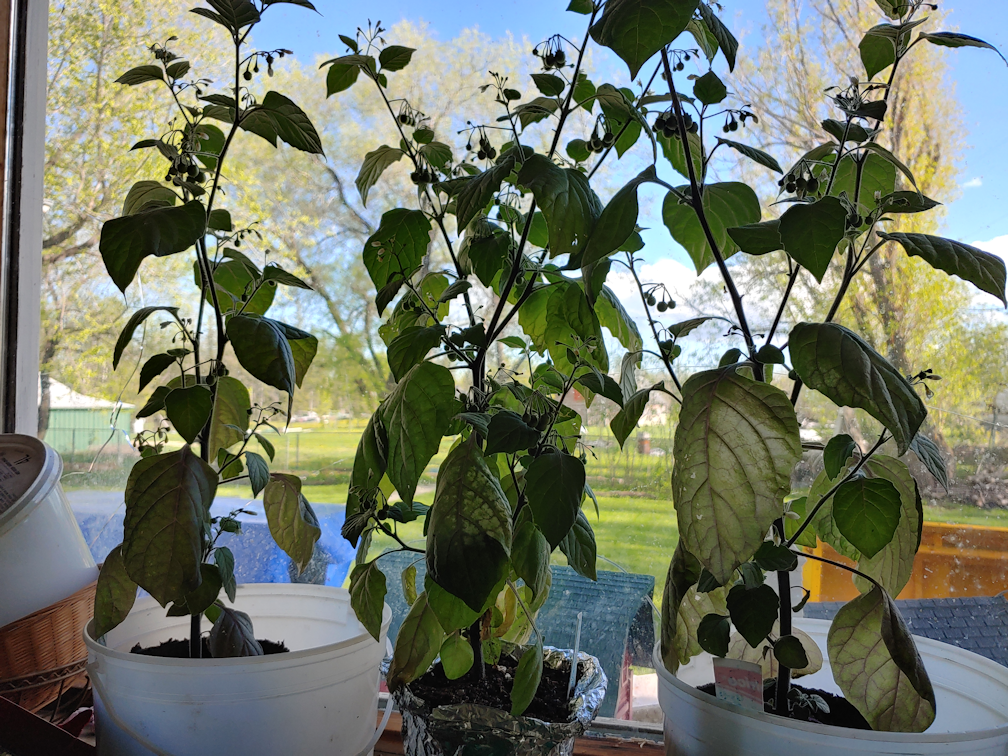
My other daughter started on the tomatoes.

Along the chain link fence, she planted the dozen Chocolate Cherry tomatoes. That’s a variety I got specifically as a gift for her. :-)

Last year, tomatoes did REALLY well in this location. This year, we’ll see how they do in other locations!

The next tomatoes she and her sister transplanted here were the Cup of Moldova and Sophie’s Choice tomatoes.

The row on the left, and in the centre, are all Cup of Moldova, while the Sophie’s Choice are the row on the right.

There are still two Cup of Moldova waiting to be transplanted, but they ran out of space.

While they worked on that, I transplanted into the blocks we finished adding along the chain link fence this spring.
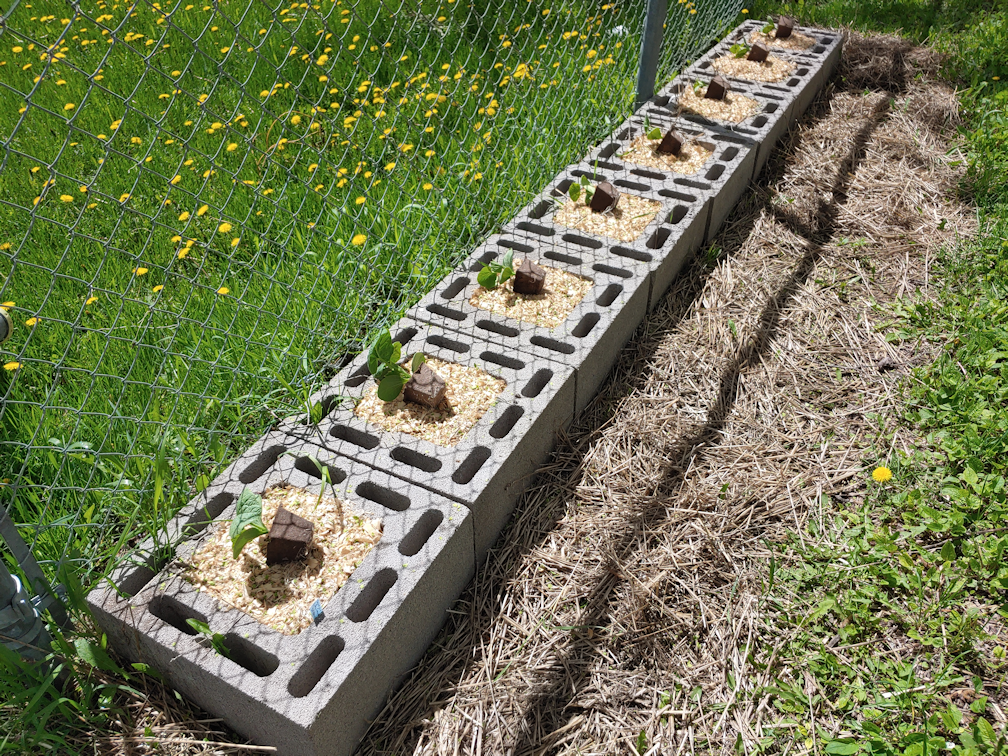
The Red Kuri/Little Gem squash went into these. I hope they do well here. Last year, we had only 2 plants, but they produced quite a lot of squash. Unfortunately, with the drought, the squash developed so late, we only really got 3 that were mature enough to be edible. The girls and I found them delicious (my husband is finding that he’s not a fan of winter squash), and we look forward to having enough to store for the winter.

While one daughter worked on the bed of tomatoes in the main garden area, adding more support posts and winding bale twine back and forth to help support the tomatoes as they grow, my other daughter and I made use of the newly available bed next to the kulli corn.
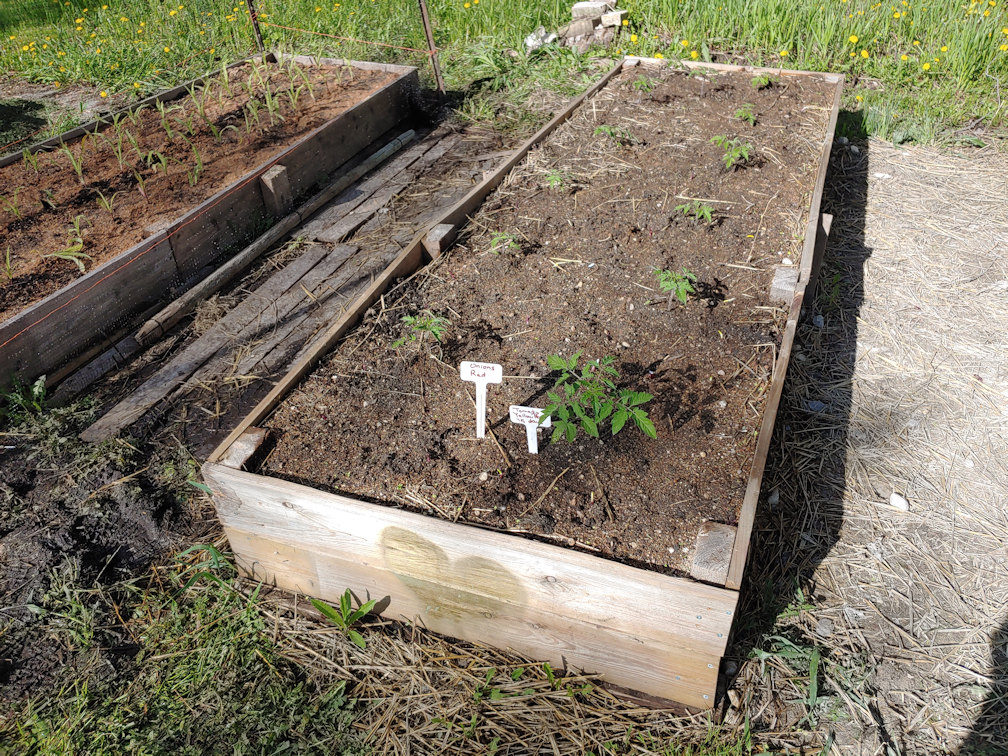
There was a total of 13 Yellow Pear tomatoes to transplant. Once they were in, we got the box of red onion sets and planted them all along the outside of the bed in a single row, then fit the rest into the middle, in 2 rows.

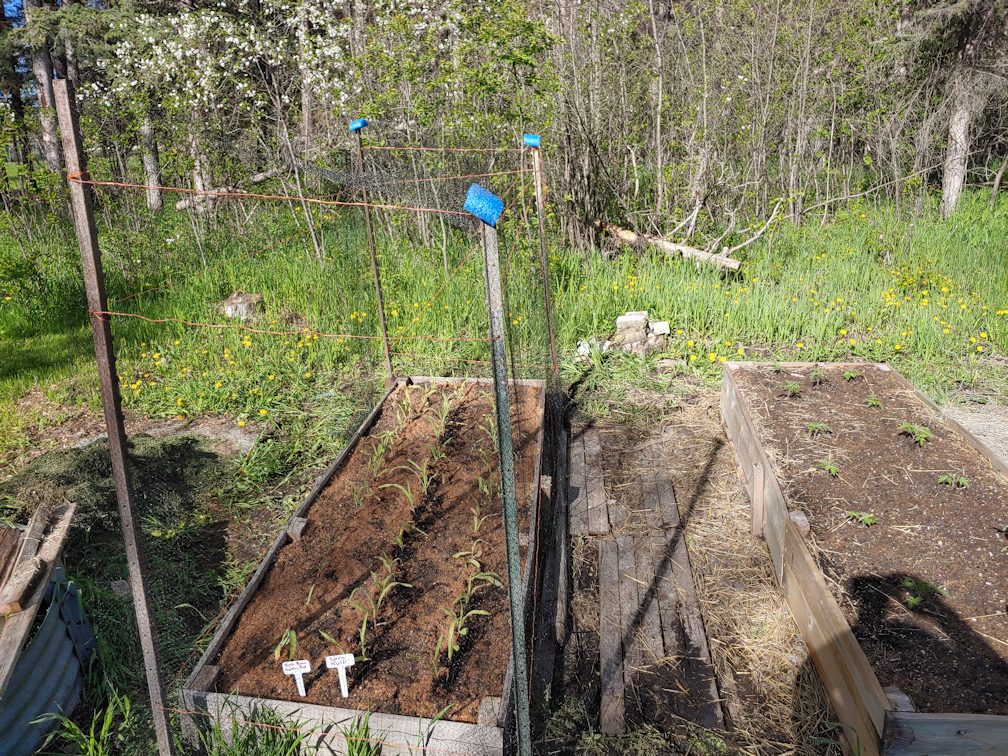
The last thing we needed to do before heading inside was putting netting on the kulli corn and the Red Kuri squash. Those were the only two things that were most at risk of betting eaten overnight!

The net is hard to see. I used pipes hammered into the ground to hold the net away from the squash. The blue bits of pool noodle shoved into the tops of the pipes are there to protect the net, as there are some sharper edges on some of the pipes. Last year, we had chicken wire at an angle over cucamelons and gourds, and the vines kept wanting to attach to the chick wire, instead of the chain link. There’s no way the net could hold the weight of squash climbing it, so I wanted to keep it away from the plants as they start growing large enough to reach the fence and start climbing. On the inside, the edge of the net is held in place with ground staples. The excess net went over the fence, and my daughter rolled it up and zip tied it down. We still want to be able to access and tend the plants as needed, which will mostly be done from the inside.

The last thing the girls did was lace up the ends, so keep the critters out. A determined critter could still tear through the net, but hopefully, they won’t want to be bothered.

In the background, you can see some wire “fencing” has been added to the outside of where the Chocolate Cherry tomatoes were planted. It will get netting as well, but the only thing in there that is in danger of critters are the carrots, and they aren’t even germinating yet, so there it no hurry, there.

We have a lot more to transplant, but work needs to be done to prepare for them, first. The supports for A frame trellises need to be added, and beds need to be weeded. The rows we used for the bush beans last year, as well as the straw mulched mounds we grew summer squash in, are completely hidden by the crab grass that has taken them over. The squash tunnel, which will be a pole bean tunnel this year, needs minimal work at least, and the summer squash can be planted in the deep mulch near the potatoes. After we’ve transplanted the squash, gourds, melons and cucumbers, and planted the pole beans, we’ll have a better idea of where we can plant the yellow corn, and the popcorn. We have more bush beans and peas we can interplant with the two types of corn, too.

We also have another variety of baking poppies and dill to plant, but I think we’ll have to skip those for this year. I know where we will plant the Wonderberry, but have still not figured out where to plant the ground cherries. All of these will be treated as perennials, as they will reseed themselves year after year, so they need permanent locations.

We’ll figure it out.

As for tomorrow, I’m finally going to make our second stocking up trip to the city. It’s unlikely I’ll be able to do any work in the garden, but we shall see. It’s hard for me to stay out of the garden, now that the weather has finally turned nice, and we can catch up! :-D

It feels so good to finally get things into the ground!

The Re-Farmer

Our 2022 garden: kulli corn, yellow beans and garlic

Yes! Finally! Major transplanting was started today. :-)

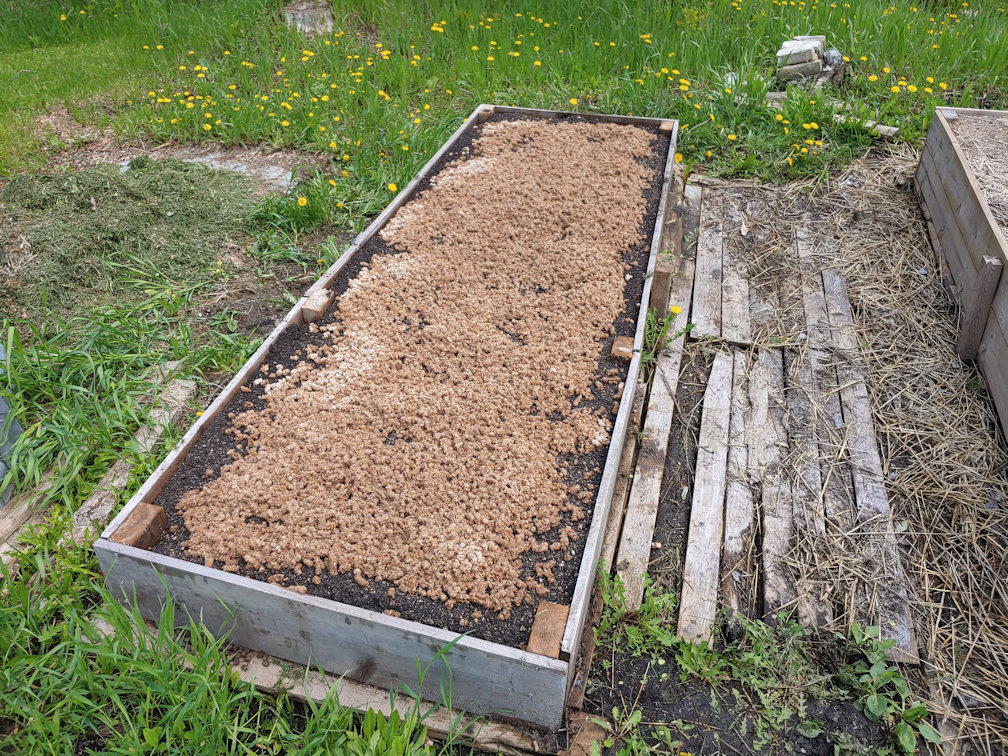
The first thing I needed to finish was topping up the low raised bed they were going into.

Since the snow melted away, we’ve been adding our kitchen compost in the trench, which already had some straw in it, and I even tossed in the soil from various pots we had, from house plants that died, to seed starts from last year that didn’t germinate. The last layer before adding the soil was some fresh grass clippings.

This is the first time this pile of garden soil has been uncovered since last year.

So. Many. Thistles!

And those roots go all the way though the pile.

Which meant I had to bring the makeshift soil sifter into service, so get as many of the roots as possible out. It was long and tedious, but at least it was made a bit easier by scavenging a couple of scrap boards out of a pile to support the steel mesh, rather than the found branches I was using before. Sifting the soil had to be a gentle process, because there were SO many worms.

I kept the worms for the new bed. :-D

After the soil was added, stove pellets were scattered across the top and hydrated so act as a thin mulch. It won’t stop any weeds, but it will help keep the soil surface from compacting. After several soakings, the sawdust was spread evenly with the back of a fan rake.

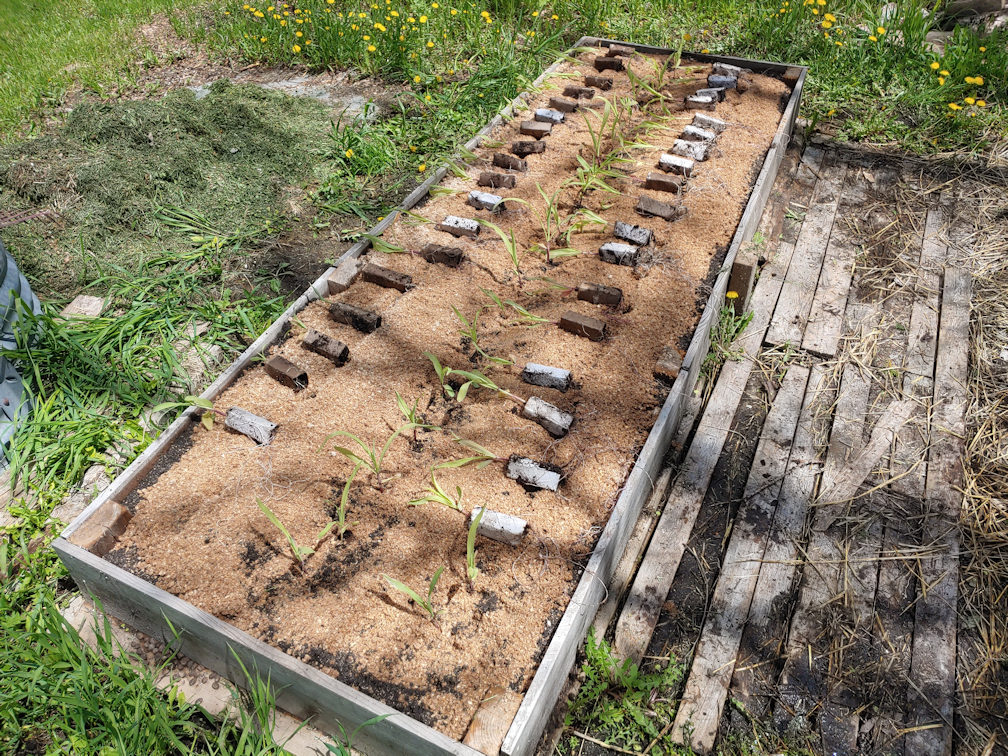
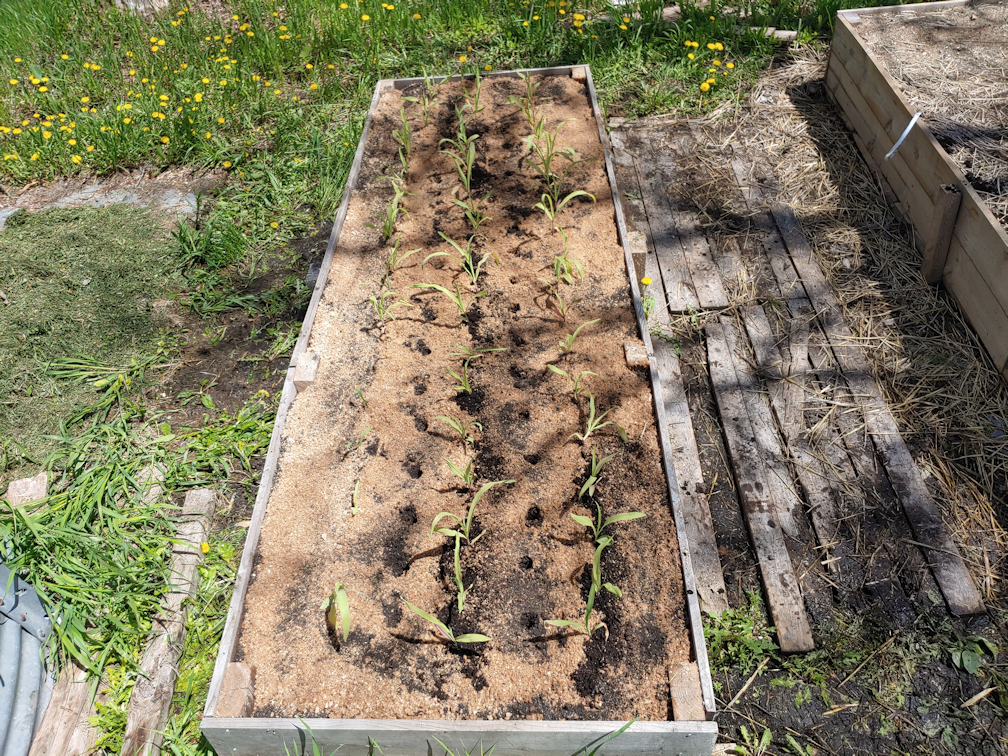
It took a couple of hours, but I could finally transplant the kulli corn!

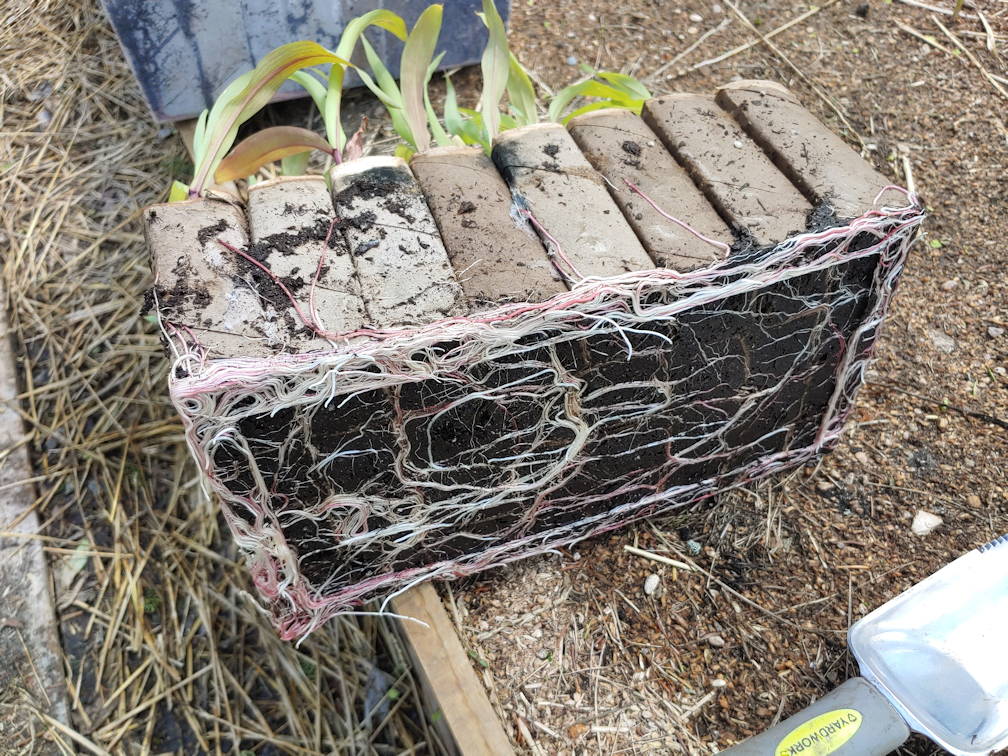
They had a major root system going! It made it difficult to get them out of the bins, then pull apart the tubes. The toilet paper really wanted to come apart!

With the larger bin, it was even more difficult to get them out, and the whole thing ended up falling out and apart. I think only one corn plant actually got broken, though. We’ll see if it makes it.

I counted the seedlings, then marked three rows of 20 evenly spaced spots for the corn. The actual total was 58, including some smaller ones that may or may not make it. We ordered 100 seeds, and there were extras, so we’re looking at roughly 50% germination rate. Which I don’t mind. We would have had trouble finding space for more. They are quite closely planted, as it is. Which should be good for improving pollination.

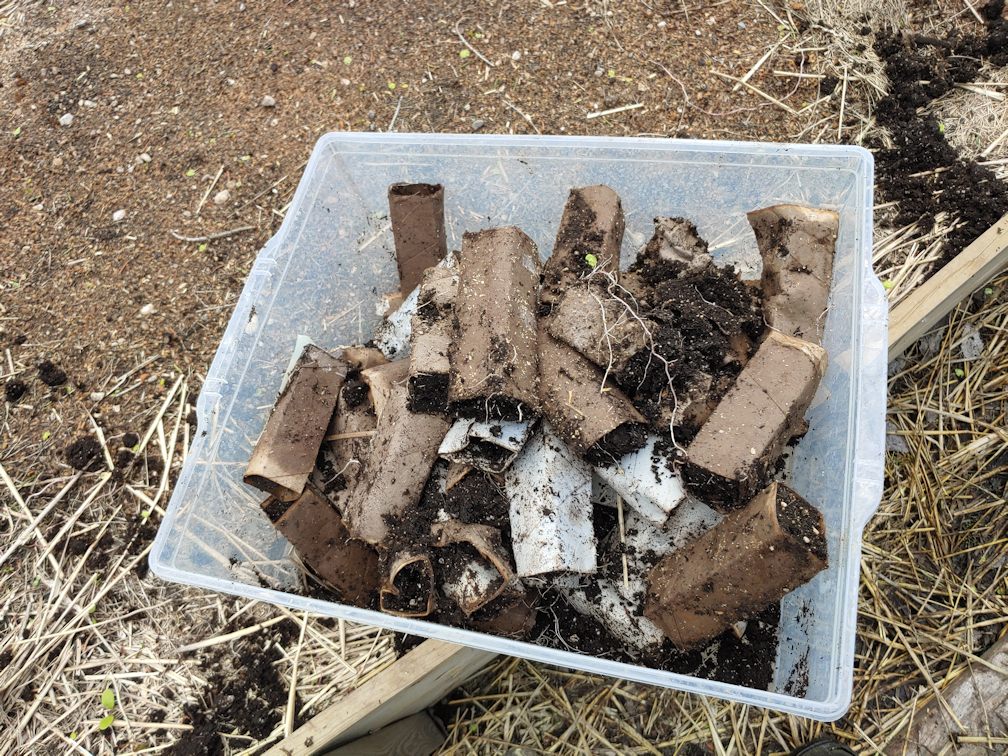
Of the remaining rolls, I broke apart the cardboard and rifled through it. No sign of the remaining seeds that did not germinate. The carboard went into the compost pile, while the remaining soil was used to top dress any seedlings that looked like they could use it.

I had also grabbed a bag of bush beans from last year, picking the one that looked like it had fewer seeds. That was the yellow “Golden Rod” variety. We still have some green bush beans left, too.

I counted the bean seeds and there was 38 – which was perfect! I could plant two rows of 19 beans, in between the corn.

As they are “old” seeds, I don’t expect 100% germination. This bed is very densely planted, but they should be complimentary.

The corn, however, needed to be protected. The question was, how?

I made a trip to the barn and dug out the T posts I spotted in one corner, a while back. There turned out to be 6 of them, all different lengths. :-/

I had to dig holes to be able to set them, using a garden trowel, since a spade would have been just too big. Within inches, I was hitting water, then rocks and gravel. After placing the posts and trying to push the soil back against them, there was literally water, shooting out from the ground, as I stomped on the soil!

We have no post pounder, so I found a heavy hammer to try and drive them deeper. Especially the longest one, but I think that one ended up hitting a rock. Being the short person that I am, for the taller once, I had to stand on the corners of the bed to reach. Even with a board across the corner to stand on, I was wobbling all over the place! LOL

Once they were in, I strung some twine around to further support the net, once it was added. That was a job that had to wait for when the girls were available.

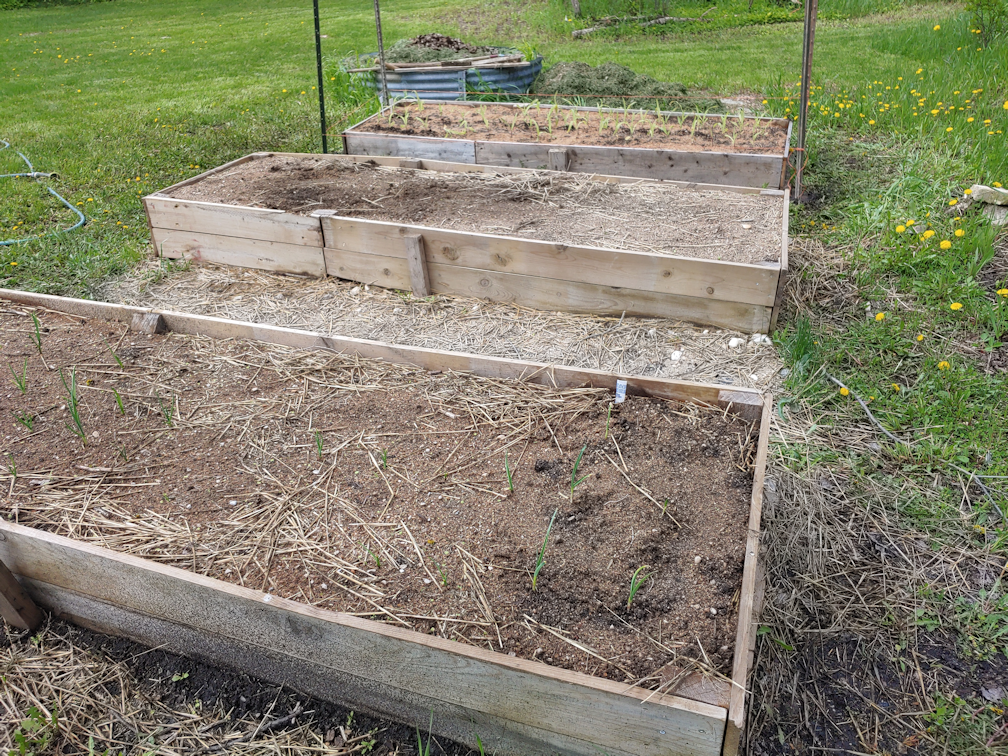
In the two garlic beds, the nearer one had only 6 remaining garlic coming up – and one of those was barely there. I could find no sign of the few others that had emerged, as well.

I decided to transplant those 6 garlic into the other bed. That one has a lot more garlic trying to grow, but there was still plenty of space at one end to transplant the remaining 6 of the other variety.

The left a bed available for planting into, which we did end up doing.

The main challenge was, how do we cover the bed with netting, yet still be able to access the plants, easily, for weeding and eventual harvesting of yellow beans.

Piece of pool noodles were added to the tops of the posts, so they wouldn’t tear apart the net. When the one on the tallest post fell off, I left it. If it tears, it’ll only go down to the twine, and will actually line up better with the rest.

When I brought the T posts out of the barn, I also grabbed a stack of narrow pipes. I have no idea what they were for, or why they were stored there, but I figured the might make good supports. The short ends of the net are wrapped around those pipes and zip tied into place. For the long sides, we zip tied narrow fence posts we found… somewhere, to weigh down the netting. Any gaps were further secured with ground staples. If we want to tend the bed, we can remove the ground staples and lift the poles to get under the netting.

Hopefully, that will work out.

The corn can potentially grow to 8 ft tall, which is higher than the netting, but if they do get that tall, we’ll deal with it, then.

That was my big job for today, but it wasn’t the only one we got accomplished! I’ll write about that, in my next post. :-)

The Re-Farmer

Out of order, but it’s getting done

It had been my intention to work on clearing out that last low raised bed in the main garden area, at the very least, but once I got outside I changed my mind. There was less standing water in the yard, and the grass was getting out of control, so I decided to try mowing.

We have a large yard.

I was also using the collection bag to save those wonderful grass clippings to use as mulch. It doesn’t hold much, so there was a lot of stopping and starting to empty the bag.

After several hours, pretty much the entire inner yard was done. There was just one place that still had so much water that, even with the mower set higher than usual, it was just too deep. I even opened up the gate in the fence near the fire pit and mowed into the outer yard. I like keeping a lane in the grass to the back gate mowed, as an extension of the driveway. There’s too much water do to it in the usual areas, but I was able to clear a lane from the fire pit area, to where the lane would be. If we absolutely had to use the back gate, we would be able to drive through the inner yard to access it. We certainly wouldn’t be able to get through, the usual way!

Another of the goals will be to trim away some small trees taking over a corner, then mowing the areas where we will be planting the Korean Pine.

But not today!

Did I mention we have a large yard? :-D

The rest of the main garden area should get a once over with the mower, before going over it again with the weed trimmer, as close to the ground as possible, but I was just too exhausted to work on that today.

The ornamental apple trees are starting to bloom. So are the sour cherry trees, and all the lilacs are developing buds. Finally! That shows me that things have finally really warmed up, hopefully enough. I don’t know that we ever got frost last night, but the sweet potato slips are fine. I’m leaving the covers on them for one more night, though. Tonight is supposed to be the last cooler night, though I’ve noticed the forecasted overnight low has changed to quite a bit warmer than before.

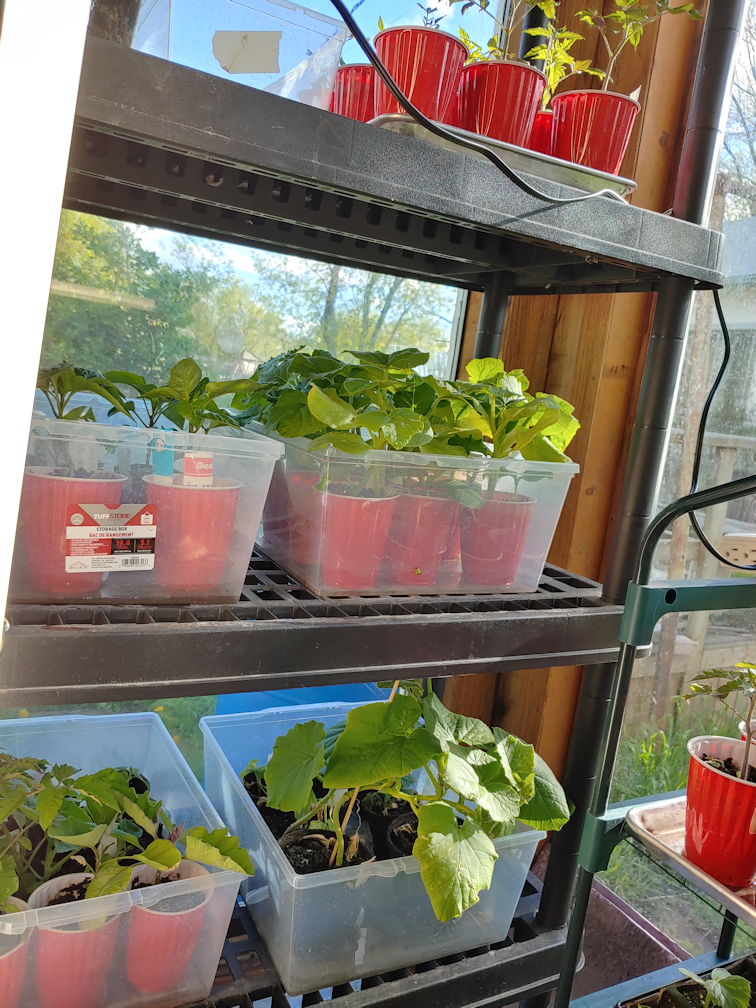
Tomorrow, we start transplanting everything. The sun room is turning into quite the jungle!

We’ve had a very high germination rate this year – a huge improvement from last year! Even the Yakteen gourds, which I restarted, have a few seedlings. Some things had seeds germinate weeks apart, but they still made it. We even have a second tulip tree sprouting! We’d pretty much lost all expectation of any more tulip trees, or any paw paws, germinating, so that was quite a nice surprise.

Another nice surprise is that all the turnips have started sprouting already! My goodness, that was fast.

Today, the girls finished transplanting the silver buffalo berry, and prepped to plant the sea buckthorn tomorrow. After that, it’s just the Korean Pine for this year’s food forest additions.

My priority tomorrow will be to get the newest low raised bed next to the compost pile topped up and ready for planting. The Kulli corn will be going in there, and I want to get that done as quickly as possible. They really need to be transplanted soon. If we start them indoors again, I won’t do the toilet tube pots. It worked well enough, and it certainly saved space, but the seedlings quickly needed more room to thrive. Even if they were in just the red Solo cups, they would have fared well longer. Once the corn is transplanted, we’ll have to make sure to put a net around it right away, so they don’t get eaten!

The girls will start transplanting tomatoes along the chain link fence in the south yard. We have more tomatoes than will fit there, though, so others will be planted in the low raised bed that I finished prepping yesterday. There are so many, we might have to the last one that still needs to be weeded, too.

It’s going to be a flurry of transplanting over the next few days. The sun room is going to look so empty when we are done! :-D We will also be direct sowing the pole beans at the squash tunnel, along with the 2 canteen gourds that are trying to claim their way out of their pots right now. Then there are the two types of corn to direct sow, and I honestly don’t know where we’ll be planting those. We’re really behind in preparing beds, but once those trees came in, they became the priority. Mowing and using the weed trimmer is also going to higher on the priority list, since the winter squash is going to be planted throughout the old garden area, not in prepared beds. Basically, we’re going to dig holes, add some garden soil and the transplants, and mulch around them. The grass is so tall right now, though, we couldn’t possibly get that done until it’s cleared.

Little by little, it’ll get done!

The Re-Farmer

Our 2022 garden: sweet potatoes, bed prep and… frost?

Yay! A day without rain! We finally got to get some serious work done outside!

I had a few goals for the day, but before I could even start on any of them, I had to get the weed trimmer out. The grass is getting out of control, but it’s still too wet to mow in most places. In the main garden area, the ground is so rough, it’s just easier to use the weed trimmer.

Easier on the lawn mower, that is. Not on me! Particularly since I was trying to trim as close to the ground as possible, as well as under the logs framing the beds. It’s pretty much all crab grass, with some dandelions thrown in for good measure, so it’s all going to come back, but at least it’ll take a bit longer, this way. :-/

Once that was done, I decided on where I would put the purchased grow bags we are testing out this year. I picked up a couple at Canadian Tire, mostly because they were on clearance. My original plan was to try growing some sweet potatoes in one of them, then have the remaining slips planted in the ground. The bed I was going to use for that now has the white strawberries in it, so I figured they could all go into the grow bags.

I decided to place them near the small potato bed, where they will get full sun, and be sheltered from the winds at least somewhat. I did put some straw in the bottom of the bags. The straw will act as a sort of sponge to hold moisture, but it also held the sides of the bags up, making it easier to add the soil.

The truck load of garden soil by the main garden is mostly used up, but so far it has been enough for what we need. The problem is that, after a year, it’s so full of roots, it’s actually hard to stab the spade into it!

We really need a soil sifter. I don’t have the materials to make one right now, so I rigged one up.

This steel mesh is what we use on the burn barrel as a spark catcher. I used it to sift soil last year. A couple of sticks to support it over the wheelbarrow, and it worked all right. Some roots still got through, but at least the big stuff was kept out.

It took a couple of loads to fill the bags. They’re not that large, but even with the straw on the bottom, they hold quite a bit of soil. I decided not to fill them to the top. I figure, once sweet potatoes start to form, they’re going to need some space. I’ve never grown them before, so we’ll find out!

Also, you can see that one of the handles has already torn off on one side!

These bags are probably too small for sweet potatoes, but this is a bit of an experiment, anyhow, so we’ll see.

For these, I decided to use the stove pellets as mulch. In the above photo, the one on the right had its first watering, and you can see they’re already starting to swell and soften.

After wetting them both down, I left the pellets to absorb the water and moved on to our other experiment.

I got a pair of these at The Dollar Tree to test out. The fabric they’re made of is a thick felt.

Hmmm… Did I mention I got these at The Dollar Tree?

You get what you pay for! The first one I opened, and it had a hole in it!

Some of the stitching looks like it simply came undone, but the opening was about a third of the circumference!

The other one was fine, though, so I gave the first one to my daughter. She’s been doing a lot of sewing, so she’s got all the supplies on hand and was able to stitch it up for me.

While she worked on that, I filled the second one. As with the others, I added straw to the bottom, using it to help hold up the sides. In between loads of soil to fill it, I watered the pellets in the first bags a couple more times, before smoothing out the sawdust, then repeated the process on the smaller fabric bed.

It looks so small compared to the other two!

The sweet potato slips I ordered was a 5 pack, and I decided to plant 2 in one of the green bags, then 3 in the black felt bed. I wanted to see if the black fabric, which would absorb more heat, would be better. We did get a short season, cooler climate variety, but they are still a heat loving plant.

Well, would you look at that!

We have extras!

After breaking up the bundle of slips (there was still ice in the packing medium!), the green bags got two each, while the shorter but wider black fabric bed got three.

Sweet potato slips, I’ve learned, are the only other plant that share a trait with tomatoes, in that you can bury them up to their leaves, and new roots will grow out of the buried stems.

I’m sure these bags will be too small, but with how sweet potato vines grow, I think I will let them spread onto the ground. Where the vines touch the ground, they can root themselves, and grow more sweet potatoes. So we might get some growing in multiple places. :-)

Once those were in, I got to work on one of the low raised beds that needed to be weeded (again) and prepped for planting.

It was actually a bit worse than the remaining bed that needs to be weeded. I got as many of the rhizomes and dandelion tap rooms out that I could. I know I didn’t get all of them, but at least I got most.

We’re running low on the canopy tent pieces I’m using for supports. This bed got only 6 of them. The other beds got 8. There are 4 left of these longer ones. After that, there are only some really short pieces. Short enough that I’m not sure where we can use them in the garden at all!

By the time I got this bed done, I really needed a break, so I popped inside for lunch … er… lupper? and a rest.

When I sat at my computer, one of the first things I saw was a flashing red alert on my task bar’s weather app icon.

It was a frost advisory.

*sigh*

Pretty much everything else we’ve got going right now is frost tolerant. These sweet potato slips, however… yes, they’re supposed to be a cool climate variety, but they just got planted!

I decided to play it safe.

We hang on to more of our water bottles, rather than putting them in recycling, and this is one reason why! They can be used as cloche over smaller plants.

Such a hot day, and we’re supposed to get frost. Ugh.

Okay… “hot” is relevant. It was only 16C/61F out there! It certainly felt hotter while working outside. I got a wicked sunburn on the back of my neck. My daughters chastised me for not wearing sunscreen, while one of them applied some aloe vera gel on the burn for me. :-D We do have sunscreen. Somewhere. I just forgot sunscreen existed, and didn’t even think that I might get sunburned!

Tonight, we’re supposed to dip to 2C/35F. Tomorrow’s high is expected to be much the same as today, while the overnight low is supposed to be 4C/39F. After that, our overnight lows are supposed to continue to slowly increase over the next couple of weeks.

Which means that we have one more night before we can start transplanting our warm weather crops. Even then, though, we will start with the ones that are most likely to handle colder overnight temperatures. There is still lots of work that needs to be done, including a repair on the squash tunnel – one of the screws holding a bottom cross piece snapped. Likely because of the winds we’ve been having.

There is still so much to do! The extended cold and the rains have really set things back.

Once everything is in, though, I expect we’ll have quite a good growing season. I look forward to not having to water all the garden beds, twice a day, almost every day, like we had to last year.

Between the weather and the critters, though, nothing is ever a sure thing!

The Re-Farmer

Food forest: silver buffalo berry

Since planting trees and bushes are more long term than our usual gardening, I decided to start a food forest category.

Including for things that were already here before we moved in, like these Saskatoons. It’s so nice to see them blooming again – though you can very clearly see how high the deer ate the twigs and branches! Hopefully, we’ll have berries this year. Thankfully, these are very flexible, so we should be able to bend them down to harvest them.

We are, however getting a frost advisory tonight. !!! Well, our June 2 last frost date is just an average, after all. It’s supposed to dip to just barely freezing, so most things should be all right.

Including…

The 20 out of 30 silver buffalo berry my daughter was able to transplant today!

She does not take progress pictures, though, so I just got a picture at the end of the day.

Even with the holes already dug, it was a huge job. The soil that was removed was so full of roots, rocks, weeds and gravel, she was using garden soil from the remains of the pile we got last year – which is clear across the garden area. After sitting there for a year, it’s full of roots, too, which she picked out as best she could.

She started at the north end of the double rows, next to the highbush cranberry, as the ground is slightly higher there, and the holes were mud rather than filled with pools of water. It didn’t take long before she was having to deal with standing water, though.

Towards the end, I was able to help her out, adding the mulch and watering it just enough to keep it from blowing away. By the end of it, my poor daughter was so knackered, she could barely lift the shovel on its own, never mind with soil in it!

So the remaining 10 silver buffalo berry (I just realized, I’ve been calling them bison berry, because we don’t have buffalo; we have bison. The label says buffalo) will be planted tomorrow. Holes still need to be dug for the sea buckthorn, but there’s just 5 of those. Then there’s the Korean pine, which is going to be planted in the outer yard.

While she did that, I worked on the main garden area and got some decent progress done, too – but that will be my next post.

The Re-Farmer

Our 2022 garden: potatoes, strawberries and sunchokes

We had a lovely, warm and sunny day.

That meant, time to catch up as much as possible in the garden!

My main goal was to get the potatoes in, since the beds for these were all prepped and ready.

The first ones were from the 1kg package; Caribe.

There just happened to be exactly 20 potatoes in the 1kg package, so this bed got 2 rows of 10 potatoes. For each one, I dug into the mulch to the cardboard below – which was very wet, from all the rain we’ve had since this bed was prepped! – cut an X into it and pulled it back, added a potato so that it was in contact with the ground below, then covered it with a couple of scoops of garden soil.

For this bed, I followed up with a watering, to settle in the soil, then covered each spot very lightly with some straw.

Then it was time to do the 5kg potatoes.

The first ones I did were the Bridget. They were planted the same way as the Caribe, though it wasn’t as easy, while having to walk on top of the straw mulch! I also didn’t bother covering them with straw after the soil was added. The hardest part was cutting through the cardboard. Some of those boxed were made of a very heady duty cardboard, and even while soaking wet, it was hard to get through. Which will be excellent for weed suppression, so it’s worth the extra effort.

It’s a lot longer doing it this way, then the first time we grew potatoes the Ruth Stout way. We didn’t have any cardboard, so the potatoes were laid out on the ground, then simply covered with straw. They did okay, but weeds got through the straw mulch as well as the potatoes. This time, we have a thick layer of cardboard, so that should take care of that problem, but it does make it more tedious! It would have been easier if I could kneel down. A lot of head rushes from being bent down so much!

This morning, I checked the tracking for our shrubs and trees, and they were ready for pick up, two days early! By the time I finished planting the Bridget potatoes, it was past 2pm, which is when the post office reopens after lunch break, so I headed out.

Wow.

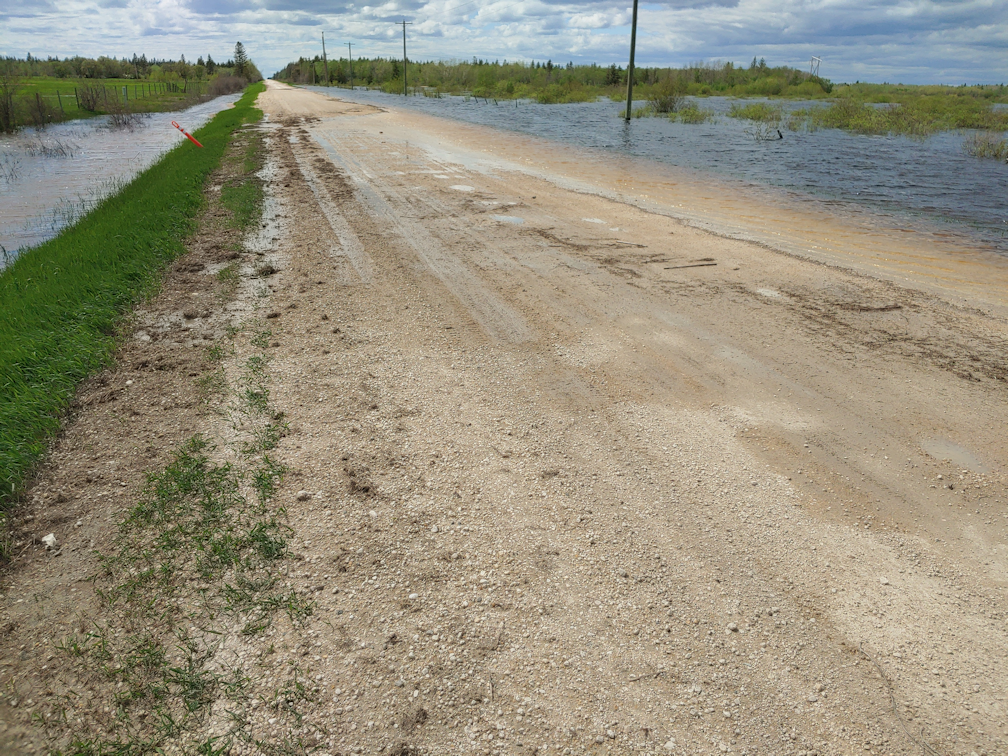
All that rain we’ve been having, and the road is washed out right at the patch from before – and this is after the water has gone down quite a bit. There’s actually 2 washed out areas. Not as bad as before, though, and I’ll be able to get through with my mother’s car tomorrow, when I had to take her to her doctor’s appointment.

What I forgot, however, was that today was Wednesday.

The store the post office is in, closes at noon on Wednesdays.

Hopefully, the order hasn’t thawed out yet, and they’ll be fine. With tomorrow’s appointment, I am hoping to be able to pick them up after I’m done with my mother’s medical appointment, but it’s hard to say right now.

Not getting to the post office wasn’t a wasted trip, since I did at least confirm the roads are passable.

Once at home, it was back to work.

The next potatoes to do where the All Blue.

This time, I had a daughter able to come out and help. With the Bridget potatoes, with the larger potatoes being cut into smaller pieces, there was a total of 67 to plant, so I had 6 rows of 10 and 1 row of seven.

Having the potatoes chitting in egg trays makes it easy to count them. The flats hold 30, and the carton holds 18, plus extras in the lid. There were 81 in total, so I made 8 rows of 10, with two little ones planted together.

Here are both beds of potatoes done. I have bamboo stakes marking where the potato rows end. These beds are the size of the traps that we lay on the ground to start killing off the grass and weeds. The Bridget potatoes took up half the bed, while the All Blue took up just over half of the second bed. That means we have space to transplant into, in the rest.

While my older daughter and I were working on that, my other daughter worked on the strawberries.

This area is where we had potatoes in grow bags, last year. The soil they grew in was used to create this new bed. I was thinking of planting some of the sweet potato slips here, but we’ll put all of them in grow bags now, so this one can be for the white strawberries.

It needed a bit of weeding, then my daughter planted the white strawberries, which had 10 root stocks in the package. They are lightly mulched for now, and will get more mulch after they have grown fairly large.

She also planted the red strawberries.

I’ve read the strawberries and asparagus grow well together, so they went into the purple asparagus bed. This had a heavy straw mulch which got pulled off completely. After finding where the asparagus were (you can see some of them in the photo; the heavy mulch blanched them somewhat), my daugher weeded around them as best she could, then transplanted the strawberries where she could be sure that no asparagus would be growing through them.

One of the strawberries has already started blooming!

The bed got mulched with wood shavings, then some of the old straw mulch got places around it, partly to keep the weeds down, partly to hold the soil in place, and partly because the soil around the bed is so buddy. It will get more mulch later on.

After all the potato planting, I was tired, but I couldn’t help myself. I had to do one more.

The bed next to the asparagus was planted with strawberry spinach last year, but all we got was weeds. I pulled as many of those as I could, then grabbed the package of sunchokes.

It was a package of 10, with some of them quite large, and others being just little nubbings!

Some were starting to sprout already.

These got planted at a depth of 3-4 inches.

They also got a layer of wood shavings for mulch, and the rest of the old straw mulch from the asparagus and strawberry bed got placed around the sunchoke bed. For this spot, not only was the surrounding soil muddy, there was standing water in places!

These beds are planted with things that can be largely ignored. The sunchokes can be treated as a perennial, depending on how we harvest them, and need little care and maintenance. We hope to propagate the strawberries over time but, for now, we can allow their runners to spread a bit, around the asparagus. We’ve got two more years before we can harvest any asparagus, so the whole bed is pretty low maintenance right now.

It’s supposed to start raining lightly tonight, then all through tomorrow. If I’m able to pick up the trees on the way home from my mother’s, we might get them in right away, even in the rain. It depends on whether they’re still frozen or not. We also need to get the grow bags ready for the sweet potato slips, which really need to be planted soon. We might be getting a rained on a bit, tomorrow!

Over the next few days, we are expected to warm up, but the overnight lows are still expected to be just above freezing. That will give us time to prep a few more beds, though we could start transplanting some things, as long as we include something to protect them from the chill nights. The heavy mulch in the beds the potatoes are in will also help protect anything we transplant into them.

There is still so much to do! But I’m glad that we at least had today to catch up a bit.

The Re-Farmer

Our 2022 garden: remaining T&T Seeds order is in

Before I get into how the rest of the day has been going – aside from “wet” – the rest of our order from T&T Seeds came in! You can read about the whole order, and why we chose what we did, here.

We got our forage radish seeds a while ago, and it was the perishable stock that had to wait to be shipped in time for planting in our zone. I never got a shipping notification. I’d actually gone to the website a few days ago to look up my order and see if there was anything to tell me when it would be shipped, so we could be ready for it. There was nothing. Not even anything to say that the seeds got shipped already. So I tried their live chat function. I ended up getting an automated reply, apologizing for being really busy, and giving me the option of leaving my email with my question, and they’d respond later. I did that, but the only thing I got in my email was a transcript of the chat that didn’t happen.

Well, something must have happened, because suddenly, here they are!

We have decided the highbush cranberry will be added to one end of the rows of silver buffalo berry, where we’d grown corn and sunflowers last year. The sweet potato slips will be split between a grow bag and a bed where we’d grown potatoes last year. The sunchokes are still not 100% decided, but I think there’s really just one spot for them; in an unused bed near the garage. We’d tried to grow strawberry spinach there last year, but that didn’t work. There are invasive that keep trying to take it over, but sunchokes have a reputation for being somewhat invasive, too, and I think they’d win out on that battle. ;-)

I also got a shipping notification for our TreeTime order. You can read about what we ordered and why, here. We’re expecting a total of 41 trees and shrubs that will need to be planted right away.

Which is going to be difficult. What came in today needs to be planted as quickly as possible, but it’s been very rainy off and on, all day today, and it’s expected to continue through tomorrow. In fact, we have started to get weather alerts.

There’s another Colorado Low on the way.

At least it’s bringing rain and not snow, though we’ve have a rather cool May, and it’s looking like June will be, too.

The warnings for our area is for heavy rain falls. Once again, the south end of the several provinces are expected to get the worst of it, as the system swirls its way east and west. There are even tornado warnings!

The transplants did not get taken outside today. They are probably okay with the temperatures by now, but being in pots, and the pots in trays and bins where they get watered from below, it doesn’t take much for rain to accumulate too much in their containers.

For the stuff that can’t be planted until after last frost, it’s looking like we won’t be able to get them out until after June 5, because of the overnight temperatures. Once they’re in and established, if temperatures dip again, we can try protecting them with row covers, but not while they are still undergoing transplant shock.

One good think about everything being in at least low raised beds: the paths may be full of mud and water, the the beds are still good.

Somewhere in there, we need a break in the rain – or at least the heavy rain – and get our T&T Seeds order into the ground!

The Re-Farmer

Our 2022 garden: peas, carrots, turnips, onions

We got some gardening done! There was a break in the rain and we quickly headed out.

My daughter had the bigger job to get the peas in. We’ll be using the pea trellis we used for the purple peas last year, as we still need to do some work on the other trellis frames. The ground was prepped in the fall, but she had to work through it to pull weeds that were trying to reclaim the space, first.

Now it just needs to have some of the wood shavings, or maybe the stove pellets, added to protect the soil surface from crusting. It’s a light enough mulch that the seedlings won’t have trouble pushing through.

The edible pod pea packet turned out to have very few peas in it. Those are between the two labels on the front left side of the trellis. The rest has pod peas in sown. There are still some seeds left of those, which will probably be planted in with the corn.

This should be the last year this trellis, and the nearby beds, will likely be used for gardening. If all goes to plan, next spring, we’ll be planting food trees here. :-)

While she worked on that, I seeded the bed that was already prepped and mulched with the stove pellet sawdust.

My priority was to get more carrots planted, as they should have been started a while ago. I marked out short rows (making things more like square food gardening), as well as a perimeter line. I started with the Black Nebula carrots. The packet had a nice amount of seeds, and it filled about half the bed, which is about 14-15 ft long. Next, I planted the Uzbek Golden Carrots, which came as a freebie from Baker Creek. There were very few seeds in the freebie packet, and I was only able to plant 4 short rows. For the rest, I planted the Gold Ball turnip, which we got as a freebie from Heritage Harvest seeds, and the Purple Prince turnip at the far end of the bed. I still have some Purple Prince seeds left, but the others in the bed got used up.

We planted the last of our onions started from seed already, so for this bed I used the onion sets I picked up at the grocery store as back ups. I got two boxes of yellow onions – no variety name is on the box – and it took almost all of them to fill the perimeter at 3-4 inches apart. The bed got hosed down to settle the soil over the seeds and onion sets, then support posts were hammered into the ground to hold the netting, after cord is strung through the holes in the posts, and crisscrossed over the middle. This bed will not be getting anything else added to it, so it can be covered sooner rather than later. The other beds have room for transplants in their middles, so they will get their net covering once that is done.

In planting the onions, I naturally was able to grab the biggest sets, since they tended to be on top, so when the bed was completely surrounded by onion, I had a pile of tiny onion sets left behind.

Well, we can’t let those go to waste!

They went into the retaining wall blocks. Two already have shallots in them. After pulling weeds and roots from the empty blocks (the others that look empty had mint transplanted into them in the fall) and adding the wood shavings, I had 6 blocks ready. I was able to fill 5 of them; 4 with 4 onions each, and one with only 3. That one block at the side is still empty. There is a matching block at the other end that doesn’t have anything planted in it, but it looks like it has chives coming through!

We have one box of red union sets left. Depending on where they end up being planted, if we have any left over, I’ll be finding space of them here, too.

The bunching onions planted in the bed along the retaining wall are still looking wimpy after transplanting. Hopefully, all these onions will make things too stinky for the grogs to want to go after the lettuce and beets. A groundhog could easily tear through the net, if it really wanted to. It’s going to be the big garden area that will be the most difficult to protect, however.

~~~pause for real world interruption~~~

My older daughter and I just finished bringing the transplants in. We have so many strong, healthy tomatoes! It’s going to be a challenge to plant them all, since they’ll mostly be going into new beds. Maybe that’s where those grow bags and fabric raised beds will be the most useful!

We’ve got our work cut out for us, but I don’t know how much I’ll be able to do tomorrow, as I’ll be heading to my mother’s to help her run errands. She is suddenly taking her back no longer hurts – I guess it took that long for the meds to have their effect, but she still says that when she takes them, they do nothing. She feels up to going out for her errands, though. She has her telephone doctor’s appointment, so I will probably go over there early enough to be there for her appointment, in case she needs things explained to her.

The question for me will be, can her car make it through that one muddy spot on the road? I might have to take the van, even if my mother will need a stool to get in and out!

The Re-Farmer

Our 2022 garden: beds prepped, spinach, onions and turnips sown

With a steady rain all night, we’ve got a lot of standing water and mud in the yard again. The straw mulch where we will be planting our 5kg bags of potatoes got well soaked, though, so I don’t mind.

This afternoon, I finally had a chance to work on the garden again, and I’ve got some thing figured out, too.

The spinach sown in the high raised bed has started to sprout. There was room for one more row of spinach, so that got planted today.

Then it was time to work on the low raised beds.

We are well behind on direct sowing our cool weather crops, so I focused on the 2 1/2 low raised beds that my daughter and I had gone through, pulling out as many roots and rhizomes as we could. A few that we missed started growing again (there will always be some of those!), so I pulled out some more, before leveling the beds out. I decided to use the stove pellets as mulch for these beds. After leveling the soil in one bed (the back of a fan rake is great for leveling the soil), I’d scatter some pellets as evenly as I could over the bed, soak them with the hose, then work on the next bed. It generally took about 3 soaks before the pellets had expanded and broken up enough to be spread evenly with the back of the rake.

It always surprises me just how much sawdust is packed into those tiny pellets!

Once those were done, I gave them one last spray with the hose, then moved on to what will be a deep mulch bed for the 1kg package of potatoes. We had considered planting those in the low raised bed by the compost heap, but have decided the kulli corn will go in there. It’ll be easier for us to put a barrier around the wooden frame to keep the critters out. Potatoes need no such barrier.

In our second summer here, we started preparing an area for future gardening by mulching the area heavily with straw, and trying to kill off as many weeds as possible. You can read about those preparations here, here, here, and here.

Yeah. It was a big job, spread over months.

The next summer, we had our first garden, and all along the north side, we planted a row of birdhouse gourds. We’d started them indoors, but I thought our last frost date was May 28, the same as a town to the east of us, only for us to get hit with a frost on June 2 – which was the last frost date for a town to the north of us (our own little hamlet is too small to be on any of the frost date lists). The gourds didn’t really survive, and since then, this particular area has not been planted in.

The straw you see raked aside in the above photo has been there for 4 years.

The area was still mostly clear of crab grass, though I spent some time pulling those out. With the straw layer, the rhizomes tended to be running across the surface of the soil, so that made it easier to get them.

I knew we had a few moving boxes left in the basement. I thought there was three left, so I cleared an area to roughly match how much I thought those three boxes, opened flat in a single layer, would cover.

I was wrong.

There was 5 boxes left, so I laid them down folded in half, to get a double thick layer. This should be more than enough for the smaller amount of potatoes.

After soaking the cardboard, I put most of the old, wet straw back, then topped it with some newer straw to get a good, thick later.

This bed is now ready for potato planting.

While I was working on this, the girls got the fire pit going, and I finished just in time for a wiener roast. :-D

We’ve used that fire pit in the past month, almost than we’ve been able to in the past 4 years. No fire bans, this spring!

After the girls made sure I was fueled up, it was back to the low raised beds. Time to do some planting!

Look how big that garlic is!! They are just thriving, here.

For this half-bed, I marked out a grid, but planted in rectangular boxes. I started with some spinach – a variety called Space – planted around the middle of the bed. There are still some seeds of this spinach variety left, if we want to sow some for a fall harvest.

One those were in, the outer perimeter, I planted some onions. These are Red of Florence; the last of the onions we started from seed.

The centre of the bed was left empty. Later on, we’ll put in plants that we won’t be harvesting leaves from, or harvesting many times. Perhaps we’ll put some eggplants or peppers in the middle. There’s room for only a few plants in this half-bed.

There will be more room in the next bed.

The centre row was marked, but nothing is planted in it. On one side of the centre line, a third variety of spinach, Lakeside, was sown. On the other side, Tokyo Silky Sweet turnips were planted. Then, all around the perimeter the last of the Red of Florence onions were planted.

The onions being planted around the perimeter like this is to dissuade critters at least a bit. That is not our first defense, though.

These will be covered with netting. I’m not sure the bamboo stakes will hold those hoops very well, though. Trying to push them into the ground, I kept hitting rocks. In one spot, right at a corner, I just couldn’t get around a rock, so that one is more shallow than I would prefer. A couple of stakes broke while I was trying to push them into the ground. Since I couldn’t get them very deep, I ended up having to break the tops off of the rest, to be able to put the hoops on them.

Later, bamboo poles will be tied to the centre of the hoops to hold them steady and hold up the netting when it’s added on. Not until after something has been transplanted in the middle.

For the long bed, I grabbed pieces from the canopy tent that was dismantled. Those were easier to pound into the soil. Literally. I had a piece of would I could use as a mallet, and got them in pretty deep.

With the logs bordering the bed, the supports aren’t spaced very well. For the ones in the middle, most had to be squeezed into the spaces between logs. Which is fine. After something is transplanted in the middle, cord will be strung through the holes in the supports around the perimeter, then criss crossing across the middle to support the netting. With them so oddly spaced, it’ll be wonky, but it’ll work.

The ground staples will be used to tack the net down , but we still want to be able to easily life the sides, to harvest greens as needed.

The third bed was left for tomorrow. We have 2 more varieties of turnips to plant, or I might do carrots, first. They should have been sown about a week or more ago!

Beds will continue to be bordered by onions from sets. I’ve got 2 boxes of yellow onions and one of red onions, so there is plenty to go! :-)

The other thing that really needs to get done are the two varieties of peas. Hopefully, it won’t get too hot for peas over the next while! Meanwhile, we need to get those potatoes into the ground.

The next few weeks are going to be very busy in the garden! Lots to go in, in a very short time.

The Re-Farmer

Our 2022 garden: sad garlic

I’m mentioned in previous posts, that two of our garlic beds are not doing well. We planted all three beds at the same time, last year.

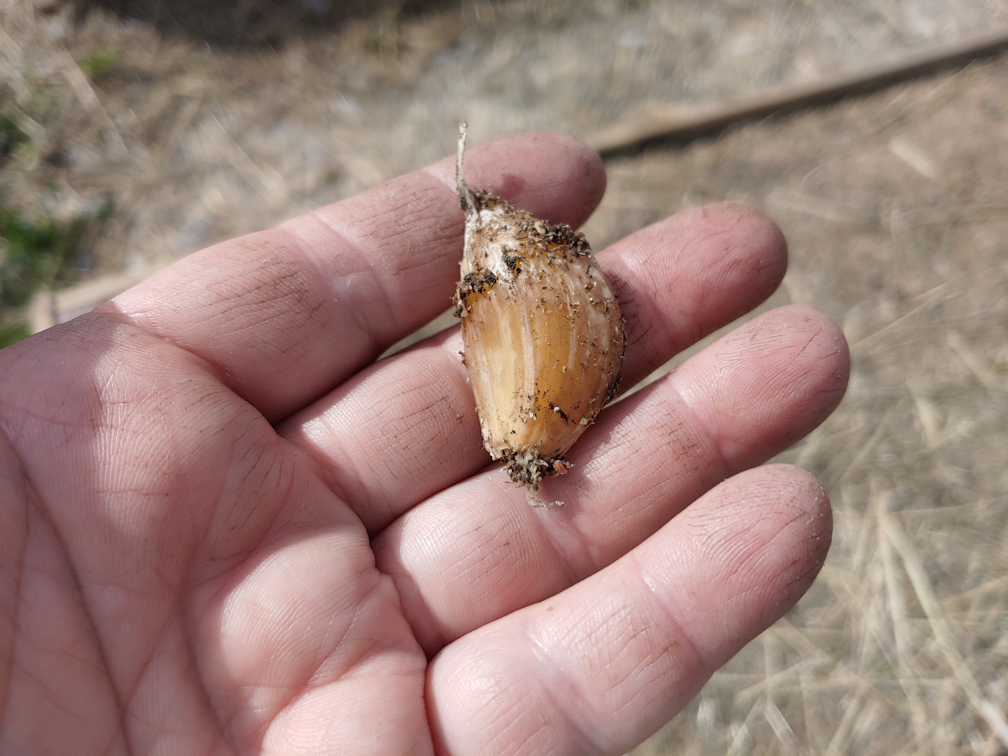
While doing my rounds this morning, I caught one of the yard cats being… inappropriate… in one of the low raised bed and chased it off. On checking the damage, I saw it had dug up one of the cloves we planted last year.

That is most definitely a dead clove. You can see that it had started to sprout, which would have been the fall growth before the snow fell. It does seem like cold killed a lot of these off.

This garlic is from the bed planted with Rocambole garlic.

There were 90 cloves planted in this bed. This morning, I counted maybe 7, including what looked like a tip just barely breaking through.

The bed with Purple Stripe in it is doing a bit better, in that there are more emerging, but it still looks like less than half have survived the winter, and they are all so very tiny.

I am curious as to why these beds did so poorly over the winter, while the Porcelain Music planted in the low raised bed in the main garden are doing to very well right now. Could it be, that the slightly higher boxes offered less protection than the lower, log framed bed?
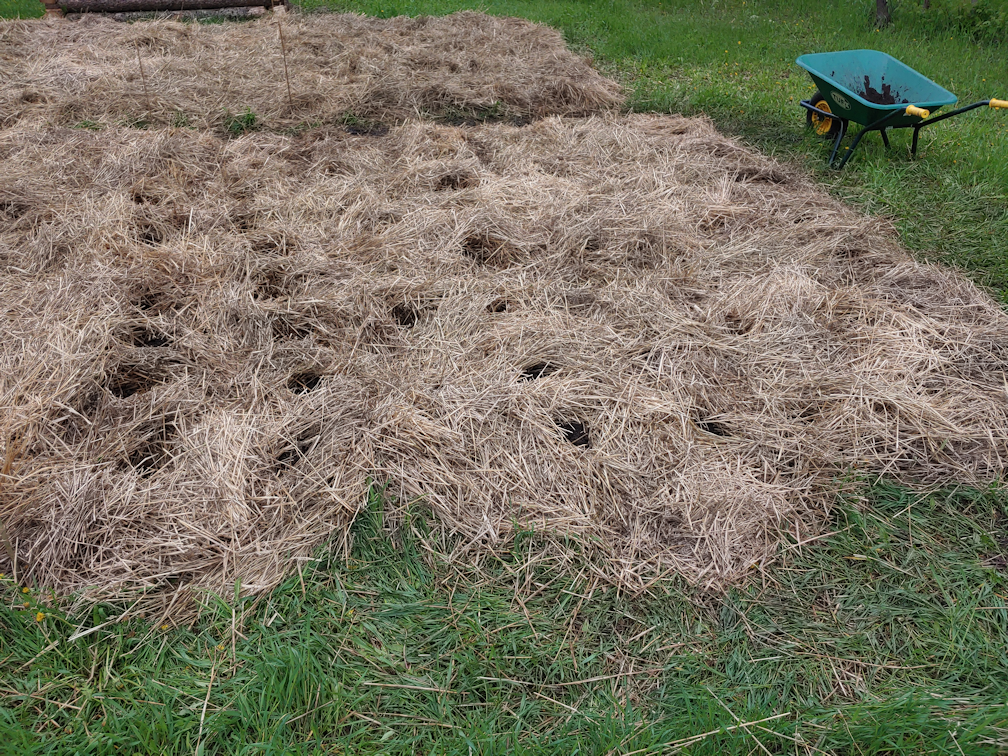
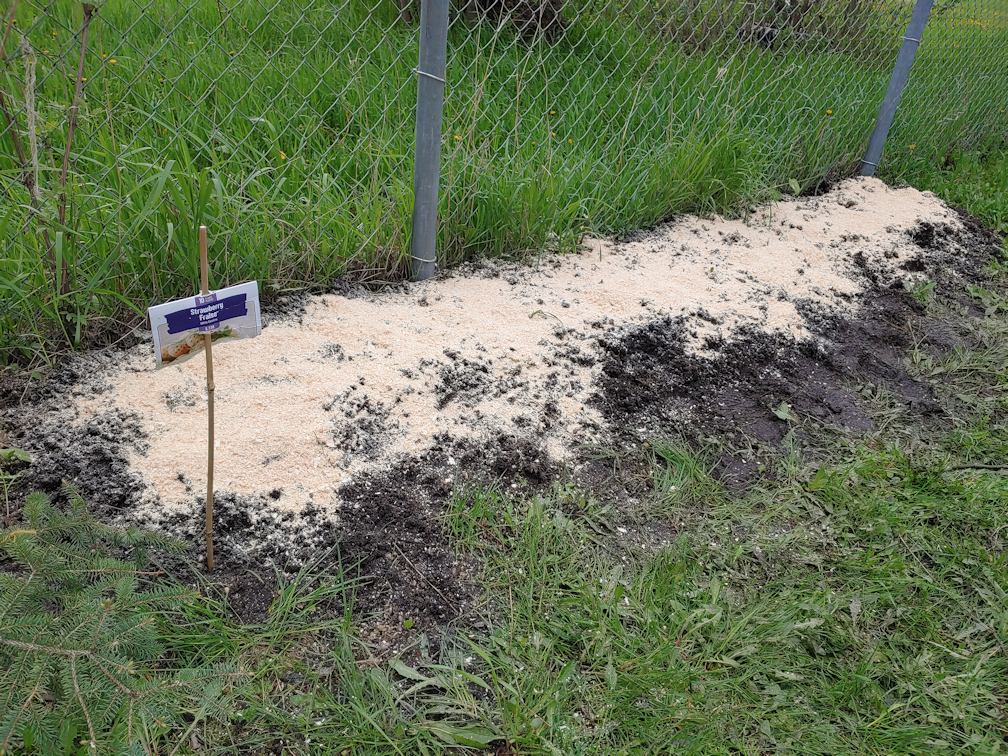
Well, whatever the reason, I hope what few have survived manage to do well, even if they are quite a bit behind in growth. It may just mean we’ll be harvesting them later in the summer.

The Re-Farmer