Analyzing our 2023 garden: peppers, herbs and greens

We tried a whole bunch of new things in this category, this year! It was the peppers that we were particularly interested in getting going.

Peppers are something I’m growing for the rest of the family – I can’t eat peppers myself, much like I can’t eat fresh tomatoes. Which is unfortunate. I love the shape and smell of them, and when I’m prepping them for the family, they look so fresh, crisp and delicious! Yet every time I’ve tried to eat a pepper, it makes me gag. Even when they’re cooked, I still find myself wanting to gag, which is not a problem with cooked tomatoes. Oddly, though, I can eat jalapeno poppers, and quite love them. How does that make sense? My husband and daughters, meanwhile, love their fresh, raw peppers. So I wanted to try a variety of bell peppers this year, plus my daughter specifically requested hot peppers.

We did try to grow peppers last year – our terrible, no good, growing year! – and almost got some purple peppers. Just a few tiny, misshapen ones off of plants that did not thrive in a bed where nothing really grew well. They pretty much did the best of all the stuff we planted in that bed.

We did still have some of last year’s seeds left, but this year we went with new varieties.

One was the Sweet Chocolate bell pepper. I also ordered a collection of early sweet peppers, for their short growing season – Early Sunsation, Early Summer, and Dragonfly, all of which are different colours. For the hot pepper, we got a variety called Cheyenne.

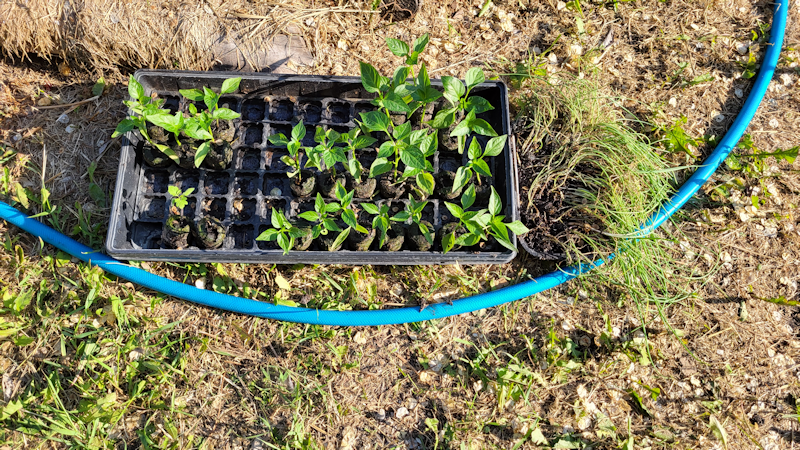
With our short growing season, the Sweet Chocolates got started indoors quite early, along with some gourds and herbs.

The German Winter Thyme and the Lemon grass both needed an early start, too. Lemon grass is a zone 8, heat loving plant, so those were going to go into a pot in a sunny and sheltered location, when it was time to transplant.

With our short growing season, these were all started in early February. A lot of people on my local gardening groups started their peppers in January! The other varieties we had were specifically for our short season, and I must say, I had to really fight with myself to not start them until much later! Those got started in late March. In theory, I could have direct seeded them.

After filling 4 rows, I filled the last two rows with Spoon tomatoes.

We started a lot more seeds than we needed, on the assumption that they wouldn’t all germinate.

Well, we had pretty much a 100% germination rate!

As for other herbs, in early April we started oregano, spearmint and the Roma VF tomatoes.

We tried these in toilet paper tube pots, which we hoped would allow us to pot them up/transplant them still in the biodegradable tubes, without disturbing the roots.

Finally, we started chamomile seeds and a nameless variety of thyme, towards the end of April.

The first ones to be transplanted outside were the Sweet Chocolates, into the new wattle weave bed.

The peppers got protective plastic rings around them, as this was well before our last average frost date. I eventually needed to add sticks to keep the wind from blowing them askew, later adding supports for the peppers as well.

In front of the peppers, you can see where the German Winter Thyme was planted. At the end of the bed are the last spindly shallots. Beyond the thyme is an onion that came up on its own! Later, the chamomile would be transplanted near where the single onion is, as well as the strawberries from seed planted in between things all along the front of the bed.

As the days flew by and we weren’t getting other things ready as quickly as planned, I ended up planting more peppers in the wattle weave bed, just in case.
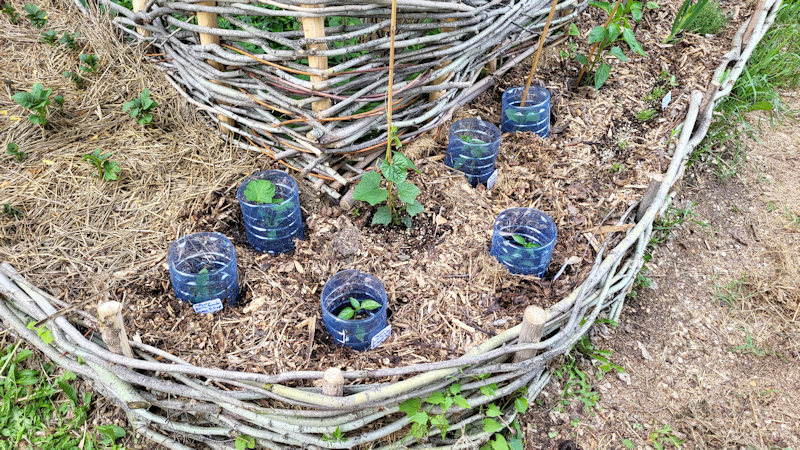
I chose one each of the early bell peppers, and one hot pepper. They got plastic rings to protect them, along with a couple other things I will cover in a different post.
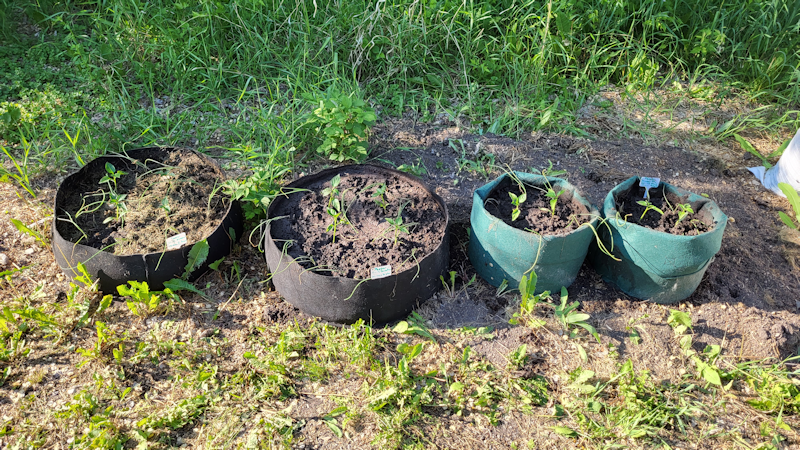
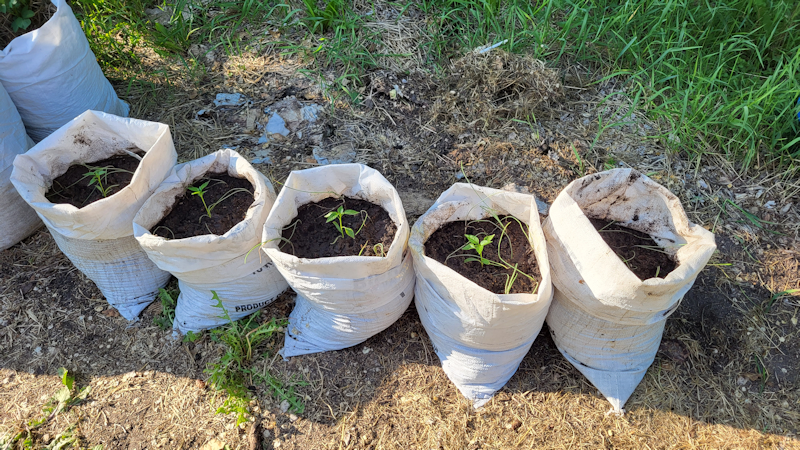
We did eventually transplant more of the peppers in grow bags, together with Red of Florence onion, but we had so many seedlings, they were included in the Great Transplant Giveaway!

Some things, however, did not need to be transplanted at all, and could be direct sown. When it came to greens, we were actually going to skip trying to grow lettuce this year, and just grow spinach.

Spinach can be sown before last frost, so they went in, in late April.

After the seeds were sown, the bed got a floating row cover, to protect them from critters. This was just a dollar store row cover, and it tore astonishingly easy!

We did enjoy some nice harvests of the spinach, too. At least, with these first ones. After the garlic was harvested, spinach was one of the things we planted for a fall crop, and we got nothing. I think something ate the seedlings!

We found ourselves with some free seeds that we decided to try. One of them was a tiny variety of Bok Choy called Hedou. The other was a Czech variety or lettuce called Jebousek.

So how did it all work out?

It was a mixed bag!

The Peppers

The Sweet Chocolates, having been started indoors the earlier, had a head start, grew quite large and were the first to have mature peppers we could harvest.

The first ones we harvested were in August. They can be eaten while still green, but we waited until they turned the chocolate brown they were supposed to, when mature. They bloomed continuously, right up until the first frosts started to hit. We did try to cover the peppers on chillier nights, and that helped. Their location in the wattle weave bed was also much more protected than the grow bags in the garden.

As for the short season varieties, they did not do as well. The ones in the grow bags started off all right, but then sort of stagnated. We did get a few Dragonfly peppers to harvest, and there were other peppers developing when the first frosts hit.

The hot peppers had the most fruit developing, but all of the peppers planted later were slow in maturing. In the end, we harvested everything unripe and set them to finish maturing indoors.

We had mild temperatures extending for quite a long time, though, and the final harvest was in October! In the photo, you can see a couple of purple Dragonfly peppers, and the rest that are visible are the Sweet Chocolate. There were hot peppers under there, too. Unfortunately, we covered grow bags too late one night, and the frost caused too much damage.

Once indoors, the green peppers that were not frost damaged did continue to mature. As I write this, we have a few hot peppers left that have turned red. The Sweet Chocolates are the only remaining bell peppers, they’ve all matured, and are currently strung up to dry. The rest were either already eaten, or had to be tossed due to frost damage causing them to start molding.

When cleaning up the garden beds for the winter, I discovered what I think may have been the reason the grow bag peppers and onions failed to thrive. I discovered the soil was filled with tiny tree roots that had grown in from below!

They were all like this grow bag, turned inside out.

No wonder they didn’t thrive!

As for the ones in the wattle weave bed, the hot pepper seemed to do fine, though late in developing, but the others seems to stagnate, too, and I’m not sure why!

Final thoughts on peppers

When it comes to the bell peppers, the family isn’t really finding enough difference in flavour to say they like one variety over another. They all just sort of taste the same, so they don’t really care what variety we grow next! I do have a request for hot peppers again. We still have seeds for all of these, so we don’t need to buy more, if we don’t want to. If we do grow the short season varieties again, I will most definitely start them indoors earlier. We’ll also have to be more thoughtful on where to plant them, to ensure they get shelter and a warmer microclimate. We might use grow bags again, but if we do, it won’t be anywhere near those trees again!

The Herbs

Our eventual goal is to turn the old kitchen garden into mostly an herb garden, along with other things that we might use in the kitchen frequently. This garden is right next to the house and sheltered, and gets lots of sun, except where the ornamental crab apple trees are an issue. Those will be pruned back more, over time. It also now has all low to mid height raised beds, with the possibility to add height to some of them, as needed.

The German Winter Thyme did quite well in the wattle weave bed, except for one transplanted group that suddenly died part way through the summer. The Chamomile also did well, and was blooming enthusiastically.

The spearmint got its own pot. We had only one oregano seedling survive – barely – so it was planted in the middle of a pot and surrounded by the other variety of thyme. The Lemon grass got its own pot, too. Everything in the pots seemed to do surprisingly well, though the Lemon grass didn’t get anywhere near as large as they should have.

Final thoughts on herbs

There’s really been just one problem with the herbs we grew.

We keep forgetting about them.

Which means, we weren’t using them.

Oh, we did use some thyme, oregano and a bit of spearmint, during the few times we remembered them. We didn’t use the chamomile or lemon grass at all. We weren’t sure when to best harvest the chamomile, which we wanted to dry for tea, and I never got around to looking it up, because I kept forgetting they existed. My daughter were wanting to try the lemon grass, but weren’t sure how to use it with the type of cooking we tend to do.

I don’t know about the chamomile, but with mulching the wattle weave bed like we did for this winter, it’s possible the German winter thyme will come back. The chamomile may have reseeded itself.

We never bothered doing anything to the pots. I suppose it’s possible the spearmint and thyme will come back in the spring; we’re having a very mild El Niño winter, so the pots shouldn’t freeze solid. I doubt the oregano will survive, though being in the middle of the pot, it’s more protected than the thyme around it.

These are all herbs I want to continue to grow, though, and as we further develop the old kitchen garden, I think we’ll get into the habit of using fresh herbs and not forget that they exist!

The Greens

With the spinach, they did better after we gave up on the floating row cover. Thankfully, no critters seemed interested in them! We’ve had spinach do both really well, and really poorly, and that happened again this year. The spring sowing was fine. The fall sowing was a complete fail.

We’ll definitely keep growing spinach, though. It’s just a matter of where, and making sure critters don’t get to it!

As for the lettuce and baby Bok Choi…

What a disaster!

Oh, they started sprouting just fine.

Then the Chinese elm started dropping their seeds.

There are four of them along the chain link fence, plus one by the house, plus more past the garage.

When those seeds start falling, everything is covered. The emerging seedlings were buried and choked out, and there was nothing we could do about it!

Those trees have got to go. They are causing all kinds of damage, with their billions of seeds and their sidewalk heaving, basement wall cracking roots.

Much to my surprise, however, a couple of baby Bok Choy actually survived and promptly bolted.

I left them be as they developed seed pods that managed to dry before the first frost hit. I was able to save some seeds!

There was a surprising number of Jabousek seedlings that survived! Enough that we even used some of the leaves in sandwiches. They didn’t seem to get bitter, even after bolting.

Once they started blooming, I left them be. Unfortunately, it took such a long time for their seeds to develop, they got hit with frost, first. I suppose it’s possible the earliest bloomers dropped seeds, but that bed is going to be reworked in the spring (I held off to let them finish producing seeds) to make it narrower, so it’s unlikely that any seeds dropped will germinate. We probably won’t grow any lettuces next year, but I certainly won’t complain if this variety shows up on its own!

I most definitely want to try growing the Bok Choy seeds we kept. We never got to try them, and I’m very curious! We do like Bok Choy, but very rarely buy it.

So that’s it for peppers, herbs and greens and, I must say, getting this written was brutal! It took me all day, just to get started, as so many things kept popping up that needed to be done. Then, once I did finally get started… I swear, I’ve never been interrupted while writing so many times in my life! Most of which was because I saw on the critter cam that racoons were in the sun room. !!! I did try using the talk feature to yell at them, and they did leave at first, but after a while, they’d just look towards the camera, then ignore my voice!

If anything I’ve written here seems at all disjointed or not to my usual standard of writing or its full of typos that I’ve missed, that would be why! 😄😄😄

The Re-Farmer

Our 2024 garden: first seed order in! Veseys

Yes, I just place our first order of seeds for next year’s garden. We might not need to order many seeds this year, considering how many we have left, but one thing we were out of completely was onions. Onions seeds only last one year, anyhow. Plus, today is the last day I can use the promo code from Maritime Gardening to get free shipping. 😁

This is what I ordered today.

I’m trying a new variety of yellow onion this year. Frontier. From the Veseys website:

Incredibly strong necks and consistent size! Frontier is a standout variety with our trial staff. Bulbs are golden, large and uniform with small necks that cure quickly. Ideal for fresh and storage markets, Frontier is long day hybrid onion with superb disease resistance. Matures in 100 days from transplant. Approx. 200 seeds/pkg.

(image belongs to Veseys)

I’m also trying a new type of shallot this year. Creme Brulee. From the website:

First Shallot AAS winner! An elongated shallot, Creme Brule has a citrusy flavour when eaten raw but when cooked, sugars are enhanced and do not leave an overpowering aftertaste. Bulbs are 4-5″ with a coppery pink skin. An attractive, easy to peel echalion, perfect for the home gardener or market grower! Matures in 95-100 days from transplant. Approx. 150 seeds/pkg.

(image belongs to Veseys)

I do still plan to try the Red Whethersfield onions again, and will probably get Red of Florence again, but those are from a different source.

Of course, I didn’t get just onions! I also got:

Yes, we will be trying to grow melons again (I’ll have a garden analysis post about this year’s melons coming up soon). We still have seeds, but I decided to get the Summer of Melons Blend. From the website:

Veseys exclusive! Best for the home gardener. This blend is the ideal solution to stretch out these beautiful summer flavours. It begins with sweet, early maturing hybrid varieties then keeps going through summer and into early fall. Maturity ranges from 75-85 days from transplant. Approx. 20 seeds/pkg.

(image belongs to Veseys)

I like having a variety, and having melons that mature at different rates – while still within our short growing season! – is bonus. It’ll also be a surprise, since the varieties included aren’t mentioned!

Finally, I got one more mix of seeds.

Yeah, me and my winter squash obsession! This is the Wild Bunch Mix Winter Squash. From the website:

Veseys exclusive! Great range of colours and sizes. This exclusive Veseys blend contains a riot of shapes, sizes and colours that will bring your fall display to the next level. Some of the weirdest and wildest looking squash that we have seen in our trials. Ideal for both home and market gardeners looking for a great display without having to buy separate varieties. All are edible, and are strong vining types so they grow well together. Approx. 20-25 seeds/pkg.

(image belongs to Veseys)

I’ll have a garden analysis about our winter and summer squash, too, which was a real hit and miss situation. We do still have lots seeds from what we grew (or tried to grow) this past year. I have zero interest in having a “fall display” (who would we be displaying it for, anyhow? 😄). I like to try new varieties, but am hesitant to buy an entire package of seeds for something I’m not sure of. This way, we get just a few seeds of different varieties to try and – if they make it! – see if we like them enough to order more in the future. At some point, we’ll settle on one or two favourites and save our own seeds. Until we get to that point, we would be dealing with cross pollination, so any seeds we save as we’re experimenting would give us different results that may not be as good.

Just a small order for now. Soon, I’ll place another order for the red onions, so that we’ll have all the seeds ready to start them in January. Because, where we live, gardening starts in winter!

Oh, wait.

It’s not even officially winter, yet!

The Re-Farmer

Red of Florence onions, finally processed!

Yes, all this time, the Red of Florence onions we harvested awhile back have been sitting on a screen in the old kitchen. With how cold it gets in there, they’ve been fine, and we’ve been using them as needed, but it’s starting to get too cold. Today, I was finally able to finish processing the last of them.

You should be able to go through the slide show of images above.

The first step was to cut away the shriveling green parts and the roots. When I was done, the bulbs filled my giant colander in a heap!

While I was working, the cats in the sun room were going nuts, trying to see what I was doing, so I opened the door and let them in with me. Quite a few came in to explore! One of the males is aggressively friendly. I was using the top of the chest freezer as a table. He jumped up onto it and was eager for pets. Thankfully, he was okay with head boops and arm rubs, because my hands were busy. If, however, I reached for the kitchen shears beside him instead of petting him, he would attack my arm! He even started biting, so I had to take him off the freezer repeatedly before he finally stopped.

Once the screen was clear, I had to figure out what to do with it. We made this as a barrier for the old basement door, so we could keep it open and allow cool air to circulate, while also keeping the cats out. It’s made with 1 inch wire mesh. I took it into the sun room and figured out a way to use it for the cats. It is now resting on one level of the shelf in front of the window on one side, and the cat cage on the other – though it did need propping up on the cat cage to make it level. Hopefully, it’ll stay. I then took a spare sheet of rigid insulation and cut it slightly longer than the screen. With how the frame and centre support is, I was able to fit the insulation under the screen, in between the long sides. The sheet was just narrow enough for that. Without support, of course, it started to sag, but this sheet had been used for something else and already had some holes in it. I was able to use one near the side and zip tie it to the screen, then made a couple more holes as far as I could reach on the other side and added another zip tie. Not that the cats’ weight would be on it, as the screen would hold them. It was just to keep it from sagging. The cats can walk on the wire, but there was another chunk of the insulation that I put on top, so it would be more comfortable. They’re probably scratch the heck out of it. They just love scratching at that insulation!

Before I set that up, though, I put the remains of another sheet against the window that’s missing the inner pane. It doesn’t fill it – we tried cutting pieces to fit before, but the insulation kept wanting to fall away, no matter how we tried to secure it – but it’s enough to reduce the chill from that window where it counts.

So now the cats have a sort of “cave” against that wall, covering the space we set up for them. It gives them another level to climb on that is under the shop lights. I have those set to turn on with the motion sensors, after dusk, and the insulation under the screen will help keep some of their own body heat in, underneath. Also, they won’t get blinded every time one of them moves. Yes, I have the lights set at their lowest level of brightness, but when it’s night, it still seems really bright!

Hopefully, the racoons won’t knock it off or something.

Once that was done, it was back to the onions.

The first batch of onions I cleaned up was for dehydrating in the oven. I have four baking sheets, but they are too big to fit side by side in my oven. This oven does not have an element on the bottom, though, so I was able to put a baking dish on the bottom for elevation, and that allowed me to fit three trays in.

For the first tray, I tried slicing the onions long ways and laying them out on a cooling rack in the baking tray. I could only fit about 1 1/2 larger onions on the tray that way. For the second one, I tried cutting them on the round and laying them out on another cooling rack, but they just fell through the openings. I ended up putting parchment paper down instead, the laid out the slices. The rings didn’t want to separate, so I cut the rest in half lengthwise, first, then sliced them. They still needed to be broken apart aggressively before the pieces could be spread out evenly. Still, I was able to fit about 3 larger onions on, that way. For the third tray (I didn’t bother taking a picture of that one), I just chopped the onions and spread them out. That was another 3 or 4 larger onions.

Those will take a while to dry, so the rest of the onions got chopped up for freezing. I would have wanted to dehydrate more, but chopping and freezing is a lot faster!

For that part, I tried out a trick I think I saw on Pinterest. Loading into freezer bags is a real pain. I’ve tried several different ways to support the bag, but the best I could come up with was to put it in a large measuring cup. It would still be floppy, but not as much.

This time, I got out our canning jar lifter. The slide lock part of the bags gets turned inside out, as I usually do to keep the locking parts clean. This lip then fits over the curved jar lifting end, while the flat handles act as a stand. The lifter can be opened as wide as the folded over part of the bag allows, and holds it tight. After filling the bag with the chopped onions – I fit 2 1/2 cups per size medium bag – the lifter can be squeezed together to free the top. After the flipped over part is flipped back again, the lifter can be opened wide, allowing plenty of room for the filled bag to be removed.

My goodness, I wish I’d known about this trick long ago! This was the easiest, fastest filling of freezer bags I’ve ever done!

I had to stop chopping part way through, as my back was starting to give out (yes, I even used a stool to raised one leg while I worked), which was a good time to have the supper my daughter made for me. Then it was back at it.

In the end, there were 14 freezer bags filled. All but one of them went into the big freezer. Before sealing the bags, I would close it most of the way, then stick in the short end of an elbow straw in the last gap and suck out the air to vacuum seal it. One of the bags lost its vacuum. I couldn’t see a hole, but there had to be one, somewhere. So that bag went into the fridge to use right away.

I’m quite happy with our onion haul this year. Even though one variety failed completely for some reason, we still have plenty of cured and braided onions, both yellow and red, to use throughout the winter, as well as some shallots, and now we have 13 bags of chopped onions in the freezer, 1 in the fridge, plus more dehydrating in the oven. It should be interesting to see how long this supply lasts us through the winter.

One thing about these Red of Florence onions; their shape makes them SO much easier to cut up! Plus, they taste good, so win-win!

The Re-Farmer

What a lovely evening!

And a lovely morning, with faces like this, saying hello.

Unfortunately, he was just in some sort of altercation – I never heard a thing, but my daughter went running outside, earlier. There’s a puncture wound on the paw, but he wasn’t favouring it in any way.

I tried doing a head count this morning. I counted 37! Then I counted again and got 34. So I counted again and got… 34. This count included Nosencrantz (yay!), Rolando Moon (yay!) and Shop Towel (boooooooo!!!). Shop Towel is the likely cause of that puncture wound.

We had a fantastic time, yesterday! Having company for a cook out gave us the excuse to do things that tend to slide, when it’s just for ourselves. One of those things was to empty the fire pit of ashes, level the bottom as much as we could, then re-set the concrete blocks that are there to hold the old oven racks we saved for fire pit cooking, as well as solidly setting up the four fire bricks we found here and there around the property, to set the Dutch Oven on, so the legs won’t sink into the ground. The ashes were dumped near the garden, to later be used in garden beds.

My younger daughter took on the job of getting a fire going, then burning it down to get the coals needed for the Dutch Oven. Since the set up for it is right near the fire itself, one side would be really hot, so she set a timer to rotate the oven every 15 minutes or soo.

It turned out awesome!

The inside of the pot was first rubbed with ghee, which can handle the hot temperatures better than, say, olive oil or normal butter. Some slices of bacon went on the bottom. The beef was seared in a pan before going into the pot – with the legs on the Dutch oven, we can’t do a sear in the pot itself unless it’s been heated over a fire/coals.

Since the meat would need quite a long time to cook, I used whole small onions from the ones we had to harvest early, because they’ve been cat crushed, whole Irish Cobbler potatoes, and big chunks of Uzbek Golden carrots. When we grew the Uzbek carrots last year, like so many other things, they did not grow to their full size. This year, they did much better! The ones I dug up for the pot were big, thick buggers! There are still plenty in the garden.

There’s a whole bulb of garlic in there – all three massive cloves of it! 😄

For seasoning, I used the truffle salt we were gifted with, and I cut up one of the sprigs of fresh pepper and scattered them about. Last off all, I added about a litre of water.

In the future, I’ll have to make sure to add more water. The photo was taken right after the pot was removed from the coals. The cast iron stays hot for a long time, and by the time we were eating, it was getting pretty black against the iron!

I neglected to take a picture of the roasted Pink Banana squash.

We also had hot dog fixings, if anyone wanted to roast some wienies, and if we were really into it, we had burger patties ready and waiting in the fridge, so there was plenty for everyone when company arrived. Especially since they brought pizzas, pie and ice cream! They also were incredibly generous and brought us FOUR big bags of kibble! 9.1kg size bags. Between that and a generous cash donation we received from a dear friend, it’s going to be a huge help with stocking up for the kitties for October.

Oh, and it looks like we have a new favourite local pizza place. They tried a place that opened in a new location recently. They’ve been around for a while, but I had no idea. I’ve walked past the previous location many times, but it was such a hole in the wall, I thought it was somehow part of the Greek restaurant, next door! There were no signs to say it was anything else. I think this new location will be much better for them. People will actually be able to see they exist!

We had a fantastic evening. We even managed to do a walk around the inner yard and garden beds before it got too dark to see.

It gets dark so fast, this time of year!

My husband was able to join us for the cook out for quite a long time. The longest I’ve ever seen him manage in ages. Of course, he then had to go inside and medicate to the gills, and he’s paying for it today, but he got to spent time with his family, and he really, really misses that. We’ve had to turn down invitations to see family simply because it’s so painful for him to travel, and he’d have to leave so quickly. So for us to have some of his family be able to make a last minute visit to our place is really, really special for him.

It was such a perfect night for it, too. Things got pretty hot during the day – our predicted 22C/72F turned out to be 25C/77F – but the evening temperatures were just ideal. Even after our company left, my daughters and I stayed out to tend the fire and let it burn itself down (leaving the most perfect cooking coals, and nothing we needed to cook anymore! 😂), because we just did not want to go inside. I felt ready to go to bed outside, it was so gorgeous! This, on the last day of September, too!

It was a bit disorienting when we did finally make it inside. After hauling everything in, putting things away, I finally started my computer, settled in and…

It was barely past 10:30pm.

It felt like it should have been at least midnight!

We did end up getting a solid rain last night, starting at maybe 4 or 5 am. The forecasts were predicting a thunderstorm today… or maybe tomorrow. Now, I’m seeing more rain in the forecast, but no storms. I’m also now seeing predictions for overnight lows of 0C/32F on Friday, when earlier long range forecasts weren’t expecting anything that low for another couple of weeks. It changed, every time I look a tthe forecasts, it seems!

We shall see.

Anyhow.

We had an absolutely fantastic day yesterday, and such a great visit. I’m so glad they were able to come out!

The Re-Farmer

Our 2023 garden: critter damage and corn harvest.

While doing my morning rounds, I found some new critter damage around. Both corn beds were hit, though not too badly. A few other things were nibbled on, including the way too under ripe Boston Marrow that I had left on the vine. It had gotten about 6-7 inches long and was even looking like it was trying to ripen since the plant was hit by frost. Now, there’s just a bit at the end of the stem left.

Thankfully, the critters seem completely uninterested in the peppers, melons, carrots and onions!

So this morning, I harvested the corn, starting with the popcorn.

In the first couple of photos above, you can see the damage. The slugs were quick to take advantage of the situation!

I did gather all the fallen kernels I could find. I don’t want them reseeding themselves in this bed.

There were still a decent number of cobs to harvest. The stalks will be used in the layers filling any new beds we manage to get done this year.

I took advantage of the chicken wire on the box frame and set out the cobs to dry out in the sun and wind. I moved the pinwheels over, to keep the birds out. We’ll bring them inside at the end of the day, as we have no place to set something like corn to cure, outdoors. Things like onions and tomatoes get ignored, but the skunks, racoons and birds would have quite a good time with the corn!

Obviously, this is still not a lot of popcorn. This is a test crop. Once things are will dried out, we’ll make some popcorn from in and see if we like it. If so, we’d be wanting to plant a whole lot more than this, to provide enough popcorn for the family! If we don’t find it’s worth it, we’ll test other varieties until we find something we like enough to keep growing.

Next was the Montana Morado corn.

Even with having a few critter damaged cobs that were worth salvaging, the losses were a lot higher in this corn. Some of the stalks didn’t even develop cobs in the first place. The few cobs we had were also set out on the wire to dry. In the second photo, you can see spots of white in places. Those are kernels that were chewed on, revealing a snow white interior!

Again, there isn’t much there, but we’ll have enough to make some corn flower to try out. I still want to try growing the South American kulli corn and acclimate it to our area, but if this corn’s flour turns out nice, I’m certainly not going to turn my nose up to a glass gem variety that’s bred for norther climates.

When it comes to growing something like corn with the goal of self sufficiency in mind, once we have found varieties we like, we would need to grow a LOT more to have enough to preserve/store. This year, we didn’t even have the space to try any of the sweet corn seeds I got! If we are going to be growing sweet corn, flour corn and popcorn, not only would we need more space to get the quantities we would need, but they’d have to be kept well apart from each other, so avoid cross pollination. Which may not be too much of a problem, since the different types of corn would start pollinating at different times of the year, but it would still be a good idea.

The bed with the purple corn still has beans in it that survived the frost. They are just there to fix nitrogen in the soil, as corn is such a heavy nitrogen feeder. I don’t plan to harvest any more of them, and the plants and roots can be left in the soil to break down, when the bed is prepared for the winter.

On a completely different topic…

As I was about to bring the purple corn to the chicken wire, with the popcorn, when I saw Broccoli going by – with three kittens following along! This would be a second litter for her, as she was among those that had kittens really early in the season. One looked like a tortie, one looked like a tuxedo, and one seems to be a long haired black and white – more black than white. I saw that one later on, in the shelf shelter, where I’d put some kibble earlier in the morning. I was only able to get a brief video, but my hands shake quite a bit, which is greatly exaggerated when zooming in.

So… three more babies. 😑 I’ve lost complete track of how many there are this year!

My next surprise was not as adorable.

I came into my room to find a couple of small bins filled with crafting material, and the stuff that was on top of them, crashed onto the floor among other things that got dragged down as they fell. A couple of the kittens have discovered the top of the wall shelf and are very determined to get up there, no matter how much I try to block it off!

After cleaning that up, I went to my computer. I don’t know what they stepped on, on my keyboard, but all the shortcut icons in my task bar were gone. Even the start button was greyed out, like when you put the cursor over it. Except, the cursor wasn’t even near it. I tried clicking on the start button, and nothing. I did get that spinning icon that shows when the computer is busy with something, but it wouldn’t stop or go away. I ended up having to do a hard shut down and just hoped it would revert to normal when restarted. Thankfully, it did, and I was able to upload files from my phone and start this blog post!

We really need to start letting the bigger kittens out of the “isolation ward”. I’d hoped to have at least a couple adopted out by now, but still no takers. The problem with letting them out is, they’d eventually make their way into the new part basement, where we keep a number of litter boxes. The girls will need to kitten proof it as best they can, first. There are places the kittens could get into that the adult cats can’t fit in anymore, where they could potentially come into harm or just plain get stuck.

Speaking of the girls, my house sitting daughter will be home in a few days! It will be good to have her back. I’m not sure she’ll feel the same, though. She’s been in a cat free house, with no one to clean up after but herself, for several weeks now! 😂😂

They’ve already got plans for a Hannibal marathon when she gets back, so she’s at least looking forward to that! 😁

Well, time to grab a late lunch, then get back outside. It’s a beautiful day out there, and I want to get as much done out there as I can!

The Re-Farmer

Our 2023 Garden: September garden tour (video)

Last night was our average first frost night, and there was no frost. The garden survives another night!

Check it out. 😊

May the frost hold off at least as long as predicted. Cooler night means things are slowing down, so if we’re going to get to harvest things, we need as much time as possible for it to fully mature.

The Re-Farmer

Our 2023 garden: the end of the Roma VF

I noticed the leaves on the Roma VF were looking like they got a fungus. I don’t know if it’s tomato blight or something else, but they needed to be pulled.

I started by picking the ripe and almost ripe tomatoes first, then my daughter and I picked the green and mostly green tomatoes and pulled up the bamboo stakes. Then she pulled the diseased plants, while I picked ripe Black Beauty and Indigo Blue tomatoes.

The green and almost green Roma are currently on the screens under the old market tent, while the ripe and almost ripe went into a box for indoors. These corrugated plastic boxes are very handy, but they have air circulation holes on the bottom and sides that are a bit big for some of the tomatoes, so I lined the bottom with carboard egg trays to keep them from falling out.

The Roma tomato plants will be allowed to dry out and will get burned with our paper garbage. That might be a while, since we are actually getting rain today! I’m even hearing a bit of thunder.

We now have a whole lot of very ripe tomatoes ready for processing. I’ll be doing more tomato sauce, first. I’m thinking of dehydrating some in the oven, late, and preserving some of the dried tomato in olive oil.

I’m still looking at recipes for making tomato sauce using roasted tomatoes and figuring out how I want to do them. I want to use as few cooking vessels as I can get away with, so there’s less to wash up! 😄

The Re-Farmer

Making tomato sauce

Well, it took several hours longer than expected, but the tomato sauce got done!

I filled my large colander with the ripest of the Roma VF we have laying on a screen in the cat free zone, as well as the ripest Indigo Blue Chocolate and Black Beauties, filling the colander to almost overflowing.

After going through a number of recipes, I decided to not blanch them first. The Roma got topped, halved and seeded first, then went into my larger stock pot. I considered doing the other tomatoes separately, but didn’t want to mess with more pots and just mixed them all together.

When we processed tomatoes last year, we blanched and cooked them, before running them through a sieve, so any seeds were no longer viable by the time they went into the compost heap. This time, I seeded them first. I expect we’ll be having some volunteers in the compost pile, next year! 😄

For the seasoning, I kept things simple. I harvested some fresh yellow onions, picking ones the cats rolled on and broke the stems, since those were not going to be getting any bigger. They were a decent size, though, and I only used three of the bunch I picked. The rest got braided and are now hanging in the cat free zone (the living room) with the garlic to cure.

I grabbed a garlic bulb that turned out to have two huge cloves, as well as a bunch of fresh thyme from the pot in the living room. Along with that, I added some freshly ground salt; my husband picked up new salt and pepper grinders to replace our old and breaking ones, and got a container of Himalayan pink salt chunks for the salt grinder, too. I also added a bit of sugar and lemon juice.

Once the tomatoes had stewed long enough that the skins could be easily removed, I sautéed the onions and whole garlic cloves in some ghee until the onions were translucent. I was going to strain the tomatoes through a fine colander I have, but I couldn’t find it, so it went through a large sieve, instead. This sieve has a quite fine mesh on it. I don’t know how much difference it would have made if I’d used the colander, since there really wasn’t a lot of pulp in there, but the end result was more like tomato juice than tomato sauce!

Which is why it ended up taking much longer than expected to cook it down to a more sauce like consistency.

All those tomatoes had filled my larger stock pot. By the time I strained out the skins, it barely filled half of my smaller stock pot. I cooked it down until it seemed thick enough, then poured the sauce into sterilized 750ml canning jars. I was able to fill two, plus maybe a third of the last jar. That one got a twist off lid. In the photo, the whitish chunks are the broken up pieces of garlic cloves. Mmmmm….

They are now sitting out to cool over night, and then they’re going into the fridge. There isn’t enough there to bother actually canning the sauce.

I think with the next batch, though, I might take the time to make tomato paste again – this time on the hot plate on the dining table, to free up the kitchen, like we did last year. I don’t expect to be making as much as we did last year, and we only got a dozen 125ml jars of paste at the time. They went over so very well, though, they didn’t last long. That’s why my original intention had been to grow so many paste tomatoes this year, and it just didn’t happen. Hopefully, we’ll be more prepared, next year!

Altogether, this took about 5 or 6 hours to finish. If we’d been working with more tomatoes, I would have broken out our giant stock pot – the one that’s big enough to brine a turkey, with room to spare – to cook down the tomatoes. That’s what I used to make the paste last year.

We still have plenty of tomatoes resting on the screen in the living room and, of course, lots more on the vines, so we will be doing this again, probably a couple more times.

I did get a bit of a nap in before I started, but I am still so very tired. I’ll expect I’ll be sleeping on the couch again tonight, too. The family did keep checking on my room, and my husband even had Snarly Marlee in the living room to give her a break from the kittens for a while, and there were no new messes. Hopefully, things will stay that way, but my mattress is still damp from the previous ones.

I so look forward to getting cats and kittens adopted out!

Speaking of which, still no sign of The Phantom. The Cat Lady and I have been discussing alternatives if she doesn’t show up, and tomorrow she plans to drop off a trap for us.

Still no interest in the kittens she shared photos of.

Since they are friendlier and easier to catch, she’s going to see about booking us to get a bunch of males fixed, next.

As much as I’d like to get the outside cats fixed and adopted out, we really need to adopt out more inside cats. Some of them are inside only because they were going to get taken and adopted out, and it just didn’t end up happening.

Ah, well. We’ll figure it out.

The Re-Farmer

Our 2023 garden: two potato types harvested

Well, the second bed of Red Thumb potatoes did better than I feared. Only a few surface potatoes had slug damage.

In the first picture, the potatoes from the wattle weave bed are on the far left. I hadn’t planned on planting potatoes there, and had just shoved the last seed potatoes that didn’t fit in the other bed in there. This bed was different in that, when it was prepared in the fall, it was topped with a mulch of wood chips. I just dug holes for each seed potato through the mulch, leaving most of it undisturbed. Then, a straw much was added on top. To harvest them, I removed the straw mulch and dumped it on the other bed I’d just emptied, but the wood chip mulch got brushed aside. After harvesting all the potatoes I could find, the wood chips and soil got pushed back and levelled off, all mixed together. The wood chips had already started to compost pretty well since last fall, and should break down even faster, now that it’s mixed in with the soil and all the worms and insects I was finding!

The second picture is of all the really tiny potatoes I was finding, plus a few slug damaged ones. They actually look far bigger in the picture than they actually are!

For now, they’re just sitting in their little piles on rhubarb leaves. I’ll figure out what to do with them later!

The Purple Peruvian potatoes should be much easier to harvest. We just need to dump them out of their grow bags and onto a tarp or something. The first time we had potatoes in grow bags, we dumped them into the kiddie pool we had, but that’s got melons growing in it right now. 😄 It’ll be a while before we harvest those. They are only just barely starting to die back right now.

We already knew we liked the Purple Peruvians. So far, we’ve only had one meal with the Irish Cobbler and the Red Thumbs, and we enjoyed them, too. They were cooked together, though. We’ll try them each on their own next, and see how we like them. At this point, though, I’d say both varieties are ones we’d be willing to grow again. When we’re at a point that we can grow enough potatoes to last us the winter, we’ll have tried enough different varieties to decide on two or three to stick to and save our own seed potatoes from.

Little by little, it’s getting done!

The Re-Farmer

Our 2023 garden: spinach, beets and radishes

I finished preparing the bed we harvested the garlic from, and sowed for a fall harvest.

I chose Cherry Belle radishes and Bresko beets. I wasn’t sure how many seeds I had left, so I brought two different varieties of spinach. I was able to sow the Lakeside variety, which is what we planted in the spring. I was so impressed with how they didn’t go bitter, even when they started to bolt, I definitely wanted to sow those again.

I used the boards I’d brought out to shelter the tomatoes from the wind in the spring and laid them out around the edges, where weeds are such a problem, as well as across the middle to divide the bed into three sections. I ended up adding a couple more boards at the ends, too. Aside from hopefully keeping the crab grass at bay and dividing the bed, they also give me something to step on while tending the middle rows.

The first thing I did was give the entire bed a watering, using the cone setting on my sprayer for more even coverage. Then I used a hoe to trench out three rows in each section. Those got a watering on the jet setting, because I wanted to drive the water deep. Even though I’d already watered the bed, the moisture didn’t get very far, and the trenches were quite dry. The water also leveled out the soil in the trenches, so they weren’t so deep.

Next, I used grass clippings to mulch along the boards and in between the rows. Once the mulch was down, I used a broken piece of bamboo stake to make the rows the seeds would be planted in.

I picked up a seeder at Dollar Tree, and this is the first time I used it. It worked rather well. In the photo are the beet seeds, which were easiest. The rounder radish and spinach seeds did sometimes get a bit out of control, though! 😄

The beets went into the middle sections, the spinach at the end closer to the house, and the radishes at the far end.

Once the seeds were in and lightly covered, I used the flat setting on the hose to water each row and settle the soil further around the seeds. The grass clippings were toasted dry in the sun, so I used the cone and shower settings to soak the mulch. Last of all, I used the jet setting to clean the loose grass clippings off the boards.

What I will probably do later is put some kind of cover over the whole thing. I think we have some mosquito netting long enough for it. I mostly want to keep the insects from eating the greens. Last year, the radishes seemed particularly vulnerable. As they get bigger, they will definitely be tempted for the deer, too!

We were at 26C/79F while I was out there. Another reason to make sure the bed got extra watering! The two northernmost rows of squash were wilting in the heat again, so I’ve got the sprinkler going on those. Squash need a lot of water, anyhow! I had been concerned that the two southern rows would have trouble because they get so much more shade, while the two northern rows basically get zero shade from sunrise to sunset. With this year’s heat, that shade it turning out to be helpful! Last year, with the flooding, it was the other way around. The squash that were in full sun strove mightily to recover from the flooding, while those in shade basically had no chance at all.

For the next week to ten days, we’re going to see increased heat. Depending on which app I look at, we’ll either have no rain at all, have several days or rain, or several days of thunderstorms! It’s awfully hard to plan things with such conflicting information!

The Re-Farmer