Today, I potted up most of our seedlings, among other things.
For the larger seedlings, I thinned by dividing, so the zucca melon and a couple of drum gourds are now in their own larger pots. The pots where nothing germinated now have new seeds in them, including the luffa on the side.
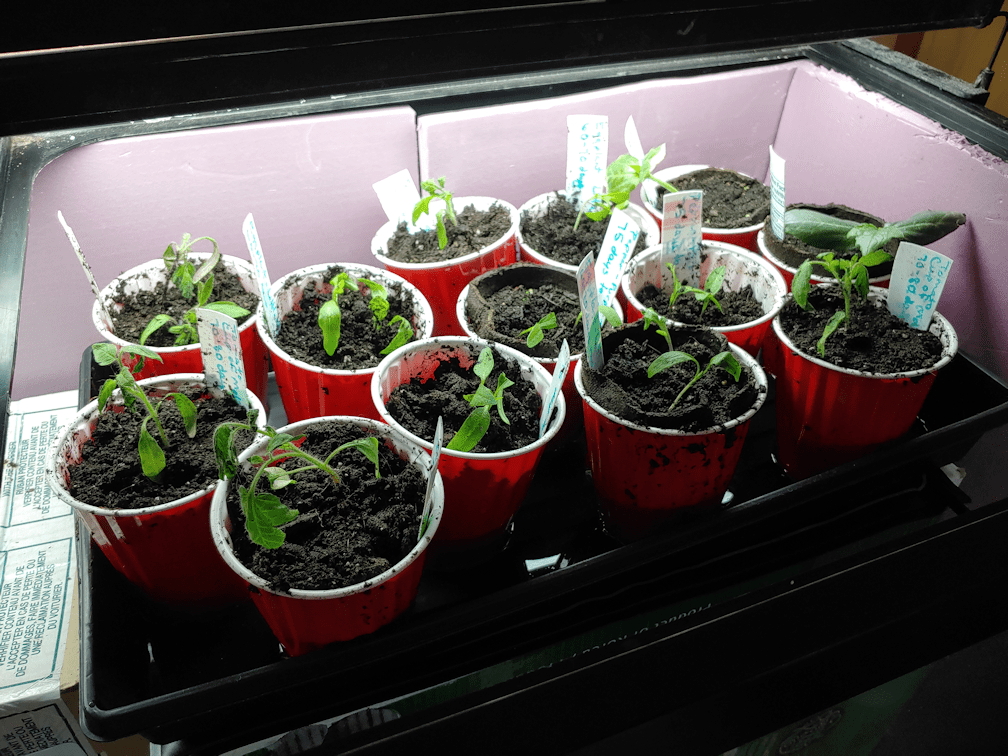
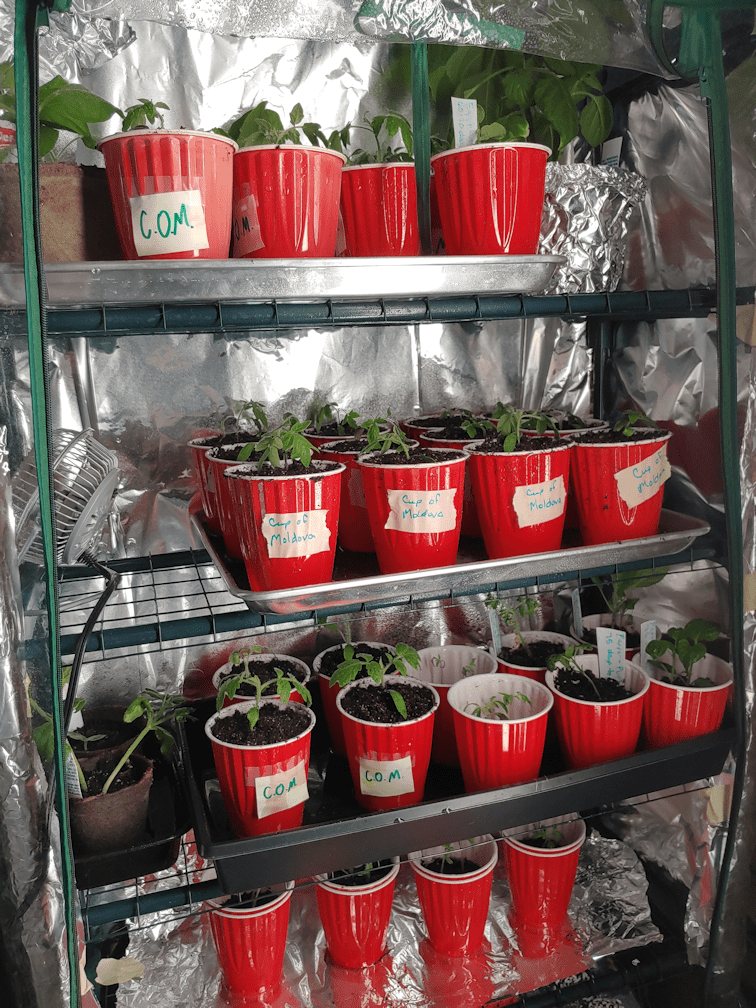
The four cells of peppers are now in 7 red solo cups. The thyme and lemongrass did not get thinned, just transplanted into deeper biodegradable pots.
I also got the strawberry kit done, and that little tray is in the aquarium greenhouse with the other seed starts. Every time I look at in there, the Black Beauty seedlings are bigger, and I can spot more of them breaking through the soil. They are practically exploding in growth! I even spotted a couple of Indigo Blue tomatoes breaking through, too!
In about a week, we’ll need to start the next batch of seeds, which will include all the remaining short season peppers and the paste tomatoes. I’m quite glad we have the living room cat proofed, so we can shift things around more freely. Yesterday, my daughter was using the room and Fenrir teleported in, as she tends to do. My daughter thought it might be okay, since she was in there to supervise. She turned her head for perhaps 30 seconds, and suddenly Fenrir had a mouth full of onion greens!
Onions are toxic to cats.
My daughter was able to catch her and get the greens before she actually ate them. Thankfully, there is no apparent damage to the onion seedlings!
So much for even one cat being allowed in, with supervision!
Today is another mild day – bright and sunny, with our high expected to reach -3C/27F, and we’re almost there as I right this. Unfortunately, we have insane winds today, and apparently for the next several days, too! My computers weather app is saying 32kmh/20mph winds, but to be honest, I think we’re getting higher than that. I’ve been eyeballing some of the trees in the spruce grove, wondering which one is coming down next, and I’ve already had to break trail through the main garden area to reclaim stuff that was being blown away. There was even a gust the blew the dining room door ajar! Not the storm door – that one stayed closed – but there was enough of a pressure change to force the inner door open. Thankfully, we have a bar latch on that door, too, so it couldn’t open very far.
Yes, the door was locked. We never use it except once in a rare while in the summer.
A daughter and I are going to be driving in this soon, as we head out to pick up some birthday pizza for her sister!
My main goal for today was to get some seeds going that need to be started much earlier. These were the ones that needed to be done.
I don’t have a “days to maturity” for the Crespo squash, which now seem to be gone from the Baker Creek website! Looks like I bought fresh seeds for this year, just in time. I still had 3 seeds left from last year, so I used those, plus three fresh ones, so there’s still some left for another year. We’ll see how the germination rate is.
I also chose only 6 Caveman’s Club gourd seeds. I took sandpaper to the large seeds to scarify them before setting them to soak. I had intended to start them soaking last night, but ended up on the phone with my brother and his wife for more than an hour, and it was quite late by the time I was done. It was worth it!
The other bowls are holding all the seeds from the packets, including both packets of Indigo Blue Chocolate tomatoes.
I had intended to use Jiffy pellets to start some of the seeds, thinking I had a full box of them, plus a partial box, from last year. I never found the full box, and the partial box had only one pellet in it, but I did have alternatives.
I was unable to find more of the larger biodegradable pots the last few times I’ve been shopping, so the 6 Crespo squash seeds were divided between my last two of those, while the smaller pots got two seeds each of the Caveman’s Club gourd.
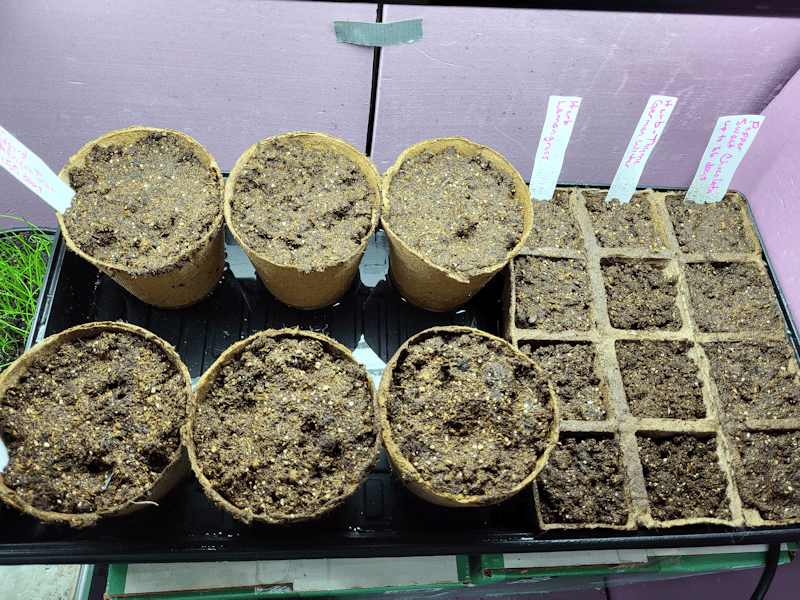
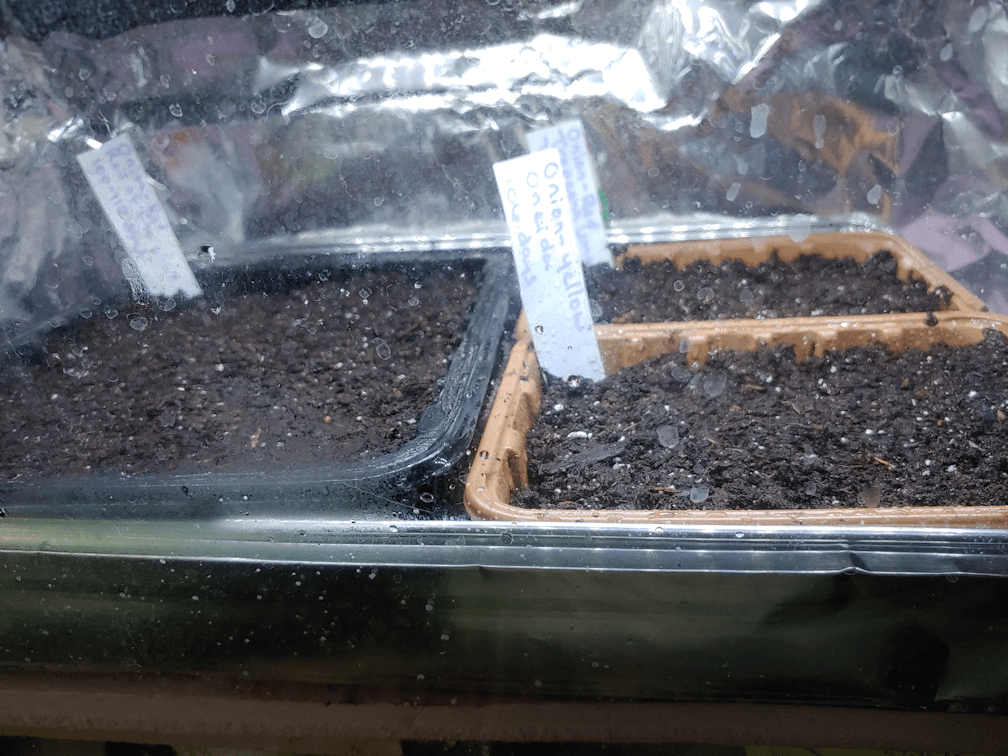
These are my last two trays of biodegradable square cells. I decided to plant more of the Black Beauty tomatoes and give them a whole tray to themselves, while the Indigo Blue Chocolate and Little Finger Eggplant are in the second one. Each square cell has 4 seeds in it.
I made sure the soil was moist before planting the seeds, then once they were in the aquarium greenhouse, I spritzed their tops, then added water to the bottom of the tray. It’s awkward to get these long trays in, as there is a divider bar across the middle of the tank’s top. After this photo was taken, I put the covers and lights back, and plugged in the heat mat. The soil was feeling quite cold while I was working with it! “Room temperature” in our living room is definitely on the chill side.
It wasn’t until I settled down to write this post that I realized I didn’t need to put the covers back on the aquarium, since the cat barriers are now in place! Except when I came out this morning, I found Tissue sitting at the inside of the latched door, waiting to be let out. Yup. She managed to pull the bottom open and squeeze through! We’ve got it blocked in that corner for now, so hopefully, she won’t get in again.
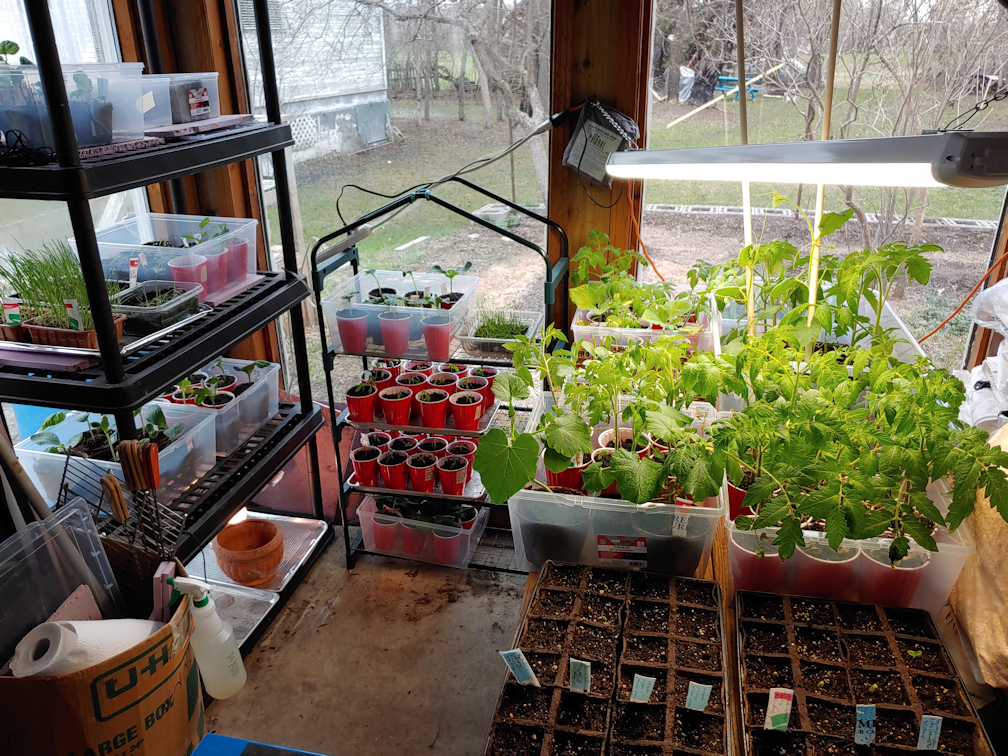
As for the other seedlings, they’ve been moved to the shelves by the window. There’s a heat vent right there, so that will help, though now that I’m done with the new seeds, I’ll have to do some rearranging. The lights are too high, so we’ll have to find away to attach cords that will allow us to have them lower, and adjust the height as needed.
Hopefully, these will germinate within the next couple of weeks, because we’ve got another batch to start before the end of March, and they’re going to need that heat mat!
What a beautiful day it is today! As I write this, we are at -1C/30F, and have yet to reach our predicted high of 0C/32F.
It’s a good thing it’s getting nice and warm. Yesterday evening, I went to set up the one of the new ceramic heat bulbs in the sun room. Before I did, I screwed it into the fixture and plugged it in, in the old kitchen, to test it.
It didn’t work.
So I took the heat bulb and removed one of the bathroom light bulbs to test it there.
It works.
Looks like the old light fixture is toast. This was something my brother had attached to a board so that he could use the heat of a light bulb to keep pipes from freezing in the kitchen, when this place was empty. We might have some other portable light somewhere that I could safely set up in the sun room, but if we do, it would be in one of the sheds or the barn, where we won’t have access until spring.
The sun room is above freezing, however, so the kitties will be fine. This morning, I counted 25!
Today I went through the packets of seeds to start indoors and selected these as needing to be started very early.
I was finding contradictory information about the Sweet Chocolate bell peppers. The package says to start the seeds indoors 8-12 weeks before last frost – but the days to maturity I found maxed out at 86 days! We could potentially start though by direct seeding by that, if the soil were warm enough right after our last frost date. I am considering planting more of them, when I do the other peppers, but we have so many varieties to try, I don’t want to take up the space, if we don’t have to.
The lemongrass will eventually end up in a large pot, while the thyme will be going into a raised bed in the old kitchen garden. They, and the peppers, will eventually need to be potted up at least once before going outside, so I decided to put them in the degradable square pots, so that can be done without disturbing the roots.
Because of the size the Zucca melon and drum gourds will get before transplanting, those went straight into the largest degradable pots I have for now.
But first, I needed to make space in the aquarium greenhouses.
I could fit only two trays of the onions in the small aquarium. The problem is, there’s nothing we have that fits in there that can be used as a drain tray for bottom watering.
We have a large jade tree that we had to cage with hardware cloth because the cats wouldn’t stop digging in it. I had to remove the top of it because the jade tree was starting to grow through the openings, so I used that to rig a cover for the tank. Last year, we used salvaged screen windows, but they were larger than the top of the tank and, even with weights, the cats kept knocking it about. I’m hoping this works. On the one hand, the openings are large enough that the cats could reach through and dig at the trays – the first year we used this tank as a greenhouse, the cats destroyed our onion starts by reaching through the filter opening in the tank’s lid. They were incredibly determined to get at those trays! However, the larger size mesh also means it’ll be harder for the cats to walk on it, so maybe they’ll just stay off?
We’ll see!
The luffa seedlings have joined the remaining tow trays of onions. I wanted to keep them in this aquarium greenhouse, since it’s warmer than the little one, thanks to the two lights above. One of the seedlings seems to have stalled and isn’t getting any bigger. The second seed in the pot hasn’t germinated at all, and probably won’t by now. I thinned out the extra seedlings that were in two of the pots. So we are probably down to three luffa. Hopefully, they will survive long enough for transplanting!
We now have four cells each of lemongrass, thyme and Sweet Chocolate peppers – those thyme seeds are so incredibly tiny! While I was sowing the seeds for those, I had six each of scarified zucca and drum gourd seeds soaking in water, and now each round pot has two seeds. The seed starting mix was premoistened and the surface got spritzed with water after the seeds were planted, but I also made sure to add a lot of water to the tray, once it was on the warming mat. I want those pots to absorb water from the tray, not the soil.
It should be interesting to see how these do, with being started this early! We won’t need to start more seeds until probably March, though I’ll have to double check on some of them. I think things like the Crespo squash and Boston Marrow could use an earlier start. We’ll have time to move things around in the living room to make space for trays as they get rotated out of the aquarium greenhouses while need seed trays go in.
Since the fixture used for the heat bulb in the sun room is broken, I won’t need the frame of the mini greenhouse to support it anymore. The mini greenhouse can be brought in and gotten ready, too. Plus, we should be able to use some of the plant hooks in the ceiling to hang the shop lights we’re using for grow lights, and generally have a much better set up than last year.
Which means we’ll have to make building a cat barrier a priority over the next few weeks!
The second seeds in two of the pots are actually germinating!
When it comes time to thin them out, I think I’ll try transplanting the smaller ones. I know squash and gourds don’t like being transplanted, but the more seedlings there are, the more survivors we’ll have once they finally go outside. We’ll see.
In the next few days, we’re going to have to shift things around again. The small aquarium greenhouse will get set up and the onions will get transferred over. The luffa will be moved off the warming mat and set where the onions are now. The warming mat will then get the next batch of seeds.
While peppers and eggplant are often started this early in our climate zone, the varieties we have can actually wait a bit longer. What needs to be started next are the zucca melon and drum gourds, since they need at least a month longer to mature than we have between average frost dates. I’ll have to go through all the varieties of seeds that need to be started indoors and sort them by days to maturity to see what else we need to start this early.
And we still need to pick up lumber to build a barrier to keep the cats out of the living room, so we can turn the whole thing into a greenhouse. I’ll have to talk to my daughter about that, since she’s the one paying for it.
Well… time for me to start heading to the city and do some stock up shopping!
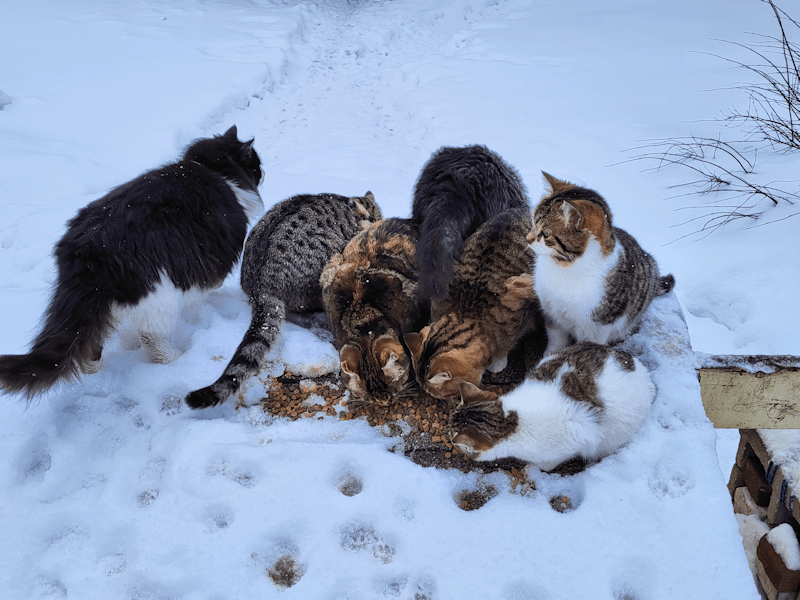
We had a light snowfall last night, making everything all white and fluffy this morning.
The outside cats didn’t mind it at all!
I counted 21 this morning.
Meanwhile, indoors, we have our first signs of spring.
When I checked the trays this morning, three out of four of them had onions sprouting. When I came back about an hour later, there were sprouts in the fourth tray!
I’m absolutely amazed by two things. One is, how quickly they started to germinate.
The other is, how much cat hair there is, all over the soil surface. These trays had lids on them. Where did all that cat hair come from? I mean, Beep Beep practically lives on top of the lights. She naps on them, rolls around on them, and even hugs them, so yeah… I can see some of her fur drifting down… but getting under the lids?
Yesterday, I marked on our communal calendar, two sets of dates. One was the number of weeks counted back from our last average frost date, June 2. This way, we can see at a glance that something that needs to be started 10 weeks before last frost, needs to be started around March 24, while something that needs only 4 weeks can wait until May 5th.
The other dates I marked was number of days counted back from our average first frost date, which is Sept. 10. We have exactly 100 days between our average last spring and first fall frosts. That’s the growing season we can mostly count on for frost sensitive plants.
For things that have really long days to maturity, it’s that “days before first frost” that we need to consider. If, for example, I have a gourd that requires 110 days to maturity, that’s May 23. If it needs 7-10 days to germinate, I would start them at least a week before that.
If I have something than need 90 days to maturity, that falls on June 12 and, by then, I could get away with direct sowing, instead.
One of the really useful tools I’ve found is the Farmer’s Almanac planting calendar. Most planting calendars just give number of weeks before first frost, because they’re meant to be generic. I can get that information from the seed packet. Farmer’s Almanac, however, lets you input your area code (or zip code, if you’re in the US). You can even put in your city (ha!) and province/state. It will find the climate station nearest you, then give you the calendar dates for starting indoors and transplanting, or seeding outdoors. It even gives you the choice of dates based on frost date, or on moon dates. Oh, and I discovered something very handy when I hit the print button on the web page. It allows you to remove things from the list that you aren’t growing, which greatly reduced the number of pages that got printed out!
It’s still a bit generic, of course, but the date range is pretty wide. For example, it tells me bell peppers should be started between March 24 and April 7. We have five varieties of bell peppers, and four of them are early varieties, so we could use the information on the seed packet to figure out which ones need to be started in March, and which can wait until April.
Of course, they can’t cover everything, so we still need to make adjustments. For example, their calendar says to start winter squash outdoors between June 16 and July 14. With some varieties, we could do that, but we’ve got some large varieties of winter squash that need more time to fully mature, so we would be better off starting them indoors. If we use the biodegradable pots that can be buried, that would reduce transplant shock.
We have always started summer squash indoors. I think, this year, we might direct seed them. The calendar says zucchini can be planted anywhere between June 16 and July 14, which is when we can expect the soil to finally be warm enough.
As for the things we’ll need to start the earliest, the herbs (except dill, which is direct sown) will need to be started at the same time as bell peppers; in March. The eggplants and tomatoes can be started in early April, melons can be started in early May, while pumpkins and watermelon can be started in mid May.
The direct sowing dates are pretty interesting for some things. If we decide to try growing radishes again, they can be direct seeded in early April – at the same time we’d be starting eggplant and tomatoes indoors. Carrots can be planted in late April, early May, which would be about the same time we’d be starting melons indoors.
All of which needs to be taken with a grain of salt. For example, the calendar says to start onion seeds outdoors in early May. Sets, sure, but seeds? Nope. There’s a reason people out here start their onion seeds indoors in January! Also, it has dates to start lettuce and chard indoors, but none for direct seeding. Who starts lettuce and chard indoors? I mean, sure, you can grow them indoors, but for transplant?
As it stands now, though, we won’t need to start anything else indoors until March 24, at the earliest.
That gives us February and most of March to get the materials we need and build a removeable door and frame, to keep the cats out of the living room, and out of the seedlings!
We’ll also need to build a barrier to block an opening in the shelf to the left of the door in the image.
Yesterday, after many delays, I finally sorted through all our seeds, old and new. I was happy to find I still had luffa seeds left, so I got those started, along with our onions.
Since I’m running out of media storage space on my WordPress account (the down side of having such a photo heavy blog!), I took my photos and made them into a video, instead. I hope you enjoy it!
Please feel free to let me know what you think of it, either here or in the comments under the video at YouTube. If you watch the video on YouTube, you can subscribe to my channel there. I’ll be uploading it to my Rumble account, too.
I will probably be doing a lot more of these, since I’m not about to spend over $300 a year to upgrade my account, when all I want is more storage space! It takes a lot more time, and I borrow my daughter’s microphone for the voice overs, but it does allow me to use higher quality images, and more of them, than I would here. I’d call it an experiment, but it’s not like I have much choice!
On another note, I’m quite enjoying the Movavi Video Suite to make these videos. I’m just barely skimming the surface of what the software allows me to do, since my needs are really basic, but if I wanted to, I could create some pretty professional looking videos. The only complaint I have is how it keeps wanting me to buy into subscriptions to get more choices in media and effects, etc. But that’s pretty typical of most media software these days, I think.
Okay, it’s that time! I’ll be working on a serious of posts, going over how our 2022 garden went, what worked, what didn’t, and what didn’t even happen at all. This is help give us an idea of what we want to do in the future, what we don’t want to do in the future, and what changes need to be made.
Our 2022 garden had a lot of challenges, and a lot of failures. Some of challenges and failures started well before we planted a single thing outdoors.
With our short growing season, we need to start a lot of things indoors. That, in itself, is expected and not a big deal. Our circumstances, however, have thrown in some major difficulties.
Fourteen of them, in fact.
Well. Sixteen, when we were trying to get them going this year.
Our indoor cats.
The other challenge is a combination of space and light. This house is oriented to the East. Our largest windows face the sunrise – with a grove of 60’+ spruces not far away. Our south facing windows are smaller and inaccessible for the purpose. The exception to that is the sun room, however the sun room is not warm enough to start seeds in when we need to. Plus, during colder weather, we allow the outside cats to use it for shelter.
Which means we need to figure out how to start seeds indoors, provide adequate artificial light, and protect the seedlings from cats that are determined to either roll on them, or eat them!
The first solution was one that we started doing last year. We have two aquariums that we have been able to convert into greenhouses, of a sort. When we moved out here, we brought our big tank, with a second light fixture to replace the kit light. Both work just fine, and provide adequate light for starting seeds.
The corner of the living room the tank sits in gets cold, so we added rigid insulation against two walls for extra protection. We were also able to get a warming mat to place under seed trays of things that needed extra heat. Since the lights can’t be raised or lowered, we used cardboard boxes under the seed trays to adjust the height, with new plantings closer to the lights, and larger ones lower down, rotating and adjusting as needed. We built frames with hardware cloth to cover the top of the tank, which both protected the seedlings from the cats, but also allowed more air flow.
This above picture was taken with the hardware cloth covers removed for access. As you can see from the bedraggled seedlings, we didn’t quite manage to protect them from the cats. More on that later.
The other tank is much smaller; just a 20 gallon tank. It, too, tended to get chilly, plus the light it came with was not as bright as having two lights, as with the large tank. It has insulation on three sides to protect from the chill walls, which also got covered in aluminum foil to reflect the light.
When we first started using this tank the previous year, we used the original lid it came with. The cats were incredibly determined to get at the trays below, and were able to reach through the opening for the filter, no matter what we used to block it, completely destroying the trays below. This year, we found some window screens in a shed, and used one of those as a lid, weighted down with hand weights. We removed the light from the bottom of the original lid and attached it to a foil lined piece of rigid insulation, and simply set it on top of the window screen. The cats still sometimes managed to knock the weights around and displace the screen but, over all, it did keep them out.
The problem with both tanks, but especially the little one, was air circulation. For that, we used a tiny fan we found in one of the basements while doing clean up. We could put it right into the big tank, or on top of the hardware cloth covers, aimed downwards. For the small tank, we could just set it on the screen, also aimed downwards. Ultimately, though, we used the small tank as little as possible.
We had an awful lot of seeds to start indoors, however. Way too many to fit in the tanks. Since the seeds needed to be started at different times, we could start the earliest ones in the tanks, then rotate them out when the next seeds needed to be started.
The question was, rotate them out where?
One of my daughters had bought a mini greenhouse for me the year before, so we brought that into the living room. We also bought a long, narrow, LED shop light to illuminate it better. That worked out well enough that we later bought a second one.
We set it up as close to the window as we could, on a chair to catch more light. The only way we could use the light, however, was to hang it from a plant hook in the ceiling above, so that it rested on the chair as well, oriented vertically.
The cats were absolutely determined to get into it!
They managed to squeeze in from under the chair, so we tried taping the plastic cover to the chair.
That wasn’t enough.
We added pieces of cardboard to block the spaces they were squeezing through.
It… mostly worked.
In the end, it was a combination of taping the bottom, the cardboard, and covering the back and sides of the frame with aluminum foil – which also helped reflect light onto the seedling better.
They still managed to get in.
I came out one morning and found cats had somehow squeezed through one of the zippers, pushing it open more, and rolled all over a couple of the trays.
It was such a disaster!
We did managed to save some of the seedlings, but not all. Thankfully, we had seeds left for some of them and were able to start over.
We were eventually able to keep the mini greenhouse sealed up well enough to keep the cats out, but it meant keeping the plastic cover on and closed up at a time when the seedlings didn’t need a cover. This meant no air circulation in there at all. Even so, there were times when a cat or two managed to get in, and try to eat some of the seedlings!
I was able to rig the little fan up inside the mini greenhouse, aimed at the walls in such a way that the air flow would be pushed upwards and around the whole space.
That little fan got one heck of a work out!
So we finally got that working, but there’s not a lot of space in between the shelves. Before long, some of the seedlings began to outgrow the mini greenhouse. They needed to be moved out, and the only place we could move them to was the sun room – but we had to wait until it was warm enough!
Eventually, we were able to move the largest seedlings onto shelves in the sun room, while other seedlings got rotated into the mini greenhouse, and newly sown trays were set up in the aquarium greenhouses. We had our seeds organized by when they needed to be started, with the earliest started 10 weeks before our average last frost date, then 8 weeks, 6 weeks and finally 4 weeks.
We still ran out of space.
In the end, we set up a surface to hold seedlings over the swing bench, and eventually we could move the mini greenhouse to the sun room – and finally take the cover off! The second shop light was hung above the plants over the swing bench, and we eventually hung the one from the living room on the inside of the shelf.
For a sun room, the sunlight doesn’t actually reach far into the room.
There were so many things that needed to be started indoors! In fact, most of what we were growing needed to be started indoors, with only a few things that needed to be direct sown.
That’s not really going to be changing, so we need to figure something better out. How do we provide the seed trays and seedlings with the light, air flow and space they need, while also protecting them from the cats?
Well, the girls and I have been talking about it, and the only real solution we have is to find a way to keep the cats out of the living room completely, and turn the living room into a plant room.
The question is, how?
There are floor to ceiling cabinets between the living room and dining room. On one set, the living room side is completely covered. On the other, there is a “window” at one shelf that allows access from both sides. It’s a favourite lounging place for David! Between the cabinets is an open space somewhat wider than a standard sized door for access between the two rooms.
The only way to prevent the cats from getting into the living room is to build a barrier in that space, with a door in it, plus another barrier to cover the “window” in one of the cabinets.
Barriers which need to be strong enough to withstand cats trying to get through, yet still be easily removeable.
One of my daughters has drawn up plans for a barrier with a doorway, while the “window” will just need a simple rectangular frame to fit the space. It’s basically going to be all wooden frames and hardware cloth.
Unfortunately, we’ll need to actually buy the lumber for this, and lumber is extremely expensive right now. There is nothing in the piles of salvaged lumber in the sheds and barn suitable for what we have in mind.
It’s something we’ll have to figure out soon. Some things, like onion seeds, could be started as early as January. February at the latest. Honestly, I just don’t see how we can get the materials and build the barriers that quickly. We could start off using the large aquarium, which might give us until March to get it done, but… I’m not very hopeful.
It would be a lot easier, if the cats weren’t so absolutely determined to destroy the seed trays!
After finishing my morning rounds, I remembered to check the tracking information and saw that our potatoes were ready for pick up. After picking up the nice big, heavy bag, I made a spur of the moment purchase and got some more wood shavings. We still had a small amount left over from last year, but since we can’t quite use our wood chipper yet, I decided it was worth picking up another bag. I’m glad I did!
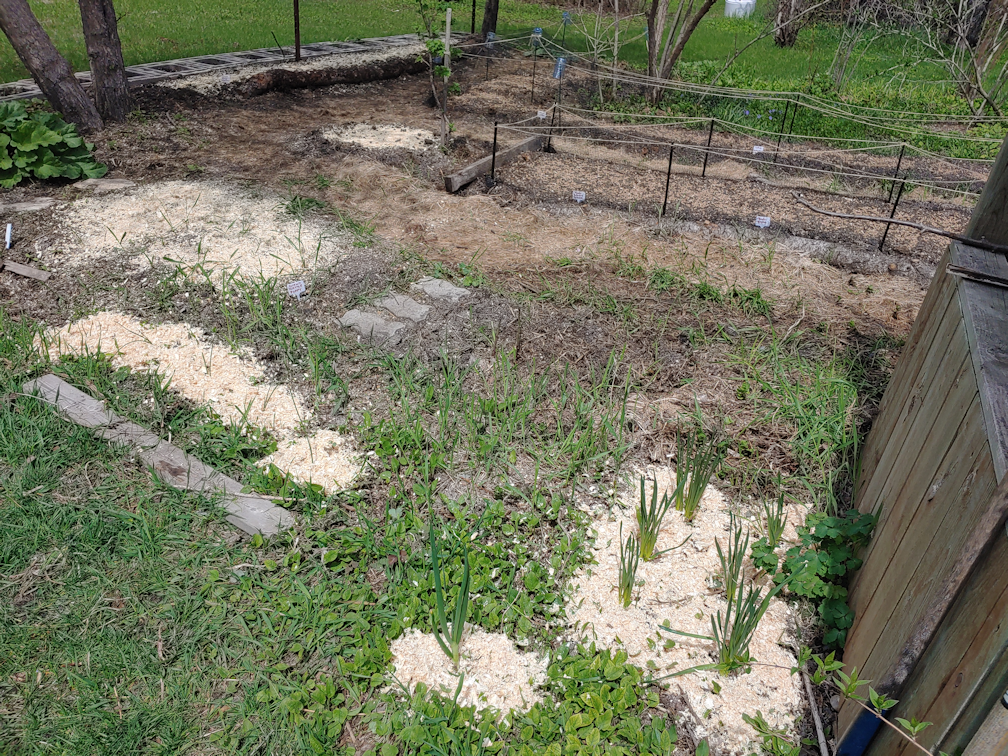
One of the issues we have with our soil is that, when it’s watered, it develops a hard crust at the time, which seedlings have difficulty breaking through. One way to reduce that is with mulching – and that’s something we don’t have in the old kitchen garden right now. A straw mulch would be too much for what we’ve got in there right now. We do have lots of the hardwood pellets we use for cat litter, but I decided to use the shavings, too.
For some things, I could use the shavings for a slightly thicker mulch, such as around the irises and daffodils, and that one onion that predates us and keeps coming back, no matter how many times something managed to crunch it. The onions along the retaining wall are super tiny still, so they just got a very light mulch, as did the area we planted poppy seeds in, and the tiny patch with lettuce seeds next to the rose bush. More can be added later, as things grow, if necessary.
I even mulched one of the retaining wall blocks. Last year, we found a mystery bulb lying on the grass. We weren’t sure which of the bulbs we’d planted had lost one, so I just stuck it into this cube to see what came up. Nothing did, so it was quite a surprise to see what looks like a tulip emerging this year!
For the beds that are covered with netting, I still used the hardwood pellets, since they can fit through the net. It was a bit difficult to get it to spread evenly, since they wanted to roll into the furrows seeds were planted in, but those are what we want to protect from crusting, anyhow.
All the mulch got watered, so they can help keep the soil moist, and for the hardwood pellets to break up into sawdust. The seedlings should be able to push through the sawdust just fine.
Over time, the crusting problem will lessen as more organic matter like this mulch, breaks down into the soil. Definitely a long term process, but that’s par for the course! This garden has already been 4 years in the works, since we started cleaning it up and prepping it, our first summer here!
Ah, but what about those potatoes we finally picked up?
That will be in my next post! :-) I am really happy with them!
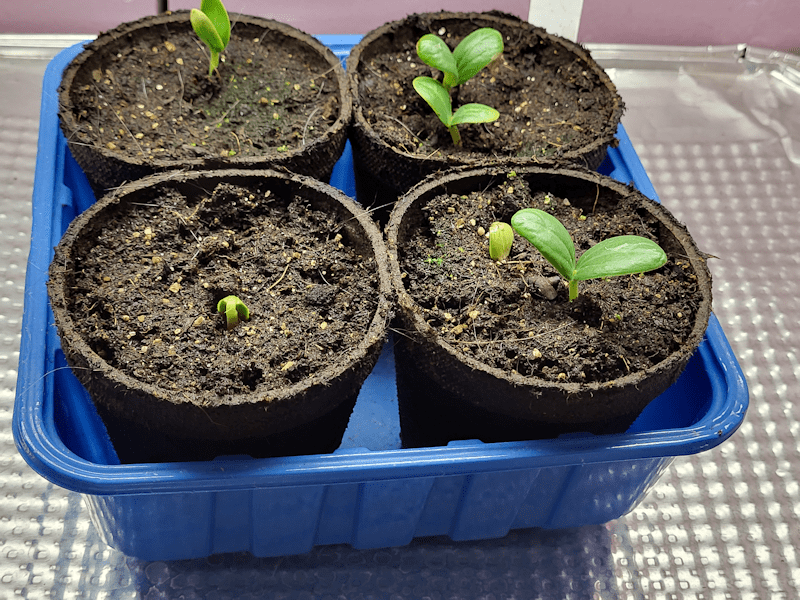
We had started some Yakteen gourd seeds indoors a while back, but none germinated. There was also one pot with hulless pumpkin in it that didn’t germinate, so I took the last 6 seeds we had left and replanted them in the three pots.
One has finally germinated!
Since I took this photo this morning, the seedling has fully emerged from the soil.
So far, there’s just the one, but I moved all of them to the sun room. Hopefully, more will germinate. This is one of those rare varieties that I want to save seeds from, to keep it going. This is really late for starting indoors, but maybe we’ll have another long and mild fall – to make up for how long it took for winter to let go, only to have a cold, wet “spring”.
We got a lot of garden related stuff done today, and I took lots of pictures, so I’ll be making several shorter posts rather than one huge one!













 The Re-Farmer