Easter preparations: baking day and frozen ground

Today, while the girls continued to work on the basement (I have yet to go down to see their progress!), I worked on baking our Easter bread.

Then, since I was baking anyway, I made some sourdough soda bread, and another double batch of what has become my usual standby, a basic bread recipe modified by the addition of rolls oats and various seeds. This recipe, plus chia seeds and minus the rye flour. Lately, I’ve also included hemp hearts as well, which adds a really nice flavour and texture. Thanks to my dear friend, I even had yeast to use for the non-sourdough recipes. :-)

In this photo, the braided loaf is for our Easter basket, and I made 4 mini loaves with the other half of the recipe. In the back, left, are the loaves of sourdough soda bread. Which did NOT want to rise today. The house was a bit too chilly today, even though it has been warming up again, outside.

In between batches and rising times, I also made a soup using one of my meals in a jar mixes with sausage. The mix had brown lentils, red lentils, orzo pasta, turmeric cous cous, dehydrated vegetables, dehydrated onions, mushroom ketchup powder, 1 cube of vegetable bouillon and 1 cube of chicken bouillon.

The seedy bread was shaped into mini-loaves that made excellent bread bowls.

This was soooo good to break my Good Friday fast (for health reasons, I do not do a total fast).

While doing my rounds this morning, I checked the ground near the power pole in the old garden, where there is horseradish planted. It was rock hard, but I hoped that things would have warmed enough to dig some up by this evening.

After scraping aside last year’s leaves, I found the horseradish has already been trying to grow.
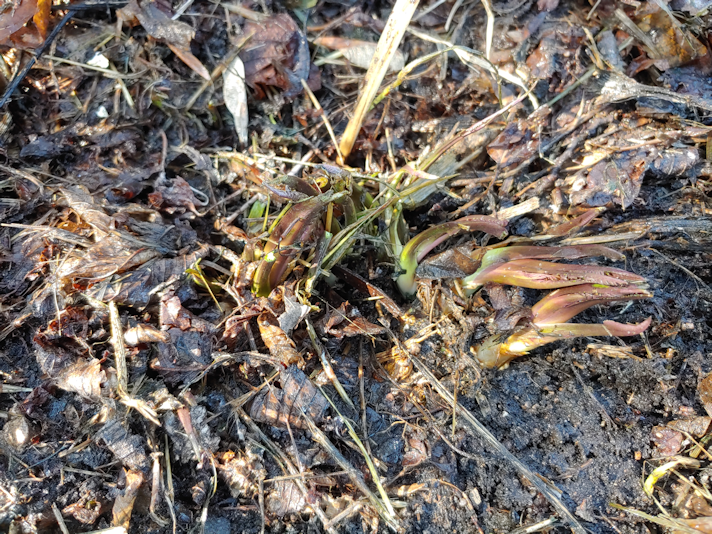
The ground was certainly starting to thaw out by this time, but the soil here is so full of rocks, it didn’t make that much of a difference. I can’t understand why my mother planted these here. For a plant that is grown for its roots, rocky ground would have been something to avoid. The area has always been much rockier than the rest of the garden; so much so, my parents eventually stopped using it completely. The base of the power pole, however, has rocks and gravel packed around it, so it’s even worse than anywhere else.

I did manage to break off a couple of pieces, then decided to see what I could find in the other spot my mother had planted horseradish; at the base of a spruce tree near our feeding station. I had hoped that, between the wood chip mulch and possibly a bit more sunlight, the ground would be thawed out more.

The horseradish here isn’t as big or prolific, but I could see where it was starting to grow.
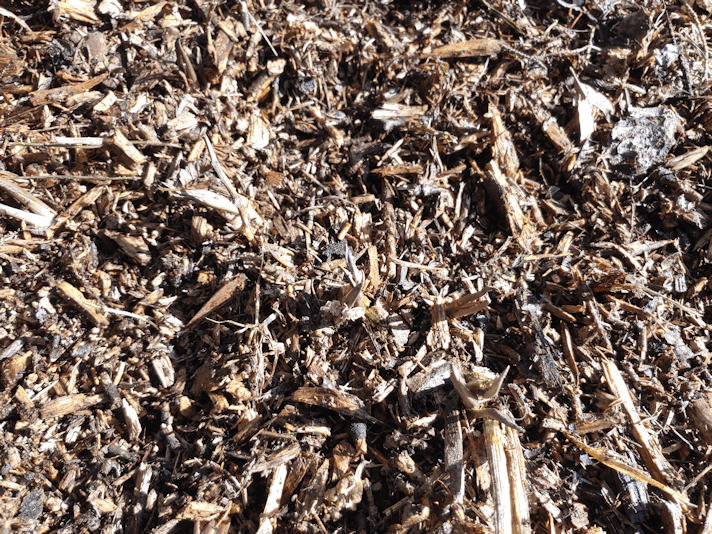
I did scrape away the wood chips, but it’s still pretty hard to see.

There isn’t as much growing here, and they’re much smaller, but the ground was indeed a bit softer, so I got a couple of decent chunks out. The ground isn’t rocky here, but of course, there’s plenty of tree roots. Again, I don’t understand why my mother chose this location.

After much washing, then scrubbing with an old tooth brush to get into the crevices, I now have several chunks to use.
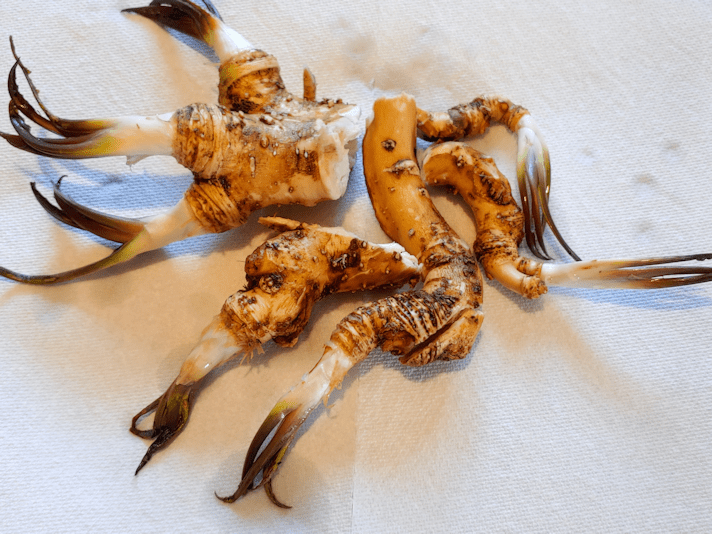
That big piece with three sprouts? I could potentially plant each of those, and have three fresh plants.

I think the two little ones will be enough for my mother. If all goes to plan, I hope to swing by her place tomorrow with a care package for her. I’ll leave these as is, so she can prepare them as she wishes – or plant them in her own little garden plot outside her window. :-)

We only need a bit for our own basket. I have been thinking of planting horseradish in softer ground; perhaps in a raised bed or planter. Something that will allow a straighter root to develop. If I can think of a good spot for that, I might do that with the big piece. My mother always kept a piece of horseradish, with the green parts still attached, in the basket to be blessed with the rest of the food, specifically to share with friends to transplant, or to transplant herself. I’ve tried it myself a few times, but the only one that succeeded (and didn’t get dug up by squirrels) was the one I’d included with our Easter basket the last time we were able to visit with my father, 5 years ago. I took it back with us to plant when we got home, and it actually survived. It got left behind when we moved, of course.

Normally, we would finished putting all our basket contents together tonight, in preparation for taking it to church for the blessing tomorrow morning, but since there is no church blessing, we’ll finish arranging the basket tomorrow and do our own blessing whenever we’re ready. I still want to do onion skin dyed and tea dyed eggs, which will be the last things that require any cooking.

For now, I think I’ll head down into the basement and see how things are looking after all my daughters’ hard work! :-)

The Re-Farmer

Preparing for Easter, and an easier way to peel eggs!

One of the bonuses of our move to the farm I grew up on is that we could take part in a childhood tradition; the blessing of our Easter baskets. It was many moves and many years before we were able to find a Polish church that did basket blessings, and be able to take ours in.

That didn’t stop us from doing our traditional baskets. It was one of my favorite traditions, growing up, and even when we stopped going to church for many years (for a variety of reasons), we still did our baskets and simply blessed them ourselves.

Which is what we’ll have to do this year, since none of the churches are holding any sort of services during the lockdown, other than online.

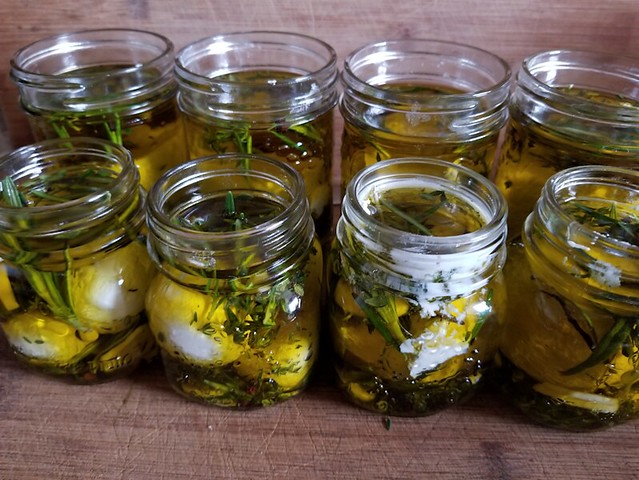
We did start some of our preparations already. For the cheese portion of our basket, we decided to do marinated goat cheese again. I made up two 250ml canning jars for our basket (I’m hoping to get one of them to my mother, along with some fresh horseradish), plus two 500ml ones, just for regular eating.

Tomorrow, I hope to make some fancy bread for the basket. Probably a Braided Egg Bread again, though I haven’t completely decided yet.

Today, I started pink pickled eggs; one of three ways we like to do eggs for our basket. The recipe for pink pickled eggs that I followed before is here. This year we, strangely, had a hard time finding anything other than shredded beets at the grocery store, so I modified the recipe a bit. I found 1 small jar of tiny pickled beets and used the juice from that to colour the liquid, plus sliced some of the beets and included them in with the eggs. With so little beet juice, I figured the addition of the beets themselves would help add colour. The other change I made was to include the fresh herbs I had left over from making the marinated goat cheese; thyme and rosemary.

When preparing eggs for the basket, we always cook way more than we need, so that we can use only the most perfect eggs for the basket.

Which is difficult, when the eggs need to be peeled first. There have been times when we’ve boiled a dozen eggs, and not a single one could be peeled without tearing apart!

So today, I tried a combination of “hacks” to get the job done.

The first is to add baking soda to the cooking water. Yes, it does make a difference.

The next is to cool the cooked eggs down as quickly as possible. Putting the eggs into an ice bath is one way to do it, but our well water gets so cold, we can get away with using tap water.

The final one is something I tried for the first time today, and it worked beautifully!

Shaking them in a jar.

Okay, so it wasn’t quite that simple. :-D

I grabbed a small canning jar, though any jar (with a lid) just a bit bigger than an egg would work. Theoretically, you can use a small glass and cover the top with your fingers, but that would get pretty messy. The first jar I tried was a 500ml (pint) size, and I found it a bit too big and ended up using a 250ml jar instead.

Leaving the eggs in their cold water soak, take one egg and put it in the jar, along with enough water to fill the jar about half full or a bit more. It can be helpful to crack the shell a bit before putting it in the jar.

Then, put on the lid and start shaking. Vigorously, but not too violently!

The shaking does a few things. The most obvious is, it cracks the shell quite thoroughly. This is where you have to find a balance on how much water is in the jar when you shake it. Too much, and the water protects the egg from cracking as much. Too little, and the egg can get bashed apart.

The shaking also separates the membrane from the white of the eggs – which would have already been spurred along by the addition of baking soda to the cooking water, and the quick cool down. And finally, it lets water work its way between the membrane and the egg white, making it much easier to remove the shell.

After a thorough shaking, dump the contents back into the water with the rest of the eggs. While holding the cracked egg under water, start peeling away the shell. If it still sticks, do the shake again. :-)

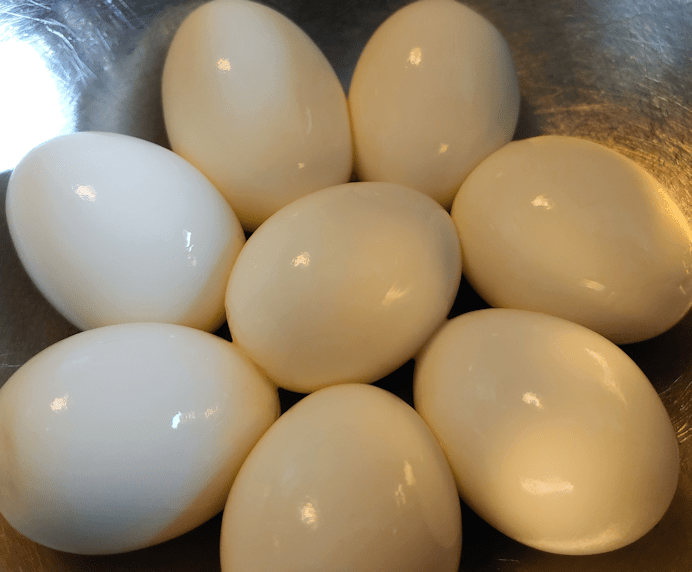
Out of the package of 18 eggs I cooked, I got 8 that were perfect enough for the basket; two for each of us.

This is what happens when an egg is shaken up too vigorously.

Here are the best eggs, ready for the fridge.

They should have at least 3 days to marinade in the pickling liquid, which is just in time for Easter.

Of the remaining eggs, there was one that broke during cooking, which left another 8 eggs suitable for pickling. I did up another container the same way, minus the beet juice. It still has beet slices with the eggs, so it will have just a hint of pink. That one will be for regular eating.

It is going to be a delicious Easter celebration this Sunday! :-)

The Re-Farmer

Marinated Goat Cheese

Though it is still weeks away, we are already planning our semi-traditional Polish Easter basket.

I say “semi” traditional, because we’ve modified some of the contents over the years.

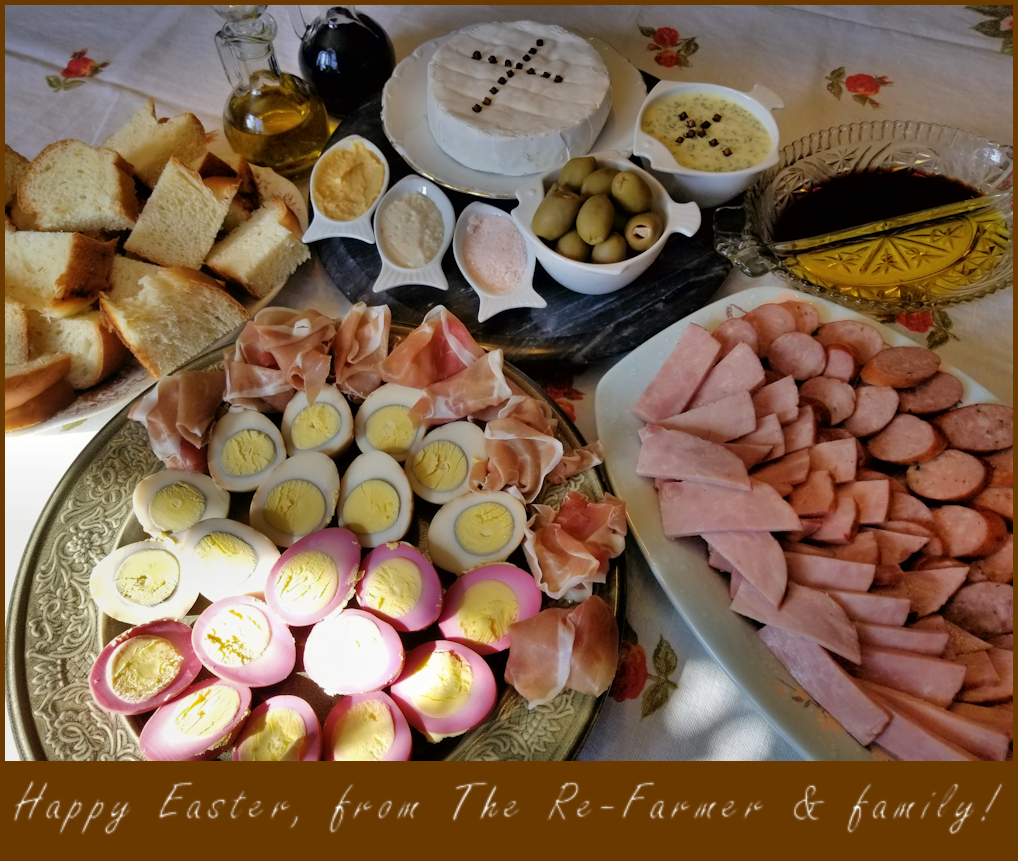
If you’re unfamiliar with a Polish Easter basket, these are filled with symbolic foods to be blessed on Holy Saturday, and eaten on Easter Sunday. The foods include ham, sausage, bacon, bread, cheese, salt, butter, horseradish and eggs. We also include things like olives, vinegar, and olive oil. It may also contain a bottle of wine and a candle. Oh, and sometimes chocolate or candy. The baskets are decorated and covered with lace or embroidered clothes. As a child, Easter was my favourite holiday, and our traditional basket was a big reason for that!

Some of the contents require more advance preparation, and I was able to start on one of those, yesterday. This is a non-traditional way to include the traditional cheese in the basket.

This year, I found some absolutely delightful mini-jars, and decided to make several small jars of marinated goat cheese, but we’ve also done it by layering medallions of goat cheese in a larger jar. Both ways work fine.

It had been my intention to make two baskets this year, with a large family basket for ourselves, and a smaller one for my mother. She declined my offer, and will be making her own basket.

We’re going to have lots extra out of this batch!

To start with, I scalded the tiny jars I bought special for the basket, plus extra pint size jars. Then I prepared the ingredients. The mini-jars have smaller openings, though, so that changed things a bit.

marinated.goat.cheese.1

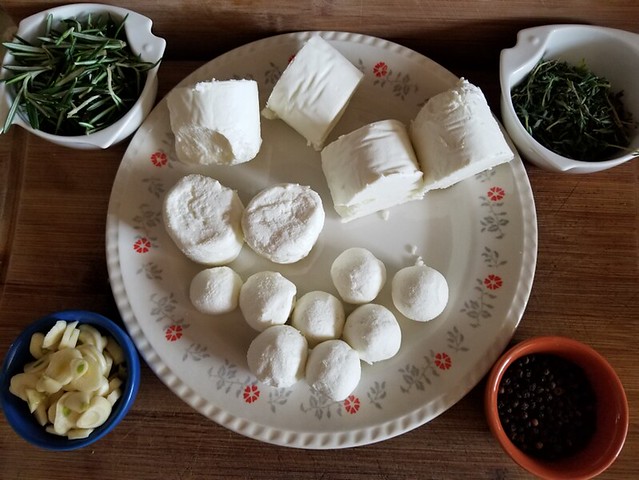
Here we have fresh rosemary leaves and fresh thyme leaves – they came in 28gram packages, and I stripped the leaves from the stems. There are peppercorns and about 8 cloves of garlic, sliced. Not pictured is Extra Virgin Olive Oil.

I completely forgot about the bay leaves. There should have been a bay leaf per jar.

As you can see, this is a forgiving recipe.

The goat cheese came in 300 gram logs; I had 2 of them and cut them each into 4 equal pieces. For the ones to go into the mini-jars, I cut pieces off to try and make them into smaller columns, then gently rolled them between my hands to make them smooth and round.

The first one I tried, promptly crumbed apart. Which is why I have rolled balls of cheese. I broke up each trimmed quarter piece into 4 and formed the smaller pieces into smooth balls.

For the pint sized jars, I didn’t have to be pretty, since they’re not intended for the basket

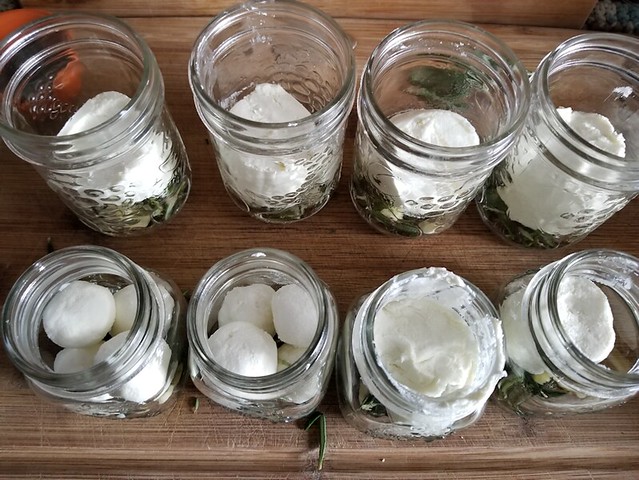
Each jar got some peppercorns, thyme leaves, garlic and rosemary leaves placed on the bottom. If I’d remembered the bay leaves, they would have gone into the bottom, too. Then the goat cheese gets put into the jars.

This is why I make extras…

marinated.goat.cheese.2

I didn’t make one of the small columns of cheese small enough. It got messy. :-D

No worries. It’ll still taste good!

Once the cheese is in, more peppercorns were added, as well as the rest of the thyme, rosemary and garlic slices. Then the olive oil was added.

marinated.goat.cheese.3

After the oil was added, the rims were cleaned, the jars sealed, and into the fridge they went.

Next is the hard part; waiting a week before using them!

From the looks of them, I think the balled cheese will be kept for the basket. I do have one non-messy mini-jar with a bigger piece, so I might use one of each. We shall see. The pint jars don’t have to wait for then, though, and I will post pictures, when they are ready. :-)

After marinating for a week, the oil can be drained through a sieve and reserved (the herbs are discarded). It makes for incredibly flavourful oil to use when cooking. The cheese can be served as a spread on bread or crackers, or used any other way you would use goat cheese.

Alternatively, little jars like this can be served as individual appetizers. The jars can be warmed by placing them in a flat bottomed pan with hot water, and placed in a hot oven until heated through. They can then be used as individual servings, eaten straight from the jar.

I intend to put these in our basket, just as they are, without straining them first since the jars are so small. When we made them before, with layers of cheese in a larger jar, we removed the cheese, then put a few pieces into a smaller container with a liquid tight seal. I then covered the cheese with strained oil and closed it up. It made for a nice presentation in the basket. :-)

The Re-Farmer

Blessing of the Baskets

My younger daughter and I took our basket into town for blessing.  After a bit of shifting things around, this is what our basket looked like.

2018-Easter.basket

The prosciutto roses were added at the very end, because they dry out so quickly – though they did double duty in holding some of the eggs in place!  I ended up fitting 8 of each type of egg into the basket, so there were some of the tea dyed and onion skin dyed eggs left over.

The embroidered table cloth is one of a couple of antique embroidered linens I’ve managed to acquire many, many years ago.  It has 8 little matching napkins.

Normally, I would have ironed it first, but neither of our two irons made it with the movers.

Which reminds me.  I have come to realize something.

We are now completely finished unpacking!

I had unpacked a box of books in the office some time ago.  I still have a number of bins, but aside from one that’s still got stuff in it because I have to find the right spot of them, they don’t need to be unpacked.  The stuff in them belongs in the bins.

On the one hand, Yay!  We’re unpacked!

On the other… there is now no possibility of finding the missing stuff jammed into an unpacked box somewhere.  That stuff is lost.

Including my two irons.

*sigh*

But I digress!

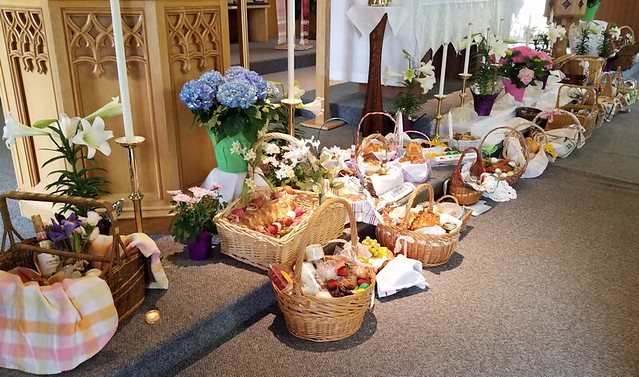
I snagged a quick photo in the church…

2018-Easter.basket.blessing

Another half dozen or so baskets were added after this photo was taken.

I’m taken aback by the lit candles inside people’s baskets.  I’m reading “fire hazard” all over the place!  :-D  My daughter remembers the last time we brought our baskets here for blessing, several Easters ago.  We had come out for a visit and stayed with my father, in the very house we live in now.  We had included a candle in our basket.  Someone lit it for us!

A couple of the baskets that came after this photo was taken were just huge!  You can kind of tell whose baskets are for larger families. :-D There was one that had the most interesting wire holder for the eggs, that kept them well above the rest of the food.  I love all the different styles of baskets and how they are decorated, too.

If you look towards the back of the photo, on the riser above the baskets at the foot of the alter, is a small basket that doesn’t have any food in it.  That’s a donation basket for the priest, for doing the blessing.  I remember helping my mother bring baskets for blessing, and she would set up the little donation basket, and a second one, where she added some food items from our own baskets.  Other people followed her lead and added more, so that by the end of it, the priest also had a basket full of food!

For the blessing ceremony, a prayer and blessing was said, then the priest sprinkled all the baskets with holy water.  Then he went down the aisle and sprinkled us, too.  We finished with a rousing hymn of blessing, with the priest grinning from ear to ear as he sang, his arms waving to the rhythm.  Clearly, this is a ceremony much enjoyed by the priest, as well!

Then, after we retrieved our basket, I saw him standing there with his iPhone out, taking video of us all, getting our baskets, still with that huge, joyful smile on his face.

It was awesome.

The Re-Farmer