I thought we would have more than enough old feed bags to use for both types of potatoes we have left to plant, but I was wrong! The Purple Peruvian fingerling potatoes alone, took 14 of the 19 bags we had!
I made a quick little video with the photos I took. It’s less than a minute and a half long. 😁
The first time we grew potatoes in feed bags, we were intending to do the tower thing, expecting to add more material to the bags several times throughout the summer. Then we found out that potatoes come in both determinate and indeterminate types – and we had determinates. They aren’t the right kind for growing in towers, so there was no benefit to adding more material. The plants got huge, though, and the bags couldn’t support them. With that in mind, this time I made sure to add quite a lot of straw to the tops of the bags. It should help support the plant stems, and hopefully the bags as well.
So now we have to figure out how and where to plant the Red Thumb fingerling potatoes.
I wonder if there are too many to plant in that bed along the old kitchen garden retaining wall I just finished reworking?
We’re in that time when we can start transplanting things that can handle frost which, for us, is the onions and shallots. I started hardening them off earlier than the other transplants. It’s going to be very hard to resist transplanting more before our last frost date! Not only are we having a very warm May (today was supposed to reach a high of 18C/65F, but as I write this, at almost 6:30pm, we’re still at 20C/68F), but the long range forecast is showing warmer overnight temperatures well above frost risk. The problem is, long range forecasts are notoriously unreliable!
So, we continue to take it slow and continue to harden off the transplants. There is still lots to do to make room to plant not only all the transplants, but all the direct sowing we have planned, too.
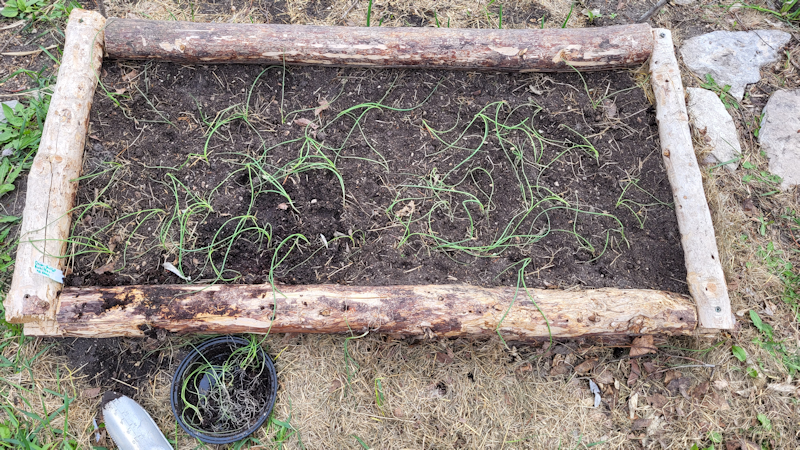
This tiny little bed in the old kitchen garden is where the shallots are going, because we have the fewest of those. This is a new variety of shallots, and the first to actually really survive to the transplant stage.
Keeping the cats out of the living room made a bit difference!
I planted fairly densely, but there were still a few plants left. After taking this picture, the bed got a thorough watering. We will have to add a mulch as soon as the transplants are strong enough.
The last little transplants went into one end of the wattle weave bed. It has a thick layer of wood chips on the top that I had to move aside to reach the soil. Protected by the wood chips, the soil was nice and damp!
So those are now in.
I foresee only one problem.
The cats have gotten used to using the garden beds for napping and playing!
I’m hoping to avoid having to cover the beds, but we might not have a choice. For now, they have no interest in the wet ground.
In other things, I went through our collection of feed bags, and had more than I thought. We’ve got 11 bird seed bags (20kg size) and 8 deer feed bags (18kg size). More than enough for the remaining potatoes. The only difference between the bags, besides the label, is that the bird seed bags are longer.
I’m still not sure where to set them up. The best place I can think of is at the far side of the main garden area, but I really don’t want to be hauling garden soil that far, if I can avoid it! Ah, well.
The girls and I are still trying to figure out the best place to set up grow bags for the potatoes, where they would get full sun, but also be closer to the house for watering. We don’t have a lot of the old feed bags left to use as grow bags, so we decided to use one of the Old Kitchen Garden beds that was recently fixed up.
The bed still needed topping up, so I started by adding some of the sheep manure I recently purchased. I didn’t add a lot, as this bed was filled with purchased garden soil, and it should still be pretty rich in nutrients. What’s missing is organic matter. This is a blend of compost and composted manure, so that will help a bit. This got worked in with a rake.
Also… do you see that bit of green poking out of the wattle weave bed?
It’s a stray onion!
I have no idea where that onion came from. This bed had never had onions planted in it.
I’m not going to complain, though!
Next, it was time to raid the garden soil pile and do some soil sifting.
Three wheelbarrow loads of the garden soil was brought over. The weeds are already starting to grow under the cover on that pile!
Some of the Irish Cobbler seed potatoes were very small, so to fit them all in the bed, I put some of the smaller ones together. Then they got buried as deep as I could, so they don’t need to be hilled.
As this area slopes away from the house, the far end of the bed is somewhat deeper than the end closer to the house, to level it off. Still, with this bed being newly rebuilt, and the layers of organic matter below, the top layer of soil still isn’t very deep.
Once the potatoes were planted, I scattered some stove pellets over the top, then began watering. Once the pellets had expanded into sawdust, I used a rake to spread it out evenly. This is not at all for the potatoes, but to protect the soil and help reduce soil compaction. Over time, we will continue to add grass clippings and wood chips as mulch. The potatoes will easily be able to grow through a mulch. With this bed being higher now, and not using straw for a mulch, hopefully, that will reduce the slug problems!
After spreading out the sawdust, I gave it a deep watering, and plan to water it again a couple more times, today. I want the water to go through all those bottom layers that were added, which will speed up their anaerobic breakdown, while also acting as a sponge to retain moisture. Once those bottom layers are good and moist, this bed should not need much watering at all.
Our peas are finally in! They could have been planted as soon as the ground could be worked, which was a couple of weeks ago.
This row is about 20 feet long. We could succession sow peas elsewhere, but I think that this might actually be enough. Assuming a high germination rate, of course.
I really like fresh peas, though, so if we have the space to grow more elsewhere – together with some corn, perhaps – they certainly won’t go to waste!
It took quite a few trips and a fair bit of rearranging, but all the transplants that were in the living room are now in the sun room!
There is a down side to not being able to close the outer door for the sun room. To keep the cats out, that means closing the inner door. The outer door has a screen window.
We reached a high of 21C/70F today, but the sun room reached 27C/81F! And the only air circulation is the ceiling fan. We are keeping the inner door into the old kitchen open. The outer door has a screen window, and with the old kitchen staying so much cooler, it should help at least a little bit. While it will help keep the sun room temperature down a bit, it will also warm up the old kitchen, so it’s a trade off.
Hmmm. I just remembered. I think we have a spare hook and eye closure somewhere. If I can find that, we can latch the outer sun room door from the inside. That would help. We’d still have to close the inner door for the night, so we don’t lose too much heat, but that’s okay.
Meanwhile…
I got the second light hung up and plugged into the first one. We are pretty much out of trays and bins to hold all the transplants, and I’m not finding more like the ones we have. We do still have a couple more of the black plastic trays, but they’re not very strong, and some of them have started to crack. I’ve been doubling them up, anyhow, just for the extra strength, and that way I can also use the cracked ones without leaking water everywhere.
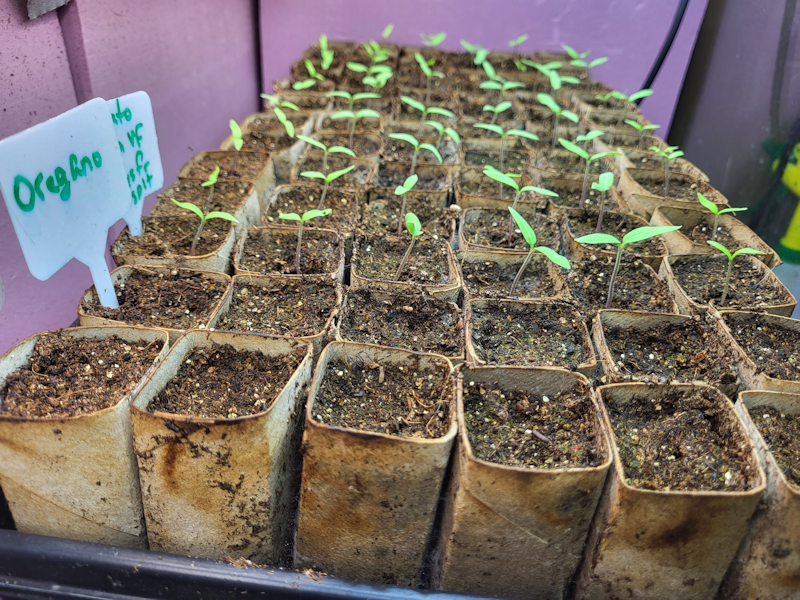
There’s still a bit of room on the shelf! Those peppers had been in the big aquarium greenhouse and will need potting up, but I think they’ll enjoy being here for a while, first. They, at least, will really like the heat in here! I’m hoping the oregano and spearmint will do better here, too. They are not doing as well as the oregano and second variety of thyme we planted more recently are. I think the sad little luffa will like it better in this heat, too. In fact, depending on how things go, we might even try growing it in a pot in the sun room, instead of outside, this year.
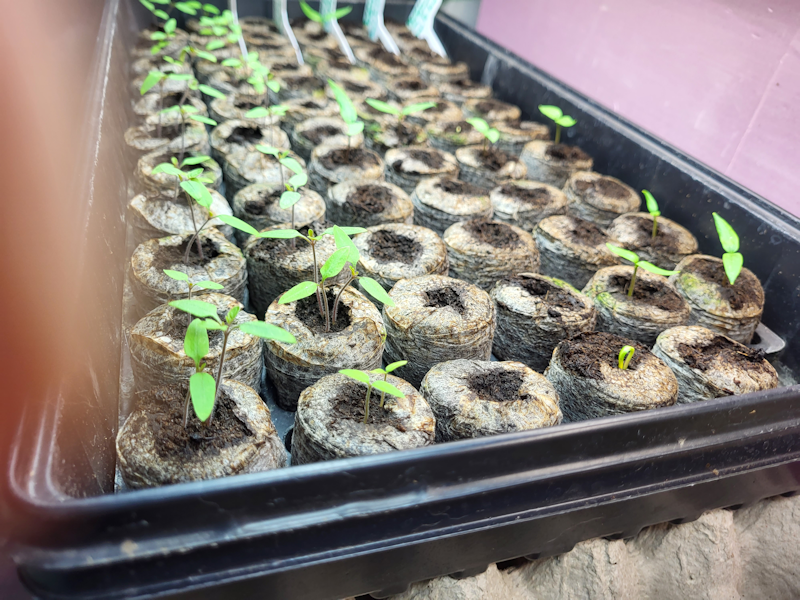
We are expected to cool down a bit over the next few days, with Sunday being the coolest at 10C/50F. Tomorrow is supposed to reach 15C/59F, so it should be a good day to continue working in the old kitchen garden and finish that last bed. I’ll start hydrating my trays with the Jiffy pellets, so they’ll be ready for starting seeds the next day.
The priority for tomorrow, though, will be to go to the post office and pick up those raspberries that are in! We’ll want to plant those as soon as possible.
Okay, this is a first. Planting something in April!
We had a bed prepared and covered with plastic over hoops for the soil to warm up more, so that is where I started. All of the carrot seed tape we made fit into the bed, with even a bit of room to spare. After that, another bed was finally prepared and covered with more plastic, and in a couple of days, it will get spinach planted in it.
I tried an experiment this time, setting up an old phone to take a time lapse video of both jobs.
Plus some random cat appearances.
The time lapse made for a short video. I hope you enjoy it!
Today, I started a planted a small tray with herb seeds. After this, no other seeds need to be started for another 2 weeks or so, though I may want to start some of the larger squash or gourds a bit earlier. We shall see.
This is the state of things in the big aquarium greenhouse. The little one is now empty, as things don’t seem to do well in there. I have my theories, but I don’t know why, for sure.
At the top is the tray seeded half with chamomile, half with thyme. Neither packet specified what variety they were. The chamomile is from Heritage Harvest, which grows their seed in a location further North than we are, so I know they can grow there. The other is from McKenzie Seeds. The variety we started a few weeks ago is German Winter Thyme. We’ll see how they differ later.
Those chamomile seeds, though. Wow, are they ever tiny! Almost like dust. That’s where using the point of a bamboo skewer to plant them comes in very handy!
So those are now in the heat mat. The tray that was there before, with the tomatoes I potted up, and its remaining tomatoes and herbs, has been left out on the “table” we made with the saw horses. The oregano and spearmint are still just barely germinating, but I think they’ll be okay there.
In the middle of the above image is the one surviving luffa, now in a plastic pot because the peat pot was starting to fall apart. I didn’t have the soil to pot it up to something larger. I’ve given up on the other three pots I’d seeded. This one doesn’t seem to be doing well, so I thought it might benefit from being back on the warming mat. We did set up a heater in the living room, but we can’t leave it running all the time, and I think it’s just too cold in there for something like luffa.
At the bottom is the tray of Spoon tomatoes and four varieties of peppers that are still in the large aquarium greenhouse. I’m happy to see so many more peppers finally germinating. Some of them really took a long time! Once we have more potting soil, I want to get those Spoon tomatoes divided and potted up. There’s about 20-25 36 seedlings. They’re so tiny compared to the other tomato varieties! They seem to be doing well, though, and should be fine in here for a bit longer. That will give the peppers more time to grow before they get potted up, too. We don’t need a lot of each variety, since we’re in the process of discovering what we actually like. It would be nice if we had extras to share – though the last time I tried to do that, everyone turned down the offers, because they enough of their own stuff growing!
Well, we’ll see how it works out, once we start planting all these outside!
It’s a chilly, damp and dreary day today. You know what that means?
Gotta do something gardening related!
Today, I potted up the Indigo Blue Chocolate tomatoes.
I’d started them in a peat tray with two rows of four square cells. One row for the tomatoes, one for the Little Finger Eggplant. I planted 4 seeds per cell, which got me 11 plants, which is quite a good germination rate.
I wish I could say the same for the eggplant! Only three germinated, so I replanted. As of today, I have finally seen one tiny, barely visible seedling, germinating. Hopefully, that means we’ll see more, soon.
In other things, yesterday I finally saw the tiniest, microscopic oregano seedling, and this afternoon, there was an equally tiny spearmint. The Roma tomatoes sharing the tray, however, are doing great. I’ll have to get more soil for potting up. Quite a bit more. The Roma and Spoon tomatoes will need to be potted up, and eventually the peppers sharing the tray with the Spoon tomatoes will need potting up, too – there are finally more and more of the peppers germinating!
I’m going to start running out of shelf space for the plant trays! It will be good when things warm up enough to start moving trays into the sun room – and start keeping the yard cats out! Last year, we set up a surface using a couple of saw horses and an old closet door I found when cleaning the outhouse over the swing bench, which worked out really well. We’ll have to work out something better to support the lights, though. We’ve got a few weeks to figure things out.
We’ll also have to figure out what to use to protect the plants when it’s time to harden them off. Last year, we used the frame of my daughter’s market tent, with an unused, home made bed frame made out of plywood on it. This kept the plants high enough that none of the cats went after them. The market tent is being use now, though, and the bed frame got painted and is now in the basement, keeping litter boxes raised off the concrete floor – just in case things get wet again. I think I saw a folding table in one of the sheds – it’ll take some doing to access it to confirm, and see if it’s big enough. The problem will be how to keep the cats off, since it would be about half the height of the frame we used before.
We’ll come up with something!
It just felt good to do at least a little big garden related, today!
Today, I went through my bin of seeds for direct sowing, pulling out the ones that can be sown “as soon as the ground can be worked” or before last frost.
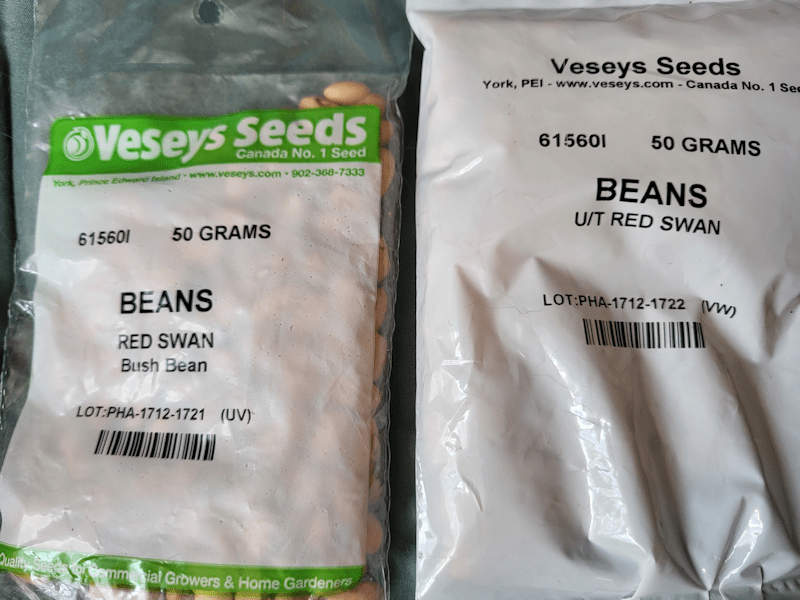
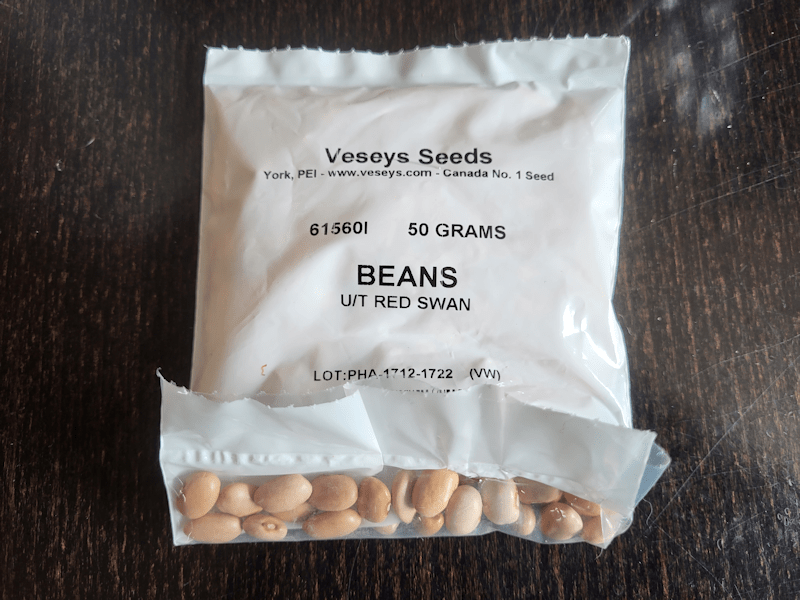
I also made sure the back ordered bean seeds I picked up in the mail yesterday went in with the other beans.
Which is when I discovered something.
I already had some.
The Red Swan beans were not the back ordered beans I was waiting for! I checked my order confirmation emails and saw that I was supposed to get these.
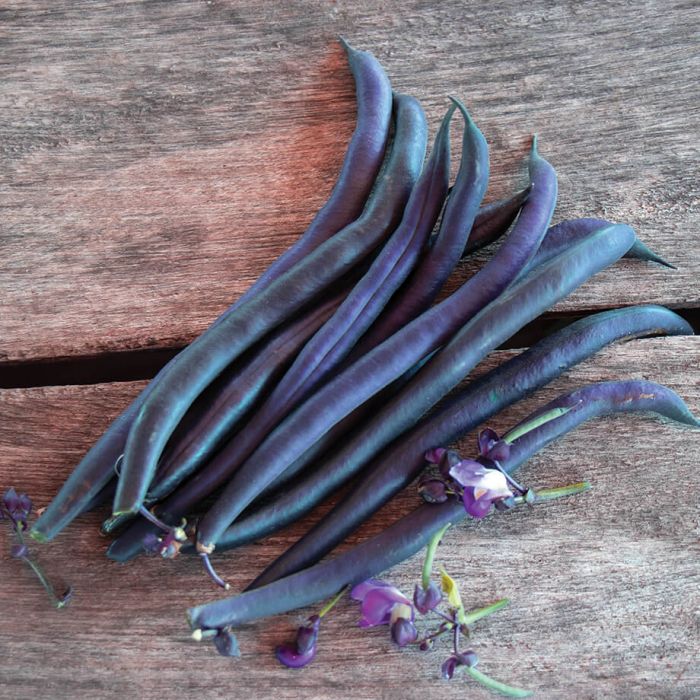
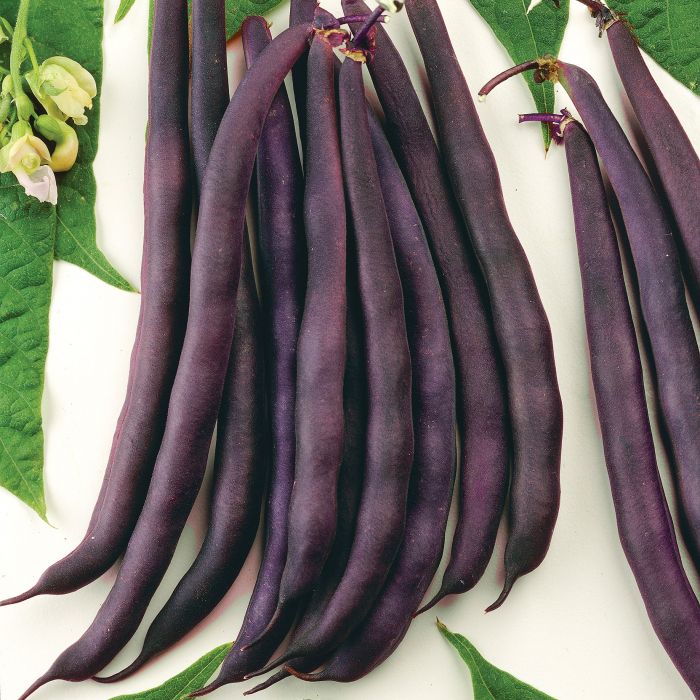
These are the Improved Purple Queen that had been back ordered. From the website:
Spectacular colour! Purple Queen produces high yields and has amazing flavour. While also resistant to cool conditions, Purple Queen matures early and holds its colour in cool conditions making it the perfect bean for home gardeners. Be sure to watch the bean turn from royal purple to luscious dark green as it is being cooked. Resistant to Mosaic Virus. Maturity 52 days.
The Royal Burgundy bush bean we’d grown two years ago was no longer available, so we got this one instead. I wanted a purple bean. So we now have yellow, green and red beans, with a purple on the way. Once I realized a mistake had been made, I emailed Veseys about it, and I already got an order confirmation for the right seeds! Veseys is great for responding to emails. We’ve had an error like this only once before, and they are very fast about fixing things. I’m quite happy with them, that’s for sure.
Interestingly, I just looked at their bush bean collection and found it says the Red Swan bean in the collection is a substitute for the Purple Queen, which is not available for 2023. Looks like they now have Improved Purple Queen, instead.
So that is taken area of.
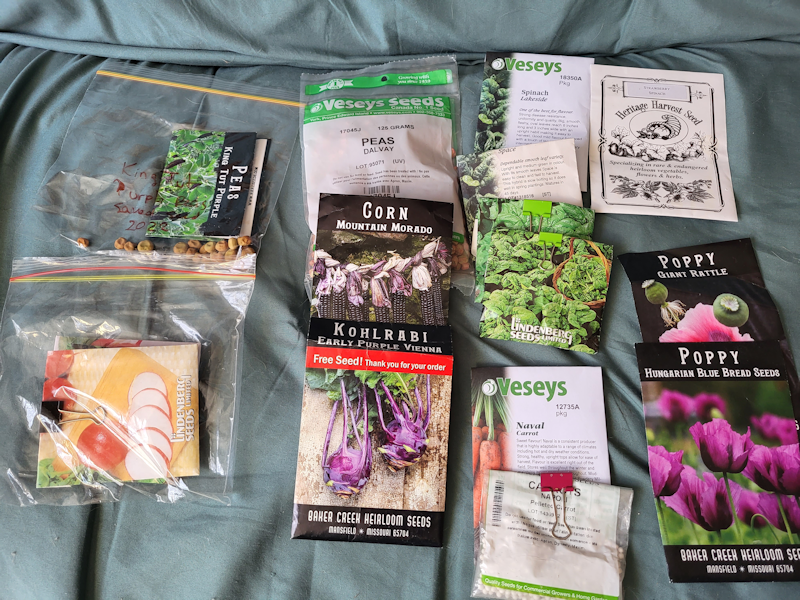
Meanwhile, these are the seeds I have that can be planted before last frost.
Of these, the Mountain Morado corn can be planted 1-2 weeks before last frost. The peas can be planted in mid-April or May. Everything else can be planted as soon as the ground can be worked.
I won’t be doing the kohlrabi. Every year we’ve tried them, we’ve had nothing, and I don’t know why. I do want to grow them. Just not this year. The radishes probably won’t be planted, but if I do plant some, it will be just a few seeds for plants that will be grown for their pods. I’m still curious to try them. We are not big fans of radishes, but I want to see if we like the pods.
The rest, we shall see when and where we will be able to plant things. I still don’t know where to plant the two types of poppies or the strawberry spinach. They will be treated as perennials and allowed to self seed, so they need permanent locations, and the two types of poppies need to be well away from each other to avoid cross pollination. I’ll figure it out.
The main thing I want to plant as soon as possible are the Naval carrots. The Uzbek Golden carrots are described as a cool weather carrot, but there is nothing about planting before last frost, so I will wait on those. I still have the pelleted Napoli carrots, from two years ago. That summer, they were repeatedly eaten by groundhogs and I finally gave up on the bed, only to discover they still managed to produce. They were quite good. If I have the space, I do want to try them again. As for the Naval carrots, I decided to make seed tape with them. I’ll include that in a video I will be making tonight, along with how prepping the low raised beds went. Hopefully, I’ll have a relatively short video ready for tomorrow.
Things are supposed to cool down for the next little while, and we may actually get rain tomorrow or the day after! So I’m not in any rush to get seeds in the ground, but I do want to get as much space ready for them as I can.
Our last packet of seeds that were backordered from Veseys finally came on. Or, I should say, I finally picked them up. I’m pretty sure they arrived last week. We just weren’t able to get out while the post office was open.
Wow! I just looked them up at Veseys, and boy am I glad I ordered them so early! The price has really gone up since then! This is the description for them.
Stringless and unique. Red Swan is a great fresh or cooking bean that is stringless! Bred by crossing a pinto and bush bean, Red swan blew our trial staff away with its yields and ornamental presence. Pods emerge red and mature to rose-purple at 5-6″ long. Red swan kept producing late into the season for multiple harvests and pods hold onto their flavour well at every size. Matures in 60 days.
We have had good results with purple things – beans, lettuces, carrots – so I hope these “red” beans will also do well. Plus, it’s a dual purpose bean. I should remember to plant half of them for a dry storage bean, and the other half for picking fresh.
Meanwhile, here is how some of our seedlings are doing.
The trays in the big aquarium greenhouse are doing well. The germination rate for the Roma VF tomatoes is really high! So if the germination rate for the Spoon tomatoes, and some of those seeds were 2 years old! Still no herbs, but at least there are more peppers starting to show up. I’ve read that peppers can take up to 21 days to germinate, so I hope we will have more showing up. Especially with the cayenne. There’s still only one of those.
Ugh. My phone focused on the wrong place! Ah, well.
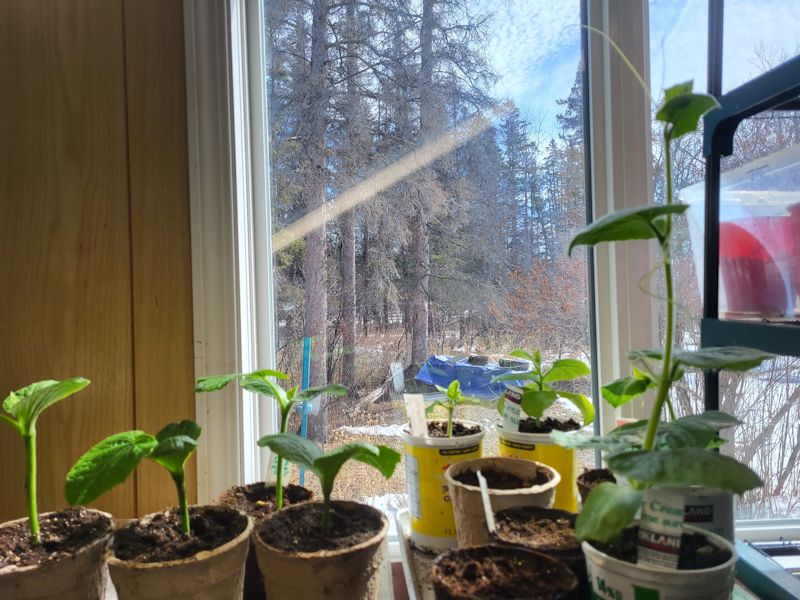
I am just amazed by that one zucca melon on the right! Not only by how tall it’s getting, but that its stem it so strong and holding itself upright, with no support! Last year, they never got this big, even after transplanting. They have such a huge fruit, it’s interesting to see that this is a climbing vine. I’ve had to make sure the tendrils don’t wrap around anything.
There are still just the two of them, though, and just two African Drum gourds, even though I did plant more seeds. We did bring a heater into the living room, but can only use it when someone is around to supervise, so while we’re able to get the room warmer, it may still not be enough to warm up the growing medium. The Crespo squash are looking good, though, with one still in its original pot, and the three that were thinned by dividing.
As for the rest, still no Classic eggplant, and none of the reseeded Little Finger eggplant or luffa have terminated. There are more tiny strawberries emerging, and I think it’s about time to pot up the Indigo Blue Chocolate tomatoes.
I might have to change up how the lights are over the seedlings. This area gets some good sunlight in the mornings, but the more trays are in the mini greenhouse frame, the less light there is for the lower trays. I have to find some way for the lights to reach the lower trays a bit better. They seem to be doing okay so far, though. I’ve been switching them around and rotating them every couple of days or so, but as we take more trays out of the aquarium greenhouses, I won’t have the room do to that for long. We’ll also have to find more surface area for trays; the potted up tomatoes are going to take up a fair bit of space!






 The Re-Farmer