Analyzing our 2023 garden: onions and shallots

Onions are something we use a lot of. I once took the time to estimate how many onions we go through in a month when buying them from a store, and calculated an estimate of how many we would need to plant to meet our needs. I think it came out to something like 200 yellow onions. That did not include red onions, which we bought less frequently. It also didn’t include shallots, which we rarely bought, because they are so expensive.

Which meant that, if we wanted to grow enough onions for the four of us for one year, we’d need to plant more than 200 yellow onions because, once we have them handy, we would probably be using them even more often than we normally do.

Plus the red onions.

Plus we wanted to plant shallots, because they are so expensive, but we like them.

With onions, we could buy sets for easier planting. A lot of sets. Or, we could start them from seed. Seeds would cost less than sets, plus we would have more varieties to choose from.

For our geographical area in Canada, we need to choose long day onions. Until I started growing them myself, I didn’t even know there were such things as long day, short day and day neutral onions!

As shown in a video in the Best Laid Plans post, we also need to start seeds indoors very early. Onions need a much longer growing season than we have.

We chose two red varieties, one yellow, plus shallots for this year. In the red onions, we’d grown Red of Florence successfully before. We like the taste of them, and their elongated bulb shape makes them easier to cut up compared to round bulbs. I also bought some Red Whethersfield to try, choosing them for their purported storability, as well as their flattened shape. With the yellow onion, we tried a new variety called Talon. The shallots variety we tried before wasn’t available, so we got the Ambition shallot to try.

All of these were started in January, and they sprouted very quickly in our large aquarium greenhouse!
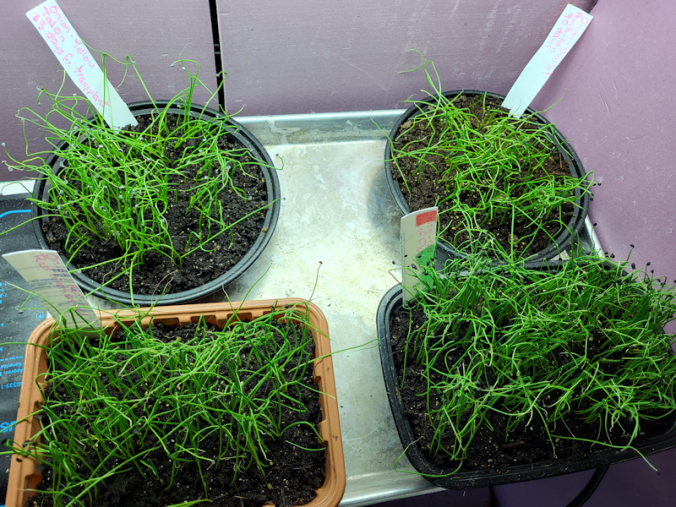
Over time, we shifted some into them small aquarium greenhouse, because we needed the space.
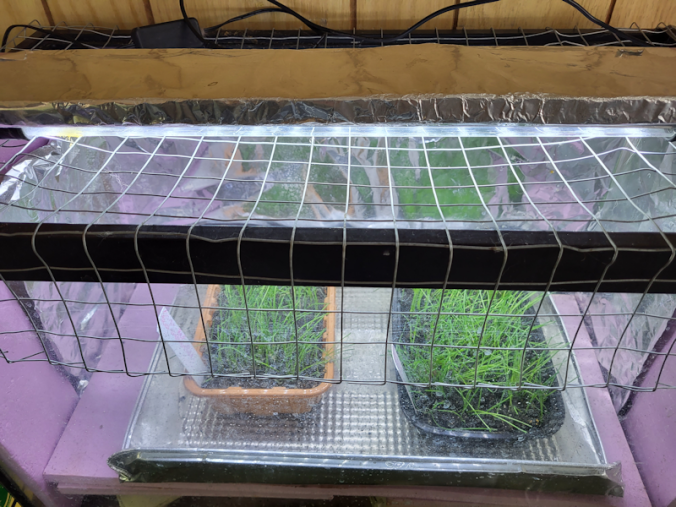
With the issues we had starting seeds indoors and destructive cats, we also began our plans to turn the living room into a cat free zone. This required not only making a door that would keep the cats out while not being a permanent addition, but also a sort of window to block an opening in one of the shelves that act as room dividers. Protecting the seedlings in the aquarium greenhouses and the covered mini greenhouse we have was not good for the seedlings, as it was hard to give them the air circulation they need. By the time we had to move the first batch of seedlings out of the aquarium greenhouses and start other seeds, the barrier was built, and we now have a cat free zone!

With so many onion seeds to start, we went with densely sowing them, which I talk about in this post, including videos from MI Gardener explaining the technique. All the varieties grew very well, very quickly!

Since we had so many onions to transplant, we didn’t plan on dedicating entire beds to them. Instead, they were mostly planted as borders, where we hoped they would also do double duty as insect and deer repellers.

There was just enough Red Whethersfield onions to encircle the Roma VF tomato bed.
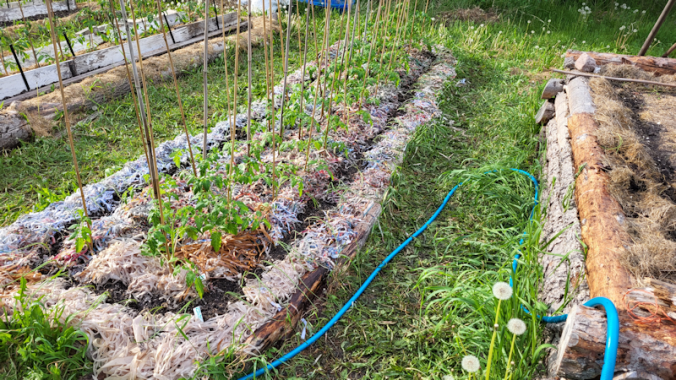
The Talon onions encircled the other two beds with tomatoes, with the last few going into the ends of the high raised bed.

In the above Instragram slideshow, you can see the Red Whethersfied and Talon onions around each of the tomato beds.

With the Red of Florence, they ended up all over the place! Some shared grow bags with peppers.
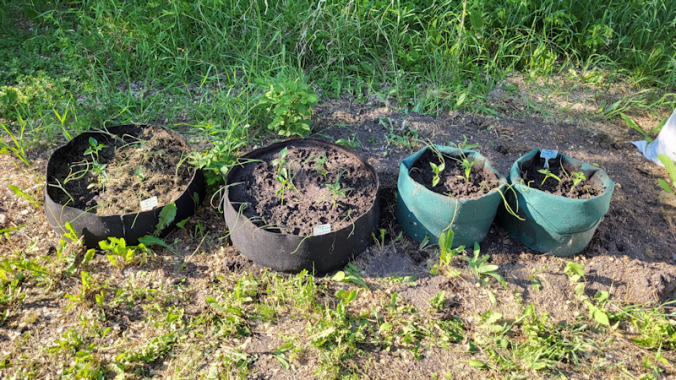
Others got planted between rows of spinach.
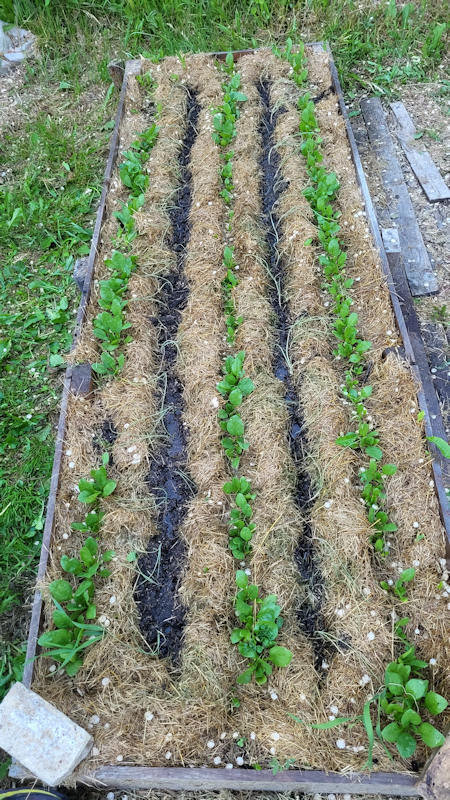
There were so many Red of Florence seedlings, it was hard to find space for them. After the spinach was harvested for the season, we still had seedlings left, and most of them went in where the spinach had been, leaving us with one bed dedicated to just those onions. We still had onion seedlings left over, including some of the yellow onions . By this point, they were the last little, spindly seedlings that we probably shouldn’t have bothered transplanting. Those ended up getting transplanted into the bed where we had peas and greens at the chain link fence.

Then there were the shallots. They got their own little bed, with a few last ones tucked into the end of the wattle weave bed.
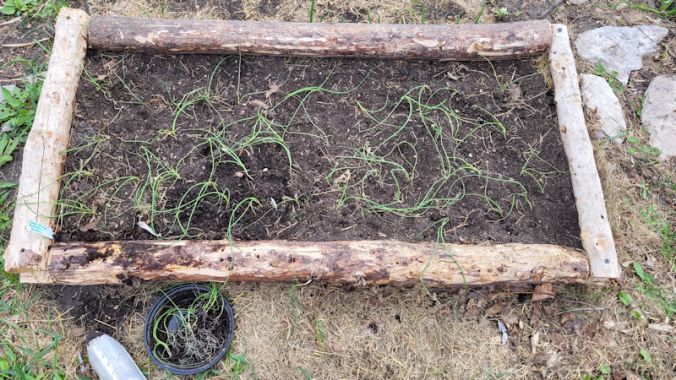
That bed ended up needing extra protection! The cats just wouldn’t stay out of it.
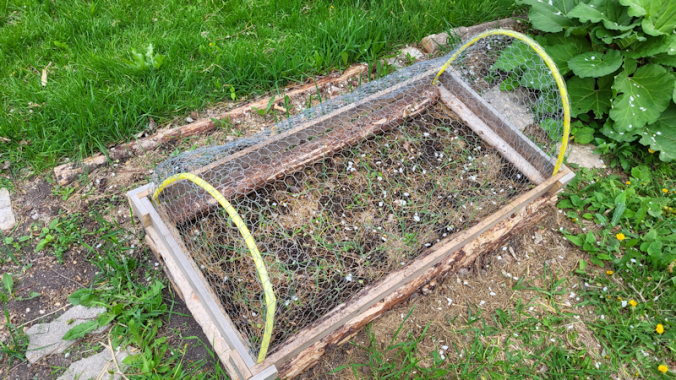
Once the open ends of the cover got chicken wire over them, we could finally keep the cats out of there!

So, how did the onions and shallots turn out?

With the Red Whethersfield, not at all.

I have no idea what happened to them. They were there and growing, and then just basically disappeared. Not a single transplant made it. It was really quite strange!

The seedlings planted in the bed along the chain link fence never really grew at all, with most of them dying off. That was not a surprise, really, considering how small those seedlings were.

The Talon onions around the tomato beds and in the high raised bed did better.
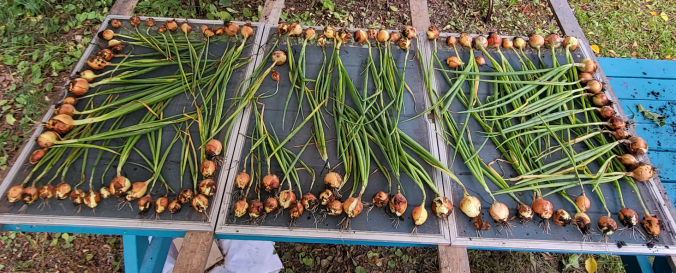
This picture is of the last of the yellow onions that got harvested, being left to cure. They were later braided to hang in the house. As I write this, there’s still a few left. Oh, there were a few other yellow onions in the high raised bed that were harvested later. They were still growing so well, we left them as long as possible before harvesting them.

The Red of Florence did a lot better, in most places. The ones in the grow bags were smaller, but those were where we turned out to have issues with fine tree roots making their way into the soil from below. The ones planted in between the spinach got quite large, with the ones transplanted after the spinach was harvested only somewhat smaller. We got a lot of onions out of that bed!

That bed was left until after the first few frosts before it was harvested completely. We already had some cured and braided indoors, but these last ones were still actively growing and would not have cured properly, so most of them ended up chopped up and in the freezer, with some set up to dehydrate in the oven.

Now, every time we open up the chest freezer, we get a strong smell of onions!

With the dehydrated onions, I ended up using our spice grinder and powdering about half. I think I like the onion powder more than the dehydrated pieces.

As for the shallots, they turned out to have self seeded company! Even though the soil in that bed was completely reworked, with fresh garden soil added, they still had seeds from years gone by in them. Specifically, dill and poppies. We’d planted Giant Rattle Poppies in this space before the little raised bed was built, so I left the poppies to grow. The self seeded dill keeps coming up every years, but never gets particularly large, but we still like to harvest the leaves for cooking, so I left those, too. The poppies grew so tall they started growing through the chicken wire of the cover, making moving it for weeding pretty much impossible. When they started blooming, we realized they were a completely different type of poppy, that my mother grew at some point! No Giant Rattle Poppy seeds seemed to have survived. 😄

When it came time to harvest the shallots, I actually left them be until the poppy pods were dried out. Once I could harvest the pods, the cover could be removed and the shallots finally harvested. They were smaller than they should have been, likely because they had so much competition for water and nutrients, but still pretty good. We got a decent amount to harvest and, as I write this, we still have some left.

Final thoughts on onions and shallots

It’s a given that we will be planting onions again next year. We will probably get more Red of Florence seeds again, as they do so very well.

I want to try the Red Whethersfield again and hopefully actually get some to taste! I’m still somewhat perplexed as to why they to utterly failed, but I suspect it has more to do with the growing conditions in that bed, then anything else.

We definitely need to plant more yellow onions, though. There turned out to be fewer seeds in the package than I expected. I need to pay more attention to seed counts! The Talon onions did all right, but they did not reach their full size potential. In fact, we only got a couple among the tiny ones planted in the high raised bed that got really big. This would be due to growing conditions and compacted soil, which we have issues with.

I want to do shallots again, though I might try a different variety, as we’re still in the “what kind do we like?” stage.

Which means I need to choose and order seeds soon, because we’re coming up on December in a few days, and we need to get seeds started in January! In fact, we could actually get them started in December and not go wrong.

At some point, we will try growing green bunching onions again, and I want to grow leeks, but those will wait until we’ve had more time to improve and amend our soil, and build more higher raised beds. Soil compaction is one of the major obstacles we have to deal with before we can grow those successfully.

All in all, onions, shallots and garlic will probably remain a staple in our garden, every year.

The Re-Farmer

Analyzing our 2023 garden: root vegetables

Our root vegetables this year were a mix of successes and failures!

First up, the successes.

Potatoes

We had three varieties of potatoes this year. We chose the varieties based on things like their storability, and their resistance to disease, as well as their flavour profiles. One time, the Purple Peruvian Fingerlings, were a potato we’d grown a couple of years ago and quite enjoyed. The other two were new to us: Irish Cobbler, a white potato, and Red Thumb Fingerling, a potato with both red skin and red flesh.

The original plan had been to plant them all in grow bags this year. We’d tried the Ruth Stout method last year, and both beds got flooded out, and there was very little left to harvest. We were going to repurpose old bird seed and deer feed bags for this. We have stopped buying both – we just can’t afford it anymore, with how much cat kibble we’re buying now – so it turned out we didn’t have enough for all three varieties.

This required a change in plans and, that early in the season, there were only a few places we could plant potatoes directly into the soil. So, the red and white potatoes went into low raised beds in the Old Kitchen garden.

The red potatoes went into the long, thin bed next to the retaining wall block, which got redone this spring, and when I ran out of room, into the short end of the L shaped wattle weave bed.

You can see how the Old Kitchen Garden beds the potatoes were planted into progressed over the years in this video.

The Purple Peruvians went into the grow bags.

So, how did the potatoes do this year?

Pretty darn good.

We harvested baby potatoes from the Old Kitchen Garden only a couple of times, since we didn’t really have a lot of any variety. The Irish Cobbler were the first to be ready to harvest, then the Red Thumb.

The Purple Peruvians, on the other hand, took an incredibly long time to mature, and did not get harvested until mid October. I’ve been going through my files to find photos of them – they were our biggest harvest – but it turns seems that by the time I was done harvesting them, it was too dark for photos!

As I write this, we have finished off our Irish Cobbler potatoes, but still have Red Thumb and Purple Peruvian Fingerling potatoes in storage.

Final thoughts on potatoes

I would consider all three varieties a success, this year. Especially the Purple Peruvians.

The smallest harvest we got was the Irish Cobblers. They were also the earliest maturing variety. They did seem to have issues with scab, however. They tasted good, however, and were a good potato for a variety of preparation methods.

The Red Thumb did quite well, and were also tasty. When cooked, they practically mashed themselves, so not a good variety if we wanted to do a hash or in a soup or stew. Having pink mashed potatoes as a side for Thanksgiving dinner was rather fun!

The Purple Peruvians seemed to take a lot longer to mature compared to the first year we grew them, with robust plants right up until the frost hit them. They are nicely prolific. The only “down” side is one of aesthetics. They do bleed their colour quite a bit, leaving fingers purple can changing the colour of any soups or stews they are cooked in!

When it comes to growing potatoes for our general needs and use, we will need to grow a lot more, but we are still figuring out what varieties we want to grow. As much as we like the Purple Peruvians and Red Thumb potatoes, I think we might want to move away from fingerling potatoes in general, other than perhaps as a side crop. Their smaller sizes and, in the case of the Purple Peruvians, uneven shapes, make them harder to handle, clean and peel. In the future, I think we will try varieties that have more even shapes and larger sizes, as well as being good for long term storage.

One last surprise

As I mentioned, we grew potatoes last year using the Ruth Stout, deep mulch method. Not only did the potato patches get flooded out, but they also got hit with slugs quite badly.

It seems, however, that we missed a few potatoes when we harvested them, and they showed up this year!

One of them, from the All Blue patch, got quite large and began producing seeds!

I didn’t try digging up the potatoes in the fall, but I did collect the seed balls. I haven’t tried opening any yet. From what I’ve read, these can be opened and the seeds inside processed much like tomato seeds. Seeds from potatoes will not be clones, as they are when the tubers are planted. I believe there are some rare exceptions, but the seeds each typically produce a new variety, like apple seeds do. I think that if we planted them, we’d still get something similar to the All Blue potato they came from, but the only way to find that out is to plant them and find out! I’ve read that, in the first year, potatoes planted from seed will only produce a single potato that can then be planted like any other potato and produce clones of itself. I don’t know if we’ll be able to experiment with this next year. It will depend on how much space we have. Still, I’d like to try it!

Carrots

We has several varieties of carrot seeds this year, and I’d intended to plant more. In the end, we only had space to plant two.

One variety was new to us; the orange Naval carrot. With those ones, we tried something else new: making seed tape.

The other variety was the Uzbek Golden carrot. We’d grown them last year and, while they did not get a chance to reach their full potential, it being such a bad growing year overall, we did enjoy them. This year, they did even better!

With these ones, we harvested them throughout the summer, as needed, then harvested the last of them after we had our first frosts.

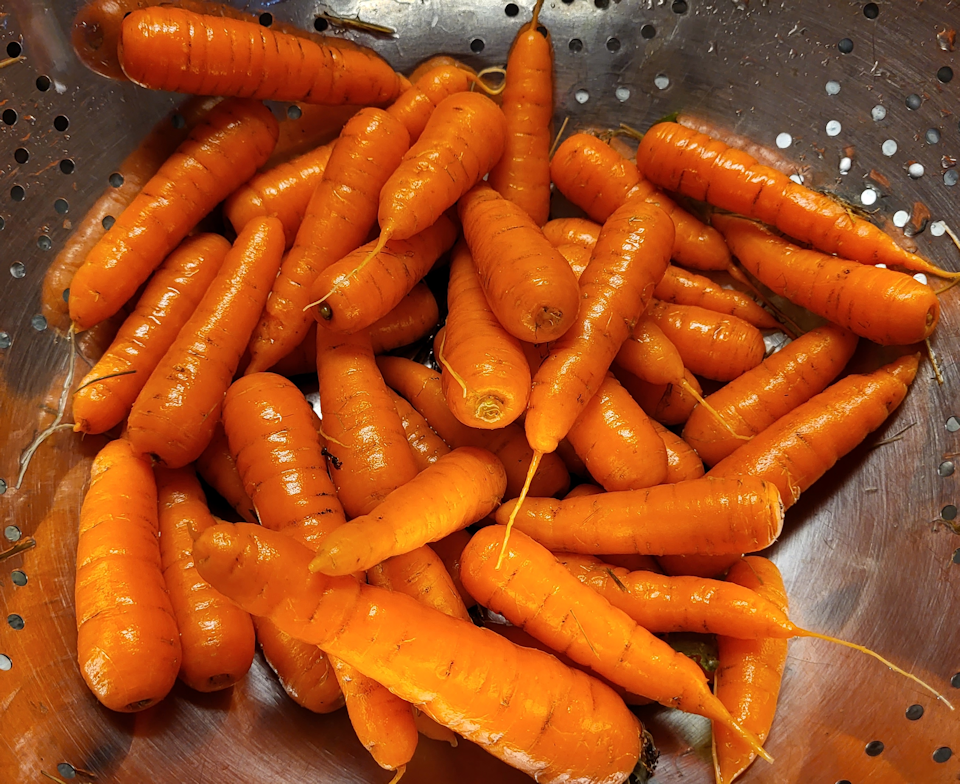
Uzbek Golden Carrots, Gold Ball turnips, a couple of radishes and some onions that got missed.

There was some slug damage, and a few of them split, but overall they did very well.

These carrots are lightly sweet, crispy and delicious. They were a great carrot to eat raw, and also held up to cooking very well. This is definitely a variety we would enjoy growing again. I would like to find a Canadian supplier of seeds, though. It’s getting too expensive to order seeds in from the US.

As for the Naval carrots, we planted devoted an entire bed to them.

I definitely liked how the seed tape worked out. We planted an entire package of seeds, didn’t need to thin any of them, and got a very high germination rate.

We didn’t harvest many of them through the summer, though. Instead, we left them in the ground to try out a different method of storing them for the winter: in ground and under a heavy mulch. The idea is to be able to harvest fresh carrots during the winter.

This is our first “winter” harvest.

The carrots were noticeably smaller at one end of the bed, likely because that end gets less light, so that’s the end I harvested these from. Under the thick mulch, the ground was cold and did have ice shards in some places, but the ground was workable and the carrots could be dug out fairly easily. They were wonderfully crisp and fresh and very tasty! The ultimate test for this method of storage is yet to come, as winter isn’t even officially here yet, and things have still been pretty mild, compared to how our winters usually tend to be.

Final thoughts on carrots

I do wish we’d had the space to plant more varieties, but I’m happy with what we did plant. Both varieties are tasty. If I have anything to complain about, I’d say it’s that they are a bit harder to pull, as their greens come off easily. These need to be dug loose, first. I’d be doing that anyhow, so that’s not really an issue. These are definite winners.

Now for the losers. Mostly.

Turnips and Beets

This year, we planted varieties of turnips and beets we have tried before.

Last year, we got Gold Ball turnips as a freebie with a seed order. We tried growing them, but something ate the seed leaves as fast as they came up. So, we bought more seeds to try them again.

For the beets, we planted a variety called Merlin.

There were planted in the same bed, next to the Indigo Blue tomatoes, and bordered with yellow onions. I hoped that the onions would help deter any critters or insects that would want to eat the turnip and beet greens.

The turnips did seem to do rather well. They got quite leafy, enough though something was most definitely eating them. The leaves were filled with holes.

While we did harvest a few larger turnips, ultimately, they never reached their full potential. You can see in the photo with the Uzbek carrots above, how few there were, that were worth harvesting, by the end of the season. All bug eaten greens, almost no turnips. I think they tasted okay, but they probably didn’t taste the same as they would have, if they’d reached their full potential.

In the photo above, you can see where we planted the Uzbek Golden carrots, sharing a bed with the Black Beauty Tomato transplants in the foreground. The carrot seeds are covered by boards to protect them until they sprouted. In the bed on the left of the photo, the half on the lower left got the turnips, while the half on the upper left got the beets. You can see the labels marking where they are in there. (The white boards on either side of the tomatoes are there to protect the new transplants from high winds.)

The beets barely came up at all.

The first year we grew beets, they did rather well, but pretty much every time we’ve planted them since, they’ve been doing worse and worse. This year was, to be honest, pathetic.

In the case of this bed, however, I think there was something odd about the soil. Even the turnips grew stronger and healthier on the south end of the bed, but by the middle of the bed, they were smaller and sicklier. Then there were a few little beet seedlings that started to emerge, but by the north end of the bed, there was nothing. No germination at all. Even the tomato plants at that end seemed to be smaller and less healthy looking.

The entire bed got the same amount of sunlight and water. This was one of the beds that had a sprinkler hose wound throughout. The problem could be in the soil itself, but after harvesting the grow bags at the end of the season, I think the problem may actually be that row of self seeded trees my mother allowed to stay. She’d had a row of raspberries there and, after transplanting the raspberries, she left the saplings to grow to be a wind break. In trying to clean up around there, I can see that attempts have been made to remove these trees in the past, and they’ve just grown back. It’s a mix of maple and Chinese elm, which means they are not only taking up space that used to be productive garden space, but are spreading seeds. Those Chinese elm seeds are the worst, and have been causing all sorts of problems. However, when working on the soil in these beds, pulling up roots and amending it, we find a lot of roots at the north ends of them. The bottoms of many of the grow bags the peppers were in were absolutely crowded out by tree roots that had grown in from below. Because of how these trees growing, I suspect that it’s the Chinese elm roots that are depleting spreading the most and winning the competition for nutrients.

Final thoughts on turnips and beets

We’ve had such poor results growing turnips and beets, I don’t know that we will try to grow them again, until we can plant them in higher raised beds. The one area we’ve grown beets in semi successfully, was in the East yard, near the spruce grove. When we cleared out where the old wood pile used to be, we found the best and softest soil of all under there. While my daughters have enjoyed what beets we’ve managed to grow in the past, with the Merlin variety being a favourite of theirs, I honestly don’t know if we like any of the turnips. I’ve selected turnips to grow as a good storage crop for food security, but it’s not much good for that, if we don’t actually like eating them. With the small turnips we’ve managed to harvest so far, we’re not getting their full flavour.

Which means we will likely skip trying to grow turnips and beets again for at least a couple of years. Once we have more, and more established, raised beds, we can try again.

Extras: more beets, plus radishes

After we harvested the garlic, we had an empty bed suitable for a fall crop. In it, we decided to plant spinach, beet and radishes.

We planted the Cherry Belle radishes, Lakeside spinach and Bresko beets.

I’ll cover spinach in another post, but in this bed, they started to germinate, then promptly disappeared. A couple of seedlings did survive, but didn’t grow much at all. The beets barely germinated, and what did germinate, soon disappeared. Only the radishes grew, and while we got decent looking plants, and a couple that shot up and started to bloom, there were almost no radishes worth harvesting. While I think insects or slugs got the beets and spinach, I suspect it was the nearby trees that did in the radishes.

Only one of us in our household actually likes radishes, however I’ve been curious to try radish pods. So far, we’ve never had radishes get to the point of producing any! Even though these ones were planted so late (my daughter that likes them ended up house sitting for a month, so she wasn’t here to eat what few we got!), the ones that started blooming are the furthest along we’ve had them grow.

As with the beets and turnips, I think radishes are something that we won’t grow again for a while. They do produce very quickly, if eating the roots is what we’re after, so we might tuck them in between other things as a sort of ground cover, but that’s about it. I do still want to grow some for their pods to try. Perhaps we’ll have an empty corner in a higher raised bed to tuck a few seeds in, and just let them be until the end of the season. That will be a last minute decision, depending on what space we have to work with, next year.

Which means that, for root vegetables, we’re basically down to potatoes and carrots!

Well. I guess that’ll make things easier to plan out next year! 😄

The Re-Farmer

Analyzing our 2023 garden: the best laid plans!

Since moving out here, our gardening plans have changed a few times. Our original 5 year plan had us starting to garden around year 5, after focusing on cleaning and clearing first the inner yard in the first two years, then the outer yard over the next 2 or 3 years, before eventually moving beyond the outer yard, which is rented out.

It’s now been 6 years. The inner yard – specifically the spruce grove – is still not cleared and cleaned up. We had to start on parts of the outer yard earlier. Some things had to be dropped completely.

Gardening, however, started early, and I’m glad it did. We started off with a couple of reclaimed patches of ground. Each year, the garden beds were expanded and we grew more things.

Until this year.

All the best laid plans, indeed! We ended up with a garden perhaps half the size of the previous year.

Early in 2023, though, we still thought we’d be able to do a larger garden. Many seeds were purchased, and orders were placed for things that would be delivered in time for spring planting. Here is a video I did, going through our seeds – old and new – and starting our onions and luffa.

Even in April, I still thought we’d be able to meet most of our goals, and was able to get started preparing a couple of low raised beds.

I also did a spring garden tour in April, where I talked about our plans.

Among the things that changed was the shed we were supposed to get, that would have been fixed up to be a chicken coop. The person that had the shed to get rid of ended up throwing it away. It did not survive the winter.

Getting the dead trees to build more raised beds didn’t work out as planned. Slowly over the summer, we did get wood harvested, but felling dead spruces resulted in trees getting hung up and stuck on other trees.

That was just the beginning of plans that fell through.

All was not a loss, though. For what we did manage to get, there were some successes and failures, as there are every year, and that’s what I’ll be going through in this series of blog posts analyzing our 2023 garden. With what we’ve learned in the past few years, we should be able to make adjustments and do better next year.

The Re-Farmer

Our 2023 garden: frosty harvest

I’m just going to post this photo for now; I took some video and will upload that later.

Until then, this is what I was able to harvest today.

We did get another frost last night. I was out doing my rounds early enough to see some frost still on the ground. Once again, there was no frost warning and, according to the official past 24 hours record, we never dipped below 6C/43F, while I know I saw 4C/39F on my app when I checked before heading out this morning.

I should get one of those high/low thermometers that have needles to mark the highest and lowest temperatures on the dial.

So for now, all the stuff affected by the frost has been harvested that could be harvested. I left the melons, because they look like enough of the vines survived for ripening to continue. We’re supposed to warm up over the next while, so that will give more time for things like the melons, peppers, Spoon tomatoes and the one eggplant to ripen. The other things, like the carrots and onions, can handle frost so they’ll be fine for quite a while longer.

Our gardening season is not done yet!

The Re-Farmer

Our 2023 Garden: September garden tour (video)

Last night was our average first frost night, and there was no frost. The garden survives another night!

Check it out. 😊

May the frost hold off at least as long as predicted. Cooler night means things are slowing down, so if we’re going to get to harvest things, we need as much time as possible for it to fully mature.

The Re-Farmer
Kitty status and morning in the garden

First, I have heard about how the adopted ladies are doing. They are recovering well at the Cat Lady’s home for now. The Phantom is being an absolute, loving joy. The kitten is also being really sweet.

Decimus is hissing and spitting and not a happy camper, but doing well, health wise! They have several catios, though, so they were able to let her go “outside” to get some fresh air.

My daughter and I went outside with the flashlight last night. Still no sign of Marlee or Butterscotch. We did spot a cat in the driveway that turned out to be Nosencrantz. Once my daughter started walking towards her, though, she ran off into the old hay yard.

If we’ve seen her, chances are pretty good the other two are okay, too.

Right?

As for the remaining cats in the isolation ward, the kittens are doing just fine, though getting very active and destructive! TTT spends most of her time in her napping cave in my closet, but she sure knows when the food is coming out!

She has also continued to make a mess on the puppy pads next to the litter box under my desk.

*sigh*

At least it’s on a puppy pad, and not my bed or the carpet.

She is also remarkably regular. She always goes in the same place, and even goes at almost the same time! I was awakened by the rustling of the puppy pad being dug into this morning. I found it was very wet and changed it, then went back to bed. Maybe an hour later, I was again awakened by that familiar rustling sound, and she’d dropped a load this time. Again, thankfully, on the puppy pad and an easy clean up, but I find it interesting that she has such a consistent habit of time and location!

Now, if she would just use that litter box, instead. The kittens are sure liking it. 😕

This morning, as I started getting the kibble ready for the outside cats, I spotted the stranger cat, inside the sun room!

For a stranger cat, it’s acting right at home.

S/He was even sharing a food bowl with Beep Boop and the friendly black and white kitten.

I feel I should know this cat. The face looks familiar. In fact, the face makes me think of Potato Beetle. The markings on the sides, though, are not at all familiar.

Could this be a yard kitten from last year that took off before we became familiar with it, only to come back now? It’s possible, but I don’t remember seeing a kitten with markings like that last year. Mind you, it might also be a slightly older cat, too. I still can’t come close to it, though.

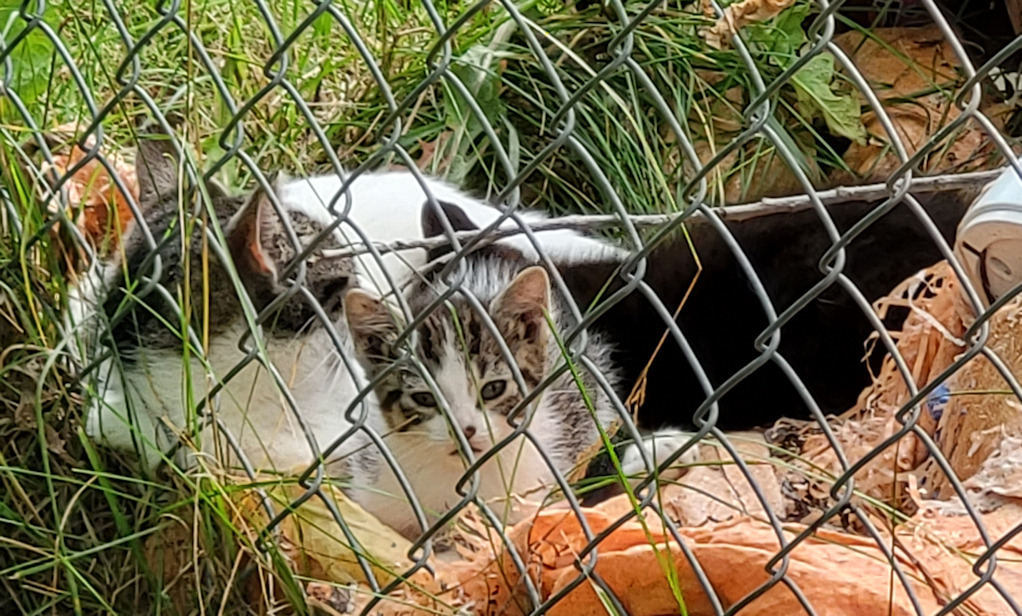
After finishing my rounds, I noticed the bitty kitties around with Octomom (whose name is actually Slick, but I kept forgetting that). They were watching me, so I got out the lure – just some jute twine tied to a stake.

This adorable ball of fluff took the bait and started trying to catch the end of the twine. I was actually able to get hold of it and pick it up. It did not like that, though! I pet it for a bit, but as I was trying to put it back down again, it chomped on my fingers and left me bleeding.

It was worth it.

I didn’t intend to harvest anything this morning, though I did end up picking some Red Swan beans and a couple of yellow patty pans. Mostly, I was making sure everything was doing well.

While checking the Crespo squash, I spotted a female flower! There have been so few of those this year. Wild that one should show up so late.

Also, that’s 2 bees in there, one on top of the other!

I decided to hand pollinated anyway, just in case, so I went looking for one of the many male flowers that was open and found this.

So nice to see!

I picked a different one to hand pollinate the single female flower. One of the bees flew off, but the other stayed, even as I moved around the male flower stamen, then broke it off and left it in the flower, so the bee could do the rest.

This next slide show is the first time I’ve been able to upload a slide show and have every single photo work! After this, I had to do one photo at a time, because every group upload was thoroughly corrupted.

I really, really hope we have a long mild fall, because we suddenly have SO many new melons forming, along with the two big ones. The vines are so mixed up, there’s no way to tell which variety is which right now. There are many more female flowers and tiny melons that forming. If the weather holds, we might have a bumper crop!

Even the winter squash is seeing an increase. For example…

This is one of two Boston Marrow vines. Both had a single squash starting to form, but the one on this plant suddenly started to rot away. You can even see it in the photo. I broke it off but left it to break down where it was.

Now there are three female flowers blooming – and not a single male flower to be seen! At least not another Boston Marrow male flower. I ended up hand pollinating them with a nearby North Georgia Candy Roaster. With that combination, if we actually get something to harvest, I’d want to save the seeds. That sounds like it would make an interesting hybrid!

Speaking of which…

The candy roasters are doing really, really well. Check out this big beast of a squash!

I noticed a few small squash that were being eaten by slugs, but they seem to be leaving the big ones alone. Likely because the skins are harder.

When I saw an open flower with what I thought might be another bee in it, I found several slugs, isntead.

I picked he flower and stepped on it. Slugs have been such a problem this year!

The pink bananas are also doing very well. Not only are there a lot of huge squash like this, but lots of smaller ones, plus they are still blooming and producing both male and female flowers!

I noticed that one of the Honeyboat Delicata squash that hadn’t even bloomed all year, suddenly has both male and female flowers budding. Even the Winter Sweet plant that had nothing going on – the other one has a single developing squash – suddenly had a female flower blooming! I had to use another type of winter squash to hand pollinate it, though.

We’re at the end of August, though. Average first frost date is September 10. Long range forecast says we should have a high of 23C/73F that day, with a low of 13C/55F. In fact, if the monthly long range forecast is right, we won’t see frost until near the end of October. If that holds true (thanks to El Nino!), that will another 50 days or so to our growing season! That would make a huge, positive difference for the garden.

As for today, there’s a limited amount of work I can do outside right now. We’ve got high winds today. We’ve had predictions for everything from a thunderstorm this afternoon, to rain this morning (we didn’t get any), so rain overnight, to no rain at all.

This morning, when I saw the predictions for a storm, I checked the radar. I would see the system coming our way but, sure enough, by the time it reached our area it dissipated and split up around our weird “climate bubble”.

Which works out. We’ve decided to do my husband’s birthday dinner today, and he asked for take out pizza from a specific restaurant in town. He didn’t get his prescriptions delivered yesterday, as they were missing something, but it’ll be ready today, so I’ll be picking those up first, plus hitting the grocery store for a few things, before picking up the pizzas – which my daughter is kindly paying for as her birthday gift! My husband’s main disability payment came in today and normally I’d be going into the city for another stock up shopping trip, but I’ll do that tomorrow, I think.

Meanwhile, I’m going to be watching the trees outside our windows closely, in case another one comes down in the wind!

The Re-Farmer

Our 2023 Garden: partial onion harvest

One of the problems we’ve had is cats getting into the garden beds. They seemed to especially enjoy laying down on the onions!

As a result, we have a lot of onions with broken stems. Under normal circumstances, that would be a sign that the onions are maturing and ready to be harvested. If the stems are prematurely broken, the plants act as if they’ve reached maturity and won’t get any bigger.

I have been leaving them for the last while, which gives them time to develop that thicker, dry outer skin, but I didn’t want to leave them too long. So today, I harvested the first batch.

This is almost all of our yellow onions, though I did leave the ones that did not have broken stems. Normally, I would not have laid them out with the greens facing in and overlapping like that, but if the greens were hanging off the edges, they’d be way too tempting for cats to play with and drag around! Onions are toxic to cats, so we don’t want any sort of temptation like that.

After a couple of days, we’ll braid them and hang them in the cat free zone inside, aka our living room.

The potatoes that had been curing on these screens were put in cardboard boxes to store and are now also in the cat free zone. We’ll have to eat them fairly quickly. I didn’t bother picking over them to separate any for the root cellar. There just isn’t enough to make that worthwhile.

I did use some of the red potatoes with breakfast. I now know that the Red Thumb potatoes are not really suitable for making hash browns. 😄 They really wanted to mash, instead! Still tasted good, though!

The Re-Farmer

Our 2023 garden: morning harvest and how things are looking

I didn’t pick any bush beans for a couple of days, so there was plenty to pick this morning!

I also grabbed a few Gold Ball turnips, Uzbek Golden carrots – a first harvest of those – and snagged a yellow zucchini. There’s some green ones starting to grow, and one that is almost ready to harvest, but not quite!

I uploaded other photos onto Instagram. As you go through these, can you please let me know if any of them look like the files got corrupted somehow? I am having problems with viewing batches of photos like this. They look fine as I go through the process, but after they’ve been published and I view them, there are usually visual changes to some of them. Some are so bad, I can barely see the image, so I delete the whole thing and start over. I had to do that with this batch, and I still see problems. The images are at least identifiable, though!

Please let me know if you see it to, or if it’s just my computer messing up!

The first image is of the North Georgia Candy Roaster squash that is getting SO big, so fast! It seems to be getting noticeably bigger, every day! There were also a lot of new female flowers among the candy roasters and the Pink Bananas.

There is a little patch of allium flowers that come up every year through a crack between sidewalk blocks and the laundry platform steps. They are in full bloom right now, and the bees loves them. I tried taking photos and just happened to catch the bee as it flew off to another flower head!

The earliest Sweet Chocolate bell peppers are turning colour quite nicely right now.

The next photo, of the chamomile flowers, looks like it has a block of purple over all but the top of the photo. Do you see that too?

The chamomile are blooming quite enthusiastically right now.

The very first luffa flower has opened – and is being pollinated!

Last of all is the first flower on the Classic Eggplant. Check out those spikes on it!

On another topic entirely, I brought one of the yard kittens in, so my daughter and I could wash its eyes out. They were completely stuck shut. As soon as the dried gunk was softened enough that the lids started to open, they started oozing more gunk! It’s nose was all gummed up, too, and somehow a tiny piece of flexible plastic was stuck to it! My guess is it was from the strips of plastic that covered the adhesive on the new roof tiles. We’re still finding them blowing around.

We got the kitten cleaned up as best we could, then set it outside again, but not before my daughter got a picture of it. The Cat Lady is going to be coming for Ghosty soon. I hated to asked, but I sent her the picture and asked if they would be able to take a second sick kitten.

She had to check with her husband, who was monitoring their cat that just came out of surgery not long ago. Their cat seems to be doing all right, so she will take the sick kitten. With its eyes gumming up so much, it tends to stay by the house a lot, so we should be able to find it and catch it, once we know she’s on the way.

The down side is, the rescue’s budget for August already done, having gone towards spays. Which means they’ll be taking on these two, out of pocket! They’ve already spent thousands on just two cats in the past, but they’re still willing to take on these two. The other downside is, once they’re all healthy, it’s been difficult to adopt cats out. Partly because she wants to keep them! 😄 I do expect Ghosty will get adopted out easily. She is a rather unique looking kitten. A bit freaky at times, too! She’s got blue eyes, and when the light hits them just right, her pupils glow red. We think she might have partial albinism. Her eyes are still sticky, too, but she has gotten much better since coming inside.

The Cat Lady commented that the strain causing these problems is particularly bad this year. Not just with so many sick cats, but so many kittens dying this year, too. So it’s not just at our place! We’ve found so many dead kittens this year, plus losing Question, even after bringing her inside. We’re still tossing the outside cats’ kibble with lysine to help their immune systems, but it’s the little ones that are suffering. The adults seem just fine, but with the littles, it seems that as soon as they start getting weaned, it’s just not enough.

Well, we do what we can! I feel bad asking the Cat Lady for help, though, but after Leyendecker, we just don’t have the budget to take another cat to the vet. The Cat Lady’s rescue runs on donations, but they do a lot out of pocket, too. Her husband, thankfully, makes good money, but it’s still a lot to cover out of pocket!

Ah, well. I’m just glad she’ll be able to take Ghosty and this other kitten. She is so awesome!

The Re-Farmer

Our 2023 garden: spinach, beets and radishes

I finished preparing the bed we harvested the garlic from, and sowed for a fall harvest.

I chose Cherry Belle radishes and Bresko beets. I wasn’t sure how many seeds I had left, so I brought two different varieties of spinach. I was able to sow the Lakeside variety, which is what we planted in the spring. I was so impressed with how they didn’t go bitter, even when they started to bolt, I definitely wanted to sow those again.

I used the boards I’d brought out to shelter the tomatoes from the wind in the spring and laid them out around the edges, where weeds are such a problem, as well as across the middle to divide the bed into three sections. I ended up adding a couple more boards at the ends, too. Aside from hopefully keeping the crab grass at bay and dividing the bed, they also give me something to step on while tending the middle rows.

The first thing I did was give the entire bed a watering, using the cone setting on my sprayer for more even coverage. Then I used a hoe to trench out three rows in each section. Those got a watering on the jet setting, because I wanted to drive the water deep. Even though I’d already watered the bed, the moisture didn’t get very far, and the trenches were quite dry. The water also leveled out the soil in the trenches, so they weren’t so deep.

Next, I used grass clippings to mulch along the boards and in between the rows. Once the mulch was down, I used a broken piece of bamboo stake to make the rows the seeds would be planted in.

I picked up a seeder at Dollar Tree, and this is the first time I used it. It worked rather well. In the photo are the beet seeds, which were easiest. The rounder radish and spinach seeds did sometimes get a bit out of control, though! 😄

The beets went into the middle sections, the spinach at the end closer to the house, and the radishes at the far end.

Once the seeds were in and lightly covered, I used the flat setting on the hose to water each row and settle the soil further around the seeds. The grass clippings were toasted dry in the sun, so I used the cone and shower settings to soak the mulch. Last of all, I used the jet setting to clean the loose grass clippings off the boards.

What I will probably do later is put some kind of cover over the whole thing. I think we have some mosquito netting long enough for it. I mostly want to keep the insects from eating the greens. Last year, the radishes seemed particularly vulnerable. As they get bigger, they will definitely be tempted for the deer, too!

We were at 26C/79F while I was out there. Another reason to make sure the bed got extra watering! The two northernmost rows of squash were wilting in the heat again, so I’ve got the sprinkler going on those. Squash need a lot of water, anyhow! I had been concerned that the two southern rows would have trouble because they get so much more shade, while the two northern rows basically get zero shade from sunrise to sunset. With this year’s heat, that shade it turning out to be helpful! Last year, with the flooding, it was the other way around. The squash that were in full sun strove mightily to recover from the flooding, while those in shade basically had no chance at all.

For the next week to ten days, we’re going to see increased heat. Depending on which app I look at, we’ll either have no rain at all, have several days or rain, or several days of thunderstorms! It’s awfully hard to plan things with such conflicting information!

The Re-Farmer

Morning… er… afternoon finds

Well, I did get some sleep last night! The kittens did tackle me, but I almost slept through it. I really, really have to watch myself, though. I leaned forward in bed this morning, and something moved. Turned out I had a kitten curled up right against my belly!

My daughter, unfortunately, did not get any sleep at all last night. Big Rig would not leave her alone! So she was up and about early to find Leyendecker for his morning medications. As I was getting up to help her, I realized I was hearing pouring rain over the sound of my fan! We were not supposed to get rain today. That’s why I watered the garden yesterday!

My daughter went on to feed the outside cats while I supervised Leyendecker, trying to get him to eat his new food. The first time my daughter gave it to him, he ate it hungrily. Now, he won’t eat it at all. We’re not sure what’s going on. Even when he’s around the main food bowls, which we now keep empty between feedings, he hasn’t even really been looking for more food. It’s likely the medications are causing him to loose his appetite, but I don’t remember it happening when he was on them before.

Since it was pouring so hard out, I went back to bed. My sense of time is now completely messed up! I went out to do my “morning” rounds a little while ago, but it was about 3pm. It still feels like morning.

Anyhow, here are some of my finds of the day!

When I saw Octomom heading for the kibble house, I checked on her babies. Usually, they’re asleep when she leaves, but not today!

It took me watching this a couple of times, counting and recounting, before I finally spotted the eighth kitten, under the two black ones! 😄

While finishing my rounds, I spotted the kittens in the junk pile with their mama.

Looks like it’s just the 2 of them, and they’re starting to go further afield! I expect we’ll soon be seeing them eating in the bowl under the shrine. 😊

I managed to get a picture of the tuxedo with the messed up eye. This photo is cropped closer, to see it better.

I’m really surprised. That eye is clearing up really well! The inner eyelid is swollen like crazy, but I was sure he was going to lose that eye completely. I am happy to say, it looks like I was wrong!

Meanwhile, I had a first in the (very well watered!) garden today!

Our very first ripe Roma tomato! It picked itself. This was the first tomato to show up, so no surprise it ripened first. I reached out to touch it and it fell off the vine into my hand!

The next picture is of ripening Indigo Blue Chocolate tomatoes. Now I can see where the “chocolate” part of the name came from!

I didn’t get a picture, but I saw a female Crespo squash in full flower, and I made sure to hand pollinate it. In the photos above, you can see the female African Drum gourd flowers are getting larger. The male flowers have been blooming consistently, so I expect to be able to pollinate those by hand when they finally open.

The last picture is of the G-Star patty pans, and we’ve got a switch on that one! The female flowers are blooming, but the male flowers just buds right now. Which means those lovely looking squash are not going to develop fully. There aren’t even any other summer squash blossoms I could use to pollinate with. I suppose I could try using a winter squash blossom, but I don’t know if they are similar enough for that to work. The G-Star plants are doing very well, though, so I expect we’ll have both male and female flowers blossoming at the same time, fairly soon.

I’m thinking it might be time to harvest the garlic. I want to give the bulbs time to get nice and big – we have so few of them this year – but the stems are drying out, which means they probably won’t get much bigger than they are now. That will free up an entire bed for something else, if we harvest those soon.

In the wattle weave bed, I transplanted 4 different early peppers, just in case we didn’t get a chance to transplant more in the grow bags. When watering last night, it looked like one of them has suddenly died. I could not find a reason why, but it’s wilting away. Nothing else around it is affected. There is no insect damage that I can find. It even looks strong around the stem and roots. I hope it perks up, but I don’t think it will. Everything else in that bed is doing well. Even the chamomile is starting to bloom. That first luffa we planted in there is getting so big, it has started to climb the lilac above it, and clusters of flower buds are starting to appear.

My sense of time is not just messed up about today, where I feel like it’s so much earlier in the day. I also get that sense, in reverse, when tending the garden. “Spring” arrived so early this year, it feels like we’re heading into fall, when we’ve still got half the summer to go. I keep thinking I should be harvesting things from the garden regularly by now. I’ve looked back at photos I took in July over the last two years to get some comparison, and we weren’t harvesting much at all at this time. When we grew melons successfully, 2 years ago, we had baseball sized fruits developing at this time. This year’s melons germinated so late, they’re just starting to bloom right now, and just male flowers so far. Some of the corn was behind what we have now, while others ahead. No surprise the summer squash was ahead compared to this year, since this year we have barely any and did direct sowing instead of transplants. I’m glad I took so many photos. It helps me get a sense of what to expect now, more or less, based on how things did in past years. Taking into account that 2 years ago was a drought year with heat waves (which the melons loved!) and last year a lot of things were lost to flooding in the spring.

I guess I feel better after looking at the photos from previous years. Some things, I can’t quite figure out why there is a significant different between them and this year. Others, it’s pretty obvious!

At least we’re not having to deal with groundhogs eating everything again! They seem to have moved on and are staying away, and I’m quite happy with that!

Now we just have to worry about racoons! Especially when it comes to the corn.

The Re-Farmer