The first Roma VF tomatoes that showed up are now starting to change colour from green to yellowish and now kinda orange.
I still am not sure how we’ll be able to tell when the Black Beauty and Indigo Blue Chocolates are ready to pick. They practically started out at the colours they’re supposed to be, when ripe. I guess it’ll come down to how soft they feel, and how easily they come off the vine. The very first Black Beauty tomato that showed up is getting quite large, so that’s another thing to use as a guide, I guess.
We also have squash and gourds developing – I hope!
The G-Star patty pan squash are looking big and healthy – the slugs don’t seem to like them! Here, the first flower buds are forming, with both male and females forming at the same time! With everything else, we’ve just been seeing male flowers. There is one exception. We have one yellow zucchini plant that the slugs seem to just love, but it’s surviving. There is a single female flower bud, with a bright yellow baby squash under the flower, but the male flower buds are just barely emerging. It’s unlikely the female flower will have any male flowers to pollinate it when it finally opens.
The second photo is of our very first female African Drum gourd flower bud!
I was not expecting it to be fuzzy.
A few other winter squash are also starting to show female flower buds, including the Crespo squash. Hopefully, the buds will actually reach the blooming stage. With the Crespo squash in particular, the only ones that showed up before now, dried up and fell off long before they got big enough to start blooming. They sure have a lot of male flowers, though! More than any other squash that has started blooming.
It was thundering and threatening rain while I was checking the garden beds, but I went ahead and made a first harvest, before heading in.
I dug around and gathered our first Irish Cobbler potatoes. These are from under 2 plants. There were still tiny potatoes among the roots, so I left the plants in the ground to hopefully keep growing.
I just picked enough for one meal. We’ll leave the rest to fully mature before we pick them again; there just aren’t that many plants, so the longer we leave them be, hopefully the better the harvest in the fall. We’ll likely try the Red Thumb potatoes too, but with the Purple Peruvian growing in feed bags, we’ll probably not bother with those. We’ve grown them before, anyhow, so we know what they taste like.
We had quite a lot of rain last night. Enough to refill the barrel by the sunroom to overflowing! With all the thunder I was hearing while checking the garden, I didn’t start any outdoor jobs. Instead, a daughter and I went into town to refill some water jugs and pick up a few things, including kitten kibble. I ran out of that last night. The storm I was hearing passed us by, though, so we should be able to get at least one of those frames done this evening.
For all that our garden ended up much smaller than intended for this year, I’m happy with how things have been turning out.
While doing my morning rounds for the past while, I’ve been able to snack on the occasional early pea pod. This morning, there were enough of them that I went and got a container to harvest them!
Not a large harvest, by any means. Basically, enough for one person – but it’s the real harvest, so I’m happy!
I’m glad I broke out the riding mower and mowed as much as I did yesterday. I got most of the area round the main garden beds. The rest out there is so rough, I’ll be using the push mower or weed trimmer. I also got the East yards done. The West yards have some things than need to be moved or trimmed first, that I left for today. Which might not happen, as the grass it now too wet. Last night, it rained off and on. Not enough to fill the rain barrel, but enough to give the garden a good watering.
But was it enough to do this?
One of the Black Beauty tomatoes got knocked to the ground. The stem is quite dry at the end, so it could have even happened yesterday. I suspect it wasn’t the rain that knocked it down, but a cat.
I picked it and now it’s sitting in the living room, in hopes it will continue to ripen.
The first African Drum gourd, in the main garden area, has started to bloom!
I don’t know that we’ll have enough growing season left for these. I tried starting them early enough indoors compensate for that, but these are among the ones that were sown a second time. The first ones that survived are at the chain link fence and, while they have been blooming for a while, there are still no female flower. Even the Crespo squash, which have also been blooming for a while, are almost all male flower. There were two female flower buds that started to form, but the first one wizened and fell off rather quickly, and now the second one looks like it’s doing the same.
Some of the winter squash are starting to show flower buds, though, which is encouraging. What’s discouraging is that the very few summer squash that are just germinating now seem to still get eaten by the slugs. They definitely prefer those freshly emerged leaves! Yes, I scattered out more cornmeal, but the rain washed that away.
I also quickly transplanted the one lemon cucumber that germinated. I ended up planting it in the mulched bed behind the compost heap, where we had ground cherries last year. I’d planted the three Ozark Nest Egg gourds along one side of that bed, but it looks like there’s only one left. For some reason, the cats really like to use the grass clipping mulch as a litter – but only where there is an open area around a seedling or transplant!
Anyhow.
The lemon cucumber is now right in the middle of the bed, with plenty of room to grow. If it survives, I’ll add something for it to climb.
It’s like they all exploded into existence, overnight. I’ve read that peas don’t like to be over watered, but they sure seemed to like the downpour we had!
The remaining three strawberry plants in the asparagus bed were eaten. One not as bad as the others, but a lot of leaf loss, for sure. I have to find some way to protect this bed, so the plants can recover.
What I really wanted to check – with some dread, I admit! – was the squash patch. Did the cornmeal work, or did my squash plants get decimated by the hundreds of slugs I saw last night?
Well… the good news is, there was no new damage to any of the plants, though a couple of seedlings will certainly not recover from the state I found them in last night.
There wasn’t a single slug, in any of the traps.
I could still see corn meal dusted on the mulch around each mound.
I didn’t see a single slug, live or dead.
Now, a live slug, I would not have expected to see. Not in the sun and heat we already had by then. But I did think I might see less cornmeal around the plants, and dead slugs.
It could be, they ate their fill, then crawled away before they died, but if that were so, I would not have expected to see so much cornmeal still visible.
So I’m not sure what to make of this. I mean, I’m glad there is no new damage to the plants, but for all I know, they’ll be back tonight.
Which means, when I head out to do my evening rounds, I’ll be looking closely at the squash patch!
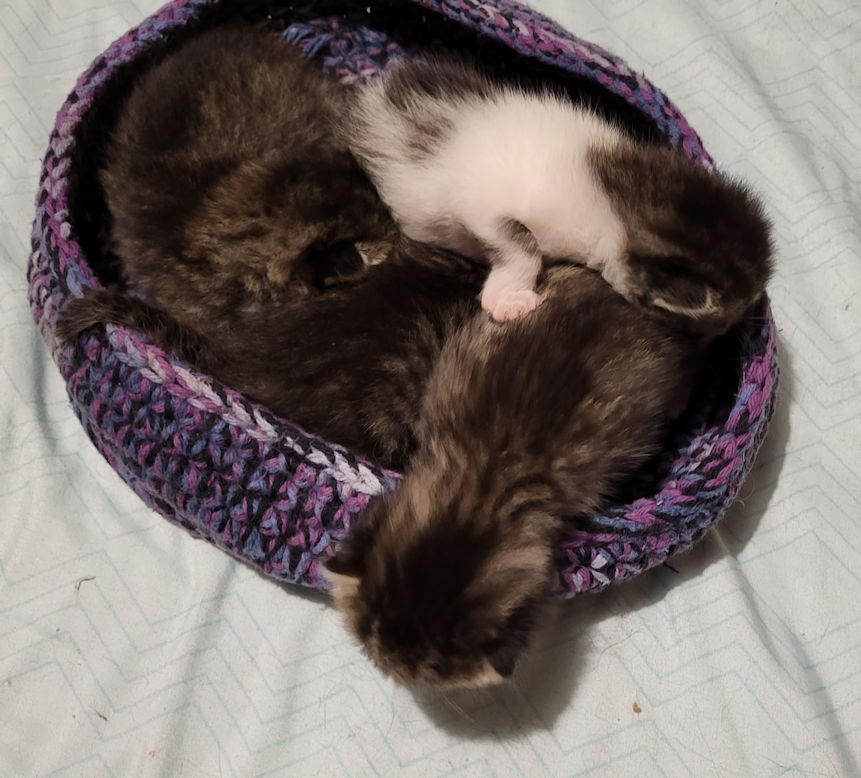
Decimus has taken to wandering around and exploring the house, which gave me the opportunity last night, to get a good look at her babies. Three of them still have their eyes closed. The bitties are getting big enough that, after squirming their way out of the cat cave, they can squirm their way back in again, all on their own!
I was going to my mother’s this afternoon, so I was outside early to get some work done in the garden. I hoped to be out there before it got too warm, but we were above 20C/68F in almost no time at all. Ah, well. At least I got some progress!
We had very few melons germinate. Of the four types we tried (all short season varieties), there were no watermelon, only two Sarah’s Choice, three Pixie and four Halona. I had intended to transplant them into the new trellis beds, but the seedlings really needed to get into the ground.
So I made do.
I used the kiddie pool that has come in so handy over the past few years! We definitely need to get another one before the end of the growing season.
I punched some holes for drainage, then put a layer of grass clippings over the bottom. A couple of wheel barrow loads of soil was enough to fill it. The soil got a soaking, then a layer of grass clipping mulch, and another soaking.
Then I left it for the water to be absorbed and dealt with another problem. Overhanging tree branches! The row of trees my mother allowed to take up where she used to have a raspberry patch includes a bunch of Chinese elms. Around this spot, their branches were getting quite large and dense, and hanging down low enough that I kept getting my hat caught in them. I cut away quite a lot of the branches and some of the smaller trunks. The goal is to get rid of all of them, but that will wait until I can get out there with a chain saw. For now, I just needed to clear the area around our container garden area.
That done, I have the new bed one more soak, then got the transplants. The two Sarah’s Choice went into the middle, while the others were spaced around them. They’re a bit densely planted, so I wanted to make sure they could climb. I had picked up some more of those large plastic coated, metal stakes this spring, so I had enough to put six around the outside, plus one in the middle. I then used the broken canopy tent pieces that had previously been used to support the protective boards around the newly transplanted tomatoes, and some zip ties to attach horizontal pieces around the perimeter. Last of all, I added a couple of shorter plastic coated metal stakes across the middle, for the Sarah’s Choice melons to climb. If necessary, we can add another level of horizontal pieces higher up.
There is a risk that the plants on the outside will end up shading out the ones on the inside, but I hope this makeshift trellis will allow them to climb and still allow light through. When we grew the Pixie and Halona before, it was a drought year, and the greenery didn’t get very dense.
So those are finally in!
Once done, I left early enough to hit the post office before going to my mother’s. While at the store, I talked to the owner, and got the okay to bring our extra tomato and pepper transplants over tomorrow, as giveaways.
I’ve since come back from doing my evening rounds, giving the melons one more watering, to settle things in. In spite of the rain we had yesterday, I found the Crespo squash, the low raised beds, grow bags and the squash patch all needed watering! Some of the summer squash are coming up, but I think I will need to replant a few.
While transplanting the winter squash, I included some of the Jiffy pellets that did not germinate, just in case. Sure enough, a few of them have actually germinated, and the new seedlings are looking stronger that some of the transplants! The transplants should have gone into the ground earlier. There is one winter squash that has been lost, though, and from the slime off over the remains, I’d say it got eaten by slugs. We have a lot of frogs this year, but they’ve been hanging out in the low raised beds. We should set up some little frog shelters around the squash patch to encourage them to hang out and eat the snails!
I’m really happy with how the potatoes are doing. Even the Purple Peruvians, which were the last variety to emerge, are now showing flower buds. I even spotted a couple of Indigo Blue tomatoes forming!
The only problem I have is the cats! While watering the beds, a couple of them decided to lie in the ones I hadn’t got to, yet – right on top of the seedlings! They like to lie on the mulch, and don’t care if that has them lying across seedlings, too, the buggers! Some onions and turnips got a bit shmushed, but I think they’ll recover.
I will be quite happy to pass on all those leftover tomatoes. I’d hoped to get the rest of the Romas into the ground, but with all the delays that keep popping up, I don’t know that I’ll have anything built to plant them in fast enough. Once they’ve been passed on, I will be able to take more time to get it done right, and not have to rush. I’d still like to get it built in time to plant any really short season crops we’ve got, but at this point, I am willing to let a lot of the direct sowing we intended to do, slide for this year. I’m still debating whether to plant some pole beans with the Montana Morado corn. I keep waffling back and forth on that. We shall see.
The next few days will be modestly hot, so I hope to catch up on the outside work!
Well, we have now planted as much as we can until we build the new trellis beds.
The first job was direct sowing summer squash. I forgot that we have 5 varieties. Which worked out well. There were four empty mounds from yesterday, so prepping another row of six mounds meant two for each type. Much less than we would normally plant per type, but this year we seem to be more about variety than individual quantity.
The last row will not be used this year, since it gets the most shade. Each mound got two are three seeds – all the seed packets are from previous years, and several of them had only five seeds left in them. With older seeds, we have to consider that some of them won’t germinate at all. The varieties we have are sunburst and G Star patty pans, yellow and green zucchini, and Magda.
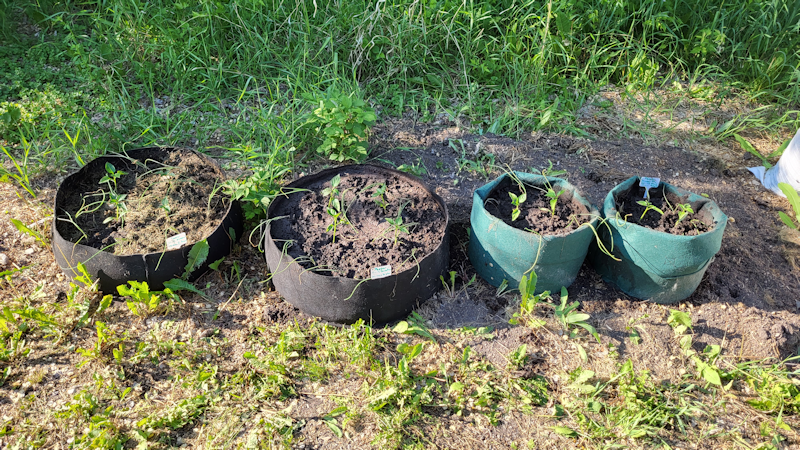
Next, the grow bags were gathered and filled.
The low, black ones were “raised bed gardens” we got from the dollar store last year. The green ones I picked up from the dollar store this year, and they are really good! I folded them down to about half height. The fabric seems really strong, and they have sewn in handles that also seem really strong.
Four of two different varieties were planted in the wider black bags/beds. Two each of a third variety went into the green bags. They all got Red of Florence onions planted around them. These are Early Sunsation, Early Summer and Dragonfly.
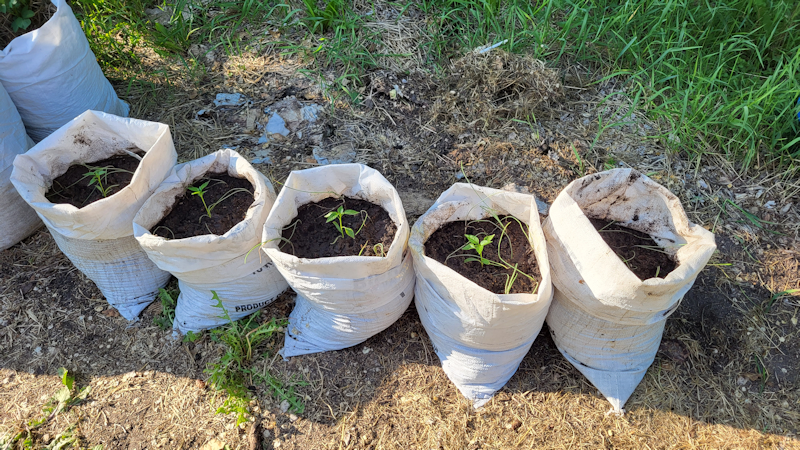
The last five feed bags were filled, and each got one Cheyenne pepper in them, with more Red of Florence onions. The last bag got all onions.
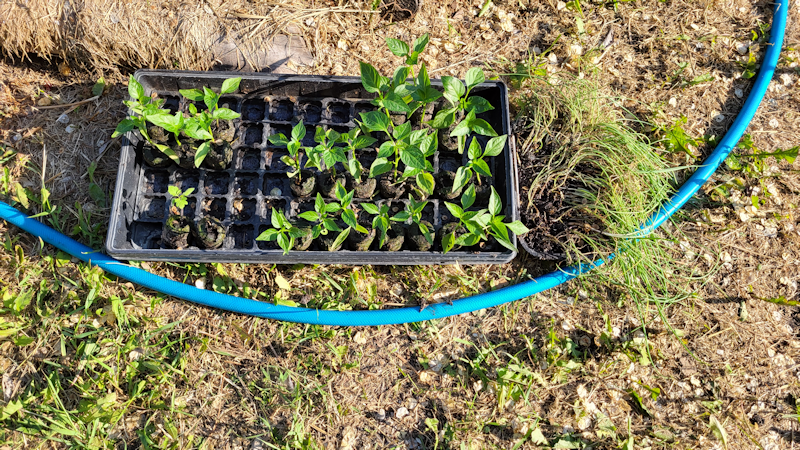
We still have lots of each type of pepper (and you can see the one late germinating Spoon tomato!), which can be given way. I plan to continue to interplant the onions any chance I get. We started a lot of them, because we use a lot of onions, and ran out fairly quickly, last year.
Oh, I didn’t bother taking a photo, but I also planted a few beans. The row of green Lewis beans had a lot fewer come up than the yellow Custard beans. The gaps in the yellow beans are minor, but less than half the green beans either didn’t germinate, or didn’t grow well once they did (some have just stems left, as if the leaves just died off), so I planted more.
We have so many varieties of beans I hoped to plant this year, but at this point, my priority is to get a trellis bed built so that we can put in our melon transplants.
Thankfully, all of these are short season varieties, so we should still have plenty of growing season left for them. The pole beans, however might have to be skipped this year. We shall see.
A high priority over the next while will be to mulch around today’s transplants, and the summer squash mounds. That means cutting more grass and collecting the clippings!
It’s only the 10th of June today. We should still have time. Plus, it’s an El Niño year, which means we should have a warmer, wetter summer and fall, and a mild winter, too. Anything that extends our growing season, I will be thankful for!
Well, I got them in, before things got too windy out there!
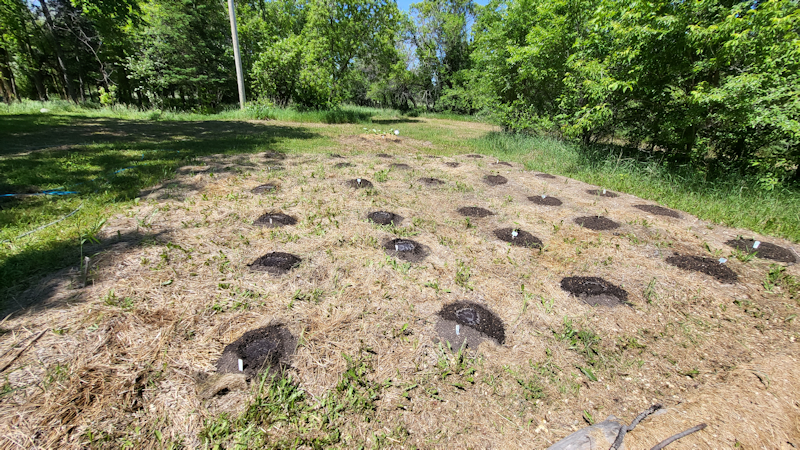
The winter squash were planted in the small Jiffy Pellet trays, six of each type. Of those where not all of them germinated, I still planted the empty pellets with ones that had germinated. They may not have had visible seedlings, but some of them did have roots showing through the pellet’s casing.
In the northernmost row, there are two Boston Marrow, two Winter Sweet and two Lady Godiva.
There were four Honeyboat Delicata seedlings to tranplant, but only two Little Gem/Red Kuri.
The North Georgia (I just noticed the typo I made when labeling the photo!) had the most seedlings, with five to transplant. There were three Pink Banana. That left four empty mounds. I’ve decided to fill one more row tomorrow, to direct sow summer squash in. We have four varieties, and I want to have at least two plants of each.
While I intend to mulch the rest of the patch with wood chips, I’ll be gathering grass clippings to mulch around the mounds of soil.
But not today.
Tomorrow is supposed to be cooler, with a predicted high of 21C/70F, which will be much more pleasant to work in. Especially since I plan to have enough soil brought over to fill grow bags.
Weather willing, we should be able to get quite a bit done tomorrow.
I didn’t get outside to do some work until past 8pm, when it finally started to feel cooler. Thankfully, the days are still getting longer, because it was just past 10pm when I was done, and pretty much full dark by the time I finished putting things away.
There wasn’t time to work on the big stuff, but there was some small spaces I could work on.
The first area I worked on were the 4 empty blocks in between the gourds and Zucca melon. I had some potting soil mix left, so after digging around in the blocks and pulling out any roots I could find, I added a bit of the potting soil to top up each block a bit. There were a total of 5 Little Finger eggplant seedlings, but two were still quite small, so I planted them together. We’ll see how they do and if one will need to be thinned out. I had plenty of new grass clippings to mulch around them, too. I collected a wagon load, and when the eggplants were mulched, I used the rest to finally give the asparagus bed a deep mulch. Until now, only the strawberries in between them were mulched. I was happy to see one new spear of asparagus, already at the fern state, had showed up. That makes 5 out of 6 crowns in this bed that survived last spring’s flooding… if barely!
Our spinach is just starting to get big enough to harvest a few leaves here and there, even though they were planted so long ago. As they will likely bolt quickly in this heat, my daughter went ahead and harvested the largest plants earlier today. In between the spinach, I started transplanting some Red of Florence onions. We grew these last year and really liked them. These are the first of this variety that have been transplanted, and they’re going to be shoved in every place we have room, as we go along planting other things.
Next, I worked my way across the retaining wall blocks, clearing and weeding. Every other block had mint transplanted into them, to contain them. It will be a battle to get the rest of the mint that’s growing in the old kitchen garden, but these were originally from my late grandmother, so I don’t want to get rid of all of them. They don’t seem to have handled last winter very well, and one block’s mint seems to have died (!!! who ever heard of mint dying on its own? 😄). A few other blocks got onions that survived the winter, that I found while prepping the area. Some stayed in the blocks they were found in, while others got transplanted, so that each block had 3 or 4 onions in it. In the end, I found a total of 6 blocks were free. Those got dug into to remove roots, topped up with the last of the potting soil, and then I transplanted some Spoon tomatoes into them. Each tomato got a bamboo stake they can be clipped to as they get bigger, then mulched with grass clippings. It’s not the area I wanted to grow these in, but at least we’ve got some in the ground. At this point, we could give away all the remaining transplants.
Not too bad for just a couple of almost cool hours before things got too dark to see!
With the weather we’ve been having, I have been feeling really anxious about getting the garden in “in time”, when we physically don’t have places prepared for everything yet. I feel like I’m falling behind, and everything is being planted late.
Then I remind myself.
Today is May 29. Normally, I wouldn’t be transplanting or doing a lot of direct sowing until after June 2.
Still, with the weather forecast being what it is, the more we get in the ground now, the more time we’re adding to our short growing season.
I headed out shortly after 7am this morning, to beat the heat, and didn’t come back in until almost 11. It was already feeling too hot by 8am, but I stuck it out as long as I could. My main focus was to finish planting in the beds the tomatoes were transplanted into, and get something into the high raised bed.
I’m still bordering everything with the yellow onions. I decided to plant bush beans in the high raised bed. That will make harvesting so much easier on the back!!
There wasn’t a lot of space left in the low raised beds, though that is partly because of the boards protecting the tomatoes. Once those are removed, it will open things up.
In the bed on the far left, with the Indigo Blue Chocolate tomatoes, I sowed all the Gold Ball turnips in one half, and Merlin beets in the other. These were densely planted in many short rows, more Square Foot Gardening style. When we planted the Gold Ball turnips last year, something ate them pretty much as soon as they germinated. I’m hoping surrounding them with onions will help keep away whatever ate them – I never saw any hint of what it was. I had intended to put a floating row cover over the turnips to protect them, but the space is too narrow for that.
In the bed with the Black Beauty tomatoes, I planted one long row of Uzbek Golden carrots. There was only space for the one row, which I then covered with boards. I will check under the boards daily and remove them as soon as I see carrots sprouting.
Both beds got a thick mulch of grass clippings along the outside, next to the onion transplants. Aside form helping keep the soil cool and moist, and slow down the weeds that come up from under the log boarders, the grass will also help prevent soil runoff while watering. I’ve basically used the last of our grass clippings at this point. We haven’t been keeping up with the mowing, unfortunately. Not only are the dandelions now all going to see, but in a lot of places, so is the grass!
With the high raised bed, I planted the yellow Custard beans – a new variety for us – on the left in the photo, and the green Lewis beans – a variety we’ve grown before – on the right. At each end, I stuck in a few more onion transplants. By this point, only the smallest yellow onion transplants are left, and I was planting them a bit closer to each other than usual, but I was still left with may 10 little transplants left. They’re so small, I probably shouldn’t bother transplanting them, but I’m sure I’ll find someplace to shove them into the ground!
(As an aside, while working on all this, I was happy for a breeze that kept away the mosquitoes. It wasn’t enough to keep away what turned out to be horseflies! Thankfully, they didn’t seem interested in bighting me today. Just in dive bombing my head.)
The large low raised bed you can see on the right is still completely empty. I’m considering using it for the Roma tomatoes, which are growing much faster than expected – one bin in particular is has plants so big, if it weren’t for the labels, I’d have thought they were Black Beauties or Indigo Blues that were started so many weeks earlier! Why that one bin of Romas is so much larger than the others that were started at the same time is an interesting question. I was originally wanting to plant peppers in that bed, but the Roma tomatoes need transplanting more urgently. I wont’ be able to fit all of them in there, but if I can at least get the biggest ones transplanted, that would be a good thing.
Before heading in, I made sure to water the corn bed, too. There are corn seedlings popping up now! I’m quite happy to see them. I was afraid that, with the heat and minimal rain, they might not make it. Checking the raised box beds in the East yard, I was happy to be able to see more carrot seedlings showing their true leaves, without having to look close and wonder, are those seed leaves carrots, or a weed? It’ll still be a while before the carrots are strong enough that we can safely weed around them. Right now, weeding mostly involves removing the biggest leaves from the weeds, and pulling and dandelion flower buds, and being careful not to disturb any carrot roots.
I was thinking of doing more transplanting later today but, at this point, I think the mowing is a more urgent priority. Not just because of how overrun both the inner and outer yards are getting, but because I need the grass clippings!
I also want to get in and around the garden beds and where the squash will be planted with the weed wacker.
When I came in, my weather app said it was 23C/73F. I think it felt quite a bit warmer than that! We’re supposed to reach a high of 26C/79F, with chance of a 43% chance of thunderstorm at about 4pm. I suspect I will have no problem getting out and doing the weed whacking when it’s cooler.
For now, though, it’s time to stay inside, stay cool, and hydrate!
I had to go to the nearest Walmart to get cat kibble this morning, and took advantage of the trip to get a few more little things. It was insanely busy with people. We’re coming up on a long weekend which, for many people, is the traditional time to put in their gardens. It’s also when a lot of people open up their cottages for the summer, so it was busy everywhere! All the garden centres and greenhouses are open now.
For us, today is 2 weeks to our last frost date. That means it’s time to sow our Montana Morado corn!
Which, of course, is never as simple as just putting things in the ground!
I chose to plant these in the low raised bed we grew summer squash in, last year. As with just about everything else, the squash did very poorly last year. It was, however, the bed that needed the least amount of work done on it before I could sow.
Not by much, mind you.
After removing the grass mulch from last year, I had a whole lot of weeds to dig out. Mostly crab grass. That stuff is brutal!
The entire bed got worked over with a garden fork to loosen the soil. Then I had to go back over it to pull out as many weeds and roots as I could. Aside from using the fork to loosen the soil even more to get the roots and rhizomes out, it was very handy to support myself as I worked. I also used a board across the bed to step on, so I wasn’t stepping directly on the soil.
We really need to get more high raised beds built. This was very hard on the back. I suppose it would have been easier if I could kneel down to work, but my knees are shot, so I’m bending from the waist, for the most part.
While working towards the north end of the bed, I started finding more tree roots, from the nearby trees that my mother allowed to grow in what used to be garden space.
More reason to get those high raised beds done!
When the weeding was done, I went to get the seeds and a rake to level the bed. I brought a container to pour the seeds into and see how many there were. There was supposed to be at least 75 seeds.
I counted 94!
Once the bed was leveled, I took the board I had to support my foot while weeding, and used it to mark off three long rows. I wanted to stay well away from the edges. The crab grass is the worst along there, as the roots make their way under the log edging. Then I used the handle end of the rake to punch holes along the rows every 6 inches or so. Typically, it’s recommended to plant 2 or 3 seeds every 12 inches, but I’m doing dense block planting. I also hate wasting seed, so I planted one seed every 6 or so inches. This should be good for pollinating, and if some of the seeds don’t germinate, the resulting gaps won’t be too large.
I lost a seed while planting, though, so there’s “only” 93 in. 😄
Everything was well watered, of course. I always water before putting the seeds in, then again once they’re done.
Once planted, I put a thick layer of grass clippings all around the edges. The ends don’t have logs to hold the soil in, so hopefully the grass clippings will help keep it in place, too. Mostly, it’s to try and keep the weeds from creeping in from the edges. Once that was done, I put a very light mulch of grass clippings over the planted area. Basically, I just shook bunches of grass and let the wind blow it on. I wanted enough clippings to protect the soil, but still keep it light enough that the corn won’t have any problem pushing through.
Once the corn is up, I will might interplant some bush beans in between the rows. Maybe. I did that with the kulli corn we planted last year, and they got huge, but never reached the point of producing cobs. I now think that there was too much nitrogen in the soil in that bed. High nitrogen leads to lots of plant growth, but can result in lower yield. Or, in our case, none at all. With how densely these are planted, though, interplanting with something like beans might be too much.
Once that was done, I decided to take a chance and do some transplanting.
The Sweet Chocolate peppers that were started back in February have gotten nice and big. Normally, I wouldn’t dare transplant them before our last frost date, but I’ve been eyeballing the forecasts and decided to take the chance. It was either plant them now, or pot them up. The German Winter thyme that was started at the same time were also quite ready to be planted.
While I was transplanting, I got my daughter to cut the tops and bottoms off of some distilled water jugs for me. Since my husband needs to use distilled water for his CPAP humidifier, we have lots of those! Hopefully, they will help protect the peppers during any cool nights. In this bed, they will be easy to use row covers if we get frost warnings, too.
I had three pots with thyme to transplant – a fourth one was transplanted into a pot to stay in the house. I don’t think they’ll need any protective covers unless we get actual frost.
Eventually, I want to plant the chamomile in here, though it’ll be a while before those are big enough to do that. The spearmint and oregano we started from seed are not doing well. I might buy oregano transplants, which would also go into this bed. Spearmint is not something I usually see in stores as transplants, so we might skip those this year and try again next year. The second variety of thyme we planted at the same time as the chamomile doesn’t seem to be doing as well as the German Winter thyme has. We’ll see how they do over the next couple of weeks.
Once again, while working in this bed, I was quite impressed by how moist the soil was under the wood chips. The mulch is really doing its job!
Oh, there was one thing about transplanting the peppers that has made for a learning experience.
We started the seeds in bio-gradable pots that are designed so that they can be transplanted directly into the soil, pot and all, with no root disturbance. When the peppers needed to be potted up, they went into the larger Red Solo cups that way – except for a couple that were thinned by transplanting.
When taking the peppers out of the cups, the ones that were still in those bio-degradable pots… were still in the bio-degradable pots! They were actually rootbound inside a pot within a pot. So when I transplanted them, I removed the shells of pots they were in. The pots were very soft and easy to break off, but hardly any roots had tried to grow into them.
I still have some of these pots and seed start trays. I’ll use them but, in the future, I think we’ll skip buying those. A bio-degradable pot isn’t much use if the roots can’t get through them after being potted up!
So this is now done. The first corn is planted, and the first peppers and herbs are transplanted.
The corn is meant to be planted at this time. I just hope I didn’t jump the gun with those peppers!
The Red Thumb fingerling potatoes had to get into the ground, so they went into the beds that were ready.
I have no doubt I was crowding them a bit too much, but these are fingerling potatoes, so I hope that will make a difference. I still couldn’t fit them all in the bed along the retaining wall. The last of them went into the short end of the L shaped bed, where you can see the straw mulch. I was able to add straw mulch to the rectangular bed with the Irish Cobbler potatoes in it, too.
The extra height added to the bed along the retaining wall came in handy. I did work in some of the composted sheep’s manure first. The bed was already starting to compact! The height of the soil is almost as high as the retaining wall (it is settling a bit, still). The logs are high enough to hold the straw mulch in place.
Unfortunately, the cats seem to think that straw is there, just for them! Especially Gooby.
It started raining by the time I was ready to add the straw, but I gave all the straw a thorough watering, anyhow. They’ll get more deep watering, even with the rain. I’ve noticed that, if the straw doesn’t get saturated first, the top will get wet, but the bottom stays dry, so the moisture never quite gets to the ground. I want to get these beds soaked down through all the layers. Once that’s done, the beds will hold the moisture for quite a long time before they will need watering again.
The whole point of our wanting to use grow bags this year was because we have such a problem with slugs. I’m hoping that, by planting these in raised beds, it will be less of a problem. I suppose we could leave out some beer traps for the slugs, but I have no doubt the cats would be getting into them! I’d rather encourage garter snakes or toads and frogs.
Meanwhile, we’re also seeing peas starting to break ground. Just barely visible! We’ve got carrots sprouting, too, but they are very small and it doesn’t look like we have a high germination rate. They really should have had the plastic right on the ground until they germinated, instead of on hoops, but the hoops were as much to keep the cats off as to keep the moisture in. Hopefully, the heat inside didn’t kill off too many seeds. We do still have 2 other varieties of carrots to sow, so we should be able to make up for any losses.
We’re getting air quality warnings right now. There is a cold front moving in, so the temperatures will drop quite a bit, tomorrow (though not low enough for frost), and with it will come smoke from the many fires in Alberta. Rain is desperately needed, though with so many of the fires being started by people, more than rain is going to be needed to get these under control!
Along with rain today, we’ve also got a fair bit of wind. Nothing exceptional, but too much to take the transplants out. We have no way to protect them from the wind on the various surfaces we use to lay them out. So they remain in the sunroom, which isn’t much warmer than outside right now, with the fan and the lights, for today.
I’m glad I got the potatoes in right away. Rainy, grey weather like this always makes me incredibly sleepy. If I’d delayed it, I probably would not have been able to get it done. As it is, I think I’m going to have to lie down for a bit. I can barely keep my eyes open, as I write this!
So… all three varieties of potatoes are planted. Which means I can finally turn my attention to taking down the trees we’ll be needing to build the trellis tunnel. That should have been done, long ago!






 The Re-Farmer