Our 2023 garden: an actual little harvest!

While doing my morning rounds for the past while, I’ve been able to snack on the occasional early pea pod. This morning, there were enough of them that I went and got a container to harvest them!

Not a large harvest, by any means. Basically, enough for one person – but it’s the real harvest, so I’m happy!

I’m glad I broke out the riding mower and mowed as much as I did yesterday. I got most of the area round the main garden beds. The rest out there is so rough, I’ll be using the push mower or weed trimmer. I also got the East yards done. The West yards have some things than need to be moved or trimmed first, that I left for today. Which might not happen, as the grass it now too wet. Last night, it rained off and on. Not enough to fill the rain barrel, but enough to give the garden a good watering.

But was it enough to do this?

One of the Black Beauty tomatoes got knocked to the ground. The stem is quite dry at the end, so it could have even happened yesterday. I suspect it wasn’t the rain that knocked it down, but a cat.

I picked it and now it’s sitting in the living room, in hopes it will continue to ripen.

The first African Drum gourd, in the main garden area, has started to bloom!

I don’t know that we’ll have enough growing season left for these. I tried starting them early enough indoors compensate for that, but these are among the ones that were sown a second time. The first ones that survived are at the chain link fence and, while they have been blooming for a while, there are still no female flower. Even the Crespo squash, which have also been blooming for a while, are almost all male flower. There were two female flower buds that started to form, but the first one wizened and fell off rather quickly, and now the second one looks like it’s doing the same.

Some of the winter squash are starting to show flower buds, though, which is encouraging. What’s discouraging is that the very few summer squash that are just germinating now seem to still get eaten by the slugs. They definitely prefer those freshly emerged leaves! Yes, I scattered out more cornmeal, but the rain washed that away.

I also quickly transplanted the one lemon cucumber that germinated. I ended up planting it in the mulched bed behind the compost heap, where we had ground cherries last year. I’d planted the three Ozark Nest Egg gourds along one side of that bed, but it looks like there’s only one left. For some reason, the cats really like to use the grass clipping mulch as a litter – but only where there is an open area around a seedling or transplant!

Anyhow.

The lemon cucumber is now right in the middle of the bed, with plenty of room to grow. If it survives, I’ll add something for it to climb.

We shall see!

The Re-Farmer

Our 2023 Garden: poppies are in (video)

Well, I wasn’t able to get progress images of what my daughters did, but I did get to set up another time lapse video later on. I was able to reclaim the bed by the chain link fence and sow one variety of bread seed poppies.

Having the rake handle break on me while I was clearing outside of the chain link fence was a bit of a downer! We had others I could have used, but I just kept using it, anyhow. It got the job done!

Also, I had a lot of cats visiting me while I worked!

I hope you enjoy the video. 😊 If you select to watch it on YouTube, you can hit the like and subscribe buttons, if you wish.

The Re-Farmer

Yellow

With all the lovely rain we had yesterday, I could see the squash really appreciated it!

This is one of the recovering squashes that recovered after frost damage to our first transplants.

We’ve got baby yellow zucchini!

This is the first of the summer surprise squash mix that we can actually see what it is. :-)

I’m happy that some of the damaged ones have recovered so well. We won’t be getting anywhere near as many squash as I had originally expected, but that’s okay. We’ll still have lots!

The Re-Farmer

Potato beds, and new garden area status

Yes! Finally! The weather is cooperating, and I was able to get our potatoes in!

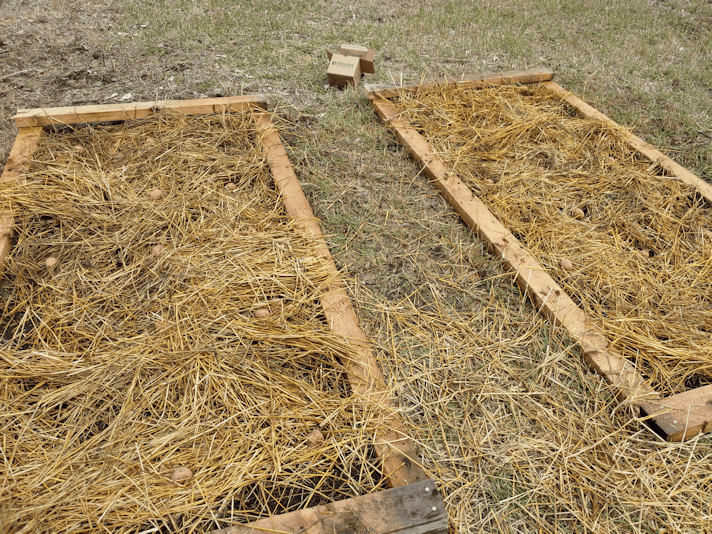
From a previous post, this is what I was starting with.

The frames are just there to mark out where the beds will be. As you can see, there’s a fair bit of grass and weeds. It has been a while since this area had any sort of gardening done in it.

While the no-till, no-dig method we’re using is something that can be done directly on the grass, I wanted to add at least some amendments, first.

I used a wheelbarrow to mix 1 bag of manure with a slightly larger volume of peat.

After spreading it out on one of the beds with a rake, I used another bag of manure mixed with peat on the second bed. I then topped them with a thin layer of straw, making sure to use the damp straw from the bottom of the bale, where it was starting to decompose already.

I had hoped to use some material from our own compost pile, but as I dug around, I did not find any usable material. I had tried to clean out some of the older compost, from before we moved here, but as I dug around, I found more stuff I missed. Twigs and branches are one thing. It looks like people had stared to use it for garbage, and I found pieces of wood that were probably used as support stakes, plastic trays from transplants, and even a piece of fabric. There was some well composted material, but it was so full of sticks, it was unusable.

I’m thinking we will need to start a completely new compost pile somewhere else. This one is looking like a write off. :-(

So, no compost of our own for the potato beds.

Once both beds were spread with the manure and peat mixture, I gave them a very thorough watering. Even though we’ve had rain for the past couple of days, the soil was still pretty dry.

After soaking the beds, I added the potatoes. Each box was 3 pounds of seed potatoes. That worked out to 3 rows of 6 potatoes (plus 1 extra, so I put 2 small ones together) in one bed, and 3 rows of 5 potatoes in the other.

After spreading the potatoes out, I went back to evenly space them and push them gently down to have contact with the ground. With one potato, I went to pick it up, but it wouldn’t move.

???

I tried again, but it was stuck to the ground.

Amazingly, in the space of a couple of minutes, this one potato that had direct contact with the ground and shot out a 3 or 4 inch root, with capillaries! I wish I’d made the effort to take off my muddy gloves to take a photo, but instead, I dug a quick hole in the ground where I wanted it to be and “transplanted” it. I still can’t believe a potato could grow a root so deep, so fast, even after seeing it with my own eyes!

The next step was to cover the potatoes with a deep layer of straw. Again, I used straw from the bottom of the bale, where more of it was already damp and some was starting to decompose already. I made a layer roughly a foot deep.

I then scattered more peat across the top, then tamped it all down with the back of the spade. This peat is as much to add some weight to prevent flyaway straw as it is to amend the soil.

After the above photo was taken, I spent the next while thoroughly soaking the straw.

With this method, I saw recommendations of putting a layer of hay (which I don’t have, so I’m using straw) 2 feet deep. This is definitely not 2 feet deep. Over the next day or two, I plan to soak the straw some more, add another layer, then soak it again. After that, I should not need to water it much, if at all, for the rest of the growing season. I’ve heard people using this method say that no watering is needed at all, because the mulch maintains moisture as it breaks down, but I expect to need to water it at some point. It all depends on whether we have another drought this summer.

After the straw has started to settle and pack itself down, I will remove the frames to be used elsewhere.

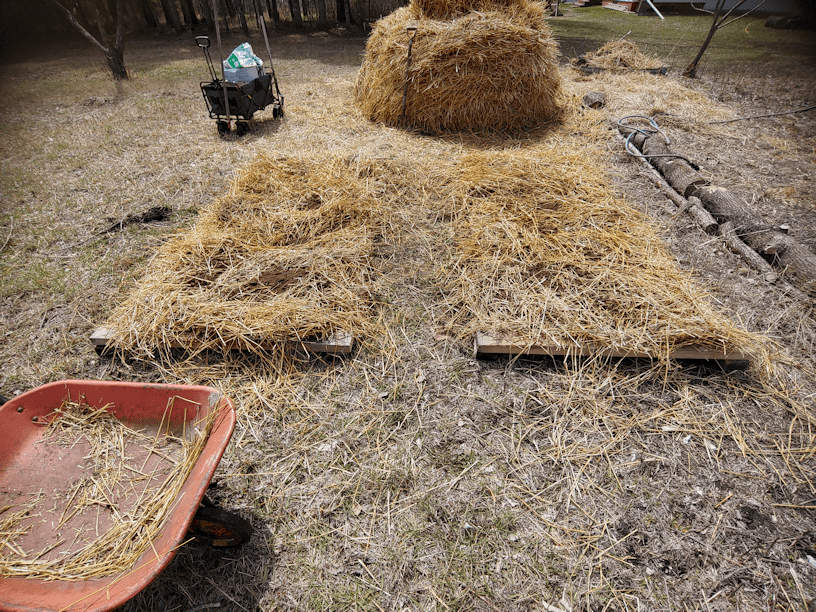
Once this was done, I checked out the area we are planning to transplant our squash seedlings. We had covered this area last year with straw, then covered with tarps, to amend the soil and try to kill off the grass and weeds. We still ended up having to use Round Up. Even covered with tarps, weeds where pushing their way through the straw and lifting the pegged down tarps off the ground!

This is how the area looks now.

The black tarps in the back are there to warm up the mulched soil on that side a bit faster.

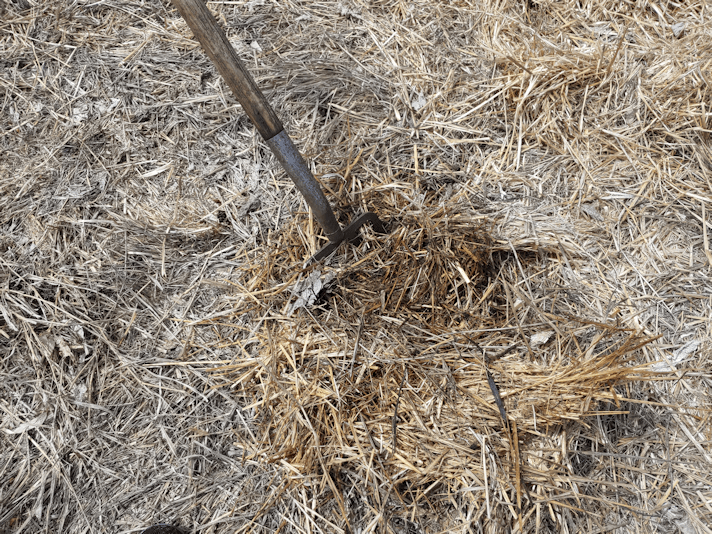
I could not do this here, last year. In fact, the soil was so hard, we were bending tent pegs while fastening down the tarps. While working on the potato beds next to this area, I would sometimes shove the fork or the spade into the ground to set it aside while I did the next thing, and ended up leaning them on the bale or wagon most of the time, because the ground is just so hard. Yet here, I could sink the fork’s tines their entire length down!

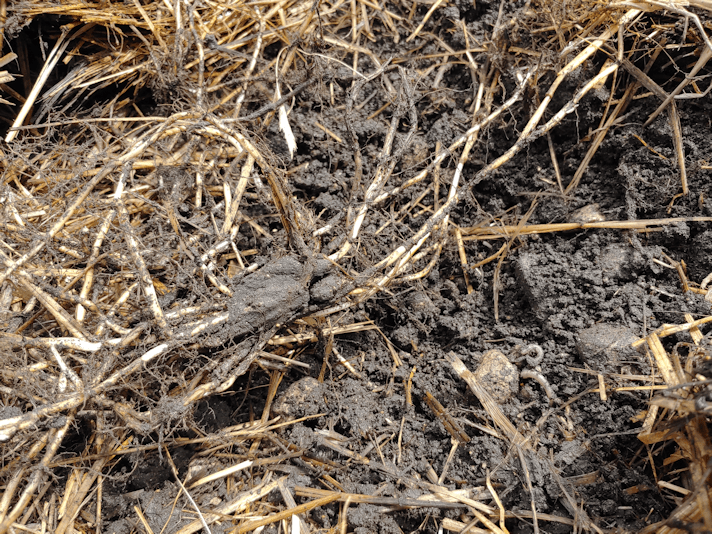
I pushed aside some of the mulch and dug around a bit. There are still a LOT of quack grass roots in there. I pulled some up, and you can see the bundle of roots in the above photo. The soil is quite “sticky”. The exciting thing was uncovering a worm. A very good sign!

Which means our efforts last year are paying off. The soil is already improving. When it’s time to transplant into the area, we will still be dealing with rocks and root systems, but the ground is now workable.

It’s amazing, what a mulch can do to improve soil conditions!

The Re-Farmer