First, a bit of a follow up from yesterday. After blocking the woodchuck holes by the house and in the old garden area, I headed out a few times to check on the one by the house. Twice, I found things disturbed!
This picture was taken after the second time I found it dug up. The first time, I had started to remove the plastic around the back of the mock orange, saw that things had been pulled out, and started tying it back again. As I was fussing and making noise, I could actually hear little grunting noises coming from under the stairs! I found some rocks had been dug up a bit on the other side, too, but just a little. After blocking the other side, I tried spraying water into the little gaps remaining, to try and pursuade the woodchuck to leave out the other side. We never saw it, but I came back later and it seemed to be gone, so I blocked the opening again. A couple of hours later, what you see in the photo above it what I came back to! After making as sure as I could there was nothing inside, I blocked it off again. As of today, it has not been disturbed again, so here’s hoping the critter has decided it’s not worth the effort.
Later in the evening, I found this in the old garden area.
Much to my surprise, the first den we found was dug into again! It was just a small hole compared to before – the buried sticks seemed to work in preventing further digging. I blocked it off and, when I checked it this morning, it was still buried. Once again, I’m hoping the woodchuck has decided it’s not worth the effort and have moved on.
After doing the watering this morning, I picked a tiny little harvest.
There was one zucchini big enough to pick, and I gathered the last of the garlic scapes (unless I missed one or two). Plus, we have our first peas. :-D Only two pods from the purple peas. Because the pea plants are so stunted in growth, the weight of the pods were keeping the plants they were on from being able to reach the trellis lines. At least we’ll be able to taste the peas. I’m curious about how the purple peas taste. Reviews on the Baker Creek website were pretty mixed!
Unfortunately, it looks like some of the pea plants are not just stunted in growth, but have been nibbled on, too! Where this is new nibbles or not, I couldn’t really tell. I also noticed new nibbles on the Crespo squash. Any part of the squash that started to grow outside the hoop and twine barrier seems to be getting nibbled. We’ll have to find a way to extend the barrier.
Meanwhile, in the old kitchen garden, I’m happy to see pods developing on the Giant Rattle poppies! These had had such a rough started, I wasn’t sure what we would get, so this is making me very happy. For this year, we might have enough pods to taste them, but not enough for cooking with; mostly I want to save the seeds to grow more next year, and fill the bed. Gosh, this brings back memories! When I was a kid, my mother grew similar poppies in this garden, and I remember my late brother and I picking dried out pods and eating the seeds, straight from the garden. We would later have big bunches of the dried pods (well… big, in my childhood memory!) gathered. The only thing I remember my mother making with them was a special soup she made only for our Wigilia (Christmas Eve) dinner.
I did have another harvest this morning, which will get its own post next. :-)
Zucchini and sunburst squash I gathered this morning.
Yesterday, I made a sort of hash, first browning potatoes, cubed small, in butter, then adding leek and frying until softened. I cubed sunburst squash, a green zucchini and a grey squash (the lighter coloured, kinda striped, kind of zucchini; our grocery stores label them as grey squash). Once those were cooked until soft, I added seasonings and maybe half a cup of whipping cream. It turned out awesome!
I’m out of cream, though, so I think I’ll just pan fry them in butter with leek.
As we work on clearing, cleaning and reclaiming the yard and planting our first garden beds, I’ve been keeping a close eye on details to keep in mind for the future. Things that will help us decide what needs to be done next, what to change or what to keep the same.
This morning, I found myself making a lot of comparisons.
The cutest one is the cucamelons.
This is the largest one that is developing, with my fingers giving an idea of just show small these are!
Isn’t that just the cutest thing? :-D This is the first one big enough to start seeing the patterns developing.
The trellis I made for these is just cotton yarn. It is working very well, except for on thing.
The cats.
When I am out there and the boys come over for some attention, they will plow their way through the trellis, pulling tendrils off in the process, then look at me all confused over why I’m flipping out at them. :-D They also try to lean and rub against the strands of yarn, only to flop over onto the plants. !!!
We already know that this location doesn’t have enough sun for cucamelons. If we grow them in the future, they will be planted somewhere with full sun. Our original intention was to plant them against the chain link fence for them to climb, and the cats are showing us exactly why that’s a very good idea! If not there, then we will have to make sure to have trellises that are sturdier, with strands much closer together. Not because the cucamelons themselves need it, but because of the cats!
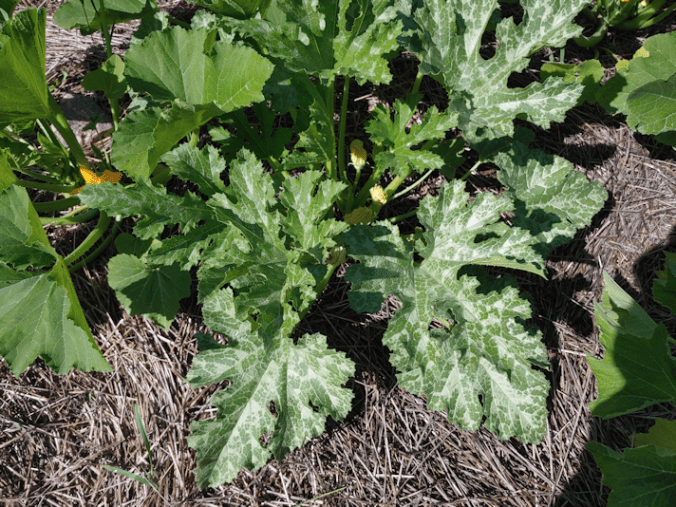
Here is another comparison. These two squash plants, with the mottled leaves.
They look pretty much like the same kind of plant, don’t they?
Now look at the developing squash.
They’re completely different!
I’m looking forward to being able to start harvesting these. My favourite way to eat them is raw, with dip. No need for anything else, when they’re at just the right stage. :-)
It was looking at the chokecherry trees that I am really seeing what a difference even minor changes in conditions makes.
This first one is at the south side of the garden where the squash beds are.
This one gets sun in the mornings, but for most of the day, it is shaded by spruce and maple trees to the South and West of it. It is not crowded by other trees. It has quite a lot of berries that are looking big and juicy (well… as much as chokecherries can be! ;-) ). Even last year, during the drought, it had larger berries. While I do not specifically water this tree, I do sometimes water the little patch of flowers and raspberries on one side of it, and the black current bush (my sister confirmed what it was for me) on the other side, so it does get extra water from that. While is has larger berries, it also ripens later. As you can see, the berries are still very much on the red side of things.
This next one is the chokecherry tree that is engulfed by lilacs.
This one gets full sun for most of the day, though it does get slightly shaded at the end of the day, by the trees my mother left to grow after she moved the raspberries they’d self-sown in between, years ago. This whole area gets quite dry, and we do not make any effort to try and water anything here.
The berries themselves are noticeably smaller than in the previous tree, and there are less of them, but they are also ripening faster.
Then there is this tree, right nearby.
This is the top of a young, small tree that was self-sown and allowed to grow (rather than get mowed over, like all the other saplings) in a grassy band between the old garden area (with the row of trees mentioned previously) and the lilac hedge. It might get some shade towards the end of the day, but otherwise gets full sun. Our first summer here, it did not produce fruit yet, and I wasn’t even completely sure what kind of tree it was. Our second summer, it had a few berries. This year, it has matured enough to produce quite a lot of berries. With full sun most of the day, not at all crowded, and little moisture, the berries are still not as big as the ones closer to the house, but the clusters are dense and ripening quickly.
You can see how this tree is situated in the background of the next photo, below. This next chokecherry is also among the lilacs, but on the edge of the hedge, not in the middle of them.
Here, it gets no shade at all. It has lots of berries that are already ripe. As you can see, though, some of the leaves are turning yellow. Only a few branches are like this, not all of them. It’s not stopping them from heavily fruiting! Like the other two along this side of the old garden, the berries are not as large as the trees nearer the house.
This next one was a surprise find, along with the Saskatoon berries. This area had been full of spirea that I had pulled up. It’s starting to grow back, so I’ll have to do it again, as pulling them up has been a good thing for other trees. The Saskatoons thrived this summer, and we discovered another chokecherry tree among them.
This area is under spruce trees, both living and dead, getting very little sun. In the above photo are the berries on the North side of the tree, where it gets even less sun. As you can see, they are just turning from green to red here.
This next photo is of the same tree, but on the South side.
That little bit more sunlight sure makes a noticeable difference in how fast they ripen!
Again, while I have not really been watering these trees, they are near the horseradish, and with the spirea taken out, wildflowers have come up and I’ve been watering those. So they will have benefited a bit from that, too. Mostly, though, being under the spruces as they are, they don’t get the full heat of the day, so the soil doesn’t dry out after a rainfall as quickly, either.
Then there is this one…
That’s a chokecherry in the middle of the photo. I had cleared a path to the junk pile you can see part of, to try and find useful pieces of wood in it, but that’s as far as I got so far. The tree itself is not crowded by other, large trees, and is shaded only in the morning hours. It’s surrounded by spirea and thistles, so we can’t get at it right now, but it appears to be just loaded with ripe chokecherries.
Finally, there is this one.
This is the top of a chokecherry tree among the cherries. I can get close to it, but not enough to be able to harvest it until I clear away the cherries around it; mostly cherries that had been killed off by last year’s horrible spring, and the bits that are now growing up from the bases. They create a formidable barrier!
This tree also gets shade in the morning hours only. Our last two summers, I don’t recall seeing any flowers or berries at all. Last summer, I’d cleared away the old wood pile, which turned out to be a much, much larger job than I expected. You can read about it in this series of posts (all links should open in new tabs, so you won’t lose your place!); parts one, two, three, four, five, six, seven, eight.
Did I mention it turned out to be a really huge job?
Yeah.
So while there is still lots to clean up to work our way into the spruce grove, what has been done so far made a big difference. I’m thinking that, had the cherries not been so damaged by the previous spring conditions, they would have improved, too. Mind you, the one cherry tree I kept because it managed to actually produce a few berries, and is not at all crowded, did not produce even a blossom this year.
It’s amazing how the same type of tree, while not really all that far apart from each other, are so different based on even minor changes in sun, shade, moisture, etc. When it comes time for us to plant more food trees, the differences among these chokecherry trees is providing us with a lot of information.
With all the lovely rain we had yesterday, I could see the squash really appreciated it!
This is one of the recovering squashes that recovered after frost damage to our first transplants.
We’ve got baby yellow zucchini!
This is the first of the summer surprise squash mix that we can actually see what it is. :-)
I’m happy that some of the damaged ones have recovered so well. We won’t be getting anywhere near as many squash as I had originally expected, but that’s okay. We’ll still have lots!




 The Re-Farmer