As we were reaching the hottest part of the day, I had concerns about the garden. Specifically, at the squash tunnel. The summer squash are well mulched and can stay cooler and moister longer, but the melons, winter squash and gourds are not as well set up, and they need more water than most other things.
I had an idea, so I headed out to the garden, only to get distracted as I walked past the concrete steps at the side of the house.
The woodchuck tried to get under the stairs again! I had checked it this morning, and it was not like this, so the attempt was made some time later.
It did not succeed.
I did see a woodchuck eating the sunflowers I scattered on the ground under the hanging bird feeder, and ended up leaving it be. I figure, it it’s eating bird seed, it’s not eating my garden. :-/
I put all the rocks back again, then jammed the boards you can just see in the photo, on top.
Anyhow.
On the way to the garden, I dragged the soaker hose over. In checking the plants at the squash tunnel, I found they were very wilted and drooping. I carefully set the soaker hose up as close to the stems as I could, making sure it went under any vines and leaves.
Which is why I finally was able to see this.
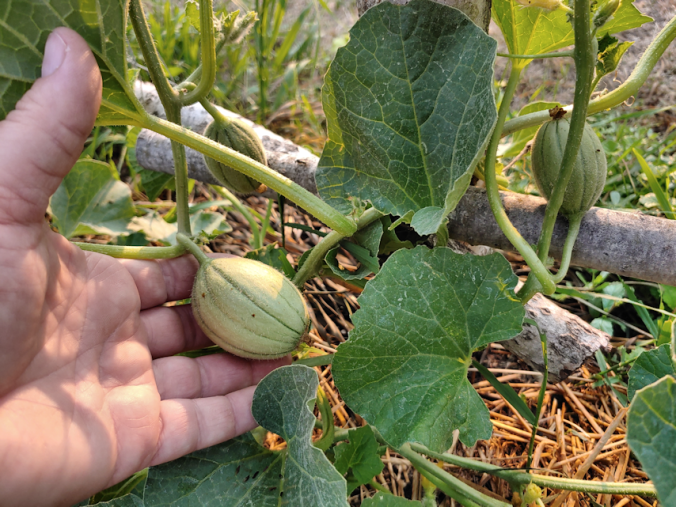
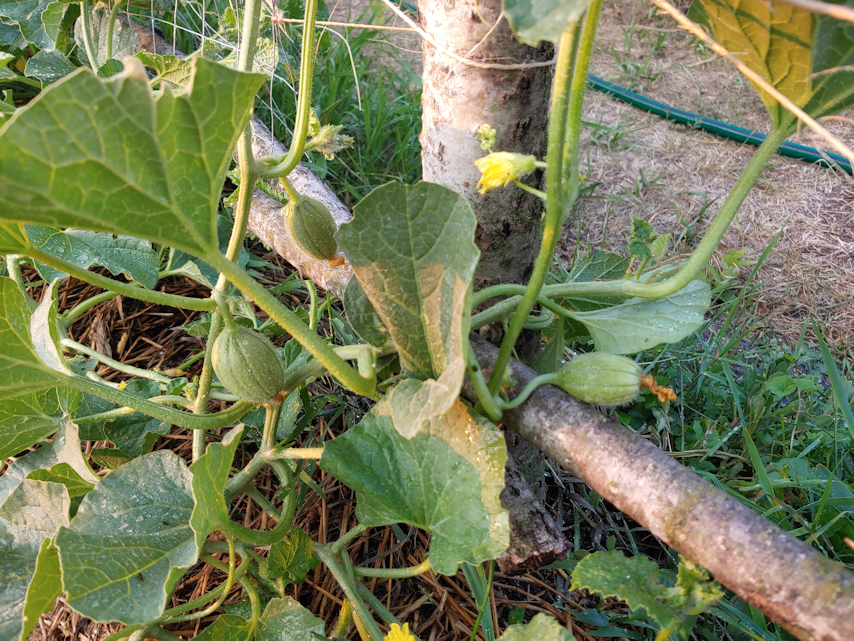
It’s a Pixie melon!! And so big, too! I’d been looking carefully to see if there were any melons forming, and never saw it until today.
I even found other ones starting to grow.
That is so awesome!!
The soaker hose is 50 ft long, so I was able to go around the entire outside of the squash tunnel, and even have about a foot and a half to spare that got looped back to the inside of the squash tunnel.
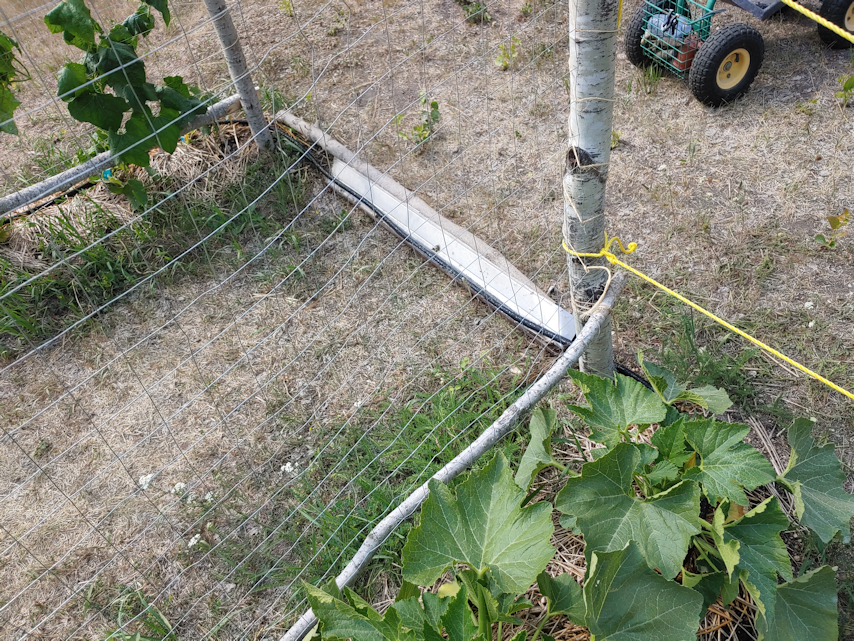
I didn’t want to be wasting water by watering the path, so I scavenged a piece of metal to put under it. It’s aluminum, the same as our eaves troughs, but it isn’t part of an eaves trough. I don’t know where it came from. We found it in the yard, by the back of the house, one day after some high winds. Wherever it came from, it didn’t blow off the house, which is the only place we have eaves troughs in that colour.
Well, it’s coming in handy, now. It’s got bends in it that I’m taking advantage of to use as a trough to divert water from the soaker hose to the ends of the squash tunnel. It doesn’t quite reach the ends of where we planted, but it’s close enough.
Before turning it on, I made a point of unscrewing sections of hose as I walked back to the tap, to drain off the scalding hot water that was inside it!
Since this hose releases so little water at a time, we can hook it up and leave the water running for an hour or more, before we switch the hose to the sprinkler to do the corn and sunflower beds for about and hour, timing it so that we can then do the evening watering when it has finally started to cool down.
The melons, gourds and winter squash are all heat loving plants, so having this set up to water them more deeply should help them quite a lot as they develop their fruit.
I am SO looking forward to tasting our very first melons!
We’re hitting a milestone today. This is post 3000 since we started the blog!
I suppose it’s appropriate to mark the growth of the blog by highlighting growth in our garden. :-)
Starting with this strange looking growth!
I spotted this strange shape, hidden in near the middle of one of the garlic beds. It looks like a garlic bulb is forming in the stem, instead of the ground! Or, as well as? Will this garlic plant have two bulbs? I look forward to finding out when they are harvested!
While watering in the evening, the girls found that something had squirmed its way under this beet bed and nibbled on quite a bit of it. More rocks and bricks were added to hopefully prevent it from happening again. The beets here had been recovering quite well, once we’d put the netting over it. This damage was mostly likely done by a woodchuck.
Which reminds me…
Yesterday evening, as my daughter went out to water the gardens, she found TWO woodchucks, loafed in the carrot bed in the main garden. The two smaller ones, just sitting there. As she came closer, one ran off, but the other just hunkered down. When she came still closer, it ducked behind one of the logs framing the bed and watched her over the top. She says she came so close, she could have slapped it in the face, while trying to shoo it away! It just did not want to leave! If finally did run off under the garden shed, but she had to practically chase it the whole way.
Brazen buggers, aren’t they?
The summer squash is doing really well and getting quite bit. This is the only bed that is fully mulched, and it’s making a very clear difference.
Next year, we really need to make sure we have lots of mulch available.
The onions we grew from seed are also doing the best of all the onions. It may be easier to grow from sets but, at this point, it seems well worth the effort to start from seed, instead. It’s really just a matter of finding the space to do it. Especially as we plan to grow a lot more next year, with more dedicated interplanting, so they can protect other vegetables.
The Montana Morado corn is doing really well. Some of the plants are about 5′ tall now. If we were not in drought conditions, they would be much taller, but they are still doing better than any of the other corn. So much better that I think we will start all our corn indoors and transplant them next year. Except the Dorinny corn, if we grow that again, since that one is meant to be direct sown before first frost, not after. They may not be as tall as the Montana Morado corn, but they are more robust.
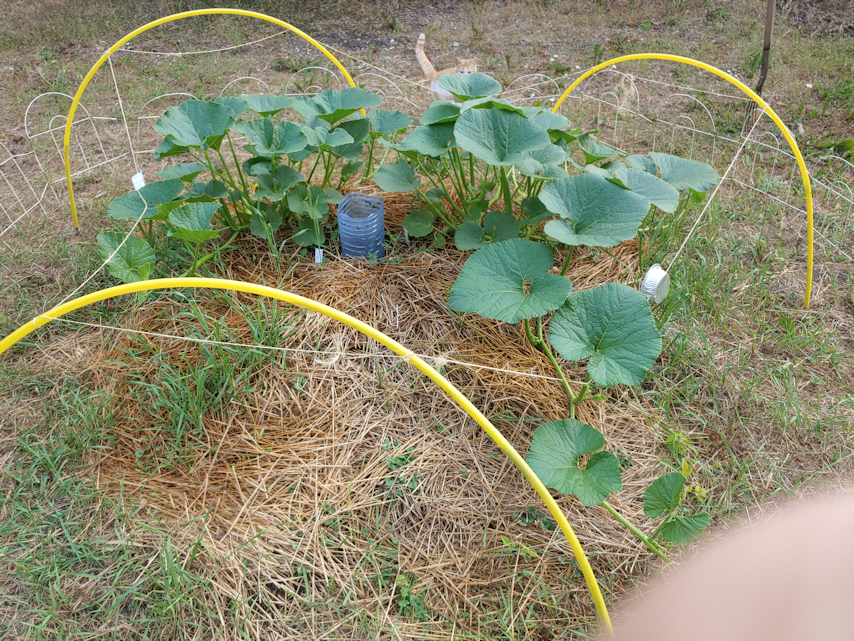
The Crespo squash is recovering from critter damage very well. It has shot out new vines, one of which you can see has latched onto some twine! The smaller transplant (on the right, in this photo) is now the bigger plant, too.
Also, it takes a special talent to put your finger over the lens while using a cell phone to take pictures. LOL!
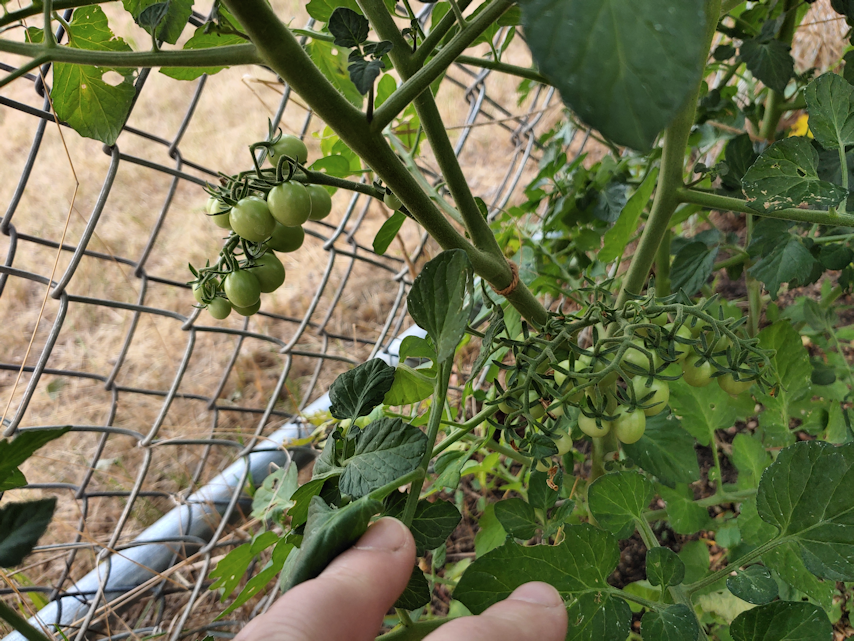
One of the Mosaic Mix tomato plants has SO many developing tomatoes on it! I don’t even like tomatoes, but I am really excited over how these are doing.
The tomatoes have gotten big and bushy enough that even some of the branches that have grown through the chain link fence are needing support.
Speaking of support…
Once the cucamelons finally reached the fence, they just shot up new vines and tendrils! Hopefully, the fence will soon be dense with leaves.
I need to find a way to put the fallen soil back and keep it there. I think the kittens are playing in the dirt and spreading it around. :-D
Even the Ozark Nest Egg gourds have gotten to the point where they are starting to climb!
If we can manage to keep things alive, we should still have a pretty decent harvest in the fall.
Today is supposed to be the hottest day of our current heat wave.
Of course, forecasts remain all over the place.
We’re going to hit 34C/93F but it will feel like 40C/104F
No, we’re going to hit 37C/99F and it will feel like 37C/99F.
We’re going to get thunderstorms today.
No, tomorrow.
No, the evening of the day after and into the following morning.
No, we’re going to get thunderstorms today – but only a 60% chance, with less about 5mm of rain.
We’ll see what actually happens! As I write this, we are at 30C/86F, and there’s enough wind to make it rather pleasant in the shade. While I was doing my rounds this morning, it was a very comfortable 17C/63F.
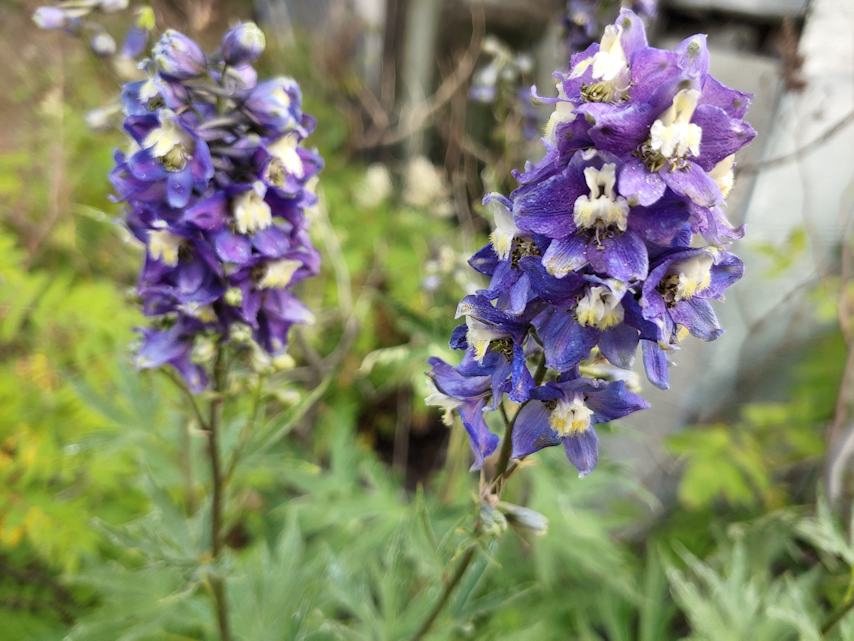
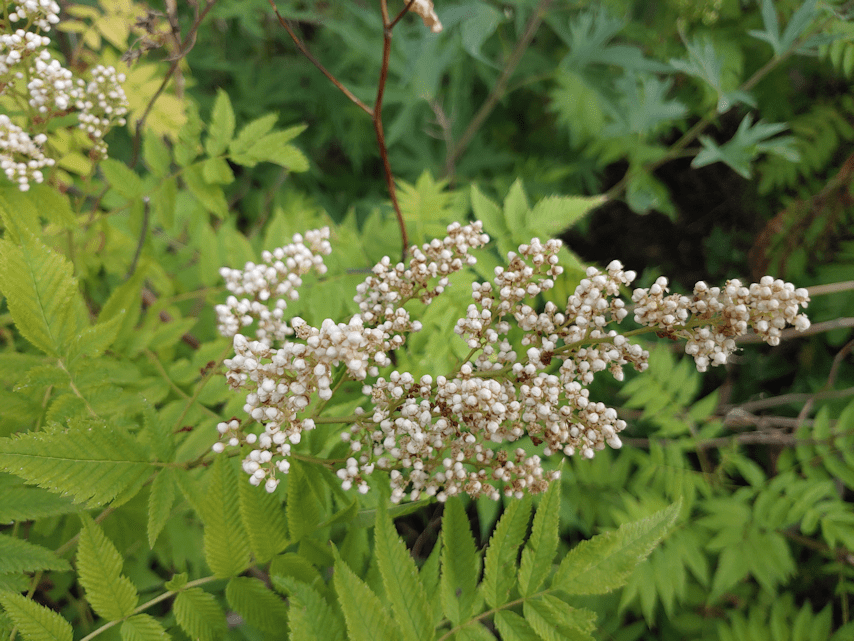
One of the few non-garden areas we’ve been giving at least some watering has been the spirea next to the storage house – the one area we are allowing the spirea to grow – and the grape vines (there are only a couple of clusters on the vine this year). More specifically, right at the corner of the house, where these flowers are growing.
When we first saw these flowers, it was a real surprise, because the plants were completely buried by the spirea. Since then, we’ve been cleaning up the spirea, taking out the dead bits and keeping it under control, but it still hid the plant and we wouldn’t see anything of it until the flower spikes shot up.
This spring, with the warm May we had, the spirea had been leafing out and starting to show flower spikes. Then that -8C/18F night hit and killed off the flower buds and damaged the youngest leaves. So the spirea is a lot thinner this year, even with our watering. Which means, for the first time, we could actually see the plant this flower is from, and it has grown much larger. You can tell by the flowers, though, that even with watering, the heat is getting to it. The flowers are smaller and shriveled looking compared to how it usually blooms, even when buried by spirea.
The spirea, meanwhile, has recovered to the point that it is starting to bud again. This will make the pollinators quite happy!
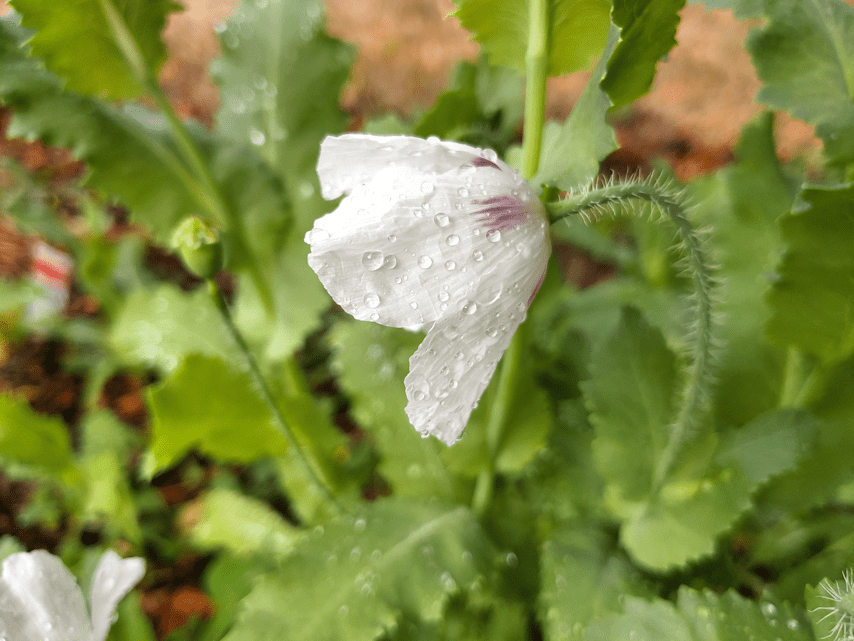
We have more poppies blooming this morning, too. About 4 of them were open, or partly open. I gave the old kitchen garden a bit of a watering this morning, too, making for some very photogenic flowers. :-)
Yesterday evening, after the girls were done watering the garden beds, I filled the rain barrel at the house, so that we would can water the old kitchen garden with a watering can, while the hose is running. I don’t expect to get any rain to actually fill the barrel. :-/
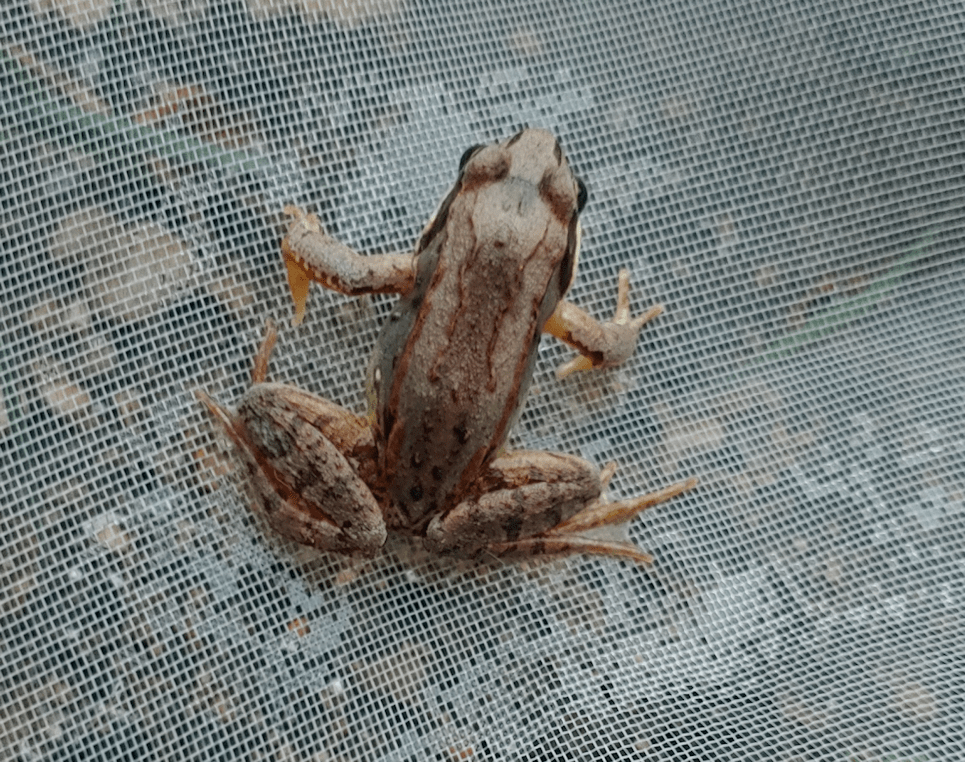
While at the barrel, I saw something scuttle across the two kohlrabi plants in the carrot bed that are covered with netting. It turned out to be this little friend.
That’s the downside of using floating row covers to protect our plants. The frogs have a harder time getting under the cool leaves. The netting isn’t stopping the flying insects from getting under them; they just cant’ figure out how to get out again. Which should be a big foggy buffet, if the could just find the edges that they can crawl under! :-D
This afternoon, I got to visit my sister and her husband on their farm.
We may be in the boonies, but they are even more in the boonies than we are! :-D
Before I left their place, we did a tour of their yard and garden, and I really appreciated being able to see how theirs is doing, in this heat.
Her row of rhubarb was a study in extremes. In the middle, she had these MASSIVE leaves and stalks – which is normal for her rhubarb – but in other areas, they were smaller and wimpy, like ours, and at one end of the row, they were basically dead. So strange!
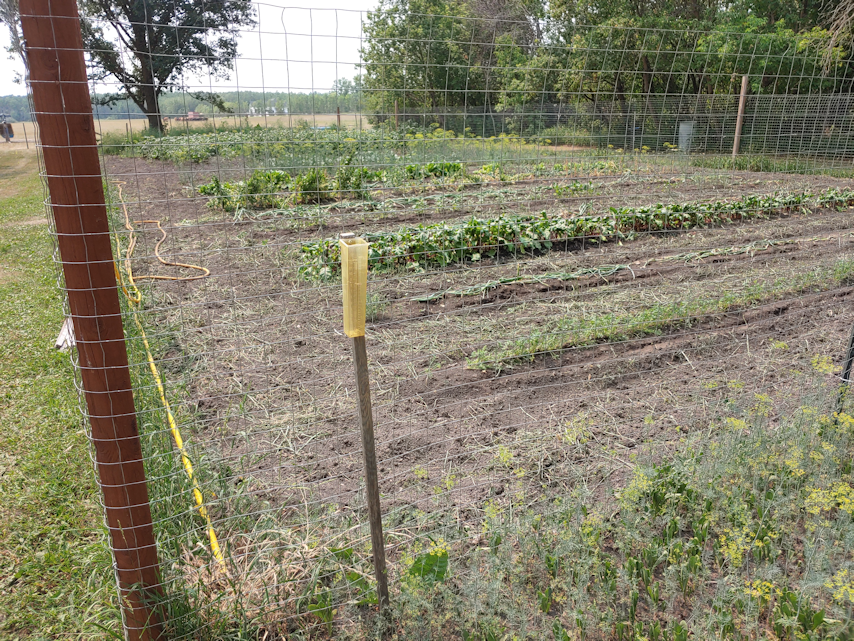
Where I’m standing to take this photo used to be part of their garden, but they reduced its size. That area is now full of self-seeded dill. This end of the garden is where they have their annuals, with some rows already cleared and tilled. At the far end are their perennials, including onions (different from the ones they have in the rows visible at the annual end), horseradish, asparagus, sorrel, mint, and a few other things. They’ve got determinate tomatoes, and I could see some very large ones developing. No peas or corn, but they do have beans, beats and potatoes, among other things.
They usually water their garden from the nearby creek. In this photo, you can see a platform on the shore, and the end of the hose is between the two sticks in the water, with a float. This is where they pump the water from.
The creek is about 3 feet lower than usual this year, and it’s got to the point that they are watering using their well water. They only water every couple of days, though, unlike the nightly watering we are having to do. It has actually been lower than this, in the past.
After all those years… LOL
When my brother in law retired from farming (like where we are, most of the land is rented out), he took over much of the gardening. The first time a deer got into their garden, he put up the fence.
Deer are not the only issue they have. They also have to deal with black bears, raccoons and…
Yup. They have woodchucks, too. This den is under the deck of a now-empty house they share a yard with. There are dens in other areas, too. Apparently, their woodchucks have plenty of other food to eat besides their garden, because their deer fence is just touching the ground at the bottom, not buried, and they’re not trying to get it.
Which is as good a segue as any as to why I visited them today. My brother in law finally had time to help sight the scope on my crossbow.
Now, this is something we could have done ourselves, except we don’t have anything to accurately measure longer distances. My BIL is an avid hunter and has a range finder, so we figured we’d go to him and get it done right.
He never even used it. He just paced off the distance, just as he would have in sighting the scopes on his rifles! :-D
Now, he had plenty of experience with rifle scopes, but he’d never worked with a crossbow before, so the first thing he did was spend time reading the instruction manual (I brought everything! LOL). We had only finger tightened the scope, so after he checked it a few times and confirmed that it was the right distance for me, he tightened that down, and then we went to his target bale.
The instructions said to start at 10 yards, which is about where the corner of that fence is, then moving to 20 yards to fine tune the scope. He is sitting at 20 yards in the photo, which is what we need the scope to be sighted to.
Also, do you see that white blob on the creek in the background?
That is a flock of pelicans. :-D
He was expecting it to take only about half an hour to sight the scope, but we ended up out there, in the heat, for probably more than an hour before we stopped.
He did the final shots at about 30 yards, before we called it for the day.
The bolt here is the first shot done at 30 years. He was aiming for the target on the left.
If you look at the top right, there is a single hole. That was the first shot at 10 years, before he started adjusting the scope.
Above and to the right of the centre target are a series of holes. He hit the exact same spot a couple of times. The instruction manual described how many clicks equaled 1 inch at 20 yards and, according to that, with the number of adjustments he made, it should have been hitting to the left of the centre target! After hitting the same spot a couple of times, the bolt ended up so far into the target, the fletchings were squeezed into the hole, too. One of them ended up coming loose. It just needs a bit of fletching glue to fix and it’ll be fine, but that’s when he started to aim at the other target.
By the time he was done, he could get a good grouping at 30 yards, but it was still hitting to the right of the target. He’d adjusted it so far, he wasn’t sure it could go any further. The scope we have is different from any of his. In fact, it had a whole extra knob to adjust, but not even the scope’s instruction sheet (which was for rifles, not crossbows) had it labelled on their diagram.
So the crossbow is not sighted, but it is closer, and we are in a position that we can figure the rest out ourselves. Of course my husband, with his military background and marksman qualifications, knows how to do it. The main issue was measuring distance. Which my BIL just paced off, anyhow.
I think we can manage more accuracy than that, with what we have! :-D
Adjusting the scope was not the only thing that was a problem. The other was cocking it in the first place. The kit came with a rope cocker. There is a rock cocking groove at the end of the stock, just before it can be adjusted to size. The middle of the rope goes in the groove, two hooks with pulleys hook onto the string, from under the stock, and there are a pair of handles to pull on. At just shy of 6′ tall, he actually had trouble cocking it, once he straightened up past a certain point. He already had doubts that I could cock a bow with 220lb draw weight, but in the end, I’m basically too short. If he, at about 8 inches taller than me, was having a hard time, it’s pretty much assured that I don’t have the height and arm length to be able to raise the string high enough to latch in place!
He recommended we pick up a crank cocker.
Since we were never able to complete sighting the scope, I never fired the crossbow myself. That will just have to wait a bit longer.
In shooting the crossbow, he had a couple of issues with it. Obviously, the scope itself was one. I know that a lot of people who buy kits will replace the kit scope with a higher quality one right away. This wasn’t a matter of quality of materials, but adjustment. He also didn’t like the trigger, which was something else I saw some reviewers complaining about. It does, however, shoot well and shoot true. Once the scope is properly sighted, we should have no issues with it. I’ve seen reviewers complain about the adjustable stock, but he had no issues with that.
He also really didn’t like the rope cocker. He had mentioned to me that he had a friend who bought a crossbow and, the first time he tried to cock it, it slipped and he almost groined himself severely. He then immediately got rid of it. As my BIL was repeatedly cocking the bow, he said he could see just how easily that could happen. Eventually, I learned that when this person had tried to cock his bow, the stirrup slipped off his foot.
…
The instructions are EXTREMELY clear about how important foot placement in the cocking stirrup is. Which rather makes me wonder just how closely instructions were being followed. Mind you, this happened quite some time ago. The instructions may well include that now because people were hurting themselves by having just their toes in the stirrup, instead of having it under the middle of their foot.
There’s a reason the instruction manual has more safety warnings than pretty much anything else! This is not a toy.
So now we need to figure out where to set up a target practice area, mark out distances, and figure the rest out ourselves.
I did have some unexpected disappointments about the whole thing. While they are not being mean or malicious about it, it’s clear neither my BIL nor my sister are confident in me. Not just in being able to use and shoot the bow (yes, I have the physical strength pull 220lbs draw weight with the rope cocker), but they seemed to assume that this was some sort of spur of the moment thing I decided to do, without any sort of research or analysis, first. Like I was thinking of it as… well… some kinds of toy. The fact that I hope to actually use it to hunt is another area they clearly didn’t have confidence in me about, with both or them, at one point or another, making sure to mention that a deer will run off after being shot, and then it needs to be tracked. I knew that, of course. It happens even when hunting with a rifle. Why did they assume I would not know that? There were a few other… assumptions… made that had me wondering. I think part of it, for my BIL, was simply because he assumed that since he was having such a hard time with some things, I would have an even harder time, and not things where my height would make a difference. Was it because I am female, and they assume I’m weak? Or because I’m fat? Or because I’m the baby sister? I don’t know. It was off putting, even though I could tell they did not have any ill will behind their comments. More like their filter was off. :-D
Well, we shall see how things work out over time. First things first. We need to get that scope sighted properly, and then I have to practice. My husband will be able to cock the bow, no problem, and honestly, I think I might still be able to as well. Even if I can, we will be getting a silent crank. The rope cocker, it turns out, squeaks! :-D
My daughters, meanwhile, are pining for a compound bow.
Now that we have Halona melons developing, it is so much more fun to check the garden in the mornings! Check this out.
These melons are visibly bigger than they were when I looked at them yesterday evening. I checked them again this evening, and they are again, noticeably bigger! Not only that, but we are finding lots more new ones, plus some larger ones that we hadn’t seen earlier. None as big as the one I’m holding in the photo, though.
I’ve looked over the Pixie melons, and while there are lots of flowers, they all seem to be male flowers. Which is interesting, since the Pixies are 70-75 days to maturity, while the Halona are 75 days to maturity, so you’d think it would be the other way around.
This is a photo of our very first WINTER squash! *insert happy dance* They are starting to get quite big, and this type are quite enthusiastically climbing the squash tunnel. I forget which ones these are; the markers are hidden under leaves right now. :-D
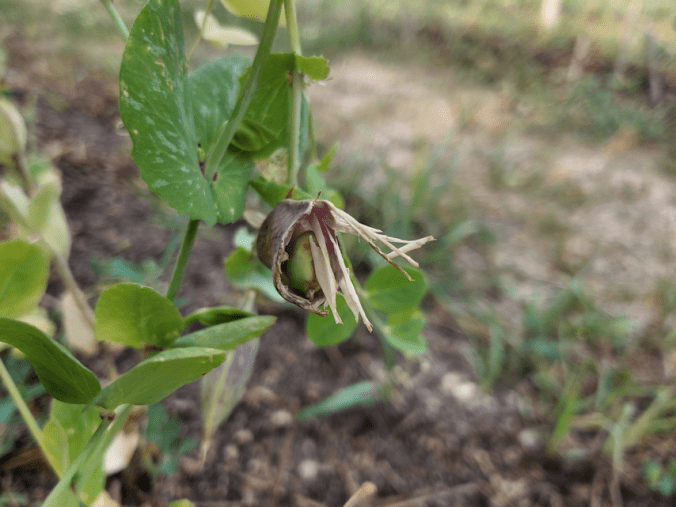
Well, if I needed clearer proof that something is eating our peas, this is it. Half the pod of this purple pea got et. There were still a few that were ready to pick. Maybe 5 or 6 pods. Just enough to include with my breakfast, as an edible garnish. :-D
This evening, I refilled the patched rain barrel and, while I was waiting, I checked over the peas more thoroughly. Enough are showing signs of nibbles that I moved the garden cam so I can hopefully see what critter is the cause. We’ve seen deer and raccoons going by, but they’re not eating anything, however the camera was not being triggered by anything in the pea beds. In fact, last night, nothing triggered it at all, until I walked past it this morning. I now have it up against the lilac hedge on the North side of the pea beds, and lowered on the flag stand, so I’m hoping it will work.
Two more poppies were blooming this morning!
They drop their leaves by the end of the afternoon, though. I was talking to my sister about them and mentioned that they were supposed to have pink petals, not white, and she said that it’s from the heat. If things were cooler, they would be the pink they’re supposed to be. Interesting. She also confirmed that it’s likely the heat that is causing our peas to struggle. I agree that this would be the major factor, though I’m sure a combination of factors are just making it harder for them to thrive.
And that’s before having critters eating them!
In other things, my plans changed with a phone call, and I headed out for most of the day, but that will be in my next post. :-)
While going through the old kitchen garden this morning, I was seeing more of our beets, slowly being nibbled away. We’d added stinky soap, cat fur, hot chili flakes, and a motion sensor light. The only thing they seem to be doing is spreading out the damage, as the various things get avoided.
So today, we tried something else.
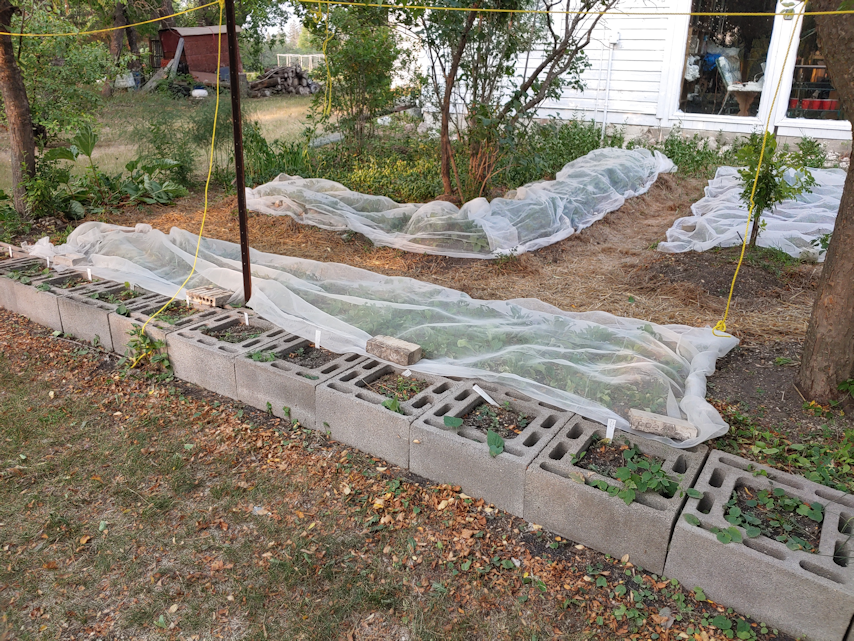
Since there’s no point keeping the mosquito netting wall up to keep the deer away from the lettuces that the groundhog decimated, it was taken down. The sheet was then torn in half, lengthwise, to be used as floating row covers.
One half was used to cover the L shaped beet bed. The other half was cut into two pieces, with one covering the beets by the retaining wall, and the other covering the carrot bed. The edges are weighted down with bricks and whatever rocks we could find that had some weight to them.
It won’t stop a determined critter, but it might be enough to convince it to not bother, and move on to easier pickings.
My only concern about that is, “easy pickings” would be the poppies and the couple of sunflowers growing next to them. They’re too tall to cover with anything, without damaging them, but not too tall for a critter to reach.
That done, we moved on to the cucamelons and gourds.
For this, we rigged a chicken wire “cage. The top is laced to the chain link fence with twine, above the cucamelons. Over the gourds, it’s just tacked in place at the end, so that a gap can be make for the plants to grow through. The ends were cut and folded in to close them off, and the bottoms are tacked down with tent pegs.
Again, this is not going to stop a determined critters. But it is better than nothing.
As I write this, it was past 9pm, and we are still at 30C/86F, with the humidex at 33C/91F. Tomorrow’s forecasted high is 34C/93F, with the humidex at 38C/100F. Hot, though not quite as hot as the previous heat wave. The girls have been diligent about the evening watering, though I think we’re going to have to keep it to just one watering a day, after something concerning happened last night.
The sweet corn and sunflower beds have been the most difficult to properly water, so we have started to use a sprinkler, turned on for about an hour before the rest of the watering is done. It reaches almost all of the corn and sunflower beds, leaving only a row and a bit at each end that need to be watered manually. Yesterday, as one daughter headed out to switch the hose from the sprinkler to the spray nozzle, my other daughter started to use the front hose to water the old kitchen garden.
This is something we have done before without issue, but this time, all pressure was lost. My younger daughter went into the basement to check the pump, and found it making that grinding noise we have managed to avoid for quite a while now, and the presser was down to zero. By the time she called me over to look, the pressure was back up to 30psi, which is where it should be, but the taps to outside were shut off, anyhow. After the pump shut itself off again, we turned the taps back on, and the girls continued watering, but with just using the back tap.
Now, when we first noticed the pump making that noise and we would lose all water pressure, it was quite a concern. There was a possibility that the foot valve was leaking. We had two plumbers look at the pump, and one even crawled into the well shaft, and my brother even bought a new pump to replace this one, which is about 20 years old. The problem is, the system is so old, neither plumber was willing to chance doing the work, because the risk of something breaking in the well and losing our water completely was too high. At the very least, we’d have to hire someone to find parts for a system that’s almost 50 years old and are in different sizes than modern wells, break the well cap to access the well and replace the parts, or dig a new well.
Digging a new well was the recommended course of action.
None of this is an option for us, so basically, we’re being really careful. The main thing is that problems would start when water was being used faster than the pump could refill the pressure tank. As long as we don’t do things like run the bath as full pressure, or use multiple sinks at once, etc., we can keep it from happening. We know we’re on borrowed time, though.
The hoses do not use a lot of water at once, and even with both taps being used, we never had issues with the pressure before. So why did it happen last night?
I can think of only one thing.
The water table is dropping.
I don’t remember this even happening before, but I can’t think of anything else. It’s not like someone decided to take a shower or something at the same time – and we’ve even the shower get used by someone not knowing the hose was in use, with no loss of pressure.
So for now, we’re going to stick to watering just once a day.
Hopefully, it will be enough.
This is when we could really use more mulch! In the future, when we build our permanent garden beds, a drip irrigation system is also very much in the plans.
This is the Giant Rattle Breadseed Poppy, from Baker Creek. The flowers are very different from the poppies my mother grew with I was a kid; those had bright red flowers with black at the bases, similar to the Remembrance Day poppies. She may have gotten the original seeds from Poland. It should be interesting to see how big the pods get. The plants themselves had a rough start and are very small, even compared to the ornamental poppies. These are supposed to get very large (hence their name.. LOL).
Interestingly, the photos at the website show pink, not white, on petals.
We have been very excited by how well the Montana Morado corn has been doing. However, as some of the stalks have gotten taller, they have started to fall over. The soil around the plants seems to be washing away as we water them. So, this evening, I added more garden soil to the bases of each one.
While watering these, my daughter has been focusing on giving a deep watering into the paths in between them, then using a finer spray to water the entire bed, so as to prevent more erosion. A couple of the stalks are also supported by stakes.
We are very curious about what the cobs will look like. Some of the stalks, silks and tassels are very purple, while others are varying shades of green. These are all supposed to give us corn so dark a purple, it looks black. But is that what we will get? We shall find out! It does look like several cobs are filling out nicely. :-) I’ve taken to hand pollinating every now and then, just to be on the safe side.
Meanwhile, while watering the squash tunnel, my daughter found another little melon!
At first, she thought one of the ones she’d found before had fallen to the ground, but then she saw they were both still there, so she lifted the third melon onto the structure. This had me looking around for more, and I was very excited to see two of these.
Tiny little melons, juuuust starting to form!
This is awesome!
I checked the other melons, squash and gourds. The summer squash is getting nice and big, and I might even have a couple of squash to pick tomorrow. The other melons and the winter squash have flowers and/or buds, but no fruit forming. Same with the Crespo squash. The luffa isn’t even showing flower buds, but it is climbing the trellis.
Then we went looking at the tomatoes (so many fruits are forming!), and they are doing great. The tiny little onions we planted under them are still tiny and little. :-D I noticed this morning, however, that a couple of self seeded (likely from the bird feeder) sunflowers seemed to be gone. This evening, I looked again and found their stems, leaves all eaten away. *sigh* More of the flowers in the bed nearby have not only had their heads eaten away, but in one area, even the stems are being eaten. We will not be getting many blooms out of that bed this year!
That reminds me: it looks like a lot of our French Breakfast radishes have been eaten, too. Possibly grasshoppers.
When checking the cucamelons, it looked like some of them had lost a few leaves and vine ends, too! They’re such small, fine plants, though, it’s almost hard to tell.
Then I saw this. :-(
This is the Thai Bottle Gourd. We had the one transplant, and a second seed germinated next to it. Now, the little one has lost most of its leaves, and the big one has lost a couple, plus a couple more leaves are partially eaten.
No damage to the Ozark Nest Egg gourds. Which is good, but we have more of those!
Very frustrating.
This year’s garden has been such a mixed bag of stuff going well, and stuff going badly, due to critter damage!
Today, we did indeed break the 30C/86F mark, but by the “cool” of the evening (you know you’re acclimatizing to the heat when 27C/81F starts to feel cool!), the kittens were out to play!
I haven’t had much luck getting Butterscotch’s babies to come close while I’m sitting in the camp chair, but they’ve come closer to my daughter when she sit on the ground. So when I had the chance, I decided to get down on the ground to see if I could lure them closer.
It worked.
This was totally worth the pain of having to get back up again! :-D
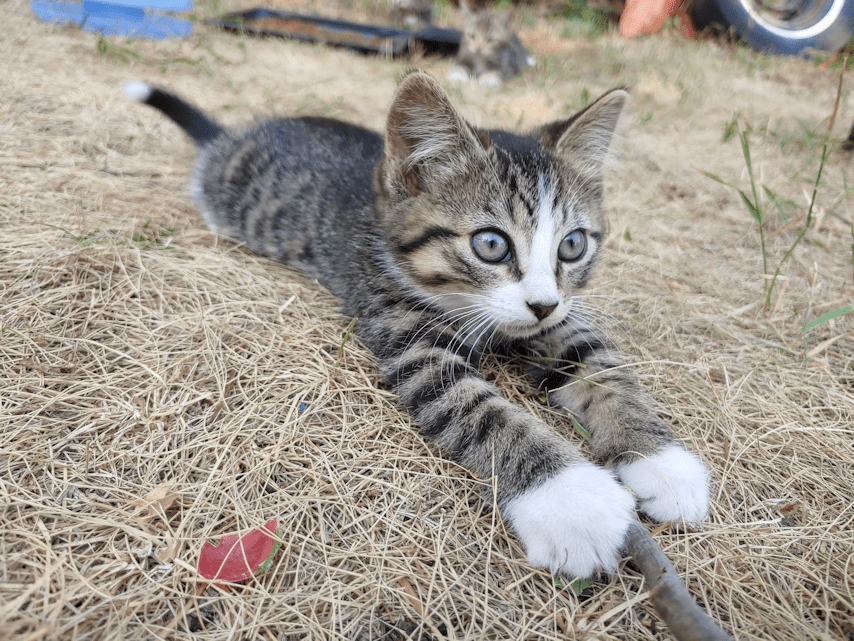
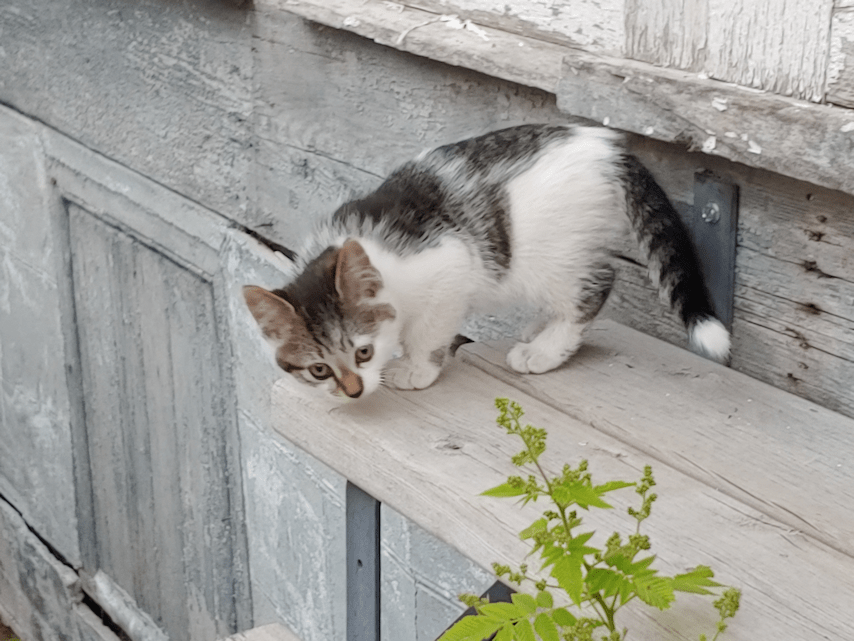
Also, I would like to introduce to you, Bradicus, of the twins, Bradicus and Chadicus. These two look very much alike, but Bradicus has the distinct white line going up his forehead, and a white tip on his tail.
Out of focus in the background is Caramel, with her caramel coloured swirls on her sides.
Awww… Butterscotch and all her babies. :-)
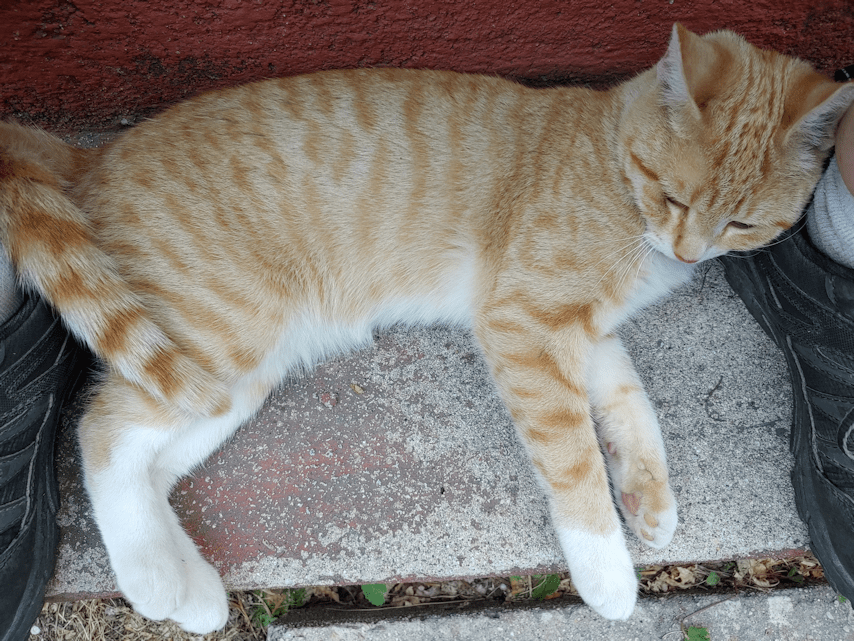
Nutmeg was enjoying attention this evening, and he even let me pick him up! As long as we don’t try to walk, he will let us hold him, and he gets very cuddly!
Rosencrantz’ babies were running around, too.
Meet Nosencrantz.
I wasn’t able to get a picture of her orange sibling, Toesencrantz, this evening.
Then there are Junk Pile’s four, but when we see them, it’s usually in the form of a tornado of kitten, running away across the yard. Hopefully, they will start hanging around more.
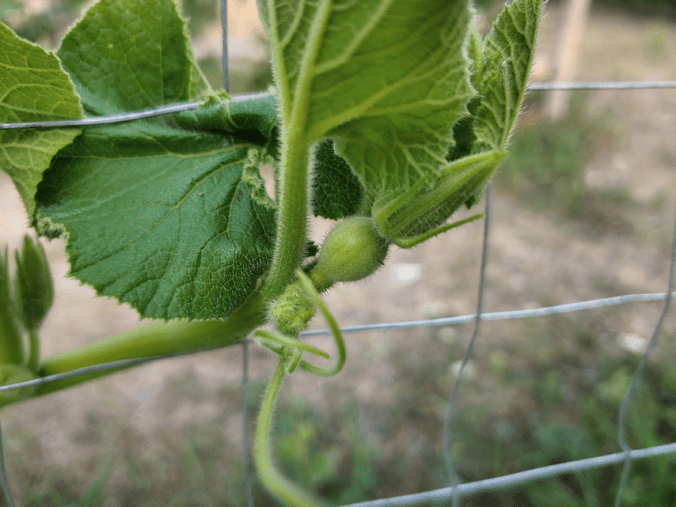
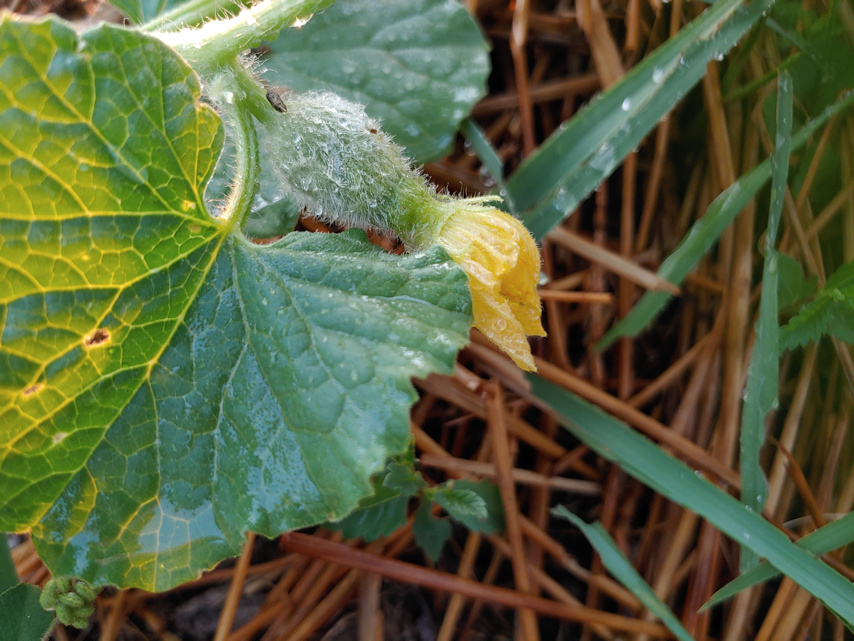
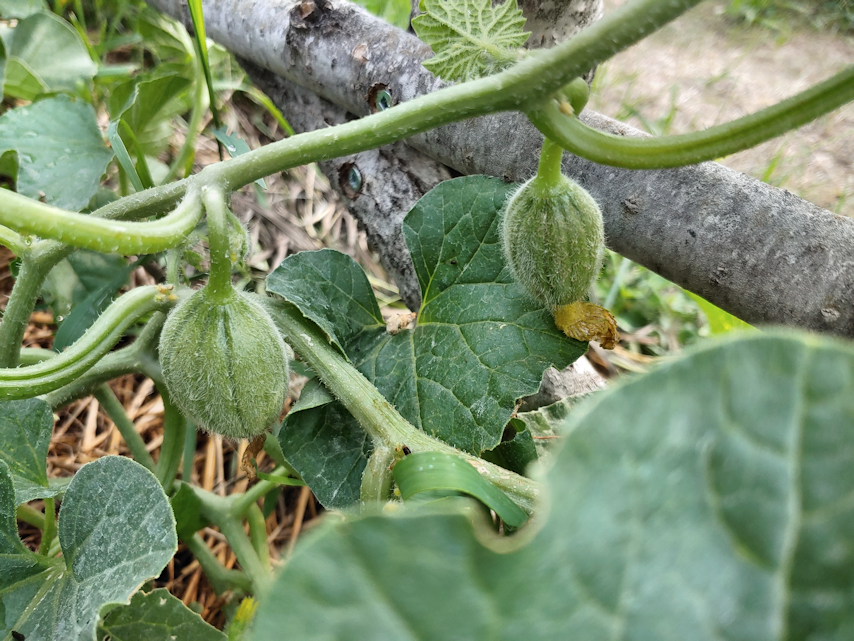
While doing the evening watering, the girls spotted a couple of little melons last night! I just had to go looking for them this morning.
Aren’t they adorable?
The bigger one is about 2 inches long. I wasn’t expecting them to be fuzzy. :-D
These are the Halona melons. Still nothing among the Pixies – at least not that we can see. Lots of flowers, though.
In thinking of how to protect our Crespo squash from being nibbled on, and our new sprouts from the upcoming heat, I scrounged in the old garden shed and dug up some old, bent up, decorative wire border fences.
Most of the sections went around the Crespo squash. Whatever has been eating them has not tried to go past the hoops, so I’m hoping the new border will further dissuade it.
The ground here is so rocky, I wasn’t able to push all the wire “legs” into the soil! Enough are in to keep it from falling over, though, so it should be fine.
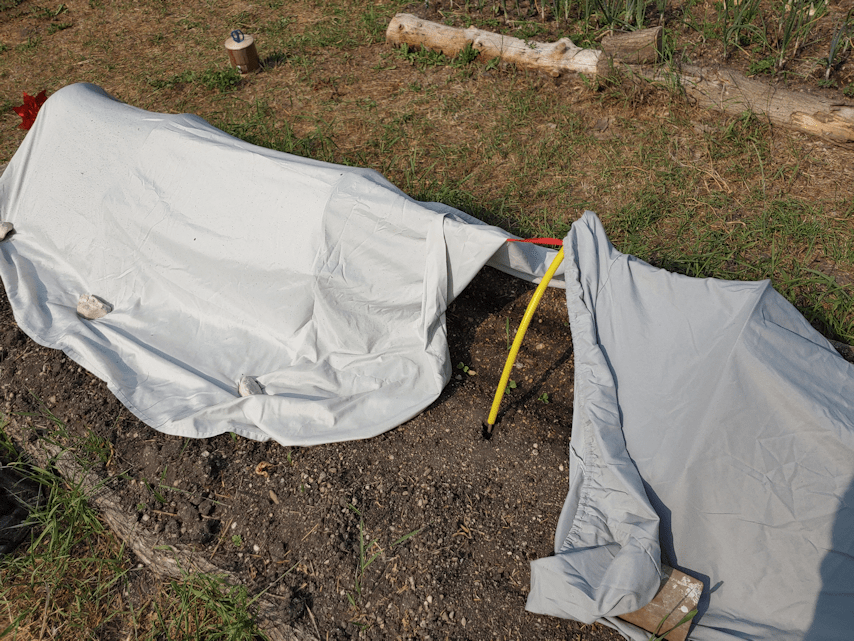
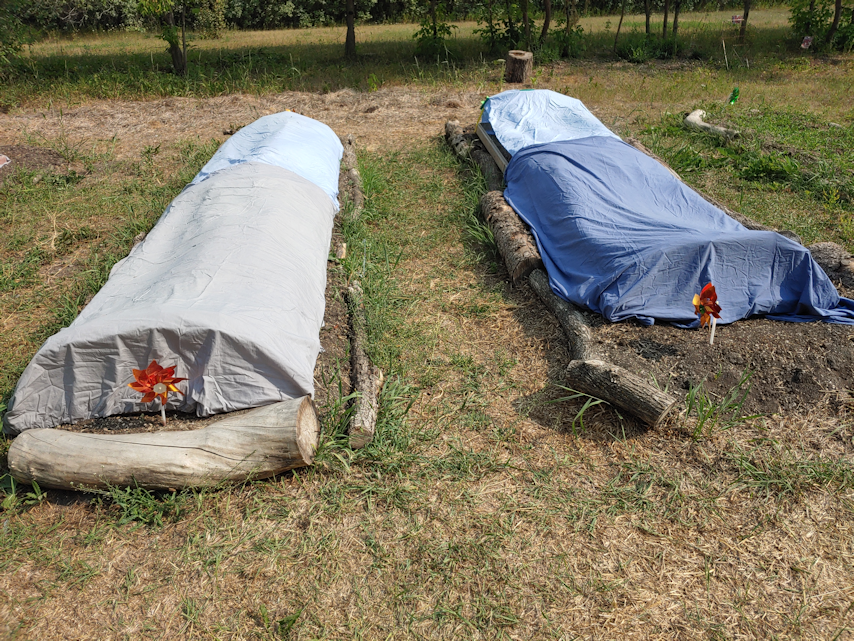
There were a few sections left, and they got used in the garden bed that doesn’t have a row cover on it. Then I used some bed sheets as shade covers. I neglected to take progress photos, though. :-/
There were 6 individual sections that got evenly spaced over the seedlings. The bundle of fencing had been tied with a fairly long ribbon, so I used that to join the tops of as many of the middle ones as I could. As I was laying the sheets down, though, there was nothing in the centre to support the ends. I had a short piece cut from a hula hoop left, so that’s now in the middle, on a couple of sticks in the ground to hold it up. It was too short to bend well, so there’s a kink in the hula hoop piece, but at long as it holds the sheet up, I don’t care! :-D
After that, rocks and bricks were used to pull the fabric taught and weigh it down.
For this bed, I could use some old Twin sheets. For the other two, I had some queen and kind sized sheets to use.
The one top sheet was easy enough, but the fitted sheets needed to have their elastics cut off, and one of them was cut in half and used to cover the ends of the rows. With these, the fabric could be secured by tucking it under the wooden frame. The sheet that was cut in half is barely wide enough on one frame, and a few inches too narrow on the other, but the ends are tucked, and in the middle of the row, the other sheets were laid on top to hold it in place.
So now our shade-loving seedlings have their shade, and protection from the heat of the day. We can uncover them when we start the evening watering, so they get some less direct light during a cooler time of the day. Then I can cover them again when I do my morning rounds.
We’re supposed to start hitting 30C/86F and higher, tomorrow, though the hourly forecast on one of my apps says we’re supposed to hit 32C/90F this afternoon. The record high for today is 33C/91F, set back in 2002. I think we were actually living in this province again in 2002, though I believe we moved back in the fall. The record low for today is 9C/48F, set in 1993.
Anyhow, we’re supposed to stay about 30C/86F for almost a week, and these sheets should help keep the seedlings a bit cooler. I’m considering whether it would be a good idea to moisten the sheets, too, but the extra weight of water might be too much for the frames to hold.
It should be interesting to see how these work out!

























 The Re-Farmer