It’s Thanksgiving weekend here in Canada. Tomorrow is Thanksgiving day, but we are having our big dinner today. My mother loves her turkey dinner, so I will be bringing her some tomorrow, while my brother visits with her today. Right now, the turkey is in the oven, as are most of the potatoes that were harvested yesterday, so I can take a break to post about our Thanksgiving garden surprise. :-)
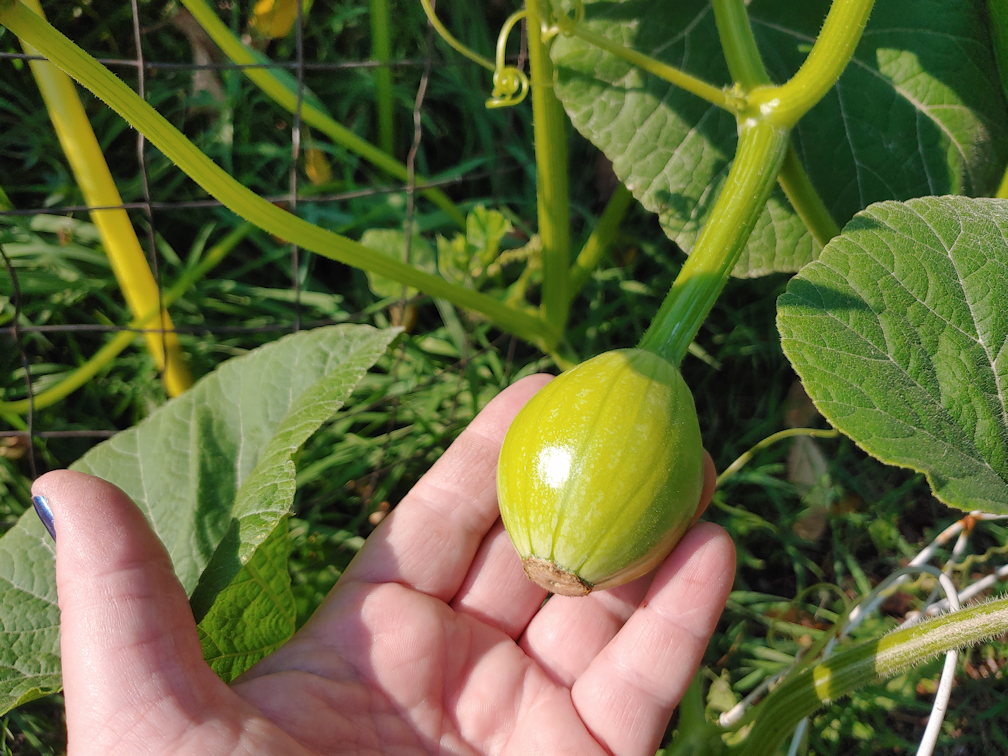
Last night, as we headed outside before the light faded completely, I took my daughters over to see how quickly the Crespo squash is growing. In the process, we discovered a hidden squash!
It had been hidden by leaves until now!
I came back this morning to get a photo, but of course my phone’s camera decided to focus on everything but the squash itself! :-D
This is easily the biggest of all the Crespo squash we have developing. This is the only pumpkin type of squash we’ve got this year, so it seemed appropriate to find this on Thanksgiving weekend.
I didn’t get any photos, but the Ozark Nest Egg gourd is also showing us surprises. There are SO many female flowers showing up, with their little gourds at their bases, and it even looks like quite a lot of them got pollinated! A few have wizened away, but more seem to be making it.
If the weather can just hang in there! I’m now seeing overnight lows of 2C/36F by Friday, with rain at the same time. The squash and gourds seem to actually like these cooler temperatures, and are producing like crazy, but I doubt any of these will survive such lows, even without frost. We shall see. It would be so awesome if they managed to mature! For that, though, I think we’ll need mild temperatures through half of November, too. Which does happen. It’s whether or not we get frost that will make the difference.
That we haven’t had frost yet is something to be thankful for, this Thanksgiving weekend!
Just in case I’m not able to post tomorrow, I wish you all a Happy Thanksgiving!
I wasn’t going to harvest our potatoes yet, since they can stay in the ground until after we get frost. It is, however, Thanksgiving weekend here in Canada, and dangit, I want to have some of our own potatoes! :-D
The fingerling potatoes are still growing, but the Yukon Gem and Norland potato plants are completely died back, so those were my target for today.
Using old feed bags as grow bags was an experiment for us, and it was interesting to see that roots had made their way through the bottoms of the bags. These will definitely not see another year of use, and they were also weathered enough to start tearing a bit while I moved them, but that’s still pretty good, considering they would have been thrown out, otherwise.
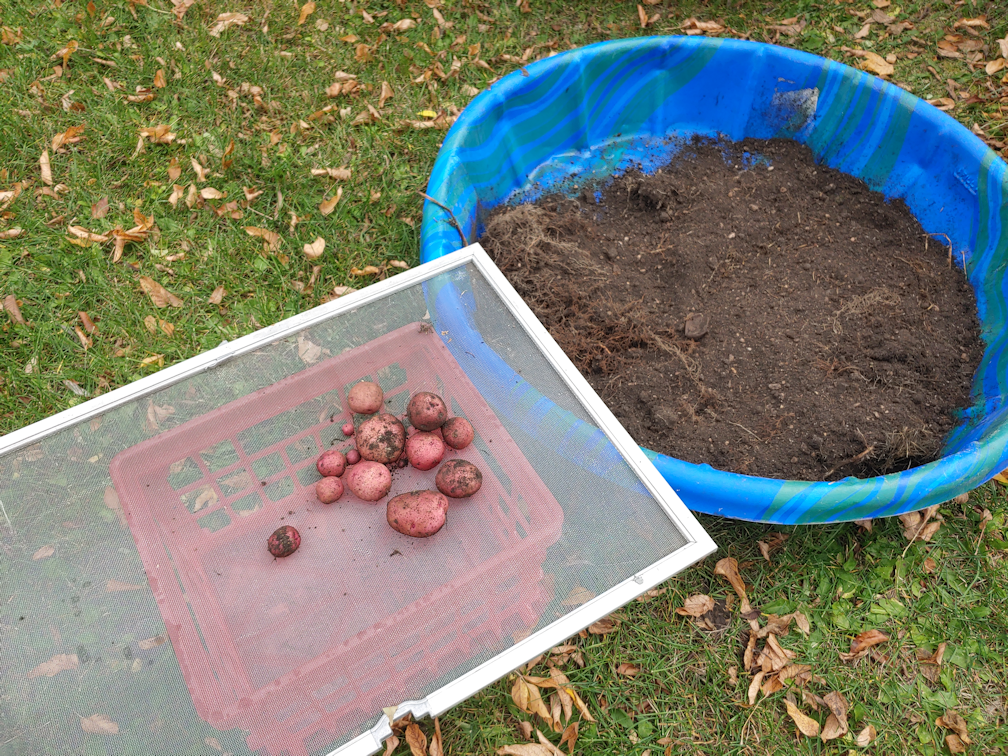
That kiddie pool is, once again, the handiest thing ever! So are those old window screens I found on the barn. :-D The bags got dumped into the pool, where I could go through the soil to find the potatoes and set them aside on the screen.
This is the contents of the very first bag I emptied!
Each variety was planted in five feed bags. We did gather some potatoes earlier, and I tried to take out just a couple from each bag, so there was originally a few more than what you can see here.
I had assistance from a Nosencrantz, ferociously hunting leafs!
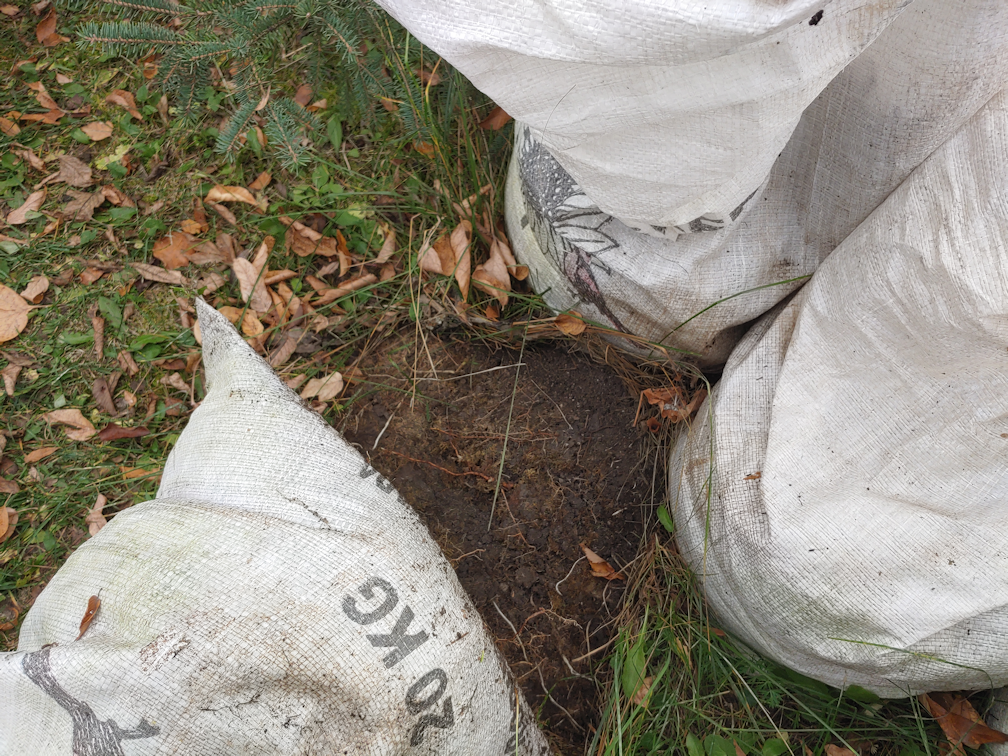
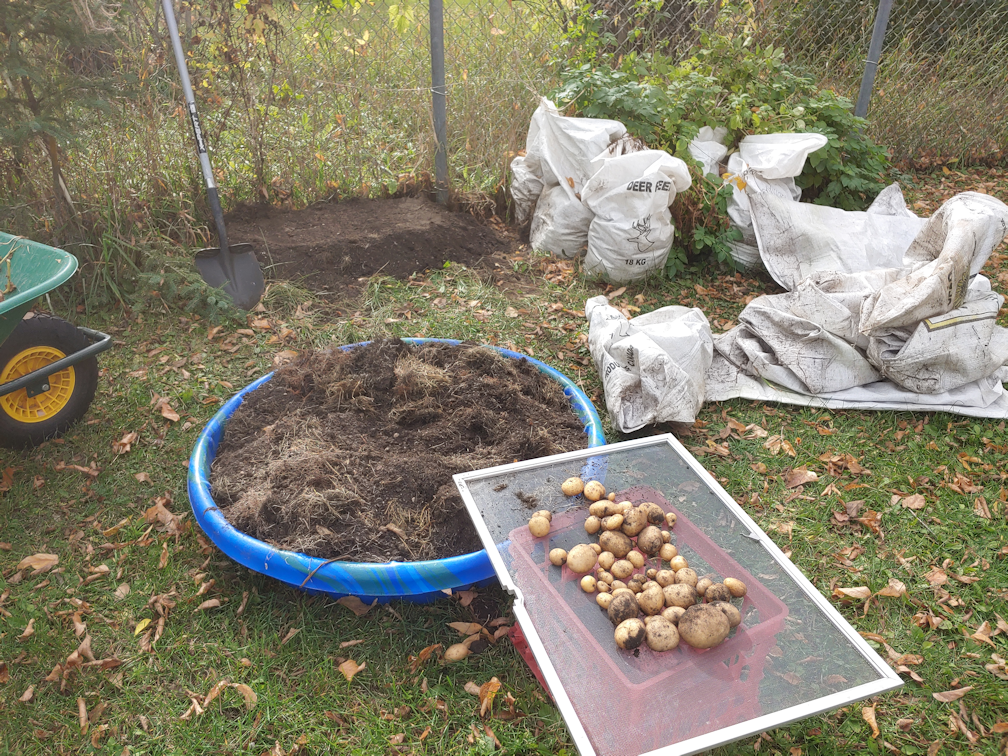
By the time I was working on the Yukon Gem potatoes, the kiddie pool was too full, so I moved aside the remaining bags and started to return some of the soil to create a new bed for planting. For the amount of soil, the new bed will extend along the fence further than the rows of bags are, as I don’t want to to be too wide or too deep. Unless I change my mind at the last minute or something, we will be transplanting some perennial flowers that need to be divided.
One of the nice things I noticed while picking through the soil to find the potatoes, was how many nice, big fat worms I found! They managed to make their way through the bottoms of the bags. I could even see worm holes in the soil under the bags, too.
Here they are! All of the red and yellow potatoes we got.
Such a small harvest, but not too shabby, considering this year’s growing conditions. These will sit outside on the screens for a bit, but with so few potatoes, there’s no need to properly cure them. We’ll be eating them pretty quickly. In fact, quite a lot of these will be used up this weekend, with Thanksgiving dinner. :-)
It should be interesting to see what we get with the fingerling potatoes!
As for how the grow bags did compared to doing the Ruth Stout, heavy mulching method we did last year, I would say these did better. I didn’t know about indeterminate and determinate potatoes before this. If I’d known, I would have specifically looked up indeterminate varieties for these bags, and would have kept filling them with soil and mulch over the summer. That would have resulted in a higher yield. It just happened that all the varieties we chose were determinate, so they grew all on one level. The main thing was that there was no sign of any slug or insect damage on the potatoes. With the Ruth Stout method, I found a lot of slugs as I dug up the potatoes, and quite a few holes in the spuds.
For next year, I am thinking we definitely want to look into doing something like this again; maybe grow bags again, or some other way of doing a potato tower. I think it will depend on what kind of varieties we go with next year, and if I can find indeterminate varieties. I was looking at different websites last night, including some that specialized in only potatoes, and just about everything is marked as sold out. I’m hoping that’s because of the time of year, and that they will come available again after harvesting and curing is done for the winter. I’d like to try sun chokes and sweet potatoes, too – there is one place I’ve found that sells sweet potatoes that can grow in our climate. I think I’m the only one in the family that actually likes sweet potatoes, though (the rest of the household just sort of tolerates them), so I wouldn’t have to grow many. I’ve never found sun chokes to buy and taste, so that will be something to try just to find out if we like them or not!
We’ll have to find a new place to grow potatoes next year, though, since this spot will become a flower bed. We’ll have to think about that! Especially since I hope to increase the quantity we plant. Over time, we’ll need to grow a LOT more potatoes to have enough for four people, to store over the winter, but we’ll get there little by little.
We got a pretty substantial rainfall last night. We are supposed to continue to get rain through today and into tomorrow, too. Which means I won’t be getting much done on the raised garden bed, but that’s okay. We need lots more rain – and hopefully get the mild, wet winter the Old Farmer’s Almanac is predicting for our region – to at least start to make up for the drought conditions we had this summer. The water table is still really low.
The rainfall made a huge difference in the garden. Especially with the squash!
The zucchini that we’d left to get bigger got a huge, overnight growth spurt! Even the patty-pans got a boost. The biggest one, with the green, is from the mutant plant. It had been producing only green patty-pans at first, then started to show the yellow they are supposed to be, and now we have squash that are a mix of colours.
There was plenty of bush beans to pick. Especially the purple ones. A few more peas were large enough to pick, and I even got three more Tennessee Dancing Gourds. There are still so many more smaller ones on the vines.
While checking them over, I had to check the luffa, too. The two developing gourds I tried to hand pollinated may not have taken. One of them, at least, seems to be dying off. However…
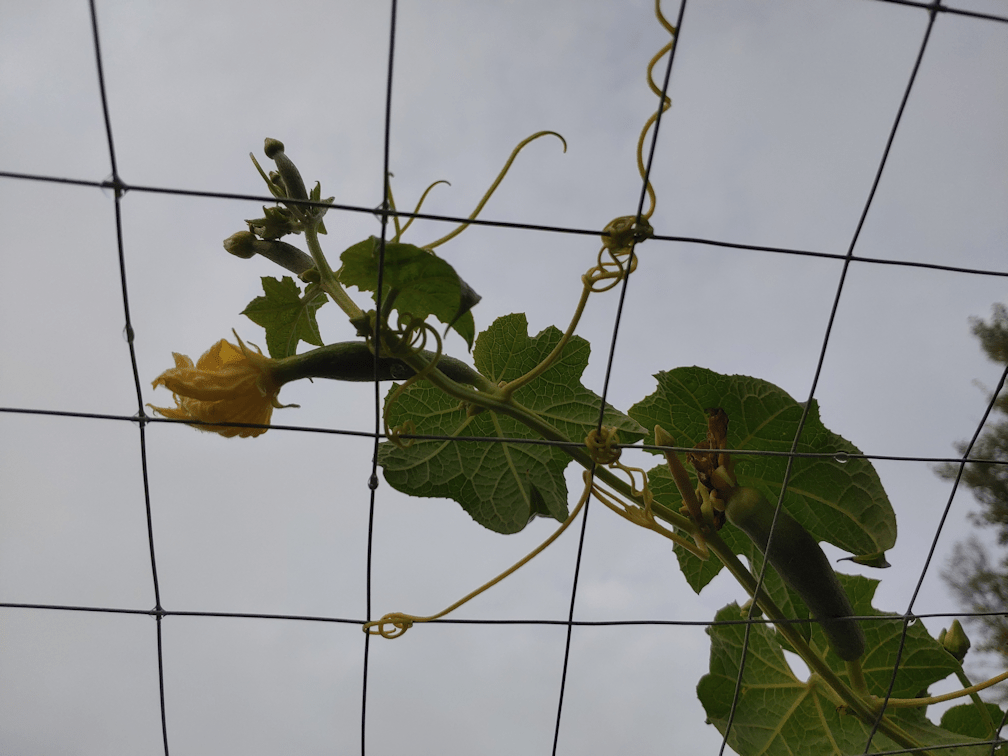
… the ones growing over the top of the squash tunnel are looking much bigger!
I don’t know how fast luffa gourds take to develop. Looking at the long range forecast, we should be hitting overnight temperatures of 4C/39F a week from now, which can mean frost, but those same nights also have predictions for overnight showers. We have no frost warnings. Even on my app that has forecasts through the end of the month doesn’t show overnight temperatures of 0C/32F until October 29, and even then we are expected to get rain that afternoon, which would actually prevent frost from happening.
However much longer we manage to have rain and no frost will not only give the luffa a chance to develop, but the Crespo squash, too. Check it out!!!
This one looks like it doubled in size since I last checked it out!
This is one of the older squash and, while it didn’t double in size, it did get noticeably bigger, and the colours and patterns are definitely changing.
The one shown by itself is the larger one in the photo showing two squash developing, and both have gotten much larger in just the last day.
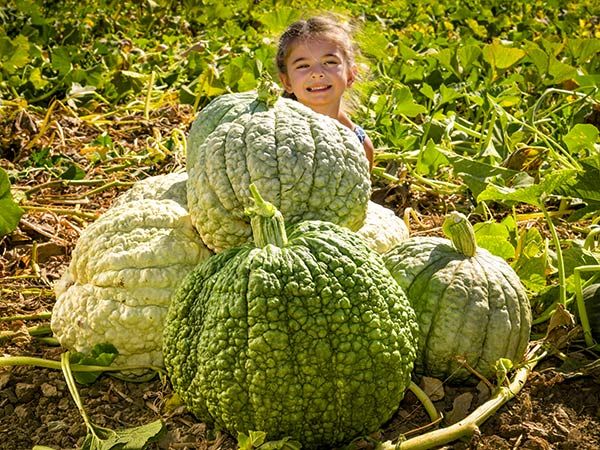
This is what they’re supposed to look like, when fully mature (image source), so the chances of them reaching their full growth this year is virtually nil, but it should still be interesting to see how close they get, if this mild weather continues, and the frost holds off!
If they’re growing this fast now, can you imagine how big they would have been, if the vines had not been eaten by deer and groundhogs?
You know, I never imagined I would find gardening so exciting. Particularly when so much of it is “failing” due to things like poor soil conditions, weather and critters! In fact, I think I’m finding it more exciting because of how well things have done, in spite of all the problems we’ve had!
The rainy weather means we’re not going to get much progress outside, but I am holding a slim hope out to things potentially improving. I did end up driving my mother to an appointment today and, in the process, I made a proposal to her. She had been talking about buying us a garden shed and got an estimate. It was over $3000, and that would have had the parts and pieces delivered to us, including the deck blocks to set it on, and we would then have to assemble it. As much as such a shed would be useful, we’re not ready for it. Where we would want to put it still needs to be cleaned up. However, with the farm being basically ransacked of anything useful while it was empty for two years, we don’t have the tools, equipment and resources to do a lot of stuff, and what we can do is taking much longer than it should. I proposed she instead give us the cash to use to pay for what needs to be done, from getting a chainsaw and wood chipper, to replacing the front door and frame. There would be enough to hire someone to haul the junk away, too. If she didn’t like the results by spring, we would pay her back. I told her to think about it and discuss it with my brother, who now owns the property, before making a decision.
It’s been really frustrating, talking to my mother about what we’re doing here. We are here to take care of the place and improve it. That’s our “job”. It’s what we’re doing in place of paying rent. Though my mother no longer owns the property, we still try to keep her up to date and let her know what’s going on. When I saw her yesterday, I told her about the problems we had with the septic backing up and how I’d done the best I could to clear the pipes until we could get the plumber in with an auger to clear out the roots. As I described trying to unclog the pipes as best I could, first, she made comments about how I was doing “man’s work”. After talking about how we’ve not been able to use the bathroom several times since we’ve moved here, so I fixed up the inside of the outhouse, she was very confused. Looking at the pictures on my phone, she somehow thought I was showing her photos of the inside bathroom, not the outhouse. ?? When she realized what she was seeing, and I showed her older photos of what it looked like before, I got more comments about my doing “man’s work”, and how she never worried about things like the outhouse. She just took care of the housework and the cooking (which isn’t true; she milked cows and even threw bales like the rest of us, when needed!).
Today, as I talked about the work that needed to be done, but that I wasn’t able to do because we don’t have the tools and equipment, I got more comments about how I’m doing “man’s work”. As for my proposal, she said she wouldn’t deal with me about that. Only with my brother.
Because he’s a man.
At one point, as I was about to put her walker into the back of her car, I noticed one of the handles was really, really loose. So I took the time to grab a keychain multitool I have to tighten it. I got one nice and tight, but the other one’s nut is damaged, and my little keychain tool wasn’t enough. I got it tighter, but it still wiggled. As I told her the status of the handles, she chastised me for doing it, saying that my brother would fix it. Because it’s a man’s job. She wants my brother to drive an hour and a half to tighten a handle on her walker, but I shouldn’t do it, because I’m female. Apparently, there are all sorts of things I shouldn’t be doing her on the farm, because it’s a man’s work. At least this time she didn’t make unfortunate comments about how sorry she feels for me, because I don’t have a man in the house (my husband being disabled apparently means he’s not a man anymore!).
Growing up here, my mother worked very hard to force me to learn my “duty as a woman” and leave everything else to my dad and my brothers (my sister having moved on to college by then), but even then, it wasn’t as extreme as what she’s trying to push on me now. How am I and my daughters supposed to take care of the place, without doing “man’s work”? I honestly think she wants my older brother to be coming out here every week, like he used to before we moved in. Our moving here was as much to take a burden off of him (and my other siblings) as to help my mother. She has become more rigid about what gender roles are supposed to be as she gets older, and has less to actually do with the farm, than she was before she and my dad retired from farming. I know part of it is getting older and her memory becoming more selective, but my goodness, I’m glad she transferred ownership to my brother, because otherwise, she’d be sabotaging our efforts to take care of the place constantly! All because I’m female.
As frustrating as it is, if that means she’ll give the money to my brother instead of to me, I don’t care. My brother knows what we want to do and what we need to do it, and we are very much on the same page.
We shall see how it works out. If she does agree to my proposal before the weather turns, it’ll mean getting more done in a matter of weeks than we’ve been able to do in years! It’s a very slight possibility, but I do have some hope for it!
I did a fair bit of running around this morning, and was even able to get a quick visit in with my mother. We are hopefully now well stocked with cat kibble for the rest of the month. It’s also coming up on Thanksgiving here in Canada, which means cheap turkey season, so I got one for this weekend, and another for the freezer. :-)
Once back at home, I grabbed a quick lunch and the girls and I headed outside. While they worked on raking leaves for me – and running to and from the house for any tools I needed – I worked on the high raised bed.
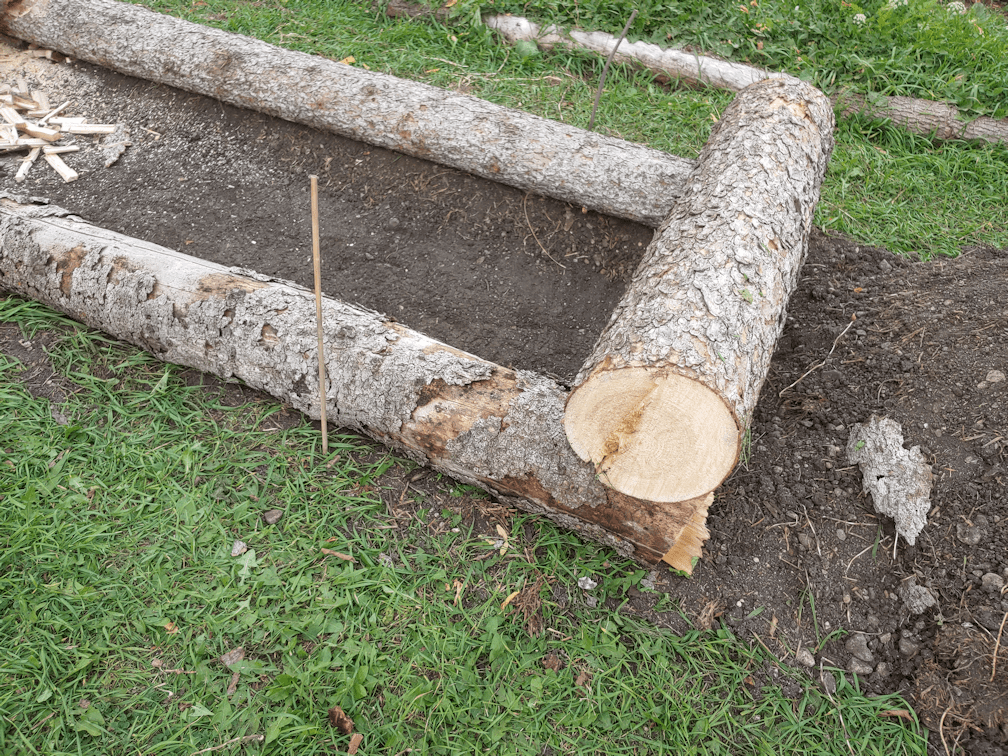
The bottom got prepared a bit, first. I straightened out the edges and shoveled out some more soil, then used a thatching rake on the bottom. I eye-balled four feet across and raked up the edges where the logs would go. Then I got two nine foot lengths in. The first one was placed right where I wanted it to go (that’s the one on the right), then placed the two sticks against it. From the sticks, I measured four feet and placed two more sticks, then rolled the second log up against the second pair of sticks.
Once those were in place, I rolled an end piece against them and used their width to judge where to begin cutting. This end piece was the bottom of the trunk, so it had one very uneven end. It was measured and cut at more than four feet to compensate for that. That made it long enough to cut a notch out to fit the logs, rather than cutting right to the edge.
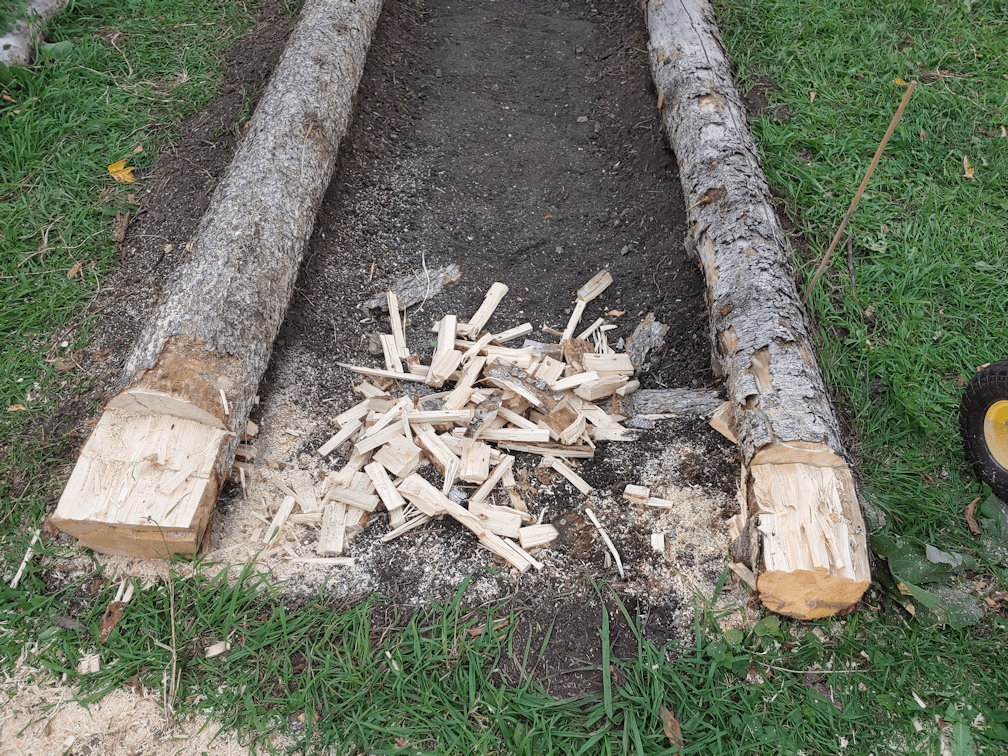
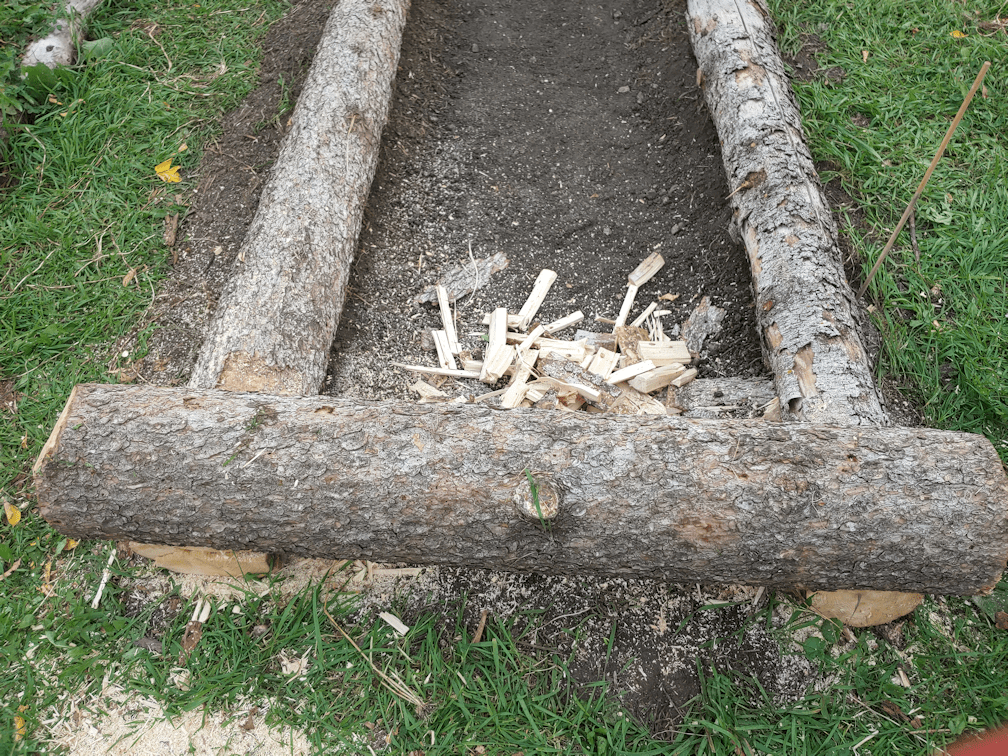
I used the baby chainsaw to cut the outer edges of the notch, then made a cut lengthwise. I then spent the next while using a hammer and chisel, sometimes a hatchet, to cut out excess wood, which you can see inside the bed. After most of the wood was chiselled out, I use the baby chainsaw to cut into the remaining excess wood, as you can see above.
Then I kept running it over the area to level it more. I wasn’t after perfection, here, and don’t have the tools to do a better job, so this was as good as it was going to get!
It didn’t take long for me to drain the battery on the baby chainsaw and have to switch to the second one
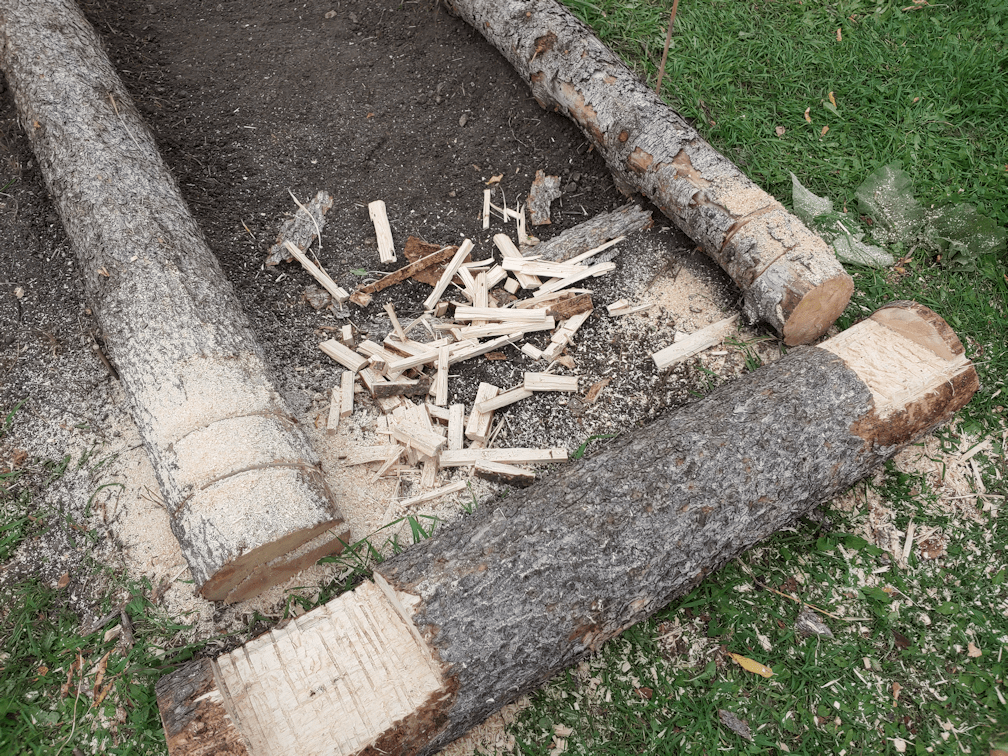
When I started working on the other end, I made plenty of cuts to make chiseling the excess out, easier!
I got it to this point with the chisel before going at it with the baby chainsaw to level it off some more.
Then I got a daughter to help me place it on the logs, so I could use it to mark were to cut wood out of the ends.
By the time I finished making cuts to depth, I drained the second battery. That’s okay. It was enough to get started, and since I was removing wood to the edge, it would be easier to take off the excess with a chisel than with the notches.
Right?
Ha! Of course not.
Both logs had knots in them. One of them had two.
Those were a real pain in the butt to work through with nothing but a chisel or a hatchet to cut through them!
On the plus side, working on this took enough time that the first battery was almost fully charged again, so I could use the baby chainsaw to finish off the area.
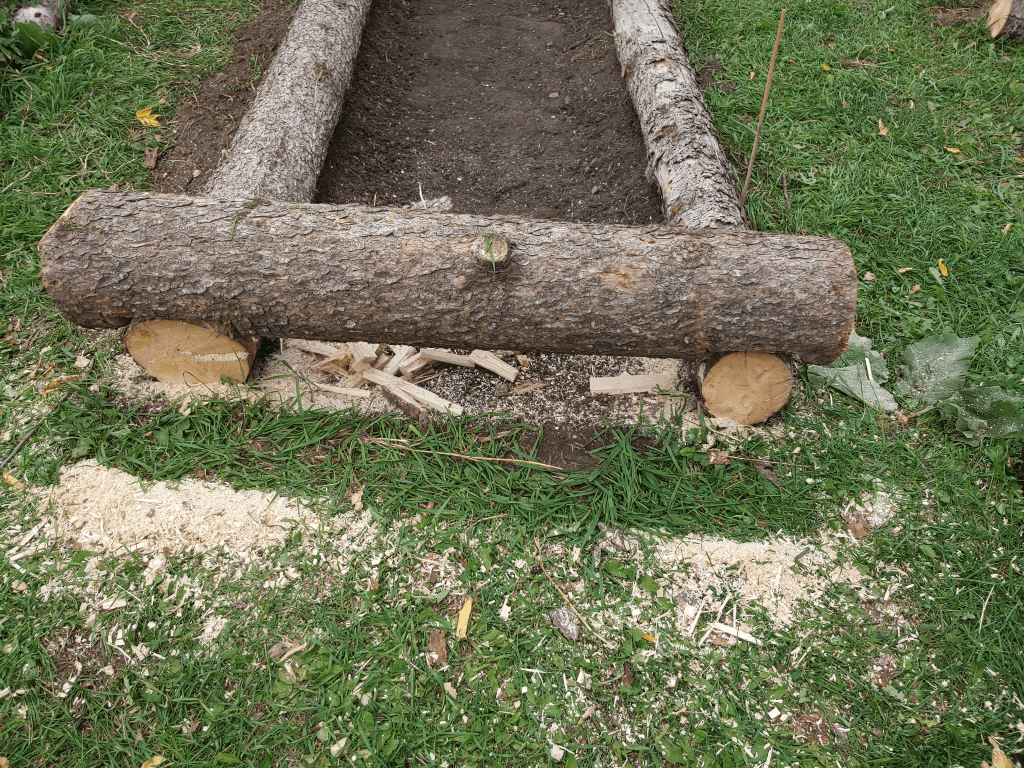
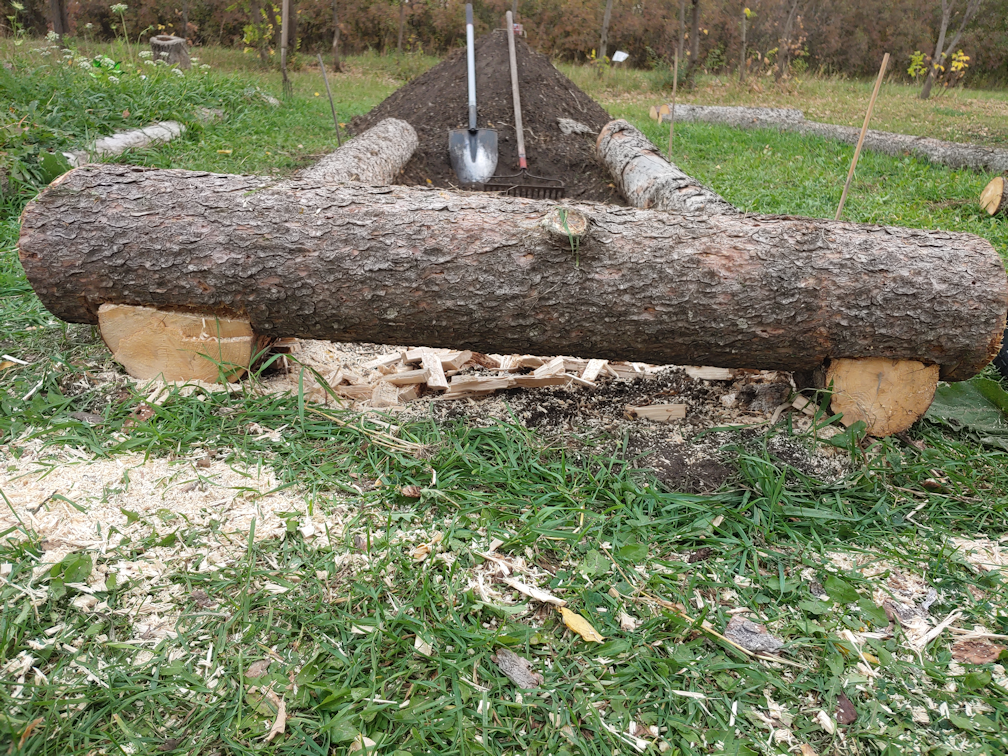
That done, the end piece could be set in place.
As you can see, there is quite a bit of a gap under the end piece. This is not a concern, as the bottom of the bed will be filled with logs. It will be an easy matter to find a piece that can be fit under that cross piece.
The good thing is, all those bits of wood I’m cutting out will not go to waste, as they will be buried with the old logs. We’ll have things decomposing at different rates, all of which will release their nutrients slowly over time while the wood will act like a sponge, reducing the need for watering.
By this time, we started to get a bit of rain, so I stopped for the day. The girls finished raking and headed in to make supper while I prepped to continue later.
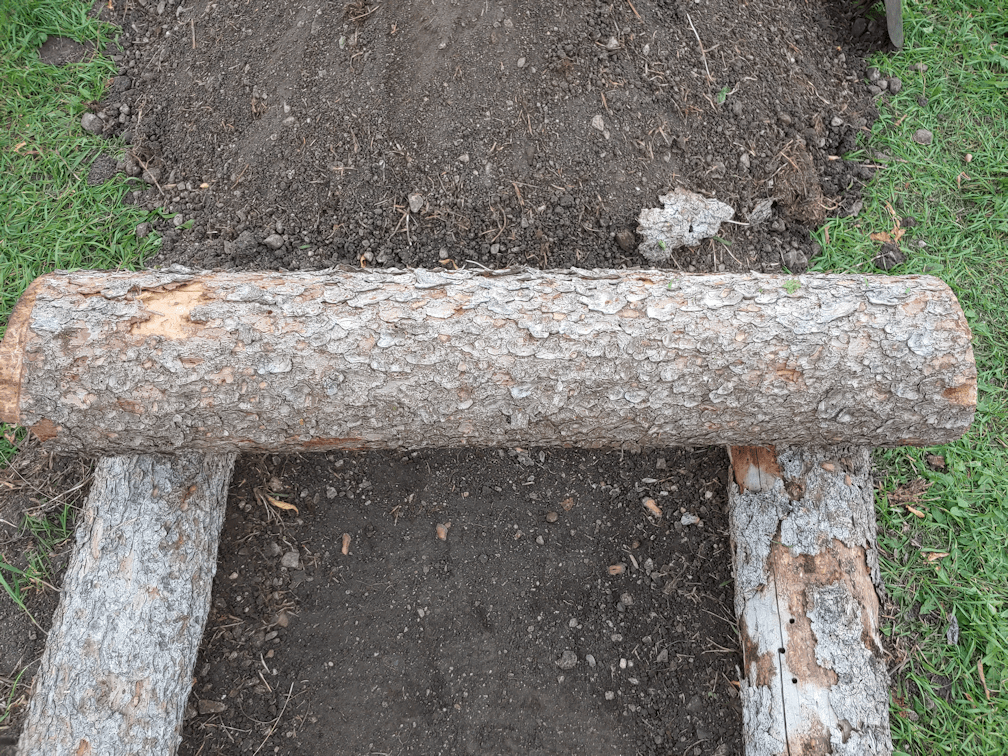
I chose a second cross piece that was close in size to the one at the opposite end. As before, I will use the other logs to see where to make the cut outs. Hopefully, I’ll be able to continue on this tomorrow. It depends on whether or not my mother will need me to drive her around or not.
This would go a lot faster if I had a full sized chain saw. :-D Ah, well. We use the tools we have!
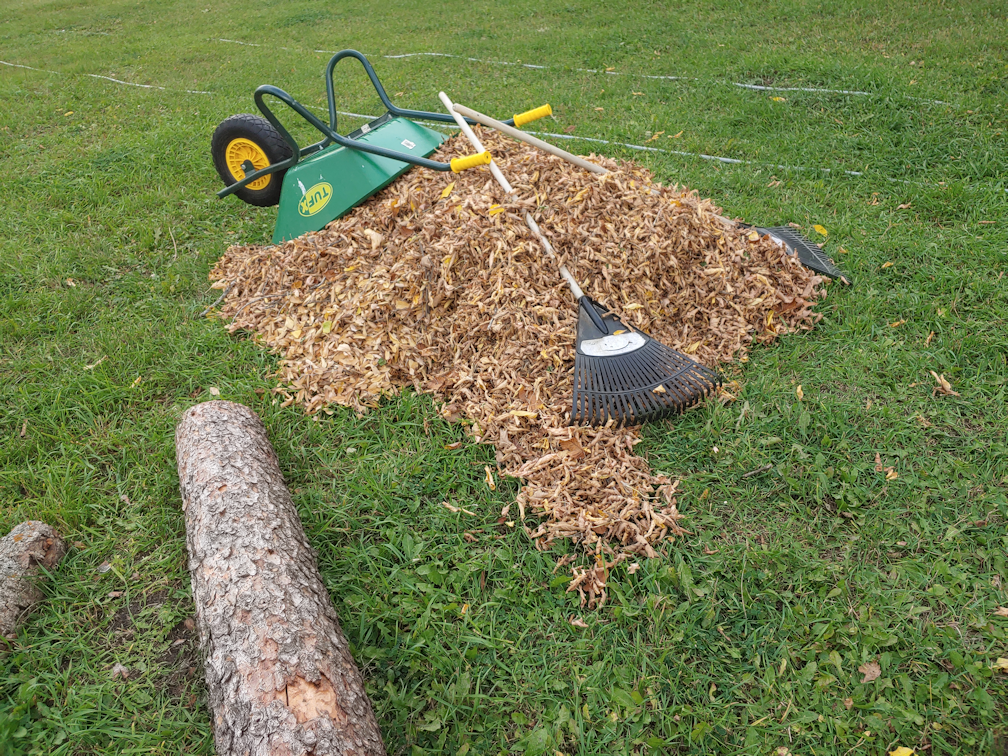
Meanwhile, I now have a nice pile of leaves to use when it’s time to start layering on top of the logs that will go on the bottom of the new raised bed! It’s been pretty windy, but hopefully they won’t blow away. ;-)
I’m glad we have found a way to make use of all those dead spruces we need to take down!
Before I headed out this morning, I took the time to pick tomatoes.
It’s October 7, and we still have tomatoes!
I probably could have picked more beans, too, but I didn’t have time before I had to head out.
Those little Spoon tomatoes are the most adorable things ever! They almost make me like tomatoes.
Well. No. Not really. I just like growing them. I don’t think that really counts. Thankfully, I have others in the household the household that like to eat tomatoes. :-D
Our glorious weather isn’t going to stick around, and we’ve got garlic ordered, so I wanted to make sure we had at least one prepared bed for them.
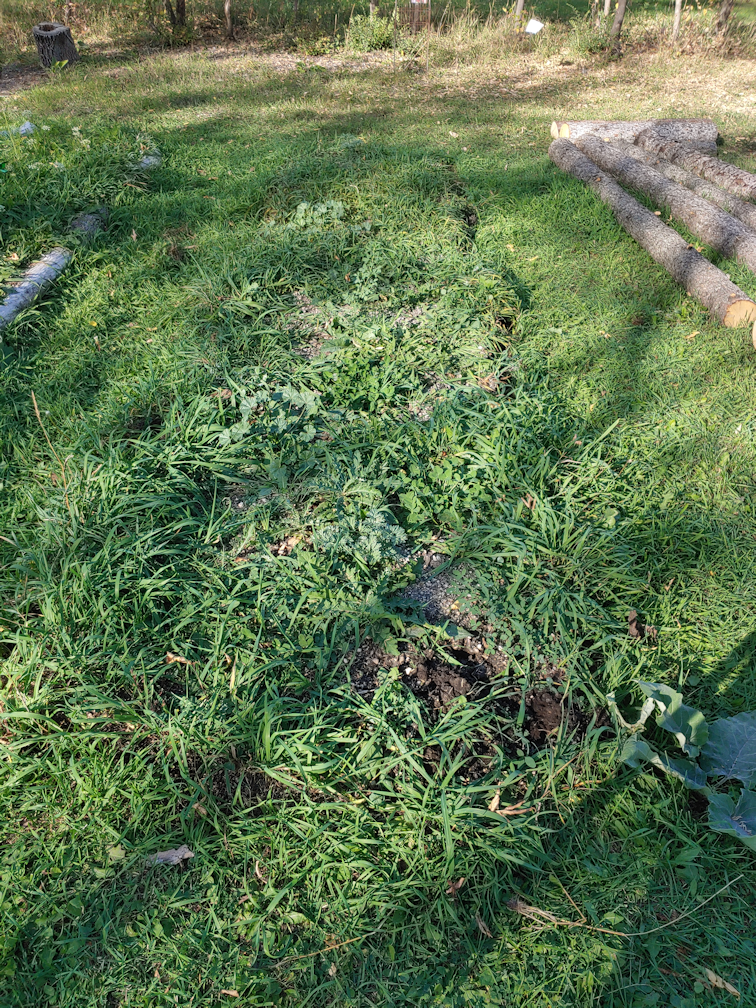
This is the empty bed that had yellow onion and shallot sets in it. It was also supposed to have purple kohlrabi, but that never grew. We were planning to rotate our garlic to a different location that did not have alliums in it, but this bed is going to be so drastically changed, it shouldn’t matter.
Also, in the foreground, in the right hand corner, is a single onion that got missed! :-D
The first order of business was to move out the bits and pieces of logs framing the bed.
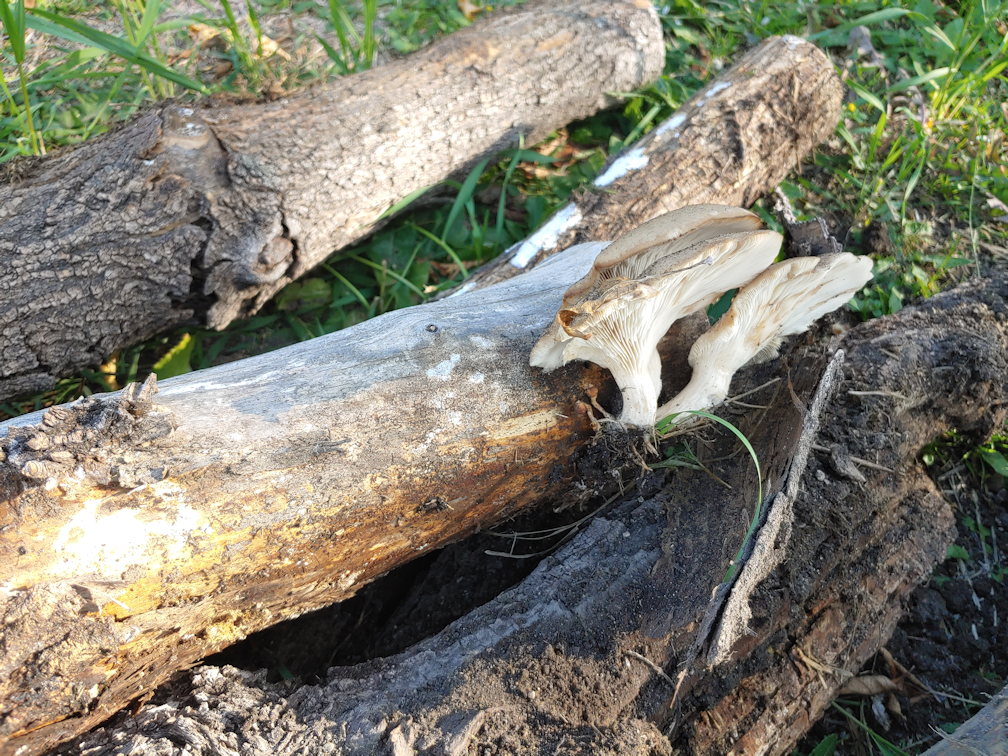
One of them had mushrooms attached! :-D
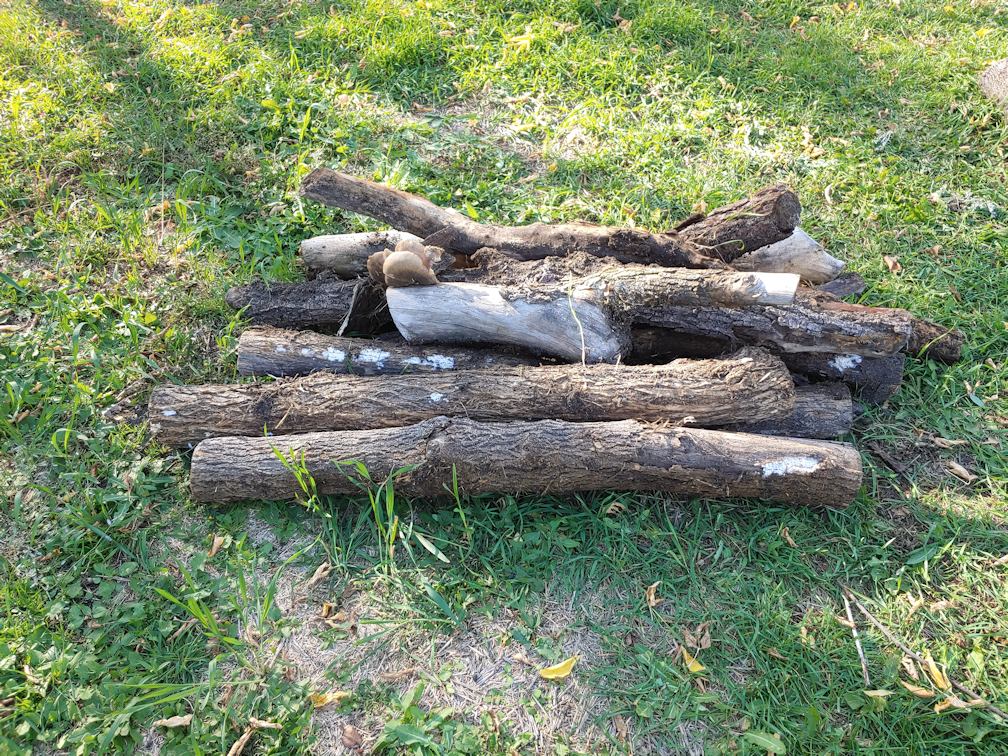
These are all the logs that were framing the bed. They will be buried at the bottom of the high raised bed. These are already starting to rot, which will be a good thing for our modified hügelkultur method of filling the bed.
Also, my spell check has hügelkultur in it!
This bed is so overgrown, you can hardly tell all those logs were removed!
Next began the tedious process of loosening the soil and pulling all the crab grass and weeds out by the roots and rhizomes.
Mostly crab grass.
When we built this bed in the spring, we extended what had been a shorter potato bed, using the Ruth Stout method, the previous year. Basically, potatoes were laid out on the ground and buried under straw mulch. After the potatoes were harvested, the straw was worked into the soil a bit. For the added portion, we just laid down more straw over the grass, as well as the previous year’s bed, then topped it with new garden soil.
There’s a reason we did it that way.
This is as deep as I could get the garden fork into the soil. About half the length of the tines. After that, I was hitting rocks. I’d shift the fork a few inches, and hit more rocks. Shift, hit rocks. Shift, hit rocks. It was insane!
Along with the onion that got missed, I found a shallot, too!
They got set aside on the chicken wire cover over the chard to cure. :-D
I pulled as many weeds by the roots as I could, but there’s no way I got all of them. The wheelbarrow is mostly crab grass, so this is not something that will go into our compost pile. I dumped it by the edge of the spruce grove, instead.
The high raised beds will be 9 feet long, and this bed is about 14-15 feet long. Originally, I wanted to keep them long like this, but we also want to be able to cover them, and at that length, the covers are very unwieldy. By going shorter, we can potentially add a second row of beds. I had to decide. Should we build the high raised bed at the south end, leaving room for a second row on the north, or start it at the north end, with a potential second row on the south side?
In the end, I decided to build the bed on the south end. It was the shade that decided it for me. If we were to make a second row of beds further south, they would be more shaded by the trees between the garden and the house. If we add a second row on the north side, they will be closer to the short row of trees my mother allowed to self seed among what had been her raspberry patch, but I want to get rid of those trees, as they are causing problems. If nothing else, they won’t be shading any new beds that are closer to them.
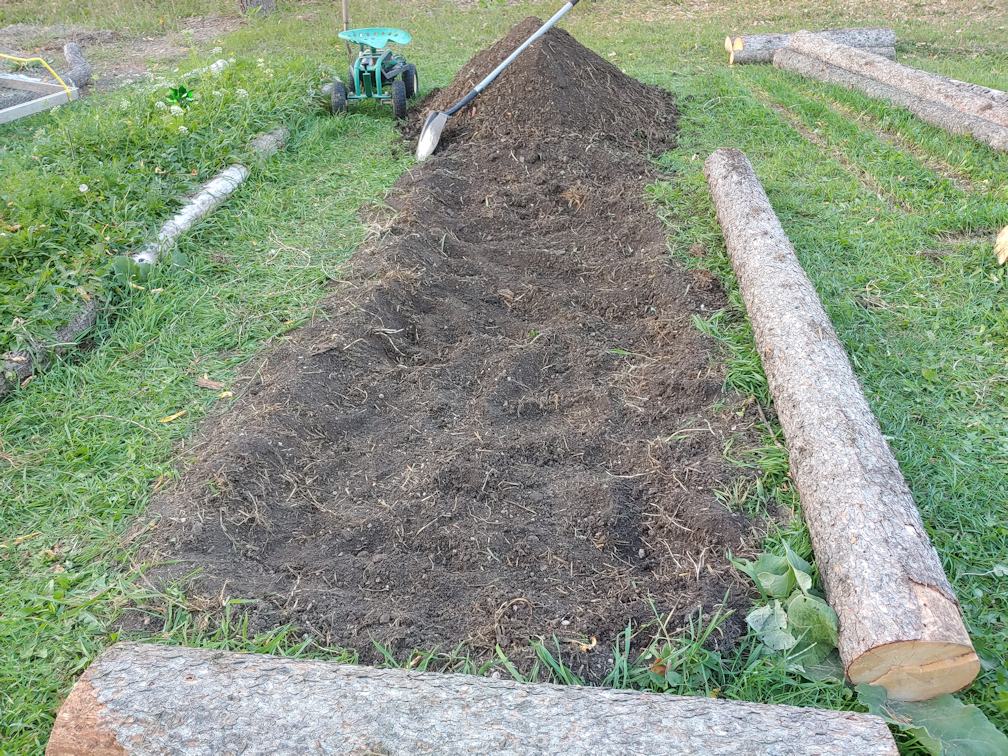
That decided, it was time to start digging!
I dragged over a couple of logs to use as a guide, then started removing the loose soil and piling it on the end that will not be part of the bed, pausing to remove more roots and rocks every now and then. I was happy to see how much the straw had broken down – and by how many worms I was finding!
This is it for the day!
I dug down only as far as the rocks, so it’s not very deep. Mostly, I just removed the straw and soil layer we made in the spring, and maybe a couple of inches lower.
The next step will be to level this off and straighten the edges for the logs. I cut the logs a bit longer than 9′ and 4′, to give room to trim the ends straight, but I may not even bother with that. As long as the beds themselves measure no more than 4′ wide on the outside, we’re good. I don’t care if there are bits that stick out a bit further at the corners.
I want to get this bed at least 2 logs high before I start putting the layer of logs on the bottom down. They’re smaller and lighter, but it’ll be easier to put them into place while the walls are a bit lower. The other layers can be added when the bed it as its full height. When it is 3 logs high, I’ll decided if it needs to be higher or not. Then it’s a matter of filling it with layers and getting it ready to plant garlic in. We might be able to plant all three varieties on one bed.
As much as I enjoy the work, it does help me realise how necessary having high raised beds will be. I don’t know how much longer I will be able to continue doing stuff like this. Weeding the bed was the most difficult and painful part. Thankfully, I was able to sit on the scooter for some of it, which helped, but this old body is breaking down. I can still do big stuff, like cutting and breaking down trees and carrying logs, but I’m loosing my fine motor skills on my hands. I drop things a lot more often, the joints are almost always stiff and sore, and that one finger just doesn’t seem to be getting any better. Then there is the back pain from bending over to weed. I can’t bend at the knees, since my knees are already shot. Strange that I’m losing my ability to do small, easy things faster than doing heavy manual labour!
I can still crochet, though, so that’s good. I whipped up a couple of hats recently, and plan to work on other small projects. The only problem has been choosing what yarn I can work with. My hands are so rough right now, some types of yarn catch on my fingers while I work! LOL Working with my stash of metallic yarns is out of the question, as well as anything the least bit fuzzy. :-D
Hopefully, I will be able to continue working on this raised bed tomorrow, after I’ve headed out to do some errands. We hit 27C/81F today, but tomorrow should be a bit cooler, and we’re expected to get rain – possibly even a thunderstorm – over the next couple of days. Looking at the long term forecast, we’ve got another nice, warm week before things start to cool down, and overnight temperatures may result in frost. It’s not until the end of October that we’re looking at the possibility of snow. Of course, looking that far ahead, things are very likely to change, so we shall see what really happens! Until then, I’ll be taking advantage of the mild weather and doing as much work outside as I can!
This morning, I went through all the sweet corn blocks and harvested anything the looked like it might have a few kernels on it. :-D
I can’t remember which variety I’d planted in each block, but you can really tell the difference in them! I’d started with the southernmost block, which almost filled my giant colander. The husks with so much red in them are from the middle block. Most of that one had split husks with green or dried out kernels visible, so there were not a lot to pick. The teeniest cobs were the largest ones I found in the northernmost block.
These are the husked corn from that northernmost block. I’m honestly surprised by how many developed kernels there are on them. They are the tiniest of cobs, and yet they are still edible!
These are from the centre block. Their darker colour has more to do with that fact that these where the first to develop cobs and are past their peak eating stage. I actually enjoy corn at this stage; there is a toothiness to them that I like, and the flavour is more “corn” than “surgar”. A lot of the cobs had a whole side that did not get pollinated, so as the pollinated kernels formed, the cobs formed a curved shape.
The southernmost block where the last to mature, and these are actually at their peak. In fact, some of the cobs I picked turned out to still be way too under ripe, and went straight into the compost pile. Even as I shucked them, I had to be careful as the kernels were so tender and juicy, if I accidentally scraped a fingernail over them, they’d practically burst!
While I joke about this being such a sad little harvest, I’m actually really happy. They are tiny, poorly pollinated, and there are so few of them, but we actually have corn to pick! I honestly was not expecting any in these blocks. Thankfully, we have not had any frost yet, and our temperatures have remained mild, if not downright hot at times. If not for these weather conditions, we would have had none at all. I’d be pulling everything up for compost.
Instead, I had sweet, buttered corn for breakfast!
If you’re on Facebook, you know how they pop things into your news feed that you posted, X number of years ago today?
Yesterday, I saw one of those, with a photo I posted, three years ago.
After a snowfall.
Not only have we blown past our average first frost date of Sept. 10, but we are at a point where it is not at all unusual to have snow on the ground. Nothing that lasts, really, but usually at least one storm.
I am so loving our extended summer. Especially with how it’s giving our garden so much more time to recover from the extreme heat and drought conditions of the summer.
This morning, I found new Ozark Nest Egg flowers, both male and female! I hand pollinated some other ones, but it’s too early to tell if it works. I went ahead and hand pollinated the female flower here, too.
While looking through the Ozark Nest Egg plants, I found a single flower from the Thai Bottle Gourd that has made its way up the fence, mixed in with the Nest Egg gourds! I’ve only seen male flowers on this one, though.
Remember that carrot bed the groundhogs kept decimating, over and over? The one we finally gave up on, other than watering it now and again? Half of it, where the Kyoto Reds are planted, has carrots gone to see, pushing their way up through the weeds. The other variety, Napoli, have fronds visible among the weeds, but none are going to seed.
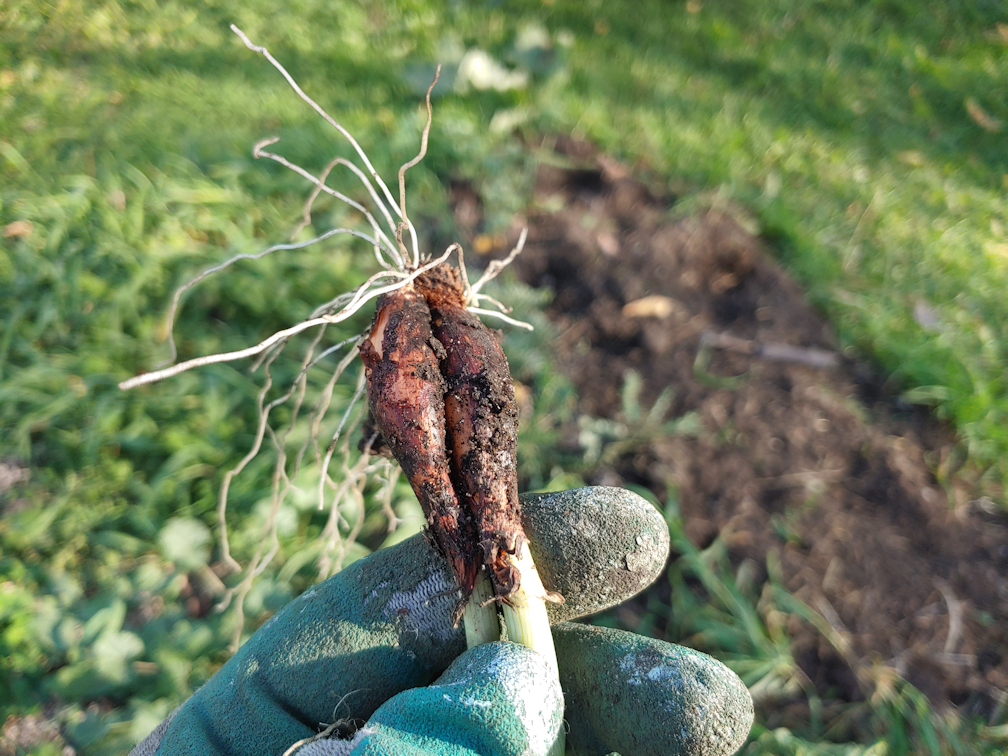
I watered the gardens this morning and, out of curiosity, pulled up some Napoli carrots. I was really surprised by how big they were! After having their greens eaten away several times, It’s amazing that there are any at all, never mind anything of a decent size! That had me looking around among the Kyoto Reds for carrots that had not gone to seed, and I found a surprisingly large one there, too!
The squash tunnel thermometer is definitely whack. We might be at 30C/86F as I write this, but it was only about 22C/72F at the time I took this photo.
While watering the peas among the corn, I couldn’t help but notice the corn block that is the furthest south.
We actually have corn. This block as lots of cobs developing!
They are very small – the husks make them look like there is more than there really is – and poorly pollinated, but we actually have corn. I went ahead and ate the one I picked, right after taking this photo, and it was tender, sweet and delicious. I will have to go back later today, with a container of some kind, and pick more!
Once back inside, I started up a big chili in the crock pot. It’s got our own onions, garlic, carrots and bush beans in it, as well as both ground beef and the ground pork we got from our neighbour. Oh, and I also tossed in some Spoon tomatoes we’d tucked into the freezer. In the future, I plan to grow beans for drying, so some day we will be making chili with our own dry beans, too, along with the paste tomatoes we plant to grow and can. :-)
With a goal of being as self sufficient as possible when it comes to growing our own food, this year has shown just how touch and go that can be. We had a very warm May that had all sorts of things starting to bloom, only to get a single cold night that killed all the flowers off. Because of that one night, we have no crab apples, no saskatoons, no chokecherries, and it killed off the (expensive!) mulberry bush we’d transplanted. Even the lilacs and roses got damaged by that one night. Then we had the drought conditions that had us watering every day, twice a day, for so long. And now we’ve got an extended summer, and instead of frost and snow, parts of our garden are able to recover and start or continue producing! It’s been a crazy gardening year, but as much as I shake my head over how extreme conditions have been, the reality is, this isn’t actually all that unusual. As every farmer, gardener or homesteader knows, you could have the best year of all, only to have all your hard work wiped out by a single storm, or one unusually cold night. Or you could get a terrible spring and summer, but then get a great fall and winter. Some years, you might not get any real summer at all, and in others, the winter will be as mild as any fall or spring. As fantastic as it can be, to be able to grow your own food and preserve it for use in the off season, I’m just as thankful that we have grocery stores and imported food. I think both are good! As my brother and his wife have both said, if they had to rely on their garden, they’d starve!
One last garden update to post, interrupted by having to make a run to the post office to pick up a package before they closed! :-D
With the kittens mashing down the netting on two of the beds in the old kitchen garden, I finally gave in and removed the mesh completely.
With the beets along the retaining wall, there isn’t much we can do about them anymore. If the deer eat them, it’ll be no more of a loss than it already is. I’ll be cleaning that bed up for the winter soon, and if there are any beets to harvest in there, that’s just bonus. The L shaped beet bed, however, will remain covered. The kittens haven’t been going after that one, and they are doing well enough that we don’t want the deer to eat them.
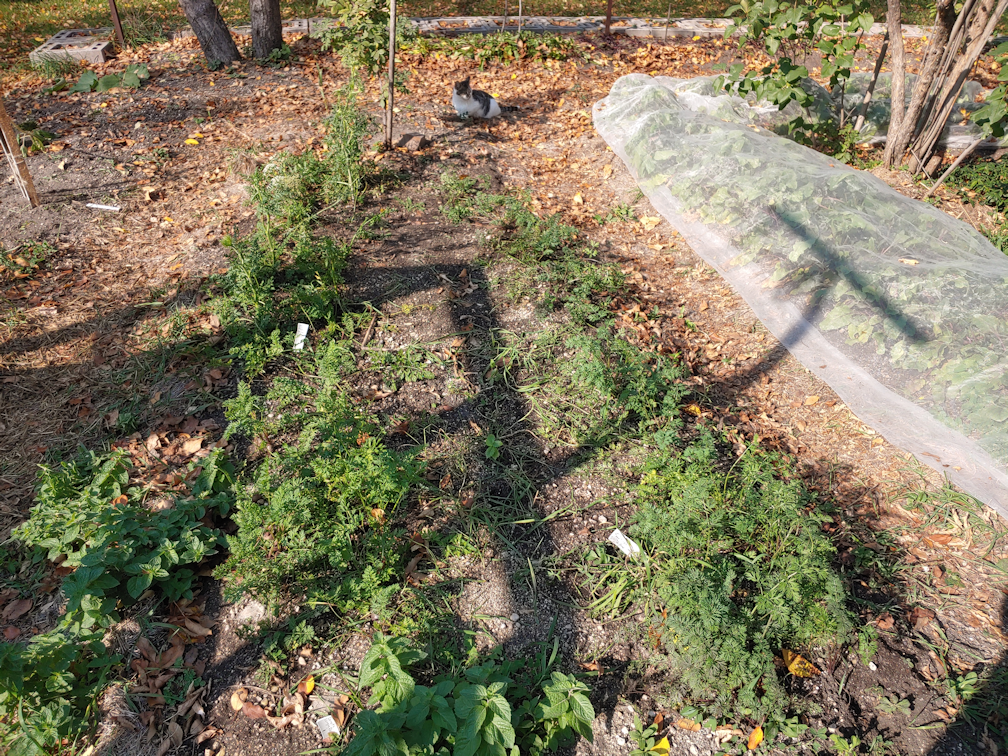
After removing the hoops and netting from the carrot bed, I found my first surprise. I did not plant this bed. My older daughter did. Two types of carrots, with kohlrabi down the middle.
Well, nothing came of the kohlrabi – I finally decided the big leafy plants that did show up were a weed of some kind, as I found them growing in other areas where kohlrabi has never been planted.
What I did notice is that there are three carrot labels, not two. Which I sort of noticed before, when I weeded the bed and added the hoops, but for some reason, never stopped to actually read the label. Along with the Deep Purple and Lounge Rouge Sang, there are Kyoto Red! If you look at the photo, towards the far end of the bed, you can see carrots that have gone to seed. Those are the Kyoto Red. Like the ones planted in the main garden bed, after the groundhogs ate the greens, they got tricked into acting as if they were in their second year and started to develop seed heads. The other two varieties didn’t.
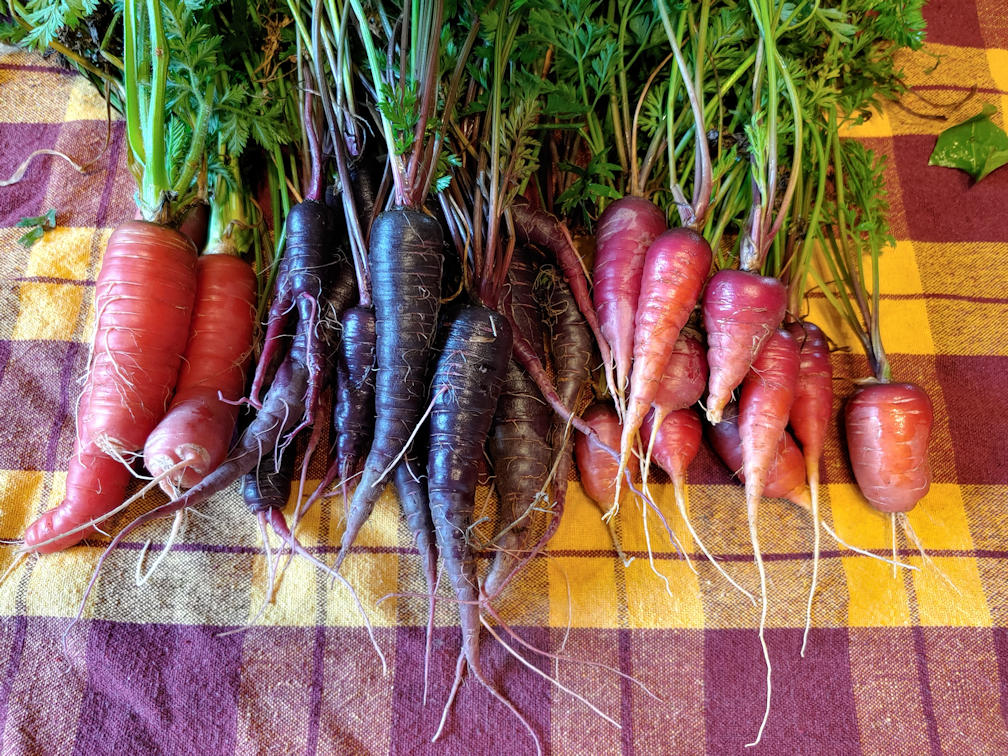
This morning, I decided to pick some, and ended up up quite a few. The ones on the far left are the Kyoto Reds. There were very few that haven’t gone to seed, so I only got a couple of them. The purple ones are obvious the Deep Purple variety, but when I’d picked from that bed before, they were not this dark purple, and I thought they were the Lounge Sang Rouge!! I hadn’t picked any from the other row, as they did not need any thinning.
Which means we got to try two new varieties of carrots today! My daughter decided to use up the summer squash we had in the fridge and make a soup, and she included a few carrots as well. After they were sliced up, we tried each of them. The Kyoto Red, unfortunately, was bitter. They may not have been going to seed, but tasted like they were ready to. The other two tasted fairly similar. We’ve had the Deep Purple before, and they tasted much the same as I remember from last year. The Lounge Sang Rouge seemed to be a bit sweeter.
When cut, the Kyoto Red was that deep reddish-orange colour, all the way through. The Deep Purple carrots were purple with a pale orange, almost yellow, ring inside. The Lounge Sang Rouge was a solid pale orange.
After picking the carrots, I used the rain barrel to water the old kitchen garden, then went on to water the loan beet bed that we made in the spring, next to where the fall garlic beds. This bed was planted with Merlin beets, only. That bed is covered with netting, too, tacked down on the long sides with tent pegs, and the excess netting on the ends rapped around boards to weigh them down. After watering it, I decided to lift the boards at the ends to see how the beets looked.
I ended up picking a couple from each end!
I should have held these differently; there was one quite large beet, but it’s underneath. It’s about the size of the other three, all together!
I’m rather pleased with these – and I know there are larger beets in the middle, from when I last tended it. I’d found a groundhog had managed to squeeze it’s way under the netting, when it was only weighted down with rocks and bricks.
We don’t plan to harvest the beets for a while; possibly not until after first frost. When we do, however, we should have enough to make it worth doing some canning!
Aside from the deer and the groundhogs wanting to eat them, beets have been among our most successful vegetables. We planted a LOT of beets this year, which we may not do next year, but I’m sure we will plant them again. We’ll just have to decide on what varieties we want, and if we want to try some new ones.
And that’s it for our fall garden update! The other parts of the garden were pretty much unchanged, so there’s nothing to really say about them. :-)
I am so incredibly grateful that our growing season has been extended this year, and am glad our drought and critter ravaged garden has had a chance to recover and continue to produce as much as it has!
The Crespo squash has turned out to be another one of our surprises. They are another of our “fun” choices; a Peruvian variety of pumpkin that gets large, green and warty.
I couldn’t resist.
They seemed to thrive in our climate (there was no zone information with the seeds), and were doing so well until they got repeatedly eaten! I thought for sure they were done for, and was already looking ahead to how we could protect them as we tried them again next year. I hadn’t planted many seeds, so we do still have some left over.
But now we have our mild October, and have had no frost at all, and the Crespo squash is recovering to an amazing extent!
Some of the colder overnight temperatures have done a bit of damage to the leaves, but look at those flowers – both male and female!
I actually had to rescue the one in the foreground; the flower was half way through the mesh. :-D
There are little squashes like this, being held high on their vines, all over the place.
Hopefully, we have enough active pollinators, because with the barriers to keep the deer out, there is no way to be able to get in and try hand pollinating them.
Some newer squash are looking bigger, and appear to have been successfully pollinated.
The very first squash that we found, way in the middle of the two plants, did end up withering away and dropping off, but these two that developed next are getting bigger and look like they are going to make it.
At least until we do get our first frost.
These are supposed to get quite large, but I don’t know how fast the fruit will grow, once they get doing. Well they have enough time to fully mature?






















 The Re-Farmer