This year, I joined a number of gardening groups on social media. Either local groups or cold climate/zone 3 gardening groups. It’s pretty cool to see how many first time gardeners have been joining the groups and asking all sorts of questions.
This is the time of year for planting hard neck garlic, as we did yesterday, and there is a LOT of discussion on these groups right now, and people are sharing some really good links.
One really good video I saw shared was uploaded just yesterday, and it give a lot of good information. I think you’ll enjoy it, too.
He talks about hard neck garlic, soft neck garlic, seed garlic and even using store bought garlic, too.
I didn’t realize Elephant garlic isn’t actually garlic!
He talks about lots more, including harvesting “wet garlic”, which was something I wondered about when checking our own garlic last year.
Among the most discussed things I’ve been seeing in the gardening groups has been how deep to plant the cloves. There is a LOT of differing, even conflicting, advice. The thing is, the conflicting advice isn’t necessarily wrong. There can be quite a bit of variance, based on climate zones. For those in zone three, like myself, this was an excellent link that was shared. I also found this video, specific to planting garlic in zone 3.
I found it interesting that he says to leave the curing garlic out in the rain!
For those who aren’t necessarily in colder climates, here’s a video from MI Gardener (published September, 2018)
A lot of gardeners on my groups get seeds from MI Gardener, too, and are very happy with what they get.
There is a lot of information and advice out there, but if you can’t follow all of it, you know what? You can still get good garlic! We didn’t plant our cloves as deep as recommended for out zone, yet they survived the Polar Vortex just fine. We don’t have compost or manure to add, and we still got decent sized bulbs. That’s one of the beauties of gardening. You can do all sorts of things “wrong”, and chances are, you’ll still get decent results. What works in your own specific garden may also be quite different from what works in other places, too, so it will always be a learning experience.
Which is half the fun of the whole thing!
For those reading, do you have other things you plant in the fall? I’ve read about a number of vegetables that can be seeded in the fall, and plan to try it in the future, as we get our garden more established. If you plant garlic, do you plant hard or soft neck varieties? What works for you?
While I was working on the garlic, my daughter did a whole bunch of clean up!
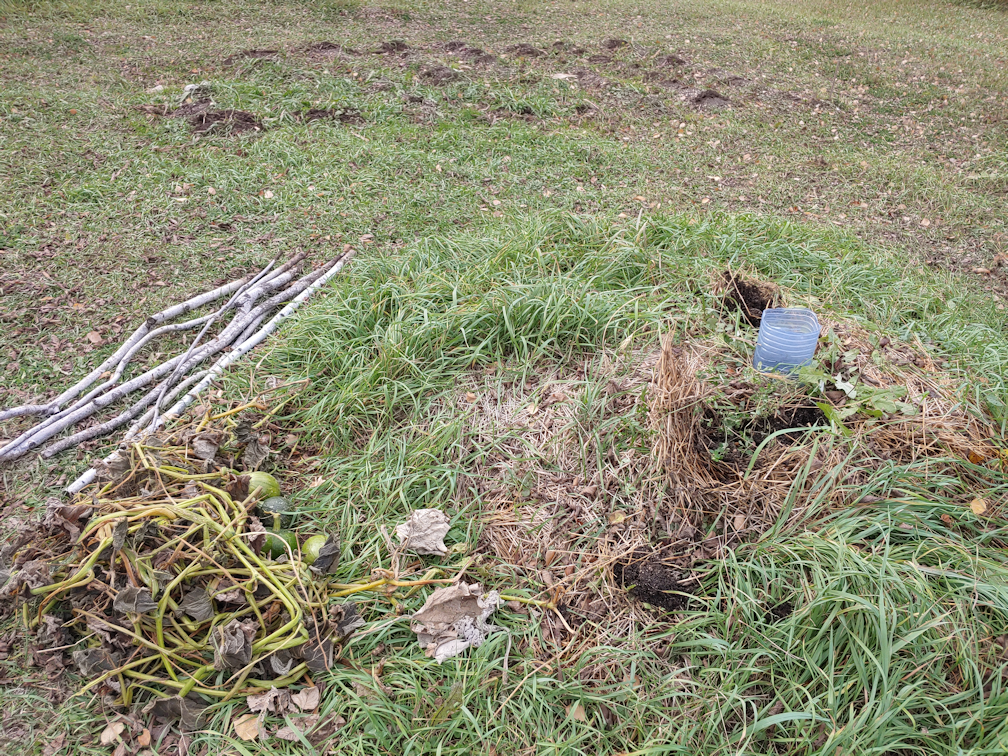
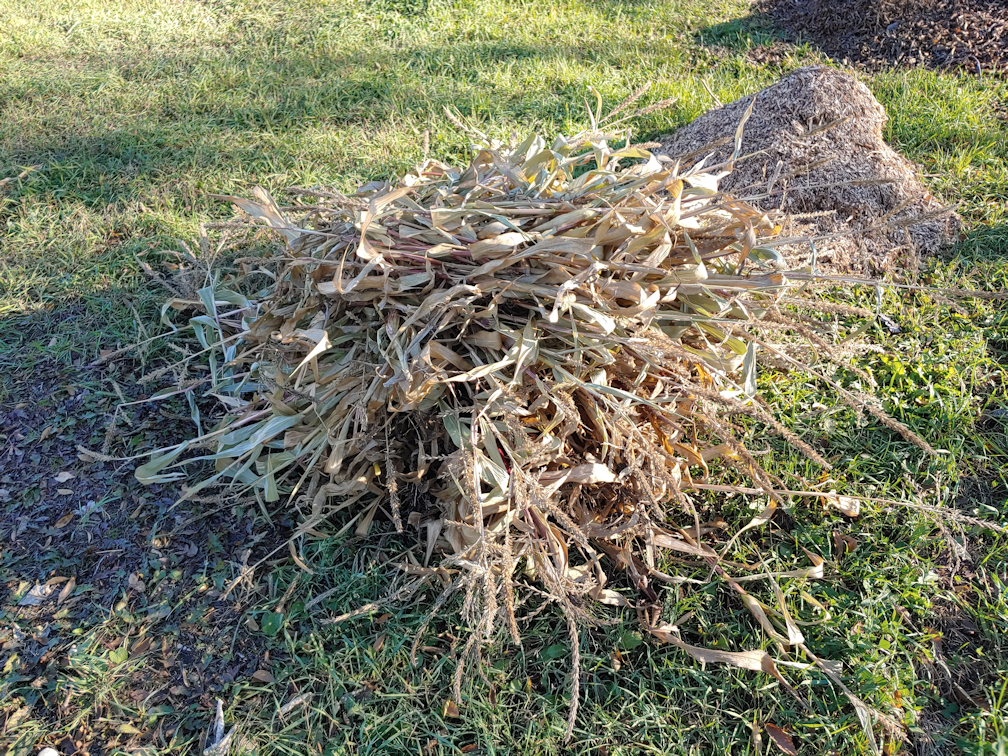
She pulled the Dorinny corn stalks that were next to the squash tunnel, then pulled all the squash, gourds and melon. Aside from the sunflowers, which we will be leaving for the deer to nibble on in the winter, we just need to weed and prep the beds that will be used next year, and put away things like the bin we keep tools and supplies in, empty the rain barrel and put it away for the winter, and take down the last of the critter barriers.
Then she pulled all the purple corn stalks, removed the three layers of barriers we had around the Crespo squash, and pulled those, too. I’m not sure what I’ll be doing with the corn block. There’s some very good soil there. It would be good to plant some sort of legume there, next year, to replace the nitrogen the corn used up. As for the squash hill, that’s something else I’m not sure what do do with. When we plant squash again next year, I want it to all be on the other side of the main beds, where they get more hours of sunlight.
What a sad sight. The Crespo squash had recovered so well from the critter damage! I definitely will be trying these again – with critter barriers, right from the start!
Once I finished with the last garlic bed, I pulled the frozen chard and the remaining radishes we’d hope to grow for pods.
All those radishes we planted, and these are the only ones that survived the grasshoppers!
It’s a shame we don’t have chickens. They would have loved all the greens we pulled today! Not that they will go to waste. They will get buried in the beds as we prepare them for next year. There are still four more beds in the main garden area, including the one with lettuce still in it, to clean up. The lettuce is handling the overnight cold very well, but they have become very bitter tasting, so they will be pulled. Of course, there is still the high raised bed to work on.
I had company while I worked on the garlic. The cats do like the high raised bed. I’m sure the wood is much warmer on their toes than the ground. :-)
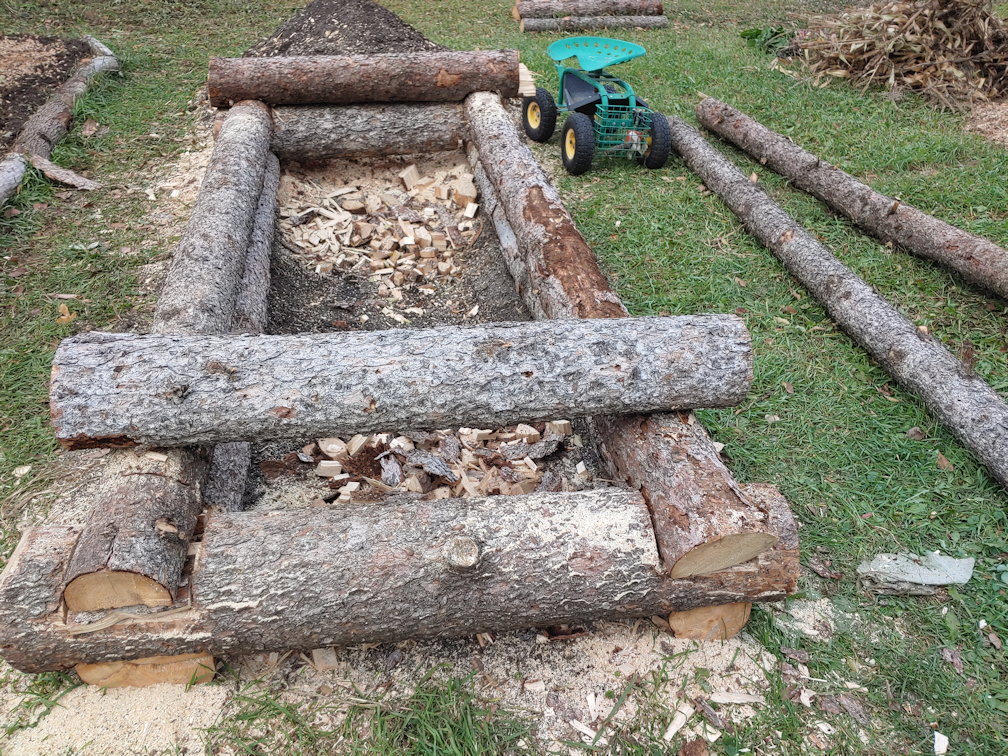
My daughter was able to help with the high raised bed this time. She finished making the notches on the next end piece, in the background, while I cut another 9′ side piece from the last tree we cut down. She does not like using the baby chainsaw, and much prefers a hammer and chisel, so I started on the notches on the end piece in the foreground, until the second battery on the baby chainsaw ran out. By then, it was starting to get dark, so my daughter finished up the end piece she was working on and we called it a day. You can’t see the cuts I made on the end piece in the foreground, as I rolled the log onto them. They make it less likely to roll around, should the cats decide to climb all over it again.
The side pieces that are waiting are from higher up in the tree trunk, and quite a bit thinner than the other logs. Almost too thin. Since we will probably make this bed four logs high, I am thinking I should wait until I have thicker logs to use, and save the narrower ones for the top row. The tree that’s still stuck on the branches would give me logs that are just the right size – if we could get it the rest of the way down! :-D It’s either that, or find another dead tree to cut down. The problem with that is, most of the trees that need to be cut down are all really huge. They might be too big!
As glad as I am to have so many dead trees available that are still solid enough for this project, I’m a bit sorry to be using them. These are the trees we intended to use for the walls of the cordwood shed we plan to build as an outdoor bathroom. It’s possible, however, that we will be able to get a load of cast-off electricity poles. These are the remains of poles that broke in storms or had to be replaced for some reason, and we’re on the mailing list with the electric company. They don’t come available often, and not always in our area, but these are cedar poles and would be much better to use for cordwood walls than spruce. So maybe it’s for the better, that the dead spruces are being used to build high raised bed gardens!
When it became clear we would be using our low raised beds to plant the garlic when it came in, I thought about how much space the garlic we planted last fall had taken, and thought we might be able to plant all three varieties in one bed. Maybe one and a half.
Boy, was I wrong. :-D
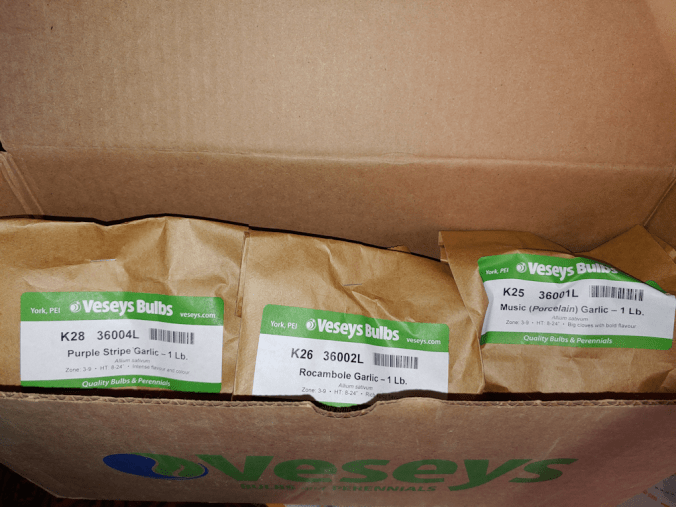
The garlic is sold by weigh so, technically, we got the same amount of seed garlic as we did last year, but when I opened the bags, it just seemed like… more.
It’s a good thing I take pictures and document everything, because I was able to look at last year’s post and compare.
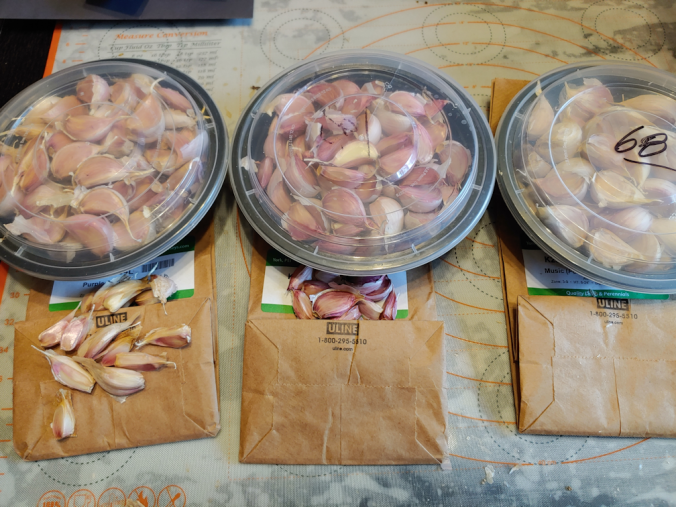
The photo on the left is from last year, the one on the right is the garlic that came in today.
I even just happened to lay them out in the same order! The Purple Stripe is actually less than last year. Seven bulbs instead of eight, but this year’s bulbs were more consistent in size. Last year, we got seven Rocambole, but this year there is nine. The Porcelain Music had eight bulbs last year, and this year there is nine.
Separating hardneck garlic cloves is rather a lot more difficult than the soft neck garlic at the grocery store! :-D
Last year, we planted all the cloves. Even the little ones. The Porcelain Music had fewer cloves per bulb, but they were all large. With the other two, I separated out the little cloves for eating, and kept the larger ones for planting.
Which turns out to have been a good decision!
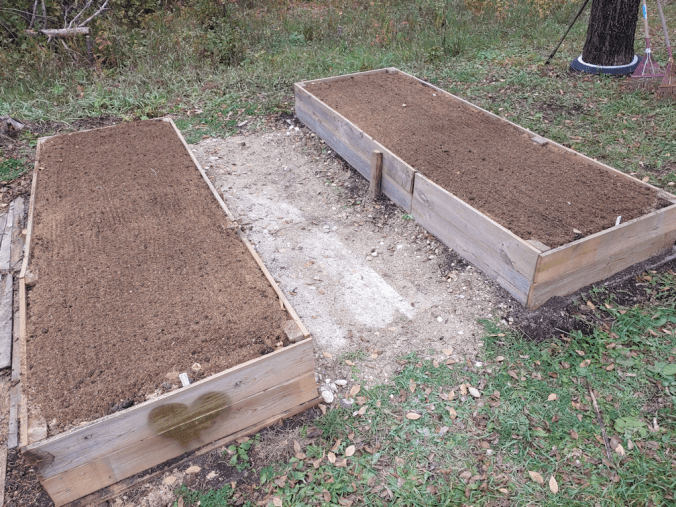
Last year, I planted the cloves at approximately six inches apart, but this time, I actually measured and marked a six in grid. Which was SO much easier now that the bed is raised up higher! Now I’m thinking I must have been closer to four or five inches, when I planted last year. At six inches, I filled one bed almost completely with Purple Stripe. There were maybe three prepared holes that did not get a clove planted in them. Which means this bed has 82 cloves planted.
The second bed got the Rocambole, which actually had more cloves. This bed is just a little bit longer than the first one, which gave me an extra row. I had exactly enough cloves to fit! That gives us 90 Rocambole garlic in that bed.
The third bed here still has beets in it, but thankfully, we finished cleaning up the carrot bed, yesterday.
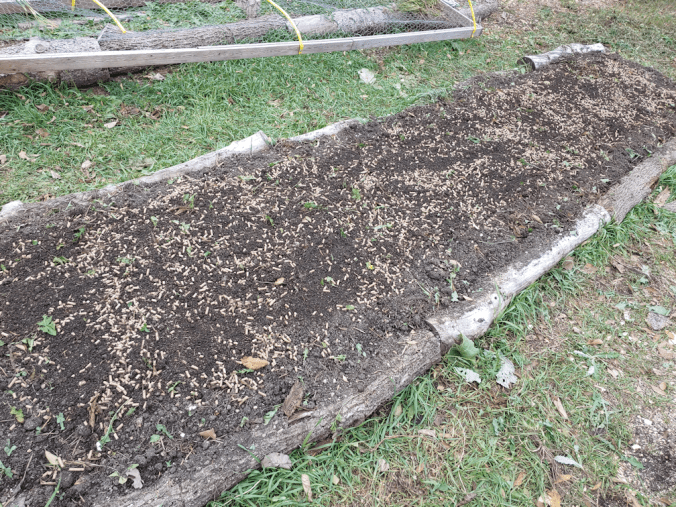
The first thing I did was add half a bag (about 20 pounds) of hardwood pellets and work them into the top couple of inches of soil. Then the bed got watered, so the pellets would start absorbing moisture.
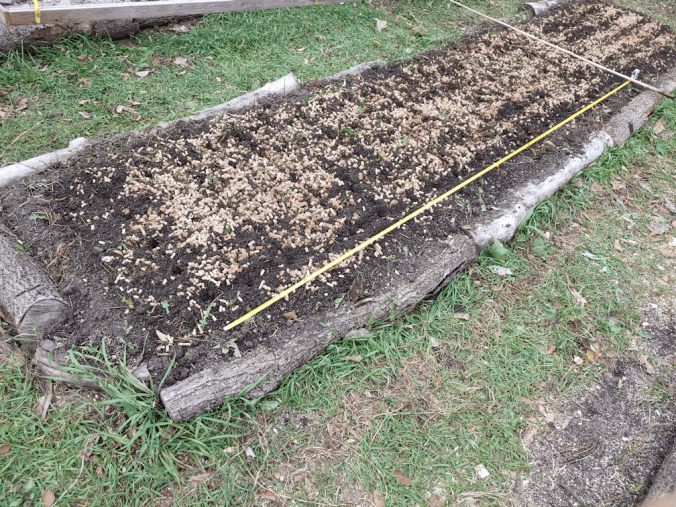
As with the other bed, I marked off a six in grid, though with this bed being so much lower, I did it by dragging a bamboo stake to mark the lines, first, then poking holes in where the intersected. Far less painful doing it that way!
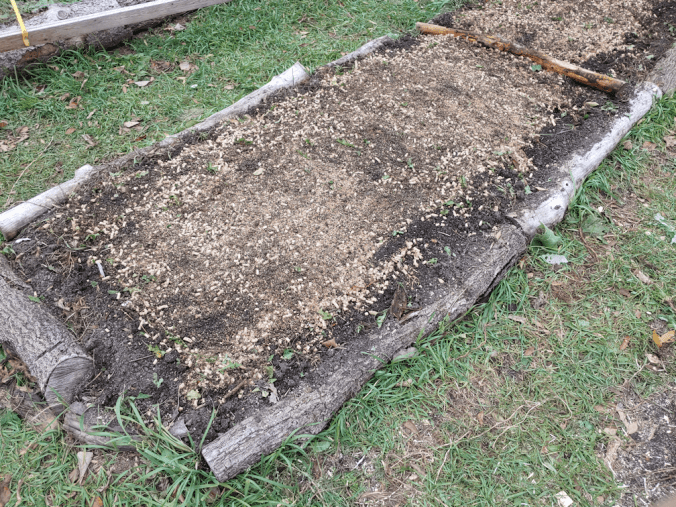
I marked far more than I needed. Having just cleaned this bed out, I know that the edges get invaded by crab grass pretty heavily, so I tried to keep further away from the edges. I marked out 5 rows but, knowing I had fewer cloves with Porcelain Music, I laid the cloves out along four rows, first. I turned out to have exactly enough to fill a 4 x 13 grid, making for 52 cloves.
Which ended up being pretty much exactly half the bed. I placed the piece of wood across to mark how far the garlic is planted, so we know how much space we have when we plant something in the other half in the spring.
While I was working on the third bed, my daughter covered the low raised beds with a grass clipping mulch before moving on to other areas of the garden, then I used grass clippings the last bed. I hope to replace it with straw, when the bale comes in. The mulch has to be removed in the spring, once the overnight temperatures are warm enough. The garlic should be showing through the mulch by then. That is fine with straw, but the grass clippings may be too dense for the garlic to work its way through, so when the straw comes in, I plan to replace the grass clippings with it.
All three beds were finished with a fairly decent watering. Mostly to dampen the mulch than try and soak through it. We are still expected to warm up over the next few days, so this should be enough for now. Later on, as overnight temperatures drop and before the snow comes to say, we’ll cover the beds with plastic.
One thing is for sure. Working with the newly framed low raised beds is SO much better than the ground level beds, even though those ones are technically considered raised beds, too. It was easier to mark out distances, easier to reach the middle, and much MUCH easier on the back. Everything went so much faster because of this, too. I look forward to when all our garden beds are at least this high, or higher!
We had originally intended to double how much garlic we planted this year, but I am glad we decided not to, at the last minute. We would not have had enough beds ready to plant them all, if we had!
It should be interesting to see how these do next year. Not only will be be able to compare with the highly amended low raised beds in the same location as last year, but also the third bed in the main garden area. The low raised beds get full sun (meaning, at least 6 hours), but are shaded longer in the morning by the spruce grow and nearby Chinese elm. The third bed has nothing to shade the morning sun, and is far enough away from the trees by the house that it’s not affected by evening shadows, either.
I made a trip to the post office today and had a lovely surprise.
Our garlic is in!
According to the Canada Post tracker, it wasn’t supposed to arrive for another four days.
We have our garlic, but we still don’t have a straw bale to mulch the bed, so I messaged our renter about it. When we bought from them before, they usually had a bale over right away, so I was wondering.
Sadly, my suspicions were correct. They are having to buy all their hay and straw bales themselves this year. They haven’t got their shipment yet, and don’t even know what to charge me until they pay for it themselves. Yet they’re still willing to part with one for me!
We ended up chatting a bit, and it’s been a very rough year from them. Almost everything is a write off this year. The corn they harvested from the field by our place was chopped up and will be made into silage, at least. Even their garden was decimated by the grasshoppers, on top of the drought.
So it may be a while before we get a straw bale. Now that I know this, I will cover the garlic beds with plastic and maybe some grass clippings until the straw comes in.
Since the garlic will be going into the low raised beds we built this year, I’m thinking it might be worth dismantling the long covers we made for the main garden beds and use the materials to make covers for the low raised beds. We shall see. That’s something that can wait until spring. Cleaning up and preparing the beds for planting in the spring is the priority right now.
But first, I will go start breaking apart garlic bulbs to get them ready for planting!
It was a chilly day for it, but we got quite a bit done cleaning up in the garden today.
My focus was on finishing with the abandoned carrot bed that was half done yesterday.
This is how it was left lat night. The second half had the Kyoto Red carrots planted, and after the groundhogs got at them, most had gone to seed when they grew back among the weeds.
Yet we still managed to have some carrots of an edible size!
There were a lot more twisted ones than with the Napoli carrots. This bed had been built on top of one of the potato beds we’d planted the year before, then basically doubled the length. The half the Kyoto Red were on was on top of non-amended ground, and you could see in some of the longer carrots, where they had hit rocks or harder soil, and twisted their way around. Even using the garden fork to loosen the soil and pull up the carrots was harder than the first half.
What a difference with the carrots that had gone to see!
It doesn’t look like we’ll be collecting any; if there are any mature seeds on some of these, I can’t tell.
Once I pulled as much as I could, I started working on cleaning out the weeds and roots. One of my daughter came out after I started that part, and she started working on the sweet corn blocks.
She stacked those next the high raised bed, as I’ll be using some of them in the layers of material used to fill it.
The sunflowers were left for now, but all three blocks of sweet corn were cleared.
She also pulled the summer squash and beans. These beds will be used again next year, so I got her to leave the plants there for now. The beds still need to be weeded and prepped for next year, and I might be able to make use of the plants to improve the soil more.
My daughter also moved the sprinkler hoses, but they were pretty cold and brittle, so they’ve been laid out in the sun for now. It’s supposed to start warming up over the next while, so I’ll wait for a nice warm day before rolling them up for storage.
By the time she got all that done, I was just finishing cleaning the carrot bed. Thankfully, none of the other beds will need as much work to clean them, and will go a lot faster!
My daughter did the final leveling and raking of the bed while I got the tools to continue working on the high raised bed.
I’m finally starting to get a bit of a method down. Between that and the narrower logs, I’m getting the notches cut faster. The logs on the ends are so huge, if I were making this bed only two logs high, I could leave the ends as they are now! As it is, when I add the end pieces for the next level, the narrower side logs means I should only need to cut notches on the cross pieces.
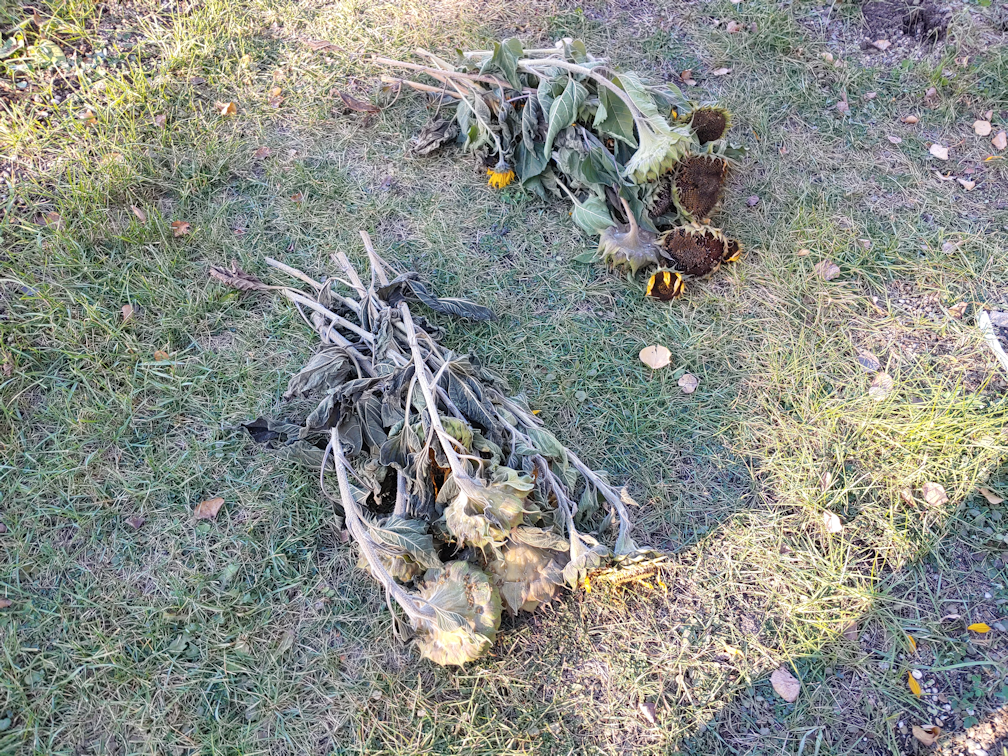
When I got to the point where the second battery on my baby chainsaw needed to sit for a bit before I could squeeze in a few more cuts, I took the time to cut some of the sunflowers. Checking them this morning, I was seeing a lot more losses to birds, so I figured we should get them inside while we still had seeds. :-D
One pile has the Mongolian Giants and the other has the Hopi Black Dye. I don’t know that all the seed heads I collected will give us finished seeds, but we shall see. I cut the stalks pretty long, which meant some of them included the little baby sunflowers that were branching out, too. Those will, for sure, not have any mature seeds on them, but that’s okay.
At this point, we would be hanging them someplace warm and dry. The best place right now is the sun room, and we have no way to hang anything in there just yet, so I made do.
They should still get good circulation around them on these shelves as they dry. I am very curious as to what we will get out of them!
There is a lot more clean up to do, but thankfully we are expected to continue to get mild weather. So much so, that I am still holding off in broadcasting the wildflower seeds for a while longer. Doing this in the fall will only work if there is no chance of germination, so I would rather wait a bit longer. I think one more week will do it, just to be on the safe side.
One of the things about living our here is that phone calls are pretty rare things.
We like it that way.
Every now and then, we’ll get a robocall. Sometimes, from political parties, for conference call town hall meetings, or urgent messages telling us that we are about to be arrested by Canada Revenue for some reason or another, if we don’t call them immediately – and give them our personal information, of course. You know. The usual.
I was just preparing to write this post when we got a robocall with a difference. It was for our municipality, but from the RCMP. It was a warning that there was possibly an armed and dangerous suspect in our area! And by “our area”, they meant the two nearest cities, plus our region. Not municipality. Region. Which is huge.
The alert came with a name, but no description of the person. We did get a description and license plate of their truck, as if that means anything.
After the call, I settled back at my compute to continue with this post. I am happy to say I finally got some progress on the high raised bed that’s worth blogging about. Of course, I’m keeping a close eye on the weather. One of the handy things is that I have a little icon from The Weather Network in the corner of my task bar with the temperature on it and, when warranted, it flashes red with a white lightning bolt as a weather warning. We used to get those whenever there was a frost warning, but I have not seen that, even after last night’s heavy frost. It was flashing when I sat down, though, so I figured we were finally getting a frost warning.
Nope.
My weather app was giving a public safety alert, and it took me to the exact same message from the RCMP that I got from the robocall!
There is no other information about this guy, but they sure to want us to know he’s dangerous and might be in the area!
Or hours away from us, considering how large of an area they are including!
None of us are particularly concerned, but the warnings are appreciated.
Anyhow. To the topic at hand!
Progress on the high raised bed has been frustratingly slow. My tools are the baby chain saw, a hatchet (our other axes are too big for the job), a hammer and a chisel. Basically, I use the baby chain saw until both batteries are drained, with the other tools used to remove material in stages.
Today, I also worked on the carrot bed next to the high raised bed, which meant the first battery actually had time to charge, giving me a chance to get more done than usual.
Which means I FINALLY got the second log in place on one side of the bed.
That took ridiculously long to do! But, it’s now in place, and I’ve started on the other side.
I used the second log to mark where I needed to cut the notches on the side log and end logs. The logs at the end are the thickest, so I started removing material from there, first.
I think part of why I’m so frustrated is, I’ve got three chain saws. The gas powered one broke when I tried to start it, simply because the plastic shell was so old and brittle. The electric one I found was checked out, and they found nothing wrong with it and just sharpened the chain for me, but I discovered it leaked chain oil when I found it in a puddle after the first time I used it, which was for just a single cut before I switched to the baby chainsaw. The next time I used it, I found it would simply stop cutting after just a few seconds. I still have the little, electric, convertible pole chain saw with a 10 inch blade my husband got for me a couple of years ago. It would be enough to do the job, but something went wrong with it the first summer we got it. I checked it out again today, and it basically just screams when I try to make a cut, and the chain stops turning. I’ve got that in the van now, for the next time I go into town and can leave it at the small engine shop to see if they can fix it. I can’t even try using the reciprocating saw. It runs, but no longer shuts off. It needs to be unplugged to turn it off, and it even starts trying to run when it’s plugged back in, making and it quite unsafe to use.
If even one of those chainsaws worked, this thing would be done by now!
*sigh*
Ah, well. It is what it is. Hopefully, I will still be able to complete the high raised bed, and fill it, before the snow flies.
One of the things I found with the baby chainsaw is that, when it first seems to run out of juice, and the red light starts blinking on the battery meter, I can set it aside for a little bit and it will actually “recover” and run again for a while. That usually gives me time to chop or chisel away excess wood. I can usually do this a few times before the battery is finally completely dead. This also gave me time to pull carrots while waiting on the battery life.
I just dug up the Napoli carrots in half the bed. With the Kyoto Red mostly gone to seed, I figured they could wait.
Pulling them all from in between the weeds was certainly a challenge, even using a garden fork to loosen the soil and weeds!
After draining the second battery on the baby chainsaw, I had time to clean up the weeds, pulling out all the roots I could. If some leaves got left behind, I didn’t care, but my goodness, there were some REALLY deep roots I had to dig out!
Half the bed, all done! Hopefully, I’ve pulled out enough roots that it won’t get this bad again, next year! The time it took to do this was enough for a battery to charge, and get more done on the right raised bed.
The temperatures are supposed to stay the same as today for a couple more days, then start to warm up again, which should hopefully give more time to work on the high raised bed and, of course, finish cleaning up all the garden beds and ready them for next year, too.
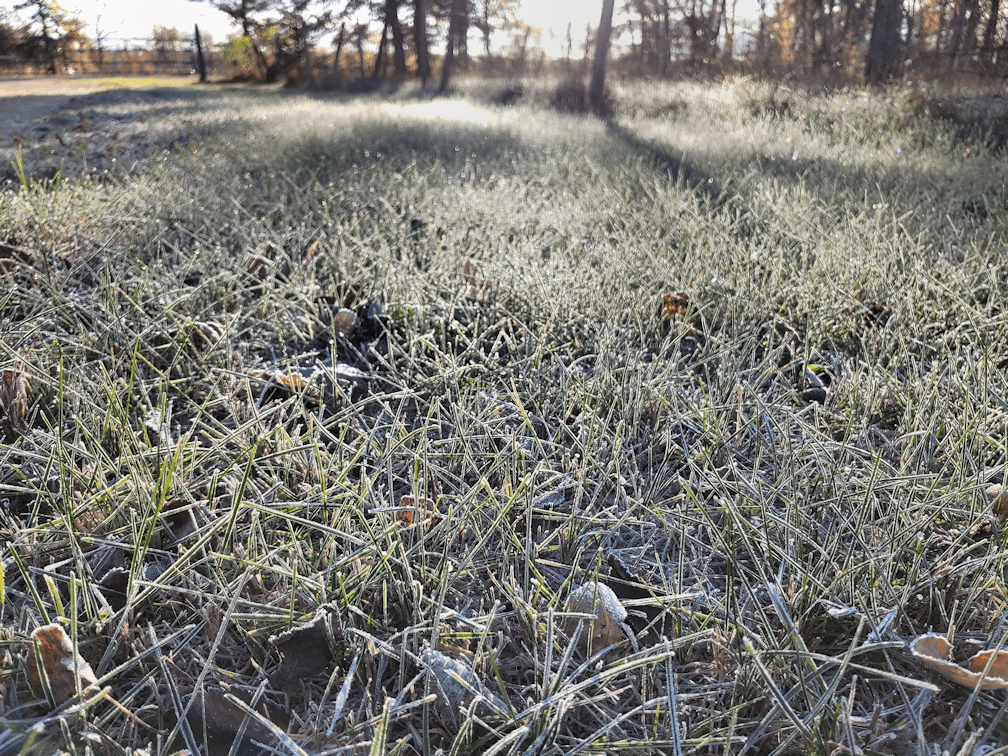
Well, it finally happened. We had a lasting frost, and temperatures were still below freezing when I came out to do my morning rounds.
My husband has still been up to feeding the outside cats earlier in the mornings, and has included putting warm water out for them, too, which they are really appreciating! It’s still not cold enough to plug in the heater in the cat’s house or use the heated water bowl, though.
While there was frost still on the ground everywhere else, this area was already warm and sunny. The kittens enjoyed that while watching me do my rounds!
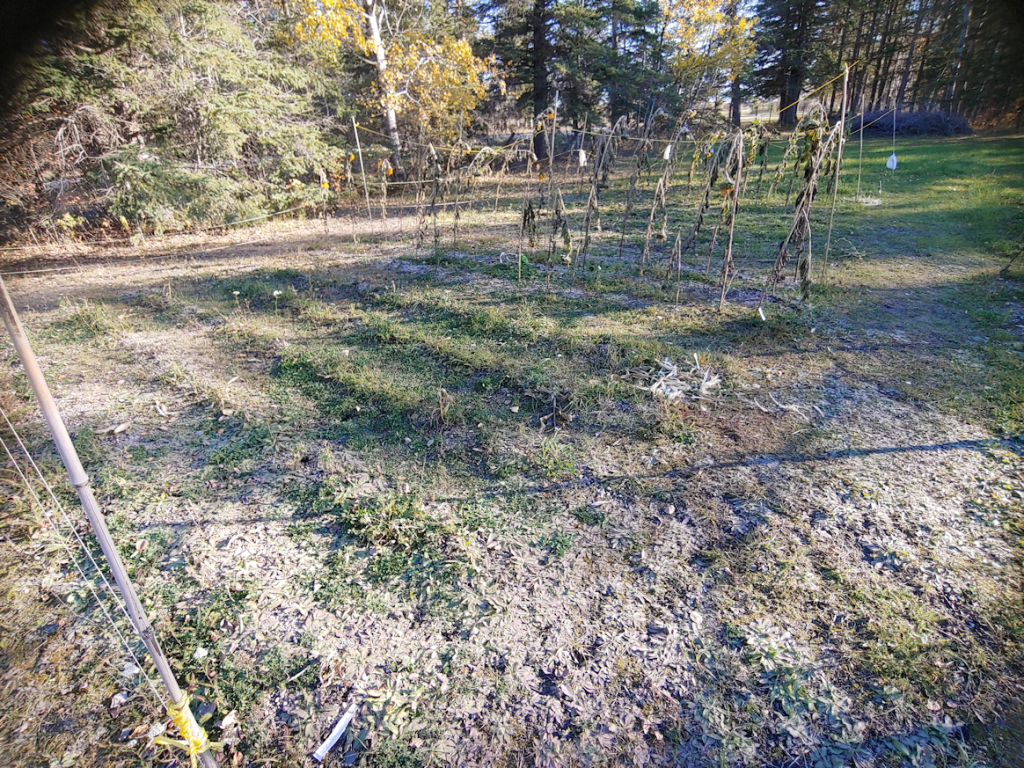
It does show why what we planted along the chain link fence lasted so long. The tomatoes and gourds are finally done for, though. We can now start pulling them and prepping the beds for next year.
While we will be pulling everything else, the sunflowers can stay for a while longer. They sure are a cheerful sight on a chilly morning!
The chard was still quite covered in frost, as these beds are shaded longer in the mornings. We’ve never grown chard before, but from what I’ve read, getting hit with frost can improve their flavour. I don’t know that we’ll grow chard again. They did well, but none of us really ate them much.
I was already planning on pulling the lettuce. That last batch I gathered was so bitter, it went straight to compost instead of the salad I was intending to make with them.
A bit of a surprise was walking by the purple corn, the remains of which we were leaving to go to seed. They were pretty dry by now, yet most of the stalks were eaten last night! They had been left alone for quite a long time, so this was unexpected. Odd that, with so much fresh food still around, and even with the lettuce and chard uncovered, the deer would go for these dried up stalks.
We are going to have a lot of work to do over the next couple of weeks. We’re supposed to warm up again next week, so we do have time. The sweet corn blocks and, eventually, the sunflowers will be pulled, but nothing else will be done in that area until we get the berry bushes we intend to plant there. My daughter has been researching the ones we were looking to get, and Autumn Olive has been taking off our list; apparently, they are considered invasive! The Buffalo Berry and Sea Buckthorn are still on the list. Sea Buckthorn is also considered invasive in some areas, but not our climate zone.
The bean beds, pea trellises, squash tunnel and summer squash areas will all be used again next year, but mostly we need to focus on preparing the main garden beds closer to the house for next year. Once we get our straw bale in, we’ll start mulching some areas for new beds. We are already making lists of what we intend to plant next year, and will start buying seeds and trees over the winter, month by month. We will use that to help decide where to prepare new ground for planting next year.
At the same time, we are making lists of things to stock up on. Though things are looking mild, we’ve been either snowed in or had our vehicles freeze for two winters in a row now, so we want to be prepared in case something like that happens again. With food prices increasing so much over the past few months, and expected to get higher, it’s getting more difficult to buy those few extra things every month. Particularly since so many other people have realized that “prepping” is a really, really good idea, too!
Having grown up here, as a subsistence farm, I am very familiar with a lot of “self sufficiency” and “prepper” habits. That was just what everyone did, because there was no other option, really. So I’m no stranger to the lifestyle. At the same time, I am always wanting to learn new information and more about how to do it better, so I spend quite a bit of time researching. Which means I’ve lately been seeing a lot of homesteading resources – “subsistence farming” just isn’t a term that’s used anymore! – and “prepper” sites. Lately, it’s been feeling downright weird to go to them, as they are increasingly focused on giving information to people who are totally new to the concept, due to current circumstances. For us, this is just stuff we need to do. We are isolated just enough that we know we have to rely on ourselves if things go wrong, and there are always thing that can go wrong. The power could go out. We could get snowed in. We might have to evacuate due to wildfires. At least flooding isn’t a concern where we are, but running out of water is. We can’t just hope over to the corner store if we run out of things, like we could while living in the city. We can’t even assume we will have telephone (meaning the land line; we already can’t rely on getting a cell phone signal here) or internet for communication. The land line is pretty reliable, at least, but our internet starts kicking out as soon as there is a stiff wind, or if there are storms to the south of us. Of course, on top of all that, we have my husband’s health issues. He and I were just talking this morning about his prescription refills. He gets his daily meds in bubble packs now, including those that are restricted. For the longest time, he couldn’t get refills for his restricted medications until he was, at the earliest, 3 days away from running out. Now, his bubble packs aren’t even done locally. They’re done in the city and shipped to the local pharmacy, and with how crazy things have been, they’ve actually lifted some of the red tape surrounding restricted medications. Which means we should be able to get a couple of months of refills, instead of just one month. He just got his refills recently, so we’ll be trying to get an extra month of refills, next time.
Anyhow. It’s just been really strange to go looking stuff up for ideas and inspiration. So many people are now doing the same thing, with absolutely zero background in it. In one way, it makes me feel thankful for how I grew up. On the other, it’s frustrating, when people start panic buying, without any sort of planning or organization in mind, and it ends up causing problems for everybody.
Ah, well. People need to learn somehow. We just do what we can!
And right now, that means cleaning out the last of this year’s garden, and preparing for next, and making sure we are stocked up for the winter.
I may have missed the kitties when my husband fed them this morning, but I got to see them this afternoon, when my daughter topped up the kibble containers! :-)
Even Ghost Baby made an appearance!
My daughter was happy because, once they all came running to eat, she was able to pet a whole bunch of baby butts, and they didn’t run away! Too interested in the food to notice they were being pet. :-)
My daughter had come out to take care of something for me. I had earlier been working on the high raised bed and, since I was right next to it, decided to dig up some carrots from the abandoned bed.
I am totally amazed that after the greens being munched down to the ground at least three times, then getting overgrown with weeds, we STILL have decent sized carrots! Certainly not their full potential, but far better than what I expected. Which was nothing! These are the Napoli carrots we ordered from Veseys, and I must say, I’m impressed by their resilience! I picked maybe 1/3rd of the bed’s carrots. It’s hard to judge, with it being so overgrown.
Then one of my daughters came out to hose them off (and feed kitties!) while I did other stuff outside. My other daughter then used them with a roast vegetable dish she made to do with supper. I finished up outside while she was working on it, and we decided to include our tiny winter squash.
The tiny halves in the background are the little Teddy squash. By the time I took out the pulp in the seed cavity, there wasn’t much flesh left! Like the immature Kuri squash in the foreground, their seeds were not at all developed.
I have no idea how edible they are at this immature stage, but we’ll find out!
Last night, I heard from one of our neighbours, asking if we were missing some kittens. It seems that several kittens were sighted on the road by our place, and while one was caught, there were others around. They were not ours; by the age estimate, they were about 5 months younger than ours, plus they seem used to humans. Which means they were likely dumped. :-( The person who caught the one said she would be coming back to try and find the others. Meanwhile, I made sure to be on the lookout for kittens while doing my rounds this morning. Especially in the furthest garden beds, which are the closest to where the kittens were spotted.
I think I did actually see a strange kitten at our house, yesterday, but it ran off, just like most of our yard cats still do. I found myself thinking the colour seeming off had to have been the light, but now I wonder! Well, if there are strange kitties around, they will find food and shelter here. So far, though, I have seen nothing today.
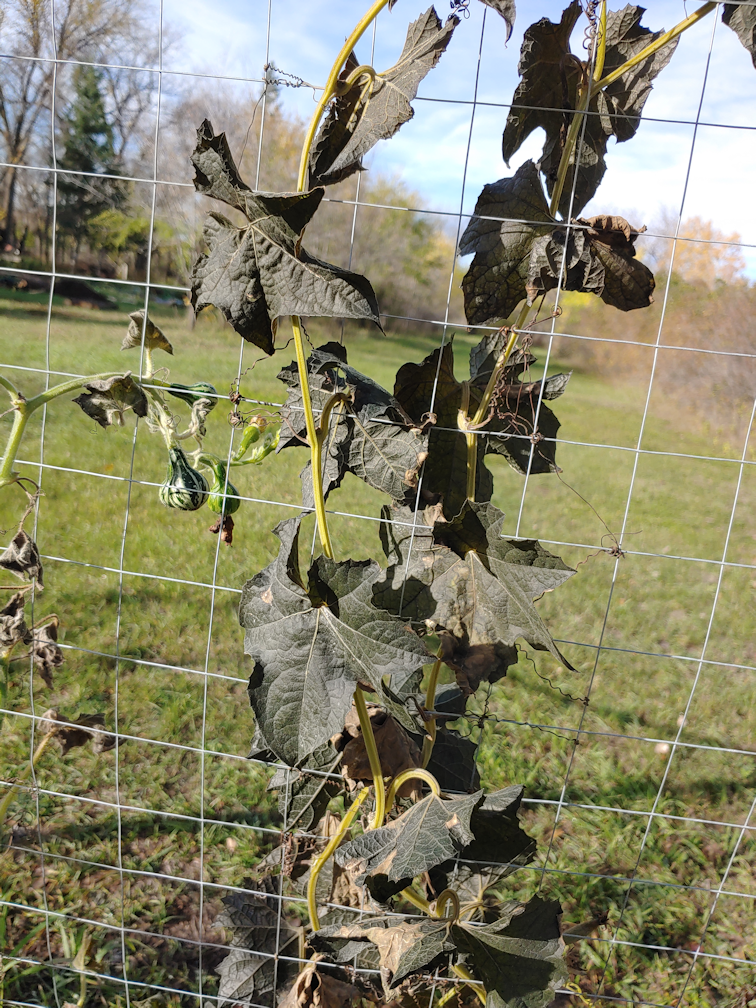
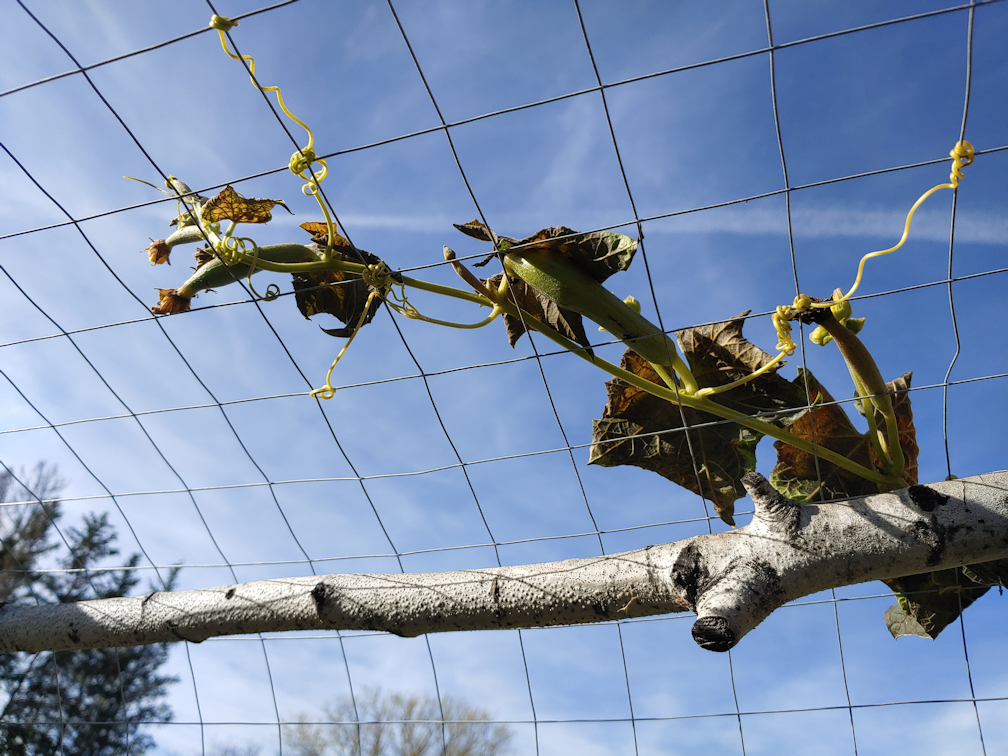
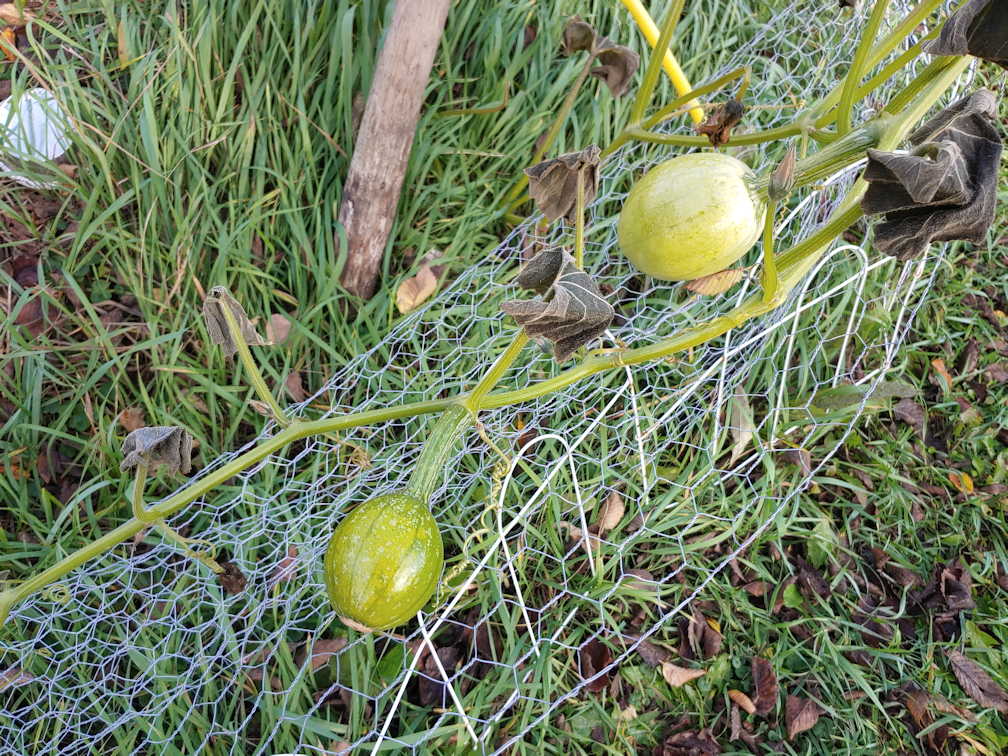
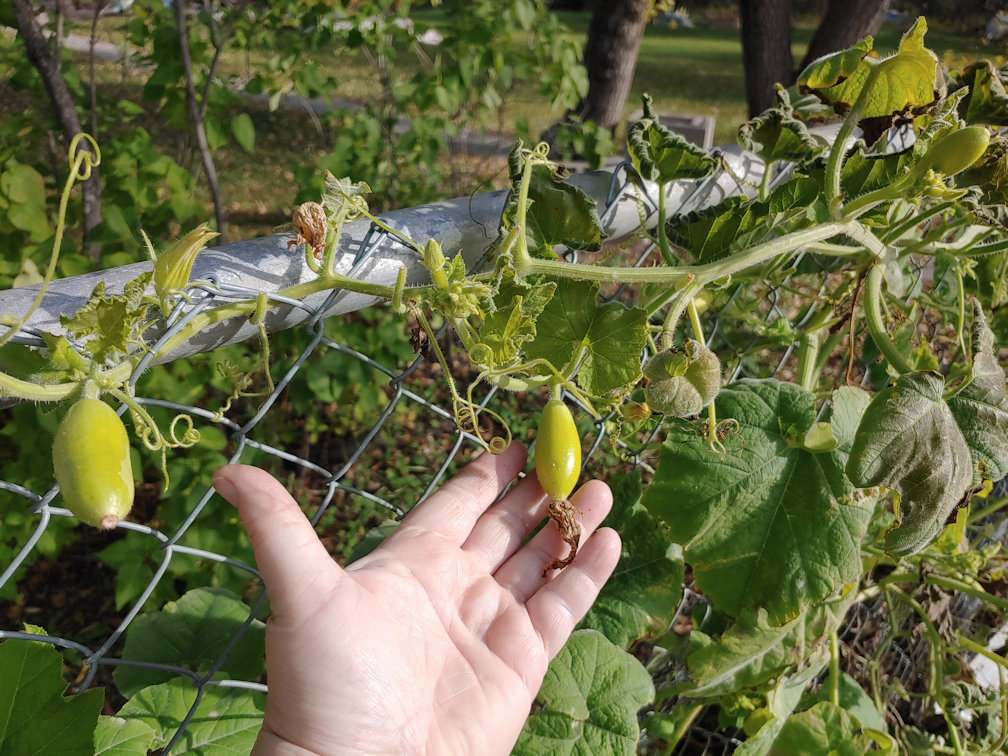
While I was on the lookout for strange kitties, I checked out the squash tunnel. The luffa and Tennessee Dancing Gourds seem to have finally succumbed to the chill overnight temperatures.
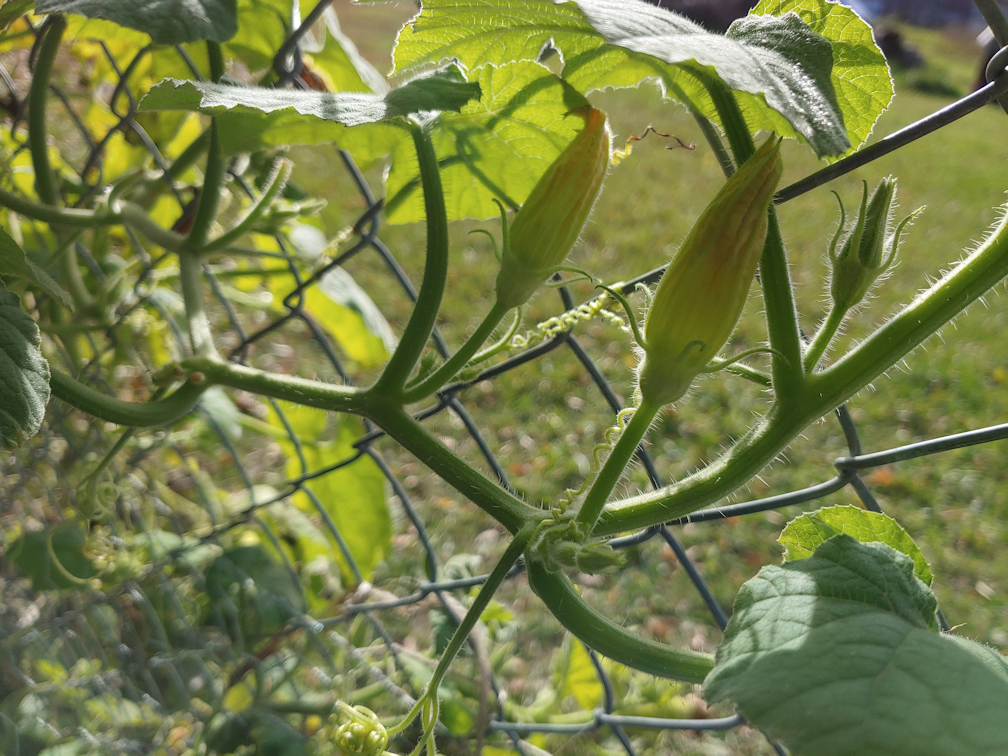
The luffa leaves turned really dark, but haven’t shriveled, like pretty much everything else. Take a click on the image of the developing gourds on the top of the squash tunnel! There are still flowers developing! They do look frost damaged, though.
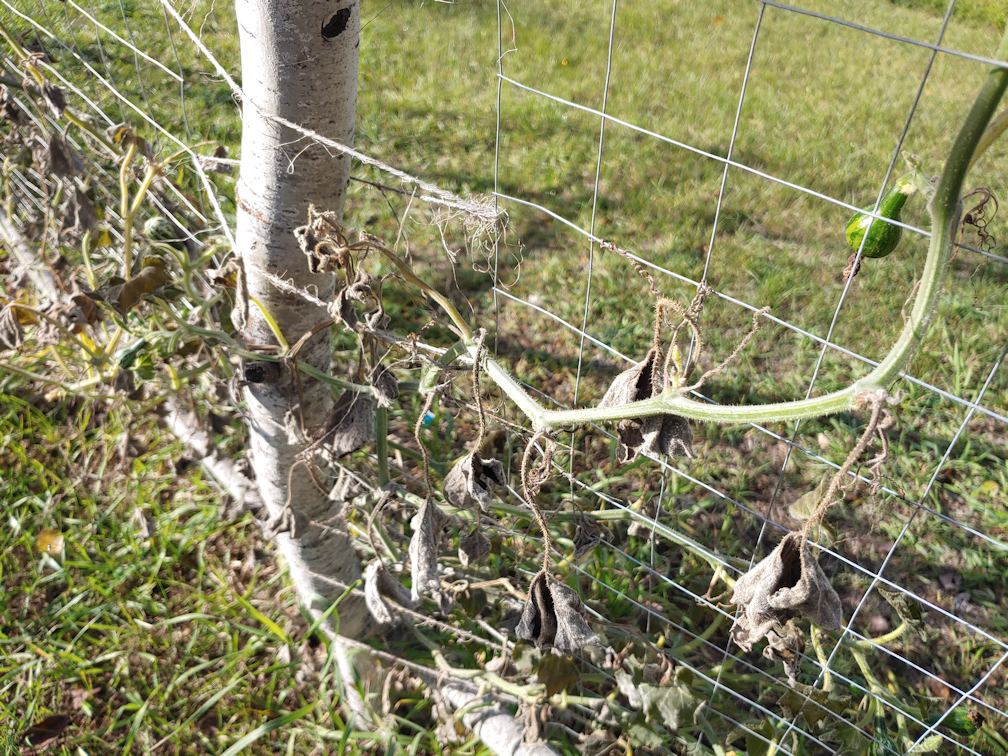
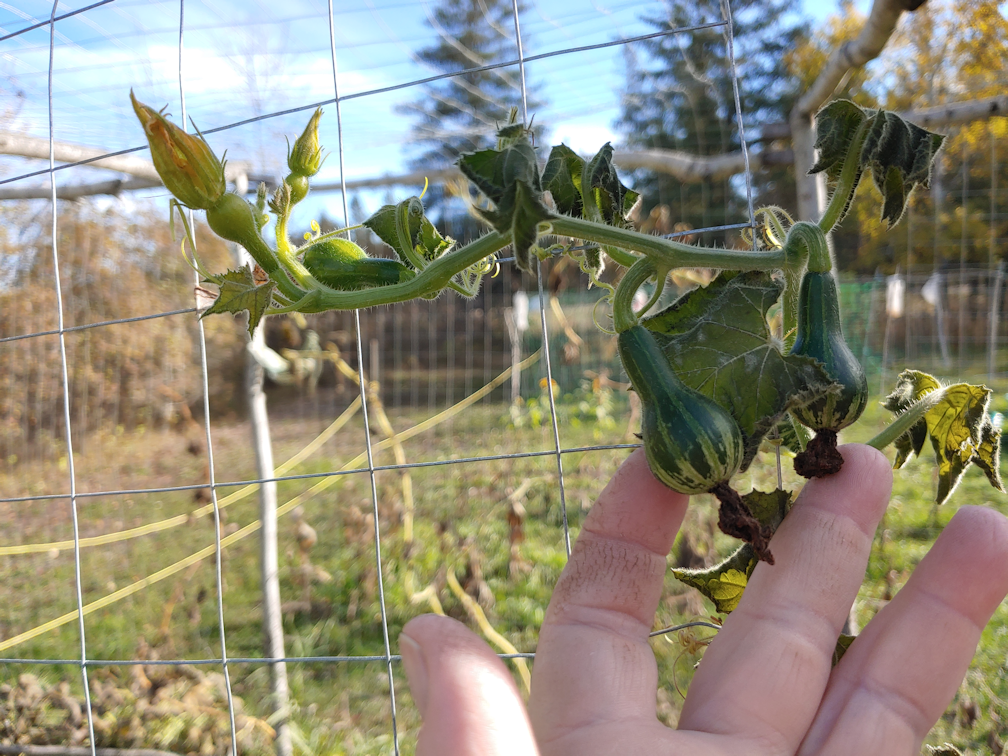
It was much the same with the Tennessee Dancing Gourds. Most of the vines have died back, and cold damage can be seen on some of the little gourds… and yet, there are still flower buds!
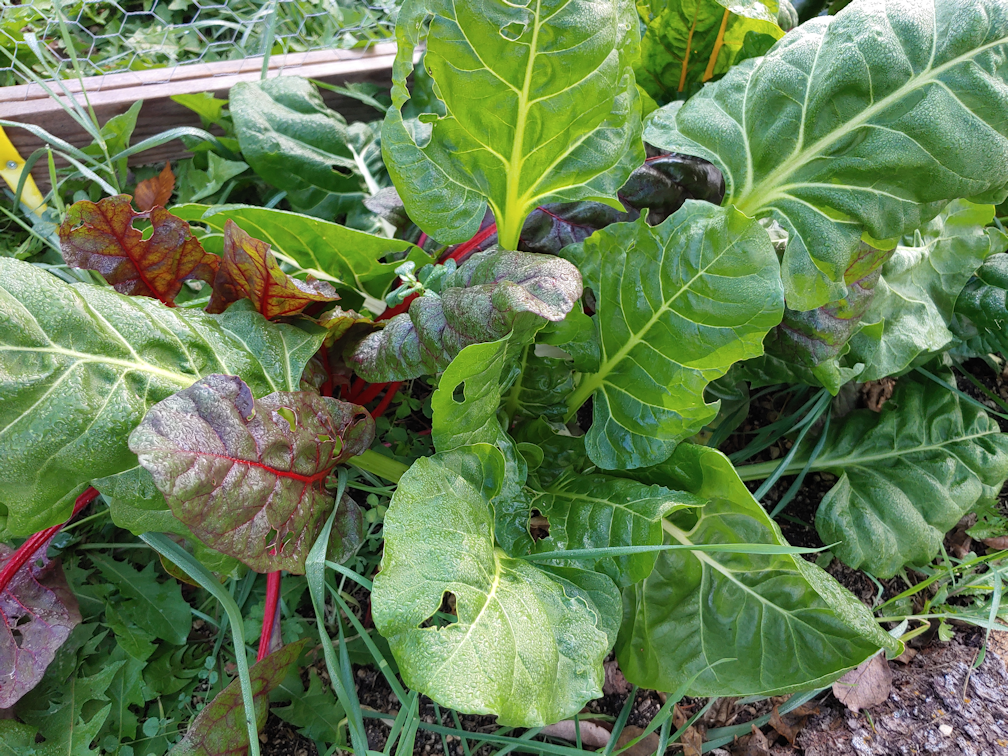
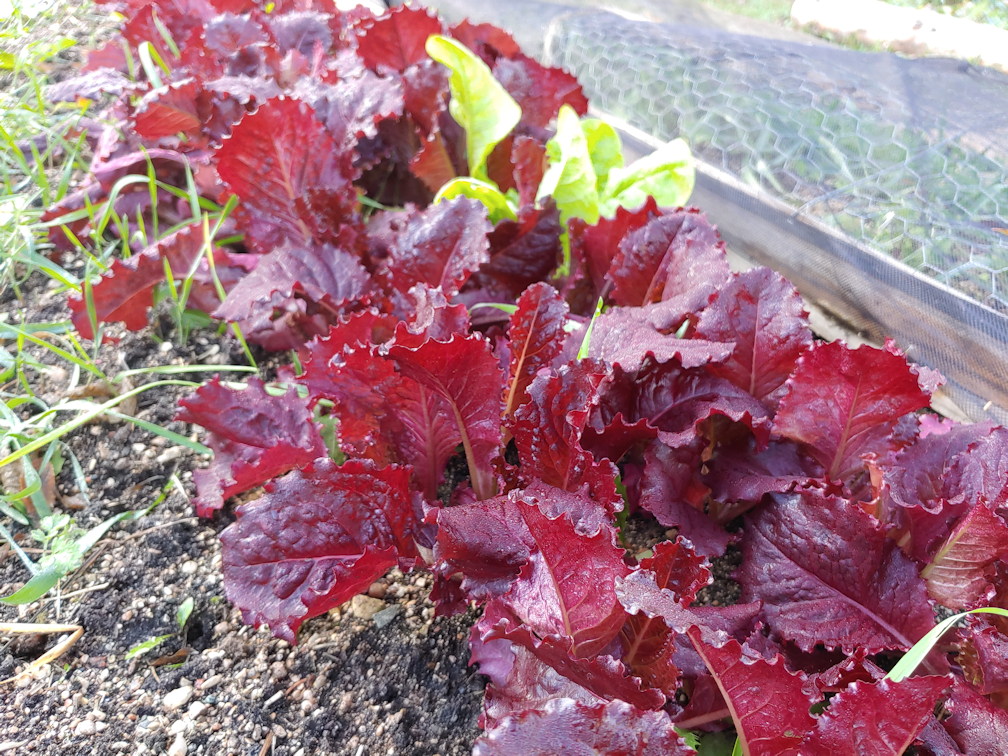
The chard and the lettuce are still going strong.
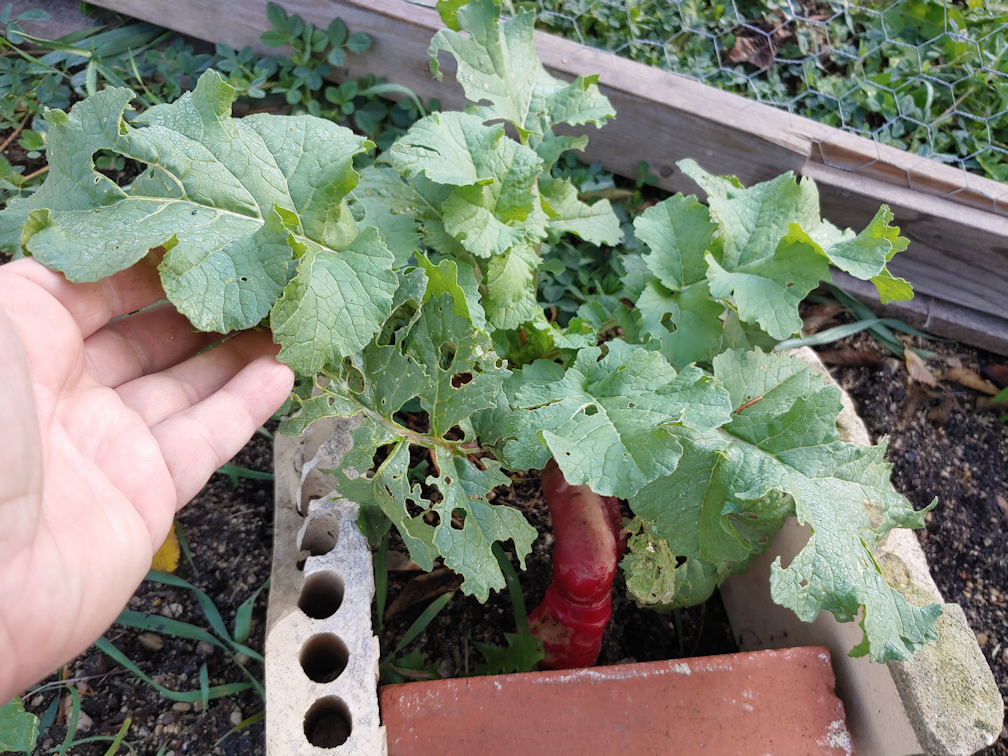
This is the biggest of the surviving radishes. You can see the older leaves that still have grasshopper damage. Something is nibbling the new growth, too, but not as much. I put the bricks around this radish plant, because something has been nibbling on the bulb. I’m guessing a mouse or something like that. Putting the bricks there seems to have stopped it, as there is no new damage.
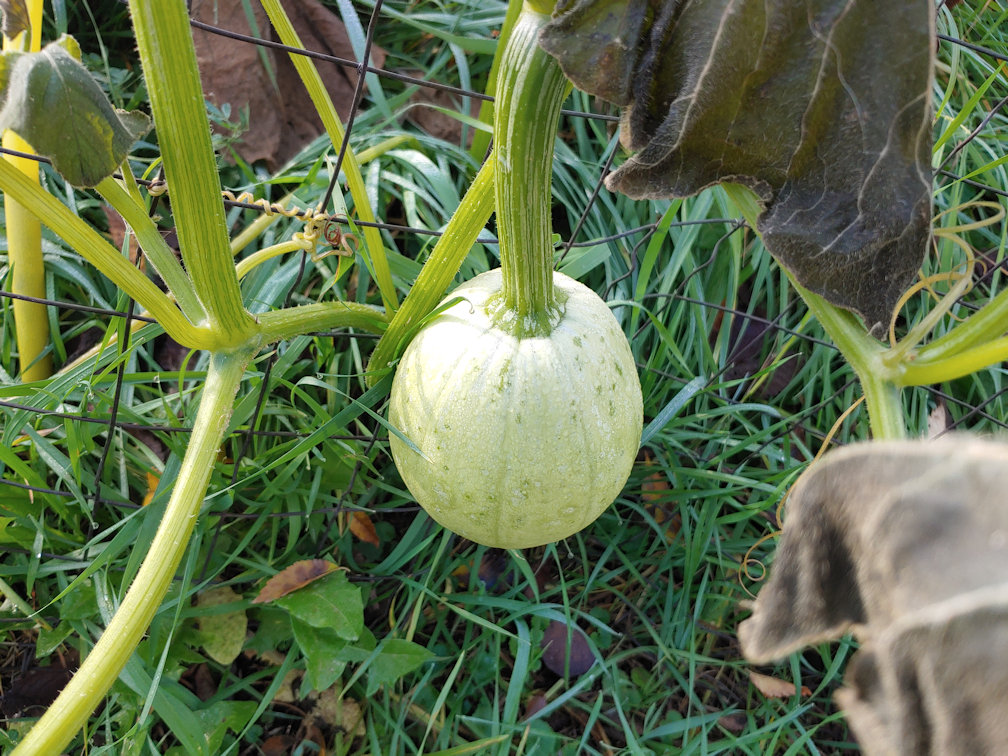
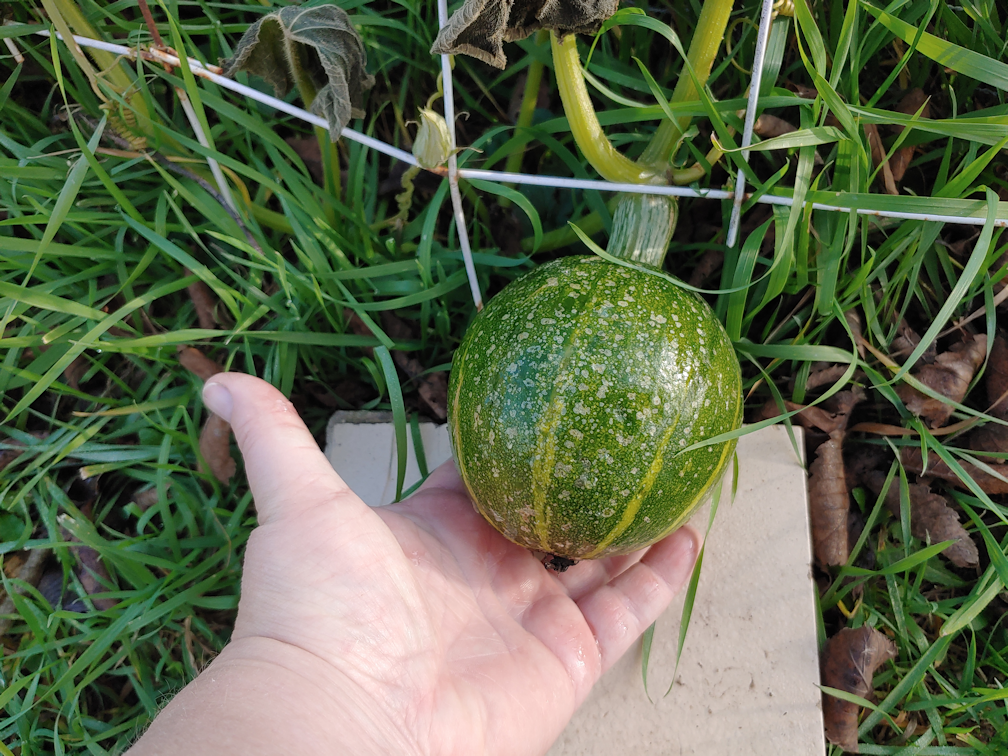
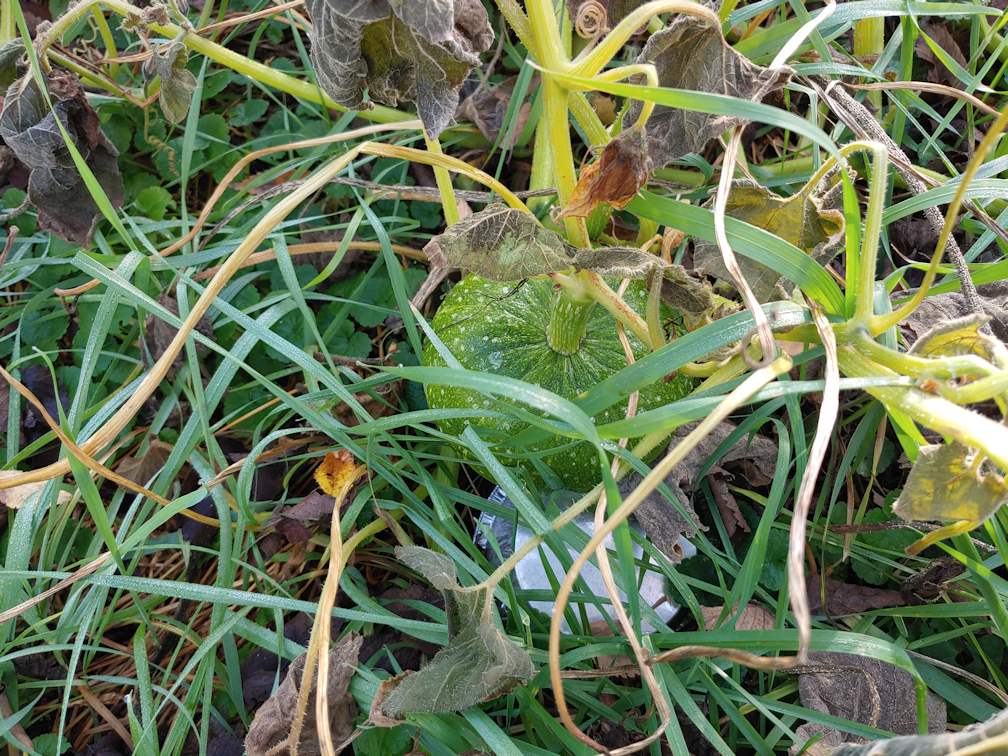
Then there is that amazing Crespo squash. Is it still going, or is it done? The leaves seem to be completely killed off by the frost, yet the vines still seem strong, and while there is cold damage on most of the squash, some of them still seem to be getting bigger!
So, we will wait and see how they do.
Meanwhile, on the south side of the house…
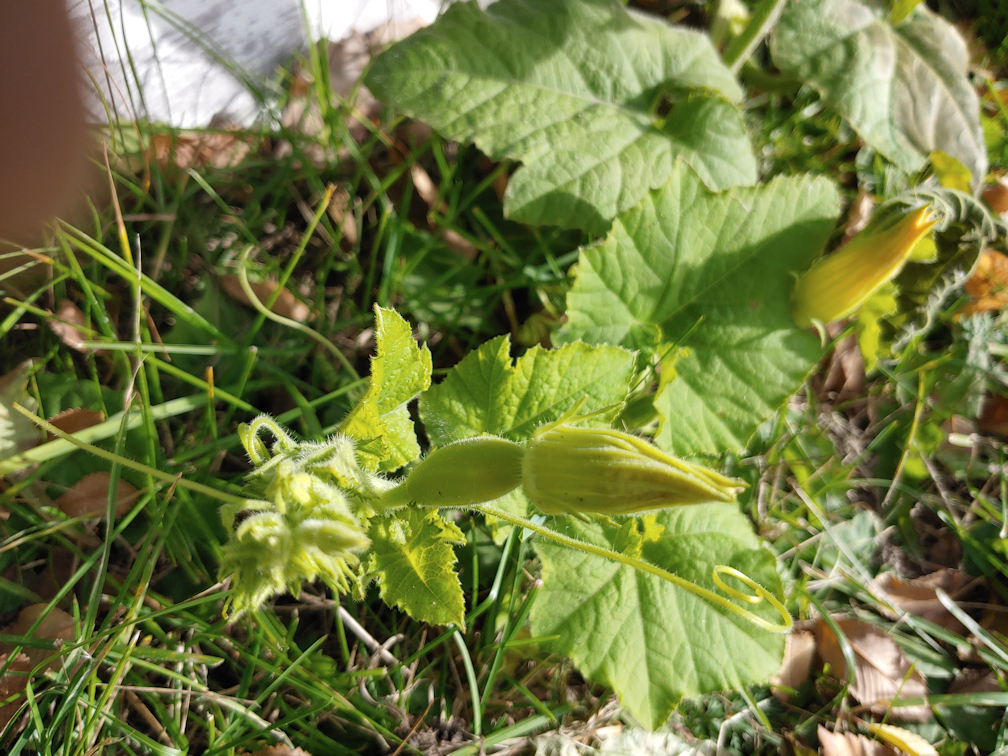
The Ozark Nest Egg gourds have almost no cold damage on them, and still seem to be growing just fine. In fact, there is more fresh and new growth happening, and new male and female flowers developing!
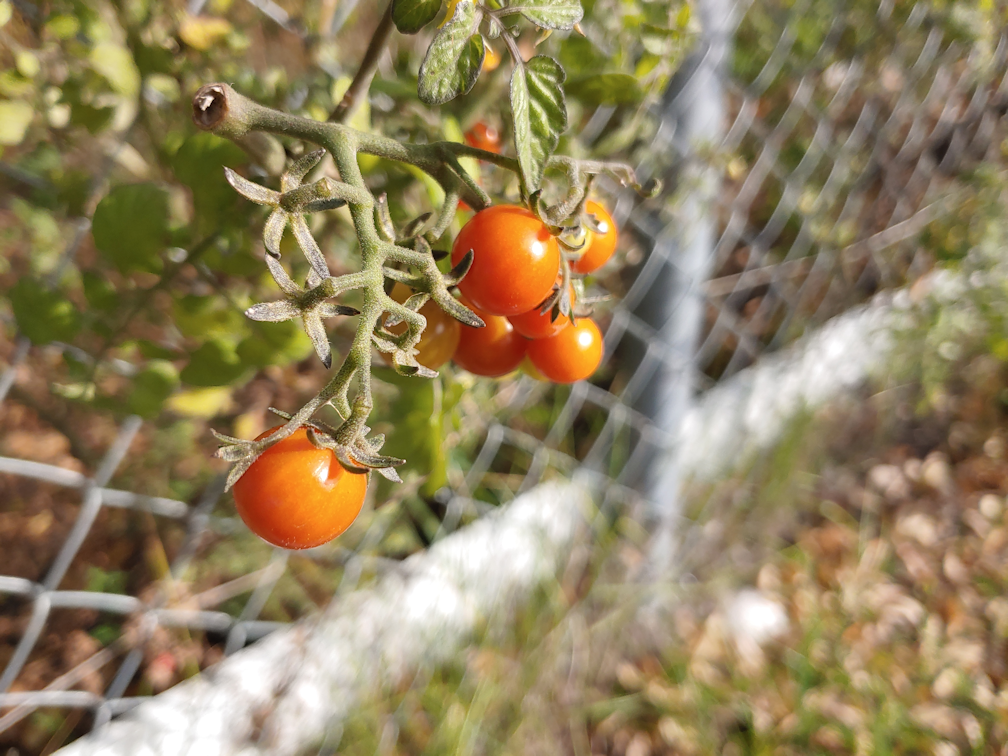
The tomatoes continue to ripen, with no signs of cold damage to them, unlike the one self-seeded tomato that’s growing near the lettuces, which is pretty much dead.
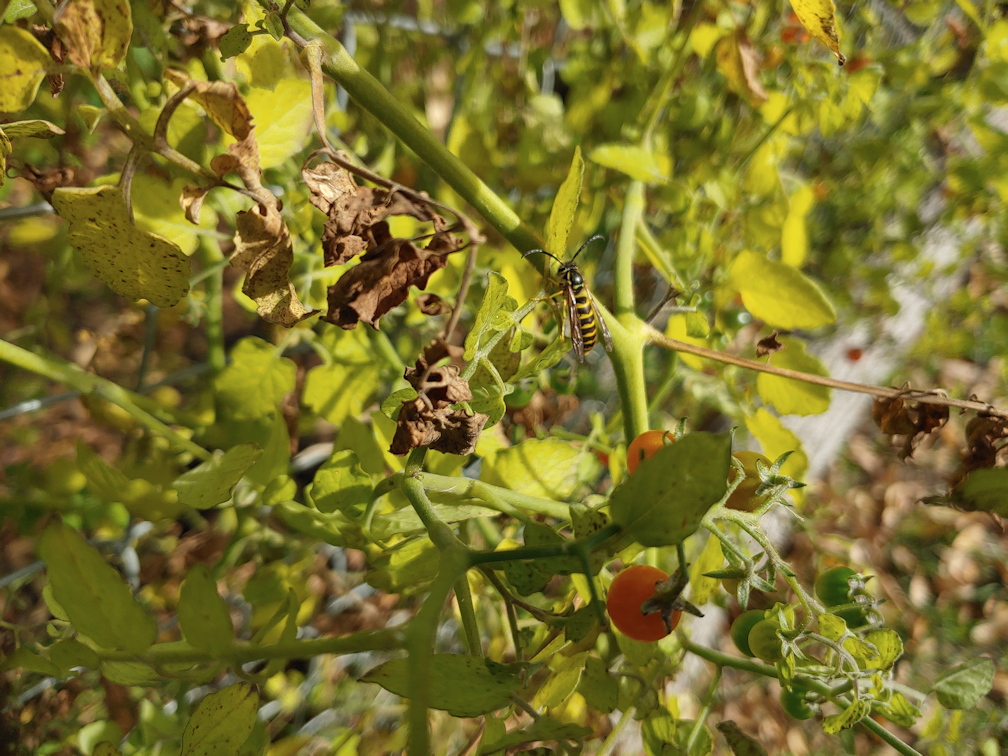
Check out that wasp on the Spoon tomato vine! Even the pollinators are still out!
The fingerling potatoes are still going strong, too. There is one bag that looks like it has died back, but the others are still very green. Especially the Purple Peruvians.
I keep forgetting to take pictures of the carrots. Even the overgrown bed we abandoned to the groundhogs has carrot fronds overtaking the weeds. Especially the Kyoto Red, which have gone to seed. I’m keeping an eye on those, as I want to try and collect them before they self sow!
It’s hard to know how much longer the garden will keep on going. Today was forecast to be 18C/64F, then things were supposed to cool down again. As I write this, we are at 22C/72F !!! Tomorrow, we’re supposed to drop to 8C/46F, then go down to 5-6C/41-43F, with overnight lows dropping to -1C/30F a couple of nights from now, but who knows what we’ll actually get?
Looking at the data for our area, our average temperatures for October are 10C/50F for the high, and 1C/34F for the low – but our record high was 30C/86F in 1992, with a record low of -18C/0F in 1991, so while a bit unusual, the mild temperatures we’re having right now aren’t that uncommon. In fact, the record highs and lows seem to lurch from one extreme to the other, within just a few years of each other, if not one year after the other!
I’m looking forward to NOT hitting any record lows this fall and winter! :-D Still, the way things are going, it may be a while before we finally harvest our carrots, potatoes and beets – I want to leave those in the ground as long as possible – and we’ll have lettuce and chard for quite some time, yet!
Thanks to my husband being up at ungodly hours and feeding the outside cats for me, I didn’t have to head out for my morning rounds until things had started to warm up a bit. Even so, I found ice!
We keep a storage bin with tools and various handy things at the far-flung garden beds. It’s in the shade of the rain barrel (which we no longer fill; it has only enough water to keep it from blowing away), and the rain water that had collected on its lid had a layer of ice on it!
The reason I needed to go into the bin was to get a knife. It was time to collect the few remaining winter squash and melons.
The mutant Red Kuri has probably been ripe for a while, and just the outer skin was getting more time to thicken. The smaller one hasn’t reached its mature colour yet. The larger melons are the Pixies. Their vines died off ages ago, but I still had to cut them free!
The two surviving Teddy squash are smaller than they would have been under more optimal conditions, but from what I’ve read about their mature size, not by much. I do think they actually did get a chance to ripen.
The last two Halona melons! They got to this size, and just stopped growing. They are probably not edible, but who knows?
I figure we’ll be cutting into these as soon as we can. I think the winter squash, at least, will be something we can eat, and we’ll want to do that right away. The Pixie melons should probably be fine. Those little Halonas, though… I suspect they will find their way into the compost!
We’re supposed to get a really warm day tomorrow – 18C/64F!! – then back to chilly, but still mild, temperatures. It should be at least a week before we potentially get rain again, then mild for the rest of October. That will give us plenty of time to do more wood chipping, pull of the spent plants, and work on the high raised bed some more. I plan to include garden material among the layers when filling the high raised bed. Every little bit will help!
Yesterday, I consulted with my brother about a job that needs to be done. The old chicken coop – a log building that was a summer kitchen when my parents first acquired the farm – has a corrugated metal roof that was laid over the original wood shingles. A tree had been allowed to grow next to it and, in high winds, the branches had torn away a section of the metal sheets. I cut away the tree last year, so at least there is no new damage from the branches.
This building is still salvageable, but the exposed wood roof needs to be covered, or it’ll end up collapsing like the others. The metal pieces that got torn off are pretty damaged, and I couldn’t even find all of them. There was another building next to the barn with the same type of corrugated metal roof. It collapsed long ago, so the remains of the roof are almost on the ground. It still has several pieces that are bent to fit over the peak of the roof, so I should be able to salvage those, as well as some other pieces, to cover the old chicken coop roof.
The problem is getting up there. I don’t think that roof can hold a person’s weight anymore. Plus, it would be pretty dangerous to try and use a ladder around there. The ideal thing would be to have scaffolding. My brother told me that there used to be scaffolding alongside the building my parents’ stuff is now stored in. I was pretty sure what I would find, but this morning I went to take another look, just to confirm.
No scaffolding.
Something else that disappeared before we moved out here.
*sigh*
My parents ran a fully equipped and functioning farm until their retirement. Sure, it was just two sticks ahead of the stone ages, but as my late brother prepared to take it over, he brought all sorts of supplies and equipment. I’d say it was more like three or four sticks ahead of the stone ages before he died. Now, it’s like I’m down to just one stick ahead of the stone ages. I have fewer tools and resources available now, than when I was a kid and we still didn’t have running water or an indoor bathroom.
It makes taking care of and improving this place, very frustrating!
Ah, well. We make do with what we have. Perhaps, with our vandal taking me to court over the remaining junk, a judge will see fit to order him to return what he took, or pay my mother and brother back for what can no longer be returned. One can dream!