Our first Summer Savory seedlings have sprouted!
The tiniest seedlings from the tiniest seeds. They are barely visible!
Here’s hoping at least some of them survive.
The Re-Farmer
Our first Summer Savory seedlings have sprouted!
The tiniest seedlings from the tiniest seeds. They are barely visible!
Here’s hoping at least some of them survive.
The Re-Farmer
I got a little bit of garden therapy in, while checking on my seed starts.
I also remembered to get a picture of how the onions are doing in the seed snail experiment.
I’m actually debating whether it’s time to “pot up” the onions. That would involve unrolling the snails, adding more soil (at this stage, I would be using potting soil rather than seed starting mix), then rolling them back up into thicker snails. I made sure to have plenty of excess foam packing material being used here to accommodate extra thickness. I think I might wait a bit longer, though.
You might have noticed the tips of the onions look dry and shriveled. I think that’s from getting too close to the shop light before I raised it higher. Currently, they have the shop light on for part of the day, but for 12 hours on a timer, they are getting full spectrum light from the larger new lamp I picked up.
In the next couple of pictures, you can see new seedlings from the pre-germinated seed starts. Well… almost see! The row at the bottom of the picture is the Caspar Eggplant, and three seedlings have broken ground. In the middle is the Sweet Chocolate Pepper, and five seedlings have appeared, a couple just barely visible through the vermiculate. The top row is the California Wonder pepper. It took some searching, but I did see the curved stems of seedlings just barely visible through the vermiculite.
In the last picture, you can see the largest of the Sweet Chocolate peppers.
I turn the shop light on for part of the day for these, too, but they also have full spectrum lights on for 12 hours. I’ve got two lights fixtures with four light strips each, and I’ve got them set up so that five light strips are over the full tray, then three strips are over the celery and luffa in the other tray. The strips with the herbs I recently sowed are off to one end of the tray, closer to the heater that I have set up to blow warm air over both trays.
I have the full spectrum light strips quite close to the surfaces of the trays. As the seedlings get larger, I can raise each strip individually, as needed. Right now, for example, the container with the celery is lower than the Red Solo Cups the luffa are in (still just the one seedling in those), so it has its own light strip that’s lower than the two that are over the taller Red Solo Cups.
I’ve made a point of spending time in the basement to have the heater on. Usually, that’s my time to do my steps (I have a step counter on my phone), but I also go over my notes. I have lists of things based on how many weeks before last frost they should be started. What I have so far has been started early, based on a June 2 last frost date, though the newly revised average has our last frost date in a range of dates at the end of May, potentially adding as much as a week to our growing season.
Looking at the calendar, I made sure to write down when the next batches of seeds should be started, though I can get away with some, like the herbs and the marigolds, to be started early. Some of them are things that could be grown in pots indoors, and are more flexible. I am mightily resisting starting tomatoes! Those are next on the list but, if I were to go by calendar dates, they shouldn’t be started until the middle of March. Being short season varieties, I could theoretically wait even longer.
I don’ wanna wait that loooonnnggg!!! <insert childish whining> 😂🤣😂
Still, spending some time with the plants and thinking these things through, even for as little time as it was, was enough to make me feel better than I have been for much of today.
In other things, I phoned my mother today. In the TCU, she can’t have a phone in her room. I call the nursing station and they transfer me to a cordless phone that they take to the person being called. They tried transferring me four times before it finally worked!
My mother was very, very happy for the call, and said she had been thinking of calling me. I reminded her that, where she is now, it’s a long distance call.
She really wants a phone and was asking if we could get her a phone, like other people have. Meaning, a cell phone.
Now, there’s no way my mother can handle a Smartphone. She could barely handle the new phone my brother got for her at her apartment, to replace her old set, and it was actually simpler than the one she had before. Still more bells and whistles than desired, and things were in slightly different locations, and that was enough to give her a hard time. My brother tried so hard to find the simplest phone set – a corded phone with an answering machine, plus two cordless phones for her dining table and bedroom – that he could, but everything has bells and whistles these days.
I do know there are cell phones made for seniors out there, so I plan to do some research later today and see what’s available here in Canada.
I explained to her that she would have to buy a phone and have a monthly phone bill. Her response was, she has money that’s just sitting in the bank, not doing anything, so she doesn’t mind using it. She currently has no idea what’s going on with her banking right now, as my brother is taking care of it for her. None of us have tried to explain to her that the hospital back dated their billing for her stay there, which was charged daily. Plus, her rent for February was taken out, but as my brother explained my mother’s situation and why he wasn’t able to give them a month’s notice, it will be refunded. Until then, she’s being double billed for the month, which she would not be able to understand and would freak out over if we tried to explain it to her. My brother is the best person to be taking care of all this for her, and I assured he, even though he’s still out of the country, he’s on top of all this and taking care of things for her.
Then I told her that I had going to mass yesterday, where prayers were said for her health, which she was very happy to hear about. I then told her I had been on the way to visit her when something went wrong with the truck, and I had to get a tow truck. She immediately said, I need a new vehicle. *sigh* As if we don’t know that! So I told her about my BIL driving me home in his truck, and that he was planning on selling it in the summer. If we can come up with $5000 by then, we will buy it from him. It took a while before I realized she didn’t know who I was talking about at first, so I said my BIL’s name again. Oh! You mean… and then she said his Polish name (his family are also from Poland). 😄 So she was pretty keen on the idea of our getting a truck from him.
We talked about a bunch of other stuff for a while. She’s not liking where she is right now, and I can’t blame her one bit. Not only is she now in a smaller room that’s being shared with someone else, it’s very close to the nursing station, which is right next to the entry doors. Lots of traffic, lots of noise. I explained to her that everyone else there is waiting to go somewhere else, like she is. Her response was, I don’t care about anyone else. I just care about me. *sigh* I said it meant that she would be seeing a lot of changes in who is there with her. She is doing a lot better, as far as care needed, than many others and that’s part of the problem; people with higher needs are going to get beds in nursing homes faster than her, typically. I reminded her that, when it came to nursing home spaces, we’re basically waiting for people to die, as that’s pretty much the only way beds get freed up. She thought that we could talk to people about getting her into a nursing home faster, because where she is is not good for her health. I told her, where she is now is the first step, but in the end, it’s the ultimately the provincial government that decides. So she said we should tell them to build an addition to the nursing home she wants to live in.
…
*sigh*
I didn’t even try to explain. Our province certainly needs more beds for long term care and assisted living, but it’ll be a cold day in hell before that happens.
Our conversation went all over, and she gave me messages to pass on to my siblings. I mentioned again that it’s long distance for me to call her now, but not for my sister. She was all surprised by that (not sure why; my sister lives only 15 minutes away, at most) and started saying my sister should phone her more often! She’s not understanding that it’s harder to do that through the nursing station where she is than how it was before. Then she wanted to know when I would be visiting her next. I reminded her, the truck was at the garage and we have no idea how long it will be, before we have transportation again.
Oh, so you want me to give you money for the truck now?
?????
I said no, I was just letting you know that it might be a while before I can visit and why. That’s all!
I can give you a check…
????!!!
I told her again, I wasn’t wanting anything like that. I was just letting her know why I might not be able to visit anytime soon, but we just don’t know right now.
But the money is just sitting there, not doing anything… I can write a check.
???!!!
Finally I deflected and said, we can talk about it the next time I visit. She happily agreed with that and we dropped it.
I wasn’t going to ask, but I’m not sure if she was offering to pay for the repairs, or to give us funds to buy the truck from my BIL! I fully expect her to forget about it long before I’m able to visit her again, and I will certainly not bring it up again! The offer was totally out of the blue and not at all what I meant by telling her about the truck. That’s the sort of thing our vandal was constantly doing to her and my late father for many years, which might be why she thought that, by telling her about the truck, I was actually asking her for money. I do appreciate the offer, but I will not ask or bring it up again.
Over all, for all that my mother is not liking where she is, she did sound happy. Even when, at one point, she started rather playfully referring to herself as an “orphan” for being there. She told me to make sure to pass that on to my sister, so she will call and visit more often. 😁
I really hope my mother isn’t there for very long. Still, it’s the first step to getting her where she wants to be, at least.
Meanwhile, I’ve got my homework assignment, and will start seeing if there is some sort of phone out there that will work for her and where she is. That won’t be easy!
The Re-Farmer
I had been thinking to start more seeds tomorrow, but I expect to be out and about and decided to just go ahead and do some today.
There are flowers and herbs that can be started in February in our climate, but I had only four in mind. After reading more on what the flowers – cosmos and hollyhock – needed to be started indoors, I decided to hold off on them. Instead, I went through two of my herb seeds that needed the longest start up time before our last frost date. Russian Tarragon and Summer Savory.
The seeds for both are very tiny and would have been ideal for the seed starting kits I got a couple of years ago. The cells are quite small and there is a USB powered full spectrum light disc for each dome.
I couldn’t find it.
It had all been stored in the original box in the sun room, but the sun room got completely emptied and cleaned out in the fall. I thought I’d put it in one of the storage shelves or one of the storage bins, but I couldn’t see it anywhere. I didn’t pull the bins out completely to look, as that would require far too many cat-blocking things to be moved out of the way, but they are semi-transparent, and I couldn’t see anything through the sides. It’s possible the box was buried in one but, for the size of it, it is highly unlikely it was in one of the bins and I wouldn’t see it.
I also didn’t want to use my new 72 cell tray for just two items. In the end, I grabbed a biodegradable seed starting strip I had left from previous years. It had two rows of five cells that I separated.
The drain tray with the cardboard buffer between it and the heat mat had space available, so I removed the buffer. The strips got filled with seed starting mix pre-moistened with hot water – which cooled down fast, but was still warm by the time the seeds were sown. With their tiny size, I scattered tiny pinches of seeds over the surface, then topped them with vermiculate. I keep a smaller amount of vermiculate handy in a covered container I refill as needed. Over time, a vermiculite dust has started to accumulate, and I tried to use more of that, rather than all larger chunks.
I also made sure the drain tray had water in it for the peat cells to absorb. One of the issues with the biodegradable pots and seed strips is that, as they dry, they tend to suck the moisture out of the growing medium inside. I try to keep them moist through bottom watering to prevent that. It does mean they become pretty fragile and difficult to move around, but that’s something I can work around.
Without the cardboard buffer over the heat mat, I wanted to have some sort of buffer for the things that are already germinated – the celery and the one luffa, in this tray. Something that wouldn’t disintegrate in the drain tray’s water. You can see in the photo that I put a piece of rigid insulation under the celery, but I was not happy with that, as it prevents bottom watering. I ended up rearranging things so the celery was on the far side, with the one sprouted luffa beside it, and then put a carboard buffer under the heat mat only on that side. That helped to push the water in the drain tray more towards the biodegradable strips, which will help them retain moisture longer.
Over the next few weeks, there will be more herbs started, plus there are some that I intend to buy as transplants rather than try to start them from seed, myself. We’ll see if the thyme, sage and oregano from last year were mulched well enough to survive the winter. Little by little, the old kitchen garden will be mostly herbs with a few vegetables, rather than mostly vegetables with a few herbs. 😁
The hard part for me will be not starting too many of any one variety! It’s always good to sow extra and then thin the seedlings, but I have this terrible habit of repotting the “spares”, because they’re usually all really strong and healthy looking! 😄
My biggest concern is having to use the basement for all this. It’s just too cold down there! Granted, the temperature is very steady, but the ambient temperature should be about 20-24C/68-75F, not 13-15C/55-59F. Even if we were using the living room, like we’ve done in the past, it’s only a couple of degrees warmer, but at least we could use the aquariums as greenhouses to keep a controlled area at a better temperature until things got large enough to handle being moved out.
Aside from not being able to safely move the tanks to the basement, we have got to figure out what to do with all the “stuff” that’s being stored in the “cat free zone”. We can barely move around in the living room anymore. Some things will be moved into the storage house, but they still have to be gone through, first, and the storage house is where my mother’s furniture went, so it’s got barely any room left – and I have very strict instructions, not to throw anything out!
*sigh*
One thing about gardening, starting seeds and planning it all out. It is a healthy distraction from the other stuff and keeps me from feeling overwhelmed!
The Re-Farmer
Well, I got one package at the mail.
I’m glad I didn’t decide to just wait until the post office reopened in the afternoon. I forgot today is Wednesday. The store the post office is in closes at noon, every Wednesday, for inventory.
I was expecting the chicken coop to come in several large boxes, but there was only one small box. Only one package slip in my mail box. No coop. There was no “attempted delivery” this morning at all.
Hmmm.
Something to look up when I got home, and after I checked out my new stuff.
This is what I got.
Two new heat mats, two 4 light clamp lamps and one 5 light tripod pedestal lamp, with full spectrum lighting.
This gave me a chance to do a few things all at once.
Right now, my work table is covered with a gain self-healing cutting mat my darling husband got for me some time ago. Unfortunately, the heat mats make it warp. So I cut some pieces of half inch rigid insulation to size, to go under the heat mats.
The heat mat with the germinated plants in it got a piece of carboard between the mat and the tray as a buffer. Normally, I would stop using a heat mat as soon as the seeds germinated, but it’s so chilly in the basement, that’s not really an option. Especially since I will no longer use a light fixture that puts off a small amount of heat. The buffer will keep the seed starting mix warm, but not too warm.
The large celled tray now has a new heat mat under it. I’ve filled the last empty cells with seeds that were set to pre-germinate, even though they were not germinated yet. Then, just in case, I added a couple of fresh seeds into each cell. I did actually see a single Caspar eggplant starting to break through the surface, but nothing in any of the other cells. It’s entirely possible the seed starting mix, not being on a heat mate, but getting some heat from above, was too cold.
I also added new luffa seeds to the three Red Solo cups where nothing has shown yet, including the one where I couldn’t find the pre-germinated seed at all.
The new lights have a controller with several settings. There are five brightness settings – I put them at the highest. They can also adjust from red, blue or white light, or all three. I have it on all three. It can also be set to shut itself off after 6, 12 or 16 hours. I set it to 12 hours. Each lamp also came with an adapter, so they can be plugged in as usual, or can have USB. I have a power bar hanging above that has a couple of USB slots in it, so I decided to use that.
The only problem is that these are clamp lamps, and cannot stand on their own. Which means I had to move the tray set up to the front of the table for the lights to reach. Only at the front of the able is the surface narrow enough for the clamps. This worktable has a sheet of plywood on top of a narrower table top. The ends are too thick for the clamps.
With a full tray of cells, plus a second tray that’s only partially full, I set things up so that the full tray has five lights over it, and the other has only three.
I’ve still left the shop light above on. That light is manual, so I’ll need to shut it off and on, but that’s okay.
I am looking to pick up more seed starting mix when we are out and about tomorrow then, either on Friday or the weekend, I’ll start more seeds. Specifically, I’ll be starting herbs.
The tall light fixture will be set up in the living room. The onions in their seed snail rolls are getting plenty of light, with the shop light lowered to their level, but the other plants around them could really use better light! That room gets the morning light, and that’s it. It’s pretty dim, the rest of the day. We don’t have a lot of plants anymore, after repotting and donating most of them to the large animal rescue that took Poirot’s orphan kittens last summer. That, at least, will make it easier to give them proper lighting with this new lamp.
The lights themselves were very reasonably priced. The smaller lamps were under $25 each. It was actually cheaper for me to buy as a quantity of two separately, than to buy a single 2pk, which is weird. The larger lamp was under $40, regular price, and I got that one on a 10% off sale.
That done, I went looking to see what happened with that coop delivery.
Now, when placing the order, I was really surprised that would be delivered by Canada Post. When checking the tracking for the two packages I was expecting, they were the same. They even went through the same delivery depots at the same time, though the lights were ordered several days before the coop was.
Any time an order arrived, the trackers say “delivery attempted”. Of course, no delivery is attempted at all. The packages are just left at the post office for us to pick up with the regular mail.
Today, however, the coop’s tracking now said “undeliverable” and “location unknown”.
It also said, Fed Ex.
*sigh*
If I’d known is was going to be Fed Ex, I would have used our physical address. They have actually found us and delivered to us before.
I tried using the “contact shipper” link on Amazon, which took me to a page with a list of delivery companies.
None of them, Fed Ex.
So I went to their website and eventually found a customer service number to call.
After going through the robot sentinel, I actually got to talk to a real human being! Not only that, but he was awesome!
I gave him our physical address, including both the name and the numerical designation for our road. He put me on hold to work on it, then had to come back to ask more confirming questions. I told him, our address doesn’t exist on Google maps. He did, however, find a road with the numerical designation – but under the name of our municipality, not our little hamlet. So I had to explain that that section of road ends at a crossroad, then restarts a short distance off before continuing for several miles. It’s those several miles that are the empty void in the map, and we are in the void. In the end, he was able to take directions and instructions on how to get to us, and how to find our driveway – with the warning that if they miss our driveway, they’re not going to find the next one to turn around in for another mile. I also told him about the sign we have, with our physical address on it, and arrows pointing the way, at the turn off. Because we’ve had this problem before!
We had a lot of laughs while working this out.
I asked if they would be delivering tomorrow, and he said it was very likely. So I told him, I’ll be out for most of the day, though there will be someone home. I let him know we would leave the gate open, and the garage, and the package can be delivered into the garage. I don’t know how many boxes this is going to go into, but it’s warm enough that I don’t mind not parking the truck all the way into the garage, so make room for the boxes.
We will need to figure out where to assemble the coop. It needs to be relatively close to the house, on level ground, and in an area that doesn’t get flooded out in spring melt. Wherever we decide to set it up, we’ll probably have to level the ground. We really don’t have level ground anywhere!
On the plus side, this is a relatively small coop. It would be easy to move, if we ever need to. It could even get set up in the main garden area, where we can let the chickens help prepare the soil for us, where more raised beds are going to be built. The coops is just under 4′ wide, and just over 6′ long. The raised beds we will be building in the main garden area will all be 4′ x 18′. It could be set up where a new bed is planned and either moved 6′ every few weeks, or an extended run could be built to cover the 18′. I’ve got enough chicken wire for that. I’d just need to find the materials to frame it out. The coop design I got has the eggs boxes and roosts above and an open run below, with wire mesh walls. It would be easy to make a door to access an extended run. The only hitch is that access to the nesting boxes are at the ends, so a run on the end would make it harder to reach.
Hmmm… Things to think about.
We’ll have snow on the ground for quite a while yet, though, so there’s plenty of time to figure it out.
The Re-Farmer
Yes, I ordered more seeds. 😄
There is a method to my madness, though!
First up, this is my first order from West Coast Seeds, a Canadian seed source that comes highly recommended. I used the Gardening in Canada affiliate link, so Ashley gets a cut. I gain so much from her videos, it’s my little bit to support her.
The other reason I wanted to order from here is because of my current seed starts. When I turned the light on over the trays in the basement, I decided to check on my luffa. Of the four pre-germinated seed, only one has emerged and it still just as seed leaved.
Yes, I dug around to check the others.
With the first one, I started off gently moving the seed starting mix aside, but there was nothing. In the end, I was digging around aggressively, and there was no sign of a seed. Which means it rotted away. The remaining two seeds, I did find when I initially, very gently, most the seed starting mix aside, stopping as soon as I touched a seed. There is no side of growth, though.
It may be that, even on the heat mat, the basement – and, therefore, the seed starting mix – it just too cold.
These seeds were ones I got from MI Gardener and have a days to maturity of 120. Thanks to Gardening in Canada, I learned that West Coast Seeds has a variety of luffa that needs only 55 days to maturity! I could actually direct sow those and get luffa!
Of course, I can’t just order a single pack of seeds, so I went looking.
This is what I ended up getting.
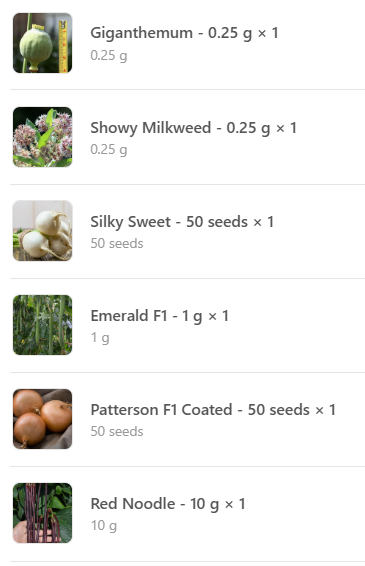
From the top (all links will open in a new tab):
Giganthemum: This is something that Ashley from Gardening in Canada had in her recent seed haul video. Yes, I already have bread seed poppies. This variety, however, is supposed to get seed heads as large as a baseball! It has edible seeds, which is the main reason for ordering them. I have a space selected to grow bread seed poppies as a perennial, where I will allow them to re-seed themselves. What I will probably do is find another such location, in another part of the yard, and grow both varieties.
Showy Milkweed: this is the main variety of milkweed for Monarch butterfly conservation efforts. I’ve got an orange variety of milkweed that I have not been successful with. Hopefully, we’ll be able to get this variety established as part of our efforts to attract more pollinators.
Silky Sweet turnip: I already have some white turnips winter sown. I chose this variety because it just sounded like it would be really tasty. It matures in only 35 days and is a cool weather crop, so this can be succession sown throughout the spring, and again in the late summer/fall, if we want.
Emerald F1: This is the luffa gourd that matures in only 55 days! It’s listed as a dual purpose gourd, as the immature gourds can be eaten, but I think that’s true of all luffa varieties. We might try eating some, but that I want are those sponges!
Patterson F1 onion: Okay, yes, I have my own saved onion seed, plus red bunching onions and red bulb onions started. My saved seed is a mix of red and yellow bulb onions. I chose these because I wanted to be sure of yellow onions, and they are described as being exceptional storage onions. Unless I start them as soon as they arrive, though, these will be for next year.
Red Noodle bean: I couldn’t help it. I just really, really want to successfully grow the red noodle bean at least once! When I tried to grow them last year, I had an amazing germination rate, the seedlings exploded into growth, got to about 6-8 inches tall, and then stopped. They never got any bigger, and I don’t know why. I can make guesses, considering the horrible growing conditions we had last year, but they are still just guesses. I have quite a variety of bean seeds, both bush beans and pole beans, as well as varieties for drying, so we will have lots of choices, once the soil warms up enough for direct sowing.
There we have it. My first West Coast Seeds order.
Oh, my goodness! I just checked my Amazon tracking. My chicken coop and my lights and seed mats have arrived!
If I leave right now, I can get there before the post office closes for 2 1/2 hours over lunch.
The Re-Farmer
First, the cuteness!
The outside cats are certainly running around a lot more, now that things are warming up! It’s going to get quiet pleasant for the rest of February, according to the long range forecast, though the local weather group I follow is monitoring a weather system that might push a Colorado Low into our area.
I never got a call from the hospital yesterday, so I called them before going to bed. I’m glad I did, because my mother called me this morning!
She is still in the hospital, all packed and ready for her transfer. She told me she asked the staff about when she was leaving, and that they told her they didn’t know how she would be transported. Which is strange, since they told me from the start that they are arranging her transport.
The doctor at the hospital was never able to connect with the doctor and the temporary care unit, and that’s why she didn’t get transported yesterday. I explained that to her, and assured her that the hospital would be arranging the transportation. Likely with a HandiVan, rather than an ambulance. My mother didn’t even know where she was going, other than it would be in the smaller, nearer city. I told her, she would be in the old hospital, now converted to temporary long term care, but that we still didn’t know where in the building she would be. She was satisfied with that. She sounded like she was really looking forward to the transfer!
Late this morning, I headed out to the feed store in the town my mother no longer has an apartment in. 😄 We’re heading into the middle of February already (how did that happen so quickly???), and we still had kibble, so I only got three 40 pound bags. I also ordered some lysine, which should be in on Monday. Or Tuesday. Monday is a statutory holiday (it has different names in different provinces) and I think they will be closed.
Since I ordered that chicken coop – which got shipped yesterday already! – I stopped to ask some questions about chickens. The two people that were there at the time got quite enthused in answering them! I’ll need to set up a brooder (I already have the heat lamp, currently being used in the sun room for the cats). They gave me a booklet from the hatchery they get their chicks from that has all the information needed. I know we still have feeders and whatnot in the old log building my parents used as a chicken coop when I was a kid, but I’m not about to go digging those out. They’ve been there for probably 30 or more years by now. I honestly can’t remember when my parents stopped keeping chickens.
I asked them which breed they would recommend for someone just starting out and looking for layers. They both very enthusiastically recommended Browns. They were really impressed with the number and size of the eggs this breed lays, plus they are known to be quiet, friendly and clean.
The chicken coop that’s on its way is big enough for only 10 chickens, which is a bit of a problem. The hatchery’s minimum order is 24 chicks. There is, however, someone else that’s looking for only a few chicks, so they took my name down alongside theirs. If they can find one more person, they can split a shipment, and the shipping costs, after the chicks arrive. It costs a bit more for sexed chicks, but with only 10, I don’t want to have any roosters in there. By the time everything is added together, it should cost me about $75 for 10 chicks. Meanwhile, I can slowly start picking up the other supplies I will need, like feeders and waterers. I can get pine shavings locally.
Over time, as we build bigger coops, we’ll look at getting meat birds, too. If we’re looking to fill the freezer for a year, we’d be looking at at least 100 meat hens, so that would require a much bigger coop! Or multiple smaller ones. It’s a shame the building my parents used can’t be used. We might still be able to fix it up at some point – it’s still in good enough shape for that, at least – but that is very much a long term project.
Once I was done there, I topped up the gas tank ($1.279/L *sigh*), then went to the grocery store. I was mostly looking to get more rye bread, but found a few more things, of course – including some tri-tip beef that was on sale. Beef has become something where local prices tend to be better than Costco prices. At least when the sales are on. Still high, but at least affordable enough to grab the odd package now and then.
I also got sucked in, as soon as I walked in the door.
There was a seed display. The first I’ve seen this year!
Of course, I had to look, and yes, I did get seeds.
The first are some double marigolds. These are something I want to scatter plant all over the various garden beds, wherever there is space. They can be started indoors 4-6 weeks before last frost, so around the middle of April or beginning of May. Marigolds are easy to collect seed from, so I should hopefully be able to collect some for next year.
I also got some yellow zucchini, because I just can’t have too many summer squash! These can be started 3-4 weeks before last frost, so in the beginning of May.
Both can actually be direct sown, too, so I might try a bit of both. It depends on how much room I find myself with.
I seriously had to resist buying more!
So we are set for the next while. I don’t need to head out anywhere again until it’s time to take the truck in to get the differential leak fixed – a 2 hour job. I had intended to visit my mother while the work was being done, but she shouldn’t be there anymore. Depending on when they can start working on the truck, once it’s done, I will likely to head to the city my mother will be in, to hit a Walmart and a Canadian Tire, both of which are quite close to the old hospital building she is being transferred to.
I’m actually surprised I haven’t gotten a call from the hospital yet. That means she hasn’t been transferred yet. I would have hoped the doctors had connected by now!
Ah, well. We shall see. The main thing is, she is safe and care for, either way.
Now… time to start pouring through that hatchery booklet I picked up today!
The Re-Farmer
Addendum: Oh! I just hit publish when a message from my brother came in. The hospital just called him. My mother is transferred, safe and sound!
But first, the cuteness!
Just a little video of the adorableness that kept trying to run into the house while we were unloading the Costco shop. He would be such a great indoor cat! He’s not “perfect”, though. Aside from the one messed up eye – which doesn’t seem to bother him, but does make him at greater risk if he decides to expand his territory in the summer – he likely has some upper respiratory issues. He’s been better since we’ve gotten more lysine to add to their food, but it basically makes him unadoptable.
The rescue can’t even help with him. They’ve had to stop all intakes. They are out of fosters and there are no more spaces for more cats.
*sigh*
I also realized today that I haven’t seen Rolando Moon for quite some time. She does tend to disappear for weeks, sometimes months, at a time, but usually in the summer, not the winter. Considering I got pictures of her when I visited my dad here, back in 2015, I’d estimate she would be around 14-15 years old, if not older. We did try to make her an indoor cat, but she would have none of it.
*sigh*
Anyhow.
I just got back from checking on our seed dungeon in the basement. I found fresh green!
The first picture in the slideshow above is our very first Golden Boy celery seedlings! There’s just the two, but I will now keep the lid open on the container I’m using for them, so they don’t have to deal with too much humidity.
The second picture is of the first pre-germinated luffa breaking ground. I now know at least one has survived being potted after pre-germination!
I didn’t take a picture, but I also potted more Caspar eggplant, and the first couple of California Wonder bell peppers that have pre-germinated.
Thinking ahead to the next batch of seeds I will be starting (herbs, this time), and when, I have placed an Amazon order for a couple more heat mats, plus some full spectrum lamps. Their prices were very reasonable, so I got one floor lamp with a tripod stand and two table top lamps. They have multiple full spectrum LED light strips on gooseneck supports, so they can be adjusted to provide light over several different trays at once, and the trays don’t have to be crammed together. The floor lamp has 5 light strips, while the smaller ones have four. The smaller ones have clips for bases. I would have preferred with a stand, but that didn’t seem to be an option at all for the smaller ones. They also have auto on/off timers.
They haven’t been shipped yet, but according to Amazon, they should arrive by the 18th. That should keep me from starting more seeds too early! 😄
The Re-Farmer
A couple of days ago, on checking the seeds I’ve set to pre-germinate, it looked like some were just starting to show radicals. Nothing ready, but it seemed they soon would be.
So I grabbed one of my deep celled trays and prepared it in advance. These trays have 21 cells, and I’m looking to have 1 row of each of the seeds I have pre-germinating right now. The seed starting mix in the cells are all pre-moistened, ready and waiting.
When I tried pre-germinating seeds last year, I let them sit for probably too long. Their roots started to go into the damp paper towels and had to be very carefully pulled free. From what I’ve been seeing online, they really should be potted as soon as the radicals appear.
So that’s what I’ve already done with the luffa.
Yesterday, that first seed I saw that looked like it was starting to show its radical – a Caspar Eggplant – had started to germinate. Just the one. So I planted it into a prepared cell, then topped it with vermiculite, partly so I could easily tell which cell has a seed planted in it.
Today, I found another eggplant, plus some Sweet Chocolate peppers.
I would prefer to have these on another heat mat, but I only have one. The light fixture above them, however, does put off some heat. With smaller seeds closer to the surface like these, it will actually be enough to affect them.
I did have to raise the light fixture another inch to fit the large celled tray under it, but that should be okay. I’ll keep transferring seeds over as they germinate. With these larger cells, I should be able to avoid potting them up for some time, if at all.
As long as the pre-germinated seeds survive the transfer, I should have 7 plants each by using this tray. If I’d been using the Red Solo cups, I can fit 9 cups in each of the bins I have to hold them, so that’s what I would have been shooting for as a total. Seven should be enough, and I am not expecting 100% germination rates, nor 100% transfer survival rates.
We shall see!
The Re-Farmer
I got to stay home today, for a change!
I did get messages back from the garage about the truck, but nothing about coming in. I’m not sure the problem is the sensor, after finding some oil on the ground in the garage yesterday. It was a while before I went out to move it today, so that I could check the oil levels, and see if there were any new oil stains under it.
There was. Just a couple of drops.
*sigh*
Oil levels were fine. I’m going to have to take a chance, though, and at least make a trip to the nearest Walmart. We’ve used the last of our canned cat food today, and the dry kibble is starting to get low, too.
It was a nice enough day that, after checking on the truck, I stayed out to clear some of the paths that got filled with drifted snow, after two days of high winds. Happily, the plows have gone by, so the roads will be clear. Things are supposed to keep warming up over the next few days, which is going to be quite a relief.
Of course, that makes me think of gardening!
The peppers and eggplant seeds that are set to pre-germinate aren’t showing any radicals yet, nor to I expect them to, this soon. Next on the list was things like tomatoes and herbs, but after watching the above video, I will just be doing the herbs, first. I sorted seeds I’ll be starting by how many weeks before last frost the packages recommend starting them. In theory, I could start the tomatoes in April.
I just really, really want to start more seeds! 😄
I realized it’s been a while since I updated about the onions. All four snail rolls now have seedlings.
They’re tall enough now that I raised the light a bit today. Should they get big enough to need “potting up”, they can be unrolled, more seed starting mix added, then rolled back up again. I made sure to leave enough excess length of the packing foam to accommodate extra width.
Just a little green growth to sooth the gardening soul, as winter drags on!
The Re-Farmer
Look what I found when I checked the pre-germinating seeds today!
The last two luffa seeds have radicals!
They are now potted up into Red Solo cups. This time, I remembered to use warm water when pre-moistening the seed starting mix. I had the heater running on the area I was working on, too.
With the space I had in the drain tray, I switched the paper towel the eggplant seeds were on into a smaller container. So far, nothing on the peppers and eggplant. This is definitely a first. Usually, the luffa have always been among the latest seeds to germinate. Before using the pre-germination method, I often had to start new seeds, sometimes twice over, before we finally had something germinate.
Now we just have to see if they will survive being potted up!
The Re-Farmer


 The Re-Farmer