Things NOT to start indoors! (video)

Gardening in Canada put out another really useful video today that I just had to share.

Of course, we still need to take into account our individual situations.

Some of these I would have thought were obvious. Root vegetables, for example. I’ve heard you can actually buy root vegetables as transplants in greenhouses (I don’t recall seeing them, myself, but I might just have missed them), and to me, that seems downright unethical.

Only recently have I seen people starting things like peas, beans and spinach indoors, which I found perplexing. Peas and spinach are among those things that need cool temperatures to germinate, and can be planted before last frost. It’s just too warm to start them indoors, isn’t it? Beans germinate and grow so quickly, it seems like extra work to start them indoors. As for lettuces, I do know of people who grow them indoors, not for transplant, but for winter greens, so that’s an option. I do recall seeing lettuces and leafy green transplants in the stores.

With things like melons, cucumbers and squash, winter or summer, I’ve been starting some of them indoors because I only have a 100 day growing season. Last year was the first time I direct sowed summer squash, and they were a magnet for slugs. Some of the ones that survived did well – the G Star patty pans in particular – but I had to resow most of them several times, and still ended up with just a few plants that didn’t produce very well, compared to past years where they were transplanted. This year, I will be direct sowing again, but need to find a better way to protect them from slugs. I just won’t have the space to start them indoors.

As for the winter squash and melons that we transplanted; the melons did well in the kiddie pool raised bed, but needed more time than we had, even though they were supposed to be short season varieties. With the winter squash, the mounds that got full sun suffered more than those that got partial shade. Basically, the full sun ones got baked. The transplants also survived the slugs better than the direct sown summer squash. Because of the growing season, I will probably start winter squash indoors, but this year, we have some shorter season winter squash, so we might be able to get away with direct sowing.

Her comments about luffa is in line with what I had been considering doing myself. I don’t have the seeds to try them again this year, but when I get more seeds, I want to try starting them in a larger pot, and simply taking the pot outside when the time comes. Last year’s transplanted luffa, we got one plant that did remarkably well in the wattle weave bed, so I know it can be done!

As for cucumbers, those were something we tried starting indoors two years in a row. The first year worked fine. The second year, not at all, so we’ve got something else going on there. It could simply be the different varieties.

I have never heard of anyone starting potatoes indoors before! Same with garlic, other than in those silly 5 Minute Craft type content mill videos.

As for corn, we did try starting corn indoors, because we were trying to grow kulli (Maize Morado) corn. We could get away with direct sowing the Montana Morado corn, as it’s a shorter season black corn, but kulli needs 120 days to maturity. Transplanting the kulli corn did result in transplant shock that set them back. Once they started growing, they got huge – but didn’t start developing tassels or cobs before the season ran out. Since we are building covers for our beds, I am thinking that when we try them again in the future, I will make use of those. First, to create a greenhouse situation to warm the soil of a bed earlier, then keeping it warm after sowing. While our last frost date is June 2, we do tend to get nice warm weather before then, so we should be able to get that extra 27-30 days (days to maturity, plus days for germination). Basically, we’d have to find a way to plant them at the beginning of May to give them enough time to fully mature.

Hmmm… I should check the calendar. I’m sure there’s something I can start indoors about now…

The gardening itch is hitting me hard right now!! 😄

The Re-Farmer

The value of failure

I just had to share this excellent piece from the Maritime Gardening Newsletter, Failure is the Best Guru.

This is the video included with the newsletter.

I highly recommend signing up for his newsletter and subscribing to his Substack.

In regards to failures, I heartily concur. We’ve had a couple of really bad years in our garden, and learned the most from both of them! We now know how our garden spaces respond to heat waves and drought, flooding, and that we’ve got a major problem with slugs to figure out!

The Re-Farmer

Learning about soil zones (video)

Most of us are familiar with climate zones, but soil zones, too?

Of course, I was aware of different soil types in different regions. I just didn’t know there were names and classifications for them.

Gardening in Canada just did a video all about soil zones, and I learned so much!

Well, things make a lot more sense, now!

In the past, I’ve described where we live as being in that transition zone between Boreal forest and prairie. It turns out that zone is known as the Dark Grey soil zone.

I’ve also written about testing our soil. You can read about how those went, here, here and here.

This is a picture from one of those soil tests. Blue cap is phosphorous, purple cap is nitrogen and orange cap is potash. The only bright colour is the dark green pH test, showing we have very alkaline soil. The test colour strip only went to 7.5, and the samples were all darker than the colour strip got! Even our direct soil pH meter only goes up to a pH of 8, and I think our soil is probably at least a pH of 9 or even 10.

Besides being in a Dark Grey soil zone, we are also sitting on top of where the ancient glacial Lake Agassiz one was. When the lake drained, it was with incredible speed, and is believed to have extended the last ice age. Which means the water also took a lot of the lighter sediment from the lake bottom, with it, leaving behind the heavy stuff.

Like rocks, gravel, sand and clay.

Dark Grey soil zones have a problem with leaching. Basically, any time we have rain, the soil nutrients get leached down through the sandier layers below. Our region has more sand and gravel, than others. That means we’d have nutrients leaching out of our soil, even faster. Also, the leached nutrients would normally form a dense, compact lower layer. I don’t know where that layer would be forming in our area. Even when heavy equipment was used to deepen our gravel pit, as well as a dugout in the other quarter section that’s rented out, there’s just gravel and sand and clay.

When my mother had her huge garden here, my dad would plow cow manure into it almost every fall. That hasn’t been done in over 20 years. However, gardening did continue. Even after my parents could no longer garden, a couple of my brothers and their wives kept up small areas. The old garden area did still get plowed in the fall.

Plowed, but not amended. Among the things that disappeared from here over the years was the old manure pile from behind the barn. In fact, there are now dips on the ground where the pile used to be, so whoever took it, dug down pretty deep.

Yeah. Someone stole the manure pile.

I’m pretty sure I know who, but no matter.

So our soil conditions are as poor as they are due to both the lack of amendments, and our geology.

We’re not in a position to buy truckloads of manure and getting it all plowed into the area. Which means our plans to use raised beds of varying heights, modified hügelkultur style, is going to make all the difference in the world.

Thank you, GIC, for putting out this video! This information is going to be very useful in helping us plan things out.

The Re-Farmer

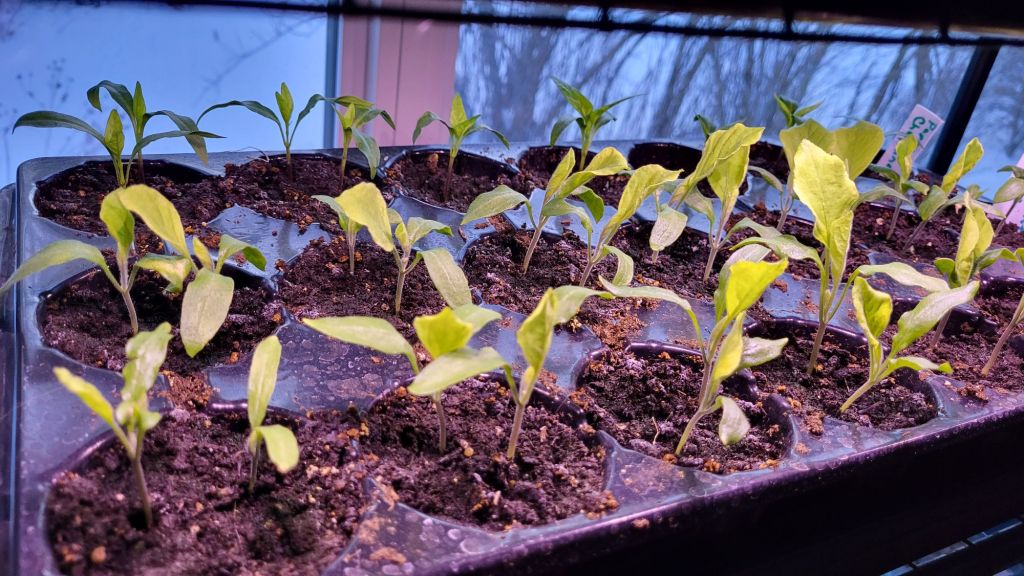
Our 2024 garden: pepper and eggplant progress

Check these out!

I took this picture after turning on the LED grow lights, but before turning on the bright shop lights. The LED lights are only along one edge of the shelf above, and I had them over the peppers for a while, but I’ve since rotated the tray, so the eggplants can be under the grow lights for a while.

It’s getting to be time to thin out those eggplants, and a couple more peppers. Thinning out is always so hard for me. I keep wanting to thin by transplanting, since I don’t want to “waste” any seedlings. The thing is, we don’t need that many! We could probably do fine with maybe 3 or 4 of each plant, including the peppers. We certainly don’t have enough space for all of them!

In the big aquarium greenhouse, all three cups with the Sweet Chocolate peppers now have seedlings in them, though it’ll be a while before they’re at the stage that they need to be thinned. With the Purple Beauty peppers, the one cup now has 4 seeds germinating; one cup had 4 seeds planted in it, the other had 3 seeds – the last of our Purple Beauty seeds. The second cup has nothing germinating it, so for that variety, when it comes time to thin them, I will thin by transplanting. I’d like to have at least two surviving plants and, right now, there are four seedlings, so we’ll see how that works out. For now, I’m leaving them in the aquarium, but I’ve moved the red onions out and under the lights at the window. We’re not going to have many of those to transplant, compared to the yellow onions and the shallots.

I spent some time looking for replacement bulbs for one of our tank light fixtures. The one with a burnt out bulb holds 2 bulbs that are T5HO. Looking at the various hardware store website, I can find the bulbs, but at sizes ranging form 12 to 18 inches. We need 48 inch bulbs. The one place that had them, they were sold out.

I did, however, find replacement bulbs on the Veseys website. These are the bulbs they use in their grow light set ups. The price for a pair of fluorescent bulbs is quite affordable. They also have LED alternative bulbs that fit the same fixtures, which last much longer and use less power, but are more than triple the price. I’ll be sticking with the fluorescents!

I checked the other light fixture we have over the tank, and it uses a single T8 bulb. That bulb is still fine, but it’ll be a good idea to get some spares of that one, too.

In the next couple of weeks, we’ll need to start our next batches of seeds. Time to go over them and make some decisions.

Speaking of seeds, I’m considering making another seed order. I’d had an order with my T&T Seeds shopping cart when my computer died. By the time I logged back on to place an order it was, of course, no longer there. My daughter had requested a couple of squash to try and I remembered one of them. Talking to my daughter later, she asked about the second one I’d completely forgotten about. When looking for replacement bulbs on the Veseys site, I couldn’t resist looking at seeds, and realized they also have the type of squash my daughter was interested in. In fact, there are two similar ones. So now I’m thinking of getting those, too.

We already have SO many squash seeds right now, though, including a winter squash surprise mix. We don’t need more seeds!

And yet…

The Re-Farmer

Is growing your own food affordable? (Videos)

I just had to share this really interesting video from Huw Richards.

Richards is based in the UK, and he’s in a wildly different growing climate than we are, but some things are pretty universal.

Richards set himself the goal of growing enough food to feed a household of four in a small space, and kept track of everything, including the costs, then comparing to what it would cost to buy that food (he does include what the costs are in US$ and Euros). Of course, his costs and availability would be different than were we are, but the same methodology can be used anywhere.

For our situation, we have the luxury of space, which is good because we also need to take into account accessibility in our planning. His narrow paths between beds, for example, are not something we can get away with. We also need to have higher raised beds, again for accessibility and mobility reasons. To a certain extent, we are also able to scavenge materials around the farm, whether it’s felling dead trees and using the logs to build the raised beds, or scrounging for lumber and tools in the barn and various sheds, we should be able to get away with spending less. Our plans will – eventually – incorporate animals to help improve and amend our soil. We were supposed to at least have a few chickens, a couple of years ago, and that just didn’t happen. It’s a goal that has been shifted to this year but, the way things tend to derail our plans, I’m just hoping we can at least get started on building a chicken coop, so we can get chicks next year!

This next video on self sufficiency is also really useful.

He’s a real wealth of information!

The Re-Farmer

Our 2024 Garden: new sprouts, no sprouts, plus possible cat adoptions!

While shutting down the lights in the big aquarium greenhouse, I spotted a bit of green. By this morning, there was more!

In one of the two cups they were sown in, all three Purple Beauty bell peppers have started to sprout.

In one of the three cups the Sweet Chocolate bell peppers were sown in, there’s one sprout emerged, and another pushing its way through. There may even be a third, under a piece of perlite, on the right. If it is, we’ll know by the end of the day.

With the thyme sprouted for so long, but nothing else, I had unplugged the heat mat some time ago and just hoped the tank would still be warm enough for the other seeds. There is NO sign of the oregano. We had issues with oregano last year, too. I’ll give it a bit longer, then decide if I want to try sowing them again, or just give up on the oregano from seed this year. It might be better to buy a transplant when the garden centres open in the spring.

In other news…

I was contacted by the Cat Lady a couple of days ago. She has been able to find open adoption spaces at a couple of shelters in the city for us. After much discussion, we’ve decided that both Ginger and Toni will go to one shelter. They have a set up just for special needs cats, and apparently three legged cats are extremely popular. In the city, at least! The other shelter specialized in Siamese or Siamese looking cats. I sent a picture of Ghosty’s face, and she was identified as a Lynx Point Siamese. My daughters figured she was a tabby with albinism! Either way, this shelter tends to have rather high end clientele, so Ghosty will likely find herself in the lap of luxury before long!

As I write this, I can see the live feed from the garage cam. There are 6 cats milling about. It’s that time of year again. There’s been a lot of baby making going on, and the males are starting to fight over the females. I’m so frustrated that we haven’t been able to snag any of the females to get fixed! They simply will NOT let us near them! I think the super fluffy little tabby that is sibling to Patience outside, and Peanut Butter Cup, the Beast, and Soot Sprite, inside, is female. It’s hard to tell with all the fur, and I can’t get close enough to check, anyhow, but the way I see her behaving around the males right now…. *sigh* Why are all the females so skittish, but the males so friendly?

Anyhow.

If all goes to plan, we might be down three indoor cats on Friday! I’ll be driving them out half way to meet the Cat Lady, and she’ll take them the rest of the way.

This morning, after giving the outside cats their food and warm water, I did a bit of shoveling. I’m much less stiff and sore than I expected to be, after yesterday! I made sure to have some Golden Milk before bed, which I think helped a lot. Lord knows, the painkillers aren’t doing much. We now have paths to the compost pile, the back of the garage, the outhouse, and the litter pellet compost behind the outhouse.

What I am NOT going to bother doing is clear a path to drive into the inner yard. I don’t see the point.

We are getting snowfall warnings for this evening, though – another 10-15cm/4-6 inches – so we might need to clear the driveway again tomorrow, so we can meet with the Cat Lady on Friday. Hopefully, the gravel roads will be plowed, too. I thought it was done already, but when I cleared our driveway, I found that what I though was a plow ridge visible on the garage cam was just tire tracks from the one vehicle that managed to make its way down our road. !! I don’t expect to have troubles with the truck on the road, but our driveway tends to drift a fair bit. Mostly right in front of the garage.

We have several packages to pick up at the post office, which closes at noon today, so I will be heading out soon to get those, then keep going into town with a couple of water jugs to refill, and pick up a few groceries. I’ll have to snag a daughter to help me bring things to the house from the garage, since I won’t be able to pull up to the house. Either that, or reclaim the wagon from the storage side of the garage. It’s got our chainsaw and other tools I was using to clear trees and work on the first trellis bed stored in it. With the paths in the snow, though, it might be easier to just carry things in. We’ll see.

As I write this, we’ve already warmed up to -13C/8F, and we are expected to reach a high of -5/23F after the snow starts to fall. We’re expected to stay below freezing for a few more days, but the forecast is now saying we should reach of high of 2C/36F on Sunday, and be staying with highs at or above freezing from then on.

We’ll see what actually happens! I just want that snow to melt away slowly, so we don’t get any flooding aside from our usual moat around the garage. 😁

Well, time to get ready to head out, and see what the roads are like!

The Re-Farmer

Seeds to start in March

What better thing to do when winter is asserting itself, is watch gardening videos?

Gardening in Canada has put out another excellent video for us short-season gardeners. Here, she talks about the seeds we should start now, or can get away with starting now if we do it right, and which she would advise against starting until April.

I believe she lives a bit further North that we do, but her last frost date is earlier than mine, so she can actually start seeds about a week two earlier than me.

I appreciate that she says that no one knows your garden in your area better than you, and to take that into account when deciding what to start. Everyone has their different soil conditions, microclimates and other factors that will affect how things grow – and what will grow at all! I also like that she recommends new gardeners take advantage of the wealth of knowledge among people in the comments section. You’re bound to find someone living in your part of the world that can answer them far better than she can, living where she does.

I suspect I’m going to be sharing her videos here regularly over the next while!

The Re-Farmer

Wise Words

Sometimes, I tease myself, watching gardening or homesteading videos by people who live in wildly different climates than I do. The things they can grow, when we’re still months away from being able to plant even cold hardy crops leave me pining!

Of course, there is always something to learn, even if much of the other stuff doesn’t apply to us.

Homestead Heart is one of these video channels that I find inspiring and informative. Some things apply, no matter where you live or what your growing season is like! This is one of them.

She makes some awesome points. When things were shutting down and grocery stores were empty, it really shook people up. So many people started talking about growing their own food, or stocking up seeds for the next time something goes wrong, and the stores are empty again. As much as I absolutely support people doing this, it was rather dismaying to see so many people excitedly sharing “how to” videos produced by content mills that were absolutely fake. At best, the information was useless. At worse, it was dangerous.

So if you’re among those looking into growing your own food, now or in the future, this is someone who tells it like it is, flat out, with no holds barred. She’s awesome!

The Re-Farmer

Seed tray purchase is in!

Recently, I saw this video from Gardening in Canada.

I liked what I saw with the seed starting kit, and her review of it. The main thing being, each tray has its own grow light, and we have lighting issues. The price was in the Cdn$30 range, which isn’t much more than getting a seed starting greenhouse kit, with the 72 pellets and dome, making it well worth picking up. So I logged into my husband’s Amazon Prime account and put it on my own wish list. I was planning to get it on our March budget, and the first disability pay was coming in soon, so I put it in the cart, too.

What I didn’t expect was for my husband to place an order before the end of the month! He saw it in the card, and included it with his own order.

It came in today.

Here are the contents.

As you can see, the cats were very interested, too!

At the top, under Cheddar, are the 5 green base trays for bottom watering and the 5 clear growing cells. Next to Soot Sprite are the tall cloche lids, each with an indentation for the lights and openings to allow moisture to escape.

Bottom left are a pair of tiny little garden gloves. Okay, tiny for me and my wide, simian hands! On top of the gloves are the label markers. Above them are a pair of very interesting looking tools!

Bottom right are the LED lights, tops and bottoms showing. Once inserted into the covers, they can be turned to cover or uncover the openings and control moisture levels. There’s the instruction sheet, and finally the cable to power the lights.

It was the cable that I was unsure of, and this is why.

It’s USB, with octopus cables for each of the lights.

We are going to not only need an adapter to plug this in, but an extension cable. A long one. There are no outlets anywhere near where we can set these up, and the one power bar we have with USB slots on it, both are being used for phone different chargers.

I’m pretty sure we already have both the extension cable and spare adapters. I’ll have to check with my husband, as he tends to have things like that with his computer stuff.

The one surprise for me is that I somehow expected the trays to be bigger. I don’t know why, since I saw them being handled in the video.

We don’t need to start seeds again until after mid March, so we have time to arrange a set up for the trays in the cat free zone, then work out getting power to that USB cable.

I’m quite looking forward to testing these out!

The Re-Farmer

Raised bed considerations

For us, building our raised beds is a matter of using what materials we can get without having to buy anything. We’re scrounging and salvaging whatever we can.

If, however, you are in a position to actually purchase raised beds, there are a lot of options, kits and companies out there to choose from.

Gardening in Canada covers some of the things to think about – and a few things I didn’t think about at all, since they’re pretty irrelevant to our situation. This video is well worth a watch.

After we’ve built more of our raised beds, I think I might do a video about them. Everyone has their own very individual situations to consider. Perhaps it might be useful to people if I go through my thought processes as to why we made the choices we did, and apply that process to their own situation.

What do you think? Should I make such a video?

The Re-Farmer