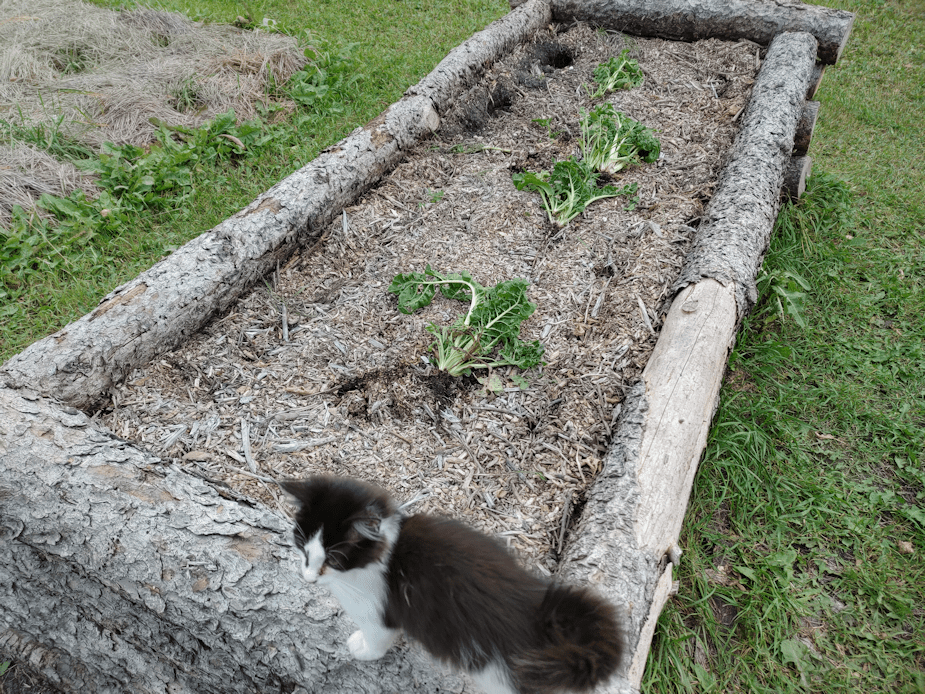
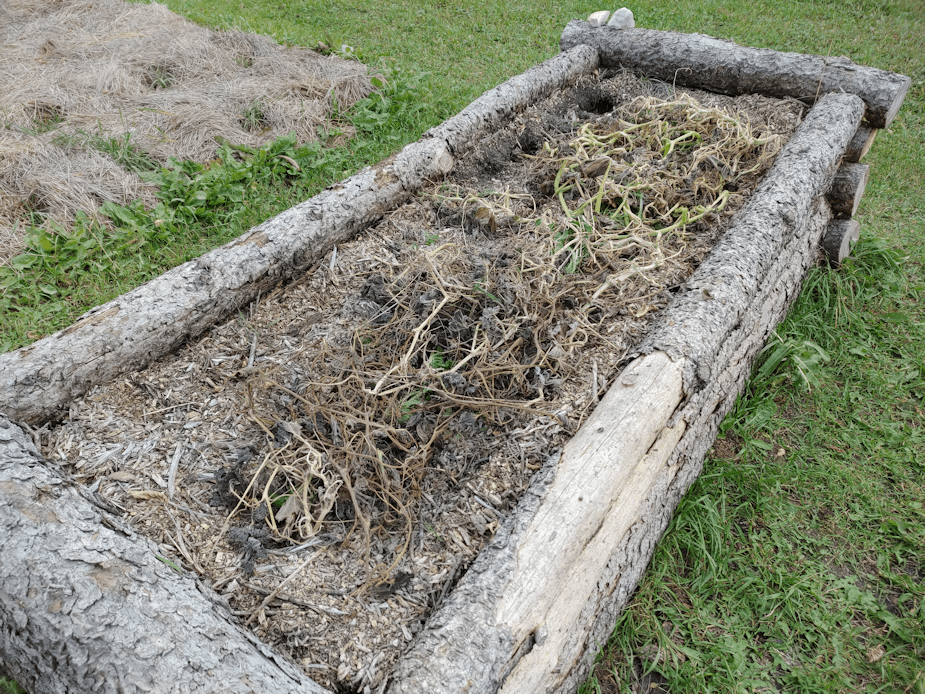
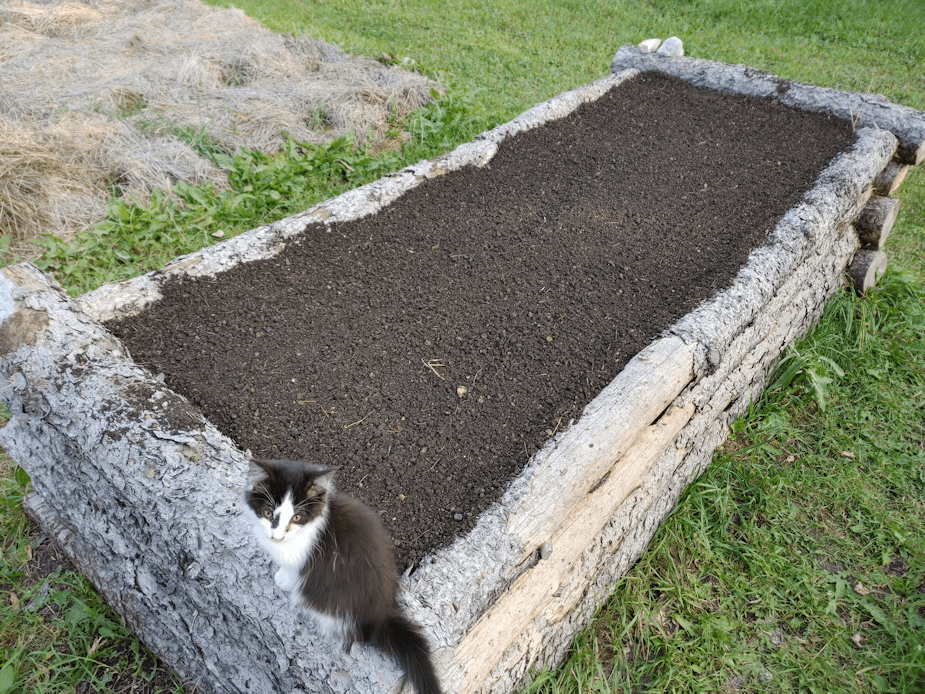
Oh, what a lovely day!

It’s almost 6pm as I start writing this, and not only have we reached our predicted high of -10C/14F (my app says there is a wind chill of -19C/-2F, but I just got back from topping up the outside kibble, with no jacket on, and there was no wind), but it’s supposed to keep getting warmer overnight!
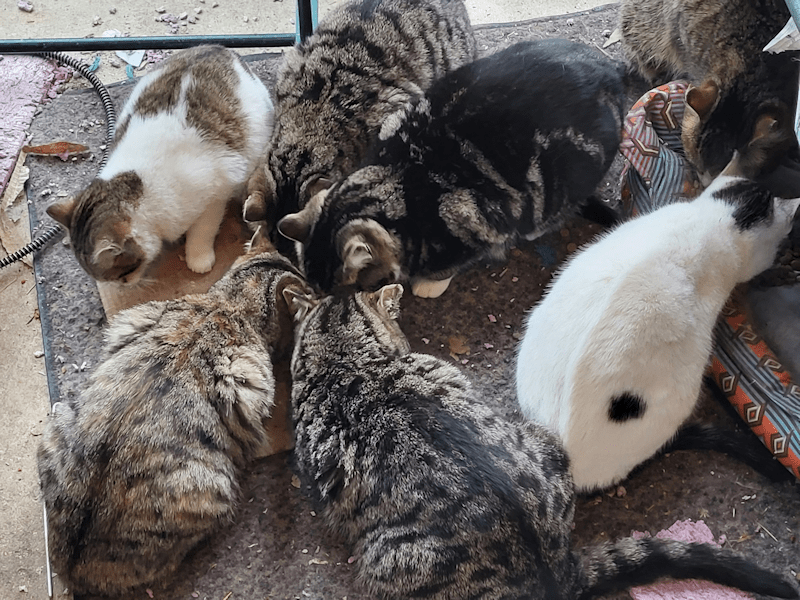
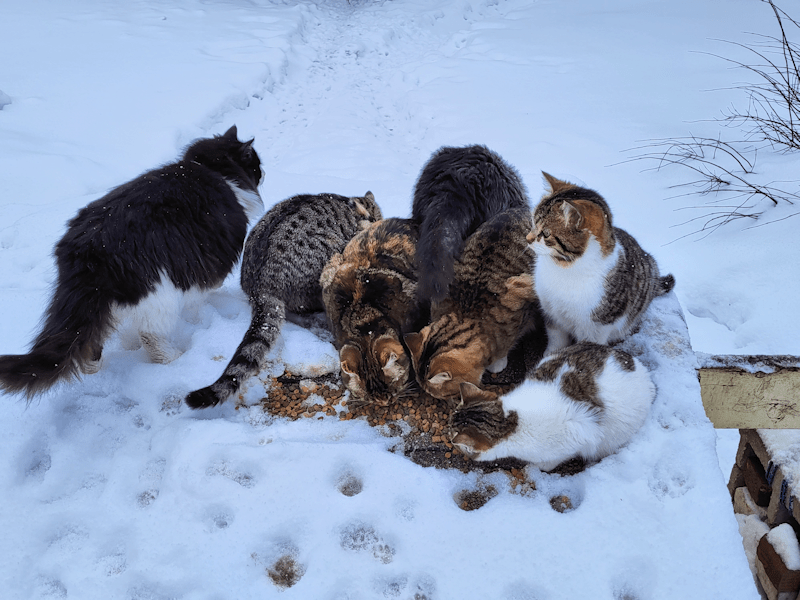
The grey tabby that has suddenly become friendly – it’s the one between the black tabby and the white and grey at the top – managed to sneak into the old kitchen while I was coming out with kibble. He not only let me pet him, but I was able to confirm he is male.

Now why can’t any of the females suddenly become friendly? They still won’t let us anywhere near them! The calicos and torties are pretty much guaranteed to be female. Not sure about the rest of the tabby cattens, besides Judgement and the newly friendly one.

They are just loving the warmer temperatures, and so am I!

I’d made arrangements to get some farm fresh eggs this afternoon. Then I got a message saying they had to make a trip to the city to try and find a part, so that got postponed until they got back. With the warmer temperatures, I’ve been feeling so energetic and antsy, I ended up going into town to pick up a few things, even though we were planning a trip to the city soon. I was home long enough to get a chicken carcass in the slow cooker to make stock when I got the message that they were heading home, so I was back on the road soon after.

Aren’t they beautiful? I love the green ones!

I am always so inspired when I visit this place. This is the same person we’ve been getting our cardboard from, to use while making new garden beds. Today, I got to meet their new additions – a pair of fainting goats, and two emus!

Emus are flippin’ huge!

This is in addition to their alpaca, horses, donkeys, hens, Guinea hens, and probably other birds I don’t know about. Once we have our coop, I’m hoping to be able to buy chicks from them, too.

While I did a small trip today, I’ve decided to do a big city shopping trip tomorrow. We’re expected to have a high from 0C/32F to 2C/36F, depending on which app I look at. I figure I may as well take advantage of the warmth. This time, we’ll be going to a different wholesale place, where I know I can get things like the big buckets of ghee and restaurant size bags of pasta. It’s time to restock pantry supplies we’ve been using when we weren’t able to make our usual big trips. We didn’t have the extreme cold we usually do, other than the past week or so, but with the holidays, December and January are always the worst months for making these trips. I’m actually looking forward to the outing, even though I’m not at all looking forward to the shopping!

My younger daughter has different plans for tomorrow. Getting back to cleaning the basement! The cats have made a mess of the new basement, and she’s using that as an excuse to do a deep clean and organization of the space. That basement, however, isn’t much warmer than outside, even with the extra insulation added around the base of the house in the winter. During our recent deep freeze, it simply got too cold to work down there. It should get much better, and stay better, from now on. She wants to get it to the point that they can paint the basement. White paint on the ceiling (which is the exposed beams of the floor above) and special anti-mold and mildew paint for the walls. I don’t know if they want to do the walls white, too, but definitely a light colour. There are quite a few lights down there, but it’s still really dark.

We have a lot of big projects planned for when things warm up. Too many, really. The girls are focusing more on the inside, and are also talking about getting flooring for the kitchen and dining room, and refinishing the kitchen cupboards. Outside, I want to get that mobile coop built (and if that isn’t possible, we’re supposed to be getting a shed given to us that can be used until we can do the mobile one). Another project that will take probably quite a long time, as we acquire materials, is the outdoor kitchen. First priority is the timber frame roof. Once there’s a roof, we can be more leisurely about what we build inside. One side will have a smoker, clay oven, a “stove” opening to fit a large wok, and a grilling area. Two sides will have moveable work stations, and the fire pit will be added. The eaves of the roof will be longer past the wall of one side, where my daughter wants to have a forge.

Since we aren’t able to build the outdoor bathroom where we want to, until after a number of dead trees are removed, I want to do another, smaller, cordwood practise building. We need a new garden shed, so we can build a smaller shed – about 6’x8′ on the inside – in the maple grove, where a couple of trees had been removed while the power lines were being cleared. That is less of a priority, but since things will need to be built in stages, as we get materials, we might actually be able to get started on it this year.

Of course, there are also the high raised beds that need to be built. The outdoor kitchen actually solves something I was trying to figure out. The dead trees that we need to take down are quite large around. Too large to be practical for the high raised beds. I was considering cutting them in half, length wise, but now I’m thinking they’d be extremely strong upright supports for the outdoor kitchen frame. We can cut the lower, thickest, part of the trunks to the length we want, and then use the rest of the trunk for the high raised beds. It’ll mean more trees need to be cut down, but we need to do that, anyhow. With more than 20 dead trees that need to be removed, that’s more than enough to do both uprights for the outdoor kitchen, and the high raised beds.

Of course, there is the garden that needs to be worked on, including building new, permanent trellis tunnels, and other mobile trellises and supports. Plus trees and berry bushes to plant.

Oh, and on top of all these projects, we still need to dismantle that shed with the collapsed roof. We’ll be salvaging parts of it for building projects, such as the chicken coop I want to build. Plus, if we get that done first, I can use the space to build the outdoor kitchen, leaving more space available for the eventual garden beds we’ll be making nearby, where we get much better sunlight.

Feeling so energetic as the weather warms is kind of dangerous. I’m starting to plan way too many things! In the end, how much we actually end up accomplishing will depend on weather conditions. Last year, the flooding prevented a lot of the work I wanted to do, and the year before that it was the extreme heat. But if all we manage is to dismantle the shed, cut down some dead trees, and start setting aside the logs to use for the timber frame, that would be good.

I am so praying for good weather conditions this year, for the garden and for all the work we need to do outside! The last two years have been so brutal, we could really use the break!

The Re-Farmer

Our 2023 garden: wildflower seeds are in, and there’s four!

We got more seeds from Veseys in the mail today!

Cheddar is checking them out, too.

I got two packs each of the Western Mix, which will be planted in a location to attract pollinators to the garden, and Alternative Lawn Mix, which will be used to reseed the bare spots under the branch piles in the maple grove that got chipped.

I also got a notification that the storage variety of Delicata squash seeds we ordered has been shipped. They were on back order. We still have some purple beans on back order. Once those come in, the only things left that we ordered from Veseys will be shipped in the spring.

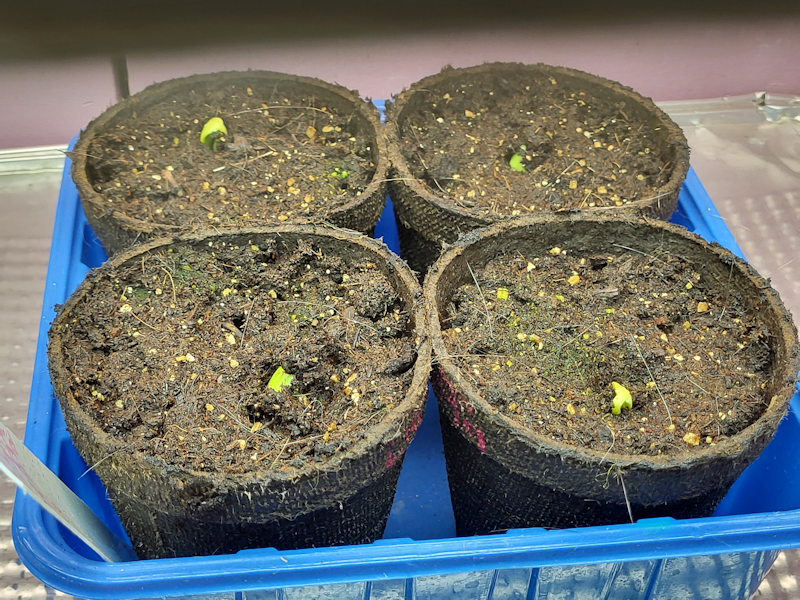
After shifting things around in the aquarium greenhouse yesterday, and noticing that there seemed to be luffa seedlings starting to push their way through the soil in a couple of them, I made sure to look closely this morning. Sure enough, I could just see green starting to show through the soil! So of course, after being out most of the day, I had to check them again when I got home.

There is four of them!

Once they start breaking soil, they really seem to grow fast! Each pot has two seeds planted in it. So far, there is no evidence of the second seeds pushing their way through. They would be thinned down to one eventually, anyhow. I’m just happy to see one in each pot! That heat mat seems to be giving them the boost they needed.

I can’t wait to see how much they’ll grow overnight. 😁

The Re-Farmer

Our 2023 garden: shifting spaces, and you can do it, little luffa!

A little bit of garden therapy on this cold, cold day. According to one of my phone weather apps, we’ve reach -25C/-13F, with a wind chill of -33C/-27F. Hopefully, things will keep warming up for another hour or two because it takes the predicted deep dive overnight!

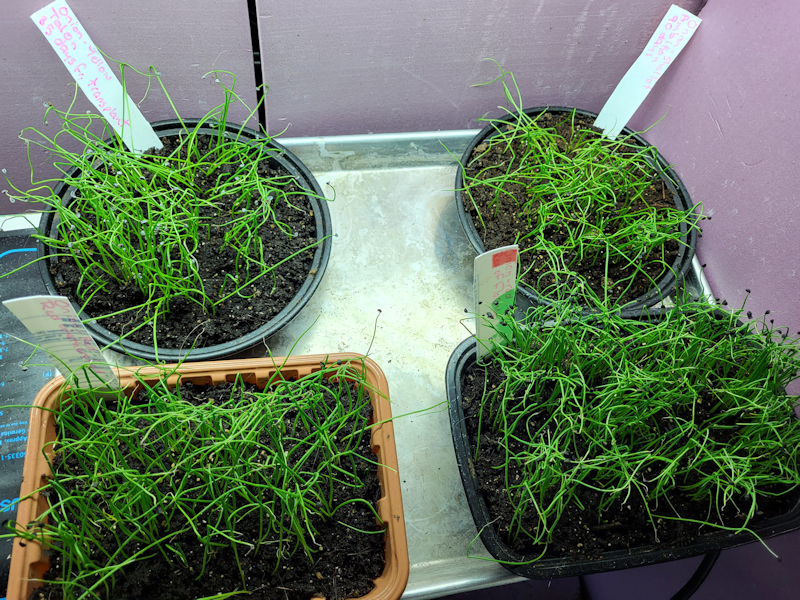
Our onion seedlings are getting tall enough that it was time to move them away from the light. Which, for our aquarium greenhouse, means rearranging things inside the tank.

The onions are going to need a hair cut soon!

The tray holding the onions is on the heat mat, which was unplugged when the seedlings started showing. Onions prefer cooler soil, anyhow. The luffa, however, have not germinated yet, and need warmer soil. They were raised up higher on a box, to get some of the warmth from the lights, but the heat mat would be beneficial for them – assuming these 3 yr old seeds are still viable at all. Shifting the two, and removing the box the luffa were on, would give the onions the space from the lights they needed, and the heat mat should make up for the slightly reduced height for the luffa pots.

Since they are in a plastic drain tray, I added the aluminum oven liner sheet to protect the plastic from getting over heated and diffuse the heat a bit, even though the warming mat doesn’t get very hot.

As I was doing this, I noticed what appeared to be disturbed soil, where that arrow is pointing.

So I took a peak.

Yes!!!!

There is a baby luffa sprout, starting to push its way up through the soil! One of the other pots seems to have a new soil hill, too, but I didn’t peak under that one, and just gently covered the first one up again.

Hopefully, the extra warmth will encourage more germination!

When it comes time to transplant these, I want to find a way to have them in the very sheltered microclimate on the south side of the house that we will be growing the lemongrass in. They can be grown in pots, if the pots are large enough. A 5 gallon bucket would be the right size for one plant. Not that I’d waste a bucket by drilling drainage holes in it. I think we have other containers we can use that are large enough. The challenge will be in how to also include a trellis for them to climb.

But I’m getting ahead of myself. Let’s see how many germinate and survive, first!

You can do it, baby luffa!!

The Re-Farmer

Our 2023 garden: onions update

Not a lot of garden related stuff going on, but I thought it was time to post another picture of how our onion seedlings are going.

They are really coming up well! So many, they’re actually lifting up the surface soil on one of the trays.

If anyone is wondering why I’m starting onions so densely like this, it’s based on how MI Gardener now does it.

We did this last year, and they did just fine!

I’m looking at the trays, though, and thinking…

We don’t have enough onions! 😄

As for the luffa, no sign of germination, yet. It might be a while for those, still.

The Re-Farmer

Our 2023 garden: That was fast!!! and planning ahead

We had a light snowfall last night, making everything all white and fluffy this morning.

The outside cats didn’t mind it at all!

I counted 21 this morning.

Meanwhile, indoors, we have our first signs of spring.

When I checked the trays this morning, three out of four of them had onions sprouting. When I came back about an hour later, there were sprouts in the fourth tray!

I’m absolutely amazed by two things. One is, how quickly they started to germinate.

The other is, how much cat hair there is, all over the soil surface. These trays had lids on them. Where did all that cat hair come from? I mean, Beep Beep practically lives on top of the lights. She naps on them, rolls around on them, and even hugs them, so yeah… I can see some of her fur drifting down… but getting under the lids?

Yesterday, I marked on our communal calendar, two sets of dates. One was the number of weeks counted back from our last average frost date, June 2. This way, we can see at a glance that something that needs to be started 10 weeks before last frost, needs to be started around March 24, while something that needs only 4 weeks can wait until May 5th.

The other dates I marked was number of days counted back from our average first frost date, which is Sept. 10. We have exactly 100 days between our average last spring and first fall frosts. That’s the growing season we can mostly count on for frost sensitive plants.

For things that have really long days to maturity, it’s that “days before first frost” that we need to consider. If, for example, I have a gourd that requires 110 days to maturity, that’s May 23. If it needs 7-10 days to germinate, I would start them at least a week before that.

If I have something than need 90 days to maturity, that falls on June 12 and, by then, I could get away with direct sowing, instead.

One of the really useful tools I’ve found is the Farmer’s Almanac planting calendar. Most planting calendars just give number of weeks before first frost, because they’re meant to be generic. I can get that information from the seed packet. Farmer’s Almanac, however, lets you input your area code (or zip code, if you’re in the US). You can even put in your city (ha!) and province/state. It will find the climate station nearest you, then give you the calendar dates for starting indoors and transplanting, or seeding outdoors. It even gives you the choice of dates based on frost date, or on moon dates. Oh, and I discovered something very handy when I hit the print button on the web page. It allows you to remove things from the list that you aren’t growing, which greatly reduced the number of pages that got printed out!

It’s still a bit generic, of course, but the date range is pretty wide. For example, it tells me bell peppers should be started between March 24 and April 7. We have five varieties of bell peppers, and four of them are early varieties, so we could use the information on the seed packet to figure out which ones need to be started in March, and which can wait until April.

Of course, they can’t cover everything, so we still need to make adjustments. For example, their calendar says to start winter squash outdoors between June 16 and July 14. With some varieties, we could do that, but we’ve got some large varieties of winter squash that need more time to fully mature, so we would be better off starting them indoors. If we use the biodegradable pots that can be buried, that would reduce transplant shock.

We have always started summer squash indoors. I think, this year, we might direct seed them. The calendar says zucchini can be planted anywhere between June 16 and July 14, which is when we can expect the soil to finally be warm enough.

As for the things we’ll need to start the earliest, the herbs (except dill, which is direct sown) will need to be started at the same time as bell peppers; in March. The eggplants and tomatoes can be started in early April, melons can be started in early May, while pumpkins and watermelon can be started in mid May.

The direct sowing dates are pretty interesting for some things. If we decide to try growing radishes again, they can be direct seeded in early April – at the same time we’d be starting eggplant and tomatoes indoors. Carrots can be planted in late April, early May, which would be about the same time we’d be starting melons indoors.

All of which needs to be taken with a grain of salt. For example, the calendar says to start onion seeds outdoors in early May. Sets, sure, but seeds? Nope. There’s a reason people out here start their onion seeds indoors in January! Also, it has dates to start lettuce and chard indoors, but none for direct seeding. Who starts lettuce and chard indoors? I mean, sure, you can grow them indoors, but for transplant?

As it stands now, though, we won’t need to start anything else indoors until March 24, at the earliest.

That gives us February and most of March to get the materials we need and build a removeable door and frame, to keep the cats out of the living room, and out of the seedlings!

We’ll also need to build a barrier to block an opening in the shelf to the left of the door in the image.

Frosty garden plans

We had fog roll in yesterday, so by morning, we were back to looking like a winter wonderland!

Nothing like seeing frost to get me thinking about the garden! 😄😄😄

One of my goals for today is to mark out on our calendar, when we need to start different seeds indoors. We will also need to figure out how to build a barrier to keep the cats out of the living room, as we need to migrate trays out of the aquarium greenhouses and over to the rest of the room. Last year’s set up had serious issues when it came to protection from cats determined to get at the pots. The problem there comes down to funds. The “unallocated funds” of our budget we would use for projects like this are now allocated to make “car payments” into savings, so that we’ll have a down payment for a replacement vehicle before next winter. That’s not going to leave much wiggle room for other things.

Still, it will need to be done! We’ll figure it out.

With the ground still frozen and covered with snow, I’m thinking about where things will be planted, and when. The old kitchen garden is getting to the point where we can start making it into an actual “kitchen garden” – the place to plant those things that we would be wanting to harvest casually and continually, as needed for our cooking. It is also a good place to plant things that will need more protection and warmth.

The waffle weave bed is done and ready. The contents will, of course, sink as time goes by, but I deliberately filled it higher than I wanted it, so that won’t be too much of a problem. With the woven walls, I do want the top of the soil to be lower than the top of the bed by a fair bit, so it’s less likely to fall through the gaps. That bed gets full sun on the long, narrow side, while the short side that gets wider at the end gets quite a bit more shade.

The rectangular bed will be built up a bit higher on the sides, plus an even higher “wall” to hold back the pink rose bush, so that won’t take much to finish. The hard part on that one will be trying to pull up all those mint roots again!

The small raised bed along the south side of the garden is ready, and the strip in front of it has bulbs planted. The area right against the bed, covered with grass clippings in the photo, has bulbils from the single walking onion that keeps coming back, planted. Last year was the first time since we’ve been here that it didn’t get broken by something before the bulbils formed! We’ll see if they survived the winter. It would be nice to have perennial onions in here. This garden would be a good place to grow bunching onions, too, though those failed completely, last year.

There’s a section by the laundry platform that is overgrown with mint that needs to be cleaned up. That could be another bed for some flowers, perhaps – my younger daughter really wants to have a flower garden in here. There’s a bed along the retaining wall blocks that needs some work – it got very compacted last year, and I finally gave up trying to keep it weeded. That bed is where the bunching onions died. 😄

This garden would be a good place to start our herb garden. We transplanted mint into alternating blocks of the retaining wall, and they did survive and grow last summer. I don’t know what variety they are, but we now have spearmint seeds. We could plant the spearmint in the remaining blocks, so we can keep it under control.

I like having a retaining wall that doubles as planters!

Other herbs seeds we have now that can go in here are the thyme (two types), chamomile and oregano. I do not want to plant the dill here, as I want to plant that somewhere it can grow freely and self seed, without taking over a bed from everything else. The lemon grass, of course, will be going into a pot and set into a microclimate against the house.

I’m thinking this garden would be a good place for the Little Finger Eggplant, as well as at least some of the peppers. The free seeds for Jebousek lettuce we got would probably do well in the shadier beds, and I’d love to try the Hedou Tiny bok choy in here.

It sounds like a lot, but I think we’ll have enough space for all of this. For things like the peppers, we’re looking to have just a few plants of each variety, as we see how well they grow here, and which ones are enjoyed the most, so they shouldn’t take up excessive amounts of space. As for the herbs, we’ll only need a couple of plants each to meet our needs, so they won’t take up a lot of space, either.

Hopefully, with raising the beds higher, we’ll have less of a battle with all those invasive flowers my mother had in here, taking things over! The raised beds should also make it easier to have protective covers we can more easily move aside, to access underneath. That was one of the biggest problems I had with tending this garden last year. We had netting to protect the plants from critters, but it had to be fixed so thoroughly, it kept us out, too!

The corner around the honeysuckle and white roses really turned into a jungle of periwinkle and purple bellflower last year. I’d like to keep fighting those off as much as we can, so my daughter can start planting new – non invasive! – flowers to eventually out grow the invaders. The purple bellflower even buried other flowers – lilies, if I remember correctly – to the point that they never bloomed. That patch needs to be divided, so we could take advantage of that and perhaps use them to create a border. I am considering transplanting the rhubarb out of there completely. They are not doing as well as they could, right under the ornamental apple trees as they are. Though, to be honest, I’d like to get rid of those apple trees, They’re creating too much shade and preventing other things from thriving. They’re so beautiful, though, and they do provide food for the birds, so I’ve no plans to do that until we have something to replace them with – somewhere else!

It will be good to have more effective use of this garden. Having a small garden so close to the house should be very convenient, if we plan things right.

The Re-Farmer

Our 2023 garden: Veseys order placed – potatoes and more

Yes, I have gardening on my mind!

Among the things we were talking about ordering that will be delivered in the spring were potatoes and, potentially, raspberries.

It seems we weren’t the only ones that had a bad growing year in 2022, because the potatoes I was looking for were simply not available. However, Veseys has potatoes again, and so I placed another order with them.

Among the items we have ordered before, we are getting the Purple Peruvian Fingerlings again. We were really happy with them, in their grow bags, two years ago. They come in 2 lb packages, so we ordered two of them.

I am also ordering a couple of seed mixes from them that we ordered before (and using the coupon code from Maritime Gardening saved me the shipping costs!). I ordered two each of the Alternative Lawn Mix, and the Western Mix Wildflowers. The areas we had planted them, in the fall of 2021, got flooded in the spring, and nothing came of them. With so many wood piles chipped, we now have areas of bare ground that I would like to seed before they get taken over the invasive weeds again! Two of those areas will get the alternative lawn mix. The third does get accumulated snowmelt nearby in the spring, but should be fine to plant in. That area is next to our budding food forest, and will be good for attracting pollinators.

The seed packs will be sent right away, but the rest will be sent in time for planting in our zone 3.

Here are the new varieties we are going to be getting. All images belong to Veseys.

These are Red Thumb fingerling potatoes. They are noted for their delicious flavour. Unfortunately, there isn’t any information about how well they store over winter. These come in 2 lb packages, so we ordered two of them.

These are Irish Cobbler potatoes, an early variety also noted for their exceptional flavour. They come in a 3 lb pack, and we ordered just one of them.

These last ones are for our food forest. Royalty Raspberries. They come in packages of three, and we ordered just one package to try them. They are a late maturing variety, hardy to zone 2. So far, everything we’ve tried that’s purple has done really well for us, even in poor growing conditions, so I’m hoping the trend continues! These will produce fruit in their second year, so as long as we can keep them alive this year, we should have purple berries to try, next year.

There are still other things we will want to order for spring delivery, such as replacement sea buckthorn. We’ll just have to be careful to set aside the budget for them as we place the spring delivery orders, because we’ll be charged for them all at once, when they’re shipped!

This year, I’m happy to have several items, with different maturing rates, added to our food forest. The raspberries for production next year, apples that should start producing in 4 or 5 years, and the zone 3 mulberry trees that should take a few more years before they begin producing berries, as we will be getting 2 smaller, younger seedlings, instead of the 1 larger, older seedling they normally would have shipped, but are not available.

Little by little, we’re getting to where we want to be!

The Re-Farmer
Our 2023 garden: getting started (video)

Yesterday, after many delays, I finally sorted through all our seeds, old and new. I was happy to find I still had luffa seeds left, so I got those started, along with our onions.

Since I’m running out of media storage space on my WordPress account (the down side of having such a photo heavy blog!), I took my photos and made them into a video, instead. I hope you enjoy it!

Please feel free to let me know what you think of it, either here or in the comments under the video at YouTube. If you watch the video on YouTube, you can subscribe to my channel there. I’ll be uploading it to my Rumble account, too.

I will probably be doing a lot more of these, since I’m not about to spend over $300 a year to upgrade my account, when all I want is more storage space! It takes a lot more time, and I borrow my daughter’s microphone for the voice overs, but it does allow me to use higher quality images, and more of them, than I would here. I’d call it an experiment, but it’s not like I have much choice!

On another note, I’m quite enjoying the Movavi Video Suite to make these videos. I’m just barely skimming the surface of what the software allows me to do, since my needs are really basic, but if I wanted to, I could create some pretty professional looking videos. The only complaint I have is how it keeps wanting me to buy into subscriptions to get more choices in media and effects, etc. But that’s pretty typical of most media software these days, I think.

Anyhow, I hope you enjoy the video!

The Re-Farmer

Our 2023 garden: Heritage Harvest and Baker Creek seeds have arrived!

Last I checked the tracking for my Baker Creek order, it was still hung up in Illinois, so it was a wonderful surprise to get it in, along with the Heritage Harvest order I knew had arrived in yesterday’s mail.

First, Baker Creek. You can read about what we ordered and why, with links, here.

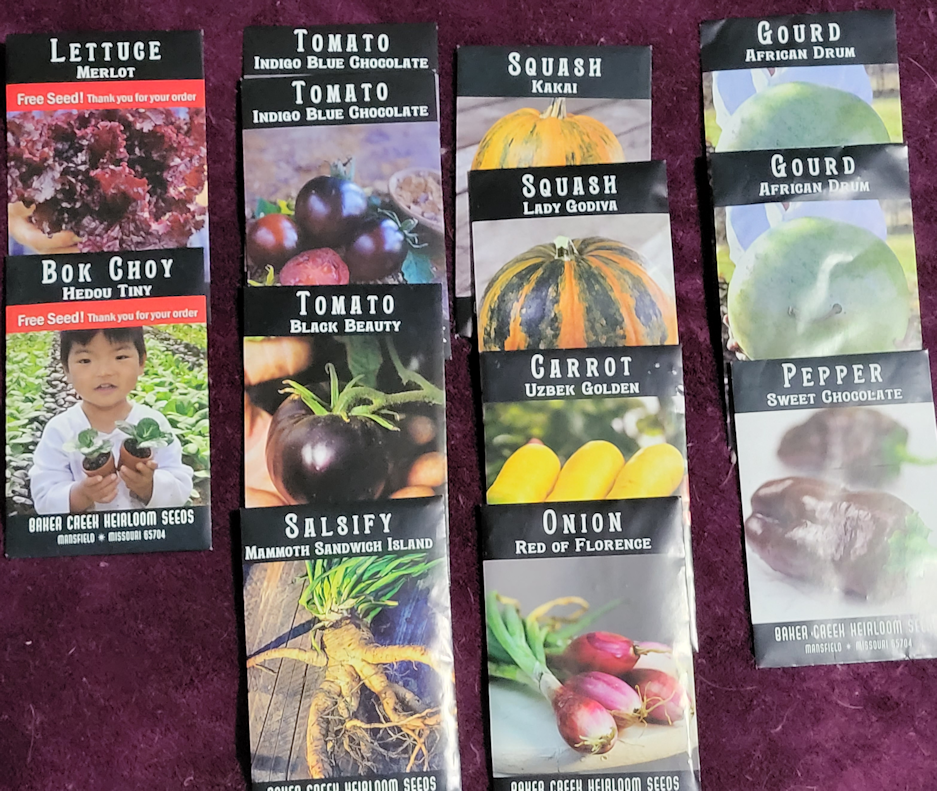
The hulless seed pumpkins, carrots and onions are all repeat orders. The free Merlot lettuce seeds are a variety we’ve ordered before. We hadn’t planned to buy lettuce seeds for 2023, but there they are!

The Hedou Tiny Bok Choy is something I’d not heard of before! I don’t know if we’ll plant the lettuce for 2023, but I’d sure like to try this variety of Bok Choy! From the description, they are a cool weather crop, so we should be able to grow them all right, here.


Then there is our second order from Heritage Harvest. You can read about what we ordered, and why, with links, here.

Well, would you look at that! Thanks to the free seeds, we now have two types of lettuce! Jebousek lettuce. “A wonderful heirloom deer tongue lettuce from Czechoslovakia. Ella Jebousek of Brooks, Oregon received this variety from a descendant of the family who brought it from Czechoslovakia. Looseleaf type.”

We’ll see if we try them in 2023 or not.

What I’m looking forward to is going through that seed saving book!

I don’t think we’ll be ordering more seeds after this. We will be ordering other things, though, that will be shipped in the spring. Potatoes, for sure, and likely raspberry bushes or strawberries. That won’t happen until after the holidays, though.

At least, that’s the plan so far… 😉

The Re-Farmer

Analysing our 2022 garden: final thoughts

Okay, it’s that time! I’ll be working on a serious of posts, going over how our 2022 garden went, what worked, what didn’t, and what didn’t even happen at all. This is help give us an idea of what we want to do in the future, what we don’t want to do in the future, and what changes need to be made.

Okay, so I’ve gone over how things went for our 2022 gardening year. We expanded our garden so much this year – and it was still less than we intended – I decided I need to do one last post to wrap it all together.

In a nutshell, though, I could probably just say this.

It was a terrible growing year.

In 2021, we got hit with drought and heat waves. For the longest time, we were out there watering the garden twice a day, just to keep it alive. With all that, things produced way better than I excepted, even when much of it did not thrive, or got eaten by groundhogs repeatedly, or got chomped on by deer.

I never thought that this year would be worse!

A lot of the failures can be attributed to things outside of our control. Winter dragged on long, as we got walloped with blizzards and large amounts of snow. I couldn’t complain about the snow, since we needed that moisture badly. Unfortunately, snow melts faster than ground thaws, and when the temperatures rose, the ground just couldn’t absorb it fast enough.

Even growing up here as a kid, I don’t remember ever having standing water in these areas!

The sad thing is, even with all this water, it would not have been enough to replenish the water table after years of drought.

Where, last year, we had things produce far better than expected, this year, it was the other way around. It turns out our garden handles drought and heat waves better than flooding and average temperatures.

Gotta look for that silver lining, though. We’ve had the two extremes, which gave us a lot of information to help us decide on our next steps.

The goal is to grow and produce as much of our own food, and be as self sufficient as possible. When we get animals, we want to grow their food as much as possible, too. How we get to that point can be changed or modified as much as it needs to be!

A lot of what we grew this year will be grown again in 2023, though not necessarily the same varieties.

As we expand our main garden area, we’ll be moving away from the distant garden beds, where we are now starting to build up our food forest. That’s what those beds where there to help prepare the soil for.

Which means that 2023 will have pretty much all the garden beds closer to the house, and we will be building more permanent structures. The temporary trellises have come down and, in the spring, we will be taking down the trellis tunnel, saving the wire to be reused.

We plan to start building permanent trellis tunnels where some of the newest, deep mulched garden beds were started. We will also focus on building more high raised beds – the challenge is to safely harvest the dead spruces to build them with, since we don’t have the funds to hire a company to take them down for us. I don’t begrudge them the cost at all; it would be worth every penny. We just have too many other things pulling at those pennies that are a higher priority, when we can do most of this work ourselves.

The low raised beds were enough to keep some things from getting drowned out, but in other areas, it still wasn’t enough. So while I do want to keep some beds low, the majority of our beds will be high raised beds.

The one high raised bed that is complete, filled hügelkultur style, did very well. By the end of the season, it had settled quite a bit and needed a top up, which was to be expected. At this point, I think the bed’s “topsoil” is deep enough that it could be used to grow longer root vegetables now. This is definitely the way we will continue to build and fill our high raised beds, though we might tweak a few details, such as finding better ways to join the logs in the walls. We have a few more and better tools to help us now, and will continue to acquire more.

Since a major component of building our permanent beds is accessibility and mobility, as we build the permanent structures, we will make sure that the paths will be at minimum 4 ft wide – wide enough for a walker or wheelchair to turn around in. That will include the trellis tunnels we will be building. Now that we are aware of how much water can accumulate where we plan to build them, we intend to build probably middle height beds on the outside of the tunnels. Those beds will be 2 ft wide, since they will be accessible from only one side. I figure we should shoot for building at least three or four of these in the main garden area (not all in one year!), along with the 9′ x 4′ high raised beds we will be making. We will be sticking to 9′ x 4′ as much as possible, regardless of how tall the bed is, so that any covers we build for them can be interchangeable. Obviously, the narrower beds we plan to build at the trellis tunnels will be the exception, but the things planted in there would need different types of protection – if any at all.

Even aside from the trellis tunnels, we will want to built quite a few other trellises that can be moved around to wherever they are needed. Among the things that actually started to grow well (if too late), I noticed that the hulless pumpkins really, really wanted to climb. The melons we want to plant are also climbers, as are some of the gourds we want to grow. These would need support that can hold the weight of their fruit, so they will need the strength of the permanent tunnel trellises. Lighter climbers, like peas and pole beans, would be fine with portable trellises.

While we will be focusing on permanent structures in the main garden area, we are also needing to plan ahead to when we build permanent garden beds in the outer yard, where there is better sunlight. We are also working on plans for an outdoor, off-grid kitchen in that general area. That’s on top of the shed we need to dismantle, so that we can salvage the lumber for other projects, like the mobile chicken coop I want to build.

We’ve got a lot of building and heavy labour ahead of us, and none of us are quite able bodied, so it might take a while to get it done!

As terrible of a growing year it was in 2022, it provided us with much useful data, and will actually help us in planning our next steps.

Little by little, it’ll get done!

The Re-Farmer