Making hard crab apple cider: racking day – what happened? (updated: I found out!)

This morning, after doing my morning rounds, I gave the sun room door frame a second coat of paint. Tomorrow, we hang the door back up.

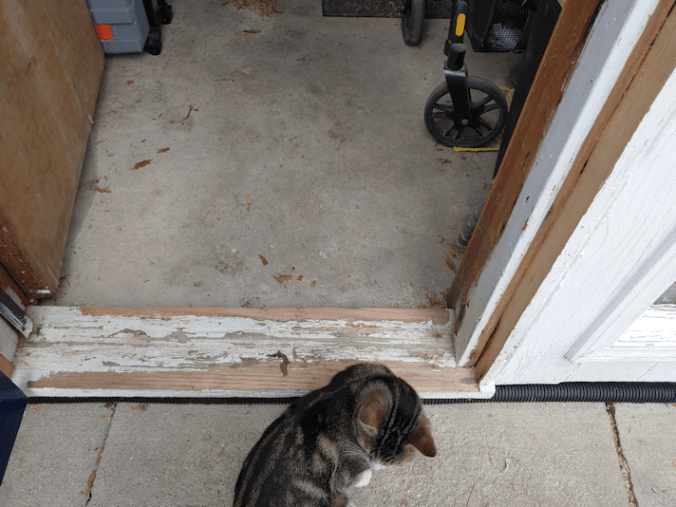
I had an audience. :-D

Also, while I was painting, I found that Nostrildamus has figured out to jump over the threshold after it’s been painted! :-D

Meanwhile…

Today was finally racking day for our first attempt at making hard apple cider, using our own crab apples. For new visitors, you can read up about that here and here. (links will open in new tabs)

Here is how the gallon carboys looked before I started. As expected, there was a LOT of sediment at the bottom. It’s not just the lees from the yeast, but the sediment from the raw, unfiltered juice.

We had some concerns with the fermentation. Activity in the airlock stopped a while ago. I think the room temperature became a problem. While they were actively bubbling, their temperatures tended towards 18C/64F, though we did also keep them wrapped in a towel and, every now and then, I’d heat up a rice-filled warming pad in the microwave and stick it between them to help keep them warm. We had used an electric heating pad, when making mead, but where these were sitting, there is nowhere to plug it in.

Racking from a 4L to a 3L carboy meant a lot of sediment heavy liquid left behind. Though I tried to hold the racking cane well above the sediment as long as I could, I could still see wisps of it being pulled up the siphon.

As I racked each jug, I made sure to get a hydrometer reading.

I just don’t know what to make of it.

For one of them, the hydrometer pretty much sank to the bottom. I had to add cider almost to the top for it to float enough to get a reading. The other was only slightly better. When they were first tested, it floated quite handily.

Unfortunately, I just can’t get it straight on how to read the specific gravity on that thing. So I write down all three readings.

The readings still don’t make any sense to me. Why would the numbers all drop so much? From what I can figure out, this is basically telling me there’s no alcohol in one, and almost no alcohol in the other.

I did taste test it, of course, and they both have a VERY sour apple taste. It also does taste alcoholic, but that is almost overwhelmed by the sour apple taste. Which is interesting, since the apples we used are actually quite sweet, and there was quite a bit of sugar added to the juice, too.

As for the hydrometer reading this time around, the only thing I can think of that might be affecting it (besides something going weird with the cider itself) is the temperature. Both carboys had a temperature reading of 16C/60F. The ambient temperature in the room is 15C/59C. From what I’ve been reading, newer hydrometers are calibrated for about 20C/68F. I’ve found a site that will calculate the adjustment for temperature, but there is virtually no change in the reading. So what gives?

I have no idea.

Considering that the traditional way of making hard apple cider is to press whole apples into a barrel, set it aside for a few months and BOOM, you’ve got booze, I didn’t expect this to be so complicated.

Anyhow. The 3L carboys are now set up with their airlocks for a second fermentation. As for the liquid left behind with the lees, I ended up straining much of it, and we now have about half a liter of filtered baby hard apple cider.

Hmmm… I wonder how it will go with the ham I will be roasting today?

The Re-Farmer

Update: When I started the hard apple cider, I did it based on this video from CS Mead and More.

There is a reason I included them among my Recommended sites!

I went ahead and contacted them about my readings, and got a very prompt response, and I am very happy!

It turns out, everything is working fine. My problem is with reading the hydrometer, then figuring out what it’s telling me! :-D

And now I know what to do with the information I’m getting off the hydrometer. I may not be using the AVB or Brix to work it out, but I’m writing them down anyway, because I can see those readings better. I can then use the printed out chart that came with the hydrometer to see where that lines up with the Specific Gravity and actually read that number on paper, instead of trying to see it in the liquid. When I take pictures and upload them to my desktop, I can usually zoom in and read it, but sometimes I find the hydrometer moved as I was taking the picture and I still can’t read it. :-/

The formula I was given to calculate the alcohol percentage is to subtract the new reading from the first reading, then multiply the answer by 135. So for one of my ciders it’s:

1.100 – 1.020 = 0.08
0.08 x 135 = 10.8% ABV

For the other one it’s:

1.090 – 1.009 = 0.081
0.081 x 135 = 10.9% ABV

We definitely have booze. :-)

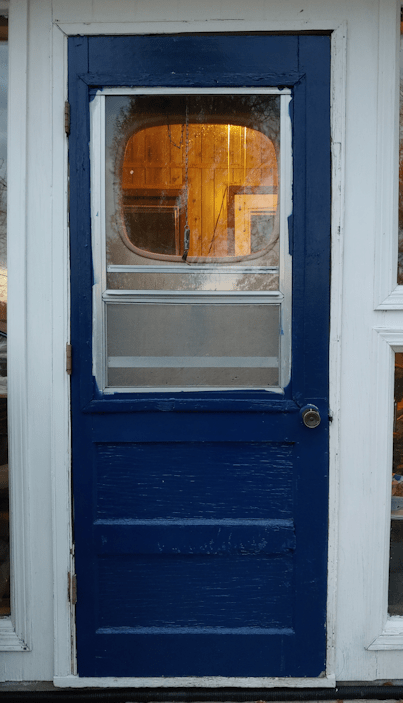
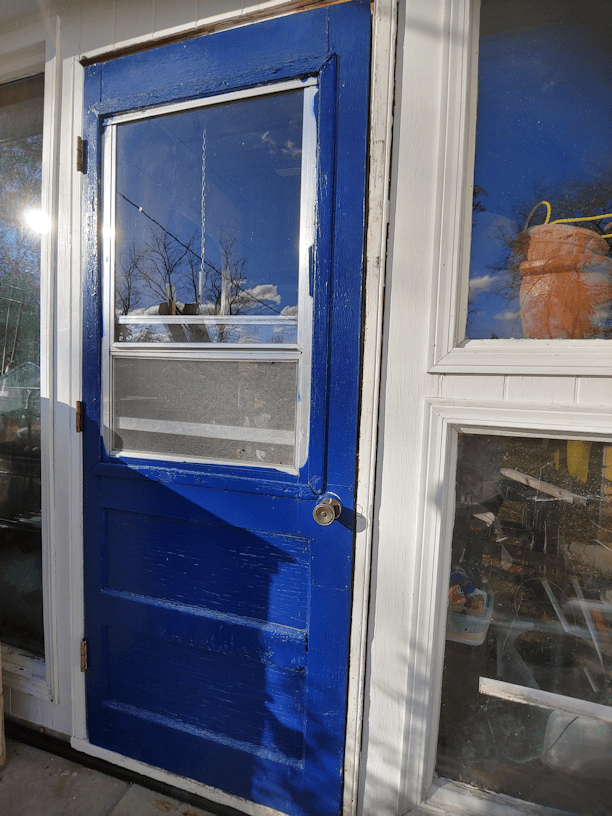
Sun room progress: door frame painted

With the chillier temperatures, it’s really not a good time to be painting outdoors, so I made a point of starting right after doing my morning rounds. This way, it could have the whole day to cure, and I could decide on whether I wanted to do a second coat or not.

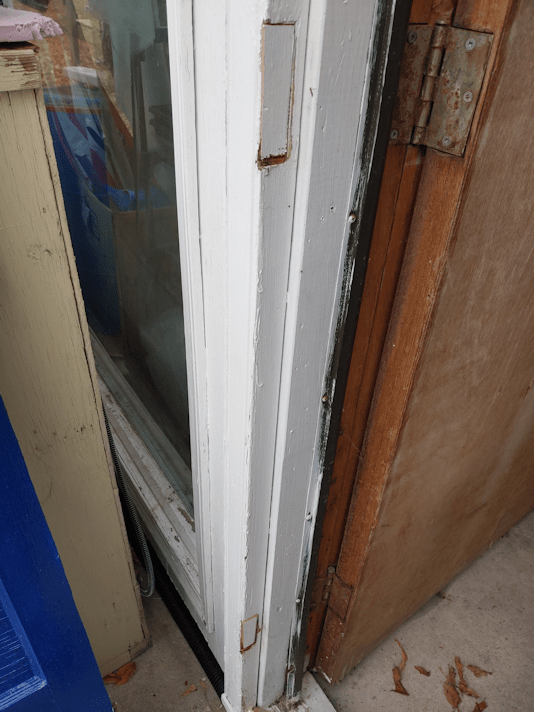
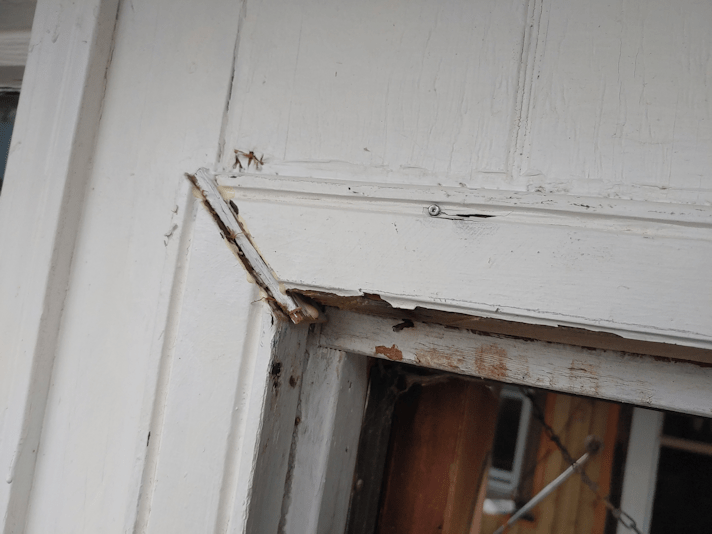
The top is cut so terribly crooked! LOL This is the piece I cut using a hand saw, after two failed attempts with the power tools we have available.

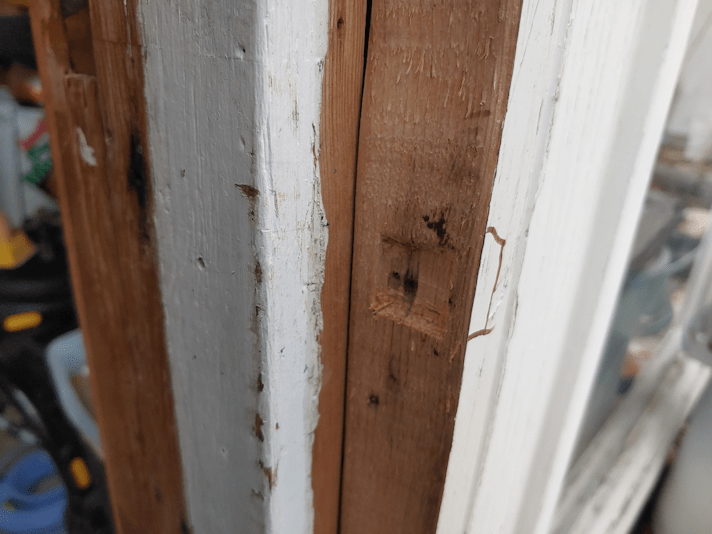
Though the house was painted the summer before we moved in, it looks like the inside of the door frame only got one coat, so I went ahead and painted that, too.

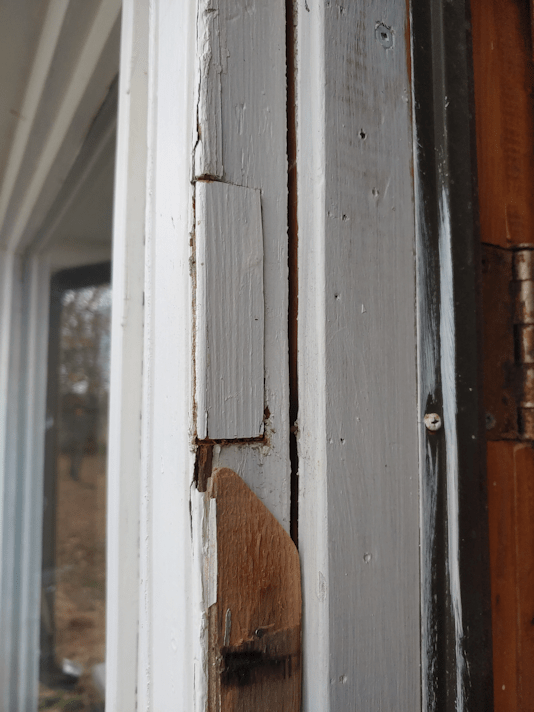
The extension cord to the cat shelter was staying, but I managed to keep it away from the paint. This corner on the left is where we’ve had to add the most material to make up for the shifting of the frame.

It’s really amazing how much a coat of paint makes even the worst patch jobs look better! :-D

Well, that didn’t take long! :-D

I had to leave the doors into the sun room open, of course, and later in the day we found white foot prints on the concrete inside! :-D

I’m rather happy with how the paint was feeling by the end of the day. We will be able to drop the cord down and actually close the door for the night. I’ve decided to go ahead and give it a second coat tomorrow morning, which means that the day after tomorrow, we can hang the door back up again.

It will be so good to finally have this job done!!!

After painting this morning, I headed to the post office to pick up our bulbs, which are now planted – but those will get their own posts! :-)

The Re-Farmer

Progress: sun room door frame, and bird feeder support post

It has been a rather productive afternoon!

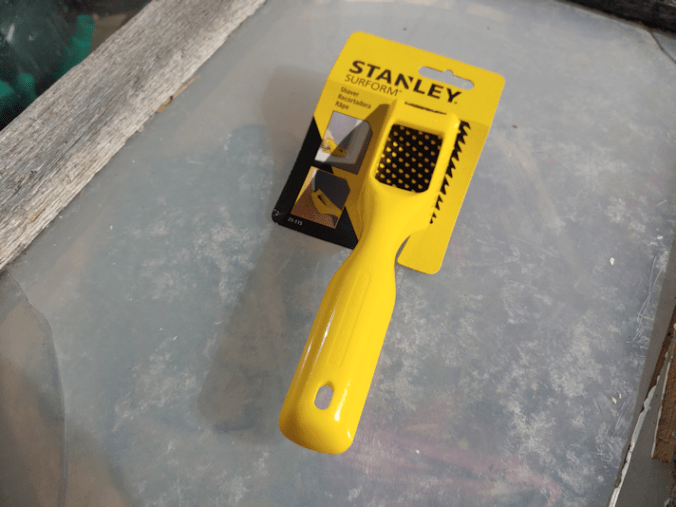
The first order of business was to test out my new tool on the sun room door frame.

I had gone into town to look at mini planers, but while perusing my options, I chose this tool, instead.

It’s a shaver. The shaving plate looks rather like a bada$$ Parmesan cheese grater. I figured the many cutting blades would make short work of the areas I needed to work on.

I was right. (For a change! LOL)

Using the blue paint marks from the door to show me exactly where I needed to shave off the wood – was well as smoothing my messy, messy cut somewhat – I did both the side of the door frame and the threshold.

What a fantastic little tool! The door can now close without catching anywhere on the frame or the threshold!

Then, because it worked so well, I did the threshold for the inner door, too. It now closes better, too.

The door is not quite done, yet. I’ve decided I need to take it off again, and move the hinges in about half an inch. Right now, when the door is closed, there is a lot of stress at the hinges, and I can actually see where parts of the door are starting to pull apart. This is a temporary fix with a salvaged door, but I’d like it to at least last the winter!

When we first set up the replacement door and attached it to the frame, we lined the hinges up on the door itself with the old door, then rehung it in the same recesses in the frame that the old door’s hinges were in.

With all the other problems that had to be dealt with, we still used the same spots, even after I filled the recesses with wood. Now that the door can actually close, I can see that the hinges are too far out, which basically forces the door to bend in order to close.

As I was thinking about this, and remembering the old door we were replacing, I am realizing what likely happened. When the sun room was built (which happened while we were living in another province), it likely had a different door. When that door was replaced with the door that was here when we moved in, the same recesses in the frame were used for the hinges. Remembering the problems we had to close that door before it finally fell apart, I am guessing that the house had already shifted and the frame was no longer straight, plus the door itself didn’t set the same way as the previous door, but whomever hung it didn’t bother doing anything to compensate for that. Over the years, my parents just put up with it. Meanwhile, the house would have continued to shift which would have made it worse, until it was in the condition it was in when we moved here.

If my guess is right, we hung this door up in the same location as the previous door, which was hung in the same location as the original door.

What I am now thinking of doing is taking the door off again, painting the frame, then hanging it back up with the hinges further in, rather than where the old door was hung.

Given the overnight temperatures, though, I will need to wait for a sunny, warmer day so the paint will have as much time to cure as possible before it starts dropping below freezing. Unfortunately, the long range forecasts are showing a steep drop in temperatures over the next few days, though it is supposed to flatten off after that.

For now, though, we have a working door!

The next job on the list was setting up the newly painted bird feeder stand.

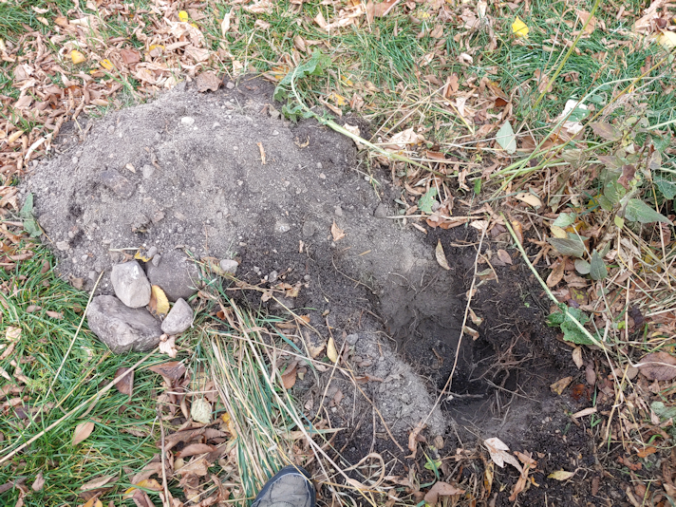
I decided to set it like a fence post, in the same spot as before. The new metal support we have the suet cage hanging from was set aside, and self-seeded flowers and bird seed plants cleared away. Much of it was already empty, though. I don’t know what cats were fighting in there, but they flattened everything around the bases of the bird bath and feeder!

I half considered trying out one of the old post hole diggers we found, but as I dug, I immediately started hitting rocks, so I’m glad I didn’t! The soil is a lot deeper here than in other areas; I just started to hit sandy soil when I stopped. Very different from the soil further away from the house.

The larger rocks I dug out went back in, to help support the post.

Finally, the soil was returned and stamped down. It will now be left for a few days to settle before I hang anything on the hook.

If you look closely at the suet feeder in the back, you can see a chickadee on it!

Chickadees were not my only audience!

The suet feeder was returned, with the hook facing the bird bath. I deliberately placed the other hook facing away from the bird bath, to reduce the number of seeds that end up in it. That’s not as much of a concern with a suet feeder, though my daughter pointed out that it’s a lot closer to something the cats use to drink out of! So it will likely be moved further away.

The chickadees were quick to return, and are already using the support bars from under the platform feeder as perches! This might actually be a better use for them than to add another platform later.

The hook is on the north side of the post, but the post itself is leaning slightly to the south. This was not intentional, but rather than straightening it, I decided to leave it. It should compensate a bit for any pull from the weight of a full bird feeder. That would be more of an issue with those surprisingly fierce winds from the south that kept blowing the whole thing over until we stopped hanging a feeder on it.

I’m rather pleased with how it looks. Plus, it’s set deep enough in the ground that I should be able to hang a feeder on it without needing to stand on something. Previously, I could tip the whole thing over to reach but, obviously, that is no longer an option!

The real test will be how it holds up the next time we have a storm, while a feeder is hanging off of it!

The Re-Farmer

Encouraged

Well, after getting such bad news from the plumbers, and passing on what they told me to my brother, he gave me a call, and I’m feeling much more encouraged.

There is no one alive today that knows this farm and the systems that run it better than my brother. So when I told him in more detail about what the plumbers had said, he was torn between disbelief and laughter, that they would be so unfamiliar with, and intimidated by, the system we have. It’s still used a fair bit, and he had no problems finding a replacement for the basement pump.

He does not share their concerns about the immersion pump and that we might lose our water. This pump has been replaced about 4 times in the past 50 years, by his memory, and it has always been a relatively simple switch.

He will be coming out to do it himself. He just has to find the time in his own schedule to make the trip out. It was something we both hoped to avoid, but he’s frustrated by plumbers that are so intimidated by our old system.

By the end of the call, I was feeling much more encouraged. As much as I am willing to trust the professionals, my brother knows things about our system that they don’t. If he is confident that the pump can be switched out without causing problems in the well itself, I trust his experience.

Speaking of wells, I remembered to ask him if he remembered what happened to our old well, from before this one was dug. This pump was operated with electricity, but when we had power failures, we could attach a handle and pump it manually. I remember bits and pieces of when problems started, but not why. He told me that the water had started to come out dirty. His guess is that something collapsed in the pipes. I then got the lowdown on how that well was set up, including that it has a piston at the very bottom, some 80 feet down. So when it was first being pumped, it would take a while for the water to reach the top (I remember that time it took before water started to come out). Of course, once it was no longer being used for a long enough time, that water would slowly drain down again.

Theoretically, if I pumped long enough, I should be able to get water out of them, but it is most likely the pipes need to be replaced.

That opens up possibilities for us, since one of the things we want is to have a manual pump well as a back up if we ever lose power and can no longer get water from the well by the house.

I wonder if I should move things away from that pump and give it a try?

The Re-Farmer

Can I just quit now?

Honestly. I would really like to just quit right now.

This morning, I tried calling a plumber about switching out our well pump in the basement. This would be the third plumber we’ve contacted in the past few weeks.

To recap: we are on a deep well for water. There is an immersion pump in the well itself, and two pipes going from the well to our basement, into another pump. The two pipes in at one end become one pipe out the other, pumping water into our pressure tank.

The well pump in the basement has been making noises. At times, the pressure is lost, as if it is losing prime, or as if we’re using the water faster than it can refill the pressure tank. When that happens, it makes a grinding noise. Once the pressure gauge on the pump is where it’s supposed to be, it goes quiet and stays quite for the rest of the time it’s running, but the noises return frequently, if not every time it turns on. Basically, it seems to be wearing out.

My older brother had bought us a new pump and was going to install it for us, but we ended up fighting with our septic, instead. So the new pump, with all the fittings, clamps and whatnot that he could think of possibly needing, has been sitting and waiting ever since. Instead of making my brother come back, we were just going to hire a plumber. Unfortunately, the “discretionary” funds had to go towards vehicle repairs, but I really wanted to get that done before winter, in case the plumber needed to go into the well, since there was also the possibility the foot valve in there was leaking.

I called the plumber and left a message, honestly not expecting to hear back until Monday. So it was a pleasant surprise to get a call back a couple of hours later.

I had said in the message what we needed done, and that we already had a pump. It just needed to be switched up.

When he called, he asked if I meant the immersion pump. No, I said. The one in the basement. He seemed confused. I brought up the possibility of the foot valve leaking in the well, but that it was the pump in the basement that was making the noise, and we wanted to switch that out.

He said they had better come out and take a look.

They came out this afternoon!

I now understand why he was confused. I’m starting to get the impression that we are the only ones that still have this old system. Once they were in the basement, checking it out, he explained that basically, no one likes to work on these systems, because they are such a problem. He asked me to turn on a tap to trigger the pump to turn on, so I went to the bathtub and did what we normally avoid doing: turned both taps on to full. This not only turned on the pump, but triggered that grinding noise and, eventually, I lost water to the tub. Which is when I shut off the taps and joined them in the basement again.

Once the pump’s pressure reached where it was supposed to be, the pump was nice and quiet again. He told me that, it’s not a matter of simply switching pumps. The front cap of the new pump would have to be removed and installed inside the well itself – and there would be just one pipe leading to the basement and the rest of the pump. There was a good chance changing it would cause further problems, which is when he asked to see the well.

They were able to get the cap off, with it’s one bent up handle. I am pretty sure this is the first time I have ever seen the inside. My only memories are of when the trench was dug from where this well was dug, towards the barn. That is where a water pipe to serve the barn and water fountains for the cows was laid, as well as the main pipe for the grey water from our septic tank. I don’t know exactly where near the barn these pipes split off in opposite directions, but I do have a general idea of where it must be.

Once the plumber used the ladder to get into the well, his assistant had to take it out so he’d have room to actually move around.

The news did not get any better.

It seems ours is a 4 inch well. Modern wells are 5 inch. That means there is a smaller immersion pump – a size that’s very hard to find these days.

Like the first plumber we talked to – the guy who has worked in our well before – he said it would be better to replace the immersion pump. This would mean one pipe into the house (the other could be used for the electrical wires to go through) and no pump in the house.

The other problem with doing that job is, the cap inside the well – what he was standing on to check out the system – would have to be removed. There’s no way to know how high the water table is right there, but given how damp and rusty things were, it’s probably quite high. Which means they’d be working in water.

However, this is a 50 year old well.

What we really need is a new well.

We could do all the other work, spending what might be as much as a couple thousand dollars but, in the end, we could lose out water entirely. He did not dare even switch out the pump in the basement, for fear of losing us our water.

As we were chatting, I asked questions and mentioned various things, ranging from the snails that showed up in our fish tank after using well water to make a change (I forgot to mention the algae blooms), and how we stopped drinking the water since them,to having to shock the hot water tank with hydrogen peroxide regularly because of the smell.

By the time I got to that, he was looking a little wild eyed. What had been, to paraphrase, as sort of “I won’t go so far as to recommend it, but if it were me, I’d drill a new well,” became a “yeah… you really need a new well!” The more he heard about it, the more he wanted to stay away from doing things like replacing the pumps, either one at a time, or both at once. We definitely have issues that are beyond what they can do for us.

In the end, after apologizing for being the bearer of bad news, I gave him my email so he could send me some names for well drillers.

Oh, and when I asked if he knew what a new well might cost? Depending on various factors, of course, it could cost as much as $10,000.

I told him that if we had that kind of money, we’d have a new roof! :-D

Normally, they would have charged for a service call like this, but by the end of it, he said he would not charge us anything. Then apologized again for all the bad news. My response was along the lines of, with this place, I’ve come to expect it!

For now, we were basically told to hang in there with what we’ve got. We have water right now, and it’s not worth jeopardizing that until we are in a position to get the job done fully.

So, not only do we need $10,000 for a new roof, now we need another $10,000 (estimated) for a new well. That’s on top of everything else that needs replacing, like flooring and walls and repairing the old basement walls, and the weeping tile under the new basement… on and on it goes.

Coming up with that kind of money is a challenge all on its own. Doing it without jeopardizing my husband’s disability insurance is another issue. If we made that much in “income,” he’d basically lose his insurance. It’s not just a matter of his disability income that we are living on, but coverage for his medications.

Needless to say, I got zero work on the sun room door today.

It would be so much easier if we could quit, somehow.

But that’s just not an option.

So, I guess we’ll just have to figure something out.

:-/

The Re-Farmer

Replacement door: hung

The replacement door to the sun room is back up again!

Of course, things went wonky in the process. At this point, I expect nothing else!

I don’t know if you can tell, but we ended up adding yet another piece of wood under the bottom hinge. The gap there was still massive. And yet, none was needed at the middle hinge!

Of course, the door didn’t quite fit, even after all this. We still needed to force the door over the threshold. We’d had to do that with the old door, to a certain extent. It wasn’t as noticeable, and I think that was partly because the door was already starting to fall apart before we moved here.

Using the blue paint scraped off the door as a guide, I used whatever tools I could dig up to smooth out the side piece. I tried one of the planes we found in the basement. It was a bit big for the space, but it would have worked, except the plate was loose, which is when I discovered the frame holding it was cracked.

We didn’t find it that way. The cats had knocked it off the shelf I’d put it on.

*sigh*

I carved out a recess for the latch plate and deepened the hole for the latch itself until it could finally catch and stay caught. I also began chiselling, carving and rasping away at the outer edge of the threshold until the door could close without being forced.

Well. It still kinda needs to be forced. There is still an issue with the hinges. Understandably, there is a lot of stress on them. I’m trying to think of what I can do to fix that, and not a whole lot comes to mind that is feasible.

I suspect this door won’t last very long, but it’s the best we can do right now, and at least there’s a working door!

I still need to work on smoothing out the frame some more before we paint it. I have been eyeballing some tiny little planers at the hardware store that would be perfect for the job. I might just have to spring for one.

I will be so happy when this job is finally done.

The Re-Farmer

Replacement door: sun room door frame progress, and washer surprise

You know, when the outer door on the sun room finally broke, we thought replacing it would just be a simple matter of switching out one door for another that we salvaged from a shed.

How wrong we were!

There were a lot of things we discovered along the way that complicated things. For those who are new to this blog (welcome! Happy to see you here! :-) ), you can catch up on the saga here, here, here and here. Then life happened, and the whole thing stopped until yesterday.
Today, I am finally seeing a light at the end of the tunnel!

The first thing I did was smooth out the rough bits of the cut pieces a bit, then nail the side piece in place. I didn’t bother taking a picture at that point, because it really just looked the same as when we checked the final fit yesterday.

I had trimmed away some ragged bits of old caulking that were still attached to both frame and wall, but that bit of a gap that you can see was still there.

Once the side piece was nailed in, it was time to take off the door and work on the hinge side.

When cutting the side piece yesterday, I first cut it to the line I’d measured and marked with a chalk line, only to discover that when we put the piece in place, needed more cut off. That I was left with two long, narrow pieces came in very handy.

I used sections from the skinny end of the first piece I cut off to fill in the hinge recesses.

Since the weight of the door will be on this side, I used some wood glue on the second piece that was cut off…

… then nailed it in place, with extra nails on either side of where the hinges will be screwed into place.

Before taking the door off its hinges, I’d marked exactly where I would need to put the latch plate on the other side.

While giving the glue some time to set, I used a chisel to start gouging out a recess for the latch.

While I had been working on this, we got a call from the appliance repair guy about our washing machine, and he arrived while I was gouging, so I paused to be with him for that.

It was just last week that our new washing machine simply stopped working. No response when pushing the power button. Of course, pretty much every time we walked past it, we’d reach over and push the button. Nothing happened.

When the repair guy first called after being contacted by LG for the warranty work, and I described what was (and was not) happening, he ordered 2 parts that could possibly be the problem. They came in very quickly – in conversation, he mentioned that some of his customers using other brands have been waiting for 5-6 weeks, and he still doesn’t have their parts! With LG, the parts come in pretty much the next day.

He, of course, did the same thing we did; pushed the power button. LOL He tested the power to the outlet, and it was fine. As we were chatting, he mentioned that he has only recently started working with LG products; the company had been trying to get him to do warranty work for them for some time, and he finally agreed. I’m glad he did, because he’s the only person in the area that does! Still, he said he’s not as familiar with LG products as other brands.

After popping off the cover for the electronics at the back, he took the screws off one of the first part he was going to replace, for the power. The other one would have been the display panel. Then to check something out, he plugged it in.

It made noise.

I think we both had matching stunned faces.

He hit the power button.

It turned on.

I asked him what he did. He’d done nothing!

He checked the wires, to see if any where loose, but everything was fine.

He was at a complete loss as to why is suddenly started working.

He was also at a loss as to how to proceed. If he left it and sent the parts back, he’d half to re-order them if it stopped working again. The fact that it stopped working once, for no reason he could find, means that it could easily happen again. In the end, he decided to leave the parts with me, bill the warranty work, then if – when? – it happened again, we could call him directly, and he’d put in the new parts. Not knowing why it happened in the first place, as well as what happened for it to start working again, made is difficult for him to just walk away from the job. It just seems like there’s a very good chance it will happen again.

After he left, we started a small load of laundry, just to test it! So far, it’s still working fine.

What a mystery!

Ah, technology. I love my tech, but it does break down a lot more than the old school stuff! :-D

After that, I went back to working on the door.

While the door was hung, I had to lift it over the threshold to be able to close it. There was a large gap at the bottom hinge, but not the top hinge. In fact, the top corner of the door was hitting the frame. So while I did not need to add material all the way to the top of the frame, I decided to fill the hinge recess at the top, as well. With no hinge recesses, there should be enough of a gap at the top for the door to no longer be touching the frame at that corner.

Once the hinge side was built up, I put the top piece back. I then applied caulk to the outside of the frame pieces.

It’s amazing how just adding that white caulk over the gap made the whole thing look so much better!

The top was a different issue. Particularly in the middle, where there was a substantial section of wood missing! I’m guessing there was some rot that got cleaned out, before it was painted the summer before we moved in.

Little bits and pieces from the remaining piece cut off the side frame got used to fill in the gap, then I caulked the rest.

I lined the angle cut with the other side of the frame, but the shifting meant that left a large gap on the hinge side. Another piece of wood and some wood glue got pressed into duty to fill the space.

For now, everything is being left for the glue to and caulk to dry and cure for a while. The next step will be to hang the door again, and attach the latch plate. I picked up a quart of white exterior paint, and the whole frame will be painted.

Then, once everything is back up, the chain for the door, to keep it from blowing open too far, will be attached to the top of the frame. Once that is secure, I plan to move the shelf we’ve got behind the door, to the other side. I want to wait until the door is completely done because, right now, that shelf ensures the door doesn’t get blown open and breaking a window or something. I doubt the door can even open that far, but I didn’t want to take any chances!

So I figure, I’ll snag a daughter this evening to help hang the door, then – weather willing – the painting can happen tomorrow afternoon/evening.

Unless we discover something else has gone wrong, once the door is hung back up. The way this project has been going, that wouldn’t surprise me at all! :-D

The Re-Farmer

Did it work?

This afternoon, the girls and I did a bit of winterizing around the house by laying sheets of foam insulation around the base of the house and covering the septic tank, and the pipes to the house, with straw. The only part that is left to do is around the tap at the back of the house. There is still a hose attached, and we’ll likely be using both front and back hoses for a while longer. Once those are put away and we shut the water off from the inside, we’ll cover it with more pieces of foam insulation. We’re doing this quite a bit earlier than last year. There was already snow on the ground then!

Once that was done, one of my daughters and I decided it was time to take down a branch of the tree in front of the kitchen window. This is the branch the tech from our internet provider singled out as the last possible thing that might be preventing our secondary internet account from having any signal at all to its satellite dish. I can’t say that I was hopeful. There are far fewer leaves left on the branch, yet the signal to our primary account has been worse than ever.

Still, the wasps are gone, so it was time to give it a go.

We considered our options and decided to use the extended pole pruning saw to take the branch down, rather than climb up a step ladder and use something else. We figured that, this way, we could more easily jump out of the way if the branch went in an odd direction as it fell.

We also chose to cut it further out, so that the cats will still have their perching branch. They like to sit on it and watch us through the kitchen window! :-)

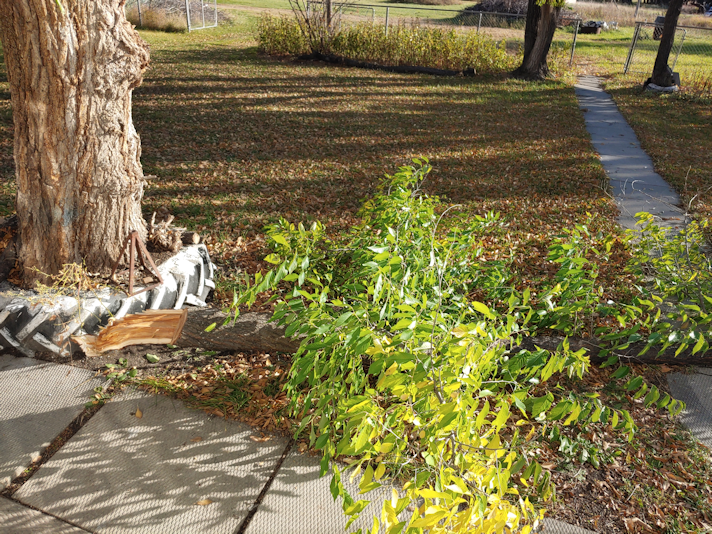
It was a pretty large branch, so rather than try and manhandle the whole thing, I used the reciprocating saw to break it down to smaller pieces. The thin, leafy branches went to the chipping pile in the outer yard. The lengths of the “trunk” were big enough, we lay them out around one side of the bed the white lilacs are in. We only needed to grab one more piece from another large branch we had taken down from the tree near the gate to completely line one side, and curve around the end.

Then, because I was able to find some this summer, my daughter sprayed the cut end with pruning paint.

At some point, we are going to take this tree out completely but, until then, I’d really like to get the branch hanging over the roof removed. There’s no way for us to take it down without it falling on the roof. We just don’t have the equipment to take it down safely in pieces.

So it will wait. It seems to be quite strong and unlikely to come down in a storm, but then, so did the branches on this tree that have come down in storms!

Once we were done and everything was cleaned up, we went inside to see if we could notice a difference in our signal with the primary account.

We had no internet.

Nothing.

Zero.

Zilch!!!

After doing the usual troubleshooting, there was still nothing.

So my husband started phoning our internet provider. After several calls that went straight to a busy signal, rather than their usual recorded messages to direct calls, we figured we were not the only ones having issues! My husband tried again about an hour or two later, and this time it went straight to a recording saying they were getting an unusually high volume of calls and were not able to answer.

Eventually, though, we did get our internet back!

Once we did, one of my daughters tested it out by trying to log into a particular game where our intermittent signal was giving all sorts of problems. She was actually able to log in first try – and was even able to switch servers in the game! Now, this could just mean we are having a particularly good night. It could mean taking down the branch made a difference. Or it could mean that, in fixing whatever shut down our IPs service completely, they also fixed whatever problem was causing our intermittent service.

One thing I’ve noticed in preparing to write this post, though; WordPress seems to be loading better now! I have been having endless problems embedding images into posts, and this time, they worked just fine. I still had tabs that didn’t want to load, but even those were able to finally load, much faster than usual.

Tomorrow, my husband will call our IP to get the suspension on the secondary account removed, and we will see if we finally get a signal. If there is still no signal to that dish, there’s nothing else here that would be causing the problem. For all we tried to ration our internet usage, we still went over last month, and the overage fees per gig are so high, the final bill was higher on one account, than the cost of both accounts together!

Until then, I’m just happy to have any internet at all, again!

The Re-Farmer

Ceramic heating soaks…?

This morning, my daughter asked me if I’d read the packaging for the terrarium heater we got for the cat house.

I had not, so she read it to me, and I just have to share!

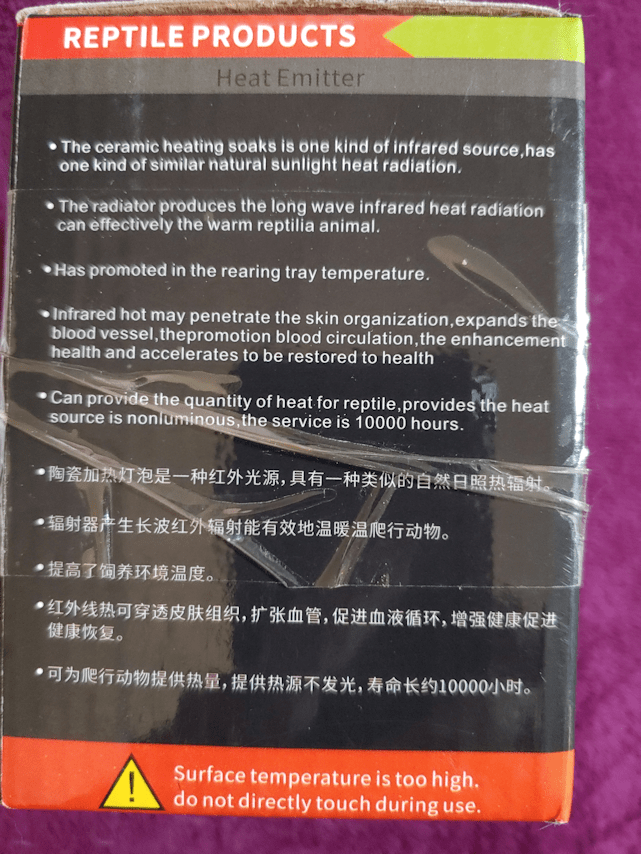
In case you can’t see or read the image for some reason, this is what is says, in “Engrish“.

Reptile Products
Heat Emitter

. The ceramic heating soaks is one kind of infrared source,has one kind of similar natural sunlight heat radiation.

. The radiator produces the long wave infrared heat radiation can effectively the warm reptilia animal.

. Has promoted in the rearing tray temperature.

. Infrared hot may penetrate the skin organization,expands the blood vessel,thepromotion blood circulation,the enhancement health and accelerates to be restored to health

. Can provide the quantity of heat for reptile,provides the heat source is nonluminous,the service is 10000 hours.

Surface temperature is too high.
do not directly touch during use

It sounds like it was put through Google translate or something! :-D I love it!

In thinking about putting this heater into the cathouse, I remembered we have something that will be useful.

We have a spare smoke detector.

I found it in the kitchen junk drawer, still in its package. We’ll test it to see if it works (it should, but I have no idea how long it’s been sitting in that drawer). We can then install it (or a new one, if it doesn’t work) in the cathouse. That will add some piece of mind for us, in the unlikely event something goes wrong with the heater.
Since we’re taking out the light source to do this, I’m thinking of getting an LED night light for in there, with a red or blue bulb that won’t affect their night vision. The light would be for us to see inside through the windows at night, and make sure it’s cats in there, and not a skunk! :-D

The Re-Farmer

Fall clean up: surprises in the junk pile

Little by little, I had been working my way towards the junk pile. With a litter of kittens living in it, it was not as high on the priority list. Still, I’d been clearing access to it, and had even gone digging into it to find scrap pieces of wood.

The junk pile is actually a wood pile, with lots of junk around it, too. The wood had been neatly stacked and covered with tarps, which have long since torn up and degraded, which means the wood at the top has a lot of rot happening, but the further down it goes, the better the shape of the wood.

Unfortunately, in sorting through the pieces to find the least rotten ones, I also discovered that many were also full of nails, screws or staples. I’d set those aside to deal with another time. With having to go through it so much more today, and having to set aside so many pieces, “another time” was today!

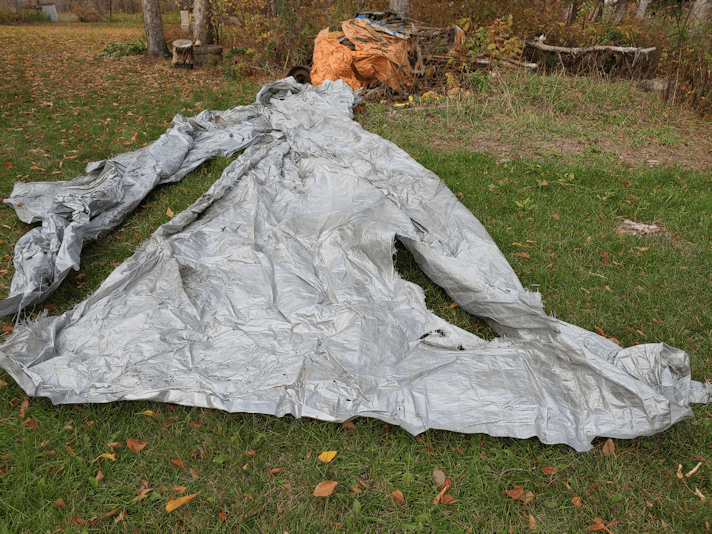
While trying to get at the wood to find better pieces, I ended up having to move the remains of old tarps to access it, and finally had to move the grey tarp that was draped across the end of the pile.

That was my first surprise.

It turned out to be huge!

I then had to remove the even more torn up orange tarp, though I found another, smaller orange one (it actually looks more like the remains of a larger tarp). There are also the remains of a blue tarp on the pile of wood, but it’s so disintegrated, I didn’t even try to dig it out, yet.

I also finally dug out the yellow tarp I was seeing just bits and pieces of. This one was so brittle, I could hear it cracking as I moved it.

When it came time to do something with the wood I’d set aside, I was a bit at a loss. I didn’t want to just make a pile on the ground. I also wanted to stack it in suck a way that no critters would hurt themselves on all the nails and such.

After thinking about it for a bit, I went over to the garden shed and hunted through the stuff we’d piled around it while cleaning out the maple grove.

I ended up bringing over an old metal bed frame – one of three I found in the maple grove. It has metal slats held in place with springs, so I put the longest boards I placed the first few boards in such a way that none of the weight was on the slats. After that, I layered the pieces in such a way that all the pointy bits were facing down or tucked away somehow. Critters can still get under it, without the risk of scratching themselves on rusty nails.

Once the rotted and dangerous pieces were stacked, I started to pull up the disintegrating orange tarp that was mostly on the side, tangled in the things that had been leaned against it to keep it from blowing away in the wind.

That’s when I started to see wheels.

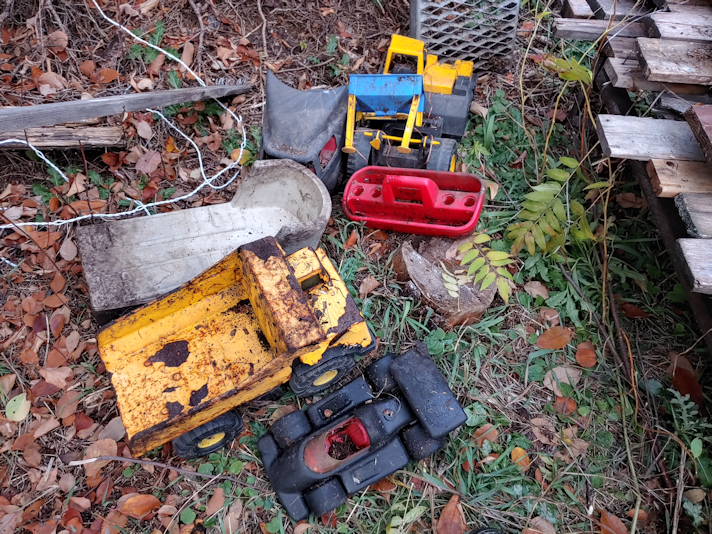
By the time I was done, I’d pulled out all of these.

That’s a metal dump truck in there! Too bad it is so rusted out. The paint is coming off in chunks, too.

I think these might have belonged to one of my nephews.

All of my nephews are adults now.

I ended up tucking them part way under the pile of rotted wood, to partially cover them. I’ll figure out what to do with them, another time.

As I was pulling those out, I also found this…

A rather large white tail deer antler! The discolouring shows the parts that were in contact with debris that would have gotten wet, regularly.

While I was working, I was eventually able to get closer to a tree stump than before. Which is when I noticed something odd.

There were nails in the stump!

Looking closer, I could see the board on the ground. Assuming that was what the nails had been holding in the past, I’m wondering if maybe this had been a platform bird feeder at some point? It’s too high to be a seat, and too small to be much use as a table.

Once I’d done as much clearing as I was going to today, I put the partial tarp that was still useful over the wood pile, having thrown out the torn up one. Then I spread out the big grey tarp.

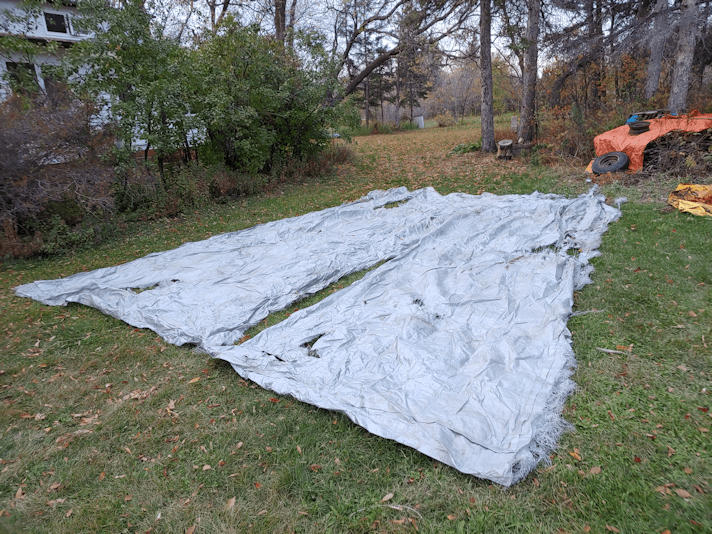
I’m not sure it’s actually a tarp. It might be a canopy cover of some sort. Whatever it was made for, it’s really big! It’s unfortunate it was left out the way it was, and got all torn up by the elements.

I ended up folding it up and setting it aside. It’s not much use at full size, but it’s big enough that, folded in quarters, I might actually find a use for it for one more winter, before tossing it.

At some point, I want to finish cleaning up the junk around the wood, then go through the wood itself to sort out the rotten pieces from the ones that are still useful.

Somewhere in there is a space big enough for Butterscotch to have a nest for her and her babies. I’m curious to see it!

The Re-Farmer