So many cords…

Today I did some work on my mother’s car, to help prepare it for winter.

For those less familiar with some of the things many of us Canadians need to do to our vehicles so they better survive our winters, most vehicles here have, at the very least, a block heater. That’s all our van has. This prevents the oil from freezing and cracking the engine block.

We actually had that happen to us. We were living in Victoria, BC, which is temperate rainforest. Getting snow there is a rarity, and temperatures below -20C/-4F even rarer. An unexpected windfall meant we could afford to drive out to be with family for Christmas. We had no car of our own, so we rented one. My husband called several places and, at each one, told them that where we were planning to drive and asked for a car with a block heater. The typical response was “what’s a block heater?” So we took what we could and headed out, stopping for the night along the way. That night, temperatures plummeted and wind chills reached -61C/-77F. Amazingly, the car started the next morning, but we barely got back on the highway when it started making noises, so we stopped. This was in the days before cell phones, so my husband started to walk back to town, getting a ride from someone (thank God!) along the way, to get help. Long story short, the engine block had cracked (also, a 6 pack of pop on the floor of the back seat exploded. :-D ) and by the time all was said and done, it cost the company some $5000.

A few years later, when we went back to rent a car there again, we learned our story had become legend in the company. Also, the franchise owner replaced his entire fleet, and all their cars now had block heaters.

So… yeah. These are essential.

If you ever see a vehicle with Canadian plates, and the end of a cord hanging out the hood, now you know what it’s for. :-D

My mother’s car, however, also has a battery warmer and, because it was used so little, my brother added a trickle charger, too.

All of which need to be plugged in.

The plug and cord for the block heater in newer vehicles are different. They don’t need to be on constantly to do that job so, to save power, the cord itself is designed to shut itself off about about 20 minutes, then if the temperature of the lines drop below a certain point, it turns itself on again.

When my brother set things up, he used an extension cord they could all plug into, tucked neatly away.

I needed to replace the extension cord.

He also had a wire around the battery warmer to hold it in place. However, with my mom’s car having so much work done in recent years, things got moved around. After the battery died while sitting at the garage for so long, it was taken out to be charged, but I guess the wire that had been around the warmer was forgotten. I was going to use Zip Ties to hold it, but they kept breaking, so I used a Bungee cord; the red that you can see around the battery.

This is the plug for the trickle charger, after I pulled the rest of it loose. As you can see, there’s no way to plug in the block heater or the battery warmer. My mother didn’t drive the car in the winter and, until we took over taking care of it, my brother stored it here at the farm and took the battery into the house for the winter.

Remember how I mentioned the extension cord used to be neatly tucked in, until work was done on the car?

This is why the cord needs replacing.

I had noticed an odd sound a while back (this was before we had the serpentine belt and pulleys replaced) and found a loop of it hanging down, touching the belt. Thankfully, it didn’t get caught, but there was enough contact for the friction to wear right down to the wire. In another spot, it had been caught between something tight enough to cut through two layers of plastic.

We had the same type of extension cord set up in the garage for our own van, so I was going to just switch them out. I had gotten to the point of trying to figure out how to fit the end, with all three plugs in it, in place when I realized something.

Our cord was much longer than the one I’d just taken out! There was no way I could safely tuck away any excess.

Since I couldn’t leave everything half done like that, I made a quick run into town. Of the 2 hardware stores, one was already closed, and I had less than an hour to get into the second one!

Score!!

I have never seen an extension cord for block heaters before!

I could have done with shorter, but that was the shortest they had.

It took a fair amount of fiddling to find a way to lay the plugged in cords out.

More Zip Ties were used to keep things from slipping down, while the new extension cord was set up to exit at the other end.

At this point, I’m not bothering to hook up the trickle charger. It’s not needed right now.

The battery has nothing to indicate which side is positive and which is negative! Only by stretching to see the far side of the battery can I see which connector cable is red and which is black.

I’d used the slots for holding the battery cover in place for Zip Ties to hold the cord. Thankfully, that did not prevent me from being able to fasten the cover back into place.

I then dropped the hood a couple of times to make sure I could actually close it with the end of the extension cord sticking out.

For now, though, it’ll stay tucked away. When we get colder, I’ll hook up the trickle charger and leave the plug hanging out. A lot of public parking lots have outlets available, so an extension cord will be kept in the vehicle in case we want to plug it in while out and about, too.

Aside from that, my mother’s car is all set for winter. :-)

The Re-Farmer

Fall cover, and working out a problem

It’s been rather windy for the past few days.

We certainly won’t be needing to mulch the bulbs we planted! They’re getting an excellent cover right now. :-)

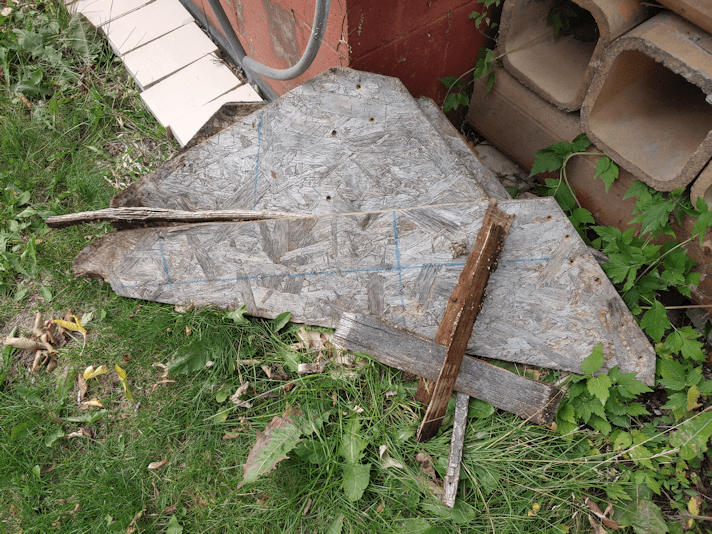
We’ve got a bit of a challenge in winterizing things outside. One of the things that needs to be done is to replace the rotting skid under the cat house.

After dismantling our goat catcher earlier in the year, we left the frames together. The two 4′ x 8′ ones were prefect to use as guides for our potato beds. When I noticed how rotten the skid under the cat house was, I grabbed one of the frames to check.

It’s actually a better size than what’s already under there! Right now, only one side rests completely on the length of the skid, while the other rests on the skid at only 2 points. That’s the side that also had the little addition, where the entrance is. There is nothing supporting the weight of the entry at all, other than the floor beams.

The problem is, this thing is incredibly heavy. My brother had managed to move it onto his trailer all by himself, but he did that by putting straps around the skid. We need to take it off the skid, then put a new one underneath. The whole thing will be on bricks to keep the wood from contacting the ground, and I plan to add more under the entry to support it, as well.

We discussed taking the roof right off, since that’s where a lot of the weight it, but we are already hearing crackling of wood every time we raise it. It’s already got a lot of years on it, and we’d like to be able to use it for quite a few more! Once we have it on a new skid, set up a bit closer to the house for the extension cord to reach, it will hopefully never need to be moved again until it’s no longer usable. Another part of the problem is the lack of tools. We don’t even have a bar we could use to lever it – there was one, but it was among the things that disappeared while the place was empty.

We will have to make do with whatever we can find!

The Re-Farmer

Fall colours

It’s looking really gorgeous out there!

My mother’s “living fence” has a row of hawthorns (you can see some of their berries) on one side, and a mix of caragana and oak on the other. I got a picture of a larger oak at the far end of the row of trees, with elms above it. The crab apple tree is one of the ones in the West yard. The apples do not taste very good, but the deer and birds will enjoy them. There is also the linden tree, all yellow, while the currant leaves (which I thought were gooseberry at first) are lovely shades of red.

The Re-Farmer

Look what I found

While tending the garden beds where we have the beets and carrots, I was looking into the area behind it. It had been part of the plan for this past summer to clean up further into there, and I was thinking of what I might still be able to manage this year, while we have some co-operative weather.

Of course, with the leaves turning, I was seeing all sorts of yellow and reds and…

… reds?

Those aren’t leaves. Those are apples!

Yup. I found another crab apple tree!

It is easily the tallest of any of the crab apple trees we’ve got, including the ones that aren’t buried by other trees. I honestly can’t remember if I’d noticed anything blooming here in the spring, but if I did, I probably thought it was another cherry tree, since there are so many in this area.

It’s not like I could get closer to see. There are at least 3 dead trees that have fallen by it (the leaves in the foreground are cherry suckers, grown from the bases of dead cherry trees). Through the matting of crab grass and various other undergrowth, I can see wood from other dead trees, but not well enough to tell if they are separate trees, or pieces of the ones that I can see more easily.

There is even a big fallen dead branch, stuck in the apple tree! I suspect this one fell during our more recent high winds, though, and was not part of the fallen trees at my feet when I took this photo.

I was able to get around one side and reach a single apple to pick and taste. I notice the apples are a pretty decent size for crab apples. It was sweet, but the texture wasn’t very pleasant. That could be due to the recent frosts, though.

Well, if I do get a chance to start doing some clean up this fall, I know where I plan to work! I want to clean out up to and around this tree, and get that dead branch out. That will open things up and give it more sunlight and space to branch out.

I suspect I will be finding little surprises like this for a few more years as I continue to clean up further into the spruce grove. :-D

The Re-Farmer

Fall Clean up: finally clearing the second tire planter

When we moved here, there were two tractor tire planters in the yard. One of them had been next to a willow for so long, it was actually damaged by the willow as it grew.

You can read about what a job it was to clear that out here, and here.

Thankfully, this one was not as big, and easier to get to!

The other one was likely about 130-140 pounds, so I’d guess this one was probably around 100 pounds.

Not counting any soil inside it.

The first thing to do was pull up the spent, self-seeded flowers, which I’d already done before taking the picture. Then I needed to loosen the soil and clear out the remaining plants, weeds and grass.

There had been a concrete block in the middle of this, to support the bird bath that used to be here. I dug it out to use in the fire pit, leaving a hole behind.

You’ll notice, there is no hole.

Junk Pile’s kittens LOVED playing in the dirt, and filled it in with their rolling around in it.

They were also very fascinated by me working on this, and were even willing to stay fairly close to watch!

Though I could pull out a fair amount of roots, stems and bigger rocks with my hands, it still wasn’t good enough for the soil to go into the retaining wall blocks.

So I rigged a sieve.

This is the mesh from what had been a screen window that would be put over the window to the old basement in the summer. The wooden frame had rotted and broken, so we built fitted replacement. The old wood frame is trash, but the steel mesh worked well for sifting the soil. A slightly finer mesh probably would have been better, but it did the job well enough!

Well enough that I think I will build a new frame for it, for future sifting jobs like this!

After filling the wheelbarrow with enough soil to top up half the retaining wall blocks, I was at a point where I needed to start lifting the tire itself.

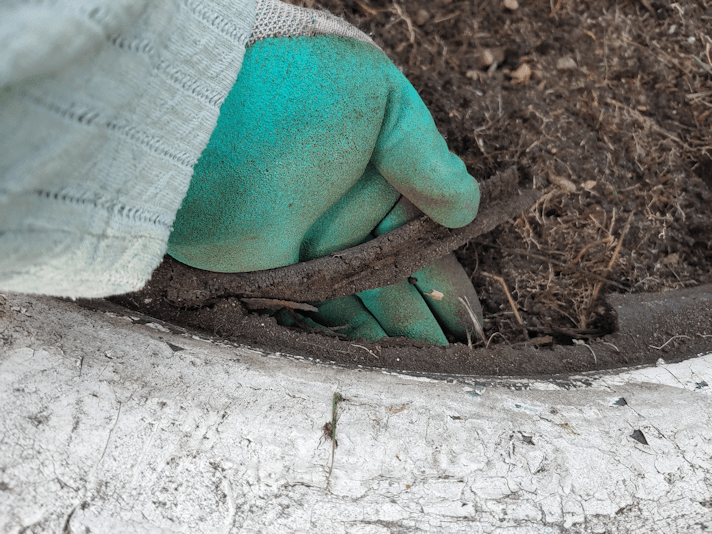
While working my way around the tire, I could hear roots tearing as I lifted it!

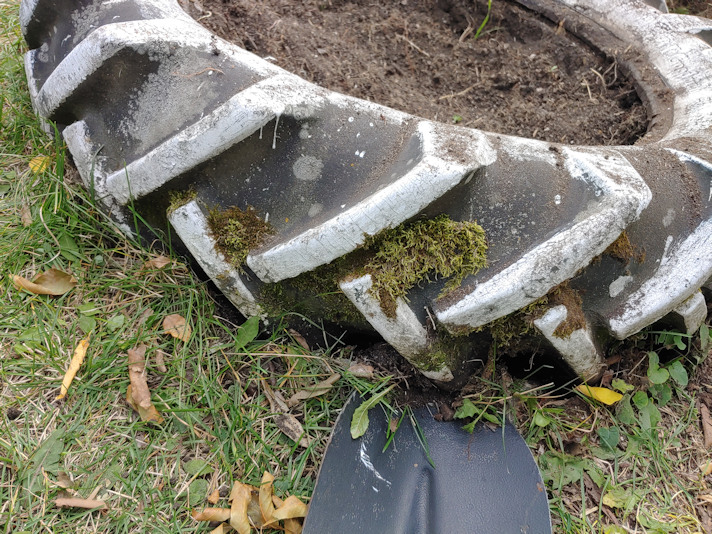
And yes, this has been here long enough for moss to start growing on it!

Since this tire planter wasn’t placed next to any trees to damage it, it could potentially still be used for something – in a better location! However, as I cleared the soil and roots away, I could see there is still a fair bit of damage from weathering. I was even pulling broken pieces of cable out.

Eventually, after clearing enough soil to finish topping up the retaining wall blocks, I had removed enough soil to actually lift it up.

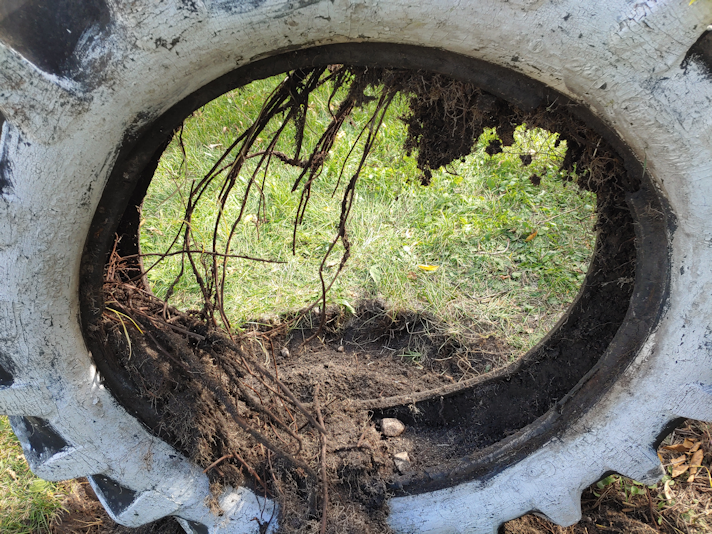
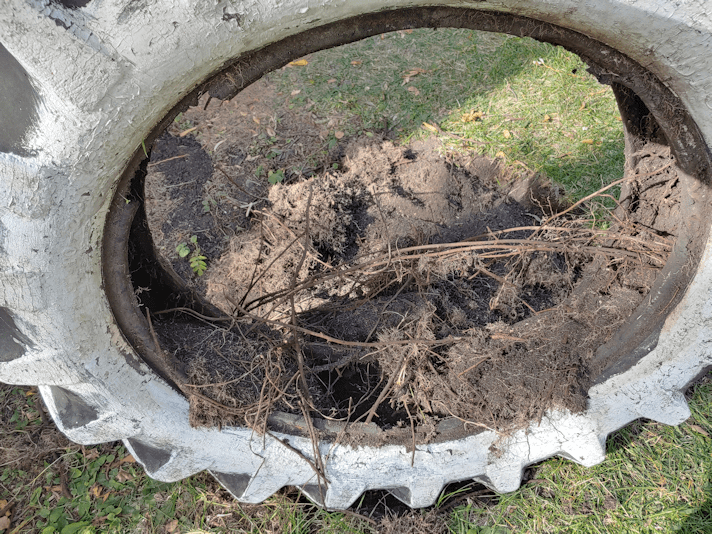
As you can see, there’s still a lot of soil in there!

Soil that is jam packed with roots.

I tried loosening the soil with a garden tool, but the root mats were so dense, it was hard to break it loose. It ended up falling over in the process.

Which did a much better job of knocking the root filled soil loose!

In the end, the easiest way to clear it was to roll it a bit, pull it back, bounce it, roll it again, pull it back, bounce it…

I finally got it all out! You can see the pile of roots in the back, where I’d pulled out the biggest, vine-looking ones. I don’t know what they were from; they look like they’ve been dead for a long time. Certainly nothing growing in the planter since we’ve been here came from those long roots!

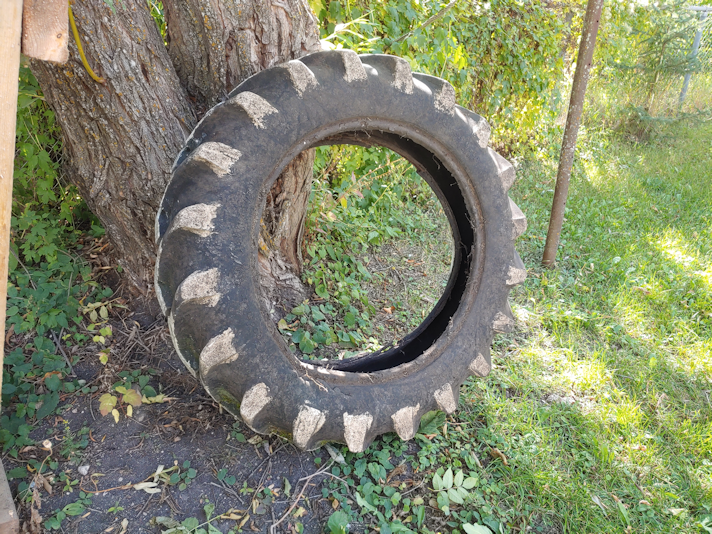
The tire was just been set aside for now. We might still try to find a way to use it, but not as a planter!

For anyone reading this, thinking of re-purposing tires as planters…

Don’t.

Just… don’t! :-D The tires do degrade quite a bit, they are difficult to work around, and they are a huge job to clean up!

Speaking of cleaning up…

Yay!! No more tire planter!

That thing was such a pain to mow around!

All rakes up and ready to have some grass seed added, next spring.

Another job off the list!

The Re-Farmer

Fall Clean Up: the platform bird feeder

We had a light frost last night, and have frost warnings for tonight, but today was a gorgeous day to get work done outside! We reached a high of 15C/59F, which is an ideal temperature, I find.

The first thing on the list was to work on the platform bird feeder. It has been just sitting off to the side for a couple of weeks now, so it’s about time!

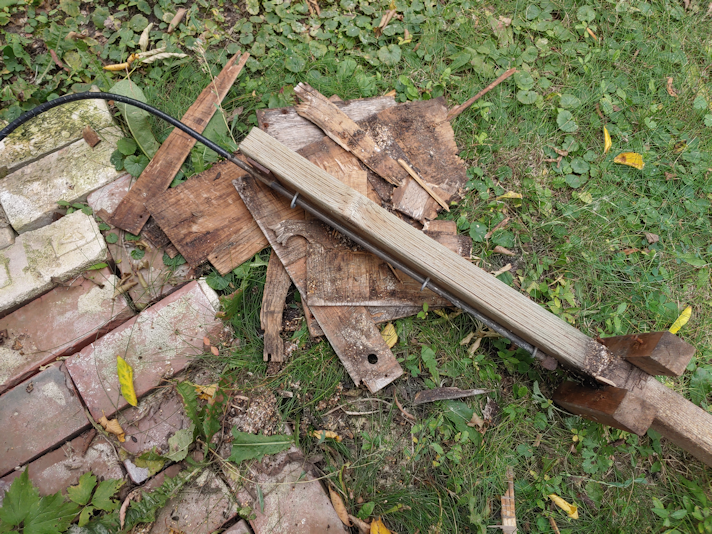
The first thing to do was remove the “legs”. They’re not particularly stable, and showing rot where they touch the ground, so it was time for them to go.

There were a remarkable number of screws holding them in place!

There were 20 screws between 3 legs!!

You can see how they were starting to degrade.

Also, pieces of the platform feeder were just peeling right off!

That took a bit more effort to take off. I started to remove screws from the supports under it, but realized it is really solid, so I tightened them again and left it.

Then I had to find the screws holding the platform to the supports.

I found one I was able to remove. Another would not budge.

It was actually easier to just tear apart the platform with my hands.

I had to use pliers to loosen the remaining screws before I could take them out.

After that, I brushed and scraped away the old bird seed that had gotten jammed around the support post, the scrubbed again with water. Is was then set aside to dry in the sun.

Later, I will cut off the rotten end of the support post, and then I think we will paint it. This can definitely be salvaged. We just need to figure out how to securely set it in place. With a bird feeder hanging off the hook – or even just the cage of a suet feeder – the wind kept blowing it over. I also want to find a way to put on another platform. Maybe something not wood, to avoid the problem of rot that developed on the old one!

We’ll figure it out as we go. For now, we’ll see about getting it painted, first. :-)

The Re-Farmer
Crab apple status

Since the wind broke the one crab apple tree, and I ended up tying it off, rather than cutting it away, I’ve been keeping a close eye on it since.

Check it out.

Can you tell which part was broken?

There isn’t even a single wilted leaf on it!

It still might not survive the winter, but for now, it’s doing just fine.

Unlike this one.

This is the crab apple tree by the old compost pile. Last year, it had good eating apples. This year… well, the ones that aren’t infected taste good. :-( About half of the tree has yellowing leaves with brown spots, and even the apples on those branches are more yellow have have spotting on them. I’d hoped to have cut away the infected branches in pruning it, but the fungus had clearly already spread further.

I’ve been looking at some of the other crab apple trees and thinking of what to do with them. Like many trees here, they were planted too close to each other. Some had already died and were cut away, others show signs of fungal infection, and most… well, they’re just not good apples. When I do my rounds and check on them this time of year, I do taste the occasional apple. One tree had me spitting it out right away. Another has the most bizarre combination of being really sweet and really sour at the same time – so sour, I end up spitting that one out, too. Others are so tiny, they’re just ornamental. The grosbeaks and deer eat them, so even though we can’t use them, they are still feeding critters. In that respect, I’m okay with them.

However…

Partly because they are so close together, partly because of the spreading fungal infection, I am increasingly thinking of cutting most of them down to save the two trees that have good eating apples, and are still healthy. I hate the thought of cutting them down at all. There is even the sentimental side of things. My late father planted these, though it looks like the parts he grafted have died and only the suckers from the bases are still growing.

If they do get cut down, they won’t go to waste. One tree with particularly disgusting tasting apples is quite large. If that one were cut down, I’d find all sorts of ways to use the wood. It’s base is large enough, I can see carving some decent sized bowls out of the wood.

In the long term, we are intending to plant a nut orchard in the area, having found a place that specializes in trees that grow in colder climates such as ours. We will also be planting hardy varieties of different fruit trees. Hopefully, we will have apples, pears, and plums in this area, too. Taking out any sick trees, poorly placed trees, or any fruit trees with inedible fruit, would free up space needed for food trees.

*sigh*

I know we’ll need to take them down. I just don’t like having to do it.

All in good time. Aside from the diseased ones, there is no urgency to it right now.

The Re-Farmer

Appreciate the beeauty

Let’s start by enjoying this lovely photo I was able to get this morning.

There were two bees on this sunflower, busily pollinating!

A nice, cheerful burst of sunshine.

I feel like I need it right now.

I had intended to use my mother’s car to run some errands in town today, just to get it on the road. Then my mother called me in the morning, asking for help to do her shopping, so I did my errands at her town, instead. Plus, I got to surprise her with her own car, which is easier for her to get in an out of than our van.

So that worked out rather well.

Of course, it was a visit with my mother, and all that this entailed. It was a pretty good visit, overall, but as usual, it left me drained. As an example of just one of the things that came up, apparently we did our celebration on Sunday all wrong. Not only was she still upset about the ceiling fan, but apparently we each, individually, were supposed to give her cards, there was supposed to be a tablecloth and candles, and after dinner, we were all supposed to make speeches.

???

Never mind that we were originally supposed to have a cookout and be eating outside, or that two other people’s birthdays and an anniversary were being celebrated at the same time. She had an expectation, and we didn’t meet it, therefore it was all wrong.

So is everything about our gardening this year, and the fall planting we’re intending to do later this month.

And so on. Everything is all wrong, because it’s now how she would do it, or the way she thinks it used to be, or how she thinks the “proper” way to do something is.

*sigh*

But that’s okay. Tomorrow, I get to recharge. We are taking my mother’s car out for a longer highway drive, and finally visiting my older brother at his place. He has come out here so many times, yet since we’ve moved in, we’ve managed to go to his place only a couple of times.

It’s going to be really great to see them!

For now, it’s back to recovering from visiting my mom, and appreciating the beauty of bees and sunflowers! ;-)

The Re-Farmer

Hard crab apple cider: Getting clear

What a difference a day makes!

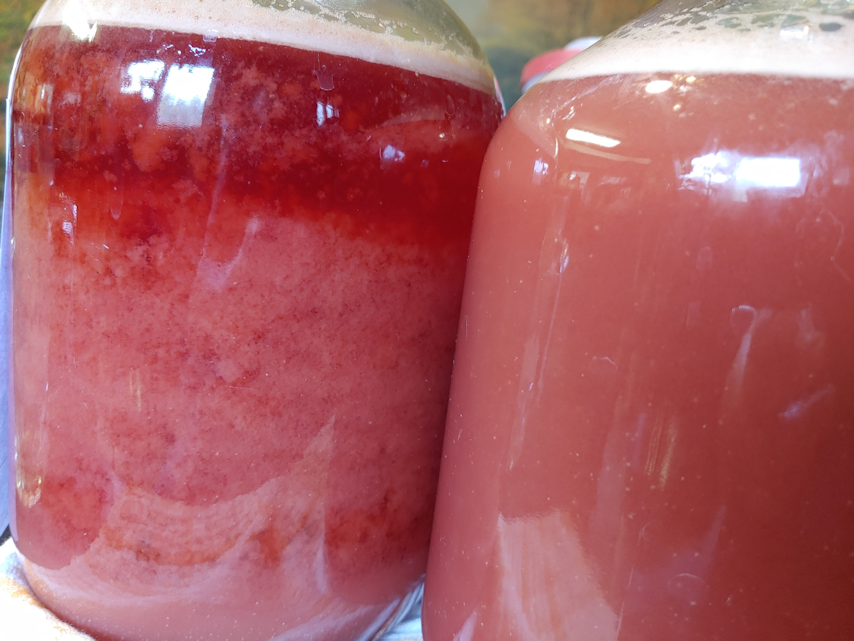
This is how the crab apple juice looked, right after we got finished setting up the fermentation.

This is how they looked this morning.

The photo does not do justice to how bright the colour is!

When I was checking these last night, the tops were full of dense foam, which has mostly collapsed, but you can certainly see how high it got.

Their temperatures seem to be holding at between 18 and 19C, and – most importantly! – we are seeing activity in the airlocks. Not a lot, but it’s definitely started to bubble!

So far, so good… I think! :-D

The Re-Farmer

Making hard crab apple cider; will it work?

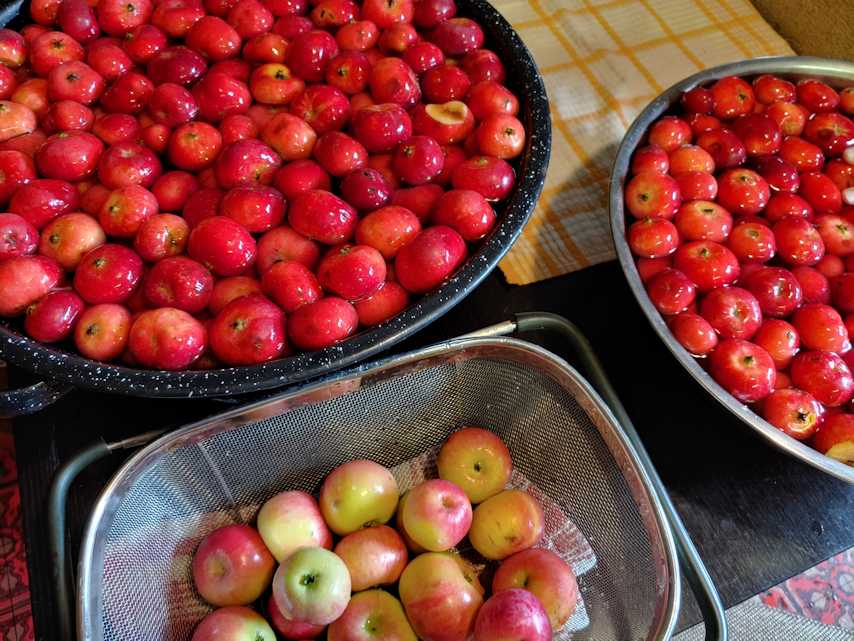
Today was our first attempt at making hard apple cider. We are using the remaining apples from the one crab apple tree we have that produces the most amazing, sweet, delicious little apples, after using some of them to start an apple cider vinegar.

When we first moved here and saw how many crab apple trees we had around the property, we looked into what was needed to make hard apple cider. At first, we didn’t think it would be anything we could do, or at least not anytime soon. Making hard apple cider, we found, required using a large press to crush whole apples, then sealing up the resulting juice to ferment a few months.

We didn’t have a press, and with so many other things on the go, we were not about to build or buy one, either.

Then I found the CS Brews YouTube channel, now called CS Mead and More. I liked it enough to include it in my Recommended series.

They started making hard apple cider, using store bought juice. Sometimes, right in the container it was packaged in!

We could make hard apple cider without having a press, after all!

One of the things we found when cleaning up this place after moving in, was a juicer exactly like the one we had to leave behind when we moved. I think one of my siblings bought it for my mother, but she hardly used it. Everything was still in its original packaging, even!

We decided to try making hard cider using our own juice.

Now, making it using store bought juice in the bottle they were sold in works, because everything comes pasteurized and sanitized off the shelf. Basically, enough juice needs to be poured off to make room for the sugar and yeast, an airlock gets put on, and you can leave it to ferment to get a very basic hard apple cider.

Of course, doing it the traditional way, with a press, the juice didn’t get pasteurized or filtered or anything.

We decided to try making our own hard crab apple cider with raw, unpasteurized, unfiltered juice. The juice would be going straight from the juicer to the sanitized gallon jugs, so the chance for contamination would be very lower.

Lower than trying to do it the old fashioned way, that’s for sure!

The first step was to clean the apples and de-stem them. They didn’t have to be cored, but the stems would cause problems with the juicer.

The crab apples from the one tree completely filled my two largest bowls. Though I cut away some obvious nasty bit, I wasn’t worried about light bruising. I also have the not-quite ripe apples from the tree that broke in the wind storm.

It’s a good thing we had so many of these apples this year, since I had to toss the cider vinegar, and start over again.

Juicing the apples turned out to be more difficult than expected. It was made slightly easier when we found a way to raise the juicer high enough that a 1L pitcher could fit under the spout. We had 2 one gallon jugs, and a gallon is about 4L, so I could use the pitcher to loosely measure how much juice I was putting in. However, these little apples don’t have a lot of juice in them, and their pulp kept jamming the machine. My daughter kept having to stop the juicer, open it up and peel away the pulp that accumulated on the perforated metal cone inside, instead of going out the back. The pulp was so dry, it could be taken off in ribbons!

Using information I got from one of the hard cider making videos, I used 2 cups of sugar per gallon. Each got 2L of juice before I put in a bung and shook the heck out of them to dissolve the sugar.

Look how pink that is!!

Also, you might notice the liquid is not at the same level. Though these are both 1 gallon jugs, one is actually bigger than the other. They are 1 gallon at about the “shoulder”, which leaves space for the fermenting liquid to bubble up a bit.

I also used the same wine yeast we’ve been using for everything else; I don’t know the specific strain of yeast, but it’s basically what is available for a non-sparkling wine from the local brewing supply store. Again, following what I saw in the video, I dissolved about a tsp of yeast in a bit of juice, then added it to the full jugs, after getting a hydrometer reading.

After the yeast was added, they got another thorough shaking, then the airlocks were put in place.

I’m also trying to be more diligent about recording everything. I have to admit, I still don’t understand the hydrometer information, so I wrote down all three readings. It has a “potential alcohol by volume” measure right on there, but I keep reading that it isn’t any good, and that it’s better to use the specific gravity reading. It doesn’t help that I can barely see the tiny numbers and lines in the first place!

I found it interesting that the readings for the 2 jugs that were made up identically, are slightly different. It’s possible that the different sized jugs means that one does have slightly more juice in it than the other, and that could explain the difference.

The juice is not only incredibly pink, but incredibly cloudy! They were, of course, just shaken when this photo was taken. You can tell which one got finished first, as the cloudiness is already starting to settle.

We have set the jugs up on a side table in the dining room for now. It’s not a particularly bright room, it’s warmer than the old kitchen, and we can keep an eye on them. I just took a look at them, after they’ve had several hours to settle. I will have to take a photo of them during the day. They look very different right now! The sediment has settled to the bottom, and the clear juice in the middle is looking a deep, deep pink – but there is a significant layer of lighter pink foam at the top! I used the temperature gun on them, and got different readings, depending on where I aimed it. The top, where the foam is, was fluctuating between 19C and 20C (66-68F). The middle was around 17-18C (62-64F), while the bottom, where the sediment has settled, is 17C (62F). Which I think is good.
Also, I’ve turned the thermostat up for the house. It was set just below 15C/59F when the furnace turned on earlier today, so I’ve upped it a few degrees! So the ambient temperature will not be too cold, either.

I have no idea how this will turn out. Will the fact that we used raw, unfiltered juice be a benefit, or a disaster? Will we get something that tastes horrific, or wonderful? Considering how great the apples themselves taste, I would hope the resulting hard cider would be its match. I have no idea. This is a total experiment for us!

As for the remaining apples, it took so long to juice enough to fill the jugs that we didn’t juice the rest of them. I had started cutting them up to cook them into a dessert, but realized I didn’t have the energy for that left, so they ended up in the freezer! Meanwhile, my poor daughter had been standing at the juicer for so long, her back was starting to give out on her! We couldn’t even plug it in somewhere where she could sit down, since there are so few outlets in this house.

Here’s hoping the end result is worth it!

The Re-Farmer