This evening, I went over our beans and made our first real harvest!
We’ve picked a couple of beans, here and there, before, but this is the first substantial amount we have been able to gather. The yellow beans, for all that they are the smallest plants, are maturing the fastest.
A few purple beans, at the very end of the row, look to be newly nibbled on, but of the entire row, I could only find these few that looked mature enough to pick. As for the green beans, there are lots of them, but I don’t think they’re quite ready for picking. With the yellow beans, it’s at least easy to tell when they are ready. They turn from green to yellow. The green beans just stay the same green! :-D
After picking these, I stopped to look over other parts of the garden, including the Dorinny corn. These are the ones that were planted before last frost, and are the most mature. With the weather, they have had a hard time, but some of the cobs did seem to be ready to pick.
A whole four of them, including one that had its tip nibbled on by a deer a while back!
Generally speaking, they seem to have had good pollination; just the one cob that got its silks nibbled away has fewer kernels, which makes sense.
I had moved the garden cam to face the Dorinny corn and one side of the squash tunnel, in hopes of seeing what is eating the winter squash. One of the things I’ve done, after the last time a deer got into the Dorinny corn, and the one row of transplanted sunflowers, was move some of the distractions by the tulips, over to these garden beds. Two of those distractions were long strings of twine with jingle bells on them. I took our last couple of bamboo stakes and set them up along the side of the Dorinny corn block, with the bells strung between them.
I didn’t catch anything on the garden cam going after the winter squash, but I did catch a deer on several video files. It was nibbling at the ground in front of the string of bells, but never tried to go past it.
That was encouraging, at least.
Meanwhile, I currently have the corn in the over, wrapped in foil with some butter, salt and pepper, and am looking forward to tasting one! The beans will be enjoyed tomorrow. :-)
Of course, because I actually needed to get a good sleep because I had to head out early for court this morning, that meant I got almost no sleep at all!
Only part of that could be blamed on the cats being destructive in the night. ;-)
Amazingly, it got cold enough that, for the first time in a couple of month, at least, I had to sleep with a blanket! Of course, I could have just closed the window, but I didn’t want to fight with the box fan, which is tied down so the cats won’t knock it over. When I finally did sleep, I was awakened by the sound of our furnace running! We had actually dropped to 8C/46F overnight. Some areas dropped to 6C/43F, and people were concerned about frost hitting their gardens! Our frost date isn’t until September 10, and that’s earlier than the areas the got colder last night.
Meanwhile, we’re supposed to hit highs near 30C/86F or higher, over the next few days.
I turned the thermostat on the furnace way down, so it wouldn’t turn on again. We keep so many windows open during the night, the last thing I want is for the furnace to kick in! :-D
Anyhow.
Since I was up anyhow, I did some of my morning rounds quite early. Which the cats seemed to appreciate. :-)
I was really thrilled to see both Rosencrantz and Nosencrantz, in the kibble house. Rosencrantz ran off when I got closer, but her baby stayed. Even when I topped up their food bowl by their junk pile home, Nosencrantz stayed in the kibble house to eat.
Progress!
I found the canister for the new bird feeder on the ground again this morning. I am guessing the raccoons have figure out how to open it. I might move the garden cam to face the bird feeder, just to confirm what’s going on, so we can use that to figure out how to stop it.
I didn’t have time to check the trail cam files, though, before I headed to the courthouse. I got there good an early, and the only person already there was the security guy.
Starting after midnight tonight, our province is lifting our police state, somewhat. No more mask mandates and a number of other restrictions are lifted, though of course they’re still restricting actual healthy social gatherings, like weddings and going to church, even though there are pretty much no limits to how many people can go into retail stores. It’s all so arbitrary, it’s a wonder anyone takes the restrictions seriously anymore.
I could see a huge difference when I got to the court building. For starters, the security table was right outside the courtroom door, rather than at the entrance. I still wore my Mingle Mask, just to avoid the hassle of having to explain my medical exemption, and no one even reacted when they saw me.
After identifying myself as the applicant, the security guard looked up our vandal’s name, marked that I was there, then told me I could wait there in the hall, where they have comfy chairs to sit on. The last time, people were made to wait outside. While I was waiting, quite a few people that appeared to be staff congregated around the security table, just chatting, or sitting in the nearby chairs with their laptops. I could hear the security guard asking people what they thought about no masks starting tomorrow, but couldn’t hear the responses.
Eventually, our vandal showed up, and I honestly did not recognize him at first, because he was wearing a mask. Of the many things I hate about the masks, the elimination of people’s identities is one that I think is among the most damaging. I’m glad we live as isolated as we do, because being surrounded by non-entities, even as little as I am, is seriously starting to wig me out. As a lifelong student of psychology, I understand the how and the why of it, which does help, but it still doesn’t stop it from happening.
Anyhow.
The main reason I figured out it was our vandal was because, as he checked in, I heard him mention his lawyer’s name. That and the security guard made a point of turning to look at me. Then the lawyer showed up, and they disappeared around the corner for a while. Eventually, the lawyer came over and introduced himself to me, asking if I was okay with talking to him. He assured me he was double vaxxed. I told him I didn’t care. (His personal health information is NONE of my business.) We did have a bit of an issue with him moving away when I got closer to him, and I had to explain that I couldn’t hear him, because of the mask. He accommodated that, though I still had to adjust things. My hearing is actually quite excellent, but I have an auditory processing problem. Instead of hearing words, sometimes I just hear parts of words, gibberish, or even have blank “spaces” where words should have been. Basically, somewhere between my eardrums picking up the sound vibrations, and my brain interpreting them as words, the signal is lost. If there are a lot of distractions, or if there is something like a mask to muffle speech, it makes it that much more difficult. So I do things like close my eyes, so I can “hear” better or, as I had to today, lean an ear closer and not look at the person speaking. Thankfully, the lawyer had good enunciation, so that helped.
What he wanted to talk about was the sort of conditions for the restraining order I would agree to. Much to my surprise, he was the one who brought up our vandal voluntarily giving up his guns. He also said our vandal had mentioned video I had of him doing stuff, and I ended up giving him copies of images I had in my stack of papers. These included screen captures of our vandal actually damaging the gate, both times, doing things like walking up to the gate and giving the finger down the driveway, the glued locks (from his response to those, our vandal had actually told him about that; he’s never admitted that he glued our locks to us before), the barn doors being screwed shut, etc. I even included the partial list of things our vandal took from the property, that we know off. I told the lawyer flat out that, if he could have a “psychotic break” and do what he did to the gate, what’s going to stop him from having another “psychotic break” and coming over with a gun? Or trying to burn the house down?
When I brought up the need for a psychiatric assessment, he started to say, going for counseling or therapy. I said no, and explained that when I pressed charges before, our vandal had done that, by court order, and while he was apparently going to weekly counseling, he was still leaving horrible messages on my mother’s answering machine about me and the property (I explained the property ownership situation, too, since our vandal thinks my mother gave me the farm, for some reason). Counseling clearly did not work. He needs a psychiatric assessment and a diagnosis.
He then went back to talk to our vandal. When he returned to me briefly, before we went into the courtroom, he asked if I were willing to drop the application if our vandal got a psychiatric assessment. I said no. There’s a reason the police kept recommending we go through with this and, as much as I’d like for this to all be over, we can’t trust him. As it was, something the lawyer said in passing tells me he had to convince our vandal to agree to at least getting an assessment.
Which is actually a big step forward, even if he still can’t admit he’s responsible for his own problems. So when we finally went in front of the judge, it was officially recorded that I agreed to not go forward with the application for a month. During this time, our vandal has to get a referral to a psychiatrist and get an assessment. There is another court date in September to follow up, but I may not need to be there at all. The lawyer (with warnings from the judge about potential conflicts of interest) agreed that he would keep me informed, so I don’t have to be calling the court office all the time. I was actually asked to take the stand, where there was a microphone, from the start, so the judge could ask me questions and clarify some details.
After I left the courtroom, the lawyer soon followed and asked for my email address (I already gave him my phone number). He then asked if I wanted to agree on a certain number of sessions with the psychiatrist, but I said no; let’s wait to hear what the psychiatrist has to say, because this is such an individual thing.
Then that was it. We were done.
Now it’s all on him to meet the conditions within the time frame.
In the end, I think this went well. Our vandal may actually get the help he needs. We used to be so close in the past, and I would love to have a relationship with him again, but that can’t happen until he gets that help.
One of the things I made clear with the lawyer is that if he does anything stupid again, I’ll be applying for the restraining order all over again if I have to. He was agreeing with me before I even finished saying it. Our vandal may be in denial, but his lawyer knows full well he has no defense.
We shall see what happens over the next month.
I don’t intend to get my hopes up too much, to be honest. I fear our vandal is a bit too far gone for that, but you never know. I’m just relieved that we finally got in front of a judge and got to move forward. It’s been 9 months since I made the application.
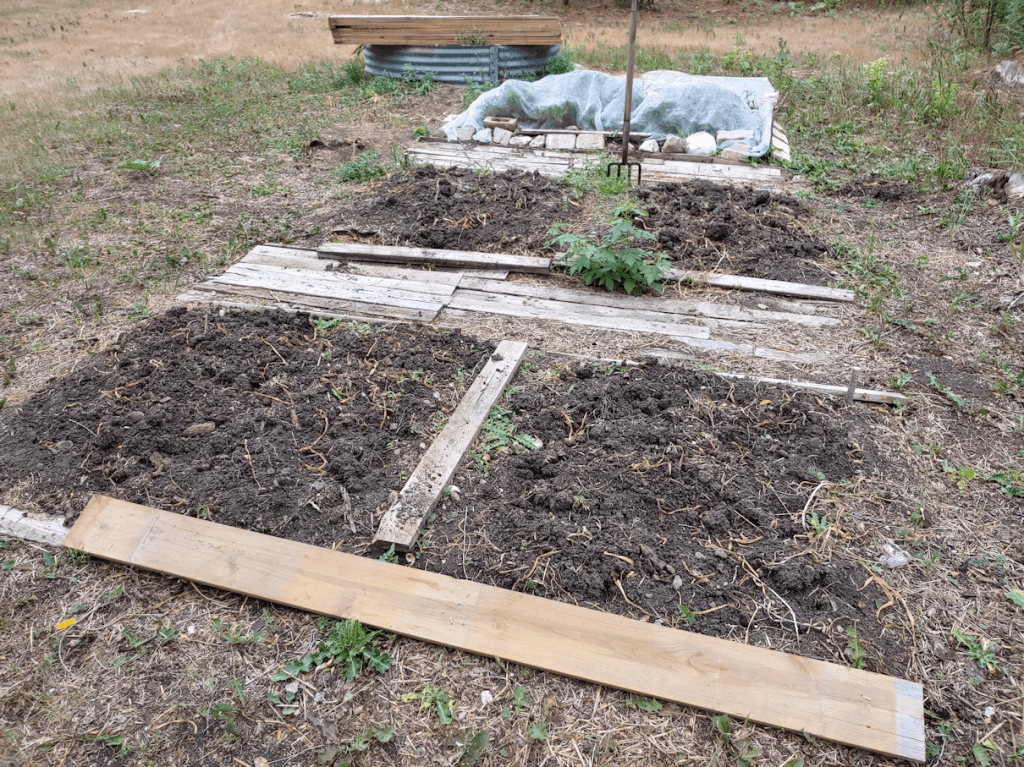
With the garlic all harvested, we’ve got two empty beds that need to be readied for next year’s garden.
With these beds, we had dug into the soft soil we found under the wood pile, mounding soil into beds and making paths in between. This worked out quite well, but there were a couple of issues. One was, for such low raised beds, I found them too wide. They were about 4 feet wide, which would be fine for a high raised bed, but awkward to reach the middles on a low bed. That was partly solved by putting a board across the middle, which served to both mark where the different varieties of garlic were, and to give something to step on while trying to reach into the middle.
What can I say. I’m short.
The other issue was that the soil along the edges would end up in the paths, either from watering or from when the birds were digging around the garlic, early in the season.
The solution to both issues was to build a narrower box frame.
After scavenging in one of the sheds, I found some boards that would serve the purpose.
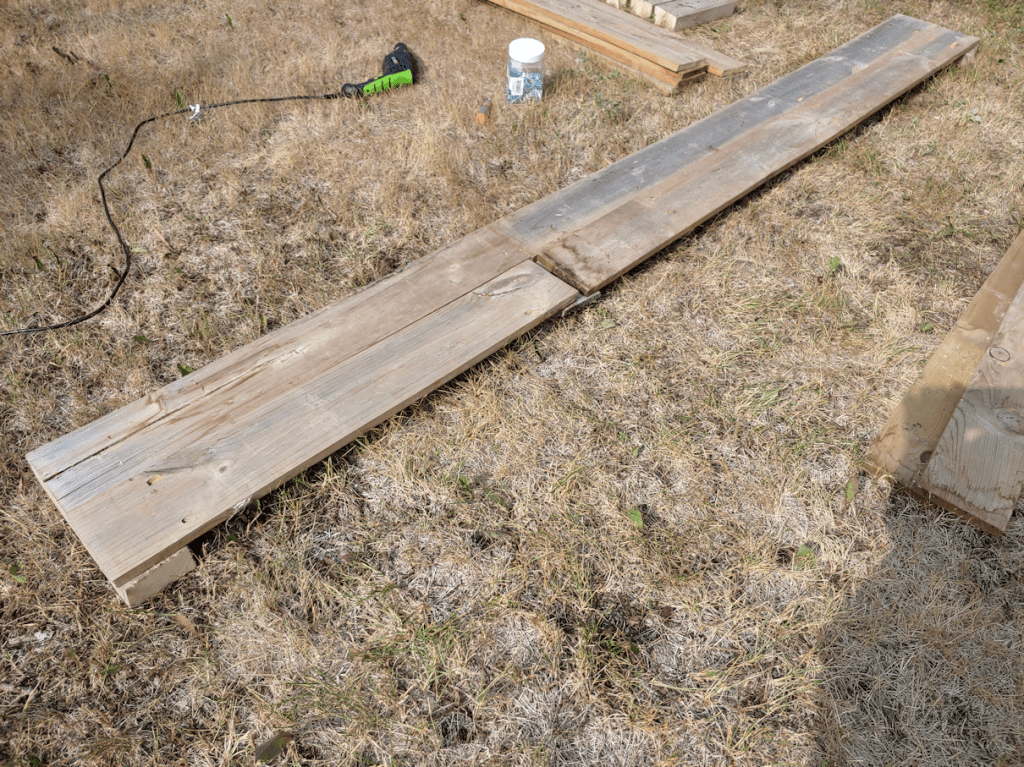
I dragged them all over to the beds. Here you can see one of them laid at the first bed I want to frame.
In total, I had 17 boards like the one in the foreground, plus 4 more that were the same length and thickness, about about an inch wider.
I decided to keep things simple.
I left four boards as is, then cut another four in half. The boards were all 6′ 1/2″ long and 5 1/4″ wide. Some of the half pieces would be used to increase the length, while the rest would be for the ends of the bed. I cut support pieces for the corners and to join the lengths together from some wood leftover from another project. Those were cut to match the width of two boards together.
The long sides were made by screwing the boards to the support pieces. The boards all have damage to them, ranging from old water damage and some rot, to splitting and cracking from being so very dry. Which is fine. They will do the job, and will last a few years, at least.
What wasn’t fine was flipping a board and almost catching my hand on these!!! They look like the screws were broken off on the other side, so there is no way to unscrew them from the wood. I have to think about the best way to get rid of these, using what tools we have, but for now, we’ll just have to watch out for them!
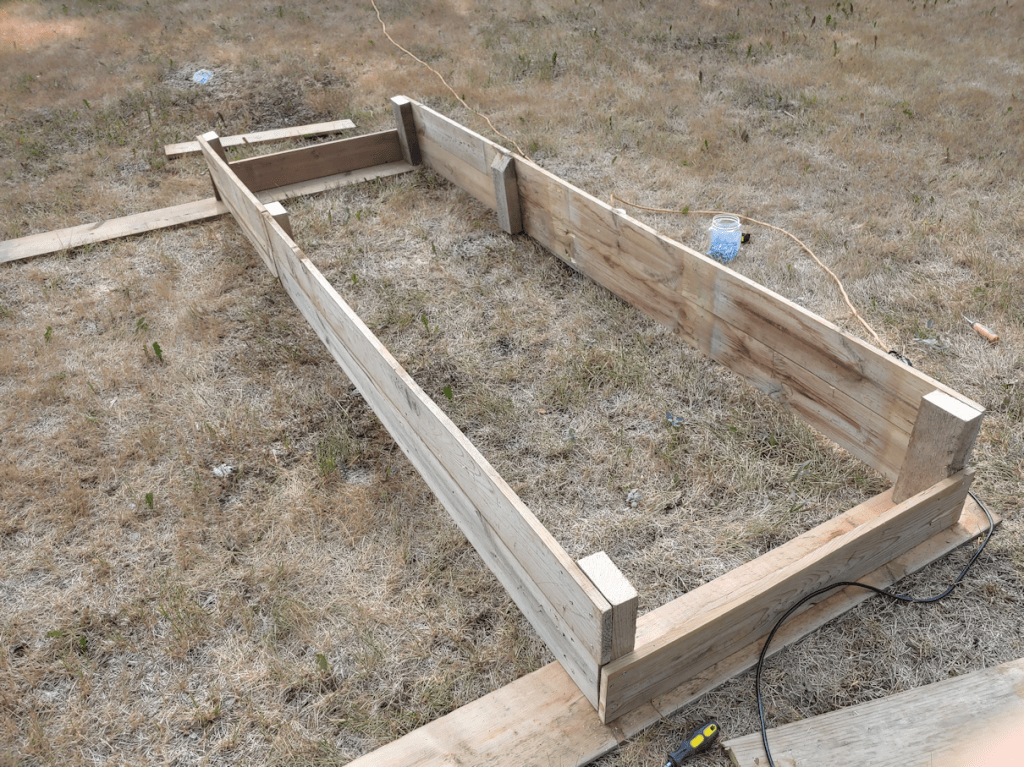
Once the side pieces were screwed together, making sure they matched in length, I brought over a couple of the wider boards to give a flatter, more even, surface to work on while putting on the end pieces.
Then I quickly tacked it together with just a single screw at each corner, to hold everything together while I worked.
Oddly, one piece was almost an inch longer than the others! Which is okay; the excess can be sawed off, later.
Here we have it! The finished box, next to the bed it will be placed at.
Here, you can see the difference in the dimensions quite clearly.
The box is about 9 feet long by 3 feet wide, and about 11 inches high.
In preparing these beds before planting the garlic, we dug out the soil and buried layers of straw and compost material at the bottom. Since the dimensions are being changed so much, I plan to dig out the beds again, then once the box frame is in position, will start filling it, hugelkulture style, by burying some of the branches we’ve been pruning for the past few years at the bottom, then layering the contents of our compost pile on top of that. Straw decomposes slowly, so I expect to find it when digging the bed out. If I do, I’ll be keeping it separate from the soil, so it can be layered back on again. As for the top layer of soil, I’ll take advantage of the situation to get rid of the weeds by their roots, then mix in some of the garden soil we purchased this year, before returning it to the bed. This soil tested healthier than anywhere else we took samples from, but it was still low in nitrogen, so adding the fresh soil will be a benefit. Once we have the materials again, the top will get layers of mulch to protect the soil.
I have enough wood to make a second box frame just like this one. I plan to build the second box before I start digging out soil. With the wider boards, there is enough to make a third frame for the bed that still has the beets in it, though it will be only one board high.
When this area is done, there will be three longer, narrower, framed beds with wider paths in between. This will make them much more accessible, even at their relatively low height.
Hopefully, I will be able to continue working on this tomorrow, but we’ll see how the day goes. I’ve got our rescheduled court date for the restraining order against our vandal in the morning. Hopefully, it’ll actually happen this time – and if the security guards try to tell me to leave and come back later, I will stay close this time.
The predicted rain never came today, but then, neither did the predicted high of the day, so I went ahead and watered the gardens in the late afternoon.
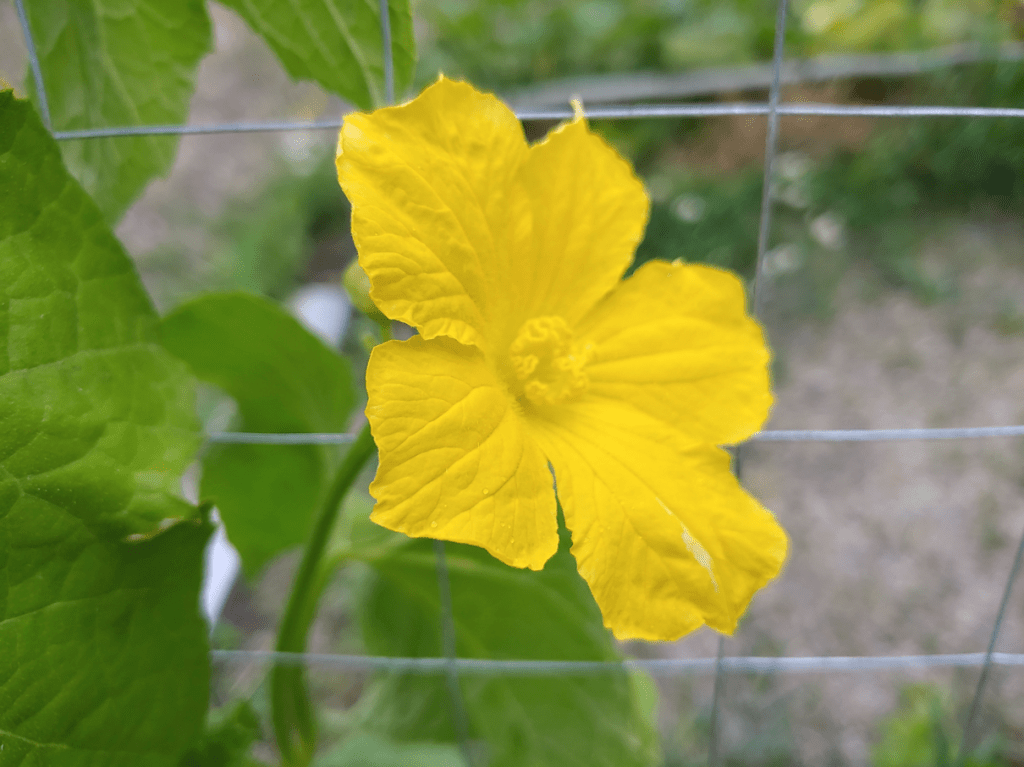
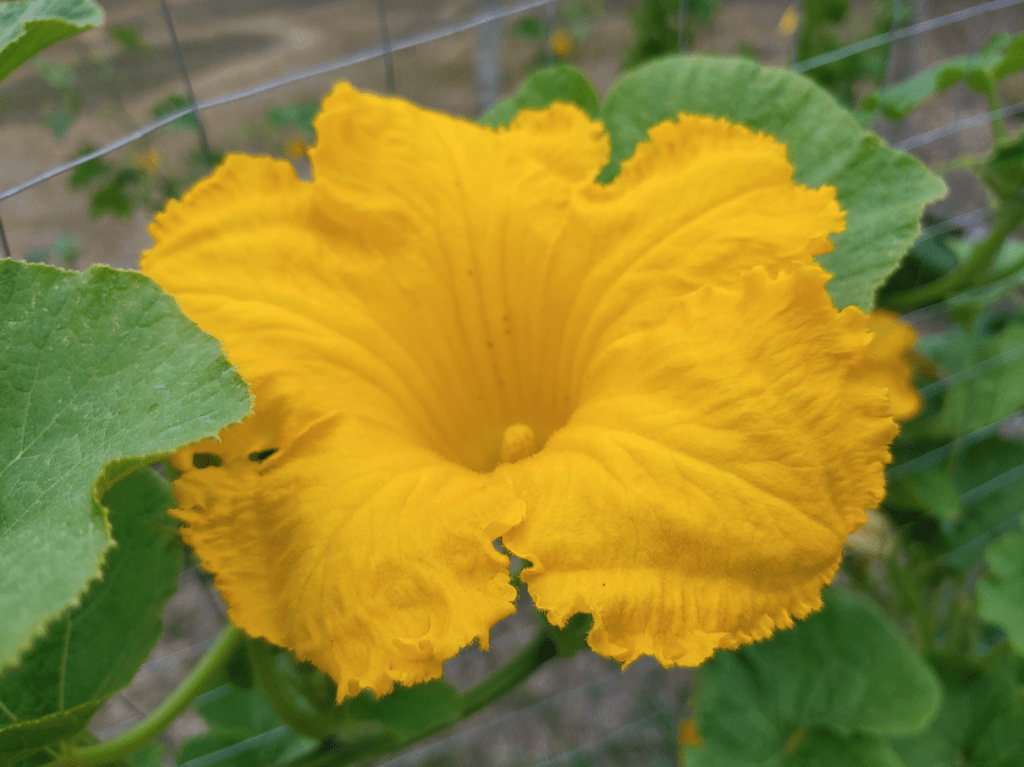
Having mentioned the Ozark Nest Egg gourds in my previous post, I just had to get a picture when I found this.
A single Ozark Nest Egg flower blooming. Still no gourds, though; all the buds appear to be male flowers, so far. There is nothing on the nearby Thai Bottle Gourd at all. If there are any flower buds, I can’t see them. The down side of having to add the mesh over these is that we can’t reach under it to handle the plants with undoing part of it!
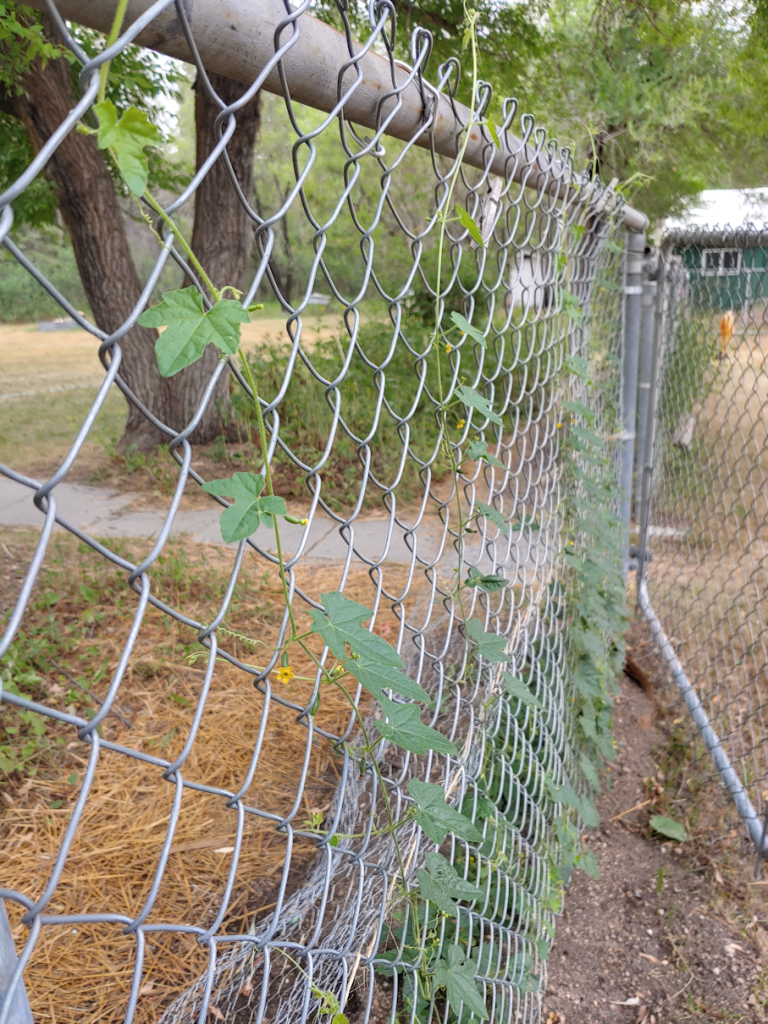
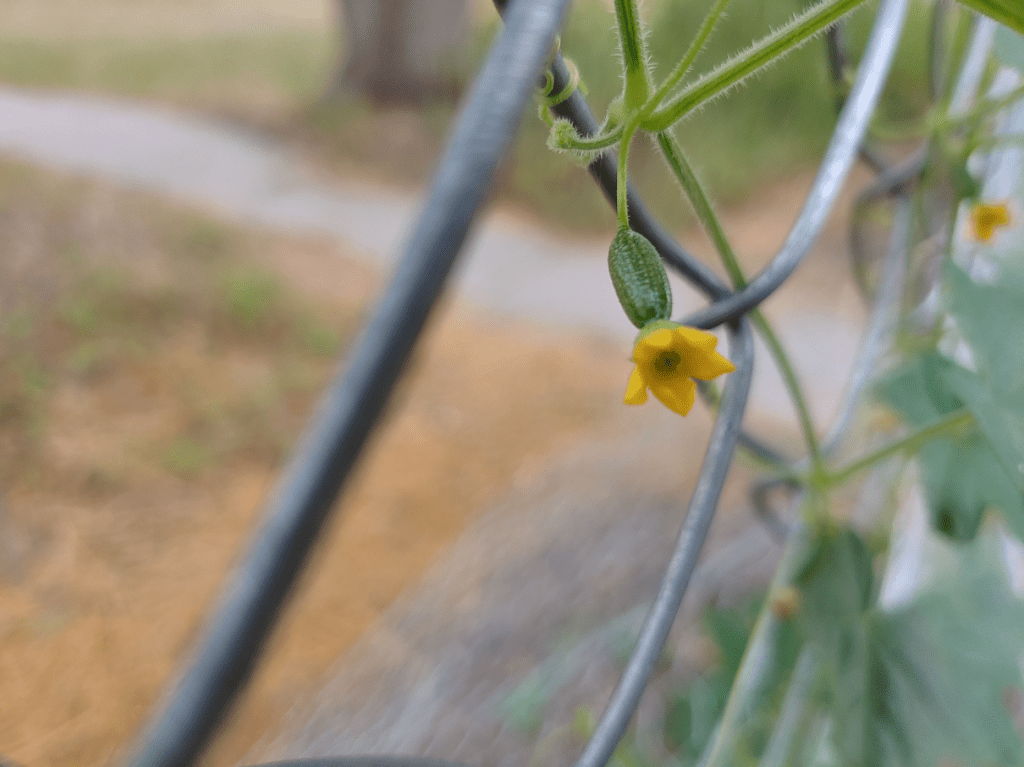
While the Ozark gourds are still just starting to reach a point where we can train them up the fence, the nearby cucamelons have shot their way to the top of the fence and are looking for more height! They are such fine, delicate vines, and you can barely see many tiny little yellow flowers all over them.
Many of the flowers have teeny little cucamelons under them. :-) They are such prolific plants!
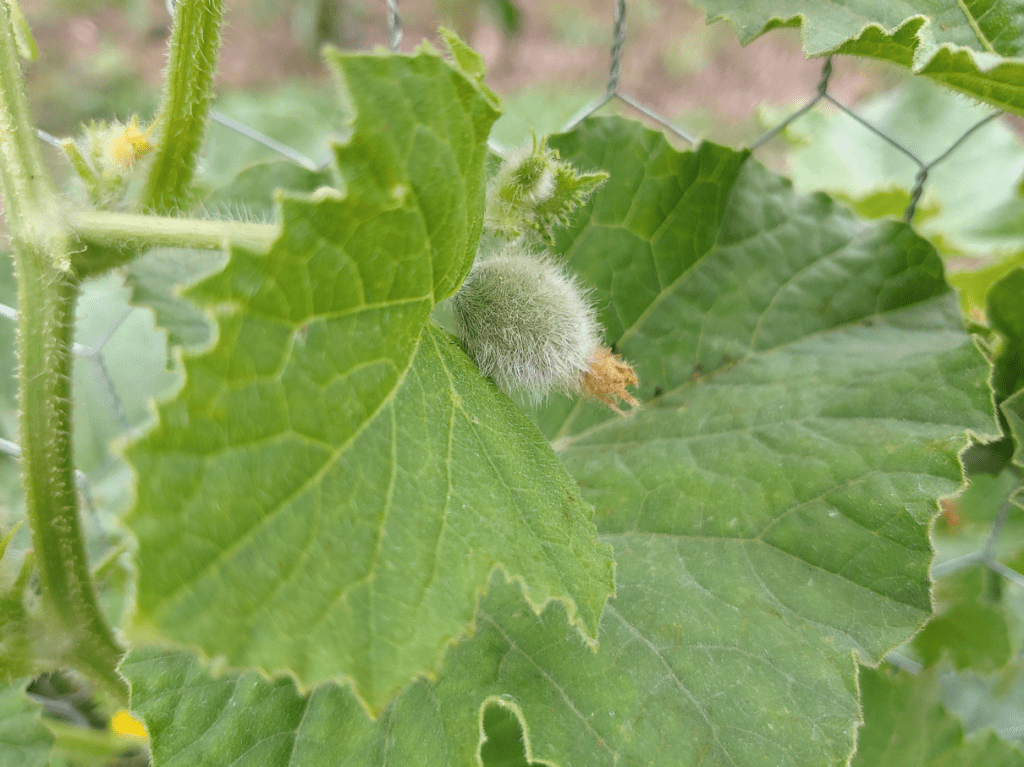
Speaking of prolific, the melons are certainly attracting a lot of pollinators to their many flowers! This is one of the Halona melons.
I love how incredibly fuzzy the baby melons are!
I decided to count what melons I could see. Not the little ones like this, but the larger ones, at least the size of a golf ball. I counted a dozen Halona melons, and another nine Pixies! If they keep up with their blooming, and their ratio of male to female flowers, we could potentially have a lot more than that, if they have enough growing season to fully mature.
There’s always that “if” factor, when it comes to gardening, isn’t there? :-D
Today is turning out to be cooler than predicted – as I write this, we are at 16C/61F, instead of the hourly forecast temperature of 22C/72F we’re supposed to be getting.
I’ll take the cooler temperatures. Especially since the predicted rain has not happened. Oh, we’re getting the odd spittle from the sky, but that’s about it. Meanwhile, the humidity level is at 94%! We kept holding off because of the predicted rain, but once I’m done with this post, I’m going to have to go out and do some watering in the gardens.
Unfortunately, it has also been an incredibly smoky day. Thick enough that I can see the haze in the garden when I look out my window. There has been no reprieve for the wildfires all over the province. Most of them are to the north of us, and they’re getting even less rain than we are. :-(
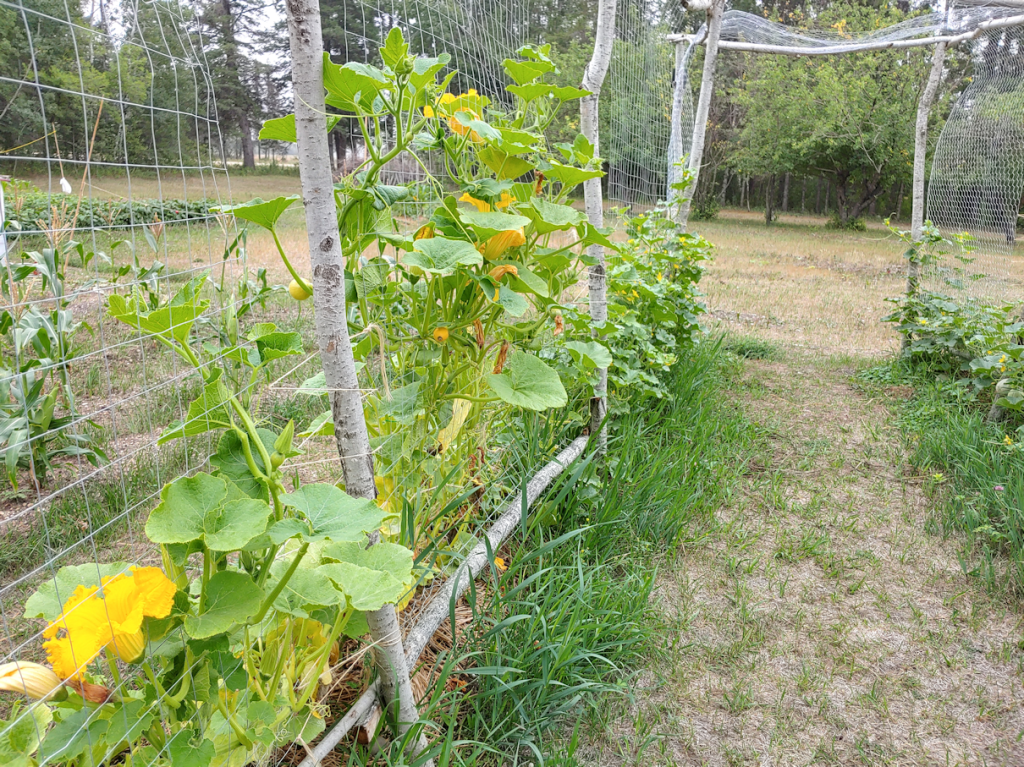
When doing my rounds this morning, however, there was some bright “sunshine” through the haze. The summer squash and everything at the squash tunnel are blooming like crazy, with flowers so bright and yellow, they practically glow in the distance.
The luffa is blooming fairly consistently, though no gourds have started to form yet.
The vines, however, are enthusiastically climbing the squash tunnel, and have even reached the very top. It looks like they grew almost six inches, overnight!
The nearby Tennessee Dancing gourds are also enthusiastically growing and blooming. Unlike the luffa, there are many gourds forming here!
I am somewhat amused that these have such big flowers, yet such tiny gourds!
Then there are the melons, which have such tiny flowers, followed by such hefty fruit – and these are small varieties of melons!
The Little Gem winter squash are also kicking into high gear as they climb the trellis, with many flowers and quite a few squash developing. The plants themselves actually don’t look all that healthy; the bottom leaves in particular are yellowing, with some dying off, but they are still doing really well.
The Teddy squash, however, are not. The plants themselves are looking strong and healthy, but it looks like there has been more nibbles. These are at the very end of the tunnel, and it’s almost as if they are being nibbled in passing, but nothing is showing up in the garden cam. If it were a smaller critter, like a woodchuck or a raccoon, that would make sense, though I would have expected the damage to be more spread out among other things, not just in those two plants. Whatever it is, it seems to have a preference for the flowers. The leaves aren’t showing as much damage. I might have to set the camera up, right on that spot, to find out what’s going on.
The flowers on the Little Gem winter squash have such dramatic, frilly edges to their petals.
While the summer squash are also blooming heavily right now, the Crespo squash, out by the purple corn, has not been. It does not seem to be recovering well from all the critter damage, even though there is no new damage since we added that third layer of protection around them. Thankfully, we still have most of the seeds in the package, so we can try again next year.
The gourds in the south yard, at the chain link fence, haven’t kicked in yet. There are lots of flower buds, though – at least, on the Ozark Nest Egg gourds – so I expect to see plenty, soon. The cucamelons planted next to them are covered with the tiniest flowers, and we are seeing lots of teeny little cucamelons forming. If things go well, we should have lots of them, soon.
All these bright yellow flowers are a cheerful sight to see, through the gloom. While walking outside, yesterday evening, my daughter noticed something about their window fan on the second floor. We’ve got several 20″x20″ box fans set up in various windows. That happens to be the size of our furnace filters, so when the girls noticed their box fan seemed to be pulling tiny insects right through the screen, they put a filter on the back of it. From outside, we could see the filter – and how brown it was, from the smoke!
Today, I finally added a filter to the back of my window fan, too. Usually, when it gets hot outside, I flip it to blow air out instead of in, but with a cooler day like today, I actually want to keep it drawing air in, but that smoke it starting to really affect my chronic cough!
Not that it’s going to be much help while I’m working outside…
The skies have been teasing us with the possibility of rain, all day today! The weather app says we’re at 26C/79F, with the humidex at 30C/86F, but we’ve been getting some wonderful breezes that are making it feel cooler.
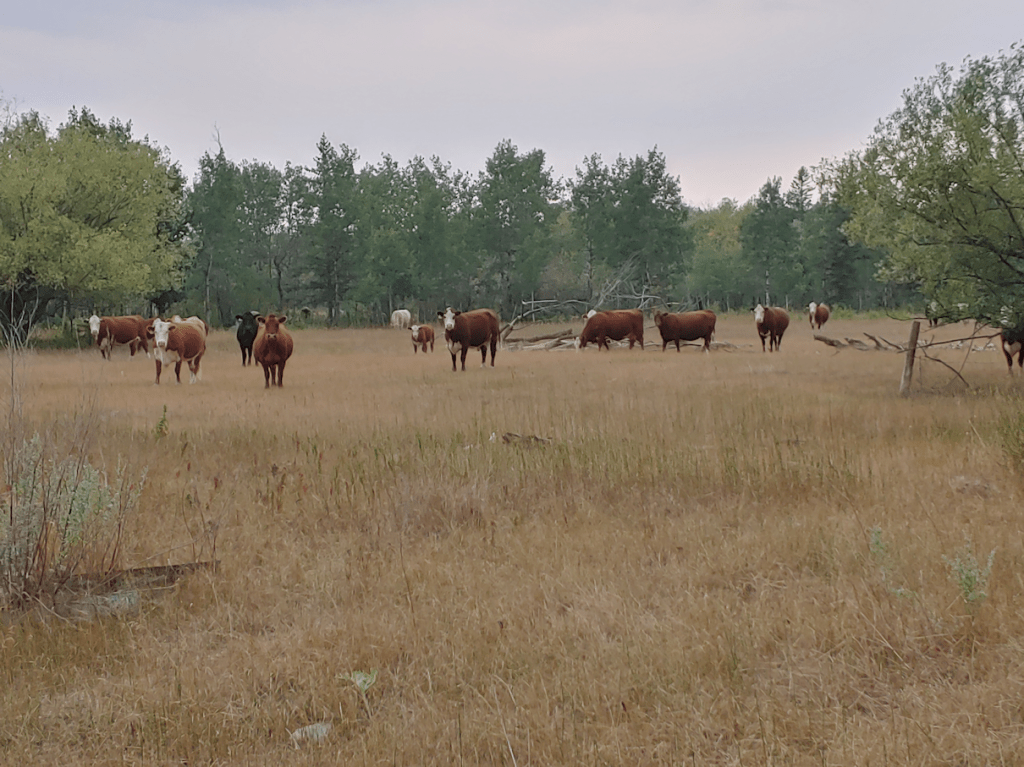
It was while we were outside, enjoying the breeze, that I noticed we were being watched.
The renter rotated his cows to the home quarter today! I am so happy to see them. :-)
While we were out, we even got a few spatters of rain and could hear thunder in the distance. I really hope we get a decent rainfall! Particularly since we’ve decided not to water the garden beds this evening.
While heading over to the furthest beds, we ended up chasing a woodchuck out of one of the corn blocks. He seemed to be just passing through, and wasn’t eating anything. In looking at the developing head on this Mongolian Giant sunflower, I can see something has been eating it. This would be the grasshoppers. Thankfully, those seem to be fewer, though compared to the clouds of them we had not long ago, that might not be saying much.
The sweet corn in the middle block seems to be developing the fastest. It’s interesting to see how a few stalks just shot up (relatively speaking!) while the others are staying small.
I don’t know how much corn we’ll actually get from these, given this year’s conditions, but it does look like we’ll at least have some for fresh eating, if not for freezing or canning.
Dang. Looking out my window, it seems the clouds have moved on. I think I’ll pop outside and enjoy the breeze a bit longer, while there is still light. :-)
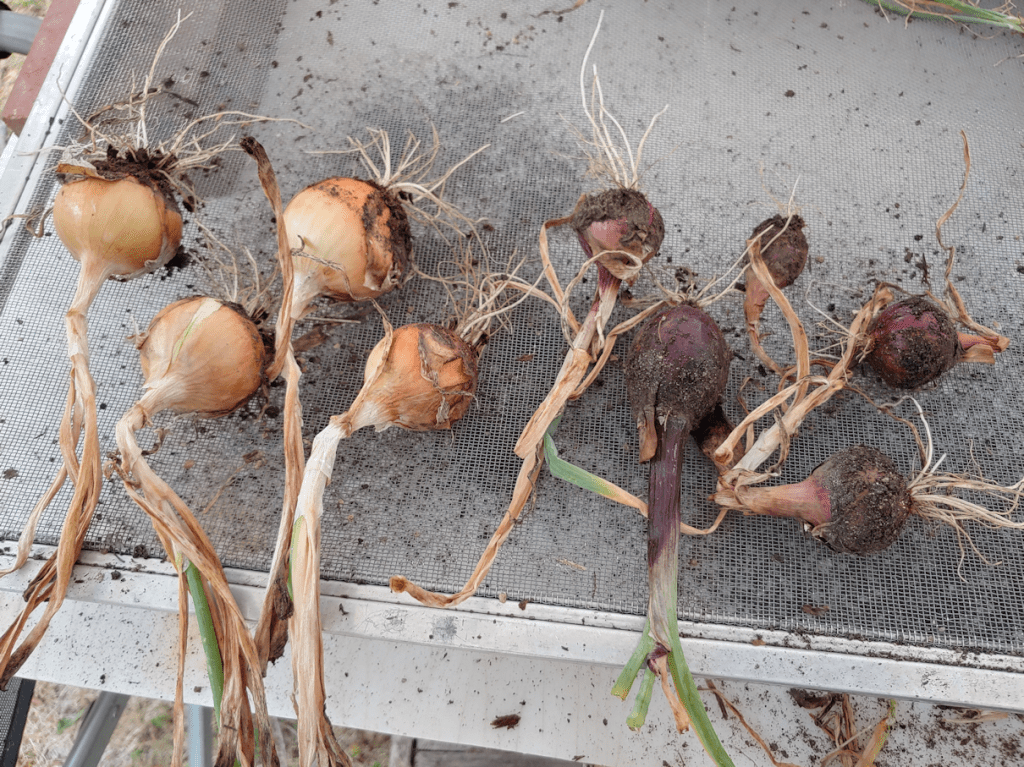
This morning, I decided to go through our onions and harvest the ones I was sure were done for the season. Here are the first ones I picked.
These are the yellow onions we planted from sets that I picked up at Canadian Tire, and planted in the same bed as the shallots. This is about a quarter, maybe a third, of what was in the bed. There were also a few that I pulled and left behind, as they had no roots and were starting to rot.
These ones are mostly pretty small, as they died off too early, I think.
There were enough of them that space on the drying screen was an issue, but they had enough stems left for braiding, so now they are hung up to cure under the canopy.
Then I went back to check the other onion bed.
Very few of these were ready to pick. On the left are the surviving yellow onions we grew from seed, and they are looking the best of all the onions. The ones on the right are the red onion sets we ordered from Veseys.
These have been left outside to dry for a while, but they will be for immediate use in the kitchen! :-)
I’ve been looking up how to tell if onions are ready to pick and finding conflicting information. Some say they are ready after their tops have fallen over, which I think is way too early. Others says after the dry outer skin has developed. Still others say once the youngest leaves – the ones in the very middle of the stalks – are dry, they are ready to pick. That one seems too late!
So the ones I picked were ones that had died off the most, and I could be sure they would not be growing any bigger. I’m also on the lookout for those with roots that have died off, and pull up easily. Those tend to already be going soft, and often have what looks like mold growing in them. From what I’ve read, that’s a sign of fungal infection, so they need to be taken right out.
It should be interesting to see the differences in flavour. I probably won’t be able to tell the difference, and the medications my husband is on has changed his ability to taste things, but the girls should be able to taste differences. I’ll have to trust them to tell me which varieties are worth growing again! :-D
After the issues we had with cats destroying so many of the onions we started indoors, I’m just happy to have any onions at all right now! :-D
My morning rounds were a bit shorter than expected. Though we are still supposed to get a hot on – not as hot as yesterday, thankfully – we are also getting predictions of a thunderstorm and possible rain. It’s even overcast right now, so I didn’t even put the shade cloths over the fall plantings this morning.
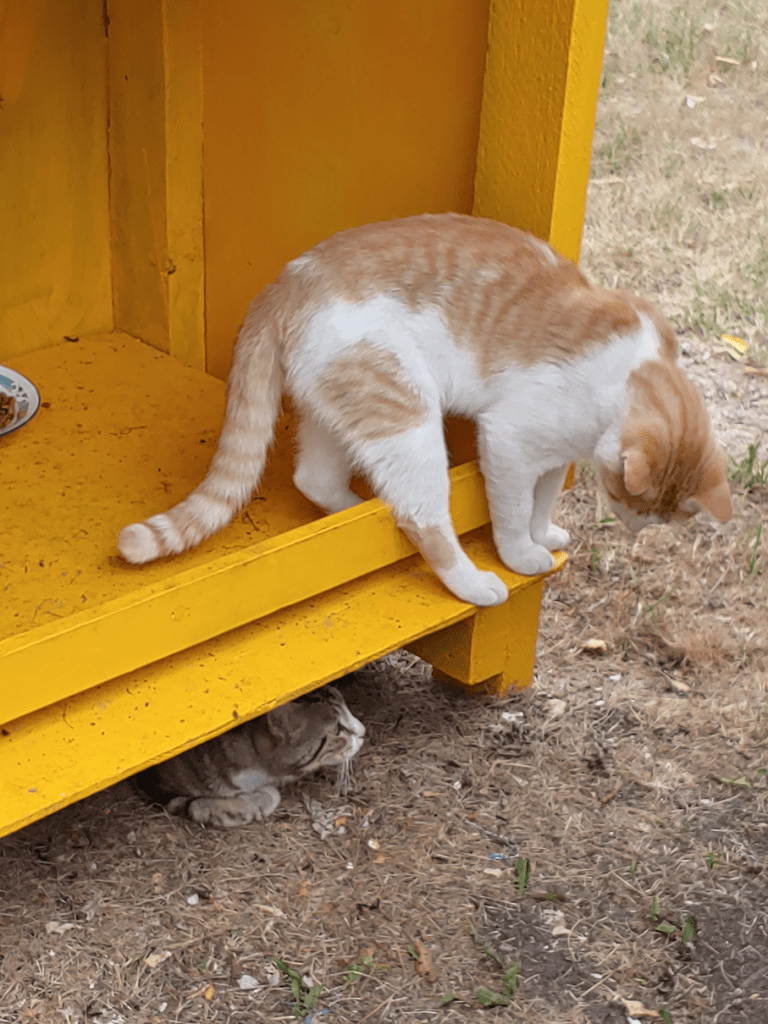
The first “find” I had this morning was one of adorableness!
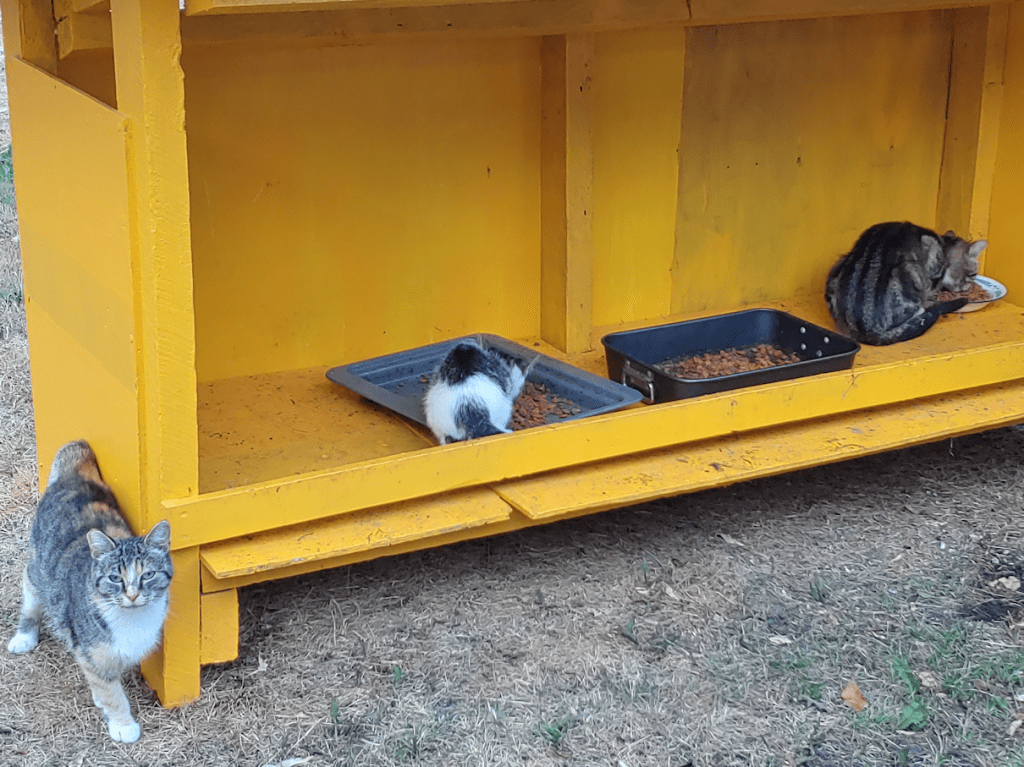
We still have separate food bowls for the kittens (except for Junk Pile’s, because we don’t really know where their home is), and I was on my way to top up the one for Butterscotch’s kittens, when I found this little cutie, just chillin’. She didn’t even run away as I went by with the kibble, then paused to take her picture. :-) Broccoli seems to be the most willing to put up with us humans, though she still won’t let us touch her.
The new hanging bird feeder was found in pieces this morning! I’m guessing the raccoons got to it during the night. Nothing else has the hands to turn the canister and unlock it from it’s base.
The big birdfeeder was also completely empty. The foam covered wire I’d used to reduce how much it wobbles on its post were all at the bottom of the post, with the foam torn up. Since I pruned away the branches the raccoons were using to reach the feeder, it looks like they scrambled up the post itself, taking out the padding in the process. I’m going to have to find something else to pad the top of that post, and steady the feeder.
Then there was this…
One of the new support hoops covering the carrot bed was pushed over, and the carrot greens beneath were looking a bit squashed.
I’m glad I had those tent pegs, as well as the weights, along the edges of the netting!
I was a bit concerned about how well the one hoop would hold out. When I was setting it up, I could hear the wooden dowels supporting it, making cracking noises and I bent the pipe onto them. It would have been better to use metal rods of some kind, but we don’t have any. The dowels are about 18″ long, and they were embedded into the ground by at least a foot, but the flags they were on have been out in the elements for the past year, so it’s no surprise that the wood was brittle enough to crack under the stress of holding the PVC pipe. I was able to straighten it up again, without having to take everything apart. We’ll see how it holds.
I actually think this was done by cats. Possibly even kittens. They like to roll around in the garden, and I’ve had to chase them off of, or out of, the mesh before. The opportunity to roll around on the mesh and on plants, at the same time, would have been too much for some of our kitties to resist!
Aside from being a bit flattened, though, the carrots are fine. Another reason I think it was the cats. If it were a woodchuck, they would have gotten through pretty easily, if they wanted to!
I’m happy to say that Potato Beetle is still with us! He seems to have simply moved back home, as if he were never gone for almost 6 months! The only down side is, he’s aggressive to the other cats. I realize they’re establishing their pecking order, but it looks like he’s already driven off Nutmeg, who was very much a beta cat. Creamsicle Baby is also showing submissiveness to Potato Beetle, but that doesn’t seem to be stopping him. He’s even going after the mamas. Normally, the males don’t go after the females like that. He’s even growled at Butterscotch; his own mother!
I’m hoping things will settle down as they get used to each other again.
Now that it’s “cooled off” again to 32C/90F (feels like 34C/93F), I headed back to the garden to remove the shade clothes and get those photos I promised.
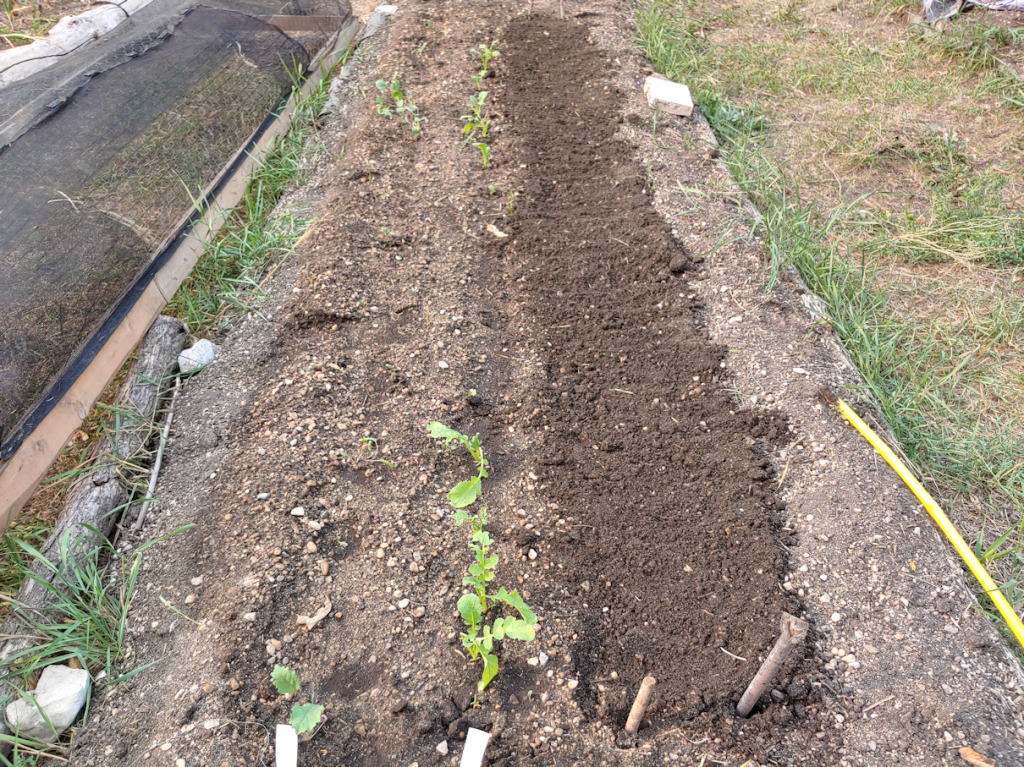
Our surviving (barely) French Breakfast radishes, and rainbow chard.
Now that one of the beds has a window screen mesh covering it, I decided to take a chance.
I planted lettuces.
On the far left are the surviving purple kohlrabi, and in the middle are radishes. I forget which variety at the moment.
I had our four varieties of lettuce together in a slide lock bag, and they spilled a bit, so I planted the mixed up seeds at the bottom of the bag. So we are going to have lettuce surprise when they start to sprout!
Moving the cover on and off is still a two person job. The length of the cover makes it a bit too wobbly. We definitely need to make the permanent beds shorter, just for that!
A nice thing about the window screen mesh is that it slows down and breaks up the water, so it lands more gently. We don’t have the hose nozzle set on anything high pressure, but these surviving seedlings are still spindly and weak from being under those water bottle covers to protect them from insects and critters. With the mesh covering the ends, I have at least some hope that these lettuces will have a chance to survive. At this point, it’s the grasshoppers, more than the critters, that are an issue.
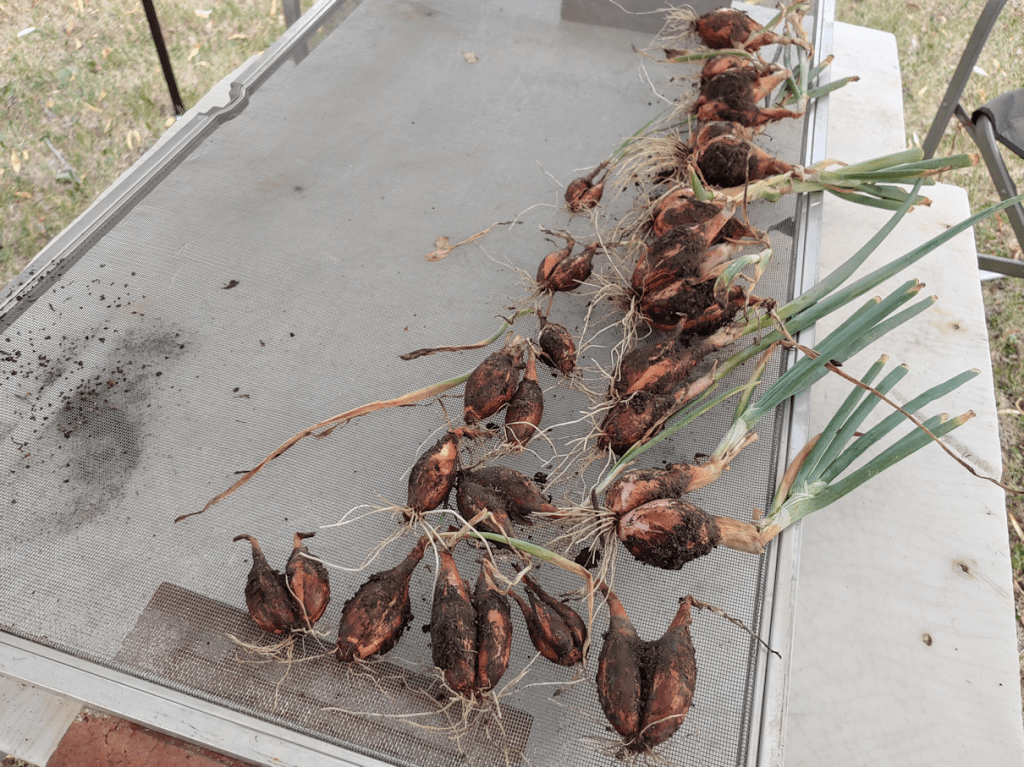
Once this was done, I decided to harvest the shallots. I’d been weeding the bed while watering this morning and accidentally pulled one up. I didn’t think they were doing well; many of the green parts had withered away completely, and I could no longer see where they were, while others just looked like they were struggling. The one I accidentally pulled up looked surprisingly large, so I left it there, to collect with the others this evening.
I was very pleasantly surprised!
As I started digging them up, I found they were much larger than expected. The one way at the far end in the photo is almost as big as an onion!
Then I accidentally dug up a shallot there there was no sign of any growing there anymore, and it was far larger than I expected, too. So I went back over the row and dug into each spot I knew I’d planted a shallot, and found several more! They are the smaller ones with no, or almost no, stems.
For now, they sit on a window screen, raised up on bricks for air circulation, to cure for a while. I’m quite pleased with what we got. Our original shallots, started from seed, were destroyed by the cats, so these ones are from sets I bought at the grocery store. There was only a dozen sets per bag, so I got two bags. A far cry from how many we would have had, if the ones from seed had survived, but way better than nothing at all! This is just awesome!
Tomorrow morning, I think I will start harvesting some of the onions. They are not all ready, but some of them definitely are. We have quite a lot of them, so I don’t mind harvesting and curing them in batches!
Being able to harvest things already, and even plant things for a fall harvest, kinda makes up for all the problems we’ve been having with the drought, critters and insects! We may not have as much as we hoped to in the spring, but we will still have food to harvest, and that’s the important part!






















 The Re-Farmer