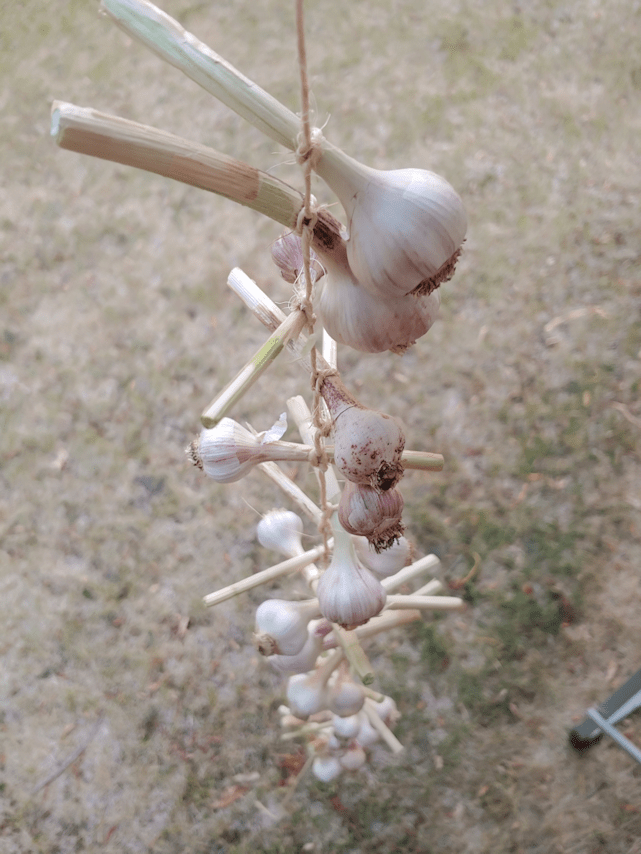
Yesterday evening was so lovely out, I spent as much time outside as I could! I took advantage of this to finished up the garlic we harvested some time ago. They have been hanging from the rafters under our gazebo tent to cure. It was not ideal conditions. They should be somewhere cool and dry. What we had available was outside, where it was hot and dry, or in the basement, where it was cool and humid.
I figured hot and dry was better than cool and moist!
The stalks and roots were trimmed, the soil brushed off, then they were tied up in twine.
They are not as cured as well as they should – some of the stems are still showing a bit of green – so these will need to be eaten fairly quickly. Which is sssuuuccchhh a hardship… Ha! I look forward to using them. They are currently hanging from the ceiling in the kitchen.
I think garlic soup would go over very well! It’s usually made at the end of winter, as a sort of spring tonic, but I think it’s good, at any time! I use an entire bulb of garlic to make it, but these are so small, I might just use up a whole bunch of the littlest bulbs. :-)
While these were dying back way too early and had to be harvested, the rest of the garlic is now looking ready to harvest, too. It’s still early, and I don’t expect very large bulbs, but that’s okay. We’ll be buying more to plant for next year, rather than try and save bulbs from this year’s garden.
Today is supposed to be hot again, so I wanted to make sure to get the garden watered early in the day, while it was still cool. I started with the soaker hose at the squash tunnel, then went around checking the melons, squash and gourds.
I was extremely disappointed to find this.
Our one and only Teddy winter squash was gone.
Et.
Munched.
Masticated.
The two Teddy plants are blooming, and there is even a female flower developing, but that one baby squash had grown so much after the rain, I was really looking forward to watching it develop.
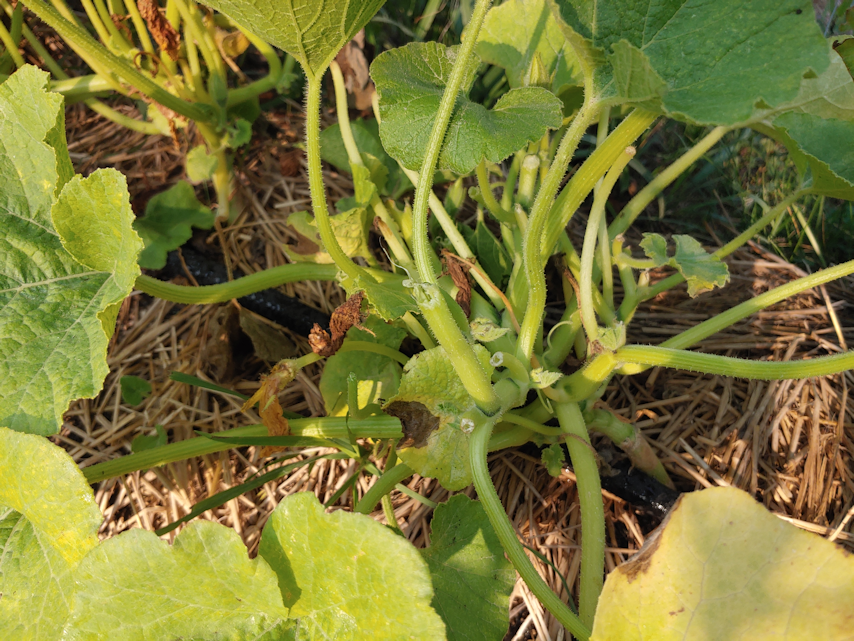
This is one of the nearby Little Gem winter squash. There were no developing squash down here to be eaten; those are much higher on the trellis. Still, it means energy will be going to recover from the damage, instead of into developing squash.
Thankfully, that was the only damage here. The melons and gourds had no critter damage. I did find one of the nearby Dorinny corn had been gotten into, the remains of a cob on the ground. The corn may have been a deer, but I figured the squash was a groundhog. The deer don’t go along that side of the garden beds, preferring to walk through the open areas in the middle.
I was wrong.
When I checked the garden cam, I almost missed the shadow moving in the darkness. It was a huge raccoon! So big that, if it hadn’t turned at the end of the bean bed and I could make out its tail, I would have thought it was a bear cub.
I continued checking the beds, and was so disappointed to find this.
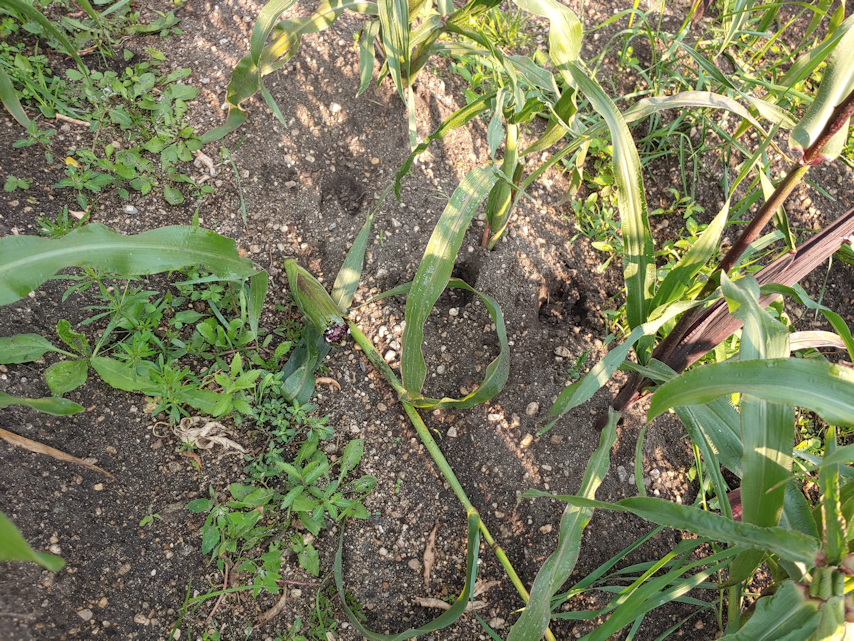
A deer got into the Montana Morado corn. In the above photo, several stalks in the outermost row are gone.
I found corn cobs scattered on the ground, each looking like they had only a single bite taken out of them.
Hoof prints left no doubt as to what was responsible for this damage.
The deer had traipsed right through the middle of the corn block, leaving damaged plants and nipped corn cobs in its wake.
These are all the cobs I picked up off the ground.
I think it would bother me less if the deer actually ate the corn, rather than taking a bite here and a bite there. and leaving a trail of damage.
On checking the cobs, you can see that a couple of them were almost completely ripe, if poorly pollinated. When ripe, the kernels should be an even darker purple.
One cob is looking like it was going blue, instead of purple!
Several of the cobs had been beautifully pollinated, full of developing kernels.
I am so incredibly unhappy. Clearly, the flashy spinny things around the corn block are no deterrent.
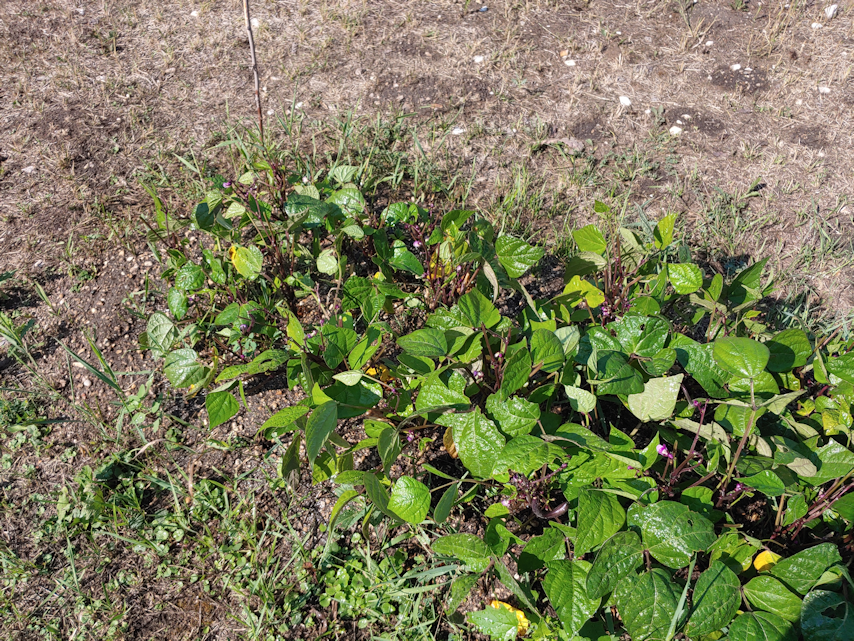
Not even our purple beans escaped damage. The purple beans are lusher and bushier than the green and yellow beans – except for at this end of the row, where the leaves have been thinned out by nibbling.
And here is the beast that did the damage – nibbling on a sunflower!!!
I. Am. Not. Impressed.
I even added bells to the lines around the corn and sunflower beds, but the deer came from the other side!!
Venison is sounding very good right now.
What a disappointing way to start the day.
Other things went well, though, and I will save those for other posts!
Oh, my goodness, what a difference a single day of good rain makes! No amount of watering with the hose can compete.
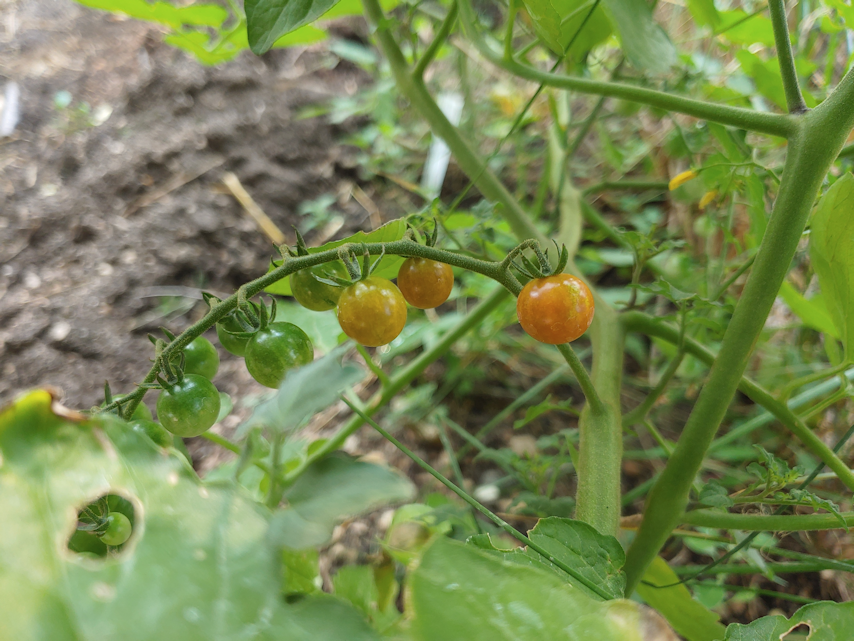
While we have been able to pick a Spoon tomato or two, every few days (there were three ripe ones yesterday, that my brother and his wife to go try. :-) ), the Mosaic Medley tomatoes still have a ways to go. Two plants have tomatoes that are starting to ripen, though, with this one being the furthest along.
Though pickings are slim right now, I can see that we will have lots ripening, all at once, soon! They are all indeterminate varieties, and with the Spoon tomatoes alone, we’re probably going to be picking lots, daily.
The Little Gem winter squash, in particular, got noticeably bigger overnight! There is easily several inches of new growth on the vines.
The Teddy winter squash has pretty much doubled in size since I checked it, yesterday morning.
Even the pea sprouts, among the sweet corn, are visibly bigger and stronger – and their stems are barely two inches high right now! :-D As short as they are, the sweet corn is starting to develop their tassels, too.
There were a few zucchini we were keeping an eye on and leaving to get bigger, but by this morning, some of them were almost getting too big!
Plus, I picked our VERY FIRST beans!!!! Just a few yellow and green beans. No purple beans were even close to being ready to pick, yet. I’m pretty thrilled with just the handful we have now, and seeing how many I could see developing on the plants. :-)
This morning, I uncovered the beet bed near the garlic. This was the first bed that got major damage, almost wiped out by a deer. After several attempts to cover it, we ended up putting on mosquito netting as a floating row cover, though I had to keep adding more weights around the edges to keep the woodchucks from slipping under and nibbling on them some more. Once the floating row cover was on, it basically remained untouched until this morning. We kept watering it, but that’s it.
It got a thorough weeding this morning, and I picked a few young beets as well. My daughters really enjoy baby beets and their greens. :-) The bed is covered again and will probably get ignored for awhile, other than watering. The other beet beds are also covered with mosquito netting as floating row covers, and they’re going to need some tending as well. That’s one down side of covering them like this. It’s a pain in the butt to move all the things we scavenged to weigh down the edges, so they are just being left alone.
In looking back at our gardening posts from last year (this blog is my gardening journal, too! :-D ), there were posts about the heat waves we got last July. It wasn’t as severe as this year, but it was the most severe we’d seen since our move at the time. By this time our sunflowers – which we’d lost half of to deer and replanted with other giant varieties – were growing their heads and some were even starting to bloom. This year’s sunflowers are nowhere near that stage! We had also been able to do quite a lot of clean up and fix up jobs that were out of the question in this year’s heat. The drought and heat waves have set us back quite a bit, as far as getting things accomplished. We were also harvesting carrots and sunburst squash, regularly, by the end of last July. It’s hard not to be disappointed with how things are turning out this year, but there isn’t much we can do about the weather, and very hungry animals that have lost their usual summer food and water sources.
Speaking of animals…
I had finished up at the furthest garden beds and was making my way to the main beds closer to the house, when I realized I was being stared at by a little furry face on the gravel over what used to be a den! A woodchuck, the littlest of them, was just sitting there, watching me come closer. I started to shoo it away, and it would run a few feet, then stop and look at me, run a few feet, stop and look at me… on it went until I finally got it to run through the north fence and off the property. By then, I was standing next to the purple corn, at the opposite end of the garden area. Since I was there anyhow, I decided to check on the purple corn, turned around and…
… discovered I was standing next to another woodchuck! It had just frozen in place until it realized I could see it, then ran off. I chased that one past the north fence, too!
Thankfully, there was no sign of critter damage in the gardens this morning, but my goodness they are cheeky little buggers!
After their visit yesterday, and seeing some of the issues we’ve been dealing with, my brother messaged me this morning with some photos. There’s a store they were at that had electric fence started kits. The one he showed me uses D cell batteries, but he knew of another store that has solar powered versions. The basic kit he sent me a picture of covers 50×50 feet, at a very reasonable price. It wouldn’t be enough to cover our farthest garden beds, but we could easily pick up the parts and pieces to cover more area. We’d need a second kit to cover the other end of the garden area.
Something to keep in mind. Particularly when we start building our permanent garden beds. We’d still need to find ways to stop the woodchucks, but it would be a good start, and cheaper than building tall fences!
I have a bit of time before I head off to pick up our meat pack, and just had to make a quick post.
It was a bad morning in the garden.
While heading over to switch out the memory card on the garden cam, the very first thing that I saw was this.
Of the surviving Dorinny corn, there was one plant on its own at the very end of a row. It is now in two rows.
The critter didn’t even eat the whole thing. It just chomped on half a corn cob.
Another Dorinny corn got it’s developing cob torn off and nibbled on.
This one got to me. These are the transplanted Hopi Black Dye sunflowers. The ones we started indoors months ago, but didn’t actually germinate until all the others were direct sown or transplanted. While small, they had been doing well. Now, all but one have their heads chopped off, and the one that didn’t, is broken.
You can see the single surviving pink celery transplant, near it. That got ignored, at least.
Then there’s this. You can even see the hoof print in the ground!
This is the purple corn, way on the other side of the garden. The last two corn in this row had already been partially eaten and were growing back, only to be eaten again. A third one has it’s tall stalk broken right off, and you can see it lying on the ground. Thankfully, that was as far as the damage went, with the purple corn.
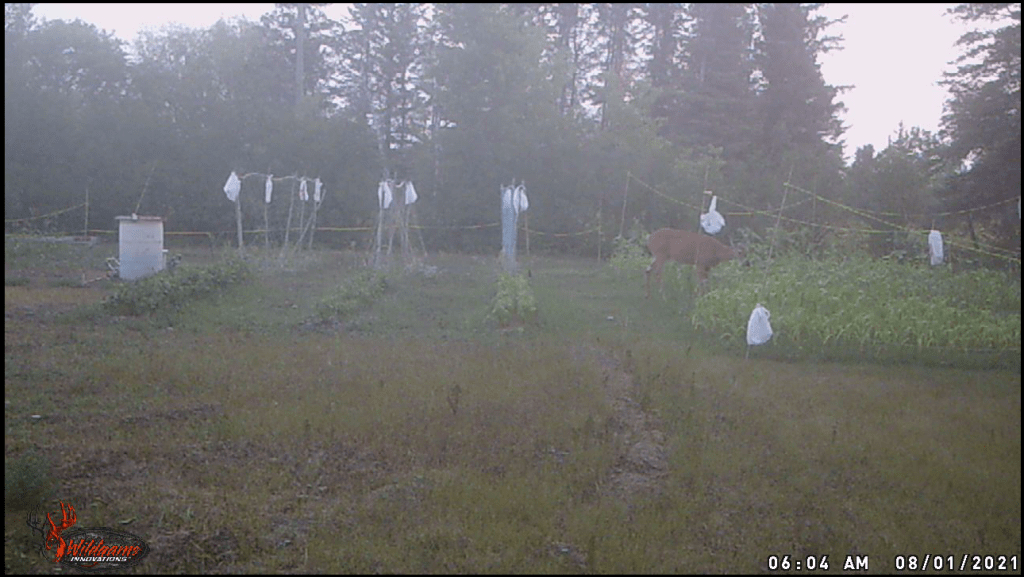
And here we have our culprit! At least for the Dorinny corn and sunflowers. The tracks in the purple corn head in the opposite direction, so it was either another deer, or this deer took the scenic route.
In the trail cam files, I did see a woodchuck in the sweet corn during the day, but there was no damage to that corn. It looked like it was eating the grass or weeds in the path.
The woodchuck – or another of them – is likely the cause of this damage, in one of the summer squash. It’s definitely not a deer that did this.
*sigh*
Later today, I’ll be moving some of the things we put around the tulips to keep critters away. The tulips have died back and they are no longer needed there. The bells and spinners would probably be useful in startling critters. Clearly, the flapping grocery bags, motion activated light and aluminum tart pans are no longer enough.
I suppose the damage is pretty minimal, given how much we’ve got planted overall, but even a little bit adds up after a while. It’s so frustrating.
When we plant trees where the temporary garden beds are now, we at least know we’ll have to take extra steps to protect the saplings from critter damage.
Today is supposed to exceed 30C/86F, so I wanted to make sure the garden got an deep watering this morning. When I had removed the shade cloth from the three beds with fall harvest crops planted, the seedlings seemed to be doing pretty good.
When I returned to cover them this morning, I saw this on one of the beds.
There was no evidence of a critter getting under the chicken wire cover. That suggested whatever ate these leaves was either a really small, light critter, like a mouse (very unlikely, given how many hungry mouths our mama cats have to feed), or it was insects.
My money is on the grasshoppers. :-(
This was, however, the only damage found this morning. The rest was all fun stuff. I was absolutely thrilled to see this.
Our very first Tennessee Dancing Gourd!!!
Somehow, in seeing all the flowers in the plants next to the luffa, my brain just stuck them in the “melons” category. On looking more closely, I found lots of these.
It looks like we are going to have plenty of little spinner gourds growing! They only get a few inches long and, according to one of the reviews I read when I bought the seeds, they are very prolific. The writer claimed their one plant ended up with at least 250 gourds. This was someone with a much longer growing season than ours, so I don’t expect that sort of success, but we should definitely have quite a few from our several plants.
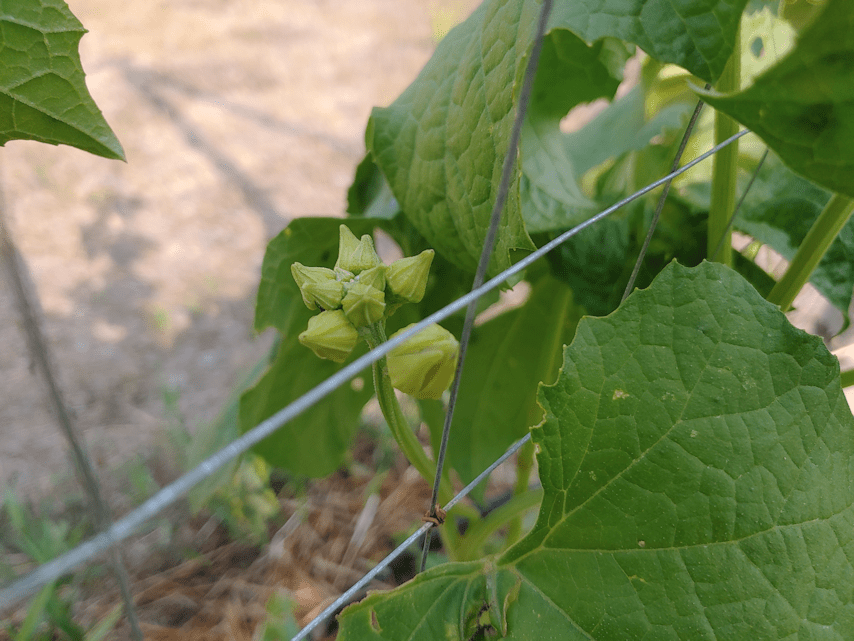
Meanwhile, the flower bud on the nearby luffa plant I saw yesterday, looking like it was starting to open, absolutely exploded into flower this morning! So awesome!
What is also awesome is being able to walk past the squash tunnel and, from any angle, be able to see melons, and knowing that there are more little ones, still hidden under the leaves.
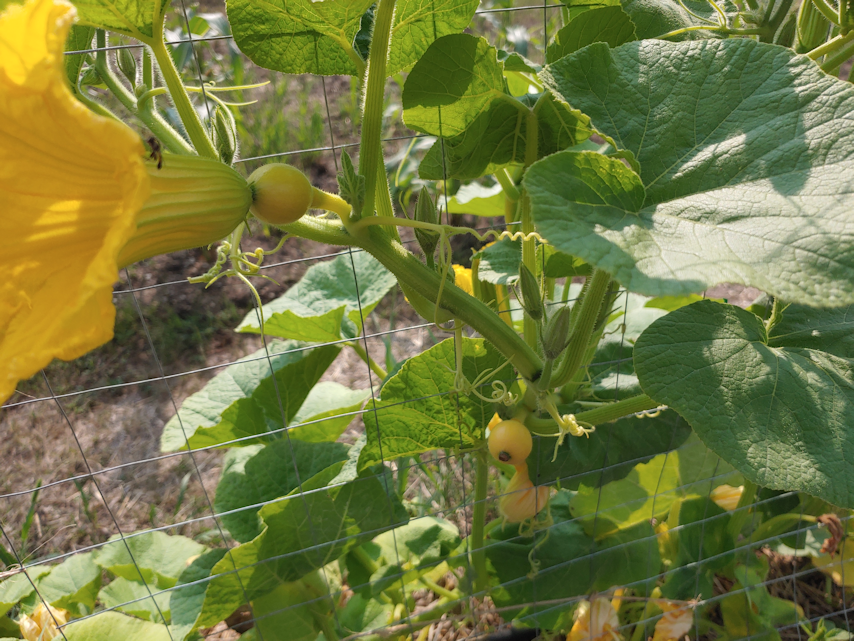
I finally remembered to uncover and read the labels by the winter squash. The ones that are so enthusiastically climbing the wire are the Little Gem variety, with several small squash already forming.
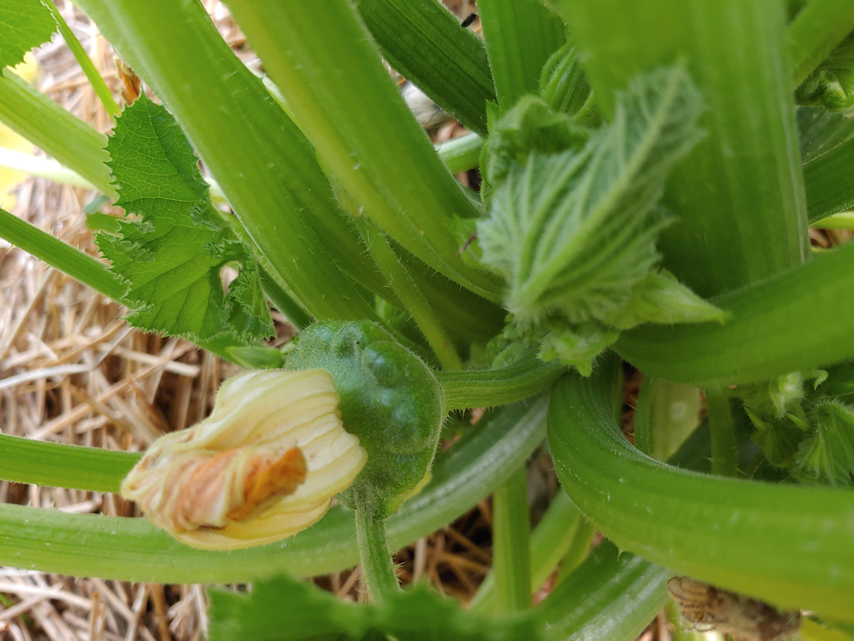
This morning, I finally saw some fruit forming on the Teddy variety of winter squash.
Both of these varieties as supposed to produce small fruit, with a short growing season, so when I hadn’t seen any of the Teddy squash developing, I was beginning to wonder. I am really excited to see the fruit developing now. :-)
You know, I think we actually got a bit of rain last night! I didn’t have to water the garden beds this morning.
To start, I found something really, really exciting this morning.
Our first ripe tomato!!!!
There it is, hiding under some leaves. :-)
Our very first Spoon tomato!
From the photos on the seed packet, this is a really big Spoon tomato. :-D
I am saving it for my older daughter, for whom I’d bought the tomato seeds as a gift, to have first taste. The girls are still keeping reversed hours, so my older daughter can work in the cooler night hours without the computer overheating, or her drawing tablet glitching out, and sleeping during part of the day. I can’t wait to see their faces when they see this!
Other Spoon tomatoes are starting to turn colour, too, so we should be getting lots more over the next while. :-) The Mosaic Medley mix of cherry and grape tomatoes are still very green right now, but they should start ripening soon, too.
One of my favourite things to do during my morning rounds has become checking on the squash tunnel, training more vines to climb the mesh, and seeing what progress there is.
It looks like one of the luffa flower buds is starting to open. I actually expected this to do better in our current heat, since they are a warm climate plant. Or at least start flowering and growing fruit before any of the squash and melons, considering how much earlier it was started indoors.
One winter squash plant in particular is growing a lot more enthusiastically than the others, climbing the trellis on its own now, and producing fruit. I keep forgetting which is which, but the other winter squash seems to have a growing habit more like summer squash, and seems to have only male flowers and buds right now.
The Pixie melons are getting so “big”! They are a “single serving” sized melon, and really dense for their size, so I don’t expect them to get much bigger than this one, here.
This is the first Halona melon to develop, and you can see how it’s outer skin is starting to form that distinctive cantaloupe texture. These should get about double the size and weight of the Pixies, or more, when they are fully ripe.
I can hardly wait to try them!!
Yesterday, I found that I thought was, maybe, kinda, possibly, a pea sprout emerging from the soil next to one of the purple corn.
This morning, there is no doubt at all. There are peas sprouting all over the sweet corn beds! I’m actually quite impressed by the germination rate so far, considering the bag of seed peas had been in the storage bin by the water barrel through two heat waves.
Now, if we can just keep the woodchucks from eating them all, not only will they help fix nitrogen in the soil for the corn, but we might even get peas in quantities sufficient for harvesting. :-)
Like for so many others this year, it has been a real challenge to keep things alive and growing in the garden. With our furthest beds, even having enough hoses to be able to reach the furthest beds, the corn and sunflower blocks were the hardest to keep watered, until we started using the sprinkler.
The corn is nowhere near as tall as they would have been, if we weren’t in drought conditions, but they have really grown a lot in a very short time, and are starting to develop their tassels. Because of how long the area of corn and sunflowers is, the sprinkler we have can’t cover it all. To be able to water it all, we set it up in the middle of one of the sunflower blocks, set it to “full”, and it can water most of the blocks. After a while, we move it to the end and set it to spray just on one side, and we get the rest of it. The corn block in the middle tends to get water from both settings, and it really shows. The corn in the photo in that middle block.
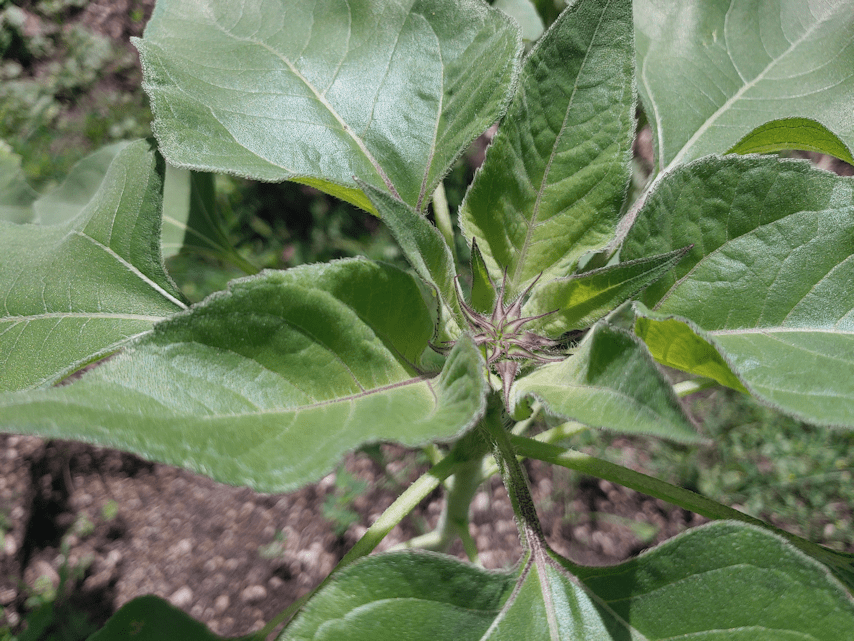
The sunflowers are also not anywhere near as tall or robust as they would be. Especially the Mongolian Giant sunflowers. They and the Hopi Black Dye sunflowers, pictured above, are basically the same size. Only the ones that got started indoors and transplanted are slightly taller. All of them have very thin stems, still. As you can see in the photo, however, they are starting to grow their flowers! I don’t expect them to reach full size, but I do hope we at least get some of the Black Dye sunflowers reach maturity.
We planted sunflowers, and chose the location for them, for a number of reasons. One of those reasons, for both the corn and the sunflowers, was to have a privacy screen. Unfortunately, this year’s drought has prevented that particular goal from happening.
If all goes to plan, however, we will be planting shrubs that will do that particular job, on a permanent basis!
With hot, dry days returning, my morning rounds once again includes covering the fall crop beds with shade cloth and doing a morning watering.
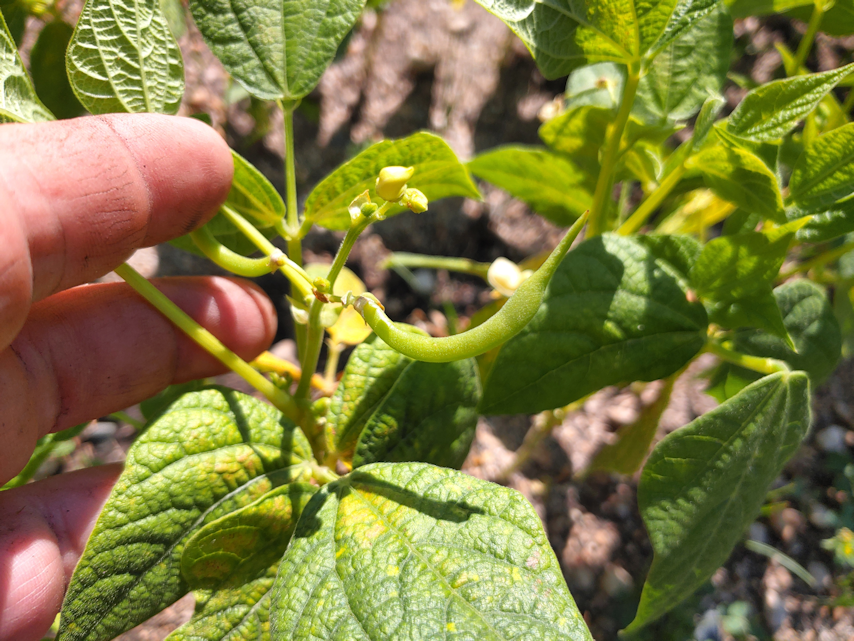
I was very, very happy to check the bean beds and FINALLY see pods developing! Other local gardeners are already harvesting large amounts of beans, while ours were still just blooming. Yesterday, I spotted the tiniest of pods developing – so tiny, I didn’t bother trying to take a photo, because I knew my phone’s camera wouldn’t be able to focus on them. This morning, I spotted these.
There are pods developing on all three types of beans.
While I had the sprinkler going over the corn and sunflowers, I worked on the summer squash bed. They have gotten big enough that I pruned the bottom leaves and staked them higher on their supports. There were a couple I had already done not long ago. Besides those, all of the squash were staked higher.
Not that you can really tell in the photo, at this point.
While I was working, as spotted a couple of plants with nibbled leaves, and even a nibbled sunburst squash. As we keep training the squash vertically, and keep pruning the bottom leaves, it should make it harder for ground critters to be able to reach to nibble on them. Which was not among the reasons we wanted to try growing squash vertically this year, but I’ll take it!
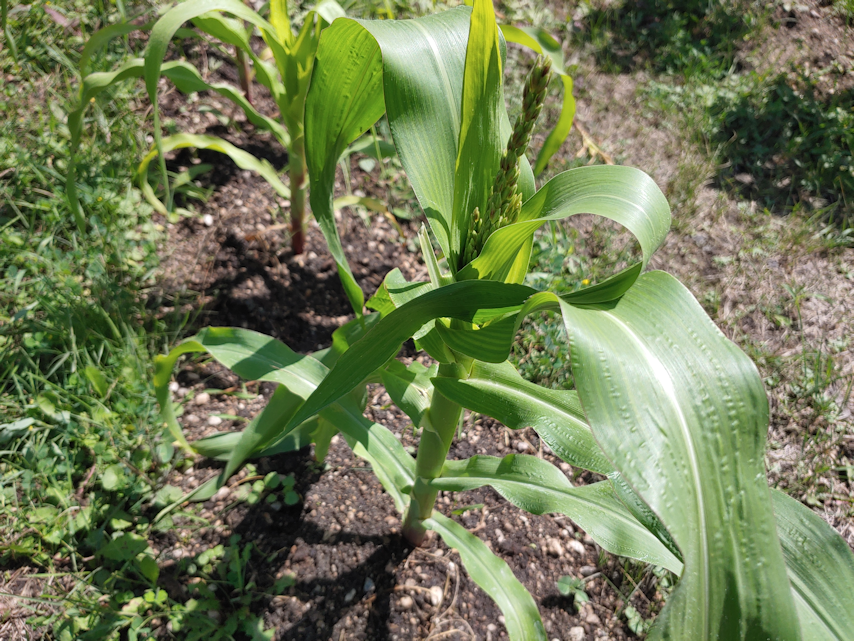
I didn’t take any photos because the sprinkler was running, but the sweet corn is starting to develop tassels! Switching to using the sprinkler to water them, and leaving it to run for anywhere from 30-60 minutes has made a visible difference.
When we build our permanent beds, we definitely need to have some sort of drip irrigation system, so we can be less wasteful with watering.
We are once again hitting higher temperatures, with no more rain, so this morning I started watering the garden beds again, moving the sprinkler every half hour or so. While checking the conditions of the various beds, I had to get a photo of this summer squash. It was the last one to start producing fruit, and when it finally did, it was definitely the odd one out.
And what is so odd about this lovely green pattypan squash?
We only bought yellow pattypan squash seeds.
So… we planted both green and yellow zucchini, but only have green zucchini developing. Then we planted only yellow pattypans, but have both green and yellow squash!
Too funny.
While checking the beds I’d watered last night, I was disappointed to find that more of the Crespo squash has been eaten. :-( So I snagged a daughter to help me put the last of our chicken wire around it.
We didn’t have enough to go all the way around. I checked the junk pile around the garden shed and found some 2 inch square wire mesh. It was all bent up – when I first found it while cleaning up the maple grove, it was buried in undergrowth – and a mess, but we straightened it the best we could and happily found it long enough to cover the gap left by the chicken wire. I used some other scrap wire that was tangled up in the mesh and used it to attached the pieces together near the ground, so no little critter could just slip in between them.
I’m hoping it works. It’s going to make filling the water reservoir in the middle (half buried, so water the roots) more difficult, though.
One of the things I’ve been trying to baby is our Montana Morado corn. I really, really want these to work out!
As these were started indoors, they are much further along than any other corn we have, and have been developing ears of corn for a while now. I’ve been a bit concerned about pollination, and have even been hand pollinating any cobs that look like they might get missed.
My concern?
Many of the silks have have dried up. This is supposed to be a sign that the cobs are ready to pick, but they shouldn’t be ready to pick until the end of August or so. The packet didn’t have a “days to maturity” on it, as the variety is just too knew, but in looking up maize morado, it says 120 days to maturity, so I figure this should be close.
As my daughter and I were looking the corn over and talking about our concerns over how many silks are dry, even on tiny little cobs, I went ahead and picked a cob from the plant that first developed one. This would be the largest, most mature, of all the cobs. The silks at the top were so dry, they came off as I started to peel off the husks.
So this tells me one thing, at least. Pollination is good. There are lots of developing kernels, and almost no gaps. It is also clearly immature, and just starting to turn to its mature colour.
I have to admit, that looks very… unfortunate… :-D
We did taste it, and while not particularly sweet (I was not expecting it to be), but it did taste… well… like corn.
So why are the silks starting to dry so early? Yes, it’s been dry, but we’ve been diligent about watering these.
Have we not been watering it enough? Has it been too hot, even for this variety that was developed in a warmer zone than us? Will the cobs continue to mature, even if the silk dries up as would normally happen when the cobs are ready to pick?
I don’t know, but I’ve posted the question on one of my local gardening groups. I’ve had some clarifying questions, but so far, no answer.
Crud.
Well, we’ll just keep watering them and hope for the best!
Meanwhile, on checking the Crespo squash nearby…
More, “oh, crud.”
One of the vines have been eaten, and it does not look like deer damage. The barriers we put around it might convince a deer to not bother, but they can’t actually stop anything. I’m guessing this is from one of the woodchucks.
Today was hot enough that everything has dried up again, so I set up the sprinkler on the purple corn for a while. As I was moving the sprinkler to the corn at the opposite end of the garden area, I spotted a woodchuck in the middle of one of the sunflower blocks!! It wasn’t eating anything, and there was no damage when I checked, so it may have been just passing through.
I greatly encouraged that notion, and chased it through the hedge, into the ditch. It can go to the empty house across the road!
Anyhow.
As for the corn, I guess the only thing we can do is keep watering it and hope the cobs will continue to mature.
When we first bought the corn seeds, the produce description was for maize morado. The site even had a video talking about how a cowboy from Peru brought some seeds to where he was living in the US, and was able to grow extra to provide seeds for the company. I thought I was getting a Peruvian corn. Then the story changed, and it turned out to be a purple corn developed in Montana, and now it seems the name has been changed to Mountain Morado.
While trying to look up what the days to maturity might be for this corn, I found a different seed company that is selling the actual maize morado from Peru, Kulli. I think I will try buying those for next year. The packets only have 25 seeds in them, so I’ll probably get two or three. I had hoped to have seeds to save from this year’s corn, which may still happen, but if I don’t, I will also try the Mountain Morado (again?). Between the two, I hope to have something that will grow in our zone.
Until then, we’ll see how things go with what we have now.
The Re-Farmer
update: well, that was fast! Having tapped into the wealth of knowledge in the local gardening group, I have a likely answer. The drying of the silk may show that they have been successfully pollinated.
















 The Re-Farmer