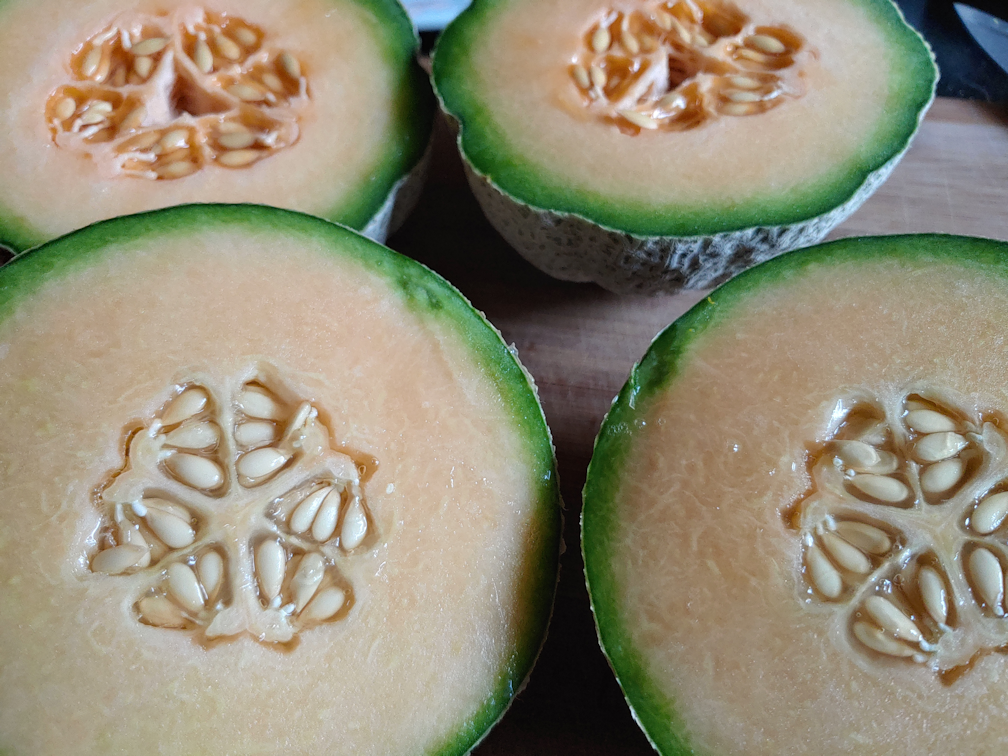
Last night, we went ahead and had the larger of the two Halona melons that were ripe enough to come off their stems.
When we taste tested our first melons, they were too early.
You can see how green the inside of the rind is, in both the Halona (top) and Pixie (bottom) melons.
What a difference three days can make!
There is almost no green visible, and the knife just slid right through. It was also incredibly juicy! After scooping out the seeds, there was enough juice in the cavity, it could be drunk!
The flesh was smooth and soft, but not so soft as to be mushy. The flavour was very much a cantaloupe flavour, and llightly sweet. The small size makes it perfect for a late night snack, too. :-)
Since it was so nice and ripe, I’ve kept the seeds to clean and dry for planting next year. It is definitely a melon worth growing again!
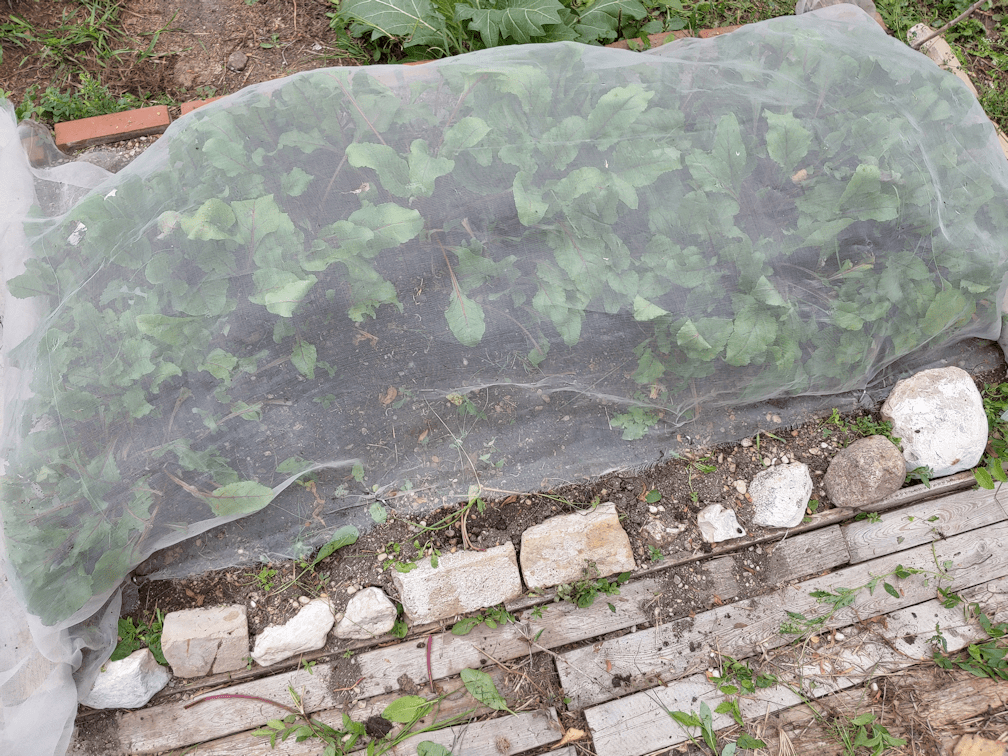
One of the things we’ve done to protect some of our garden beds from the groundhogs and deer was to use mosquito netting as row covers. The edges were weighed down with whatever was handy; rocks, bricks, pieces of wood… that sort of thing.
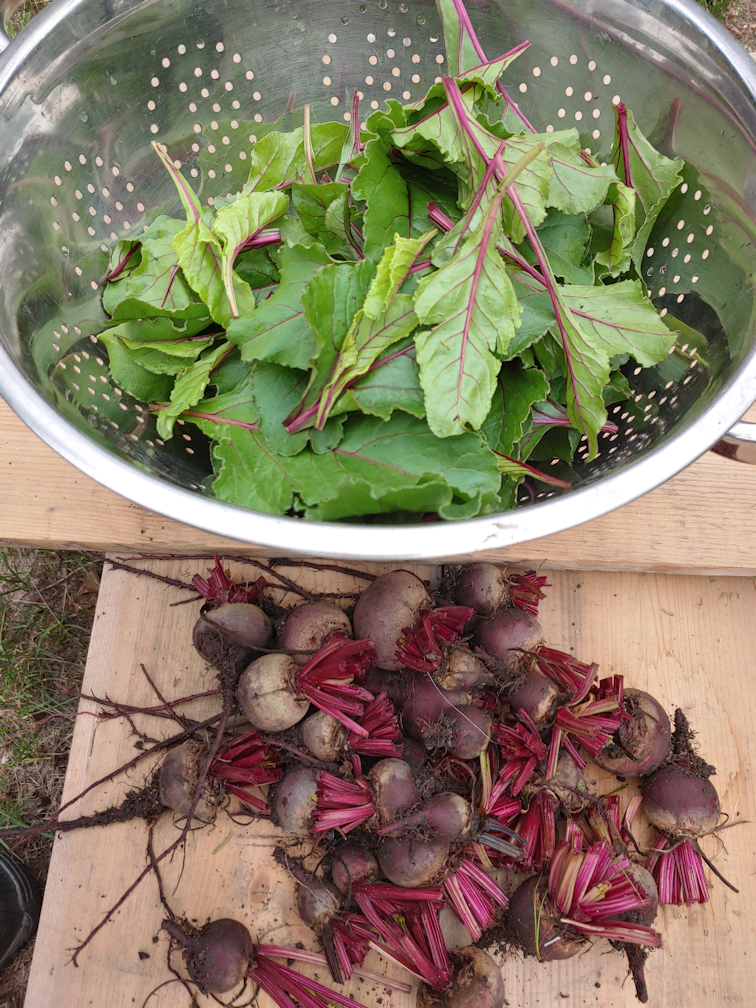
The beet bed near where the garlic had been planted has been recovering very well. So well that the greens were tall enough to pull the netting out from under the weights that were holding it in place, in spots.
More specifically, out from under this board and the rock that was weighing it down. A grog took advantage of the gap and had a bit of a snack.
There wasn’t a lot of damage. The netting still did its job.
I took advantage of the situation to do some weeding and pick the onions that had been planted around the beets as a deterrent.
The down side of adding the netting was that the onions were rather squished, as they were planted so close to the edges of the bed. A few ended up on the compost pile, but there were still a few good enough to harvest! These last onions joined the others that are curing under the canopy tent right now.
I picked the beets that had the most of their greens eaten, plus a few more while I was weeding, which left me with some greens to harvest as well.
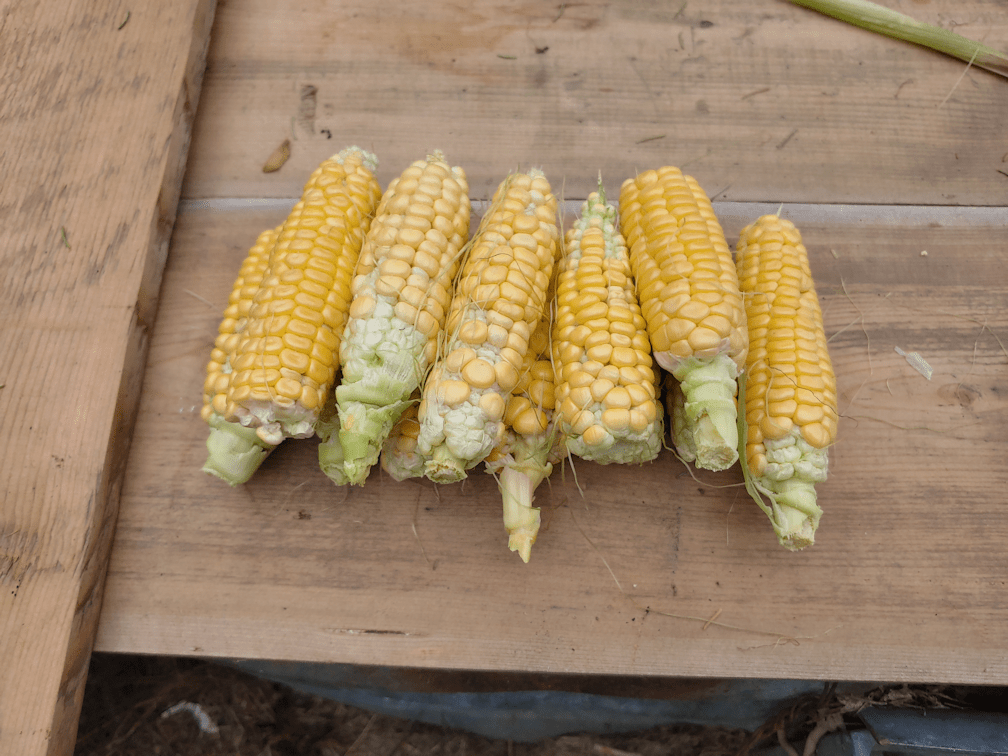
They got to join the corn I’d picked earlier.
This is pretty much the last of the Dorinny corn. There are still a few little cobs out there. I figure I’ll just leave those, and when we clean up the beds in the fall, we might have some seeds to save for next year, perhaps.
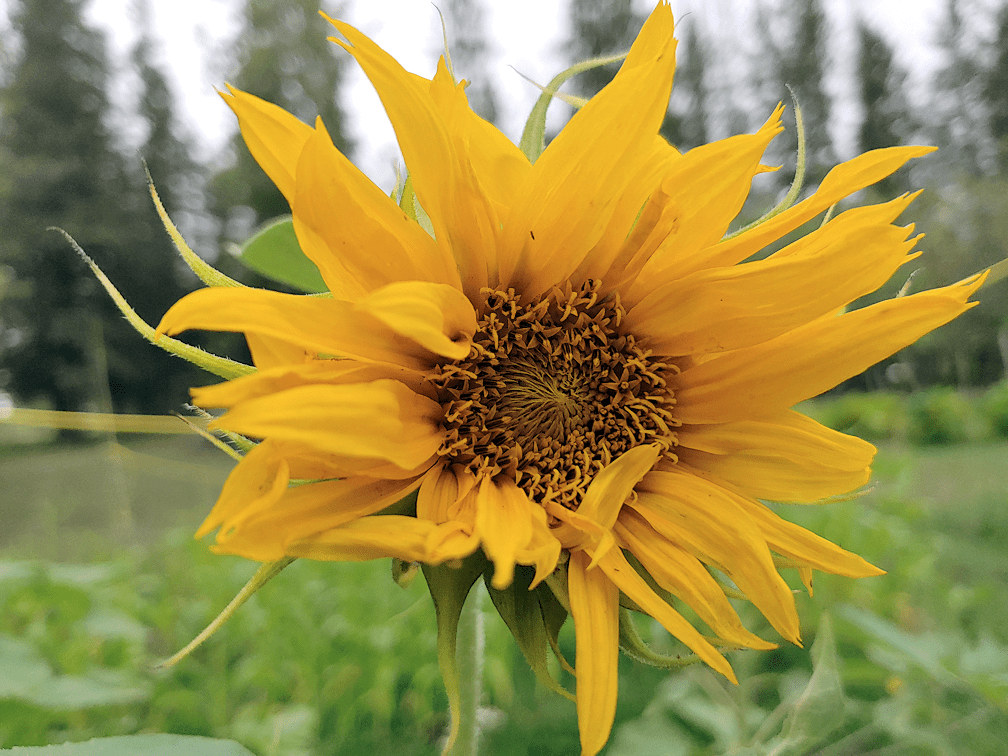
I just wanted to share how the first Mongolian Giant sunflower to start blooming is progressing, too. :-D
Back to the beets!
They are looking a lot better for a bit of clean up! There are some pretty big ones forming in there, too. It should be interesting to see what we get when it’s time to harvest the entire bed.
Then the netting was returned. I made good use of the bag of tent pegs I found in the garage, and pegged the sides down snug along the length, but close in to the beets, so that there would still be slack over the bed, with room for the beets to continue to fill out. I rolled boards into the excess netting at the ends and tucked them close under the leaves as well, so there would be no gabs in the corners for critters to get through.
The beets in the big L shaped bed in the old kitchen garden are starting to lift their floating row cover as well. I spotted a small gap where the rocks weighing the edge down had rolled off, and there are a few nibbled on greens at the very edge. There are heavier weights on either side of the gap, so a critter the size of a ground hog isn’t getting any farther. Tomorrow, I plan to uncover the bed, give it a thorough weeding, pick some more beets, then peg the netting down like this one, so it is more secure.
The beets planted against the retaining wall in the old kitchen garden don’t have this problem. They have not really recovered from when they got eaten. I think it has more to do with low light levels. That area is more shaded by the ornamental apple trees than the rest of the old kitchen garden. I’ll be uncovering them to at least weed them, and get a better look at how they are doing in the process.
As for what was picked today, the corn was added to the summer squash and teeny tomatoes the girls had picked earlier, and roasted in foil with some olive oil, granulated garlic, salt and pepper. The beets got roasted in another foil, with some chive blossom oil, salt and pepper. That way, I could roast both at the same time, in the same pan, without the beets turning the other vegetables all purple! :-D It turned out very well!
For the past while, we’ve been harvesting a handful of beans, every couple of days. Just enough for the day’s meal, really. It would mostly be the yellow beans, with a few greens, and maybe three or for purple beans.
This morning, we had our biggest harvest, yet!
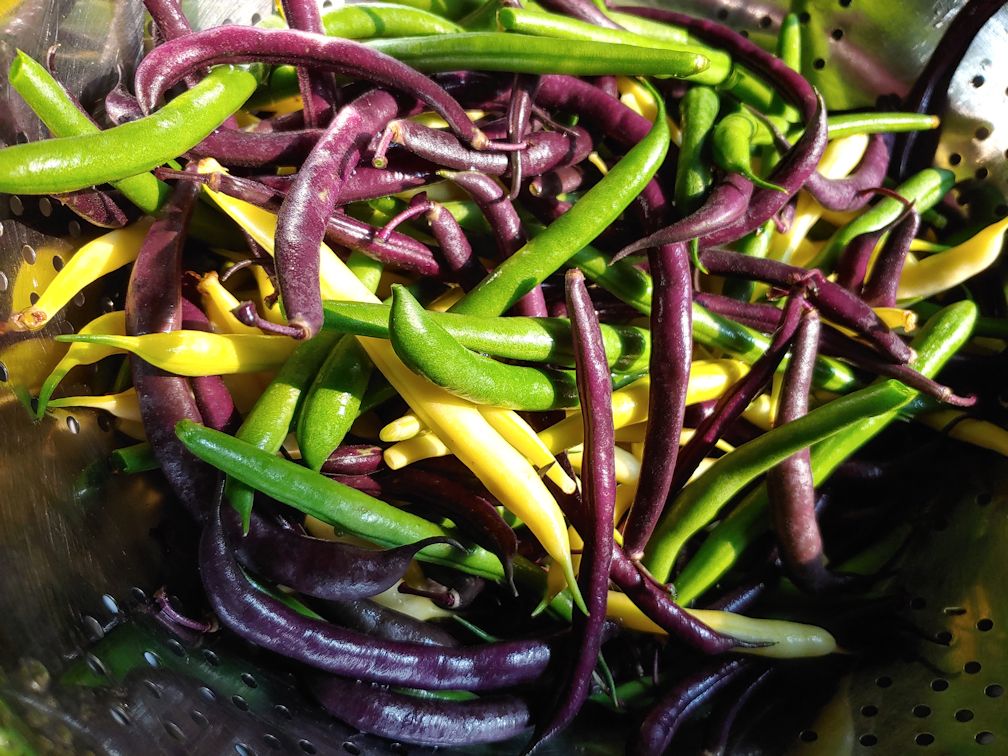
It is still mostly yellow beans, but they are on the bottom. It’s remarkable to me how, the plants that are the smallest and having the hardest time in this heat, is producing the most right now! Not for long, though, I think. There are LOTS of immature green and purple beans hiding under the leaves. We should start getting hauls like this more often, soon. :-)
This is the first time we had enough to make it worthwhile to preserve them. Not enough to make it worth breaking out the canner or doing some quick pickles or something, but enough to fill a bag for the freezer.
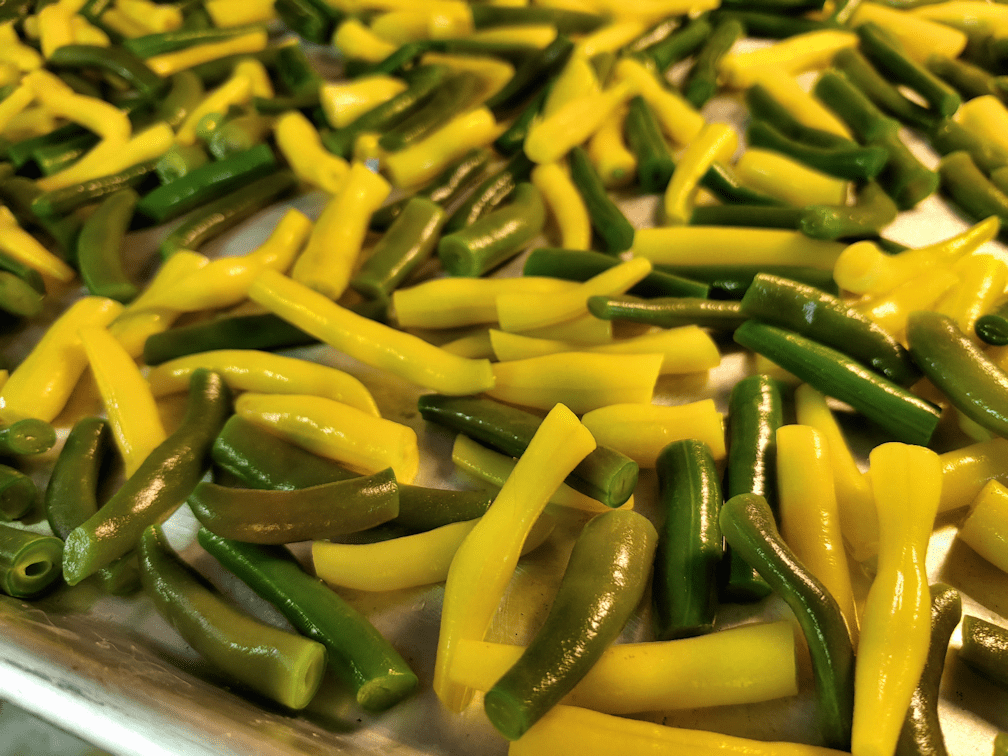
After trimming the ends, then cutting them to more equally sized pieces, I was able to use the blanching pot I’d found in the storage area of the kitchen, while trying to cat proof it (it’s right up by the ceiling and hard to get to!). This is the first time we’ve been able to use it. :-)
All those ice packs we have to help keep our food cold or frozen when we do our city trips are coming in handy. I used a bunch of them to make an ice bath to chill the blanched beans in. We don’t typically make ice with our well water, and the ice we do have is purchased, so I didn’t want to use any of that!
This variety of purple beans turn green when cooked or blanched. They are a somewhat less bright green; you can tell them apart in the foreground.
The blanched beans were laid out on a couple of trays and are now in the chest freezer, to be bagged later.
One thing about freezing produce. It’s very fast! I still hope to have enough to pickle or pressure can, so we have shelf-stable beans, too. :-)
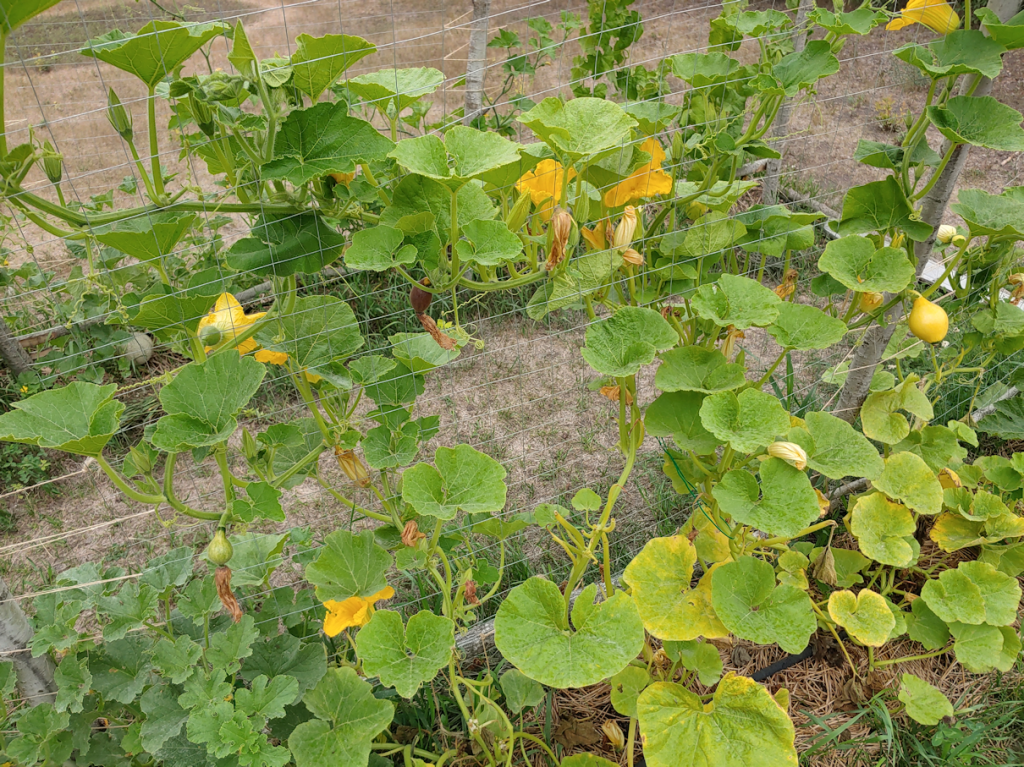
Most of the squash are blooming like crazy right now. The Red Kuri/Little Gem winter squash is especially showy right now.
Isn’t that gorgeous?
Unfortunately, there is still just the one squash that is developing. There are so many little ones like this, but they have been dying off without getting much bigger.
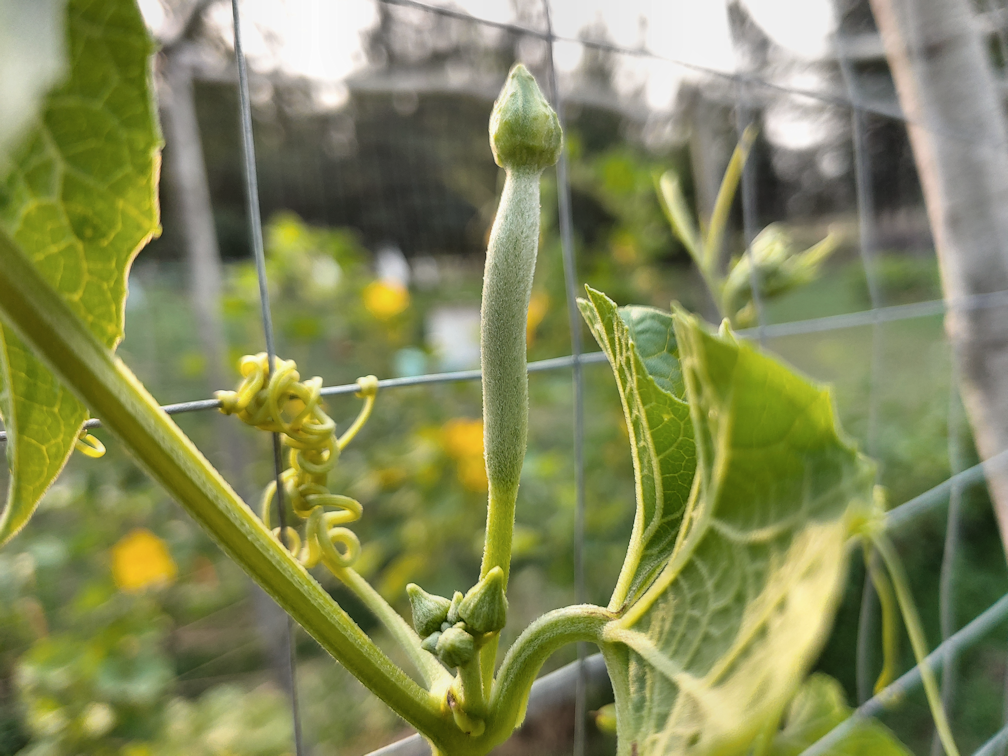
Then there was this little – and I do mean little – surprise I found behind a leaf.
Our first luffa gourd has shown up!
There have been plenty of male flowers blooming, so there should be no pollination problems when this one finally blooms. It should be interesting to see if we get mature gourds, this late in the growing season!
The girls had gone through the garden beds earlier and picked a couple of big zucchini, as well as some sunburst squash. Which tells me that cayenne pepper seems to be working. In yesterday’s garden cam files, I actually saw a groundhog by the summer squash in a couple of videos, in between files of me going by while tending the sprinklers. It was just grazing something next to the summer squash. It did not try to go into them at all. Which is very encouraging. With the watering, I should probably add on more cayenne pepper, but there’s a 60% chance of showers this morning, so it would be washed off if it does. We shall see.
Today has turned out to be – so far – not as hot as predicted. On the down side, the smoke came back with a vengeance this morning. It has gotten better since then, thankfully.
While heading out to move the sprinkler, yesterday, I spotted Butterscotch and her brood.
I’m not sure if this is Bradicous or Chadicous. Either way, he’s adorable!
While tending the furthest garden beds, Butterscotch and her babies went through the squash tunnel on their way to the neighbour’s farm across the road. So much space they could have gone through, and they chose the squash tunnel! :-D
I also saw a lot of birds in the garden. They were appreciating the water on the ground from the sprinkler!
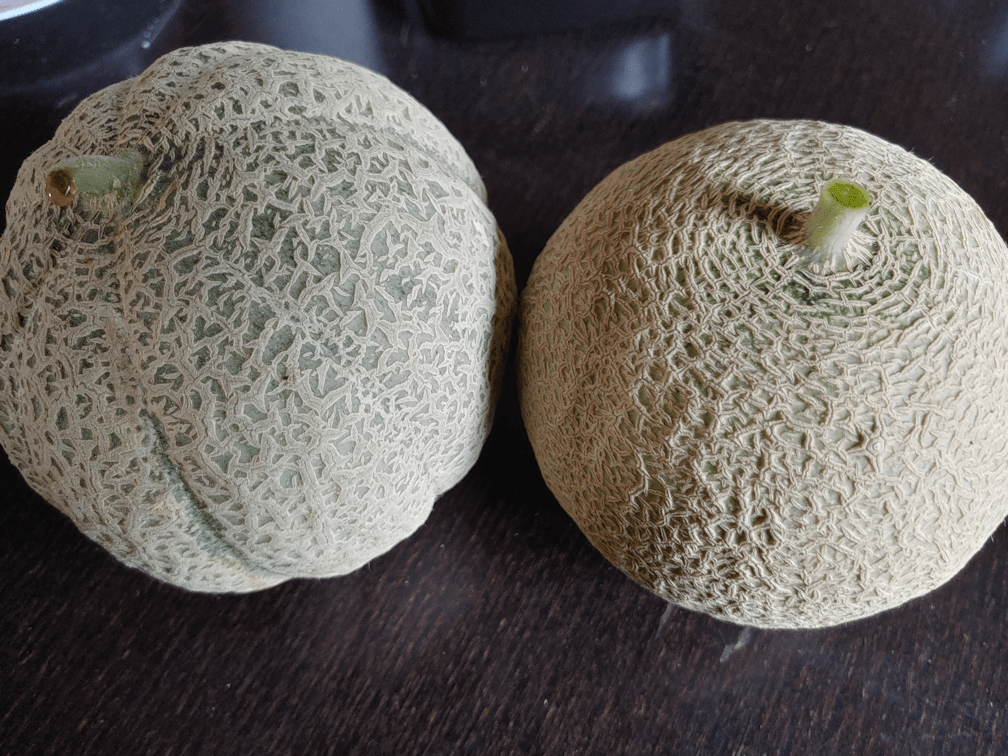
I decided to pick the two biggest, oldest melons to check them out. The one on the left is a Halona melon, and the one on the right is a Pixie.
Here, the Halona is at the top, and the Pixie at the bottom.
First thing I could tell is that they were not fully ripe yet. So we knew, when we taste tested them, that they were harder and less sweet than they should be.
They were still very tasty, though. General consensus is that we like the Pixie a bit better than the Halona, though it was really hard to pick one as better than the other.
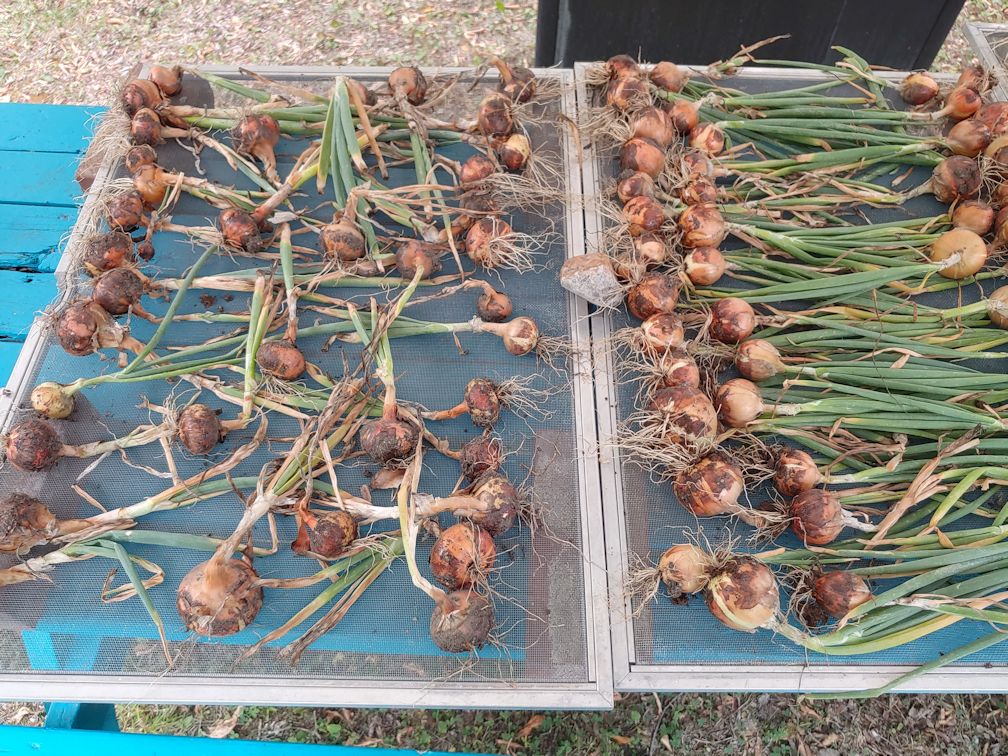
With the weather predictions including thunderstorms over the next few days, I decided it was time to harvest the rest of the onions.
The canopy has been moved over the picnic table, so that’s where we set up the screens to lay them out on.
The screen with the fewest onions on them are the ones grown from sets I bought locally. About half of those had already been harvested earlier and are hanging in the root cellar.
The red unions are the sets we got from Veseys, and the screen in the middle has the onions we grew from seeds. These will stay outside until the soil is dried enough to brush it off and trim the roots. At that point, I will decide if I will leave them under the canopy to cure longer, or set them up in the root cellar. It will depend on the weather.
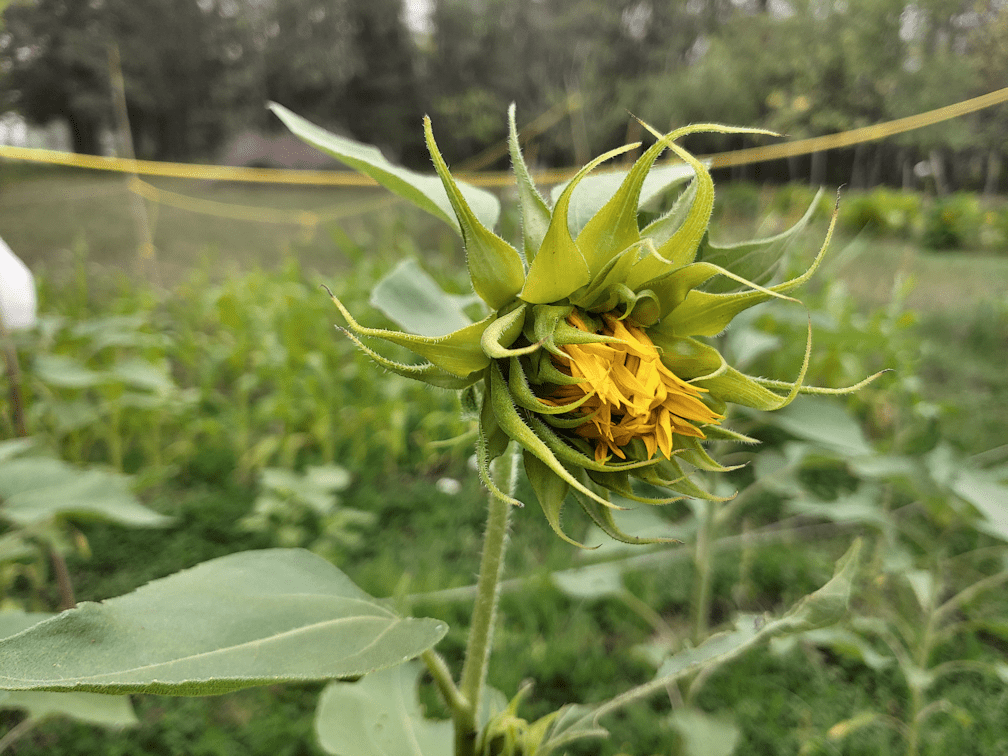
This morning, we are finally seeing yellow petals on the sunflowers! Most don’t even have heads developing yet. The Mongolian Giants are the only ones with developing heads right now. Given we’re in the second half of August right now, I don’t know that we have enough season left for them to develop. The sunflowers in the fields we pass are not only in full bloom, but today I drove by a field where the seed heads are already past blooming and starting to dry up.
In checking the rest of the beds this morning, I found this carnage in the purple corn.
Quite a number of stalks have been knocked down to the ground. From the looks of it, I think there may have been a cat fight in here or something. This is not the damage of a critter trying to eat the corn. I had to head out, so I left it until later today, when we’ll head out to clean up the mess. Hopefully, when it’s a bit cooler.
*sigh*
Anyhow.
Today I made a run to the nearer little city to do a Walmart run and pick up some more cat kibble, among other things. The smoke actually got thicker the further south and east I drove; most of the smoke we’d been getting before was from fires to the north. We are now getting predictions of possible thunderstorms starting tonight, which would go a long way to helping with the wildfires. I’m debating whether we should do an evening watering of all the garden beds or not. Some beds, like the tomatoes, got done already. Though we didn’t reach the predicted highs, I still had to run the hose into the rain barrel for a while, to get rid of the hot water, first. Otherwise, it would have scalded the plants. After letting it run, our well water still is not getting cold like it usually does. Even our ground water is warm! Which means there’s no danger of shocking the plants, I guess. I watered the potato bags, and those looked like something went crashing over them, too. Those, at least, can handle it better than the corn!
This year’s gardening has certainly been a learning experience.
As I write this, in the early afternoon, we have reached 30C/86F, with a humidex of 35C/95F. Our high of the day is expected to reach 35C/95F with the humidex at 40C/104F. Thankfully, this is supposed to be the hottest day for the next while, but it means that we’re back at watering the garden at least once a day.
At least this time, I had a full rain barrel to use in the garden beds by the house, while the sprinkler was running in the furthest beds.
With the upstairs so hot during the day, the girls are still staying up all night, so my old daughter can work on her commissions. They still have to put ice packs around their electronics – and themselves – to keep things from overheating.
Since they were still up during the cool of the morning, they did a bit of harvesting, and this was waiting for me when I got up.
We actually have summer squash to pick! The cayenne pepper seems to be working and keeping the grogs (groundhogs) away. This is the most we’ve been able to gather all summer.
They also picked a single red crab apple for me. <3
It was delicious.
The summer squash bed now has one of the sprinkler hoses I found by the grog den a while back, so they can be watered from below more easily. I set the other one up through two bean beds, but half of the hose seems to have clogged holes. I think they will clear as the hose is used more often.
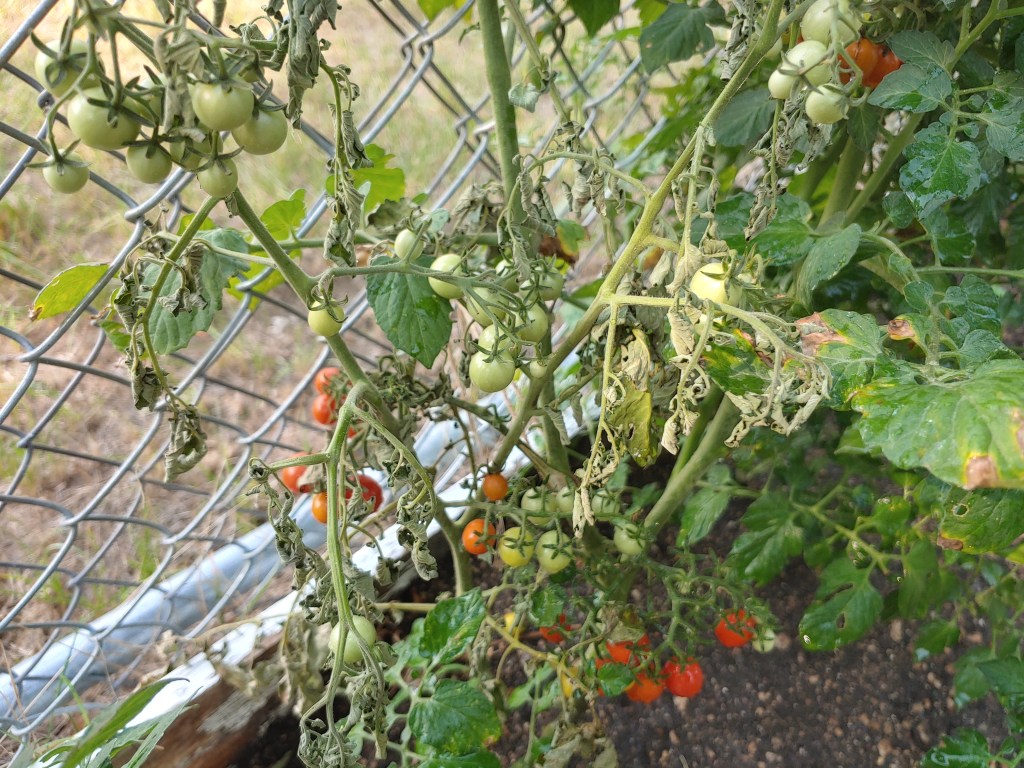
I’m rather encouraged by these tomatoes. The wilted one is the branch that broke off in the wind, and that I just stuck into the ground. The leaves may be wilted, but the stem is still strong, and the tomatoes that are on it are ripening.
I found a surprise while watering the tomatoes.
This cluster of seedlings has emerged from the new garden soil we recently added!
My initial thought was more sunflowers from the bird feeder, but these actually look a bit like squash seedlings.
We’ll leave them to see what they turn out to be.
Unless the grogs eat them, first.
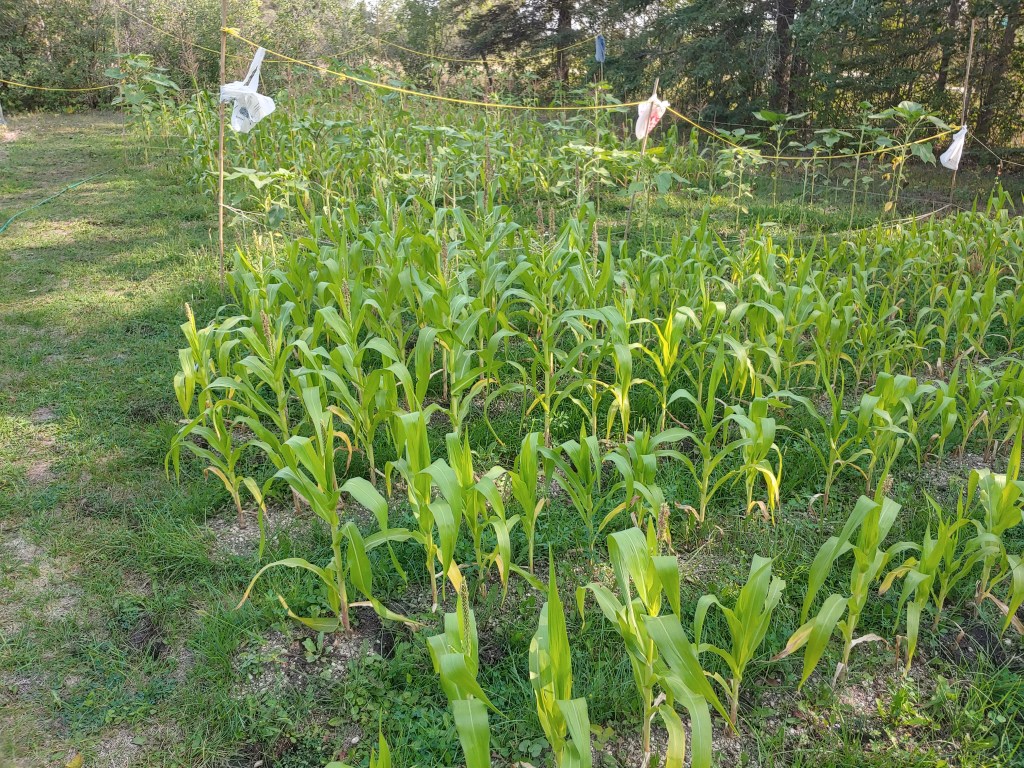
The sweet corn may be small, but they are maturing. The middle block is maturing the fastest, while the northernmost block the slowest. The southern block has one half maturing faster than the other. This area gets shade in the morning, but at least 8 hours of sunlight per day. The Eastern side, however, would still have shade longer than the rest, and that is likely why the plants are shorter on that side.
It does not seem to matter as much for the sunflowers.
The earliest Mongolian Giant flower heads are progressing nicely.
Even the ones that got chomped by deer are recovering. These are the Hopi Black Dye sunflowers, transplanted next to the Dorinny corn, where the entire row had lots their heads.
You can see the cayenne pepper on the sunflower leaves. Since we are using the sprinklers to water things, we’ll need to reapply it at the end of the day.
On the garden cam, I spotted a big raccoon headed towards the summer squash. It reached a plant, touched it with its nose, and pulled back its head like it got bitten, then ambled around the squash bed, avoiding the plants.
When setting up the sprinkler on the purple corn, I noticed a cob with husks that looked quite dried up. I took a chance and harveted it.
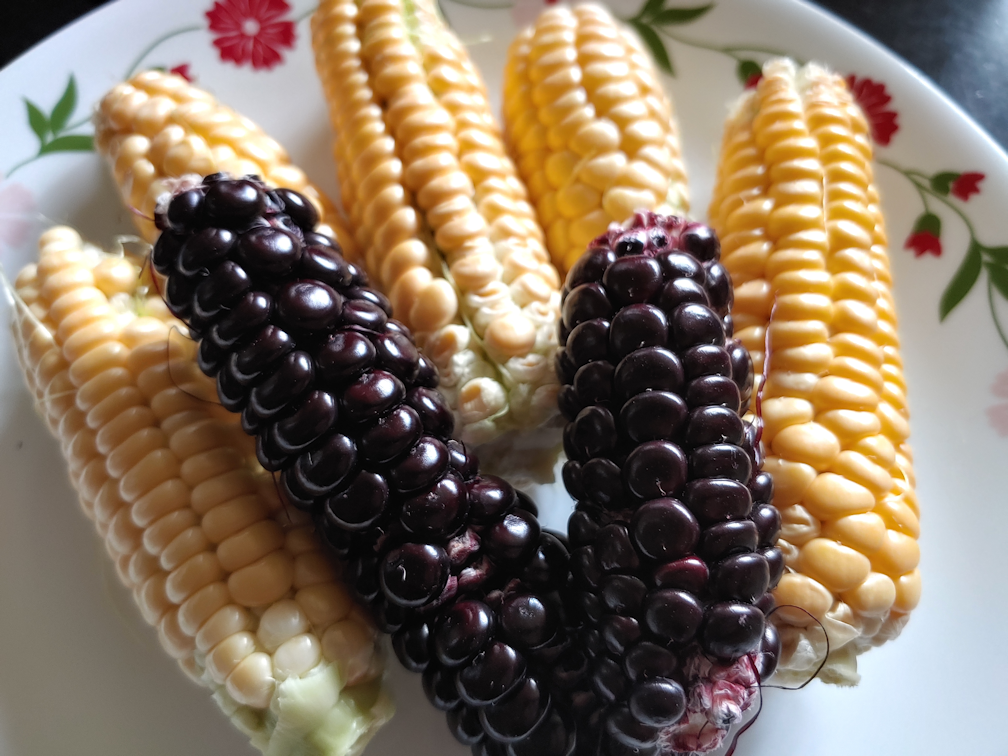
It’s ripe!! Small, not completely pollinated, but still pretty full, and the deep, dark purple it’s supposed to be. I found one other little one with dried husks and picked that, too.
With only two of them, I went to the Dorinny corn and picked what I could there, too.
It isn’t a lot for four people, but enough for part of a meal!
I’m thinking of moving the BBQ my brother gave us to the canopy, so we can grill in the shade. Corn on the grill would be awesome! We’ve got some sirloin steaks from the meat pack we got thawing out, and the summer squash are prepped for grilling. I don’t know if we’ll be up to grilling in this heat, but if not, the vegetables can be roasted.
Either way, I’m looking forward to an excellent Sunday dinner!
Yesterday, I posted about a concern I was finding with our Red Kuri/Little Gem winter squash. I also shared photos in some gardening groups I’m on, and of course, did some searches.
I greatly appreciated the feedback that I got from all over. Some had suggested it was a pollination problem, but that seemed to be from people seeing the pictures of the dying fruit, and not seeing my question about the yellowing leaves. Thankfully, we have not had any shortage of pollinators, unlike some other gardeners I’ve been hearing from. Others suggested blossom end rot. That would be due to watering problems, particularly over watering. In this location, and with our soil (or lack of it), over watering would be very difficult to do. Under watering could be an issue, but these plants are watered the same as everything else at the squash tunnel.
Other possibilities included squash borers, which there are no signs of, and the pattern of yellowing would have been reversed from what is happening. Fungal disease was another possibility, as was root rot. Both of which I could rule out pretty confidently. Insect damage in general could also be ruled out.
Nutritional deficiency seems to be the most likely cause. Everything at the squash tunnel has been fertilized a couple of times with high nitrogen fertilizer, and lack of nitrogen is one of the possible nutrient deficiencies, but I ‘also had suggestions that lack of calcium, iron and even magnesium might be contributing factors. None of those are included in the soil tests I did! It could simply be that this type of squash has higher nutritional needs than the melons and squash on either side of it. There are five of this type of squash, and all five are affected, while nothing around them are having the same issues, which suggests to me that it this variety is simply a heavier feeder than the others.
This morning, I pruned away all the dead and dying leaves at the bottom of the plants, as well as trimmed away the stems from leaves that had been nibbled on, previously. There were very few of those; it’s the winter squash next to them that is getting the worst of the nibbles!
There was quite a bit to trim away! What I found interesting was what was revealed, once these leaves and stems were removed.
There are fresh new leaves growing! Many are growing out of the stems right next to the dying leaves, as if the plants are trying to replace them as fast as it can.
This also opened things up so I could better check for things like fungal disease, insect damage, etc., just in case I’d missed something before.
In the end, lack of micro nutrients seems to be the most likely cause. That new leaves are coming up at the bottoms (no leaves higher up on the trellis needed to be trimmed), is encouraging.
The big, beautiful flowers, and the still healthy developing squash is also very encouraging!
On a completely different garden topic, I was checking out the corn and sunflower blocks, and taking a closer took at some of the developing seed heads.
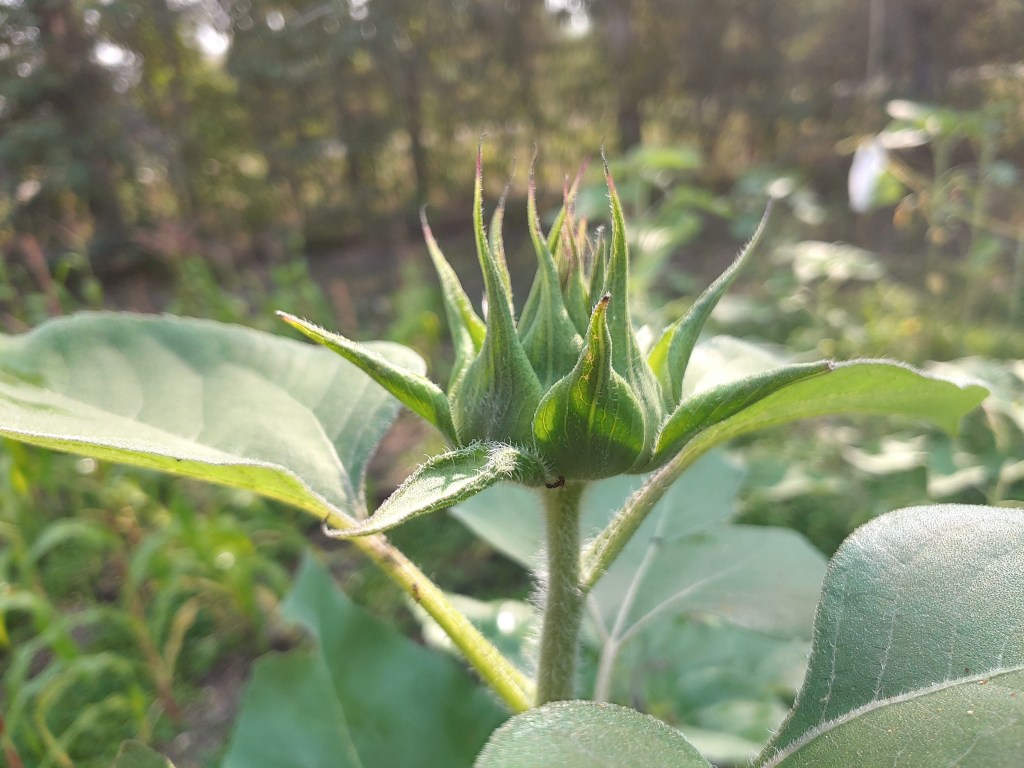
This Mongolian Giant is typical; one large seed head developing at the top.
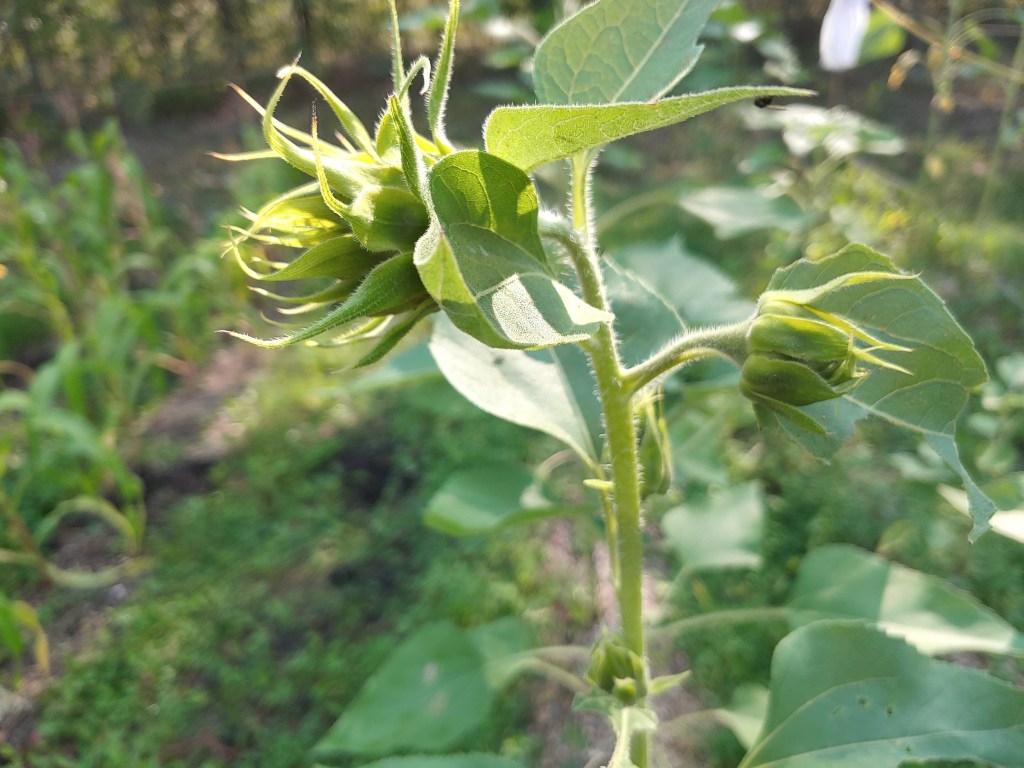
Then there was this one, two stalks over.
This one has a whole bunch of little seed heads starting to develop, all down the stem! Pretty much every leaf on this plant is showing a baby seed head growing in their elbows.
I remember we had a sunflower last year do this, too! Sadly, none had a chance to mature before that first frost hit. Hopefully, these have more time to develop, and we’ll have seed heads to harvest as something other than bird feed this year!
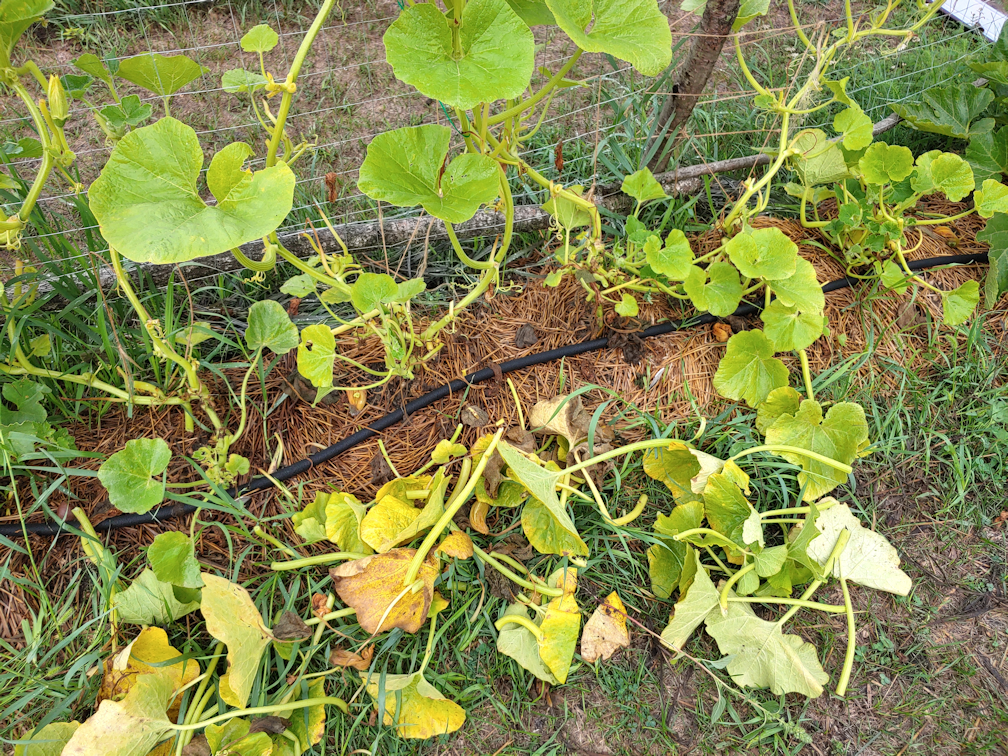
Just yesterday, I posted about how big our Little Gem winter squash seemed to be doing.
But only parts of it are doing well.
Does anyone experienced with winter squash know what’s going on here?
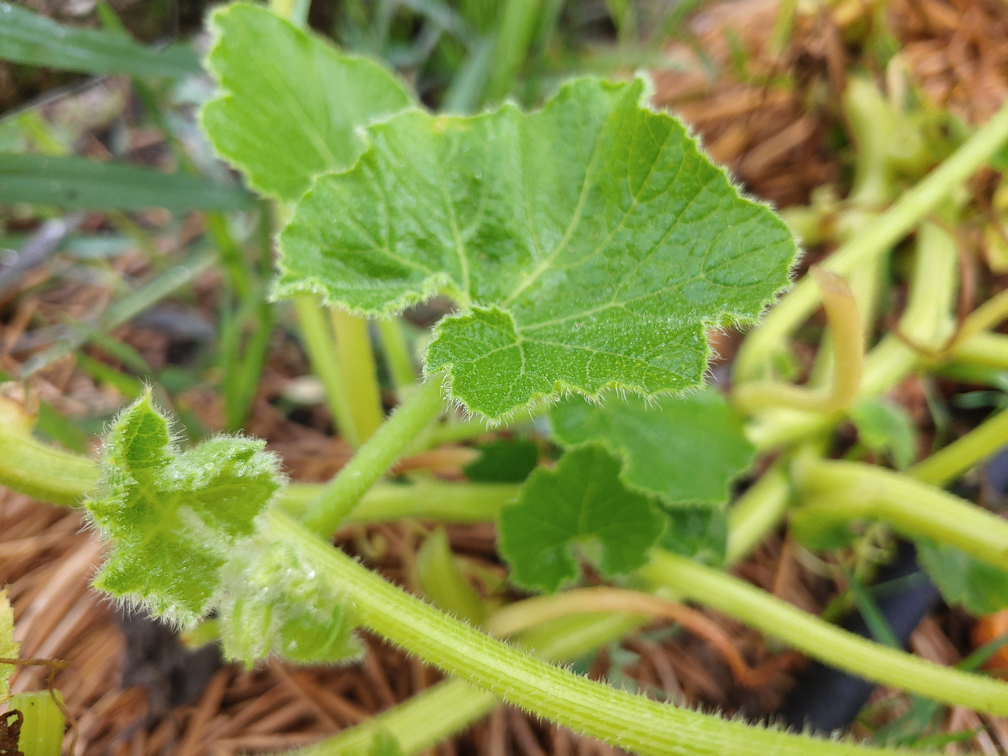
The newest growth is looking healthy and vigorous, but near the ground, the leaves and stems are looking yellow, and some of the leaves are dying.
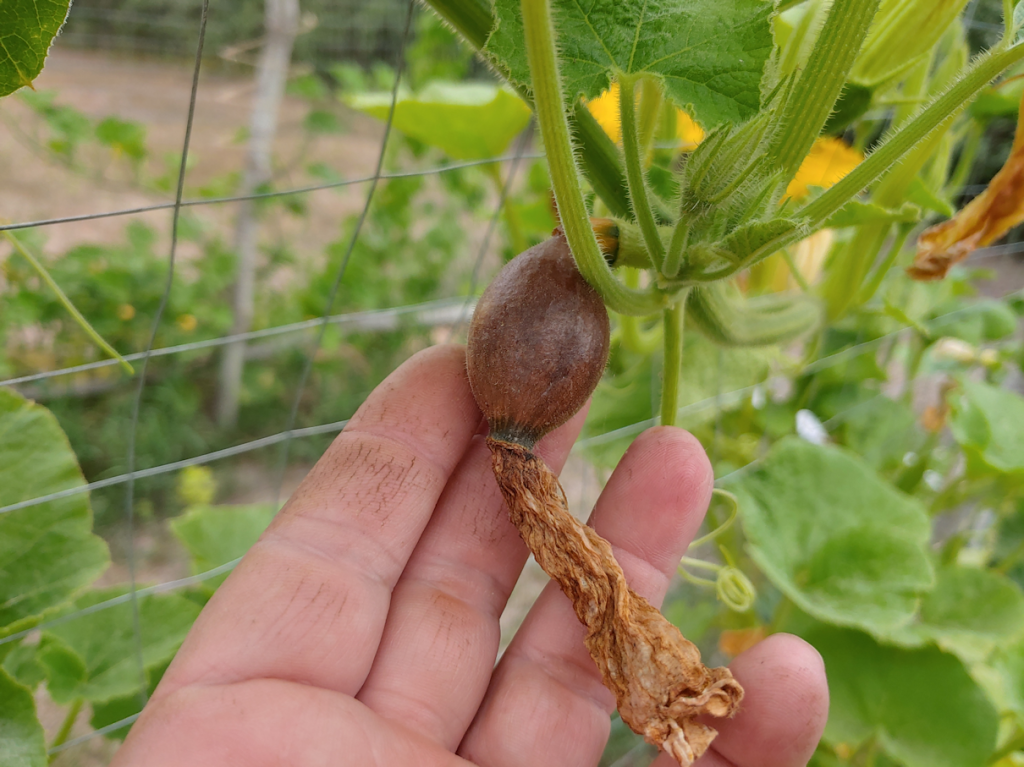
Worse, some of the developing squash are dying.
This one fell off while I was taking its picture. :-(
This is the very first baby squash we found. It has not gotten any bigger, and is now starting to rot, too.
There are SO many baby squash developing under their flowers, but too many don’t get very far.
I don’t know why this is happening.
There is no sign of disease on the leaves. I’m not seeing anything like squash borers or insect damage. It is only affecting this variety – all the plants of this variety – but none of the others.
These are near the middle of the row. They are getting the same amount of water as everything else here. They have been fertilized the same, too. It isn’t even getting any critter nibbles, like the nearby Teddy squash is/was.
I need to consult the local gardening groups to see if anyone else has had this issue.
Yesterday ended up being even hotter than was forecast.
We also didn’t get the thunderstorms that were predicted. :-(
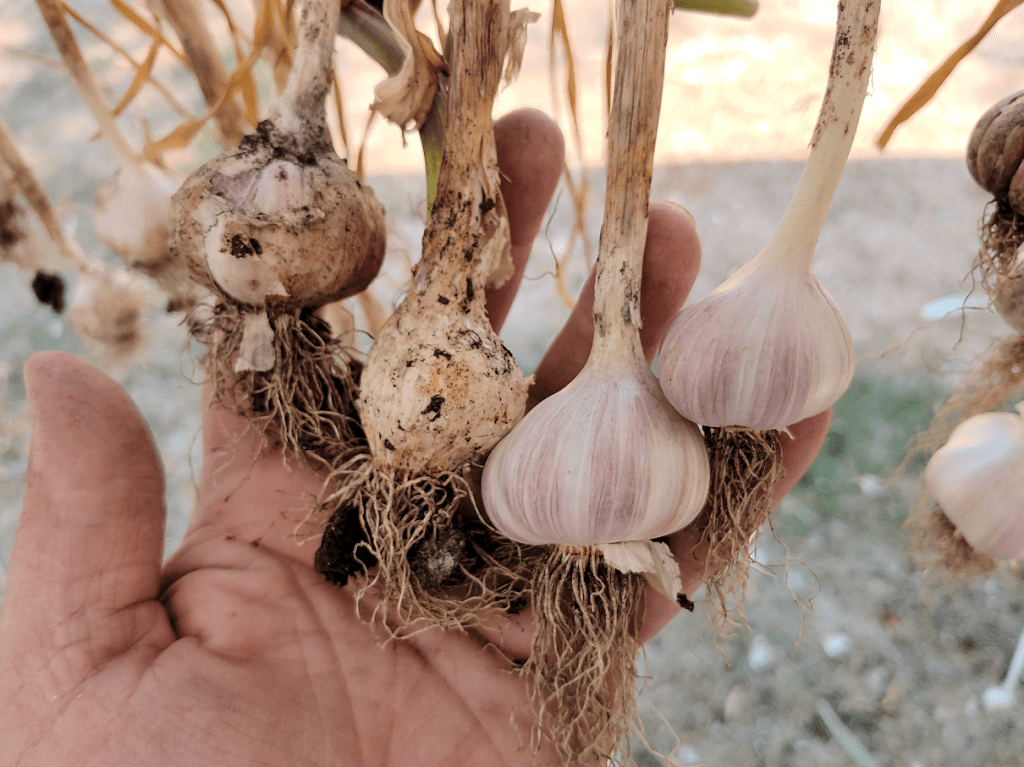
I still ended up outside to take care of a few things. One of them was to check on our curing onions, shallots and garlic.
They are not cured yet, but they’ve dried enough that I took the time to brush off the soil from the shallots, then kept right on going, doing all the onions and hanging garlic, too.
Quite the difference!!
They will probably need at least a few more days, probably a week, to cure, but I might be able to trim and re-string them and hang them in the root cellar to finish curing. We shall see what the conditions are like. They really shouldn’t be hanging outside in the heat like this, though they are at least dry. I found out from my SIL that my mother would braid her garlic and hang them in trees, so I guess this should work out fine, too.
Though we did not get the predicted thunderstorms, we did have high winds from the south all day.
High enough to break a heavily laden tomato branch that didn’t have enough support. :-( I spent some time adding supports to the tomatoes, and found others that were bent, but not broken like this one. This one was still attached, so I tied it upright, but by this morning it was wilting. It’s likely a lost cause, but I went ahead and took it off completely, then stuck the end into the ground.
After adding support to the tomatoes, I picked the ripe ones – there are three different types of tomatoes in this photo – and picked the largest cucamelons, too. We’re still getting just enough for snacking on. :-)
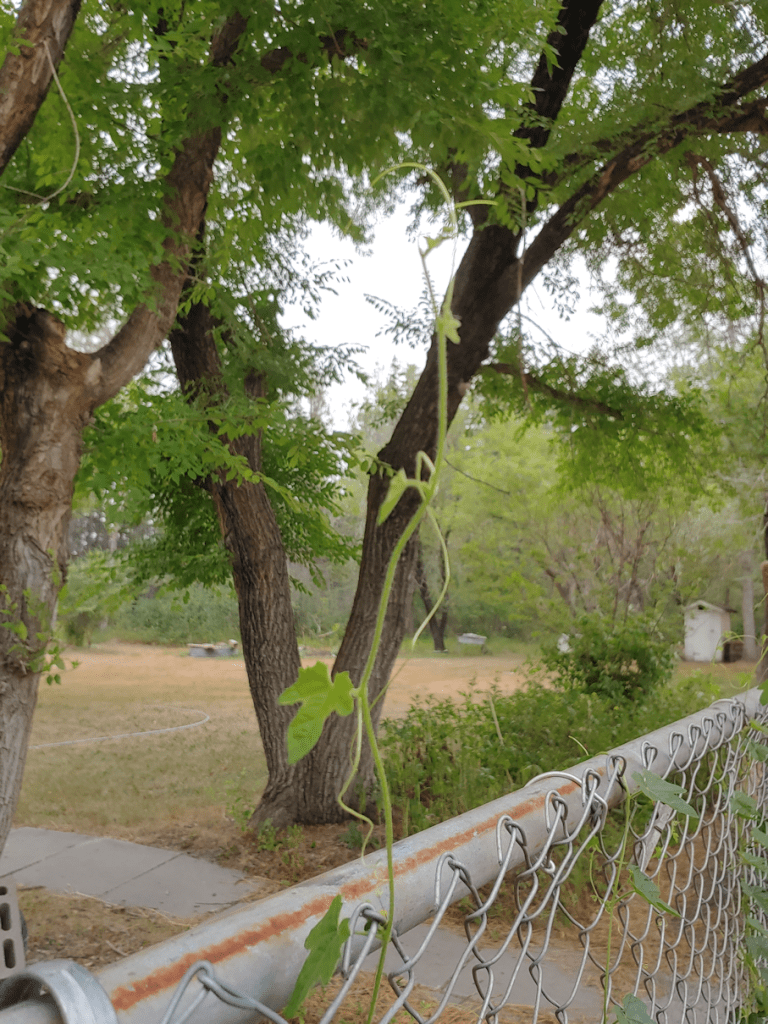
Speaking of cucamelons, check this out.
This morning, their vines were reaching even higher past the top of the fence. How these are not falling over, I don’t know! The vines are clearly much stronger than they appear!
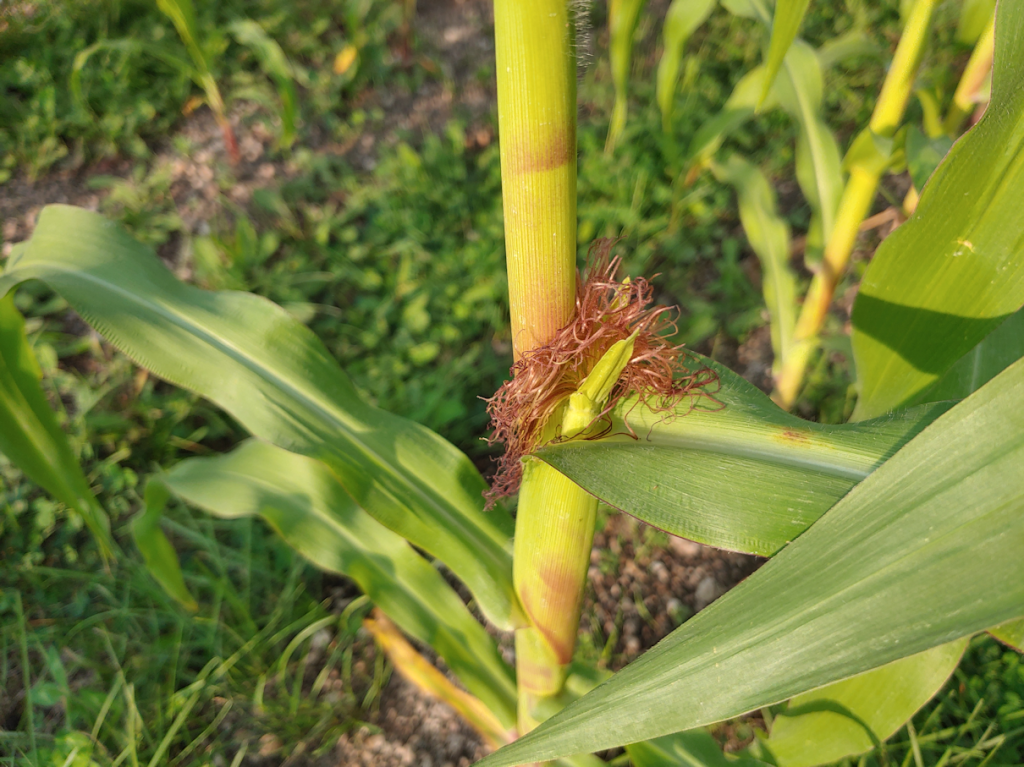
For the past while, I’ve been watching the sweet corn grow, wondering that there were so may tassels forming, but no cobs. When I went to water them yesterday evening, it was a relief to finally see silks emerging on several stalks. We might have corn to eat, after all!
This morning, I was able to pick some more beans, too.
The yellow beans seem to be getting into the height of their production, and I even found green beans large enough to harvest, but only one purple bean large enough to pick!
With how many we planted, I had hope to have more, but with our drought conditions, I’m happy that we have enough to eat fresh with our meals.
Also, do you see the drops of moisture on the colander in the photo?
That’s not from rinsing the beans.
Those are rain drops.
Yes! We have rain! It started to rain lightly just as I was finishing up with my rounds, and has been raining off and on ever since.
So exciting!
Even my older brother is getting rain at their place. They’ve had even less rain than we have. They get the same weird weather phenomenon that we do. As the systems move over us, something seems to just push them to go around, or even cause them to dissipate. Our theory was that it has something to do with being between such large lakes, but my brother’s place is well past the southernmost tip of the lake. So it can’t be that
We are just so happy for the rain we are getting right now. I can’t wait to check on the gravel pit this evening, to see if there’s any water at the bottom of the new dig!
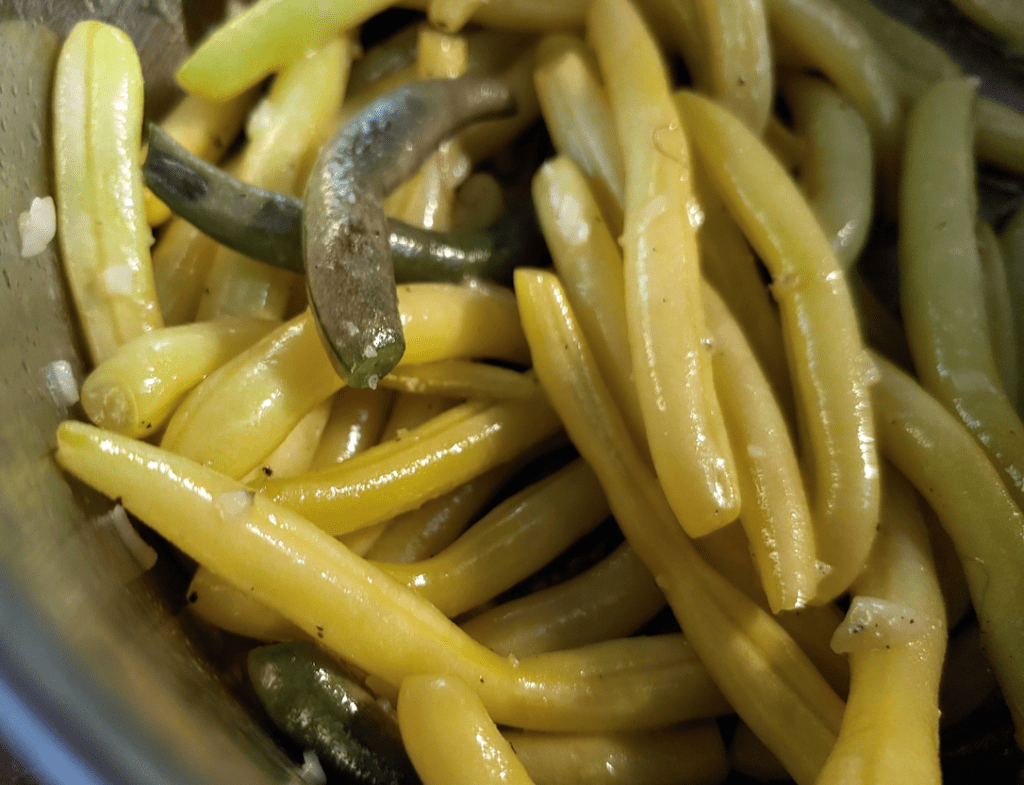
This evening, our first real harvest of beans was prepared to accompany our supper, and did a taste test. Though we’d picked a few beans before, they were so few, they just got chopped up and added to a hash.
For these, they were first steamed until almost done, then pan fried in butter with fresh garlic (our own, of course!), then seasoned with salt an pepper.
The purple beans turn green when cooked, and I made a point of tasting them individually, to compare the flavour.
Honestly, I couldn’t tell the difference. As far as I could tell, they tasted the same! :-D Which was very good, I might add. :-)
I forgot to follow up on how the Dorinny corn tasted. We had those last night, wrapped in foil with butter, salt and pepper, then roasted in the oven, next to a ham.
I really liked the Dorinny corn. If you’re a fan of really sweet corn, it probably wouldn’t be your thing, but it had a good, solid corn flavour. It was also wonderfully toothsome. As much a pleasure to eat as to taste. I don’t think we’ll be able to save seeds from these, there are so few of them, but I will definitely want to pick up more for next year’s garden. In fact, I think I will get two packets this time.
While heading out to check on the gravel pit, I paused to look at the cucamelons and had a lovely surprise.
Hiding behind some leaves are some really big ones! Not quite big enough to harvest, but very close.


























 The Re-Farmer