Yesterday evening, I was able to head out and finally work on the dead tree that’s stuck. While I was getting tools out of the sun room, I discovered I was being watched!
They were not only watching me, but they did NOT run away, and one of them looks almost relaxed!
I’ll take that as progress. :-D
Then it was time to get to work.
For the tree that’s stuck, the first thing that needed to be done was to brace it before I started cutting. Then I measured a little more than four feet from the bottom and cut it most of the way through. Then, just to be safe, I used a rope to pull out the brace from a distance, then used the rope again, to pull out the cut piece.
Now that this has been cut shorter, the tree can be pulled out with the van, once we have something we can use to safely haul it out. We do actually have chain handing around but 1) I won’t want to use chain, because if it breaks, the damage could be catastrophic and 2) the chain I’ve found is so big and long, I would have to use a wheelbarrow to bring it over! :-D At this stage, though, the tree can wait until we get some strong enough rope. It’s also now low enough that I could remove the rope that was wrapped around the trunk, from when I tried to get it to roll off the branches it’s stuck on.
The four foot length was moved to join the others by the main garden beds. Then I took down the third dead tree in this group.
This tree was a fair bit thinner than the other two, and was faster to cut down. When it fell, it landed on the stuck tree, which basically guided it away from the trees it’s stuck on, and down to the cherry trees.
All of those cherry trees will be cleared away, as they are not right for our climate zone, so the first order of business was to start clearing enough of those away that we could access the trunk. Dead branches were also cleared off the trunk. Then, while I continued to clear more of the cherry trees away, using loppers for the thinner ones, and the baby chainsaw for the few larger ones, my daughter started to measure off the trunk to cut the first four foot length.
We got two four foot lengths and a nine foot length before it got too dark to work, so I got these photos this morning.
As with the other two trees, the wood is nice and solid, with no sign of rot. That means, not only will the wood be used to build our high raised beds, but the stump will be used to support a seat or a table.
With so many dead trees to clear away, we’re going to have a lot of those by the time we’re done!
While cutting lengths from the trunk off, we were able to pull the rest of the tree out a bit, but at this point, it’s too hung up on the cherry trees that haven’t been cut away, yet. I had thought to be doing more of that today, but it might have to wait. Pain levels are high, which is no surprise, but as I write this, it is also 30C/86F right now!
One more nine foot length, and I’ll have enough wood to make a raised bed that’s 3 logs high. With how thick the trunks are, that might be high enough! :-)
Well, we’ve done as much as we can with the outhouse for now, and I think it’s turned our rather well!
The first order of business was to paint the shelf boards.
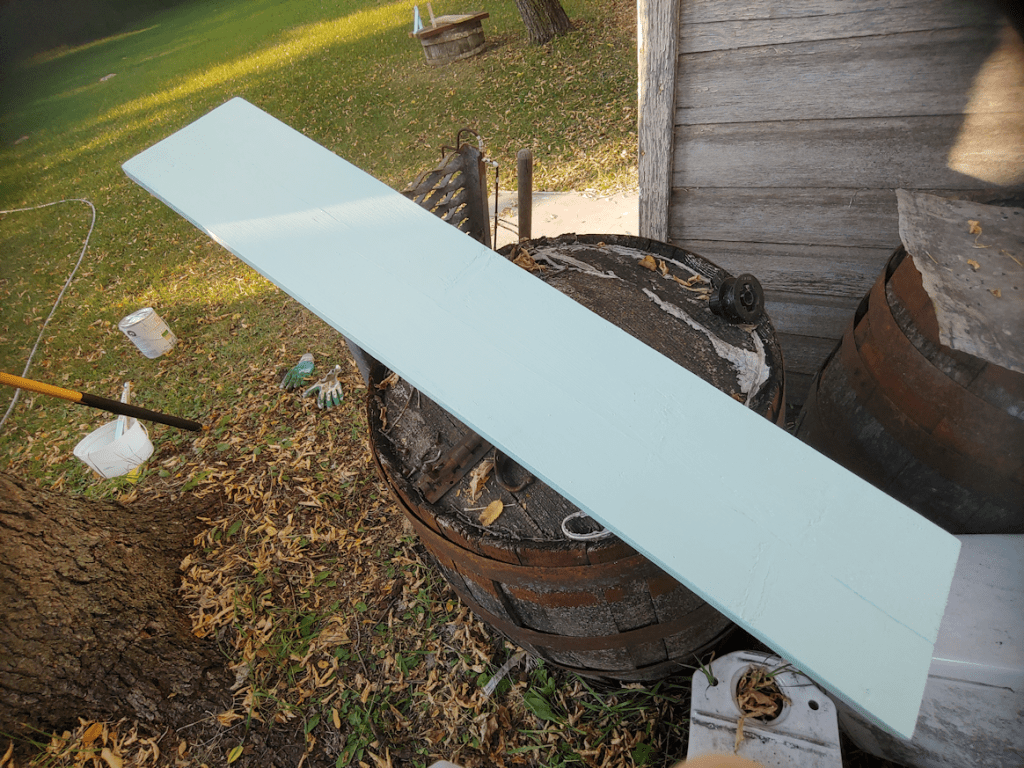
The longer one was the one that got painted on one side, and the edges, yesterday. I decided to paint the remaining section of the board, too, for a future shelf after we get more shelf brackets. After a cleaning and a sanding of the rougher edges, it gone one side and the edges painted, too.
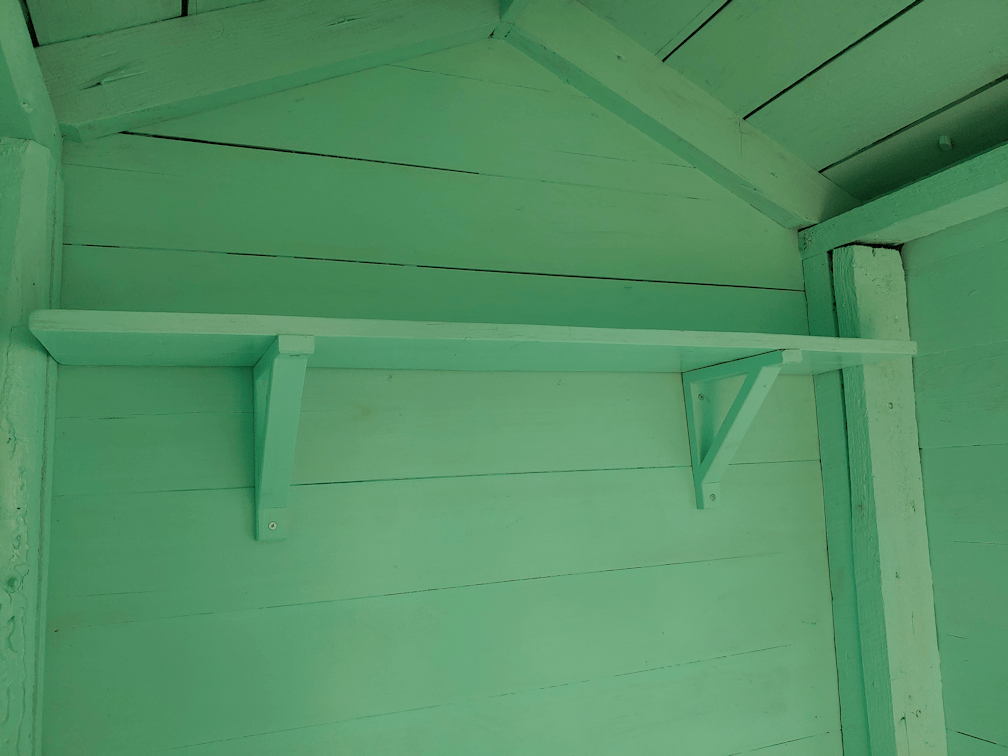
Leaving those to dry, I put up the shelf brackets, living them up with the top of one of the boards.
That screw in the top corner was a real pain in the butt to do. There’s almost no space for the screwdriver! I also put the screws to attach the board part way, so that when I came back later, I’d only need to bring the screwdriver.
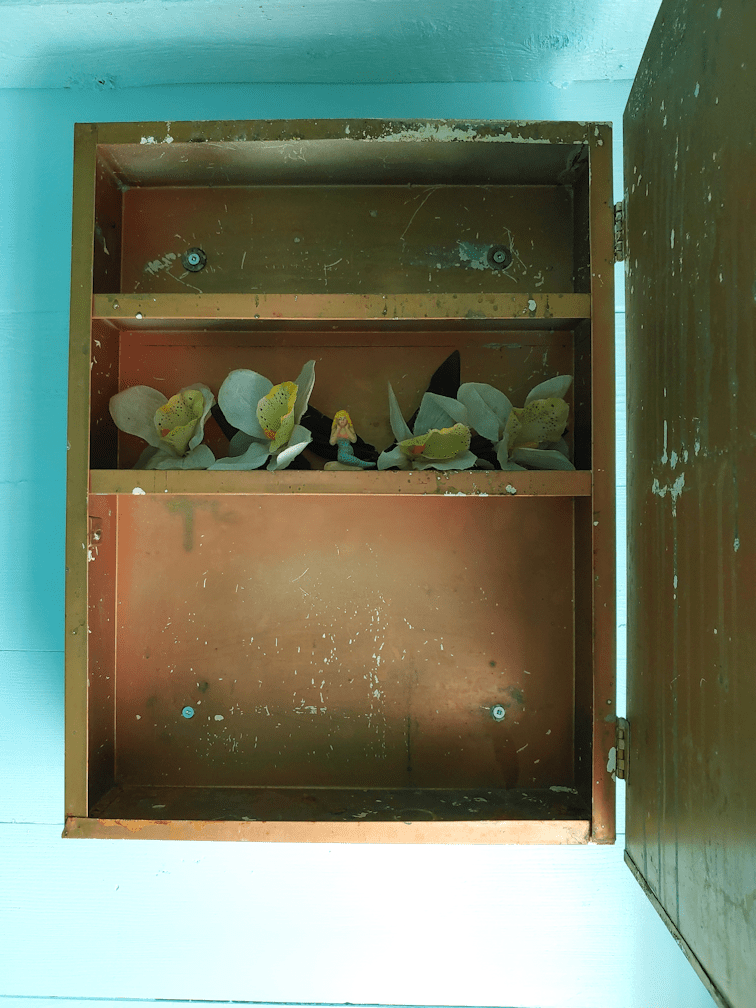
I noticed one of the girls had moved the mermaid toy into the middle shelf (I’d put it on the bottom). Remembering that there were some fake flowers in the garage, I went digging around and found some small ones to put beside her. :-D
After giving the shelf boards a couple of hours to dry, I came back later to put up the longer shelf board.
We wanted the shelf to be pretty high up, but when I tried to put it in place, I found it was narrower than where I’d checked the fit, before! Not by much, though, and I was able to jam it in and screw it in place.
That done, it was time to paint. Since there was so little paint left, the first thing that got done was the other side of the second shelf board, then the inside of the door. The back wall was done as high as the shelf, and the wide walls on either side of the seat box were done.
There was just enough paint left to do the wall joists in the middle, and the final dregs were used to paint the inside edges at the bottom boards under the joists. I’d painted the tops, but not the inside edges before. One of the boards only had half an edge along most of its length; a chunk seemed to be missing! LOL
Then I cleaned off the paint brush on the toilet lid again. :-D
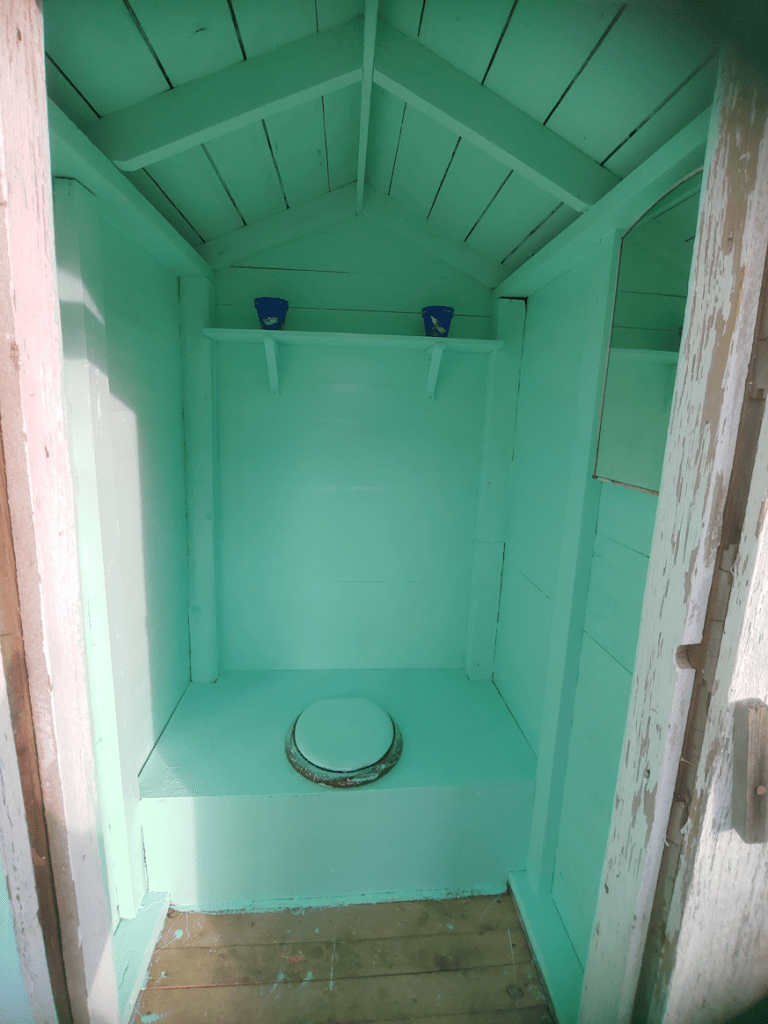
After washing up the paint supplies (including the empty can; I figure we can reuse it for something), I took a couple of decorated terracotta plant pots we’d found when we first cleaned out the sun room and put them on the new shelf.
Gosh, that looks so much better!!
The girls are already talking about getting another gallon of paint to add another coat in the future. Other than adding the battery operated light inside, whatever we figure out for the floor, and eventually replacing the toilet seat, it’s basically done on the inside. Oh, and the latch for the inside.
While waiting for the painted shelves to dry, I took a closer look at the outside.
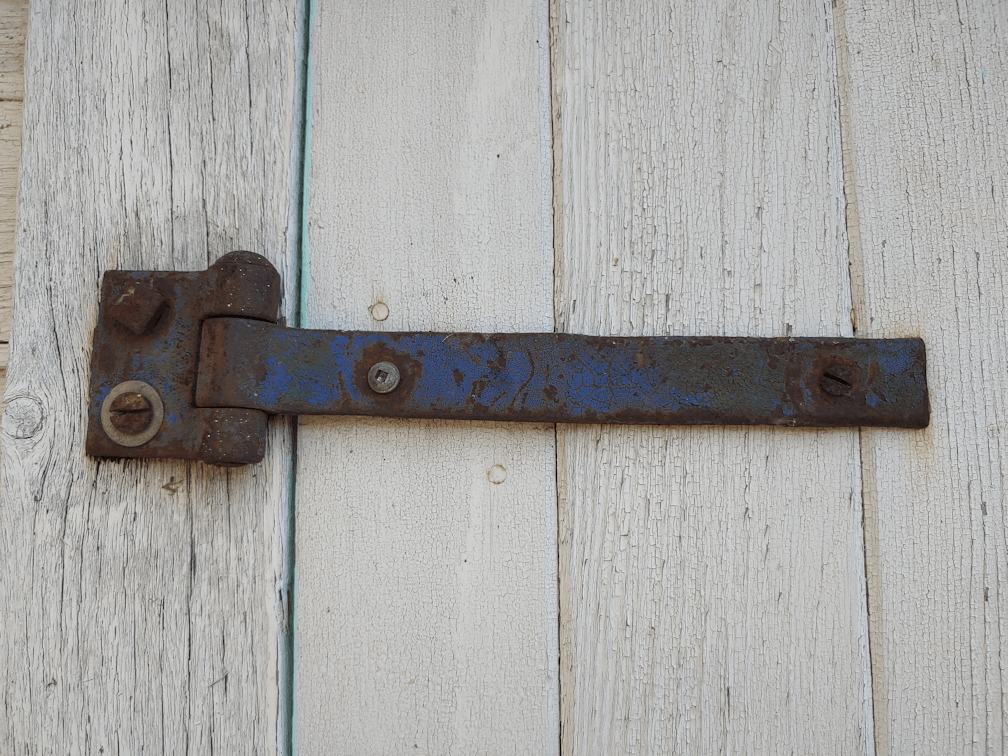
This is one of the hinges that needs to be replaced.
Why does it have four different screws???
The other one has three different screws.
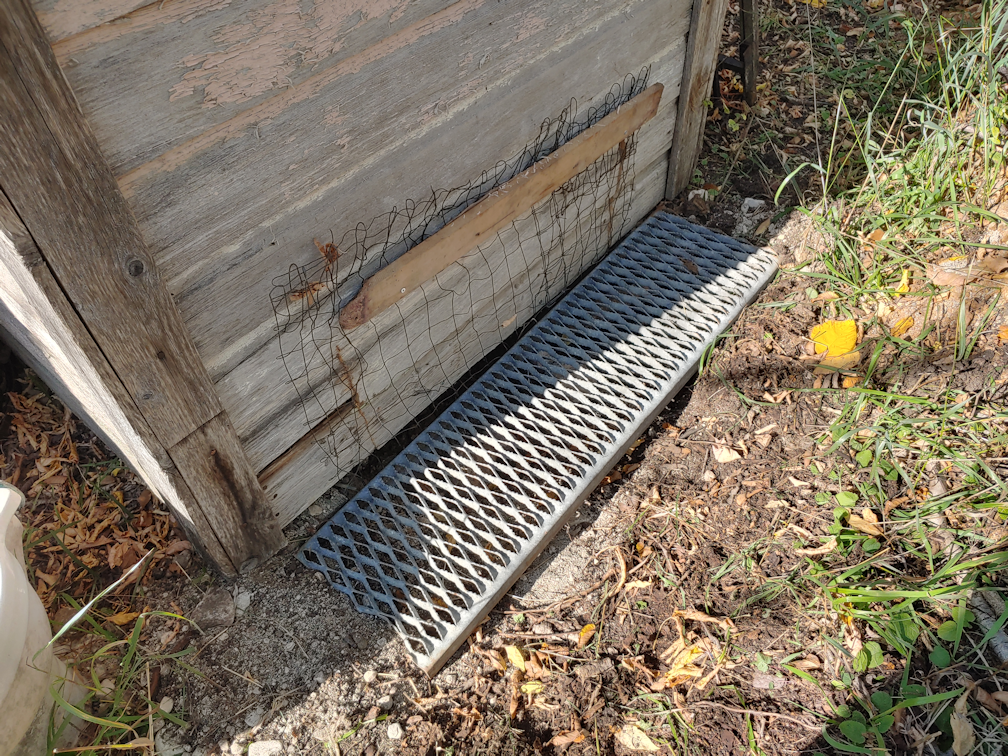
I also took the metal thing that had been in front of the door, to cover the hole that was getting bigger, over the wire mesh at the back. I didn’t even bother to level it or anything. That can wait for when we actually paint the outside.
I also looked at the roof, thinking ahead to when we fix it up. There’s quite a lot of rotted edges on there. :-/ One of the things I wanted to do in repairing it was making an overhand above the doorway. We definitely want to have it overhang the roof trusses, too. After they have been reinforced because of the rotten edges!
It would be good if we can get that done before winter, but we shall see. After the roof is done, we’ll work on painting the outside. The front of the outhouse is white, but the other three sides are a pink. It may have started out as a red, but there’s so little left, it’s rather hard to tell. You can see some of it in the above photo.
The girls want to keep the pink. :-D
By the time we’re done, this thing is going to be downright adorable. Plus, it will last longer, until we build the outdoor bathroom we have planned.
The plan was to head over to the outhouse, quickly do a second coat of paint until we ran out, then get back to working on the bread baking.
Instead, I kept adding more things to do, and by the time I got inside, I had to get my daughter to continue the bread baking, as I was no longer physically able to do it. Which is what she is working on now, as I write this blog post!
While looking for something else entirely, I found a pair of wooden shelf supports and instantly realized that they could be painted and used to put a shelf in the outhouse. So when I headed out to do the second coat of paint, I also poked around the barn and a shed to find a thin board wide enough for the supports. It was about six feet long, though, so I basically held it up to the outhouse door from the outside, and eyeballed where to cut it to fit along the back of the outhouse. It ended up being just over half the length of the board, so I figured if I was off with the longer one, I could still use the slightly shorter one.
It ended up being just a hair too wide to fit between the corner posts. A few swipes with a micro plan and some sand paper was enough to get it to fit perfectly!
That done, I sanded the rough edges, then scrubbed and hosed it down before setting it aside to dry. Then I added a second coat of paint, just to the seat box inside, before painting the shelf supports.
I’m thinking I might paint the rest of the board, too. If we get more shelf supports, we can add it onto one of the side walls.
It took a while for the washed shelf board to dry, so I decided to give the mirrored shelf a scrub down, too, then once that was dry, I hung it back up inside the outhouse.
Rolando Moon decided she absolutely had to be on top of where I was putting the tools and screws! The violent beast went from demanding I pet her, to attacking the hand that was petting here, making me bleed! I did manage to get the screws with washers out from under her, though.
I just wanted the washers, though. There were just two, for the top screw holes, which are slightly wider than the bottom ones. I used new screws to hang the mirror back up. After washing the blood off the new screws and washer, from the wound Rolando Moon gave me!
Previously, it had been hung up right against the centre joist, but I chose to centre it between the corner and the joist, instead.
Then, I just had to do it…
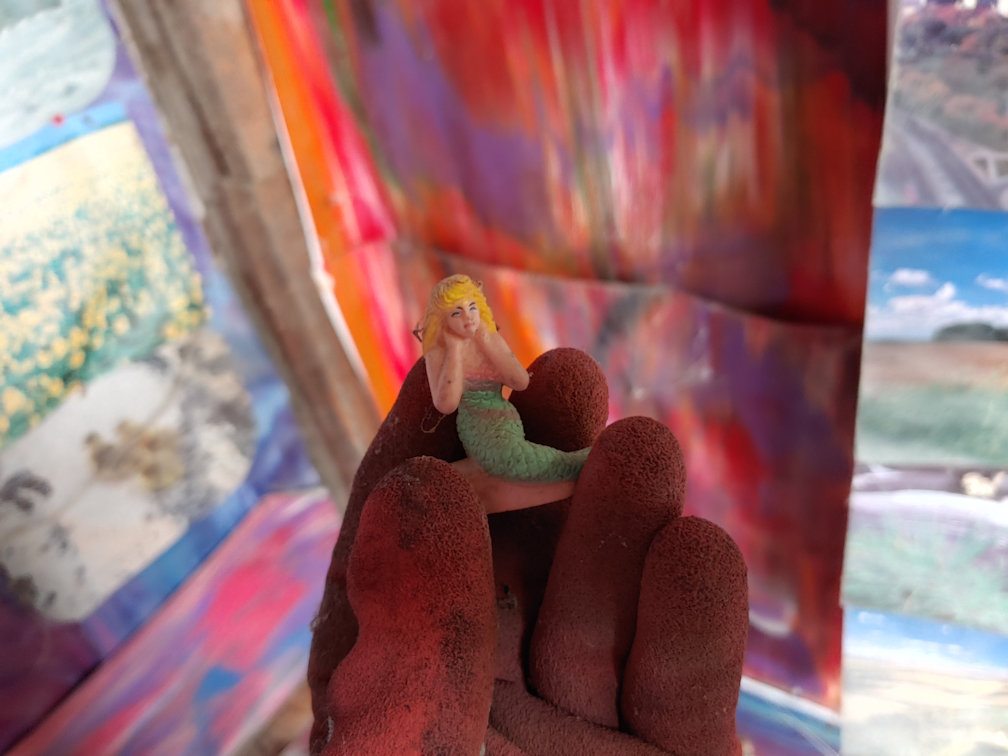
I just had to put the little mermaid I found while I first emptied and cleaned out the outhouse, inside the cabinet.
She lives here now.
:-D
Once we’ve picked one up, the LED battery operated light switch will be mounted directly opposite the mirror.
By the time this was done, the shelf board was dry.
After removing Rolando Moon, I got the one side painted. Tomorrow, I will paint the other side. By then, I should be able to mount the shelf supports, using the boards on the wall to make sure they are level, then attach the shelf board once the paint is dry. Only then will I continue doing the second coat of paint inside, until the can is empty. If I end up not doing the ceiling, or the narrow parts around the door, that’s not going to be a problem. As long as the areas that are most likely to get scrubbed in the future get a second coat, it’s all good.
Since I could no longer work on the inside, I decided to work on the outside, and empty the pit of groundhog gravel.
The wire mesh on the back was held in place by being hooked onto two bent nails, that were nowhere near each other. You can see one at the top right. The other is barely visible, near the bottom left. It didn’t take much to remove the mesh.
There was a second, smaller piece of mesh, partly buried until a thick layer of grass and roots.
*sigh*
That took some doing to move out of the way.
I thought I would be able to remove the two bottom boards by taking off the smaller pieces on the side, then pulling them off. They where, however, thoroughly nailed in place, with old and rusted nails that were not about to come out. So, I instead dug out my jig saw and used it to cut a piece off the bottom.
As you can see, it’s solid gravel against it! I ended up having to cut a second piece off. I was then able to start shoveling the gravel out, and when I could no longer get the shovel far enough in before the 2×4 across the bottom stopped me, I used a garden hoe to move more gravel closer, then shoveled some more.
I never did reach the … compost… layer. I did hit a lot of rocks, though! I emptied it as best as I could, without removing the more recent… deposits.
Then it was time to cover the hole back up.
I put the two pieces of siding back, then screwed the bottom one to the 2×4 behind it. The next time we need to get under there, we can just remove the screws and the boards will easily pop out again.
I then folded the smaller piece of wire mesh to fit the opening. I found a scrap piece of board with screw holes already in it, so I used that to fasten the mesh in place. The wire is folded at the bottom and weighted down with rocks. Critters can still get in if they really wanted to, but this is temporary. When we get to painting the outside, we’ll make things more permanent, perhaps replacing the cut boards with a hinged flap that can be latched to keep the critters out. Who knows.
I have no idea why that other large piece of wire mesh was used to cover almost the entire back of the outhouse. It really served no purpose, since only the gap at the bottom needed to be covered. Even the smaller one on the bottom couldn’t keep the critters out.
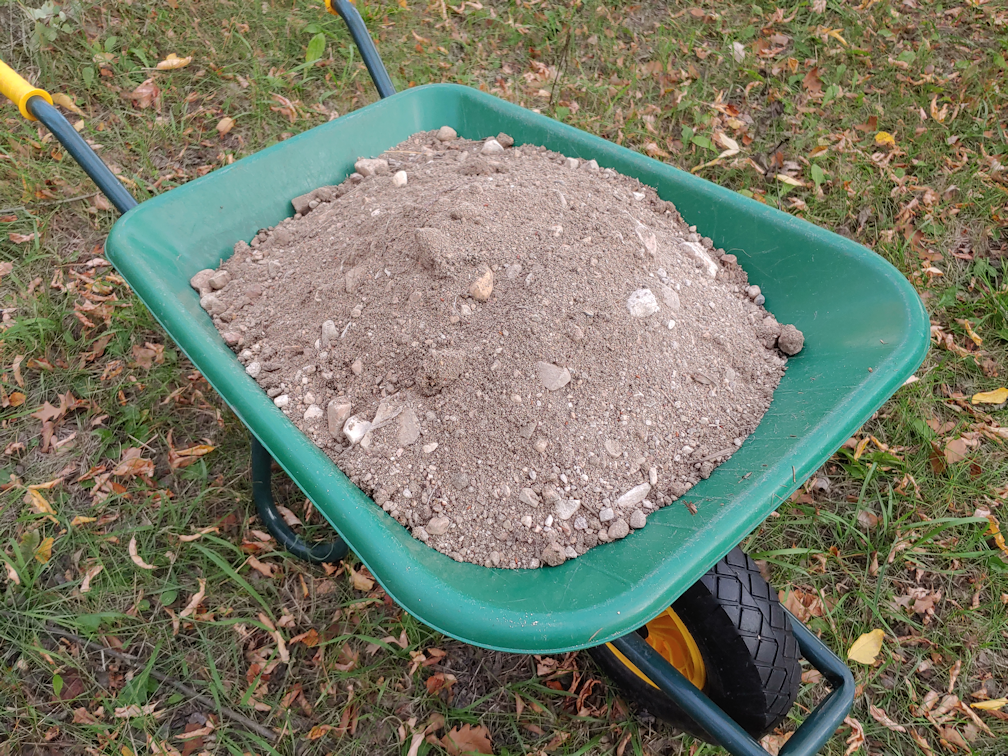
I was able to fill the wheelbarrow with clean groundhog gravel! If there was any chance the shovel full I pulled out wasn’t clean, it went onto the nearby cat litter compost pile, instead.
The clean gravel was put to good use.
It was enough to make a thin layer on top of the boards in the path between the new low raised bed boxes. The bigger rocks went up against one of the boxes, where there is a larger gap, then it all got spread out and hosed down, so that the finer particles would wash into the gaps between the boards below. It seems to be more clay than sand and gravel, though. We will still need to add more, but this is a good start.
And that was it for today!
Deciding to include a shelf added at least an extra day to finishing the inside, but I think it will be worth it. I’m more happy about getting the pit clean up over and done with for now!
After a quick run out to hit the farmer’s market, and then town, I decided to finish painting the inside of the outhouse while there was still enough light.
I’m glad I did. :-)
Here are the “before” pictures.
I had a few drips, while working on the top and ceiling. :-D
It was a bit tight to get photos of the inside, front!
There are a LOT of nooks and crannies around that door frame.
I actually started with the door. I figured I should get that done first, just in case it needed to get closed at the end of the day, so it would have more time to dry.
Then I worked on the most difficult areas around the door. For such a small amount of square footage, it took quite a while to get that done! Painting the inside of the door frame turned out to take quite a while, too, as there are a lot of gaps that I needed to squeeze the brush into.
Once the front was done, I methodically worked my way to the back. Of course, I found more staples and tacks that I missed! :-D
Since I wasn’t planning on taking off the toilet seat, once the sides were done, I painted the seat box under the toilet seat first. The lid leans against the back wall when it’s open, so I wanted to give the paint at least a little while to dry before having to close the lid again. On the plus side, there are only 2 points of contact under the seat, so even if still wet, closing the lid wouldn’t mess the paint up too badly.
Here are the “after” shots.
This time, I remembered my phone has a “panorama” setting. LOL
Yeah, I painted the toilet lid. Sort of. It had so many drips on it, I just went ahead and used the lid to get excess paint off the brush. :-D
And here it is, with the painted door.
While doing a second coat will take a lot less paint, I suspect we will need to buy another can. Those nooks and crannies took a lot more paint to cover than expected. Especially when I came across wood that had pieces fall out, or had a very rough finish. One of the beams supporting the corner still had bark on it, and winding gouges on the surface from insects. All of this ended up needing extra paint to get into the various holes and surfaces
What a difference!
One of the things we’ll have to do is put some sort of non-slip… something… on the metal sheet in front of the outhouse. It can get slippery when it’s wet.
After a second coat of paint, we’ll put the mirror cabinet back in – my daughter suggested just putting the old one back, rather than digging out the one in the basement, because then we’d just have to find somewhere to store the old one, anyhow! :-D Also, she noticed we had a chain latch, still in its package, that we can use on the inside, so we don’t have to buy a new latch. It will be mounted on the top cross piece of the door, so I won’t be trying to mount a latch where old screw holes have already damaged the wood. I’ve decided that, for a light, I will pick up another one of those LED, battery operated light switches. We have two of them in the house that come in very handy; one is set up in the bathroom to use at night instead of turning on the very bright main lights, and another is set up in a very dark corner where one of the upstairs litter boxes is kept. When we get one for the outhouse, I want to mount it across from the mirror, to take full advantage of reflected light. We’ll need some sort of dust, critter and insect proof container to keep toilet paper in, and maybe some wet wipes or something. The girls plan to put art on the walls. :-D
The next time something happens and we can’t use our indoor bathroom again, we will at least have someplace pleasant to go! :-D The only other thing is, we now have to empty the pit of all that gravel the groundhog dug up. It will be important to get that done before winter, because if we get any normal amount of snow, when it melts in the spring, we’ll have a big puddle in front of the outhouse, and the back of the garage, and water will drain into the pit again. The gravel is high enough in there, that there is no longer room for it, which would force the water above the floor boards. Mind you, it would probably end up draining into the groundhog’s den, but there is nothing we can do about that.
The main thing was getting at least this first coat of paint done, then digging out the pit. If we don’t have a chance to fix the roof before winter, I want to at least put a tarp or something over it. The rest can be done slowly, as we find the time.
Hopefully, I’ll be able to continue later today, but if not, there is at least some progress in painting the inside of the outhouse.
This is the colour my daughter chose. Personally, I would have gone for a pale blue instead of a pale mint, but honestly, I don’t really care that much. We just needed a light colour to brighten things up on the inside, that wasn’t institutional white. :-D
I almost forgot to take the before photos!
The angle is bad because I was already standing on the seat box when I took these, and I wasn’t about to clamber down, just to take pictures. ;-)
My main goal for today was to do everything that needed me to be standing on the seat box to reach. The only exception was one side of a roof joist, right in the middle. For that, I made use of the thick boards we’d found stored in here when we cleaned it out. The three of them together gave me 6 inches in height, and that was enough.
This is probably the most difficult part to do, with all the corners and tight areas. After this, things should go a lot faster.
The opening at the top is covered with wire mesh window screen, stapled in place. It did not occur to me that the mesh was not flush with the surface when I started trying to paint over it. I didn’t want to take it off, though. I think we will pick up some more wire mesh window screen in the future for other projects, and when we do, I’ll look at replacing this screen. Then the frame can be painted properly. No hurry, though. Depending on how long before we can do that, we could paint the frame in the same colour as the outside. We haven’t decided what that colour will be.
For now, though, I’m off to the Farmer’s Market. I’ve discovered that organic humans are being allowed in, and I want to pick up some pork from our neighbour. :-) We’ve emailed briefly and I might be able to check their homestead out over the weekend, too. :-) I’m looking forward to it!
While it was incredibly handy that the old outhouse had been made safe and cleaned up inside, when we found ourselves unable to use our indoor bathroom, the reality is, it was still pretty… unpleasant… using it.
So now that we have the scrubbable, high traffic paint, I decided it was time to work on the inside of the outhouse. Because the way things seem to go in this house, we never know when we’re going to have to use it again!
Which means that today, I worked on preparing the inside for paint, starting with removing the remaining stuff stuck to the walls, after taking down all the colourful paper my mother had put up.
Thumb tacks, nails, staples, bits of paper, and bits of packing tape. Some of those tacks, I’m sure a hammer was used to put them in! I found myself using a staple remover, a screwdriver small enough to lever under the thumb tacks, and even a wrench, to yank out the most stubborn bits. They were all over the walls, on the top and front of the seat box, and the inside of the door.
Of course, I found more that I’d missed, after I took the photo, too!
My mother was very through in covering those walls! :-D
I also removed the mirrored medicine cabinet, then used a broom and brushes of different sizes to get as much dust and dirt off the walls, ceiling and floor, and out of the corners, as I could. The inside latch on the door was also removed. It was held in place with two very rusty screws, and a bent roofing nail!
The final step was to power wash the inside with the house. Remembering how difficult it was to go the front of the inside, before, that was where I started this time. By standing on the seat box, I was able to get at the cracks and crevices fairly well, without being splashed with water too badly! :-D Even doing the underside of the roof worked out all right. Once the front was done, I could get down and do the rest from the doorway.
Now it needs to dry overnight. It will be ready for painting, tomorrow!
I am happy to note that the floor is a lot sturdier than I thought it was. I had still been wanting to reinforce it by adding more boards on top. However, the seat box is pretty low. If we add any more height on the floor, it will make using the seat pretty hard on the knees. So I will have to rethink what to use to reinforce the floor. A sheet of metal could be thin enough, and strong enough, to do it. We have more like what is now in front of the outhouse, but they are huge pieces and I don’t have the tools to cut them with. Not that I would want to. I have no doubt that, some time in the future, I’m going to be thankful to have such large sheets of metal for some project! :-D There is no hurry, though. After it is painted, we can poke around the barn and the sheds and see what we can find.
After it is painted, I am thinking it would be good to replace the inside latch with a new one, as well as adding a handle or latch to the outside. Right now, it is kept closed with a piece of wood nailed loosely to the frame.
I should probably pick up new hinges. The door is starting to sag and I want to straighten it out, too. And if I’m going to do that, I may as well get matching handles and latches for the outside, too. There is not as much of a hurry on that, though, as the outside needs to be scraped and painted, and that likely won’t happen until next year. Fixing the roof is more of a priority, and I still hope to get that done this year. For now, I’ll just replace the inside latch with a new one.
Hmm. Now that I’m thinking about it, there is another medicine cabinet with a mirrored door in the basement. I think it’s in better shape than the one I took off. If it is, I’ll use that one, instead.
It may be just an old outhouse, but if we’re going to have to use it, we’re going to make that thing as pretty and pleasant as possible! The girls already have ideas for decorating it inside. :-D
Today was dry enough that I could work on cutting up the dead tree that had finally fallen, thanks to recent high winds.
This time, I could use power tools! I used my baby chainsaw (aka: cordless pruner), with it’s 4″ blade, to trim off branches, then a reciprocating saw, with a 12″ blade to cut the measured lengths. Unfortunately, my reciprocating saw is giving up the ghost. It cuts, but it doesn’t stop. Sometimes, it’ll slow down when I release the trigger, but other times it would just keep right on going. I had to unplug it to turn it off!
At the last minute, I changed my mind on the longer lengths I would be cutting. These will be used to make high raised beds in the main garden area, and I had been thinking of building them at 10 feet long. As I was measuring, however, I decided to make them 9 feet long. The boxes we built for the beds where the garlic had been planted are 9′ x 3′. I figured if I did these at 9 feet long, any future cover frames we build will fit on both. I kept the short ends at 4 feet, though. With the width of the wood, the inside of the beds will be roughly 3 feet wide, so any covers would still be interchangeable.
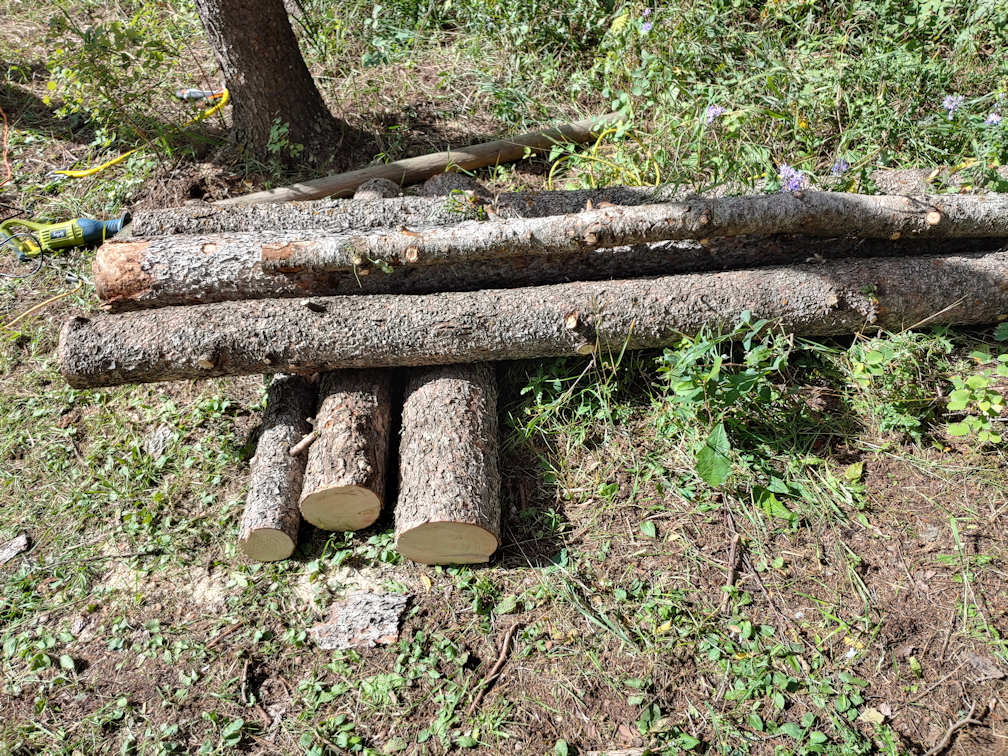
So here we have two 4′ and two 9′ lengths. Enough to make one course of logs to frame a high raised bed.
By the time I cut these, the rest of the tree was light enough that I could drag it closer to cut a couple more pieces.
That gave me another 9′ and another 4′ piece. At the top of the long pieces is the remaining top of the tree, which is about 7 or 8 feet. I set that aside for potential future use. When I was trimming the branches off, I found another 6 or 7 feet of the top had broken off and was dangling from a nearby tree. With three 9′ lengths, three 4′ lengths, plus another, say, 7 feet of trunk, and 6 feet for the top that broke off, we’re looking at a tree trunk that was roughly 52 feet. Add in the roughly 3 feet of stump left behind, we’re looking at a dead tree that was about 55 feet tall when I cut it down.
The one that’s still stuck on another tree was a bit taller.
At this point, I had salvaged logs to do 1 1/2 courses to build a raised garden bed. I needed two more pieces.
I didn’t have to cut down another tree, though. I still had the trunk of the dead tree I’d cut down and used the stump to make a bench.
After I finished trimming the branches, the trunk was eventually rolled up against the patch on the right, where there is a currant bush, chokecherry tree, raspberries, some flowers and a crab apple tree that died this spring. So after dragging/carrying the first pieces over to where the garden bed will be built, I cut a couple more lengths from this tree trunk, then set the remaining top piece aside with the top of the other tree, for potential future use.
You can see that the new raised bed will be quite a bit shorter than the low raised beds we had this year. Those are about 13 feet long. We will be losing planting space, but we should also be able to plant more densely, once they are at a more accessible height. For now, I want to make these at least 3 logs high, then see how they work. I expect to finish them off at 4 logs high.
Which would translate to roughly 3 or 4 trees to harvest, per bed. In this area, there are six low raised beds that will be converted to high raised beds, so that means as many as 12 trees to replace all the low raised beds with high raised beds.
Considering that we have more than 20 dead trees that need to be cut down, having enough logs won’t be a problem, even if some of them turn out to be too rotten to use. Some of those trees are thicker and taller than the two I used today, so I’ll probably need even fewer. With the new beds being several feet shorter than the current beds, we could potentially have a double row of beds. That will depend on the space for paths. These are meant to be accessible raised beds, with room for a walker or wheelchair in between, so the paths need to be 4′ wide.
The one thing we do have is the luxury of space. While we are starting with raised beds in this area we are already gardening in, as time goes by we will be adding more beds in this area. Not a lot more, though, as there are too many tall trees on the south side casting shadows. The plan is to build more permanent raised beds in the outer yard, where they will get full sun.
But that is for after we’ve done a lot more logging of dead trees in the spruce grove!
Once the last of the logs were dragged over, I took advantage of having the tools handy and finally took down the dead crab apple tree.
For this job, I was able to use the baby chain saw, and didn’t need anything else. I love that thing!
In the photo, you can somewhat see where the bark as split off the trunk at the bottom. This tree had started to get leaves in the spring, but then just died off, and seeing that damage sure explains why. The tree itself was showing signs of disease, even last year, so all this wood is for burning, not the chipping piles. I noticed that even the raspberry plants near it were also showing signs of disease, so what we will likely have to do is remove any plants growing around the tree and not plant anything at all here for a few years. That should be time enough for whatever disease has gotten into the soil to die off.
Once cutting and clearing away to the base, I could see that this tree was actually the sucker of a larger tree that had died, long ago! The inside of the old stump was so rotted out, I could brush it aside with my hands.
I kept cutting and breaking up bits and pieces for a while, but what I will ultimately do is bring a small metal ring I found and have been using as a portable fire ring, and light a fire on top of the remains of the tree. That will prevent any suckers from trying to start growing and, hopefully, sterilize the soil of whatever disease has gotten into it, at least a bit.
It was good to finally get this cleared up. There are a few other dead and dying crab apple trees that will need to be cleaned up, too. Over time, once enough time has passed, I hope to replace them with other fruit trees that are more disease resistant. This spot, however, will not get anything tall planted in it. There are already too many tall trees shading the area. An awful lot of garden space was lost to shade because my parents planted so many new trees on the south side of the garden, instead of the north! Most frustrating is that they also planted them too close together, so none of them thrived, and quite a few died. I removed a lot of these when I cleaned up the maple grove, our first summer here, but I think I will have to take out an entire row of crab apple trees I discovered in the process. They simply aren’t getting enough light to bloom and produce, even after I cleaned the area up. That’s not a priority right now, though.
But I digress!
I’m happy to have gotten as much done as I did today. Tomorrow, the girls and I have an outing with my mother planned, so we won’t be able to get more done then. I’ll have to use Sunday to take down another tree and hopefully get enough wood to start on the first permanent high raised bed before winter. With several days of rain predicted next week, we shall see how far we will be able to get on that!
While I was working outside with the loppers and lawn mower, in the area we intend to seed with wildflowers, the winds were pretty high. By the time I was done, I was dealing with double ear aches from it. :-/
It has since only picked up. I’ve just come back from a walkabout, picking up fallen branches and closing up the pump shack door that I found blown open.
One of them broke free and fell all the way down, right were I was intending it to fall! Which means I can start breaking it down to the lengths I want and clearing it out, and can access another dead tree in this group to cut down.
Unfortunately, the bigger tree is on the wrong side of the tree it’s hung up on. The winds are blowing it into the tree instead of away from it.
Getting this one out is going to be an issue. The only direction it can be pulled from is where I’m standing to take the photo. That leaves the stump in the way. A stump I want to keep, to use as the support for a seat or table.
The trunks will be cut into 10 and 4 foot lengths. What I figure I will do is first find something to support the trunk, then cut it at about 4 1/2 feet from the end. That leaves room to trim the end level. The rest of the tree would then be clear of the stump and can be pulled out, once I have something strong enough to pull it with.
Unless the winds shift, and it manages to fall. Unlikely, but one can hope!
After giving my hips a chance to recover, it was time for more manual labour today!
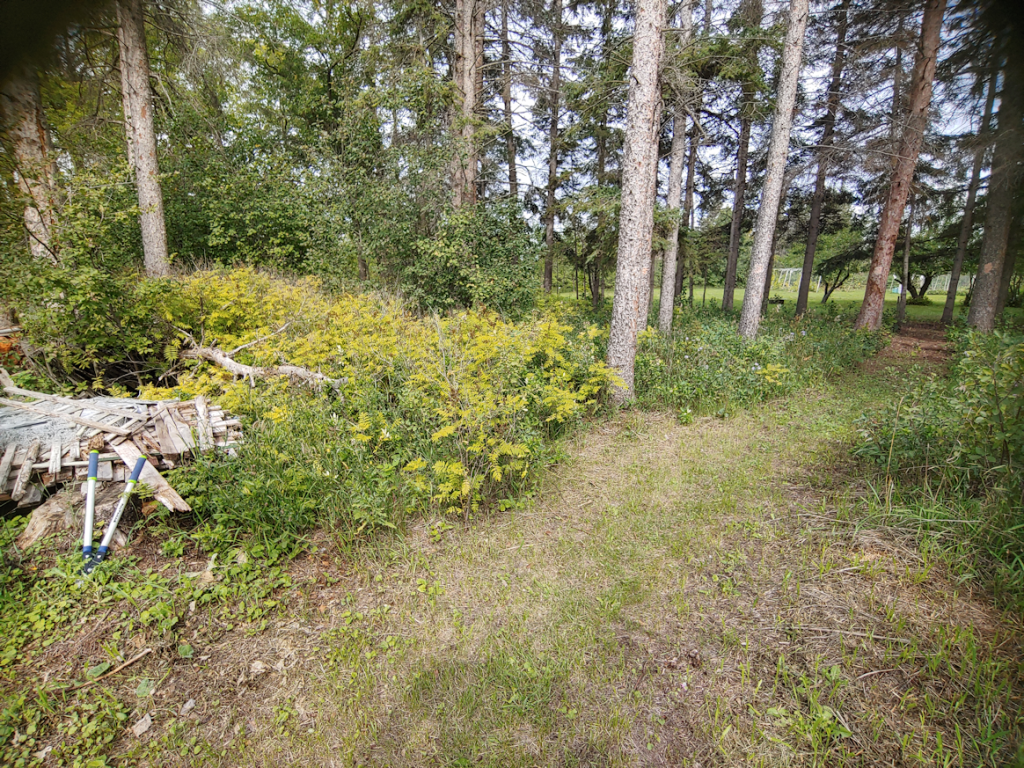
Today, I decided to do a bit more cleanup around the junk pile, so I could access some dead trees that need to be taken down.
Here is how it looked before I started.
We have our ongoing battle with the spirea that’s choking everything out, so I wanted to pull them up by the roots as much as possible.
Some of them had roots so long, they started going under things. I pushed them aside after a certain point, so I could focus on clearing around three specific dead trees.
The thistles were much more of a problem. The thorns go right through my work gloves!
I did leave on thing behind, besides some wildflowers.
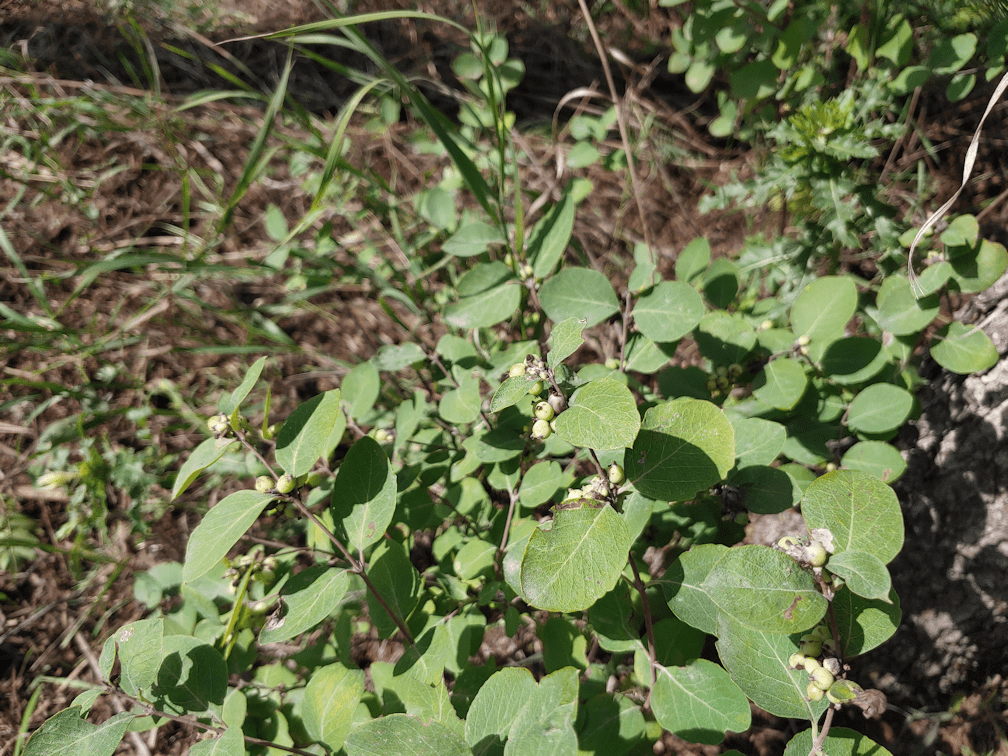
There was a little Saskatoon bush, at the base of one of the trees, and it’s actually trying to produce berries! Weather willing, the berries you see will turn a deep, dark purple, and look a bit like blueberries.
Once the area was cleared of tripping hazards, I started taking down the first tree, using a bucksaw. Because of where these trees are, I tried to do it in such a way that it would fall in a space between some other spruces. I didn’t want it falling towards the open yard, because then it might land on the beet bed or compost pile, or some Saskatoon bushes and an elm tree we want to keep.
It almost worked.
It fell too far to the south, and got hung up on another dead tree, that’s right nest to a still live one.
I was able to wrap some rope around the trunk and get it off the stump, but it would not come loose from the dead tree it was entangled in.
So I moved on to the next tree. This time, it actually fell into the gap I wanted it to fall into.
It still got hung up! I had hoped these trees would be heavy enough that the dead branches would break and let them fall to the ground, but apparently, they are still quite strong.
On the plus side, I was very pleased with what I saw after cutting them down.
The wood is nice and solid, with no sign of rot or ant damage. This is very encouraging, because I want to use the logs. These nice, solid stumps will later be used to make seats and tables.
Here is how it looked when I stopped for the day. I did try to use the rope and our van to try and get that first tree loose from the dead tree it’s hooked up on, but the rope kept breaking. We don’t have any stronger rope. If we’re going to need to use the van anyhow, I will pick up some sturdy rope and hook it up to near the base of the trunks, and pull the entire trees out into the yard, where we will break them down.
Since the wood is in such good shape, these will be used to make the high raised beds we will be building in the main garden area, where we currently have the low raised beds we’d planted spinach, onions and carrots in. I’m thinking of cutting the logs into 10 ft and 4 ft lengths, and I figure it will take about 4 logs to get the accessible height we are after, though of course, that will depend on how big the individual trees are. We don’t have a lot of time left, if we want to get these ready for next year. I’m hoping to get at least a couple built for next year. By using whole logs like this, we won’t have any concerns about the sides bowing out under the weight of the layers of wood, compostable materials and soil they will be filled with.
Once these dead trees closer to the edge of the spruce grove are down, we’ll be able to feel the other ones towards the yard, and there will be no other trees for them to get hung up on!
Once all the dead trees in this corner are down, and the area is cleaned up, we will be able to convert the trunks into seating and surfaces. Then we can start planting food trees that need a protected microclimate. I will be testing the soil, and if the acidity from all those decades of spruce needles is high enough, I hope to be able to plant blueberries. We do still want to grow a mulberry tree, since the one we got this spring got killed off by that one cold night in May, and it was in here that we originally intended to plant it. I think, this time, we will try and get a Canadian variety we found out about, that is increasingly endangered. We will still need the microclimate for it, but if we can help keep a variety at risk going, that’s what we prefer to do, if we can.
There are a lot more dead trees further to the east and around to the south, inside the spruce grove. Some will also have their trunks converted to seating, but as we go further into the grove, I want to start transplanting more spruces into the spruce grove! :-)
While we are getting rid of the spirea, we will be leaving the wild roses and red bark dogwood as underbrush. I will probably take out most of the chokecherries I’m finding in here, as there are so many, to make room for the Saskatoons to spread. We will also be transplanting new spruces in here, though more strategically. Lots to do, but I am really looking forward to when we have a lovely little sanctuary in here, where we can sit and enjoy the outdoors, somewhat protected from the elements by the trees. :-)
For now, however, I’m going to get some tweezers, and get that thistle thorn that got through my gloves!
Okay, so the area in front of the outhouse is now safe to walk on.
What about the inside?
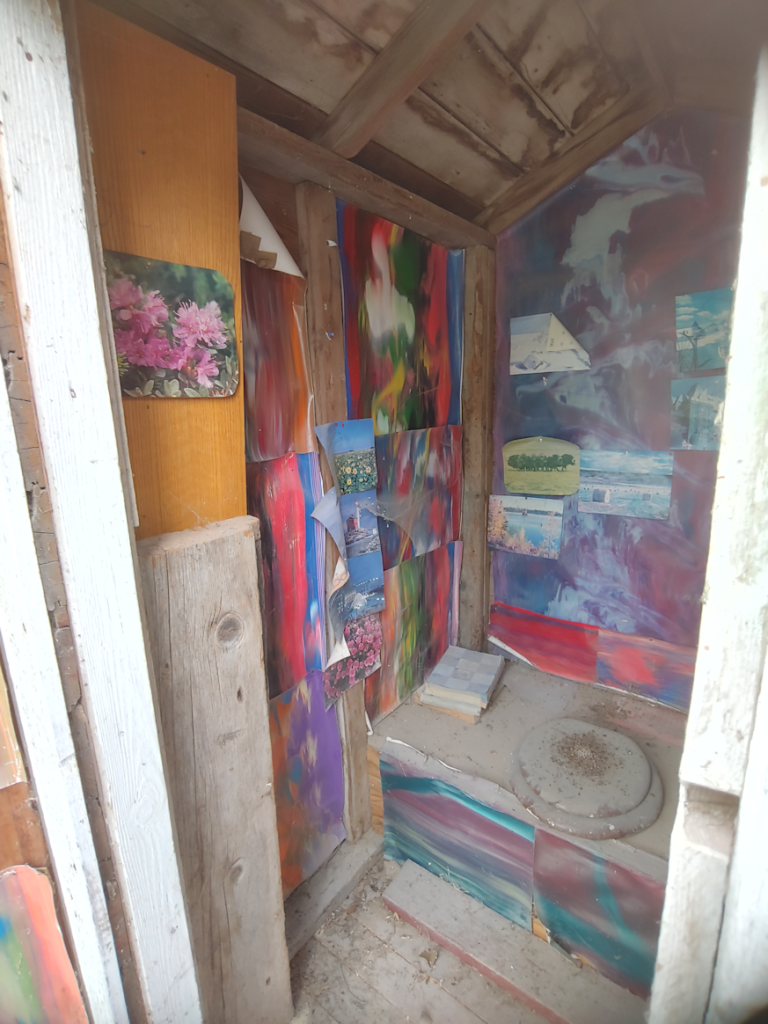
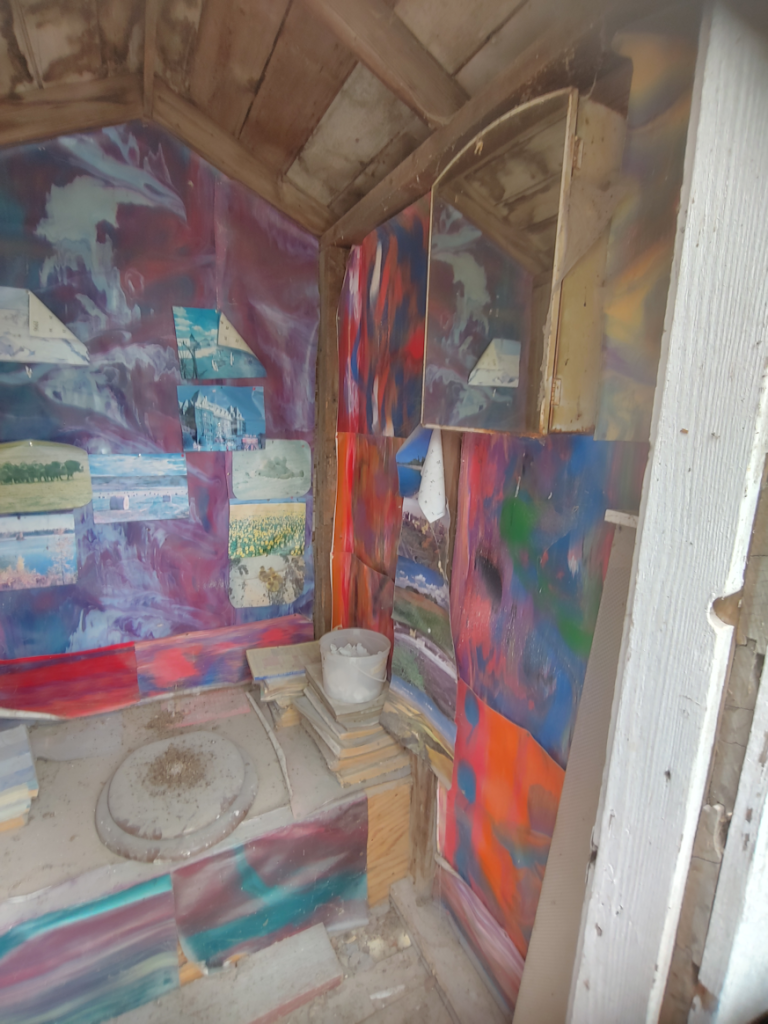
The very… colourful… inside.
I’d asked my mother about all the paper in there. She told me she put them there to make it pretty.
…
I… just don’t know what to say about that.
Like pretty much everything else around here, the outhouse was being used for storage.
The first thing I had to do, though, was check out the floor. Much to my surprise, it’s solid. I still plan to reinforce it, but there is nothing wrong with the floor boards.
Other than being really, really disgusting.
And that toilet seat…
*shudder*
This outhouse has actually been used a couple of times since we’ve moved here. Once or twice by my brother, who insisted on using it rather than going inside. Once by a poor guy who came out to service our internet that suddenly needed to go to the bathroom, but my daughter had just gone into the shower. He couldn’t wait for the bathroom to be available, and was actually willing to use this outhouse.
I still feel so bad about that. The poor guy!
The first order of business was to take everything out that was leaning in the corners.
Which included a folding closet door (minus one hinge), a length of copper pipe, a fluorescent light fixture, which I think still have bulbs in it, and several pieces of wood.
I might be able to use the bigger ones to reinforce the floor.
Oh, and more of that colourful paper that is all over the walls.
Then it was time to move the toilet paper.
Yes. I’m serious. That’s the toilet paper.
Well, not the rolled up paper with the tape on it. That was with the stuff stored in the corners.
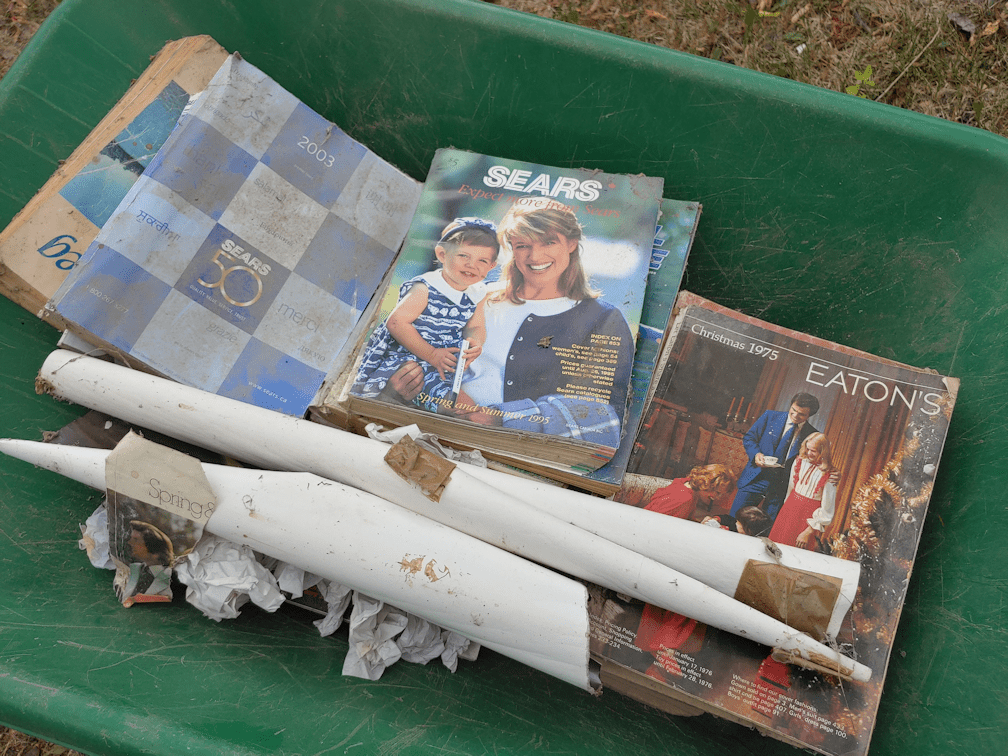
When I was a kid, before we had an indoor bathroom, we used old catalogs, fliers, phone books, etc. as toilet paper. I didn’t think it was strange, since I knew nothing else. We didn’t buy toilet paper until we got an indoor bathroom, because this stuff couldn’t be flushed down the toilet.
While clearing things out, I emptied the medicine cabinet on the wall, too.
A 30 year old calendar page isn’t quite so strange when compared to a 46 year old Eaton’s Christmas catalog.
After moving the catalogs and whatnot away, I found this in the corner.
A pile of pine cones!
Also, my mother even covered the top of the toilet seat box with colourful paper!
When I saw the pine cones, my first through was that squirrels had got in and were starting to make a winter stash. Which was a surprise, since this outhouse is actually pretty animal proof. I don’t know where squirrels would have got in.
There was something I missed, however.
Do you see that tiny little something in the corner, a different colour from the pine cones?
When I started sweeping the cones away, I found this.
A mermaid!
I now think that perhaps my late brother’s kids may have played in here and left the pile of cones and mermaid behind, forgotten. If true, then this may have been here for more than 10 years. Probably quite a bit more! However it got here, when we are done with cleaning up and setting up the outhouse, this is going to get a place of honour for display! :-D More “found object” art… ;-)
Once everything was cleared out, it was time to take all the paper off the walls.
At that point, I was starting to really wish I could wear a mask. I tried to be careful not to kick up much dust, but there was no way to completely avoid it.
The outhouse might have been critter proof, but it was not moth proof! As I pulled sheets of paper off, I kept finding moths hiding behind them. Dozens of them.
They did not appreciate being woken up!
Moths were not the only surprise I found behind the paper.
I suspect this was the first attempt at “beautifying” the outhouse. This was right in the middle of the back wall, and would have been the first thing a person saw on opening the door. Then it got covered over with the colourful paper.
I … don’t know what to say. :-D
Yay!! It’s all done! All the paper is gone!
I was going to say, it already looks a lot better, but… no. It still looks disgusting.
Time to break out the big guns.
It’s power washing time!
I hosed down the entire inside, trying to get into every crevice. Which is not easy to do when trying to get the front, on either side of the doorway, while standing outside.
I sure as heck wasn’t going to be hosing it down while standing inside!!
That part took a while.
Okay, NOW I can say, it looks a lot better!
Also, that toilet seat is actually white. It’s been painted brown.
I… don’t know what to say.
Now that it’s have it’s initial cleaning done, I’m actually impressed with how sound this is. Ideally, we would jack it up higher and put it on blocks, rather than leave it on the beams that it’s on, but this is not meant to stay.
The next thing that needs to be done is to scrub the inside. That will be the time to get rid of all the bits of paper and packing tape stuck to the tacks and staples used to tack them to the walls. I forgot to hose down the inside of the medicine cabinet, but that’s okay. We will likely take that down for a while.
While the whole thing needs a paint job, the plan is to use a highly durable paint on the inside, that can handle scrubbing.
In a LIGHT colour! My daughter was suggesting a robin’s egg blue, but I’d be happy with anything that makes it brighter in there. Also, a new toilet seat. There’s nothing “wrong” with this one, except… ew.
I checked the pit, of course. It does need to be emptied. It’s also completely composted and level – being flooded out with melted snow for years did have a plus side. The cat litter compost is behind the outhouse, so it can be added to that. There are those that recommend using human waste as garden compost, but that is something we will never do. Who knows what medications a person might have been on when they left their “deposits”. While it is not urgent to empty the pit, it is definitely something I want to do before anyone actually uses it again.
Oh, we also have to do a bit of work on the door. It needs new hingles, as the current ones are sagging. It would probably be a good idea to calk around some areas, so no more moths will get in. Particularly around the screen covered opening at the top. I actually saw a moth squeezing through the wood around there!
The biggest job that needs to be done is the roof. The shingles have moss growing on them. Given the small size of the roof, however, I think we have options to modify. There are some scrap pieces of plywood in the barn that should be big enough. After removing the old shingles, I am thinking of adding some plywood that is longer than the current roof size, to make an overhang above the door. We also have lots of leftover pieces of metal roofing material that can be cut to size and used instead of using shingles.
The final touch I’d like to add is a solar powered light. I’ve been eyeballing some solar powered hanging light fixtures, thinking of the cordwood building we plan to make, and that can be used here just as well. That would be a huge improvement over using candles or flashlights, like we did when I was a child! :-D
If we do this right, this outhouse should not only last for years, but actually be pleasant to use.


















 The Re-Farmer