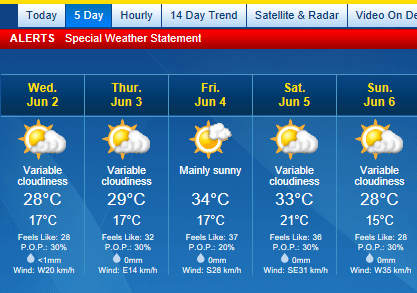
Today, I finally started painting the kibble house. The temperatures were pretty warm. It is “only” 22C/70F as I write this, but after today, we’re supposed to get hit with another heat wave over the next week, peaking at 34C/93F, so I’m glad to get it started today. And glad we aren’t expected to see the 40-45C/104-113F temperatures that some provinces are getting hit with right now!
Under the tent, it was much more pleasant. If fact, I could forget the heat, until I stepped out into the sun for a few moments!
The first coat, I’m happy to say, is done.
Mostly.
We won’t be able to do the rest until the paint has cured enough to flip it, and the floor pieces, upside down.
The roof may or may not get a second coat. We will likely shingle it, but until we do, the paint will be enough to protect it from the elements for now.
Even with just one coat, it’s looking so much better already. My daughter chose a lovely colour. :-) This is REALLY going to brighten up the yard!
If we end up not putting on shingles, I’m thinking we should paint garish designs all over the roof. :-D
I tried to get the more reachable parts underneath, but not under the overlap of the roof itself. And not just because I didn’t want to disturb this beauty!
What a gorgeous moth!
As far as I know, it’s still there, too. :-)
I’m not sure if we’ll bother painting the underside of the roof. Maybe just around the overlap, if at all. I do want to get the inside walls, though. That will make it easier to clean up after dirty kitties! The gaps under the roof are there partly so the cats and get in and out through them, if needed. They did use those gaps over the winter, which meant muddy paw prints, all the way up the walls. :-D
Today was set to be a scorcher, so when I did my morning rounds, I took the time to water all the garden beds before things got too hot, even though they got a thorough watering last night.
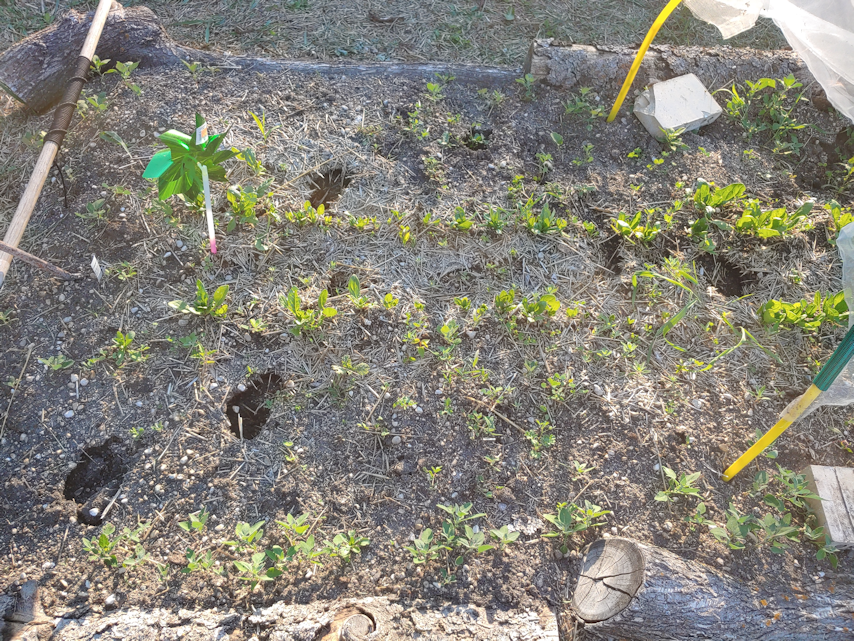
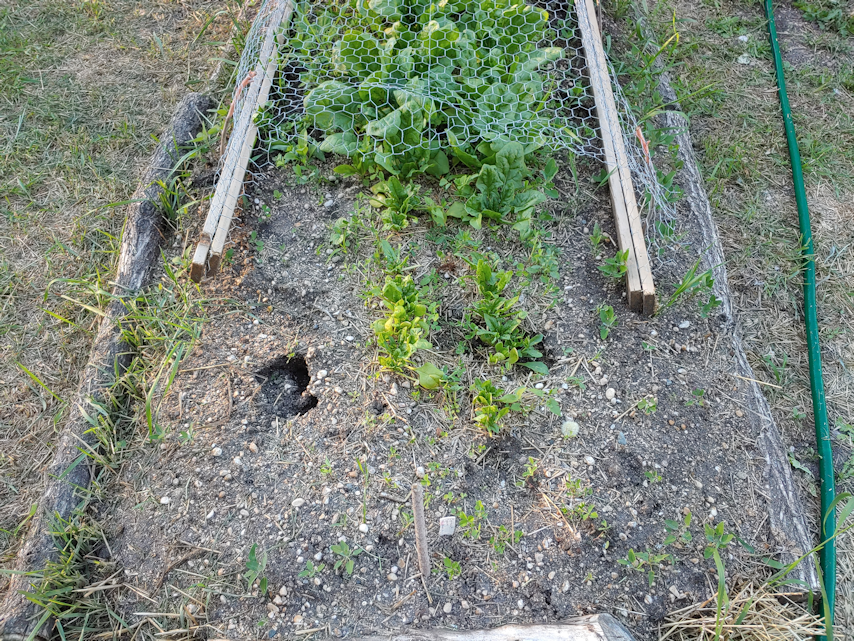
When I got to the spinach beds, I saw evidence of skulduggery!
The sacrificial spinach, at the ends of a couple of rows, were duly sacrificed.
I moved that pinwheel over from one of the beds with the wire mesh covers, after the fact. Not that they seem to be accomplishing much, anymore!
No surprise, when I finally went inside and checked the trail cams, that a deer was captured, wandering through the corn beds, on the way out of the yard. Considering that the deer did not even pause to nibble on anything, I’d say the sacrificial spinach did its job! ;-)
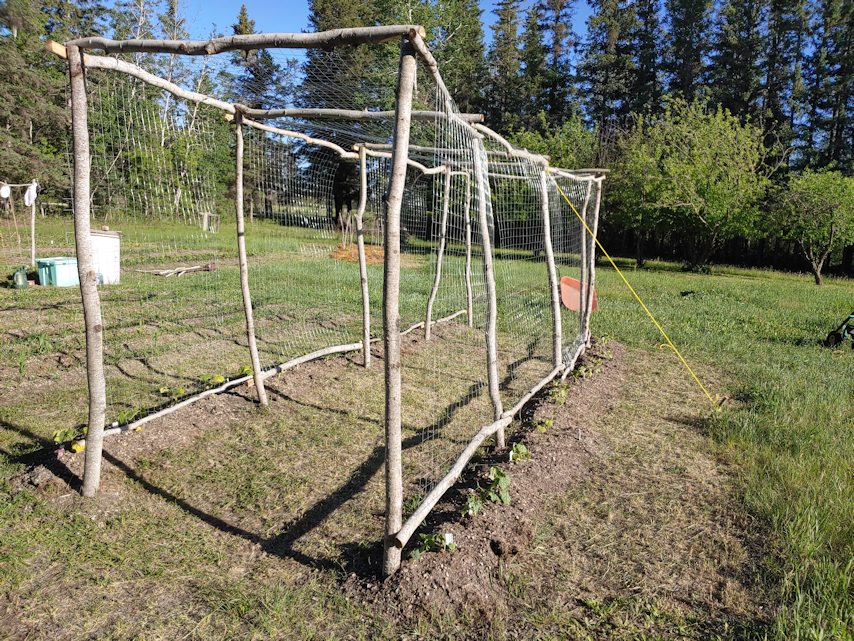
Late this afternoon, when things were supposedly getting cooler again, the girls and I finished the squash tunnel.
Almost.
We got the cross pieces put in place, then brought over the wire mesh for the vines to climb.
The roll of wire mesh I got was 50 feet long, and that was enough to cover 3 of 4 sections. At only 4 feet wide, there are gaps at each post, but we can weave twine between the sections of wire mesh, if it’s necessary.
My original thought was to use U nails (also called staples) to attach the mesh, but we ended up only needing to attach it to the bottom cross pieces. With one, we used wire saved from a previous roll of wire mesh that had been wrapped around it to keep it from unrolling. In cutting the first length, the second length had one end with the wire ends sticking out, and we were able wrap the end around the cross piece, then just twist the wire ends around to hold it in place. Other sections were tied in place with twine.
We just need to buy another roll of this mesh, and we can finish the last section. The main thing is that the end where the luffa is growing, now has something for them to climb.
The girls also noted that one post seemed to need support, so they added the rope and peg to hold it in place.
It’s a good thing this is meant to be temporary! :-D
By the time we were done, we were totally baked and headed inside to cool down for a while. We were at “only” 25C/77F with a humidex of 28C/82F but we were also in full sun, and there was no breeze. At least we could pop into the shade of the nearby lilac hedge, every now and then.
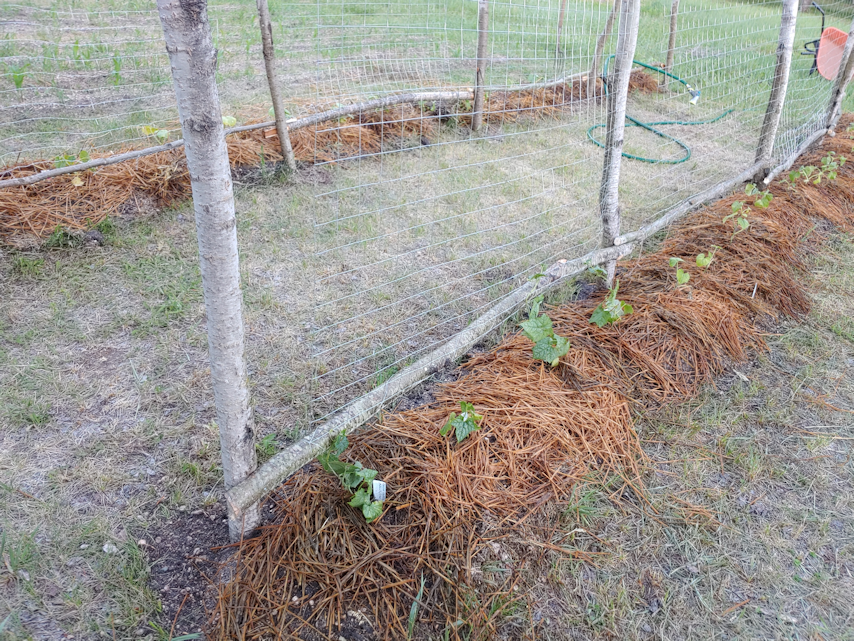
While I was doing the evening watering, the girls brought over the last of the straw and mulched around the squash tunnel. You can see in the photo that some of the luffa was grown long enough to reach the mesh, already. Hopefully, they will soon be making their way up the side on their own.
This whole thing really is rather slipshod and wonky. I look forward to when we have our permanent raised garden beds, and can build something more solid, elsewhere. But this will do for a year, maybe even two, depending on how our plans to plant trees in this area progress. Well, Not where this tunnel is, I don’t think. There are telephone lines buried somewhere under here.
Anyhow.
I’m glad we finally got this done. At least as done as possible until we get more mesh for that last section. The forecast has changed again. Tomorrow, instead of thunderstorms, we’re expected to hit 31C/88F and maybe get some showers at some point. While I was doing the watering this evening, I used the water to make doing some hand weeding easier, and I could not believe how dry the soil was. I’d hate to think how dry it would have been if I’d decided it was damp enough this morning, and skipped the watering! The added mulch at these squash, gourds and melons will help keep their moisture better, at least. I look forward to having more mulch to add to the other beds as well.
Meanwhile, I hope we have some happy little squash, gourds and melons!
Today has been another day of rain and high winds.
After today, we’re going to be back to high temperatures and sun. My Weather Network is forecasting 37C/99F on Wednesday! I think that must be some kind of typo, because I’m not seeing that anywhere else. The highest I’m finding is on my phone’s app, which is forecasting 27C/81F on the same day. Even so, it’s going to get hot again, and I am really, really glad we’re getting this rain right now!
In between rainfalls, we managed a trip into town, and I even got a bit of weeding done in the garden. We’re going to need to do a LOT of weeding once this rain passes. The weeds are loving the rain as much as the things we actually planted.
Speaking of which, while weeding among the corn earlier, I did find some radish sprouts. They are recent sprouts, not the ones that came up before the corn did, then disappeared. So we will have at least a couple of radishes. Unless these sprouts disappear, too!
Gosh, I’m just watching the trees outside my window as I write this. If a section of that big maple came down right now, it wouldn’t surprise me at all!
With this weather, our internet is seriously cutting out. It’s taken me more than an hour just to be able to start this post, and I still can’t get images to load. So this will be a quick one!
I wanted to share some of the new things we’re trying this year. The chives are blooming, and we decided to try making chive blossom vinegar.
I got a small bottle of white wine vinegar, and we’re simply putting clean, dry chive blossoms into it (after removing a bit of vinegar to make space. Some of the blossoms are left whole, while others had the bit at the bottom taken off, so all the individual flowerettes are loose. We’ve been adding to the bottle as more blossoms open up, then we’ll let it sit for a couple of weeks, in a cool, dark place, giving it a few turns every now and then. After that, the vinegar will be strained and re-bottled. I’m looking forward to seeing how this turns out!
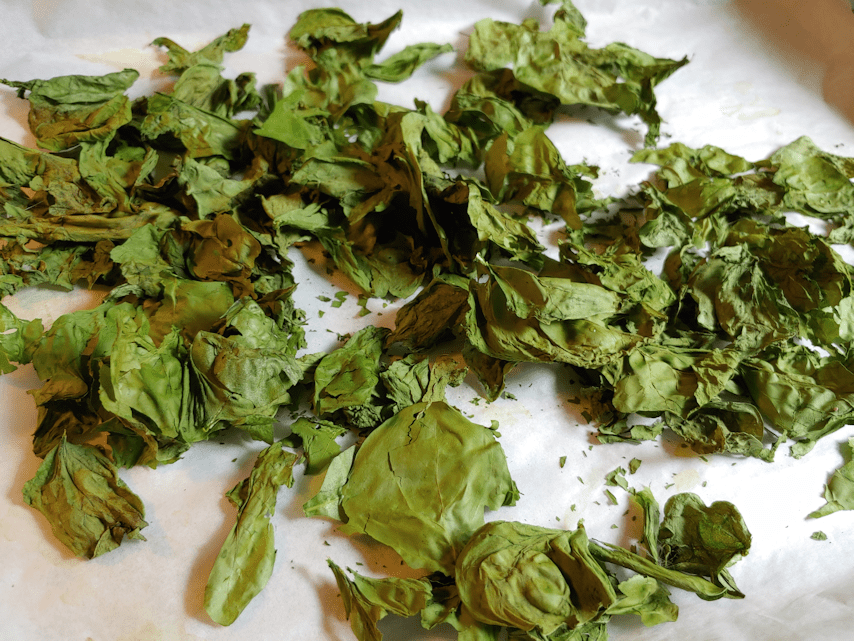
I’ve also started to dehydrate spinach leaves.
I use our oven to dehydrate things, using the “warm” setting, reduced to it’s lowest temperature of 145F (default is 170F). For something as light and thin as spinach leaves, I shut it off and let the oven light on to stay warm. We can only fit two trays in the oven at a time, but after I went to turn the leaves and found they’d shrunk enough, I combined them into one pan and left it for the night. In the morning, I just crushed them lightly, and put them in an air tight canister. There’s maybe 1/3rd of a cup of dried, crushed leaves from the 2 trays. We’ll keep doing small batches like this and, eventually, we’ll reduce them to a powder instead of flakes. It kind of reminds me of dehydrating celery. You start off with what looks like so much, but by the time it’s completely dehydrated, it looks like there’s nothing there! :-D
Now it’s time to see if I have enough connection to publish this!
We managed to get outside for a bit more progress on the garden. One of the things I did was go through where we planted sunflowers last year, and dig out any remaining stumps. I am really impressed with how much softer the soil is. Well. When I managed to not hit any rocks, at least. ;-) I think using this area for the summer squash will work out. We just have to fight back the grass and weeds. :-/
Not yet, though. The new corn block will be the priority for transplanting.
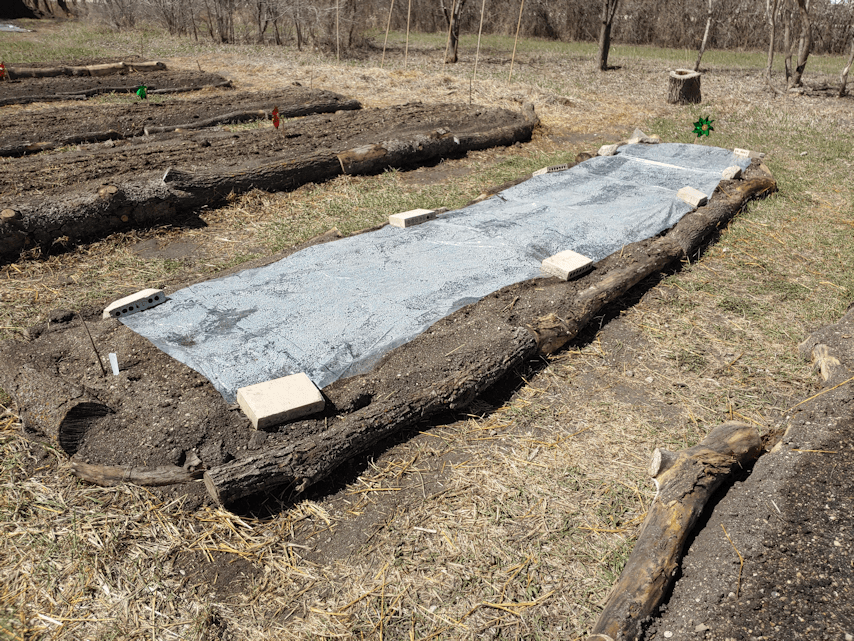
This area has been covered with black tarp for at least 2 months. Almost, but not quite, enough to kill off the grass and weeds.
This area is remarkably rough, though. I had the hardest time mowing on this side, without hitting rocks or lumps of dirt. Partly because of this, I will be going things differently. I will actually be turning the soil here. Nothing extreme. Mostly just loosening it with a garden fork, while pulling out the larger roots and rocks. Once it’s loosened up, I plan to go over it with a thatching rake (we only have 1 thatching rate, and a bunch of fan rakes, so that’s the tool I’ll use! :-D ). That should pull up more roots, but mostly I want to level it off enough that I’m not tripping over dirt clumps every time I walk through!
I had gotten a start on loosening the soil at one end, when one of my daughters was able to join me. Together, we got to work on the squash tunnel.
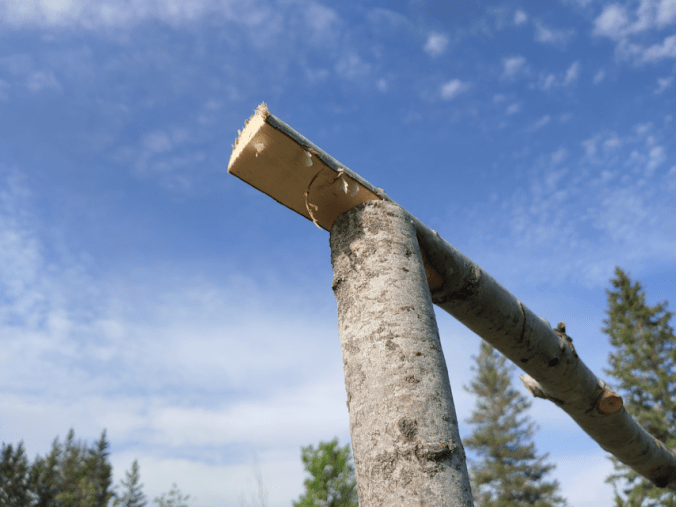
We were able to get all the side cross pieces in place at the tops. A job that was much more difficult than it looks!
I may have mentioned this before, but… we’re a bit on the short side.
Oy, did that make a difference!
My daughter held the cross pieces in place while I climbed the ladder to drill the pilot holes, then put in the screws. It was very awkward and painful for her – especially with her gimpy shoulder! – to try and hold the pieces steady until I had the screws in far enough that she could relax. Some of the uprights had shifted, too, so not only was she holding a cross piece in place, above her head, but sometimes holding an upright in place as well. The fact that everything was different sizes and shapes didn’t help, either. Doing this in 27C/81F heat, and winds high enough to blow over the step ladder, certainly didn’t make things any easier.
Also, we really need a power screwdriver. Driving in 3 inch screws manually, while someone else was struggling to hold the pieces together, was another thing that made the job more difficult than expected!
But we got it done!
It is still incredibly wonky, of course. Good thing it’s not intended to be permanent! We also didn’t use as many screws as I intended. For some joins, it was because the pieces were not of a size or shape to add more than one screw. With others, we just needed to get it in place and move on to the next, due to how painful or awkward it was for my daughter to support the cross pieces.
I now need to cut cross pieces for the bottoms. When I put those in, I will take the time to add extra screws were they are needed at the top. If necessary, I’ll add extra support pieces at the corners, but I think once we add the wire mesh for the vines to climb, that will help stabilize it a bit more, too. I’m actually not sure how we will get the mesh over the top.
Did I mention we’re short? LOL
At least it’ll be easier to put in the bottom cross pieces.
When we did as much as we could, I was ordered by my daughter to head indoors and out of the sun. Apparently, I was looking rather overheated!
So I am taking a bit of a break in the cool of the house. By the time I get outside again, more of the corn block I want to work on will be in shade, so that will help. I’m hoping to be able to get the corn transplants out by the end of tomorrow. We’ll see how it goes. I’ll be helping my mother with her grocery shopping earlier than usual, so that should work out.
Well, I’d hoped we could actually finish the squash tunnel today, or at least get the side cross pieces at the top done, but we didn’t get quite that far.
But, progress was still made.
Most importantly, we got the supports up in the post holes.
In refilling the post holes and tamping the soil down, a few of them did need to have more soil added. A good way to reduce some of the lumps in the old garden, left from when it was last plowed before we moved here.
It’s very… rustic looking. That’s a trend now, right? :-D
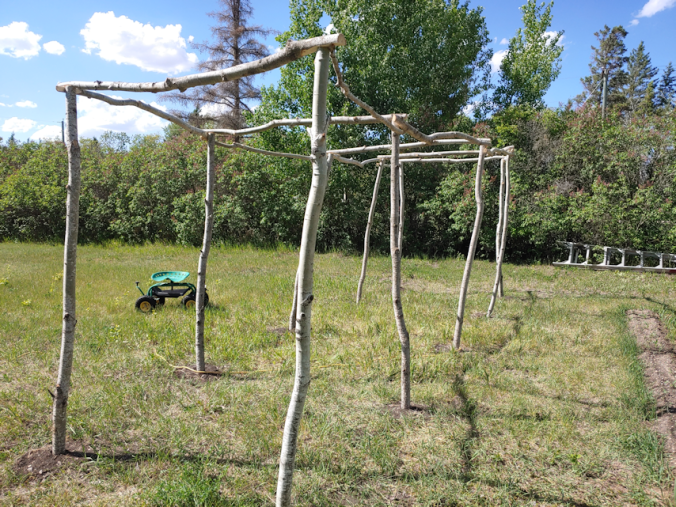
And no, that middle pole isn’t actually tilted. The tree it’s made from is bent. All the pieces are wonky in shape! :-D
It’s also still very flimsy right now. Joining them at the sides with cross pieces should fix that.
It was already starting to get hot by the time this was done, so we took advantage of the morning shade to transplant the Mongolian Giant sunflowers. It wasn’t until evening that I was able to work on the next step for the squash tunnel. I cut a total of 8 of the 16 cross pieces needed at 5’6″, then trimmed matching flat pieces at each end.
I also trimmed one side of the flattened ends a bit; just enough to have a narrow flat surface on what will be the top.
The flat parts are intended to butt up against the upright and the top cross piece. It will wait until tomorrow, but the plan is to screw the cross pieces to the upright, then add one more screw through the top cross piece, down into the side piece – and hopefully not hit another screw in the process. This should give it some more stability. The other 8 cross pieces will be attached a few inches from the bottoms, which should strengthen it even more, as well as provide a place to attach mesh for the vines to climb.
There are a couple of problems we need to figure out how to get around, to finish the job. We do have a cordless drill, but both batteries no longer hold a charge, and the company doesn’t make them anymore. Until we get around to buying a new one, we have several corded drills to choose from. Getting extension cords to reach this far, though… that’s going to take a bit! We have a pair of 100′ extension cords, which won’t reach reach from the outdoor outlet on the side of the house. I remember how far I could reach while using the electric weed trimmer, and three extension cords. We’ve since gotten more cords, so I think we’ll have enough to reach around the structure.
The next challenge is, we’re short. Well, except my husband, and he’s broken. ;-) To be able to drill a pilot hole through the stop cross piece will require clambering up and down a step ladder. For our gimpy household, that is somewhat risky!
But, it’ll need to be done. With this structure, we can’t get away with tying the cross pieces on with twine, like with the pea trellises.
With 5 uprights and 4 cross pieces per side, only two cross pieces can be placed up against the overhangs at the top, so each side will have two cross pieces mounted just under the other two. Which will hopefully also contribute to the stability. If that’s not enough, we’d have to add supports on the inside of the corners, and I really don’t want to get that finicky with a temporary structure.
We may not have finished the squash tunnel, but we accomplish other things, but that is for my next post! :-)
Not that long ago, we were dealing with freezing temperatures. Now we’ve got a heat wave!
Today’s high was predicted to be 24C/77F. Instead, we reached 28C/82F. Tomorrow’s high is supposed to be 28C… does that mean we’ll be going to break 30C/86F? :-(
Hot as it was, we needed to get started on the squash tunnel. Thankfully, we could at least work in mostly shade.
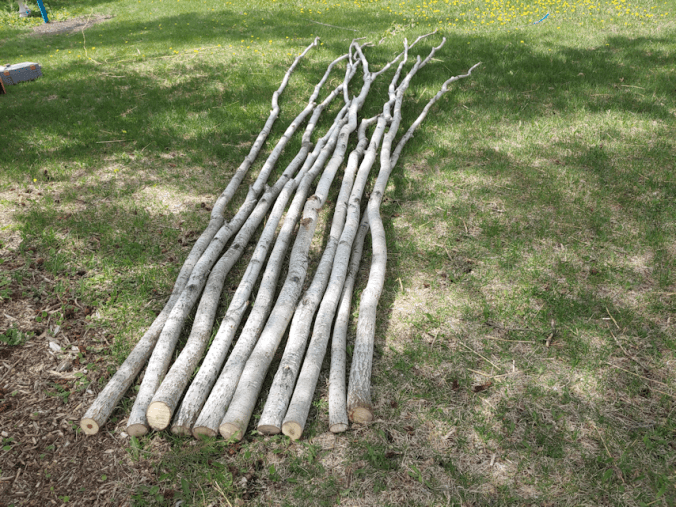
The first thing to do was go through our pile of poplar we’ve cleared out of the spruce grove, and pick the strongest, straightest ones. Straight for the first 7 feet, at least!
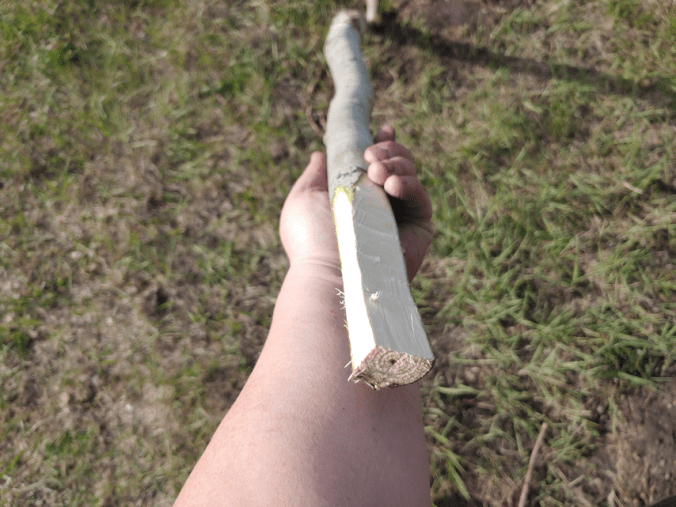
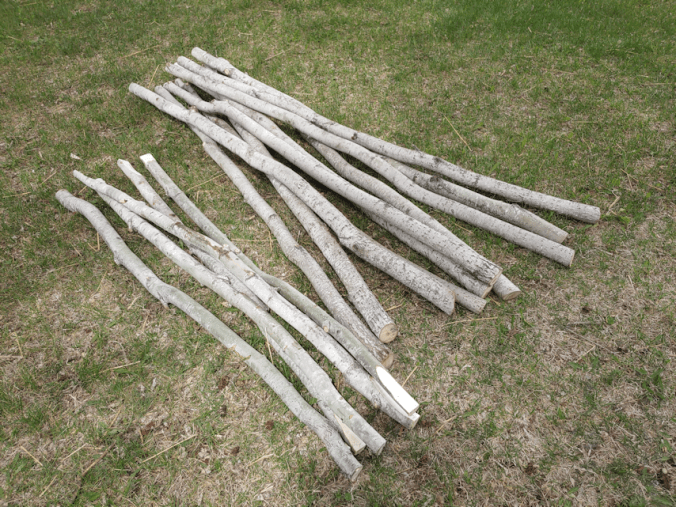
The upright supports were cut to 7 feet, but there was still enough from each of them to cut cross pieces at 5 1/2 feet. Of those, the strongest ones were selected, and at least 3 inches was trimmed from each end to have a narrower, flattish part to attach to the uprights.
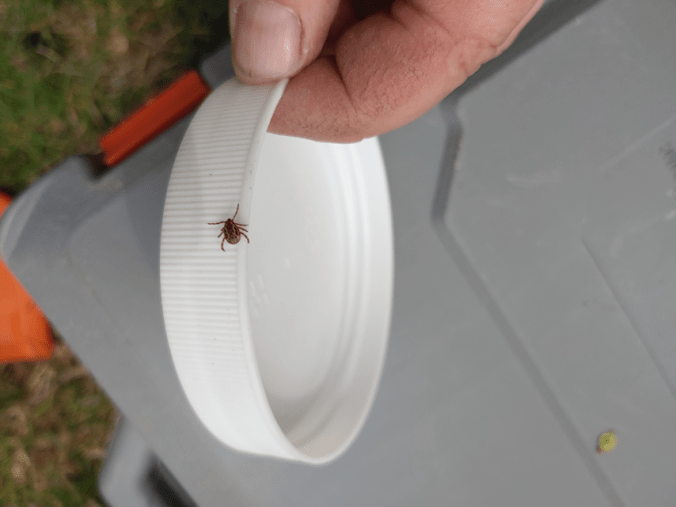
While preparing to screw the pieces together, I found our first wood tick of the season! We ended up finding a couple more, later on.
Time to dig out the bug spray to go with the sun screen… :-(
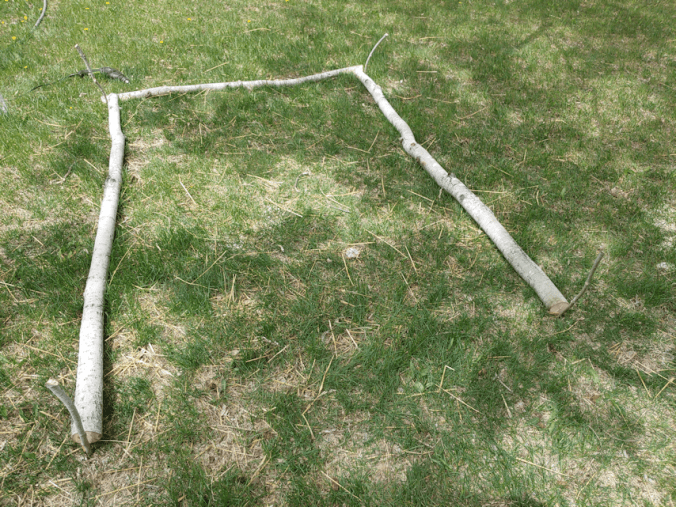
The uprights need to be 5 feet apart, and the cross pieces were to be attached to their tops. I measured out and shoved some sticks into the ground as guides. The bottoms of the uprights would be centered at the pegs at their based, while the tops would be placed with the two sticks at the top on the outsides, to have them lying parallel at 5 feet. The cross piece could then be laid out and the flat sides lined up to the tops. Pilot holes were then drilled and they were screwed in place.
Which sounds a lot easier than it actually was. A few cross pieces needed extra trimming to rest against tops of the uprights. Sometimes, the uprights needed to be turned until they all fit together as flush as possible. Still, it got done.
There they are! Five sets up upright supports for the squash tunnel! They just needed to be dragged out to where the squash tunnel will be set up.
At this point, they are very rickety. Unfortunately, with some of the screws pulled right out of the wood, so we had to redo them with longer screws. Which, thankfully, we had!
By this point, we’d reached that 28C/82F, so once we finished with these, we packed everything away and went indoors to get out of the heat for a few hours. The next stage was to dig the post holes, and there wasn’t any shade to be had, so we waited.
When I finally did head out, I first took the time to water the garden beds and blocks from the rain barrel by the peas. I was able to use the watering can to water everything but the Dorinny corn before the barrel was too low for me to refill the watering can anymore.
While I was watering, I found a friend.
Such a cute little frog!!
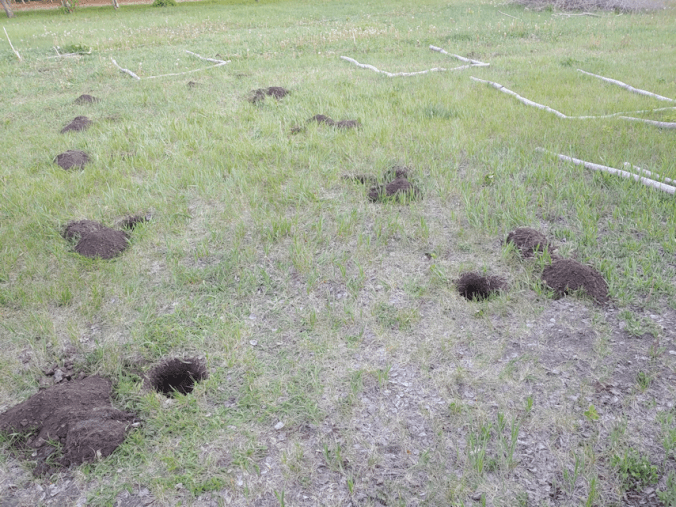
Then it was time to start the post holes. Each spot was marked with a flag, so I started by using the space to stab out a circle around each flag, then moving it so I could remove the sod. Once the sod was out, I went in with a hand trowel to take out the bigger rocks, then used a lopper to take out the many roots I found.
I had company.
I love how Rolando Moon will just hang out while we’re working outside. She doesn’t want us to pay attention to her. She just wants to be close by. She even settled down for a nap!
Finally, I brought over the post hole digger and got to work. It’s pretty much a one person job, so the girls took care of the evening watering, refilled the rain barrel by the peas, and watered the last corn block. Once the barrel was full, I decided to set up the sprinkler over the corn and sunflower blocks, to make sure the seeds got the moisture they need to germinate. Going over them with the watering can may or may not have been enough, so I wanted to make sure they got a thorough soaking while I continued digging post holes.
All done! Ten post holes, all 5 feet apart.
That was it for today!!
Getting those supports in will be a three person job. Particularly since they are still so wonky. Two people will be needed to place the supports into the holes, while the third person will back fill the holes. They will still be rather fragile until the cross pieces are added to the sides. We weren’t able to pick up a cordless drill on this month’s budget, so we’re going to have to string together a whole bunch of extension cords to drill the pilot holes! The cross pieces at the top should have enough extra length that we can put a screw through them, into the side cross pieces, too. We’re all short, though, so we’ll need a step ladder to do that!
I want to add cross pieces near the bottoms of each side, too. We’ll need a total of 16 pieces to do tops and bottoms of both sides, and then we can put either wire mesh or netting for the vines to climb up and over the tunnel. Then, we can start making the beds themselves, to transplant the winter squash, gourds and melons into. These will be on the outside of the tunnel supports only, keeping the tunnel nice and wide on the inside. If all grows well, it should create a nice shaded space that we can put chairs in, to rest and enjoy while tending the garden. :-)
Next on the list are the beds for the summer squash, and the block for the Montana Morado corn. They’re getting quite big in their cups, and hardening off nicely. I hope they handle being transplanted okay! I do with the toilet paper tubes had worked out. That would have been much better and less disruptive to the roots. Well, we’ll know for next time: pre-soak the growing medium before putting it into the tubes!
The next week or so is going to be very, very busy!
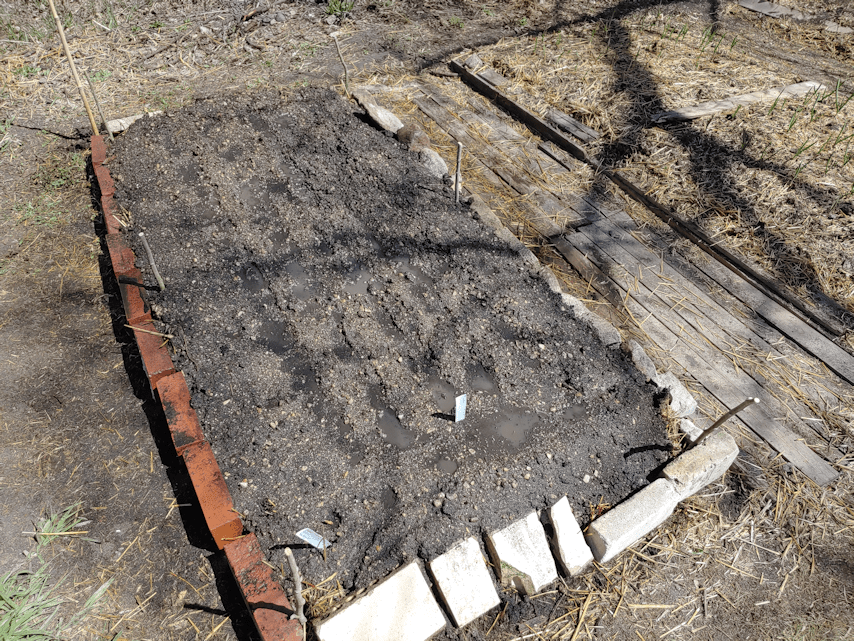
This morning, I wanted to get that half-bed planted with carrots. I was happy to discover that the Kyoto Red carrots I’d ordered were pelleted seeds (I’m sure I knew that when I’d ordered them, but completely forgot!), so they could go in right away. Before I did, though, I cooked up some cornstarch gel, and set the other two varieties of carrot seeds to soak. Last year, we used the technique described in the video below to plant carrot seeds, and it worked very well, so I wanted to do it again.
Those will wait until tomorrow, though. For now, the carrot bed in the old garden area is fully planted, and I covered them with plastic after watering them.
They’ll be checked often, and as soon as green can be seen, the plastic comes off.
The next job was the new garden bed beside the garlic.
Before topping it with fresh garden soil, I found what I could to shore up the sides, so things wouldn’t erode. This is a pretty small bed, so it only took two loads of soil to cover it.
Then began my experiment.
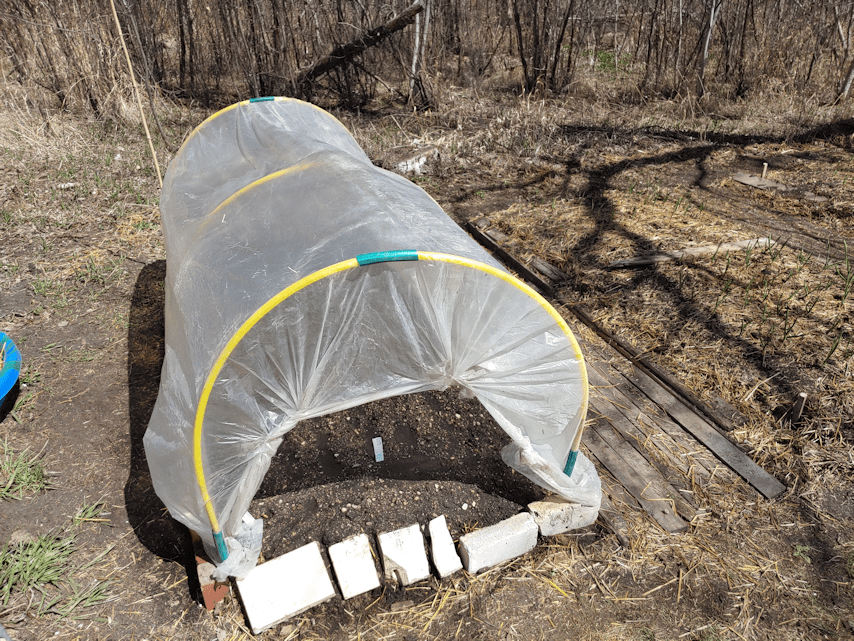
After planting the middle with Merlin beets, then surrounding it with the last of the yellow onion sets, I cut small lengths of poplar that were fairly thin. I’d opened up the three dollar store hula hoops I’d bought and removed the bits of what looks like decorative rocks that were inside, to make a rattling noise. The sticks were of a size to fit snugly into the openings of the plastic. I also cut lengths of old garden hose and split them lengthwise and grabbed some plastic that was used to cover one of the garlic beds over the winter.
I suppose I could have cut the plastic tubes from the hula hoops shorter, but I really didn’t want to fuss with it. I was able to fit the ends over the sticks and push them down quite far, even though some of the sticks were nubbly from twigs I’d cut off.
I used the pieces of hose to hold the plastic sheet to the hula hoops. Then I used packing tape to gather up the loose pieces at the end and pull things taught. I ended up getting a couple more piece of hose and used them to attach the plastic to the sides of the center hoops as well.
This thing is going to blow away in our next stiff wind! :-D It is by no means durable! This is more about keeping the deer away than anything else.
One of the wind socks we got to help deter critters ended up being spun so much in the wind, the twine I used to tie it to a tree broke. It’s in the shape of a spiral, so I hooked it to the top of a bamboo stake, then wrapped the spiral around the bamboo. It won’t get blown around as violently anymore, but still moves around the stake, so it should still help startle critters away.
So that bed is now done and planted!
In between watering the new bed, I made sure to water the strawberry spinach bed, and covered that with plastic, too. Though we’ve been diligent about watering, these are almost surface sown, and the surface dries out very quickly. I’m hoping it’s not too late to put the plastic over them. :-/ We shall see!
So that worked out rather well. Tomorrow morning, I’ll see if the hoop cover is still there, of it it blew away during the night. :-D
The next job was much larger! But that will in in my next post.
We had a beautiful warm day today – prefect for working outside!
Our peas are among the things that require the most preparation before we can direct sow them, so we decided to focus on building trellises for them. After looking over some design ideas, drawing some sketches and making some decisions, I headed out with my baby chain saw and rifled through the pile of poplar poles we kept after doing some clean up and testing out the cordless pruner.
That baby chainsaw made cutting poles to size very fast!
In the background are the support poles, cut to 6 ft lengths. The poles on the wagon are the cross pieces. I am short a few to be able to complete all the beds, but I ran out of medium sized poles. We are saving the bigger ones for the squash trellises, as they will have the most weight on them. The smaller ones will be good as stakes, but are too thin to be cross pieces.
I’ll just have to do more clean up and gather more poles! :-)
Our purple peas have the fewest seeds, so it got the simpler trellis design.
I started by laying out the support poles near where they will be set. Each bed will have 5 support poles, with the biggest ones on the ends, and the middles.
That rain barrel in the background is the one I patched up last year, to keep water at ambient temperature near our squash beds. We will need to fill it with water soon, so it doesn’t blow away! It’s going to take all our hoses put together, to reach that far.
After finding the centre of the first bed, I started digging a post hole – and immediately started hitting roots and rocks!!
I did drag over one of the post hole diggers we found, to try it out.
I’m pretty sure it has pieces missing. :-D
It can handle smaller pebbles, but roots and larger rocks were a problem. For some of the rocks, I had to get in there and bring them out by hand, because not even the spade could get them out. We only have one spade, and I don’t want to break it! We did have a second spade. The handle broke while I was digging holes for the haskaps. :-/
First pole is in!
The pile of rocks was later added to the top of the soil around the post. The soil that was put back into the hole and tamped down was a lot softer, and sank down quite a bit.
Shortly after that, my younger daughter was able to join me, and the rest of the poles went in much faster. :-)
Attaching the cross pieces was a bit of an issue. What I really would have liked to do was screw them together. There’s no way to do that manually, since we’d end up pushing the poles around in their holes. We don’t have enough extension cords to reach this area to use a corded drill and drill pilot holes. Our cordless drill is old and the batteries no longer hold a charge – and it’s old enough that the brand no longer uses the same batteries and does not make them anymore. Once we work out a solution, we’ll go back and put in screws.
Before adding the cross pieces, we measured and marked heights at the top and bottom of each support pole, then cut flattened spots on the ends of the cross pieces and at the marked areas of the support poles. When cleaning up the basements, we found a ball of old bale twine, so we used that to tie the crosspieces in place. That twine is really old, so while it’s holding surprisingly well right now, I expect it to disintegrate fairly quickly.
Once that was done, I used the twine to weave on strings for the peas to climb.
Which took quite a long time! The ball of twine was lots of shorter pieces. I kept stopping to tie ends together and make centre pull balls, to make wrapping around the cross pieces easier. I ended up using most of the ball, so we’ll have to find something else to use for the other trellises.
This bed is now ready to layer straw and soil down. We might even be able to find something usable in the old compost pile to add to the layers. We don’t have a lot of material that can be used to build over that grass, but anything is better than what’s already here! And we can deal with weeds.
It seems a bit much, to do all this burying of posts for a temporary garden, but wind is something we have to take into consideration. Hopefully, we were able to get the support poles deep enough that they won’t be blown over.
The other two beds will have double rows of peas planted in them, so the trellises we build there will not have the cross pieces at the bottom. Instead, we will put cross pieces about a foot away from the centre poles, at about the same height as these ones. Once these trellises are strung, they will form a sort of A frame, with each row having it’s own side of strings to climb.
When I was a kid, my mother always grew peas, but never used trellises. One of my jobs as a child was to flip the rows of peas, so that the sun could reach the other side of the plants. I do remember a lot of yellowed or rotted leaves when flipping my mother’s un-trellised peas. This would have been due to lack of sunlight in the bunched up plants, and contact with the soil. There was likely fungal issues, too, but as a child, I wouldn’t have recognized it for what it was. It worked, and we always had lots of peas, but this will be healthier for the plants, and should result in better yields.
While I was working out here, I was able to hear people out and about, walking on the road, etc. The old house across the road from us has no one living there, but the current owners come out regularly. It was so wonderful to hear the voices of children, playing outside! At one point, I was even visited by a very friendly little dog. The only down side was having our vandal come driving by on his ATV, very studiously avoiding looking our way and pretending to be doing something else other than creeping on me. As if his driving over, turning around and going home again wasn’t making it really, really obvious. :-/
We definitely need privacy screens! The corn and sunflowers will help, once they’re tall enough, but when we clear the fence line so we can repair the fence, we’ll be removing what little screening we have in that area right now.
For now, I’m rather pleased with our “rustic” pea trellis. Not too bad for something made of completely salvaged materials!
One thing about our internet being a problem is that we’re really learning what browsers and websites are data hogs of one type or another. Chrome is better than Firefox, and WordPress is just awful. Not just the editor, but simply trying to view other WordPress blogs. I don’t know what they’re trying to do in the background, but it’s more than our internet can handle and they are constantly timing out or only partially loading.
Today, I’m trying a new browser, and it seems to be working MUCH better. Which is weird, because I’m using Tor right now, and it’s an onion, so you would think it would be worse, not better!
Either way, here I am, able to write a blog post!
As much as possible, we keep Sunday as a day of rest. What often happens during that rest period is that it becomes a time of inspiration. Today was one such day, and I came up with a garden solution.
When I posted about our layout plans for this year’s garden, one of the things mentioned is that our potatoes aren’t anywhere on it; we are planning to grow potatoes in containers this year.
The question was, what to use as containers?
The easy solution would be to buy grow bags. That requires money, of course. Money that would be more efficiently spent elsewhere. We had a number of things around the property we could use, but each had more negatives than positives about them.
So that problem got set aside, and we got to thinking about other things. Like how to preserve our harvest. Particularly the root vegetables. I got to thinking about the bags from deer feed and bird seeds we’ve been accumulating, and how they might be usable.
Which is when the inspiration hit.
The feed bags would make excellent grow bags!
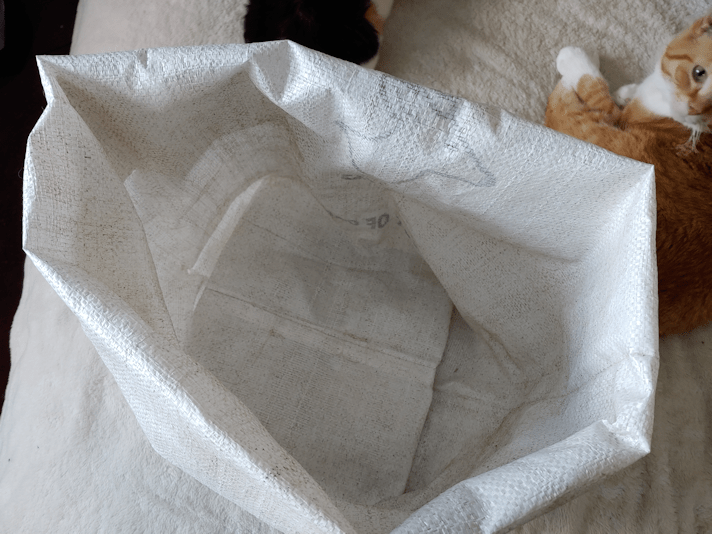
The bags are simple tubes with seams sewn on the top and bottom. The seams are basically slip stitched, so to open them, I trim one end of the thread close to the bag, then yank. The whole thread pulls out, leaving the top of the bag undamaged. Once the bags are empty, they lie flat.
So I grabbed one to experiment.
To use them as grow bags, they need a flat bottom. To create that, I folded the ends of the seam so the points met at the middle, then stitched them in place. Because of the layers of thickness from the seam, I had to do two rows of stitches on either side of the seam. I used a back stitch, as that would hold better. The thread I used was salvaged from the inside of a very long length of paracord. My younger daughter had made herself a corset, but the lacing she got was not long enough. The lacing is the same as the outside of paracord. My husband bought a 1000 yard roll of black paracord a while ago, so we had plenty to use. It took a while, but we got the inner strands out, which we then separated into individual strands to keep for other things. It’s remarkably strong, and we didn’t want to waste it! It was perfect for this job.
This is the end result. A flat bottomed bag with sides that can be rolled up or down to the height desired. The bags will allow for drainage, and are strong enough that we will be able to move them around as needed.
They’re fairly small. The bags are more long and narrow than wide, and the bird seed bags are taller than the deer feed bags. They are large enough for just a couple of potatoes, or maybe three or four fingerling type potatoes, at most. So we’ll need a lot. I don’t mind the smaller size, since that means they’ll be easier to move after being filled. We are pretty sure we know where they will go, but if that doesn’t work out, being able to easily move them is a bonus.
I brought in the rest of the bags from the sun room, which turned out to be another 12 bags, plus we’ve got two more bags of feed on the go. Over the next month or two, we will be getting more of both deer feed and bird seed, which will likely give us another 8 bags to work with. After that, we’ll just be buying bird seed, but by then, we’ll be planting, so it won’t matter. Until we actually get the seed potatoes, we won’t know how many we’ll have, since they’re sold by weight, not number of potatoes. If we don’t have enough bags, we’ll just try some of the other ideas we were thinking of.
I’ve stitched up three, altogether, to get the hang of it, and now they are set aside. Over the next few weeks, we’ll stitch up the rest so that they will be ready for our planting in late May or early June. Being in bags, we should be able to get away with planting earlier.
The cats, meanwhile, are absolutely fascinated by these bags, and all the smells that came in with them! :-D
I found them while looking for something else, of course. :-D
Here is where, on the tank, I want them to sit.
The bar across the middle has extra surface area in the corners of the ledge the covers rest on. There’s lots of room, here.
The outer corners, however, don’t have that, so there’s a lot less margin for error in positioning the pads well.
The first step was to clean off the ledge the frame rests on. An old toothbrush worked very well for that!
Since the cross pieces of the frames have an angled edge, to better fit into the space, I figured it would be easier to place the felt pads in position on the ledge first, adhesive side up, then placing the frame on top.
The felted pads I have were from a larger package with mixed sizes of circles, plus long, narrow ovals. The larger circles were used up, and all I had left were smaller ones, and some of the long ovals. I’d hoped I still had some larger circles left. If I had, I would have cut them in quarters, and fit them right in the corners, but half circles would have to do!
Once they were in position, I lined up the cover and dropped it down, pressing just enough to make sure the adhesive stuck, then removed it to press the adhesive in more thoroughly.
In this corner, you can see the pad will protect the tank’s frame from the wire. This was the edge of the roll, so no sharp bits sticking out, like the edges I had to cut, so I didn’t trim it.
And this is why I lined the pads up to the corners of the tank, rather than the frame. Yes, there’s a likelihood that the pad will get pulled off where it’s overhanging, if I leave it like that (I will trim it later), but it also isn’t sitting on the screw head. It was supposed to be countersunk, but some of the screws simply stopped and would not screw in any further. I am not sure what was stopping them but, whatever it was, I was wrecking my screwdriver’s tip, trying to get them to go in further, so I stopped. The others were just fine.
So the corners are padded now, protecting the tank’s frame from being scratched up, should a cat decide to jump onto the cover.
When I was fussing with everything to prepare for this, I did have a kitten not only jump onto one of the covers while I was there, but also walk across on the light fixture! Not a problem for a light kitten, but a potential problem, if one of the heavy adults tries to do it. Thankfully, they seem to not like the new covers and are staying off. At least while we’re around to see! The few times I’ve seen one of the adult cats up there, they have stuck to walking on the wood and stayed off the wire and away from the light fixture.
Meanwhile, the baskets and other items stored in the tank have been removed. I’ll need to take a vacuum to the bottom to clean it, then see how my seed trays fit on the bottom. That will help me decide whether the rigid insulation will be lining the inside, or the outside, of the tank. Whatever I do with the sides, the bottom will have its own layer of insulation lining it, too.
It’s remarkable how handy that insulation has been. I’m glad my daughter bought so much extra!
I’m going to need the little step ladder to be able to access the bottom of the tank. I could barely reach to get the smaller baskets out!
The joys of being short! LOL
Another little bit of progress made! :-) I can hardly wait to see how this works for starting seeds!


















 The Re-Farmer