For those of you who have been following this blog for a while, you may be wondering what happened with our cider vinegar.
Yeah. The stuff we were supposed to taste test 2 months ago, to see if it was done!
It’s been sitting in the old kitchen all this time.
Given how cold it gets in there, I wasn’t too worried about it.
For those who are new to this blog (welcome! Happy to see you!), you can check these posts out. All the links will open in a new tab, so you won’t lose your place here. :-)
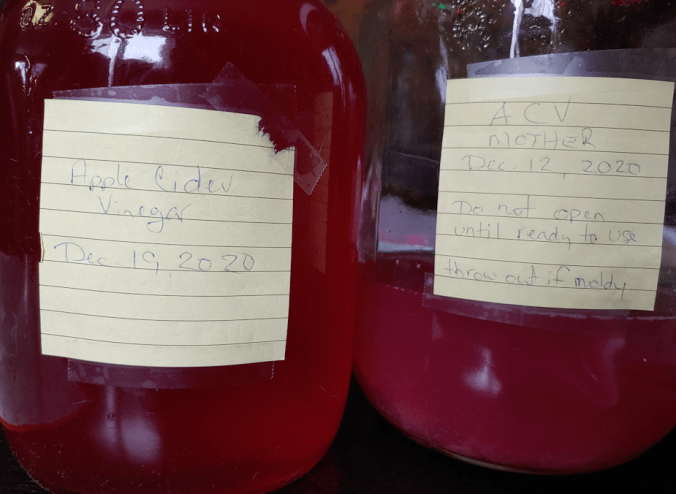
One of the issues I had was, what to store the vinegar in? The last time I made it, I could just use a quart jar. What did I have that was big enough, easy to pour from, and that I could close? I discovered that one of our 1 gallon (4L) glass jug that we have for making mead has a top that fits the same caps from the 3L jugs currently holding hard apple cider vinegar (which is also ready for bottling), so I was able to use that.
Once I had the bread dough rising, I brought the ACV in out of the cold!
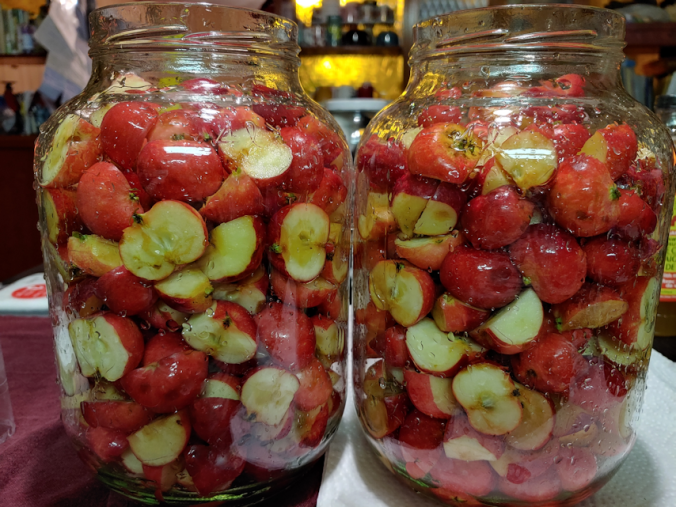
Both of them had visible mothers, floating on top. There was very little visual difference between the airlock and the cheesecloth jars. The airlock one had some condensation near the top of the jar, and that was about it.
I drew some out of each jar, using a turkey baster, to taste test.
Both of them had a mild, vinegar smell to them. Both of them were also had a VERY strong vinegar taste!
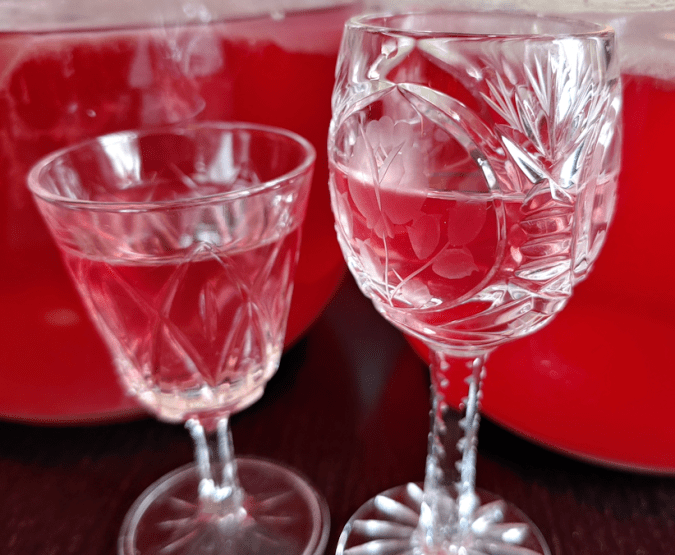
The girls taste tested them, too, and we all agreed that there was a slight difference in taste between them. The cheesecloth one (the girls did not know which glass was from which jar when they tasted them) has a slightly milder, more pleasant taste.
Meanwhile, I did a bit of research on what to do with the mother. We won’t be making this again until next fall. Can the mothers be kept for that long?
It turns out they can.
I was able to remove the mother from the cheesecloth jar before pouring, but didn’t have as much lock with the airlock jar. :-D So I put a small strainer over my funnel when I poured the vinegar into the cleaned and scalded jug. There wasn’t enough room for both jars in the jug, though. Yes, I mixed them together. I’d have kept them separate, if I’d had another small jug, but I did not.
Which was okay. I read that the mother has to be immersed in vinegar, and kept air tight, for storage. So the remaining vinegar was left in the jar, along with both mothers.
The gallon jug of ACV will go into the fridge for later use.
The jar with the mothers was sealed, and is now back in the old kitchen for storage.
I am quite happy with how this turned out. Having left it for so long, it’s a lot stronger than if we’d bottled it back in October, like we originally intended, but that’s okay. Using our own crab apples, from the one tree with the best, sweetest apples, not only resulted in a gorgeous colour, but it’s own unique flavour.
We will definitely be doing this again! Next time, though, we will just use cheesecloth and skip the airlock.
Now we just have to do a hydrometer test on the hard apple cider and see how it is. It would be awesome to have some of our own hard crab apple cider to enjoy with Christmas dinner! :-) Hopefully, I can get that done in the next day or two.
This morning, after doing my morning rounds, I gave the sun room door frame a second coat of paint. Tomorrow, we hang the door back up.
I had an audience. :-D
Also, while I was painting, I found that Nostrildamus has figured out to jump over the threshold after it’s been painted! :-D
Meanwhile…
Today was finally racking day for our first attempt at making hard apple cider, using our own crab apples. For new visitors, you can read up about that here and here. (links will open in new tabs)
Here is how the gallon carboys looked before I started. As expected, there was a LOT of sediment at the bottom. It’s not just the lees from the yeast, but the sediment from the raw, unfiltered juice.
We had some concerns with the fermentation. Activity in the airlock stopped a while ago. I think the room temperature became a problem. While they were actively bubbling, their temperatures tended towards 18C/64F, though we did also keep them wrapped in a towel and, every now and then, I’d heat up a rice-filled warming pad in the microwave and stick it between them to help keep them warm. We had used an electric heating pad, when making mead, but where these were sitting, there is nowhere to plug it in.
Racking from a 4L to a 3L carboy meant a lot of sediment heavy liquid left behind. Though I tried to hold the racking cane well above the sediment as long as I could, I could still see wisps of it being pulled up the siphon.
As I racked each jug, I made sure to get a hydrometer reading.
I just don’t know what to make of it.
For one of them, the hydrometer pretty much sank to the bottom. I had to add cider almost to the top for it to float enough to get a reading. The other was only slightly better. When they were first tested, it floated quite handily.
Unfortunately, I just can’t get it straight on how to read the specific gravity on that thing. So I write down all three readings.
The readings still don’t make any sense to me. Why would the numbers all drop so much? From what I can figure out, this is basically telling me there’s no alcohol in one, and almost no alcohol in the other.
I did taste test it, of course, and they both have a VERY sour apple taste. It also does taste alcoholic, but that is almost overwhelmed by the sour apple taste. Which is interesting, since the apples we used are actually quite sweet, and there was quite a bit of sugar added to the juice, too.
As for the hydrometer reading this time around, the only thing I can think of that might be affecting it (besides something going weird with the cider itself) is the temperature. Both carboys had a temperature reading of 16C/60F. The ambient temperature in the room is 15C/59C. From what I’ve been reading, newer hydrometers are calibrated for about 20C/68F. I’ve found a site that will calculate the adjustment for temperature, but there is virtually no change in the reading. So what gives?
I have no idea.
Considering that the traditional way of making hard apple cider is to press whole apples into a barrel, set it aside for a few months and BOOM, you’ve got booze, I didn’t expect this to be so complicated.
Anyhow. The 3L carboys are now set up with their airlocks for a second fermentation. As for the liquid left behind with the lees, I ended up straining much of it, and we now have about half a liter of filtered baby hard apple cider.
Hmmm… I wonder how it will go with the ham I will be roasting today?
The Re-Farmer
Update: When I started the hard apple cider, I did it based on this video from CS Mead and More.
There is a reason I included them among my Recommended sites!
I went ahead and contacted them about my readings, and got a very prompt response, and I am very happy!
It turns out, everything is working fine. My problem is with reading the hydrometer, then figuring out what it’s telling me! :-D
And now I know what to do with the information I’m getting off the hydrometer. I may not be using the AVB or Brix to work it out, but I’m writing them down anyway, because I can see those readings better. I can then use the printed out chart that came with the hydrometer to see where that lines up with the Specific Gravity and actually read that number on paper, instead of trying to see it in the liquid. When I take pictures and upload them to my desktop, I can usually zoom in and read it, but sometimes I find the hydrometer moved as I was taking the picture and I still can’t read it. :-/
The formula I was given to calculate the alcohol percentage is to subtract the new reading from the first reading, then multiply the answer by 135. So for one of my ciders it’s:
After three weeks (and a day) the crab apple cider vinegar has been strained.
For those new to this blog, you can catch up on the process by clicking on the following links. Each should open in a new tab, so you won’t lose your place.
While I have not been checking on them every day, I have been checking regularly, and the last I did, it they still looked like this.
So it was a bit of a surprise when I brought the jars over to strain them, and saw this.
Oh, dear.
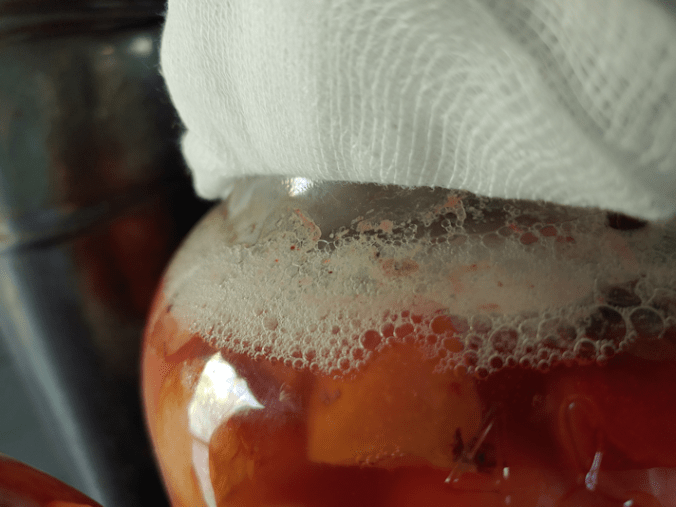
Both jars appeared to have mold at the top.
Now, part of what we’re doing this year is seeing if there’s a difference using cheesecloth to cover the top, or an airlock. Theoretically, because the cheesecloth allows oxygen in and an airlock doesn’t, the one with the cheesecloth should have been worse.
When I opened them up, though, there really wasn’t much difference. They both looked like this.
Yeah. Gross.
It seems the glass weight I used was not large enough to keep all the apple pieces below the level of liquid. Why it was enough to do so for almost 3 weeks, I don’t know.
On taking out the glass weight, I found that the pieces still immersed looked fine.
After scooping out the pieces at the top, the ones below all looked fine. The photo on the left is the jar that had the airlock, the one on the right had the cheesecloth.
I see no difference at this point.
After straining the pieces out, I checked them, and everything still looked fine. It was only the very top pieces that showed mold.
Took keep the experiment going, I made sure to do each jar from start to finish separately, cleaning and sanitizing the jars (and the airlock with its lid) before pouring the baby vinegar back.
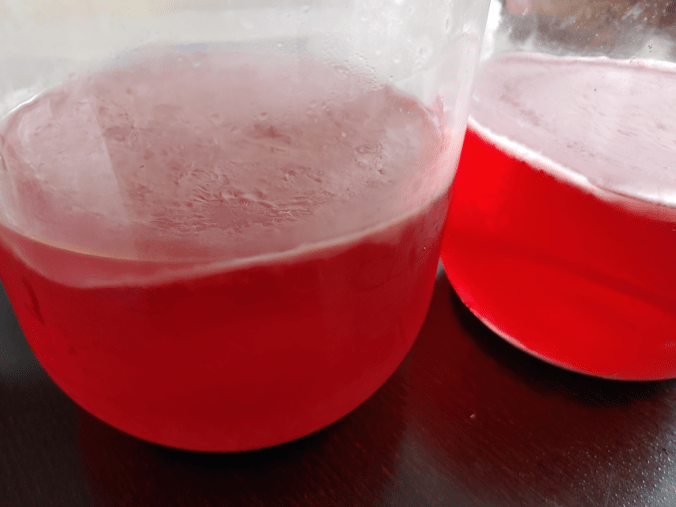
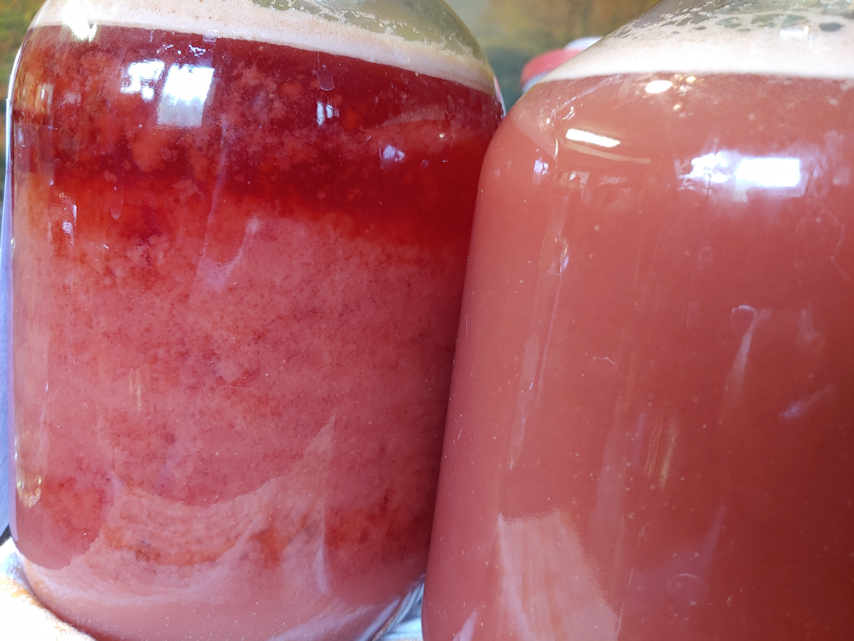
The vinegar on the left is from the airlock jar. The one on the right is the cheesecloth jar.
Again, I see no difference between them.
Both of them also resulted in 2L (about half a gallon) of baby vinegar. If I weren’t testing the two different tops, I would have poured it all back into just one jar.
One thing I noticed very quickly when straining them, is that they both have a surprisingly strong alcohol smell. A rather pleasant one! I might have a bit of hard cider going at the moment!
No, I didn’t taste them.
The question is, will the mold that was at the top be a concern? Will the continued fermentation – which is really just controlled decomposition – eliminate any potential problems?
There’s only one way to find out.
Back they go to the old kitchen, for another three weeks. Then it’s tasting time before deciding to let it ferment for longer or not.
These are supposed to stay out at room temperature. Room temperature in the old kitchen is a fair bit lower than the rest of the house – which isn’t particularly warm, either! When I brought the jars over to strain them, I used the temperature gun and they were both at 12C. If we were wanting to make an alcohol, that would be too cold, but is it too cold for a vinegar?
Yesterday, we hit 27C/80F. An unexpected result of that is, all number of house flies and other flying insects emerged from wherever they were slumbering in the previous cool, and got into the house.
Which meant a night of cats making a ruckus while chasing bugs all over the house.
I got very little sleep.
Today was much cooler, but rather than being outside, taking advantage of it, I ended up passed out for a couple of hours.
Cuddled by a couple of cats, of course. The buggers! It’s a good thing they’re so cute.
Anyhow.
While puttering about the house, trying to get at least some productivity in, I was in the old kitchen and checked on the apple cider vinegar. It’s been a couple of weeks since I started – or should I say, restarted – them, so I figured it was time for a progress report.
For my new followers (welcome! Happy to see you here. :-) ), you can visit our first making of apple cider vinegar with our crab apples here. This year, we decided to make a larger quantity, with some experimentation. You can read about our first attempt here, and after discovering I made a really silly mistake, the reboot is written about here. (All links will open new tabs, so you won’t miss your place. :-) )
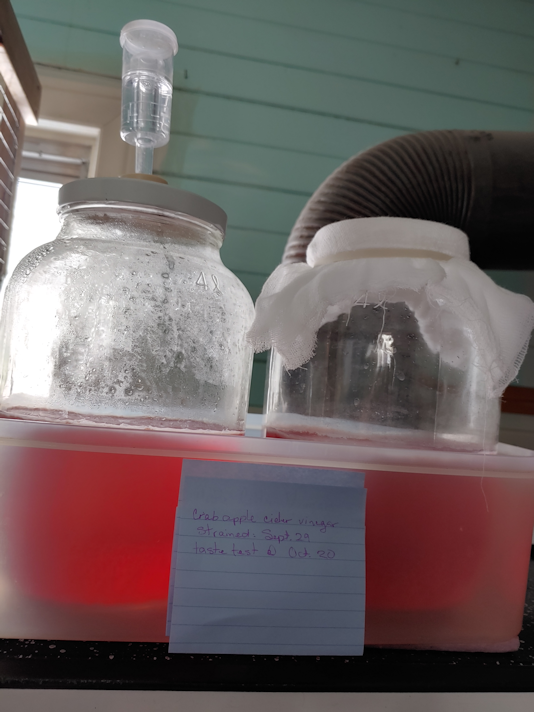
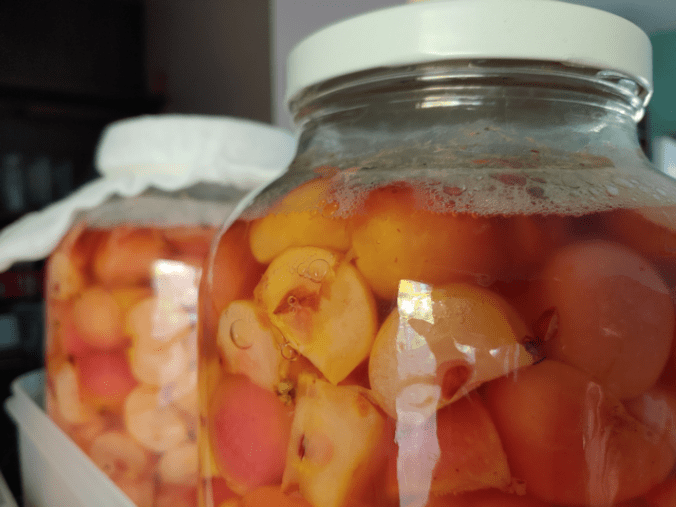
Here is how the jars look now.
The old kitchen is a very dark room. The south facing window has the sun room in front of it, so it doesn’t get any direct sunlight. The west window, which would normally provide a lot of light at the end of the day, is covered with aluminum foil (which predates our moving here), so there is zero light coming through there. The north facing window is what’s providing what light you can see in the above photo. Without turning the light on in the room, it was too dark to get a photo without moving to the window side of the jars.
This is a good thing. The instructions said to put the jars in a cupboard, and we just don’t have any with the space for these jars, so a room that never gets bright works just fine. The concern I had was how cold this room is. Fermentation requires warmth.
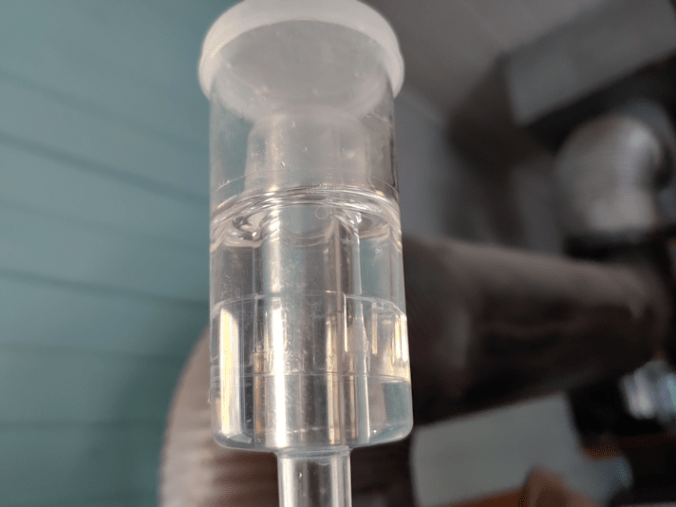
As you can see, there is no activity in the airlock at all. If there had been, the plastic cap on the inside would have been pushed to the top as it filled with CO2.
However, this is not the same as fermenting alcohol, so not seeing activity in the airlock does not necessarily mean nothing is happening.
And things are most definitely happening in there!
Both jars look the same. At this point, I see no difference between the one with the airlock and the one with the cheese cloth. Both have this layer of bubbles at the top, and when turning the jars to check them, more bubbles enthusiastically make their way up the jar. There most definitely is active fermentation going on.
One good thing about doing this in the larger jars like this: it’s nowhere near as messy as our first attempt! The fermenting vinegar had bubbled up enough to reach the coffee filter covering it and leaked a bit, inviting all sorts of fruit flies to check things out. This year, had I not had to throw away the first batch, with the its very full jars, it may well have bubbled up, and the one with the cheese cloth, at least, would likely have had a mess. There may be more headspace than needed in these jars now, but it seems to be better that way.
There also doesn’t seem to be any sign of mold or rot or anything of concern. The glass canning jar lids being used as fermentation weights are doing the job of keeping the floating apple pieces submerged.
So far, everything is looking good!
Next week we’ll hit the 3 week mark and, according to the instructions I’m following, that’s the time to strain out the apple pieces, return the vinegar to the jars, and let them sit for at least another 3 weeks.
I’m very curious to see if there will be a noticeable difference between the two jars.
This is how the crab apple juice looked, right after we got finished setting up the fermentation.
This is how they looked this morning.
The photo does not do justice to how bright the colour is!
When I was checking these last night, the tops were full of dense foam, which has mostly collapsed, but you can certainly see how high it got.
Their temperatures seem to be holding at between 18 and 19C, and – most importantly! – we are seeing activity in the airlocks. Not a lot, but it’s definitely started to bubble!
Today was our first attempt at making hard apple cider. We are using the remaining apples from the one crab apple tree we have that produces the most amazing, sweet, delicious little apples, after using some of them to start an apple cider vinegar.
When we first moved here and saw how many crab apple trees we had around the property, we looked into what was needed to make hard apple cider. At first, we didn’t think it would be anything we could do, or at least not anytime soon. Making hard apple cider, we found, required using a large press to crush whole apples, then sealing up the resulting juice to ferment a few months.
We didn’t have a press, and with so many other things on the go, we were not about to build or buy one, either.
They started making hard apple cider, using store bought juice. Sometimes, right in the container it was packaged in!
We could make hard apple cider without having a press, after all!
One of the things we found when cleaning up this place after moving in, was a juicer exactly like the one we had to leave behind when we moved. I think one of my siblings bought it for my mother, but she hardly used it. Everything was still in its original packaging, even!
We decided to try making hard cider using our own juice.
Now, making it using store bought juice in the bottle they were sold in works, because everything comes pasteurized and sanitized off the shelf. Basically, enough juice needs to be poured off to make room for the sugar and yeast, an airlock gets put on, and you can leave it to ferment to get a very basic hard apple cider.
Of course, doing it the traditional way, with a press, the juice didn’t get pasteurized or filtered or anything.
We decided to try making our own hard crab apple cider with raw, unpasteurized, unfiltered juice. The juice would be going straight from the juicer to the sanitized gallon jugs, so the chance for contamination would be very lower.
Lower than trying to do it the old fashioned way, that’s for sure!
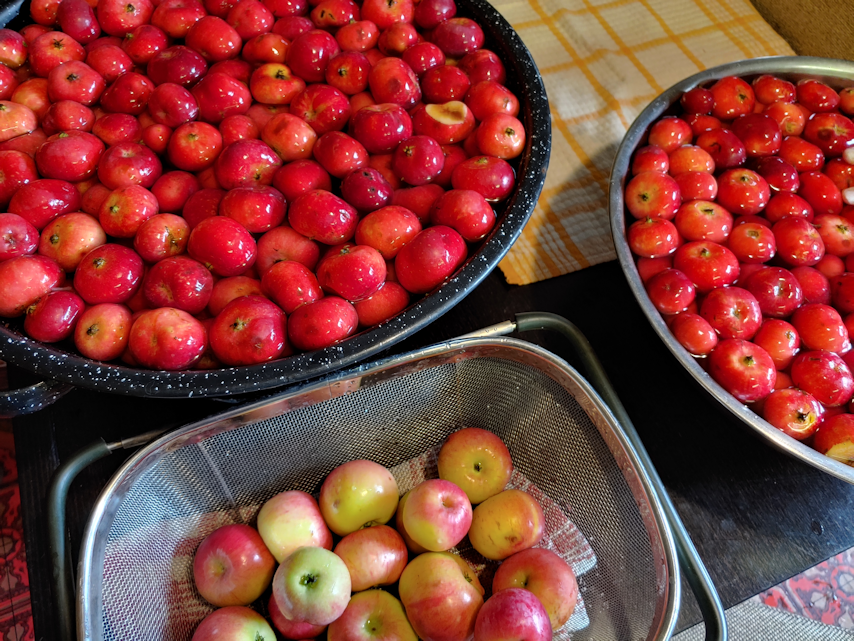
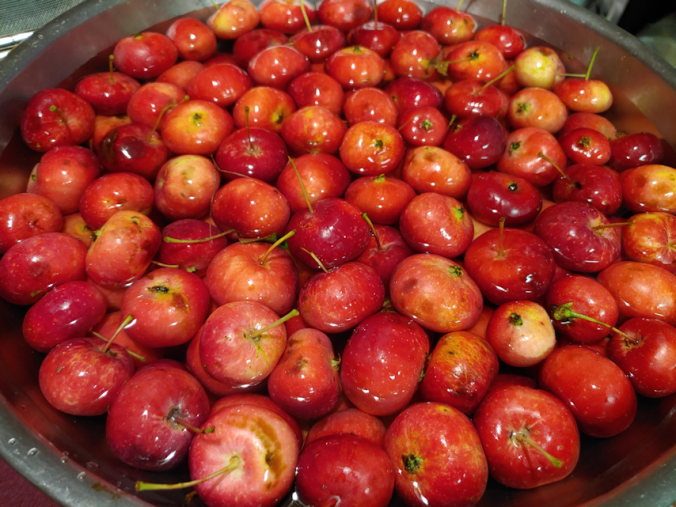
The first step was to clean the apples and de-stem them. They didn’t have to be cored, but the stems would cause problems with the juicer.
The crab apples from the one tree completely filled my two largest bowls. Though I cut away some obvious nasty bit, I wasn’t worried about light bruising. I also have the not-quite ripe apples from the tree that broke in the wind storm.
It’s a good thing we had so many of these apples this year, since I had to toss the cider vinegar, and start over again.
Juicing the apples turned out to be more difficult than expected. It was made slightly easier when we found a way to raise the juicer high enough that a 1L pitcher could fit under the spout. We had 2 one gallon jugs, and a gallon is about 4L, so I could use the pitcher to loosely measure how much juice I was putting in. However, these little apples don’t have a lot of juice in them, and their pulp kept jamming the machine. My daughter kept having to stop the juicer, open it up and peel away the pulp that accumulated on the perforated metal cone inside, instead of going out the back. The pulp was so dry, it could be taken off in ribbons!
Using information I got from one of the hard cider making videos, I used 2 cups of sugar per gallon. Each got 2L of juice before I put in a bung and shook the heck out of them to dissolve the sugar.
Look how pink that is!!
Also, you might notice the liquid is not at the same level. Though these are both 1 gallon jugs, one is actually bigger than the other. They are 1 gallon at about the “shoulder”, which leaves space for the fermenting liquid to bubble up a bit.
I also used the same wine yeast we’ve been using for everything else; I don’t know the specific strain of yeast, but it’s basically what is available for a non-sparkling wine from the local brewing supply store. Again, following what I saw in the video, I dissolved about a tsp of yeast in a bit of juice, then added it to the full jugs, after getting a hydrometer reading.
After the yeast was added, they got another thorough shaking, then the airlocks were put in place.
I’m also trying to be more diligent about recording everything. I have to admit, I still don’t understand the hydrometer information, so I wrote down all three readings. It has a “potential alcohol by volume” measure right on there, but I keep reading that it isn’t any good, and that it’s better to use the specific gravity reading. It doesn’t help that I can barely see the tiny numbers and lines in the first place!
I found it interesting that the readings for the 2 jugs that were made up identically, are slightly different. It’s possible that the different sized jugs means that one does have slightly more juice in it than the other, and that could explain the difference.
The juice is not only incredibly pink, but incredibly cloudy! They were, of course, just shaken when this photo was taken. You can tell which one got finished first, as the cloudiness is already starting to settle.
We have set the jugs up on a side table in the dining room for now. It’s not a particularly bright room, it’s warmer than the old kitchen, and we can keep an eye on them. I just took a look at them, after they’ve had several hours to settle. I will have to take a photo of them during the day. They look very different right now! The sediment has settled to the bottom, and the clear juice in the middle is looking a deep, deep pink – but there is a significant layer of lighter pink foam at the top! I used the temperature gun on them, and got different readings, depending on where I aimed it. The top, where the foam is, was fluctuating between 19C and 20C (66-68F). The middle was around 17-18C (62-64F), while the bottom, where the sediment has settled, is 17C (62F). Which I think is good.
Also, I’ve turned the thermostat up for the house. It was set just below 15C/59F when the furnace turned on earlier today, so I’ve upped it a few degrees! So the ambient temperature will not be too cold, either.
I have no idea how this will turn out. Will the fact that we used raw, unfiltered juice be a benefit, or a disaster? Will we get something that tastes horrific, or wonderful? Considering how great the apples themselves taste, I would hope the resulting hard cider would be its match. I have no idea. This is a total experiment for us!
As for the remaining apples, it took so long to juice enough to fill the jugs that we didn’t juice the rest of them. I had started cutting them up to cook them into a dessert, but realized I didn’t have the energy for that left, so they ended up in the freezer! Meanwhile, my poor daughter had been standing at the juicer for so long, her back was starting to give out on her! We couldn’t even plug it in somewhere where she could sit down, since there are so few outlets in this house.
Today, the girls and I worked on juicing apples and getting some hard crab apple cider started (which I will post about next). While I was de-stemming the crab apples and cutting off any nasty bits, they took care of sanitizing the gallon jugs and the various items that would be needed.
They usually did the sanitizing part during our few beginner attempts at making alcoholic drinks.
That’s my excuse!
You see, when I used sanitizer to start the crab apple cider vinegar a couple of nights ago, I made a mistake. A silly, forgetful mistake. A laughable mistake, even.
But for the cider vinegar, it was a deadly, disastrous mistake.
As I listened to the girls chatting while using the sanitation solution, then rinsing everything off and setting it aside on a towel to drip dry, I suddenly realized my horrible mistake.
When I sanitized everything for the vinegar, I set everything out to drip dry – but forgot to give them a final rinse, first. Which means, when I made the vinegar, everything had dried sanitizing solution on them.
There’s no way they’d be able to ferment at all!
Later, while my younger daughter and I were juicing apples, I mentioned it to her. Oh, my, the look on her face!
Sweetheart that she is, she took over the juicing while I went and got the jars.
There was, of course, no sign of bubbling in the air lock, but after only 2 days, would there have been any? I don’t know. However, when I opened them up, I could see they were already a loss. There may not have been any fermentation happening, but decomposition had already started at the very top. :-(
Thankfully, since I had prepped all the other apples for juicing, I was able to wash, sanitize and RINSE THE HECK OUT OF everything, then quickly chop apples into pieces for a new batch.
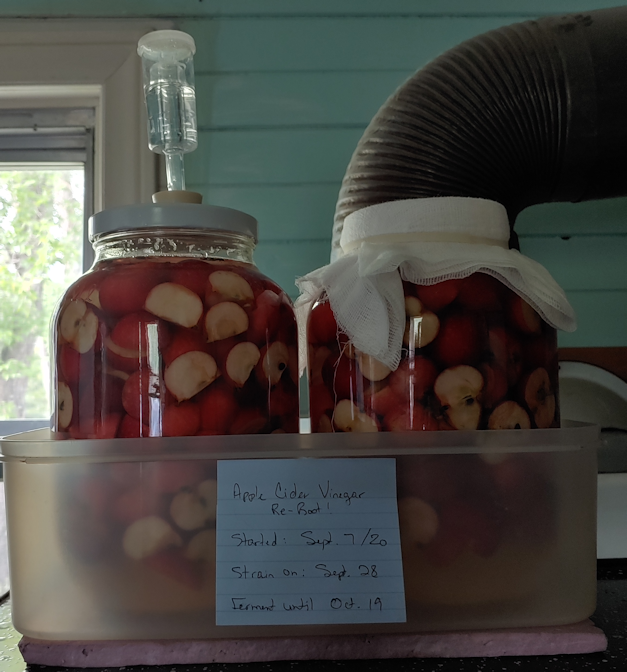
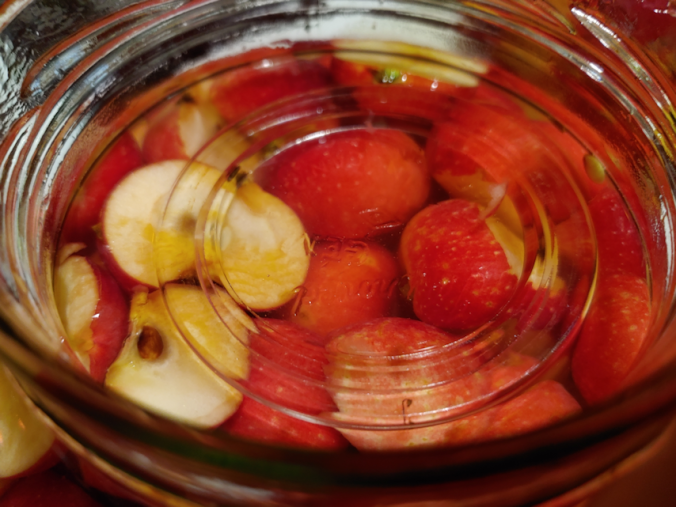
The only thing different from last time, aside from actually rinsing everything after sanitization, was to not fill the jars as much as I had before. The recipe had said to fill the jars 3/4 full. I think I was still over that, but the first batch was full almost to the top. Here, you can sort of see through the container they are in, that there is a fair bit of space under the floating apple pieces.
I foresee only one problem right now.
These are in the old kitchen and, right now, it’s pretty cold. It was cold enough today that the furnace actually turned on – and the thermostat was dropped quite low over the summer! As I write this, it’s already dropped to 4C (39F), and we have frost warnings for tonight. Amazingly, we’re supposed to go above 20C (68F) in a couple of days, but for now, it’s downright chilly! The old kitchen doesn’t have any heat going into it. Back in the day, with the wood stove going, it was a source of heat for the rest of the house, not the other way around! I don’t even know what the old kitchen has for insulation, if anything. It stays cools in the summer, and in the winter, it gets pretty close to freezing in there. We can actually use the room as an extra refrigerator in the winter.
The cider vinegar should be done well before we reach those sorts of temperatures all the time, but the next couple of days might slow things down a bit!
We shall see how it goes.
I still can’t believe I made such a silly mistake!
Last night, I procrastinated cleaning the dining room by starting the apple cider vinegar! :-D
I slightly modified the recipe I used last year, which you can find here. (Link will open in a new tab.)
I started off by using one of my gallon jars to measure out apples from one of the 5 gallon buckets. As the apples would be cut into pieces that would fit more tightly, plus I would expect to cut away nasty bits, or even toss entire apples, I filled the jar to the top twice, then added a few extra. I have a large enough bowl to be able to give them a bit of a wash, then leave them to soak while I prepped other things.
Last year, I sterilized things with boiling hot water. Since then, we have started brewing, so along with extra airlocks, we also have sanitizing solution. So one of the changes this year is to use that to sanitize everything, instead of scalding them.
Since I was doing a lot more crab apples this year, I put the cut pieces into water with a bit of lemon juice as I worked. Last time, for the amount of apples I can, there was no need for anything to keep them from browning until I was done. I cut them all into halves or quarters, depending on the size of the apple – or used what was left after cutting off any nasty bits! As expected, there were some losses, but not all that much. In fact, I could have done with fewer apples for the jars!
The recipe said to fill the jar 3/4s full, and I ended up with almost full jars! Even after shaking down, they were still full to the shoulder.
The recipe called for 2 Tbsp of sugar for a 1 quart jar, so for these, I used 8 Tbsp of sugar per jar. The recipe calls for filtered water. Last year, I happened to have some water bottles I could use, instead of our very hard, iron rich, well water. We currently buy refills of water for drinking that is first filtered, then treated with UV light and reverse osmosis. That is what I used to dissolve the sugar in, first.
The next change from last year was the use of a “starter.”
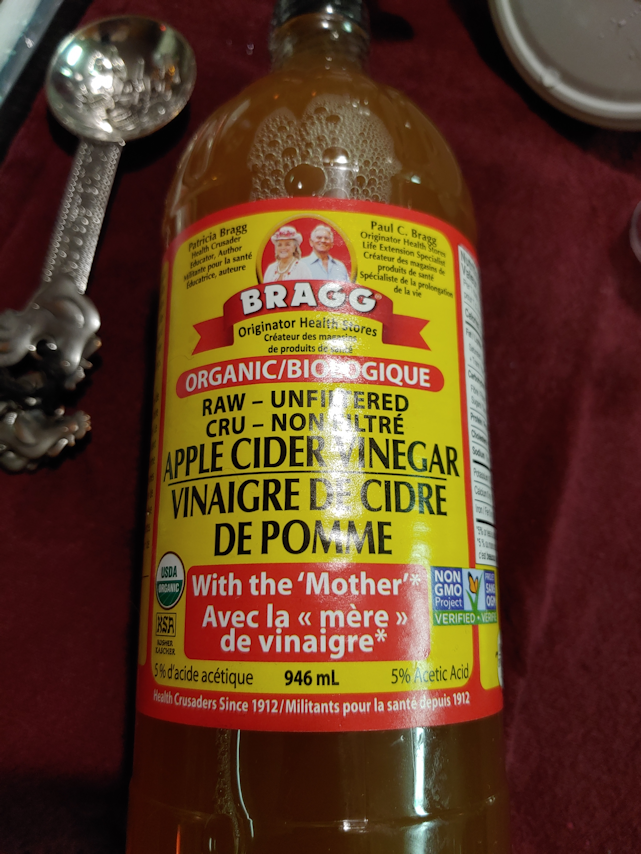
I’ll admit that when I normally buy apple cider vinegar, I buy whatever is cheapest. It gets used as an ingredient in cooking, so I don’t feel the need to anything fancy or expensive. When making the cider vinegar last year, it relied on the water, sugar, apples and whatever natural bacteria in the air “contaminated” it. Since I plan to use an airlock this year, and everything has been well sanitized, it’s not going to get that exposure. So I picked up a bottle of Bragg raw, organic, unpasteurized ACV, with the “mother”, to use as a starter and introduce the little critters needed for fermentation.
In doing my research, I found one person who used this same brand as a starter in his own ACV. He was using a large crock and just sloshed a bunch in, with no measuring, so I was left with no real idea of how much to use. I decided that 2 Tbsp per gallon out be enough. To make sure I got some of the “mother” that had settled on the bottom, I gently turned the bottle back and forth and upside down a few times first.
Once the starter was added, I filled the jars the rest of the way, with about an inch of headspace, with the filtered water.
When doing this last year, I didn’t have any fermentation weights and made do with some small jars. I still don’t have fermentation weights, but with the nice, wide openings in these jars, I had something else I could use.
When I was a kid helping my mother with canning, snap lids wasn’t a thing, yet. She used either wax or glass lids with rubber rings to seal. In cleaning up the basements and the old kitchen, I’ve been finding lots of these glass lids. I cleaned and sanitized a couple of them, and they look like they’re just the right size to keep the apple pieces submerged! :-)
Now comes the experimental part.
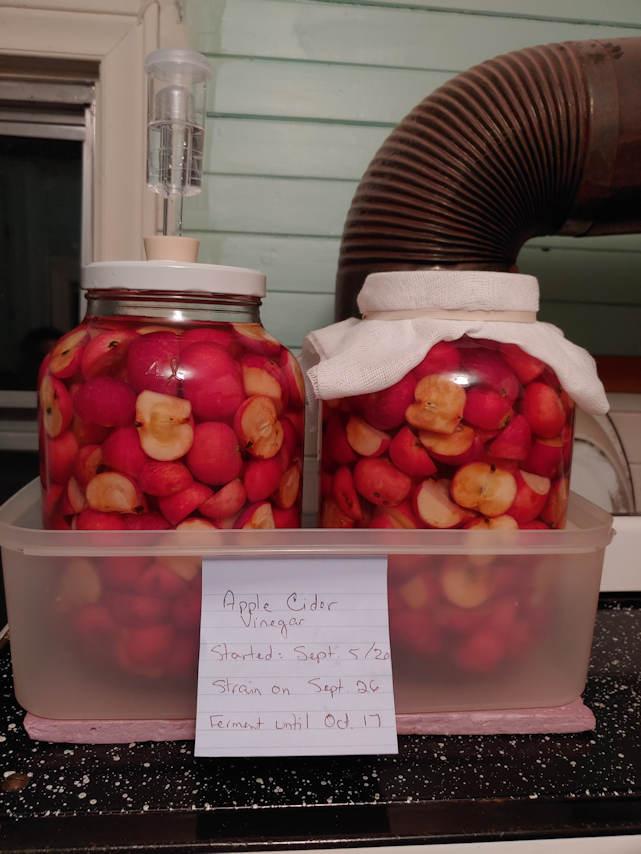
The two jars were made in exactly the same way. One of them now has the airlock cap, while the other is covered with layers of cheesecloth, held in place with an elastic band. They are not sitting on top of the warming shelf of the old wood cookstove in the old kitchen. I placed a small piece of foam insulation down, first. The old kitchen stays quite cool throughout the summer, and is even cooler now, so the metal would be quite cold. During fermentation, there will be bubbling and foaming, and a possibility that the liquid might reach the cheesecloth, or even overflow, so they are in the plastic container to protect the top of the stove from any drips.
Now, it sits for three weeks. During this time, we’ll be checking them daily. I look forward to seeing what differences there might be, between the two methods, as well as comparing to how it turned out last year.
Hopefully, no fruit flies will be attracted to the one with the cheesecloth! We have a fruit fly problem in the kitchen right now, but so far, they haven’t been found in the old kitchen.
I still have about 7 or 8 gallons of apples left, even after my mother took some home. Tomorrow, I plan to juice them and start making some hard crab apple cider! The traditional way to do it is to use a press to smush the whole apples, then leave the juice to ferment on its own. We don’t have a press, but we do have a juicer, so I’ll be using that, plus some of the yeast we picked up to use for mead making. We have four 1 gallon jugs, plus a half gallon jug, to use for fermentation, so there’s plenty to be able to do both. :-)
This should be fun!! :-)
The Re-Farmer
Update: Sept 7, 2020 – I goofed! But you won’t spot my mistake here. Visit this follow up post to see what I did wrong, and how I fixed it.
Last year, we made apple cider vinegar using the bright red apples from just one tree. The result was a delicious, delicately pink cider vinegar, and we were looking forward to making it again.
There was just one problem.
The instructions we followed said to put the jar in a dark place, so we tucked it into a cupboard. Unfortunately, it attracted fruit flies. The jar was covered with a coffee filter and they couldn’t get in but, as it fermented, some had bubbled up enough to dampen the paper. Which meant any time we opened the cupboard, we’d find a cloud of fruit flies inside!
Not good.
Since then, we’ve bought the things necessary to make mead. This includes smaller bungs to fit airlocks into gallon jars. We will be using some to make hard apple cider out of our crab apple juice, later. With airlocks being so cheap, I’ve picked up extra, so we could have all our gallon jugs, plus the 5 gallon carboy, all going at once, and still have extras.
This year, I will be taking advantage of our mead making supplies.
Since making the ACV requires using apple pieces, I need to use a wide mouth jar. I also want to make more than last year, so I wanted to use something bigger than a quart jar.
Every now and then, we picked up the big gallon jars of pickles at Costco, and I’ve been keeping the jars. That’s what I’ll be using to make the vinegar this year.
The question then becomes, how do I use an airlock on one of these?
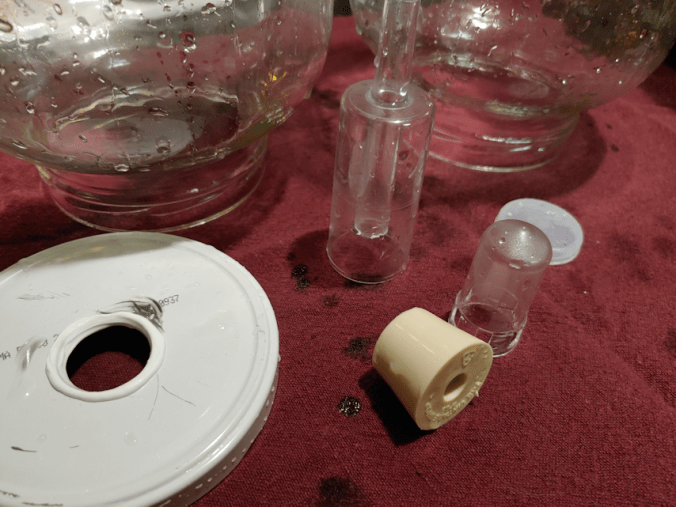
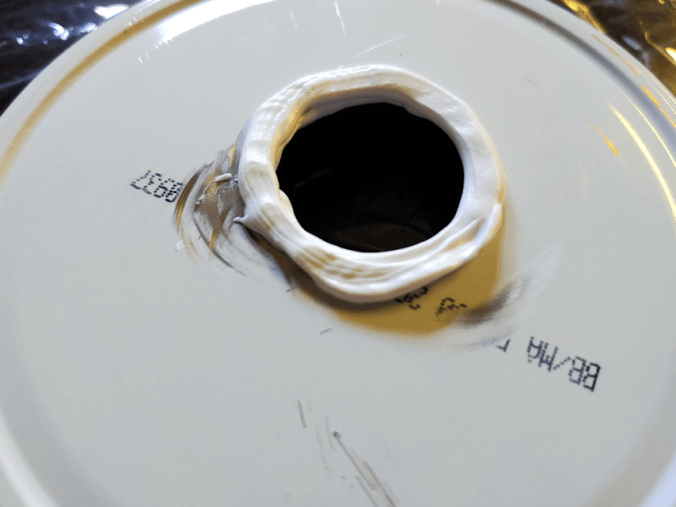
Now, if I had some silicon grommets (which I learned the name of only yesterday), I could drill an appropriately sized hold in a cap, pop on a grommet, and insert an airlock.
I don’t have those. I do have extra bungs, though.
I don’t have anything I can use to simply drill a hole that big into a cap, though, so I had to do it the use-watcha-got way.
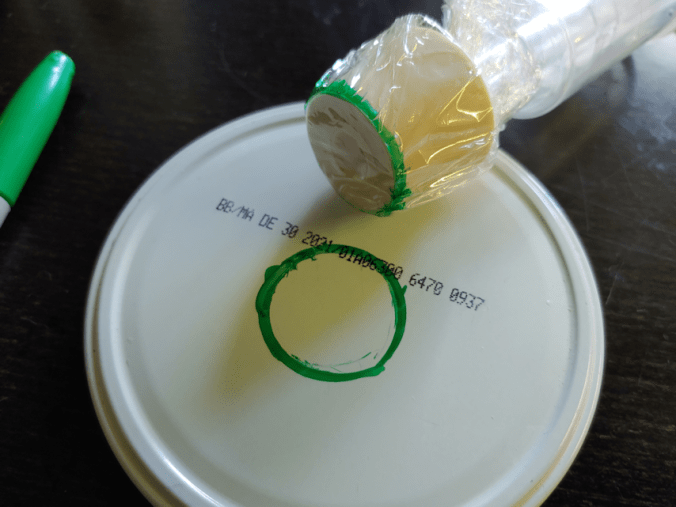
The first thing to do was mark the size of hole I needed. After protecting the bung with plastic wrap, I traced around it with permanent marker. As the bung is tapered, the actual size of the hole needs to be slightly larger than the inside of the circle.
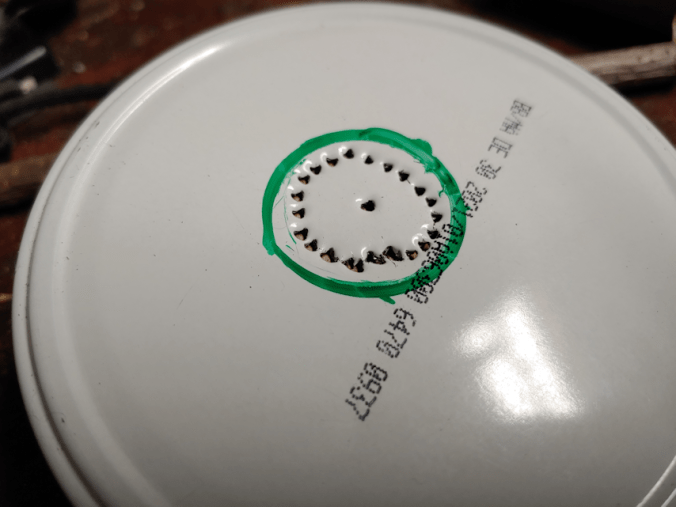
With a scrap of wood underneath, I punched a series of holes well within the marked circle, then used pliers to break off the middle.
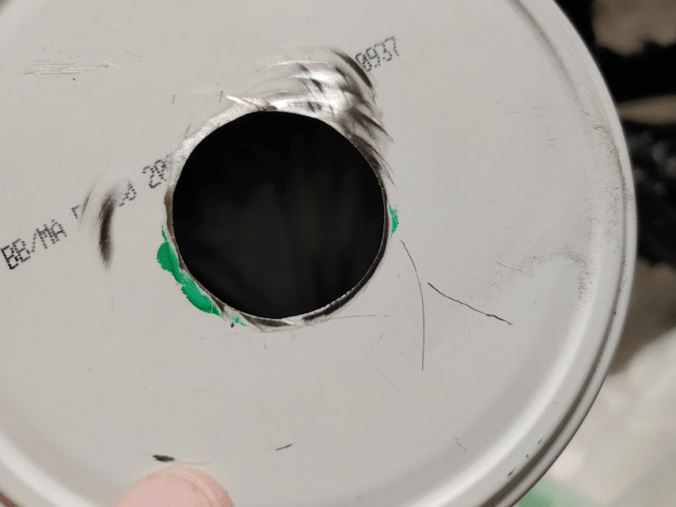
Working directly over a garbage bag, I used a series of metal files to grind away at the opening to smooth it out, then make it larger.
Once I’d reached the inside of the marked circle, I switched to the Dremel to grind and smooth the metal.
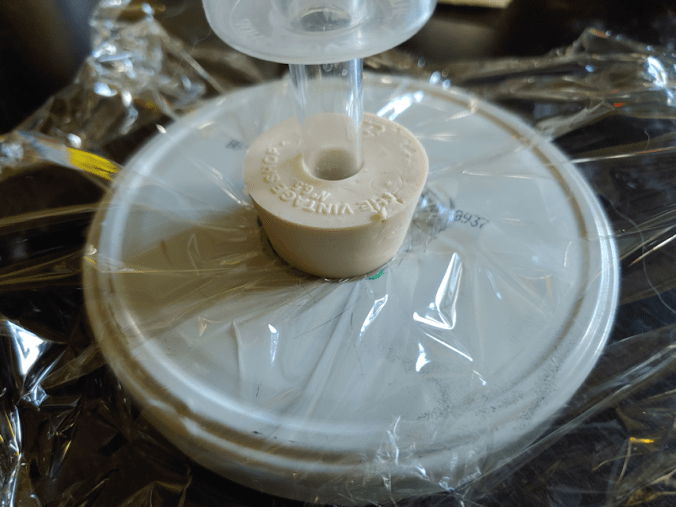
Then it was time to test the size of the opening. A perfect fit!
We’re not done yet!
Though the metal was ground smooth, it still is sharp enough to potentially damage the bung, if I were to push it in tight enough to great a proper seal.
Silicon sealant to the rescue!
I used the same stuff we got to fill screw holes when our satellite dishes got moved, then again, for a final seal in the cracks on the rain barrel we set up by the garden. It’s a multipurpose, indoor/outdoor product that is coming in very handy.
The tube it comes in is also very easy to control, even for a job as small as this. After giving the cap a very through cleaning, I lay a bead down on both sides of the cap, right on the edge of the hole, so that top and bottom would touch and completely cover the metal edge. Basically, I imitated a silicon grommet. This should both protect the bung, and ensure an air-tight seal is created.
Now it just needs time to cure before I can test it again with the bung.
Since we have so many apples, I might make two; one with the airlock, and one without, to see which works better. I’ve also picked up some fancy-schmancy ACV “with mother” to use as a starter (last time, we just used water and sugar). Using just a coffee filter, it relies on exposure to the air to get the bacteria needed for fermentation. So it’s touch and go, whether you get a good bacteria or not. With an airlock, it won’t get that exposure, so using a vinegar with the mother in it will ensure the right kind of bacteria is already in there.
Welcome to my “Recommended” series of posts. These will be weekly – for now – posts about resources I have found over the past while that I found so excellent, I want to share them with you, my dear readers. 🙂 Whether or not I continue to post these, and how often they are posted, will depend on feedback. Please feel free to comment below, and if you have a favorite resource of your own, do share, and I will review them for possible future posts.
I hope you find these recommendations as useful and enjoyable as I have!
When we decided to try making mead we, of course, did research, first.
Unfortunately, what we found was a lot of conflicting information.
One source would say to just mix honey, water and bread yeast in a jug, top it with a balloon, stick it under your desk and forget about it for months.
Another source would describe starting a fermentation in one container, with daily actions, racking after a couple of weeks, and basically babying the must until it was time to bottle.
Some sources recommended using basically nothing; no other ingredients than honey, water and maybe some yeast. Others would talk about the need for various additives, ranging from raisins to nutrients to various chemicals to start or stop fermentation.
It turns out, mead making is something people can vociferously disagree on, too!
The last time I posted about our mead making attempts, I mentioned a new resource I’d found. CS Brews. This is the YouTube channel for a larger enterprise that includes a similar channel about cooking, a website called City Steading, a Facebook community, and more.
As the website name implies, this is a sort of homesteading resource for people who don’t live in the boonies, like we do. The skills and information are, of course, transferable.
My recommendation, however, is focused on their brewing videos.
Now, this may sound odd, but I don’t actually like alcohol all that much.














 The Re-Farmer