Garden plans for 2021: orders in, and probably way too much!

I posted previously about seeds we ordered from Rare Seeds. Since then, I’ve placed another small order from them, which I will talk about below. (all links should open in new tabs, so you won’t lose your place. :-) )

The problem is, our first order hasn’t arrived yet. It has been shipped and, as far as my account on the website states, it’s complete. It should have arrived by now.

Could it be stuck at the border? I don’t know. I’ve emailed them and asked. Hopefully, they will be able to find out at their end.

A lot of the stuff on my wish list there is out of stock, so when I had the chance, I did place another order while what I wanted was available. This is what I will be getting (along with a free packet of mystery flowers).

Hopi Black Dye Sunflower. I’m really excited about this. Not only is it supposed to be a good eating sunflower, but it can be used to make a purple dye. After what happened when we planted sunflowers last year, we ordered 2 packages of these.

Mongolian Giant Sunflower. I love how they use small children to demonstrate just how MASSIVE some of their products are. This one is a monster of a sunflower! Heads can reach up to 18 inches across, and the stalks can reach 14 feet. This will make a substantial wind break and privacy screen. Yes, we ordered two packages of these, as well.

Crespo Squash. This is a type of big, warty green pumpkin. Why did I order it? Because it’s big, green and warty. Also, it’s supposed to be very delicious.

In deciding what to get, we are looking at both summer fresh eating, and winter storage. The sunflowers we planted last year did not get a chance to mature, but if we can get these planted earlier, hopefully, that will not be an issue again. We will also be looking at finding ways to keep the deer away from them. From the looks of the stalks we left in the garden, they are still trying to eat them which, for this time of year, is part of why we have them there. Hopefully, the birds are able to eat the developing seeds in the seed heads, even if they’re not fully formed and ripe. Last I checked, some did appear to be eaten, but not much. With bird feeders right by the house, they don’t really have much incentive to eat underdeveloped seeds.

We got our Vesey’s catalog in the mail recently, which was quite exciting. :-D The girls and I have been talking about what we want to do while going through it. Today, I ended up placing a much larger order than before. I had been thinking of waiting until January, but with things already disappearing from my cart because they were suddenly out of stock, I figured I’d better order things while I could. Even so, much of what I would have liked to have ordered was out of stock. Some of them, I ordered different varieties instead. Others, we will wait and will probably order in January or February.

This is what we’ve got ordered, as of right now.

Vesey’s Mosaic Mix Tomato. We are not big tomato eaters. I actually detest tomatoes, though I can eat tomato paste or crushed tomato as an ingredient in dishes. One of my daughters, however, really likes little tomatoes. This package is a mix of cherry and grape tomatoes in a range of colours that will produce over a long period of time. This is for her! :-D

Merlin Beet. Of the beets we tried to grow last year, this is the one the girls liked the most. We’ll just have to protect them from the deer!

There is another variety we plan to get, but it’s out of stock, so we’ll order that later. When we’re ready to plant, we should have 2 varieties of beets.

Spinach collection. Three varieties of spinach that mature at different types. We all love fresh spinach, but store bought spinach goes bad so quickly, we rarely buy it. Something else we have to protect from the deer, though!

Summer Squash Mix
Sunburst Summer Squash These are the same as what we ordered last year. The mix does include sunburst squash in it, but having more of them went over very well last year. This time, we have better information for starting them indoors, and protecting them from late frost, so hopefully, we will have even more. They will be for fresh eating, and for pickling and freezing.

Baby Pam Pumpkin. The pumpkins we planted last year were planted way too late, and we didn’t even know what variety they were. This time, we chose a variety noted for its eating quality, and faster maturity.

Red Kuri (Little Gem) squash. These little winter squashes should mature even faster than the pumpkins! This variety was also chosen for its winter storage qualities.

Teddy Organic Winter Squash. We picked these for their combination of small size (serving size!) and high production, as well as it’s faster maturity.

Pixie Melon
Halona Melon

I was unsure about trying to grow melons again, as the transplants I bought last year did not work out. I had a variety recommended to me, but it was not available. These cantaloupe type melons were picked for their quicker maturity. We enjoy melons, but it’s another of those things we rarely buy, so it’s worth giving it another go.

Cucamelon. Yes, even though I was able to save some tubers, I’m still getting some to start from seed. Just in case!

Conservor Organic Shallot
Norstar Onion
Red Karmen Onion Sets (to be shipped in spring)
Red Baron Onion (bunching onion)

We have 3 varieties of garlic already planted. Now, we’ll also have lots of onions, too! We use onions a lot, so figured it was worth going ahead and planting lots. We chose come of these for their winter storage-ability.

Yukon Gem Potatoes (yellow flesh)
Purple Peruvian Fingerling Potatoes (purple throughout)
Norland Potatoes (red skin, white flesh)
Purple Chief Potatoes (purple skin, white flesh)

Last year, we ordered 2 boxes (3 pounds each) of the Yukon Gold. This year, we decided to double the amount (each comes in a 3 pound box), but quadruple the varieties. The Norland and Purple Chief are noted for their winter storage, so we’ll have some we will grow for eating earlier, and others to keep for later.

Napoli Carrot
Deep Purple Carrot

Deep Purple is one of the varieties we planted last year. The Napoli is not the variety I originally picked, but this one was in stock and highly rated. We have two other carrot varieties coming from Rare Seeds that should have arrived by now. If something has gone wrong with that order (for all I know, seeds aren’t being allowed across the border right now. Or maybe it’s just slow), we’ll still have 2 varieties. If we end up with 4, well, that’s just more for pickling or freezing.

Dalvay Pea I actually had a 3 variety collection in my cart, but waited too long to order, and now it’s out of stock. So I ordered this variety for now. We may order another variety, later. These were noted for their fast maturity and long pods.

Lewis Bean (green)
Golden Rod Bean (yellow)
Royal Burgandy Bean (purple, turns green when cooked)

The 3 variety collection I had on my wish list is out of stock, so I picked similar varieties that were in stock. These types of beans are another thing I rarely buy in the stores, though we like them. They tend to either look oogy, or get oogy very quickly. These will be used for pickling and freezing, too.

Peaches and Cream Corn Collection Three varieties of Peaches and Cream corn. Not the collection I originally intended to order, but the one that was in stock! We have 2 other, more unique, varieties from Rare Seeds that are held up (watch, after my saying this so often, I’ll find them in the mail tomorrow… LOL). I believe we will need to plant those varieties away from these ones. I don’t think they would be good to cross pollinate. Especially the purple variety. :-D

Illinois Everbearing Mulberry (shipped in the spring) This is it! Our first food tree! I really hemmed and hawed about ordering it, because it’s quite expensive, but it will be two years before it produces fruit, so the sooner, the better. It’s actually a zone 4 tree, so we will have to ensure that it is well protected. It can grow up to 25 feet high, which also needs to be kept in mind when we decide where to plant it, too! My mother remembers they had a mulberry tree growing behind their barn, when she was a child in Poland. She remembers bright yellow silk worm cocoons on them, too! We might be able to grow the tree here, but I don’t think we could introduce silk worms here! :-D

Western Mix Wildflowers
Alternative Lawn Mix Wildflowers

These are mixes that will be scatter sown in a couple of areas. One of them will actually be outside the property, between a fence and the road. This is an area that is currently open, and I don’t want it to be taken over by trees, like on the other side of our driveway. Plus, the garden area is on the inside of the fence, so it will attract pollinators. Reading over the planting instructions, it seems they actually do better being planted in the fall, so we might take the summer to prepare the areas (they actually recommend tilling! No, we aren’t going to go that far), then seed them.

There we have it! Our order is in.

This is probably way too much – and there are other things I’d still like to order! We certainly don’t have enough beds or grounds prepared for all of it. Especially the corn. But that’s okay. We’ll work it out!

We will need to build potentially 4 trellises for the peas and beans, plus we want to build squash tunnels and trellises. Where we planted the squash last year, there are 5 prepared beds, plus the 2 beds the potatoes were in, plus 1 long skinny bed where I planted the seed potatoes I found that hadn’t sprouted. No idea if they will grow at all next year. We also have the retaining wall and parts of the old kitchen garden available for some things. The potatoes we ordered will need to be planted in a different area from where we grew them last year, so as not to attract the Colorado Potato Beetle. We are talking about trying to grow potatoes in containers, instead, this time.

So we’ll have to prepare beds for 27 plant varieties, plus larger areas for the corn and sunflowers, just from what I’ve listed here. More, counting my first order from Rare Seeds, and anything else we might order later. Not that we actually have to plant all of everything we get this year. Some things can be inter-planted (squash, beans and corn together, for example), so that will help a bit.

We’re still looking at potentially 20 beds or more that need to be prepared! All manually, too.

Yeah.

We can do that. :-D

Did we maybe overdo it? :-D

The Re-Farmer


Garden plans for 2021

Yes, it’s only the middle of November, but the girls and I are already planning for next year’s gardening.

We learned a lot in our first year of gardening here, and will be using that information as we expand our food growing.

We have several goals and things we keep in mind when deciding what to order. First is keeping in line with our long term goal to be as self sufficient as possible. The other is to take advantage of being able to grow our own food by growing things we either can’t normally buy in the grocery store (either due to lack of availability, or poor quality in stores), or because they tend to be more expensive, or “treat” items, that we typically can’t justify spending our limited budget on. Both of these goals also allows us to go a bit wild in what we grow! :-)

With that in mind, I’ve already placed and order with Rare Heirlooom Seeds. It’s a small order; some of the things I would have bought were out of stock while, with others, we will go through the wish list to pick and choose. Here is what I’ve got ordered right now.

Giant Rattle Breadseed Poppy. I was really excited to see this new item! These are very much like the poppies I remember my mother growing, when I was a kid. I used to love eating the seeds right out of the dried poppy pods. She grew enough to make the filling for poppy seed rolls, which uses a LOT of seeds! Poppy seeds are something I love, but buy very rarely. If we have our own, I would certainly be using them every chance I get!

Longue Rouge Sang Carrot. I’ll be honest. I selected these just for the colours.

Kyoto Red Carrot. This is one I ended up choosing based on comments other customers left behind. It’s described as a “winter carrot”, which obviously isn’t a thing in our climate. Several people had complained about not being able to grow it well in their warmer zones. Then someone in a zone 3 – the same as us! – said they grew it as a summer carrot and it thrived. Awesome!

Strawberry Spinach. This is something I’ve actually tried to grow before, in containers on our balcony, years ago. We had limited success, largely due to weather conditions. What little we got, I liked, so I want to try them again. Both the leaves and the berries are edible, so that’s bonus, too!

Dorinny Sweet corn. I hemmed and hawed quite a bit about growing corn yet, but I decided to just go for it. This variety is from a Canadian hybrid, so it should be quite hardy to our growing zone.

Montana Morado Corn. This one falls into the “go wild” category! I chose it partly because it is a cold hardy variety, but mostly because of the amazing colour. It is also a variety that can be milled into flour; something we have included in our mid term plans. We just have to acquire a hand mill. Once we do, we will be looking into planting grains as well as corn, specifically for milling.

Other things we plan to get from this site are giant sunflowers, plus a variety of sunflowers that can also be used to make a purple-grey dye.

We’ve also got a substantial wishlist going at Veseys, which is where we got almost everything we planted last year. Those will be ordered later in the season, as their new catalogs include promo codes for discounts. With how much we plan to order, we’re going to need a discount!

This past year, one of the things we really loved about having the garden, was being able to pick and eat our own produce, daily.

As great as it was to have fresh produce all summer, there wasn’t much left over for the winter. This time, we will focus more on things we can process (the pickled summer squash was a huge hit for our family), as well as things that can be kept in the root cellar for long periods.

So for sure, we will be re-ordering the summer squash mix, with an extra packet of sunburst squash again, to go with the carrots and cucamelons (I have cucamelon tubers from this past summer, but will likely get more seeds, too).

We plan to get a variety of winter squash, with a focus on those that store well. Winter squash is something I almost never buy in stores. This will include small eating pumpkins (rather than the more popular carving pumpkins).

This time, we know to use 3 or 4 inch pots to start our seeds indoors, and to start them earlier. Maybe even get a warming mat. Some of our seeds took forever to germinate (especially the birdhouse gourds!), while others germinated fine, but outgrew their Jiffy pellets before the weather allowed for transplanting.

With potatoes, we decided to get the same amount of Yukon Gem potatoes as before (6 pounds of seed potatoes), but also get other varieties. If all goes to plan, we’ll be planting 4 varieties, including two that are noted as being good for winter storage. For these, we’re thinking of using grow bags or pots, to try and keep out the grublins that chewed holes in our potatoes.

We might get more varieties of corn, as well. We will be getting a collection of peas in 3 varieties. Peas right out of the pod are the best! A 3 variety collection of bush beans is also on the list. I love fresh beans, but in stores, they are among those things that always look a bit iffy. Eventually, we will get beans for drying, but not quite yet.

If we can figure out how to protect them from the deer, we will be getting the same collection of beets as we did before, too. A spinach collection (three varieties, each maturing one after the other) is also on the list.

We will be getting at least one more variety of carrots. We will very likely pick up a 3 variety pack of raspberry canes, too. These produce in their second years, so they will be for 2022’s garden. We’ve also been looking and onion and shallot varieties, focusing on those best for storage.

We’re looking at starting to get more trees and bushes, too. There are blueberry varieties that are suitable for our climate. Of course, we want more haskap berries. What I thought were gooseberries here turned out to be currants, so gooseberry bushes would be good to get, too. We’re also looking at mulberry, apple, plum and pear trees. All of these take at least a couple of years before they start producing, so the sooner we start planting them, the better. We will likely get fruit and nut tress from Hardy Fruit Tree Nursery. It’s one of the few places I’ve found that has cold hardy food trees suitable for our zone.

There is an extra purpose to all this planning ahead so early. We had plans we weren’t able to follow through on for last summer’s garden, in regards to trellises and other supports. Once we know what we are going to plant, and figure out where, we can use the winter months to accumulate any materials we need to buy (like cattle panels, rebar or rebar grid, tie wire and other fasteners, etc.). Most of what we want to build, we can use materials salvaged from around the property, but there will always be a few things we’ll have to buy.

With that in mind, I now have a tighter goal for cleaning up the spruce grove – something that is already behind “schedule” of our original timeline by a couple of years! We have a lot of tall, springy poplars that I want to clear out, and they will be used to build upright trellises, A frames, arbors, and more. We’re also looking to build squash tunnels. The beds we have where we planted squash last year looks like they will be permanent gardening areas, so I would like to start building up raised beds there. The walls for these can double as supports for any arches we add. Plus, I’m going to see if I can start taking down more of the dead spruces that are further from the house and garage (the ones closer will be taken down by professionals!). The wood might be usable for various projects. However, as we clear out the dead wood and open up the ground to sunlight, this will give us space were we can plant fruit trees that require extra protection from the elements.

We’ll have a lot of work ahead of us!

I’m looking forward to it. :-)

The Re-Farmer

Fall planting: the garlic is in!

I was so excited to finally get our bulbs this morning!

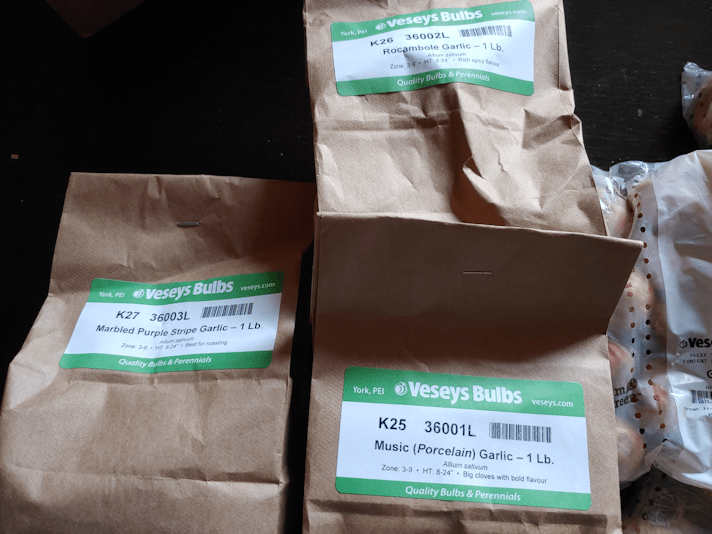
Here are the three varieties of garlic we ordered.

I appreciate how they add things to the label, like “best for roasting” , “rich, spicy flavour” and “big cloves with bold flavour”.

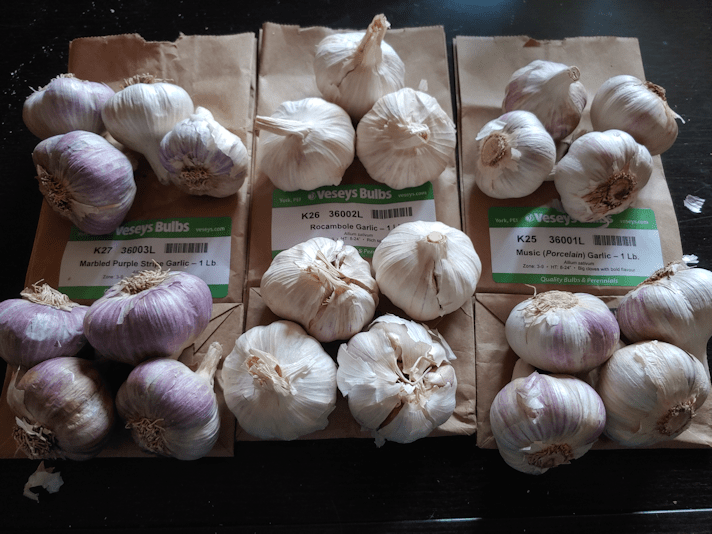
This is what 1 pound of each variety looks like. I wasn’t sure how many bulb heads or cloves that would translate into. That was the main reason I wasn’t sure if the two beds I’d prepared for them would be enough. At least I was reasonably sure it wasn’t going to be too much space! :-)

Today turned out to be a very windy day, so my daughter and I broke apart the cloves inside the house.

Those old take out containers were perfect for keeping the varieties organized!

Also, they made the house smell absolutely amazing!

I had been watering the prepared beds, to try and get moisture down to the layer of compost and straw buried inside. Unfortunately, I wasn’t able to do that as often as I’d wanted to, so I gave them another thorough soak.

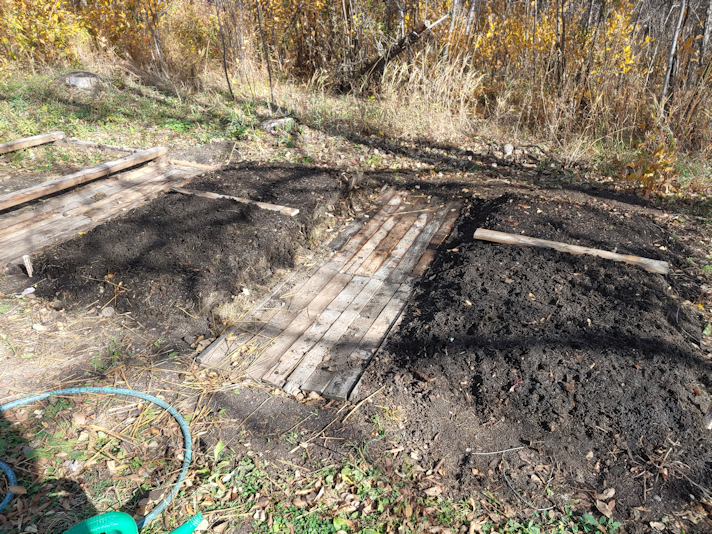
The frame used as a guide to dig 4′ x 8′ beds fit in the next space, inches to spare between it and the ring around the new compost pile. It was ready, just in case I needed a third bed.

Thankfully, I didn’t!

Porcelain Music Garlic

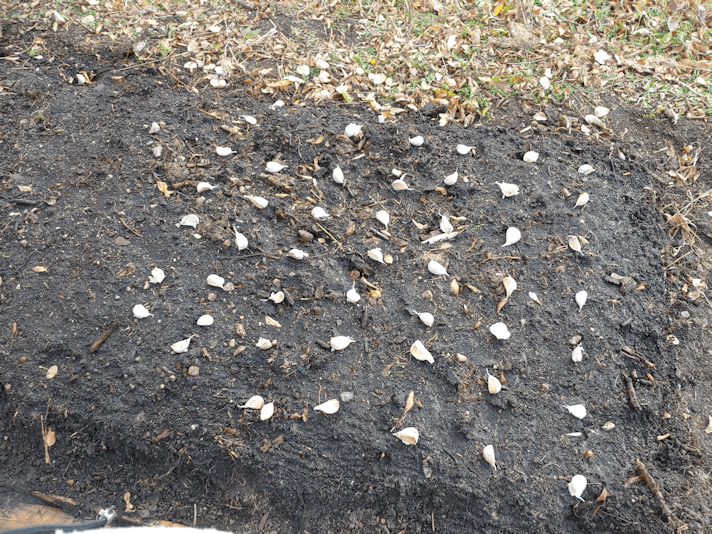
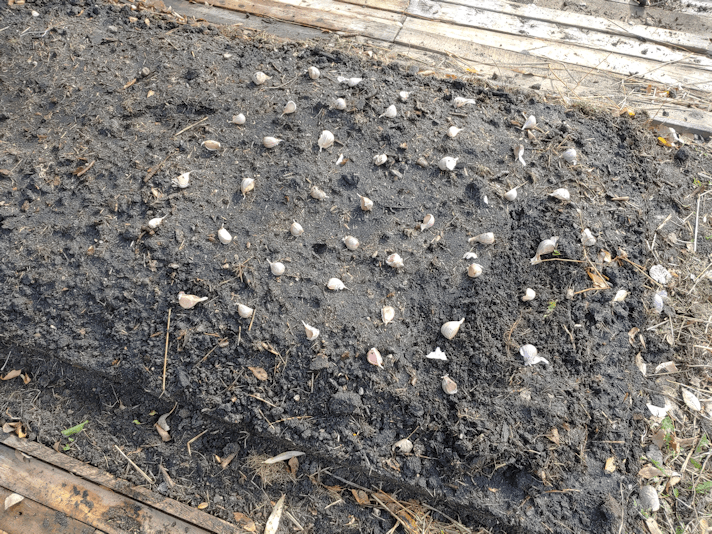
The first variety I planted was Music. Directions for planting hard neck garlic I have looked up, say to plant cloves 4 – 8 inches apart, in rows about 12 – 18 inches apart. Since we are doing beds rather than rows, I laid them out in a roughly 6 inch grid. The soil is so soft here, I was able to plant the by just pushing my gloved fingers in to the correct depth, without the need for any tools.

Purple Stripe Garlic

With the number of cloves we got from the Purple Stripe, my grid wasn’t quite as even at the end. :-D The corners on this bed seemed like they would collapse a bit, so I moved the cloves that would have been planted there to the other side.

Once the two varieties were planted, I added boards to mark where the grid ended, and the third variety, which would be in both beds, started.

Racombole Garlic
Roggenrola (Pokémon) - Bulbapedia, the community-driven Pokémon encyclopedia

The last ones to plant were Racombole. Which sounds like a Pokemon.

Meet Roggenrola.

(image source)

The Racombole turned out to have a lot more cloves, including more smaller ones. It was almost like soft neck garlic that way. So these were planted slightly closer together. More like 4 inches apart, rather than 6. I probably shouldn’t have bothered to plant the smallest ones, but I didn’t want to waste a single clove!

Those boards across the beds also came in very handy to put a foot on to brace myself, making it easier for my short little arms to reach the middle. ;-)

Planting in these beds really demonstrated for me that building much higher raised beds for accessibility is a very good idea!

The next step was to add the mulch, and this is where the wind became a real potential problem.

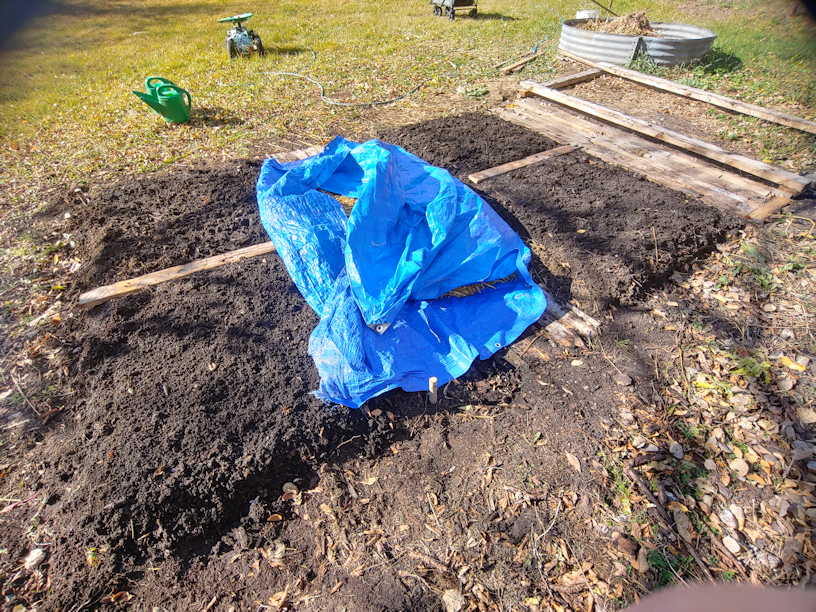
Thankfully, I thought to put the chopped up straw on a tarp.

It was easy to slide the whole thing into the path between the beds. I could then grab handfuls, keeping them low and out of the wind as much as I could, to spread out.

I then had to rush to give the mulch a soak with the hose, more to weigh the mulch down than anything else! As you can see, the wind was already starting to blow the straw away!

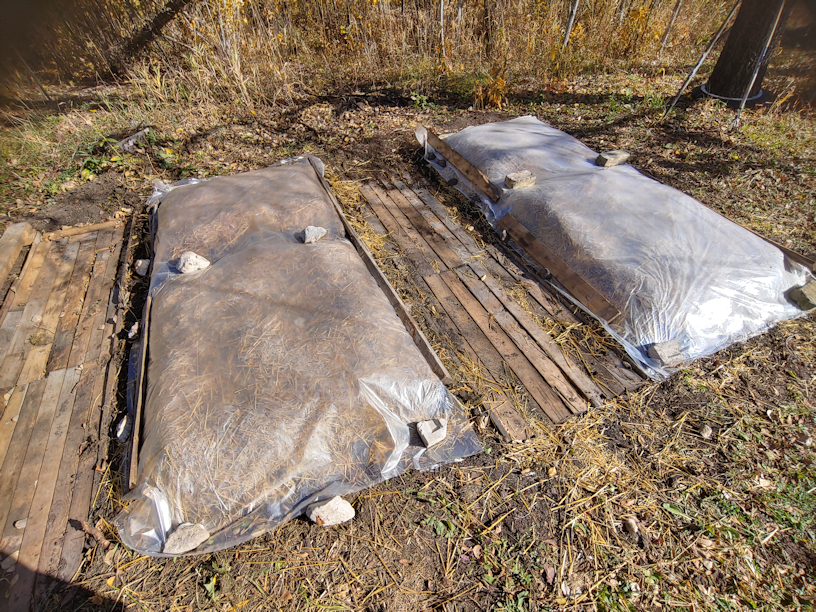
The last step was to cover the beds with plastic – which the wind certainly made challenging! Thankfully, we’ve found a couple of rolls of plastic while cleaning up the house and basements, so we have plenty, and I could unroll it directly on the mulch, adding weights as I did.. The plastic is actually folded in half on the roll, and I didn’t bother to unfold it, so this is a double layer of plastic on the beds.

As you can see, those board across the beds came in handy for the weights, too!

The plastic isn’t something I’ve seen suggested, in general, but we are in zone three, and most of the places I’ve looked up are in at least a zone 6. While October is the month for planting hard neck garlic for them, we probably should have planted these at the end of September – and would have, if they had not been back ordered.

The issue is overnight temperatures. We’re consistently hovering just below freezing. In the long range forecasts, our highs for the day will be just barely above freezing.

There are a few things going for these beds that should help with our planting this late in our zone. Burying the organic matter at the bottom of the beds means there should be some warmth generated as they break down, just as it would have if it were in a compost pile. The mulch will also help regulate the temperatures and, finally, the plastic should help keep things a bit on the warm side. I don’t want it warm enough for the garlic to start sprouting, but they do need to start their growth below ground before winter temperatures set in.

I might remove the plastic later on. Snow also acts as an insulator, plus these beds should not need any watering throughout the growing season. Between normal precipitation and the mulch, they should have enough moisture. Letting the snow cover the beds would give them that first burst of moisture in the spring, and the beds being slightly raised means they should thaw out faster than the ground surrounding them. However, the plastic will also keep the moisture they already have from drying out before the snow falls, and will help the soil warm up even faster in the spring, giving the garlic a chance to start growing a bit earlier. I would then remove the plastic once I saw that greens were making their way through the mulch.

My mother grew garlic in the old kitchen garden, but she never used mulch or plastic or any of the other techniques I am using that irritates her so much. :-D So I can’t go by how she did things, in past years.

So if there are any experienced garlic growers here, I would love to hear how you have done it! And would you leave the plastic, or take it off before the snow falls?

I’m really looking forward to seeing how these do. When it comes time to harvest them next year, we will be looking to save the largest bulbs for planting. Hopefully, we’ll have enough large ones to have more to plant than what we started with.

You just can’t have too much garlic, after all!

The Re-Farmer

In the sun

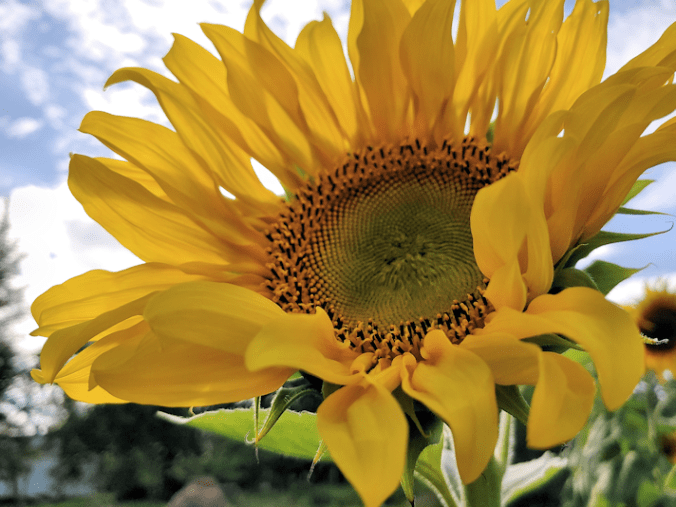
I just couldn’t resist sharing these photos!

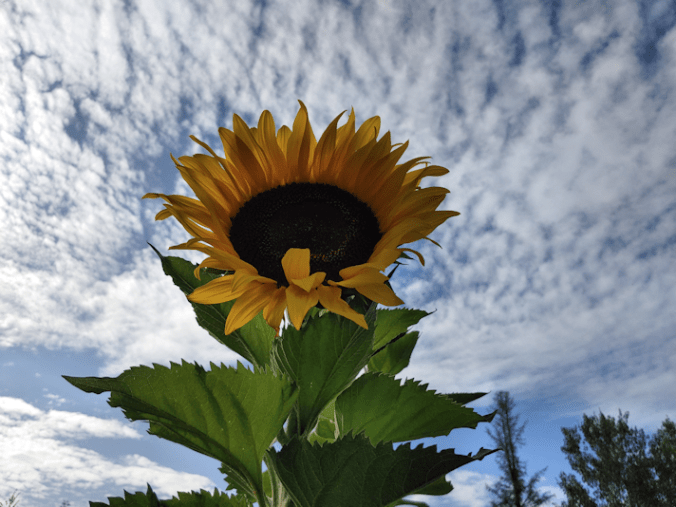
I’m happy to say that last night’s frost seems to have had no effect on the sunflowers at all.

The only leaves with frost damage that I saw were leaves that had first been broken by the high winds we had a few days ago.

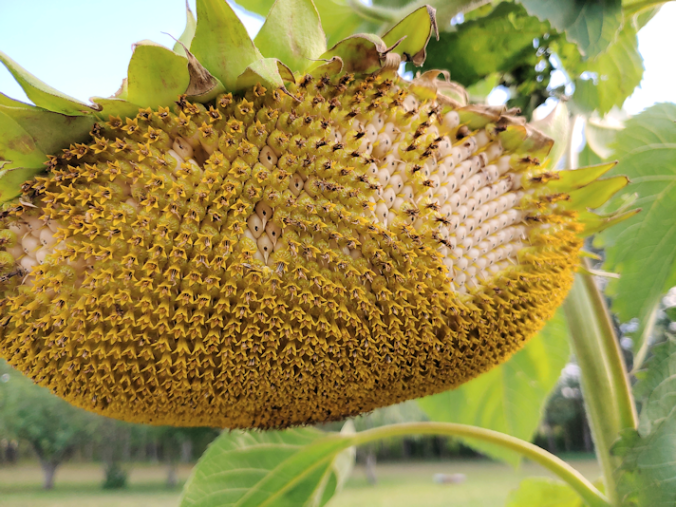
Right now, we’ve got seed heads at pretty much all stages of opening and ripening!

The birds seem to have finally discovered this one. Based on what I researched, I should be able to cut this seed head off and set it up to dry, but in the video I saw that demonstrated this, the guy was able to easily brush off the flower heads from the seeds. That isn’t happening on this seed head at all! The ones that haven’t already fallen off on their own are still attached quite well.

The girls and I will be heading into the city tomorrow, but I might harvest this seed head after we come back. If not then, then the day after. I’m planning to dig up the potato beds as well. We’ll see how the timing of things goes.

Hopefully, tomorrow’s trip to the city will be more productive than today’s – but that will get it’s own post later!

The Re-Farmer

Harvest

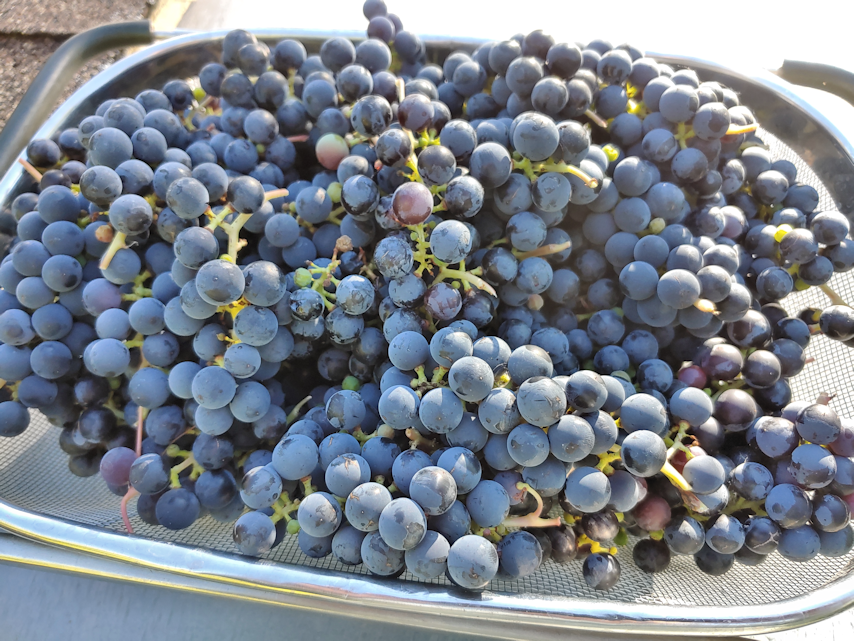
This morning, I finally harvested all of the grapes.

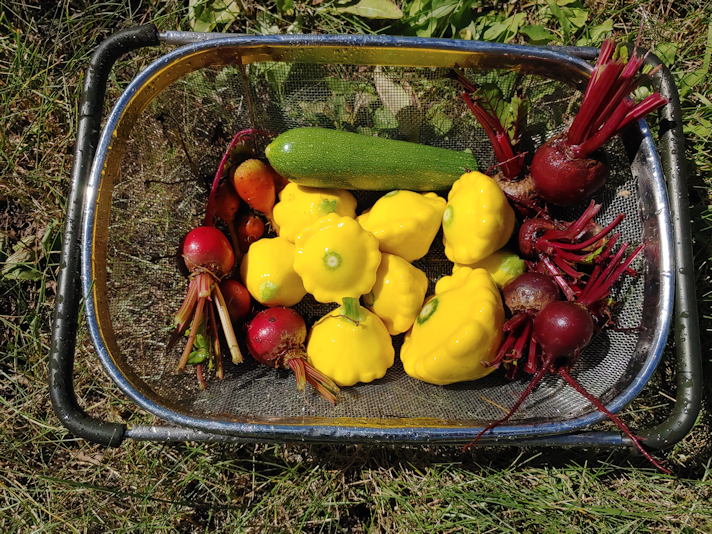
There is actually a zucchini and a couple of patty pan squash under there!

I’m really happy with how the grapes did this year!

Our first summer here, we didn’t even know we had grapes at all, at first. We even had some to pick, then made some small batch jelly with it.

20180816.bowl.of.grapes

What a difference in how they looked, two years ago, and now! The above photo is from 2 years ago. This year’s grapes are easily double in size – and these are not a large fruit variety!

It’s even more appreciated, since after cleaning out and trellising them last year, we didn’t get any grapes at all last summer. Not a one.

In picking the grapes this morning, I did have a bit of a problem. Most of the grapes were on the other side of the trellis. Which is when I realized the trellis was so close to the wall, I couldn’t get at them.

Thankfully, the trellis is just on a couple of bars pushed into the ground for support. I was able to move them a few inches away from the wall, and that was enough for me to be able to get back there to harvest the grapes. I’ll have to go back to them to pound the supports into the ground more, but I will likely do that when I prune the vines before winter.

At the moment, we’re not really sure what we want to do with the grapes, so they’ll be given a wash, then frozen, like we did with the chokecherries. If we do decide to do something like a jelly or syrup, or add them to the must when making mead, freezing them first will make it easier to extract the juice.

I must say, for a variety that clearly isn’t a table grape (my mother doesn’t remember what they were), they taste quite good, just as they are!

The Re-Farmer

Oh, sunny day!

Just check out these sunflowers!

We now have two seed heads on the originally planted giant varieties, opening up.

The first one to start opening is getting big enough, the stalk is starting to droop quite a bit – which means short little me can see it better! :-D

Nice to see the pollinators busy at work on the second one to start opening!

Speaking of pollinators, they are just loving our squash bed right now. So many new flowers. Including in the pumpkins.

Look out big this pumpkin is getting!

This pumpkin mound has two plants growing in it, lots of flowers but, so far, there is just this one pumpkin that seems to be growing. There is another on the second plant, but it doesn’t seem to be getting bigger.

This one is on the plant in the mound I’d planted 5 seeds in, and it took so long to come up, I thought none would germinate. Now, not only is the plant just big as the ones that sprouted earlier, but it has a pumpkin that’s almost as big as the other one!

I still don’t thing there is enough of a growing season left for the pumpkins to fully develop and ripen, but I’m still enjoying how they are doing now.

The Re-Farmer

First!

Among the things we chose to plant for our first garden since moving out here were Yukon Gem potatoes. My view when it comes to planting potatoes is, since they are so inexpensive and easy to find in the grocery stores, we’ll choose a variety that are not available unless we plant them ourselves. Yukon Gem are a yellow flesh variety that is supposed to be more resistant to disease, and are good for both fresh eating and storage.

We only got 6 pounds for our first try, so we’re not expecting to have any to store. At least not for long! :-D

The biggest thing we did differently, though, was to use the Ruth Stout method. When my mother had her garden in this location, she had my dad or my brothers to plow it for her, every year. She had a working tiller (we’ve got 4 or 5 lying about, and none work), and 5 kids to help pick rocks.

While the area did get plowed before we moved here, no one’s been picking rocks for ages, and the plow job was a bad one. So what we’ve got to work with is rock hard soil, full of rocks, and very little equipment. The traditional method of growing and hilling potatoes was simply not manageable.

Among my recommended posts is a Canadian gardener who tried the Ruth Stout method in his own garden. He sowed his potatoes on top of hard, grassy ground, covered them with a thick layer of hay for mulch, and at the end of the season, he had lots of potatoes, and the ground beneath was greatly improved.

I figured it was worth a try!

We didn’t have hay, so I used straw from the bale we got last fall. What we don’t use to cover our septic tank gets used for mulch, and we still have plenty left this year. Mulch was already a big part of our plans to improve and amend the soil.

Well, the potato plants seem to struggle through the mulch, and never got really bushy. They did bloom, however, and at one point I dug around under the mulch to see if I could get some baby potatoes to try.

Even though this was after a rainfall, and the straw was damp, the ground beneath was bone dry. The only potato I could find was the mushy seed potato.

So… I was beginning to think this was a write off. I don’t know if it was because I used straw instead of hay, but it seems like the straw absorbed all the moisture, and it never made it to the soil.

While going through the garden over the past few days, I’ve been watching the potatoes. Some of them have already died back completely.

This morning, I decided to dig up the 3 potato plants that had died back on one end of a potato bed.

After moving the straw, there wasn’t much to see.

That is the seed potato, and no sign of any others. Only after digging, did I find one tiny potato under this plant.

It wasn’t a complete loss, though.

A few others were visible once the straw was moved, and they were looking pretty good.

Time to carefully dig around with the potato fork and see what I could find.

The first thing I noticed was how different the soil was. Even with plenty of rocks to dig around, the soil itself was much, much softer. I even found worms, as well as a single slug. :-D

So even if we don’t get a lot of potatoes out of here, we will have at least improved the soil!

How many potatoes did I find?

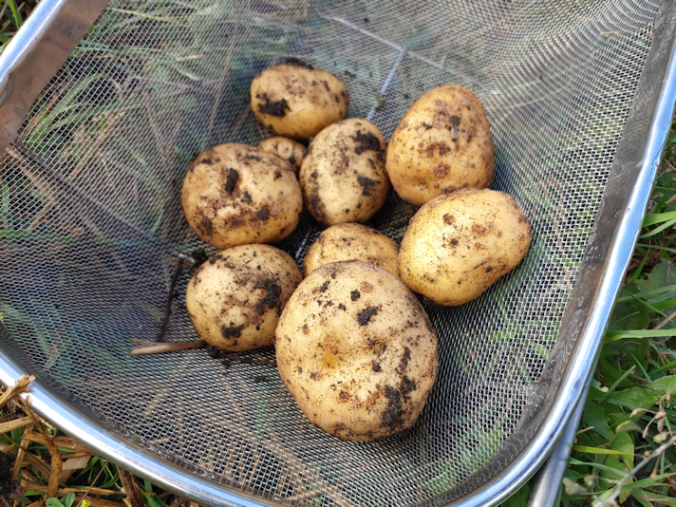
Here they are! Our first potatoes!

I’d say these were from 3 plants but, really, they’re from 2 plants. You can just see the itty, bitty potato that I found by the seed potato of the third one.

Of all the larger potatoes, one had a hole in it from a bug. The rest were solid.

I’m rather pleased! After what I found earlier, I was really wasn’t expecting to find much of anything.

Now to think about how to cook them for supper this evening. :-) I’ll likely make them very plain, so we can get a sense of how this variety tastes, compared to what we usually have.

I’m really looking forward to them!!

The Re-Farmer

Garden stuff update, and shortened term plans

With this being our first attempt to do any gardening since we’ve moved back to my family farm, we are learning quite a lot.

One of those things is, there are a lot more rocks in the old garden than I remember as a kid!

I had broken up some of the hillier parts that were making mowing more “damaging” than “difficult”, and the girls had a chance to go at some of those spots with hoes, to break them up and flatten them out. They were only able to do a few before the heat drove them inside.

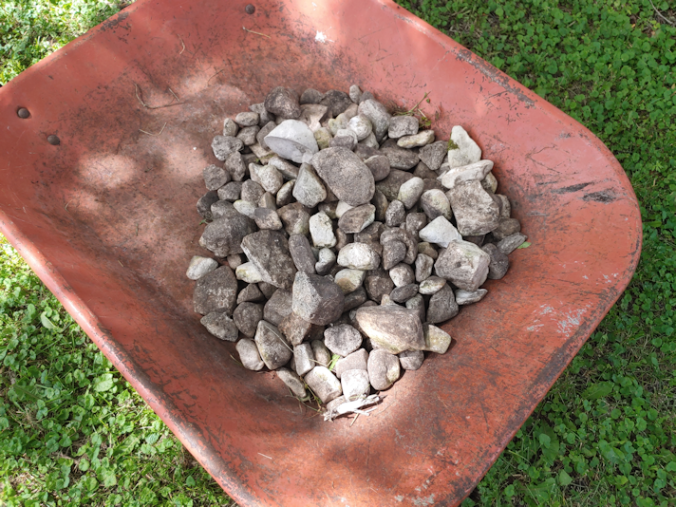
Even so, they managed to also collect these.

When I was a kid, picking rocks out of the garden was a regular and constant thing we did. It kept things manageable. I don’t know how many years ago that particular chore stopped. I know my parents would not have been able to keep it up, and my siblings that were able to go to the farm more often certainly would not have had time to pick rocks, when there were far more urgent things for them to take care of, while they were there.

We are definitely seeing the difference. It’s one of several reasons why I want to go with raised garden beds. Being on the bed of a ancient glacial lake means there will always, always be rocks working their way up the soil with every frost and thaw. It’s also why we are working on using mulch and layers of material to build up the soil. In the old garden area, mulching where we have the squash beds now is the only reason the area is at all manageable.

The squash seem to like it! Here is another type that has started to bloom. Since the other ones turned out to be sunburst squash, that means this is one of the summer surprise variety pack of zucchini. Not a variety I’ve seen grown before; we grew different types of squash when I was a kid, but never one with these mottled leaves. It should be interesting to see what they are!

The cucamelons are now trellised. I did it in stages, adding the bamboo stakes that wouldn’t be needed in one of the squash beds into the openings on the sides of the chimney blocks, then coming back to add the horizontal lines. Finally, I added a vertical line at each of the cucamelons. I didn’t bother for two of the blocks, as it looks like the cucamelons in them are not going to make it. They’re not dead, but they’re not really growing, either.

Once the vertical lines were in place, I placed tendrils around them, to start training the cucamelons to grow upwards. On one side, I added a line up to an overhanging tree branch to keep the whole thing from sagging from the weight. If necessary, the same can be done on the other side.

This is not where we originally planned to grow the cucamelons. I don’t think they can get as much sun as they need in this location, but we couldn’t delay transplanting them anymore. If we grow these again in the future, we will have to be sure to have a sunnier location ready for them.

I am continuing to build up the old flower garden here, and have been adding layers of straw, leaves and grass clippings mostly at the lower end, closer to the retaining wall. Where the soil has been added is where we transplanted the few fennel that came up, and a couple of those have since died. So we have a whole 3 fennel still growing in there! :-D

For all the layers and additions of mulch, things are still working their way through. The rhubarb and some of the flowers, we are good with. Those horrible invasive vines keep coming up, and there’s a type of flower my mother suddenly decided she didn’t want me to get rid of (after I’d already gotten the okay from her and started the layering) that wants to take over the whole area.

What I had hoped for this garden is to use it as a kitchen garden, to grow things like herbs and the like, as well as some flowers. Maybe some lettuces. My mother keeps going on about how she’d planted onions here, and keeps asking me how her onions are doing, then complaining that I killed them all by mulching the area. :-/ The only place I ever saw onions coming up was along one edge, where I’d taken some fencing and car tire planters out, so I’m not sure what she’s taking about. One has actually come up again, this year, but there was never more than a couple, since we’ve lived here. From the state of the rest of the garden, there was no way she had more than those growing, even going back in my memory to what was there when I was a kid. She only ever had onions growing along that south side, but when she talks about it, she makes it sound like most of the garden was onions and garlic.

The ornamental apple trees had been planted to provide shade, I’ve been told. Then there’s the double lilac, the honeysuckle and the roses. One of the roses finally bloomed this year, but being under one of the apple trees the way it is, it’s really struggling. The Cherokee rose, on the other hand, is spreading like a weed.

Those apple trees are going to cause problems for anything we try to grow there.

I suppose they wouldn’t bother me as much, if they were at least an edible apple. How ironic that the pretty much only apple trees we’ve got that don’t show signs of fungal disease, are the ones that we can’t eat from!

The girls and I have been talking about what we’ll do next, when it comes to growing and planting. They really want to start planting flowers. We’re also talking about finding a way to get the nut orchard collection I’d found, earlier rather than later. Trees take so long to grow, that it would be worthwhile for us to start that as soon as possible. The package deal I’d found is for 100 trees, and we were planning to use the old garden area, including the spaces that have always been a mowed border, for that. The package is over a thousand dollars – and that’s with the bulk discount! With that in mind, they will be working to come up with funds to contribute, so we can get it earlier. Maybe even as early as next spring!

Some other things, however, will be ordered for planting this fall.

One of the things we’ve decided to do is use the bed currently filled with the beets and carrots for garlic, after everything in it now has been harvested. We’ll be ordering a collection of 1 pound each of 3 different types.

Aside from the garlic, we will be ordering lots and lots of flowering bulbs.

As much as I enjoy mowing, there are some areas in between the trees that I would rather not be mowing at all! In fact, if we can not mow in between any of the trees, that would be great. It’s really bad for the mower in there!

So I took a bunch of pictures of different areas, then we went through them to discuss what we would be planting and where. The plan is to fill some areas with naturalizing flowers, and other areas will be kept open as paths, with some sort of ground cover that can be walked on, instead of grass.

Next month, along with the garlic, we will order muscari (aka grape hyacinth), a collection of snow crocuses, a double tulip collection, and various other flowers. The muscari and snow crocuses will be mixed together and basically scattered in select areas where we want low growing plants. The taller flowers, the girls will decide on the exact places. Other areas we want to have low growing plants will have things like creeping phlox in them, or hostas in the shadier areas, and even ferns, eventually, but the areas we want to walk on will have things like different kinds of thyme, while others will have mosses. There are some areas we need to keep flower free, so that my husband, who is allergic to stings, can go into them and not worry about bees.

For our zone, once we order our selections next month, we should expect them to be delivered around the end of September.

I bought an auger attachment for my drill with plans to use it when we did the sunflowers. I decided against using it, because of how rocky the old garden area is. It’s actually sold as a tool for planting bulbs. The muscari alone will be 200 bulbs (we’re getting 2 packages), so that thing is going to get a workout this fall! :-)

At least, that’s what our plans are. I’ve long since learned that no plans are written in stone, so we shall see what we actually get to do when the time comes! :-)

The Re-Farmer

Growing things – and not growing things

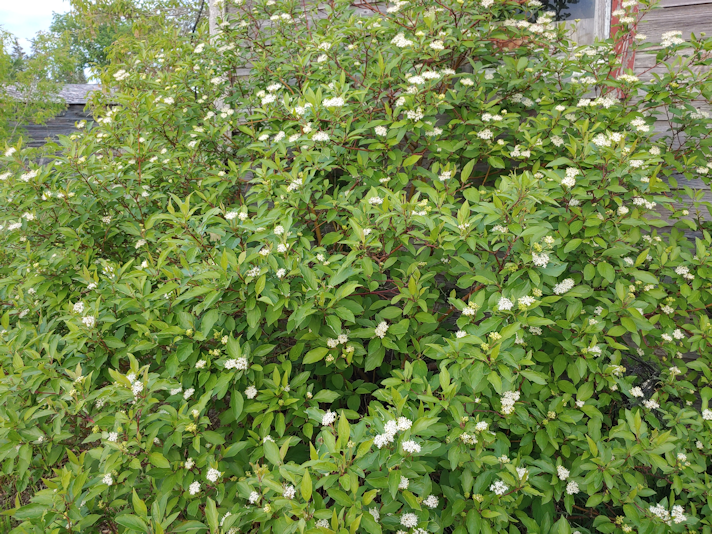
My daughters and I headed out towards the barn last night, and noticed the dogwood growing at the shed with the roof my brother and I patched is now blooming very enthusiastically!
It is such a strong, healthy bush! I’m hoping I can get away with leaving it alone, even though it’s growing right up against the shed. Unlike the maples growing along the side, I don’t think dogwood will grow in a way that will actively damage the shed.

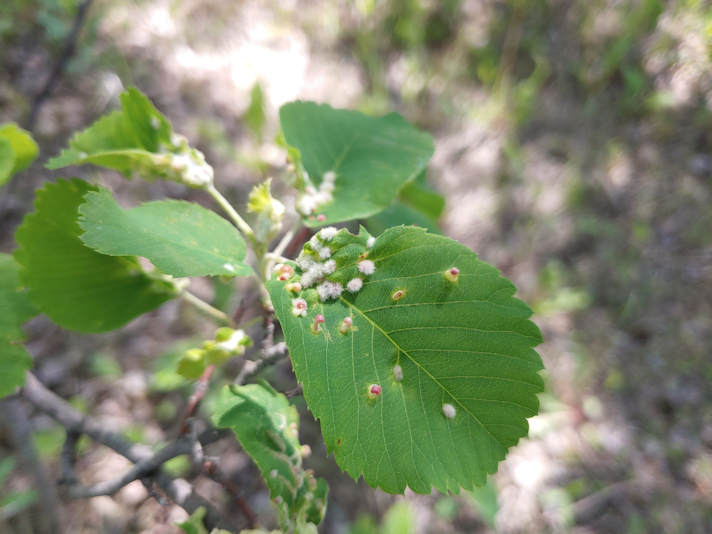
While doing my rounds this morning, I noticed the Saskatoon bushes by the south fence have once again become infested. :-(

This is some sort of insect damage, and almost all the Saskatoon bushes along this area show some signs of it. Last year, there were very few Saskatoon berries, partly because the bushes were just not very healthy, and I believe this infestation is the reason. It doesn’t seem to be on any other type of tree around there, so whatever insect is doing this, they seem to have a preference for Saskatoons.

For the first time since noticing that something has been killing off sunflower seedlings, I found one where the leaves were still there. All the others, there was just a stub of a stem sticking out, and the leaflets were completely gone.

With a few other areas, I don’t expect any seedlings to break ground. The spots they were planted in appear to have been dug into by some critter. It may even have been skunks digging in the only soft soil in the area, looking for grubs, though the holes don’t look like the divots they usually leave in the yard.

My mother’s white lilacs, meanwhile, are at the peak of their blooming period!

Meanwhile, we had covered the squashes and cantaloupes last night, as the temperatures were expected to drop close to freezing. There was no frost warning, but it would still have been cold enough to hurt the squash and cantaloupes. They all looked just fine, when I uncovered them this morning. I’m glad we covered them. It got cold enough last night, that the furnace actually turned on!

After this, we aren’t expected to have temperatures that low again as far as the long range forecasts go. Hopefully, that will be the end of that!

The Re-Farmer