Drying mushrooms – sort of

At our last Costco trip, we picked up large packages of three different types of mushrooms. After using as much fresh mushrooms as we wanted, I planned to dehydrate the rest. I really like the mushroom salt we’d made, but wanted to have mushroom powder, without the salt, to use. The powder is an excellent flavour enhancer.

We had used a dry “gourmet mushroom blend” we’d picked up at Costco to make the salt, but it looks like they don’t carry it anymore. So I decided to just dry our own mushrooms.

I had used a coffee grinder to made the mushroom powder for the salt. The mushroom blend had some very large pieces – large enough that I cut them with scissors before I could put them in the coffee grinder. Even so, some of the thicker, more leathery pieces would jam the blade.

With that in mind, I very deliberately sliced the mushroom pieces quite thin, before laying them out on baking sheets to dry. I had enough button mushrooms to fill one sheet, while the other was filled with shitake and crimini mushrooms. The “warm” setting on our new oven is 175F, but I put it at the lowest temperature it would go: 145F. Then I left the trays in the oven overnight.

This morning…

Well… they did dry very thoroughly!

This is the sheet of white button mushrooms. They had been quite crowded together, and I could barely fit all the pieces in. They are now about 1/3 – 1/2 the size before drying.

They are also thoroughly stuck to the pan.

The shitake mushrooms didn’t shrink anywhere near as much, and were easy to loosen.

These are the crimini mushrooms, which are also very stuck to the pan! I have been using a spatula to try and scrape them off. We’ll keep working at it, little by little, as we are able, throughout the day.

Well, I wanted powdered mushroom, and I’m getting powdered mushroom!

Normally when I dehydrate in the oven on pans, I like to use a cake rack to allow air circulation under whatever I’m drying. Some things are just too small for that, which is why I didn’t use any this time. I was thinking that it might have been better if I’d had a drying screen, but looking at how the pieces have adhered to the pans, I’m thinking they would have done the same to a screen. At least with a pan, I can scrape them off and still use them. If they had stuck to a screen, there probably would have been no way to get them unstuck without damaging the screen.

So in the future, I’ll know to cut crimini and white button mushrooms thicker! I know we should be able to leave them whole, or just cut them in half, but I don’t want big pieces. I’ll have to find that balance.

We’ll just have to get more mushrooms and try again.

Not that we need an excuse to get more mushrooms! :-)

The Re-Farmer

Not quite a recipe: three cheese scalloped potatoes with kielbasa and carrots

While making scalloped potatoes yesterday, I wanted to find a way to use the carrots from our garden I had picked that morning.

If they had been larger, I would have just sliced them thin and layered them with the potatoes, but these were on the small side.

So I got creative.

Here is how I ended up making the the scalloped potatoes.

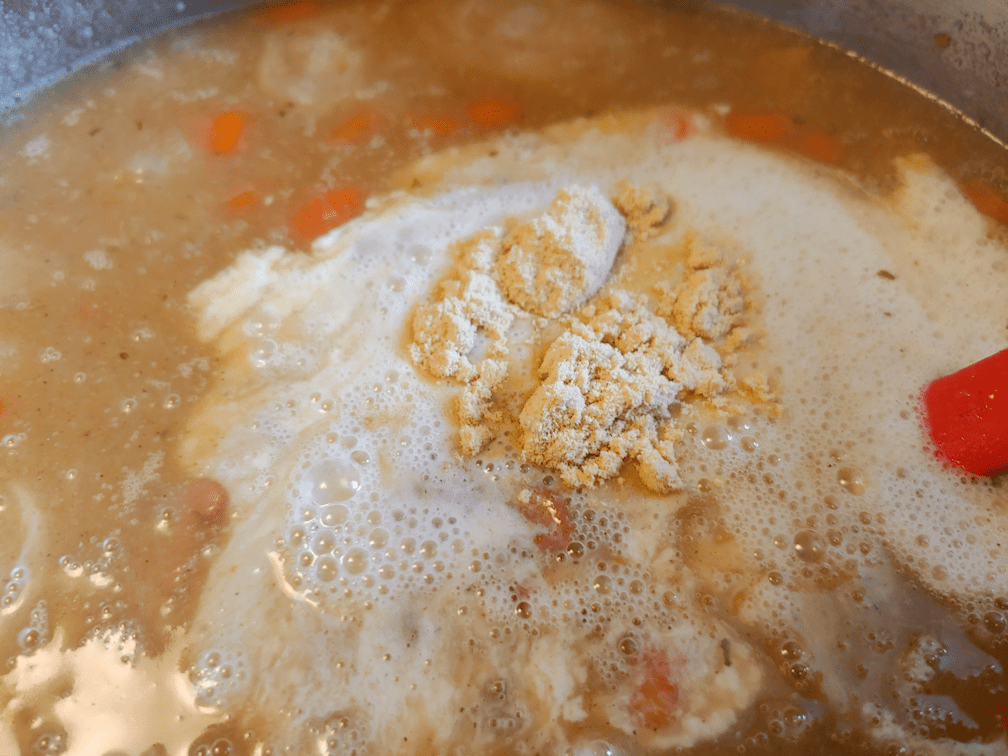
For the cheese sauce, I used 1 medium onion, sliced thin, butter, flour, seasonings, whipping cream and cheese.

We already had old cheddar and grated Parmesan in the fridge. I also picked up a cheese that has recently showed up in local stores that is just awesome. BellaVitano Reserve. We’ve tried the three different varieties we have available, and I picked up Tennessee Whiskey this time. They have an Espresso one that it really good, too. I shredded this, plus the cheddar, and mixed it all together with some grated Parmesan. I used most of it in the sauce, saving some for later.

For the seasonings, I used mushroom salt, freshly ground pepper, garlic powder and paprika. For the liquid, I like to use whipping cream, but it can be made with milk or a lighter cream, though why anyone would want to, I don’t know. ;-)

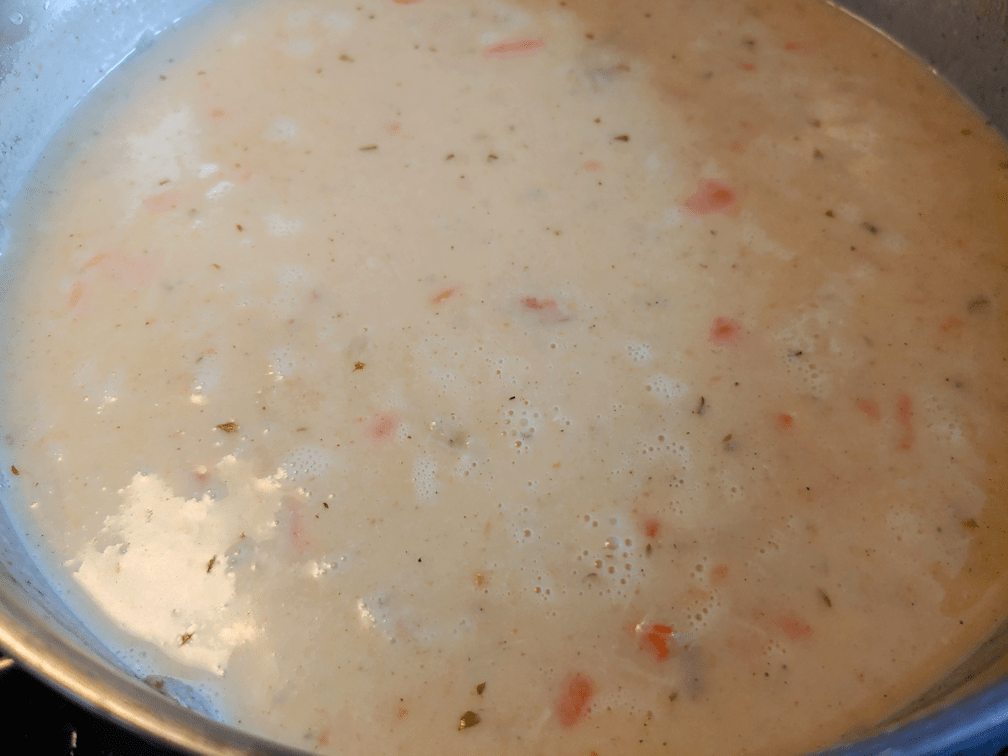
To make the sauce, the onion first gets slowly cooked in about a tablespoon of butter until soft. Then, a couple more tablespoons of butter is added. When that’s melted and bubbling, the flour (about 2 tablespoons) is added and cooked, stirring constantly with a whisk, for maybe a minute. Then 2 cups of room temperature cream is added, little by little, with pauses to whisk it smooth. For the first while, the flour thickens the cream very quickly. After all the cream is added, the sauce is simmered, while constantly stirred with a whisk, until it is slightly thickened. Then the seasonings are mixed in. Finally, the heat is turned off, then the shredded cheese mixture is stirred in until melted. After tasting to see if the seasonings need adjusting, it is set aside.

For the rest of it, I had potatoes peeled and sliced thin and the carrots were peeled and shredded. I didn’t count how many potatoes I used. They were on the small side, so it was probably around a dozen. The shredded carrots made about 3 cups, loosely packed.

In a buttered baking dish, I put a layer of potato slices, topped it with 1/3rd of the shredded carrots, then added 1/4th of the onion and cheese sauce. This was repeated two more times, then the top layer was just potatoes and the last of the sauce.

It then went into a 350F oven for about 40 minutes.

Shortly before the time was up, I took a ring of Polish sausage and cut it into slices. The slices were then laid on the top of the potatoes.

I hadn’t originally planned to use the sausage, but I happened to have it, so why not? :-)

I did have some concerns at this point. We’re still getting used to the new stove, and haven’t used the oven much at all in this heat. When stabbing the potatoes with a fork before adding the sausage, they were still surprisingly hard. I had forgotten to cover it with foil at first, so that might be why.

I covered with foil at this point, but it really should have been added right from the start.

With the sausage on the top, I put them in for another 10 minutes. Most recipes for scalloped potatoes that I’ve seen say to bake for 40-50 minutes, and I was shooting for 50 minutes in total. After that, I added the rest of the cheese mixture on top.

Back in the oven it went, though without the foil. I didn’t want the cheese to stick to it. I then baked it until fork tender.

It ended up taking a lot longer to cook than I expected.

Also, handy hint. Put the pan on top of a baking sheet, in case the sauce bubbles over.

We’ll be testing out the oven’s self cleaning function, next…

:-D

When it was fork tender, I took it out and topped it with chopped parsley I’d picked from our garden that morning.

This was quite an experiment from how I usually make scalloped potatoes. They are usually just the potatoes and onion-cheese sauce, these days. I was very curious as to how the carrots worked.

They pretty much disappeared!

I used some of each type of carrot we have; white satin, rainbow (orange, pale yellow, and white), and deep purple. The purple carrots left colour on the potatoes, but with them being shredded, and such a long cooking time, they all pretty much disintegrated and disappeared into the sauce. I could taste a hint of their sweetness, but that was it.

I would definitely be up to including them again.

The addition of sausage… well, you can’t go wrong with adding kielbasa!

The cheese mixture worked really well, too. That Tennessee Whiskey cheese added to the flavour, but did not overpower.

All in all, this was quite a success!

The Re-Farmer

Recommended: XiaoXi’s Culinary Idyll

Welcome to my “Recommended” series of posts. These will be weekly – for now – posts about resources and sites I have found over the past while that I found so excellent, I want to share them with you, my dear readers. 🙂 Whether or not I continue to post these, and how often they are posted, will depend on feedback. Please feel free to comment below, and if you have a favorite resource of your own, do share, and I will review them for possible future posts.

I hope you find these recommendations as useful and enjoyable as I have!

My very first Recommended post was for the YouTube channel Liziqi. I love the video format that makes it accessible to all, including those who don’t understand any Chinese language. Since discovering this channel, I’ve found a couple others that I now follow that are similar, yet very different. This is one of them. XiaoXi’s Culinary Idyll, which focuses on both cooking and hand crafts.

I didn’t know that, when I stumbled on the first video I saw: How to make delicious braised chicken out of stone.

Out of stone? That certainly piqued my curiosity when it showed up in my feed, recommended by YouTube.

As I started watching the video, I was perplexed. Where is the chicken? What is he going to do with that rock he dragged out of a riverbed?

By the time I got to the cooking part of the video, I was completely hooked.

How do you braise a chicken out of stone?

First, find a rock and carve it into an exquisite cooking pot.

This is a very new channel, less than a year old at the time of this writing. So it didn’t take long for me to go through all of the videos.

The first videos started off with a very different feel. At first, it was straight up cooking videos.

Other videos featured a lot more people and activities.

Then the crafting portion came into the picture – with a sense of humor!

Are you having trouble making traditional noodles by hand? That’s okay – use a machine!

First, cut down a tree…

As I worked my way through the videos, from oldest to newest, I got the sense that the makers of these were kind of feeling their way around on the focus. Where the Liziqi videos started out with just her, filming herself until she could finally hire a couple of people to do the recording for her, these videos appear to have been made with a professional film team from the start.

I’m okay with that.

The format they seem to be settling on is basically just the one guy who first makes a thing, then somehow uses that thing to prepare a food. Both of which are gorgeous.

Then you get to watch him eat. :-D

I readily admit, every time I see the guy working in his shop, I suffer from an extreme bout of tool envy.

You’ll see him doing everything from forging a frying pan (one of the few videos where he cooks food, but you don’t see it being eaten at the end), to weaving various useful objects (I will never look at a bamboo steamer the same way again!), to making things with wood and resin and…

…succulents?

While there is a lot of focus on traditional crafts, there is definitely a modern, even high tech, side to some of these videos.

While these are hardly “how to” videos, they are still quite inspiring – whether you’re looking for ideas on things to make, or ideas for cooking traditional Chinese food!

Or going fishing with a woven, waterproof hat you just made.

Even if you have no interest making the things or cooking the food, the videos themselves are beautiful to watch, and seeing his exquisite attention to detail is a pleasure in itself.

I highly recommend working your way through all of the videos.

You might not want to do it while hungry, though. ;-)

Historical cooking: chickpea soup with fried bread

One of my Recommended posts was for the Historical Italian Cooking YouTube channel. Recently, they put out a new video for a super simple dish made with ingredients we typically have on hand. Today, I was able to give it a try!

Here is the video.

You can also visit this link for the written recipe.

This is an ancient Roman dish; chickpea and leek soup, with a fried flatbread called lagana.

About the only thing we had to go out of our way to get for this recipe was the white wine.

There was one ingredient we couldn’t find, though. Durum wheat flour. Any type of flour is just now becoming easier to find, but there’s no chance of finding any out of the ordinary flours. All Purpose flour, which is what we have, is made with a blend of hard and soft red wheat. Here in North America, durum wheat tends to be used in pastas. It’s the sort of thing we’d have to go to specialty stores to find. I’m sure I could find it in the city, but certainly not locally.

So I substituted AP, since that’s what I had.

First, the soup ingredients.

Another substitute I made was to use canned chickpeas instead of soaking dried chickpeas overnight. The recipe called for 2 leeks, but has almost no other quantities given. I had 2 leeks, but they were pretty massive, so I used 2 cans of chickpeas to balance out the quantities. There’s also the white wine, some olive oil, and caraway seeds ground with a mortar and pestle. I eyeballed most of the quantities based on watching the video. :-)

The soup was started by boiling everything but the leeks in salted water for 10 minutes. Then, the leeks are added and cooking continues for another half hour.

While that’s being done, the flat bread is made.

The flour was the other thing with a quantity given: 300 grams.

Unfortunately, my kitchen scale disappeared. So we had to use a converter. I used a little under 2 1/2 cups of flour. Salt is added, then a dough is formed with some warm water. That’s it, that’s all!

After the dough is kneaded until smooth, the recipe said to divide it into 10 pieces. There are 4 of us in this household, so I divided it into 12 pieces, instead.

The pieces of dough are then rolled out into rough circles.

The recipe calls for olive oil to be used to fry the bread. Olive oil has a low smoke point, so I modified the recipe a bit more. I added a bit of vegetable oil to increase the smoke point a bit. I was just frying in a pot on the stove, so this was more of a safety issue.

Once the oil was hot, the rolled out dough was fried, one at a time.

The dough bubbled up a bit in the video, but not into big dough pillows like this! :-D This could be because of the different type of flour, or even because of the oil blend.

Not that I’m complaining! :-D

These fried up very quickly. Maybe half a minute on each side, to get them to a golden brown, before placing them on paper towel to drain. The bubbles cracked on a couple of them, allowing oil to get into the pockets. That took a fair bit of draining! The bread was finished well before the soup itself was.

They look absolutely amazing!

Taste test time!

The soup itself was very mild tasting. Possibly because I used more water than in the recipe. I couldn’t distinguish individual flavours of the caraway or the wine, for example. No one ingredient overpowered the other.

The lagana bread had a surprising amount of flavour for something that is just flour, salt and water! The outside was crispy, while the inside was chewy. It went incredibly well in the soup. A real balance of flavours. Making one without the other would not be as good as the two together.

This is a remarkably easy soup to make. The lack of quantities in the recipe made it a bit more interesting to work out, but that just gives room to adjust to one’s one preferences!

I can definitely see us making this recipe again!

The Re-Farmer

Lemon cheese, end result

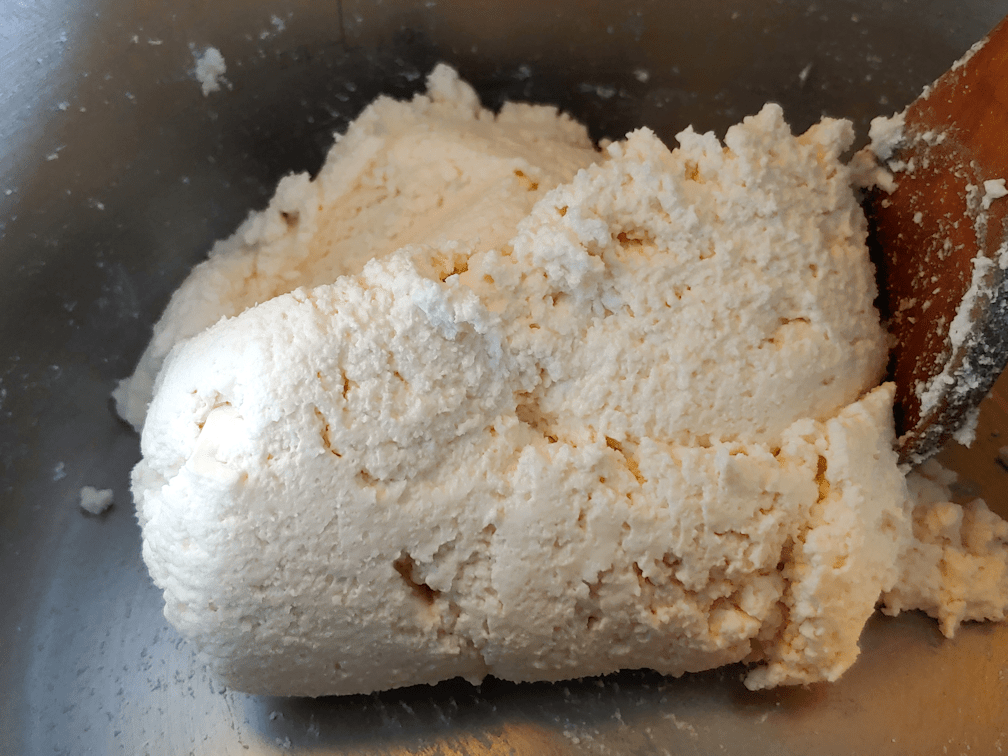
Here is how the lemon cheese turned out! :-D

This photo was taken right after the bag was taken down from the hanging rig.

Of course, I gave it a taste.

It has very mild in flavour, as to be expected with a cheese like this. Lightly salty – I probably could have added maybe an extra half teaspoon, instead of the quarter teaspoon or so I added, to adjust for using 4L instead of 1 gallon. It has a light, almost creamy texture to it.

Because it’s so loose, I squeezed it together in the cheesecloth a bit, then put it back into the colander over the bowl, put a plate over it and weighed it down with my stone mortar. Just for a couple of minutes, to make it easier to transfer into a container.

Since it’s such a fresh cheese, it will need to be finished quickly.

I don’t think we’ll have a problem with that! :-D

Then, because I had a big bowl of still-warm whey handy, I made up a double batch of bread, using whey for the liquid. This works out really well. Yeast seems to really like whey. The dough has a softer feel to it while kneading, and the finished bread is lighter, with a delicate crumb and a lovely flavour.

We’ll be storing the rest of the whey in the fridge to use in other baking. It would be awesome in a sourdough bread!

I’m quite pleased with the end result of this cheese. Definitely something I will be making again, and maybe playing around with adding things, like fresh herbs, to it at the salting stage.

The Re-Farmer

Easter preparations and successful finds

I’m happy to say that I was able to deliver a little care package to my mother for her Easter. I called right after dropping off my daughter to see if she needed anything at the grocery store, but she was able to order everything she needed from the grocery store and have it delivered. Which means they were able to accommodate her in regards to her not being able to pay over the phone. I thought that might be the case, as the grocery store near her caters to a lot of seniors in similar situations.

When I got there, she met me at the door, since her building is on lockdown. Technically, I could have visited her and it would have been okay, but the less people from outside come in, the better.

After the drop off, I went to the grocery store near her place and scored big time!

Not only did they have big bags of cat kibble, but they were well stocked in pretty much everything! They even had a big display of large pack toilet paper, though they were selling for over $30. We are fine for that, so I didn’t get any. Their yeast section was completely full, and I was able to get a nice big jar of the traditional (slower acting) yeast. Between this, what we’ve already got left at home (even after baking day, yesterday) and our sourdough starter, we’re set for a good long time. :-)

Finding a candy thermometer was just bonus! I won’t have to make to with a meat thermometer, when I try a new cheese recipe after Easter.

Once home, I got a couple of pots doing with more eggs; one with the tea dying mixture, and the other with onion skins. We’ve been collecting onion skins all year, and there was so much, I couldn’t even use it all. (click here for how we do our three different types of eggs)

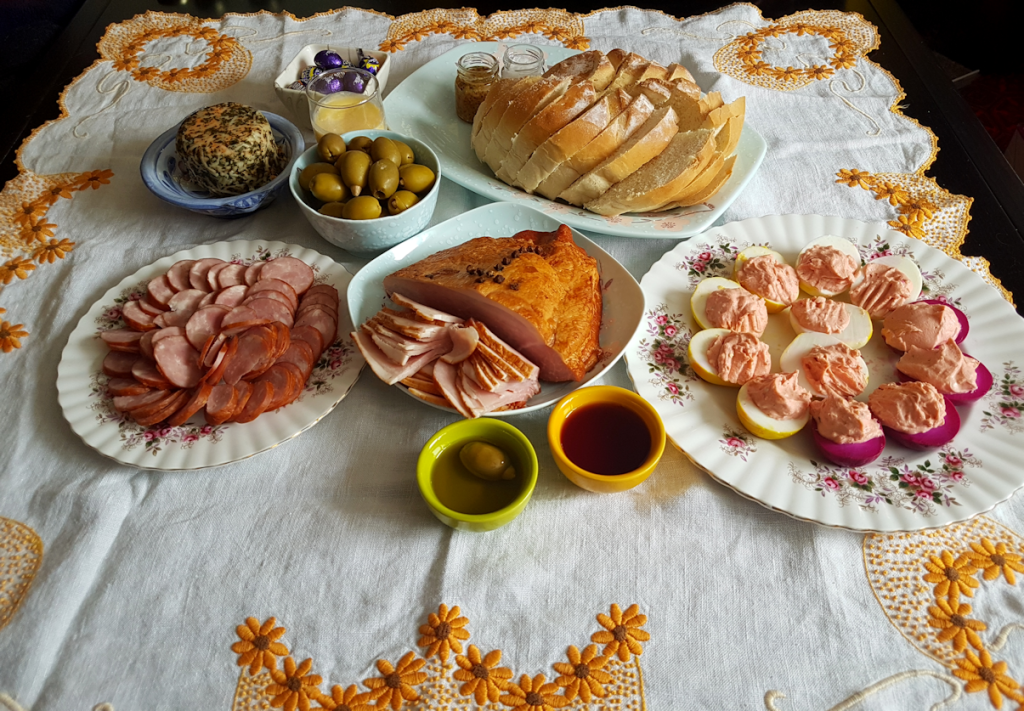
Once the eggs were at the stage where they could be left unattended, I got the dining table all pretty.

Which has fascinated the cats.

Cheddar, at least, was polite about his curiosity. He just sat on a chair and rested his chin on the table cloth. I’ve already found Two Face, just sitting on the table, like a bread loaf.

Once the table was cleared of cats… again… I worked on preparing other basket ingredients.

Each of the items has symbolic significance, some of which are old traditions for our Polish family, while others are traditions we added ourselves. Along with the bread, which symbolizes Jesus (the “bread of life”), and the eggs, which symbolize the Resurrection and new life, we have:

  • ham; to represent joy and abundance, marked with a cross made of cloves
  • sausage; representing the favor and generosity of God
  • butter; to remind us of the goodwill we should have towards all things. We like to make different flavored butters. This year, I’ve added parsley, garlic granules and paprika. Like the ham, it’s marked with a cross of cloves, and the fish shaped bowl it’s in is a reminder for us to be “fishers of men”.
  • salt; in one of the tiny jars, it symbolizes prosperity and justice, and is a reminder to be the “salt of the earth”.
  • cheese; this year, marinated goat cheese, but we’ve used many different kinds of cheese over the years, as a symbol of moderation
  • vinegar; the other tiny jar has red wine vinegar, as a reminder of the wine vinegar mixed with hyssop that Jesus was given to drink, just before he spoke his last words. This is one of our own, added traditions.
  • olives and olive oil (in with the marinated goat cheese): this is another of our added traditions, symbolizing wisdom, peace, and hope.
  • Not pictured is the horseradish, which symbolizes the pain of crucifixion. Traditionally, it can be made into a paste with beet juice, with the sweet juice representing the joy of resurrection. We’ve included the beet juice with our pink pickled eggs.

Other items that would be appropriate to add are a candle, a bottle of wine, and sprigs of greenery.

By the time we’re done, there’s enough food in the basket to feed us for a couple of days! Typically, we eat the blessed food as a brunch on Easter morning.

Gosh, I love making these baskets so much!

Now it’s time to check on the eggs, and prep the horseradish! :-)

The Re-Farmer

Easter preparations: baking day and frozen ground

Today, while the girls continued to work on the basement (I have yet to go down to see their progress!), I worked on baking our Easter bread.

Then, since I was baking anyway, I made some sourdough soda bread, and another double batch of what has become my usual standby, a basic bread recipe modified by the addition of rolls oats and various seeds. This recipe, plus chia seeds and minus the rye flour. Lately, I’ve also included hemp hearts as well, which adds a really nice flavour and texture. Thanks to my dear friend, I even had yeast to use for the non-sourdough recipes. :-)

In this photo, the braided loaf is for our Easter basket, and I made 4 mini loaves with the other half of the recipe. In the back, left, are the loaves of sourdough soda bread. Which did NOT want to rise today. The house was a bit too chilly today, even though it has been warming up again, outside.

In between batches and rising times, I also made a soup using one of my meals in a jar mixes with sausage. The mix had brown lentils, red lentils, orzo pasta, turmeric cous cous, dehydrated vegetables, dehydrated onions, mushroom ketchup powder, 1 cube of vegetable bouillon and 1 cube of chicken bouillon.

The seedy bread was shaped into mini-loaves that made excellent bread bowls.

This was soooo good to break my Good Friday fast (for health reasons, I do not do a total fast).

While doing my rounds this morning, I checked the ground near the power pole in the old garden, where there is horseradish planted. It was rock hard, but I hoped that things would have warmed enough to dig some up by this evening.

After scraping aside last year’s leaves, I found the horseradish has already been trying to grow.

The ground was certainly starting to thaw out by this time, but the soil here is so full of rocks, it didn’t make that much of a difference. I can’t understand why my mother planted these here. For a plant that is grown for its roots, rocky ground would have been something to avoid. The area has always been much rockier than the rest of the garden; so much so, my parents eventually stopped using it completely. The base of the power pole, however, has rocks and gravel packed around it, so it’s even worse than anywhere else.

I did manage to break off a couple of pieces, then decided to see what I could find in the other spot my mother had planted horseradish; at the base of a spruce tree near our feeding station. I had hoped that, between the wood chip mulch and possibly a bit more sunlight, the ground would be thawed out more.

The horseradish here isn’t as big or prolific, but I could see where it was starting to grow.

I did scrape away the wood chips, but it’s still pretty hard to see.

There isn’t as much growing here, and they’re much smaller, but the ground was indeed a bit softer, so I got a couple of decent chunks out. The ground isn’t rocky here, but of course, there’s plenty of tree roots. Again, I don’t understand why my mother chose this location.

After much washing, then scrubbing with an old tooth brush to get into the crevices, I now have several chunks to use.

That big piece with three sprouts? I could potentially plant each of those, and have three fresh plants.

I think the two little ones will be enough for my mother. If all goes to plan, I hope to swing by her place tomorrow with a care package for her. I’ll leave these as is, so she can prepare them as she wishes – or plant them in her own little garden plot outside her window. :-)

We only need a bit for our own basket. I have been thinking of planting horseradish in softer ground; perhaps in a raised bed or planter. Something that will allow a straighter root to develop. If I can think of a good spot for that, I might do that with the big piece. My mother always kept a piece of horseradish, with the green parts still attached, in the basket to be blessed with the rest of the food, specifically to share with friends to transplant, or to transplant herself. I’ve tried it myself a few times, but the only one that succeeded (and didn’t get dug up by squirrels) was the one I’d included with our Easter basket the last time we were able to visit with my father, 5 years ago. I took it back with us to plant when we got home, and it actually survived. It got left behind when we moved, of course.

Normally, we would finished putting all our basket contents together tonight, in preparation for taking it to church for the blessing tomorrow morning, but since there is no church blessing, we’ll finish arranging the basket tomorrow and do our own blessing whenever we’re ready. I still want to do onion skin dyed and tea dyed eggs, which will be the last things that require any cooking.

For now, I think I’ll head down into the basement and see how things are looking after all my daughters’ hard work! :-)

The Re-Farmer

Preparing for Easter, and an easier way to peel eggs!

One of the bonuses of our move to the farm I grew up on is that we could take part in a childhood tradition; the blessing of our Easter baskets. It was many moves and many years before we were able to find a Polish church that did basket blessings, and be able to take ours in.

That didn’t stop us from doing our traditional baskets. It was one of my favorite traditions, growing up, and even when we stopped going to church for many years (for a variety of reasons), we still did our baskets and simply blessed them ourselves.

Which is what we’ll have to do this year, since none of the churches are holding any sort of services during the lockdown, other than online.

We did start some of our preparations already. For the cheese portion of our basket, we decided to do marinated goat cheese again. I made up two 250ml canning jars for our basket (I’m hoping to get one of them to my mother, along with some fresh horseradish), plus two 500ml ones, just for regular eating.

Tomorrow, I hope to make some fancy bread for the basket. Probably a Braided Egg Bread again, though I haven’t completely decided yet.

Today, I started pink pickled eggs; one of three ways we like to do eggs for our basket. The recipe for pink pickled eggs that I followed before is here. This year we, strangely, had a hard time finding anything other than shredded beets at the grocery store, so I modified the recipe a bit. I found 1 small jar of tiny pickled beets and used the juice from that to colour the liquid, plus sliced some of the beets and included them in with the eggs. With so little beet juice, I figured the addition of the beets themselves would help add colour. The other change I made was to include the fresh herbs I had left over from making the marinated goat cheese; thyme and rosemary.

When preparing eggs for the basket, we always cook way more than we need, so that we can use only the most perfect eggs for the basket.

Which is difficult, when the eggs need to be peeled first. There have been times when we’ve boiled a dozen eggs, and not a single one could be peeled without tearing apart!

So today, I tried a combination of “hacks” to get the job done.

The first is to add baking soda to the cooking water. Yes, it does make a difference.

The next is to cool the cooked eggs down as quickly as possible. Putting the eggs into an ice bath is one way to do it, but our well water gets so cold, we can get away with using tap water.

The final one is something I tried for the first time today, and it worked beautifully!

Shaking them in a jar.

Okay, so it wasn’t quite that simple. :-D

I grabbed a small canning jar, though any jar (with a lid) just a bit bigger than an egg would work. Theoretically, you can use a small glass and cover the top with your fingers, but that would get pretty messy. The first jar I tried was a 500ml (pint) size, and I found it a bit too big and ended up using a 250ml jar instead.

Leaving the eggs in their cold water soak, take one egg and put it in the jar, along with enough water to fill the jar about half full or a bit more. It can be helpful to crack the shell a bit before putting it in the jar.

Then, put on the lid and start shaking. Vigorously, but not too violently!

The shaking does a few things. The most obvious is, it cracks the shell quite thoroughly. This is where you have to find a balance on how much water is in the jar when you shake it. Too much, and the water protects the egg from cracking as much. Too little, and the egg can get bashed apart.

The shaking also separates the membrane from the white of the eggs – which would have already been spurred along by the addition of baking soda to the cooking water, and the quick cool down. And finally, it lets water work its way between the membrane and the egg white, making it much easier to remove the shell.

After a thorough shaking, dump the contents back into the water with the rest of the eggs. While holding the cracked egg under water, start peeling away the shell. If it still sticks, do the shake again. :-)

Out of the package of 18 eggs I cooked, I got 8 that were perfect enough for the basket; two for each of us.

This is what happens when an egg is shaken up too vigorously.

Here are the best eggs, ready for the fridge.

They should have at least 3 days to marinade in the pickling liquid, which is just in time for Easter.

Of the remaining eggs, there was one that broke during cooking, which left another 8 eggs suitable for pickling. I did up another container the same way, minus the beet juice. It still has beet slices with the eggs, so it will have just a hint of pink. That one will be for regular eating.

It is going to be a delicious Easter celebration this Sunday! :-)

The Re-Farmer

No-Knead Focaccia

My daughters were sweethearts and baked the new recipe they found. It’s the Shockingly Easy No-Knead Focaccia from Bon Apetit.

We did make one change in the recipe. We didn’t have any extra virgin olive oil. We did, however, have avocado oil, so we used that, instead.

It worked very well!

We also didn’t have the type of pan they recommended. We have 9×13 pans. Just not with high sides. So we used a slightly smaller glass pan. The dough has a second rising in the pan, and was very close to overflowing before it was vigorously poked at to deflate it.

For a recipe with no oil in the dough, it uses quite a lot of oil! And butter. The baking pan is buttered, first, then oil added, then the dough put in.

Just before putting it in the oven, more oil is drizzled over the top, and sprinkled with Kosher salt. After it’s baked, butter is melted with garlic, which is drizzled on top.

The end result is both beautiful and delicious. That salty, buttery, garlicky topping is sublime! The texture is moist and chewy, and there were some pretty large bubbles in there! Even the bottom crust has a very nice texture, thanks to the butter and oil combination.

I rather like avocado oil better than olive oil in a lot of things, but it’s frightfully expensive stuff. Costco has it at much better prices, at least.

This recipe is definitely worth trying out! It has rising instructions for both an overnight dough and a same day bread.

Now excuse me, while I go back to enjoying this Focaccia!!

The Re-Farmer

Bread Baking Day – all done!

Sometimes, I think we really need to do bread baking more often.

Then I remember how much clean up is involved. :-D
No matter! We now have two kinds of freshly baked bread done.

Here’s how the seedy bread turned out.

This is how it looked after only 1 hour of rising time. The bowl it’s in is pretty huge – too big to fit in our kitchen sink (which makes washing it a bit of a challenge! :-D ) – with plenty of room for this 4 loaf recipe.
The timing of things works out really well. I use half the dough to make buns first, leaving them to rise while I shape a couple of loaves. Once those are done, I star to preheat the oven. By the time it’s heated up, the buns have risen enough to go straight in. Once they’re out, the loaves have had enough time for their second rising. When those are done, the overnight sourdough loaves are ready to go into the oven. No wasted time in between, making for more efficient use of a hot oven.

They came out quite beautifully, too! Such a tasty bread, with a really nice texture. I love the bit of crunch the seeds add to it.

The second rising for the sourdough loaves was probably about 4 – 4 1/2 hours. The first rising was probably about 11 or 12 hours.

This is how they looked, just before I put them in the oven. They definitely rose more than the first time I tried this recipe, so the modifications made quite a difference, but still not rising as high as variations that use added yeast.

Is it worth it?

I think so.

The actual working time to make this bread is low. It’s mixed at night, then kneaded for 10 minutes the next day. It really doesn’t need a lot of attention.

The loaves came out so smooth and gorgeous. None of the cracking you can get when using an added yeast bread, since there’s no sudden rise in height in the oven.

The bread itself has a slightly thicker, sturdier crust, while the crumb is incredibly soft, tender and fine in texture.

Reducing the amount of sugar was definitely a good move. The sourdough flavour was more dominant this time, whereas the last time I tried this recipe, the sweetness was more dominant. I think adding that little bit of baking soda helped with the rising, too.

I’d still prefer a more “sour” sourdough flavour, but that has more to do with our starter than with the recipe. We’ll be making more of this one, that’s for sure. I think I’m satisfied with it enough that, next time I bake it, I’ll post with the tweaked recipe.

Tomorrow is going to be another baking day, though this time for my daughters. I look forward to seeing what they’re planning to make. :-)

The Re-Farmer