I admit, I’m writing this post in the morning, instead of the evening, as a distraction. Normally, after finishing my morning rounds, I would be making breakfast right now.
I’m hungry. And thirsty.
Unfortunately, I’m in the stage of my pre-op fast where I can’t even drink water.
My daughter is definitely doing the driving on the way in. I’m starting to feel quite light headed and ill, and my hands are getting shaky – and we aren’t leaving for another hour yet!
So, here I am.
I am quite happy with the harvest I got this morning. The beans didn’t get picked yesterday, so there was quite a lot.
These are quite nearly the last of the yellow beans. From what I could see, we won’t be getting more than a few green beans over the next while. The purple beans, however, are at their peak. I don’t expect to pick this many again, but the plants have lots of developing pods visible.
I also picked the one Early Prolific Straightneck squash that was ready. There is a second, smaller one and possibly some female flower buds, spread around the three plants.
Not very prolific, but then, none of the summer squash has been prolific this year. I can see female flower buds on the green pattypan squash plants, and there’s a single Golden Zucchini squash that should be big enough to harvest in a few days. No lemon squash. No Yellow Scallop squash.
Then, out of curiosity, I harvested some Hollow Crown parsnips. The plants are huge and I was curious to see how large the roots were.
Small. They are very small. Parsnips have a ways to go in the season, though, and are a cool weather crop, so maybe they will be better as we approach fall.
I haven’t tried to pick any of the beets. Their greens are huge, which we’ve left, because we are not big on beet greens. Beetroots, however, form right at the surface of the soil, so I can see how they are. These seeds were from a variety mix, and some of the plants look very, very different from others. I can see some roots forming from the red varieties, and they are really small. Other varieties that I am guessing are yellow, orange or white varieties, I can’t see any roots forming at all. Which is so very strange. Particularly for this bed, which has good loose soil, and gets “extra” watering from below, any time the sump pump goes off. Which hasn’t been often, lately, but with how wet things were earlier in the growing season, anything in this bed had a huge advantage.
Well, we’ll see when it comes time to harvest everything and clean up the beds.
So much for that one Yellow Swiss Chard that I was leaving to go to seed. Apparently, the deer like Chard.
The motion sensor noise maker is still there, so I moved it over to the former garlic bed, where the Yellow Swiss Chard is. Hopefully, the closer proximity will help? We shall see.
Meanwhile, my daughter just popped by and we are almost ready to head out to the hospital. Leaving early is good, since there is road construction on our route, so we’ll be heading out fairly soon.
I’m so looking forward to getting this surgery over and done with!!!
I almost forgot to get a “before” picture, so the first image is after I’d already cut away a couple of cabbage heads.
I got a dozen heads loaded up in the wheelbarrow. I left the stems and outer leaves for now. Those will be composted into the bed, later on.
Everything was very wet with dew, so I laid them out on the table under the canopy tent to dry. They have since been brought in, but are still a touch damp, so they’ve been laid out in the cat free zone. A couple of them have very loose heads, so those will be used right away. My older daughter was thinking of making some cabbage soup, or even just roasting them.
We won’t have any purple savoy cabbage heads to harvest. None have formed. The leaves, however, are still edible. The youngest ones, at least. So I might find something to do with those at some point.
After the cabbage was laid out, I got the wire mesh divider from the basement and set it up on a couple of sawhorses, then took all the garlic hanging around the perimeter of the canopy tent down. They were rather damp, too, and one bulb was quite soft, so that one got set aside. The rest were freed from the cord they were hanging from, and laid out through the wire mesh of the divider. I hope that this will allow them to finish curing properly, and they didn’t get so damp from the rain that they rot or start sprouting, instead! The largest ones will be set aside for planting this fall.
Also, Gouda photo bomb. 🧀🐈
The insect netting that was protecting the cabbage actually had things growing through them along the edges of the bed. I got as much as I could out, while stretching the net out to full size on the grass. Later in the afternoon, I hung it on the clothes line and took a hose to clean it off a bit, before it gets folded and rolled up for storage.
I think I will harvest all of the Golden Boy celery next – except for the two that have gone to seed, which I will leave to collect later. My older daughter seems to be mildly allergic to fresh celery, so we haven’t been using it a lot. I’m thinking to dehydrate it, then powder it to make celery salt.
Hmmm… There’s only so much I can fit into my oven to dehydrate, so maybe I’ll just harvest a couple of bunches at a time to dehydrate. I’ve dehydrated celery before and it’s amazing how small the pieces get!
I was able to get a new handle for my garden fork today, so I’ll be able to harvest the potatoes relatively soon, once the ground is dry enough.
Or I’ll get my daughters to do it, depending on how I feel after my surgery.
Today has, somewhat surprisingly, been a day of progress.
Surprisingly because I was dealing with the pains on and off today. I was fine when I went to bed, then got awakened by the pain in the wee hours of the night. I managed to finally fall asleep and it was gone by the time I got up, but was back again after I did my morning routine and was having breakfast. Then it went away.
There just doesn’t seem to be any rhyme or reason behind it. I really, really hope the surgery next week puts a stop to this!
This morning, I did a head count and there were 12 cats showing up for breakfast. When I counted again at the second feeding of the day, there were 14, plus the kitten showed up later.
I did contact the rescue about needing to adopt the cats. They recommended I contact other rescues as their resources are stretched really thin right now. I wasn’t asking for fostering. Just if we could post them on their website, but it doesn’t look like they can even do that right now. The problem is, I’ve tried contacting other rescues before and they don’t cover our area. The only one that did turned out to have… issues. The only good thing that came out of that is we connected with The Cat Lady, who helped us so much while she ran her own little rescue.
I already know none of the rescues are doing intakes right now. Everyone is full. So… we need to figure things out.
Anyhow…
As usual, after feeding the cats, I went through the garden. I am just so happy with how the Arikara squash is doing!
I’ve got my hand in the second picture as a size reference. We’ve got one squash that’s growing. A couple others have withered away, and there’s one that I’m not sure is going to make it. It’s bigger that the size of the others that withered, but it doesn’t seem to be growing. There are some female flower buds visible, too.
The winter squash at the chain link fence are looking good, with lots of male flowers blooming. There was one that had a single female flower that dropped before it ever opened. Currently, I see a different winter squash with a female flower that will hopefully blossom and at least have a chance to get pollinated.
The Super Sugar Snap peas that were planted later at the chain link fence bed are blooming and forming pods now.
The yellow bush beans had matured faster but are winding down now, yet are still just as prolific as the green and purple beans that are pretty much at their peak right now. There are fewer green and purple bean plants, too.
Next year, I hope to remember to try using the wire tomato cages on the bush beans, like I do now for peppers and eggplant. They seem to need that extra support.
Bush beans do great in the high raised bed, but it isn’t big enough. We have enough beans for eating fresh, but not enough to freeze or can. We definitely need to grow more beans. Normally, I’d be starting to harvest pole beans as the bush beans are winding down, but the Red Noodle beans seems to be struggling. Not as much as last year, where they only reached 6-8 inches high then stagnated. The first year we tried growing them was a drought year and they barely grew at all. It wasn’t until I was cleaning up at the end of the season that I found a single, skinny bean pod that was about the size of a worm. This year, they are bigger but, again, they seem to have stalled. There’s next to nothing climbing the trellis, and the leaves are a yellowish green, like last year, instead of the darker green I see in pictures of mature plants. I don’t know if we’re going to get any pole beans at all this year. We do have the bush beans planted later, with the Arikara squash, and I’m seeing pods starting to form there, so we’ll have at least a bit more beans to harvest from there, soon.
I harvested a couple of green scallop squash, deciding to leave the golden zucchini to get a big bigger before picking them. There are still a couple of varieties of summer squash that barely have flower beds, even.
On coming back to the house through the sun room, I could hear noises through the door. As I came closer, a little raccoon ran out, but I could still hear noises.
Of the two you see in the first image above, the top one eventually ran by me and out the door. The one below it, however, ran to another corner, and just sat there. I even tried to persuade it to leave with an old broom handle I’ve got in the sun room for times like this. I was going to just sort of push it from its back, to convince it to move.
It didn’t move.
I ended up “petting” it with the broom handle while it just sat there, frozen, staring at me, which is what you see in the second picture.
I tried leaving for a bit and tapping on the other side of the window. Nothing. So I puttered around outside some more before coming back. It was still there. I moved in closer do to something else and all it did was turn around and stare at me some more, which you can see in the last picture.
The little thing looks so sad and adorable. The most tragic of expressions! 😄
It did eventually leave, some time after I was back in the house.
Once my morning routine was done and I was making breakfast, I used some of the fresh beans I picked this morning. I ended up making the fanciest breakfast I’ve ever made for myself, ever. 😄
My daughter had roasted the marinated pork belly last night, so I used some of that. I cooked up a couple of packages of ramen noodle soup, boiling the cut up beans in the stock for a few minutes before adding the noodles. Then, once the noodles were softened, I added a couple of eggs to poach for the last couple of minutes. We have some very ripe avocados that need to be eaten quickly, so I sliced one up.
The noodles and soup liquid didn’t all fit in the bowl, though, so the last of it went into a mug to be added to my bowl once there was room.
Since the meat was already cooked, the whole thing took hardly any time at all. I think waiting for the water to come to a boil was the longest part.
It was quite delicious, too!
Unfortunately, by the time I finished cooking, the pain was coming back. When I finished eating, it was bad enough that I had to take some pain killers and try lying down for a couple of hours. By the time the pain eased, it was long enough that I’m pretty sure it went away on its own, and the painkillers didn’t actually do anything.
Still, I was feeling well enough that I headed for the basement, sneaking past my daughter as she was mopping the floor before she got to that part. 😄 My brother is wanting to haul away the hot water tank collection, and I wanted to at least move them from the old basement to the bottom of the stairs in the new basement, as there is more room around them and they are stronger.
The modern tanks were pretty easy to move, though one of them turned out to still have a fair bit of water in it. I had it tilted over the little trench in the concrete floor that drains to the sump pump reservoir for a while. The water coming out was thick and deeply orange from rust!
With the tanks being round, it was quite easy to “walk” them across the old basement, though the space at the bottom of the old basement steps is so narrow, I had to drag them through there. Once in the new basement, I could mostly just roll them along a bottom edge.
Then there was the original tank. The one I thought I could make lighter by removing the outside of it. That inner tank is way heavier.
I tried rolling it back and forth at first, testing the weight, and could hear all sorts of things rattling around inside. There must be so much scale in there! I stood it up, and almost immediately, noticed some water leaking from the outflow valve. I started rocking it a bit and more water started spurting out. I ended up walking to over to the drainage trench in the concrete and held it there, at an angle, for a while.
The light isn’t good there, so I was using my phone’s flashlight to check the outflow pipe and could see it was threaded at the tank. There was an old pipe wrench handy in a nearby shelf so I used that, at the “tap” end of the outflow, to try and unscrew it. It was coming loose quite nicely when I realized it wasn’t coming loose from the tank. The “tap” was coming off – I couldn’t even see that it was threaded, earlier! After a while, a white pipe was visible and I was able to pull the whole thing out by hand. By then, most of the water had already drained and it was just a slow trickle. I ended up dragging something over to lean the tank against, so I didn’t have to sit there holding it at an angle the whole time.
Once it was down to a drip, I continued moving it to the other basement steps. Which was way easier than I expected. With the outer shell removed, it was narrower than the modern tanks, making it easier to get past the bottom of the old basement steps. Once it was on the smooth concrete of the new basement, I was able to just push and slide it most of the way!
So we now have three hot water tanks at the base of the new basement steps, waiting to be hauled out.
Then I went and got the old door from our last vehicle. It’s been leaning against a wall off to the side for years now. That turned out to be an easy move. The concrete floor in the new basement is nice and smooth, and it slide across quite nicely.
So that’s all ready to drag up the stairs and outside to the junk pile, which the girls and I were thinking of doing today.
It won’t be done today.
Once everything was moved, I cleaned up where the tanks had been, then grabbed the very handy old garden hose we keep for clearing the pipes to the septic tank to clear the drainage trench to the sump pump of all the thick, rusty sludge still sitting in it. Ew.
That done, it was about time to feed the outside cats, so I headed back outside. After feeding the cats, I broke out the push mower to FINALLY get a job done that I’ve been meaning to get to for weeks.
I cleared the two overgrown spaces in the main garden area, and around the fallen tree by the old squash tunnel we still haven’t taken down. These areas both needed to be mowed twice. The first time with the mower as high as it can go. The second time, a few notches lower. The old garden area is still so insanely rough from the botched plow job done before we moved here, I can’t really mow it as short as I’d like. I was able to mow in between the silver buffalo berry, though. Those need more wood chips mulched around them, eventually, too.
It looks so much better now!
After I put the mower away and headed back to take the above photos, I spotted little Bug in the north yard, behaving strangely. Like something in the grass had her full attention…
That mouse is about half the size of her skull. Such a good little Bug, earning her keep! 😁
I had intended to water the garden after I finished with the mowing, but I was at my limit for the day. My older daughter was able to do it for me, while I was working on this blog post.
As I write, I can start to feel that I may have pushed myself a bit too far with moving those tanks, though. My shoulder and neck muscles are starting to stiffen up.
Time to be pro-active with the painkillers, I think. Maybe some Tei Fu lotion on my legs before bed, too, since I can’t take my magnesium supplements until after my surgery.
An early bed time is definitely in order, tonight.
For all that I ended up having to lie down due to pain for several hours, I glad I was able to get things done.
So… I didn’t make it to the city again. I didn’t even make it to the garden to harvest until the late afternoon.
I will cover why in my next post.
When I did make it out, my daughter was there to help me with the walker and to harvest the bush beans. Then, as I was feeling well enough, she started doing the watering while I went to the old kitchen garden to harvest a bit more.
The amount of bush beans available to harvest has dropped quite a bit by now, so we didn’t have much to pick. I also harvested what will likely be the only kohlrabi we’ll get this year. Then a grabbed the two largest Green Benning scallop squash. We will definitely be getting more of those, later on! Those are looking really beautiful. Last of all, I grabbed a bunch of mint, to make fresh mint tea.
Then I decided I felt well enough to harvest the garlic. As I started on that, my younger daughter got a message from her sister asking what we were picking, as she was thinking to do a stir fry. So I told her where the colander with the vegetables was, then grabbed a few Swiss Chard leaves for her, for added greens. There wasn’t a lot of surviving Swiss Chard between the garlic large enough to pick, but enough to add to a stir fry.
I am so happy with the garlic. This is easily our best year for garlic, with SO many huge garlic heads! I believe the variety is Porcelain Music, if I remember correctly. They are from our own saved garlic, not purchased.
The first image of the slide show above is where I’d stacked them all while digging them up, on the mulch by the potatoes. There was one garlic head that broke off when I tried to pull it up, even after digging under it with the garden fork, with a snap so loud my daughter heard it while watering at the other end of the garden! I’m happy to say, I timed it right this year. Last year, I’d put it off longer and about half a dozen bulbs had starts to split. Which is fine. Those just got eaten right away. There were no split bulbs at all this time.
Yesterday evening, I’d set up the canopy tent and the folding table. You can see the bundle in the second image. In the last image, they’re all laid out with the bulbs off the edges of the table. I’ll leave them to dry overnight, then string them up to hang for curing tomorrow.
So, today didn’t happen as planned, but it sort of happened as expected.
For all that I felt so well yesterday, I had a mostly sleepless night. I finally just got up, fed the outside cats, and did my morning routine. I made sure to bring a container along, as the bush beans had not been harvested yesterday, so I knew there would be plenty to pick, today.
I pretty much filled the colander I was using. It was mostly yellow beans, as we have more plants of those, and they seem to be more prolific, but there were plenty of purple and green pods to pick, too.
Once back inside, I stayed long enough that knew the lab would be open, then headed out. The plan was still to go to Costco after I got my blood work and EKG done, so I made sure to grab ice packs. By the time I got to the hospital, though, I knew I wasn’t going anywhere else. I was just too tired and sleepy, on top of all my joints aching from tossing and turning all night.
At the lab, I was called in very quickly after dropping off my requisition papers. Blood was drawn first, and then it was straight to gown up for the EKG. The test itself took less time than it took to wire me up!
From there, I just stopped to get a bit more gas before heading home, had a light lunch, took some pain killers and tried to lie down.
It didn’t really work. Neither the painkillers, nor the attempt at a nap.
When I finally gave up, I was soon back outside again. It was a bit early, but I went ahead and did the evening cat feeding, as well as refreshing their water bowls and putting in new frozen water bottles. My brother and SIL had their own plans change a few times, but they will be coming out today; while my brother works on his tractor, my SIL planned to start mowing the lawn. It goes a lot faster with their big zero turn mower, that’s for sure! They’ll be going back to the city for the night, though, and coming back tomorrow.
I decided to do a bit of weed trimming.
One area I wanted to get trimmed is what will be a stone framed flower garden near the gate, around my mother’s angel statue. I had already started to place rocks down but wasn’t happy with it. I moved them all aside, then weed trimmed the area before laying them back out in what I think is a better set up. Eventually, soil will be added to make a slightly raised bed, as that area is low and becomes a pond at times. The plan is to sow varieties of flower seeds in there that do better being planted in the fall and going through a winter’s deep freeze.
After that, I did some trimming around the garage and the baler my brother parked beside it. I’ve got my first two logs meant for the outdoor kitchen in there, too, and it’s hard to get in there with a mower, so it was starting to get pretty overgrown.
By the time I was done that area, plus trimming around some rocks in the yard so no one would accidentally go over them with a mower, I was also just plain done. Even this small amount of physical activity has trigged a return of my abdominal pain. Something I’d hoped wouldn’t happen, after not having any of this pain at all yesterday. Even so, I hoped I could rest and go back outside, but as I sit here typing, I’m realizing that this is not going to happen after all.
*sigh*
I did, however, do something else today, for next year’s garden.
I’m starting to think I’m addicted to seeds. 😂🤣
I’d been going through the MI Gardener site last night and even went so far as to start a shopping cart going, but then headed to bed. I don’t actually need more seeds, but I wanted to try some new varieties, fill some gaps, and there was a modest sale on.
Well, today a 40% off seed sale started, so I went back and added a few more things and placed the order.
I am such a sucker for seeds!
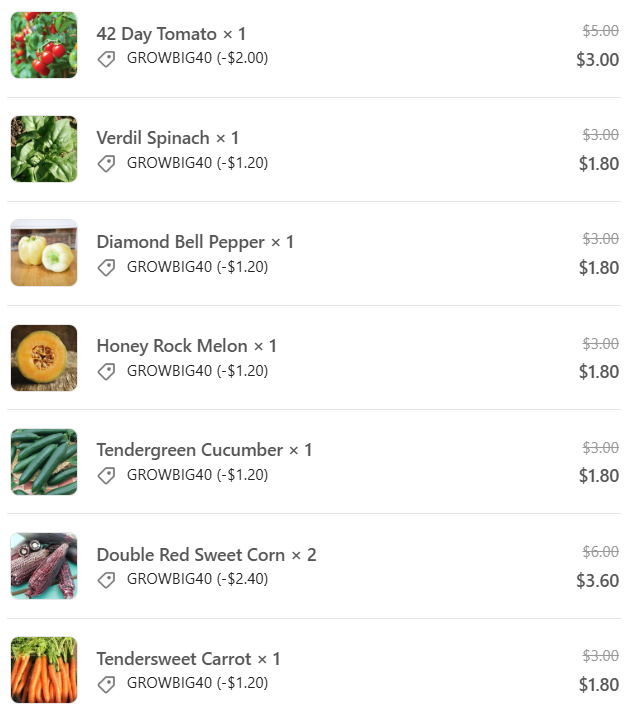
This is what I ordered today.
Yes, I got more tomatoes. These mature in only 42 days, hence the name, 42 Day Tomato, which means they can actually be direct sown in the spring rather than started indoors.
I tried another variety of spinach, Verdil. I still have others, but we like spinach, but have not been able to actually get good results for a while. This variety is less prone to bolting.
I also got yet another variety of pepper, Diamond Bell. We’re still working out what varieties the family enjoys most.
The Honey Rock Melon is a short season variety that could also be potentially direct sowed, rather than starting indoors.
The Tendergreen Cucumber can be harvested small for pickling or long for fresh eating, and the girls have expressed a desire for a slicing variety.
I got yet another variety of corn – Double Red Sweet. Not a lot of seeds in the packages, so I got two. I just like the look of them, and like to try something other than your basic yellow corn.
I got even more carrot seeds. I’m coming to the conclusion that we can’t plant too many carrots. I chose an orange variety called Tendersweet, and…
… I got a yellow variety, just for something different.
Yes, I still have Atomic Red carrots, too. Variety is good.
I have had no luck with the tiny bok choi, as they always seem to bolt, so I’ve decided to try a Pak Choi cabbage that is less prone to bolting.
I was looking at the beets and decided to just get another Assorted Beet Mix – and then got another Sugar Beet packet. I still have some, but I want to try growing enough both to try making my own sugar, and to use as chicken feed, when we finally get our birds.
The Black Sesame seed is something I am curious to try, though it might not be next year.
I already got the plain garbanzo beans, and I figured I may as well try the black version, too.
I also wanted to try a new zucchini variety; Bianco Di Trieste. Because we never manage to have “too much” summer squash!
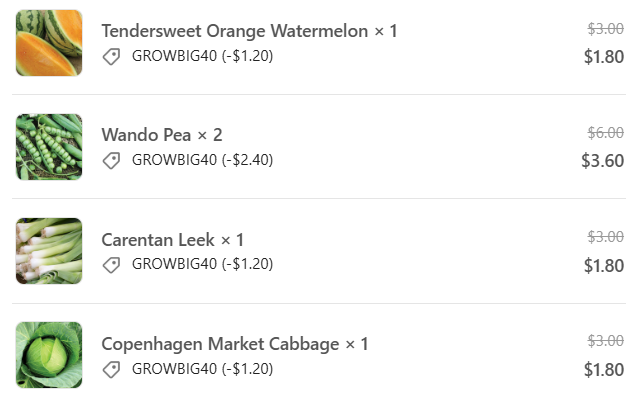
I have so many different types of melon sees, but I couldn’t resist getting some Tendersweet Orange watermelon – another shorter season variety.
I also have quite a few varieties of peas, but decided to try the Wando pea as well. We have yet to grow grow enough peas to do much more than snack on them, so I hope this variety does better. There aren’t a lot of seeds in the packages, so I got two.
I’ve been interesting in growing leeks for some time, and today I finally picked up Carentan Leek; a variety that has a shorter growing season.
And finally, I picked up some Copenhagen cabbage which, if I remember correctly, is the variety of cabbage I bought transplants for when I didn’t think the Purple Savoy cabbage would grow at all. So we will have both varieties again, next year.
Once of the things I’ll be doing closer to fall is going through my entire seed inventory and organizing it into things I can plant in the fall for winter sowing, things that need to be started indoors, and things for direct sowing.
Hopefully, after I’ve had my surgery, I’ll be better able, physically, to build and prepare beds. This forced inactivity is driving me nuts.
If I’m not careful, I might end up buying more seeds again…
I found this while using the rain barrel to water the garden from the rain barrel. I had taken the caps off the watering cans, just in case frogs got into the filled cans again. They are kept full so they don’t blow away. I have no idea what kind of caterpillar that is, and hope it’s beneficial. It’s quite adorable.
The first image is our very first fully open winter squash flower. A male flower; I don’t expect to see female flowers for a while yet. The second image is a bit hard to see, but our caraway is starting to bloom!
Today was getting hotter and I normally would have watered the garden in the morning, but the girls and I were planning to head out a couple of hours early for my older daughter’s pre-op appointment. Thankfully, I made a comment about parking at the women’s hospital when my daughter reminded me that the appointment was somewhere else entirely! I had completely forgotten! I would have taken the wrong highway into the city!
So… we took a different route and stopped briefly at a gas station in the one town along the way for drinks and some fresh potato wedges to eat along the way. My younger daughter didn’t eat at all until afterwards, as she didn’t want to get sick at the start of the trip (eating in general always makes her sick for some reason).
The clinic we went to is clear across the city, and took well over an hour to get there, but the route was straightforward and there was plenty of free parking, which was greatly appreciated. We even got there a bit early, with more than enough time for my daughter to do the “first visit” paperwork.
Her appointment went well. She needs to book another pre-op appointment, but the person wasn’t in today so she’ll have to call them tomorrow. By the time she sees this person, they should have a time and date for her surgery. She was told it should be withing 3-6 months which, for Canada, is incredibly fast. She’ll also be getting a requisition for bloodwork emailed to her, which she can get done locally.
Since we were in the city, once the appointment was done, we went to a nearby Walmart to pick up cat supplies for the inside cats, plus a few other things for ourselves. I also wanted to pick up some food for all of us. This Walmart had a Subway instead of a Walmart – nothing on the menu I could eat while driving, but my daughter was able to get a sub for herself and her sister (who stayed in the truck). I tried looking around the grocery section of the Walmart for something I could eat while driving, but there was nothing. As we left, we got more gas and I went in to pre-pay, so I could use a discount coupon, and ended up getting some beef jerky to eat on the road, once clear of the city, with my daughter to hand me pieces.
Once at home and the truck unloaded, I changed and headed out. First to do the outside cat feeding, then to water the garden. After the watering, I was able to finish weed trimming around the East yard garden beds, but was not going to stay out to do more. Too many mosquitoes, even though I had bug repellant on!
I was almost done the watering when my brother and SIL showed up for the weekend. Before I headed in for the night, I quickly popped over to say hello. I was too much of a mess to go inside and visit, so it was a short one. We caught up for a bit, then my SIL remembered she had some things for us. One turned out to be a bag of frozen meat! Some butcher’s shop sausages that they found they couldn’t eat, and a packet of venison that had been given to them, but they aren’t fond of venison. If it turns out we don’t like any of it either (I already know I’m going to enjoy the venison!), we can always give it to the cats!
Oh, after looking at the forecast, I’ve decided I will skip the market tomorrow. I don’t want the truck to be baking in the heat. Not when those high temperatures somehow seems to be causing problems with the battery – or at least has the battery gauge doing weird things! Next weekend might be just as hot but for that one we will be there until 8pm, and things will be cooling down by then.
I will definitely be watering the garden again in the morning, before things get hot. I’m hoping the grass will be dry enough before it gets too hot that I can get the push mower out, as well as more weed trimming!
I was rather late in heading out this morning to feed the outside cats and do my morning rounds. A thunderstorm rolled in when I normally would have gone out and lasted a couple of hours.
We got a lot of rain in a very short time! The upstairs window started leaking again; the same one that used to leak a lot when the snow started to melt in the winter, before we got the new roof. This is the second time it has leaked during a heavy downpour. I’ve contacted my brother about it, since he had the warranty papers and was able to pass on details he thought the company would need. He’ll let me know what he gets back from the roofing company.
The usual low spots that were finally drained were full again. Even the inner yard had standing water all over the place. I was rather hoping to be able to mow the lawn or at least do some weed trimming. Lawn mowing was out of the question and likely will be for a while, but I did managed to get the weed trimmer going to clear the paths in the old kitchen garden. It’s higher there so no standing water there. I kept trimming until I went through all three batteries.
The lower eavestroughs are terribly full of elm seeds that are sprouting. None of us are able to get up to them safely with a ladder. Last year I got a cleaner brush that can be used from the ground. It came with two brushes, and the first one broke rather quickly.
The second one broke before I could get very far with the cleaning.
*sigh*
My daughter has been looking into hiring someone to do it for us. Someone with a lift or a harness… and insurance. Meanwhile, I’ve just ordered a hose attachment, but it won’t get here for a couple of weeks.
After failing to get much done on the eaves, I switched to working in the garden. There are a couple of things I want to get done. One of them is to work over the entire area that was supposed to be planted with corn to loosen the soil, then scatter sow the tillage radish seeds I got a while back as a cover crop. These can grow up to 6 feet long and should be able to force their way through the layers of gravel, sand and clay under our shallow top soil. They are left to freeze and die off over the winter. The decomposing radishes create channels and enrich the soil, and the leaves can be worked into the topsoil to compost in place. At least, that’s what I’ve read they can be used for. Over time, this area will be getting a combination of perennials, annuals that self seed and can be treated as perennials, and possibly some shorter, 12′ long raised beds. We’ll see.
The exposed ground that had been under the black tarp is starting to get taken over, even though it’s pretty compacted. I will work on that later. For today, I decided to work on the small bed where I’d planted the giant poppies. A few actually survived, but the area was being overtaken by weeds.
I forgot to take a “before” picture, so the first one in the slide show below is after I’d started clearing around one side of the poppies.
The second picture shows the area all cleared. The soil here is really, really good. I could dig into it easily with my bare hands. Which I needed to do to try and get as many of the tree roots as I could.
*sigh*
With more than half of this little bed empty, I decided to transplant into it. In the next image, you can see a couple of little sprouts. One of those was quite a bit smaller this morning, and the other was barely breaking the surface. They just sort of exploded in a few hours! So I figured, why not. These are Canary Yellow melons, with 80 days to maturity. I made sure to get a photo of the label, since I haven’t been labeling anything from my own transplants. I’m using my photos as a record of what things end up where.
We have about 60-70 days left to our average first frost date. At this point, I’m counting on that Super El Nińo giving us an extended growing season.
I transplanted them in protective collars, then mulched the whole bed heavily with straw. The soil was still moist from today’s deluge but, once the straw was down, I gave the bed a thorough watering, focusing more on getting the straw soaked through.
In the last photo, you can see one of the poppy buds. This variety can potentially get poppy heads the size of a softball. I don’t expect to get any that big, considering how relatively small the plants are right now, but it should be interesting to see how large they do get by the end of the season. I did get another packet of the seed when I thought none had survived, but plan to save seed from these, too. The seeds are edible, but there won’t be enough poppy pods to harvest for eating. There should be plenty of seeds to save for planting.
Unfortunately, by the time I was done with this, my pain levels had kicked in pretty high. Once inside, I was able to take some painkillers, hydrate and start this post while my daughters made supper – and brought some over to me so I didn’t have to get up again! That was much appreciated.
We were expecting a very hot day today, so I was up early to water the garden thoroughly before things got too hot – even though we have rain in the forecast. Depending on which app I check, we’ll either get rain or thunderstorms. Just before I started writing this, our phones started going off with tornado warnings, but it looks like the system will be passing to the north of us. We might get some rain from the edges of it. We did hit 31C/88F today. As I write this, past 7pm, we are at 28C/82F right now, with the humidex making it feel like 30C/86F.
After I did the morning cat feeding (with some cats very confused by the early hour!) and garden watering, I went back to bed. I must have been really beat because I slept for about 3 hours, checked the time, then passed our for another 2 hours.
Unfortunately, today has turned out to be a bad pain day, and not just for me. My daughter somehow ended up getting a sun burn yesterday, even though she was in the shade most of the day. I’ve been getting so much sun since it got warm enough to work outside longer, I don’t get burned, though apparently I’m quite the redneck right now. 😄 Meanwhile, my other daughter has had increased health issues again. Her pre-op appointment in the city is a couple of Fridays from now – the day the bin my brother is renting is supposed to be delivered! My younger daughter will have to stay home so she can meet them and tell them where to drop the bin off.
Aside from the pain related to why I got those ultrasounds done, my left hip has decided to start working wrong again. Not a lot of pain there. The joint just isn’t moving right and wants to give out.
I am so thankful for all the arm bars and hand rails that were installed for my father, all those years ago!
Eventually, though, I did head outside. I had to use the walker for it, but I set up the new deer scarer my brother picked up for me.
I’ve set this one up by the corn, which is going to need the netting removed from it pretty soon. I set the other one up by the peas to keep the deer away with the sound of a dog barking. With this one, I expect raccoons to be more of an issue, and I set it to the ringing of a bell, since I think raccoons would get used to the sound of a dog barking very quickly.
Once that was set up, I wandered around and checked on various things. In the next image in the slide show above, you can see some chard leaves. These are planted between the garlic and are finally starting to grow! Still pretty much nothing on the spinach in the other row; what little germinated and survived promptly bolted. It does look like we will at least have some Swiss Chard for greens this year.
In the next image, we have a red nasturtium flower. The seeds I collected were from a package with a variety of colours in it, and so far we’ve had yellow and red. They are still quite small, but adding that straw mulch once they got big enough has really helped.
Next is the row of summer squash. Those are picking up quite nicely. The plan is to grow them vertically, but I’ll need to remove the netting to do that, and they still need that protection for now.
The last picture is of the fennel and chicory. They’ve had a bit of a growth spurt! Unfortunately, some of the fennel at the end of the bed got flattened. Stinky found his way under the netting and I found him lying there. I opened the netting up at the other end, so as not to spook him, then moved to scoot him in that direction. Instead, he panicked and started running into the netting over and over before I finally got him to go out the open end. *sigh* He didn’t do too much damage, at least. We added more rods to the hoops over the fennel and it’s getting so tall, it’s almost touching the top of the netting again!
We just got another tornado alert on our phones while I was writing the above paragraph. While that is passing to the north of us, our region and the entire south end of the province are currently under a severe thunderstorm watch this evening and overnight. The warning includes 4-6cm (about 1.5-2.5in) hail, 50-70mm (about 2-3in) of rain and wind gusts up to 100km/h (about 62m/h). For us, we’re to expect rain starting around 4am tonight and lasting until about 10am.
We are definitely not going to be hit with the worst of it, for which I am thankful, but my heart hurts for the people that have been slammed by these storms, over and over again.
Today, we’ve had rain off and on throughout, with a brief period where the sun actually came out. As I write this, we are under a severe thunderstorm alert, which is a whole lot better than the tornado alerts other areas were getting. Large swaths to the south and west of us got storm damage and at least one tornado touching down. We are very fortunate in our location. Even today, I could hear thunder, but all the storms went around us. Our weird climate bubble has protected us again!
I did get a chance to do my morning rounds, if a bit on the late side, in between rain. I was able to harvest more scapes.
At this rate, I’ll have enough to dehydrate a bunch, which will then be ground to a powder. I did that last year and it was the handiest thing ever!
Some time back, I had moved the seed tray of winter squash, melons and cucumber off the portable greenhouse frame and set it in the open on our front steps. I don’t know why I bothered, and yet…
The first image is of a Golden Hubbard seedling from the second sowing that finally germinated. The second image is a Canary Yellow melon.
Yes, I’ll transplant them somewhere, even though the chances they will produce fruit that reaches maturity is very low. Especially the Hubbard squash, which needs 95-110 days for maturity. The melon needs 80 days. We have maybe 70 days before our average first frost. Still, we have had years where we didn’t get frost until well into November. This year is supposed to have a Super El Nińo which, in our region, usually translates into heat waves and drought.
I actually poked around in the seed starting mix in the tray, and it looks like we will actually have more things popping up!
Yes, I will transplant anything that does. Chances of them reaching maturity may be low, but possible. I’d rather give them the chance. It certainly doesn’t hurt to try.
This afternoon, during that brief period we had sunshine, I got out the shake and feed fertilizer we picked up during our Costco trip. The instructions say to work the granules into the top couple of inches of soil, but that’s not really an option. Especially with the mulched beds. So I just scattered it. This stuff can also be applied in water. Between the rain we’ve been having and watering the garden in between, the plants will get something out of it. The granules are supposed to be a slow release over 3 months. Every little bit will be a help.
We shall see soon enough, I guess!
Meanwhile, I finally got around to editing the garden tour video I took on the last day of spring. I got one of my daughters to watch the video when I was done to check for any errors I missed or let me know if anything should be fixed or changed. When I messaged them to ask if one of them could come down, my older daughter was able to do it.
Apparently, it’s hilarious. She burst out laughing several times. Mostly because of the cats, but a few other things, as well. I wasn’t trying to be funny, which is probably why it actually was. It just finished uploading onto YouTube, so here it is now!
Today has turned out to be a fairly hot and muggy day. Depending on which weather app I look at, we’re either supposed to be raining right now (it isn’t) through to tomorrow, and then thunderstorm warnings for the next two days. Or, we will get scattered rain today, with more rain for a few hours, now and then, for the next two days. Once again, it looks like the more severe weather systems will go around us.
Our day started early, as my younger daughter and I needed to get to her blacksmithing workshop for 8am. We left an hour early, and just made it on time, partly due to skirting road construction and areas still damaged from the flash flooding. The road to the blacksmith’s acreage had visible damage, some of which has been repair, some still waiting to be patched. There were a couple of areas I could tell had been completely under water, with standing water and flood damage in the fields on either side.
When we got there, I started getting messages from the rescue about Sweetie. She is not doing well and bit someone again. They wanted to know when she can come back to us. After going over what we’ve got going on over the next while, it was worked out that someone will bring her here on Monday (today is Saturday). They did manage to get her spayed a week ago, so we will keep her in the isolation shelter for only a few days, so she can get used to the idea that she is back in familiar territory again.
My daughter’s workshop didn’t take as long as originally expected. There weren’t as many people signed up for this date, which is their only “build your own forge and take it home” workshop of the season, and only one person added the extra of including an electric blower to take home as well. My daughter wants a manual blower. In the end, the workshop was only about 2 hours instead of 4. When it was done, we loaded the table portion into the back of the truck and strapped it down, removing the firepot portion and putting that in the cab with the air duct for the blower. Then we headed to the smaller city nearby for a quick lunch and to pick up a few small things we would run out of before we do our next stock up shop on Tuesday.
Once we got home, we made some space for the forge in the side of the garage with my brother’s big riding mower and other equipment. Now, we need to build a structure for her smithy so set it up in permanently. In between, she wants to find a blower, and then get fuel.
With rain apparently on the way, I asked her to give me a hand with some maintenance in the garden. Plus, I had one Butterneck squash seedling to transplant.
The first bed we worked on was the summer squash. It was time to remove the protective collars. The finnicky part is lifting the netting high enough, without getting tangled up, to work in the bed. The “funnels” in between the groups of summer squash remain, as they get watered through those.
In the next image in the slide show above, you can see the fennel and chicory bed we worked on. The fennel was getting too tall for the netting, so we took it off, then added one more rod and connector to each hoop. The netting had been folded in half, but with the new height, we unfolded it before setting it back. There is still slack with the new height, but not very much.
In the next image, you can see the turnip, pole bean, daikon radish and onion bed we worked on next. The turnips and onions were getting crowded, so all the hoops here got on more rod and connector, too. We also took the opportunity to do some weeding, and add some straw for a mulch.
Once thing I’m concerned about with this bed is the red noodle beans. When I tried to grow them last year, they got to about the stage this year’s beans have reached now, and then… stopped. They never really got any bigger, and I never figured out why. I’m hoping that a different bed and consistent watering and fertilizing will help them grow. Once they get to when they can start climbing, we’ll take off the net set up a trellis. For now, though, there’s just no need.
This netting had also been folded in half and needed to be unfolded to fit over the new height, then secured. A job made much easier with my daughter to help!
The next image is something I’d actually done last night – I finally added a mulch in between the cosmos, marigolds and nasturtiums. The nasturtiums are quite small. They didn’t get very big last year, either, and I know they should be larger and fuller. No sign of any self-seeded memorial asters (I’m still unhappy that the seeds I saved indoors have disappeared), so the spaces are now all mulched.
In the last image, we have progress on the chain link fence bed. My daughter helped me raise the bottom half of the netting from end to end, securing it up so that I could work under it. After that, I could manage it on my own.
In one of the empty protective collars, I transplanted the single Butterneck squash seedling. Then I mulched with straw tightly around the collars, and carefully around the sunflowers. I also made sure not to cover the furrow I’d planted the super sugar snap peas, from our own saved seed. There are seedlings appearing now!
After the straw was in place, I carefully removed the protective collars. The mulch will protect them from the elements now. Last of all, the netting was set back down and reset nice and snug.
Once that was done, and everything was cleaned up and put away, I checked on some of the other beds. The high raised bed needs a straw mulch, too, but I’ll do that later. Hopefully, tomorrow. The short season corn is getting tall enough to mulch, too, I think. I checked on the more recent sowing of carrots. No seedlings yet, but the frogs do love hanging out under the boards protecting the carrot seeds! I didn’t notice any cucumbers coming up, yet. I checked the garden beds in the east yard, too, and was happy to see my last sowing of bush beans, in the small square raised bed, have started to germinate.
I really hope things start catching up soon. Staples like carrots, peas and beans all seem to be under the weather. The winter squash and melons aren’t doing well, either, but they’re not quite staples in the same way. The garlic is doing great, and scapes have started to form. I expect to be harvesting some in the next day or two. I’m really looking forward to those! The potatoes are starting to develop flowers, with one variety developing faster than the other. We should be able to start harvesting baby potatoes soon, if we wanted to.
So that is garden progress today. Mostly just maintenance. I’m really liking the flexibility of the hoop kits. I still plan to build more covers for the raised beds, but for now, these are doing just fine. Being able to make the hoops higher as needed really helps.
The surreal thing of the day has been the time. When my daughter and I were starting for home, it felt like 2 or 3 in the afternoon, but it was just coming up on noon. When I finished in the garden and did the outside cat feeding, I was sure it was well past 5. Maybe even 6. Instead, it was just barely 3 when I got in! Meanwhile, I can see outside my window, the sky getting darker and the wind blowing the maple branches, and I feel like it’s almost bed time… and it’s not even 4:30 as I write this!