This and that

I seem to still be in recovery mode today, even after taking yesterday as a day of rest. I tend to forget just how draining it can be after spending time with my mother, even when she’s having one of her better days!

It’s also working out to be a hotter day. We’ve got a high of 26C/79F for today and tomorrow and, depending on what app I’m looking at, we’ll be hitting either 29C/84 or 31C/88F by the end of the week.

I did get at least one thing accomplished – finally! I cut away the web of roots and got the water pipe out from where I’d tried patching it, to the tap.

It took more digging and cutting to find the bottom of the tap and cut it free!

The only thing holding it upright was the web of roots, and that length of conduit pipe.

The short sections of rigid pipe were filled with dirt and roots. A couple of them had to be blasted with water before I could get them off the water pipe.

I did find where water can been coming out, when I did the patches and tested the tap. Quite a split in the pipe!

How the ground pipe was joined to the tap pipe was not what I expected. I thought there might be some sort of threaded connector. The metal pipe is jammed into the water pipe – and it is still very water tight, and very secure! I’ll probably have to cut it off, if I bother to at all.

I would like to use the original tap again. Even parts of the original metal pipe, too, if I can. However, my intended replacement for all this is to use an ordinary, heavy duty garden hose that can be easily removed, as needed. The dirt and roots in the short sections of pipe reinforce my plan to have a long pipe, from house to tap, to protect the hose.

For now, however, I will not remove the rest of the pipe, to the house. There are going to be much larger roots to cut through, plus it runs through a higher traffic area that gets regularly mowed, so I don’t want to dig a trench until I’m ready to put in the new system. I’m very interested in seeing how that hose end that comes out of the ground is attached to the water pipe!

So, for this project I need to get a long enough heavy duty hose, enough pipe, with drainage holes, to fit together and reach from house to tap, angled fittings for the ends that will get a removeable seal around the hose to prevent water, dirt or critters from getting in, and appropriate pipes and fittings to attach the hose to the tap assembly. For the tap itself, I want to build a box for the vertical pipe with the tap mounted on the garden side. I liked the original post’s little roof over the tap and will probably expand on that, to double as a shelf or something. The box will have a door at the back to access the hose and pipes, with room enough to store a few things, like the cord that will be used to pull the hose through the underground pipes, should it ever need to be removed, repaired or replaced.

Once this is installed and complete, I plan to make a vegetable washing station under the tap, using salvaged materials I’ve found around the property.

Hopefully, by the time it’s done, it’ll be good enough to last another 50 years or so.

After I finished up with the tap and hose set up, I headed towards the house and checked out the old kitchen garden. I was finally able to get a photo of one of the developing luffa.

I’ve been able to spot three of these. Hopefully, they have been pollinated and will develop into mature luffa gourds before we get frost. These are so high up, there’s no possibility of hand pollinating!

Before heading back to the house, I had an adorable surprise.

Tiny, familiar kittens.

Octomom had brought them to the house!

I only saw 4 of them, including this one.

They still can’t move very fast, so I was able to catch this one and hold it for a little while. This one is completely black. I saw the other black one, and it appears to have a white patch on its chest. I also saw the brown and the grey tabbies. Where the other 4 are, I could not see. Eventually, Octomom came around for them, but only two followed her across the yard. The rest were still hiding under the storage house.

While I was outside, I started to get some messages from the Cat Lady. She was at the vet with the kittens, and the prognosis is not good. They would have died within the week, she was told. As it is, they have a cat virus (calci), herpes, low glucose, low oxygen, pneumonia, infected ears and sores in their throats. The kittens have been at the vet all day, and the bill is getting high. I feel so bad about this. We were only going to pass on the one kitten, so now it’s double the expense for her, and we have no way to help out.

Priority is going to be spaying and neutering, because a lot of this is exacerbated by the sheer number of kittens.

Oh, wow!! Something just happened while I was writing this!

Two Toes is letting Tin Whistle nurse!

I had been expecting the kittens to at least try to nurse on her, since Decimus leaves the room once she’s done with nursing, and batting them away when they want to nurse more. They had not been trying, though, nor did Two Toes, until just moments ago!

Two Toes is doing really well. She seems quite happy, loves head pets, and gave me kisses today!

Whatever fight she was in that left her with a broken leg, the fur on her face and head is full of scabs that are healing well.

The only down side is poor Snarly Marlee! She does NOT like the kittens. The girls try to bring her into the living room for a while, so she can get a break, while they are there.

Hopefully, it won’t be for much longer. It would be fantastic if we could adopt them all out!

The Re-Farmer

Our 2023 garden: transplanting done!

Now that the tomatoes and pepper transplants have been set up in town for give-aways, the remaining transplants have been done!

These are the pictures I uploaded on Instagram.

First image is the Indigo Blue Chocolate tomatoes that have started to develop.

In the matching pots are the herbs. The single oregano transplant is in the middle of a pot, surrounded by the second variety of thyme we have. The second pot has all the spearmint. For the pot themselves, I put a few inches of grass clippings on the bottom to keep the soil from falling through the drainage holes. Most of the soil is actually recycled out of other plant pots, with only a bit of a top up of garden soil, then the transplants were carefully mulched with more clippings. Doing the transplants freed up a couple of metal trays, so they’re now being used as drain trays.

We had already transplanted a couple of rows of onions in between the spinach earlier. The remaining spinach that bolted was pulled up, and my daughters took care of harvesting the remaining leaves. They discovered the Susan really, really likes spinach! We had to check to make sure spinach is okay for cats, and once that was confirmed, my daughter would hand her a leaf every now and then, as she stripped them off the stalks. It was amazing to watch her gobble them down! Even Fenrir came over and tried stealing some leaves, and got a few given to her, too.

We definitely need to stick to this variety of spinach. As bolted as they were when the plants were pulled, the leaves are still not at all bitter!

Now, the bed that had the spinach is completely filled with Red of Florence onions. There were still onion transplants left, so I cleaned up a bit more of the spaces the lettuce and bok choy were planted, in the bed along the chain link fence. Much to my surprise, there are quite a few lettuces that survived the smothering drifts of elm seeds. As for the bok choy, we’ll be lucky if the three or four I found survive at all. The empty spaces in the rows got planted with the remaining onion transplants, including a few yellow onions, and the other variety of red onions we’ve got. There were enough Red of Florence onions left that, after transplanting from end to end between the remaining lettuce and bok choy, I made holes in the mulch along the outer edge of the bed and kept on transplanting, filling about half the length of the bed. By the time I was putting those in, only really tiny ones were left. If they survive and develop fully, great. If not, we’ll still have lots.

Next, I worked in the wattle weave bed, and noticed one of the Sweet Chocolate bell peppers is getting quite big! The plant is still blooming, as are the other plants, so I expect we may get a decent harvest over the summer.

The tiny strawberry plants grown from seed got transplanted out. One of the three bunches of winter thyme did not survive being transplanted, so that left a gap I could fit several strawberries in. I did take out the self-sown walking onion as I kept transplanting strawberries wherever there was space between the herbs and bell pepper. It was neat having that onion show up on its own, but I don’t want walking onions settling into this bed. The strawberries are planted pretty close together, but it’ll give them a chance to get bigger, before they get transplanted to somewhere else next year.

There was still one surviving squash that I’m about 95% sure is more luffa, so I transplanted that next to the other two, and transferred the protective plastic ring to the new one. Hopefully, it won’t get shaded out by the potatoes too much.

I didn’t get a picture, but there was one last tiny Spoon tomato that emerged from the only Jiffy pellet that hadn’t had anything germinate when I potted them up. One of the Spoon tomatoes that got transplanted into the retaining wall blocks got broken, and is just a stem with a single branch, now, so I planted the baby tomato plant in the same block with it. Hopefully, at least one will survive.

And that’s it. These are the last of the surviving transplants – though when I went to get the trays, I spotted a hulless pumpkin seedling show up in one of the trays! All the other trays left behind are with things that did not germinate at all, for some reason. The Cream of Saskatchewan watermelon. Both varieties of cucumbers. The Birds Egg and Apple gourds, and a few other things. I’m not sure what to make of a zero percent germination rate. Since so many things have this habit of suddenly germinating, later on, I am not quite ready to count them as a loss, but even if they did germinate, for most of them, it’s too late in the season for them to be able to reach full maturity by the end of the growing season.

While I was walking around, setting up to transplant the onions, I kept hearing a cracking sound from the spruce grove. The cracking really started to increase, so I stopped to watch as the one tree my brother cut down for me that got stuck on other trees, started to fall. It got hung up again, but there was enough wind that it fell further still. It’s still stuck on other trees, but is now at about a 40° angle, instead of an 80° or so angle! It should make it easier to finally get it down the rest of the way, I hope. That one tree is almost enough to build a complete bed in the size I’m after!

After so many delays and distractions, it felt so good to finally get progress done outside! The one thing I want to do before working on those trellis beds is re-sow some of the summer squash. Then, it’ll be time for some manual labour!

I’m quite looking forward to it.

The Re-Farmer

Our 2023 garden: transplanting mysteries

Okay, so I managed to get a bit done in the garden this evening. Also, I had a wonderful surprise. Rolando Moon appeared! I haven’t seen her in at least a month, maybe two. At her age, we just never know if she’ll disappear and not return anymore.

I was also happy to see The Distinguished Guest wander into the north side of the property. Happy, that is, until I heard a cat fight and discovered he had attacked Pinky, and I had to chase him off. *sigh*

I had some squash that were getting too big for their pots that needed to go in, so I focused on the hill we grew pumpkins in last year.

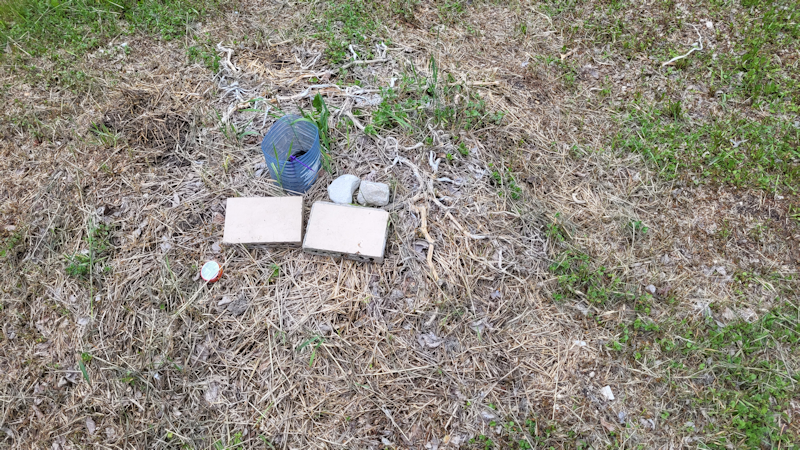
This is how it looked after taking a weed trimmer to it, after the mowing around it was done. Those bricks had been placed under the developing pumpkins to keep them off the ground. The round thing is an ant trap. There was two of them, but one disappeared when it got caught by the push mower, last year.

They didn’t work. The ant hill is still there.

Thankfully, the bug spray I used seems to do a good job of deterring ants, too. I dug up the bed with a garden fork and pulled out as many weeds and roots as I could. The ground was crawling with ants, but while I had them on my boots, that’s about as far as they went.

Before, this hill had only ever had two plants transplanted into it. After weeding it and working the last of a bag of sheep’s manure into the surface, I raked it out into a flattish square.

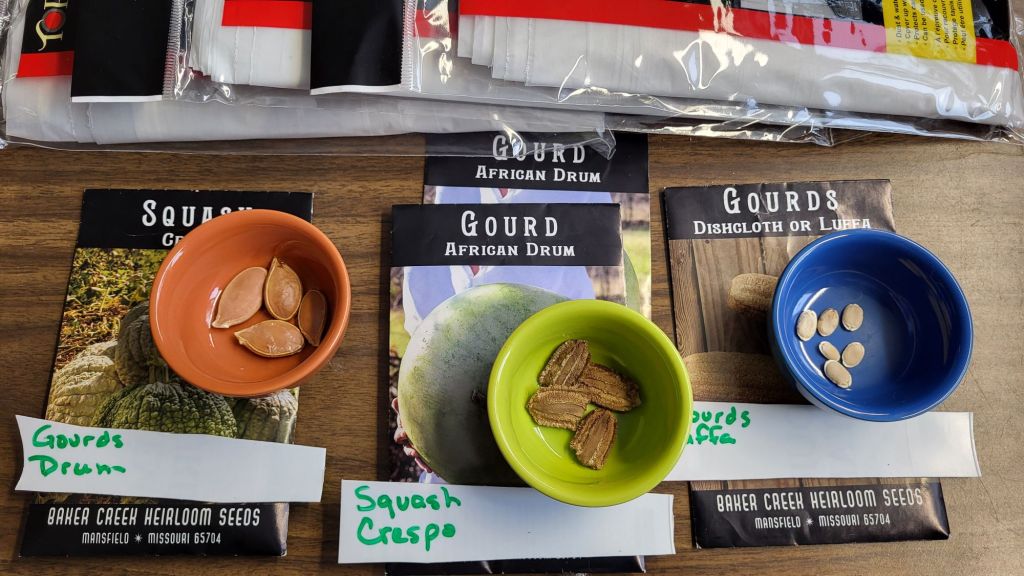
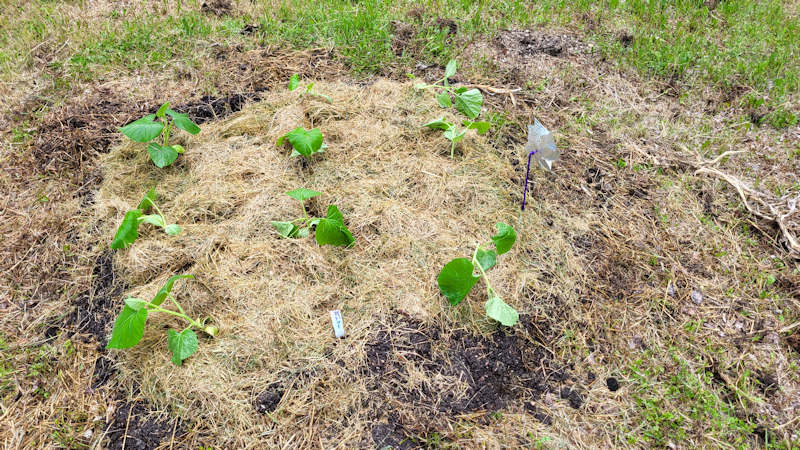
I fit 6 transplants in. The row of three on the far right are Zucca melon, from a second seed start. In the middle row, the two in the foreground are African Drum gourd, also from a second seed start. The other four were in an unlabeled pot. I restarted both the Zucca melon and Drum gourd at the same time, but one unlabeled pot got mixed up. I think they are also drum gourds, but I’m not sure. At this stage, the leaf and stem shapes look almost identical.

We’ll figure it out soon enough, if they survive.

I then filled in the last of the space available in the wattle weave bed.

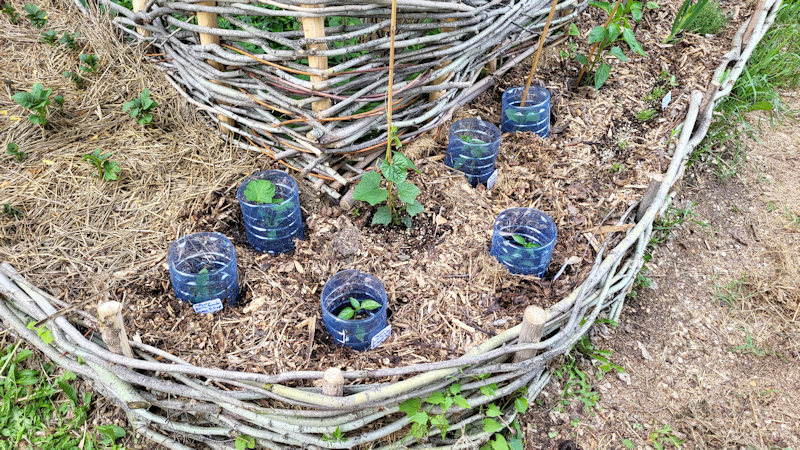
I had removed the protective plastic from the Sweet Chocolate peppers, and they now all have support stakes. I left the protection around the one Classic Eggplant, though it did get its own support stake, as did the luffa in the corner.

I transplanted one of each variety of pepper seedlings we had waiting. Between the luffa and the eggplant is Dragonfly. The three around the curve are the Cheyenne, Early Summer and Early Sunsation. I wanted to get at least one of each type transplanted, just in case we aren’t able to get things ready early enough to get the rest into the ground.

To the left of the luffa is the largest of the 3 mystery squash that germinated with some Roma tomatoes. I think they might be luffa, but I’m 100% not sure.

As I write this, it’s coming up on 8:30pm, and we’ve finally started to cool down a bit. What I got done wasn’t a lot, and certainly didn’t involve much physical exertion, but it still left me dripping with sweat. The next few days are supposed to be every so slightly cooler, and then things are supposed to heat up again. And physical exertion is going to be the main work, because we have to start hauling garden soil over to the squash patch, so we can start transplanting. We can’t even start that until I take the weed trimmer to the tall grass around the pile that couldn’t be mowed.

It’s going to be hot, sweaty and disgusting work, but we’re running out of time. It’s not just prepping spots for the transplants. This year, I was going to try direct sowing the summer squash, and those seeds should be in the ground already.

I suspect that by the time we finish building the permanent trellis beds, it’ll be too late to direct sow a lot of things. I might try, anyway. We could find ourselves with a long, mild fall again.

There’s only so much we can do, though. None of us area handling this heat well.

The Re-Farmer

Our 2023 garden: new seedlings!

I’ve been waiting for days before finally getting a picture with the newest drum gourds, then went again and got progress pictures of the rest.

I found a new baby this morning!

The red arrows are pointing to the barely visible first zucca melon!

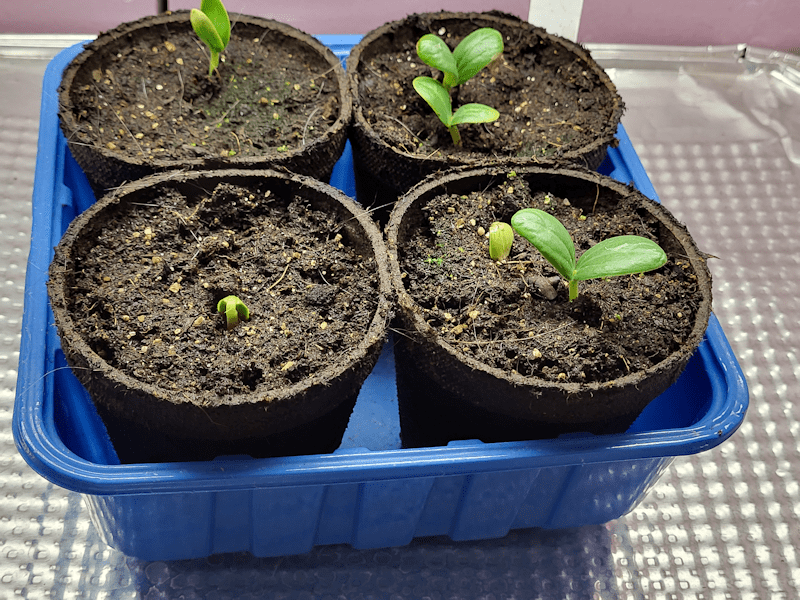
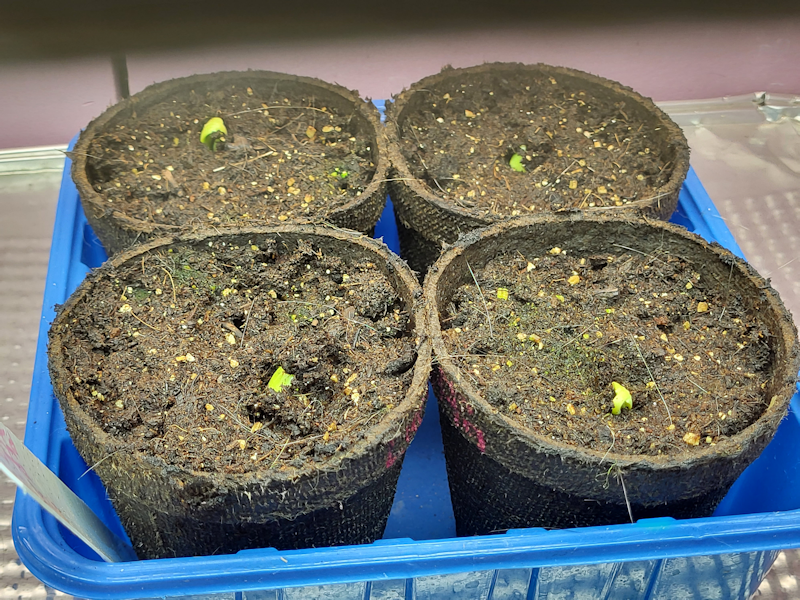
The new drum gourds were taking a lot longer than the first ones to break free of the soil. When the first one did, the reason became obvious. It was still completely encased in the seed shell! After a while, I very carefully removed it and just dropped the pieces on the soil surface, but the seed leaves have still not started to separate. I can now see that the other one is also still encased in the seed shell. Once it manages to break free of the soil, I will carefully remove it, too. The risk in doing that is tearing the encased parts of the seed leaves right off, as they are so very fragile in there.

The earlier drum gourds are just barely starting to show their true leaves. The luffa’s true leaves are coming out nicely. Even the lemongrass is showing some true leaves. I think. They don’t look very different, other than there being more blades. I honestly can’t tell with the thyme.

That last cell of sweet chocolate peppers finally has a single seedling germinating, so we now have a total of four. Still just the seed leaves in even the oldest ones, though.

The onions and shallots are growing very slowly at this stage. No new haircuts needed! So far, they’re all surviving, too. Hopefully, we’ll be able to keep them alive! Last year, we had some issues with the yellow onions and shallots not doing well, but we have different varieties of both this year, and they seem to be doing better so far.

We’ve got two varieties of red onions, one of yellow onions, and one of shallots.

I keep thinking… we need more yellow onions! 😄

The Re-Farmer

Our 2023 garden: two more, and who’s next?

We have two more luffa babies!

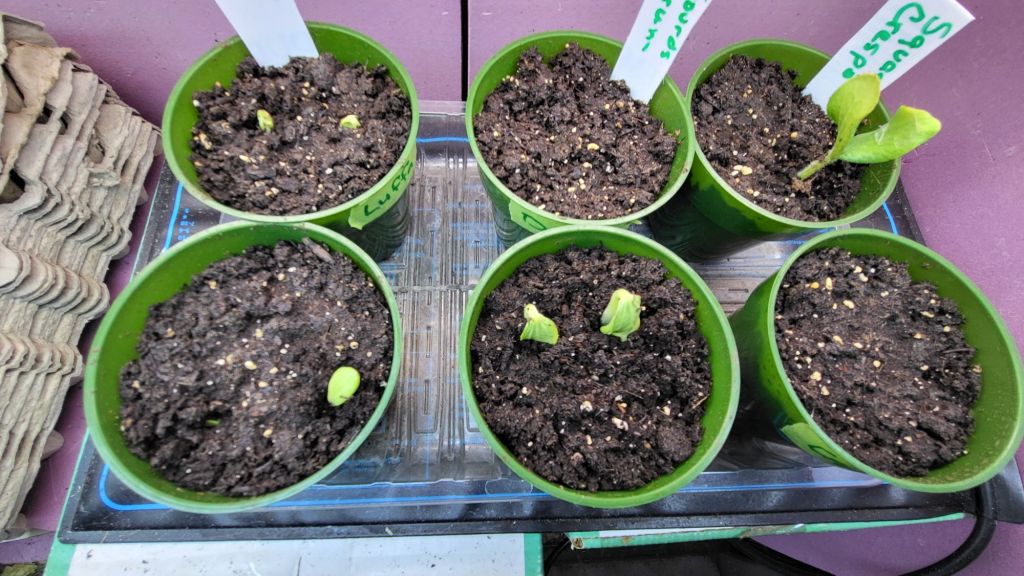
The second seeds in two of the pots are actually germinating!

When it comes time to thin them out, I think I’ll try transplanting the smaller ones. I know squash and gourds don’t like being transplanted, but the more seedlings there are, the more survivors we’ll have once they finally go outside. We’ll see.

In the next few days, we’re going to have to shift things around again. The small aquarium greenhouse will get set up and the onions will get transferred over. The luffa will be moved off the warming mat and set where the onions are now. The warming mat will then get the next batch of seeds.

While peppers and eggplant are often started this early in our climate zone, the varieties we have can actually wait a bit longer. What needs to be started next are the zucca melon and drum gourds, since they need at least a month longer to mature than we have between average frost dates. I’ll have to go through all the varieties of seeds that need to be started indoors and sort them by days to maturity to see what else we need to start this early.

And we still need to pick up lumber to build a barrier to keep the cats out of the living room, so we can turn the whole thing into a greenhouse. I’ll have to talk to my daughter about that, since she’s the one paying for it.

Well… time for me to start heading to the city and do some stock up shopping!

The Re-Farmer

Our 2023 garden: wildflower seeds are in, and there’s four!

We got more seeds from Veseys in the mail today!

Cheddar is checking them out, too.

I got two packs each of the Western Mix, which will be planted in a location to attract pollinators to the garden, and Alternative Lawn Mix, which will be used to reseed the bare spots under the branch piles in the maple grove that got chipped.

I also got a notification that the storage variety of Delicata squash seeds we ordered has been shipped. They were on back order. We still have some purple beans on back order. Once those come in, the only things left that we ordered from Veseys will be shipped in the spring.

After shifting things around in the aquarium greenhouse yesterday, and noticing that there seemed to be luffa seedlings starting to push their way through the soil in a couple of them, I made sure to look closely this morning. Sure enough, I could just see green starting to show through the soil! So of course, after being out most of the day, I had to check them again when I got home.

There is four of them!

Once they start breaking soil, they really seem to grow fast! Each pot has two seeds planted in it. So far, there is no evidence of the second seeds pushing their way through. They would be thinned down to one eventually, anyhow. I’m just happy to see one in each pot! That heat mat seems to be giving them the boost they needed.

I can’t wait to see how much they’ll grow overnight. 😁

The Re-Farmer

Our 2023 garden: shifting spaces, and you can do it, little luffa!

A little bit of garden therapy on this cold, cold day. According to one of my phone weather apps, we’ve reach -25C/-13F, with a wind chill of -33C/-27F. Hopefully, things will keep warming up for another hour or two because it takes the predicted deep dive overnight!

Our onion seedlings are getting tall enough that it was time to move them away from the light. Which, for our aquarium greenhouse, means rearranging things inside the tank.

The onions are going to need a hair cut soon!

The tray holding the onions is on the heat mat, which was unplugged when the seedlings started showing. Onions prefer cooler soil, anyhow. The luffa, however, have not germinated yet, and need warmer soil. They were raised up higher on a box, to get some of the warmth from the lights, but the heat mat would be beneficial for them – assuming these 3 yr old seeds are still viable at all. Shifting the two, and removing the box the luffa were on, would give the onions the space from the lights they needed, and the heat mat should make up for the slightly reduced height for the luffa pots.

Since they are in a plastic drain tray, I added the aluminum oven liner sheet to protect the plastic from getting over heated and diffuse the heat a bit, even though the warming mat doesn’t get very hot.

As I was doing this, I noticed what appeared to be disturbed soil, where that arrow is pointing.

So I took a peak.

Yes!!!!

There is a baby luffa sprout, starting to push its way up through the soil! One of the other pots seems to have a new soil hill, too, but I didn’t peak under that one, and just gently covered the first one up again.

Hopefully, the extra warmth will encourage more germination!

When it comes time to transplant these, I want to find a way to have them in the very sheltered microclimate on the south side of the house that we will be growing the lemongrass in. They can be grown in pots, if the pots are large enough. A 5 gallon bucket would be the right size for one plant. Not that I’d waste a bucket by drilling drainage holes in it. I think we have other containers we can use that are large enough. The challenge will be in how to also include a trellis for them to climb.

But I’m getting ahead of myself. Let’s see how many germinate and survive, first!

You can do it, baby luffa!!

The Re-Farmer

Our 2022 garden: luffa – finally!

It took a long time, but the second planting of luffa seeds has finally germinated, just this evening.

There was nothing, when I checked them this morning.

I’m glad to see them, because it looks like the one surviving luffa isn’t going to make it. Another casualty of the Great Cat Crush. :-( At just under 10 weeks before our last frost date, I’m hoping it’s enough time for them, still.

Some of the Sophie’s Choice tomatoes that got moved out of the big aquarium greenhouse and into the little one, to make room for the newly planted seeds now with these luffa, have suddenly withered. After a bit of rearranging and squeezing things closer together, I moved them into the mini-greenhouse. It has the brighter light, plus the little fan to maintain air circulation. Hopefully, that will help them recover and grow stronger again. There are still lots of others, though, so for now, I’m not too concern. We only need a couple of plants from this variety, along with the two or three other tomato varieties we’ll be starting in a week or two, that are being grown mostly for fresh eating.

Things are supposed to start warming up tomorrow, and keep warming up from now on. At least for daytime temperatures. It’s time to prep the sun room and start keeping the outside cats out again, so we can be ready to move things over as soon as the overnight temperatures in there get, and stay, warm enough.

The Re-Farmer

Our 2022 garden: reboot and new set up

Quite a few seedlings, pots and trays got moved around today. The only things that didn’t need to be moved where the onion seedlings, inside the small aquarium greenhouse. That tank doesn’t fit a lot, so they get to be undisturbed for now.

These are the survivors of the Great Cat Crush.

They are still struggling, but it looks like most of them will make it.

Also, the second seed in the cup with the Canteen gourd sprouted! That makes for a 100% germination rate on those!

As for the luffa, there were two peat pots, with nothing coming up, so more luffa seeds were set to soak, this morning.

Last time, the seed coats were scarified by carefully snipping them with nail clippers. In the off chance that they were damaged by this, I used sandpaper on an edge of each seed, instead.

When it was time to plant them, I used the tip of a chopstick to loosen the seed starting soil – and see if I could find the old seeds. I found only one (there should have been 2 in each pot), and it was just the shell, completely empty.

Hopefully, we will have better luck with the new seeds.

I also decided to do more Wonderberry. We started seeds in two Red Solo cups, and one of them now has a second seedling in it. The other, nothing. So a few more seeds were used to try again. We do still have some left over.

Next to do were the Sophie’s Choice and Cup of Moldova tomatoes. There were barely even stems left with the Sophie’s Choice, and all the leaves on the Cup of Moldova were withered away. These were the ones we transplanted to thin out of the original pots. While a cat destroyed the Sophie’s Choice seedlings, I still don’t know what happened with the Cup of Moldova seedlings. They had been doing so very well, after transplant. :-(

We reseeded the Sophie’s Choice minimally, and still have some seeds left. I managed to get a couple of seeds into each Cup of Moldova pot (though I noticed some seeds were stuck together, so a few have more), and finished off the packet. If these don’t work, then all we’ll have is anything that survived the Great Cat Crush.

The newly planted seeds went into the big aquarium greenhouse. My daughter has hung her orchids in front of the window, and I found a place for our aloe that will hopefully dissuade the cats from digging in their dirt. That allowed me to set up a surface for a second tray.

The Sophie’s Choice, luffa and Wonderberry are on the heat mat, and there was space enough for a metal tray to hold the Cup of Moldova on the other side. The Red Solo cups don’t fit in the black trays as well. If they weren’t the exact size for the mini-greenhouse, I’d be using nothing but those baking trays!

Speaking of the mini-greenhouse…

We emptied that out, removed the plastic cover, then lined the back and sides with heavy duty aluminum foil. The whole set up is now closer to the window for more natural light.

The remaining seedlings went back into the mini-greenhouse. The shallots are now in here, along with the two other Canteen gourds that sprouted while in the big aquarium greenhouse, as is the sprouted Wonderberry. The new location should mean more natural sunlight – especially first thing in the morning – and the aluminum should help reduce any stretching towards the light from the seedlings. They’ll still be checked and turned as needed, of course. Eventually, it’ll be moved even closer to the window, but it’s still too cold for that.

I had hoped to be able to block the front opening of the cover with the window screen we used to use on top of the small aquarium greenhouse, but it’s not big enough to keep the cats out. So, we have the little fan inside again. Since today is quite overcast, I’ve also added the light fixture that also provides a bit of heat. There’s another lamp we use, but it doesn’t fit inside the mini-greenhouse, and will sit in front, instead.

The tray with the baggies of paw paw and tulip tree seeds is back on the top shelf, where it has the least amount of light, but is also the warmest. It should still be a while before we start seeing anything happening with those.

You know, all of this would be a lot easier, if we didn’t have to protect everything from cats! :-D One or two shelves in the living room window, and we’d be done.

Ah, well. It is what it is!

Hopefully, the newly planted seeds and the new set up for the mini-greenhouse will work out.

The Re-Farmer

Our 2022 garden: starting shallots and transplanting tomatoes

Okay, for better or for worse, we now have stuff in the mini-greenhouse! Let’s see if we’ve succeeded in making it cat proof. :-D

The first thing today was to get the shallots started.

There are a lot less seeds than I remember from last year. I’ll have to look back at last year’s photos and double check.

The container is a mixed greens salad container from the grocery story. It has drainage holes in the bottom, and the seed starting mix is pre-moistened.

With such easy to see seeds, after scattering them I used a chopstick to separate any that were right up against each other, and spread them out more evenly. Then they got a spritz with water, a light layer of more soil mix, then spritzed again.

The container’s lid is recessed, and I didn’t want it too close to the soil surface, so I just plopped it on upside down. I then left it in a tray with water under it, to be absorbed from below. While it was sitting, it was time to work on the aquarium greenhouses.

The red and yellow onions are doing quite well. I rotated the trays after adding more water below them. The reflective light from the aluminum foil at the back, which is closest to the trays themselves, is clearly making a difference. All the sprouts were leaning towards the back of the tank! :-D

We have our first Wonderberry sprout! These were taken out and got more water added to the outer cups, as well as a spritz, then set aside for later, so they wouldn’t get knocked over while the seedling tray was being moved around.

You can just see that a new luffa gourd is starting to sprout! It’s right against the wall of the pot at the top of the photo.

I very carefully removed the seed covering from the leaves of the canteen gourd. Normally I would avoid doing that, but I’m glad I did this time. It was really solid, and had to be broken apart to get it off.

Here are the tomatoes, on either side of the eggplants and peppers.

The tray usually gets water on the bottom well before the pots dry out this much, but when the pots are damp, they are difficult to move. They feel like they’re about to fall apart. Which will be good when they get transplanted into the garden, but not so good when I need to move them around!

With the eggplants and peppers, they were thinned to 2 plants per pot. As they get larger, we will probably thin them to one plant per pot. We don’t need a lot of either of these. Three plants each should be fine to meet our needs.

The plan was to transplant all the strongest tomatoes to thin them – but there were a lot of them! Especially the Cup of Moldova. They’re doing really well in here. In the end, there was just one seedling that didn’t get transplanted because it was so tiny.

We half-filled red Solo cups with soil and used a chopstick to make holes for the transplants. Then I ended up using a steel poultry trussing needle (which never gets used to truss poultry; I’m not even sure why I originally bought them!) to loosen and tease out the transplants as carefully as I could. After they got tucked into their new pots, more soil was carefully spooned around them to about half way up their stems and gently pressed in, just enough to make sure there were no air spaces, before they all got a spritz of water.

Each of the original pots was left with one tomato plant. With the Cup of Moldova, we ended up with a dozen transplants, making 15 altogether. These cups were used last year, too, and already had drainage holes in the bottom. If we needed to, we could double cup them, but for now, they fit into the baking tray, in one of the higher shelves of the mini-greenhouse, above the back of the chair it is tied to. I’d rather it was lower down, but with the wider baking tray, that’s where it fits.

With the Sophie’s Choice, there were only 7 strong enough to transplant, and they fit in the tray with the shallots container.

When it’s daylight, we’ll assess whether or not we need to set up a light from the other side. There may be an issue of the high tray shading out the lower one.

Then the original tray went back into the big aquarium greenhouse, on the heat mat, and the tray got a generous amount of water added, to moisten the pots from below.

In doing the transplants, the tomatoes also got moved to one end of the tray, while the eggplants and peppers are now next to the gourds. That was just because it was easier to reach the tomatoes while transplanting them.

Hopefully, these will survive their transplanting well. It should be interesting to see the difference between how the tomatoes in the mini-greenhouse do, compared to the ones in the aquarium greenhouse. There is going to be a substantial difference in light and warmth.

But first, we’ll see just how tempting the trays in the mini-greenhouse are for the cats, or if they will be left alone!

There are still two more shelves open in there. The next time we need to start seeds, which should be in two or three weeks, we should be able to move things out of the aquarium greenhouses, into the mini-greenhouse, and have the new seed starts put into the aquariums. If the weather co-operates, by the time we’re ready to start more seeds in April, we should be able to transfer the biggest seedlings into the sun room. I’m sure these tomatoes will need to be potted up by then, too.

This is the first time we’ve had so many seeds to start indoors. It’s going to be a juggling act!

The Re-Farmer