Small builds, and green tomatoes

It has been absolutely gorgeous outside today. As I write this, we are at 14C/56F. Just perfect to be outside for many hours!

I was planning to build a soil sifter today, but after fussing with the trail cams this morning, I decided I needed to build a new stand for one of them, first. The gate cam had stopped working again, even though I’d just changed the batteries. The day before, there were only 3 files recorded before it stopped working. The gate is more of a security priority, so I took the new solar powered camera from by the sign and set it up on the stand at the gate. Which was not as good of a set up, but it would do.

I brought the camera that had been at the gate inside and tested the batteries. They had gone down a lot, for being used only for a day, but they were still well into the green. After checking the camera itself out for a bit, I decided to take a scouring pad to the battery contacts in the flip-down cover. Water had gotten into it at some point, and there was rust, but I had given them a scrubbing before, and things were quite dry. Still, it was really the only thing that was available to do. Sure enough, it worked!

I wanted to leave the solar powered camera at the gate, so I took the now working camera to the sign. I could screw it onto the mounting plate, but it’s a very different design. Instead of screwing into the bottom, it screws into the back. With the other camera, I could swivel it into an angle that covered the front of the sign and, because it’s a wide angle camera, it also included the road and intersection. Not being able to swivel this camera meant that it was basically facing the sign, on edge.

I figured my best bet was to use the old flag stand the camera was mounted on at the gate, and bring it to the corner by the sign. That would actually work better than having it mounted on one of the supports holding up the tipping corner fence post. Which meant making something for the new camera, that I could attach the mounting plate to, for the gate.

After scrounging in the barn for some scrap wood (I spotted a couple of Rosencrantz’ kittens just outside the barn!), this is what I made.
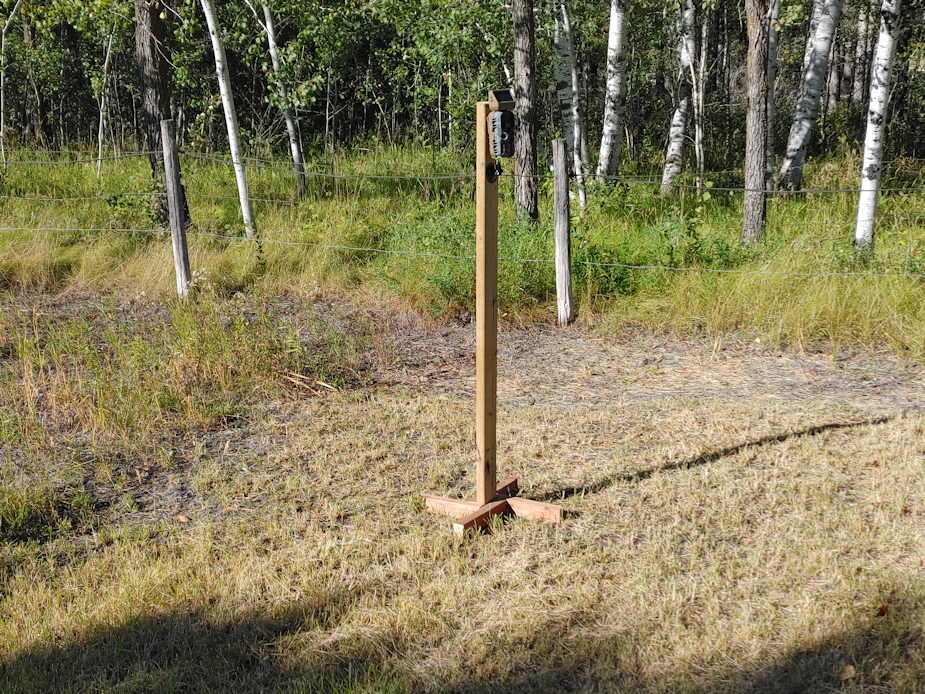
The solar panel makes the camera very top heavy. When it was mounted by the sign, there were many files motion triggered not by someone or something going by, but by the wind making the camera wobble on its mount. I made this stand taller, and attached the mounting plate low enough that I can use the strap that also came with it, to secure it more firmly and ensure no wobbles will trigger the motion sensor.

I moved the camera to the other side of the driveway, so that the solar panel will get maximum exposure to sunlight. With the wide angle lens, it also needs to be closer to the gate than the other camera. Once I find the sweet spot for coverage, I am thinking of pegging the legs to the ground, for extra stability. It would be better to have something like a sandbag, though, since I’d have to move it when mowing in the area.

Once that was done, I could start on the soil sifter.
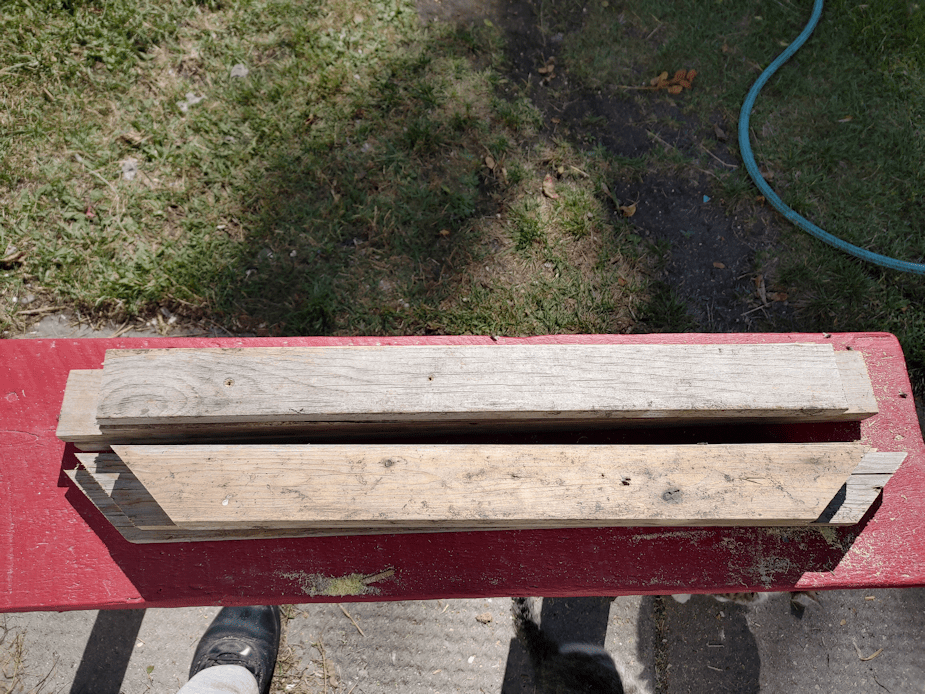
I measured our wheelbarrow and cut pieces for a 2’6″ x 2’4″ sifter. The straight pieces would form a box, and the angled pieces would make a frame.

At this point, the only thing holding the frame together are the metal right angle brackets on the corners. The frame would be secured to the box, with the hardware cloth sandwiched in between.
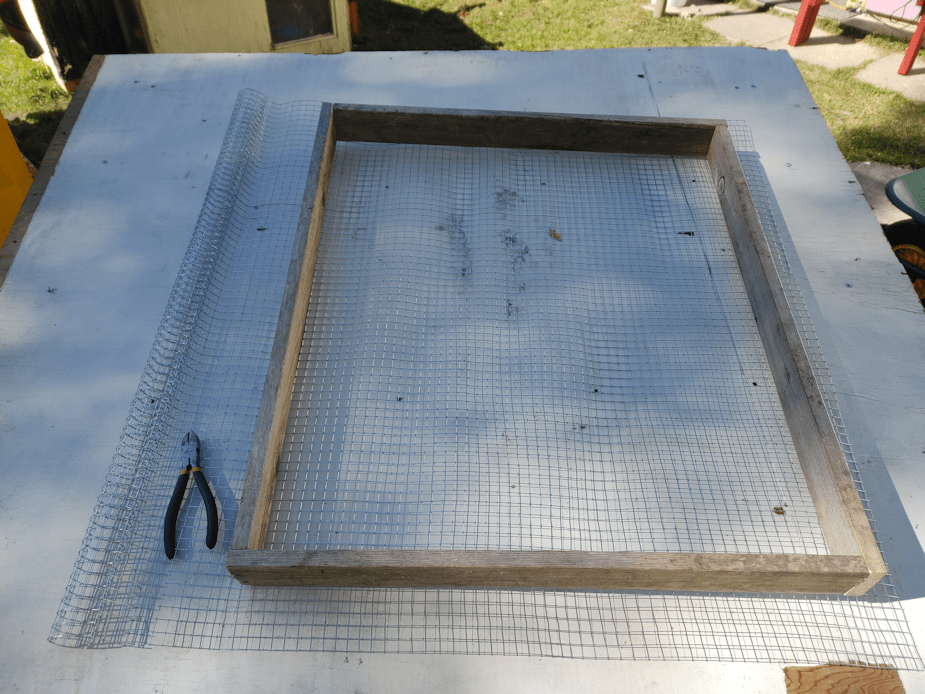
The roof of the water bowl house made an excellent surface to unroll the 1/2 inch hardware cloth, then use the box to measure out where to cut the wire. Once cut to size, I tacked the mesh to the box with a few staples, just to hold it in place while adding the frame.

There is, a problem with using salvaged wood for everything.
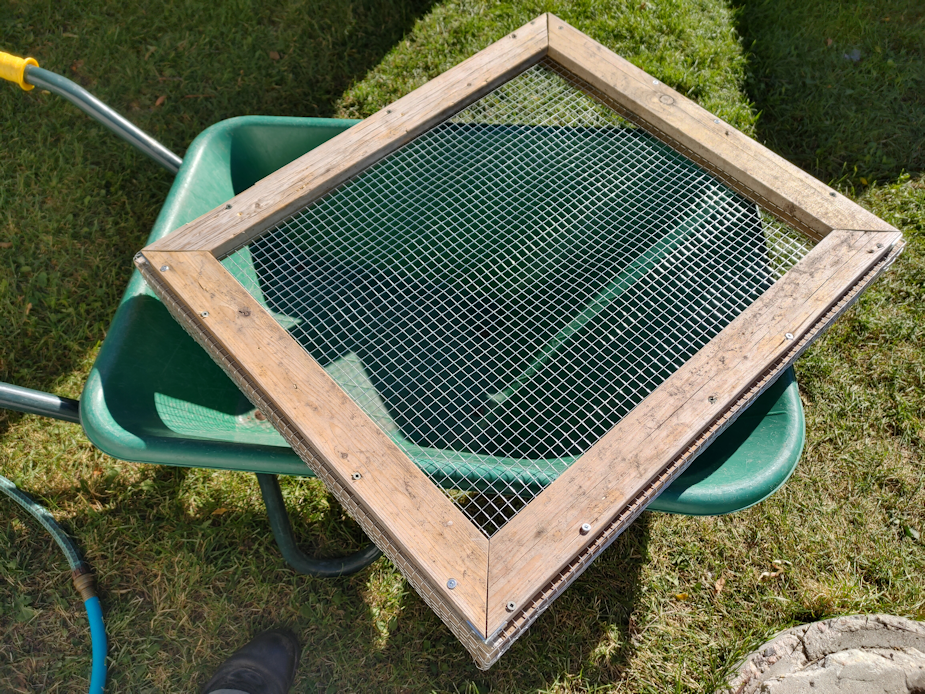
I should have made the frame pieces about an inch longer. I didn’t compensate for the slightly extra width the box got from how I attached them at the corners. However, the wood is warped and uneven, which meant there was no way I could match the frame to the box, even if I’d made the frame part bigger. In several places, I had to put the screws in at an angle to catch the edge of the box. I had been using a drill to make pilot holes, only to break the bit part way through, and I didn’t have another in that size. The wood is old and very dry, so it was easy to put the screws in without a pilot hold but, as you can see, the wood started to split in a couple of places. Some of the wood was already splitting on its own.

Once the frame and box were secured to each other, I folded the excess mesh onto the sides, cutting at the corners so that a piece could fold around the corner to be secured.
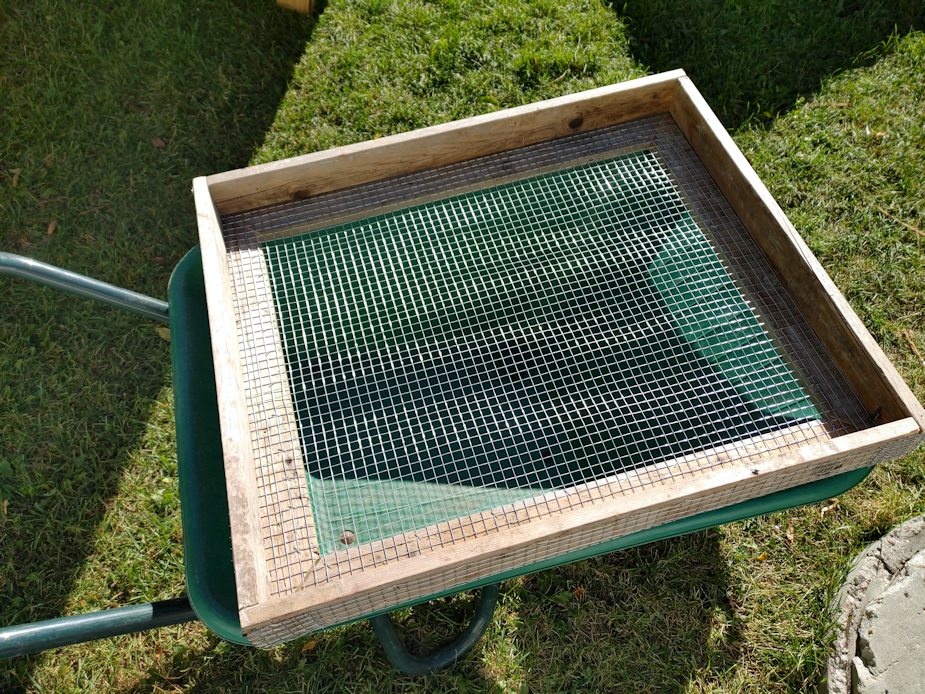
The mesh was secured with a LOT of staples around the outside of the box, and more staples were added to secure the mesh to the frame on the inside. These won’t hold well, though. We need a heavier duty staple gun for projects like this.

Once done and set up on the wheel barrow, I could really see how warped some of the wood it. It can’t lay flat. Which is okay. I am not expecting this to last very long, but if I can get a year or two out of it, that’ll be enough. I am planning on using it while cleaning up and preparing garden beds for next year, to sift out rocks and roots. I want to use it on the wood chips, too. The smaller chips can be used as mulch right away, while any larger pieces can be set aside until we can bring the wood chipper out and use the shredder chute to chop the bigger pieces finer.

While I was working on that, one of the things the girls worked on was picking through and sorting all the tomatoes we picked. They found more slugs inside some tomatoes! The ripest tomatoes were set aside to use right away, while the greener ones were to be laid out on screens.

The problem was finding a place the screens could be laid out that the cats won’t get at.

We ended up using the sun room.

The onions were still laid out to cure on the wire mesh door we use for this, so we prepped them by trimming the roots, brushing off the dried dirt, and thinning the greens, before and my daughter braided them. It made for one very heavy braid! Once those were out of the way, we set screens up over the mesh door, and many of the tomatoes would fall straight through the mesh.
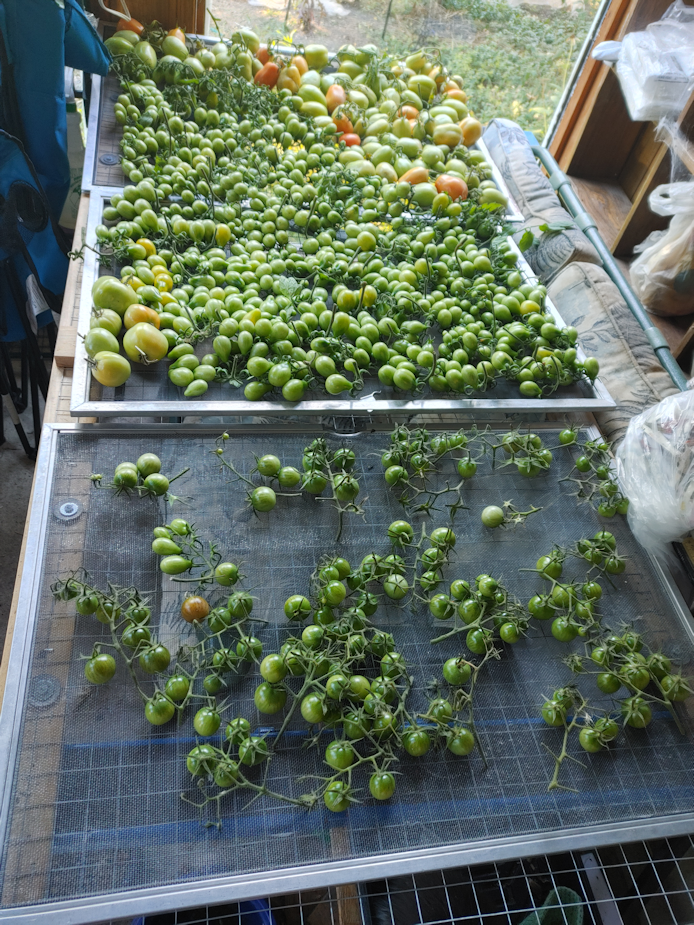
In the foreground are the chocolate cherry tomatoes. Then there’s all the yellow pear tomatoes, with the few remaining Sophie’s Choice tucked in with them. At the far end are the Cup of Moldova tomatoes.

They can stay in the sun room to ripen, though we will also be looking up recipes for using green tomatoes, too. There are plenty of ripe ones to start on first, though. Now that these ones are laid out on the screens, they can sit for a while before we have to get at them.

And the kittens can still use the swing bench, below. In fact, there was a kitten sleeping under the tomatoes when I took the picture! Unlike the inside cats, they have no interest at all in what’s on top of the screens. They just want soft, warm places to lie down and sleep!

The Re-Farmer

Have I mentioned I’m a suck for the cats?

It was a gorgeous afternoon and evening yesterday. Not only a pleasant temperature, but even the mosquitoes weren’t as bad. I didn’t want to go back inside when I was done what I needed to do!

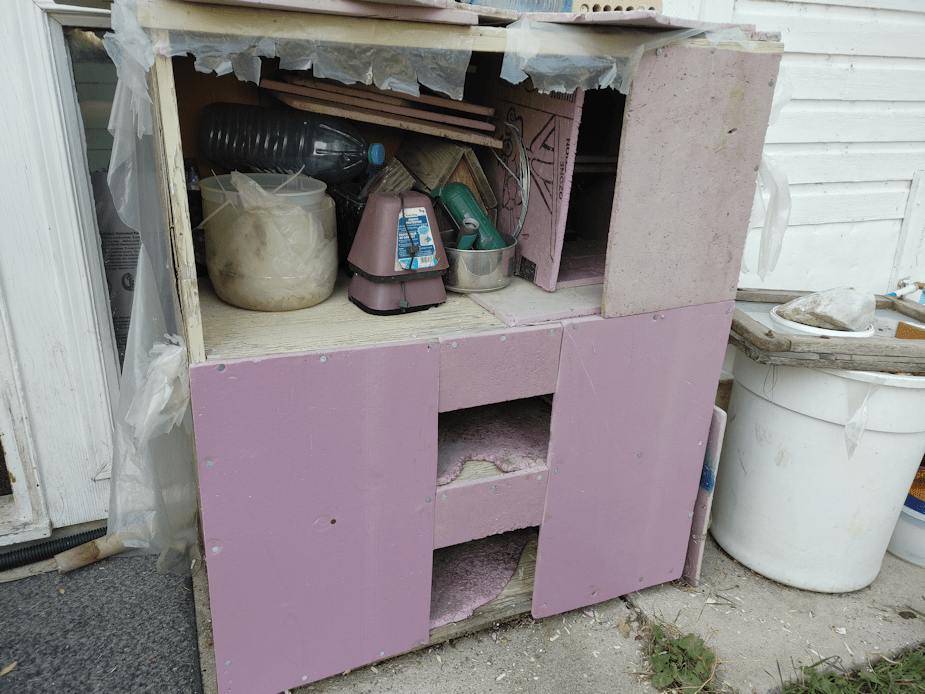
One of the things I did was re-do the shelf shelter for the cats. I noticed that the little kittens have been climbing all the way to the top shelf, which was actually use to store stuff, and have been snoozing in a corner, where I’d stacked some smaller pieces of rigid insulation.

The insulation over the bottom two shelves were getting ratty, so I decided to empty the whole thing, give it – and some of the insulation pieces – a hose-down and redo it.

Including making a next in the corner of the top shelf for the kittens, even though it meant not being able to fit everything back in again!

The sheets of insulation lining the bottom shelves were used again, since they fit the best and, aside from a few edges, still intact. When covering the fronts, I left the openings wider than before. When startled, the cats would dash out, catching on the edges of the insulation, sometimes hitting them hard enough to pull them right off the nails holding them to the shelf. I decided to try reducing the height of the openings. I want it open enough for them to easily get in and out, but small enough to let less of the weather in. Hopefully, they won’t get ripped right out by a startled cat!

As for the top shelf, I tucked a small pedestal plant stand in the corner and used it to support two levels with the rigid insulation for the kittens to lie on. There’s more space in front with an insulated floor, and there is insulation along the side and back walls, too. An extra piece across the front, and the kittens have their own little cubby hole to settle in.

Now I just need to clean up and redo the outside of the shelf. It had been wrapped in plastic to protect the wood from snow and rain, with an extended “roof” of rigid insulation, but the wind tore the plastic to shreds, and the cats have broken up the insulation. I’d like to find something sturdier to replace them with.

After I had emptied, swept and hosed down the inside, I had to give it time to dry before continuing, so I started another project.

A new cover for the rain barrel.

A couple of years ago, we made covers for the rain barrels out of window screen mesh and hula hoops. One for the barrel at the corner by the sun room, and the other for the barrel we fill with the host, at the far corner of the garden. The covers were partly to keep debris out, but also to make sure no critters fell into the barrels.

After a couple of years, however, the plastic hula hoops became brittle and started to crack. The cover for the garden barrel had been stored in the old garden shed for the winter, and it looks like something chewed holes in the mesh, too.

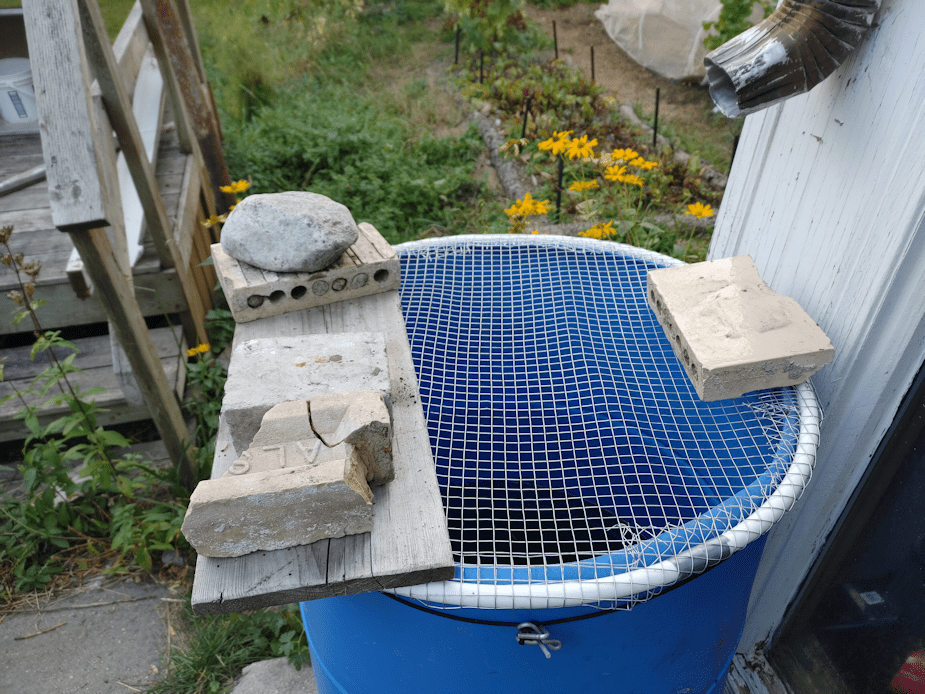
The sun room barrel’s cover is held in place with a board weighed down with bricks. When the barrel is getting full enough that more rain would cause it to overflow, the board and bricks hold the rain diverter in place.

Not long ago, I found the cover and its mesh broken up. Something had jumped onto it or something. The mesh had torn, but thankfully whatever did it, did not end up trapped in the water. Then we heard a commotion one night, and I came out to find the board and its weights, and the rain diverter, all knocked off the barrel, and the cover damaged even further. I put the board and its weights back, then found some pieces of rigid insulation to cover the rest of the barrel, with weights to hold them in place, to ensure no critter could access the water, until a new cover could be made. Even that ended up being pusher around a bit, as if some critter was trying to get at the water below – even though we have several bowls of fresh water critters can drink from. A new cover had to be made quickly.

Which is what I did while the shelf shelter was drying.

The materials used are much sturdier!

I considered using some chicken wire, but the openings are too large and the wire too easily broken. I went with some half inch hardware cloth I had, instead. The hoop is the same PEXX tubing I used to make arches to support netting over the old kitchen garden beds you can see in the background.

I used the barrel itself to measure the size needed to make the hoop, then cut a square of the hardware cloth to size, removing excess mesh from the corners to make it closer to “round”. The hardware cloth is a lot stiffer than chicken wire, but the extra strength is, I think, well worth it being such a pain to wrap around the hoop. Definitely glad for gardening gloves! The last step was to use a hammer on the underside to get the mesh right up against the hoop as tightly as I could.

There was, however, one problem.

The top of the barrel is not round. It’s more of an oval shape, and a wonky oval at that. The old hula hoop I’d used before was quite a bit larger than the top of the barrel, so it didn’t matter, but this hoop was cut for a more snug fit. The less sticking out, the less likely a critter will knock it off, even with the weights. I thought I’d still made it large enough to fit over, but the barrel’s shape was just too wonky.

I ended up tying some paracord around it as tight as I could, then used a metal tent peg to twist the cord even tigher.

Yeah. That bend up piece of metal was a tent peg.

Between the paracord pulling the top of the barrel into a more round shape, and the hammering of the hardware cloth tight against the hoop, I was finally able to get it in place. The board and weights were added to support the diverter when we need it, and the extra brick at the back, just in case something knocks the board off again, so the whole thing doesn’t flip off.

I might still add window screen mesh to this, since things like small frogs or insects, as well as small debris, can get through the half inch mesh. As it is right now, a cat – or even a racoon – could jump onto the cover and it’ll hold their weight without issue. The PEXX tubing will also last a lot longer, too.

All in all, I think it worked out rather well for using stuff I got for other projects! 😁 It didn’t even take that long to do. It took long enough for the washed out shelf to dry, at least.

So we now have a shelf shelter for the cats all cleaned out and ready for winter – on the inside, at least – and a cat and other critter proof cover for the rain barrel.

Ah, the things I do for the kitties!

The Re-Farmer
Scything and mulching progress

There had been predictions for more rain this afternoon, but when things stayed dry, I headed out with the scythe.

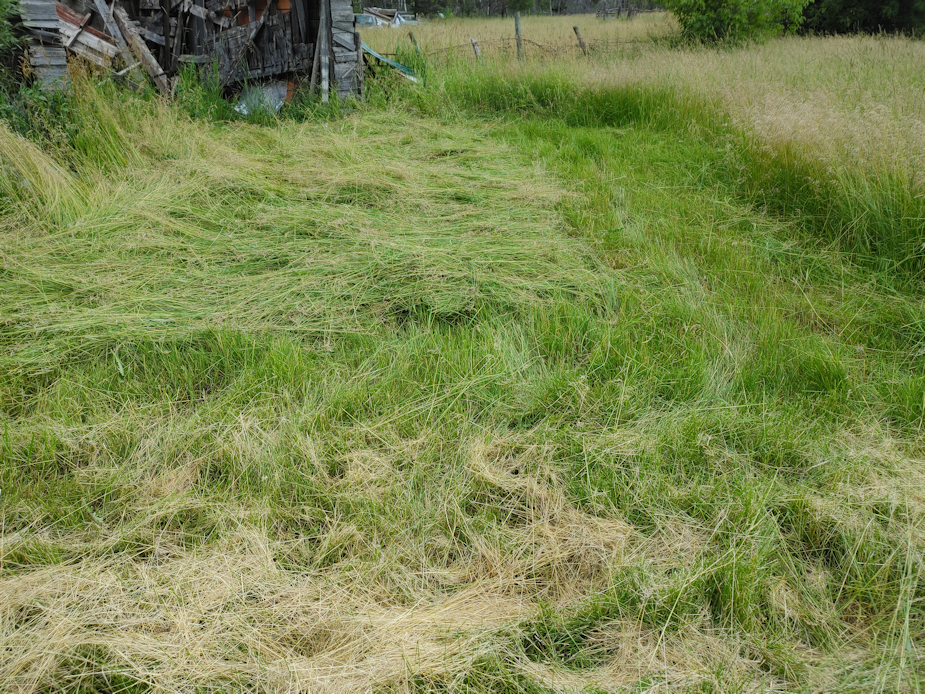
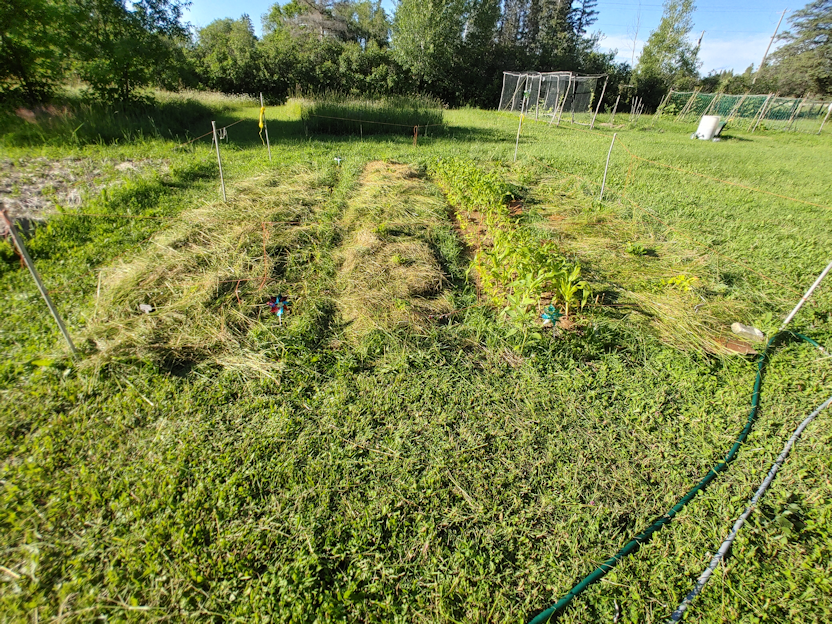
I worked on the area where the hay is still upright, and not flattened to the ground by wind. I took this picture when I thought I was done with scything for the day, but ended up cutting one more swath.

This means we can now access the shed we want to dismantle, now that the roof collapsed over the winter. We still need more space to stack things. I suspect much of it will go into a burn pile, but I know there is some good lumber that can still be salvaged in there, and I want to make sure there’s someplace to put them that’s off the ground. Once the remains of the roof is cleared away, I’m thinking of dragging out the old metal garage door that’s leaning against one wall and laying it on the ground, and using that to stack lumber on top of. If all goes well, we’ll have the materials to build a chicken coop that can handle our winters. I’d really like to build one on wheels, so we can set it up in different places, as needed. I hope to use the chickens as part of our gardening plans, as well as for eggs and meat.

We shall see how that works out.

Meanwhile.

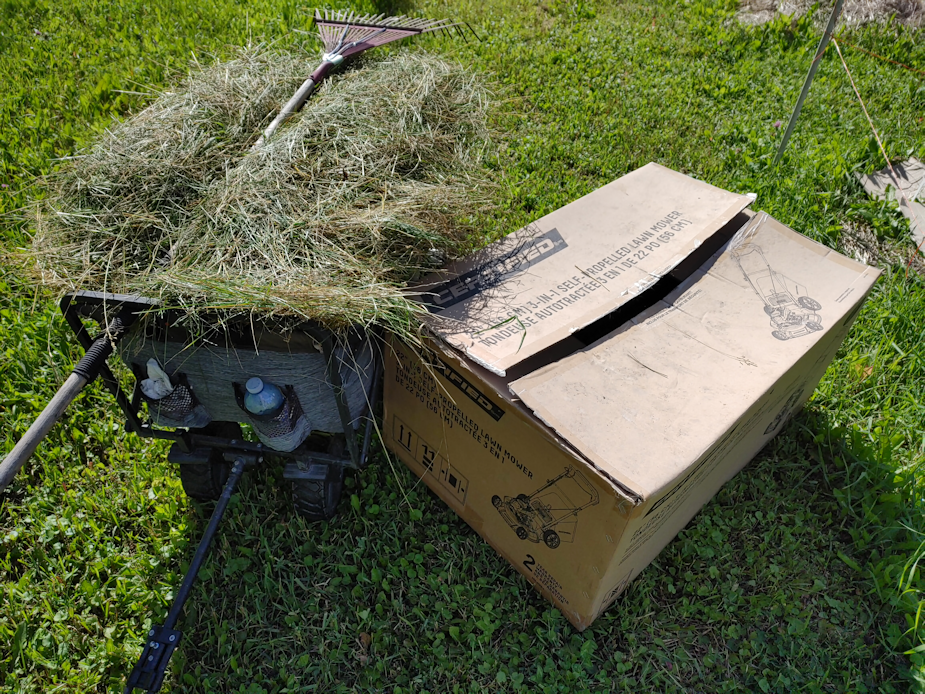
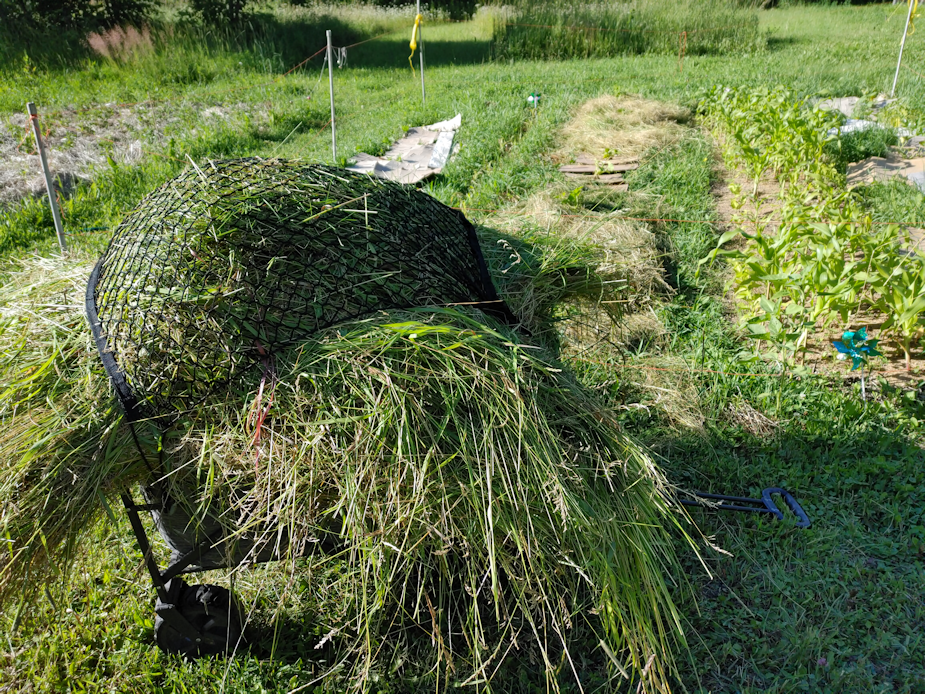
In the foreground of the photo, you can see some of the dried hay from when I tried using the weed trimmer to cut this. I gathered all the previously cut hay into the wagon and hauled it to the garden.

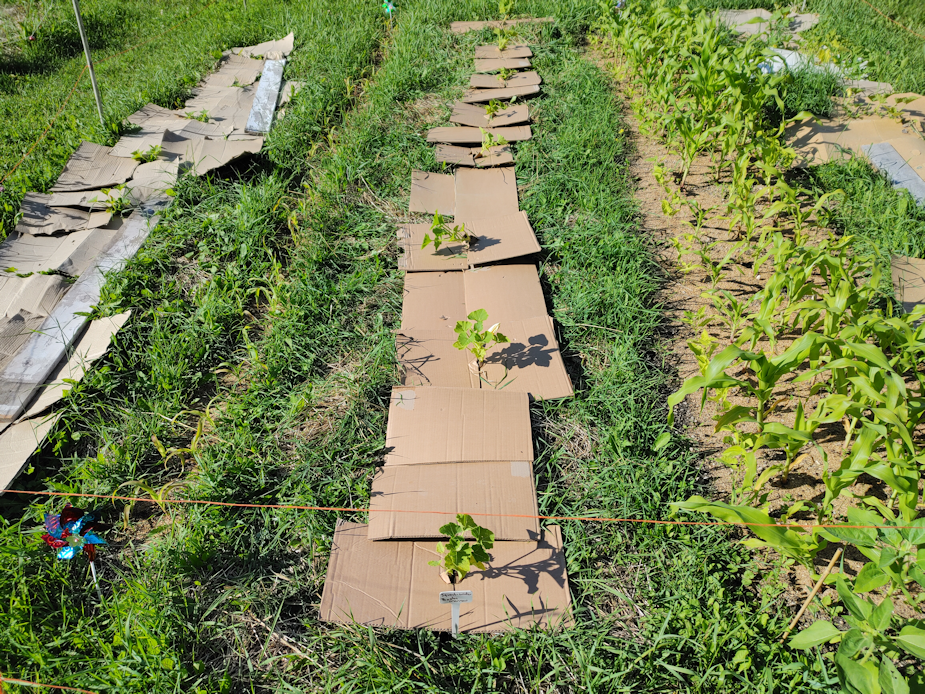
The Boston Marrow really, really needed some help with all the grass and weeds that had grown through the straw mulch. I have not been able to get more cardboard, however…

I did have the box from when we bought the new lawn mower last year in the garage. It’s a really, really heavy cardboard, and there were so many strong metal staples in two of the corners, it was easier to just cut out that part of the cardboard, after removing all the tape I could.

Because the cardboard is so heavy, and I had just one box, I cut it up into many smaller pieces. Then, for each Boston Marrow, I cut a piece with an opening in the middle, to fit around the plants. Once each plant was done, I filled in the spaces in between with the remaining pieces.

I was short one piece to finish!

Ah, well. Close enough.

The dried hay in the wagon, however, was not enough to mulch all the squash, however. So I went back and got the freshly cut hay.

Thanks to the net that came with the wagon, I was able to jam all of it into the wagon.

It was enough to almost completely finish mulching the area.

Because there was no mulch on top of the cardboard I’d already laid down around the green patty pan squash and the hulless pumpkins, not only did the cardboard dry quickly in the sun, but pieces kept getting blown around. In this bed, it was bad enough that I weighed them down with some boards, as best I could.

Thankfully, there was enough hay to mulch all the individual squash plants, but not enough to finish filling in the spaces between the hulless pumpkins, nor to fill in up to the corn. It will be sufficient for now, though. Once the hay was down, I wet it enough that the cardboard below would be damp, too.

The green patty pan squash plants are so tiny, they’re completely hidden by the hay! I did make sure they were not covered. Honest. 😄 As small as they are, after all this time, there is still the possibility of a crop out of them. They have only 55 days to maturity. I’m hoping that, now that they’re mulched and not fighting for nutrients – and they’re no longer drowned out! – they’ll perk up, and we might have something to harvest by the end of August.

The cardboard being blown around is a problem in the big squash patch, too, but there was no more hay. I decided to use some of the remaining straw bale.

I only got one load done. Just enough to mulch two Baby Pam pumpkin plants.

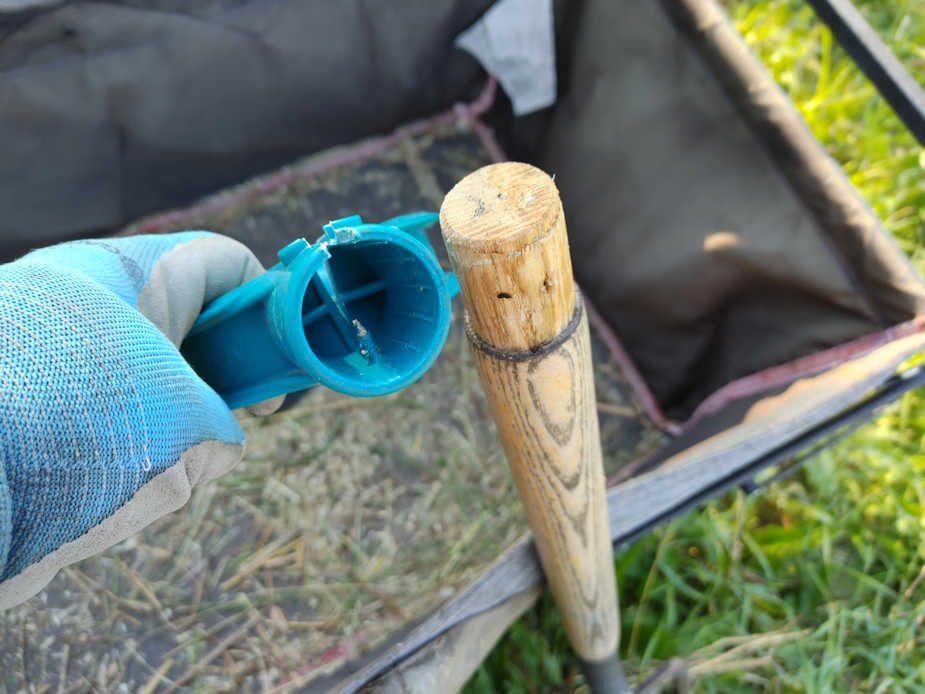
This is one reason why. The handle on our new garden fork broke off!

The other reason is, while pulling the straw off the bale, there were clouds of what look to be mold spores being kicked up. I really didn’t want to be breathing that stuff!

Well, there’s a whole area just north of the garden that’s too overgrown to mow. I’ll start scything that to use on the nearby squash patch, so that I’m not having to use the wagon to bring it over.

But not today. Probably not tomorrow, either, as I will be out and about for much of the day. Saturday is supposed to hit 28C/82F, but if I get started scything early enough, I should be able to escape the heat. The hottest part of the day is typically around 5pm, so there should be plenty of time.

Little by little, it’s getting done.

The Re-Farmer

Morning kitties, and critter damage

I headed out a bit late this morning, and this time, I had lots of kitties waiting for their kibble!

Potato Beetle and Rosencrantz were chill, but Toesencrantz did not like me being so close!

So he joined the party at the kibble house. :-)

Altogether, I think I counted 10 cats, and saw more running towards the house as I continued my rounds.

While putting the bird seed out, I had a surprise.

It looks like a groundhog tried to dig under the steps again! That plastic had been wrapped around the mock orange to hold the branches back last year, when trying to make it so they wouldn’t dig here again. It did work – until now!

All these rocks and broken pieces of bricks had been used to fill the hole, with pieces of insulation slid between the steps and the basement wall.

Much to my surprise, when I cleared the pieces out of the hole, with the intention of putting all the smaller rocks in, I actually saw movement! I think the grog may actually have been stuck there, with the heavier pieces falling over the opening after it dug through.

In trying to fix this last year, it was a relief to find the digging did not go far. The concrete steps are hollow. In the past, cats have had their kittens under there. I am less concerned now, knowing they’re not digging deep against the basement wall. Unfortunately, they’re also digging up the roots of the mock orange. Mind you, I do want to transplant it to a better location. It’s too close to the house, and gets really dried out.

So I think this time, we will leave the grog to it’s hidey hole under the steps.

I saw another one, later, going under the old garden shed, which makes three spots with dens under them.

I did find another burrow, of a sort.

The wheelbarrow leaning on the bale had start all around it, with just a small opening leading under the barrow. This morning, it was very open, with the straw knocked down and flattened. Taking a closer look, I could see something had burrowed under the loose, fallen straw, around the rest of the bale. I don’t see any dirt, so whatever made this may have a nest deeper in the straw.

I was much more dismayed by this damage.

A bunch of tulips have been eaten!

Not all of them; mostly around one edge. Still, quite a few seem to be just gone; eaten all the way to ground level. They’re not dug up at all, which makes me think it was a deer, rather than a skunk or a racoon.

I don’t think groundhogs eat tulips.

Do they?

Anyhow, I grabbed one of the rolls of chicken wire we’d used to try and protect the Crespo squash last year and set it up as far as it could go.

There’s a second, smaller piece that I hope is long enough to cover the rest of the space. It won’t stop any digging creatures, but hopefully it will be enough of a deterrent that critters in general won’t bother, and go for easier food elsewhere.

Along with the usual morning routine, I also checked out the road conditions, which will be in my next post.

The Re-Farmer

Disassembled

What a gorgeous day today! We seem to have skipped spring and gone straight to summer, reaching a high of 19C/66F this afternoon.

The weather is not done with us yet, though. We are getting weather alerts again, for tomorrow. More rain is on the way, with the south end of our province expected to get another 2-3cm (under an inch) of rain. With waterways already full and the ground saturated, this could make the flooding situation worse. The municipalities to the north and south of us, which have rivers and large creeks running through them, are also on high water level alerts. Besides the expected rain tomorrow, looking at the 14 day forecast, we’re supposed to get showers almost every other day.

Talk about one extreme to the other! Drought last year, and now this.

I took advantage of the lovely temperatures today and spent some time at the picnic table, taking apart the collapsed canopy tent frame.

There it is! All the bits and pieces. I was even finally able to get the broken leg out of the ground – the hole was full of water, making it much easier.

The frame pieces to the left of the unbroken legs on the table top are all broken. They are still perfectly useable, though. There were a couple of longer pieces that were bent but not broken. I was able to bash on straight again with a brick, but the one you can see in the photo was more stubborn. :-D

The great thing about all these frame pieces is that they’ve got holes in them. We’ll be using the longest ones to support temporary fencing around small garden areas, like the old kitchen garden or an individual block of corn. They all have these handy screw holes in them, which will allow cord to be threaded through them, to provide extra support for any netting they will be holding up. The short pieces can be used to support netting or plastic over individual beds. We have been keeping our small water bottles, and those can be used as caps on the tops, to further support any netting or plastic laid over them.

I’ve also kept all the connectors, with their nuts and bolts, as well as the piece in the middle of the canopy, with the handle that allows for one person to pop the tent up at the highest point. The hub from the peak of the canopy has a crack where one of the nuts went through. I have no idea if we’ll ever find a use for all these connectors, but I’m sure we’ll find one at some point. :-D I’m also not sure what we can do with the legs. Especially with one of them damaged. If we don’t extend them, though, they can still hold a surface. We might come up with something.

The canopy cover was a total loss and severely torn apart, so that got thrown away.

There are seeds that we can direct sow right now, but we need to protect the beds from critters – like the pair of groundhogs I saw at the feeding station today! I saw one of them come out from the den under the stacked, salvaged boards at the edge of the spruce grove that used to be covered in junk. They would make short work of any new seedlings! Salvaging the pieces from the canopy tent will go a long way in helping protect our garden beds.

Well worth taking the time to disassemble it!

The Re-Farmer

Well, that was unexpected, and an upgraded tool

I just made a quick trip into town to pick up a few things. Of course, I ended up getting more than planned! There were some good sales on stuff that will be for the Easter basket, and others to add to our pantry and freezer. A two for one whole chicken sale is not something to pass up! ;-)

We also had a package to pick up at the post office – where I made sure to warn the the postal worker that there would be a rather heavy package expected on Friday. Not that I think she’ll have a problem with it. She’s a farm girl, too! Still, lifting something that turns out to be unexpectedly heavy can lead to injuries, so I wanted to make sure she was aware.

Today’s package was an upgraded OBDII reader.

The one we have is basic and does the job, but this one should provide us with more information. It also has a proprietary app, and 24 hour customer service. I’ve downloaded the app and will have to test it out, the next time I’m in the van. With this new reader, we can keep the old one in my mother’s car.

While folding up and putting away the wagon in the sun room, I noticed something that I’m sure wasn’t there, this morning.

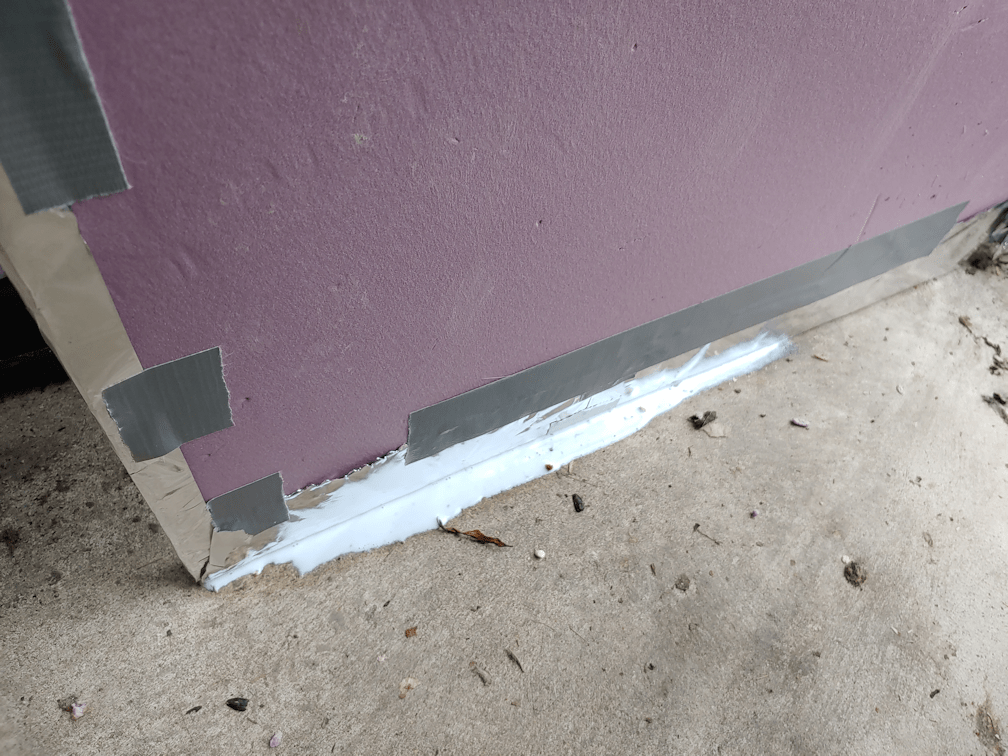
A puddle of glue under the reflector we made yesterday!

I used watered down all-purpose glue on the sheet of insulation to adhere the aluminum foil, applying a very thin coat with a paintbrush. I knew the glue wasn’t going to stick very well to the insulation, but I figured it would at least dry and adhere enough to hold the foil in place.

I did not expect it to leak like this, instead! That’s quite a lot of glue, too, for the amount that was used in the first place.

Ah, well. It’s still sticky and holding the foil in place, plus the foil is held by tape on the back. It’ll stay, and that’s all the matters, really.

The Re-Farmer
Our 2022 Garden: latest seedling status

This morning, while tending our seedlings, I spotted a newcomer!

That is a Crespo squash seedling!

This tray, on the heat pad, needs to be watered about twice as often as the tray next to it.

Where the Cup of Moldova tomatoes are doing quite well! The big aquarium greenhouse has been working out the best among our three set ups.

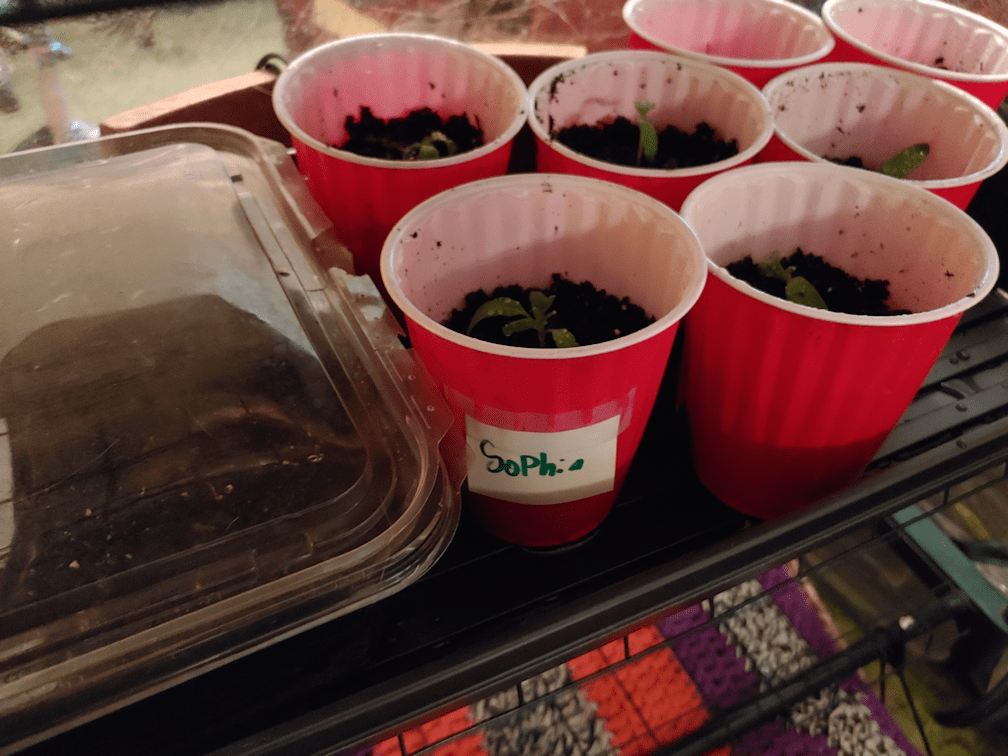
The Sophie’s Choice tomatoes got moved from the small aquarium greenhouse to the mini-greenhouse, in hopes that they will start doing better. I’m not sure why things are not doing as well in that little greenhouse. I suspect it has to do with lack of air circulation. The mini-fan we had on the aquarium greenhouses, moving it back and forth between the two, is now set up in the mini-greenhouse. We can’t open up the cover because of the cats, so the fan is needed more in there, than with the aquariums. I hope we can figure it out, though, because that’s little tank is currently wasted space that could be growing things! We do have a pedestal fan, but it’s not tall enough to provide air circulation in through the screen covers on the tanks. We’ve looked at different ways to set it up, but so far, we haven’t been able to come up with anything suitably cat proof.

It’s become such an issue, that we’re coming up with plans to build a “door” between the living and dining rooms, so that we can turn the living room into a safe zone for plants – all our plants – and not have to have all these barricades and shields around them. My older daughter has diagrammed a plan for a removeable frame to fit into the opening between the two sets of shelves between the living room and dining room, which would support a “door”. It would be made using hardware cloth, for maximum light and air to pass through. One of the shelves has an opening through it that we’ll have to frame a screen on, as well. We’ve really got to come up with something, because all the stuff we’re doing to try and protect the plants from the cats isn’t all that good for the plants! Especially since we are starting so many seeds indoors and, next year, will likely be starting even more. That will be a summer project, if we can get the materials we need to build it.

Last night was the first night we had the outside doors to the sunroom closed, so no cats – or skunks – could come in. It had reached temperatures of 20C/68F in there yesterday, yet this morning, it was just barely above 0C/32F, which means it was even colder, overnight. There is no way we can move any of our seedlings into there, without having to bring them back into the house overnight, which we won’t be able to do. Our overnight temperatures are going to be warming up, though, so we’ll have to keep monitoring the room. I might set the ceramic heater bulb up overnight, just to see what a difference it makes.

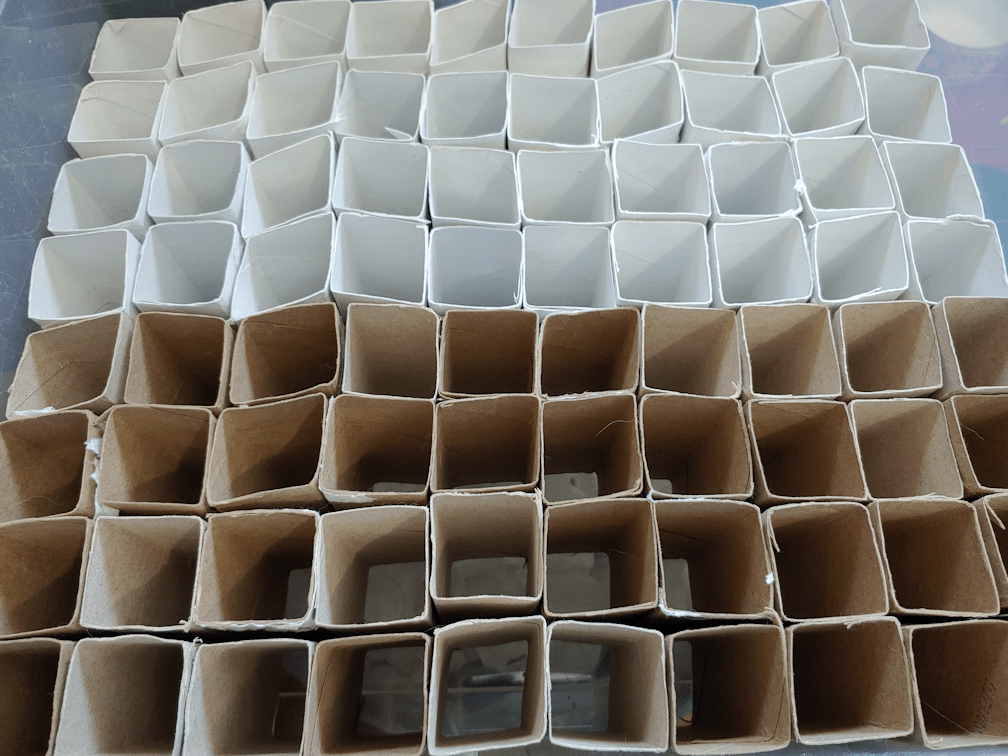
Some things will be started right in the sun room, but not for a while, yet. We’re still preparing, though, including getting the toilet paper tube “pots” set up in a bin.

This will be for the black Kulli corn. I’m not going to bother folding bottoms onto the tubes, so as to give the roots more depth. We have a total of 100 Kulli seeds (unless there are extras in the packets, which sometimes happens), and I thought I’d be able to put 100 tubes in this bin. If it had been square, it would have worked but, alas, it is a rectangle. Instead of the 10 rows of 10 I thought would fit, we could only fit 8 rows of 10. We do have more of the smaller bins we used to start the tulip tree and paw paw seeds in (still no signs of anything in those, but I’m not expecting it, yet). They can fit 4 rows of 8, so we’ll be able to work it out. The corn won’t be started until early May, though. The sun room’s overnight temperatures should be just fine by then.

I picked up more bins in this size; there was only 2 left in the store I found them in, so I now have 3 “spares”. I also got more of the smaller bins, and we now have 4 available to use for new starts. With their transparent lids, they can be used as little greenhouses, and they will make things much easier to move around when it’s time to harden off the seedlings. The toilet tube pots fit really well in these, so we’re going to continue collecting the tubes to use to start seeds in the bins.

Little by little, it’ll get done.

The Re-Farmer

Collapsed

I hoped it would hold out a bit longer, but it finally happened.

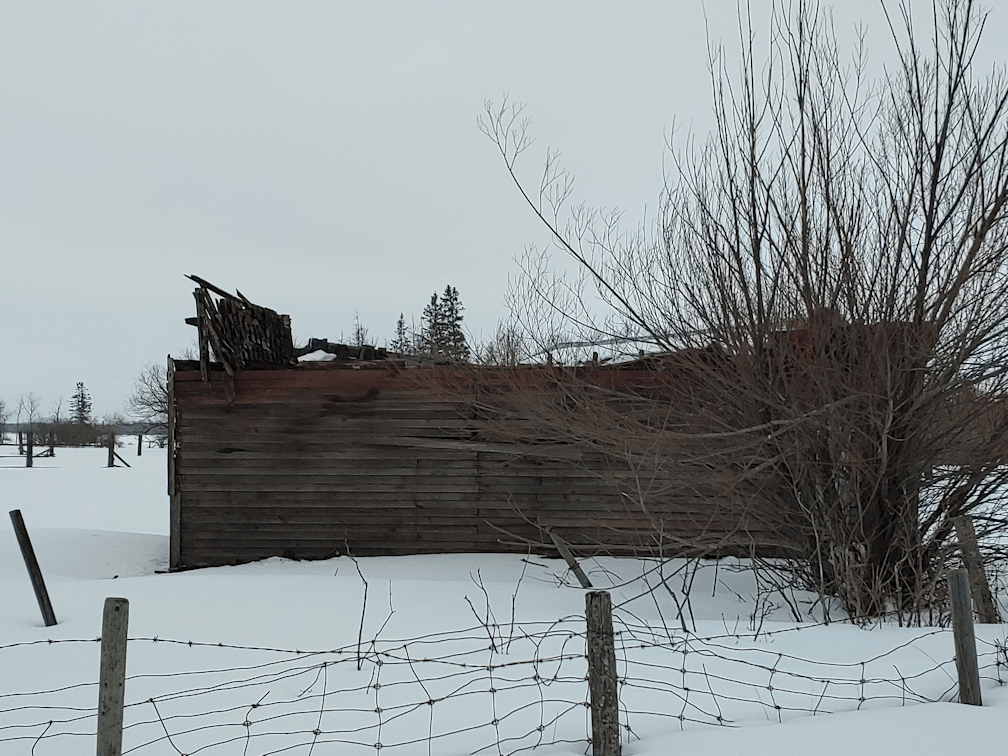
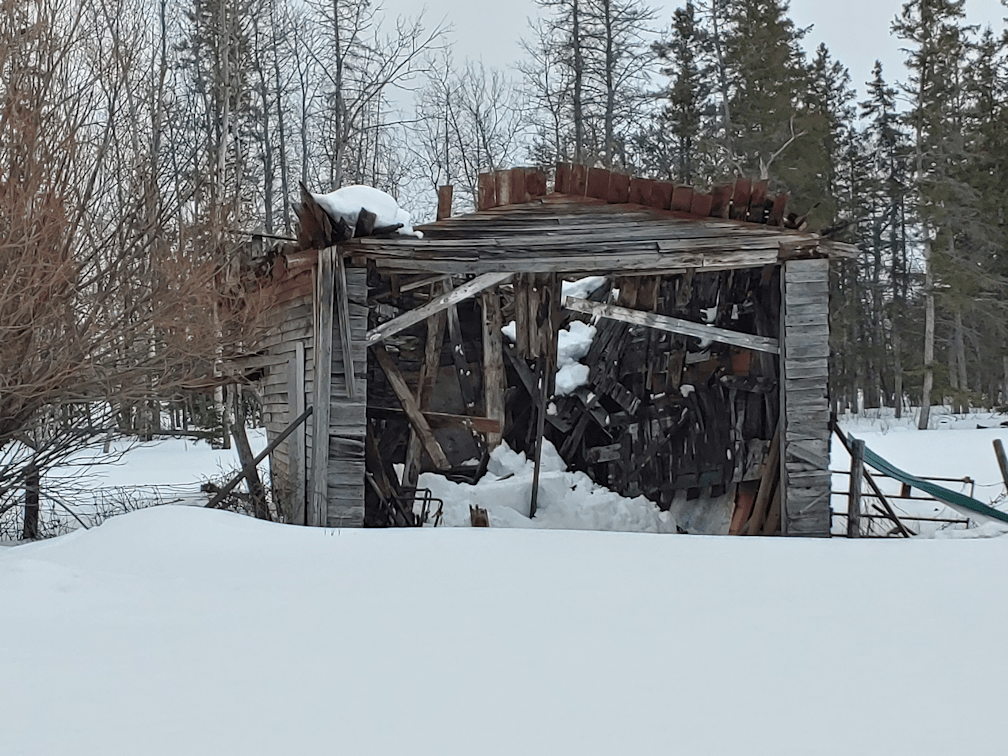
An old shed roof collapsed.

I spotted it when I headed outside to meet the pharmacy delivery driver.

Just look at all that snow!

The shed was mostly empty, with a few odds and ends in it. There were a couple of things I’d hoped to tuck away somewhere else before the roof came down. There’s a package of shingles that are useable, for example, and an antique plow I’d hoped to save. It might actually still be okay, as it was tucked pretty far into a corner.

When I showed the pictures to one of my daughters, her reaction was, “so that’s what that crunching noise was!” She’d thought it was from a vehicle and had gone outside to see if there had been an accident or something, but didn’t think to look at the shed.

This shed was among the things we wanted to actually get rid of, but I was thinking along the lines of after a new fence was built, from the barn to the road, so we could get rid of the fencing towards the driveway. The renter was talking about putting in new fences (part of the agreement in renting the property from my family is that he would be responsible for the fences) and I’d suggested the new fence line. If he does build new fences this year, and cuts through the old hay yard, that’s where we would eventually be planting more shelterbelt trees.

This past summer, I’d made a point of examining the shed from the inside, to see if it was worth trying to save. It wasn’t. The roof structure really didn’t have a lot of support, and there were already holes in it.

Now that the roof has finally collapsed, I want to dismantle the shed and salvage as much material as we can. The 2×4’s in the joists should still be useable, and I think a lot of the boards forming the walls should still be pretty sound. In fact, there might be enough material to salvage out of this that we can build a chicken coop. I’d hoped to be set up for chickens this spring, but we just don’t have the materials to build shelters for them. I can’t even figure out where we could put a cat proof brooder for any chicks we get.

I want to have a chicken tractor for use in the summer, so we can integrate chickens into our garden plans, but we would also need a permanent structure sturdy and warm enough for them to survive our winters. The old log summer kitchen my parents used as a chicken coop is not useable. I do want to replace the corrugated tin pieces that have come off, due to a tree being allowed to grow against it, and its branches tearing away at the roof. It’s the only log building that is still structurally sound, but it won’t be for long if we don’t patch up the roof. I would love to be able to clean out and repair it, but that’s a huge job we won’t be able to start for quite a while.

I think I can reasonably expect to salvage enough material from this shed to build a small coop – large enough for the dozen or so chickens that would be suitable for our egg laying needs – but not enough to also build a chicken tractor. However, one of the things I want to do is build mini-coops for our high raised beds that will allow us to set up a few chickens on a raised bed after it’s been harvested, to do their magic and leave their fertilizer for the next season. We’ll be making all our raised beds the same size, so that any covers we make will fit on any of them, whether a bed needs to have a plastic cover to act as a cold frame or protect from frost, a screen to keep the insects out, mesh to keep the critters out, or a mini-portable coop to keep chickens in!

So the roof collapsing on this shed will actually made it easier and safer to take it down, and we’ll be able to salvage materials out of it sooner than expected.

The Re-Farmer
Our 2022 garden: starting shallots and transplanting tomatoes

Okay, for better or for worse, we now have stuff in the mini-greenhouse! Let’s see if we’ve succeeded in making it cat proof. :-D

The first thing today was to get the shallots started.

There are a lot less seeds than I remember from last year. I’ll have to look back at last year’s photos and double check.

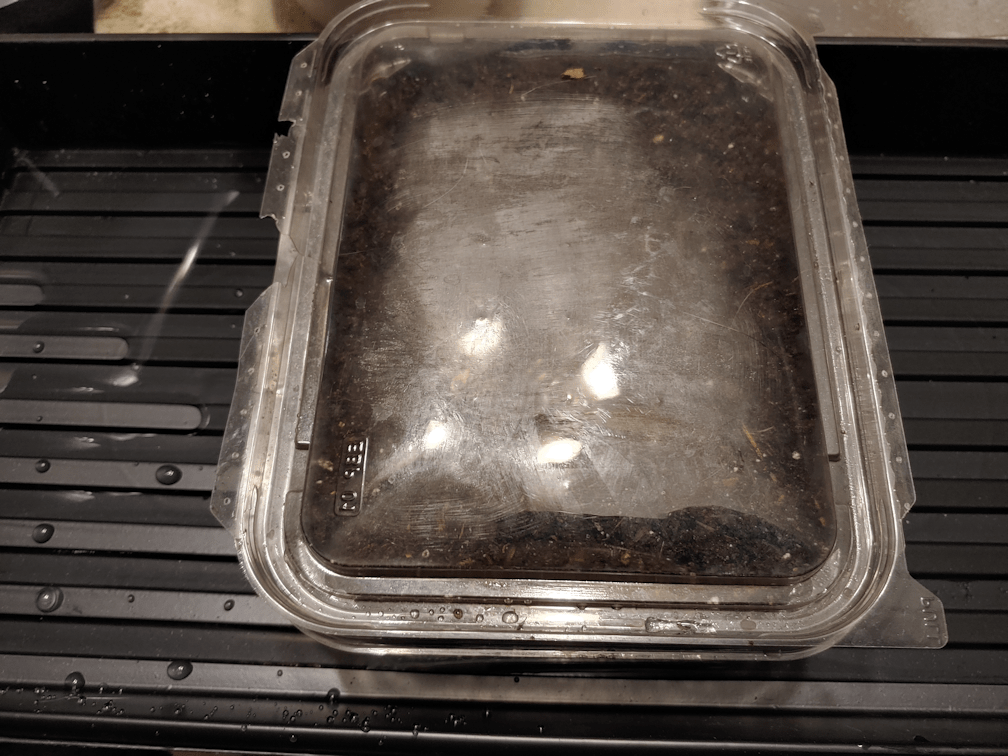
The container is a mixed greens salad container from the grocery story. It has drainage holes in the bottom, and the seed starting mix is pre-moistened.

With such easy to see seeds, after scattering them I used a chopstick to separate any that were right up against each other, and spread them out more evenly. Then they got a spritz with water, a light layer of more soil mix, then spritzed again.

The container’s lid is recessed, and I didn’t want it too close to the soil surface, so I just plopped it on upside down. I then left it in a tray with water under it, to be absorbed from below. While it was sitting, it was time to work on the aquarium greenhouses.

The red and yellow onions are doing quite well. I rotated the trays after adding more water below them. The reflective light from the aluminum foil at the back, which is closest to the trays themselves, is clearly making a difference. All the sprouts were leaning towards the back of the tank! :-D

We have our first Wonderberry sprout! These were taken out and got more water added to the outer cups, as well as a spritz, then set aside for later, so they wouldn’t get knocked over while the seedling tray was being moved around.

You can just see that a new luffa gourd is starting to sprout! It’s right against the wall of the pot at the top of the photo.

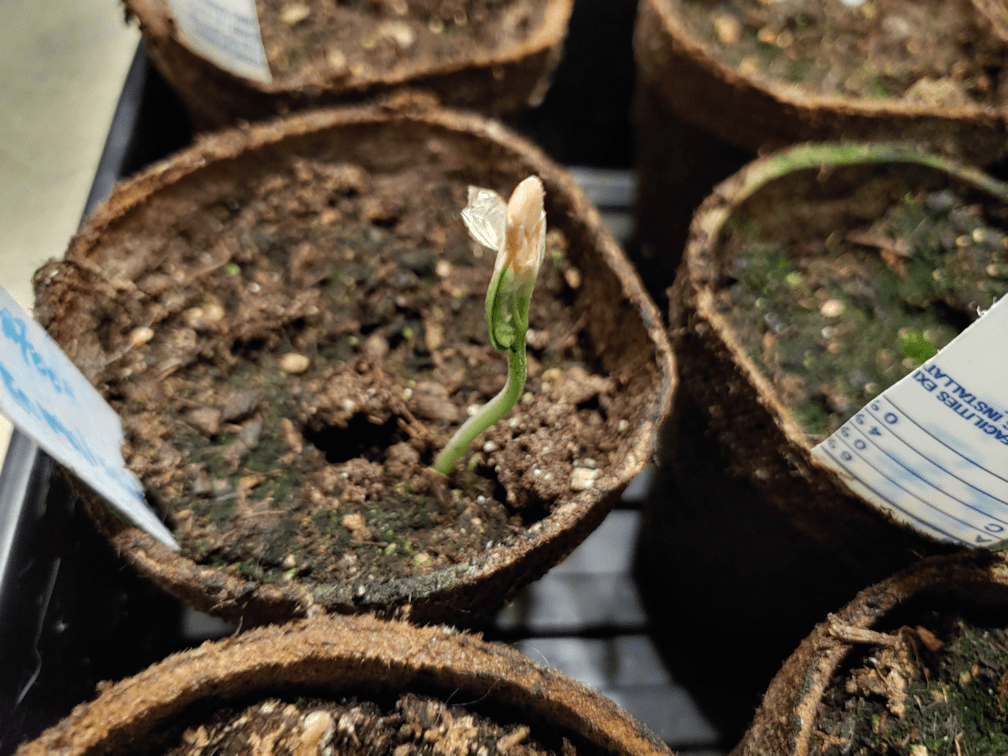
I very carefully removed the seed covering from the leaves of the canteen gourd. Normally I would avoid doing that, but I’m glad I did this time. It was really solid, and had to be broken apart to get it off.

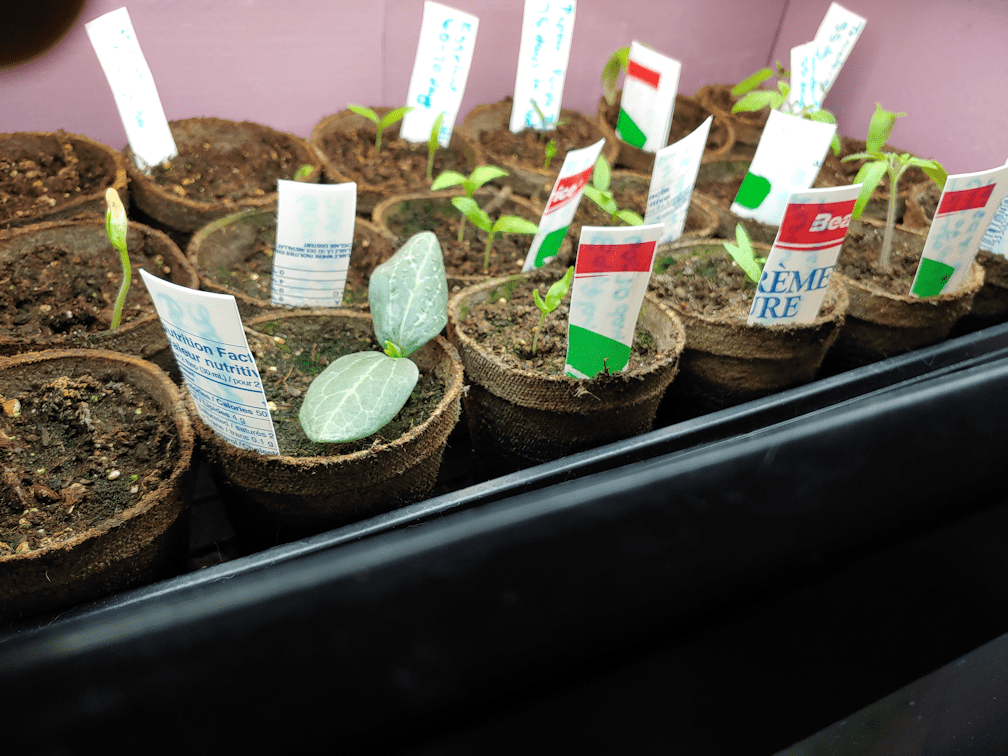
Here are the tomatoes, on either side of the eggplants and peppers.

The tray usually gets water on the bottom well before the pots dry out this much, but when the pots are damp, they are difficult to move. They feel like they’re about to fall apart. Which will be good when they get transplanted into the garden, but not so good when I need to move them around!

With the eggplants and peppers, they were thinned to 2 plants per pot. As they get larger, we will probably thin them to one plant per pot. We don’t need a lot of either of these. Three plants each should be fine to meet our needs.

The plan was to transplant all the strongest tomatoes to thin them – but there were a lot of them! Especially the Cup of Moldova. They’re doing really well in here. In the end, there was just one seedling that didn’t get transplanted because it was so tiny.

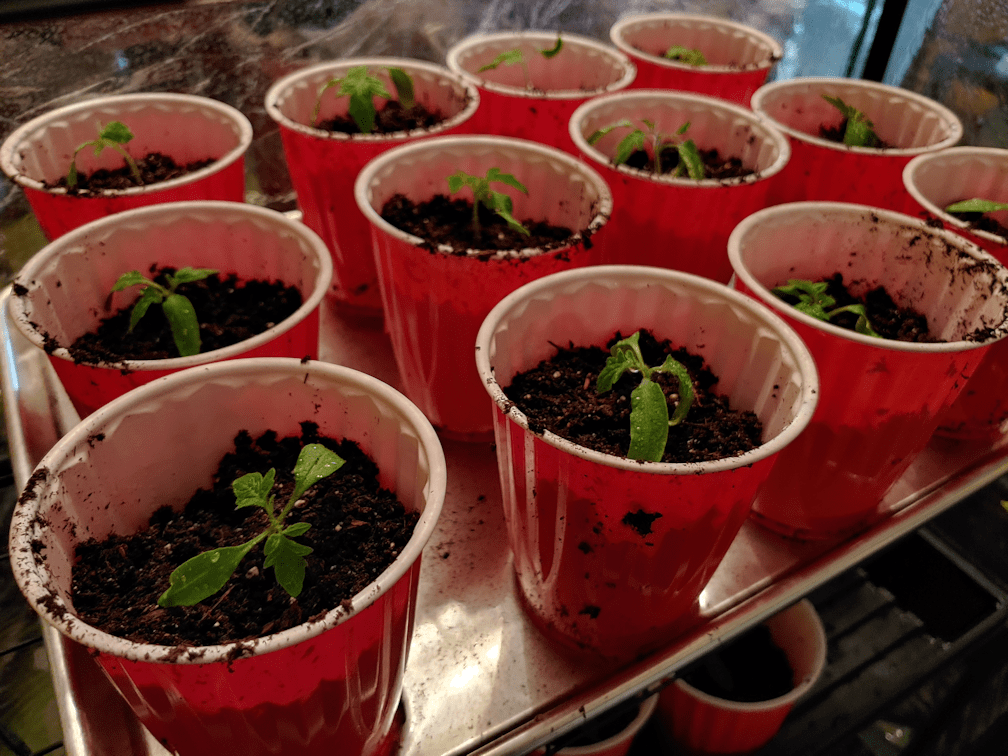
We half-filled red Solo cups with soil and used a chopstick to make holes for the transplants. Then I ended up using a steel poultry trussing needle (which never gets used to truss poultry; I’m not even sure why I originally bought them!) to loosen and tease out the transplants as carefully as I could. After they got tucked into their new pots, more soil was carefully spooned around them to about half way up their stems and gently pressed in, just enough to make sure there were no air spaces, before they all got a spritz of water.

Each of the original pots was left with one tomato plant. With the Cup of Moldova, we ended up with a dozen transplants, making 15 altogether. These cups were used last year, too, and already had drainage holes in the bottom. If we needed to, we could double cup them, but for now, they fit into the baking tray, in one of the higher shelves of the mini-greenhouse, above the back of the chair it is tied to. I’d rather it was lower down, but with the wider baking tray, that’s where it fits.

With the Sophie’s Choice, there were only 7 strong enough to transplant, and they fit in the tray with the shallots container.

When it’s daylight, we’ll assess whether or not we need to set up a light from the other side. There may be an issue of the high tray shading out the lower one.

Then the original tray went back into the big aquarium greenhouse, on the heat mat, and the tray got a generous amount of water added, to moisten the pots from below.

In doing the transplants, the tomatoes also got moved to one end of the tray, while the eggplants and peppers are now next to the gourds. That was just because it was easier to reach the tomatoes while transplanting them.

Hopefully, these will survive their transplanting well. It should be interesting to see the difference between how the tomatoes in the mini-greenhouse do, compared to the ones in the aquarium greenhouse. There is going to be a substantial difference in light and warmth.

But first, we’ll see just how tempting the trays in the mini-greenhouse are for the cats, or if they will be left alone!

There are still two more shelves open in there. The next time we need to start seeds, which should be in two or three weeks, we should be able to move things out of the aquarium greenhouses, into the mini-greenhouse, and have the new seed starts put into the aquariums. If the weather co-operates, by the time we’re ready to start more seeds in April, we should be able to transfer the biggest seedlings into the sun room. I’m sure these tomatoes will need to be potted up by then, too.

This is the first time we’ve had so many seeds to start indoors. It’s going to be a juggling act!

The Re-Farmer

Window Down

When doing my morning rounds, I make a habit of checking various things, looking for fallen branches, weather damage, etc.

This morning, I found this.

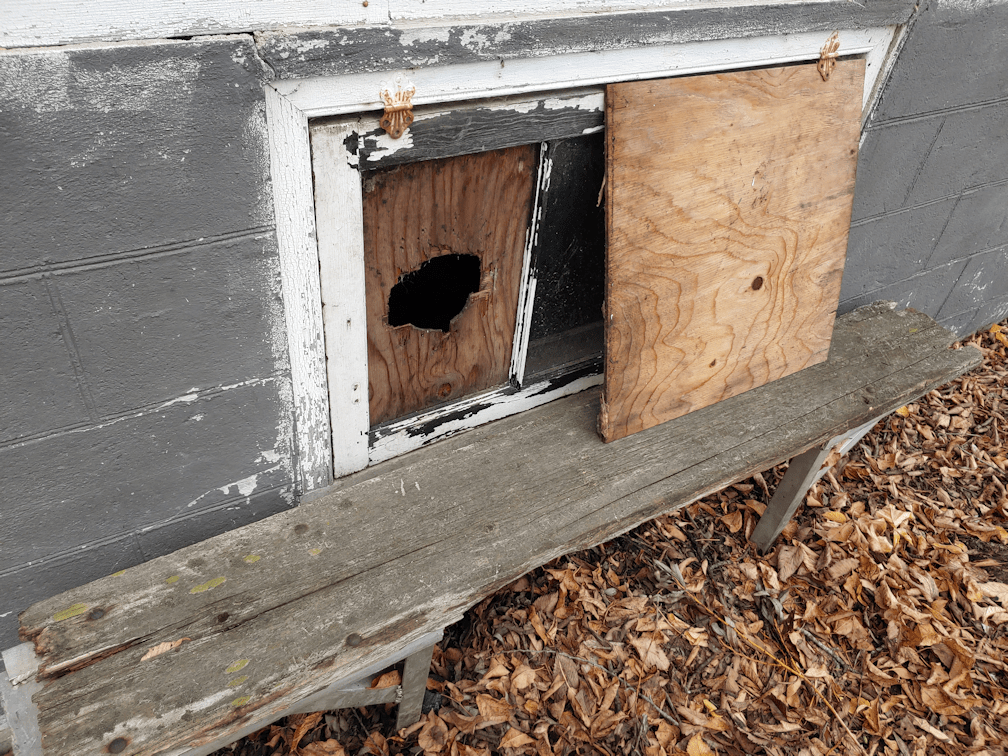
This is the back window to the “basement” of the storage house. The cats – and skunks! – use it to get in and out, so we put an old bench we found in the spruce grove under the window to make it easier for them to do so, without knocking more of the glass out. The board was there to keep some of the weather out.

My guess: there was another cat fight that made its way under here, and a cat went through the window with more force than usual. The only thing holding the window frame in place are those hinges in the frame above, and a bent nail on the side.

Since the window was out anyhow, I took advantage of the open space to take another look under the storage house. I’ve taken pictures under there before, but that had been by sticking my hand through the window frame, where the pane is missing.

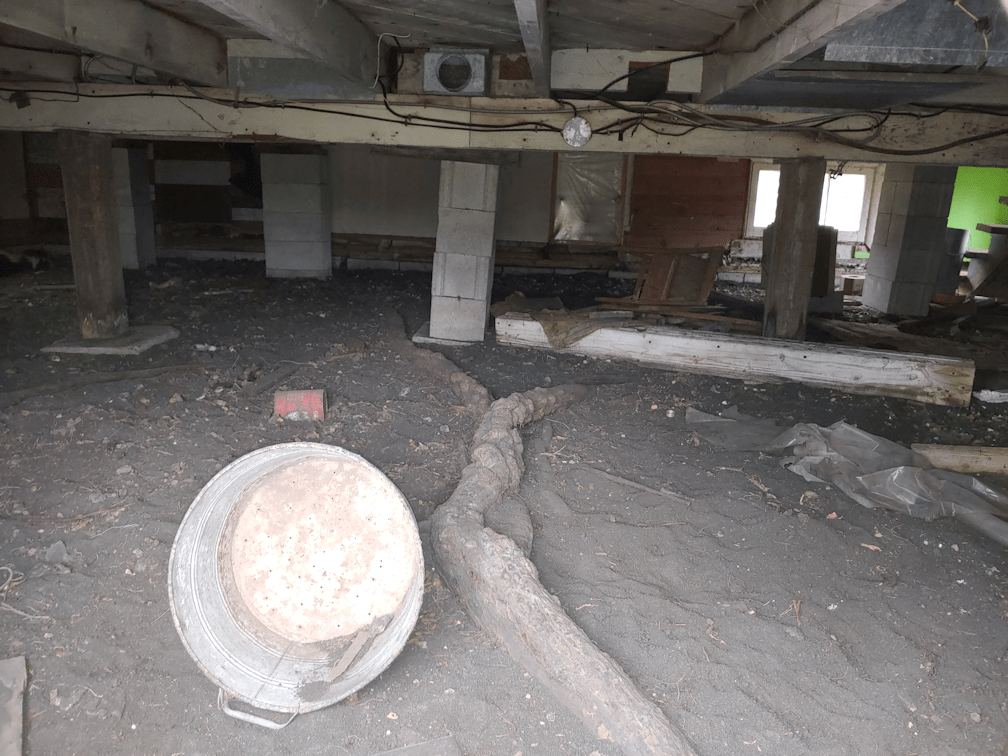
This is looking straight in from the window.

That massive root is looking bigger than I remember it. It looks like the cats have been rolling around in the dirt beside it, as it seems more uncovered than before.

I do wonder about that metal tub, with all those holes in the bottom.

What I could see – and reach – this time, was the glass from the broken pane that you can just see a corner of, in front of the tub. I got that out, so no critters will get cut on them.

This is looking to the north side. There are three windows there. Once is completely covered, the one with light showing through is protected by a lattice on the outside, and there is a third window near it, where you can just see a bit of light. I can’t tell wasn’t on the inside, but on the outside, there is a bench sheet of what I think it aluminum in front of it. One corner at the bottom is bent outwards, and that is the usual way the critters get under here. What usually happens is, when they get started away from the kibble house, the dash in through that opening in the corner, then come out through the window I’m looking through to take this photo.

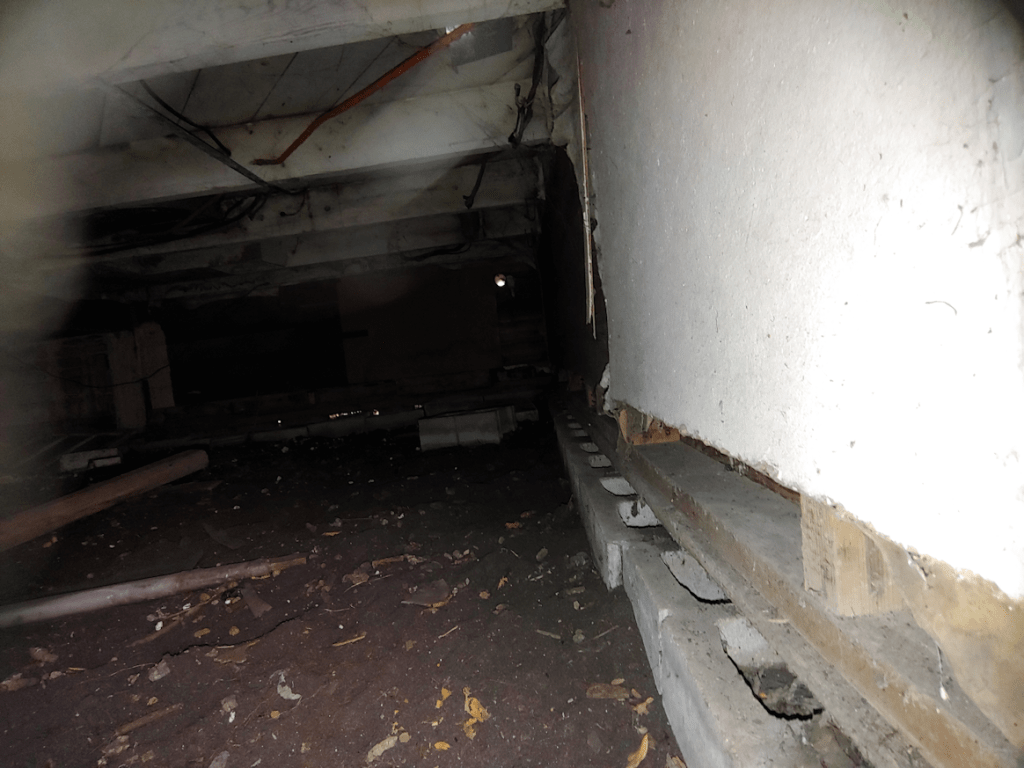
In the opposite direction, there is another boarded up window on the south side.

Here, you can see the concrete blocks the house is sitting on. It’s on a double row of blocks, with the outer row lined up with the outside of the building, so there is nothing sticking out. The weight of the house has caused all these bricks to sink into the soil. Because the inner row of bricks are not completely under the house, they are all tipping towards the middle.

There are SO many of these concrete blocks! There’s the double rows holding the house itself up, the pillars supporting the floor, and even loose ones scattered about.

I admit, I’m pining for those bricks. I’m seriously considering crawling under here, just to get those loose bricks! They are incredibly useful. I used to play under here with my late bother, but I’m not quite as small and agile as I used to be! :-D We would go under there, using the remains of the basement steps that are still attached. There is a remarkable amount of space under here. I should be able to move around all right. Plus, I admit to being curious about what else I would find.

My parents intended this house to be moved to a permanent location onto the quarter section the younger of my brothers lives on now, but obviously, that never happened. I guess it never occurred to them that their sons would want to have newly built homes, rather than an old one that’s been moved a couple of times. Now it just sits, filled with old junk and stuff we don’t know where else to put!

As for the fallen window, I just put it back as best I could. I don’t want to board up the window, as the space under here is one of the safe places critters can use to get out of the weather. The cats use it a lot. They go in and out through that small hole in the wood. When we first moved there, there was an old metal pipe running through it for some reason. I think it was there to brace the window or something. The board leaning on the bench will keep the worst of the weather out of where the window pane is missing, but should still give the cats enough space to get in and out easily.

I can’t see this building being moved again, which means at some point, we’re going to have to go in there and start clearing it out and cleaning it up.

I am not looking forward to it.

The Re-Farmer