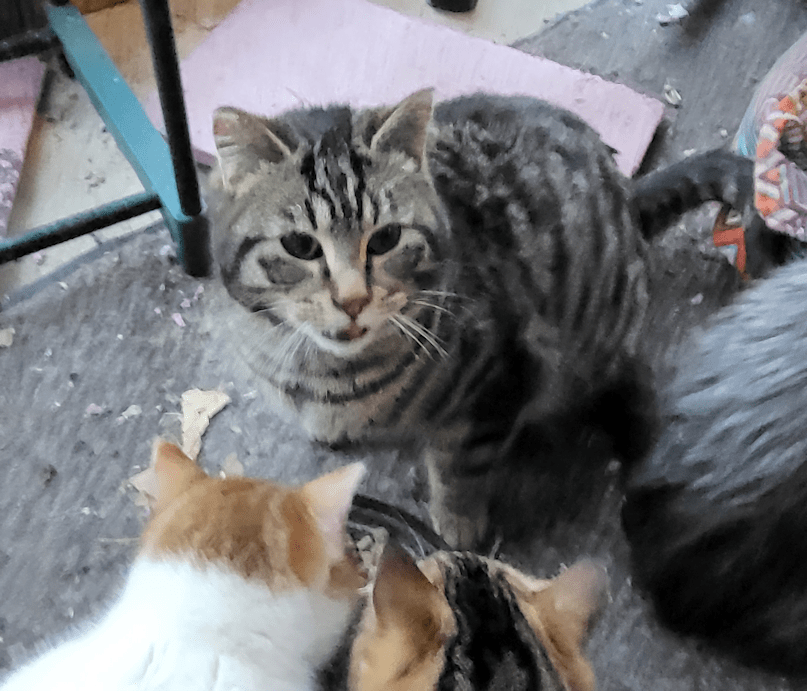
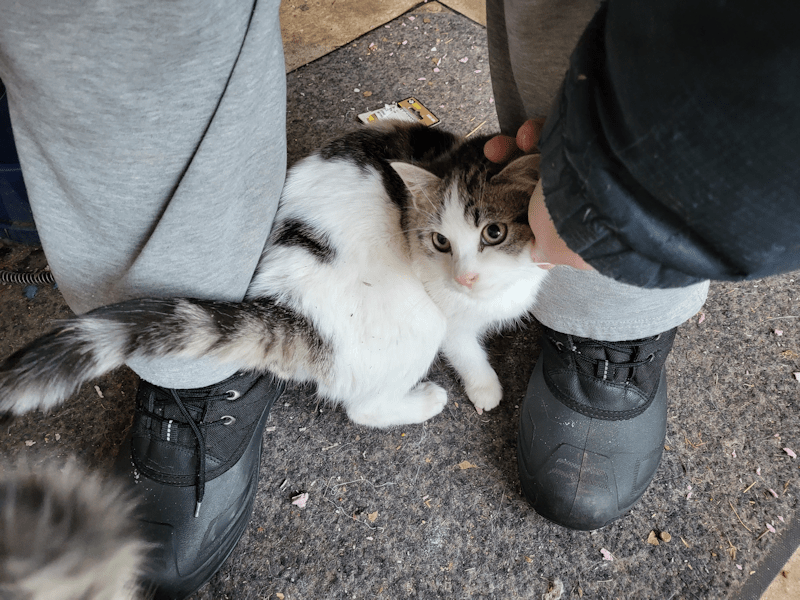
The one really friendly grey and white kitten of the bunch.

He was rolling all over my boots, wanting attention!
Now if only the females were this friendly, so we could snag them to be fixed without using traps!
The Re-Farmer
The one really friendly grey and white kitten of the bunch.

He was rolling all over my boots, wanting attention!
Now if only the females were this friendly, so we could snag them to be fixed without using traps!
The Re-Farmer
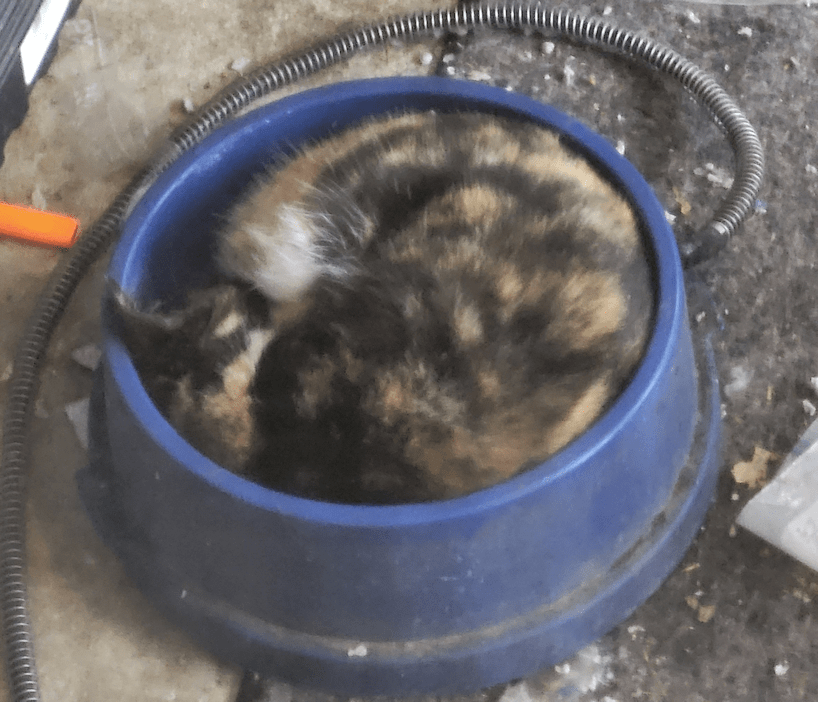
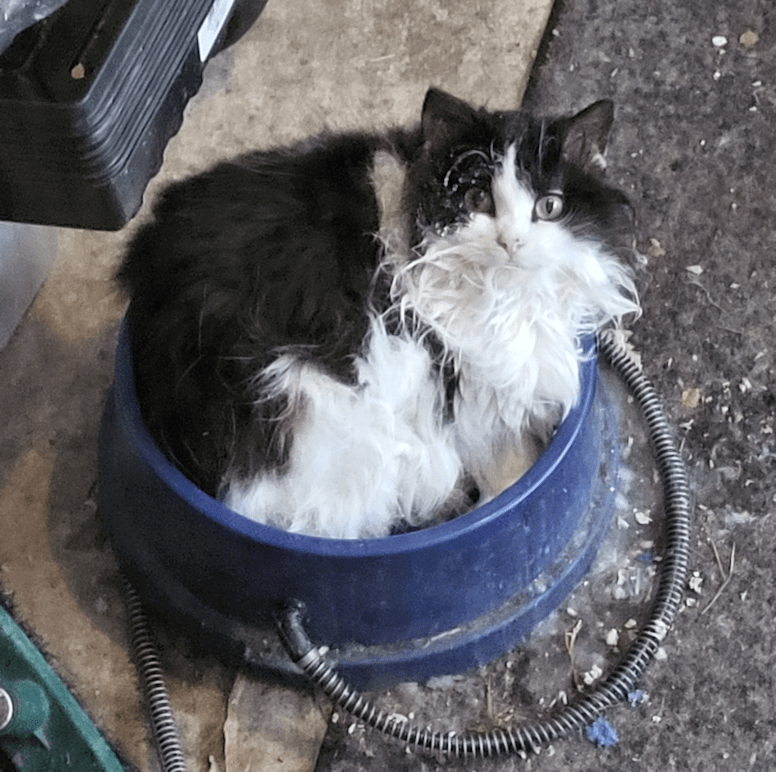
This is what I found, when I was about to go into the sun room with the kibble.

One very bedraggled baby taking advantage of the empty heated water bowl!
Also, that has got to be the whitest nose I’ve ever seen on a cat. I think it may just be how the camera picked up the lighting. Particularly since the eyes look so light, too.
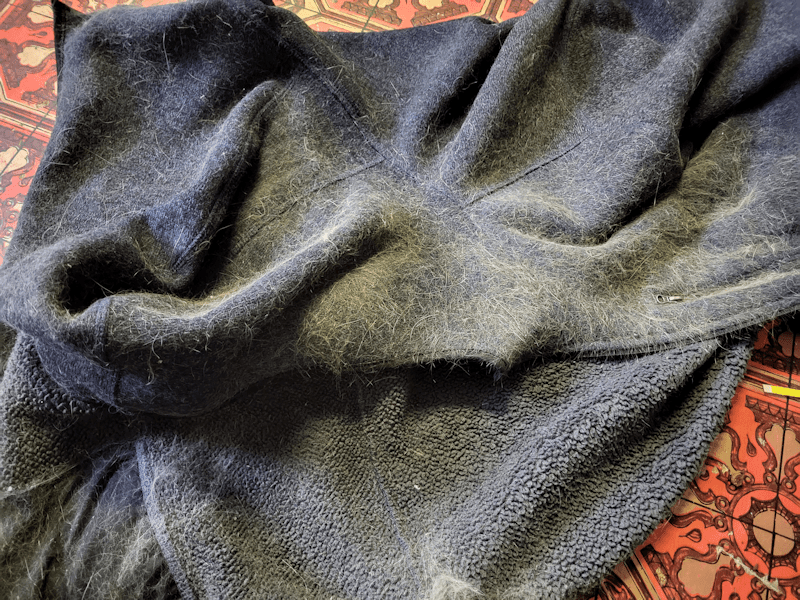
I am somewhat concerned about the long haired cats outside. None of them are socialized, really. There’s one that sometimes lets me pet him. We can’t get near the others. Their fur could get to incredibly matted. Even if we were able to get them to the point that we could pet them, I just can’t see them ever letting us brush mats out of their fur!
The Re-Farmer
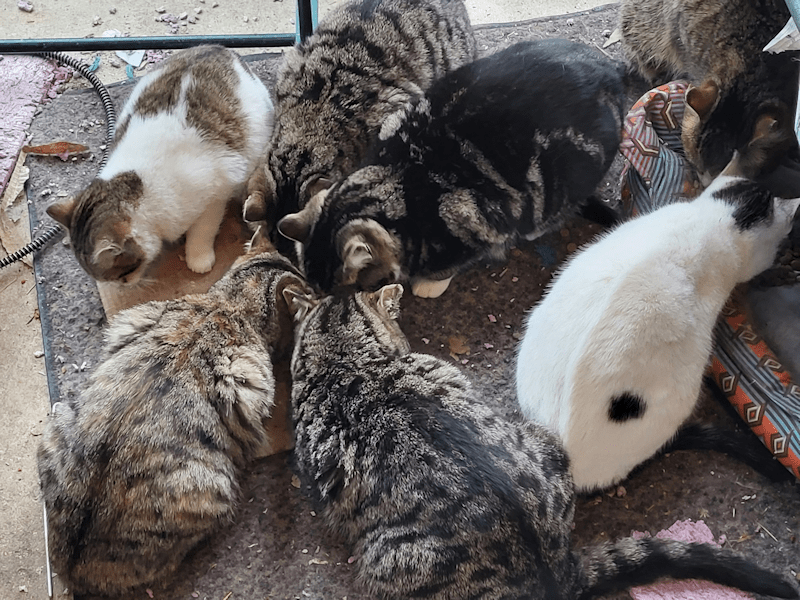
One of the things I like about letting the cats use the sun room for the winter, is looking out the bathroom window and seeing them all in a pile on the swing bench.
Sometimes, though, we see this guy.

He was loafed by himself by the old kitchen door and looking completely miserable. But then, he always looks miserable. That beat up face, though…
We really don’t want to encourage him to stick around. He attacks our own yard cats – even the females – way too often. And, of course, he gets them pregnant.
And yet I would love nothing more than to socialize him. Clearly, he’s had a brutal life. As long as he’s not bothering the other cats, we’re certainly not going to chase him out of the sun room in winter. As I write this, we are at -29C/-20F with a wind chill of -38C/-36F. The thermometer in the sun room was reading -20C/-4F when I was putting the food out. Far better, I’m sure, than the many shelters there are around the property, even besides the ones we’ve provided for them. Plus, there is food and warm water.
How can I possibly say no to that face?
The Re-Farmer
Wow, did the temperatures sure drop overnight! Especially with the wind chill.
It does make for pretty sun dogs, though.

I honestly can’t remember if I’ve ever seen rainbow sun dogs before, other than in photographs! The colours were much brighter in real life.
As I write this, we’re at -19C/-2F, with a wind chill of -31C/-24F. It’s actually gotten colder from when I was doing my rounds this morning! It was “only” -16C/3F with a wind chill of -25C/13F Our high for this afternoon is supposed to be -16C/3F with a wind chill of -29C/-20F If I could avoid heading to the city today, I would, but it’s supposed to get colder over the next few days, so this is my window.
The kitties are taking full advantage of the sun room, including this little shrimp.

The photo sucks because I was taking it through a screen window. This tortie has been named Phantom by the girls, because it has a black “mask” over one eye. She was so solidly asleep that, not only was I able to go into the room and set out kibble in various containers in the sun room, I was able to actually PET HER!!!! Just for a few moments before she woke up, saw I was touching her and ran off. Even then, she only ran as far as the door, then stopped to look at me, until I went over to untie it so I could do the outside kibble trays.
It would make life so much easier if we could socialize more of the females. I don’t like the idea of having to trap them, as that would make them even more distrustful of us. Still, it’s better than having so many litters of kittens again!!!
The Re-Farmer
I was so happy to see Rosencrantz in the sun room!

It’s been so long since I’ve seen her, I was starting to wonder if she was coming back at all. She’s looking pretty thicksome, so wherever she’s been for the past month or so, she’s been well fed!
We’ve been talking to the Cat Lady about setting up traps to catch female yard cats for spays. Rosencrantz is almost friendly enough that we might… maybe… be able to get her into a carrier. She did not look like a happy mama. Last year, she had kittens insanely early, was clearly coming to me for help, but I couldn’t get to where she had them in the junk pile. Everything was too frozen to the ground, and they clearly died soon after. Once things thawed out, we never did try to get to that spot. I was just not ready to see if there was anything left of them. Then she had another litter – 3 grey and whites, Pinky and a tortoise shell – also in the junk pile, but somewhere in a different spot. She became increasingly hissy and snarly when I tried to pet her. Her behaviour actually reminded me of how Butterscotch used to be, and Butterscotch is her mother. When Butterscotch was spayed, her uterus was in really bad shape, but when Cabbages was done, she had a twisted uterus, too, and she was only 2 yrs old. Cabbages was from Butterscotch’s second litter, the summer we brought her and Beep Beep into the basement to have their babies, and we discovered she was killing off her first litter because she wanted out so badly. I suspect there may be a genetic defect in Butterscotch’s line.
Here’s hoping we’ll be able to start getting that done in the time window, where it’s warm enough to safely trap them and not fear they’d freeze before the trap got checked, but before the ladies start going into heat!
Also, the Cat Lady messaged me on the 1 year anniversary since they took in Cabbages! Where did that year go? Cabbages is doing so well, now. It’s quite the miracle! She’s living the high life, getting fed salmon and chicken so much, she turns her nose up at cat food. 😄
I’m so glad we found the Cat Lady. She and her family are just amazing!
The Re-Farmer
You can tell when temperatures have started to drop again.

More of the cattens are back in the sun room, enjoying the comfort of the swing bench!
The Re-Farmer
This is what I have to wade through, in the mornings!

The one using the empty heated water bowl as a butt warmer is hilarious!
Also, they’ve done quite a job of knocking things out of the shelves and off the counter. We’ll have to wait until the ground is dry before we can move things out to pick it all up. Until then, we need to watch our step for all little stuff that got knocked out of their various containers!
The Re-Farmer
By a Rolando Moon.

The old lady is still pretty spry!
The Re-Farmer
We had a light snowfall last night, making everything all white and fluffy this morning.

The outside cats didn’t mind it at all!
I counted 21 this morning.
Meanwhile, indoors, we have our first signs of spring.

When I checked the trays this morning, three out of four of them had onions sprouting. When I came back about an hour later, there were sprouts in the fourth tray!
I’m absolutely amazed by two things. One is, how quickly they started to germinate.
The other is, how much cat hair there is, all over the soil surface. These trays had lids on them. Where did all that cat hair come from? I mean, Beep Beep practically lives on top of the lights. She naps on them, rolls around on them, and even hugs them, so yeah… I can see some of her fur drifting down… but getting under the lids?
Yesterday, I marked on our communal calendar, two sets of dates. One was the number of weeks counted back from our last average frost date, June 2. This way, we can see at a glance that something that needs to be started 10 weeks before last frost, needs to be started around March 24, while something that needs only 4 weeks can wait until May 5th.
The other dates I marked was number of days counted back from our average first frost date, which is Sept. 10. We have exactly 100 days between our average last spring and first fall frosts. That’s the growing season we can mostly count on for frost sensitive plants.
For things that have really long days to maturity, it’s that “days before first frost” that we need to consider. If, for example, I have a gourd that requires 110 days to maturity, that’s May 23. If it needs 7-10 days to germinate, I would start them at least a week before that.
If I have something than need 90 days to maturity, that falls on June 12 and, by then, I could get away with direct sowing, instead.
One of the really useful tools I’ve found is the Farmer’s Almanac planting calendar. Most planting calendars just give number of weeks before first frost, because they’re meant to be generic. I can get that information from the seed packet. Farmer’s Almanac, however, lets you input your area code (or zip code, if you’re in the US). You can even put in your city (ha!) and province/state. It will find the climate station nearest you, then give you the calendar dates for starting indoors and transplanting, or seeding outdoors. It even gives you the choice of dates based on frost date, or on moon dates. Oh, and I discovered something very handy when I hit the print button on the web page. It allows you to remove things from the list that you aren’t growing, which greatly reduced the number of pages that got printed out!
It’s still a bit generic, of course, but the date range is pretty wide. For example, it tells me bell peppers should be started between March 24 and April 7. We have five varieties of bell peppers, and four of them are early varieties, so we could use the information on the seed packet to figure out which ones need to be started in March, and which can wait until April.
Of course, they can’t cover everything, so we still need to make adjustments. For example, their calendar says to start winter squash outdoors between June 16 and July 14. With some varieties, we could do that, but we’ve got some large varieties of winter squash that need more time to fully mature, so we would be better off starting them indoors. If we use the biodegradable pots that can be buried, that would reduce transplant shock.
We have always started summer squash indoors. I think, this year, we might direct seed them. The calendar says zucchini can be planted anywhere between June 16 and July 14, which is when we can expect the soil to finally be warm enough.
As for the things we’ll need to start the earliest, the herbs (except dill, which is direct sown) will need to be started at the same time as bell peppers; in March. The eggplants and tomatoes can be started in early April, melons can be started in early May, while pumpkins and watermelon can be started in mid May.
The direct sowing dates are pretty interesting for some things. If we decide to try growing radishes again, they can be direct seeded in early April – at the same time we’d be starting eggplant and tomatoes indoors. Carrots can be planted in late April, early May, which would be about the same time we’d be starting melons indoors.
All of which needs to be taken with a grain of salt. For example, the calendar says to start onion seeds outdoors in early May. Sets, sure, but seeds? Nope. There’s a reason people out here start their onion seeds indoors in January! Also, it has dates to start lettuce and chard indoors, but none for direct seeding. Who starts lettuce and chard indoors? I mean, sure, you can grow them indoors, but for transplant?
As it stands now, though, we won’t need to start anything else indoors until March 24, at the earliest.
That gives us February and most of March to get the materials we need and build a removeable door and frame, to keep the cats out of the living room, and out of the seedlings!

We’ll also need to build a barrier to block an opening in the shelf to the left of the door in the image.
Where the warm spot is?

There were actually four cats squeezed onto the warm spot above the heat bulb, but two of them were Pointy Baby and Gooby, who decided to climb me when I stopped to take a picture.
Do you know how hard it is to line up a shot while a cat is manically trying to lick your nose?
The Re-Farmer