Zucchini and sunburst squash I gathered this morning.
Yesterday, I made a sort of hash, first browning potatoes, cubed small, in butter, then adding leek and frying until softened. I cubed sunburst squash, a green zucchini and a grey squash (the lighter coloured, kinda striped, kind of zucchini; our grocery stores label them as grey squash). Once those were cooked until soft, I added seasonings and maybe half a cup of whipping cream. It turned out awesome!
I’m out of cream, though, so I think I’ll just pan fry them in butter with leek.
This year, I’ve been allowing various things to come up in between the sidewalk blocks by the sun room, instead of taking the weed trimmer to them, to see what is there.
Quite a lot of flowers have come up through the cracks and crevices between the rain barrel and the clothes line platform. Most of them are either the purple bell shaped flowers we’ve got all over the place this year, or a taller plant with bright orange-yellow flowers.
Then, there is this one.
And it is just one. A single stalk with a single flower! I can’t see any other part of the plant.
I don’t know what this is, other than something from the allium family.
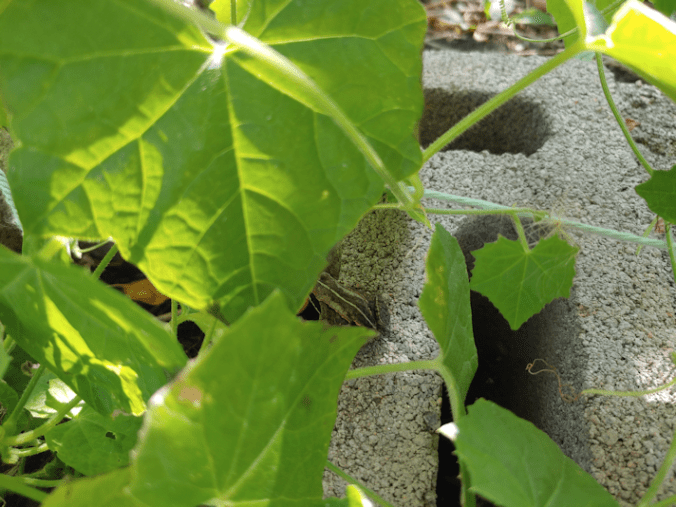
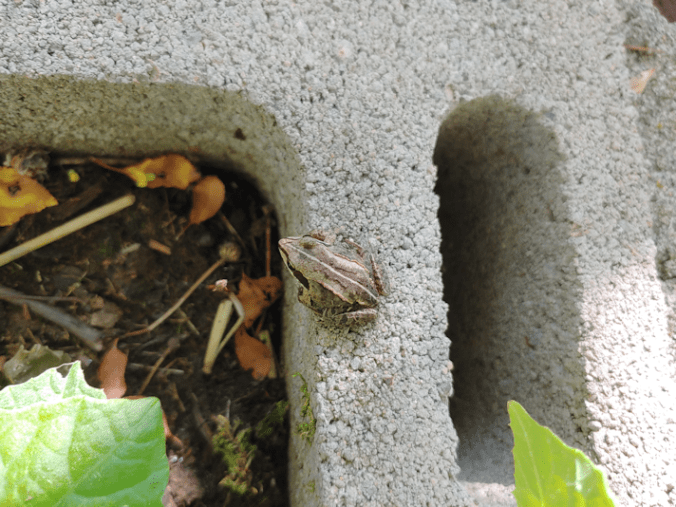
While picking cucalmelons this morning, I found a little friend!
We’ve been seeing LOTS of frogs about this size, every time we to go through the garden beds. Usually, they hop off too quickly for me to get photos, but this one didn’t move!
He was even okay with the cucamelon leaves being pulled aside.
I am very happy to see so many frogs in our garden beds. I’m sure they’re doing a great job of eating up things that would be eating our vegetables!
On a less cheerful note, the original plan for today had to change. This was the day I was supposed to bring my husband into the city for an appointment at the cardiac clinic. They want to discuss the possibility of implanting a defibrillator in him.
Unfortunately, about a week ago, my husband discovered cats had peed under his hospital bed, and under the small table with the mini fridge he keeps some of his medications in. He cleaned it up himself, rather than asking any of us to do it.
He still hasn’t completely recovered.
When his pain levels didn’t improve by Monday, he called the cardiac clinic about his appointment. The letter he received said to expect to be there for at least 2 hours. He explained his situation. The choices were to either cancel the appointment, or they could find some way to accommodate his pain levels and disability.
The appointment got cancelled.
They way he put it, the response was along the lines of, how dare he mess with their system.
They will send another letter with a new appointment (I find it interesting that they make these appointments with zero input from patients), and after he gets the new letter, he can talk to them about accommodations. Of course, he has no way of knowing if he’ll have a good day or a bad day – or even a good week or a bad week – that far in advance. That’s why he was stuck phoning them only about 48 hours before today’s appointment. No matter; even if he’s having a good day, being able to lie down on a stretcher of something would probably be needed, just after such a long drive.
I understand why the province has a single cardiac clinic in a central location. It is probably much more efficient, and allows for things like better access to equipment. The problem is, like almost all Canadian provinces, we are geographically huge, and not everyone lives in or near this particular city. We’re just an hour away from the city (though it can take another half hour to reach the clinic, depending on traffic), and it’s difficult enough. I can’t imagine living in one of the fly-in communities and needing cardiac care. Sure, the small communities don’t have the population base to warrant their own cardiac clinics, but there are large towns and other cities that could serve these more remote communities.
The fact that it’s such and inconvenience for them to accommodate my husband’s disability is also frustrating. They’re in a hospital, for crying out loud. And with so many hospitals cancelling care to make room for all the pandemic hospitalizations that never materialized, there are plenty of stretchers and beds available that could be used for someone like my husband, without having to prearrange it weeks in advance.
Another unfortunate thing with my husband is that his pain levels have forced him to cancel a number of appointments. He has also done things like walked out after being forced to wait well past his appointment time, due to pain caused by the wait itself, and basically has stood up for himself. He is likely now considered a “problem” patient. I don’t think they realize that, when it comes to his list of health problems, his recently developed heart condition is actually not at the top of the list. Not even close. With everything else going on, this new development doesn’t even phase him, and certainly doesn’t frighten him, as it probably more typical. His pain needs to be gotten under control first. Some of his other health problems are caused by the pain itself, and will improve on their own, accordingly. They have not been able to figure out why his heart failure developed in the first place, and we’re pretty sure it has more to do with the large number of medications he is on, and has been for such a long time, than anything else. We already know that there is no surgery or treatment that can “fix” the physical source of his disability, and it will continue to cause further degradation of his spine. The only real thing that can be done is treat the pain. That’s the foundational thing. Without that being addressed, treating his other problems are little more than stop-gap motions.
This has been explained at heart clinic appointments a few times. I’ve watched notes get taken for his file, that the whole team looks at. There is no reason for them to not be aware of his disability, and what that means for his appointments. Even the fact that we have to drive so far and the affect that has on his pain levels has been duly noted.
Yet when he tries to address this with them, he’s made to feel like he’s inconveniencing them somehow?
Not impressed.
Well, next week he has his first appointment with the pain clinic. Hopefully, that will get the ball rolling on more effective treatment.
Over the past while, I’ve been adding another coat of Plasi Dip to the ends of the picnic table legs. I stopped adding more coats yesterday, but have continued to spray the cracks in the rain barrel. Basically, I plan to empty that can on those. :-D
This is about 5 or 6 coats. I lost track of how many, exactly. When I took the picture, it had at least 24 hours to cure since the final coat. It looks like it will do the job just fine, and help extend the life of the picnic table.
Earlier today, a daughter and I flipped the picnic table right side up, then checked the surface. Sure enough, there was a bit of damage. Some paint had come off when the bird feeder had been put on top of it – both surfaces hadn’t quite cured yet, and the feeder stuck to the table.
While upside down, the table was on the chimney inserts I’d used to raise it off the ground while painting. There were a few scratches from those, as well as dirt. My daughter hosed it off and scrubbed where needed.
Tomorrow, the bits of damage will get touched up before we move it to somewhere near the fire pit.
For something that is too far gone to repair, this should last quite a bit longer now. As long and nothing actually breaks. :-D
After looking up and confirming when to start harvesting cucamelons, I went ahead and picked the largest ones.
The fruit doesn’t grow larger than 1 or 2 inches, and we read that if they are left too long, they get really seedy. Which makes sense.
Aren’t they adorable?
There was just enough for 2 each, so the girls and I tried them last night, while I left the last two in the little bowl on the table for my husband to try in the morning.
One of them disappeared.
Either we’re going to step on a cucamelon at some point, or a cat ate it. :-D
So… how did they taste?
Like cucumber, really. :-D The skin to flesh ratio is higher, so you do have more of that slightly bitter flavour of the skin, but just enough to make them distinct. They have a nice crunch, too.
From what we read, picking the fruit makes them more productive, and they will produce for a long time. I look forward to having more of them to gather, soon!
I think these are definitely keepers for future gardening. Apparently, in colder climates with shorter growing seasons like ours, you can even dig up the roots in the fall for spring transplanting, and have earlier production.
Normally, I would not have done clean up on a Sunday, but the chokecherries needed to be picked, and we couldn’t get at the two trees with the ripest berries.
Which turned out to be 4 trees… :-D
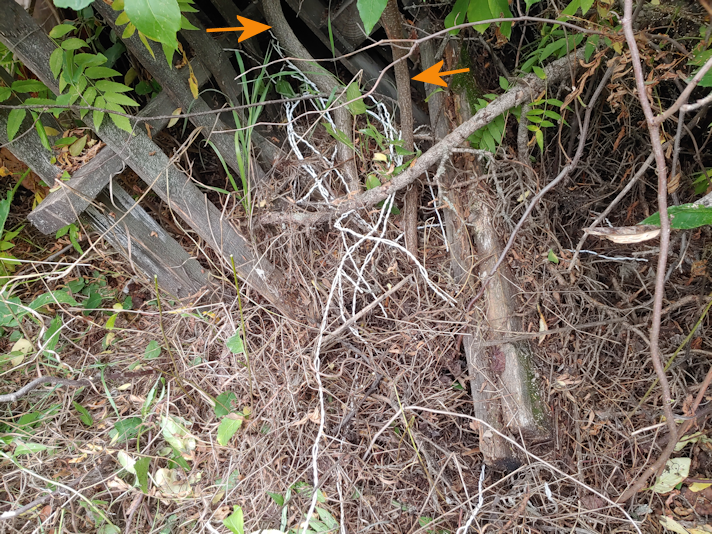
Here are the ones behind the garden beds where the old wood pile used to be.
The arrows are pointing to the two chokecherry trees. They are close enough together that I had thought they were just one tree at first. All around them are dead cherry trees with live cherry saplings coming up the bottoms, along with other odds and sots that have come up since I cleared things away last year.
I started on this side because I figured taking out the dead cherry trees would be the more difficult job. Especially since we were getting spotty rain, so I wasn’t going to string out extension cords to use the electric reciprocating saw!
This is how it looked when I stopped.
The fallen spruce tree and poplars behind them kinda make it look like they’re not cleared, but there is plenty of space to walk around them now.
While the girls started picking berries, I moved on to the other side. This is how it looked before I started.
In the spring, I had cleared a path to the junk pile to access the wood stacked in it, and I’ve been trying to keep things clear around the Saskatoons. You can see those on either side of what’s left of the path, and the arrow is pointing to the chokecherry tree. Which is actually two trees next to each other.
Most of what’s here is spirea and thistles, with a bit of burdock, plus a few other things hidden by the spirea. I figured this side would be much easier to clear, since I could basically just yank them out of the ground.
I really should know better by now.
The spirea and thistles were, indeed, easy to pull up.
First, I’d forgotten about the fallen spruce tree in there, and how close it was to where I needed to go.
It’s been there for a long time, so I was pulling out bits and pieces that had broken off as it fell, as well as breaking off or pulling out rotten branches that were jutting out all over.
I’d uncovered the one stump that I already knew about, then found another, smaller one, beyond it.
As I worked my way closer, I found something else.
There’s a reason we call what started out as a pile of neatly stacked boards that used to be covered with a tarp, a “junk pile”.
So… that’s… wire? It looks like the wire from those little decorative fences you can get to put around garden beds.
Also, there’s an old pallet there.
Because, of course there is.
Don’t mind me. After clearing out the old wood pile and dragging away a couple dozen rotten pallets, I’m not much of a fan of those anymore! :-D I remember having to work my way around it, while searching for boards in the pile that weren’t too badly rotted.
As I worked my way closer, I found the chokecherry trees grew through the partially rolled up wire. Which gives an idea of how long it’s been hidden there!
That wire really does look like it’s from one of those little fences, undone. It even has cross pieces still wound into the twists.
At this point, I stopped!
It was clear enough to reach the trees, and most of the berries. So I started picking those, while the girls harvested carrots and little squashes. :-)
The piles of debris will wait until tomorrow to be hauled away!
This pile is almost all spirea and thistles, with a few smaller branches from the fallen spruce tree tossed in. I had to pull up some of the wildflowers, too. They’ve shown up all over the place this year, so there are plenty more around the yard.
This pile is mostly the cherry I cleared away from around the first chokecherry trees, plus the larger pieces of the dead spruce tree I was working around.
These are pieces I set aside to keep for future crafting or carving purposes.
As for the chokecherries, we picked about a gallon pail of them. The girls had picked from the tree by the squash beds, and the ones among the lilac hedge, too. Lots were left behind for the birds. We are finding more chokecherry trees deeper in the spruce grove, that are not ripe yet, so we will have more to pick, later on.
This morning, I applied the first coat of spray-on rubber to the legs of the picnic table, and the cracks on the rain barrel.
This is the product I am using.
I have never used this stuff, or this brand, before. It was the only one on the shelf, so it’s not like I had a choice of brands or product versions. I think it will work just fine.
The first time we used a product like this, it was a can of liquid rubber deep enough to dip things directly onto. Like the handles of tools. Which is what we did at the time. Or it could be brushed onto a surface. The first time we tried a spray, it was basically the same product as an aerosol. My husband used it to coat the handle of one of his canes (made with aircraft grade aluminum, that could also be used for self defense), and to a cord wrapping he added to parts of his walker for extra support to hold the weight of the backpack he has hung on it. For the can, a dip version would have done a better job, but as a spray, it worked very well on the uneven surface created by the rope work. It’s still holding out, and it’s been about 5 years.
So that was basically what I was expecting. Black, spray on rubber.
Nope.
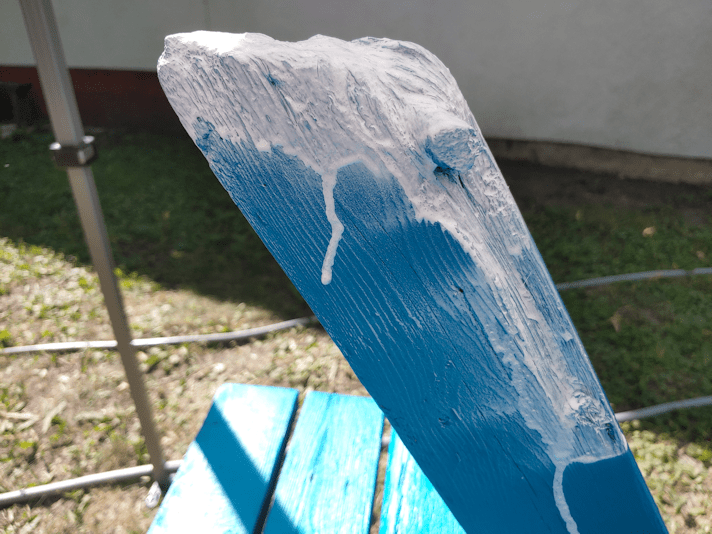
It’s white.
At least it looks white against the blue paint.
It’s also a lot lighter and thinner than I expected. Which I suppose is exactly what I need to fill in all those crevices. I added extra along the part where the most rotted wood had come off on the one leg.
I probably could have applied it more carefully to avoid drips, but there is no aesthetic requirement on this.
On the rain barrel, it looks a bit different. The barrel got sprayed both inside and out.
Here, you can see it has an almost blue tint to it. Depending on the angle, it looked a bit more purple than blue.
It should be interesting to see how it looks when it’s done.
How many layers we put on will depend on how well it coats. It requires at least 2 hours between coats. Depending on how often someone can get outside to add another coat, this may take a day or two! It then needs at least 4 hours of curing time after the final coat for the coated object can be used. Thankfully, these are not things we need to use, quickly.
It was a hot day to be taking my mother for her medical appointment in a van with no air conditioning!
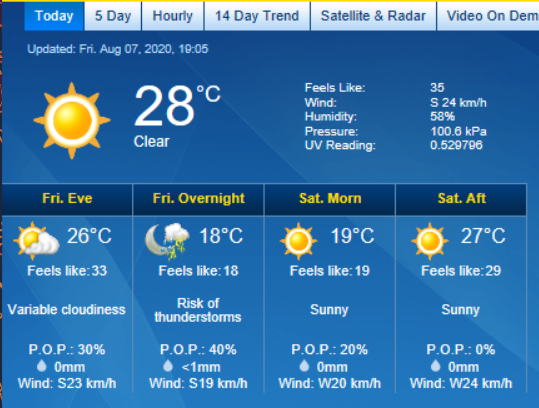
It was already cooling down when I took the above screencap. 28C/82F, with the humidex bringing it to 35C/95F From the weather radar, I don’t expect to get that predicted thunderstorm; it appears to be moving to the north of us. I hope we’ll at least get some rain. It’s been a challenge to keep the garden beds watered. At least I haven’t needed to mow the lawn in a while. :-D
While driving my mother to her appointment, she actually asked me to open the windows more, even though we were at highway speeds. Normally, she’s asking me to close them because of the wind! Well, hopefully we’ll have her car back next week. I could see she was really struggling to get into our van. She’s so tiny! :-D
Her appointment went well. She is frustratingly healthy. All her tests came back excellent. She has obvious issues with arthritis, which there’s really nothing more she can do about, and problems with her knees. She could get surgery to fix those but, considering she won’t even wear her knee brace, there is significant doubt she would keep up with the post surgical requirements, so it didn’t even come up. Her major concern is with her “heart”. By which she means her breathing. But only sometimes, and only in the morning, when she sometimes wakes up gasping for air. The doctor suggested she try sleeping upright, to relieve pressure on her chest from certain generously proportioned parts of her anatomy. I mentioned my siblings and I have discussed getting her a sleep chair, and he said he thought that would help her a lot. He also suggested we try putting something under her mattress to elevate it. I figure we can try that for a few weeks, then assess how it helps or not. She might actually do well with a hospital bed, like my husband’s, which would allow her to lower the whole thing to get in and out easier, too.
He will also be referring her to a geriatric team to assess her. Or an “elder care team”, as he put it. She still didn’t quite understand what he meant, so when we were talking about it later, I explained to her about how some doctors specialized in helping older people, with their physical and mental needs that are different from younger people. Once she understood, she was quite excited about that, saying that yes, she needs that!
Since I was driving her around anyhow, I also helped her get some grocery shopping done, and then we had a very late lunch – in a nice, air conditioned restaurant!
All in all, it went really well, and she was on much better behavior than usual. She was having one of her good days, so it made a huge difference.
After I got home and updated my siblings on how things went, I went to do my evening rounds a bit earlier. The girls had already watered the garden beds. I tried weeding around the beets a bit, but so many of the leaves have been eaten by deer, I don’t know if I should even bother. I’d mentioned this problem to my mother, and she decided that meant we needed a dog. A dog will keep the deer away! I wish I’d remembered to mention that my sister has a dog, and they still had to fence their garden to keep the deer out. And bears, but that’s a problem we, at least, don’t have! :-D
With the bird feeder painted and done, the girls are still doing coats of paint on both sides of the screened window frame for the old basement. Today, I flipped the picnic table and scrubbed the bottoms of the legs clean of dirt, so that we can apply the spray rubber on the ends. I also cleaned a rain barrel I’ve moved near the squash beds, around the cracks it has in one area. I was going to look for some sort of silicon caulking or something to patch the cracks when I realized the spray rubber would actually be better. The application will wait until tomorrow. According to the instructions on the can, the weather we’re predicted to have will affect how well it works. The 14 day forecast predicts continued high temperatures, but no rain, so that will be a good time to start applying layers of this stuff. Meanwhile I want to make some sort of screen cover for this rain barrel, plus the one set up by the house, to keep debris and critters out. I found a bird downed in the one by the house once already – I’m guessing it flew into a sun room window, knocked itself out, then fell into the barrel. :-( Once I have a cover made, and the cracks coated, I will keep the one barrel filled so that we can use ambient temperature water on the squash, instead of cold well water. If we don’t get rain tonight, I’ll likely be filling the rain barrel by the house to warm up, too.
In the long term, I want to get some large tanks like this.
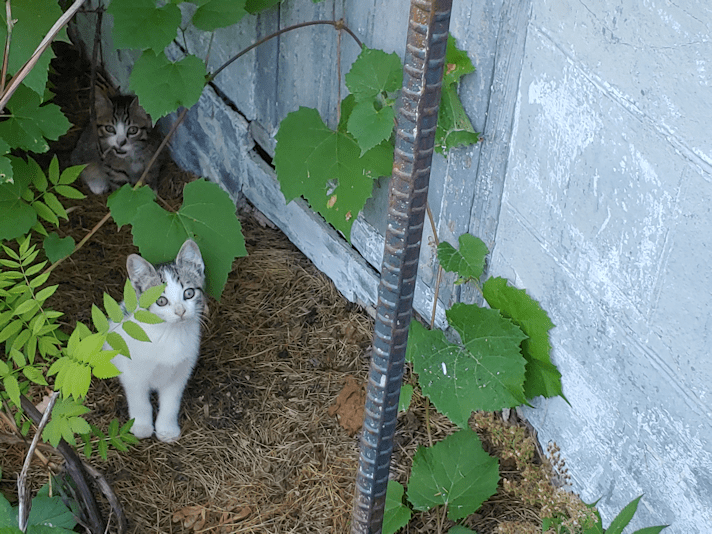
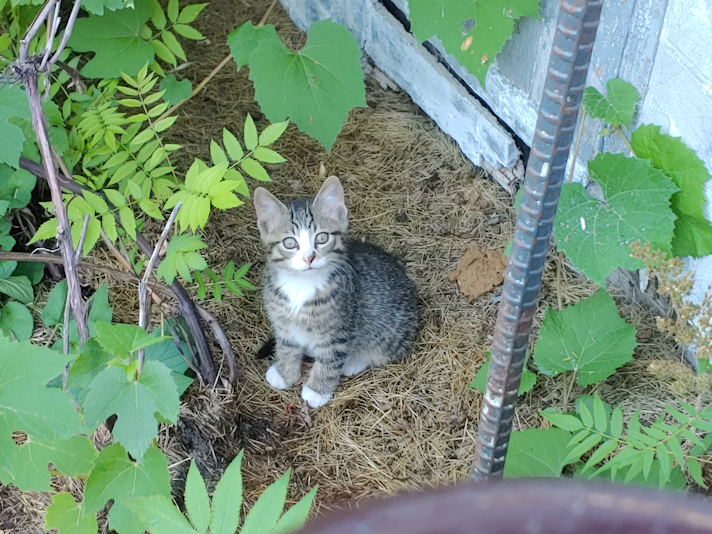
It had been a while since I’d seen the outside kittens, so I was happy when they showed up this evening. Little Braveheart had follow Junk Pile to the food bowls by the house, but ran off when I came out. They hung out by the steps into the storage house, before hiding in the grape vines, so I decided to sit on the steps and see if I could tempt them to play.
Braveheart was immediately curious!
Just look at that intense gaze! :-)
And who’s that back there?
Another baby, chewing on a grape vine! :-D
Junk Pile, meanwhile, came over and lay on the mulch, growling at me the whole time! That seems to be her default attitude these days. :-D
I broke off the spent flowers of a spirea growing under the stairs to wiggle around on the step. It worked a bit!
Braveheart pounced at it! :-)
Her sibling even came a bit closer.
I saw no sign of the third kitten, though. I hope it’s all right.
After this, they ran off with Junk Pile into the spirea, so I let them be.
Once indoors, I got entertained by more kittens.
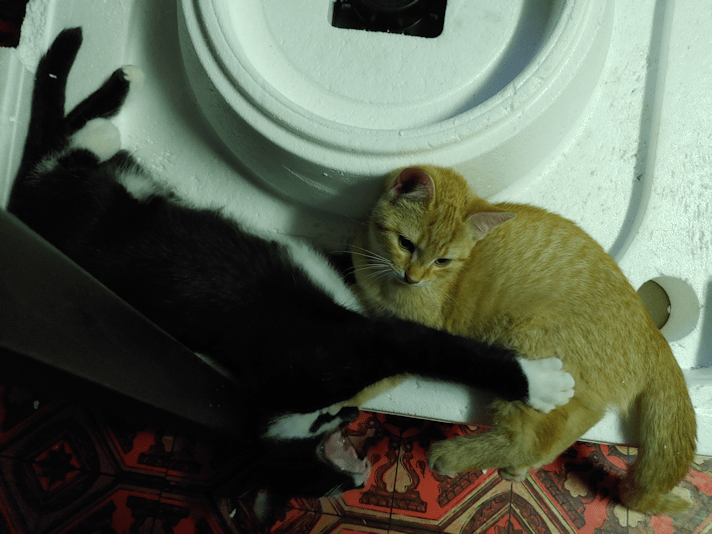
The cats love the base of the washing machine packaging so much, we don’t have the heart to get rid of it, yet! :-D
Layendecker had been napping on it when Turmeric crawled on and woke him up. :-D
As we work on clearing, cleaning and reclaiming the yard and planting our first garden beds, I’ve been keeping a close eye on details to keep in mind for the future. Things that will help us decide what needs to be done next, what to change or what to keep the same.
This morning, I found myself making a lot of comparisons.
The cutest one is the cucamelons.
This is the largest one that is developing, with my fingers giving an idea of just show small these are!
Isn’t that just the cutest thing? :-D This is the first one big enough to start seeing the patterns developing.
The trellis I made for these is just cotton yarn. It is working very well, except for on thing.
The cats.
When I am out there and the boys come over for some attention, they will plow their way through the trellis, pulling tendrils off in the process, then look at me all confused over why I’m flipping out at them. :-D They also try to lean and rub against the strands of yarn, only to flop over onto the plants. !!!
We already know that this location doesn’t have enough sun for cucamelons. If we grow them in the future, they will be planted somewhere with full sun. Our original intention was to plant them against the chain link fence for them to climb, and the cats are showing us exactly why that’s a very good idea! If not there, then we will have to make sure to have trellises that are sturdier, with strands much closer together. Not because the cucamelons themselves need it, but because of the cats!
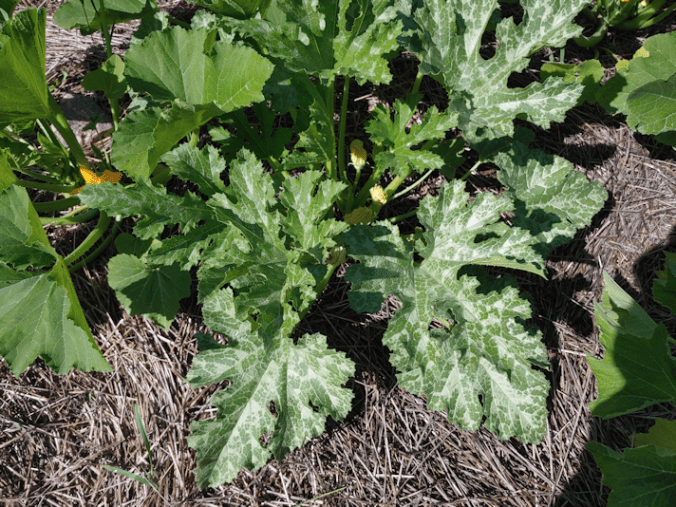
Here is another comparison. These two squash plants, with the mottled leaves.
They look pretty much like the same kind of plant, don’t they?
Now look at the developing squash.
They’re completely different!
I’m looking forward to being able to start harvesting these. My favourite way to eat them is raw, with dip. No need for anything else, when they’re at just the right stage. :-)
It was looking at the chokecherry trees that I am really seeing what a difference even minor changes in conditions makes.
This first one is at the south side of the garden where the squash beds are.
This one gets sun in the mornings, but for most of the day, it is shaded by spruce and maple trees to the South and West of it. It is not crowded by other trees. It has quite a lot of berries that are looking big and juicy (well… as much as chokecherries can be! ;-) ). Even last year, during the drought, it had larger berries. While I do not specifically water this tree, I do sometimes water the little patch of flowers and raspberries on one side of it, and the black current bush (my sister confirmed what it was for me) on the other side, so it does get extra water from that. While is has larger berries, it also ripens later. As you can see, the berries are still very much on the red side of things.
This next one is the chokecherry tree that is engulfed by lilacs.
This one gets full sun for most of the day, though it does get slightly shaded at the end of the day, by the trees my mother left to grow after she moved the raspberries they’d self-sown in between, years ago. This whole area gets quite dry, and we do not make any effort to try and water anything here.
The berries themselves are noticeably smaller than in the previous tree, and there are less of them, but they are also ripening faster.
Then there is this tree, right nearby.
This is the top of a young, small tree that was self-sown and allowed to grow (rather than get mowed over, like all the other saplings) in a grassy band between the old garden area (with the row of trees mentioned previously) and the lilac hedge. It might get some shade towards the end of the day, but otherwise gets full sun. Our first summer here, it did not produce fruit yet, and I wasn’t even completely sure what kind of tree it was. Our second summer, it had a few berries. This year, it has matured enough to produce quite a lot of berries. With full sun most of the day, not at all crowded, and little moisture, the berries are still not as big as the ones closer to the house, but the clusters are dense and ripening quickly.
You can see how this tree is situated in the background of the next photo, below. This next chokecherry is also among the lilacs, but on the edge of the hedge, not in the middle of them.
Here, it gets no shade at all. It has lots of berries that are already ripe. As you can see, though, some of the leaves are turning yellow. Only a few branches are like this, not all of them. It’s not stopping them from heavily fruiting! Like the other two along this side of the old garden, the berries are not as large as the trees nearer the house.
This next one was a surprise find, along with the Saskatoon berries. This area had been full of spirea that I had pulled up. It’s starting to grow back, so I’ll have to do it again, as pulling them up has been a good thing for other trees. The Saskatoons thrived this summer, and we discovered another chokecherry tree among them.
This area is under spruce trees, both living and dead, getting very little sun. In the above photo are the berries on the North side of the tree, where it gets even less sun. As you can see, they are just turning from green to red here.
This next photo is of the same tree, but on the South side.
That little bit more sunlight sure makes a noticeable difference in how fast they ripen!
Again, while I have not really been watering these trees, they are near the horseradish, and with the spirea taken out, wildflowers have come up and I’ve been watering those. So they will have benefited a bit from that, too. Mostly, though, being under the spruces as they are, they don’t get the full heat of the day, so the soil doesn’t dry out after a rainfall as quickly, either.
Then there is this one…
That’s a chokecherry in the middle of the photo. I had cleared a path to the junk pile you can see part of, to try and find useful pieces of wood in it, but that’s as far as I got so far. The tree itself is not crowded by other, large trees, and is shaded only in the morning hours. It’s surrounded by spirea and thistles, so we can’t get at it right now, but it appears to be just loaded with ripe chokecherries.
Finally, there is this one.
This is the top of a chokecherry tree among the cherries. I can get close to it, but not enough to be able to harvest it until I clear away the cherries around it; mostly cherries that had been killed off by last year’s horrible spring, and the bits that are now growing up from the bases. They create a formidable barrier!
This tree also gets shade in the morning hours only. Our last two summers, I don’t recall seeing any flowers or berries at all. Last summer, I’d cleared away the old wood pile, which turned out to be a much, much larger job than I expected. You can read about it in this series of posts (all links should open in new tabs, so you won’t lose your place!); parts one, two, three, four, five, six, seven, eight.
Did I mention it turned out to be a really huge job?
Yeah.
So while there is still lots to clean up to work our way into the spruce grove, what has been done so far made a big difference. I’m thinking that, had the cherries not been so damaged by the previous spring conditions, they would have improved, too. Mind you, the one cherry tree I kept because it managed to actually produce a few berries, and is not at all crowded, did not produce even a blossom this year.
It’s amazing how the same type of tree, while not really all that far apart from each other, are so different based on even minor changes in sun, shade, moisture, etc. When it comes time for us to plant more food trees, the differences among these chokecherry trees is providing us with a lot of information.