Our 2024 Garden: melons, pumpkins, drum gourds, bush beans, pole beans and shelling peas

Yeah, I’m tired.

I didn’t get all the stuff on my list done, but my goal was to get most of it, and I managed that!

I had intended to start earlier in the day, but ended up unable to sleep for some reason, until about 5 or 6, when I got an hour or so of actual sleep. Not very good sleep, though, as I had several cats draped over me, and I really, really needed to pee! 😄😄

By the time I got out, it was coming up on 9am and starting to get warm already. The first job I did was work on the trellis bed, which needed a serious weeding before anything more could be done in it.

We are starting these beds out at two logs high, and they will most definitely be made higher, over time. It didn’t take me long to realize I needed to use the scooter, to make the weeding less painful. This is the first time it’s been used since last year, to all the tires needed to be pumped up.

This bed has the onions transplanted out of the bed that now has winter squash in it, as well as a few I found in the other bed that was shifted over, but has not been planted in yet. These onions are doing very well! As these had over wintered, they should go to seed this year, which would be awesome.

All along one side, where a permanent trellis will be built in, I wanted to fit as many of the Summer of Melons Blend transplants as possible. This bed is a little messed up as, on what will be the trellis side, the bottom log is bowed inwards. This works out to ensure the vertical trellis supports will be even with each other, but it means that we loose several inches of planting area. With that in mind, I used a couple of stakes to mark the ends of where the row of melons would be, then used another stake to mark a line from one to the other, far enough in for the melon roots to have space.

We had some packages delivered yesterday, so I had some packing paper and cardboard that I could lay down between the markers.

The next part was the most difficult. Getting the transplants out of the large celled trays and so I could space them out between the markers.

With other things I grew in the large celled trays, I didn’t have too much trouble getting them out. Their roots held things together enough that, usually, I could loosen them by squeezing the cells a bit, then pull the whole thing out by the plant stem.

Not with these melons!

Their stems and roots are way too fragile. Plus, as I tried to push the soil and root cluster out, the soil (seed starting mix, actually) would start to break apart. With some, I had to use a narrow trowel to scoop it out. When it got to that point, there was no way that the roots could not be disturbed quite a bit!


Interruption! I ended up going into town. My husband needed something, but I also ended up getting Dairy Queen to bring home. I was too tired and sore to cook, my younger daughter is caning it and can’t stand long enough to cook, and my older daughter became ill during the night and still feels unwell! I headed out just in time; the rain hit while I was on my way home. I was just getting in the driveway when the radio started blaring an emergency alert. Parts of our province was under a tornado watch, and the weather office was tracking some. Not anywhere near us, though. We’ve got a bit of a break in the rain as I write this, then start up again at around midnight, and keep raining for about 6 hours!

Now… where was I? Ah, yes…


So getting those melons out of the tray was not a good thing for those roots! I would not be surprised if we loose some of them.

Because we will be training the melons up a trellis, I was able to space them closer to each other, getting 17 transplants laid out. That leaves another 4 transplants in this Summer of Melons Blend that still need to be transplanted.

Once I figured out where they were going, I cut through the packing paper and cardboard and found the line I’d marked out earlier, to dig the planting holes. Once the holes were all watered and the melons transplanted, I made use of the bark I’d taken off the logs for the bed the winter squash is in, to weigh down the paper and cardboard mulch, so it won’t blow away. Then everything got another thorough watering.

That left a section on the other side of the bed to plant in. I decided to put bush beans there, and planted the Royal Burgundy seeds. It’s not a large space, so there were seeds left over that we might plant somewhere else. Grass clippings were added on either side of the row for mulch.

That bed is now done!

The next thing on my list that I decided to do was to work on the bed with the winter squash. I used a stake to mark out a little trench to plant in, on either side of the winter squash and their grass mulches. Since the bed’s frame is not going to be complete for a little while, yet, I needed to make sure they weren’t too close to the edge of the soil mound. On one side, closer to the high raised bed, I planted the Dalvay shelling peas. We have quite a lot of seeds. I spaced them 4-5 inches apart, and had lots left over. After pushing the seeds into the soil, I made sure to cover them in such a way that there is a soil “wall” on the outside, and there is still a bit of a trench for the water to collect in before being absorbed.

I did the same on the other side, with the Carminat purple pole beans. I didn’t have as many of those left, so they were planted more like 6-7 inches apart. When I finished the row and still had a few seeds left, I went looking for spaces that looked a bit wider and added them there. We no longer have any Carminate pole bean seeds left!

The seeds planted and watered, I grabbed a bundle of bamboo poles and set up 5 to each side. After the beans and peas have germinated, we will add netting to the bamboo poles for the peas and beans to climb.

This bed is now done. At least, when it comes to planting!

After that, I took a hydration and sustenance break. While I was doing that, my younger daughter headed outside to try and get some lawn mowed. Even after waiting until noon, that grass was still so wet! That’s not even taking into account the low areas where standing water collects. There were whole sections she had to just go around and leave alone.

It may be making things hard to mow, but the gardens sure love it! All the stuff we planted previously is doing really well.

When I got back outside to continue working in the garden, though, the poor melons were looking pretty limp! Aside from the obvious transplant shock, we were reading our high of the day. I ended up misting them a bit to help relieve them from some of that heat!

I decided the next thing that needed to be done was to get the drum gourds and pumpkins planted. They are the largest transplants, and needed to get into the ground faster.

In the space in line with the high raised bed, we’d made a pile of grass clipping mulch. Most of it was used throughout the garden last year, but there was still some grass clippings and shredded paper mulch left. I raked what was left aside, clearing a rectangle about the same length and the high raised bed. Eventually, the high raised bed will either had a matching bed near it, with a space between them, or we’ll just add a new bed attached to the current high raised bed. I haven’t decided, yet.

With a garden bed planned for the area already, I figured it would be a good place to build squash mounds, which can be incorporated into whatever bed we end up building there.

I just had to sift some more soil from the pile in the outer yard.

I made three mounds of soil. Each of them got a gallon water bottle with its bottom cut and no caps, placed upside down in the middle. They got filled with water to slowly drain.

I had two pots with the pumpkins from the free seeds we got at the grocery store by my mother’s place. They have grown so much!

I also had two pots of drum gourds, but each pot had two very strong and healthy plants in it. What a difference from last year, when I ended up replanting them, several times, and ended up with none!

As expected, when I took them out of the pots, there was no separating them. Their roots were just too entwined. So I kept them together, but after planting them, I gently teased the stems away from each other. As they grow, I want to train them to run in opposite directions.

Once they were all in, the grass clipping mulch that had been raked aside was drawn up and around each mound.

And I was done for the day!

Well. Almost.

My daughter had done as much mowing as she could and gone inside. I sent a message asking for a hand with my next task, only to see her come hobbling along with her cane! She was in a world of hurt. 😢

With the possibility of thunderstorms tonight, I’d set up the support hoops for the row “greenhouse” I’d picked up at a dollar store to try. The set came with a plastic cover, but I wanted rain to get through. I just didn’t want the little transplants to be battered with rain!

So I brought out a roll of mosquito netting to put over the hoops. Unfortunately, the netting wasn’t long enough to cover the entire row of melons. We ended up moving the hoops a bit closer together, and set it up over the end where the transplants seemed to be needing the most protection. Once the netting was over the hoops, we used bricks, boards, branches – anything we could find, to weigh the edges down.

By the time that was done, it was just too hot to keep going. Still on my list was to plant onions or shallots in the high raised bed, around the peppers. There’s also that second shifted bed that needs to be prepped for planting.

We still have 4 Summer of Melons Blend transplants, but we also have another 15 pots with melons we actually know the names of Plus, there is still 7 winter squash to transplant, and a few tomatoes. Anything else would be direct sown.

If all goes well, tomorrow my priority is to get the shifted bed prepped for planting. I have decided to get the last winter squash transplanted. There will be more space between them compared to the other bed, which I plan to take advantage of. I have a variety of sweet corn that is only 55 days to maturity, so I will plan small groups of them in between each winter squash.

Once those are in, the next three beds need to be weeded and shifted over. We’ve got plenty of melons that will need to be transplanted, including a couple of Zucca melon. I will find a way to give them their own hills to grow on, since their fruit can reach 60 pounds in size. The rest of the melons will be need trellises to grow on – and I’m starting to run out of takes!

We also have the last, sad little San Marzano tomatoes to plant, and last of all, all the onions and shallots will get tucked away, in between other things.

Once all the transplants are in, I went to direct sow more summer squash. I also want to plant more carrots – it’s probably late for those, but I’ll try , anyhow. I’ve got yellow and green bush bean seeds, too, if there’s room for them.

I’m actually starting to see a light at the end of the tunnel!

I just have to make sure not to push myself too much, though, so I don’t have to take more days “off” to recover!

Little by little, it’s getting done!

The Re-Farmer

Our 2022 garden: morning harvest, and first purple beans!

Check it out! Our largest morning harvest, yet!

There were very few yellow beans to pick this morning. The bush beans seem to be winding down. There were more of the green pole beans to pick, though – and our first purple beans!

There are still a few peas on the first planting, while the second planting of peas are getting into their prime. I found more cucumbers than expected. Enough to make a decent size cucumber salad.

I finally picked the one Sophie’s Choice tomato that was looking like it could have been picked a while ago. It didn’t seem to be getting any redder, so I went ahead and grabbed it. I also grabbed the reddest Cup of Moldova tomatoes. The one that fell off while I tried to get the clip loose has ripened indoors, so there are two of them for my husband and the girls to taste test later on.

I picked what seemed to be the largest of the turnips to taste test as well. They are not a large variety and golf ball size is supposed to be when they have the best flavour. I also pulled a couple of the largest looking beets, to see how they are, and… they’re not doing well at all.

But we have something. And something is better than nothing!

I had done some recordings to make another garden tour video in the morning, but after going over them, I went back out to re-record most of them in the early evening. The final video will have a mix of both. I have this terrible habit of using the wrong words for things and not even noticing. Like saying “purple corn” when I meant to say “purple peas”. That sort of thing. I might have time to work on editing it this evening, but I’m not sure just yet. It depends on how things go after I get back from my mother’s, this afternoon.

We shall see.

The Re-Farmer

Our 2021 garden: morning in the garden

Well, it is getting decidedly cooler when I do my morning rounds! Fall is just around the corner, but things are still holding out in the garden.

Here are the gourds growing on the south facing chain link fence. The yellow flowers that you see are the Ozark Nest Egg flowers.

If you look at the bottom right, you’ll see a white flower!

This is a Thai Bottle Gourd flower. The Ozark Nest Egg plants are going so well, they sort of hide that there is another type of gourd growing here. The Thai Bottle Gourd has leaves that are more rounded, while the Ozark Nest Egg leaves have points on them.

These gourds are not the only thing bursting into bloom.

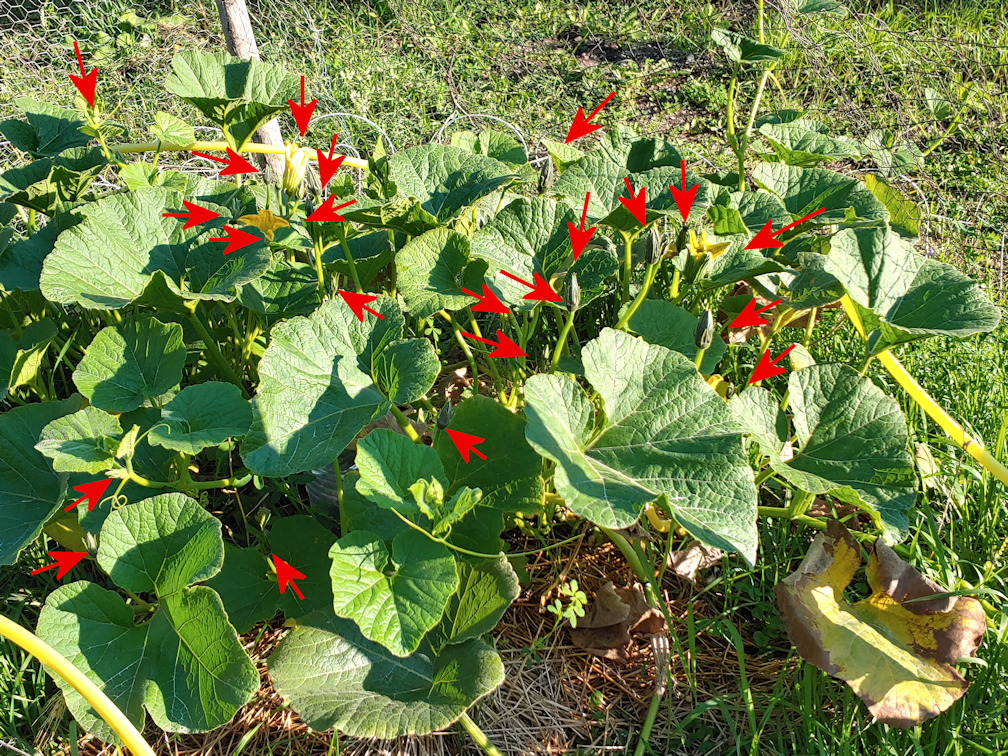
This is the Crespo squash, recovered from critter damage and growing enthusiastically! I was not able to get all of it in this photo. All those arrows are pointing to flower buds, some of which are starting to open this morning. There are probably another dozen or so on the rest of the plant off the left side of the photo.

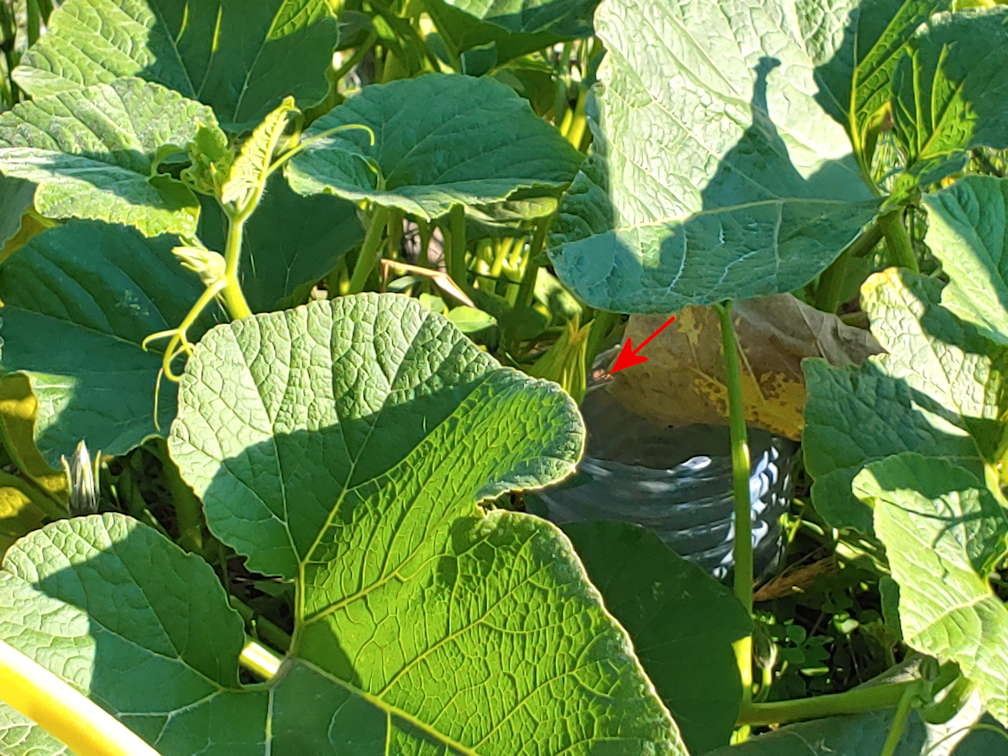
Hidden away in the middle, I found the first female flower!

I couldn’t get any closer because of the critter barriers, but that flower bud the arrow is pointing to has a baby squash at its base. Hopefully, it will get pollinated and not die off. Under the current conditions, I would hand pollinate, but that would require moving the critter barriers. Mind you, there’s no way any fruit that develop will reach maturity.

More on that, later.

There are only a few Halona melons left on the vines, but there are probably a dozen Pixie melons that have not yet ripened.

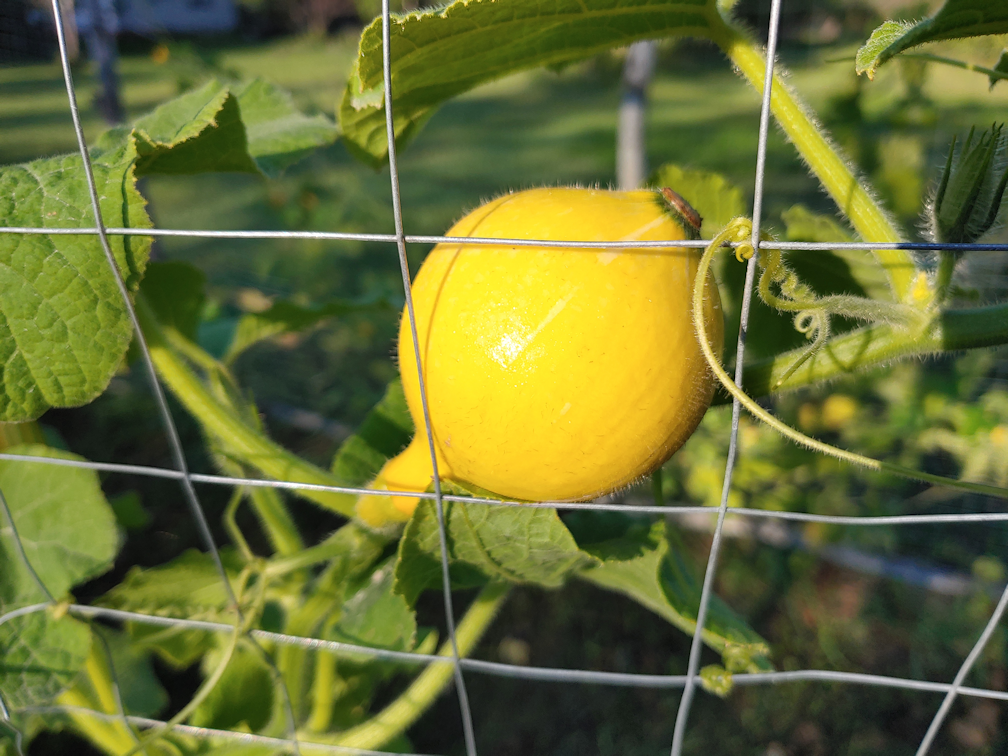
This is the largest of them. Since it has a hammock, I check it in the mornings by lifting it at the stem, to see if it is starting to separate, but it’s still hanging on tight!

The rest are more like these two.

I’ll have to double check, but I thought the Pixies had a shorter growing season than the Halonas. They are taking much longer than the Halona to fully ripen. I’m sure the drought conditions over the summer have something to do with that, but since we’ve started having rain fairly regularly now, I would have expected them to mature faster. Ah, well. We’ll see how they do!

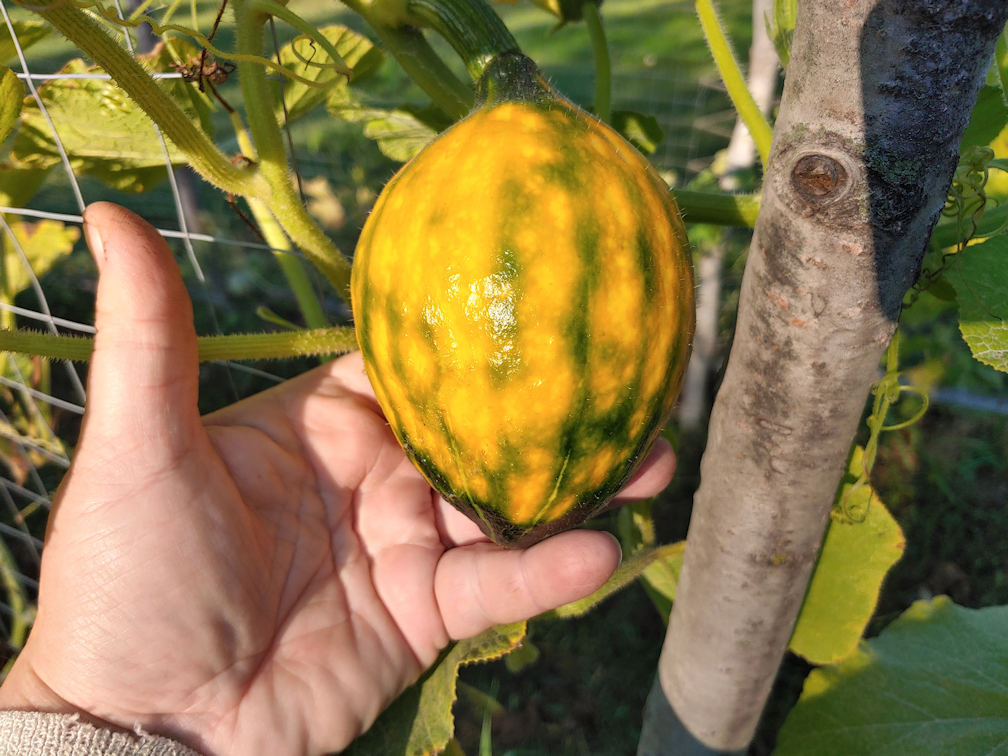
This is the largest of the developing Teddy winter squash. This is roughly half of what it’s mature size is supposed to be, so they may still have time.

Our weird mutant Red Kuri is noticeably bigger! It makes me smile, every time I see it.

We’ve got a couple more that are getting bigger, too. This is what the mottled green one should be looking like, which is why I suspect it was cross pollinated with the Teddy squash.

Here’s something that is NOT getting bigger!

The one luffa gourd is just… stalled. The plants are still blooming, but also starting to die off for the season. I started these quite a bit earlier, indoors, and they should have had enough time to develop gourds and reach maturity, but this summer was so rough on everything, I think we’re lucky to have even this.

We even had something to harvest! Not every morning, but at least every few days. We even still had a few beans left to pick. In the photo, I’m holding one of the mutant green sunburst squash. :-D I’ve been trying to let the sunburst squash have more time for the fruit to get bigger, but they seem to be developing more slowly than they did last year.

I just had to get a picture of the sunflower in the old kitchen garden. We can see it from the bathroom window, through the sun room, and it makes me smile, every time. :-)

As the season winds down, I’ve been keeping a close eye on the long term forecasts. Yesterday was our first frost date for the area, but it continues to look like we are not going to have any frost here, for a while. Of course, the forecast constantly fluctuates, and different sources have different forecasts. My Weather Network app has a 14 day forecast, and with today being the 11th, that puts the 14 day trend between the 12th and the 25th. The lowest overnight temperatures I’m seeing is for the 25th, at 6C/43F, with variable cloudiness.

My Accuweather app, however, is very different. The long range forecast on that one goes up to October 5. Up until this morning, all the overnight lows were above freezing, but this morning, there is now a single night – the 25th – where it says we will hit -2C/28F. It is also predicting thunder showers scattered about the province in that day.

If that is accurate, we have only two weeks before frost hits (which is 2 weeks longer than average, so I’m not complaining!). If we do get a frost, that will be it for the tomatoes, squash, gourds and melons. We have no way to cover any of these beds, so if we get any frost warnings, we’ll just have to pick as much as we can the day before. We should get plenty of sunburst squash, but I’m really hoping the Pixie melons and winter squash ripen before then. The gourd and Crespo squash just don’t have enough time left. Except the Tennessee Dancing gourds. They are so small, we should have quite a few to gather before the frost hits. We may be lucky, though. Aside from that one night that one app is predicting will go below freezing, overnight temperatures are supposed to stay mild into October.

The sunflowers will be a lost cause, though. There is no way the seed heads will be able to mature in so short a time. So many haven’t even opened, yet. Starting some of them indoors would have made the difference (well… except for being eaten by deer), had they been under better conditions. Not just with the weather, but the soil quality where they are growing. Had our only reason for planting them been for the seeds, they would be a failure, but they were planted there partly for a privacy screen, partly for wind break, and mostly as part of our long term plans to prepare the area for when we plant food trees there. Which means we had a success with 3 out of the 4 reasons we planted them. I do want to get more of these seeds to try them again, elsewhere.

For now, every night we have without frost is a help.

The Re-Farmer
Our 2021 garden: morning harvest and first potatoes, makes for an awesome breakfast!

I finished off my rounds this morning by doing some harvesting in the garden. The beans in particular had plenty to pick. :-)

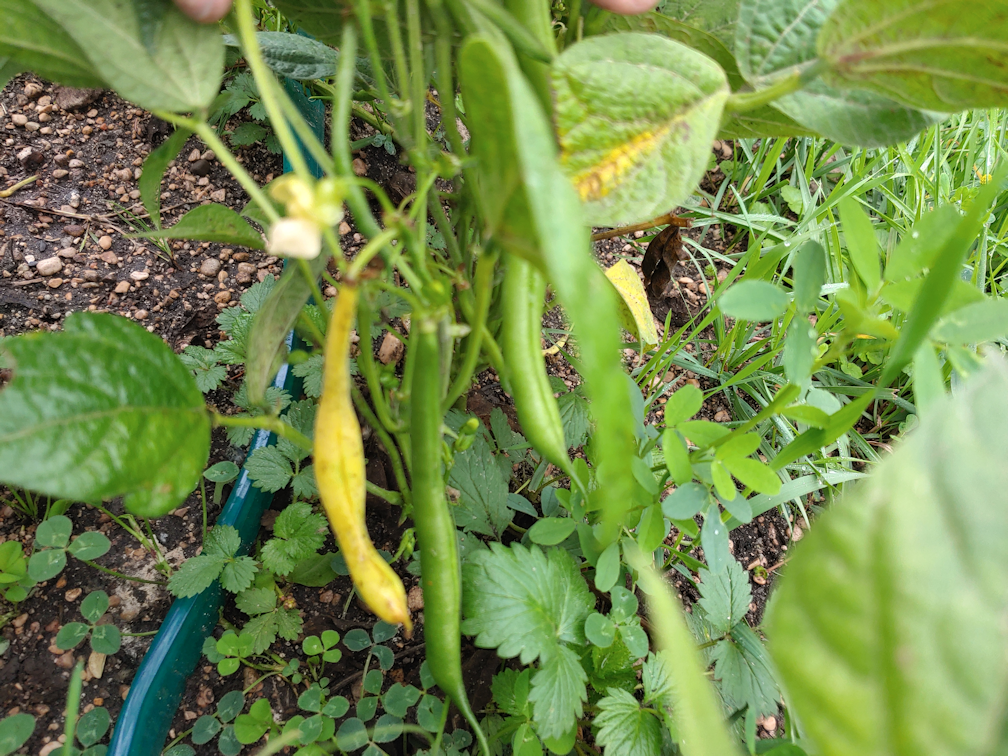
I found a yellow bean, growing on a green bean plant!

It didn’t get picked. It felt completely empty. Any beans it might have had did not develop. I did find one other yellow bean among the green beans, on another plant, that did have developing beans in it, but it was super soft for some reason.

There as a big enough haul this morning to need two containers! :-)

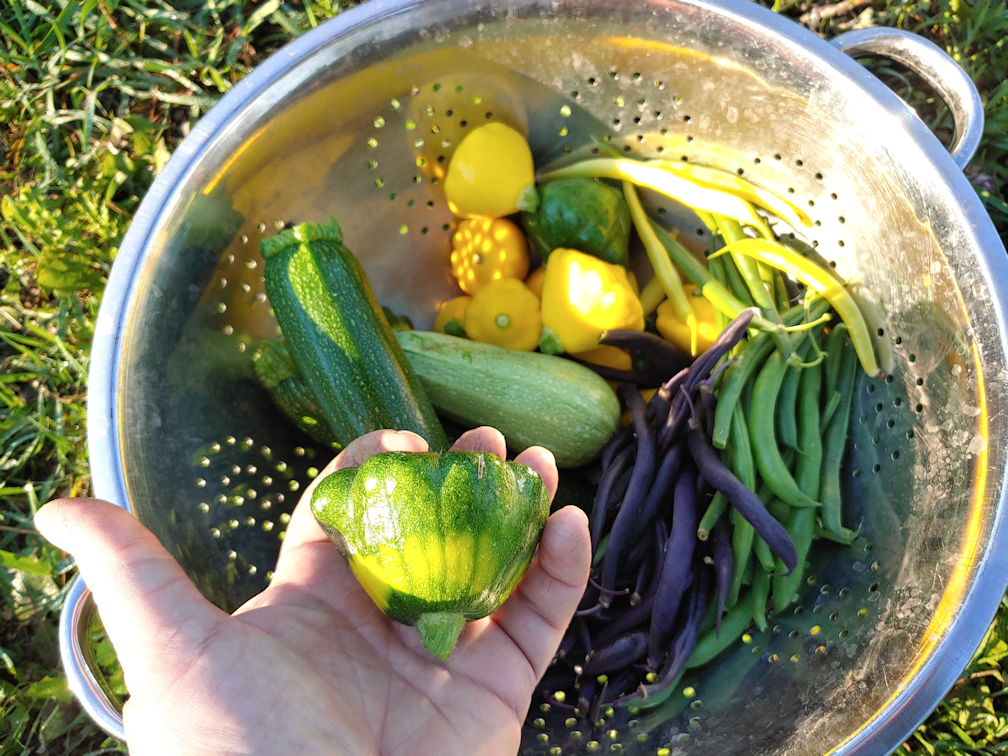
Among the sunburst squash, we have the one plant that is producing green squash instead of yellow, though some of the developing squash have streaks of yellow in them. An interesting mutant plant! :-D

The yellow beans are pretty much done. We’ll still be picking them for the next while, but just a few here and there.

I found flowers on both green and purple bean plants! Just a few, but still a surprise, this late in the season. We’ll be having plenty of those to pick for a while, from the looks of it. Lots of little ones developing on the plants.

Our first potatoes! We could have picked potatoes earlier, but we’ve been leaving them for now. This morning, I decided to reach into a few bags and dug around until I felt a potato and pulled it up. These are the yellow Yukon Gem and red Norland potatoes. I did not try to pick any of the fingerlings, yet.

That’s a pretty good harvest for the day! There are enough beans there to do another bag for the freezer, if we want. :-)

I used a bit of everything when I made breakfast this morning. :-)

I made a hash using all three types of beans, a couple of sunburst squash, a zucchini, and one of each type of potato. I also used onion and garlic that we harvested earlier. Even the oil I used to cook with was infused with our chive blossoms, and the dried parsley on top is from last year’s garden.

It tasted great, too! :-)

The Re-Farmer

Our 2021 garden: evening harvest

While doing my evening rounds, I was able to gather quite a substantial harvest from the garden!

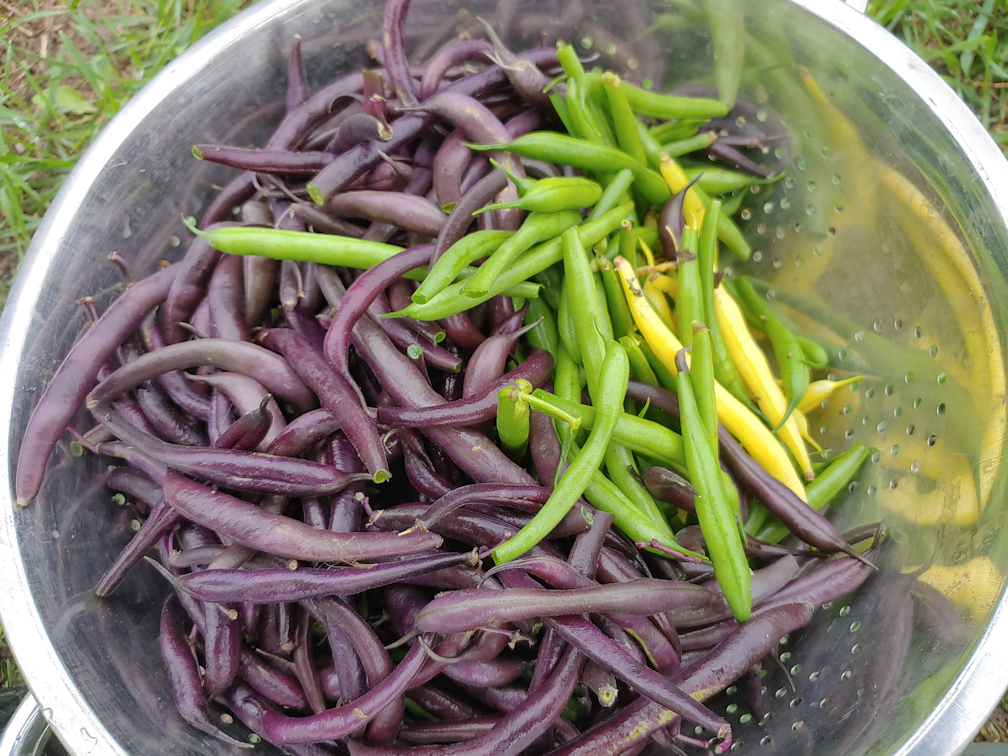
The yellow beans are, as could be expected, winding down right now, but there was still quite a lot of them. There were plenty of green beans, too, but it was the purple beans that stole the show! There were so many ready to pick this time!

I picked a few sweet corn that seems like they might be ready, just to see how they were. Though their silks are drying, they are still quite immature. My expectations are on the low side for these, given how nitrogen poor the soil is, but we shall see as time goes by.

I was really happy to have so many sunburst squash and zucchini! I also had to straighten up a lot of the support poles, as the wind had blown them over somewhat. However, I can definitely say it was much easier to find and harvest the summer squash grown vertically! Last year, I was picking sunburst squash and zucchini pretty much daily, but this is the first time we’ve had a substantial amount to pick. They did not get eaten before we could get to them! The cayenne pepper is definitely working!

I applied more over everything after I finished picking things. The rains would have washed it all off by now. We might get more rain today, then off an on over the next week, but I don’t expect to get much here, so I wanted to make sure the garden beds had their spicy protection.

There was enough picked that we could blanch and freeze some more, but this time I’m keeping them for having with our meals. In fact, I’m enjoying some of those beans with my lunch as I write this, sauteed with our Purple Stripe garlic (crushed and chopped) in butter, then braised until tender, then seasoned and stir fried with rice and some of the grass fed beef we got with the package we ordered a while back. It turned out very well!!

It may almost be the end of August, but we’re finally getting to where we can probably eat from our garden every day. :-)

The Re-Farmer
Our 2021 garden: so many beans!

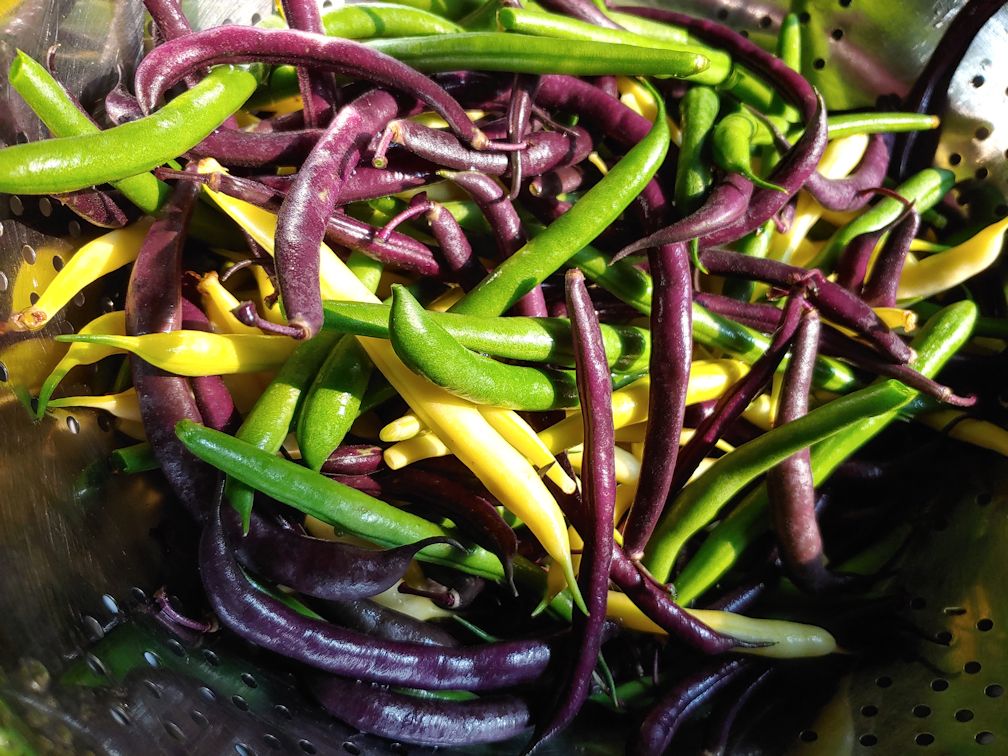
For the past while, we’ve been harvesting a handful of beans, every couple of days. Just enough for the day’s meal, really. It would mostly be the yellow beans, with a few greens, and maybe three or for purple beans.

This morning, we had our biggest harvest, yet!

It is still mostly yellow beans, but they are on the bottom. It’s remarkable to me how, the plants that are the smallest and having the hardest time in this heat, is producing the most right now! Not for long, though, I think. There are LOTS of immature green and purple beans hiding under the leaves. We should start getting hauls like this more often, soon. :-)

This is the first time we had enough to make it worthwhile to preserve them. Not enough to make it worth breaking out the canner or doing some quick pickles or something, but enough to fill a bag for the freezer.

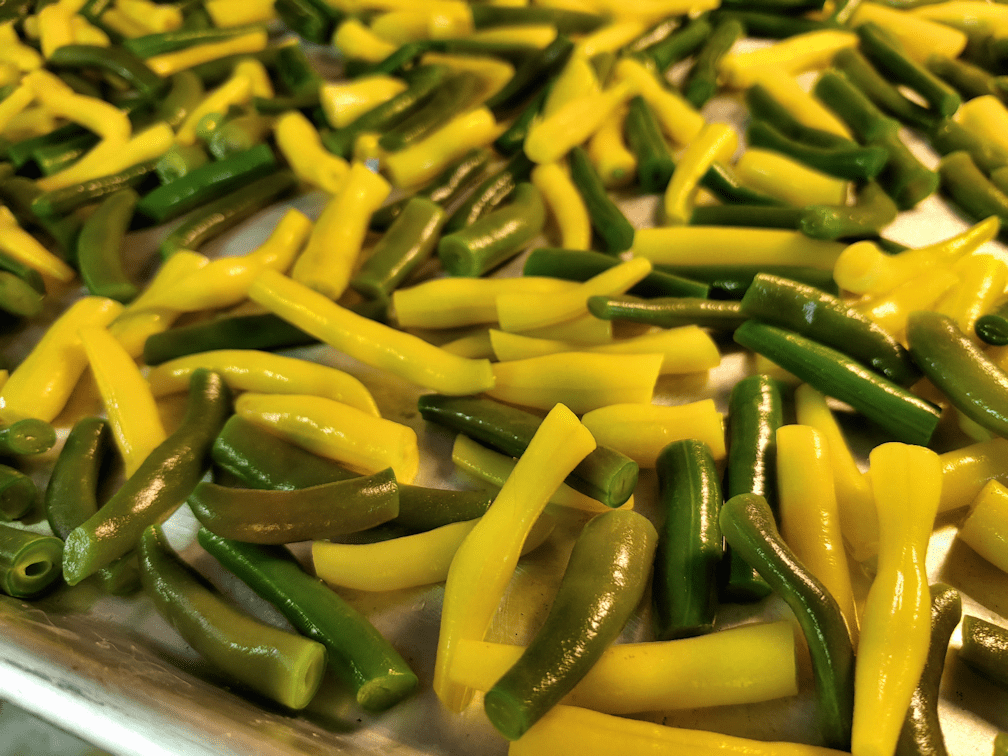
After trimming the ends, then cutting them to more equally sized pieces, I was able to use the blanching pot I’d found in the storage area of the kitchen, while trying to cat proof it (it’s right up by the ceiling and hard to get to!). This is the first time we’ve been able to use it. :-)

All those ice packs we have to help keep our food cold or frozen when we do our city trips are coming in handy. I used a bunch of them to make an ice bath to chill the blanched beans in. We don’t typically make ice with our well water, and the ice we do have is purchased, so I didn’t want to use any of that!

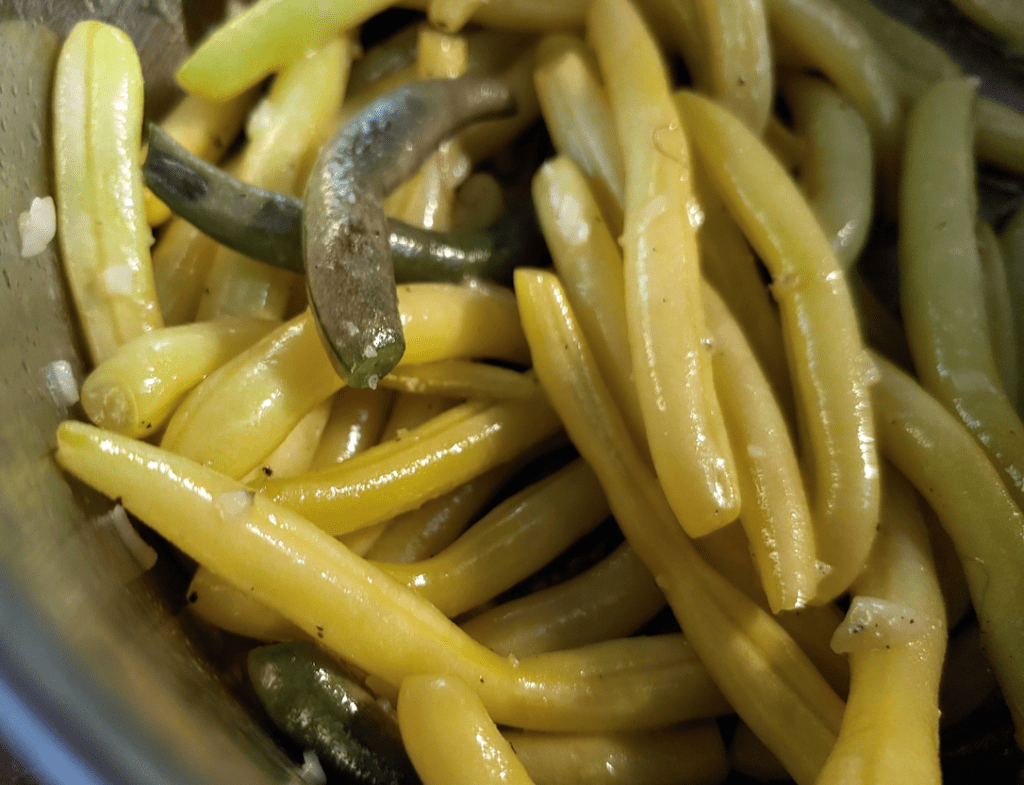
This variety of purple beans turn green when cooked or blanched. They are a somewhat less bright green; you can tell them apart in the foreground.

The blanched beans were laid out on a couple of trays and are now in the chest freezer, to be bagged later.

One thing about freezing produce. It’s very fast! I still hope to have enough to pickle or pressure can, so we have shelf-stable beans, too. :-)

The Re-Farmer

Our 2021 garden: first taste, and getting big!

This evening, our first real harvest of beans was prepared to accompany our supper, and did a taste test. Though we’d picked a few beans before, they were so few, they just got chopped up and added to a hash.

For these, they were first steamed until almost done, then pan fried in butter with fresh garlic (our own, of course!), then seasoned with salt an pepper.

The purple beans turn green when cooked, and I made a point of tasting them individually, to compare the flavour.

Honestly, I couldn’t tell the difference. As far as I could tell, they tasted the same! :-D Which was very good, I might add. :-)

I forgot to follow up on how the Dorinny corn tasted. We had those last night, wrapped in foil with butter, salt and pepper, then roasted in the oven, next to a ham.

I really liked the Dorinny corn. If you’re a fan of really sweet corn, it probably wouldn’t be your thing, but it had a good, solid corn flavour. It was also wonderfully toothsome. As much a pleasure to eat as to taste. I don’t think we’ll be able to save seeds from these, there are so few of them, but I will definitely want to pick up more for next year’s garden. In fact, I think I will get two packets this time.

While heading out to check on the gravel pit, I paused to look at the cucamelons and had a lovely surprise.

Hiding behind some leaves are some really big ones! Not quite big enough to harvest, but very close.

Yes, this is “big” for cucamelons. :-D

So awesome!

The Re-Farmer