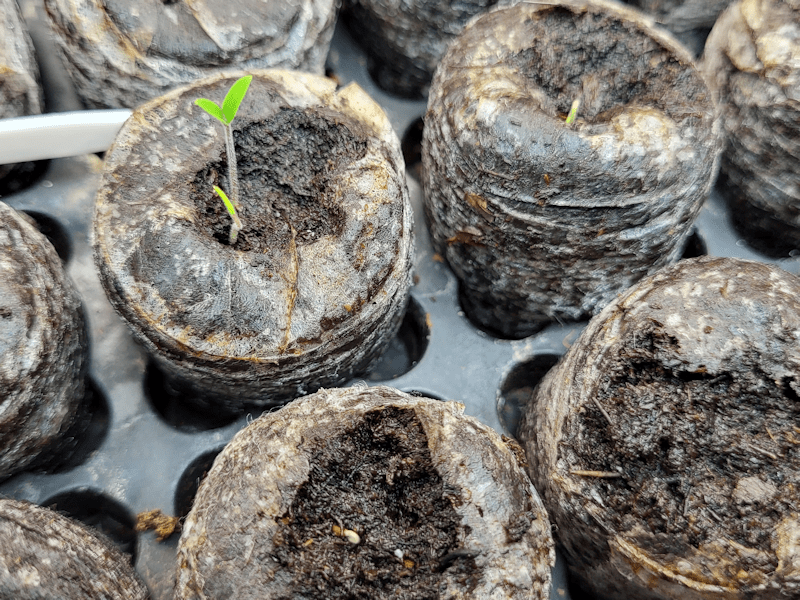
I few days ago, I spotted our first Spoon tomatoes, but they are so fine and spindly, I waited until today to try and get a photo.
Still no sign of peppers, but there’s about 8 or so tomatoes sprouting, and signs of more seedling elbowing their way to the surface. They are so bitty!
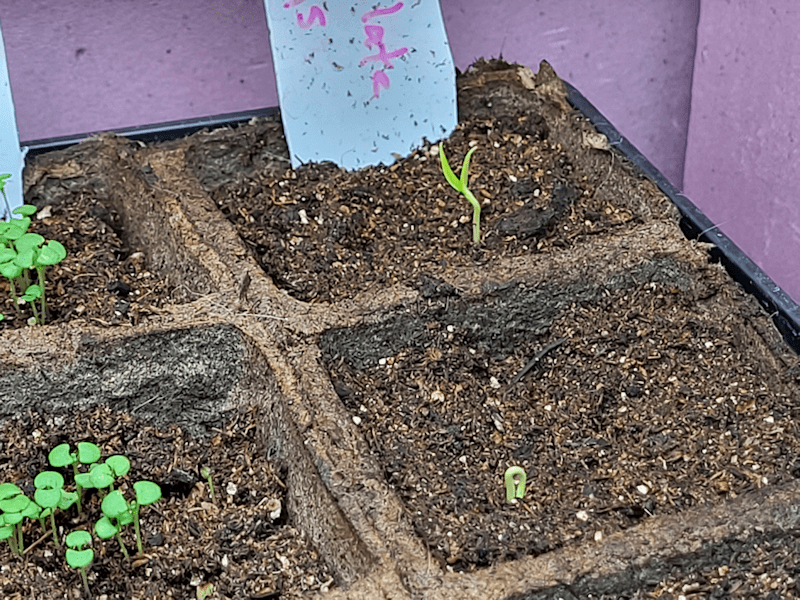
Speaking of bitty, we also have our first strawberries sprouting!
Growing strawberries from seed is totally new to me, so I’m pretty happy to see these. Over time, I want to have lots of strawberries, so if growing them from seeds works, that would make it much more affordable compared to buying transplants or bare roots. We’ll probably still do both. I want to use them as a living ground cover around the silver buffalo berry bushes. Those are nitrogen fixers, so it would be a good combination, and when the bushes start getting too big and start shading out the strawberries, we can just transplant them somewhere else.
I am so looking forward to having our own berries. We all love them, but they are so expensive to buy! My younger daughter was asking about growing blueberries, but they need acidic soil. Ours is very alkaline. We will need to find a spot and focus on lowering the pH so we can plant some. Once we clear more of the dead trees out of the spruce grove, we might be able to get some good spaces in there. I’ve read the spruces increase soil acidity, so I will want to do some soil tests and see how it is now.
The rest of the peppers got done today, along with the Spoon tomatoes. That bowl has all the Spoon tomato seeds left from last year, as well as the new seeds I got this year.
The tray has 6 long rows, and I considered also planting the remaining Purple Beauty pepper seeds from last year, but there weren’t enough seeds to fill a row, so I decided against it. There were not a lot of pepper seeds for any of the other varieties, but with just one seed per pellet, I still had some left over.
With the Spoon tomatoes, I used the last two rows, planting two seeds in each, and still had some seeds left over. (A wooden chopstick is really great for picking up individual seeds and planting them!) It’s potentially a lot more of these tomatoes than I was intending to plant of this variety, but they did go over very well the last time we planted them. If the germination rate is high and we have a lot of extras, I’m sure I can find someone who would like some transplants. 😉
As for the peppers, we’re not after a lot of each type, so if the germination rate is low, as long as we have a few plants of each to try, I’m good. I want to have an idea of which ones do well here, and which ones my family enjoys eating, and that will decide what we will grow again in the future.
After this photo was taken, I put the dome over this tray, and then switched out the tray on the warming mat in the aquarium greenhouse. I had thought I might be able to leave this tray, with the dome, by the window, but when I touched the Jiffy pellets, they were cold! These are heat loving plants, so onto the warming tray then went.
This is the tray that got switched out. The Crespo squash on the right will be potted up once the true leaves are more fully developed. We still have just the two Caveman’s Club gourds in the middle; I’m considering soaking a couple more seeds to add to the one pot where nothing germinated, just to have more transplants. I don’t expect everything that gets transplanted to survive, so having more just increases our chances of having at least one plant survive.
The Black Beauty tomatoes (middle) and the Indigo Blue Chocolate (left) are doing quite well. The Little Finger Eggplant (far left) are not. Of the few seeds that germinated, only two are growing, and one… I’m not quite sure if it’s going to make it. So I reseeded the pots. Hopefully, we’ll have a few more to transplant by June.
Oh, it looks like I’ll be heading out soon. A very excited daughter just came in to let me know her glasses ordered from Zinni have arrived. She has been absolutely miserable without glasses for so many weeks. I just have to wait for the post office to reopen for the afternoon. I’m really looking forward to seeing how these are for quality.
I love it when seedlings suddenly burst out of the ground and grow so fast, things are different every time I check on them!
When I checked on them yesterday, I could just see one Crespo squash starting to shoulder its way through the soil. Near the end of the day, I could see two emerging and one more just visible. I also spotted one eggplant peaking through. By the time I shut down the lights for the night, the eggplant was up, with signs of more starting to emerge, plus signs of one Caveman’s club gourd.
This morning, two of the Crespo squash are fully up, with the third one almost there – and the soil in the other pot looks like something might be breaking through soon, too. There are still more tomatoes emerging, and more eggplant peeking through. Still just one Caveman’s club gourd visible, so far.
As for the older seedlings, it looks like all the ones that got potted up have survived, though one drum gourd that did not need potting up doesn’t look like it’s growing. There had been two in that pot and one died. I was hoping the second one would make it. We shall see. The other two that were thinned by division are growing, and the third pot was reseeded, so I hope there will be more to transplant once the garden is ready. The more there are to transplant, the better the chances that at least one will reach maturity!
I’m happy to see so many seedlings emerging now. Soon, these will be moved off the heat mat to make room for the next batch of seed starts.
Today, I potted up most of our seedlings, among other things.
For the larger seedlings, I thinned by dividing, so the zucca melon and a couple of drum gourds are now in their own larger pots. The pots where nothing germinated now have new seeds in them, including the luffa on the side.
The four cells of peppers are now in 7 red solo cups. The thyme and lemongrass did not get thinned, just transplanted into deeper biodegradable pots.
I also got the strawberry kit done, and that little tray is in the aquarium greenhouse with the other seed starts. Every time I look at in there, the Black Beauty seedlings are bigger, and I can spot more of them breaking through the soil. They are practically exploding in growth! I even spotted a couple of Indigo Blue tomatoes breaking through, too!
In about a week, we’ll need to start the next batch of seeds, which will include all the remaining short season peppers and the paste tomatoes. I’m quite glad we have the living room cat proofed, so we can shift things around more freely. Yesterday, my daughter was using the room and Fenrir teleported in, as she tends to do. My daughter thought it might be okay, since she was in there to supervise. She turned her head for perhaps 30 seconds, and suddenly Fenrir had a mouth full of onion greens!
Onions are toxic to cats.
My daughter was able to catch her and get the greens before she actually ate them. Thankfully, there is no apparent damage to the onion seedlings!
So much for even one cat being allowed in, with supervision!
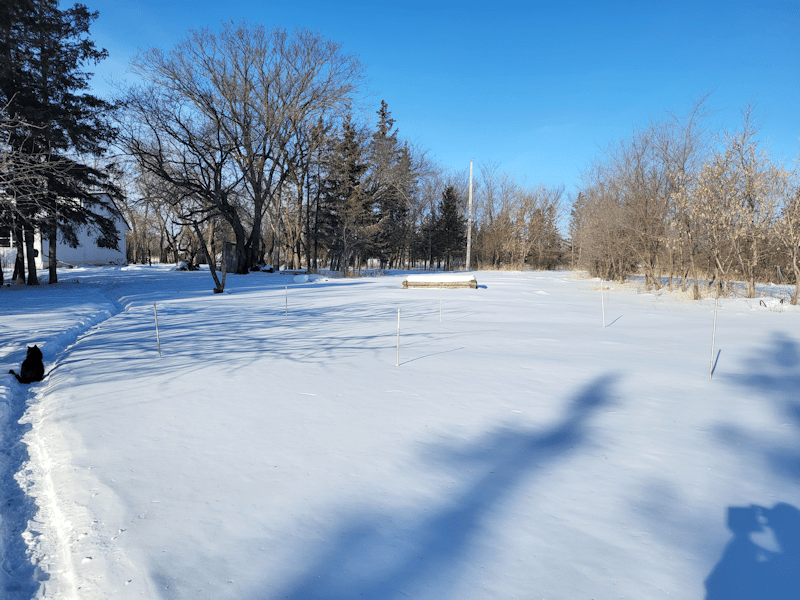
Yesterday was the first day of spring. Check out our spring garden!
😄😄😄
It’s going to be a while before we can start building the trellis tunnels (we will be starting closer to the high raised bed, and I hope to eventually have two or three, though maybe not this year), never mind planting anything!
BUT!!!
We do have other signs of spring.
When I shut the lights off for the night, I found two Black Beauty tomatoes had emerged! There had been no sign of them when I turned the lights on in the morning. I could just make out the “elbow” of a third one, and this morning I can see there is a second “elbow” emerging. These are in the cell just below the one with the visible sprouts.
Today, I plan to pot up some of the transplants, and try to start seeds for some losses. We are down to one luffa, two pots of zucca melon still have had no germination, along with one pot of drum gourds, so I’ll see if I can get new ones started, though I won’t bother putting them in the aquarium greenhouse. Their current location above a heat vent should be warm enough. I did remove the plastic cover on the mini greenhouse, as I think the lack of air circulation may be contributing to the losses, and even some of the bigger seedlings have started to look unhealthy.
I stopped at a grocery store to pick up some milk for my mother, and ended up picking up a seed kit. One of the things I wanted to do later on was get strawberry transplants – quite a few of them, depending on the budget – and plant them as a living ground cover around the silver buffalo berry. Last year, the transplants cost about $3 or $4 each. The kit was only $4. So I’m going to try growing strawberries from seed, which will hopefully give me more to transplant than I would be able to afford if buying transplants. And if they fail, it’s not an expensive fail. So that is something else I plan to work on today.
Oh, and I’d better call the plumber about our bathtub before I forget again! After that, I’ll know if I have to be making a trip to get a tub surround and the replacement taps I want.
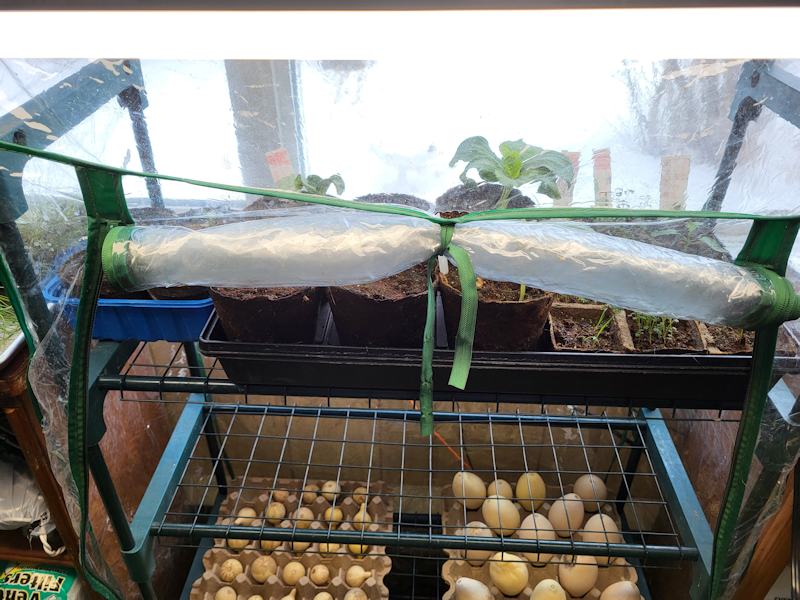
After a bit of adjusting, our new set up for the seedlings rotated out of the aquarium greenhouses is figured out.
The seedlings that need more warmth are inside the mini greenhouse, which is set up over a heat vent. The plastic cover is there to help trap a bit more heat, and protect them from the cold window.
It looks like we’ve lost one luffa, likely due to the chill, and one drum gourd, but there are still 2 luffa left, and 3 drum gourds. There are also several pots that had nothing germinate in them, but I’m leaving them for now, because who knows? Now that it’s over here, maybe something will happen.
The rolled up door in the cover is hiding them, but the thyme is looking like it could be potted up already!
The onions and shallots get to be on one of the shelves, as they can handle the cooler temperatures better. They look ready for a hair cut!
We were able to use some paracord to bring the lights down lower, and their heights can easily be adjusted. With just the two areas with seedlings, only one light is needed for the space right now. The shelves are closer to the window than the lights, so the seedlings are getting lit up from both sides. That was a major problem with our seedlings last year, and I was using aluminum foil to try and reflect light back to the shadowed side of the trays.
Also, you can see the trays of gourds from last year, in the mini greenhouse. They’re one shelf level above the heat vent; the bottom level won’t be used at all, since it’s right over the heat vent and very dark. If, for some reason, we need the space, we’d have to elevate the entire greenhouse frame somehow. The Tennessee dancing gourds are drying up nicely, but it looks like the Ozark nest egg gourds may still have been a bit too green when harvested. There wasn’t much choice about harvesting when we did, since we were starting to get frost, and that would have wrecked them completely. I still have seeds, though, and we will likely be starting them with the batches we’ll be planting before the end of this month.
With the cat barriers in place, and the living room rearranged for the seedlings, it’s actually made the room more useable. The girls have taken to actually having their meals in there, and even watching shows on Tubi. At the moment, they are enjoying some birthday cake in there! I’ve actually allowed myself one exception to my Lenten fast from sugar/starchy foods, to have a piece of birthday cake. It’s been long enough since I’ve eaten any sugar or starch, it’s actually making me fill a bit dizzy!
Anyhow. That’s our garden progress for the day! 🍃🌿🌱
Butterscotch has discovered the window shelf! She doesn’t spend much time there, but enough to keep Nosencrantz from using it as often. 😄 So far, the only other cat that’s checked it out is Potato Beetle, and he does just that – checks it out, then leaves.
At the moment, I’m taking a bit of a break from preparing for spending a day and a night at my mother’s. This will be the first time I’ve been away from the farm overnight since we’ve moved here! Which means I’ve been spending a fair bit of time digging around, trying to remember, where is my travel toothbrush? Do I still have a travel toothbrush? Oh, there’s a case for a full size toothbrush. What smaller bag should I use to pack into, and how much will I have to dig to find it behind the barricade made to stop the cats from using the suitcases and scratching posts? Does my husband have an extra pill case I can use for my meds and supplements?
It’s just an overnight trip, but it’s an overnight trip to my mother’s which puts a whole new level of considerations. Plus, I want to stick to my Lenten fast while also not depleting my mother’s grocery supply, so I’m not only bringing food for myself, but enough to share with her. She won’t be able to eat for at least 4 hours after the procedure, since they are going to be freezing her throat, so she’s going to be hungry.
I ended up making a quick trip into town with my mother’s car for a few things for my overnighter, plus a few extras until I can make my next city trip. That will, at the very least, have to wait until after the tire on the van is fixed. Hopefully, our mechanic will find something suitable at the auction that the financing company will accept for the loan that’s already approved. So many things are getting delayed or side tracked because of all the problems with the van!
I am so thankful we have my mother’s car that we can use as a back up vehicle. It’s been needed often enough to be worth the extra expense. Living out here, having two vehicles is a necessity, not a luxury.
Meanwhile…
While tending the seedlings in the large aquarium greenhouse, I graduated the drum gourds that germinated first. They’re getting tall enough to need more space from the lights, so that one pot has been moved to the lower tray that the onions and luffa are on. I almost, kinda, maybe, think I could see new growth in the one last pot with drum gourd seeds!
Now, in theory, I really should thin out one of the seedlings in the pot I moved. The problem is, they are both so very strong and healthy! Meanwhile, the second pair of seedlings are still recovering from being stuck in the hulls of their seeds and are not looking anywhere near as healthy yet. So I am keeping both and, when it’s time to pot them up, will thin by transplanting one out into its own pot, while the other can be potted up without removing it from the biodegradable pot. Hopefully, the one that gets thinned out will survive. The more seedlings I can keep alive until it’s time to transplant outside, the better our changes of having at least one plant survive transplanting and maybe even enjoy a full growing season!
I took a closer look at the tiny little zucca seedling. There was still just an “elbow” showing, but something seemed odd about it.
Where those roots?
Yup.
I very gently poked around in the soil and found the seed leaves were still thoroughly encased in the hull, which was trapped enough by the soil that instead of the leaves lifting up, the root end was being pushed out! So I very, very carefully and gently uncovered the seed hull encased leaves while covering the roots – only to accidentally reveal a second seedling working its way out, too! That one was also still stuck in the hull, so I loosened the soil over that, too. Once they’ve gotten large and strong enough to fully emerge and start standing upright, I will gently remove the hulls, like I did with the second pair of drum gourds that germinated..
I’m just babying these suckers! 😂
I am just itching to start more seeds but, for what we’ve got, it’s still a bit too early.
Well, break time is done. Time to go dig out a bag to pack for tomorrow.
I’ve been waiting for days before finally getting a picture with the newest drum gourds, then went again and got progress pictures of the rest.
I found a new baby this morning!
The red arrows are pointing to the barely visible first zucca melon!
The new drum gourds were taking a lot longer than the first ones to break free of the soil. When the first one did, the reason became obvious. It was still completely encased in the seed shell! After a while, I very carefully removed it and just dropped the pieces on the soil surface, but the seed leaves have still not started to separate. I can now see that the other one is also still encased in the seed shell. Once it manages to break free of the soil, I will carefully remove it, too. The risk in doing that is tearing the encased parts of the seed leaves right off, as they are so very fragile in there.
The earlier drum gourds are just barely starting to show their true leaves. The luffa’s true leaves are coming out nicely. Even the lemongrass is showing some true leaves. I think. They don’t look very different, other than there being more blades. I honestly can’t tell with the thyme.
That last cell of sweet chocolate peppers finally has a single seedling germinating, so we now have a total of four. Still just the seed leaves in even the oldest ones, though.
The onions and shallots are growing very slowly at this stage. No new haircuts needed! So far, they’re all surviving, too. Hopefully, we’ll be able to keep them alive! Last year, we had some issues with the yellow onions and shallots not doing well, but we have different varieties of both this year, and they seem to be doing better so far.
We’ve got two varieties of red onions, one of yellow onions, and one of shallots.
This morning I got a picture of some of our seedlings, after refilling trays to water them from below.
There are still only two little pepper seedlings. The thyme and lemongrass don’t seem to be growing much. I think this might be part of why they need to be started so early!
The two drum gourd seedlings in one pot are still the only ones to have germinated. With using these biodegradable pots, it’s been interesting to see how the pot the germinated seeds are in dries out so much faster than the other ones. Even the square cells the herbs are in show noticeable drying out in the ones with the most seedlings. For this reason, I still mist them as well as water from below.
Last year, I remember my first zucca melon seeds never germinated, and I had to try again. I’m hoping I won’t need to do that again this year. The zucca and the drums need as much growing time as we can give them.
We’re going to have to start other seeds soon. That means rotating things out of the aquarium greenhouses and, for that, we still need to make a trip to the city to pick up the materials we need to build barriers and keep the cats out of the living room. When picking up eggs yesterday, I noticed they had lumber in their truck and asked about prices. Lumber prices have gone down a LOT in the last while, which is encouraging. The prices are still high, but not astronomical anymore.
The trip to the city will have to wait until after the van’s date at the garage to get the temperature gauge sensor replaced.
Still holding out hope that we’ll qualify for financing on the Caravan, but if I’m going to be honest with myself, the odds are not in our favour. Mind you, our situation wasn’t much better when we got financing for the Grand Caravan we got, years ago. Oddly enough, my husband being on disability gives us a more reliable income now than when he was still working. Nothing like moving to a new city for a 2 year contract, only to have the contract end after 6 months, instead!
Ah, well. Whatever happens, happens. We just need to deal with what’s in front of us.
Which, at the moment, means turning the living room into a cat proof plant room. 😁
In my last post about our seedlings, I mentioned that I thought maybe where the peppers were in the tray was a bit too cold. So I squeezed things over a bit and pulled the tray and heat mat a couple of inches away from the end of the aquarium greenhouse wall. I checked them a few hours later, and would you believe, I found peppers sprouting already! Maybe they would have sprouted anyhow, but it sure was nice to see!
As of this morning, they were noticeably bigger.
When I shut off the lights for the night, the one that is upright in the photo was like the bent one in the foreground. There’s just the two seedlings, but that’s better than none!
I’ve just come back from a long day, which I’ll write about in a separate post, but I checked them again when I got back. Not only are the peppers a bit bigger (though there’s still just two of them), there is now a second drum gourd seedling starting to show through the soil! It’s in the same pot as the first one, with no sign of seedling in any of the other drum gourd or zucca melon pots, so I hope to see more seedlings soon.
I’m just happy to finally be seeing some peppers showing up!







 The Re-Farmer