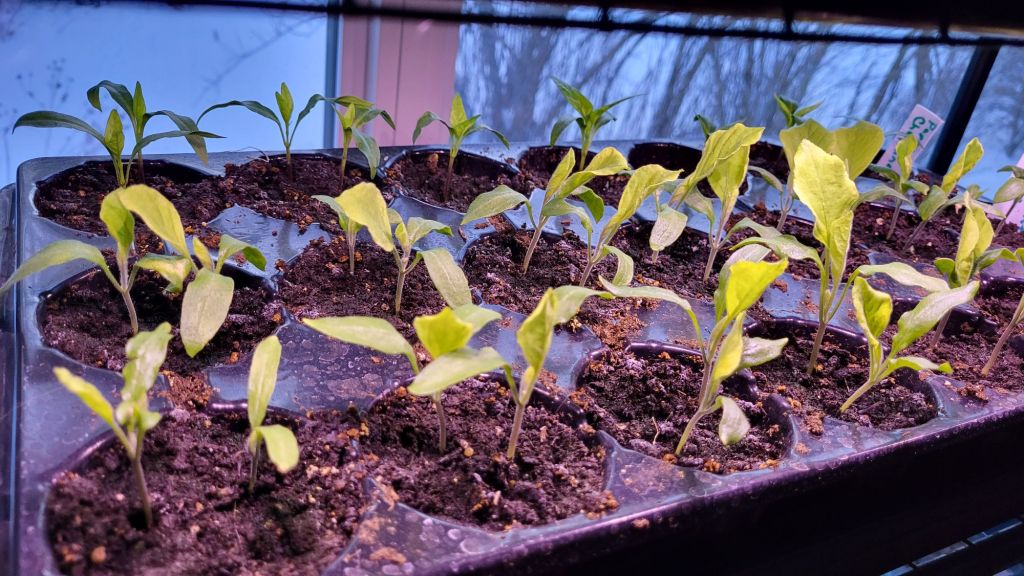
Our 2024 Garden: transplanting Crespo squash, San Marzano tomatoes, and direct sowing pole beans

Today was a productive day!

After I finished my post earlier today, my daughter and I headed out for a dump run, then errands. We ended up going to the smaller city for her shopping, so that I could pick up some cat food at a better price at Walmart. By the time we got home, it was well past 3 and, I’m happy to say, starting to get a bit cooler!

After having a late lunch, I headed outside to finish at the new low raised bed.

Before I got started, I prepared a 4L size water bottle by removing the top and punching holes in the bottom, then brought over protective rings and support posts. The support posts were long enough to reach from corner to corner on the bed, so I used them to find the centre. That is where I partially buried the water bottle. This way, we can add water into it, and it will drain out the bottom and water the roots of the plants nearby. We’ve done similar in the past, including the first time we tried to grow Crespo squash, and it has worked well.

The pot with the single Crespo squash was the one where the stem had broken when the cats knocked the bin holding the pots off the table. I had it supported with a pair of bamboo skewers. Unfortunately, as soon as the skewers were removed, it immediately bent over at the break, almost snapping off. I had intended to plant it deep enough to cover the break, as the squash will develop adventitious roots, but I had to be so careful not to break it completely! I planted it in a protective ring and ended up filling the ring to the top with soil to support the stem. It still ended up lying on the soil. I just made sure it was running towards the side I wanted to train it towards, as it gets bigger – if it survives!

The other pot had two squash in it. I was planning to separate them, but the roots were too entwined, so they were planted together. They, too, ended up with their protective ring filled almost to the top with soil. They both got well watered, and I added water to the reservoir in the middle – which drained much faster than I expected! I ended up filling it again, a couple of times. before I was done.

With how the light hits this area, I decided to plant a row of beans along the east and west sides of the bed. I chose Seychelles pole bean seeds left over from a couple of years ago, that did so well for us when so many other things did not! These are a very straight green bean, and they were quite prolific.

Once the beans were planted and well watered, I set up supports to create an A frame, then added 4″ square netting. This will be enough to keep the deer from getting at the squash, while still being open enough to reach through to weed or pick beans. The beans themselves are planted about 8 or 10 inches from the side, so they will also be protected by the netting until they get tall enough to start climbing it. Hopefully, we’ll have a decent germination rate. The germination rate was excellent when we grew them before, but after a couple of years, I would expect it to be far less.

Though it was starting to get late, the days are so long right now, I decided to do more transplanting. The San Marzano tomatoes needed to be transplanted, and I decided to see if the retaining wall blocks could be used for that.

Aside from the chives in the corner, I planted mint in alternating blocks. Unfortunately, there’s some sort of plant in this garden that is more invasive that even crab grass or creeping Charlie! The mint is struggling to come back this year, and this plant is choking them out! I pulled as much as I could around the mint, but they’re so mixed together, there really isn’t much I can do.

In the other blocks, there was a lot of this plant to clean out as well. A couple of blocks still had some onions growing in them. There had been more, but they were choked out by this invasive plant.

I was able to clean up 10 blocks for the tomatoes, including two of blocks with a pair of onions in them that still had room for a transplant. I used my pH meter and was surprised the soil was just as alkaline as everything else. These blocks have been amended with peat in the past, and the cement itself can increase the acidity of soil. That meter’s needle was a hard 8. So I worked some sulfur granules into the prepared blocks, too. I wonder, at times, what the reading would be if I had a meter that went higher than 8! Even the solution in my soil test kit maxed out at 7.5. Ah, well.

In the tray that had the biggest, healthiest tomatoes, there should have been 9, but there were only 7 surviving. One of them was even starting to bloom! The last three blocks were planted with the smaller tomatoes that almost didn’t survive being moved to the sun room. This was the tray that had tipped and spilled after I’d topped up the soil in the cells, so they’ve had just a rough time, over all! After transplanting the three strongest looking ones, there’s maybe 5 or 6 left. There’s one, I’m not sure is going to last much longer. I don’t know where I’d transplant these right now, but being as small as they are, they can stay in the tray longer.

Each of the transplants got a bamboo stake that will be used to support them as they grow. They will likely need more as they get bigger, but that can be added later. Last of all, they got a very thorough watering. Hopefully, they will do okay here. The ornamental apple trees cast quite a bit of shade, even with the pruning we’ve done over the years, but we’ve grown tomatoes in these blocks before, and they did okay.

Once everything was put away, I did one last prep. There are three pots on the landing outside the main doors. Last year we grew herbs in them. I have decided to grow summer squash in them this year. This way, even if we don’t end up having the space to direct sow in the main garden beds, we’ll at least have some summer squash in the pots to enjoy!

One of the pots had spearmint in it, but it did not survive the winter. Another had a mix of thyme and oregano. The one oregano that survived to be transplanted had bloomed and gone to seed, and I was going to see if any of the self-sown seeds germinated, but decided having summer squash was a priority. The biggest pot had lemon grass in it and, wow, were those roots every hard to clean out!

One of the new seeds we got for this year were are a white patty pan, so I’ll plant some of those, for sure. We have both green and yellow zucchini, and I haven’t decided which of those I will plant, yet. If we still have some Magda seeds left, I want to plant some of those. We really like them, but they are the ones that have been the hardest to grow! With some of the seeds being a few years old, I’ll plant at least three per pot, and see how many germinate.

The pots are prepped, but the planting will be done tomorrow.

With so many winter squash that need to be transplanted, they are a priority for the low raised beds that are already shifted, with or without frames. Tomorrow, my daughter and I will finally drag the second 18′ log out of the spruce grove – between the rain and the high winds, we haven’t gone into the spruce grove since she got this last one cut to size! We have enough logs to frame one bed, so that will make things a bit easier.

Things may change, but I’m thinking of planting the winter squash in the middle of the bed, in a long row, then planting more pole beans on either side. We won’t be able to do an A frame support structure, like over the Crespo squash, but we should still be able to rig up a quick trellis for them, later on.

With how many winter squash we have, and how far apart they need to be planted, the two shifted beds might not be enough for them all. The drum gourds and the pumpkins will probably need their own hills. I’ll figure that out, later. We’ll be transplanting melons into the first of the trellis beds, all along one side, where the trellis supports will be added, later, but again, we probably won’t be able to fit them all in. Since they will have a trellis to climb, they can be planted closer together, but I don’t expect to fit them all in that bed. Something else we’ll need to figure out!

Still, today was a productive day, and it feels rather good to have fewer trays to return to the sun room for the night!

The Re-Farmer

Our 2024 Garden: transplanting tomatoes, luffa, onions, thyme and mulberry, plus some updates

Yesterday, I had my eye appointment, which included pupil dilation, so I had my daughter there to drive me home. I’ll have another field of vision test in 6 months, though probably not the dilation. This will be my third field of vision test, which will give a solid baseline to compare with in the future. For now, the miniscule hemorrhages she can see in my eyes have not really changed, and we’re still in the monitoring stage. As for my regular eye test, my left eye has changed, but not enough to be worth getting new glasses.

All that went well, and I took a break from stuff to give my eyes time to recover. So I can’t blame that for my rough night. I was just getting pains in different places at different times, making it impossible to get comfortable, nor stay asleep for very long. So my daughters did the morning cat feeding and kitten cuddling for me while I tried to sleep in.

Tried to.

This time, it was cats that kept me awake! Butterscotch, after months of hiding under a chair, now likes to sleep with me. Or on me. She still won’t leave my room, but this is progress! She gets along with most of the cats, but some of them have decided to be aggressive towards her, so every time she sees them, even if they’re just walking by, she starts snarling and growling. Then there’s Ghosty, who likes to lick my nose, and Shadow, who tries to eat my buttons. Or Cheddar and Clarence, who get aggressively cuddly!

It’s better than being kept awake by pain, at least!

In the end, my having a late start turned out to be a good thing. I was inside for the call from Home Care about my mother and her wanting to move to a nursing home. We’ve dealt with this guy before, and he has assessed my mother in the past, which didn’t help her any. They can’t provide the help she needs. He was somewhat confused about getting the fax from her doctor to do a panel on my mother. It turns out, this is basically the opposite of how it usually works. Typically, someone has a fall or some other incident that puts them into the hospital. That’s when Home Care does their panel, the doctors do the other tests, and the person usually doesn’t go home from the hospital, but straight to long term care.

Which is not what we were told. When my brother called the nursing home my mother wants to move to (which is where her sister and my father, as well as many of their friends, spent their final months and years), he was told we needed to get a doctor’s recommendation. Which we now have. We didn’t know Home Care would be involved until that appointment. Home Care and a brain MRI are the last things that need to be done.

As he was explaining it to me, he felt that, since my mother hasn’t actually put herself in the hospital or had any falls, he doesn’t expect his assessment to amount to much. We already know this is basically putting her on a waiting list, but when I mentioned this, his response was that “waiting list” is basically too generous a term. More like an “indefinite list”.

She’s coming up on 93. I really don’t think that’s going to be an issue.

At one point, I called out the absurdity of the situation. Basically, because my mother is being so careful about things like NOT falling down and hurting herself, she’s being penalized for it? He sort of walked that back but, really, that’s what it comes down to.

Anyhow. The appointment was made for Monday, which is nice and fast. I will be there for this one. The assessment should take 1 1/2-2 hours.

Once I got off the phone with him, I called my mother to give her the appointment time and explain some of the things he told me. I suggested she write down the things that concern her the most, just so nothing is forgotten. It’s not just about her physical difficulties, but we also talked about how she’s noticed problems with her memory, too, and that needs to be taken into account.

Then I sent an email to the family to keep them in the loop. It would be ideal if my brother could be there, too, since he’s got a longer history of helping my mother out, plus he has Power of Attorney, but there’s no way he can get off work for it.

Well, part of the deal for us living here is that I am now able to take on this stuff for my mother. My schedule is the most flexible, and we live the closest to her.

I was eventually able to get outside and get some things done. We had scattered showers, but that’s it. The yard still has water pooling all over, so mowing the lawn is still out of the question. We were also getting high winds, which were blowing the plastic on the box frame over the eggplant and hot peppers loose. I kept putting the weights back on the bottoms, but in the end, just before I came back in for the day, I ended up tying twine all the way around, on two levels, to keep the plastic in place. If the sheets had been long enough to overlap, it would not have been an issue, but it is what it is. I also finally anchored the T posts holding the netting for the snap peas to climb. Some of them are getting long enough to actually start climbing, and the weight of them would eventually pull the posts inwards. Now, they are secure.

But that was at the end of things.

I decided the place to start today was in the wattle weave bed.

I’ve already transplanted the Forme de Couer tomatoes in the rectangular bed. There were only six Black Cherry tomatoes, so I decided those could go in the old kitchen garden, too. They got their protective plastic rings, as well, each with a pair of bamboo stakes to hold the rings in place and, eventually act as supports for the tomatoes.

I had two pots of luffa, but they each had three plants in them. I considered just planting them in groups of three, but decided to split them, so we now have six luffa plants. I put them in the same area as last year, right around the turn of the L shape. They also got the protective plastic rings, but just one bamboo stake. These were positioned closer to the wall, so that the luffa can be trained up them, until they can reach the lilac above.

Then, because there was still space, I transplanted the last of the Red Wethersfield onions, and the German Winter Thyme. There is self seeded chamomile coming up in between some of the strawberries, with room for the thyme beside it. More chamomile is coming up in the path, too!

There is still a small space that can have something planted into it, closer to where the garlic is in this bed, but I have not decided what to put in there. Most of the transplants we have are things that will get rather large, so they would not be appropriate for that spot. I should look through my seeds for direct sowing for something to go there.

Once everything was transplanted, I used some of the grass clipping mulch that had been removed from the other beds in the spring, and mulched around everything. Especially right up against the wattle weave walls, since a lot of stuff growing outside the bed makes its way through there.

At this point, the only tomatoes left to transplant are the San Marzano – and I have no idea where those are going to go!

What really needed to get in the ground, probably more than anything else, was the Trader mulberry. They’ve been in their pots for too long, and were not looking very healthy.

These went on the north side of the main garden area. These can get quite large, so I didn’t want them casting shade over places we want to grow vegetables. Plus, they will act as a wind break from the North winds.

For now, however, they need to be protected.

The first one went in front of a gap in the lilac hedge that the deed have been getting through. I used the loppers to clear away some lilac and little poplars. There was also a dead poplar on the fence side of the hedge. It’s been dead for a long time, so I was able to basically tear it loose from the ground. I laid it across the gap, near the fence (it’s an old barbed wire fence that’s slowly collapsing), which should also deter the deer from using this spot.

Of course, as soon as I started digging a hold for the mulberry, I started hitting rocks and gravel. I added nothing to the soil, though. The planting instructions for these specifically stated to NOT add anything to the soil when transplanting.

Normally, I would have set them slightly above grade, but this area is higher than other parts of the yard, and tend to get very dry. For this reason, I actually want water to pool a bit around the trees before it drains away. Once the sapling was in place, I emptied a 5L watering can around it, to settled in the soil and the roots. Next, thick cardboard was placed around the sapling as a first layer of mulch. At this size, they need to be protected from critters. I had some wire mesh that was used for something else last year. It was taller enough that I could cut it in half. I put bamboos stakes through the wire, then into the ground through holes in the carboard, so they would hold both in place.

Then I walked about 10 paces to the West for the second sapling. There was no gap in the lilacs there, so I cut away some of it to make a little protective hollow. This time, when digging the hole, I was hitting both rocks and roots! The loppers had to be used a few times to cut through the roots.

Once the second sapling was done, they both got their final mulch. They each got an entire wheelbarrow load. Most of it went outside the wire mesh, but I carefully added some to the inside, too, making sure there was nothing too close to the saplings themselves.

By the time this was done, the winds were picking up again. I could actually hear it roaring at times, but where I was working was well sheltered! Tucking them close to the lilacs should protect them from the worst of the elements, until they get larger. They will still get the full sun that they need, too. These will eventually grow 15-20 ft/4.5-6m tall. The berries are edible, of course, but apparently the leaves can be used for a tea that helps control blood sugars. It should take 2-3 years before they start producing fruit. We got these last spring, but they were out of the 2 year old saplings, so instead of the one we ordered, we got two, teeny tiny 1 year old saplings that I didn’t dare plant outdoors yet! I don’t know if that will make a difference in how long before they produce fruit, but I’ll just assume it’ll take 3 years.

Assuming they survive in the first place!

We shall see.

We’re supposed to be a bit more rain this evening, but none at all tomorrow. The high should also be cooler, too. That means I should be able to get back to working on shifting those last three beds to their permanent locations. What really needs to be transplanted next are the winter squash and gourds. Especially the Crespo squash. They are getting really tall, I’ve already pinched off flower buds, and more are appearing! So I might first make small raised bed, just for them, behind the compost pile. We made a small bed there last year, but the few things planted there didn’t survive. Right now, it’s very wet, so it would need to be made into a low raised bed, anyhow. I do have a 4’x4′ frame, much like the one that’s around the strawberries planted this spring, that can be repurposed for this, then we can add a few loads of garden soil from what’s left of the pile. We haven’t even uncovered that, yet. That this location is very wet right now would actually be a benefit, since the Crespo squash are supposed to get very large, and they need a lot of water to reach their full potential.

This will be the… third? year we’ve tried to grow them. I just looked at some of my old posts. The first year we grew them was in 2021. So this will be our 4th year trying! They did amazing, the first year, until they got eaten by deer and groundhogs. They recovered so well, with many fruit developing, only to run out of season. We did a large squash patch in 2022, but that was the year we flooded, so just about everything was a loss. Last year, they got their own patch out by the old squash tunnel that still needs to be dismantled. They did quite poorly. This was close to where the mulberry have been planted, and it seems that the spot actually got too much sun and heat. We did get a squash to harvest, but much smaller than it should have been. It started developing so late, it never reached full maturity. So, this year, I am taking that into account in choosing where to plant them. The spot I have in mind still gets full sun, but is shaded in the morning, and doesn’t get baked like the north east of the main garden area does.

The other winter squash will need plenty of room to grow, too, so they’ll probably take up a couple of the beds that I’m working on now, at least. I’m planning to put melons in the trellis bed that was built last year, along the side the trellis will be attached, but those are small enough that they can stay in their pots a bit longer. We might have to get creative in finding space for all of them, though. A good problem to have, I suppose!

I plant to put the peppers in the high raised bed, but they, too, are small enough that they can handle staying in their pots a bit longer, while I work on the remaining beds.

I have three pots that we planted herbs in last year. I think I’ll direct sow summer squash in those. That way, we’ll at least have some, even if we end up not having room in any of the main garden beds!

So many things to plant, and so few beds ready to plant in!

The Re-Farmer

Our 2024 Garden: eggplant and pepper experiment

Okay, I am totally beat! It’s so hot and muggy out there, I had sweat dripping onto the lenses of my glasses while I worked. We’re at 21C/70F, with the humidex putting us at 26C/79F, and we haven’t even reached our high of the day, yet!

But, I got the third raised bed in the east yard planted, and I’m done!

I also took a chance on an experiment that has the potential to be a complete disaster.

Before I could even start, though, I had to deal with the water. There’s so much of it flooding the east yard, the the boards forming the path next to the bed I needed to work on, were floating. The year we put those in was a drought year, and we had no idea it would collect so much water! The path on the other side of the centre bed is gravel, though there isn’t enough of it. We were planning to eventually get more gravel from the pit, but I have no idea when we’ll be able to head out there to get a load with the truck. We do, however, have plenty of wood chips.

There’s too much water to use the weed trimmer around the beds, so I pulled them by hand. Then I filled our wheelbarrow as much as I could without spillages, three times. That path needed a really thick layer to weigh down those boards and get above the water. With the last load, I could add some to one end, and a bit around the other side. Eventually, more will be added, but for today, I just needed to be able to access the bed without trying to walk on slippery, floating boards!

Then I began the first part of our experiment. I needed to secure the box frame so that it wouldn’t blow away. I’ll explain why that can be good, or really bad, later! For that, I drove some posts salvaged from the Walmart market tent we had, until a piece of tree fell on it, into the soil inside each corner. Then I secured them to the box frame with twine. The box frame is tall enough that I can still tend the bed without needing to move it.

I also used the stirrup hoe and weeded the bed a bit, then started on the eggplant and hot peppers. west end of the bed, I planted the smaller Little Finger eggplants; of the 7 in the tray, two were too small and wizened to transplant. At the opposite end, I planted the Classic eggplant; there were only 5 of those. The last two in the tray died off a while ago. The Cheyenne peppers, however, had all 7 in the tray, though there was quite a difference in size from one end of the row to the other! I planted the peppers in between the eggplant, and the shorter ones on the south side of the bed.

Then, because I had material from the boxes I picked up at the grocery store, yesterday, I mulched the bed with paper. Mostly paper. Each of the boxes had a paper liner, and those are almost enough to cover the entire bed, with some overlap. I cut openings in the paper to go around the transplants. At the very end, after I ran out of paper, I broke down one of the boxes. Those had air circulation holes in them, but I was able to use the flaps to cover those. I ended up using one entire box, plus a couple of extra flaps cut from another one.

Then I got my daughter to come out to help me with the rest of it.

I did remember to bring out some of the supports I have for the peppers and put them in before the next steps. Though the soil was quite wet and didn’t need a watering, we did water the paper and cardboard, so it would settle against the soil more and not blow away while we were working on the box frame.

We took the plastic sheets off the arched covers, then secured them around the top of the box frame. We just used staples for that. The two sheets weren’t quite long enough to go all the way around, so there is a bit of a gap at one corner. We then took one of the arched frames and put it on top of the box frame, and the other over the bed with the German Butterball potatoes (which are coming up now!), mostly for storage. They were just sitting in the wet grass, so this protects them from moisture damage. One had been stored on the box frame, but with the plastic over it, the wind blow it off. That won’t happen again, now that it’s just wire mesh. Once the plastic was tacked into place along the top, the bottoms were weighed down with bricks and boards that we have around those beds, just for that sort of thing. This way, I can still access the bed by lifting the plastic from the bottom.

Adding the plastic around the bed is an idea I got from Maritime Gardening.

Last year we had one surviving Classic Eggplant that did surprisingly well, in the shelter of the wattle weave bed. The Little Finger eggplant were among the things that failed to thrive in the chimney block planters at the chain link fence, that we now know is because of the elm roots getting up into them.

This bed is much more exposed, so I figured they would need extra protection from both the wind, and temperature variations, but of the air and the soil. These plastic walls should help with both. The top is open to still allow rain in.

If we get high winds, though, the plastic around the box frame could potentially become a sail. Hopefully, the frame is secured well enough to the stakes, but it’s entirely possible the wind could pull the stakes out of the ground and the whole thing could go flying.

It’s a risk, but I think it’s worth a try, at least.

So this has been a productive day in the garden. Two types of tomatoes (out of four) are transplanted. Shallots and red onions were interplanted with one type of tomatoes – I don’t plan to have beds of just onions and shallots, but will interplant them as other things go in. Two types of eggplant and the hot peppers are now also planted.

We have one 18′ bed, the high raised bed, plus some space in the wattle weave bed, that’s ready for planting. We can potentially plant in the two shifted beds before they get their log frames. We just have to plant in the middle. Still, this is not going to be enough for all our transplants, never mind our direct sowing. There are three more low raised beds that need to be shifted over to their permanent positions, then they too can be planted in before they get their log frames. Then more beds need to be built, almost from scratch, for the trellis tunnels.

At this point, I honestly don’t know how much of a garden we’ll be able to get in this year. It all depends on how much progress we can get on those beds, in time!

Well, there’s only so much we can do, and there’s no sense fretting about things if we can’t get them done in time for planting this year. Things will continue to expand, year after year, so it will get better.

My eye appointment tomorrow is in the afternoon, and we don’t need to leave until 1pm. I was thinking I’d have time to get more done early, but it’s supposed to start raining in the morning, and keep raining off and on, all day. We are supposed to get almost 2 weeks with no rain after that, though, and even get some cooler temperatures, so that should be time to get things done in the garden. If we can get everything done by the middle of June, that should be enough time for our growing season.

We’re definitely into crunch time!

The Re-Farmer

Our 2024 Garden: transplanting tomatoes, onions and shallots

It is really wet out there, but we’re not supposed to get more rain today. I was torn between continuing on shifting the beds or starting transplanting. We have quite a few things that are more than ready to get set out.

After looking at the weather forecast, and the state of our transplants, transplanting won. In particular, tomatoes. It’s either that or pot them up, and that would be a silly thing to do at this, when they would do much better out in the garden.

The first thing I did was go through my trays and see how many I had of each type. When I saw I had 8 chocolate cherry, I decided they should go into the 8 chimney block planters at the chain link fence.

I then cut some of our many distilled water bottles to create rings for the transplants. With my husband needing distilled water for his CPAP humidifier, we have LOTS of these gallon/4L jugs. I had a few rings left over from last year, but a lot of them seem to have disappeared over the winter.

Anyhow.

I had some of the tomato transplants in individual pots, and some in a large celled tray. There were three rows of four Chocolate Cherry, Black Cherry and Forme de Couer, and the remaining cells got San Marzano. Those ones are the strongest and healthiest San Marzano. The deep celled tray with just San Marzano ended up in the sun room too early – we needed the space – and has only a few sad tomatoes left.

The tomatoes in the tray were so big and bushy, it wasn’t until I was taking the Chocolate Cherry out (they were in the middle row, of course) that I saw one had died off. I completely forgot we’d lost one in that tray. So, we have 7 Chocolate Cherry tomatoes at the chain link fence, and an open space for something else.

Once transplanted, they each got a ring around them. This is to protect them from the wind for the first while, and from the cats that like to go under the netting. The netting was draped back over the blocks and will remain until the elm trees are done dropping their seeds. As the tomatoes grow, the chain link fence will be their trellis support.

There were 10 Forme de Coure tomatoes, so I decided they should go into the rectangular raised be in the old kitchen garden. This bed already has a soaker hose set up. There is garlic growing down the middle, though not very many. This bed got the last garlic cloves, so some of them were pretty small and did not survive the winter. The garlic will be ready to harvest before the tomatoes are fully mature, so they should be okay together.

These tomatoes got their protective rings around them, which are being held in place by pairs of bamboo stakes – the rings blow away if they’re not anchored – which will become their trellis supports as they the tomatoes grow.

Once those were in, I saw there was space enough to transplant some onions. Because I’ve got those started in repurposed mixed vegetable trays, it was quite easy to pop out onion starts in just one section and bring them over. I started with Red Wethersfield, because they were the largest, and I have the fewest in the trays. They were planted at each end of the bed and in between the tomatoes, with a few extras tucked in among the garlic. I think I got half the Red Wethersfield onions done.

There was room enough along the south side of the bed to add a row of the smaller shallots – planting a larger bulb onion might have been a bit too crowded. I didn’t try to plant some on the north side of the bed, as there wasn’t quite as much space, plus I figured they would end up getting shaded out by the tomatoes.

All that took about 3 hours or so. I decided to take a break, and will get back at it, later. The next bed I want to work on is the empty bed in the East yard, next to the peas, spinach and carrots. I will be putting the eggplant in there, and want to try something different to protect these heat loving plants. I will probably be planting the hot peppers with them.

After that, I have some space in the wattle weave bed. I think I’ll put the luffa next to the double lilac again; they did well there last year. Peppers did well there, too, but I might put the Black Cherry tomatoes there, instead. Some of the peppers can go into the high raised bed. The first of the trellis beds, however, is being saved for the melons, and I think the winter squash will be going into the two beds we are shifting, with our without their walls in place. The Crespo squash in particular really needs to be transplanted, but it needs a LOT of space. I might just make a whole new squash hill, just for them. Then there are the mulberry, which are way overdue for transplanting.

Much to do, that’s for sure! Tomorrow is going to be a write off for me, as I’m getting my field of vision test done, which includes pupil dilation. My vision is going to be messed up for quite a while, so I want to get back out there and get as much done today as possible.

But first, hydration and sustenance!

The Re-Farmer

Our 2024 Garden: planting and netting

Today, finally, we planted the German Butterball potatoes.

Orders of perishables like this get sent out in time for planting, which means we could have planted them weeks ago. The Purple Caribe had to wait until the bed they were intended for was redone. We hadn’t quite decided where to plant the German Butterballs, but today we decided to use one of the prepared raised beds in the West yard, where we also needed to tend to the bed with peas, carrots and spinach planted in it.

The first thing we did was weed the bed, again. My daughter went digging around with the garden fork first, pulling out the bigger stuff she found, while I followed along and dug deep with my hands and pulled out the smaller stuff. Once again, we were finding lots of tree roots from the nearby Chinese elm. We went over the bed twice, finding more roots, each time!

I did remember to use the pH meter to see if there was any change, before we topped up the bed. At this point, the bed was amended only with the sulfur granules. I was thrilled to see the needle was actually, ever so slightly, moved. It’s still pretty much at 8, but the needle is now just barely touching the green colour at the 8, instead of about as far as it could possibly go on the alkaline side.

We then added a wheelbarrow load of soil left over from amending the previous beds. This soil has more sulfur granules in it, plus peat. Once that was spread out, we worked it into the bed with our hands – and pulled out more roots. Then, while my daughter went to fill watering cans from the rain barrel, I used the stirrup hoe to stir and level the soil – and pull out more roots – before using my hands to create a broad trench down the middle.

There turned out to be exactly 32 potatoes, so we laid them out evenly in two rows. Yes, they are probably being planted too close together, but this is the space we have available, so it’ll have to do.

Once we had the potatoes set out where we wanted them, I went around with a garden trowel and dug a hole for each one, while my daughter followed along and watered the holes, then I followed along behind her, planting each potato into the watered holes. Once she was done, she went to get more water from the rain barrel, while I covered the potatoes and used the soil from the sides to create hills over them. They got a final watering in the trench between them, then we put a cover over the bed, so the cats won’t go in and use that nice soft soil as a litter box!

Before we’d gone outside, I set the sugar snap pea seeds I bought yesterday to soak. Unfortunately, I’d put them in the bowl last night, and it got knocked over by the cats. My older daughter and I found most of them, but from the 24 seeds I’d counted when I opened the packet, we were down to 21 – and only because I found one more this morning.

I’m not impressed with the inside cats right now! It’s been no end of them getting into things they shouldn’t, lately!

Once the potatoes were done, my daughter went to get the peas while I used a bamboo stake to make a row of holes for them. I planted the previous two rows of snap peas, so I knew where I could do that, and not be on top of the previous rows. There may, possibly, be a single pea from the first planting emerging, but I’m not sure, yet. Last night, I found that something had dug into the bed over where some peas had been planted, and there was no sign of any peas when I pushed the soil back. I think most, if not all, that first planting of peas died off for some reason.

Once that was done, I went to the garden shed to get the trellis netting. That’s when I spotted Broccoli’s babies! I got the netting out, as a tiny calico hissed silently at me, then called my daughter over to look. She had already finished planting the peas by then. We paused for a bit to move the babies to a carrier, then my daughter went on mama-baby watch while I continued. I gave the bed a watering, first, then set the netting up on the T posts. Then it was back to the shed, partly to see if Broccoli was looking for her babies, and partly to get some netting to put around the bed. I’d already grabbed a bundle of supports and set six of them up around the bed. Unfortunately, the bundle of netting I grabbed was not long enough to go all the way around. There’s about 2/3 of one side that’s not shielded by netting. The netting is there to keep things from eating the spinach that’s coming up, as well as to keep the cats out. We’ll have to go through our other bundles of netting to see if we have either something short enough to fill the gap, or long enough to go all the way around, and replace what I put up today.

Eventually, we will need to set up something outside the beds to secure the T posts. If the peas actually start to grow, their weight will pull the T posts inwards, so we’ll need something to keep that from happening. There’s no hurry on that, though, since we’ll only need it if the peas survive in the first place! I don’t assume anything, at this point.

So we did manage to accomplish the goals we had for before things got too hot – we’re now at 26C/79F. 28F/82F, if I go by the website instead of my phone app.

For all the warmer highs we’re getting, over the next week to ten days, our lows are expected to dip to 1 or 2C/34 or 36F, which means we could get frost. If the long range forecasts are at all accurate, we’ll start to bed overnight temperatures consistently 6C/43F or warmer, which is about the minimum we’d need for the soil to get warm enough for direct sowing anything that isn’t cold hardy, like the peas and spinach. Mind you, with plastic covered covers for the raised beds, we could plant things and the covers will protect them.

What we really need to get working on is harvesting logs to build the raised beds we need. It’s too windy to try and cut down dead spruces, but we can process the ones that are already down.

We’ll have to make sure we use plenty of bug spray before going into the spruce grove. Not for mosquitoes. Those aren’t out yet. For wood ticks! It’s been a really bad year for them, already. So far, I’ve only pulled them off myself before they’ve attached themselves, but I’ve been pulling lots of them off of Syndol. With his long fur, he can’t get them off his neck or near his ears on his own. The short haired cats that let me pet them have no ticks. Just Syndol. Which makes me wonder about the other long haired cats, that don’t let us handle them like Syndol does.

Also, while I was writing this, Broccoli has been seen around the kibble house and walking around the sunroom, to the back of the house, but she has not gone into the sunroom. With her babies sleeping peacefully and not meowing, she would have no way to know they are there!

Moving them was a big risk. I hope she finds them, soon!

The Re-Farmer

Our 2024 Garden: potting melons

We had pre-germinated seeds ready to put into pots, but I was almost out of seed starting mix, so it’s a good thing I ended up doing a shop today.

Of the four Zucca melon seeds in the container, two were starting to germinate. With the Cream of Saskatchewan Watermelon, four out of five seeds germinated – and two were getting almost overdue for planting!

At first, I thought four of five Sarah’s Choice seeds had germinated, but it turned out the one of the seedlings had gotten big enough that it dropped its shell completely! So we’re five out of five on those.

As for the Pixie melons, I could see a couple of seeds starting to open up, but they are not at all ready yet. They, and the two remaining Zucca melon seeds are set aside now, to give them more time.

I was originally going to use one of the large celled trays for these but, at the last moment, I decided to use individual 4″ cardboard pots. I don’t know how long it’ll last, but I used a marker to label the pots directly, before filling them with pre-moistened seed starting mix. With some of the Sarah’s Choice seeds, the roots had grown between the layers of paper towel and spread quite a bit, so I tore the paper round them rather than risk damaging the roots by pulling them through. I now have all of the pots in a tray over the heat mat, with water on the bottom for the pots to absorb, rather than absorbing water from the premoistened growing medium.

As for the Summer of Melons blend, all the pre-germinated seeds but one have fully emerged.

We now have quite a lot of squash and melon seedlings going! Hopefully, they’ll all survive transplanting, but we have enough that we can afford a few losses. What was that poem again? Four seeds, all in a row; one for the blackbird, one for the crow; one to die and one to grow! Something like that.

I’m glad I got at least one gardening job done today, without making my messed up right arm any worse. 😁

The Re-Farmer

Our 2024 Garden: making room, and starting melons

We got some progress with our transplants today!

We now have various melon seeds set to pre-germinate above the heat mat – indirect, so they don’t get too warm.

As with the Wild Bunch Mix of winter squash, I wanted to do all the seeds in our Summer of Melons Blench, There were four more of the Wild Bunch winter squash ready for potting first, though. There were still some seeds left, but I put those in the compost bucket. Some were looking like mold was starting to grow on them, and others were looking slimy, so I figured they were done for. Which is fine. We have so many from the Wild Bunch mix that successfully germinated, we won’t be starting any other winter squash this year, as much as I’d like to. We just won’t have the prepared space for that many large plants, even with trellises.

All of the smallest and not quite emerged Wild Bunch Mix squash are now together in the one half of the aquarium greenhouse. The larger ones got moved to the mini greenhouse frame at the window. The larger ones that were already in the mini greenhouse frame in the window were tucked into a bin and, together with the bin that had peppers and herbs in it, are now in the sun room. The cats like to sit on these shelves to look out the window, but the bins should protect the transplants.

The tray with the hot peppers and eggplant is now on the shelf between two windows in the sun room, along with one of the tomato trays. There’s also space for a cat to sit by the door, as a few like to do. These trays will get plenty of light through most of the day. I’m taking a chance on putting them there, but last year the cats were good about leaving the transplants alone, for the most part. They were more interested in getting at the window, so as long as they can still do that, the transplants should be okay.

Once the space was made in the mini greenhouse frame and the aquarium greenhouse, I made some decisions as to which melons I wanted to start.

The Summer of Melons Blend was the only for-sure choice. The package had 21 seeds, and I set all of them to pre-germinate.

For the others, I decided to try the Zucca melon again. It’s been rough going for these, even though we’ve had success starting them out, so I’m hoping to actually get some this year. They are supposed to get quite massive in size. The seeds are pretty huge, so they got where the only ones to be scarified to help with germination. I decided to try only 4 seeds, with plenty left to try again next year, if it doesn’t work out this year.

The Pixie melon is one we’ve grown successfully before, during a drought year, which is what we’re supposed to be getting this year, too. They are a small “personal size” melon. I set out only 5 seeds, which left another 4 in the package. If we have the space, I might try direct sowing the last seeds, since they only need up to 75 days to maturity. The plants are very productive, though, so even if we only have a couple make it, that should still provide us with a decent amount of little melons.

The Sarah’s Choice is one we tried last year, but I think only 2 seedlings survived to be transplanted. They were planted together with some other melons and, to be honest, I’m not sure which variety was which, the vines were so interwoven. The plants did well, but they didn’t start producing both male and female flowers at the same time until quite late in the season, so we didn’t get very many that fully ripened before frost hit. So I want to try them again. This year, I’ll make sure we plant them away from other melon types, so we can tell them apart. Again, I started only 5 seeds, which was a little under half was what was in the package.

I had two types of watermelon to choose from, and I decided to go with the Cream of Saskatchewan. Both were short season, cold climate varieties, but I only had one container left. 😂 Again, I picked out 5 seeds, which was half the package.

The 7 day forecast has changed, and we’re now looking at a cooler day tomorrow, with possible rain, and only slightly warmer days after that. We won’t be back into highs in the double digits (Celsius) until next Monday, if the current forecasts are anything to go by. Which I don’t mind too much. Unless the winds are a problem, the cooler days make it more pleasant do to manual labour in, and we’ve got garden beds to prep, and new ones to build! We need to make room for all those transplants, plus the stuff we want to direct sow!

The Re-Farmer

Our 2024 Garden: first direct sowing! (video)

Okay, so I’ve scattered seeds and such, but today is the first day for direct sowing. It was such a gorgeous day for it, too!

I planted all the edible pod peas from the package, minus the ones that split apart as they soaked between damp paper towels overnight. Not a lot of carrots were planted; I’ll include them between other things, over the next while. I’ll probably do the same with more spinach. Basically, they’ll be space fillers and ground covers until it’s too warm to plant them anymore.

The box frame cover got worked on first, then set aside, since I put in the old salvaged T posts to hold netting for the peas to climb. I couldn’t drive them in very far, so they will need to have support added to them before any trellis netting is added, so they don’t get pulled into the bed by the weigh of the peas – or the net, for that matter! I intended to add a third post in the middle, but hit something hard. Possibly one of the branches set at the base of the bed, when it was first built and filled. Or a rock that got missed.

I found my pH meter and did a reading. No surprise the pH is still at 8. I even stuck it into the compost heap nearby, and the needle barely moved. I had a bit of an ah-ha moment earlier today. Well, more like a “duh, of course” moment. Maritime Gardening did an April garden tour video and was taking about how acidic his soil is, and mentioned that liming the soil can make the soil more alkaline.

Liming.

Lime.

Garden lime.

Which is made out of limestone.

Which is what we are sitting on top of.

Our area has limestone quarries and commercial gravel pits – we even have our own little gravel pit – with limestone based sand and gravel below a very narrow band of topsoil.

Of course our soil alkalinity is maxing out the pH meter. How could it be any different? *smacks forehead over what should have been obvious*

Increasing the acidity is going to be a challenge, that’s for sure. The use of raised beds will make it easier, at least.

Our order of sulfur is supposed to arrive by Thursday. Once we’ve got that in, we’ll be able to start amending the various beds with it, to increase the acidity. My husband actually ordered 2 different bags. One bag is 90% sulfur, 10% betonite clay. The other is guaranteed 99.5% elemental sulfur, but both are supposed to be broadcast evenly, then worked into the top 6 inches of soil, at a rate of 250g/10m² (0.5lb/100ft²). These low raised beds are 27ft², so they shouldn’t need much but, from what I’m reading, the more alkaline the soil, the more sulfur is needed (which makes sense), plus our soil type would also need more, for it to make a difference. Even so, it won’t actually do much for us this year; if we were treating a field, we’d be adding it to the soil a year before planting a crop. Any amending we do this year will mostly benefit what we grow, next year. Once we’ve started incorporating it into our soil, though, we should test the soil every few months to see how much difference it has made. Still, every little bit will help.

While it will be slow going to increase our soil acidity, using sulfur is supposed to be one of the quickest ways to do it!

Anyhow…

In the early evening, the girls and I went around the yard, checking things out and enjoying the longer daylight hours and warmth. We blew past our predicted high and reached 16C/61F! Plenty of trees and bushes have leaf buds showing. It took some searching, but we were thrilled to find a few shoots of snow crocuses and grape hyacinth emerging through the leaf litter. We even spotted the leaves of two tulips that had emerged near the saffron crocuses! These were not there, this morning!

We are getting into that period when everything starts to just explode into new growth.

Before long, we’re probably going to be complaining over how hot it is! 😂😂

For now, I’m just really happy to get some progress done outside. We’re supposed to get some rain next week, but we should have plenty of lovely days like today, to get things done outside!

The Re-Farmer

Our 2024 Garden: starting tomatoes, peppers and milkweed (video)

Okay, so I’m really a week early for this, but I decided to start more seeds, anyhow!

It was also an excuse to finally get my video making software up and running on the new computer. That was far more complicated than it should have been, but once it was all set up, everything went well.

Plus, PBC makes a cameo appearance.

This time, I started the three varieties of short season bell peppers left over from last year; Early Sunsation, Dragonfly and Early Summer. When it comes time to transplanting them outdoors, we need to try a completely different location. Definitely well away from those trees along the north side of the low raised garden beds! Hopefully, by starting them indoors this early, as well as planting them in a better location, we will actually get ripe peppers to try. With the peppers we started last month, this will make for 6 varieties, only one of which was able to ripen outdoors last year. None of the seeds are new.

I ended up starting 4 varieties of tomatoes. We were intending to only plant a couple varieties, originally; one paste tomato variety and one cherry tomato variety for fresh eating. Then we got some free seeds I wanted to try, too. When going through the tomato seeds we had, I decided to grow the Chocolate Cherry tomatoes again. I used the new seed starting trays for the tomatoes, which have only 12 cells, so I’m going for more variety over quantity of plants. I know the cherry tomatoes should be prolific (if they do well this year), but the free Forme de Coeur we got are also supposed to be quite prolific. I planted only 2 seeds per cell. If we end up with only a few plants of each variety, all together should be adequate to our needs. If we do end up with a high germination rate, I’ll might thin by transplanting, but we’ll see when the time comes.

The San Marzano tomatoes went into my remaining new style of tray I got this year, with the larger, deeper cells. There weren’t a lot of seeds in the package, though, and I used them all up. I filled the cells only half way for now, and will top them up as the seedlings get bigger. With this, if we do have a high enough germination rate that they’ll need thinning, I will definitely thin by transplanting. As it is, I only had enough seeds to plant a pair of seeds in two rows, and the last row got only one seed each. It’s entirely possible that thinning won’t even be an issue.

Last of all, I started some Butterfly Flower, which is an orange variety of milkweed. That one had plenty of seeds, so I might also try direct sowing in the spring, too. I had a small tray with Jiffy Pellets left over from last year, so I used that. The seeds are pretty big, compared to all the others I started today, and each pellet got only one seed each. That’s still a dozen seeds, so not bad. Since these are perennials, we will need to be selective on where we transplant these.

Starting these seeds meant a bit of rearranging needed to happen. The seeds starting in the Red Solo cups were still in the big aquarium greenhouse, and that was going to be needed for the large tray of tomatoes.

Zero oregano seeds germinated, so I took those cups out completely. With the Purple Beauty bell peppers, one cup had all 4 seeds germinate, while the other had none, so I transplanted two of them into the empty cup. The German Winter Thyme doesn’t seem to be growing much bigger. I’m not sure what to make of that. The bin with these went into the mini greenhouse in front of the window. The two trays with the LED grow lights on them went into the mini greenhouse as well, and are now plugged into their USB cables. For now, I can still use the remaining three lights to supplement the tray with the eggplants and hot peppers.

The trays with the tomatoes and peppers are set up above the heat vent. Hopefully, that will be enough, because we’ve only got one heat mat, and that’s now being used with the San Marzano tomatoes. The milkweed is in the big aquarium greenhouse, too, but off on the side. These shouldn’t need the extra heat, anyhow, but the warmth from the lights themselves should be adequate for them.

Now I’m really going to be getting antsy. We are at 11 weeks before last frost and with these seeds started, the seeds I have left don’t need to be started until 2-4 weeks before our last frost date. Unless I decide to start some gourds, but even they all are recommended for starting at 2-4 weeks. That means having to wait until the start of May, at the earliest!

Well, before then, I’m sure some things will need to be potted up or something, so I should still be able to get my gardening fix! 😂😂

The Re-Farmer

Our 2024 garden: pepper and eggplant progress

Check these out!

I took this picture after turning on the LED grow lights, but before turning on the bright shop lights. The LED lights are only along one edge of the shelf above, and I had them over the peppers for a while, but I’ve since rotated the tray, so the eggplants can be under the grow lights for a while.

It’s getting to be time to thin out those eggplants, and a couple more peppers. Thinning out is always so hard for me. I keep wanting to thin by transplanting, since I don’t want to “waste” any seedlings. The thing is, we don’t need that many! We could probably do fine with maybe 3 or 4 of each plant, including the peppers. We certainly don’t have enough space for all of them!

In the big aquarium greenhouse, all three cups with the Sweet Chocolate peppers now have seedlings in them, though it’ll be a while before they’re at the stage that they need to be thinned. With the Purple Beauty peppers, the one cup now has 4 seeds germinating; one cup had 4 seeds planted in it, the other had 3 seeds – the last of our Purple Beauty seeds. The second cup has nothing germinating it, so for that variety, when it comes time to thin them, I will thin by transplanting. I’d like to have at least two surviving plants and, right now, there are four seedlings, so we’ll see how that works out. For now, I’m leaving them in the aquarium, but I’ve moved the red onions out and under the lights at the window. We’re not going to have many of those to transplant, compared to the yellow onions and the shallots.

I spent some time looking for replacement bulbs for one of our tank light fixtures. The one with a burnt out bulb holds 2 bulbs that are T5HO. Looking at the various hardware store website, I can find the bulbs, but at sizes ranging form 12 to 18 inches. We need 48 inch bulbs. The one place that had them, they were sold out.

I did, however, find replacement bulbs on the Veseys website. These are the bulbs they use in their grow light set ups. The price for a pair of fluorescent bulbs is quite affordable. They also have LED alternative bulbs that fit the same fixtures, which last much longer and use less power, but are more than triple the price. I’ll be sticking with the fluorescents!

I checked the other light fixture we have over the tank, and it uses a single T8 bulb. That bulb is still fine, but it’ll be a good idea to get some spares of that one, too.

In the next couple of weeks, we’ll need to start our next batches of seeds. Time to go over them and make some decisions.

Speaking of seeds, I’m considering making another seed order. I’d had an order with my T&T Seeds shopping cart when my computer died. By the time I logged back on to place an order it was, of course, no longer there. My daughter had requested a couple of squash to try and I remembered one of them. Talking to my daughter later, she asked about the second one I’d completely forgotten about. When looking for replacement bulbs on the Veseys site, I couldn’t resist looking at seeds, and realized they also have the type of squash my daughter was interested in. In fact, there are two similar ones. So now I’m thinking of getting those, too.

We already have SO many squash seeds right now, though, including a winter squash surprise mix. We don’t need more seeds!

And yet…

The Re-Farmer