Today is the first of a short spell of warmer days we are expecting. As I write this, at almost 7pm, we are at a lovely 12C/54F. The weather app says it feels like 5C/41F, but it doesn’t seem that chill around our home.
This afternoon, I took advantage of the warmer temperatures and finally got to work, cleaning up in the main garden area. What I’m shooting for is to get some beds ready to try some fall planting – because garlic, that is. I’ve been inspired once again by Gardening in Canada.
The more we can get done in the fall, the easier it will make things in the spring!
I’m surprised by just how much can be planted in the fall, with our zone 3 winters. Her list includes wildflowers; particularly poppies, hollyhocks, sunflowers, coneflowers and columbine. Now that I think about it, all of those make sense; we’ve had all but coneflowers sow themselves here, and the only reason we haven’t had coneflowers overwinter here is because we don’t have them anywhere to begin with. I do still have a native wildflower mix that needs to be sown, but those will have their own space to be seeded in.
For vegetables, she listed them in groups. One is the alliums; onions, leeks and shallots. We’ve got our own onion seed this year, so that is an option for us. We should also be able to use our own garlic for planting this year, too.
She mentions root crops like turnips, carrots, radishes and beets, all of which benefit from winter sowing by becoming sweeter and more flavourful, the following year.
Peas is something she plants all over, as she uses them as an indicator plant. You can tell how warm the soil is becoming by when they germinate.
The next group she mentions are brussels sprouts, kale, spinach, kohlrabi and possibly cabbage.
Last of all, she mentions squash and pumpkins. Considering the squash we had in our compost pile last year, we’ve already had those by accident!
They are normally a hot weather plant, but our compost tomatoes shows that, in the right conditions, tomatoes could be added to the list, too. Hmm… so can beans, for that matter.
Looking at her list and remembering what I have for seeds right now, we could plant onions, turnips, carrots, radishes, beets, peas, spinach, kohlrabi and both summer and winter squash.
What I might end up doing is just mixing up the seeds for onions, turnips, carrots and beets and planting them randomly in one bed – mostly because the onions could protect the things it’s planted with from deer. I could probably interplant onions with kohlrabi, peas and spinach, too, though I’d have to watch the spacing more. Squash… well, they take up so much space, they would be on their own, for the most part!
In order to do this, there are two things I need to get ready. First, is prepare the soil by increasing organic material. Compaction is a huge problem with our soil. I can do trench composting again, which really seems to make a big difference in production, but the soil itself needs to be amended as best we can.
Then, once seeds are planted, the other thing they will need is a light and fine mulch. Grass clippings and leaves would be what we have on hand to use. She recommends piling snow over the seeds in the winter for added insulation, but for the main garden area, I don’t see us needing to do that. That whole space gets well covered with snow over the winter!
Right away, I can see that we would have a very different garden next year, if we do this fall sowing.
We shall see if we can get to that point over the next week or so!
With that in mind, I focused on the main garden area. Here is a slideshow of today’s progress.
I started off using the weed trimmer. I hadn’t been able to do much clearing of the paths, once the winter squash, pumpkins, drum gourds and melon bed vines really took off. In some paths, I could barely walk through them without stepping on a vine.
I started to use the weed trimmer in where the next raised bed that will be part of a squash tunnel will be built, but not too much, just yet. I’ll clear into there more when I have to access the stack of what will be vertical support poles attached to the existing bed.
After trimming one side of the high raised bed, I stopped to pull up the winter squash vines. All the squash got powdery mildew towards the end of the season, so all of these were for the burn pile, not the compost. In fact, the only squash that did not get powdery mildew was the Crespo squash, in a completely different area.
I ended up spending most of my time on the pole bean trellis. There were only 5 surviving plants but, my goodness, they sure took over that trellis netting!
Also, folding up that netting for storage is a lot easier when you lay it out, then weave a bamboo stake through one short end.
After the first squash bed was cleared, I moved the corn stalks over from the other squash bed, so I could get at the vines under them. Later, I plan to trench compost the corn stalks.
Pulling up the squash vines was truly interesting, at times. I couldn’t believe how long some of them had gotten! These would have been so awesome on a trellis tunnel!
The only two beds I did not clear this time were the high raised bed, and the first trellis bed. I did finish weed trimming the paths, though. Right now, the bed that needs the least amount of work is the westernmost one, where I’d already prepped half of it after harvesting the onions and covered it with plastic.
The solarization doesn’t seem to be working, though. I’m seeing a lot of green growing under one end. The problem is, that end of the bed gets a lot more shade, this time of year, so it doesn’t get a chance to get hot enough to solarize. At least not at the south end. There may be greater success towards the middle of the bed.
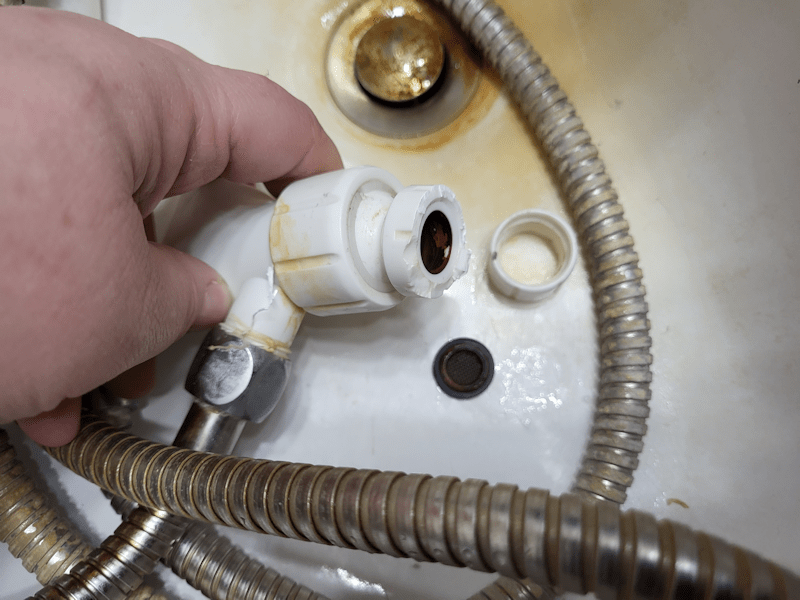
Around the time I finished the weed trimming, I found some messages from the family. My daughter had spent some time going through all the fittings I picked up, working out which would be needed, which wouldn’t, etc. In the end, we were going to need more of two fittings – and will likely have quite a few to return to the store, once the job is done.
It was past 3:30 by then. The store we needed to go to was the second one I’d gone to, yesterday. Thankfully, they weren’t going to close until 5:30 – the local one closes at 4. My daughter came along with me.
While she was looking at the fittings, I looked around for the hot water tank element tool I needed, then asked for help, because I couldn’t even find the section. It turned out to be tucked away in a corner. 😄 I also asked about a socket large enough to remove the anode rod but, in the end, I think the same heat element tool will fit the anode rod. I’ll test that out, later.
Then my daughter needed help, because one of the fittings she was looking for was behind locked doors! Quite a few displays in this store were behind glass. I would not have expected theft to be more of a problem in this location, that the store I usually go to!
After we got what we needed and were heading home, I missed my turn to cross over to the other highway – the streets look no different than driveways in this town! That meant we ended up driving to the town closer to home.
My daughter hadn’t eaten anything since early in the morning. Since we ended up in town anyhow she, being the sweetheart that she is, sprung for some Dairy Queen for all of us.
It now looks like we have everything we need to replace the pipes and faucet set for the tub. The hard part is going to be cutting the copper pipe to get the old pieces out. There is very little room to work in. Especially since the cutter needs to spin around the pipe.
While I might be able to assist, this is a job mostly for my younger daughter. She’s the most able bodied among us – and considering she has PCOS and all the joint pain that can come with, that’s not saying much!
Hopefully, I will be able go get more progress in the garden instead, and if all goes really well, be able to plant things for next year in a few days!
If all goes well for my daughter, we might even be able to use the tub and shower again, soon, too!
We shall see!
The Re-Farmer









 The Re-Farmer