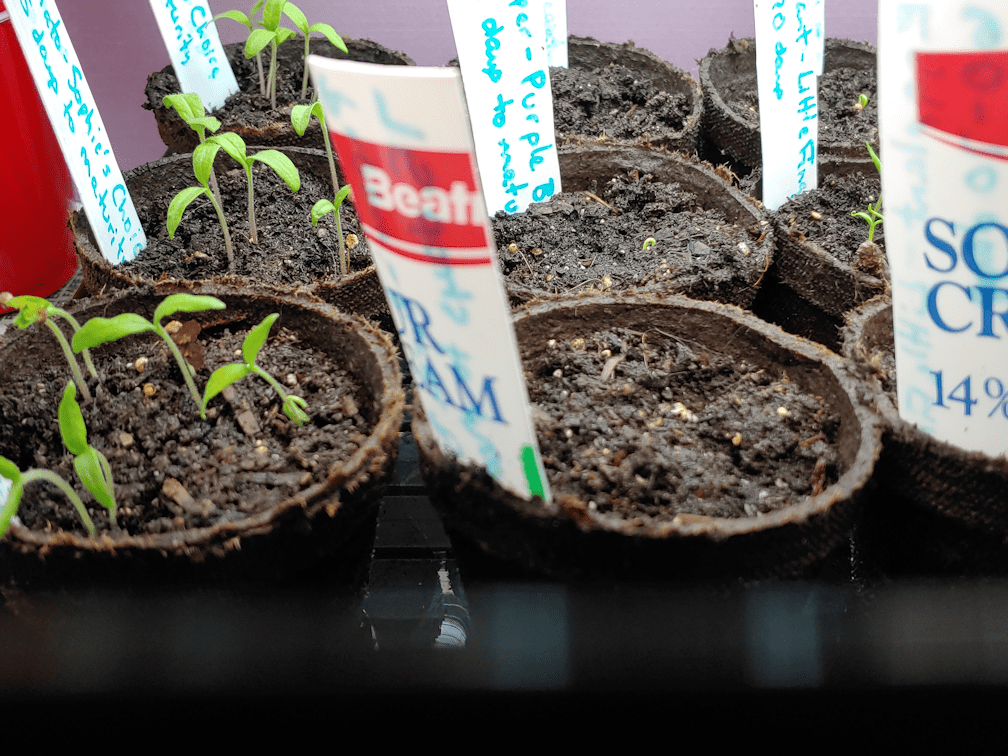
While tending the seed trays last night, I spotted a new first sprout. This morning, it was big enough to get a photo of.
Barely!
There in the middle, you can just see our very first Purple Beauty pepper sprouting!
Which means that, at this point, the only thing in the tray that has not had any sprouts at all are the canteen gourds. The luffa still has just the 1 sprout. It looks like all the tomato seeds have germinated by now, and there are more eggplant and onions sprouting, too.
Oh, there are no Wonderberry yet, either. They are the ones planted in the double cups next to, but not on, the heat mat, so that might be why.
I am very happy with what looks to be a very high germination rate, so far!
For at least a decade, there has been an increase in people who have decided to move out of the cities, get themselves an acreage, and live as self-sufficiently as possible.
Which is basically, how I grew up.
Things have really changed, though, and modern homesteaders have a lot more resources, options and choices than was available when I was a kid, 50 years ago, never mind what our pioneers had. I found this very encouraging to see.
A couple of decades ago, while part of an online homeschooling support group – pre-social media, when everything was by email (and dinosaurs roamed the earth) – I often saw people waxing poetic about how we all need to go “back to the land”, and live these organic, subsistence lives, and all our food would be free and we would barter for everything else, and so on. It had a lot more to do with ideology than anything else. Going back to the farm was a dream of mine since I moved away in my late teens, so I could appreciate many of the sentiments they expressed. Unfortunately, this romanticized view was wildly unrealistic, and I found myself trying to remind people that there are reasons people, including farmers, moved away from that life.
Most of them didn’t get it.
Once we moved to the farm, 4 years ago, in a caretaker role, how things were done when I was a kid just wasn’t an option, and I’m quite okay with that. Most of the land is rented out, so we just have our corner to work on. My mother had a massive garden that had been slowly neglected for many years, as my parents retired from farming and age reduced their mobility, no matter how much my siblings tried to help. We can finally work on our dream to be as self-sufficient as possible, but we have to do a lot of things differently than how we did it when I was a kid.
It was in researching this that I found this dynamic and growing homesteading community. These were people who may have gone in starry eyed, but were also realistic and determined, and they were making it work. The aging hippies I couldn’t get through to all those years ago, with their ideological blinders, could never have done what these awesome people were doing. It was very exciting!
Then, the last couple of years happened.
As people saw their jobs disappearing, their livelihoods destroyed, prices skyrocketing, and government restrictions stifling people’s ability to do some of the most basic things, a lot of people are suddenly having real concerns about being able to feed themselves and their families.
During WWII, governments actively encouraged families to grow Victory Gardens, and even gave out information and resources to help people do it. That sort of thing isn’t happening now. Instead, we are having to rely on each other to figure out how to grow what, for too many people, are literally survival gardens.
Whatever your reasons for wanting to start growing as much food for yourself as you can, I heartily encourage you! You won’t get any sermons or lectures from me. I do hope that I can, at the very least, provide some information and inspiration.
Start where you’re at
Your circumstances are going to be unique to you. If you’re already on an acreage, great. If all you’ve got to work with is a hall closet and some makeshift grow lights, great. You can start where you’re at, even if it’s just poking some holes in a bag of potting soil to grow some greens in a sunny window. Little by little, it’ll get done!
What I will be sharing here is going to be geared mostly to people living in colder climates – and by that, I meant Zone 2 or 3 (depending on what Canadian zone maps are being used, we live in either 3a or 2b).
I will add one thing I’ve heard quite a number of very experienced, prolific gardeners say. If they had to depend on their gardens for survival, they’d starve! It takes a lot to grow enough food to actually provide enough for even one person to last from preservation to the next year’s harvest, and it will still need to be supplemented with other things. I’m still somewhat amused and perplexed by my mother trying to lure us out here by saying we could grow a garden and not have to buy groceries anymore. Even as big as her garden was, plus having chickens and cows, sometimes pigs, turkeys and geese, a root cellar and lots of canning and freezing, we still had to buy groceries.
So you’re still going to need to buy stuff. Hopefully, just a lot less!
With that in mind, as you plan what to grow in your own personal survival garden, here are some things to consider when making decisions.
Grow what you will eat.
I’ve looked at so many lists out there, for things like what to grow to feed a family for a year, or what to grow in your climate, and so on, and frankly, a lot of stuff on those lists are foods I just don’t like. Others, I can’t eat. There are four of us in our household, and we have very different tastes. Which means that our focus will be more on growing things all of us enjoy eating, then including smaller amounts of things only one or two of us like to eat. As wonderful and appetizing as I find tomatoes and bell peppers, they both make gag, but two people in our household enjoy eating them, and all of us can eat processed tomatoes. Now, those two people REALLY like their tomatoes, so growing more of those than peppers for fresh eating makes sense, as well as growing a lot of tomatoes that are good for making tomato paste to last us for months. It’s a sort of juggling game.
Try new things
What we find in the grocery stores is there because those varieties can handle large scale growing and transportation. When you’re growing your own, you can have a lot more choices. This is a time to grow new varieties of things you know you like, and if you have the space and resources for it, grow something you’ve always wanted to try, but couldn’t for one reason or another. Which kinda ties in with my next point to consider.
Grow at least one thing for fun
Yes, growing food to ensure your family has something to eat when times are tough is serious business. The whole point of the list I’ll be presenting to you is to be able to get as much bang for your buck as you can. At the same time, growing something just for fun is a great morale booster. As you go through what various seed companies and nurseries have to offer, you’re bound to find something that just puts a smile on your face. If you have the space and resources for it, go for it!
Keep in mind your region, climate and particular circumstances.
While the zone maps are very handy, that doesn’t mean there aren’t exceptions. There are things my mother successfully grew in our Zone 3 that were rated at Zone 5. She didn’t even doing anything different for them, either! This is a good time to find and get involved with a community of people in your region and zone, online or off, to learn from. If you are growing outdoors, look at what is rated for your zone, but also consider whether you can create microclimates. If you have only a balcony or patio, there are lots of places where you can learn about container gardening or vertical gardening. If you are growing indoors, there are resources geared specifically for that.
Storage and preservation
If you’re growing food to feed your family, and trying to grow as much as possible in your space, it’s not going to be much good if you grow more than you can eat, but can’t preserve it! There are many options available; freezing, dehydrating, water bath canning, pressure canning and even freeze drying, if you can afford the machine! You might even be able to create a root cellar in some corner of your home. Refrigerator pickling and fermenting are options, if you don’t have canning equipment.
If you’re going to store and preserve food, you’ll need somewhere to put it. What methods you have available to save your food will help you decide what makes the most sense for you to grow.
Things will go wrong. Do it anyway
One thing that is going to happen is, there will be failures at some point. It’s inevitable. Sometimes, you’ll make a mistake. Sometimes, there will be circumstances completely out of your control. It happens. The beauty is, you can still fail “up”. Honestly, you’ll probably learn more from the failures than the successes! Of course, it’s always a good idea to learn from others as much as you can to avoid failures, but it’s still going to happen. Since being here at the farm for 4 years, and only gardening for 2, we knew we were trying to grow in far from ideal conditions, and had some setbacks, yet we still managed to have food from our own garden that we could enjoy.
When it came to making a list of things that might work well in a survival garden, I looked for things that could be grown in colder climates, had high yields, and could be stored or preserved, while also keeping time in mind. So let’s start with the fastest growing things, first!
There are quite a few things that can go from seed to plate in less than a month. Some in less than 10 days! Micro-greens and sprouts can be grown very quickly, can be grown indoors in trays or jars, continually throughout the year. Many seed companies now has sections for sprouts, and quite a variety of things can be grown for their sprouts. Many sprouts can be grown in jars – alfalfa, mung beans, lentils, radishes, and more. Gelatinous seeds, such as flax, chia, cress, arugula and psyllium, can be sprouted in trays. For microgreens, you can try beets, swiss chard, broccoli, cress, peas, radishes and sunflowers.
If you want to give things a bit more time, leafy greens such as pretty much any type of leaf lettuce, spinach, chard, kale, bok choi and radishes can be grown and harvested very quickly. Many of these don’t like heat much, so they can be planted outdoors early in the spring and sowed successively until the heat of summer, then sowed again for a fall crop.
These quick growing plants are nutritional power houses, but they don’t have a lot of calories. They’re not going to keep anyone going for long, so it’s good to think of these as a supplement, and something that can provide nutrition until other foods can be harvested.
Short term
By “short term”, I am talking about the things we typically think of in our annual vegetable gardens. These are things that can take a few months before you can start harvesting anything, and can potentially keep feeding you and your family throughout the winter, with proper storage and preservation.
Root vegetables: carrots, parsnips, beets, radish bulbs, turnips, rutabagas… there are many to choose from, and many varieties of each! Stored properly, they can last for months on their own, but they can also be pickled, pressure canned, frozen, and dehydrated. With these, they are one seed, one plant (except beets; their seeds are actually clusters of seeds), but they produce so many seeds, most packets will provide more than needed for a typical household.
Bulbs and tubers: potatoes, sunchokes/Jerusalem artichokes, sweet potatoes – yes, there is a cold hardy variety of sweet potatoes out there! – bulb fennel, celeriac and more.
There are many varieties of potatoes, some more prolific than others, and some better for storage than others. A good source of seed potatoes will give that information. Potatoes also come in determinate and indeterminate varieties. Indeterminates are good for potato bags and towers, while determinate are good for hilling or Ruth Stout growing methods. Sunchokes will grow in just about any type of soil, and can be so prolific, they are sometimes considered invasive.
Special mention: the alliums are excellent bulbs to grow, but tend to require a lot more time, unless you are starting onions and shallots from sets, or spring garlic. Hard neck garlic needs to be planted in the fall, while onions and shallots from seed – which gives a lot more choice in varieties – need to be started indoors very early. In my garden groups, I’ve found Zone 3 gardeners that start their onions from seed as early as January! Onions also come in long day and short day varieties. If you are in a northern Zone, look for long day varieties. Of course, some varieties store longer than others but, properly cured and stored, they can last a very long time! Onion greens can be eaten as the bulbs mature, and hard neck garlic produces scapes that need to be removed to produce bigger bulbs, and they are delicious, making them dual crops to grow.
Summer squash and zucchini: There are many varieties of summer squash, and they all tend to be quite prolific. Just a couple of plants can provide plenty of baby squash that mature fairly quickly, and if they are left to grow larger, some varieties can be stuffed and baked. Most summer squash start to get tough as they get larger, and are not a storage vegetable, but they can be pickled, canned, frozen and dehydrated. Zucchini is a bit of an exception, in that it can be used as both a summer squash while small, or a winter squash if allowed to grow to full size.
Winter squash and pumpkins: These are squash that can grow to sometimes colossal sizes, but there are also varieties that are small, fast maturing and very prolific. Once they reach maturity, the fruits are cured and can be stored for the winter months. Some varieties reach their best flavour after weeks or months in storage. They can also be frozen, canned, shredded and dehydrated.
Legumes: there are few vegetables out there that provide more bang for your buck than legumes! Especially beans. Bush beans can be grown for their pods, and when they’re done producing is about when pole beans are ready for harvesting, and of course there are shelling beans, which are grown for their fully mature and dry seeds. Peas, chick peas and lentils can also provide a lot of food from just a few plants. Dried legumes, stored properly, can last for years, making them one of the most efficient foods to grow.
We could fit about a hundred of these tiny Spoon tomatoes into a single Red Solo cup.
Tomatoes: tomatoes are a fruit that deserve their own category. The varieties available is staggering! However, if you are looking to get the most pounds per plant, look at growing a mid sized variety. Aside from fresh eating, they can be frozen, canned or dehydrated on their own, or be used as an ingredient for sauces and salsas, and so much more.
Cucumbers: As with tomatoes, there are a really amazing number of cucumber varieties available, but most fall into one of two categories; slicers, for fresh eating, and picklers, for preserving. They all tend to be fast growing and very prolific, too.
Peppers: I wasn’t sure about including peppers on this list. They are excellent producers, but growing them in our colder climate seems to be touch and go. I’ve heard from people who have had great success with them, while others have tried for many years, but have never had a harvest. Peppers can be canned, preserved in oil, frozen, dehydrated, pickled and made into relishes.
While being able to grow food quickly is important, it is also useful to consider the long haul. If you have the space for it, there are things that may take several years before they begin producing, but once they do, the harvests will be bounteous!
Asparagus: asparagus can be grown from seed or you can buy crowns to transplant into trenches. It can take three years before they can be harvested, and even then, for the first year or two, harvests should be minimal. Once they are established, however, asparagus will keep producing for up to 20 years!
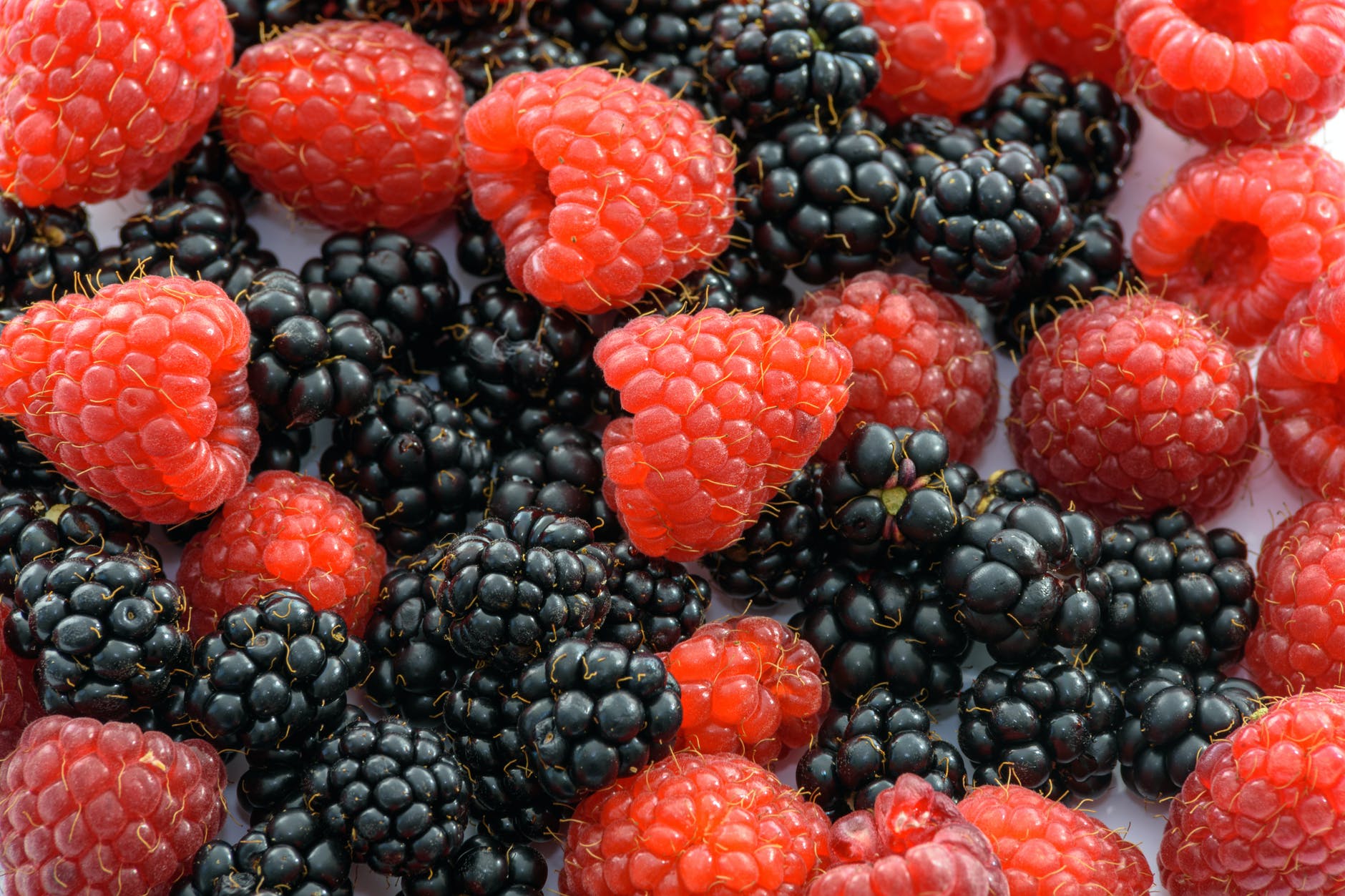
Raspberries, currants, gooseberries and haskaps: Haskaps are the new berries on the block, and are exceptionally cold hardy. They require male and female plants to produce, and can potentially begin producing berries in their first year. Raspberries are available as regular cane (new canes produce berries in their second year, then die back) or primal cane (new canes produce berries in their first year). Choosing varieties that mature at different times can give you fresh berries for months. Currants and gooseberries, once established, can produce fruit for many years. Berry bushes can provide a great deal of fruit per plant. Along with being used fresh, frozen or dehydrated, as well as made into jams and jellies, they can be used to make vinegars, syrups and wines.
Grapes: yes, there are Zone 3 grape varieties. I’ve even seen a Zone 2 variety. Grape vines are very long lived, and have the potential to provide fresh and frozen fruit, jelly, and wines for many years.
Hedge bushes and trees: There are a number of larger berry bushes that can double as shelter belts and natural boarders. Some, like sea buckthorn and bison berry, do well in poor soils, and while they may be considered invasive in warmer climates, they tend not to be, in our Zone 3. The Rugosa rose produces large edible hips, and their flower petals are edible, too. Saskatoons are a more of a tree than a bush, and absolutely delicious. Chokecherries produce many berries, but are better used in syrups, vinegars, etc. than eaten fresh. Many of these will provide enough berries not only for your own use, but for birds as well!
Now we’re really going for the long haul! Here, we are looking at things that can take five or ten years before they start producing food – but once they do, they will continue for decades to come.
Fruit trees: there are a remarkable number of fruit trees that can grow in colder zones. Apples, pears, apricots, cherries and plums can all be grown here. While a single mature tree can provide enough fruit for the entire family, many need to be planted with a pollinator, which can be a different variety.
Nut trees: there are not a lot of nut trees that can grow in Zone 3, but some, like the Korean Pine, are hardy to Zone 2! Hazelberts and beaked hazelnuts are also very hardy. Others, such as the black walnut, can grow in Zone 3, but the nuts may not have enough for a growing season to fully mature.
Okay, so all this is a lot more than just a “survival” garden, but we all start somewhere, right? :-) Little by little, it’ll get done!
I hope you find these useful in working out what are the best things for you to start growing in your own particular situation.
For those who have already been doing this for a while, please feel free to leave a comment, sharing your own experiences. What worked best for you? What didn’t work? Is there anything you would tell someone who is just starting out now? Let us know!
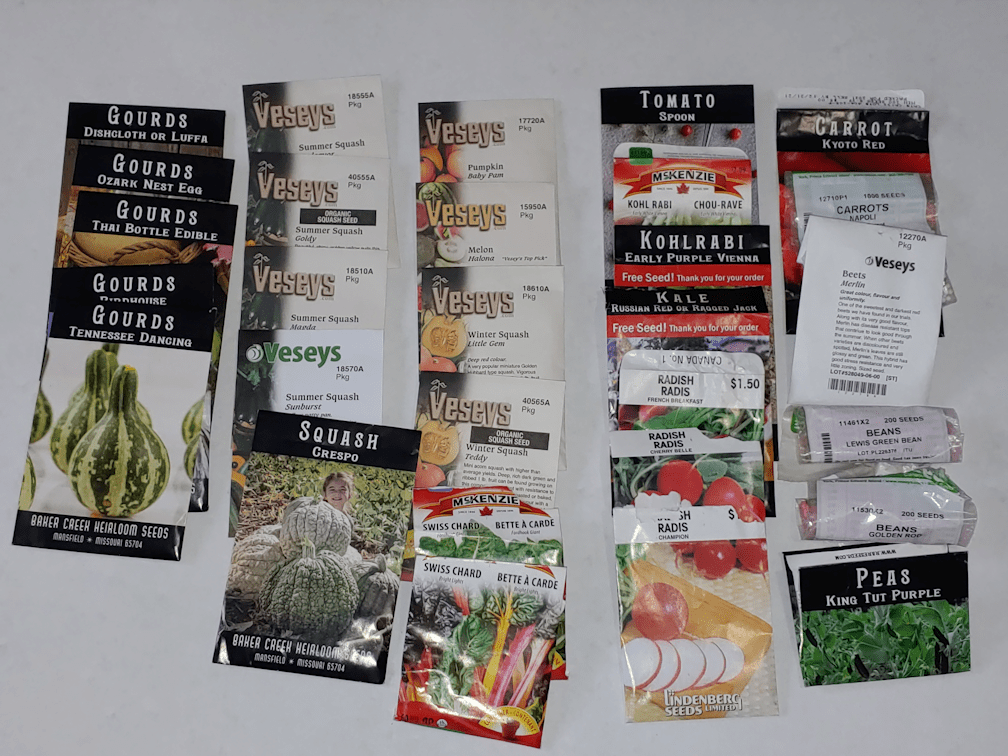
With all but one order of seeds having arrived, I decided to do an inventory of what we have, including what we have left over from this past year’s garden.
I was a bit surprised by some of them.
One surprise was the Spoon tomatoes. We had two packets of those, and while I thought we had planted all the seeds, I found a surprising number of seeds at the bottom of each packet. So I combined them into one. There isn’t a huge amount, but it does mean we could start some indoors, if we felt like it. I don’t think we will, since we have so many other tomatoes. Plus, I wouldn’t be surprised if a bunch showed up on their own in the bed we grew them in this past summer!
I didn’t think we had any kohl rabi left, either. One of my daughters had done a second planting of those, and I thought she’d used the last of the seeds. The White Vienna is actually from the year before. We got two free packets of the Early Purple Vienne, and both got opened for some reason; my daughter probably missed the one I’d opened to do an early planting. We had no luck at all with kohl rabi this year and I plan on starting them indoors instead of direct sowing.
For the gourds, I want to do the Tennessee Dancing Gourds again. They did really well. I want to try the Ozark Nest Egg again; were it not for the drought delaying their development, we would have had lots of those. I also want to try the luffa again, because I’m a sucker for punishment, but will probably skip the Birdhouse and Thai Bottle gourds.
Though we still have seeds left from the summer squash collection, we also still have the other two collections I’d ordered by accident. I like having a good variety, and this year we’ll have green patty pan squash, too, so we’ll start just a few seeds of each. The Baby Pam pumpkin never germinated at all, but I think that had more to do with growing conditions. We have so many others, I don’t know that we’ll try them again. There are still Halona melon seeds left, but I also saved seeds from both the Halona and the Pixie, both of which did very well, plus some other seeds I saved from other melons we enjoyed.
I will happily grow more of the Teddy and Red Kuri (Little Gem) winter squash again, along with the new varieties we ordered. They may have had a hard time with the drought, but they were quite good, and they are much smaller varieties that – in more ideal conditions – are supposed to be prolific producers.
Not in the photo are the varieties of spinach and lettuce we still have lots of. They, and the chard, are for spring and fall planting, so we’ll have to plan those out – if we try growing chard again. We didn’t really eat them much. As for the radishes, I want to plant a just a few of each, much earlier, and leave them, as it’s the pods I’m after, not the root.
The carrots here are pelleted seeds, and there are still quite a lot. It’s easier to space the pelleted seeds when planting. With thinning not as much of a concern, I don’t think I used even half of each variety this past year. I will happily plant them again, along with the new varieties we got.
I was surprised to find the Merlin beets. I thought I’d mixed all the remaining beet seeds together to plant into the L shaped bed, but I guess I missed these. We were planning to plant only one variety next year, but it won’t hurt to have two. :-)
We have quite a bit of the green and gold bush beans left, but that packet of King Tut purple peas only has about 5 seeds in it, and those are seeds I’d saved myself. If I do plant those, they will be only for seed saving. I didn’t order any other peas this time, but those are something I can easily buy locally in the spring. As for the beans, we do have several varieties of pole beans, but bush beans tend to mature faster, so I might go ahead and do both.
These are all our new seeds, except for the Kulli corn that is still on the way. It seems like a lot, but for things like the squash and gourds in particular, we will only be starting a few seeds indoors for each. I would rather plant fewer of many varieties and see how they do, than have lots of one variety then discover it doesn’t like growing here. That, and it would get pretty boring eating the same variety of vegetable all year! For things like the onions… well, I’m finding we just can’t have too many of those!
The beginnings of our culinary herb garden is something I need to think about. We already have a mint that we found in the old kitchen garden, but I don’t know what kind they are. Not spearmint, is the most I can say for sure. Probably peppermint. I want to have permanent places for our culinary herbs, and the old kitchen garden makes the most sense, since it’s right at the house, but unless we start taking out the ornamental crab apple trees, and the double lilacs, roses and honeysuckles – which I have no intention of doing – there’s not a lot of well lit space left in there. I might try growing them in buried pots at first, so that as we build raised beds in there, they will be easy to transplant, and things like the mint will be contained.
One of the things about the squash is that, with their spreading habit, we can use them to reclaim more garden area. We’ll be growing potatoes using the Ruth Stout heavy mulching method again, for much the same reason. With so many climbers this year, we’ll need to build more trellises, too.
I’ve been talking to quite a few people who are looking to start gardening for the first time, out of necessity. There is a lot to consider. Especially in our Zone 3 growing zone. So if it seems like I’m spending an inordinate amount of time talking about gardening of late, that is partly way. I’ll be writing a post specifically for those who are suddenly finding themselves having to grow their own food, so if you have something specific you’d like me to include on that, or experiences you’d like to share, please feel free to mention it in the comments.
Last night, I heard from one of our neighbours, asking if we were missing some kittens. It seems that several kittens were sighted on the road by our place, and while one was caught, there were others around. They were not ours; by the age estimate, they were about 5 months younger than ours, plus they seem used to humans. Which means they were likely dumped. :-( The person who caught the one said she would be coming back to try and find the others. Meanwhile, I made sure to be on the lookout for kittens while doing my rounds this morning. Especially in the furthest garden beds, which are the closest to where the kittens were spotted.
I think I did actually see a strange kitten at our house, yesterday, but it ran off, just like most of our yard cats still do. I found myself thinking the colour seeming off had to have been the light, but now I wonder! Well, if there are strange kitties around, they will find food and shelter here. So far, though, I have seen nothing today.
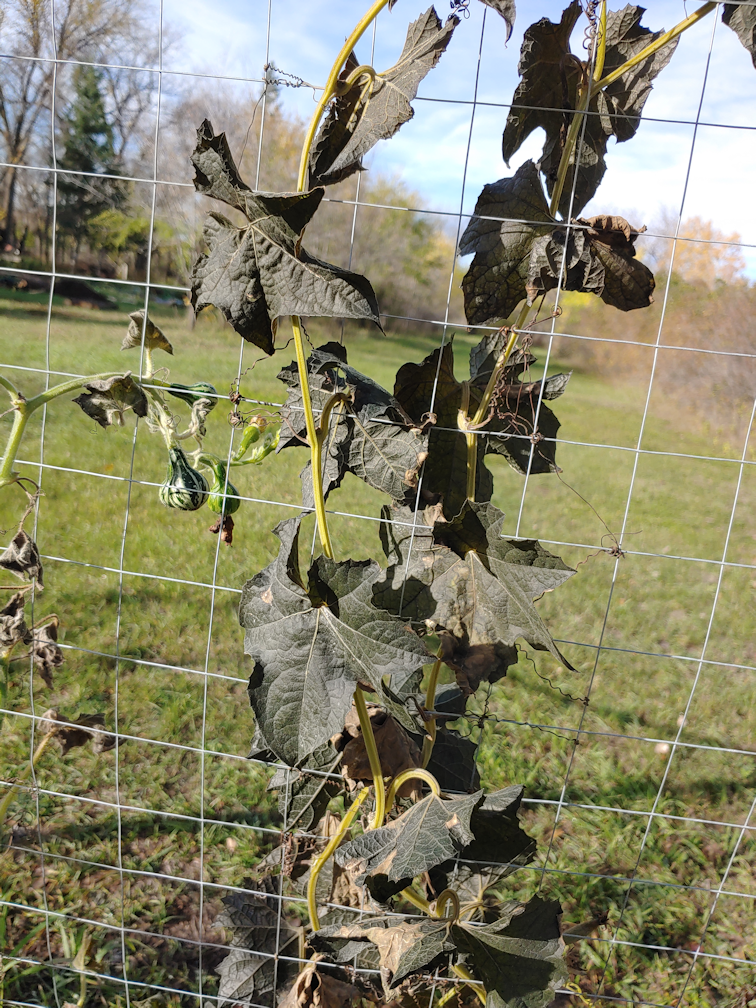
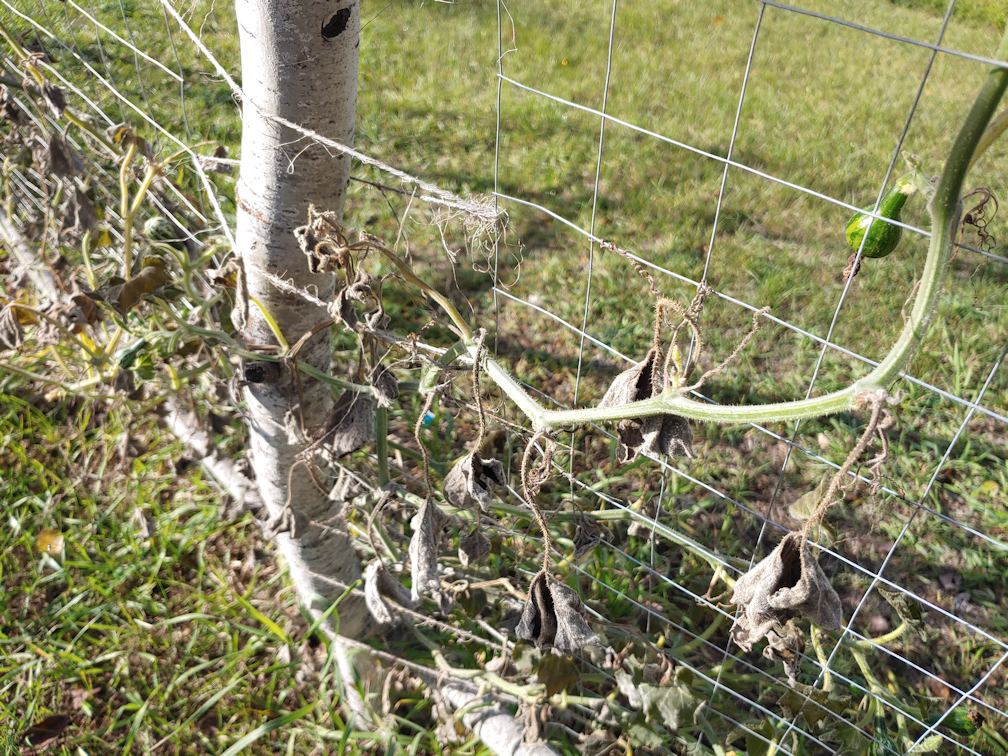
While I was on the lookout for strange kitties, I checked out the squash tunnel. The luffa and Tennessee Dancing Gourds seem to have finally succumbed to the chill overnight temperatures.
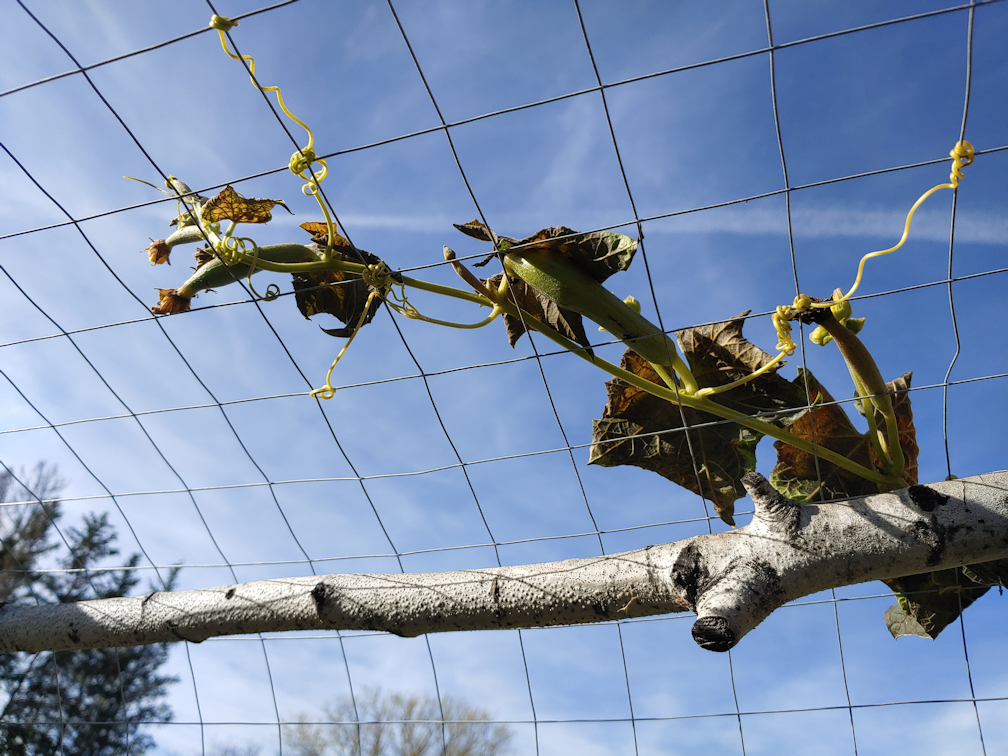
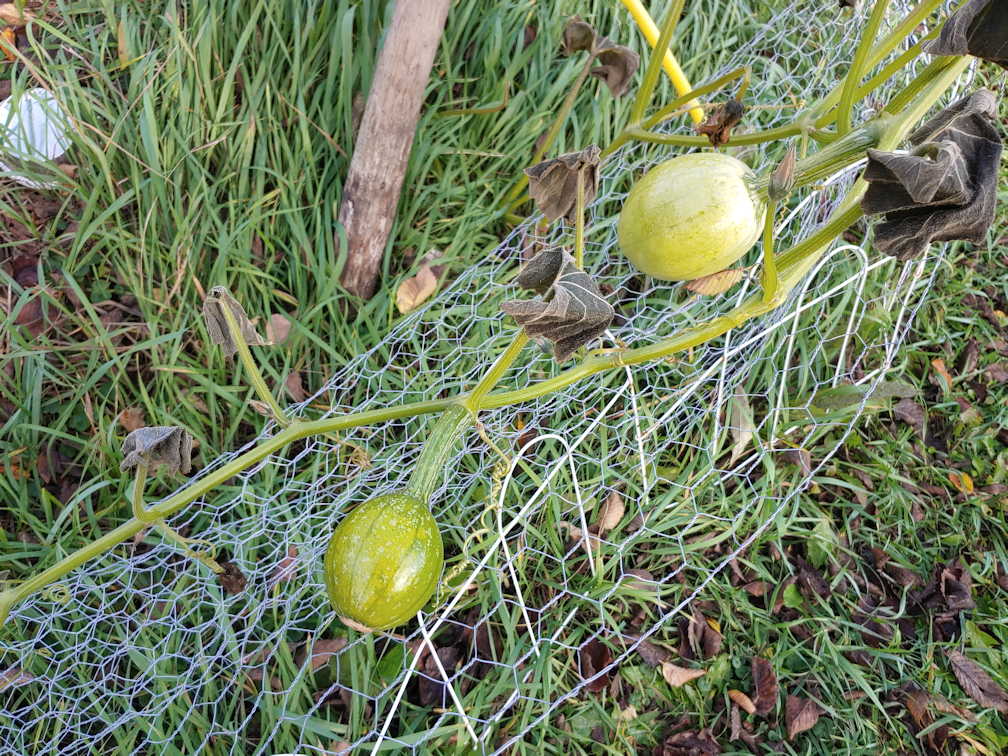
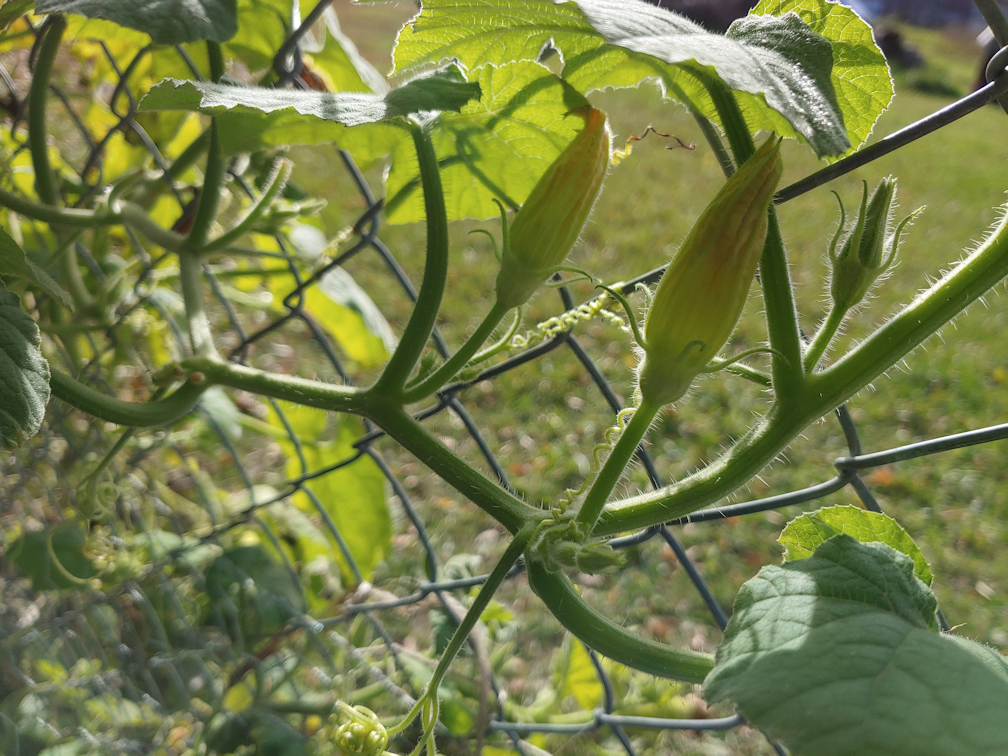
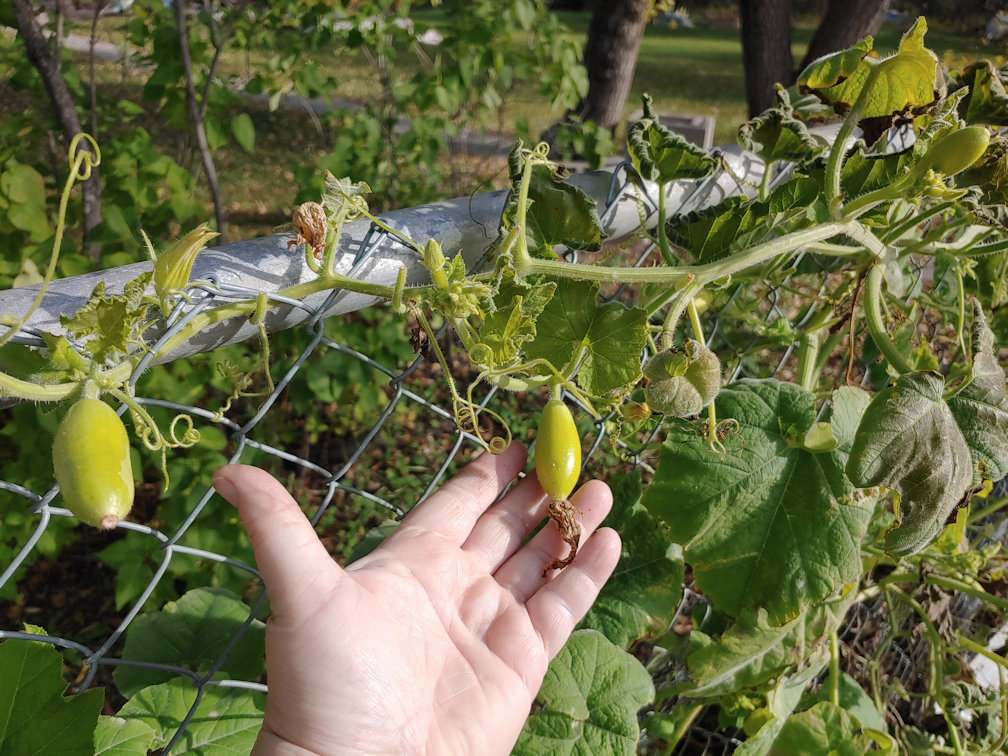
The luffa leaves turned really dark, but haven’t shriveled, like pretty much everything else. Take a click on the image of the developing gourds on the top of the squash tunnel! There are still flowers developing! They do look frost damaged, though.
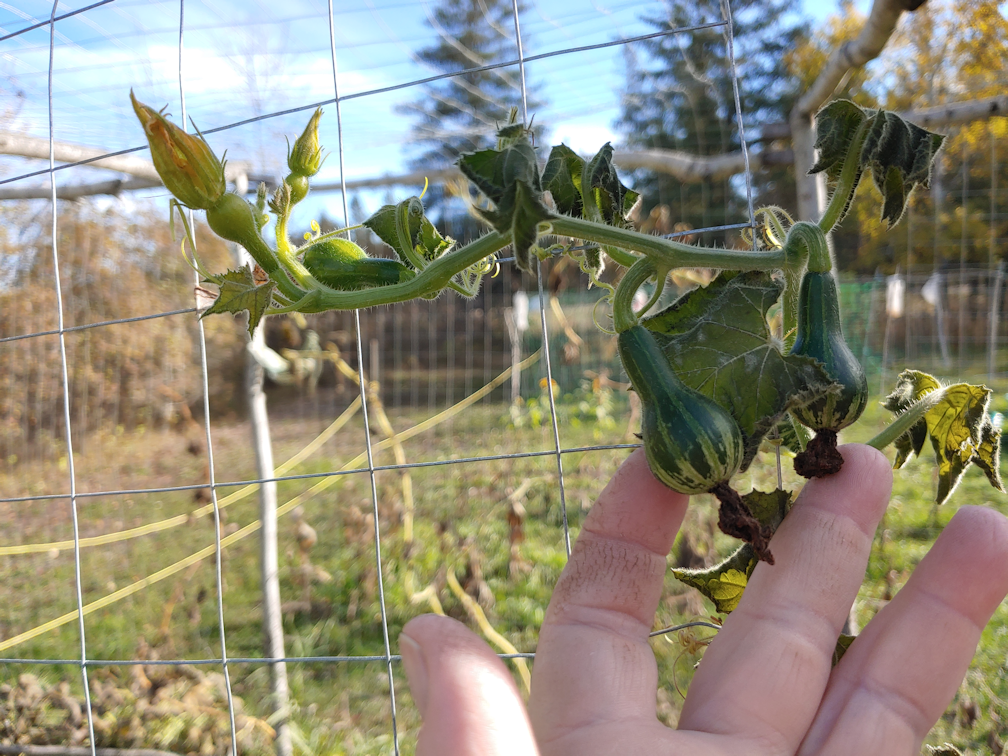
It was much the same with the Tennessee Dancing Gourds. Most of the vines have died back, and cold damage can be seen on some of the little gourds… and yet, there are still flower buds!
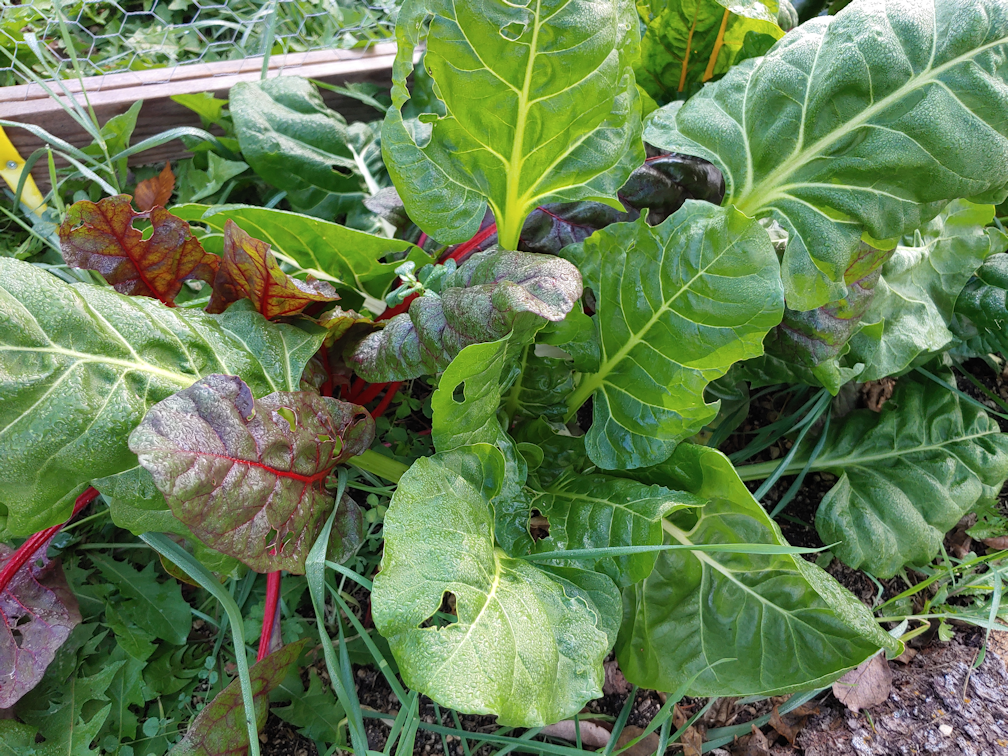
The chard and the lettuce are still going strong.
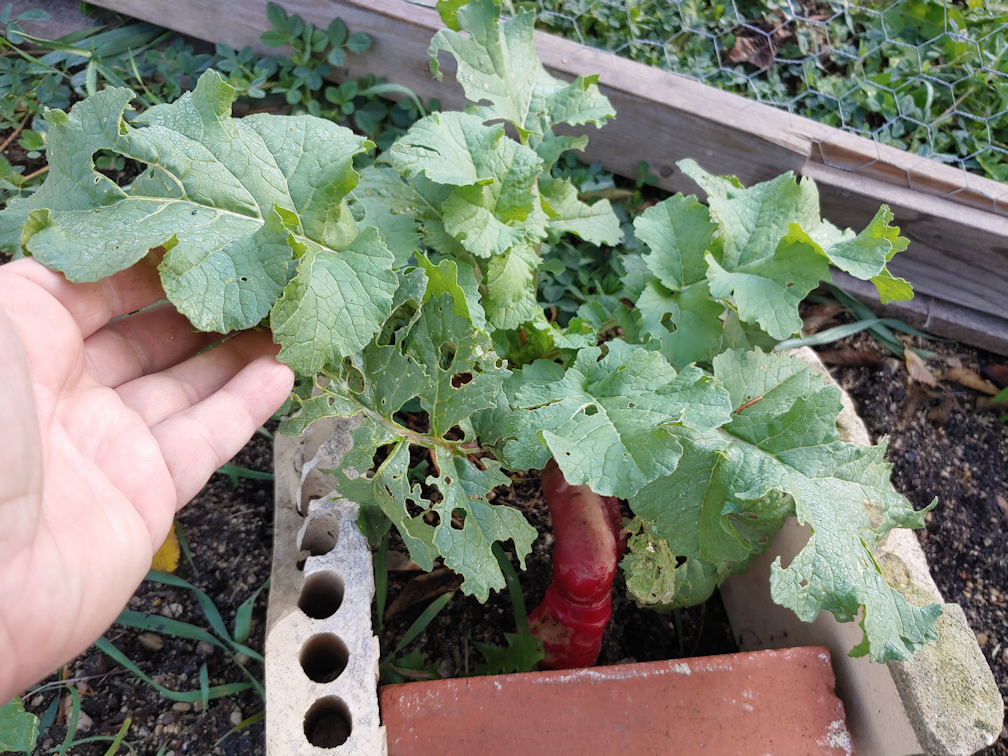
This is the biggest of the surviving radishes. You can see the older leaves that still have grasshopper damage. Something is nibbling the new growth, too, but not as much. I put the bricks around this radish plant, because something has been nibbling on the bulb. I’m guessing a mouse or something like that. Putting the bricks there seems to have stopped it, as there is no new damage.
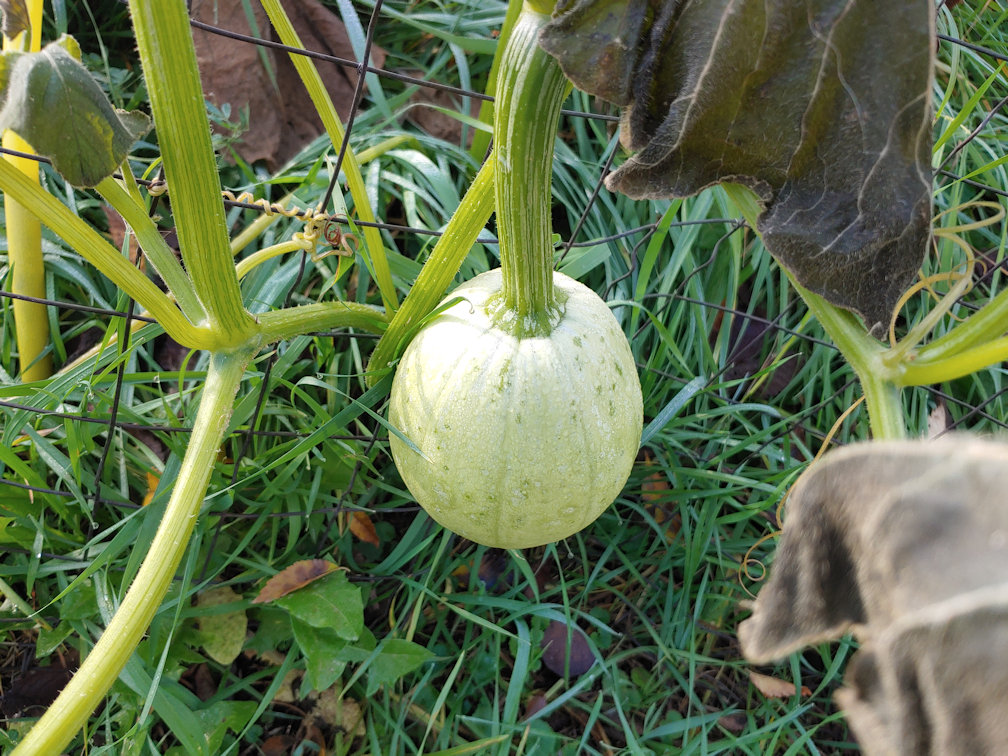
Then there is that amazing Crespo squash. Is it still going, or is it done? The leaves seem to be completely killed off by the frost, yet the vines still seem strong, and while there is cold damage on most of the squash, some of them still seem to be getting bigger!
So, we will wait and see how they do.
Meanwhile, on the south side of the house…
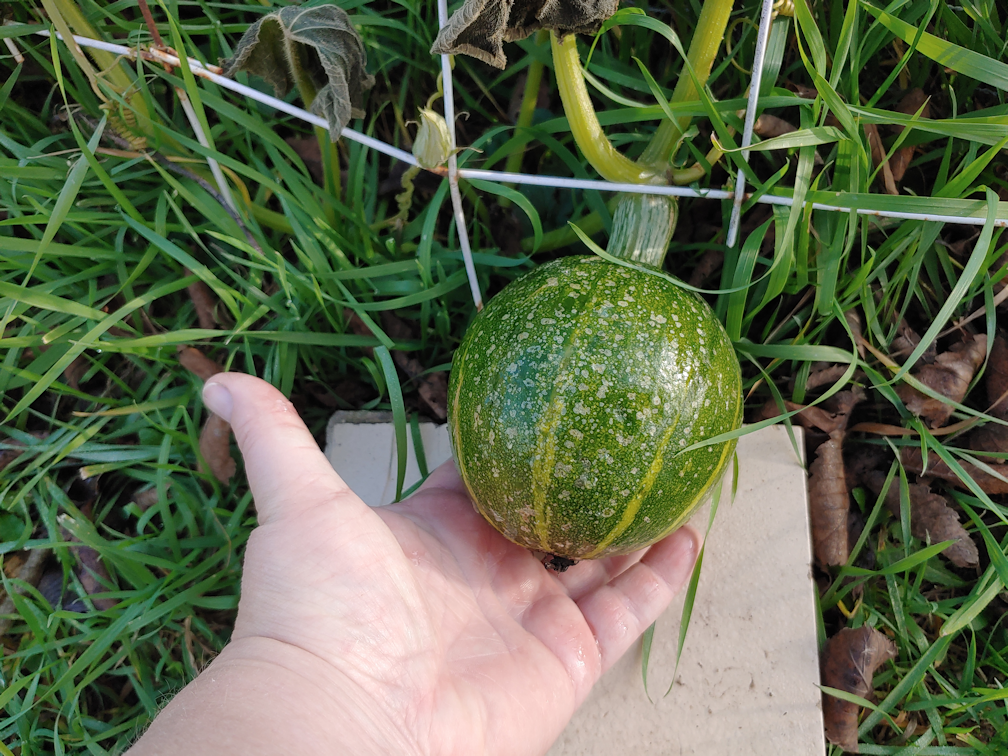
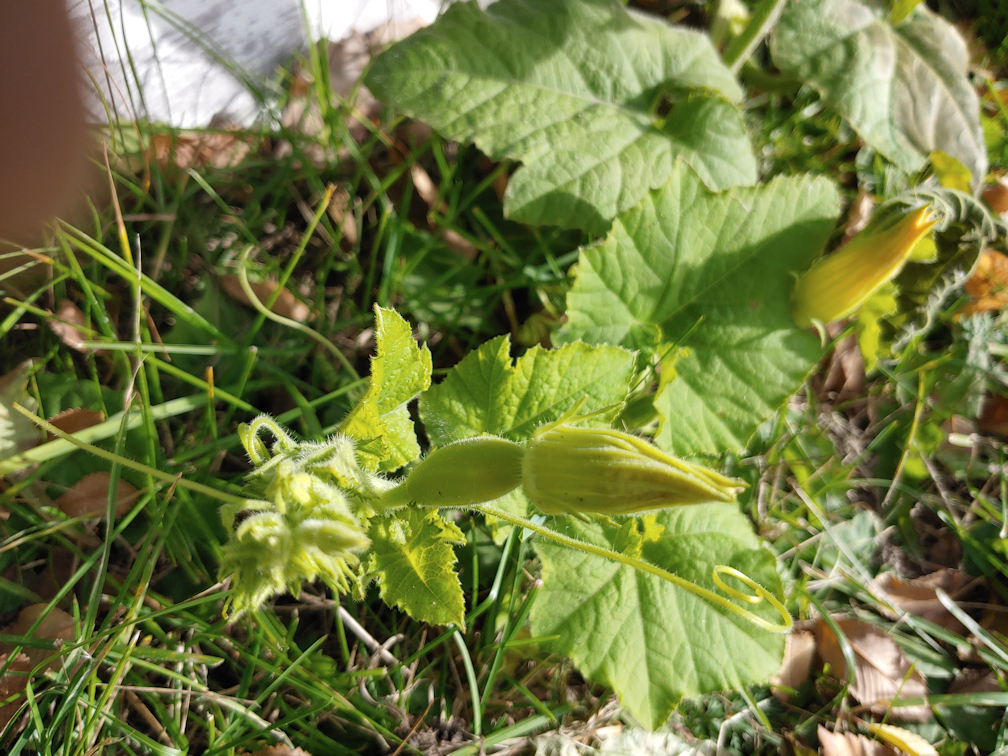
The Ozark Nest Egg gourds have almost no cold damage on them, and still seem to be growing just fine. In fact, there is more fresh and new growth happening, and new male and female flowers developing!
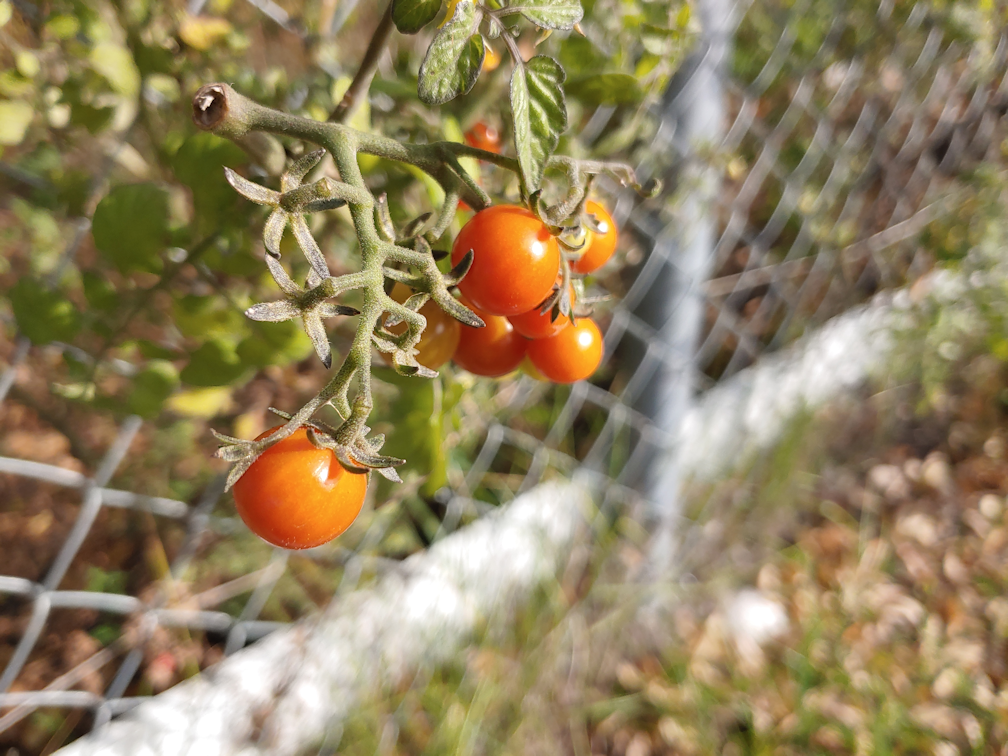
The tomatoes continue to ripen, with no signs of cold damage to them, unlike the one self-seeded tomato that’s growing near the lettuces, which is pretty much dead.
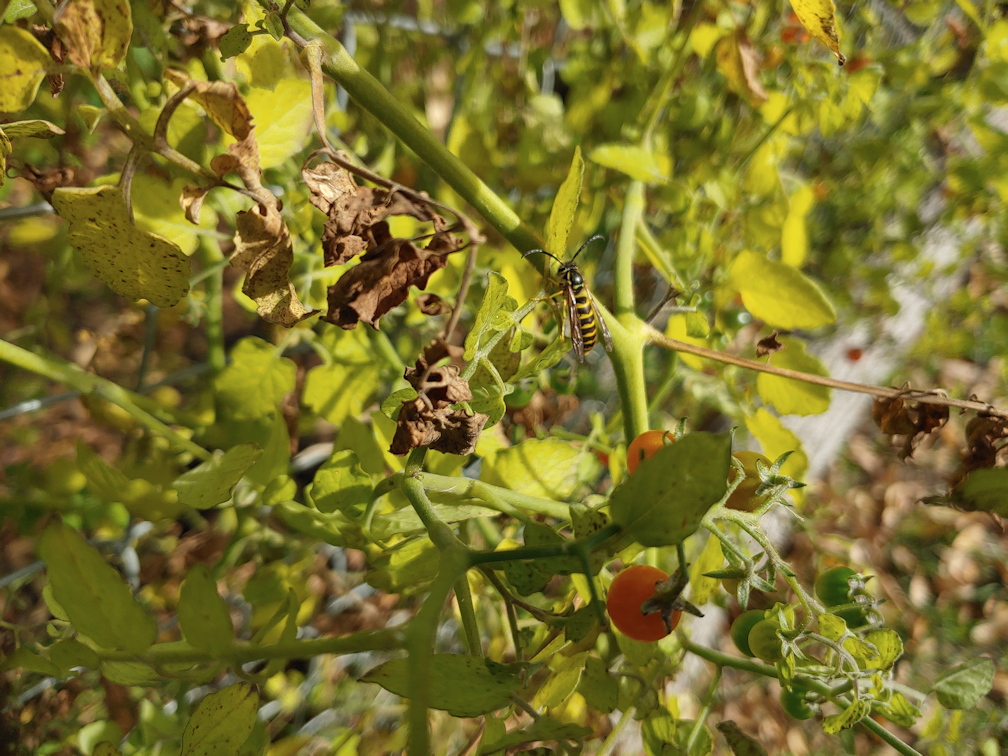
Check out that wasp on the Spoon tomato vine! Even the pollinators are still out!
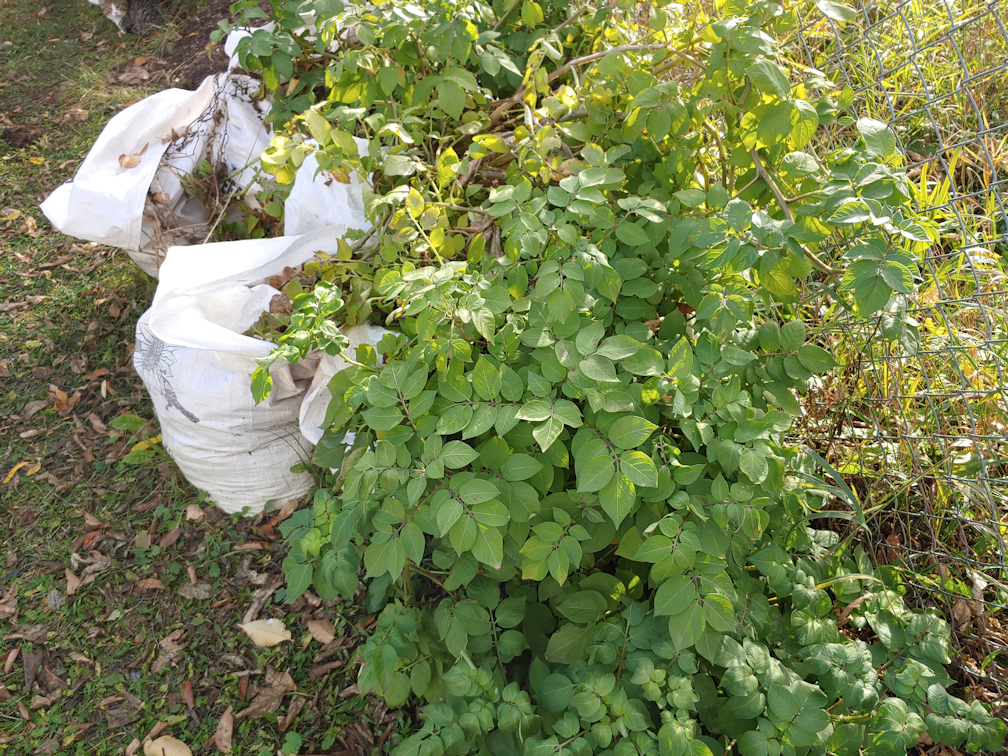
The fingerling potatoes are still going strong, too. There is one bag that looks like it has died back, but the others are still very green. Especially the Purple Peruvians.
I keep forgetting to take pictures of the carrots. Even the overgrown bed we abandoned to the groundhogs has carrot fronds overtaking the weeds. Especially the Kyoto Red, which have gone to seed. I’m keeping an eye on those, as I want to try and collect them before they self sow!
It’s hard to know how much longer the garden will keep on going. Today was forecast to be 18C/64F, then things were supposed to cool down again. As I write this, we are at 22C/72F !!! Tomorrow, we’re supposed to drop to 8C/46F, then go down to 5-6C/41-43F, with overnight lows dropping to -1C/30F a couple of nights from now, but who knows what we’ll actually get?
Looking at the data for our area, our average temperatures for October are 10C/50F for the high, and 1C/34F for the low – but our record high was 30C/86F in 1992, with a record low of -18C/0F in 1991, so while a bit unusual, the mild temperatures we’re having right now aren’t that uncommon. In fact, the record highs and lows seem to lurch from one extreme to the other, within just a few years of each other, if not one year after the other!
I’m looking forward to NOT hitting any record lows this fall and winter! :-D Still, the way things are going, it may be a while before we finally harvest our carrots, potatoes and beets – I want to leave those in the ground as long as possible – and we’ll have lettuce and chard for quite some time, yet!
Here we are, in the middle of October, and still there are things in the garden to pick!
Yesterday evening, I went out to work on the high raised garden bed a bit. The notches at the north end needed to be finished. In particular, I needed to deepen the ones at the ends of the side logs. Since so much material had already been removed, I just used the baby chainsaw for as long as the batteries lasted. Checking it this morning, it looks like one side still needs more material removed, so I will work on that today. I didn’t bother taking photos as the difference really isn’t all the visible.
After I did as much as I could on the high raised bed, I went and did a burn. With the rain we’ve been having lately, using the burn barrel is about as safe as it can be, without snow on the ground! :-D What an evening it was! I could hear masses of Canada Geese out in the field, where the renter has already harvested his corn. I could even see clouds of them, though the trees, flying low to the ground.
The burn barrel is in the outer yard, which made it easy to check on the garden beds along the chain link fence. When my daughters came outside while doing their evening chores, I snagged one of them to tend the burn barrel while I got a bowl to pick tomatoes into.
Yes, we still have tomatoes!
It was getting a bit too dark to see the ripe from the almost ripe tomatoes, but there were enough that my daughter finished with the burn barrel before I was finished picking!
While we were out there, not only we were serenaded by the cacophony of geese, but howling, as well.
Very different sounding howls.
We have quite a few coyotes in the area, so hearing them howling and yipping is not unusual. These, however, sounded like wolves! Wolves are rarer in our area. I can’t say I’m surprised, though. With all the fires we had this summer, we had a lot of bear sightings. If so many bears could be driven this way, wolves certainly could be, too.
Last night, temperatures were predicted to drop to just above freezing, which means frost was very likely, even though we had no frost warnings. I figured, however, this would be our last tomato harvest. Especially since the actual temperatures dropped lower than predicted. At least, according to the weather apps.
I think I was wrong!
I checked them this morning, and the tomato plants are just fine! With temperatures warming up again over the next while, we should be picking tomatoes for quite a while longer!
The Ozark Nest Egg gourds are also looking just fine, too. Seeing this has confirmed for me that setting up garden beds in the outer yard, south of the house, is a very good idea, because things were different in the old garden area.
The bush beans are done. There are still many little bean pods, but after last night’s cold, I could see frost damage on them, so that’s it for them.
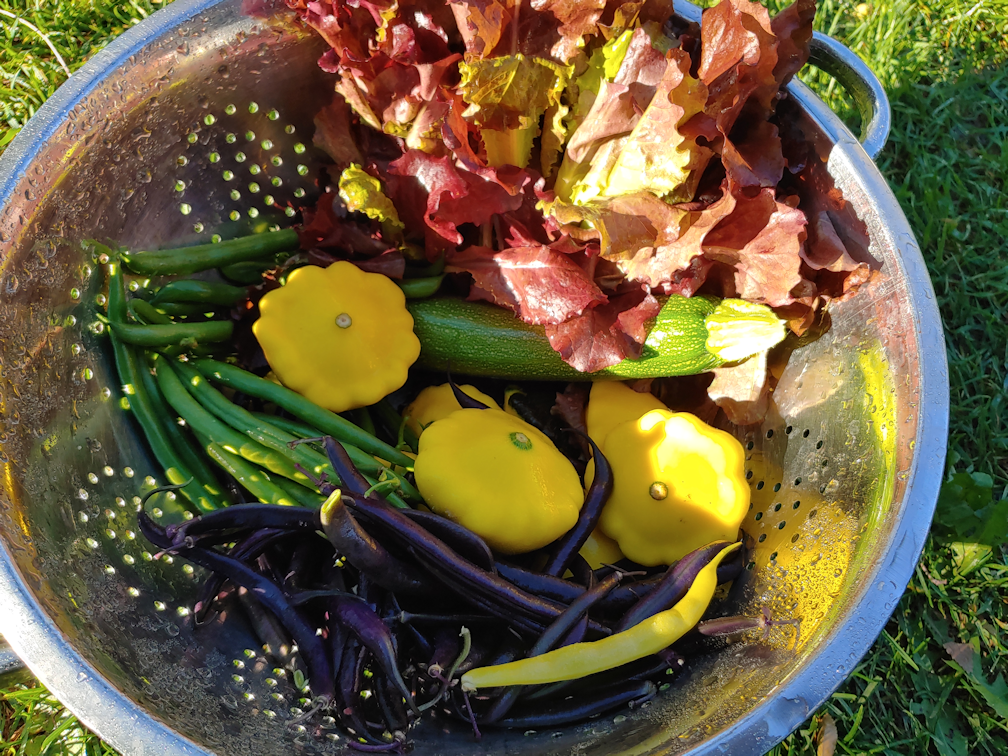
The summer squash… I’m not so sure. I picked sunburst squash, anyhow.
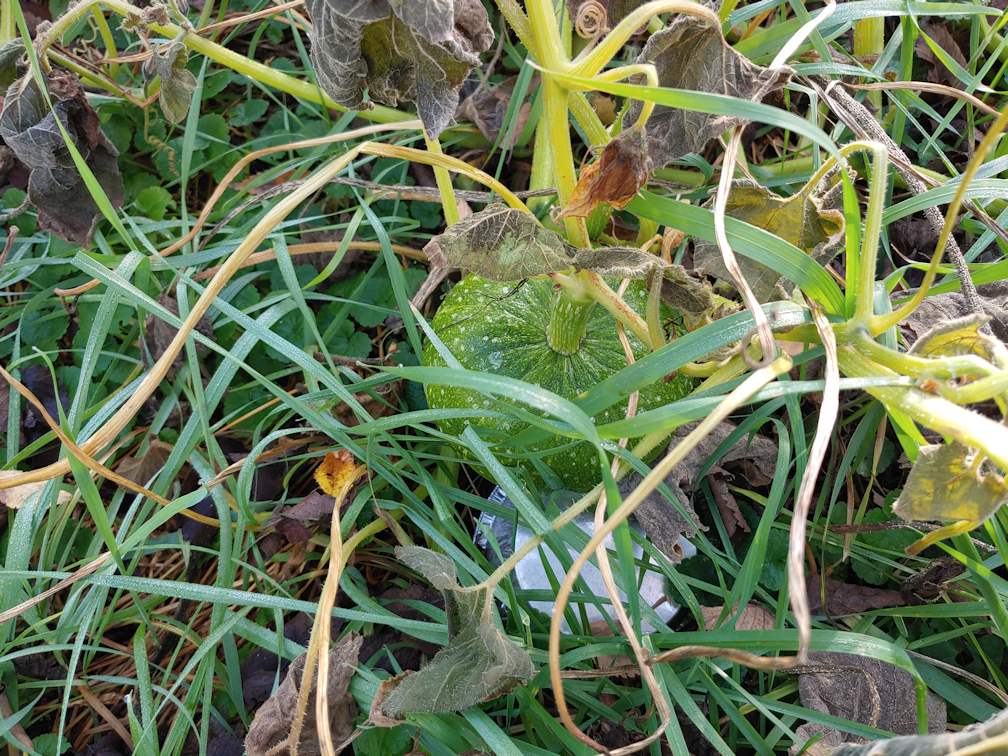
Most of these are smaller than I would have picked them. There are still quite a lot of little ones on the plants, and I left the zucchini entirely, just in case they survived. This entire area gets full sun, however it parts of it do get shade for longer in the mornings, because of trees along the fence line to the east. The shade does not reach the squash tunnel, however, and when I checked it, expecting to harvest the last few winter squash, I decided to leave them longer, though I did collect a couple more Tennessee Danging Gourds. Even the luffa looks like it’s still growing, and there are a few melons that are still firmly attached to their vines. With the warmer temperatures expected over the next few days, the longer the fruit stays on the vines, the better.
So we shall see how it goes!
Meanwhile, the lettuce and chard are handling the temperatures just fine, so we’ll have access to fresh greens for a while, yet.
Today’s focus is going to be on preparing beds for the garlic. I got an emailed shipping notification, so they will arrive next week. There is no way I will be able to finish the high raised bed in time, so I will finish topping up the new low raised beds built over where the garlic was planted last fall. I’ll prep both, even though we may only need one. The beets in the third bed are still growing. Until the ground freezes, they can be left, as can the fingerling potatoes. One of my weather apps has long range forecasts into November, and it looks like we will continue to have mild temperatures for quite some time, yet! Even the overnight lows are going to remain mild, with only a couple of nights forecast to reach -1C/30F.
With temperatures that mild, we may actually eat all our lettuce and chard before it gets cold enough to kill them! I’m very curious to see how far the Ozark Nest Egg gourds manage to mature, and if the radishes will mature enough to produce pods that we can pickle.
These mild temperatures and rains are just what we needed right now. If we can continue to have a mild, wet winter, and no more Polar Vortexes, that would be icing on the cake!
This morning, I went through all the sweet corn blocks and harvested anything the looked like it might have a few kernels on it. :-D
I can’t remember which variety I’d planted in each block, but you can really tell the difference in them! I’d started with the southernmost block, which almost filled my giant colander. The husks with so much red in them are from the middle block. Most of that one had split husks with green or dried out kernels visible, so there were not a lot to pick. The teeniest cobs were the largest ones I found in the northernmost block.
These are the husked corn from that northernmost block. I’m honestly surprised by how many developed kernels there are on them. They are the tiniest of cobs, and yet they are still edible!
These are from the centre block. Their darker colour has more to do with that fact that these where the first to develop cobs and are past their peak eating stage. I actually enjoy corn at this stage; there is a toothiness to them that I like, and the flavour is more “corn” than “surgar”. A lot of the cobs had a whole side that did not get pollinated, so as the pollinated kernels formed, the cobs formed a curved shape.
The southernmost block where the last to mature, and these are actually at their peak. In fact, some of the cobs I picked turned out to still be way too under ripe, and went straight into the compost pile. Even as I shucked them, I had to be careful as the kernels were so tender and juicy, if I accidentally scraped a fingernail over them, they’d practically burst!
While I joke about this being such a sad little harvest, I’m actually really happy. They are tiny, poorly pollinated, and there are so few of them, but we actually have corn to pick! I honestly was not expecting any in these blocks. Thankfully, we have not had any frost yet, and our temperatures have remained mild, if not downright hot at times. If not for these weather conditions, we would have had none at all. I’d be pulling everything up for compost.
Instead, I had sweet, buttered corn for breakfast!
If you’re on Facebook, you know how they pop things into your news feed that you posted, X number of years ago today?
Yesterday, I saw one of those, with a photo I posted, three years ago.
After a snowfall.
Not only have we blown past our average first frost date of Sept. 10, but we are at a point where it is not at all unusual to have snow on the ground. Nothing that lasts, really, but usually at least one storm.
I am so loving our extended summer. Especially with how it’s giving our garden so much more time to recover from the extreme heat and drought conditions of the summer.
This morning, I found new Ozark Nest Egg flowers, both male and female! I hand pollinated some other ones, but it’s too early to tell if it works. I went ahead and hand pollinated the female flower here, too.
While looking through the Ozark Nest Egg plants, I found a single flower from the Thai Bottle Gourd that has made its way up the fence, mixed in with the Nest Egg gourds! I’ve only seen male flowers on this one, though.
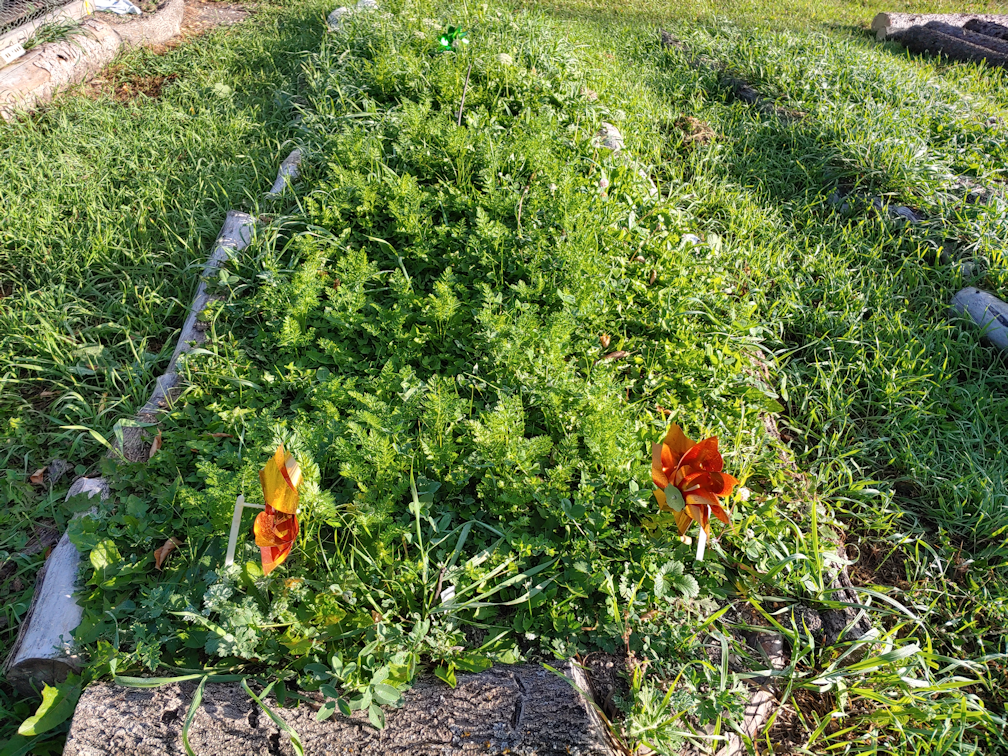
Remember that carrot bed the groundhogs kept decimating, over and over? The one we finally gave up on, other than watering it now and again? Half of it, where the Kyoto Reds are planted, has carrots gone to see, pushing their way up through the weeds. The other variety, Napoli, have fronds visible among the weeds, but none are going to seed.
I watered the gardens this morning and, out of curiosity, pulled up some Napoli carrots. I was really surprised by how big they were! After having their greens eaten away several times, It’s amazing that there are any at all, never mind anything of a decent size! That had me looking around among the Kyoto Reds for carrots that had not gone to seed, and I found a surprisingly large one there, too!
The squash tunnel thermometer is definitely whack. We might be at 30C/86F as I write this, but it was only about 22C/72F at the time I took this photo.
While watering the peas among the corn, I couldn’t help but notice the corn block that is the furthest south.
We actually have corn. This block as lots of cobs developing!
They are very small – the husks make them look like there is more than there really is – and poorly pollinated, but we actually have corn. I went ahead and ate the one I picked, right after taking this photo, and it was tender, sweet and delicious. I will have to go back later today, with a container of some kind, and pick more!
Once back inside, I started up a big chili in the crock pot. It’s got our own onions, garlic, carrots and bush beans in it, as well as both ground beef and the ground pork we got from our neighbour. Oh, and I also tossed in some Spoon tomatoes we’d tucked into the freezer. In the future, I plan to grow beans for drying, so some day we will be making chili with our own dry beans, too, along with the paste tomatoes we plant to grow and can. :-)
With a goal of being as self sufficient as possible when it comes to growing our own food, this year has shown just how touch and go that can be. We had a very warm May that had all sorts of things starting to bloom, only to get a single cold night that killed all the flowers off. Because of that one night, we have no crab apples, no saskatoons, no chokecherries, and it killed off the (expensive!) mulberry bush we’d transplanted. Even the lilacs and roses got damaged by that one night. Then we had the drought conditions that had us watering every day, twice a day, for so long. And now we’ve got an extended summer, and instead of frost and snow, parts of our garden are able to recover and start or continue producing! It’s been a crazy gardening year, but as much as I shake my head over how extreme conditions have been, the reality is, this isn’t actually all that unusual. As every farmer, gardener or homesteader knows, you could have the best year of all, only to have all your hard work wiped out by a single storm, or one unusually cold night. Or you could get a terrible spring and summer, but then get a great fall and winter. Some years, you might not get any real summer at all, and in others, the winter will be as mild as any fall or spring. As fantastic as it can be, to be able to grow your own food and preserve it for use in the off season, I’m just as thankful that we have grocery stores and imported food. I think both are good! As my brother and his wife have both said, if they had to rely on their garden, they’d starve!
One last garden update to post, interrupted by having to make a run to the post office to pick up a package before they closed! :-D
With the kittens mashing down the netting on two of the beds in the old kitchen garden, I finally gave in and removed the mesh completely.
With the beets along the retaining wall, there isn’t much we can do about them anymore. If the deer eat them, it’ll be no more of a loss than it already is. I’ll be cleaning that bed up for the winter soon, and if there are any beets to harvest in there, that’s just bonus. The L shaped beet bed, however, will remain covered. The kittens haven’t been going after that one, and they are doing well enough that we don’t want the deer to eat them.
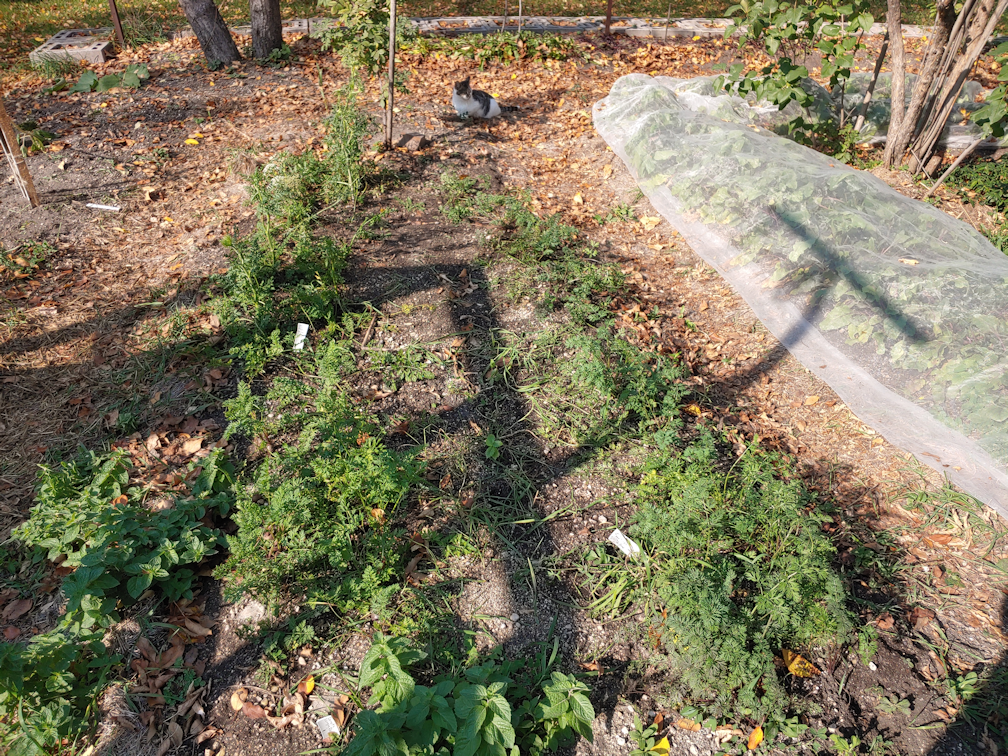
After removing the hoops and netting from the carrot bed, I found my first surprise. I did not plant this bed. My older daughter did. Two types of carrots, with kohlrabi down the middle.
Well, nothing came of the kohlrabi – I finally decided the big leafy plants that did show up were a weed of some kind, as I found them growing in other areas where kohlrabi has never been planted.
What I did notice is that there are three carrot labels, not two. Which I sort of noticed before, when I weeded the bed and added the hoops, but for some reason, never stopped to actually read the label. Along with the Deep Purple and Lounge Rouge Sang, there are Kyoto Red! If you look at the photo, towards the far end of the bed, you can see carrots that have gone to seed. Those are the Kyoto Red. Like the ones planted in the main garden bed, after the groundhogs ate the greens, they got tricked into acting as if they were in their second year and started to develop seed heads. The other two varieties didn’t.
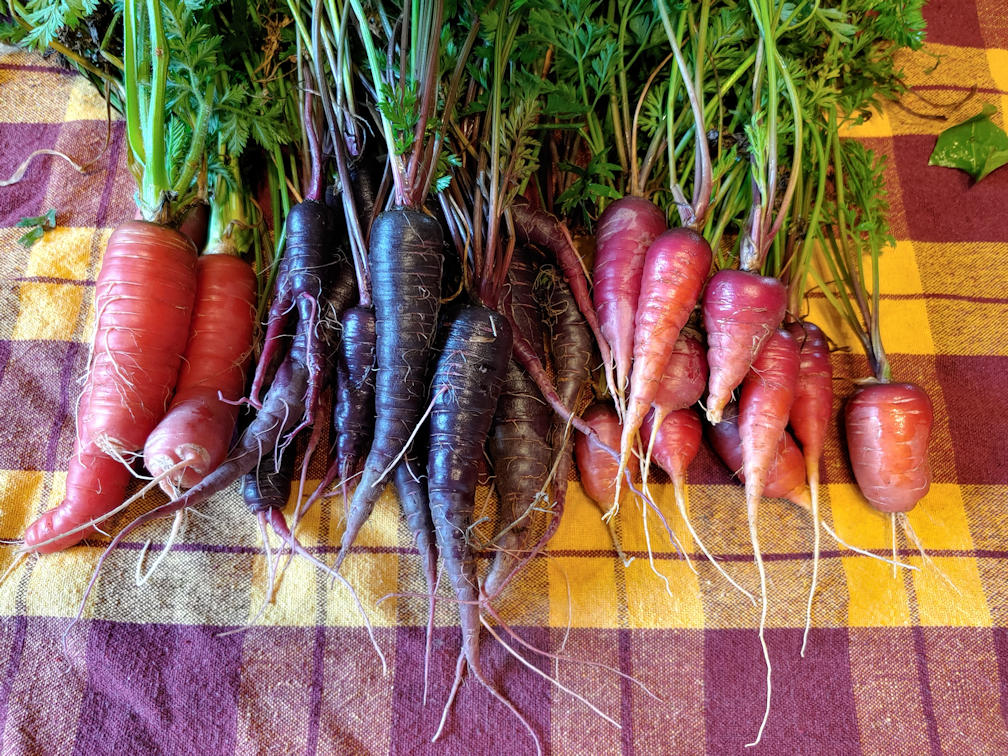
This morning, I decided to pick some, and ended up up quite a few. The ones on the far left are the Kyoto Reds. There were very few that haven’t gone to seed, so I only got a couple of them. The purple ones are obvious the Deep Purple variety, but when I’d picked from that bed before, they were not this dark purple, and I thought they were the Lounge Sang Rouge!! I hadn’t picked any from the other row, as they did not need any thinning.
Which means we got to try two new varieties of carrots today! My daughter decided to use up the summer squash we had in the fridge and make a soup, and she included a few carrots as well. After they were sliced up, we tried each of them. The Kyoto Red, unfortunately, was bitter. They may not have been going to seed, but tasted like they were ready to. The other two tasted fairly similar. We’ve had the Deep Purple before, and they tasted much the same as I remember from last year. The Lounge Sang Rouge seemed to be a bit sweeter.
When cut, the Kyoto Red was that deep reddish-orange colour, all the way through. The Deep Purple carrots were purple with a pale orange, almost yellow, ring inside. The Lounge Sang Rouge was a solid pale orange.
After picking the carrots, I used the rain barrel to water the old kitchen garden, then went on to water the loan beet bed that we made in the spring, next to where the fall garlic beds. This bed was planted with Merlin beets, only. That bed is covered with netting, too, tacked down on the long sides with tent pegs, and the excess netting on the ends rapped around boards to weigh them down. After watering it, I decided to lift the boards at the ends to see how the beets looked.
I ended up picking a couple from each end!
I should have held these differently; there was one quite large beet, but it’s underneath. It’s about the size of the other three, all together!
I’m rather pleased with these – and I know there are larger beets in the middle, from when I last tended it. I’d found a groundhog had managed to squeeze it’s way under the netting, when it was only weighted down with rocks and bricks.
We don’t plan to harvest the beets for a while; possibly not until after first frost. When we do, however, we should have enough to make it worth doing some canning!
Aside from the deer and the groundhogs wanting to eat them, beets have been among our most successful vegetables. We planted a LOT of beets this year, which we may not do next year, but I’m sure we will plant them again. We’ll just have to decide on what varieties we want, and if we want to try some new ones.
And that’s it for our fall garden update! The other parts of the garden were pretty much unchanged, so there’s nothing to really say about them. :-)
I am so incredibly grateful that our growing season has been extended this year, and am glad our drought and critter ravaged garden has had a chance to recover and continue to produce as much as it has!
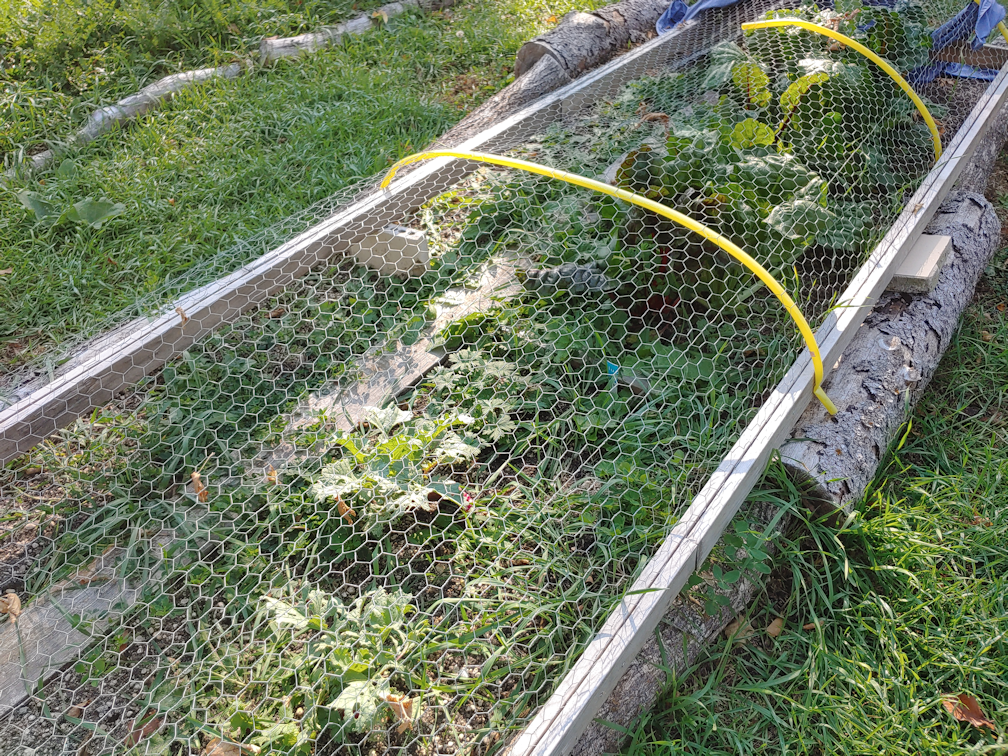
In the main garden area, which will be a permanent garden, we’ve still got the two beds covered with mesh to protect them from the deer. Unfortunately, that leaves them pretty neglected, due to the difficulty in moving such long frames.
Of the radishes we planted, there are two French Breakfast radishes that survived the grasshoppers, and they are actually now looking stronger and healthier than ever! They were so eaten up, I did not expect them to.
And just look at the big mutant radish bulb. :-D
Will they get to the pod stage they were planted for? I have no idea. Normally, I’d say it’s way too late for that, but then I look at the long range forecast and think… maybe they will?
The surviving chard, on the other hand, are just thriving! The problem is, we’re not really using them much. It’s not that we dislike them or anything. It’s just a pain to get at them.
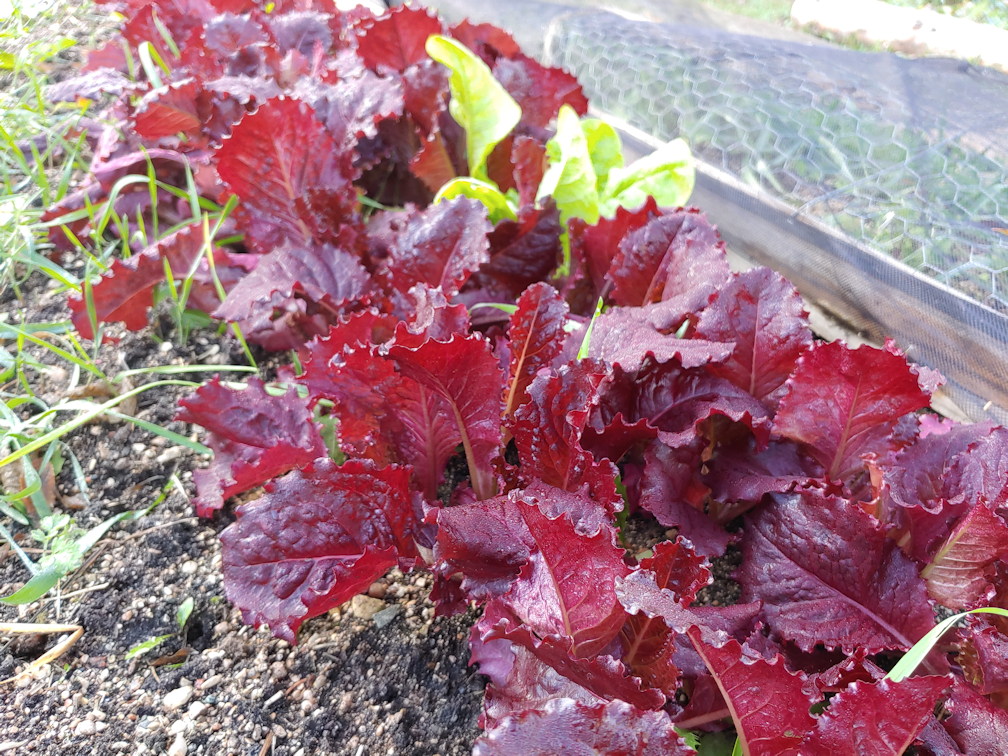
The lettuce is also doing really well – as is that one tomato plant that showed up on its own!!
If I were not sure that deer are still passing through the garden areas, I would take the covers off completely. Then they could be tended and harvested more easily. Which won’t be much use if I come out one morning and find it all gone. Mind you, from what I’ve seen on how big radish plants get when they start to develop pods, we’re going to have to take the cover off at least that bed. And what will we do about this very strong, very healthy tomato plant that started itself so late in the season? I don’t even know what kind of tomato it is. Can tomatoes be transplanted into pots and grown indoors over the winter? I have no idea.
At least the groundhogs are no longer a problem. For them to go into hibernation so early, I would be thinking we’re in for an early and bitterly cold winter, and yet it’s supposed to continue to be warm throughout October, for as far ahead as the long range forecasts go. Plus, The Old Farmer’s Almanac is predicting a milder, wet winter for our region.
Once protected from critters and insects, we can at least say that the chard, lettuce and radishes were – eventually – a success. When we have our permanent, high raised beds, which will be only nine feet long, we will be making sure the covers we make for them will be easy to move aside as needed!
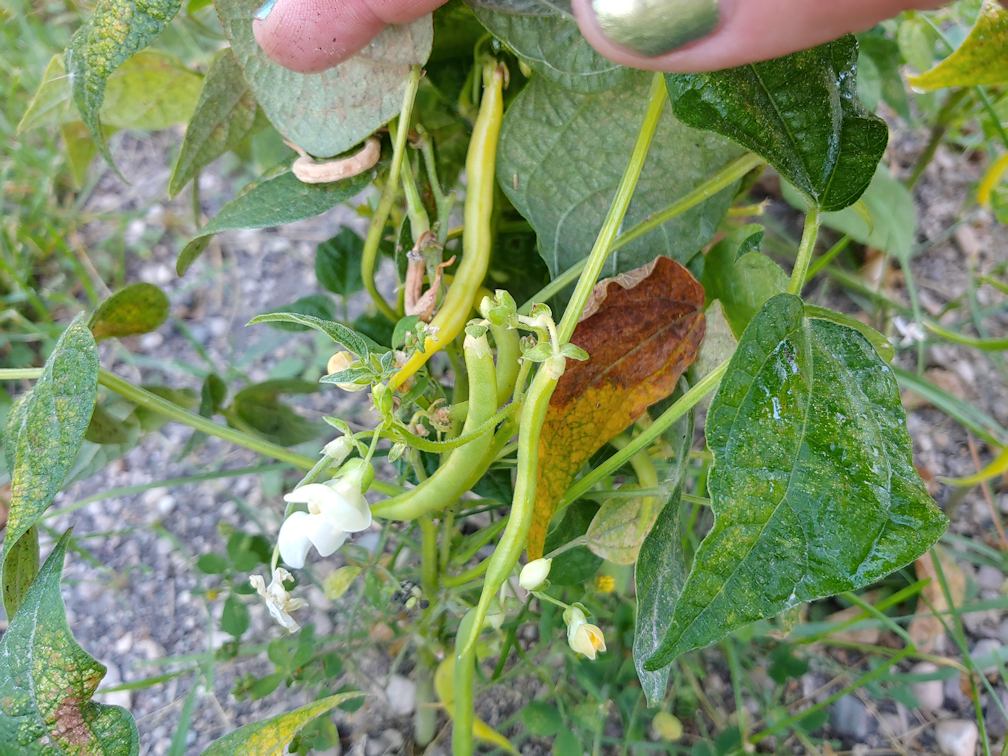
I am just amazed that we still have beans to pick, this late in the season! Even a single yellow bean. :-D
If the mild temperatures continue, we will be getting more yellow beans, too. There are new beans growing, all over the row! From what I could see while picking the green and purple beans, we will have more to pick for at least a couple of weeks, unless a frost hits, first.
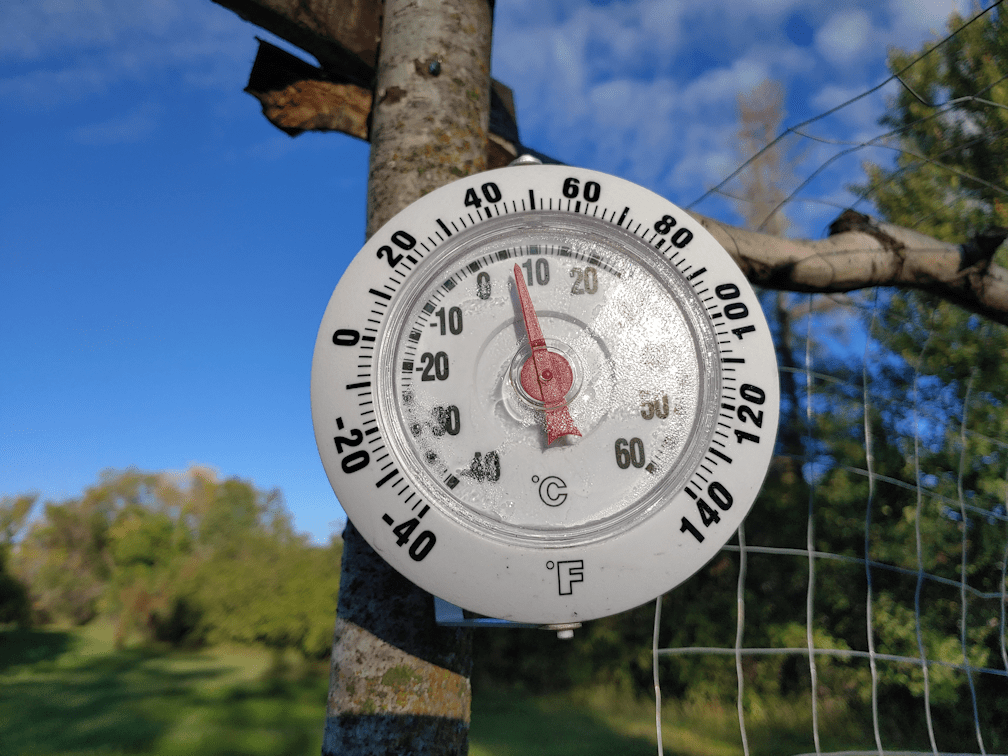
After seeing that insanely high reading on this thermometer a few days ago, I’ve been making a point of checking it more often. This time, it seems to be reading low. It was chilly this morning, but not that chilly!
Ah, well. It’s a Dollar Store thermometer. As long as it’s close, it’ll be useful.
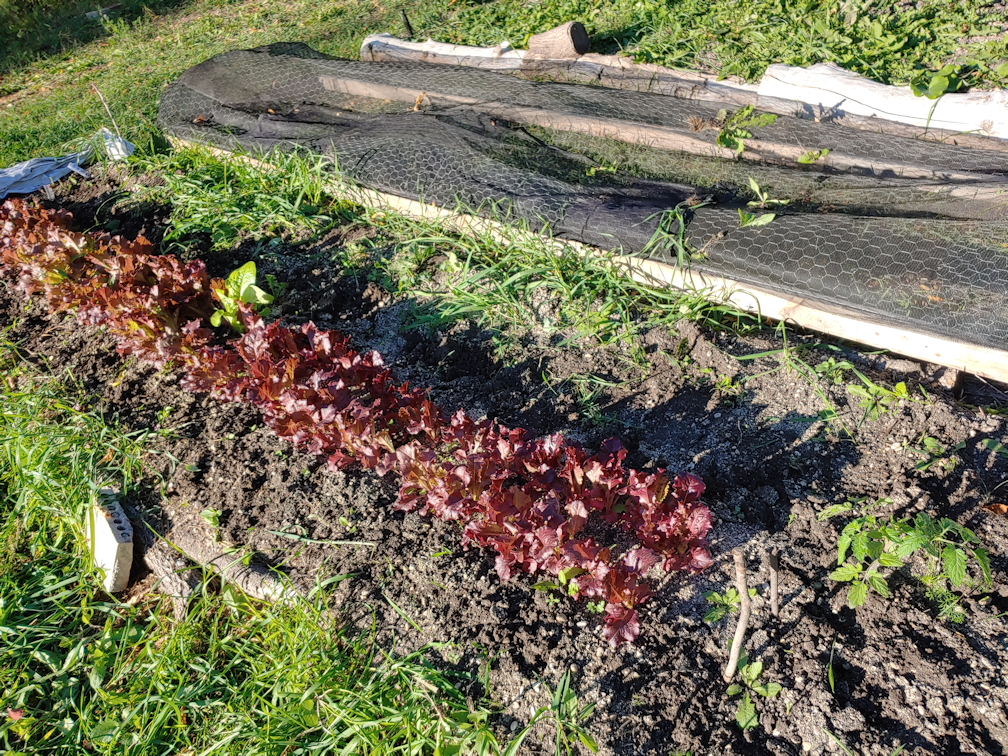
This morning was the first time I uncovered the lettuce to weed and thin them. The cover may keep the critters out, but it’s so long, it’s awkward to move on and off, unless there are two people.
These seeds had been from the bottom of a baggie they had spilled into, so I was expecting a mix. It looks like they are almost all the same type, with the exception of two Buttercrunch. Today is the first time we have been able to harvest lettuce this year! The first time we planted them in the spring, the groundhog got to them before we could. The lettuce is just loving these cooler temperatures.
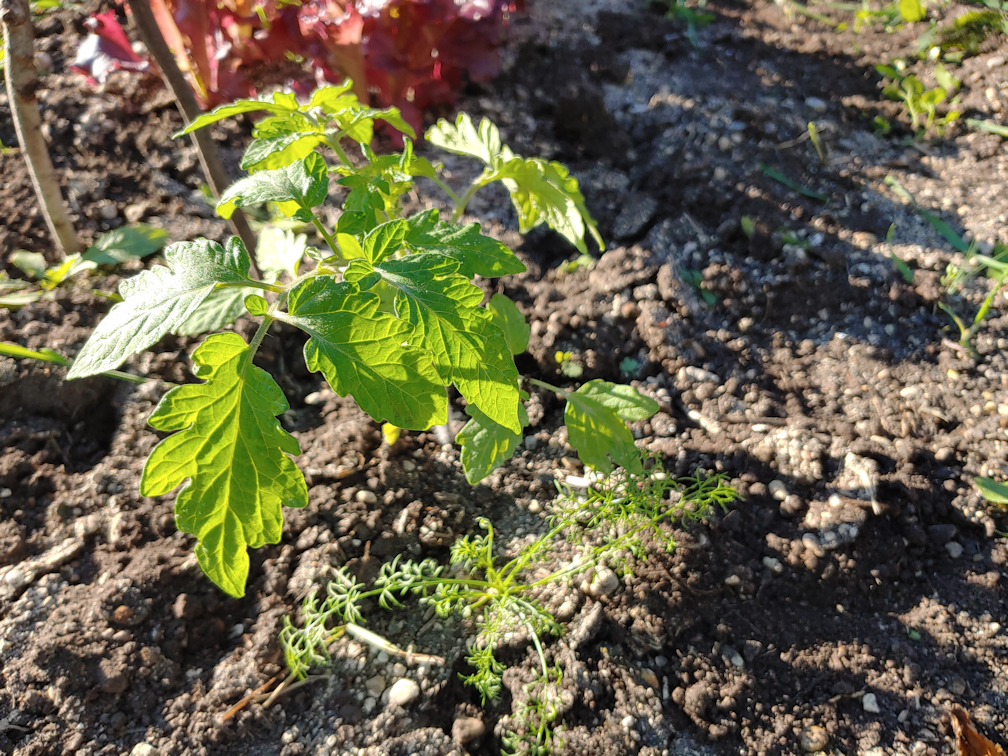
What I am most curious about is this…
There is a tomato plant growing here! It’s looking very strong and healthy, too. I think that’s a dill growing beside it. Dill self seeds easily, but a tomato? Where did that come from? And why did it sprout so late in the season? This bed had spinach in it, first, and this tomato is growing past the sticks marking the ends of the rows I sowed the lettuce in. No additional soil had been added. Very strange!
While weeding this bed, I was on the lookout for the radishes we’d planted in the other half. I found a couple, but they were really tiny. I have no idea what happened to them.
The Bright Lights chard is doing well. We’ve harvested leaves a couple of times from these. They are liking these cooler temperatures.
We have completely abandoned the carrot bed the woodchucks had decimated repeatedly. I’d tried to at least keep weeding it a bit, but it was just too much. And yet, you can see carrot fronds among the weeds! It should be interesting to see what we have, when this bed gets cleaned up for next year.
The Hopi Black Dye sunflower in the old kitchen garden had three stalks with flowers on it. In our recent winds, one of them broke, so I added the supports for the plant to try and save the rest. This morning, I found a second stalk, broken on the ground.
We didn’t really have a lot of wind last night.
I suspect kittens.
I’ve been catching them playing in this garden, right on top of the netting over the carrot bed and the beets by the retaining wall. The carrots are on the edges of the bed, and the kittens have been playing in the middle, so those aren’t as affected, but the beets are being flattened. That bed was already struggling to recover from being et by grogs, and not doing well, so I guess it’s not really a loss, but I find it interesting that the kittens seem to really like playing on top of the netting, instead of on the ground or paths beside it!
Thinking ahead to next year, I believe we have enough salvaged boards in the barn that can be used to make low raised beds here. It would be a good place to make contained areas, such as with square foot gardening, as we turn this into a kitchen garden, and we start to plant more herbs that may have a spreading tendancy. If we have actual frames on the beds, that will make it easier to set up sturdy covers to protect from voracious critters and insects – and playful kittens!
I think we should dig up the rhubarb and transplant them somewhere else. They are not doing well here, likely because they are right under the ornamental crab apple trees.
As difficult and sometimes disappointing as things have been with gardening this year, particularly with the drought, it has showed us a lot about what works, and we can do to improve things for the future.















 The Re-Farmer