Our 2021 garden: filling the gaps

Today was nowhere near as productive as I intended it to be. Ah, well.

I headed out early in the day to the nearer small city, to pick up a few things we couldn’t get during our big city trips. The first stop was Canadian Tire, where I was able to get more of the stove pellets we’re using for cat litter now; we now have enough to last the month or more. A day or so after the frost we got, we could see that it did damage the new Heritage raspberries I’d bought as a gift for my daughter. They will recover, but they won’t do will this year. So I went looking to see if I could got more, but they were completely out of stock for raspberries. I resisted the temptation to buy blueberries, instead. Blueberries need acidic soil, and ours is very alkaline. We do plan to have blueberries, and once we decide on where we will plant them, we will have our work cut out for us to amend the soil to something they can do well in.

I hoped to get more chicken wire, but they only had 2′ wide rolls in stock. I ended up getting a 4′ x 50′ (1.2m x 15.2m) roll of 4 inch square wire mesh fencing. I even remembered to pick up a new hose nozzle to replace our broken one. Paid a lot more than I usually do; I usually get the Walmart cheapies, but I figured it was worth paying for quality for a change.

Then it was across the way to the Walmart to get more cat food and a few more little things, including a garden hose for the front of the house. It’s only 50′ but it’ll be enough to water the old kitchen garden, and as far as the grapes. Which, I am happy to say, are actually showing leaf buds! I thought for sure they had been killed off this winter, but they survived! Yay!

The down side of making the trip is that it basically wiped me out. I’ve been pushing myself too much of late and, while it feels good to do it, this broken old body doesn’t recover like it used to. :-( Once the girls unloaded the van and put everything away, I ended up crashing for a couple of hours. By the time I was mobile again (to find lunch waiting for me! <3 ), I still wasn’t up to doing much. Particularly since we were getting into the hottest part of the day. So we waited a couple more hours before heading outside.

I am really happy we got the new hose and nozzle!

While my daughter watered the old kitchen garden and anything else she could reach on that side (and planted that mystery bulb I found among the tulips), I started watering the north east garden beds until my daughter could join me. It was very handy to have her using the hose on some beds, while I used the watering can on others. Though we hadn’t needed to water this morning, by this time of the day, everything was thirsty again. Especially the newly planted corn and sunflower blocks.

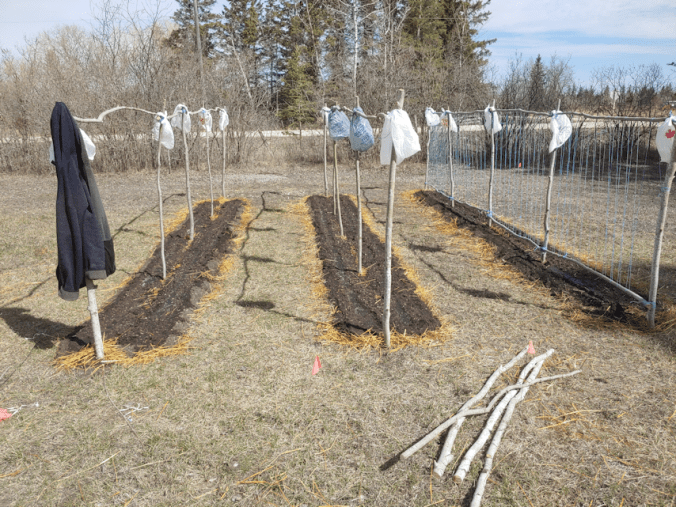
While watering the Dalvay peas, I decided it was time to fill the gaps.

I figured that whatever was going to germinate, already has, and what hasn’t by now, isn’t going to. With these peas, we had a lot of seeds left over, so I went around with a bamboo stake and poked holes in the gaps between the seedlings, sowed new seeds, then covered the holes with fresh soil. Then the beds got thoroughly watered again.

That’s one thing about this area. It’s almost impossible to over water out here.

The King Tut purple peas also have gaps where seeds did not germinate, but there were no extra seeds left over from that packet, so whatever has come up is all we’re going to have for this year. We’ll still have a decent number of plants, and they are supposed to be rather prolific, so I’m hoping they work out.

And that’s about my limit for today. Other than bringing our transplants that are hardening off back into the sun room for the night, my body is letting me know that I am done like dinner!

I think maybe getting to bed before midnight would be a good goal to shoot for, this evening… ;-)

The Re-Farmer

Our 2021 garden: direct sown corn and sunflowers, done!

The crab apple trees near the old garden area are starting to bloom. Not all of them yet, but this one was looking gorgeous, today. :-)

This morning, after all the garden beds were watered, my older daughter and I got to work on the corn and sunflower blocks. She started by making furrows for the seeds and watering them, then I followed behind to plant.

We managed to get 2 corn blocks done, with radishes planted in between, when we stopped for lunch. It started raining, and for a while I thought we wouldn’t have a chance to finish, but it did get done! Mind you, I was getting rained on while planting the last seeds, but not enough for it to be an issue. :-)

These are the three types of corn that got planted today. At the far end in the photo, is the Sweetness, then Early Eh, and finally the Montauk, in the foreground.

Because the soil is hardest packed the further north we go, we planted the April Cross Chinese Radish, a Daikon type radish, in the northernmost corn block. The packet had much fewer seeds than I expected, so we were able to include them in only 3 of the 5 rows. There was enough Red Meat Watermelon Radish to interplant with the remaining two blocks of corn. Hopefully, both varieties will help with breaking up the hard soil and, once harvested, will give the corn’s roots more room to grow into. This is really late for radishes to be planted; they can be planted as soon as the soil can be worked, however with their short growing season, it should still work out.

The blocks of 3 rows were for the sunflowers. The Mongolian Giant got planted in the block to the north; with how big they are supposed to get, I figured that would work out better. There aren’t a lot of seeds in the packets, but at 2 ft apart, I did end up filling two rows. There will still be the transplants to include, about a week from now. The 3 row block that’s to the south got the Hopi Black Dye sunflowers. The flags mark the block with the Hopi Black Dye and, not being a giant variety, they were planted 18 inches apart. That filled 2 rows as well. Not a single one of the packet we started indoors has germinated, so there is nothing to transplant. We will have more Mongolian Giant transplants than will fill in the one row left in that block, so we might end up splitting them between the two blocks. I didn’t think ahead, and planted seeds on the northern rows. Any Mongolian Giant transplants could end up shading the Hopi Black Dye – though with zero germination from the first packet, I wouldn’t be surprised if none of these germinated, either. I am at a loss as to why the ones we started indoors completely failed to germinate.

Now that these beds are done, we have some time before we can start transplanting, which should be enough time to get the squash tunnel built, and create more beds for them and the other transplants that need them.

Two weeks from now, if all goes well, all the planting (not counting successive sowing) should be done!

The Re-Farmer

Our 2021 garden: beans are in, and first spinach protectors

Once again, our temperatures have lurched from one direction to the other! From days cold enough for the furnace to turn on, and overnight lows below freezing, we’re back to the heat. It’s past 7:30pm as I write this, and our temperature is still at 24C/75F. A week from now, we’re expected to hit 31C/88F.

Well, by then we should be transplanting our squash seedlings, so that will be good for them, at least!

This morning’s job was to direct sow our bush beans. I am so glad we picked up that extra hose. The mini-beds we made for them needed to be soaked, re-soaked, then soaked again, before I even planted the seeds. I can’t believe how quickly things have dried out already, though I suppose with the winds we’ve been having, I shouldn’t be surprised. You can even see that the pea trellises have been moved around by the winds! I even found one end of a cross piece had come loose after one particularly windy days. The bags may work to startle critters, but they also act like sails.

The yellow and green bean packages had 200 seeds each. With a 20’/6m double row, we still had seeds left over. The purple beans were packed by weight, and a 50g package was just enough for its double row.

Once planted, they all got watered, and watered again! Normally, I would have pre-soaked the beads, but these were inoculated seeds, and I figure soaking them first would have washed off the inoculant!

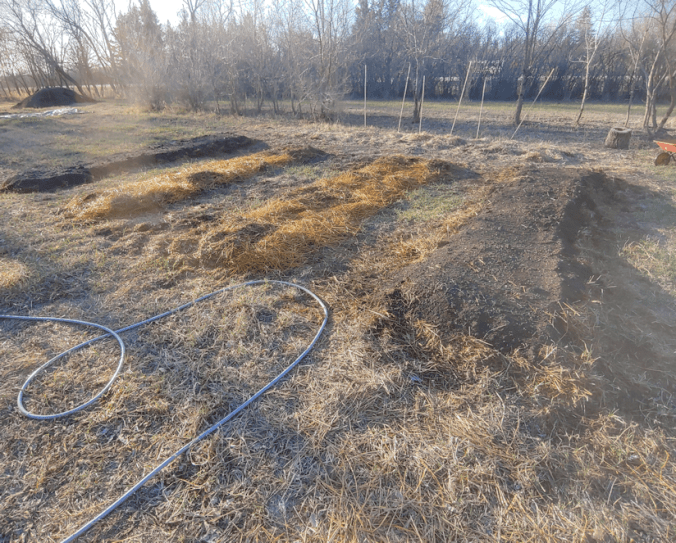
After the beans were done, we set up the sprinkler to start soaking down the rows for the corn and sunflowers. We left it running over one side for a few hours, then moved it to cover the other end. Much to my surprise, the sprinkler can cover all but 3 rows. There isn’t a lot of pressure, this far out!

Our afternoon project was to see what we could do about protecting our spinach beds. After scrounging in a little shed near the barn, we dragged out the last of some narrow old, salvaged boards. Many of them had several 3″ deck screws in them that had to be removed, first. There were 13 boards, and we ended up using 12 of them, because they were not all the same length.

The roll of chicken wire (or 1″ hex wire) we got was 25′ (7.6m) long and 4′ (1.2m) wide. We have three spinach beds we need to cover. While the beds themselves are about 3-4′ (about a meter) wide and roughly 15′ (just over 4.5m) long, the rows of spinach were, of course, less than that. So we were able to use the roll to cover 2 spinach beds. Well, mostly.

We stole a couple of hoops from the small beet bed by the garlic beds to hold the wire up in the middle. The sides are held in place with sticks, that have a bit of mesh hooked onto their tops, so they are helping hold that up, too. Once we get more hoops, we’ll be able to stop using the sticks to hold up the mesh, which will allow us to move the covers to harvest the spinach.

The edges of the chicken wire were sandwiched between boards that were screwed together. Because of the different lengths, we had to cobble them together. A couple ended up with small gaps between the ends of boards, but they were still secure. The covers don’t really leave much room to do a second sowing, though, which we could do any time now, if we wanted. I think I will skip it, and save the seeds to sow later in the summer for a fall crop.

Like everything else we’re doing this year, this is a temporary thing, so we don’t need to get too fancy. When we build our permanent, high raised beds, we will make protective covers that fit properly, and be properly framed and supported. Right now, neither one completely covers the rows of spinach, so the ends might still get nibbled at, but it should be fine. If we want, we can tie on brightly colored or metallic ribbons to flap in the wind and discourage critters.

I’ll have to make a trip to the local dollar store again and see if they’ve restocked on things like pinwheels. I’ll pick up more hula hoops, too. I figure a couple more rolls of the chicken wire would not be a bad idea. I think we still have enough of that wood in the basement that we can make one more cover for the third spinach bed. For the small beet bed, I’m hoping the mosquito netting we ordered will come in soon, but if not, we can use chicken wire.

While in the city, I also picked up 200’/60.9m of yellow rope to string around where the corn and sunflowers will be planted. If what I read about deer not having good depth perception, so having two shorter fences a few feet apart works as well as a high fence, is accurate, we should be able to string just one “fence” of the yellow rope around half the garden, since it’s already so close to the barbed wire perimeter fence. Since most of the other half will be edged with squash, which deer don’t like, we might not need to do much more than that. We shall see!

Now that the blocks for the corn and sunflowers have been soaked down, tomorrow’s job is to plant the corn, with radishes in between to help break up the hard soil, and direct sow the rest of the sunflowers. The transplants are not done hardening off yet, and all our transplanting will wait until after June 2, regardless of what the weather forecasts are right now! The forecasts change so often, I don’t really trust them beyond a couple of days, and, even then, they are frequently wrong for our area.

Once the seeds are sown, we can finally get back to working on the squash tunnel!

The Re-Farmer

Our 2021 garden: asparagus is in!

Well, it hasn’t really cooled down all that much, but I wanted to at least get the asparagus planted.

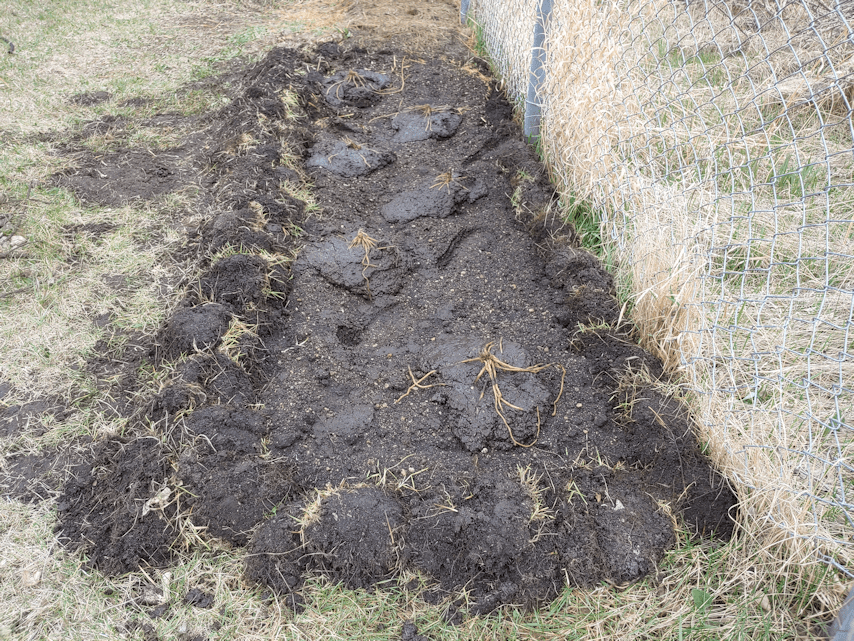
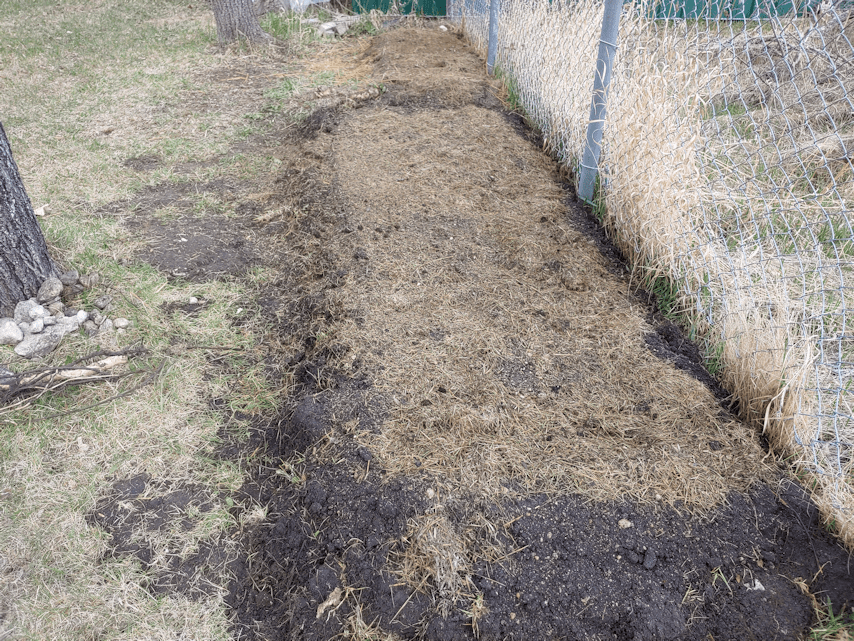
The first thing was set the crowns to soak in water before covering the cardboard with a layer of soil, and laying out the sod around the edges to make a sort of wall to support the height of the bed. The base got a very thorough watering. Then we mixed a load of soil with peat, thoroughly soaking it in the wheelbarrow while mixing it with a spade.

That took a while. :-D

The wet peat mixture was used to create the hills for the crowns. They’re supposed to be planted 2 feet apart. With the bed being longer than 6 feet, they were staggered a bit.

They look a bit like facehuggers. :-D

The crowns were then covered with a rather deep layer of soil, and a light layer of mulch. From what I’ve read, they may need more soil added later.

We will have to make a point of watering it deeply over the next while, just to get the top layer wet through to the crowns. Wetting it in layers should help prevent them from drying out until that’s accomplished.

It’s past 8pm as I write this, and we are finally starting to cool down again. I’m going to see if I can get to bed before 3am for a change. I tried to do that yesterday, and ended up still wide awake at 4am. *sigh* Anyhow, I’d like to get out earlier in the day to continue working on the block for the corn.

Meanwhile, the girls and I have been talking about finding a different permanent spot for the mulberry. One of the best suggestions was to plant it along the north side of the big garden; we intend to plant fruit and nut trees in most of this area anyhow, so why not start now? Then I remembered that the location we were talking about has buried telephone wires somewhere in there. I had tried contacting the phone company about the location and was given the contact information for the Call Before You Dig organization. I ended up sending them an email with our longitude and latitude.

I’ve discovered why people have such a hard time finding our place in the process.

I tried several different map sites to pinpoint our location, but our physical address would not work. I finally just found us manually, and discovered that the road that goes past our place is not labelled. At all. This road has two names; one is the numerical grid number, and the other is my family name. Neither are on the maps.

All but one of the stop signs along our road with the name on them have disappeared. There had been one on one of the stop signs at the intersection near our garden, but not long after we moved here, someone broke the stop sign and the street sign on it disappeared. I am pretty sure this was no accident, since this happened after our first falling out with our vandal, but whatever. The road number was on the other stop sign, so it’s still there. I’d asked about having the road signs with the name replaced at all the intersections that are missing, but I think the councilor I spoke to (who also happens to be the guy renting most of this property) forgot about it. Anyhow. Now that I know that the road that runs past our driveway is unlabelled on any of the maps, I’ll have to find out how to get that fixed.

Meanwhile, I’ve not heard back from the Call Before You Dig people.

Until we do, we’ll avoid planting trees along that strip. There’s already a self sown chokecherry tree there. Those don’t get very big, so we should be able to leave it. The mulberry, however, gets much bigger, so we’ll have to think again about where to put it. It needs to go into the ground right away, so we can’t dilly dally about the decision!!

The Re-Farmer

Our 2021 garden: peas are in, and other progress

Our first direct sown seeds are in!

This morning, I got the peas planted in their new beds.

I also added our first line of defense against birds and deer: flappy, noisy grocery bags.

As soon as we can, those will be replaced with whirligigs, wind chimes, flags, flashy things – whatever we can find that will startle critters, but not act as potential sails and pull the trellises down!

While covering up the seeds, I made a point of pressing down little trenches on either side of the seeds, where water can collect and soak in, rather than flow off the soil. I made slightly deeper trenches on the insides. The more water gets through the soil to the straw and old soil below, the better for the ground to soften up and encourage worm activity. That was one thing I noticed when digging the post holes. I think I saw only one worm, and I’m not even sure if I’m remembered that correctly or not. :-/

Everything else being planted in this area has to wait until after the last frost date, so when I was back from helping my mother with her grocery shopping (I showed her pictures of what we’ve done so far. She had nothing positive to say, of course. ;-) ), then making a dump run, the girls and I moved on to where we will be planting things that can go in before our last frost date.

The two beds now covered in soil had looked like the long bed with the bamboo poles, before. Aside from raking around the edges to clean them up, adding the raked up material onto the beds, all we did was cover them with several inches of new soil.

The straw layered beds were rakes around the edges and evened out to more or less match the first two in size, then got thoroughly soaked. Then the soil beds got soaked, too.

Tomorrow, they will all get another soak, and then the straw will be covered with soil. After that, the two short beds that are off frame will be lengthened to match these ones in size, then they’ll be soaked, topped with soil and soaked again. Meanwhile, our onion seedlings are being hardened off for transplanting. Until they’re ready, we will continue to soak down the beds to get them thoroughly, deeply moist. This area had a summer under mulch and black plastic before we planted in it last year, so the soil is decently soft. We mostly want to encourage the break down of the straw.

Once these beds are ready, plus a couple in other areas we will be planting cold-hardy seeds, we will be able to move back to where the peas are and continue marking off and preparing beds for what will be planted there in June, after the last frost date.

I am so glad we were able to get that soil!! It’s going to make such a difference.

The Re-Farmer

Our 2021 Garden: onions – to trim or not to trim?

I remembered to get a photo of our onions in their new location in the sun room.

I ended up removing the plastic on the mini-greenhouse frame, so it wouldn’t get too warm, and so there would be air circulation from the ceiling fan.

This is early enough in the morning that the room is still “dark”, but once the sun comes around, it gets many hours of sunlight. The ceramic heater is just enough to keep the seedlings from getting chilled overnight. We’re supposed to get snow starting tomorrow night, at with point I might put the plastic cover back on.

There should have been trays for three types of onions in here by now, but the shallots died off and I had no seeds left to try again, and the reseeded bunching onions are still in the aquarium greenhouses inside, for a while longer. By the time those are ready to be moved over, we’ll be bringing the tomatoes and gourds into here, too.

I have a question for those who grow onions from seed.

Should I trim these?

I’d read that onion seedlings should be trimmed when they reach about 6 inches, to about 3 inches, while they await transplanting. I would have done it by now, however, I’ve since heard from people who say to NOT trim them, because then you get smaller bulbs. They were pretty adamant about it, while others were just as adamant about the opposite.

I’m inclined to trim them, but I wanted to hear from anyone with more experience than me with growing onions from seed. I am more than eager to listen to the advice of others!

Did you trim them, or not?

What do you recommend?

The Re-Farmer

I couldn’t resist

https://clipground.com/images/winter-vegetables-clipart-16.jpg

Well, I’ve gone and done it.

I’ve made another order from Vesey’s Seeds.

What can I say? I couldn’t resist!

Truthfully, the things I ordered today are not for me. They are for my daughters. My excuse is, they both have spring birthdays, so this is my gift to them!

Here is what I’ve ordered. (All links will open in new tabs)

Purple Passion Asparagus: This is the one that got the bug in my ear to order more! The new Vesey’s spring catalogue had come in, and my older daughter came to me, all excited about these. They are not only hardy to zone 2, but apparently are so sweet and tender, they can be eaten raw. She didn’t ask about ordering it, though, since she knew we already had so much.

So I ordered it anyway. :-D We do have some asparagus here; a few brave spears come up in the spring, but not enough to harvest. Asparagus takes 2-3 years to get going, so ordering fresh root stocks now just makes more sense. Once they’re established, they should keep producing for up to 20 years. We’ll be getting the 6 pack of these, delivered in the spring.

April Cross Chinese Radish: This is a Daikon type of radish. I actually don’t like these – or any radishes at all – but my younger daughter really likes Daikon radish, so this is for her!

Red Meat Watermelon Radish: This one is for both my daughters! A white radish with a pink interior and green “shoulders”.

Robin Beet: We got only one variety of beets this year, with a second variety my younger daughter had wanted being out of stock. It’s still out of stock. Both my daughters really liked the deep, dark, sweet beets that we grew last year, so these should be right up their alley. These are “baby” beets, maturing at only 25-30 days.

Black Form Iris: this is another one for my younger daughter. There is another black iris that she had wanted to get for our fall planting, but it was out of stock, and still is. I know she’ll like this one, too. Like the asparagus, this will be delivered in the spring.

So that’s it! Just a little order, at least compared to the last one I made at Vesey’s! :-D I think the girls will really enjoy growing these.

The Re-Farmer

Garden plans for 2021: orders in, and probably way too much!

I posted previously about seeds we ordered from Rare Seeds. Since then, I’ve placed another small order from them, which I will talk about below. (all links should open in new tabs, so you won’t lose your place. :-) )

The problem is, our first order hasn’t arrived yet. It has been shipped and, as far as my account on the website states, it’s complete. It should have arrived by now.

Could it be stuck at the border? I don’t know. I’ve emailed them and asked. Hopefully, they will be able to find out at their end.

A lot of the stuff on my wish list there is out of stock, so when I had the chance, I did place another order while what I wanted was available. This is what I will be getting (along with a free packet of mystery flowers).

Hopi Black Dye Sunflower. I’m really excited about this. Not only is it supposed to be a good eating sunflower, but it can be used to make a purple dye. After what happened when we planted sunflowers last year, we ordered 2 packages of these.

Mongolian Giant Sunflower. I love how they use small children to demonstrate just how MASSIVE some of their products are. This one is a monster of a sunflower! Heads can reach up to 18 inches across, and the stalks can reach 14 feet. This will make a substantial wind break and privacy screen. Yes, we ordered two packages of these, as well.

Crespo Squash. This is a type of big, warty green pumpkin. Why did I order it? Because it’s big, green and warty. Also, it’s supposed to be very delicious.

In deciding what to get, we are looking at both summer fresh eating, and winter storage. The sunflowers we planted last year did not get a chance to mature, but if we can get these planted earlier, hopefully, that will not be an issue again. We will also be looking at finding ways to keep the deer away from them. From the looks of the stalks we left in the garden, they are still trying to eat them which, for this time of year, is part of why we have them there. Hopefully, the birds are able to eat the developing seeds in the seed heads, even if they’re not fully formed and ripe. Last I checked, some did appear to be eaten, but not much. With bird feeders right by the house, they don’t really have much incentive to eat underdeveloped seeds.

We got our Vesey’s catalog in the mail recently, which was quite exciting. :-D The girls and I have been talking about what we want to do while going through it. Today, I ended up placing a much larger order than before. I had been thinking of waiting until January, but with things already disappearing from my cart because they were suddenly out of stock, I figured I’d better order things while I could. Even so, much of what I would have liked to have ordered was out of stock. Some of them, I ordered different varieties instead. Others, we will wait and will probably order in January or February.

This is what we’ve got ordered, as of right now.

Vesey’s Mosaic Mix Tomato. We are not big tomato eaters. I actually detest tomatoes, though I can eat tomato paste or crushed tomato as an ingredient in dishes. One of my daughters, however, really likes little tomatoes. This package is a mix of cherry and grape tomatoes in a range of colours that will produce over a long period of time. This is for her! :-D

Merlin Beet. Of the beets we tried to grow last year, this is the one the girls liked the most. We’ll just have to protect them from the deer!

There is another variety we plan to get, but it’s out of stock, so we’ll order that later. When we’re ready to plant, we should have 2 varieties of beets.

Spinach collection. Three varieties of spinach that mature at different types. We all love fresh spinach, but store bought spinach goes bad so quickly, we rarely buy it. Something else we have to protect from the deer, though!

Summer Squash Mix
Sunburst Summer Squash These are the same as what we ordered last year. The mix does include sunburst squash in it, but having more of them went over very well last year. This time, we have better information for starting them indoors, and protecting them from late frost, so hopefully, we will have even more. They will be for fresh eating, and for pickling and freezing.

Baby Pam Pumpkin. The pumpkins we planted last year were planted way too late, and we didn’t even know what variety they were. This time, we chose a variety noted for its eating quality, and faster maturity.

Red Kuri (Little Gem) squash. These little winter squashes should mature even faster than the pumpkins! This variety was also chosen for its winter storage qualities.

Teddy Organic Winter Squash. We picked these for their combination of small size (serving size!) and high production, as well as it’s faster maturity.

Pixie Melon
Halona Melon

I was unsure about trying to grow melons again, as the transplants I bought last year did not work out. I had a variety recommended to me, but it was not available. These cantaloupe type melons were picked for their quicker maturity. We enjoy melons, but it’s another of those things we rarely buy, so it’s worth giving it another go.

Cucamelon. Yes, even though I was able to save some tubers, I’m still getting some to start from seed. Just in case!

Conservor Organic Shallot
Norstar Onion
Red Karmen Onion Sets (to be shipped in spring)
Red Baron Onion (bunching onion)

We have 3 varieties of garlic already planted. Now, we’ll also have lots of onions, too! We use onions a lot, so figured it was worth going ahead and planting lots. We chose come of these for their winter storage-ability.

Yukon Gem Potatoes (yellow flesh)
Purple Peruvian Fingerling Potatoes (purple throughout)
Norland Potatoes (red skin, white flesh)
Purple Chief Potatoes (purple skin, white flesh)

Last year, we ordered 2 boxes (3 pounds each) of the Yukon Gold. This year, we decided to double the amount (each comes in a 3 pound box), but quadruple the varieties. The Norland and Purple Chief are noted for their winter storage, so we’ll have some we will grow for eating earlier, and others to keep for later.

Napoli Carrot
Deep Purple Carrot

Deep Purple is one of the varieties we planted last year. The Napoli is not the variety I originally picked, but this one was in stock and highly rated. We have two other carrot varieties coming from Rare Seeds that should have arrived by now. If something has gone wrong with that order (for all I know, seeds aren’t being allowed across the border right now. Or maybe it’s just slow), we’ll still have 2 varieties. If we end up with 4, well, that’s just more for pickling or freezing.

Dalvay Pea I actually had a 3 variety collection in my cart, but waited too long to order, and now it’s out of stock. So I ordered this variety for now. We may order another variety, later. These were noted for their fast maturity and long pods.

Lewis Bean (green)
Golden Rod Bean (yellow)
Royal Burgandy Bean (purple, turns green when cooked)

The 3 variety collection I had on my wish list is out of stock, so I picked similar varieties that were in stock. These types of beans are another thing I rarely buy in the stores, though we like them. They tend to either look oogy, or get oogy very quickly. These will be used for pickling and freezing, too.

Peaches and Cream Corn Collection Three varieties of Peaches and Cream corn. Not the collection I originally intended to order, but the one that was in stock! We have 2 other, more unique, varieties from Rare Seeds that are held up (watch, after my saying this so often, I’ll find them in the mail tomorrow… LOL). I believe we will need to plant those varieties away from these ones. I don’t think they would be good to cross pollinate. Especially the purple variety. :-D

Illinois Everbearing Mulberry (shipped in the spring) This is it! Our first food tree! I really hemmed and hawed about ordering it, because it’s quite expensive, but it will be two years before it produces fruit, so the sooner, the better. It’s actually a zone 4 tree, so we will have to ensure that it is well protected. It can grow up to 25 feet high, which also needs to be kept in mind when we decide where to plant it, too! My mother remembers they had a mulberry tree growing behind their barn, when she was a child in Poland. She remembers bright yellow silk worm cocoons on them, too! We might be able to grow the tree here, but I don’t think we could introduce silk worms here! :-D

Western Mix Wildflowers
Alternative Lawn Mix Wildflowers

These are mixes that will be scatter sown in a couple of areas. One of them will actually be outside the property, between a fence and the road. This is an area that is currently open, and I don’t want it to be taken over by trees, like on the other side of our driveway. Plus, the garden area is on the inside of the fence, so it will attract pollinators. Reading over the planting instructions, it seems they actually do better being planted in the fall, so we might take the summer to prepare the areas (they actually recommend tilling! No, we aren’t going to go that far), then seed them.

There we have it! Our order is in.

This is probably way too much – and there are other things I’d still like to order! We certainly don’t have enough beds or grounds prepared for all of it. Especially the corn. But that’s okay. We’ll work it out!

We will need to build potentially 4 trellises for the peas and beans, plus we want to build squash tunnels and trellises. Where we planted the squash last year, there are 5 prepared beds, plus the 2 beds the potatoes were in, plus 1 long skinny bed where I planted the seed potatoes I found that hadn’t sprouted. No idea if they will grow at all next year. We also have the retaining wall and parts of the old kitchen garden available for some things. The potatoes we ordered will need to be planted in a different area from where we grew them last year, so as not to attract the Colorado Potato Beetle. We are talking about trying to grow potatoes in containers, instead, this time.

So we’ll have to prepare beds for 27 plant varieties, plus larger areas for the corn and sunflowers, just from what I’ve listed here. More, counting my first order from Rare Seeds, and anything else we might order later. Not that we actually have to plant all of everything we get this year. Some things can be inter-planted (squash, beans and corn together, for example), so that will help a bit.

We’re still looking at potentially 20 beds or more that need to be prepared! All manually, too.

Yeah.

We can do that. :-D

Did we maybe overdo it? :-D

The Re-Farmer


Garden plans for 2021

Yes, it’s only the middle of November, but the girls and I are already planning for next year’s gardening.

We learned a lot in our first year of gardening here, and will be using that information as we expand our food growing.

We have several goals and things we keep in mind when deciding what to order. First is keeping in line with our long term goal to be as self sufficient as possible. The other is to take advantage of being able to grow our own food by growing things we either can’t normally buy in the grocery store (either due to lack of availability, or poor quality in stores), or because they tend to be more expensive, or “treat” items, that we typically can’t justify spending our limited budget on. Both of these goals also allows us to go a bit wild in what we grow! :-)

With that in mind, I’ve already placed and order with Rare Heirlooom Seeds. It’s a small order; some of the things I would have bought were out of stock while, with others, we will go through the wish list to pick and choose. Here is what I’ve got ordered right now.

Giant Rattle Breadseed Poppy. I was really excited to see this new item! These are very much like the poppies I remember my mother growing, when I was a kid. I used to love eating the seeds right out of the dried poppy pods. She grew enough to make the filling for poppy seed rolls, which uses a LOT of seeds! Poppy seeds are something I love, but buy very rarely. If we have our own, I would certainly be using them every chance I get!

Longue Rouge Sang Carrot. I’ll be honest. I selected these just for the colours.

Kyoto Red Carrot. This is one I ended up choosing based on comments other customers left behind. It’s described as a “winter carrot”, which obviously isn’t a thing in our climate. Several people had complained about not being able to grow it well in their warmer zones. Then someone in a zone 3 – the same as us! – said they grew it as a summer carrot and it thrived. Awesome!

Strawberry Spinach. This is something I’ve actually tried to grow before, in containers on our balcony, years ago. We had limited success, largely due to weather conditions. What little we got, I liked, so I want to try them again. Both the leaves and the berries are edible, so that’s bonus, too!

Dorinny Sweet corn. I hemmed and hawed quite a bit about growing corn yet, but I decided to just go for it. This variety is from a Canadian hybrid, so it should be quite hardy to our growing zone.

Montana Morado Corn. This one falls into the “go wild” category! I chose it partly because it is a cold hardy variety, but mostly because of the amazing colour. It is also a variety that can be milled into flour; something we have included in our mid term plans. We just have to acquire a hand mill. Once we do, we will be looking into planting grains as well as corn, specifically for milling.

Other things we plan to get from this site are giant sunflowers, plus a variety of sunflowers that can also be used to make a purple-grey dye.

We’ve also got a substantial wishlist going at Veseys, which is where we got almost everything we planted last year. Those will be ordered later in the season, as their new catalogs include promo codes for discounts. With how much we plan to order, we’re going to need a discount!

This past year, one of the things we really loved about having the garden, was being able to pick and eat our own produce, daily.

As great as it was to have fresh produce all summer, there wasn’t much left over for the winter. This time, we will focus more on things we can process (the pickled summer squash was a huge hit for our family), as well as things that can be kept in the root cellar for long periods.

So for sure, we will be re-ordering the summer squash mix, with an extra packet of sunburst squash again, to go with the carrots and cucamelons (I have cucamelon tubers from this past summer, but will likely get more seeds, too).

We plan to get a variety of winter squash, with a focus on those that store well. Winter squash is something I almost never buy in stores. This will include small eating pumpkins (rather than the more popular carving pumpkins).

This time, we know to use 3 or 4 inch pots to start our seeds indoors, and to start them earlier. Maybe even get a warming mat. Some of our seeds took forever to germinate (especially the birdhouse gourds!), while others germinated fine, but outgrew their Jiffy pellets before the weather allowed for transplanting.

With potatoes, we decided to get the same amount of Yukon Gem potatoes as before (6 pounds of seed potatoes), but also get other varieties. If all goes to plan, we’ll be planting 4 varieties, including two that are noted as being good for winter storage. For these, we’re thinking of using grow bags or pots, to try and keep out the grublins that chewed holes in our potatoes.

We might get more varieties of corn, as well. We will be getting a collection of peas in 3 varieties. Peas right out of the pod are the best! A 3 variety collection of bush beans is also on the list. I love fresh beans, but in stores, they are among those things that always look a bit iffy. Eventually, we will get beans for drying, but not quite yet.

If we can figure out how to protect them from the deer, we will be getting the same collection of beets as we did before, too. A spinach collection (three varieties, each maturing one after the other) is also on the list.

We will be getting at least one more variety of carrots. We will very likely pick up a 3 variety pack of raspberry canes, too. These produce in their second years, so they will be for 2022’s garden. We’ve also been looking and onion and shallot varieties, focusing on those best for storage.

We’re looking at starting to get more trees and bushes, too. There are blueberry varieties that are suitable for our climate. Of course, we want more haskap berries. What I thought were gooseberries here turned out to be currants, so gooseberry bushes would be good to get, too. We’re also looking at mulberry, apple, plum and pear trees. All of these take at least a couple of years before they start producing, so the sooner we start planting them, the better. We will likely get fruit and nut tress from Hardy Fruit Tree Nursery. It’s one of the few places I’ve found that has cold hardy food trees suitable for our zone.

There is an extra purpose to all this planning ahead so early. We had plans we weren’t able to follow through on for last summer’s garden, in regards to trellises and other supports. Once we know what we are going to plant, and figure out where, we can use the winter months to accumulate any materials we need to buy (like cattle panels, rebar or rebar grid, tie wire and other fasteners, etc.). Most of what we want to build, we can use materials salvaged from around the property, but there will always be a few things we’ll have to buy.

With that in mind, I now have a tighter goal for cleaning up the spruce grove – something that is already behind “schedule” of our original timeline by a couple of years! We have a lot of tall, springy poplars that I want to clear out, and they will be used to build upright trellises, A frames, arbors, and more. We’re also looking to build squash tunnels. The beds we have where we planted squash last year looks like they will be permanent gardening areas, so I would like to start building up raised beds there. The walls for these can double as supports for any arches we add. Plus, I’m going to see if I can start taking down more of the dead spruces that are further from the house and garage (the ones closer will be taken down by professionals!). The wood might be usable for various projects. However, as we clear out the dead wood and open up the ground to sunlight, this will give us space were we can plant fruit trees that require extra protection from the elements.

We’ll have a lot of work ahead of us!

I’m looking forward to it. :-)

The Re-Farmer
Potato beds put to bed

Today, we took advantage of the warmer weather and dug up our two potato beds.

The first one got done fairly early in the morning, before we headed to the city. Having already dug up a few of them earlier, I had some idea of what to expect, but I have zero experience with growing potatoes the “Ruth Stout” way.

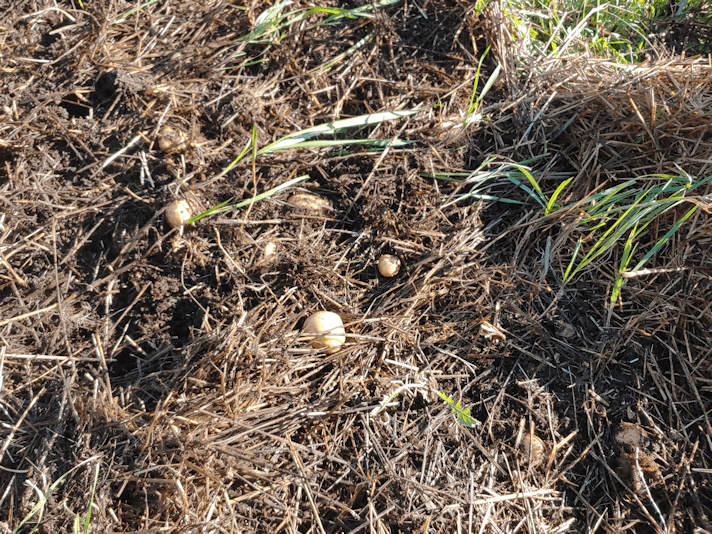
I first pulled up the potato plants, then carefully used my potato fork to lift off, then “rake” the mulch away. Here, you can see some of the potatoes I uncovered in the process.

I also uncovered several chilled little frogs! I carefully moved them to the mulch by the squash, where they could warm up in the sun.

I also uncovered slugs.

I did not rescue them. ;-)

Almost all the potatoes I found were just sitting on top of the soil! Some took a little more raking away of the mulch to find, but not much more.

What had been rock hard ground when we started, the mulched soil was so much easier to work – even with all the rocks.

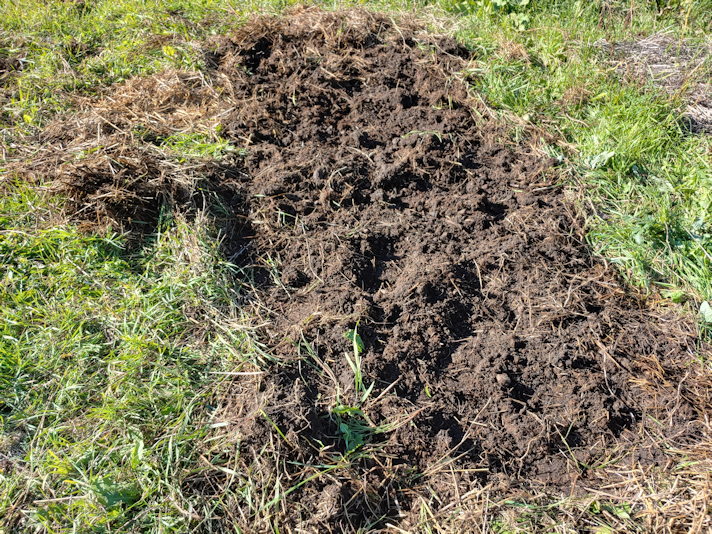
I took advantage of the situation and dug up the entire plot, so I could pull out as many weed roots as I could. The crab grass came out pretty easily. Then I hit a solid mass of roots near the surface, with a tap root of some kind that continued deep into the ground. I could not get it out with the fork! If I’d had the spade handy, I might have been able to cut through it, but since it seemed to be dead, I left it. It will be buried.

I did find a couple more potatoes in the process!

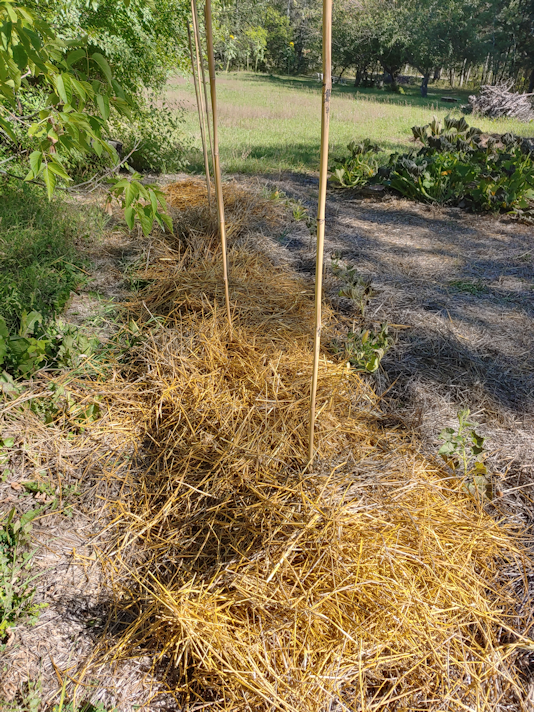
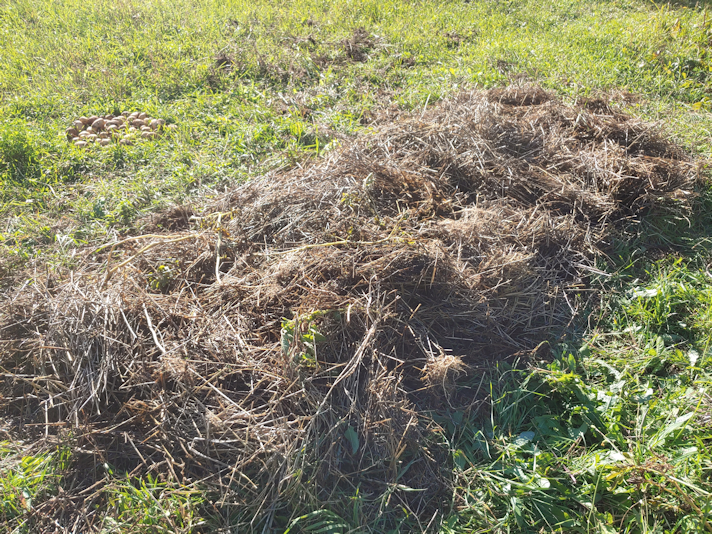
The end result looked like a 4×8 foot grave! :-D

When I finished pulling up as many roots as I was able, the mulch all went back – along with the potato plants that had been pulled up.

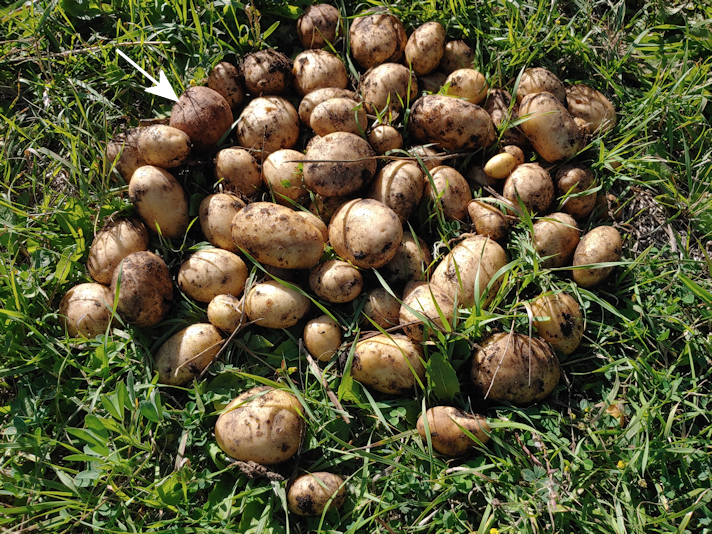
These are all the potatoes I got out of the one bed.

Also, note the one slightly darker potato with the arrow pointing to it. I’ll explain that, below!

When we got back from the city, I continued working on the second bed.

Once again, I was finding most of the potatoes on the surface of the soil as I pulled away the mulch.

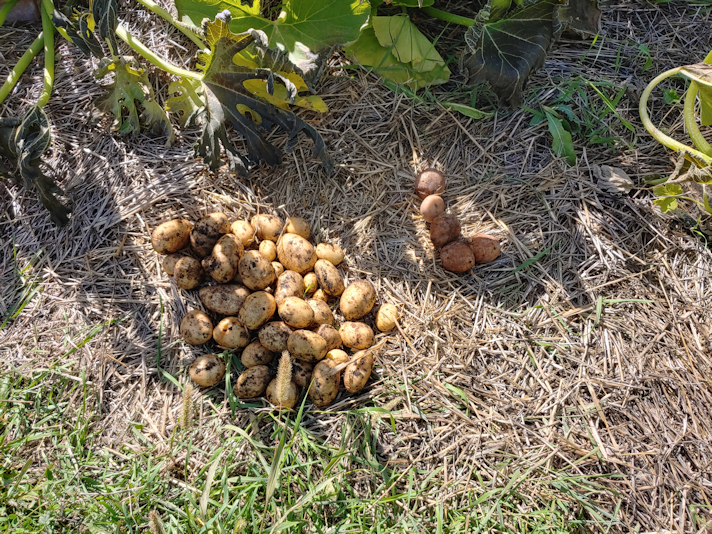
These are all the potatoes I found, before I did any digging at all. Unfortunately, quite a lot of them had holes eaten into them. :-( After digging, I found maybe 5 more.

Speaking of 5, do you see those 5 darker potatoes on the side?

Those are the original seed potatoes! The other bed had only one. While they had stems and roots that I broke off of them, they are just as hard as the day I planted them. I found the remains of some other seed potatoes, all mushy and used up like one would expect at the end of the growing season.

I got two 3 pound boxes of seed potatoes, which gave me 3 row of 6 potatoes in one bed, and 3 rows of 5 potatoes in the other, plus an extra. That’s 34 potatoes – and 6 in total never grew more potatoes!

As with the previous bed, I dug it all up, finding a few more potatoes, a whole lot more slugs, and pulling out weed roots.

Would slugs be the cause of those holes in the potatoes?

This bed had quite a few more rocks near the surface that I got rid of, too. My fork was hitting many more as I dug down, but I didn’t try to get them out, since we will continue to build these beds up. The mulch and old potato plants went back over the soil.

I then took all the harvested potatoes and laid them out on the dry straw mulch between squash beds, so they can cure (is that the right word for it?) in the sun. Except for the tiniest ones, which will be cooked and eaten right away. :-)

I then had the 6 original seed potatoes. What to do with those??

Yeah. I planted them, almost the same way they were planted in the original beds. The only difference is that I did loosen the soil a bit, first. Not to bury the potatoes – there are so many rocks along this end, I could barely do more than scrape away the mulch on top! No, it was so I could push in the bamboo poles to mark where they are. Even then, I don’t think the poles will be able to stay up for long. I could barely get them into the soil at all. No matter how I shifted and searched, I kept hitting rocks just inches below the surface.

What will most likely happen is that the potatoes will freeze over the winter, and nothing will come of them. Another possibility is that they will be protected by the mulch and, as soon as it gets warm enough next spring, they will start growing and we’ll have early potatoes started.

We’ll find out next year!

As for now, the potato beds are put to bed for the winter. I don’t know what we will plant in those spots next year. We do intend to do potatoes again, but in a different location. We don’t want to entice the Colorado potato beetle by planting in the same location again. We didn’t see a single one this year, but one of my neighbours a mile up the road mentioned that his potatoes had been decimated by them! My parents always planted lots and lots of potatoes, and I well remember going through the rows, picking off the beetles or their larvae, and hunting for the eggs to crush. Even with several of us doing that every day, some years my mother had to resort to using a poison powder of some kind, to get them under control.

I’d really rather not have to deal with them at all, if I can avoid it!

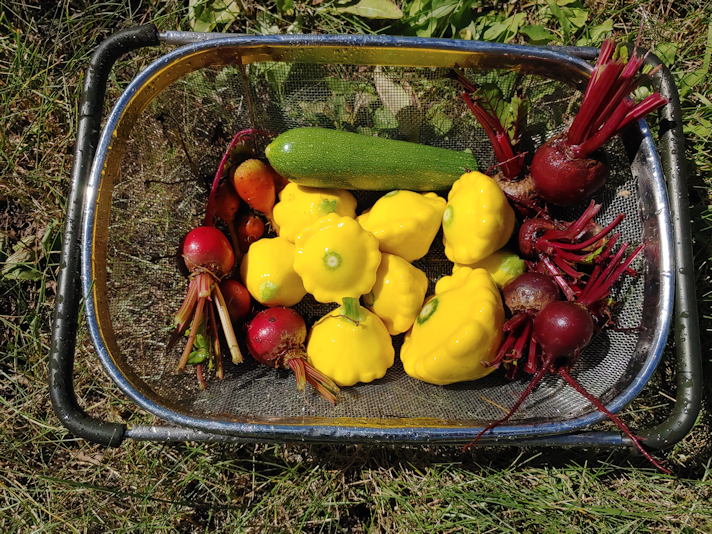
As for the squash, for now I have stopped harvesting any more of the sunburst squash, though there are a couple of zucchini that are almost large enough to pick. I prefer them when they are quite small, but with the sunburst squash, I want to give them as much of the remaining warm weather as I can for them to grow. As I write this, past 6pm, we are still at 21C/70F. We are supposed to stay fairly warm over the period covered by the long range forecast, with no more frosts expected overnight. That should give our produce a bit more time before we have to harvest what we can, then prep for the winter – and next year’s gardening! :-)

Our first year gardening since moving here has been quite interesting, and quite the learning experience. We will, for sure, continue using the Ruth Stout method until we are able to start making the accessible raised beds that are the ultimate goal. The extensive use of mulch is making a very noticeable, positive difference in the soil, even after just one year. My mother may be disappointing in our gardening, compared to what she had here, years ago, but I’m happy with our progress so far! :-)

The Re-Farmer