We tried a whole bunch of new things in this category, this year! It was the peppers that we were particularly interested in getting going.
Peppers are something I’m growing for the rest of the family – I can’t eat peppers myself, much like I can’t eat fresh tomatoes. Which is unfortunate. I love the shape and smell of them, and when I’m prepping them for the family, they look so fresh, crisp and delicious! Yet every time I’ve tried to eat a pepper, it makes me gag. Even when they’re cooked, I still find myself wanting to gag, which is not a problem with cooked tomatoes. Oddly, though, I can eat jalapeno poppers, and quite love them. How does that make sense? My husband and daughters, meanwhile, love their fresh, raw peppers. So I wanted to try a variety of bell peppers this year, plus my daughter specifically requested hot peppers.
We did try to grow peppers last year – our terrible, no good, growing year! – and almost got some purple peppers. Just a few tiny, misshapen ones off of plants that did not thrive in a bed where nothing really grew well. They pretty much did the best of all the stuff we planted in that bed.
We did still have some of last year’s seeds left, but this year we went with new varieties.
One was the Sweet Chocolate bell pepper. I also ordered a collection of early sweet peppers, for their short growing season – Early Sunsation, Early Summer, and Dragonfly, all of which are different colours. For the hot pepper, we got a variety called Cheyenne.
With our short growing season, the Sweet Chocolates got started indoors quite early, along with some gourds and herbs.

The German Winter Thyme and the Lemon grass both needed an early start, too. Lemon grass is a zone 8, heat loving plant, so those were going to go into a pot in a sunny and sheltered location, when it was time to transplant.
With our short growing season, these were all started in early February. A lot of people on my local gardening groups started their peppers in January! The other varieties we had were specifically for our short season, and I must say, I had to really fight with myself to not start them until much later! Those got started in late March. In theory, I could have direct seeded them.

After filling 4 rows, I filled the last two rows with Spoon tomatoes.
We started a lot more seeds than we needed, on the assumption that they wouldn’t all germinate.
Well, we had pretty much a 100% germination rate!
As for other herbs, in early April we started oregano, spearmint and the Roma VF tomatoes.

We tried these in toilet paper tube pots, which we hoped would allow us to pot them up/transplant them still in the biodegradable tubes, without disturbing the roots.

Finally, we started chamomile seeds and a nameless variety of thyme, towards the end of April.
The first ones to be transplanted outside were the Sweet Chocolates, into the new wattle weave bed.

The peppers got protective plastic rings around them, as this was well before our last average frost date. I eventually needed to add sticks to keep the wind from blowing them askew, later adding supports for the peppers as well.
In front of the peppers, you can see where the German Winter Thyme was planted. At the end of the bed are the last spindly shallots. Beyond the thyme is an onion that came up on its own! Later, the chamomile would be transplanted near where the single onion is, as well as the strawberries from seed planted in between things all along the front of the bed.
As the days flew by and we weren’t getting other things ready as quickly as planned, I ended up planting more peppers in the wattle weave bed, just in case.
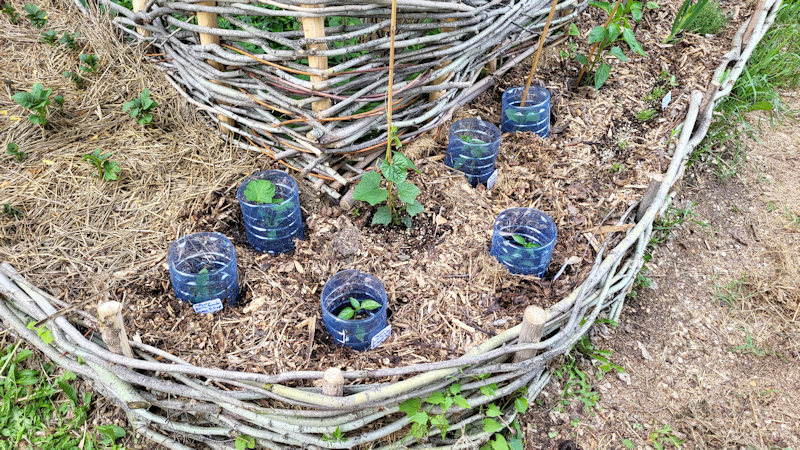
I chose one each of the early bell peppers, and one hot pepper. They got plastic rings to protect them, along with a couple other things I will cover in a different post.
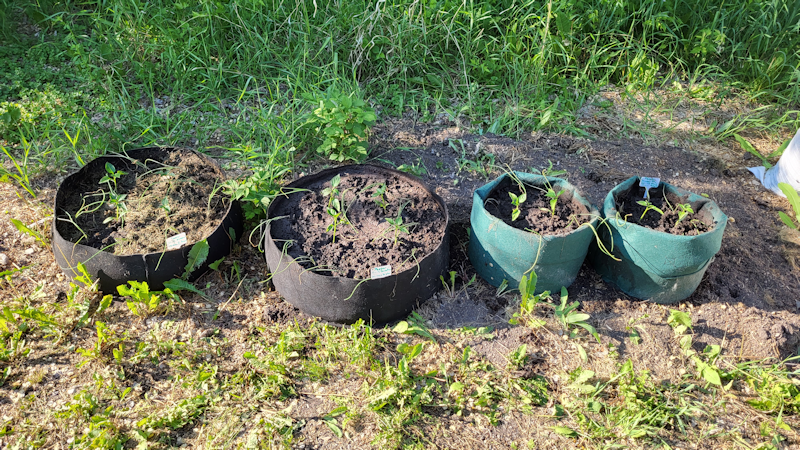
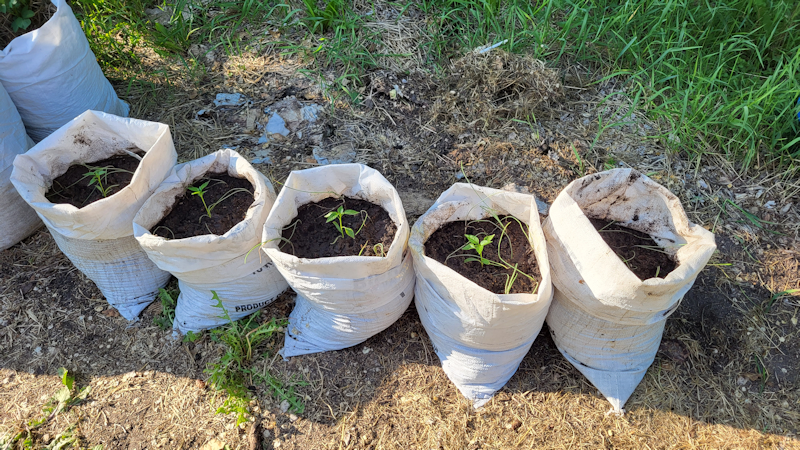
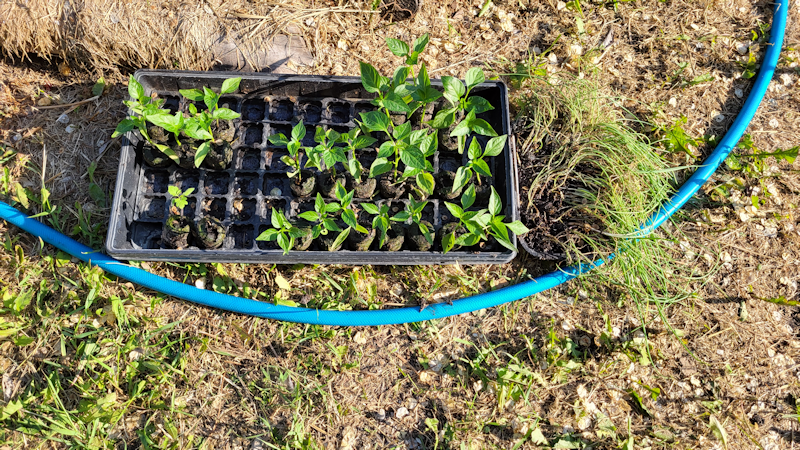
We did eventually transplant more of the peppers in grow bags, together with Red of Florence onion, but we had so many seedlings, they were included in the Great Transplant Giveaway!
Some things, however, did not need to be transplanted at all, and could be direct sown. When it came to greens, we were actually going to skip trying to grow lettuce this year, and just grow spinach.
Spinach can be sown before last frost, so they went in, in late April.

After the seeds were sown, the bed got a floating row cover, to protect them from critters. This was just a dollar store row cover, and it tore astonishingly easy!

We did enjoy some nice harvests of the spinach, too. At least, with these first ones. After the garlic was harvested, spinach was one of the things we planted for a fall crop, and we got nothing. I think something ate the seedlings!
We found ourselves with some free seeds that we decided to try. One of them was a tiny variety of Bok Choy called Hedou. The other was a Czech variety or lettuce called Jebousek.
So how did it all work out?
It was a mixed bag!
The Peppers
The Sweet Chocolates, having been started indoors the earlier, had a head start, grew quite large and were the first to have mature peppers we could harvest.

The first ones we harvested were in August. They can be eaten while still green, but we waited until they turned the chocolate brown they were supposed to, when mature. They bloomed continuously, right up until the first frosts started to hit. We did try to cover the peppers on chillier nights, and that helped. Their location in the wattle weave bed was also much more protected than the grow bags in the garden.
As for the short season varieties, they did not do as well. The ones in the grow bags started off all right, but then sort of stagnated. We did get a few Dragonfly peppers to harvest, and there were other peppers developing when the first frosts hit.
The hot peppers had the most fruit developing, but all of the peppers planted later were slow in maturing. In the end, we harvested everything unripe and set them to finish maturing indoors.

We had mild temperatures extending for quite a long time, though, and the final harvest was in October! In the photo, you can see a couple of purple Dragonfly peppers, and the rest that are visible are the Sweet Chocolate. There were hot peppers under there, too. Unfortunately, we covered grow bags too late one night, and the frost caused too much damage.
Once indoors, the green peppers that were not frost damaged did continue to mature. As I write this, we have a few hot peppers left that have turned red. The Sweet Chocolates are the only remaining bell peppers, they’ve all matured, and are currently strung up to dry. The rest were either already eaten, or had to be tossed due to frost damage causing them to start molding.
When cleaning up the garden beds for the winter, I discovered what I think may have been the reason the grow bag peppers and onions failed to thrive. I discovered the soil was filled with tiny tree roots that had grown in from below!

They were all like this grow bag, turned inside out.
No wonder they didn’t thrive!
As for the ones in the wattle weave bed, the hot pepper seemed to do fine, though late in developing, but the others seems to stagnate, too, and I’m not sure why!
Final thoughts on peppers
When it comes to the bell peppers, the family isn’t really finding enough difference in flavour to say they like one variety over another. They all just sort of taste the same, so they don’t really care what variety we grow next! I do have a request for hot peppers again. We still have seeds for all of these, so we don’t need to buy more, if we don’t want to. If we do grow the short season varieties again, I will most definitely start them indoors earlier. We’ll also have to be more thoughtful on where to plant them, to ensure they get shelter and a warmer microclimate. We might use grow bags again, but if we do, it won’t be anywhere near those trees again!
The Herbs
Our eventual goal is to turn the old kitchen garden into mostly an herb garden, along with other things that we might use in the kitchen frequently. This garden is right next to the house and sheltered, and gets lots of sun, except where the ornamental crab apple trees are an issue. Those will be pruned back more, over time. It also now has all low to mid height raised beds, with the possibility to add height to some of them, as needed.
The German Winter Thyme did quite well in the wattle weave bed, except for one transplanted group that suddenly died part way through the summer. The Chamomile also did well, and was blooming enthusiastically.
The spearmint got its own pot. We had only one oregano seedling survive – barely – so it was planted in the middle of a pot and surrounded by the other variety of thyme. The Lemon grass got its own pot, too. Everything in the pots seemed to do surprisingly well, though the Lemon grass didn’t get anywhere near as large as they should have.
Final thoughts on herbs
There’s really been just one problem with the herbs we grew.
We keep forgetting about them.
Which means, we weren’t using them.
Oh, we did use some thyme, oregano and a bit of spearmint, during the few times we remembered them. We didn’t use the chamomile or lemon grass at all. We weren’t sure when to best harvest the chamomile, which we wanted to dry for tea, and I never got around to looking it up, because I kept forgetting they existed. My daughter were wanting to try the lemon grass, but weren’t sure how to use it with the type of cooking we tend to do.
I don’t know about the chamomile, but with mulching the wattle weave bed like we did for this winter, it’s possible the German winter thyme will come back. The chamomile may have reseeded itself.
We never bothered doing anything to the pots. I suppose it’s possible the spearmint and thyme will come back in the spring; we’re having a very mild El Niño winter, so the pots shouldn’t freeze solid. I doubt the oregano will survive, though being in the middle of the pot, it’s more protected than the thyme around it.
These are all herbs I want to continue to grow, though, and as we further develop the old kitchen garden, I think we’ll get into the habit of using fresh herbs and not forget that they exist!
The Greens
With the spinach, they did better after we gave up on the floating row cover. Thankfully, no critters seemed interested in them! We’ve had spinach do both really well, and really poorly, and that happened again this year. The spring sowing was fine. The fall sowing was a complete fail.
We’ll definitely keep growing spinach, though. It’s just a matter of where, and making sure critters don’t get to it!
As for the lettuce and baby Bok Choi…
What a disaster!
Oh, they started sprouting just fine.
Then the Chinese elm started dropping their seeds.
There are four of them along the chain link fence, plus one by the house, plus more past the garage.
When those seeds start falling, everything is covered. The emerging seedlings were buried and choked out, and there was nothing we could do about it!
Those trees have got to go. They are causing all kinds of damage, with their billions of seeds and their sidewalk heaving, basement wall cracking roots.
Much to my surprise, however, a couple of baby Bok Choy actually survived and promptly bolted.
I left them be as they developed seed pods that managed to dry before the first frost hit. I was able to save some seeds!
There was a surprising number of Jabousek seedlings that survived! Enough that we even used some of the leaves in sandwiches. They didn’t seem to get bitter, even after bolting.
Once they started blooming, I left them be. Unfortunately, it took such a long time for their seeds to develop, they got hit with frost, first. I suppose it’s possible the earliest bloomers dropped seeds, but that bed is going to be reworked in the spring (I held off to let them finish producing seeds) to make it narrower, so it’s unlikely that any seeds dropped will germinate. We probably won’t grow any lettuces next year, but I certainly won’t complain if this variety shows up on its own!
I most definitely want to try growing the Bok Choy seeds we kept. We never got to try them, and I’m very curious! We do like Bok Choy, but very rarely buy it.
So that’s it for peppers, herbs and greens and, I must say, getting this written was brutal! It took me all day, just to get started, as so many things kept popping up that needed to be done. Then, once I did finally get started… I swear, I’ve never been interrupted while writing so many times in my life! Most of which was because I saw on the critter cam that racoons were in the sun room. !!! I did try using the talk feature to yell at them, and they did leave at first, but after a while, they’d just look towards the camera, then ignore my voice!
If anything I’ve written here seems at all disjointed or not to my usual standard of writing or its full of typos that I’ve missed, that would be why! 😄😄😄
The Re-Farmer

 The Re-Farmer
to me it sounds fascinating, including a chuckle at the end about those naughty racoons. :-) I would have thought I know as much about gardening as I do about football – next to nothing and what footballers call analysing a game can send me right of to sleep, but your post really did make sense. And who like chamomile tea anyway. Thanks for writing 😊
LikeLike