Last night, as I was topping up the food dishes near where kittens are, I found Butterscotch and her babies playing around the concrete steps at the side of the house. So I sat on the stairs and scattered some kibble at the bottom to see if I could convince them to come closer.
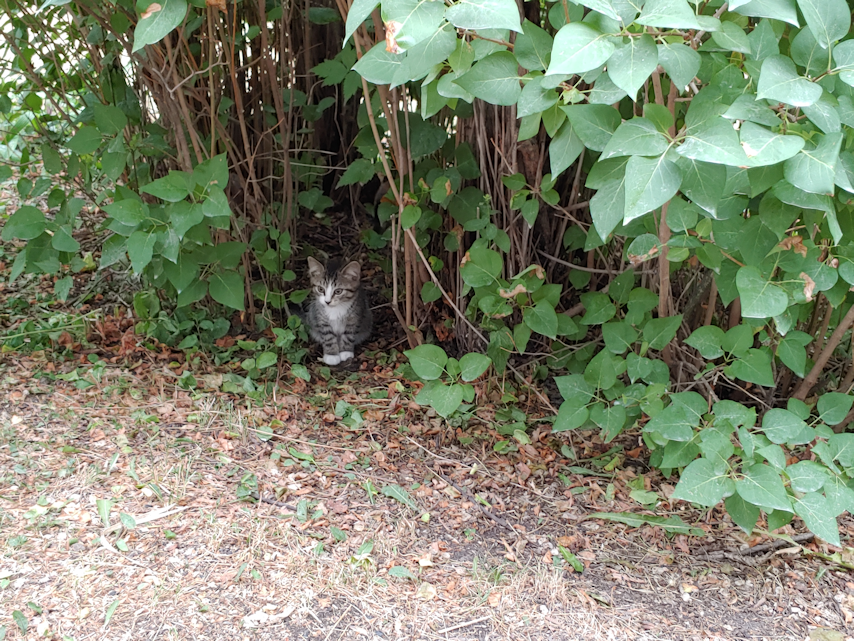
This was about as close as Bradicus got. At least I could see him! Chadicus just hid in the lilacs and peaked at me. :-D
While I was trying to get a picture of Chadicus (I never did), I heard a small noise beside me.
Broccoli had come over and was licking the container I used to carry the kibble in! :-D
Of course, I scattered some kibble on the step for her, as she ran off a little ways.
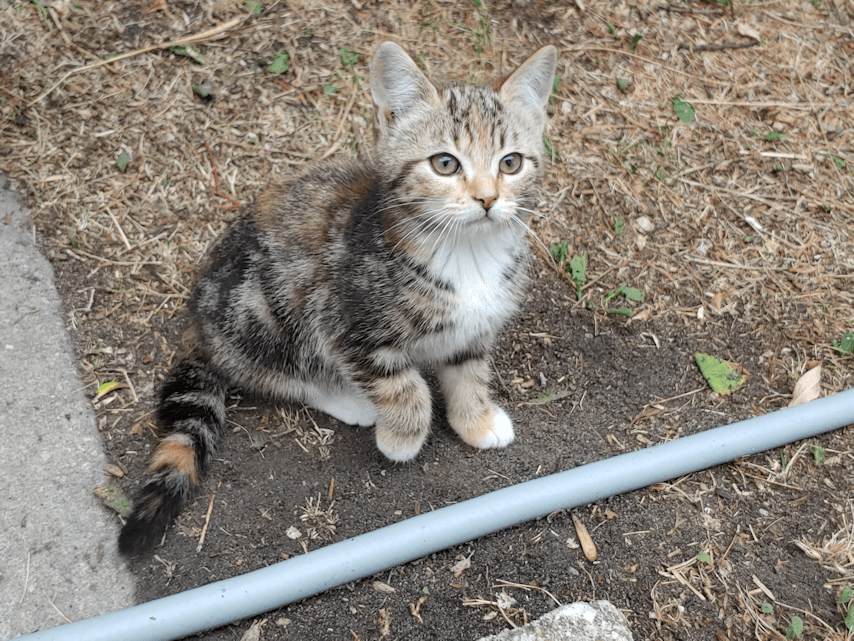
Those eyes!!!! My goodness!
Caramel is definitely one of the braver ones. My daughter has actually been able to put Caramel on her lap and scritch her ears.
Eventually, I had both Caramel and Broccoli on the step by my foot, eating kibble, and I was even able to touch and pet both of them!! They’re not comfortable with that at all, but were interested in the food enough to put up with it. A bit.
Gosh, they are cute. I just wish Butterscotch wasn’t leading them to the empty farmyard across the road. These babies need to stay close to the house!
For the past while, we have been pretty much constantly checking the weather radar. Yesterday evening, it was getting discouraging, and the predicted overnight rain kept getting pushed back and the weather system passed us by to the south. This morning, however, I was thrilled to see a system pushing rain right over is. Granted, based on the radar images, we should have been raining right at that moment, but at least we weren’t going to be missed entirely.
We did get at least some rain last night, as the ground was still damp when I came out to do my morning rounds. It even started raining while I was out there! A very light rain; the sort of rain that, had I not been outside being rained on, I wouldn’t have been able to tell it was happening, but still, it was rain!
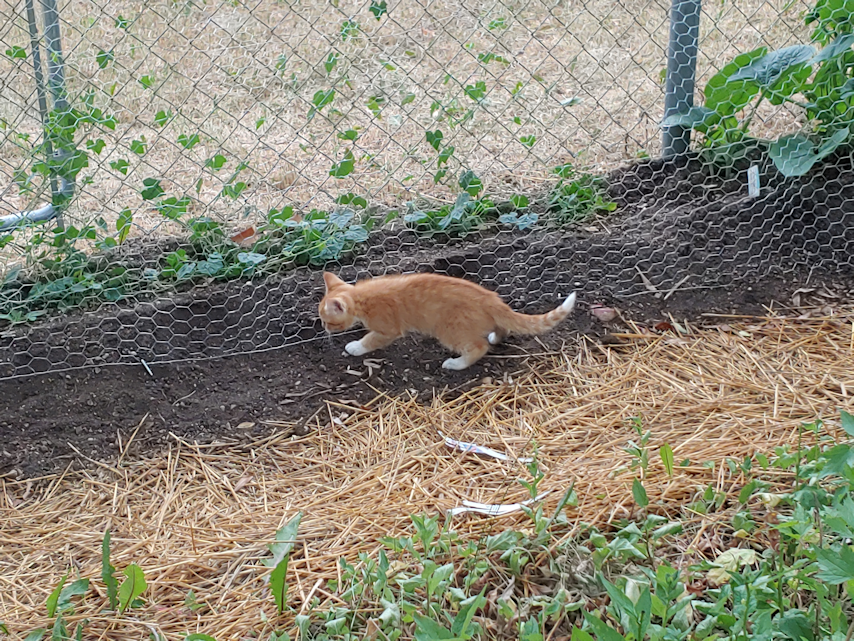
While checking the furthest garden beds, I was accompanied by Creamsicle Baby, who has finally started to allow us to pet him again. Frustratingly, when the cats follow us around those beds, they have a terrible habit of going into the pea trellises. This morning, I had to chase Creamsicle off the pea plants he was rolling on, only to have him come right back and start playing with the trellis twice, pulling their pegs out of the ground and getting tangled in them!
Even as I checked the garden cam this morning, I saw Butterscotch going through the pea beds, all four kittens following along, and every one of them went through the pea trellises, running, bouncing and rolling around.
Those poor peas just can’t seem to catch a break!
Other things, however, are doing quite well.
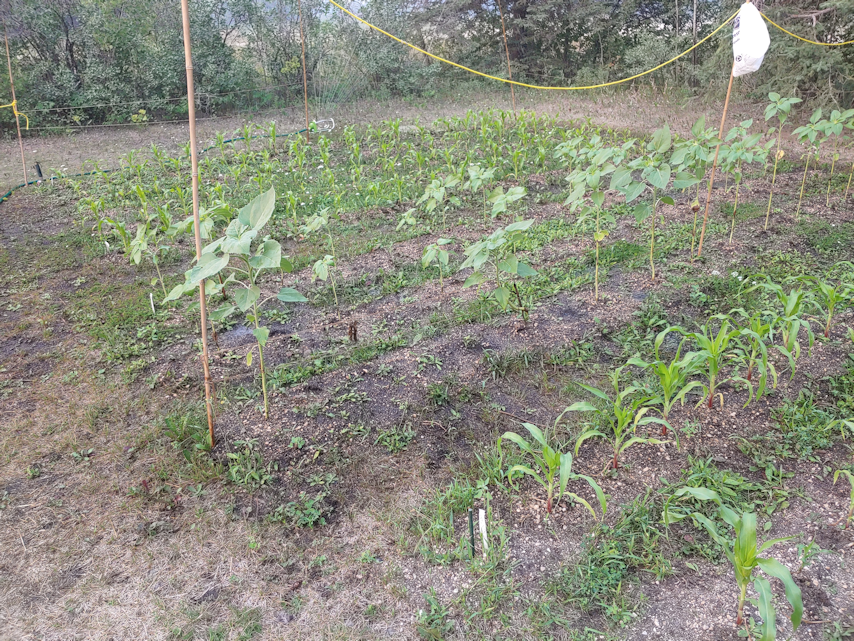
I’m really impressed by how well these Hope Black Dye sunflower transplants are doing. These are from the ones we tried starting indoors, but never germinated until well after we’d direct sown the other half of the seeds outdoors. The seedlings have pretty much quadrupled in size since they got transplanted. I don’t expect them to have a chance to reach maturity, given how late in the season they got transplanted, but part of the reason we grow sunflowers is as a privacy screen and wind break, and these might still accomplish that. Assuming they don’t get eaten. This morning, I saw deer tracks in the soil at the very ends of two bean beds, but no signs of anything new critter damage, so here’s hoping!
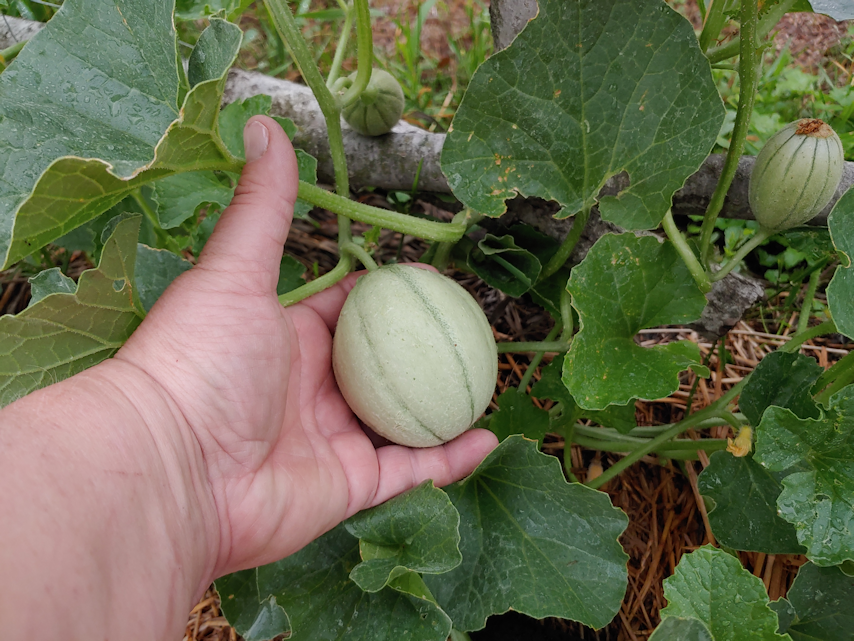
Every time we go out to these garden beds, we can’t help but check on the melons. They are getting so big!! This variety isn’t supposed to get as large as, say, the cantaloupes we see in the grocery store, but they are still supposed to produce lots of 4-5 pound fruit. The Pixies are supposed to reach about 1 1/2 pounds in size. I’m really, really excited about these. Melons are among my favourite foods, but we rarely buy them, as they are a treat, rather than an essential.
One of the challenges we’ve been having as been with the potatoes. Since discovering some critter damage, we unrolled the feed bags we’re growing them in to full height. If these had been indeterminate potatoes, we would eventually have done that by continually adding more soil, but these turned out to all be determinate potatoes, so there is no advantage to doing that.
Unfortunately, that meant there was nothing to support the bags, and the plants kept flopping over. Especially while being watered. If we had mulch, we could have added that to help fill the space and keep them from flopping over, but we don’t have anything right now. At least it’s been working to keep critters out, but some of the bags were flopping over to the point that I was concerned the stems would all break, and they’re still in their blooming stage.
Last night, I think I found a solution.
This is how they looked this morning, so it seems to have worked!
What I’d done is cut small holes near the tops of the bags, then tied them together with twine. The double row was tied together in groups of four, while the bags in the front were tied in groups of three. Then, just in case, extra twine was run around the front, tying them to the chain link fence. So now, the bags are holding each other up, while also protecting the plants from critters. It’s just insects we’ll still need to keep an eye on.
Hmm. One down side of finally getting some rain. There are some storms passing to the south of us, which means we’ve lost internet. The WordPress editor’s autosave has been spinning for a while, and once that starts, it doesn’t recover even once the connection is back. Which means that I can’t save my draft, and once our connection is up again, I’ll have to open whatever draft was last autosaved, then copy and paste whatever got missed into it, before I can publish it, and close this window.
Oh, the internet seems to be back again! Let’s see if I can publish this!
I just have to start with the exciting part. We actually got rain today!
Okay, so it was maybe only for about 20 minutes, but it was a nice, gentle, steady rain, and enough that after several hours, the ground is still damp. Not only that, but we’ve got a 90% chance of more rain overnight and into tomorrow morning.
Thank God!
Hopefully, by then, the smoke will finally clear out of the air, and some of that rain will hit the areas that have fires right now.
It is not going to make up for months of drought and heat, but it will certainly help. Even the completely dry, crispy grass has started to wake up and show green already.
It was lovely and cool when I did my rounds this morning, then a daughter and I went and checked all the garden beds just a little while ago.
I’m really glad we set up the chicken wire over the gourds and cucamelons. I found this critter damage this morning. It looks like something, likely a woodchuck, leaned on the wire and managed to nibble on a leaf through the gaps. Just one leaf here, and another on the other side of the chain link fence. Without the wire, we probably would have had a lot more damage.
While I was checking on these, Nosencrantz was playing on the concrete block leaning on a tree nearby, so I paused to try and get her to come to my hand. I managed to boop Nosencrantz’s nose before she ran away. Toesencrantz, on the other hand, was far more interested in trying to get at a lump of dirt on the other side of the chicken wire! He could get his paws under the wire, but the tent pegs held and he couldn’t get the lump out. Not for lack of trying! So that confirmed for me that the kittens were doing the digging in the dirt. More reason to be glad for the wire! The dirt lump got broken up, so as to remove further temptation.
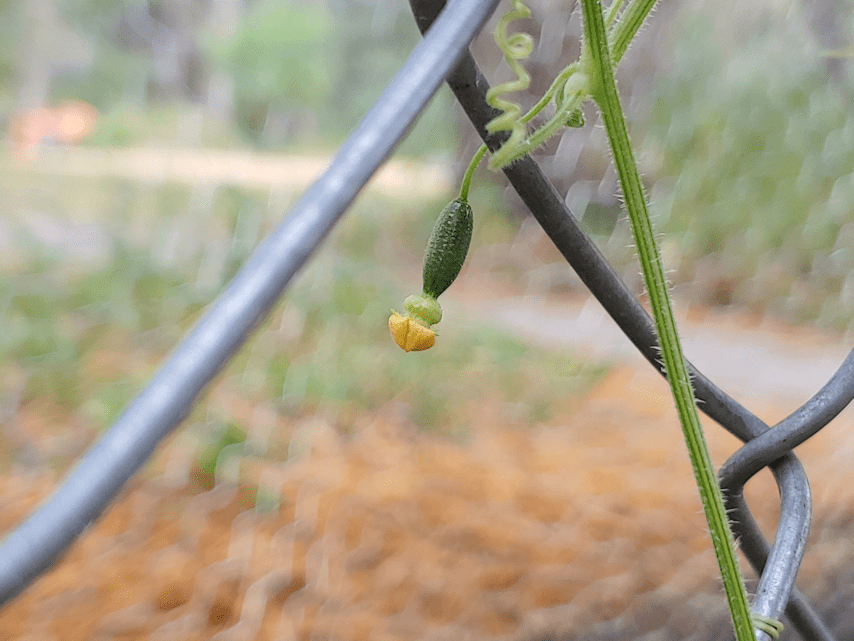
The cucamelon plants looks so tiny, but they are starting to develop fruit! The chain link fence gives an idea of just how tiny these are. I’m looking forward to seeing how they do in this location, which gets more sun than where we grew them last year. They produced quite well last year, for a plant that’s supposed to have full sun.
While checking things out with my daughter, I found new critter damage. When I checked the bed this morning, the damage wasn’t there. These are the Champion radish sprouts. Not all of them were eaten, and the purple kohlrabi sprouts next to them seem to have been untouched. Which would lead me to think it was grasshoppers, not a groundhog, except that after the rain, there were NO grasshoppers around. I didn’t see any in the morning, either, but I usually don’t, that early in the day. They tend to come out later.
Unfortunately, this bed has only the wire border fence pieces to hold up the shade cloth. We are out of the materials to make another wire mesh cover, so with the shade cloths not being used, this bed is unprotected, and there’s really nothing we can do about it right now. :-( On the plus side, it wasn’t a total loss, and I’m thinking the woodchucks, at least, are preferring the easy pickings under the bird feeder.
At the squash tunnel, we found this lovely friend, resting on a Halona melon flower. The melons, winter squash and gourds are doing quite well right now, though all the garden beds are due for another feeding. The baby melons are getting nice and big, and we keep finding more. I was really excited when my daughter spotted this, hidden under a leaf.
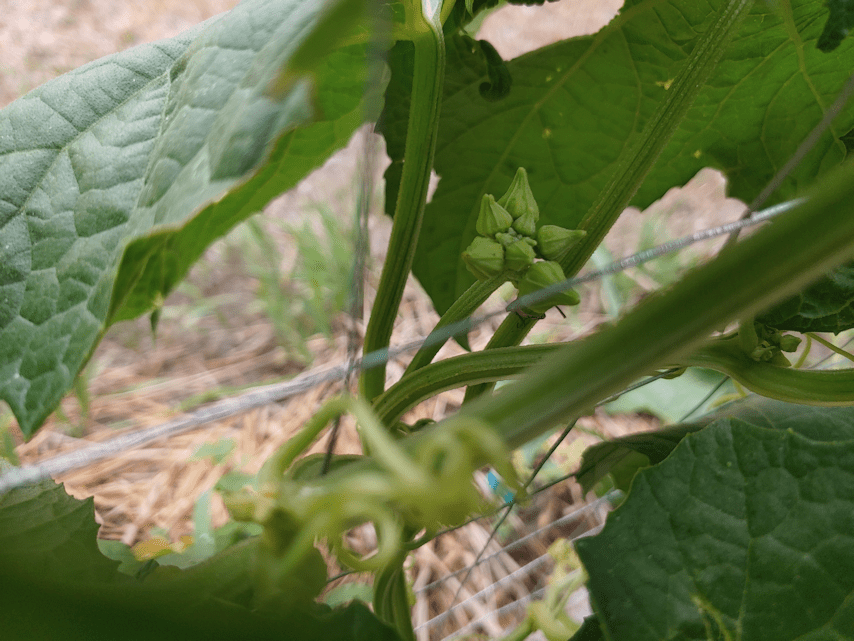
These are the first flower buds on the luffa! I was really starting to wonder about them. They started out well, then went through a rough patch, but since I started using the soaker hose, they are already looking more robust again.
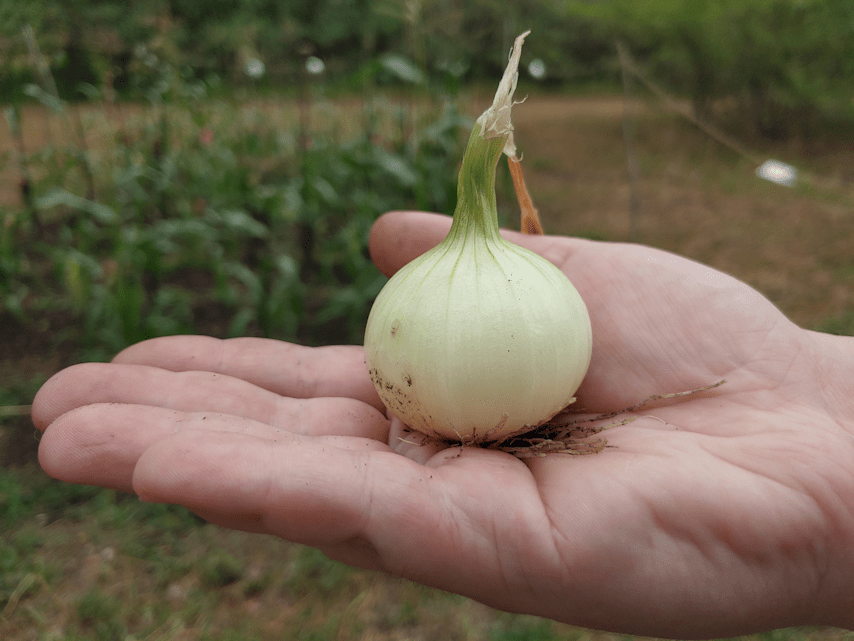
In checking the onion beds, my daughter spotted an onion that had lost its greens completely, so she picked it. It will need to be eaten very quickly. It is so adorable and round! This is from the onions we grew from seed. Though I’ve trimmed the greens of almost all the onions, we’re finding some of them with broken stems. Most likely, it’s from the cats rolling on them, as I’ve sometimes seen Creamsicle Baby doing.
We also found a green zucchini big enough to pick. I’ve checked all the plants, and while there should be at least one golden zucchini, I’m not finding any. Every plant is starting to produce fruit now, too, even if just tiny ones, and no golden zucchini. Odd. Perhaps the package was mislabeled and we got a different kind of green zucchini instead? There are differences in the leaves that suggest two different varieties, even if the fruit looks much the same.
Oh, in the background of the onion picture is the Montana Morado corn. We’re always checking them and the nearby Crespo squash for critter damage. There does seem to be some, but I am uncertain what to make of it. One corn plant, in the middle of the furthest row, lost its tassels and top leaves, but none of the others around it were damaged. It has a cob developing on the stalk, so I pollinated it by hand. Then I spotted another stalk, in the middle of the bed, that also lost its tassels. But what would have done that, while ignoring all the other plants around it? Very strange.
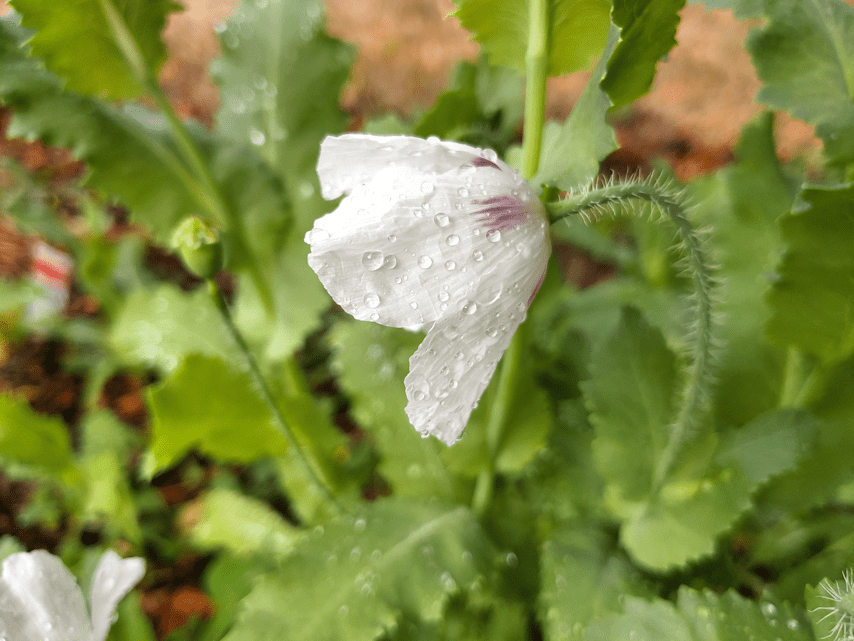
And finally, we have the poppies.
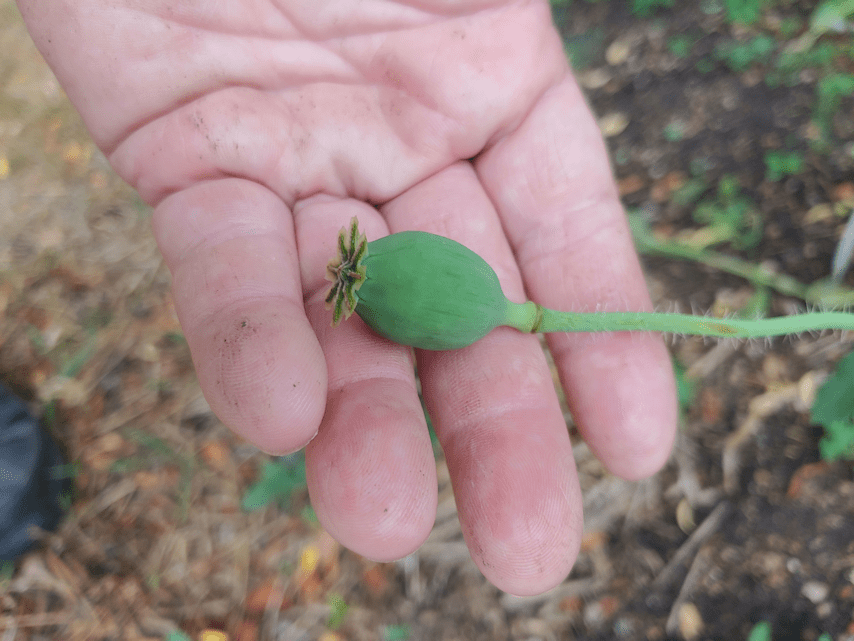
The Giant Rattle Breadseed poppies continue to bloom in the mornings, loosing their petals by the end of the day. Their pods are so tiny at that point, but in my hand, you can see the pod from the very first one that bloomed. It has gotten so much bigger!
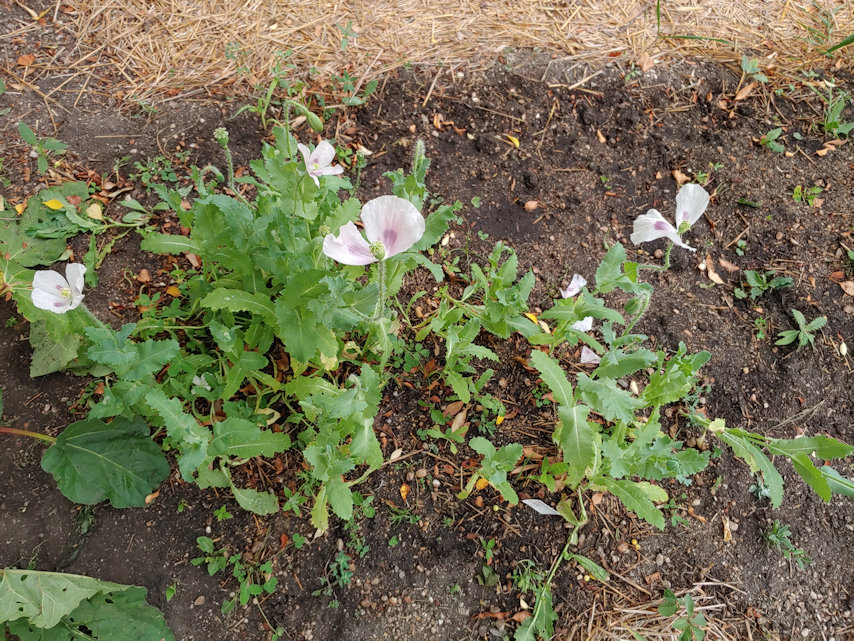
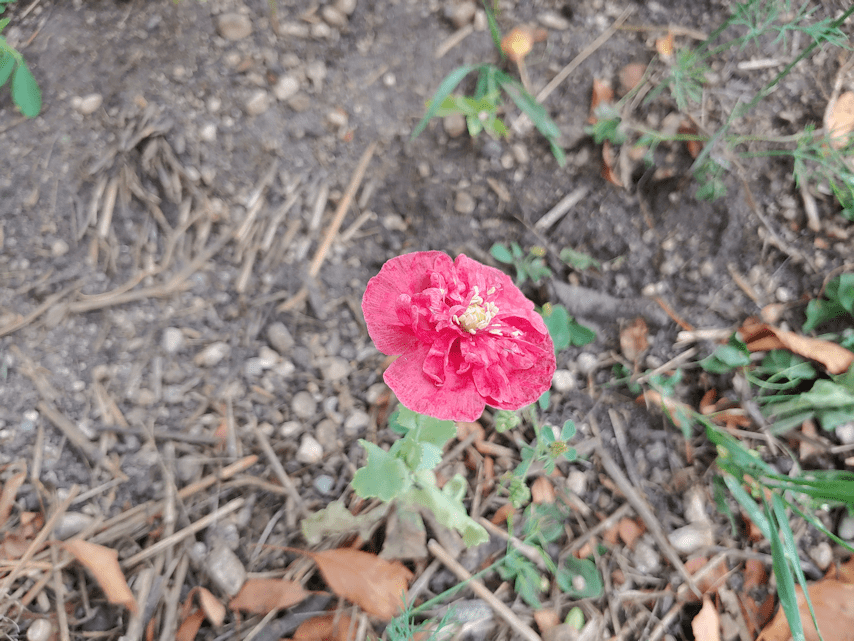
We also found a couple of these.
My mother had ornamental poppies in here, and even with the mulching and digging we did, some still survived. This photo is of the bigger of two that showed up in an unexpected place: where my daughter had dug a trench to plant her iris bulbs. Somehow, they survived, and now we have two tiny little ornamental poppies. :-D
In hopes that we will get rain tonight, we will not be doing our evening watering. If we don’t get rain, we will water everything in the morning, instead.
Today, I did something I haven’t done in quite a while; check things out beyond the outer yard. Everything beyond the fence surrounding the outer yard, plus the old hay yard, is rented out, and somewhat less than half of that is used for pasture.
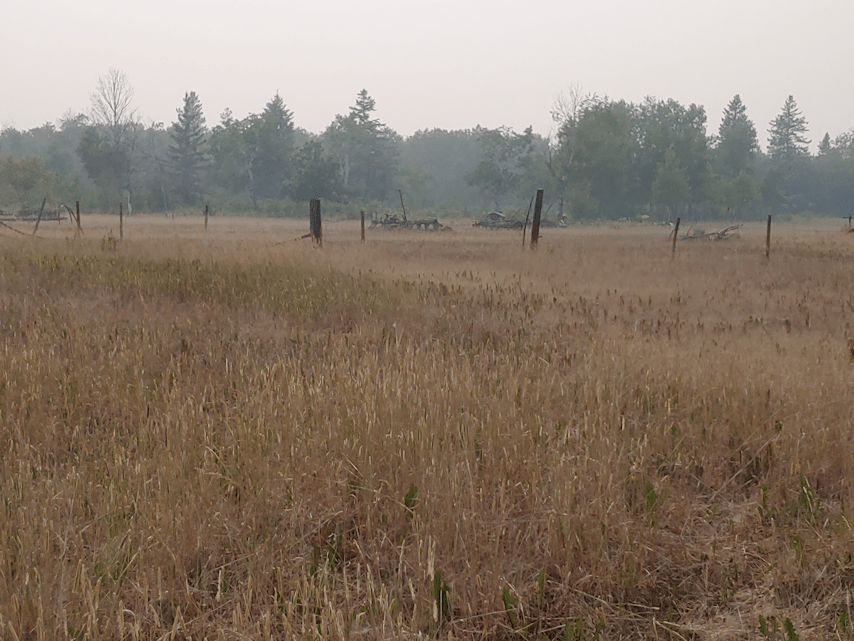
This first photo was actually taken from within the outer yard.
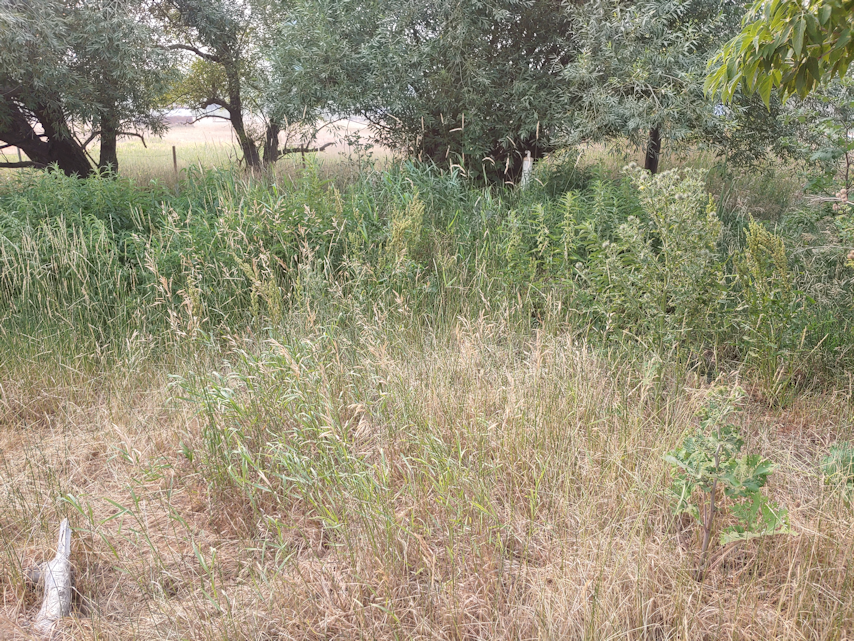
Everything is bone dry and crispy, and you can see the haze of smoke from wildfires that are nowhere near us! Keep in mind that the camera automatically cleans up haze, so the view was actually smokier than this.
This photo was taken at the “gate” by the barn. You can see the renter’s electric fence wire ends here. The only green that shows among the dormant grass is dandelions, and even they are burnt red.
This is facing the areas behind the old barn. By the time the renter rotates his cattle here, this grass is typically 2, almost 3, feet high.
This old pond is typically a source of water for the cattle. I walked to the deepest part, and even there, the ground is bone dry.
Also, we would normally be able to see the neighbour’s tree line in the distance, about a mile away. In the photo, it’s just barely visible as a shadow.
This is the deepest areas of what used to be a gravel pit, but which became another dugout to provide water for the cattle. At the far end is a marshy area that eventually reaches as far as the roadway by the pond.
This is in the deep part of the old gravel pit. Most of the tracks look like they were made by deer, but I think I saw some that looked like there were claw marks. All the tracks are old. There hasn’t even been mud here for some time.
This pit used to be quite a bit deeper. Since it wasn’t being used for gravel anymore, there’s at least a couple of decades of pond sediment, decaying plants and cow manure building up at the bottom. One of these years, I would like to have it, and the pond, excavated again. Since we moved back here, this is the first time I’ve seen the old gravel pit completely dry. Even in last year’s drought conditions, there was still water in the lowest area, making it one of the few sources of water for wildlife in the area.
Here, I’m standing at the “end” of the gravel pit area. Behind me is more marshy area that extends to a “creek” that is part of the municipal drainage system, but tends to have water only with the spring runoff.
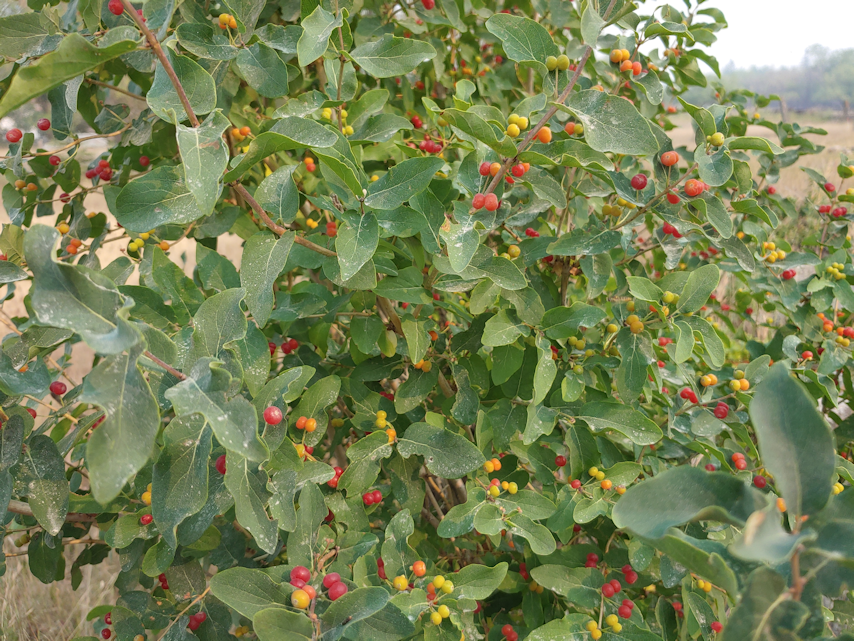
Heading back towards the house, I checked out an area that is mostly rocks and broken concrete that is overgrown with hawthorn and other bushes. This is the only thing there that has berries on it, and they’re not doing very well.
The white that you see on the leaves is dust kicked up on the gravel road, every time something drives by.
There has been a lot of road dust this year.
Another view of the pasture area, looking towards the pond.
Walking through all this, not only was everything crispy and crunchy, but ever step I took sent masses of grasshoppers flying. With things this dry, I don’t think even the grasshoppers can eat it!
There is but one area of relatively lush, green growth.
The septic field.
This is out towards the barn. Unlike a gravity field, our system pumps the greywater from the tank by the house, all the way out here. You can see the white pipe that is the outflow. It just sprays out from there. There is an entire low area beyond this that, in a wet year, forms another pond. It had been fenced off to keep the cattle out, since any water there would have septic water in it, too, but those fences have long since fallen down.
After I finished my walkabout, I set up the soaker hose at the squash tunnel, then decided to try an experiment.
Our green peas in particular are pretty much toast. Or should I say, toasted. They are still blooming and trying to grow pods, but between the heat and whatever is eating them, we aren’t going to get a crop from them.
The Dalvay peas are sold by weight, not seed count. Which means we had a LOT of seeds left over. Part of why I wanted to plant so many peas and beans near the corn, and to do it in this far flung area, was for their nitrogen fixing qualities.
So I decided to take the leftover seeds and plant them with the sweet corn.
Interestingly, not long after I started, I realized I was hearing the sound of a small engine vehicle moving around on the property. It turned out I was not the only one who decided to check conditions today. The renter had come over on his utility vehicle and was checking out all the pasture areas.
If he does rotate his cows here, I suspect he’s going to have to provide both food and water for them. Last year, he only had to provide water.
One of the things I’d like to do in the future, if we ever have the money to do it, is get those two water fountains going again. It would mean replacing our pressure tank with a much bigger one, as there had been in the past, and hiring someone to make sure all the pluming and the tanks themselves are in working condition. We don’t have cows of our own, but they would be good for wildlife, as well as the renter’s cows.
That’s something for the dreams list! :-)
I was almost done planting peas when my daughter came out to set up the sprinkler. Using a sprinkler feels like such a wasteful way to water, but for this area, we simply couldn’t water them as thoroughly as they needed, any other way. The other beds don’t have the same issues. It’s remarkable how different soil can be, even in a short distance. Since we started using the sprinkler, the corn and sunflowers have been doing visibly better.
There were so many peas left in the package, I was able to plant one pea for every corn in the block-and-a-bit visible in the photo. In these, I had planted a couple of seeds of corn a foot apart, then thinned them later. In the last block, I just planted a corn seed every six inches. Most of them germinated, so there wasn’t the space to plant one for every corn plant, so I planted one every 1 – 1 1/2 feet, depending on the spacing.
I still had enough seeds to plant more among the surviving Dorinny corn. Then I still had enough to plant with the Montana Morado corn (which seems to have been replaced at Baker Creek with Mountain Morado corn). And I STILL had seeds left over! Only about a dozen or so, but wow, was Veseys ever generous with their quantities!
Now, these seeds had been left behind in a storage bin we keep by the rain barrel next to the pea trellises. Which means that they’ve been out in this heat all this time. It’s entirely possible they won’t germinate. Or only a few will germinate.
Though planting peas for a fall crop this time of year, to get a fall harvest, is something that can be done in our zone, this year is so hot, we might still have the same problem as with the ones I planted in the spring, even if they do germinate. However, that’s not what I’m planting them for. I’m planting them for their nitrogen fixing qualities. Corn are nitrogen hungry plants, and our soil is nitrogen depleted. Yes, we can use a high nitrogen fertilizer, but having a plant that will do that job is preferable. Plus, if they do germinate, the corn plants will provide shade for them, while also providing a natural trellis for the peas to grow on, as with beans in Three Sisters plantings. We only have bush beans, though, so they won’t climb the corn. People had been talking about the Three Sisters method of planting in some of my gardening groups. Some people found it worked well. Some found that the squash made getting at the corn difficult, or that there was just too much competition for nutrients, and some found peas worked better for them than beans.
So we shall see how this turns out.
As I’ve mentioned in the past, all of these far flung beds are temporary. We’re basically breaking and amending the soil in perpetration for future plans. With what we are learning this year, we are already adjusting some of those plants. We were talking about planting a nut orchard and fruit trees, which we’re going to have to do soon, because those can take years, in some cases a decade, before they start producing.
We’re going to be adding a step.
My daughters and I have been going through the Whiffletree catalog, repeatedly. With the soil conditions we have, we’re now thinking to start by adding hedges. There are several options available for zones 2 and 3 that not only produce edible fruit and do well in poor soil, but also help fix nitrogen in the soil. If they’re still available next year, we’ve decided on three different ones. Silver Buffaloberry, which is a zone 2 bush, Autumn Olives (also called Autumn Silverberry), which is a zone 3 bush that is semi-fertile, and Sea Buckthorn, which is a zone 3 bush that requires 1 male variety for every 5-9 females varieties. On top of producing edible berries, being able to grow in poor soil conditions, and acting as nitrogen fixers, these will also form a barrier that will not only give us a privacy screen from our peeping vandal, they are dense enough to form a barrier that deer can’t get through. Plus, they will be dense enough to act as dust barriers. We’ve worked out the areas we can plant in, leaving a gap over where we thing the buried telephone wires are. We never did hear back from the Call Before You Dig people, but I figured out an easy way to do it. My brother’s property is right across the road, and the lines run though his place, too. He has a gap in his spruce grove, over the phone lines. All we have to do is line up our gap with his! :-D Anyhow, after we start with these nitrogen fixing, berry producing bushes, we will then start adding fruit and nut trees in what is currently a big void in the old garden area. Little by little, year after year, we will be adding more food trees, strategically placing each of them, so serve multiple purposes. At least, that’s the plan right now! :-D
Meanwhile, by the time I was done with all the pea planting, the smoke in the air had gotten to the point that there was a haze in the yard. As I write this, I can see the live feed from the garage security camera, and I can see smoke in our driveway. We’re still getting rain in our forecast, but in millimeters. Some areas did get rain today, which I am happy to hear about, but none of it is reaching us. I would actually be okay with that, if we could at least get rain over those northern fires.
Today, we finally have cooler temperatures! According to the hourly forecasts, we should be at about 23C/73F right now, but we’re still at only 18C/64F, which is awesome. There are still predictions of rain, all of which have been passing south of us. We desperately need rain. I’ve been reading about how it’s affecting some of our farmers. Those growing things like oats have had their crops gone crispy. Cherry producers (I didn’t even know we had a cherry industry in our province!) have had their cherries bake, right on the trees.
On top of all that is the smoke. I had to make a trip into town this morning, and it’s even worse there. There are fires on the other side of the lake, which is likely why. There are no fires near us but, today, the smoke is heavy enough to affect visibility quite a bit. I was talking to my mother on the phone a little while ago, and the smoke coming into the house was so bad, I had to excuse myself for a couple of coughing fits while talking. I’ve been able to reduce my mystery coughing fits pretty well over the last few years, but with this smoke, I’ve had more in one day than I’ve had in the last 4 years since we’ve moved here. I’ve actually reversed the fan in my window to blow the smoke out, even though I would normally be drawing the cooler air in while we’ve got it.
This adorable monster was eating our bird seed this morning. I saw one of the smaller ones out my window, heading to the bird feeder, just a little while ago. I should probably chase them away, but as long as they’re eating the seeds, they’re not eating my garden, so… I’m letting them be for now.
I’ve got the garden cam set up to try and see what has been eating our peas. The only things that got caught were a skunk and Butterscotch going by. Skunks are omnivores, so it could potentially be a skunk, but the one I saw was just passing through.
When doing the watering last night, I uncovered the beds with radishes, chard, kale and kohlrabi. This morning, I left them uncovered. We’re overcast, so they don’t need the shade, and if we do get rain, I want them to get some!
While talking to my mother about the current drought conditions, I mentioned that there are people whose wells have gone dry. I told her I thought my brother had said our well is 80 feet deep. It’s a number that’s been bothering me, but I couldn’t remember him saying anything different for this well. The old well in the pump shack (which predates my family owning this property), I remember him saying is about 110 feet. My mother, however, corrected me. She didn’t know about the old well, but she did remember that the well by the house is a little over 150 feet deep.
I suddenly feel much, much better. There is no way my brother would have been wrong about that, since he was heavily involved when all the work was being done, so I don’t know where I got that 80 feet from. Especially since I know we have a deep well pump. “Deep” is a relative statement, depending on the geography and elevation, but I know that in our area, even 80 ft would be considered pretty deep. However, if we’re loosing pressure while using two hoses at the same time (granted, one of those hoses had been running a sprinkler for an hour) at 150 ft in current conditions, at 80 ft, our well would probably be dry right now. Which is a rather alarming thought.
And so we pray for rain, for respite for our farmers and firefighters, and to clear some of that smoke out of the air!
As we were reaching the hottest part of the day, I had concerns about the garden. Specifically, at the squash tunnel. The summer squash are well mulched and can stay cooler and moister longer, but the melons, winter squash and gourds are not as well set up, and they need more water than most other things.
I had an idea, so I headed out to the garden, only to get distracted as I walked past the concrete steps at the side of the house.
The woodchuck tried to get under the stairs again! I had checked it this morning, and it was not like this, so the attempt was made some time later.
It did not succeed.
I did see a woodchuck eating the sunflowers I scattered on the ground under the hanging bird feeder, and ended up leaving it be. I figure, it it’s eating bird seed, it’s not eating my garden. :-/
I put all the rocks back again, then jammed the boards you can just see in the photo, on top.
Anyhow.
On the way to the garden, I dragged the soaker hose over. In checking the plants at the squash tunnel, I found they were very wilted and drooping. I carefully set the soaker hose up as close to the stems as I could, making sure it went under any vines and leaves.
Which is why I finally was able to see this.
It’s a Pixie melon!! And so big, too! I’d been looking carefully to see if there were any melons forming, and never saw it until today.
I even found other ones starting to grow.
That is so awesome!!
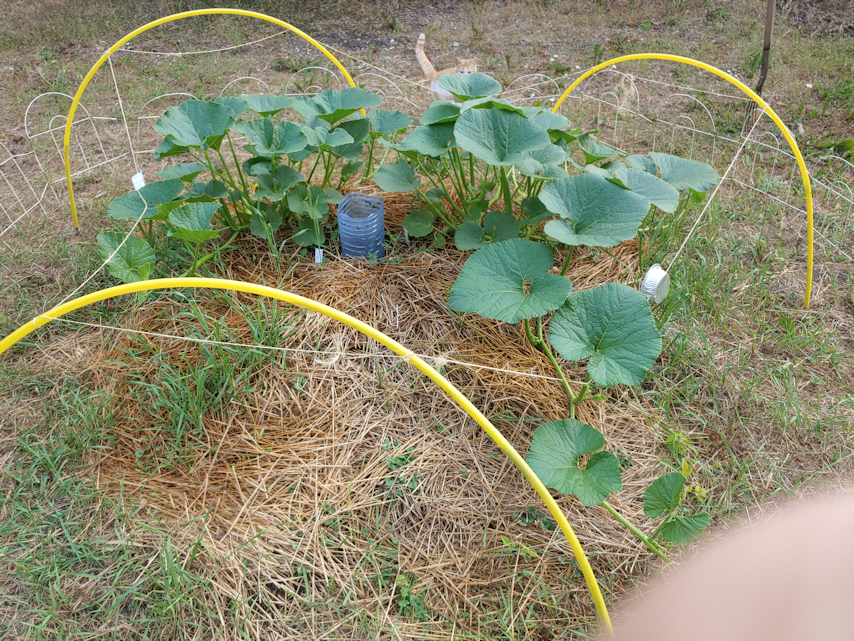
The soaker hose is 50 ft long, so I was able to go around the entire outside of the squash tunnel, and even have about a foot and a half to spare that got looped back to the inside of the squash tunnel.
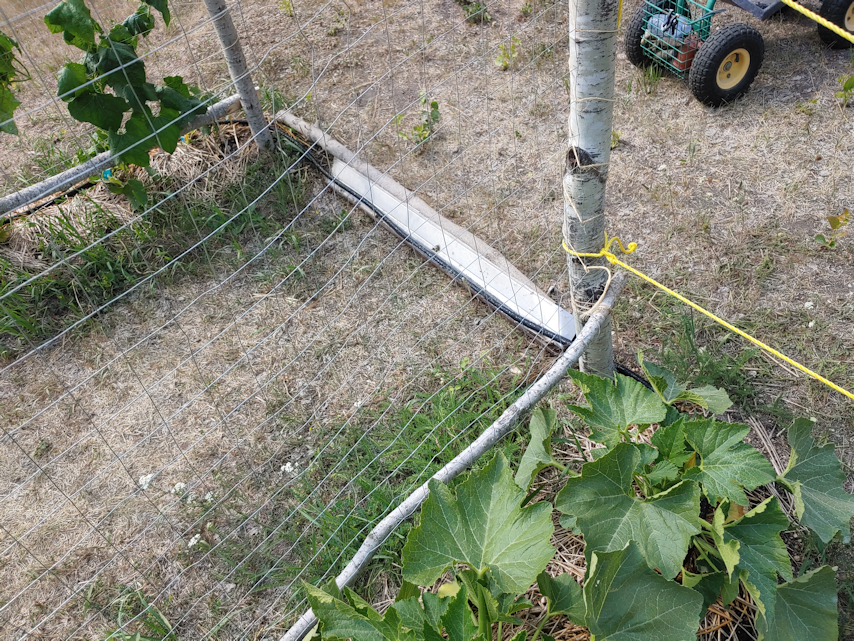
I didn’t want to be wasting water by watering the path, so I scavenged a piece of metal to put under it. It’s aluminum, the same as our eaves troughs, but it isn’t part of an eaves trough. I don’t know where it came from. We found it in the yard, by the back of the house, one day after some high winds. Wherever it came from, it didn’t blow off the house, which is the only place we have eaves troughs in that colour.
Well, it’s coming in handy, now. It’s got bends in it that I’m taking advantage of to use as a trough to divert water from the soaker hose to the ends of the squash tunnel. It doesn’t quite reach the ends of where we planted, but it’s close enough.
Before turning it on, I made a point of unscrewing sections of hose as I walked back to the tap, to drain off the scalding hot water that was inside it!
Since this hose releases so little water at a time, we can hook it up and leave the water running for an hour or more, before we switch the hose to the sprinkler to do the corn and sunflower beds for about and hour, timing it so that we can then do the evening watering when it has finally started to cool down.
The melons, gourds and winter squash are all heat loving plants, so having this set up to water them more deeply should help them quite a lot as they develop their fruit.
I am SO looking forward to tasting our very first melons!
We’re hitting a milestone today. This is post 3000 since we started the blog!
I suppose it’s appropriate to mark the growth of the blog by highlighting growth in our garden. :-)
Starting with this strange looking growth!
I spotted this strange shape, hidden in near the middle of one of the garlic beds. It looks like a garlic bulb is forming in the stem, instead of the ground! Or, as well as? Will this garlic plant have two bulbs? I look forward to finding out when they are harvested!
While watering in the evening, the girls found that something had squirmed its way under this beet bed and nibbled on quite a bit of it. More rocks and bricks were added to hopefully prevent it from happening again. The beets here had been recovering quite well, once we’d put the netting over it. This damage was mostly likely done by a woodchuck.
Which reminds me…
Yesterday evening, as my daughter went out to water the gardens, she found TWO woodchucks, loafed in the carrot bed in the main garden. The two smaller ones, just sitting there. As she came closer, one ran off, but the other just hunkered down. When she came still closer, it ducked behind one of the logs framing the bed and watched her over the top. She says she came so close, she could have slapped it in the face, while trying to shoo it away! It just did not want to leave! If finally did run off under the garden shed, but she had to practically chase it the whole way.
Brazen buggers, aren’t they?
The summer squash is doing really well and getting quite bit. This is the only bed that is fully mulched, and it’s making a very clear difference.
Next year, we really need to make sure we have lots of mulch available.
The onions we grew from seed are also doing the best of all the onions. It may be easier to grow from sets but, at this point, it seems well worth the effort to start from seed, instead. It’s really just a matter of finding the space to do it. Especially as we plan to grow a lot more next year, with more dedicated interplanting, so they can protect other vegetables.
The Montana Morado corn is doing really well. Some of the plants are about 5′ tall now. If we were not in drought conditions, they would be much taller, but they are still doing better than any of the other corn. So much better that I think we will start all our corn indoors and transplant them next year. Except the Dorinny corn, if we grow that again, since that one is meant to be direct sown before first frost, not after. They may not be as tall as the Montana Morado corn, but they are more robust.
The Crespo squash is recovering from critter damage very well. It has shot out new vines, one of which you can see has latched onto some twine! The smaller transplant (on the right, in this photo) is now the bigger plant, too.
Also, it takes a special talent to put your finger over the lens while using a cell phone to take pictures. LOL!
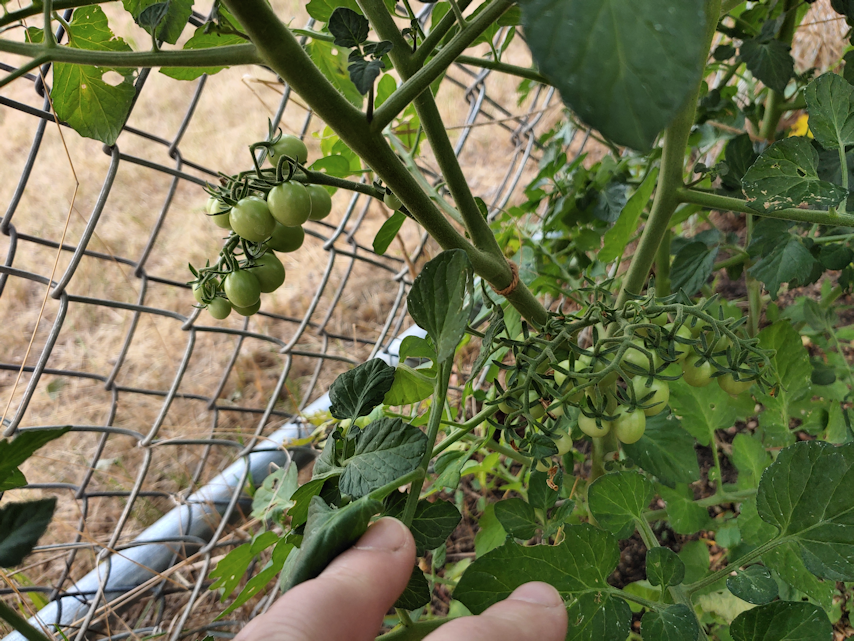
One of the Mosaic Mix tomato plants has SO many developing tomatoes on it! I don’t even like tomatoes, but I am really excited over how these are doing.
The tomatoes have gotten big and bushy enough that even some of the branches that have grown through the chain link fence are needing support.
Speaking of support…
Once the cucamelons finally reached the fence, they just shot up new vines and tendrils! Hopefully, the fence will soon be dense with leaves.
I need to find a way to put the fallen soil back and keep it there. I think the kittens are playing in the dirt and spreading it around. :-D
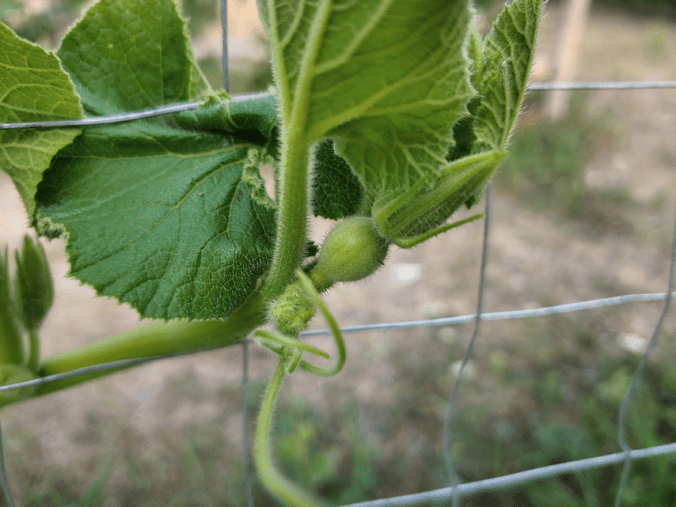
Even the Ozark Nest Egg gourds have gotten to the point where they are starting to climb!
If we can manage to keep things alive, we should still have a pretty decent harvest in the fall.
Today is supposed to be the hottest day of our current heat wave.
Of course, forecasts remain all over the place.
We’re going to hit 34C/93F but it will feel like 40C/104F
No, we’re going to hit 37C/99F and it will feel like 37C/99F.
We’re going to get thunderstorms today.
No, tomorrow.
No, the evening of the day after and into the following morning.
No, we’re going to get thunderstorms today – but only a 60% chance, with less about 5mm of rain.
We’ll see what actually happens! As I write this, we are at 30C/86F, and there’s enough wind to make it rather pleasant in the shade. While I was doing my rounds this morning, it was a very comfortable 17C/63F.
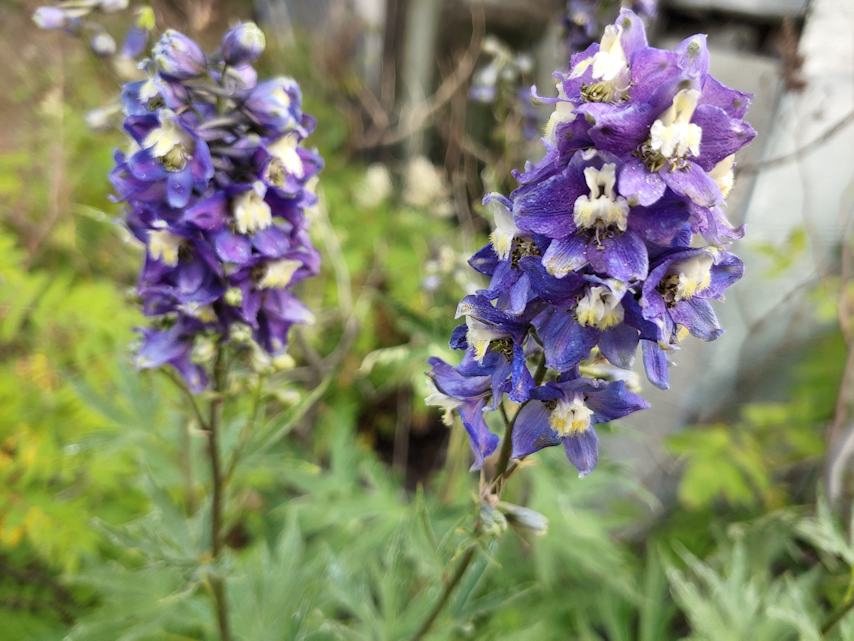
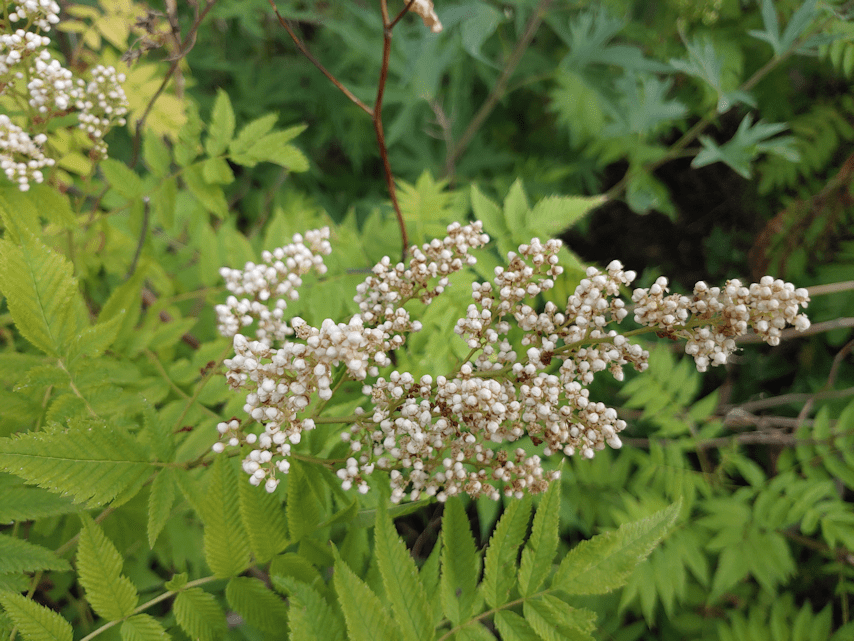
One of the few non-garden areas we’ve been giving at least some watering has been the spirea next to the storage house – the one area we are allowing the spirea to grow – and the grape vines (there are only a couple of clusters on the vine this year). More specifically, right at the corner of the house, where these flowers are growing.
When we first saw these flowers, it was a real surprise, because the plants were completely buried by the spirea. Since then, we’ve been cleaning up the spirea, taking out the dead bits and keeping it under control, but it still hid the plant and we wouldn’t see anything of it until the flower spikes shot up.
This spring, with the warm May we had, the spirea had been leafing out and starting to show flower spikes. Then that -8C/18F night hit and killed off the flower buds and damaged the youngest leaves. So the spirea is a lot thinner this year, even with our watering. Which means, for the first time, we could actually see the plant this flower is from, and it has grown much larger. You can tell by the flowers, though, that even with watering, the heat is getting to it. The flowers are smaller and shriveled looking compared to how it usually blooms, even when buried by spirea.
The spirea, meanwhile, has recovered to the point that it is starting to bud again. This will make the pollinators quite happy!
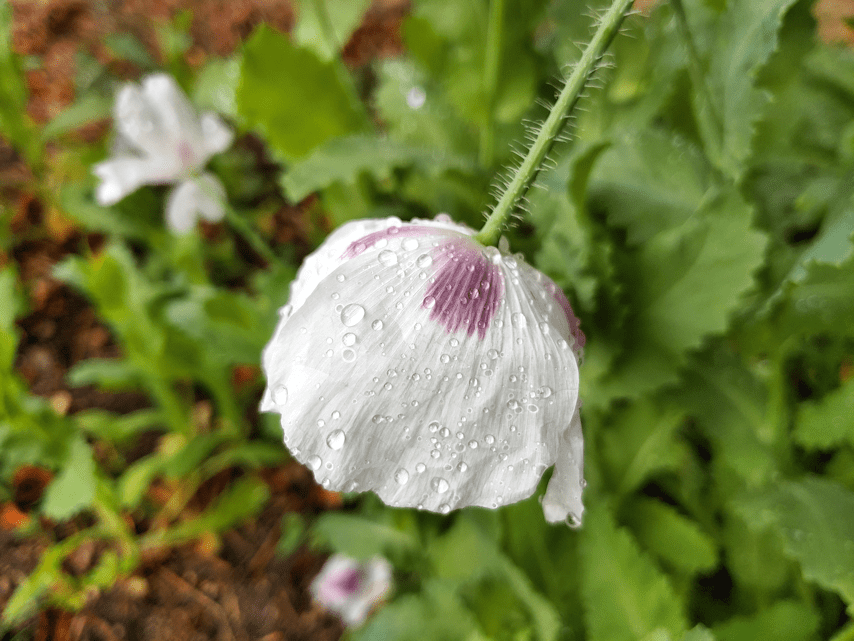
We have more poppies blooming this morning, too. About 4 of them were open, or partly open. I gave the old kitchen garden a bit of a watering this morning, too, making for some very photogenic flowers. :-)
Yesterday evening, after the girls were done watering the garden beds, I filled the rain barrel at the house, so that we would can water the old kitchen garden with a watering can, while the hose is running. I don’t expect to get any rain to actually fill the barrel. :-/
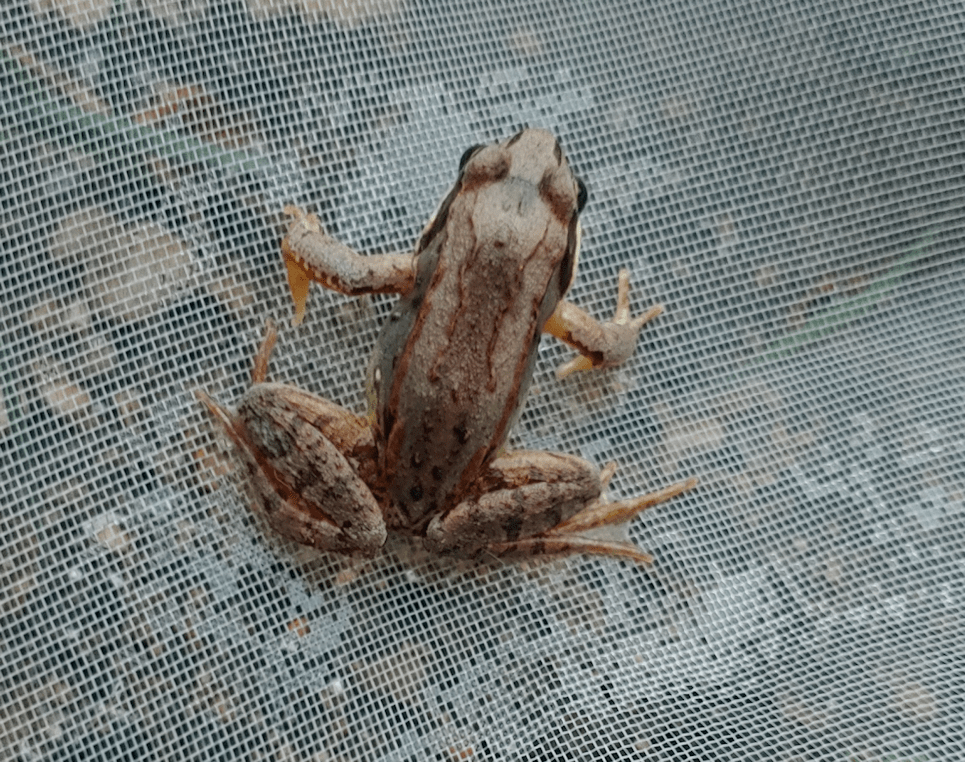
While at the barrel, I saw something scuttle across the two kohlrabi plants in the carrot bed that are covered with netting. It turned out to be this little friend.
That’s the downside of using floating row covers to protect our plants. The frogs have a harder time getting under the cool leaves. The netting isn’t stopping the flying insects from getting under them; they just cant’ figure out how to get out again. Which should be a big foggy buffet, if the could just find the edges that they can crawl under! :-D
This afternoon, I got to visit my sister and her husband on their farm.
We may be in the boonies, but they are even more in the boonies than we are! :-D
Before I left their place, we did a tour of their yard and garden, and I really appreciated being able to see how theirs is doing, in this heat.
Her row of rhubarb was a study in extremes. In the middle, she had these MASSIVE leaves and stalks – which is normal for her rhubarb – but in other areas, they were smaller and wimpy, like ours, and at one end of the row, they were basically dead. So strange!
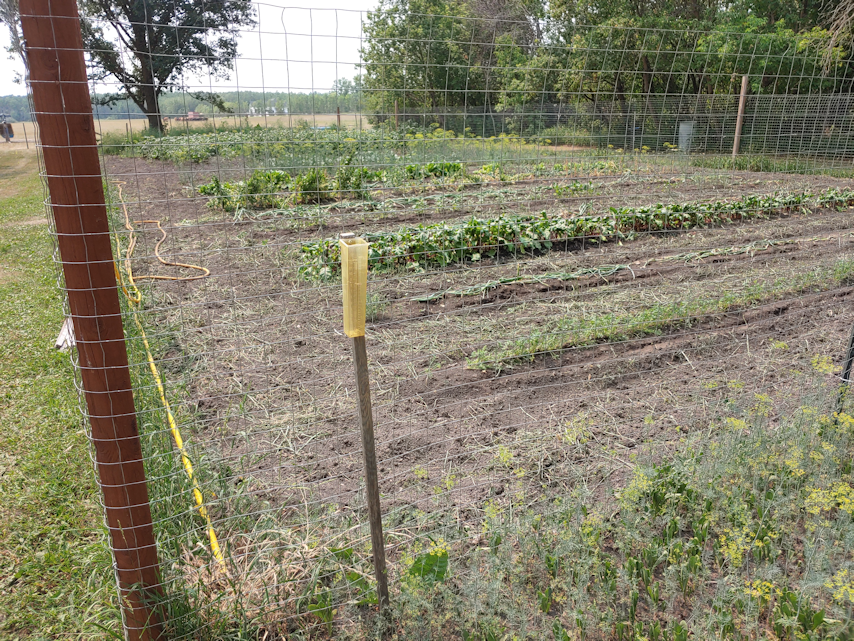
Where I’m standing to take this photo used to be part of their garden, but they reduced its size. That area is now full of self-seeded dill. This end of the garden is where they have their annuals, with some rows already cleared and tilled. At the far end are their perennials, including onions (different from the ones they have in the rows visible at the annual end), horseradish, asparagus, sorrel, mint, and a few other things. They’ve got determinate tomatoes, and I could see some very large ones developing. No peas or corn, but they do have beans, beats and potatoes, among other things.
They usually water their garden from the nearby creek. In this photo, you can see a platform on the shore, and the end of the hose is between the two sticks in the water, with a float. This is where they pump the water from.
The creek is about 3 feet lower than usual this year, and it’s got to the point that they are watering using their well water. They only water every couple of days, though, unlike the nightly watering we are having to do. It has actually been lower than this, in the past.
After all those years… LOL
When my brother in law retired from farming (like where we are, most of the land is rented out), he took over much of the gardening. The first time a deer got into their garden, he put up the fence.
Deer are not the only issue they have. They also have to deal with black bears, raccoons and…
Yup. They have woodchucks, too. This den is under the deck of a now-empty house they share a yard with. There are dens in other areas, too. Apparently, their woodchucks have plenty of other food to eat besides their garden, because their deer fence is just touching the ground at the bottom, not buried, and they’re not trying to get it.
Which is as good a segue as any as to why I visited them today. My brother in law finally had time to help sight the scope on my crossbow.
Now, this is something we could have done ourselves, except we don’t have anything to accurately measure longer distances. My BIL is an avid hunter and has a range finder, so we figured we’d go to him and get it done right.
He never even used it. He just paced off the distance, just as he would have in sighting the scopes on his rifles! :-D
Now, he had plenty of experience with rifle scopes, but he’d never worked with a crossbow before, so the first thing he did was spend time reading the instruction manual (I brought everything! LOL). We had only finger tightened the scope, so after he checked it a few times and confirmed that it was the right distance for me, he tightened that down, and then we went to his target bale.
The instructions said to start at 10 yards, which is about where the corner of that fence is, then moving to 20 yards to fine tune the scope. He is sitting at 20 yards in the photo, which is what we need the scope to be sighted to.
Also, do you see that white blob on the creek in the background?
That is a flock of pelicans. :-D
He was expecting it to take only about half an hour to sight the scope, but we ended up out there, in the heat, for probably more than an hour before we stopped.
He did the final shots at about 30 yards, before we called it for the day.
The bolt here is the first shot done at 30 years. He was aiming for the target on the left.
If you look at the top right, there is a single hole. That was the first shot at 10 years, before he started adjusting the scope.
Above and to the right of the centre target are a series of holes. He hit the exact same spot a couple of times. The instruction manual described how many clicks equaled 1 inch at 20 yards and, according to that, with the number of adjustments he made, it should have been hitting to the left of the centre target! After hitting the same spot a couple of times, the bolt ended up so far into the target, the fletchings were squeezed into the hole, too. One of them ended up coming loose. It just needs a bit of fletching glue to fix and it’ll be fine, but that’s when he started to aim at the other target.
By the time he was done, he could get a good grouping at 30 yards, but it was still hitting to the right of the target. He’d adjusted it so far, he wasn’t sure it could go any further. The scope we have is different from any of his. In fact, it had a whole extra knob to adjust, but not even the scope’s instruction sheet (which was for rifles, not crossbows) had it labelled on their diagram.
So the crossbow is not sighted, but it is closer, and we are in a position that we can figure the rest out ourselves. Of course my husband, with his military background and marksman qualifications, knows how to do it. The main issue was measuring distance. Which my BIL just paced off, anyhow.
I think we can manage more accuracy than that, with what we have! :-D
Adjusting the scope was not the only thing that was a problem. The other was cocking it in the first place. The kit came with a rope cocker. There is a rock cocking groove at the end of the stock, just before it can be adjusted to size. The middle of the rope goes in the groove, two hooks with pulleys hook onto the string, from under the stock, and there are a pair of handles to pull on. At just shy of 6′ tall, he actually had trouble cocking it, once he straightened up past a certain point. He already had doubts that I could cock a bow with 220lb draw weight, but in the end, I’m basically too short. If he, at about 8 inches taller than me, was having a hard time, it’s pretty much assured that I don’t have the height and arm length to be able to raise the string high enough to latch in place!
He recommended we pick up a crank cocker.
Since we were never able to complete sighting the scope, I never fired the crossbow myself. That will just have to wait a bit longer.
In shooting the crossbow, he had a couple of issues with it. Obviously, the scope itself was one. I know that a lot of people who buy kits will replace the kit scope with a higher quality one right away. This wasn’t a matter of quality of materials, but adjustment. He also didn’t like the trigger, which was something else I saw some reviewers complaining about. It does, however, shoot well and shoot true. Once the scope is properly sighted, we should have no issues with it. I’ve seen reviewers complain about the adjustable stock, but he had no issues with that.
He also really didn’t like the rope cocker. He had mentioned to me that he had a friend who bought a crossbow and, the first time he tried to cock it, it slipped and he almost groined himself severely. He then immediately got rid of it. As my BIL was repeatedly cocking the bow, he said he could see just how easily that could happen. Eventually, I learned that when this person had tried to cock his bow, the stirrup slipped off his foot.
…
The instructions are EXTREMELY clear about how important foot placement in the cocking stirrup is. Which rather makes me wonder just how closely instructions were being followed. Mind you, this happened quite some time ago. The instructions may well include that now because people were hurting themselves by having just their toes in the stirrup, instead of having it under the middle of their foot.
There’s a reason the instruction manual has more safety warnings than pretty much anything else! This is not a toy.
So now we need to figure out where to set up a target practice area, mark out distances, and figure the rest out ourselves.
I did have some unexpected disappointments about the whole thing. While they are not being mean or malicious about it, it’s clear neither my BIL nor my sister are confident in me. Not just in being able to use and shoot the bow (yes, I have the physical strength pull 220lbs draw weight with the rope cocker), but they seemed to assume that this was some sort of spur of the moment thing I decided to do, without any sort of research or analysis, first. Like I was thinking of it as… well… some kinds of toy. The fact that I hope to actually use it to hunt is another area they clearly didn’t have confidence in me about, with both or them, at one point or another, making sure to mention that a deer will run off after being shot, and then it needs to be tracked. I knew that, of course. It happens even when hunting with a rifle. Why did they assume I would not know that? There were a few other… assumptions… made that had me wondering. I think part of it, for my BIL, was simply because he assumed that since he was having such a hard time with some things, I would have an even harder time, and not things where my height would make a difference. Was it because I am female, and they assume I’m weak? Or because I’m fat? Or because I’m the baby sister? I don’t know. It was off putting, even though I could tell they did not have any ill will behind their comments. More like their filter was off. :-D
Well, we shall see how things work out over time. First things first. We need to get that scope sighted properly, and then I have to practice. My husband will be able to cock the bow, no problem, and honestly, I think I might still be able to as well. Even if I can, we will be getting a silent crank. The rope cocker, it turns out, squeaks! :-D
My daughters, meanwhile, are pining for a compound bow.
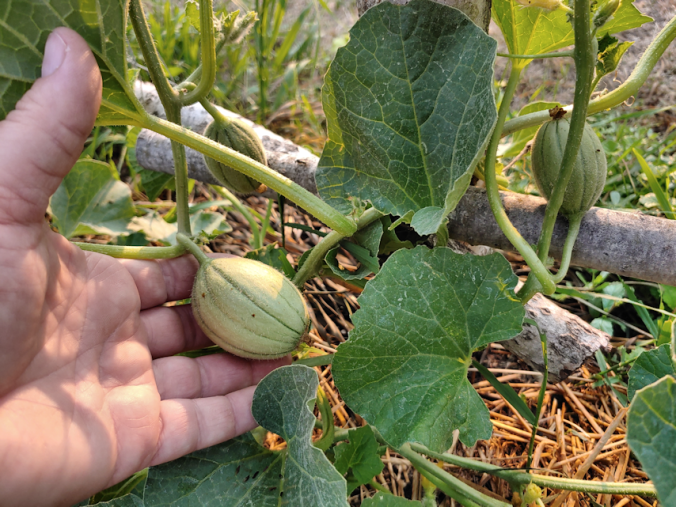
Now that we have Halona melons developing, it is so much more fun to check the garden in the mornings! Check this out.
These melons are visibly bigger than they were when I looked at them yesterday evening. I checked them again this evening, and they are again, noticeably bigger! Not only that, but we are finding lots more new ones, plus some larger ones that we hadn’t seen earlier. None as big as the one I’m holding in the photo, though.
I’ve looked over the Pixie melons, and while there are lots of flowers, they all seem to be male flowers. Which is interesting, since the Pixies are 70-75 days to maturity, while the Halona are 75 days to maturity, so you’d think it would be the other way around.
This is a photo of our very first WINTER squash! *insert happy dance* They are starting to get quite big, and this type are quite enthusiastically climbing the squash tunnel. I forget which ones these are; the markers are hidden under leaves right now. :-D
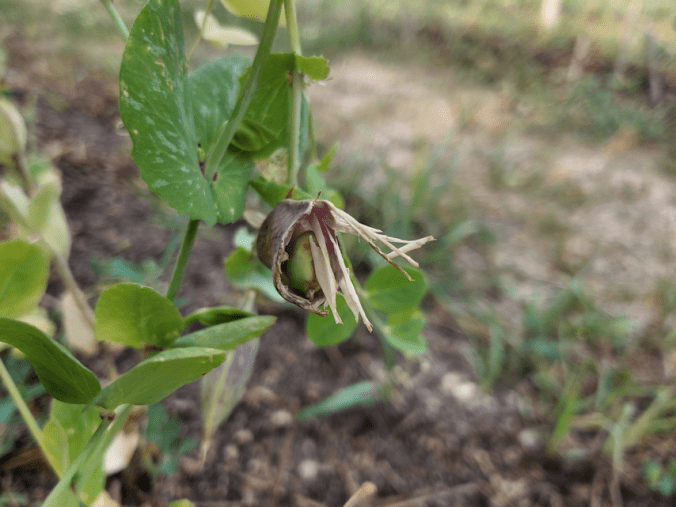
Well, if I needed clearer proof that something is eating our peas, this is it. Half the pod of this purple pea got et. There were still a few that were ready to pick. Maybe 5 or 6 pods. Just enough to include with my breakfast, as an edible garnish. :-D
This evening, I refilled the patched rain barrel and, while I was waiting, I checked over the peas more thoroughly. Enough are showing signs of nibbles that I moved the garden cam so I can hopefully see what critter is the cause. We’ve seen deer and raccoons going by, but they’re not eating anything, however the camera was not being triggered by anything in the pea beds. In fact, last night, nothing triggered it at all, until I walked past it this morning. I now have it up against the lilac hedge on the North side of the pea beds, and lowered on the flag stand, so I’m hoping it will work.
Two more poppies were blooming this morning!
They drop their leaves by the end of the afternoon, though. I was talking to my sister about them and mentioned that they were supposed to have pink petals, not white, and she said that it’s from the heat. If things were cooler, they would be the pink they’re supposed to be. Interesting. She also confirmed that it’s likely the heat that is causing our peas to struggle. I agree that this would be the major factor, though I’m sure a combination of factors are just making it harder for them to thrive.
And that’s before having critters eating them!
In other things, my plans changed with a phone call, and I headed out for most of the day, but that will be in my next post. :-)