It’s only been two days, but with our set up being more in the open, I thought I’d show what the active fermentation looks like.
Even in the still shot, you can see that the water in the airlock is carbonated, with all the bubbles on the sides.
In the video, you can see that a “burp” comes up about every 6 seconds. It’s a bit on the slow side, from what I’m reading, which could be temperature based.
Now, we’re also supposed to be aerating this twice a day for the first few days, which was easy to do when using the fermentation bucket. We haven’t done that at all, yet. The spoon that came with our wine making kit is too big to fit into the opening of the 1 gallon jug.
I’ll have to see what I’ve got that’s thin enough, and can be sanitized.
This stage should take about 7-12 days, and watching those bubbles and burbs are supposed to help us know when it’s time to do that. So we’ll be keeping a close eye on that airlock. :-)
Today, we started up a second – smaller – batch of mead.
I hope.
I documented our first attempt, throughout the process, which you can revisit at the following links (they will open new tabs, so you won’t lose your place. :-) )
Part 1 getting started Part 2 early stage maintenance Part 3 early stage maintenance, completion Part 4 transferring for second fermentation Part 5 bottling and initial results
A couple of days ago, my husband and I had appointments with someone we hoped would be our new doctor, since our previous doctor had to suddenly move out of province.
The very morning of the appointment, my husband had to cancel out.
Our older cats ignored it, but the young ones did get into it, bending the bottom branches. After a while, though it seemed to be safe to straighten those out and go to this stage: just lights and garlands.
Plus Scentcicles, hoping that the smells would deter them.
Instead, we kept finding them on the floor!
My daughter has made up a spray bottle with vinegar in it, as that’s supposed to be something they don’t like.
It does seem to be working, but only while it’s fresh.
This morning, while doing my rounds, I had an unexpected visitor – my brother’s beautiful dog! He is usually very shy and tends to sneak up behind a person, and under their hand, for sneaky pets, but not today! He was quite happy to come right up for some attention.
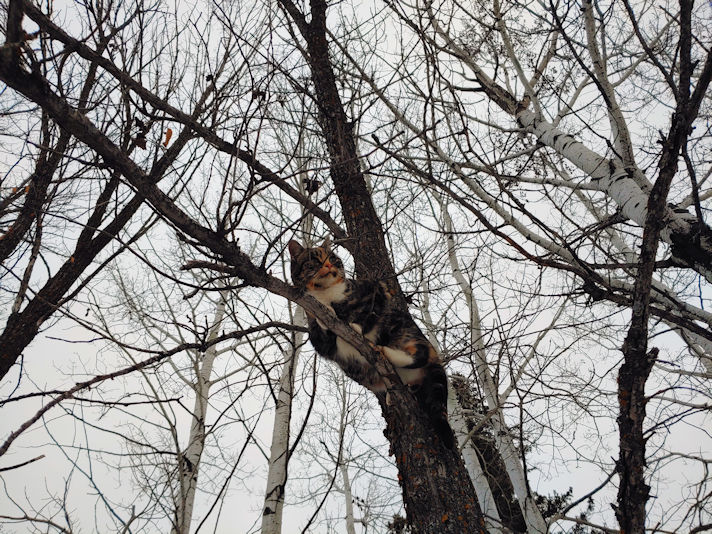
While I was petting him, I heard a noise above my head.
As usual, the cats had followed me while I was doing my rounds. Butterscotch and Beep Beep will bully each other to be carried. This morning, Butterscotch came along, and she was not happy to see our visitor!
Sadly, when I paused to take the picture, my visitor went away.
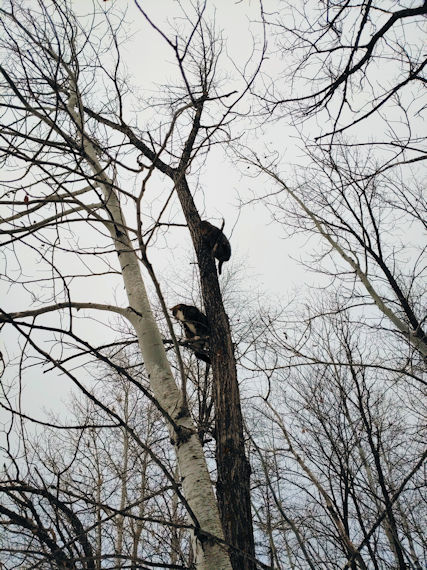
As I started back, I saw Butterscotch was not the only one unhappy with our visitor!
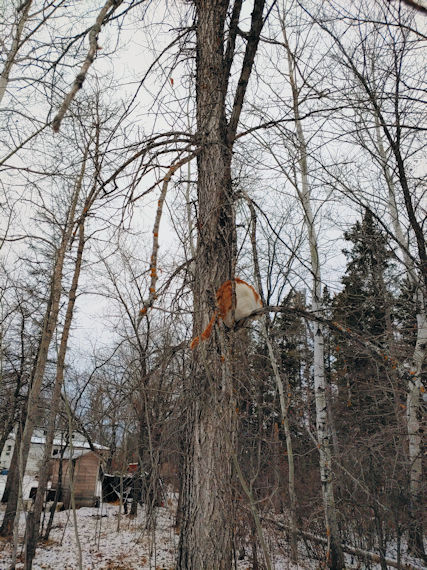
Even Junk Pile cat had been following along and was up a tree, but before I could get a picture, he’d jumped down and bolted further into the grove.
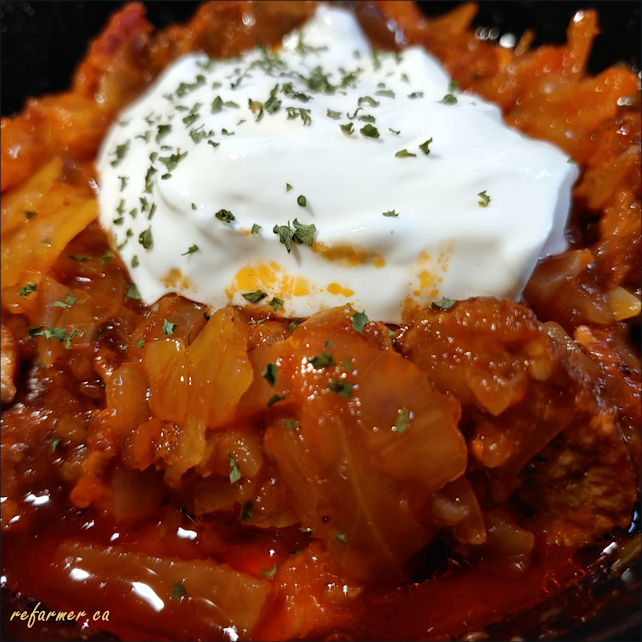
Traditionally, bigos – otherwise known as Hunter’s Stew – is made with game meat and a whole lot of ingredients I don’t typically have on hand. I just used what I had! Maybe I should call it Non-Hunter’s Stew? :-D
This is my version of Poland’s national dish!
I made this yesterday evening, for today’s eating, and I must say, it turned out very well!
cooked sausage, cut into 1 inch pieces, to make about 2 – 3 cups
2 cups cubed pork or fresh meat of choice
1 package bacon
1/2 cup crab apple cider vinegar, mixed with 1/2 cup vegetable broth, or 1 cup de-glazing liquid of choice.
1 can crushed tomatoes
1 can tomato paste
optional: seasonings to taste
Top row, left to right: sauerkraut (rinsed and draining), chopped crimini mushrooms, cubed pork, cooked sausage (honey garlic). Middle left: frying bacon pieces. Middle right: de-glazing the pan Bottom row, left to right: softening cabbage mixture, all ingredients stirred together, stew after 1 hour in oven, stew after 2 hours in oven. Centre:Bigos, after resting overnight, topped with sour cream and parsley
Instructions:
Turn oven on to 350F.
drain sauerkraut, rinsing if desired. Squeeze out excess liquid.
chop onion and garlic coarsely
core and finely cut fresh cabbage. Cabbage, onion and garlic can be combined into one bowl for later.
trim mushroom stems, cut mushrooms in half, then slice. (Alternatively, re-hydrate dried mushrooms in boiling water, then chop coarsely. Reserve liquid to add to the stew.)
cut bacon into 1/2 inch pieces
prepare de-glazing liquid (my vegetable stock was hot water and powdered bouillon)
Place the cooked sausage pieces into a large, oven safe pot with lid.
In a large frying pan, fry the bacon pieces until just browned. Add bacon to the sausage, reserving rendered fat in pan.
Brown pork cubes in the bacon fat. These do not have to be cooked through. When browned on all sides, add to the sausage and bacon mixture, reserving fat in pan.
Add mushroom pieces to the reserved fat and cook until just starting to brown, stirring frequently. (If using reconstituted mushrooms, skip this step and just add the mushrooms to the pot with the meat.)
Add de-glazing liquid to the pan and cook liquid down to about 1/3rd volume.
Add cabbage, onion and garlic to the pan. Cover with lid to steam for a couple of minutes, and for the cabbage to reduce slightly. Continue to cook, turning the mixture often, until vegetables are softened.
Add the sauerkraut and softened cabbage mixture to the pot with the meat and mushrooms.
Add the crushed tomato and tomato paste (plus reserved mushroom stock, if reconstituted mushrooms were used). Mix thoroughly.
By now, the oven should be preheated. Cover the pot and place in oven.
Check after about an hour and stir. If the liquid level seems low, add boiling water, as needed to prevent burning.
Check after 2 hours and stir. Adjust liquid again, if needed.
Cook for another half hour or so.
Can be eaten immediately, or left to cool and rest overnight (recommended).
Serve with rye bread, or a dollop of sour cream. Garnish with parsley if desired.
For this, I used no added seasonings at all. The ingredients themselves add a lot of flavour on their own. However, feel free to add whatever seasonings you like, if you feel the need.
Of course, after this was done cooking last night, I had to have a small bowl to taste it. It was definitely a success! Letting it rest overnight did allow the flavours to mellow and combine very nicely. It was a subtle difference, but enough for me to recommend giving it that extra time.
The more traditional ingredients for this dish includes a greater variety of meats, with game meat being the prime ingredient, and even prunes – though the bigos I’ve tasted in the past did not include prunes. Some versions include things like grated carrot, but my fermented vegetable sauerkraut includes carrots, so there was no need to add more.
The amount of sauerkraut I used is a bit on the low side – a typical jar of commercial sauerkraut is about 900-1000ml (approximately equal to a quart jar) and my jars are 500ml. Even adding the last of my plain sauerkraut gave me just over that amount. However, that is also the equivalent of more than half a head of cabbage. The fresh cabbage I used was more on the large than medium size, so between the two, the total quantities didn’t change much.
This makes quite a large quantity of stew, and it really helps to have a very large, deep frying pan with a lid. Even then, I had to be careful adding the cabbage mixture to the pan! Using the lid to let it braise for a bit made it much easier to stir, as the cabbage released its liquid and reduced in size.
This dish can be made on the stove top instead of the oven, but that would require continuous attention and stirring to make sure it cooks evenly and doesn’t burn on the bottom. Using the oven is just simpler and more efficient.
If you try this recipe, do feel free to let me know how you liked it!
I admit, my morning rounds are not as consistent as they should be. Some mornings, when my daughter has a shift, it’s earlier – and this time of year, pitch black, still! Others, like today, I can wait until there’s actually light out.
Which means, I can get pictures of the company I get. :-D
I always do the cat food and water first, then do the feeding station. The cats will happily abandon food and fresh water to come join me.
Because, apparently, bird bath water is better.
They also like to use the bird feeder pole as a scratching post. :-D
Creamsicle was all set to jump on me!
I didn’t let him.
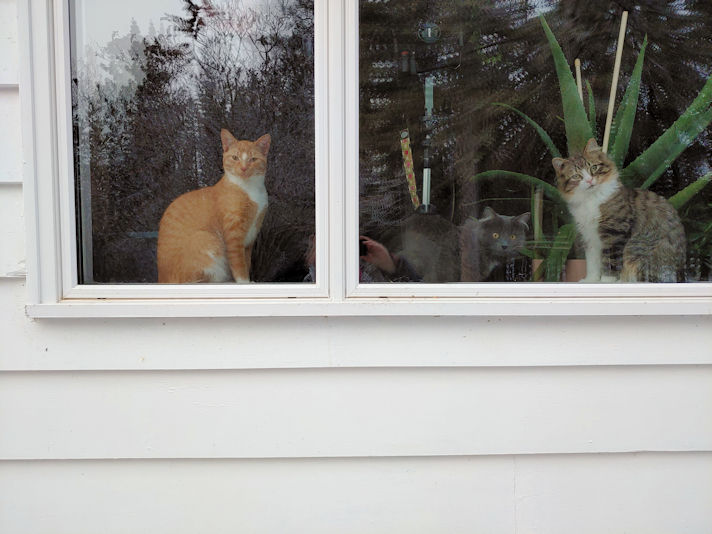
As I finished up at the feeding station, I realized I had an audience.
Gosh, they are so funny.
Also, that aloe vera behind Dave is the baby of one we had before our move. It’s about half the size of the mama was. We called it the sarlacc, so I guess this is sarlacc junior. :-D
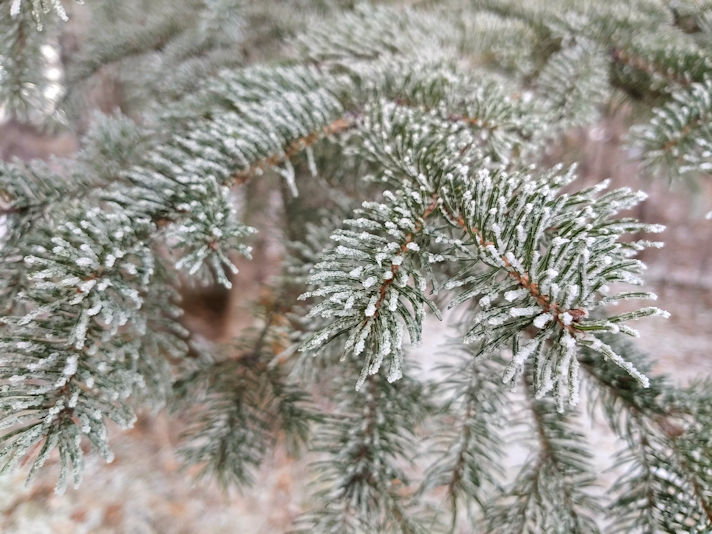
The frost covered spruces were very pretty this morning. :-)
Today, we got out one of my jars of probiotic fermented vegetable sauerkraut for a taste test!
Before I get into that, though, if you haven’t seen my earlier posts, you may want to visit the links below, first (they will open in new tabs, so you won’t lose this post!).
The recipe I got from my friend said to leave it to ferment for 2-4 weeks. It’s 2 weeks today, so we’re trying the one jar, and will leave the other to ferment for another 2 weeks.
We are a bit behind on our Christmas decorating this year.
Usually, we start at least by Nov. 27 (the Feast of St. Catherine). However, this Christmas is a first for 3 felines.
So we set up the tree, but left it alone. We didn’t even fluff out the branches. The idea being, the cats can get used to the tree being there, and we can start training them to stay out of it, using a spray bottle.
The problem with that, however, is someone has to be in the room to catch them in the act, and we don’t exactly hang out in the dining room.
It’s going to take pliers to straighten some of these branches out. :-D
We can, however, start decorating the rest of the house. Tomorrow is the first day of Advent, so I at least want to get our Advent wreath and its candles set up.
I just have to figure out which of the bins it got put into. :-)