I started working on the pork fat well before it was thawed out, as it’s much easier to cut it while it’s partially frozen. I have two large slow cookers, and I was planning to use both of them to render the fat out. It should be done over low heat for a long time, and I wasn’t about to monitor a pot on the stove all night.
Thinking back, my mother never rendered lard on low heat. She didn’t have the time for that. I remember it being quite hot by the time she scooped the crispy cracklings out. I’m pretty sure I’m remembering burned bits, too! 😄
Having a large slow cooker or two would have made the job much easier for her!
Part way through cutting the fat up, I changed my mind.
I wasn’t going to do two slow cooker’s worth!
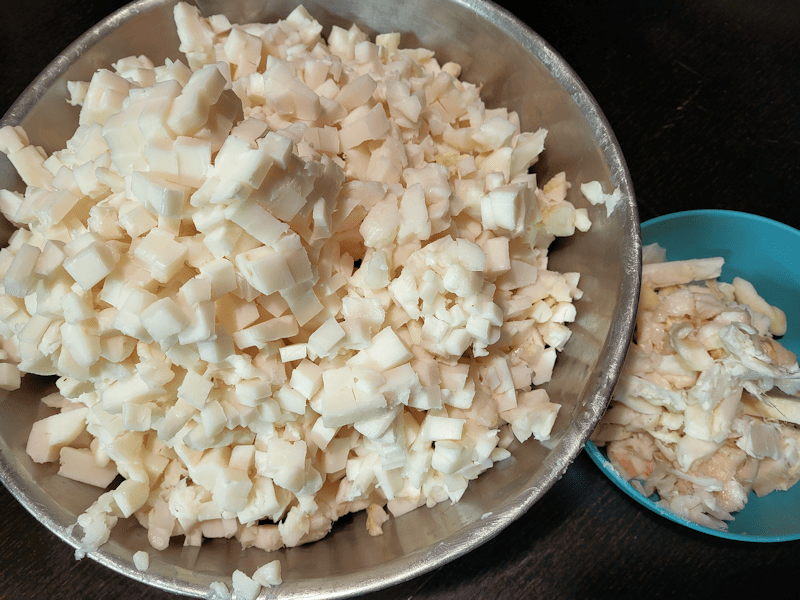
To fill this bowl, I finished off all the smaller pieces I could find. All three of them. 😄 I started cutting into the larger pieces, but they were still too frozen. Plus, I didn’t want to push my hands too far. They’ve been relatively pain free of late, and I would rather they stayed that way!
The small bowl on the side is the janky bits, with blood vessels or meat and the sliver skin. That was saved as a treat for the outside cats, which they were very happy to get!
There was enough pork fat left in the giant bowl that the lid still didn’t quite fit all the way closed, and I had to use the foil to cover it completely again. It’s now sitting on top of the freezer in the old kitchen. It’s going to be a very slow thaw in there! Which is okay. While I was cutting, the outside of the fat would be getting too soft to cut easily, while the inside of the bigger pieces were still too hard. A slow thaw won’t have the two extremes, and it should be easier to continue cutting up tomorrow.
They kinda look like cheese curds in there! 😄🧀
For a moment, while filling the slow cooker, I thought I’d have to dig out the second one, after all! I squished it just flat enough to make sure nothing would touch the underside of the lid. As it renders, it’ll get lower.
The slow cooker is now set on low for 8 hours, and then it’ll automatically switch to warm. It might need more time, so I’ll be checking it off an on throughout the night. I did add a small amount of water to get it going, and make sure it the bits don’t start burning before the fat starts rendering out.
Once it’s getting close to done, we’ll sterilize some jars – probably in 500ml sizes (pints) – to store the lard in. If we do decide to go with a larger size, I’d go with the 750ml jars, rather than the 1L/quart jars. I don’t see us using it fast enough to warrant that large of a jar.
Based on how much is left that needs to be cut up, we might actually be doing two more batches! It’s a shame the meat grinder I found while cleaning out the old kitchen has parts missing. A grinder would make the job much easier, and more fat would render out of the smaller pieces, too.
No matter! The job is getting done, and we’ll have a good supply of shelf stable, high smoke point, flavour neutral fat for our pantry.
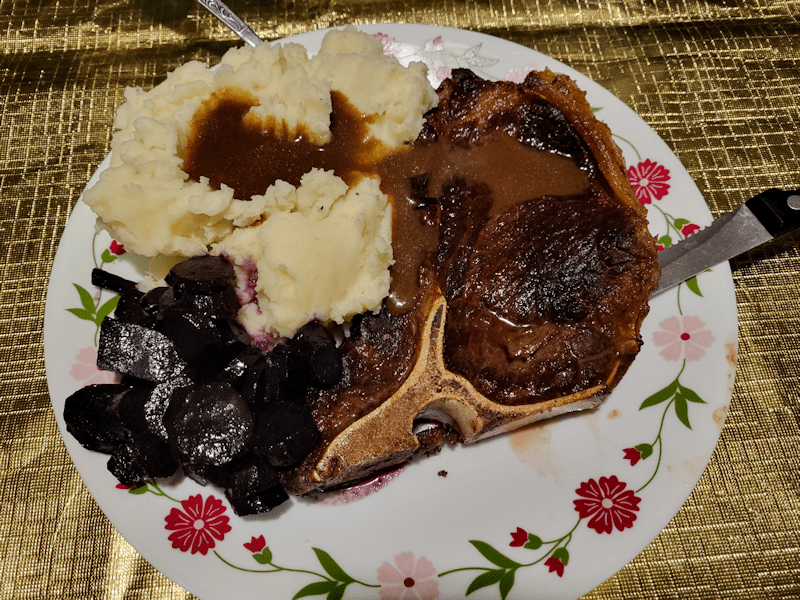
It occurred to me that I have yet to post a picture of what the Black Nebula carrots look like, cooked! So I thought I’d share this photo with you, while we still have some left.
My daughters did the mashed potatoes and ginger carrots. At the last minute, I cooked up four HUGE t-bones from our quarter beef order, and made a pan gravy. The steaks were so big, I could barely fit them in our largest pans. I was able to cook all of them at one time, though, and made the pan gravy while they rested.
I am so full right now!
As for the Black Nebula carrots, they are so dramatically dark! A very beautiful dish. As for flavour… they’re really not any different from any other carrot. They were sweet and tasty, but not outstanding in any way. I am glad we grew them. We had the most seeds for the Black Nebula, and they shared a bed with the Uzbek Golden carrots, in the main garden area. The Napoli and Kyoto Red carrots we grew along the chain link fence did not do well with how much flooding that area got, even being in a slightly raised bed. If we had not had carrots growing in two completely different areas, we would not have had enough to last us beyond a couple of meals. Something to keep in mind, when we grow carrots next year! I’d be willing to grow them again some day, but I want to try a few other types before we settle into one or two varieties.
I can’t help it. I feel like I’ve wasted a day. I got a stock going and tended it, off and on, for much of the day. While I didn’t have to be there constantly, I was checking on it often enough that I didn’t want to start anything that took too much of my focus or was too distracting. I ended up actually *gasp* watching TV, binge watching DS9 on Prime. I could use each the status bar on the episodes as my timer to go check the stove. Normally, I’d at least do something like crochet at the same time, but a summer in the garden has left my fingertips so rough, most yarns stick to them like Velrco, and I ended up pulling the loops right off the hook! 😆
Ah, well. I suppose it’s good to have a break every now and then.
One thing I discovered while sitting on the couch watching the show.
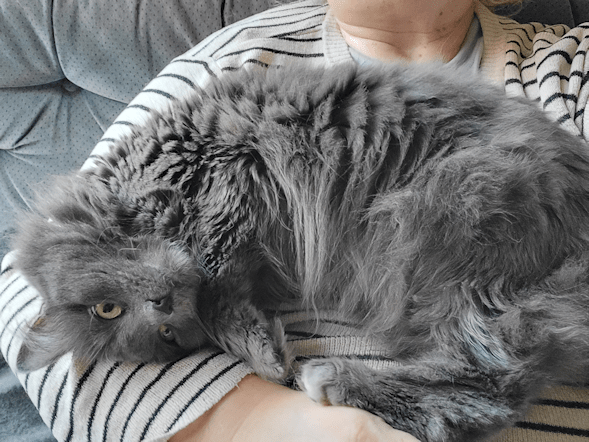
Fenrir missed me!
Before Butterscotch and Nosencrantz came indoors, she used to spend as much time as she could like this, while I was at my computer.
Which made it very difficult to type.
Unfortunately, Fenrir is one of the cats that will come in and immediately launch an attack at Nosencrantz if allowed in my room. Butterscotch, too, if she’s in view. I have no idea why she is so aggressive towards them. Especially Butterscotch. Butterscotch and Beep Beep took her in, along with their own kittens, when she showed up at our place as a kitten, our first summer here. Now, she will spend hours just outside my bedroom door, watching it and, if I’m not careful, she’ll teleport herself into my room as soon as the door opens, and attack Nosencrantz. She’s amazingly fast! Given the opportunity, however, she will climb onto me, curl up on my chest, and nap, as she did several times, today. She was not impressed by my frequently getting up to tend the stove. 😁
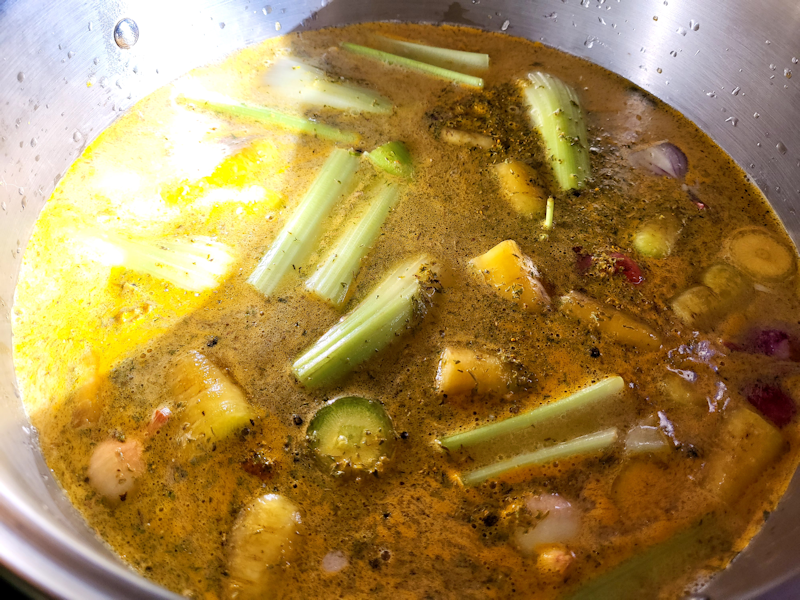
Our fridge freezer had quite a few bags of carcasses waiting, mostly from chickens, but also some turkey. I roasted them first, and they completely filled my roasting pan. There was enough that I used my giant stock pot, that I’ve also been using for water bath canning, to fit it all.
Into the pot went most of our remaining Uzbek Golden carrots.
I admit. I’m a coward.
I could have used at least a couple of Black Nebula carrots, too. That would have changed the colour significantly! But I decided that might not look too appetizing. 😂
Along with the carrots I added crushed garlic cloves, yellow and red onions – the little ones from our garden – plus celery. For seasonings, I added course salt, whole peppercorns, turmeric powder, dried thyme leaves and dried parsley, then covered it all with water. Later on, I added a generous splash of our crab apple cider vinegar, too.
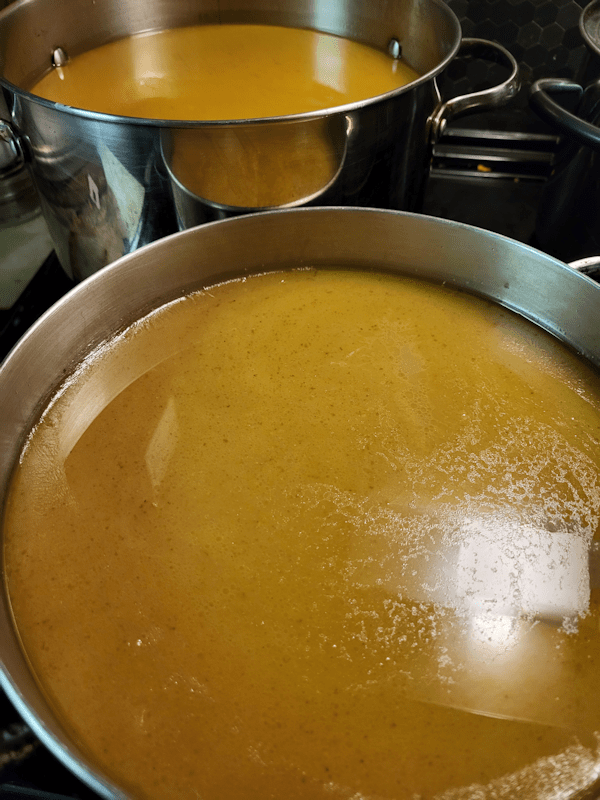
After bringing it to a boil I let it simmer for about 7 hours adding more water to the pot part way through. After that, I used a hot pot soup strainer spoon that I find very handy, to take out as many of the bones and vegetables as I could, then a small sieve to strain out more, before finally ladling it through a fine mesh strainer into my other two stock pots.
The larger pot, with the measurements on the inside, shows a little under the 6 quart line. In total, I would say there’s about 10, maybe 11, quarts (11 to 12 1/2 litres).
For now, the pots are covered and cooling, as is the bowl of carcasses and vegetables. I’m debating what to do with it next. I could just pour it into freezer bags and freeze them, as is. Or I could cook it down to make a more concentrated stock. I’m kind of leaning towards cooking it down more. I’ll see how it looks in the morning.
It’s Thanksgiving weekend, here in Canada. Thanksgiving is officially tomorrow (the second Monday of October), but we had our dinner today.
We did pretty much everything different this time! Including the turkey. I had hoped to brine the turkey overnight, but didn’t have the energy for it. Well. Mostly, my hands were hurting too much. Either way, we normally would just roast the turkey, covered in bacon. To keep the turkey from sticking to the bottom of the roaster, I would put a layer of some vegetable under it, depending on what I have at the time. An onion sliced into rings, long stripes of carrot, pieces of celery, that sort of thing.
Turkey takes a long time to roast, though, so I decided to try something different.
I spatchcocked it. Something I’ve done with chicken, before, but not turkey.
It’s surprisingly easy to cut that spine out, even with the pain in my hands.
Once spatchcocked, however, it no longer fit in my roaster. Using a baking sheet meant I could use a rack under the turkey. I still added some thick slices of the Tropeana Lunga onions we need to use up first, under the turkey.
For the bacon, I would normally weave the sliced right on top of the bird, but tried something different there, too.
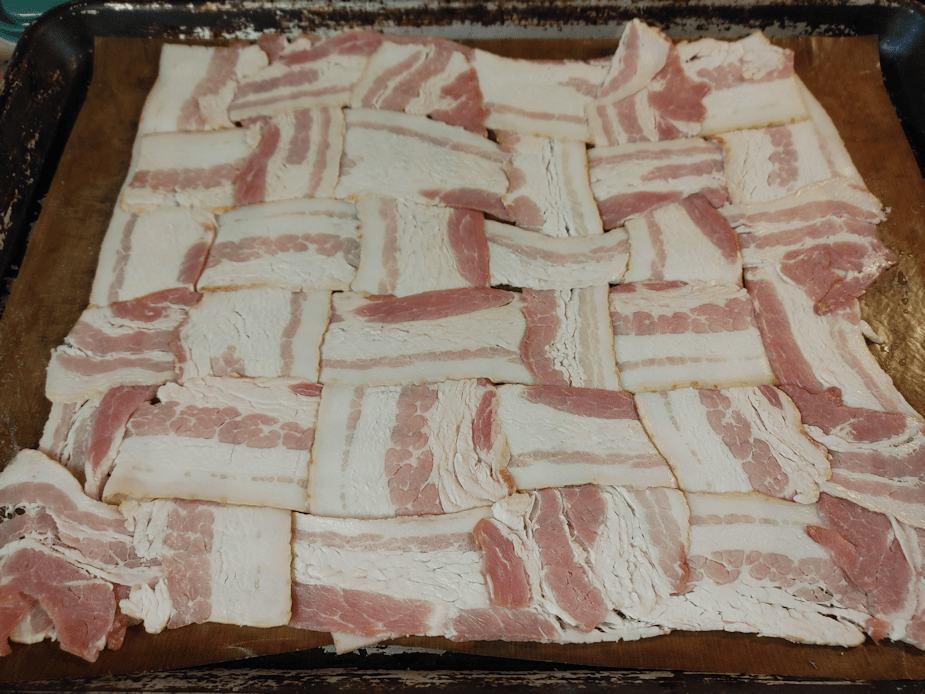
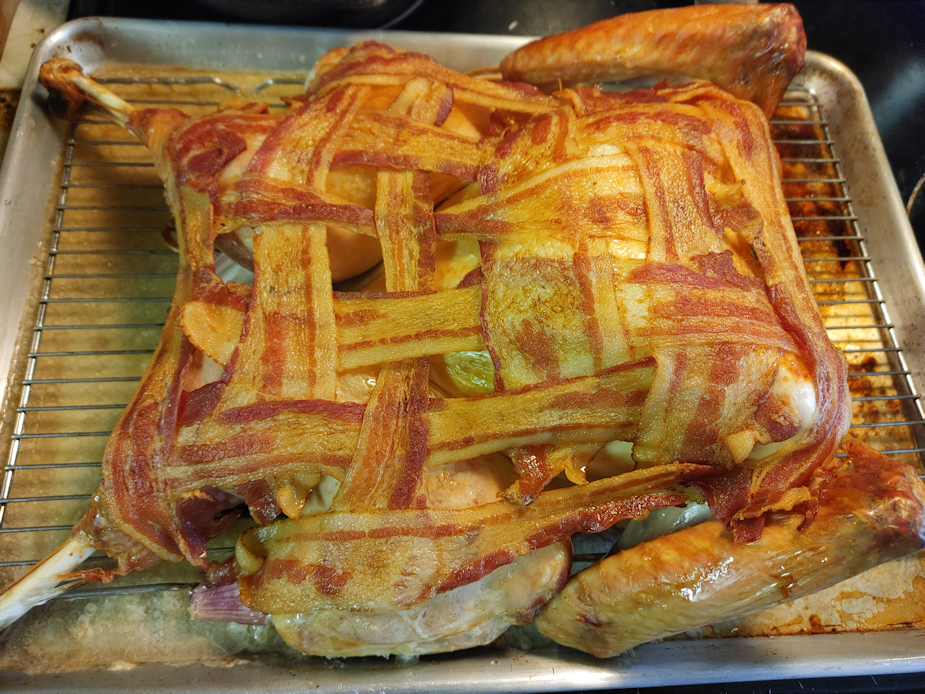
In another baking tray, lined with a silicone baking sheet (parchment paper would have worked, too), I wove the slices from an entire package of bacon. That got topped with another silicone baking sheet, and then I used a heavy marble rolling pin to flatten it out. After removing the top sheet, I used the bottom one to transfer the bacon mat to the top of the turkey. The final step was to add some water to the bottom of the pan.
I forgot to take a “before” picture, but this is how the turkey come out after it was done.
It took a lot less time to roast it, too.
After the turkey was in the oven, I got the mixed vegetables prepared, then spread out on another baking tray and added to the oven about 40 minutes into the turkey’s roasting time.
The mixed vegetables included some Uzbeck Golden carrots (I didn’t want to use the Black Nebula carrots, as they’d discover the entire dish!), more Tropean Lunga onions, the last of our own potatoes, plus a few store bought potatoes, some Red Kuri squash, sweet potatoes and, of course, the sunchokes. That all got tossed with some salt, pepper, garlic granules, paprika and olive oil. It turned out awesome.
When the turkey and vegetables were getting close to done, we made a soup as well. Something else I’ve never done before…
Peanut soup.
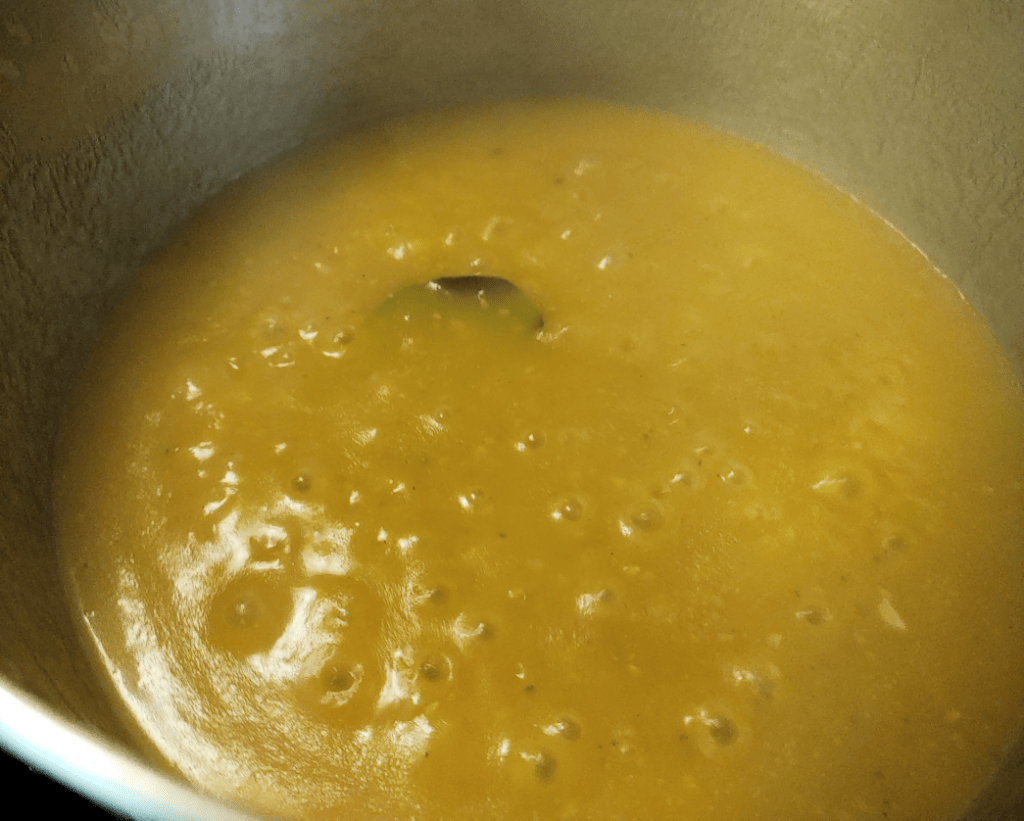
When I was able to visit my brother not long ago, we had peanut soup for lunch. I’d never tasted peanut soup before! My SIL had spent a long time trying to recreate one that she’d had at a restaurant. A recipe for West African Peanut Soup was the closest recipe she found, and she modified it to get the flavour she was after. I was able to take a picture of the recipe she used, along with her own notes for the things she changed.
What we made was a mix of the original recipe, plus some of her modifications, and it turned out really well. Among the optional ingredients was shredded chicken, which we skipped this time. The instructions also suggested one way to serve it was over rice. My younger daughter helped me make it, and we both found it funny when, after her sister had some of the soup, she commented on how it seemed a bit like a curry, and that she was tempted to put it over her turkey, adding that it would probably be great over a bed of rice!
Once the idea was brought up, both girls did use the last of it over their turkey, and decreed it delicious.
This is definitely something we will make again!
By the time we were done our dinner, none of us had room for desert, so that waited a few hours. For that, we just had a purchased pumpkin pie and some butterscotch swirl ice cream.
Meanwhile, I’ve also set aside a turkey dinner, including the soup, to bring to my mother tomorrow. She should have enough to last her a couple of days. 😊
If she’s willing to eat it, of course. No mashed potatoes and gravy, this year. 😉
I knew making the tomato paste would take a long time, but my goodness, it did drag on!
The girls and I had a sort of assembly line set up. At one end of the kitchen counter we had the electric kettle going, then space for the container used to bring batches of frozen tomatoes. Then there was the giant bowl we used to blanch them, a bowl with a colander for the skins, a cutting board and compost bag for final prep, a kettle on the stove to boil more water, and finally my giant stock pot.
I even remembered to check what size that thing is.
This thing was an excellent investment. We originally got it for when we were making tourtierre regularly, and would be browning more than 30 pounds of ground meat at a time – then adding the rest of the filling ingredients. That was once a year, though. We’ve used it more often just this summer than we have since we bought it!
We did the tomatoes in fairly small batches. The electric kettle and the stove top kettle took very different lengths of time to boil, which worked out.
One kettle was enough to cover one batch of tomatoes. After they had time to blanch, they’d be transferred to a colander over a bowl, where I would remove the skins, then cut them up (and remove the rest of the stem ends, if needed), and pop them into the stock pot. A daughter would get another batch of tomatoes from the freezer, and by the time we were ready to blanch those, the second kettle would be boiling and ready to go.
It took many batches. I figure there were maybe a couple hundred tomatoes, in a variety of sizes.
The cooking was started as soon as the first batch went in, which cut the time down quite a bit, I’m sure. By the time all the tomatoes were blanched and added, the stock pot was about half full – roughly 11 quarts or about 10L.
It took about 2 hours of cooking before I felt it was ready for straining through a sieve.
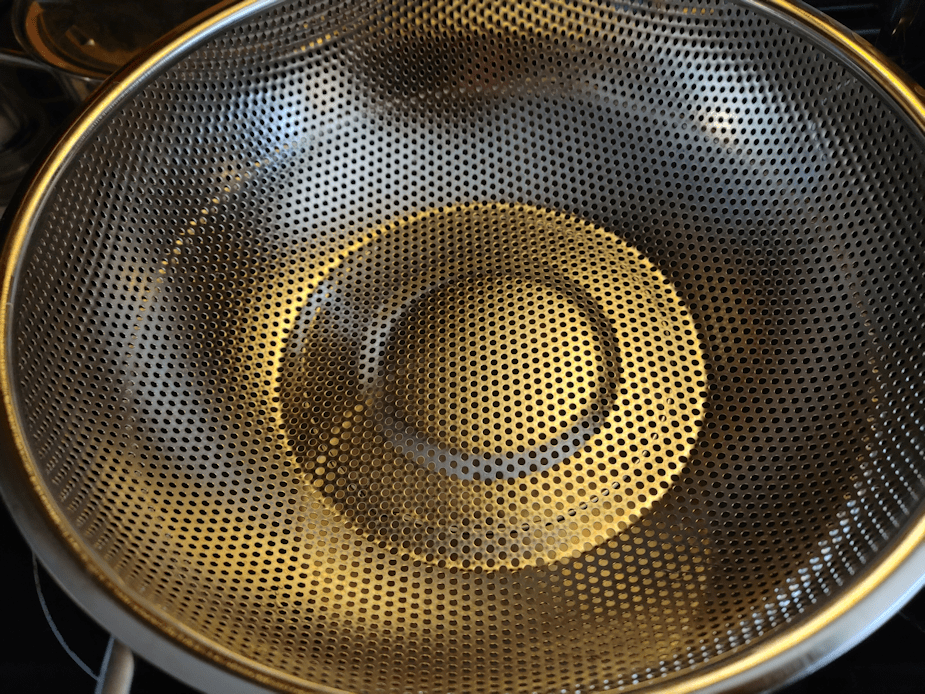
Our giant sieve has a very fine mesh. Great for straining out the seeds and any bits of skin that got left. Some of the tomatoes turned out to still be a bit green, so there were pieces that never got soft enough to be pushed through the mesh.
If we end up doing this regularly, it’ll be worth the investment to get a food mill.
The tomato sauce was strained a bit at a time, while the cooking continued. By the time I got to the bottom of the pot, it was getting pretty thick, and there was a lot less pulp left behind in the strainer.
This is all the seeds, cores, green bits and fibrous pulp that was strained out.
The strained puree was very thin. Can you imagine if we were not using a paste tomato for this! It would have been more like tomato juice, than tomato puree!
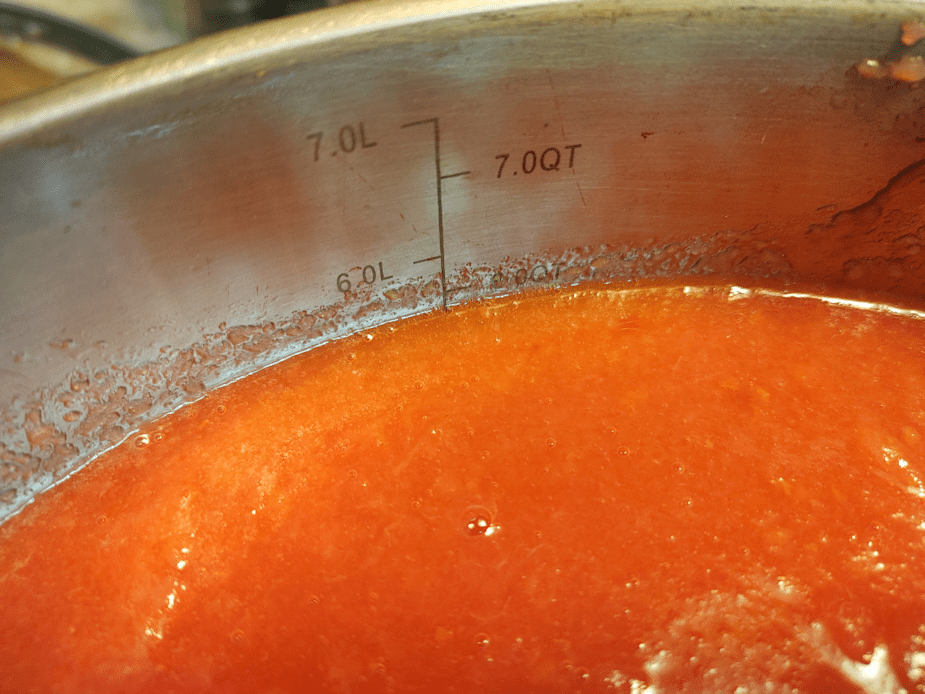
The stock pot I strained into has a very handy feature.
Measurements on the inside!
We went from roughly 11 quarts of blanched tomatoes, to just under 5 quarts of strained tomato puree. This was what I used to calculate how much lemon juice to use, later on. I had wanted to use citric acid, but couldn’t find any. Lemon juice will work, but does affect the flavour, too. If I were just canning the puree at this point, I could have added the lemon juice (and salt, if I wanted) directly to the jars, but that can’t work with tomato paste.
At this point, I took a break for a while.
For the rest of the cooking time, we set up the hot plate at the dining room table, to free up the kitchen, because I knew it would take hours to reduce this to a paste.
I could have cooked down the puree on its own, with just the lemon juice to increase the acidity. After looking at many different instructions for making and canning tomato paste, I decided to include a couple of large, crushed garlic cloves, a big bay leaf, and some canning salt.
The hot plate worked out really well. Once the puree was up to temperature, however, it stayed very hot and quick to splatter all over, even with the hot plate set quite low.
Another benefit to having a pot with measurements on the inside. I could see progress, even when it didn’t feel like any was being made!
As it reduced in volume, I also had to keep reducing the temperature. I only needed to stir it enough to keep it from bubbling and spattering. The more it reduced, the more often it needed to be stirred, and the lower the temperature needed to be turned. At first, I could just sit on a chair to stir every once in a while. After several hours, I was having to stand at the table, holding the pot to keep it from being knocked about as I stirred vigorously. Once it started getting quite thick, I removed the bay leaf. The garlic cloves were completely disintegrated by then.
I must say, towards the end, it was SO tempting to stop earlier because… it’s thick enough now, right? Right?
Not quite.
In the end, it took somewhere around 6 or 7 hours to get the puree into a good, thick paste.
When the spoon could scrape along the bottom, and the paste wouldn’t fill the gap right away, it was finally ready.
At this point, one of my daughters had taken over the stirring while I got the giant stock pot, which they had washed out for me while I stirred for hours, and sterilized the jars.
But how many jars would I need?
The measurement in the pot starts at 2 quarts and, at this point, the paste was well below that. I estimated around 1 quart, perhaps.
Because the paste is so thick, it has to be canned in small jars. The instructions I’d been reading were from the US and talked about “half pint” jars. I didn’t stop to convert that and was thinking the jars I had were probably half pints. Usually I get 750ml or 500ml wide mouth jars. Though the measurements don’t match, what sells as quart jars in the US are 1L jars here. A pint is 500ml so a half pint would be 250ml – or about 1 cup.
The jars I have are 125ml. So, a quarter pint, not a half pint! 😁
Which meant that if there was about a quart of paste in the pot, I would need 8 jars. I had two cases of twelve, so I sterilized one case. With the jars being to tiny, I could use both canning racks and stack them.
It still takes long time for the water to boil! I almost forgot to add vinegar to the water, to prevent the jars from clouding on the outside from our very hard well water.
Much to my surprise, I was able to fill every jar! Granted, for the last one, I was scraping the sides quite a bit, but I still got my half inch head space!
By the time I finished canning the tomato paste, it was well past 1am. I gotta say, I was quite happy to be able to finally leave them to cool for the night!
When I checked them this morning, I found 2 jars had not sealed properly. Which I’m just fine with! They went straight into the fridge to use right away.
I just love those adorable little jars.
We’ve been out of tomato paste for a while. I typically buy cases of them at Costco. The problem is that we usually only use a small amount at a time. Just adding a spoonful into a dish for extra flavour, for example, leaving us with aluminum cans partly filled with paste, that can’t be resealed well. Then we’d be rushing to use the rest up before it went bad. It will be much handier to have it in sealable jars!
I’ve already had some today, adding a spoonful to some leftover pasta I had for lunch, adding a bit of cream to make a bit of a sauce. As my daughter had mentioned when taste testing the fresh tomatoes for me, the Cup of Moldova tomatoes are very mild in flavour, so the resulting paste is not as strongly flavoured as the tinned paste we would buy. Which I don’t mind at all.
The question will be, is all the time end effort that goes into making and canning the paste worthwhile? There are lots of other ways to can tomatoes that take a lot less time. It’s the time that’s the kicker. I have seen some instructions that use the oven to make the paste – basically, dehydrating the puree – but while that might require less supervision, it means not being able to use the oven for anything else for a very long time.
That’s something we’ll have to talk about and decide after we’ve used this batch up, I think.
Last night, after saving some for planting next year, I picked over the blue grey speckled tepary beans we grew, then left them to soak overnight. I ended up using all of the remaining beans.
This is how they looked after shelling.
After soaking overnight, they looked like this.
The got a bit bigger, but not by much, really.
I was going to use them in a soup, and decided to cook them separately, first. This is how they looked after being cooked al dente.
The colour is off because the camera got steamed up. They did lose a lot of their colour, and I noticed they turned the water quite grey, so I’m glad I decided to cook them separately, first. Otherwise, they would have turned my soup grey!
I was going to make a cream of chicken soup, but ended up making an “everything but the kitchen sink” soup. My daughters had roasted several whole chickens, with our own potatoes, a couple of days ago. Today, I deboned what was left of them, and used the remaining roasted potatoes in the soup, too. I also used a couple of yellow onions from the garden, the single shallot I’d picked yesterday, the last bit of slab bacon we had, and all of the Kyoto Red carrots, since there were so few of them. The tiny sweet potato harvest was used up, along with the last of our summer squash – green and yellow zucchini, and yellow patty pan squash. Corn kernels, cut from the cobs, went into the pot, as well as some of the tomato sauce I’d made recently. After everything was cooked, I took the immersion blender to it for a while, adding in some whipping cream at the same time. The very last thing was a handful of shredded cheddar cheese.
I tasted the beans after they were cooked, and they tasted like… beans. 😁 I had not added any seasonings of any kinds, so they were as plain as plain could be. Once in the soup, I honestly couldn’t taste them at all. They did add a nice texture, though, and the ones that got hit with the immersion blender helped thicken things a bit. I like my soups hearty and thick!
I think they worked out rather well, but… well… Aside from what I took out to plant next year, that was an entire year’s harvest, used up in a single pot of soup! 😂 I’ve set aside twice what we planted this spring. Between that and if we get a better growing year, it would be nice to have a much better harvest next year! I also have some beans my mother gave me. I don’t know the name of them, but they are a small (though bigger than the tepary beans) white bean that she grew every year from her own seeds. She’d given some to my sister, who grew them for years. She doesn’t grow beans anymore, so she brought a pasta sauce jar – just shy of a quart – full of seeds to my mother. My mother has no plans to grow them, in her little garden plot, so she gave them to me! They’re a few years old, but there should still be a decent germination rate. Which means that, next year, we should have two different types of shelling beans to grow.
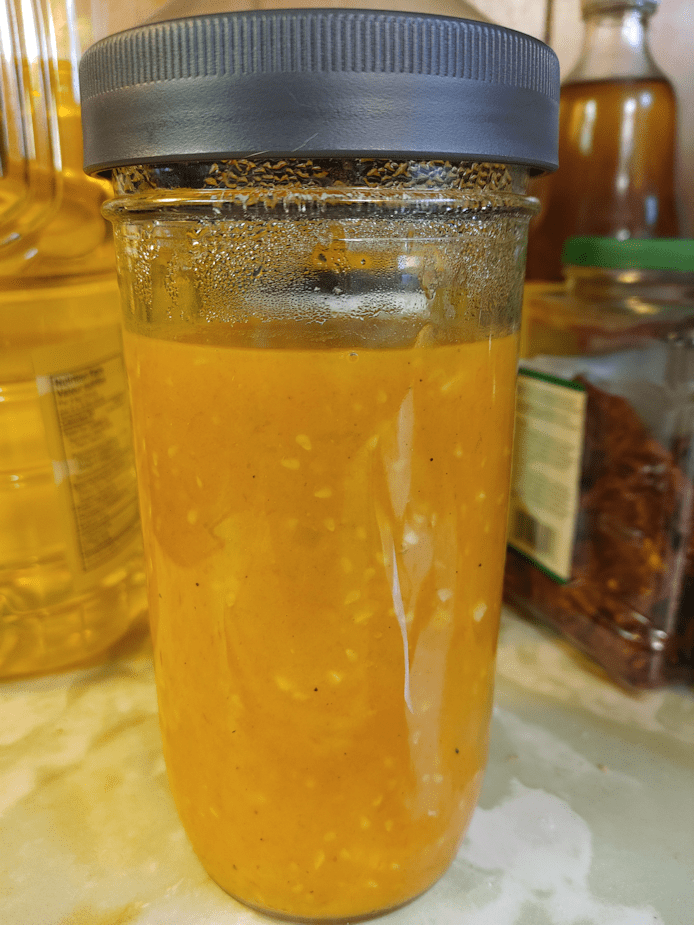
There are only two people in our household that enjoy eating fresh tomatoes, but even they are getting tomatoed out when it comes to the Yellow Pear tomatoes! They were starting to accumulate, so I decided to make a small batch of tomato sauce.
Along with the Yellow Pear tomatoes, there were about five or six Chocolate Cherry tomatoes, and two Cup of Moldova tomatoes on hand, so they wall went into the pot together!
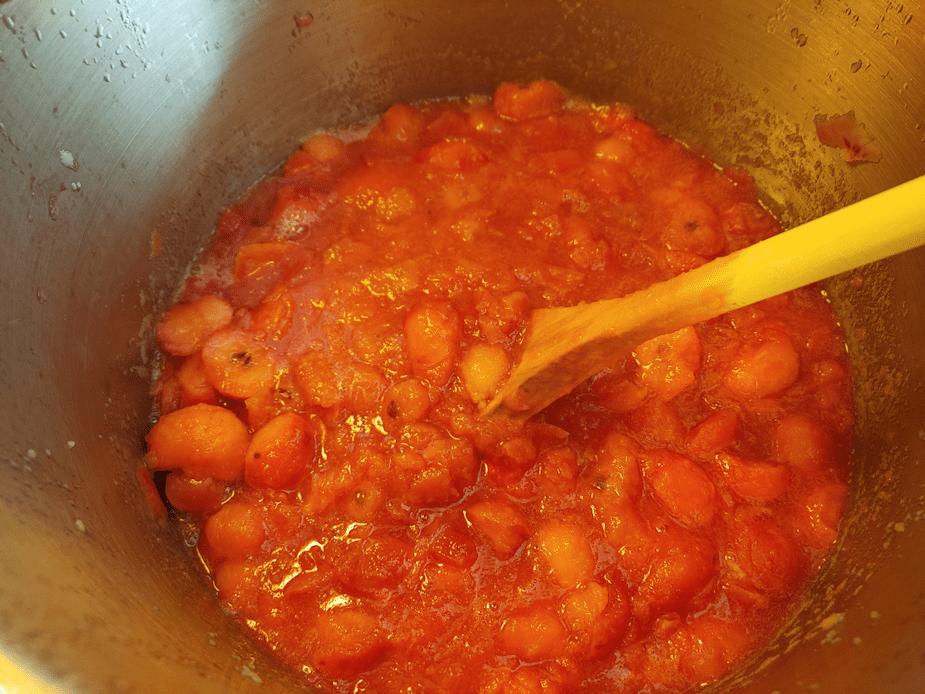
Being so small, they got mushy very quickly, so it wasn’t long before I was running them through the finer colander we have. Some of the seeds still get through, but no one seems to mind that. If I were making a tomato paste, though, I’d run it through a sieve as well, to get rid of the seeds.
After straining the tomatoes, I fried up some finely chopped onions and garlic in some olive oil until soft, then added the strained tomatoes back to the pot. For seasoning, I added salt and pepper, a bit of sugar, and a bay leaf, then cooked it down until slightly thicker.
It wasn’t quite enough sauce to fill a 750ml jar.
What a colour!
Not too long ago, I found some large mouth screw on jar lids – usually I can just find regular mouth. Since this is going into the fridge, I much prefer to use the screw on lid, rather than the canning lids and rings. I’ll have to pick up more of these when I find them again. Most of the canning jars we have are wide mouth jars.
Not being a fan of tomatoes in general, I didn’t actually taste this to see how it turned out. I’ll have to get my husband or daughter to do a taste test and let me know what they think!
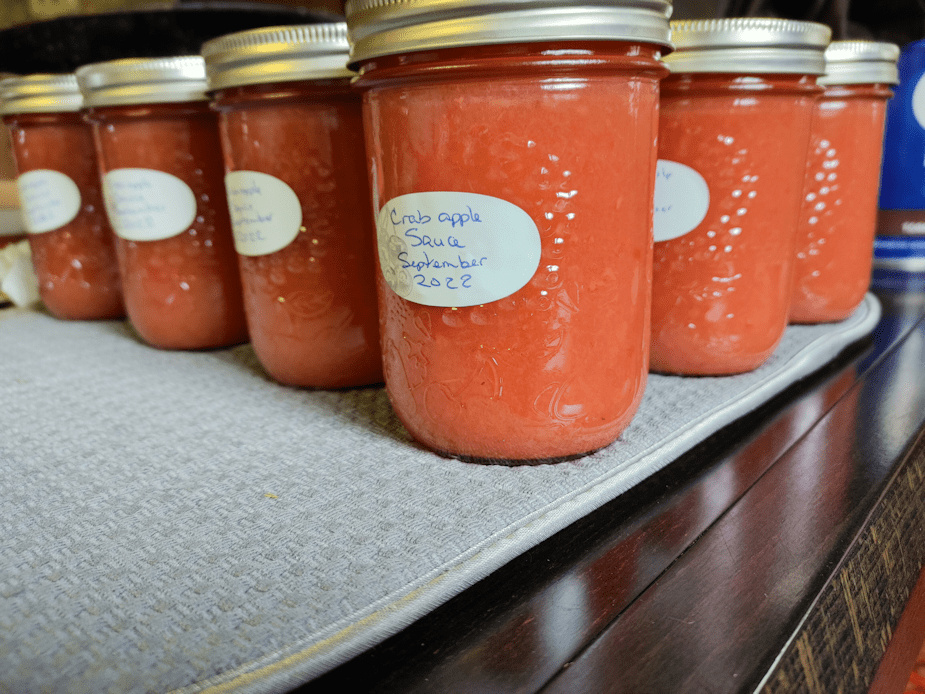
This morning, I canned up the crab apple sauce I started on last night.
It took about 2 hours to go through and cut up the crab apples in one bin – and that’s the one that had apples taken from it for the large batch crab apple cider vinegar, and a small bucket set aside for my mother.
Who has told me she doesn’t want any more apples. She had been appled out. So we still have another bin, plus the bucket!, to process.
The cut up apple pieces filled my giant stock pot to about 2/3 full.
A few cups of water was added to start the cooking process, and it was then boiled until mushy. Which took remarkably little time.
It stained my new giant wooden spoon pink! 😂
All the instructions I read said to peel and core the apples – which was not going to happen with such small apples! – unless you had a food mill to remove the skins and seeds later.
I don’t have a food mill.
I did recently acquire this…
I picked this up at a dollar store for a completely different purpose. I needed something finer than our colanders, but strong than our big sieve. This turned out to be perfect to use as a substitute food mill. I put in a couple of ladles of cooked pulp at a time, then used a silicon spoon/spatula to push it through, before scraping up the leavings and putting it into a bucket for the compost and moving on to the next batch.
I used our taller, normal sized stock pot for this, which conveniently has measurements marked on the inside.
The strained sauce was just shy of 6 quarts.
It was also very runny.
For the next step, the girls took over, in the early hours of the morning. They tasted it to see if it needed sugar, then cooked it down to thicken it a bit. I forgot to ask if they added sugar, but after tasting in myself, I don’t think they did. These crab apples are very sweet-tart on their own.
They cooked down the sauce by a couple of inches to make it thicker. That done, it was my turn again. I sterilized a dozen 500 ml (pint) jars, then canned up the sauce – a job that seemed to go much faster than I expected!
I could hear the lids popping on some of them, even as I removed them from the water bath!
When done, there was 10 jars of sauce, plus one that was about 3/4 full to go to the fridge, for eating right away. These just need to sit until tomorrow, then they’ll go back into the jar case and be ready for storage for the winter. 😊
I’m quite happy with how these turned out. Love that colour, too!
Now… what to do with the rest of the apples? This is more than enough apple sauce to last us; it’s not something we eat often.
I suppose I could just trim and freeze them for later.
On another note, with the season changing, I’ve asked the girls to switch back to “day shift”. There are things we need to do before winter that require an extra person. Which will mostly be my younger daughter, since my older daughter will have commissions to work on, but she will also be coming out to help as much as she can.
I expected to do more canning this year, but the garden just wasn’t productive enough for it – but more on that in my next post!
We had a very successful cookout, with great company and lots of food!
And lots of mosquitoes.
Insane numbers of mosquitoes.
We had bug spray, citronella candles, and even the smoke from the fire, and we still got invaded.
Still, we had a great time of it.
Having company was my excuse to finally use our new Dutch oven.
I’ve been looking up recipes for quite a while, and it’s been rather frustrating. So many of the sites I’ve been finding are just the same links to the same recipes, over and over. I had better luck with YouTube and survivalist/bushcraft type channels.
In the end, I realized I really didn’t need any special recipes so much as get a handle on the technique.
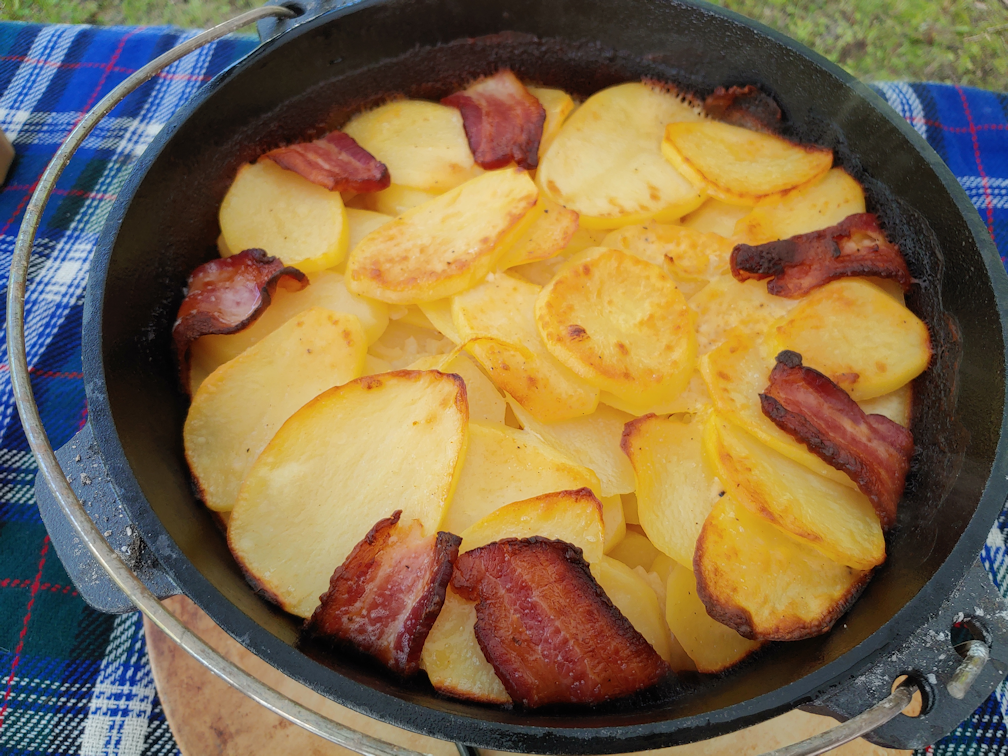
With our planned cookout, we were going to have burgers on the grill, with wieners and hoagies over the fire. So for the Dutch oven, I decided to do scalloped potatoes. I just slightly modified my usual recipe for them.
The first thing I made for them was a cheesy white sauce. A basic white sauce is a table spoon of butter, melted, a tablespoon of flour added and stirred to keep smooth, then slowly add about 2 cups of milk (how much milk depends on how thick you want the sauce), stirring constantly. The sauce it cooked until the desired thickness, then seasoned to taste (I used salt, pepper, paprika and garlic powder). For today’s sauce, I also added a handful of shredded Old cheddar cheese, stirring until melted. The sauce was then set aside until it was time to do the rest.
Along with the sauce, I used bacon slices, sliced onions and peeled and sliced potatoes.
The Dutch oven we got was pre-seasoned. According to the instructions, we could use it straight out of the box. However, since it was our first time using it, I still gave it a wipe down, then gave it a light coat of oil.
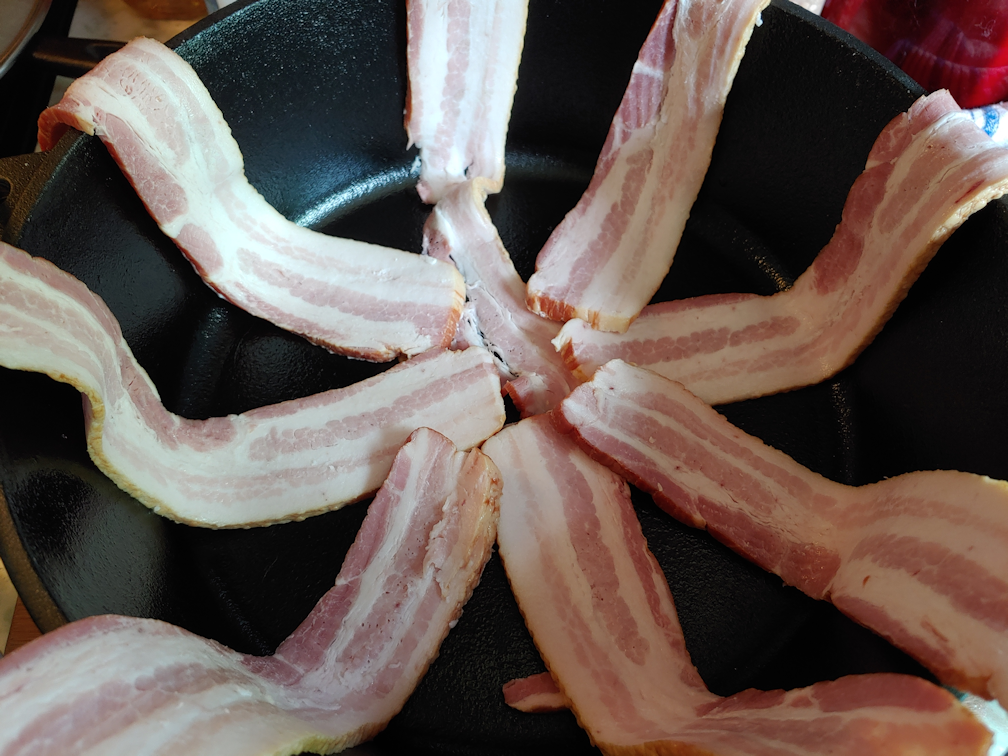
My first modification to my usual scalloped potatoes recipe was with the bacon. Pre-sliced bacon would have worked, but we happen to have a slab of bacon right now, so I cut a bunch of slices from that. They were not at all even and pretty, but who cares? :-D
The bacon is there to keep the potatoes from directly touching the surface – at least not right away. As they cook, the fat from the bacon renders out, making another layer between the sides and the other ingredients, until they absorb it. At least, that was the plan.
The sliced potatoes were in a bowl of water, and I didn’t try to shake it off much. The water would add to the moisture that would cook the potatoes, without making things too runny. The potatoes were layered on top of the bacon first, then a layer of sliced onions. Because of the bacon and seasonings in the sauce, no other seasonings were added between the layers.
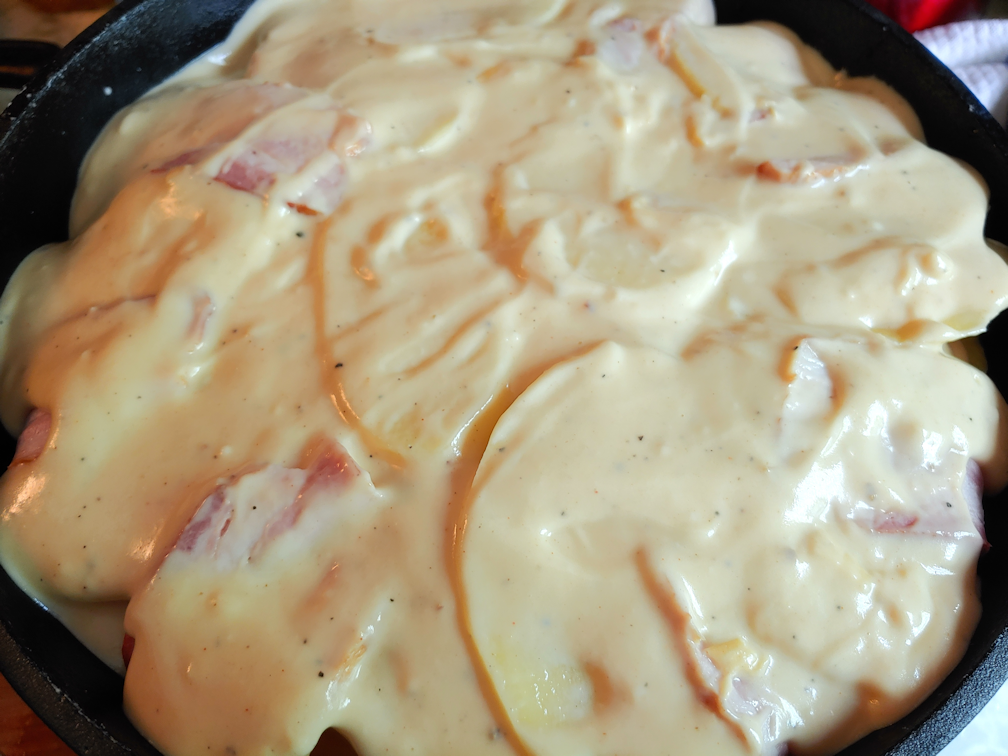
Because I was making enough for 8 people, I used about 7 – 8 pounds of potatoes and 2 sliced onions. The layers made for a VERY full pot! Once the layers were down, the bacon ends were folded over the top.
Then the cheesy sauce was poured over the whole thing. The sauce had thickened more as it cooled, so I smoothed it out and pushed it down the sides to get it down into the potatoes.
Because it was so very full, I thought it might end up touching the lid, so I gave the underside of the lid an extra coat of oil. Just in case.
Our Dutch oven set came with a carry bag. I put the full Dutch oven into the bag, tucking an ice pack under it, and a couple more along the sides, until it was time to get cooking. The carry bag made it much easier to move the whole thing to the fire pit later on, too.
About 2 hours before we were expecting our guests, I got the fire going.
I made sure to use all maple wood at first. That piece of tree that fell on our canopy tent and destroyed it was nice and dry, and burned really well.
Still, it took an hour to get it down to the coals I needed.
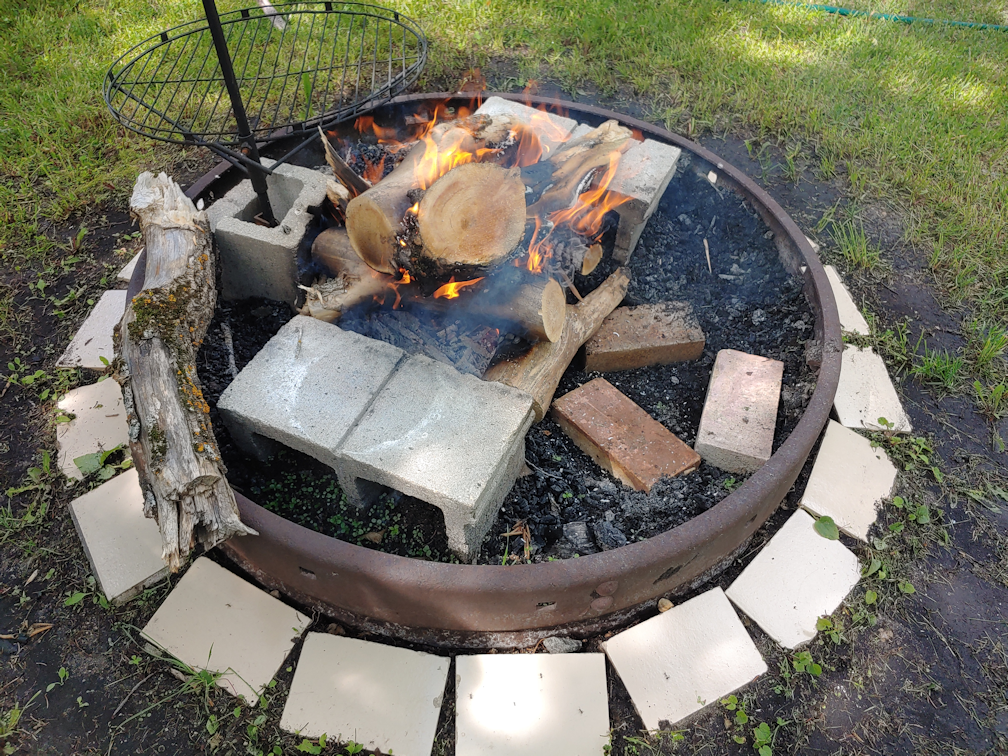
I put a bunch of coals in between the fire bricks I found. We will need to empty the fire pit of ashes, soon, so one of the benefits of using the bricks under the Dutch oven is that it keeps the legs from sinking. More ashes were added to the lid (they got spread out better, after I took the picture), and then I built the fire up again, for later roasting of wieners. :-)
By this time, I was starting to use pieces of apple wood we’d set aside was we pruned branches or cut away dead trees.
Since the fire was going, with so much more heat on the one side, I set a timer on my phone to go off every 15 minutes, at which point I rotated the pot a 1/3 turn. Getting the legs to rest on the bricks equally was more difficult than expected. I can’t see them while using the lid lifter on the handle to turn it, and I’d sometimes miss. At the very end, though, with my last rotation, I missed the bricks entirely, and the Dutch oven was resting directly on the bricks. It was more than an hour by then, and the coals were starting to die down, so I left it that way.
After about 1 1/2 hours, I decided it was time to take it off. Being cast iron, which holds heat for a very long time, if the potatoes weren’t quite done yet, they would continue to cook, even off the fire.
I ended up using a BBQ scrubbing brush to get as much of the ashes off the lid as I could, then used my fire fan to blow more ashes off the top. We brought out our pizza stone to use as a trivet on the picnic table.
The potatoes turned out to be perfectly done. The bacon was nice and crisp, and the potatoes absorbed the sauce completely. They were perfectly soft – almost creamy in texture, but still holding their shape. While things were crispier around the bottom and edges, nothing was burnt. Just toasty.
They were an absolute hit. So incredibly tasty!!
With how well these worked, we are looking forward to trying other dishes in the Dutch oven as we do more cookouts!
When that will be is hard to say, though, with so many mosquitoes to do battle with!!!
Last night, I found a large enough, liquid tight jar that would be great for making chive blossom oil.
It’s big enough that all the cleaned and dried blossoms could fit into it. The jar was saved from some Christmas nuts that were available at a local grocery store. Buying the nuts and keeping the jar was cheaper than getting the same type of jar (without the decorative glass) on its own!
After putting the blossoms in, the jar was filled with olive oil, then gently muddled with the handle of a wooden spoon to get out any air bubbles. A label on the top has the date and a reminder to turn the jar a bit, at least once a day. It should be stored in a cool dark place, but with the temperatures we’ve been having, we’d got it in a dark cupboard that is just a little bit cooler than the rest of the house. Thankfully, we aren’t expecting any unusually high temperatures for the next while.
This should be ready to use in about 5-7 days – or longer, if we want the flavour to be stronger.















 The Re-Farmer