After sitting overnight, tucked away in the oven, it was time to take out the cheese and do the final steps.
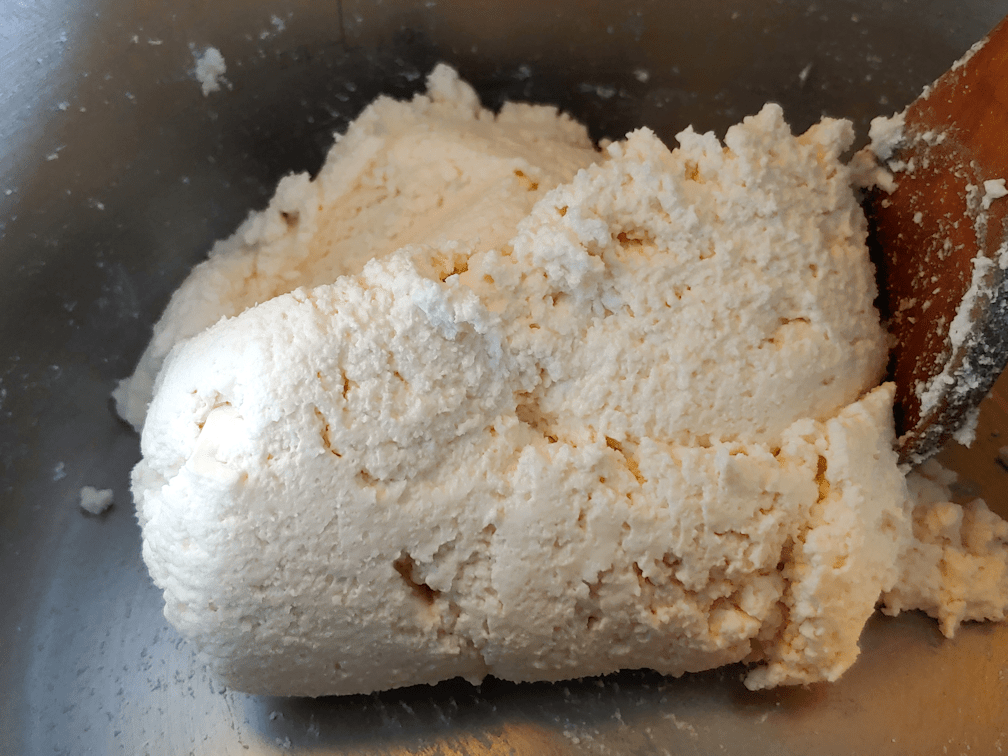
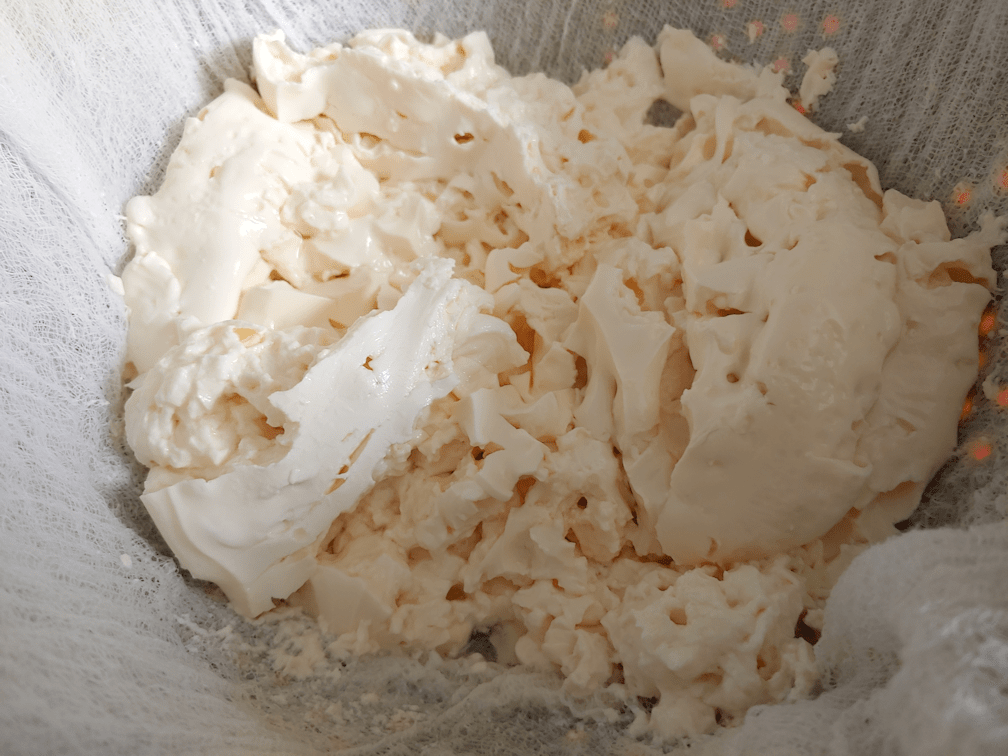
This is what it looks like this morning, after stirring.
It… looks like dry cottage cheese.
The next instructions were:
Add salt to taste, if desired. Add colour if desired. Add herbs/spices, if desired.
For this first attempt, I am only adding salt.
If you look closely, you can see the salt on the curds in front of the spoon. My mother would have just plain table salt, since that’s what she would have had. I stole some of the powdered salt my daughters use in the popcorn pot. It’s just coarse salt that has been run through a coffee grinder, so it can be added to the oil that popcorn is popped in, and actually stick to the popcorn as it pops. That got very thoroughly mixed in while I started the next step.
Put to frying pan on low heat, in batches, and heat. Mix while heating.
The more the curd got mixed, the more dough-like it got in consistency.
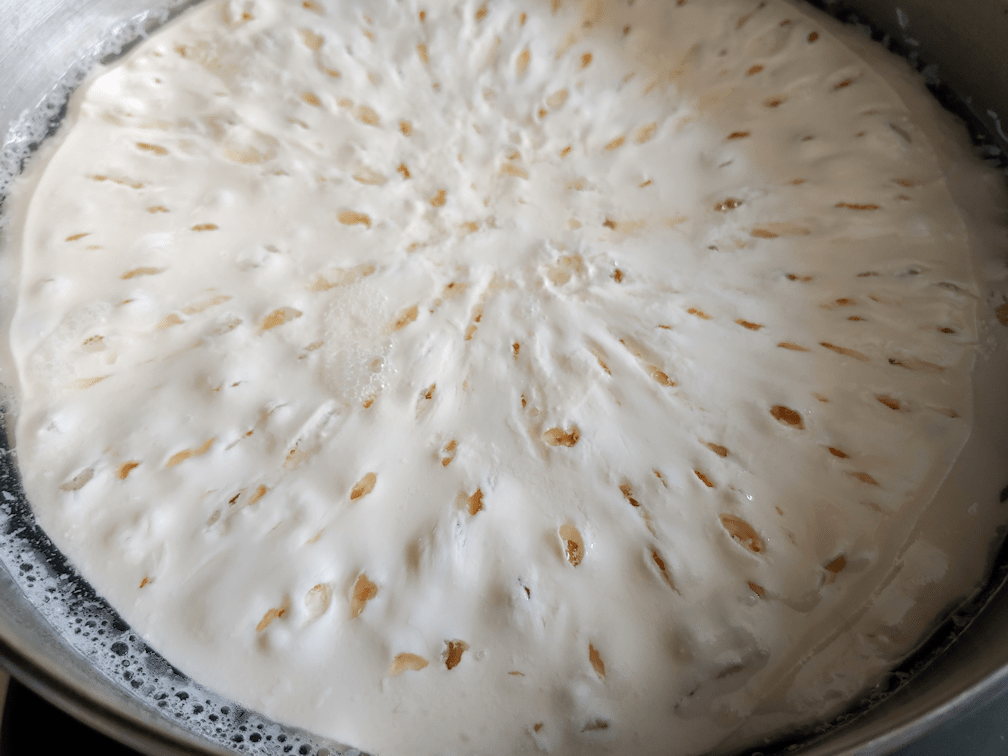
Then, it actually started to melt!
I know that’s what my mother said, but I still felt surprised by it!
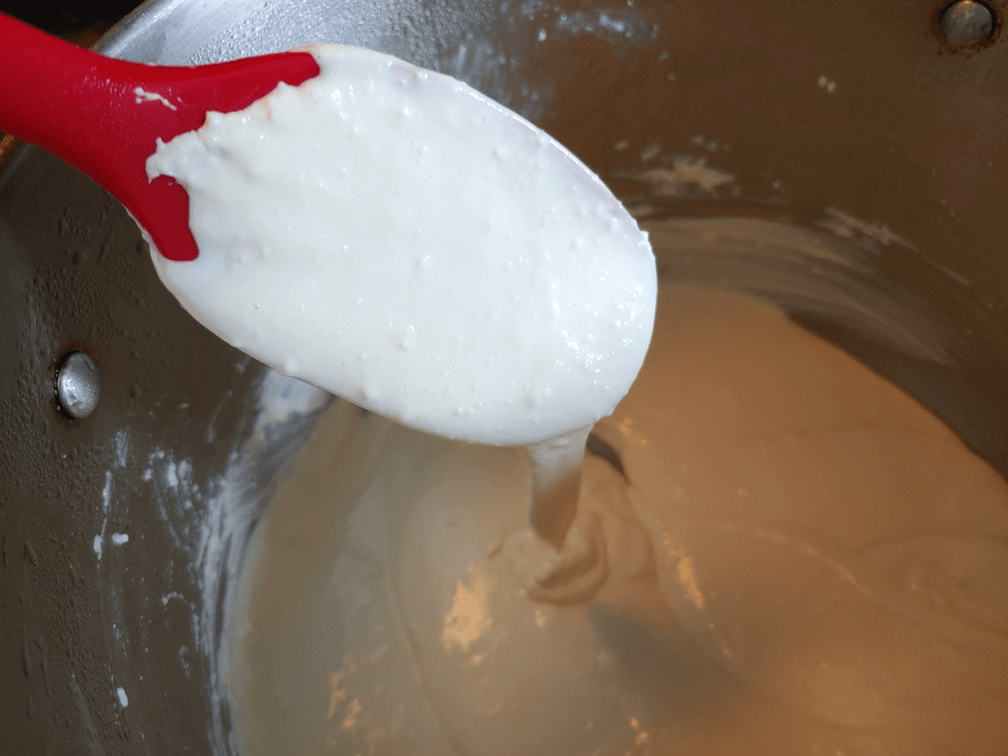
I even had to change spoons. By this stage, the texture was a bit like cake batter.
When melted completely, pour into form.
I didn’t know how long it needed to be stirred, but my mom said to pour it, so I just kept going.
Just look at this! It really did get to a pour-able consistency, unlike any other cheese I’ve ever worked with! At this stage, it was like well stirred sour cream in consistency.
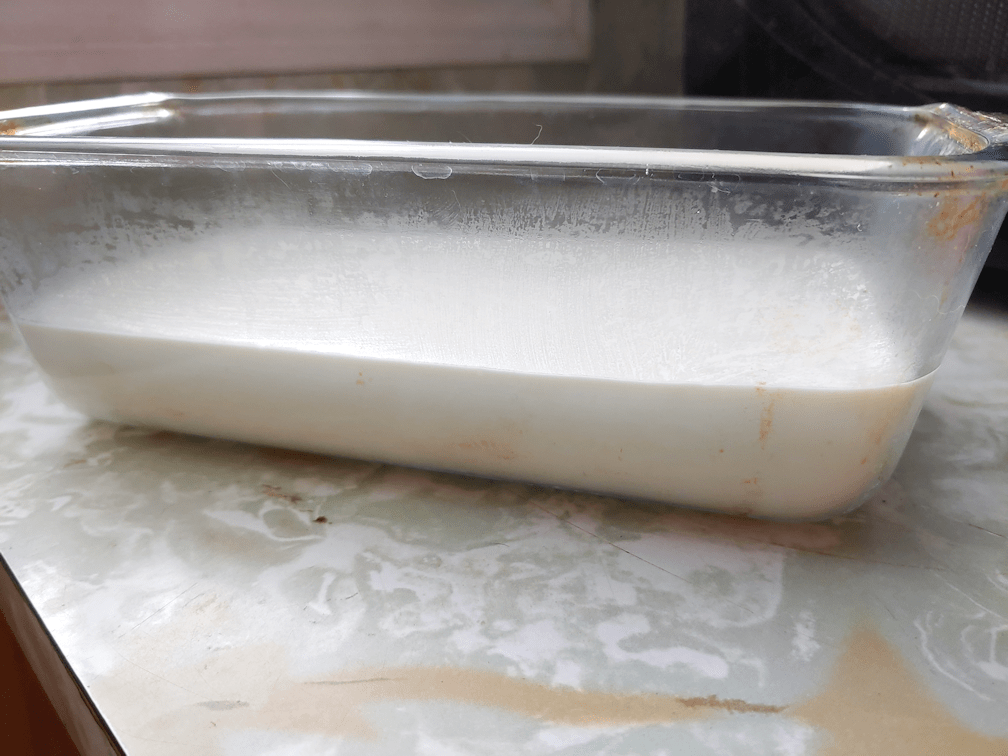
I then poured it into a loaf pan I’d scalded and had ready. This level if what 1 gallon of milk was reduced to.
Leave to rest until cool. When cool, ready to slice.
This is the stage we are at now. I covered the loaf pan with a narrow wooden cutting board I have. I considered covering it with plastic wrap, but I wasn’t sure I wanted the condensation build up, and the board would keep the dust off while also allowing a bit of air.
I’m hoping that, as it cools, it shrinks a bit, so it’ll be easier to remove from the loaf pan.
I did taste it after pouring it into the mold (I admit it. I licked the spoon!). The salt definitely improves the otherwise bland flavour. There is another flavour in there that I just can’t identify or describe. I’m hoping after we do a taste test, later, someone in the household will be able to describe it!
Okay, so the curds have been hanging for about 5 1/2 hours, and I’ve moved on to the next steps in trying to recreate my mom’s cheese.
Now, my Mom had said to just set it aside for a few hours, or overnight, so hanging it may have changed things a bit. I don’t know. But this is what it looks like after hanging for most of the day.
Also, it’s a good thing I covered the whole set up with another cheesecloth, because the cats REALLY wanted to get at this!
The next instructions are:
Put solids into large pot. Add about 1 tsp baking soda and mix thoroughly. Leave overnight. Will rise like bread.
Hmmm.
Looking at how little there is in here, I’m starting to think that my original notes, saying about 5 gallons of milk, was accurate. There is not a lot in here, and when I saw my mother’s cheese, it filled an ice cream bucket, so there’s no way it was only 1 gallon.
Which means I’ve been using the quantities for vinegar and baking soda for 5 gallons, not 1 gallon. Yet, 1 tsp of vinegar to sour 5 gallons seems like way too little. Mind you, she would have been making this in the summer, and the milk probably would have soured quickly, with no vinegar at all. Knowing she was pretty loosey-goosey on the quantities to begin with, it’s really hard to know. Considering how long it took to sour using 1 tsp of vinegar to 1 gallon of milk, I suspect it’s actually the correct amount, and that I would have needed more, if I were using more milk.
This is after very thoroughly mixing in the baking soda. Yes, I used 1 tsp for this amount.
The curds feel like a cross between cream cheese and cottage cheese. I spent quite a bit of time mixing it, because I wanted that baking soda to be worked in as much as possible.
My mom said to leave it overnight, which means she would have just left it on a counter, but I have put the covered pot into a warm oven, because of how chilly that part of the house gets.
She commented that it will “rise like bread.” That makes sense, since we should be seeing a chemical reaction between the acidic milk soured with vinegar, and the alkaline baking soda. It’s something I’m used to when working with sourdough, but with cheese? I did get the sense that the curds were starting to feel “fluffier” by the time I finished stirring in the soda, but that could be just my imagination because I am expecting something like that.
I did taste the curds before and after adding the soda. As I mentioned before, it has very little flavour right now, but I did feel that the baking soda … softened… the flavour, if that makes sense.
After it has sat for the night, salt, colours and herbs and spices can be added. For this first attempt, I will be adding some salt, but that’s it. If we make it again, we’ll experiment with adding herbs and spices or whatever.
I am incredibly curious to see what it looks like by morning!
Growing up here, as a subsistence farm, we had cows for milking and for beef. Even with 7 of us, we were milking enough cows to have excess milk. I remember my mother making cottage cheese (which I did NOT like), but that was the only type of cheese I saw her make until some years after I’d moved off the farm. I’d come out to visit, and saw some semi-hard cheese in an old ice cream bucket for a form. It was slightly harder than a cheddar, sort of tannish yellow in colour, with caraway seeds in it. It was quite tasty. I asked my mother about it, and she said she had made it.
A few years ago, I asked my mother about how she made this cheese I remembered. Unfortunately, she thought I was talking about cottage cheese, and the more I described it, the more perplexed she was.
After moving here, I was having a conversation with my mother about making and preserving food, when she mentioned a cheese she’d made. It was the one I remembered! I quickly took advantage of the moment, and got her to describe to me how she made it. I knew it had to be different, because my mother did not have access to rennet or any of the bacterial starters. She didn’t have a food thermometer, either.
Getting any sort of information like this from my mother has always been difficult. I remember the first time I tried to get a recipe for a soup she made. I remembered some of the ingredients, and asked her if she remembered how she made it. Instead of answering me, she started mocking me for not knowing how to cook and not knowing how to make soup. Never mind that I was already married and a child, by then, and had been feeding the family just fine.
I never did find out how she made that soup.
This time, I did manage to get the information down then, after I got off the phone with her, re-wrote it into more cohesive instructions, since the conversation bounced all over the place. When I was finally ready to try it, I was perplexed by some of the quantities, so I called her to clarify. Did she really start with 5 gallons of milk, or did I make a mistake writing it down?
Finding out was like pulling teeth! She kept avoiding answering the question, and kept saying, “you mean you’ve never made cheese before?” in total shock. Then giving me instructions on how to do different parts. I kept going back to the quantity, and asked her if she had used 5 gallons, only to be told how I should just use one gallon, because 5 gallons is such a lot… *facepalm* Then she talked about how she’d never made it using milk from a store, and how I could use lemon juice instead of vinegar, and on and on. It took a while, but I managed to explain that I have made cheese before, I did only want to use 1 gallon, and if the instructions I had was for 5 gallons, I’d have to know that, so I could adjust the other quantities.
What it came down to is, my mother never measured. She used whatever amount of milk she had, and went from there. I did know that. What I needed was some sort of approximation, because there is a heck of a big difference in quantities involved.
Finally, she told me she used about 1 gallon.
*sigh*
Once I had that clarified, I finally got a batch started. Here are the instructions I got from her, highlighted in blue, with my own commentary.
Milk – about a gallon Add 1 tsp vinegar to make sour. May take all night.
This part actually ended up taking almost two days. The milk was supposed to rest at room temperature, but with how cold our house is – especially the kitchen – I put it in a warm oven.
When sour, put in pot/roaster into oven to warm (lowest heat) until forms curds and whey.
We finally reached that stage this morning.
This is how it looked.
I have no idea if this is how it’s supposed to look.
Drain through cheesecloth.
There is nothing about cutting the curds or anything like that, first. Just to drain it.
I did give it a taste at this point. It doesn’t have much flavour to speak of. The texture was a lot denser than I expected it to be, considering how it broke apart.
Set aside for a few hours or, preferable, overnight.
This is the stage we’re at now, though I’m cheating a bit. I dug out the stand I made to hang jelly bags or drain yogurt cheese, tied off the cheesecloth and hung it.
After taking this photo, I covered the whole stand and bowl with another cheesecloth, to keep out the dust and cat fur – and cats!
Since I got to this point so early in the day, I will likely continue after a few hours, rather than leaving it overnight, because…
Put solids into large pot. Add about 1 tsp baking soda and mix thoroughly. Leave overnight. Will rise like bread.
… it will sit overnight again, after this stage.
As for the whey, I think it’s time to do some more bread baking! I love using whey as the liquid. It adds so much flavour!
The next instructions have me wondering.
Add salt to taste, if desired. Add colour if desired. Add herbs/spices, if desired.
This is all stuff that’s supposed to be added after the baking soda gets added, and after it rests overnight. Which seems odd to me, but that’s how she did it, so that’s how I’ll try it!
Put to frying pan on low heat, in batches, and heat. Mix while heating. When melted completely, pour into form.
… melted?
It can melt at this stage?
I am really perplexed by this.
I’m not sure what I’ll use as a form just yet. It will depend on what I see when the time comes
Leave to rest until cool. When cool, ready to slice.
If I hadn’t see my mother’s cheese, I would never guess that these instructions would get that result. As it is, I am still unsure of what I’ll actually get!
So this should be an interesting experiment. I hope it works, because it’s really easy to make, even if it does get spread out over several days.
It was a lovely morning, as I did my rounds, with nothing at all to suggest we were going to be hit by a storm, later today!
As is now usual, I had a whole crowd of kitties waiting outside the door for breakfast. :-D
I counted 19, but it’s possible I missed one of the ‘icouses. They were milling about so much! I did get to pet a few furry butts, including several of the kittens that normally would have run off already, plus our newcomer.
Creamsicle Baby was battling it out with Agnoos for special attention. :-D
Butterscotch followed me while I was doing my rounds. She really likes that I now go to the corner of the property to check if the new sign has been vandalized yet, and switch out the memory card on the camera. She has taken advantage of the set up and uses the various posts to climb up and jump onto me, making it very hard to switch out the memory card!
While going through the yard, I spotted a few summer yard tools we missed putting things away, and brought a couple of our snow shovels closer to the sun room door. They are normally kept by the main entry, but we are avoiding using that door until we can get the door and frame replace; something we’d hoped to get done before this winter, but the budget for it just didn’t happen. I wasn’t even able to get the estimate done; I was going to call the same company that did the windows here, before we moved in, but I can’t find them! I do hope they haven’t gone out of business, like so many others have done in the past year and a half. :-(
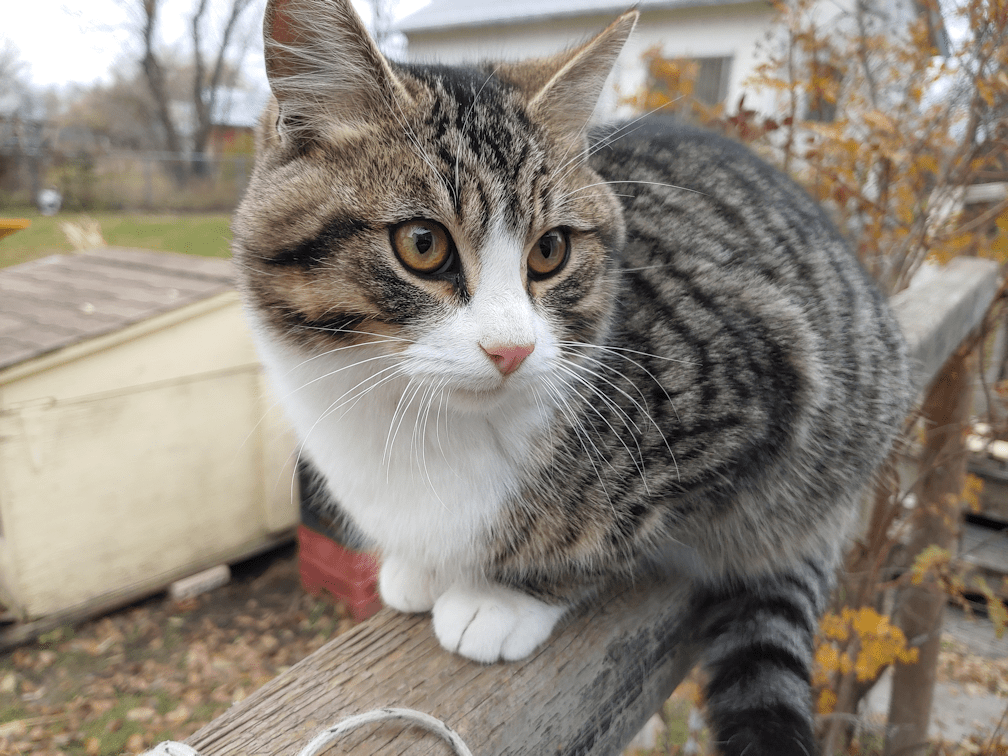
When I was ready to come inside, I found this handsome fella waiting for me.
He even let me pet him and scritch his ears!
I think this one is Chadicous, but I’m not sure.
I love that pink little nose!
The general store the post office is in closes at noon on Wednesdays, so I headed out shortly after they opened. I wanted to get the battery we needed for the cat’s house smoke detector that I forgot to pick up yesterday. While there, I picked up another bag of flour, just in case.
I had a few general things planned for baking today. One of them was muffins, but I hadn’t settled on any recipes. After doing some searching, I found a couple of savory recipes I wanted to try.
The whole day of baking was about timing! The first thing I did was cook a package of bacon in the oven, until dry and crumbly, for one of the muffin recipes. Once that was cool and crumbled, I started a double batch of bread. I didn’t use our dough baby, because I forgot to set it to soak overnight. Instead, I used our basic bread recipe, which gets modified with whatever we have on hand. This time, it included oatmeal and chia seeds, with molasses for the sweetener.
While that was sitting for its first rise, I had time to make a double batch of apple bacon muffins.
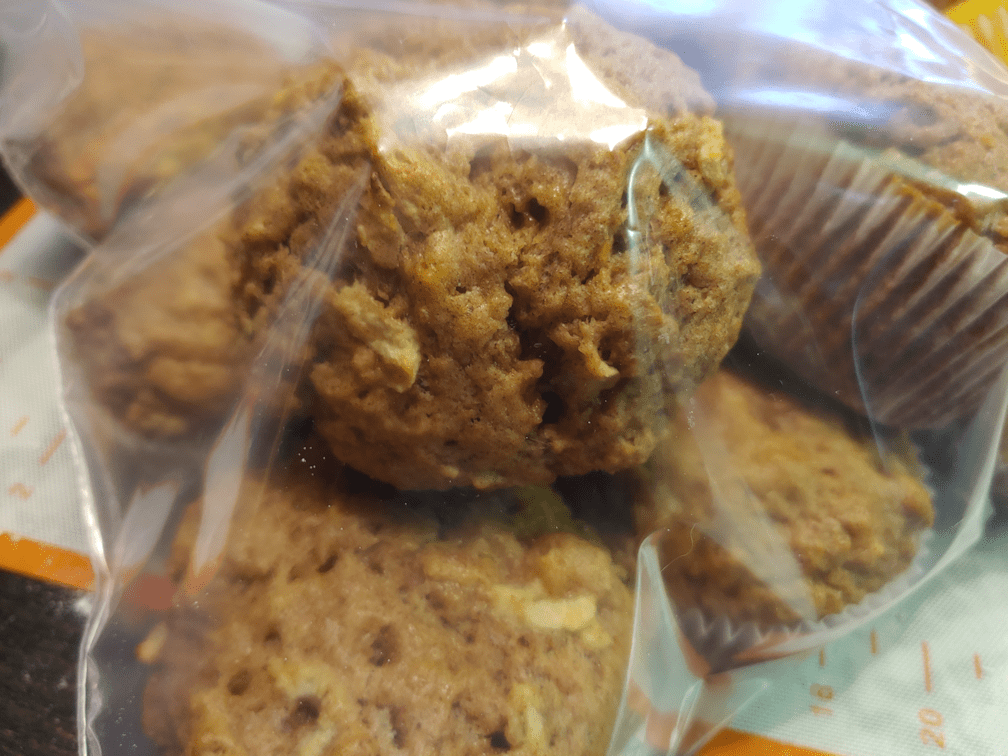
Half of them were for the freezer, and half to have on hand. This recipe as a surprising amount of cinnamon in it, which accounts for the darker colour.
There is an entire package of bacon and two Granny Smiths in that double batch! The recipe sounded amazing, but it didn’t live up to expectations. Don’t get me wrong; they were quite tasty. However, I really expected to at least taste all that bacon! The predominant flavour was the apple. I’d definitely make them again, even if they didn’t life up to their hype. ;-)
When the muffins where done and cooling, the girls quickly took over the kitchen to make lunch for everyone. That gave me a chance to take a break – and see that the snow had finally arrived!
It has just changed from rain to snow when I took this photo. They’re hard to see, but there is at least one chickadee going for the sunflowers as they disappeared under the snow!
By the time we finished lunch, the bread was ready to be shaped into loaves and left for a second rising, which gave me time to make another double batch of muffins.
This time, they were cheddar cheese muffins. They were supposed to be smoked cheddar, but what we had on hand was sharp cheddar. The recipe included cornmeal and cayenne pepper. For a double batch, it would have been 1/2 to 1 tsp of cayenne, but there was no way I could use that much. I enjoy the flavour of spice, but have no tolerance for the heat. Still, I did add some. These turned out very nice. Better than the apple bacon, I’d say. Another keeper. Especially for the next time we get smoked cheddar. :-)
Once these were done, the bread loaves were ready to go into the oven. While they were baking, I started another double batch of bread. This one had oatmeal in it, too, (more specifically, rolled oats, softened in boiling water for a few minutes) and some hemp hearts I had left.
Also, I’m glad I got that extra bag of flour. We had just started a new bag, and I’ve already gone through half of it!
These are the oatmeal, molasses and chia seed loaves. I’m rather pleased with how they turned out! I’m a terrible one for using too much flour, and taking them out of the oven too soon, but I’ve gotten better. ;-)
Then, while the second batch of bread was rising, I made a batch of double chocolate cookies. Double as in, it has two kinds of chocolate (cocoa and chocolate chips), not a double recipe. A single recipe was enough to fill four baking trays. For so many, I had to get a daughter to tend the oven, as they baked very quickly, while I had to start shaping the bread for their second rising. This time, I made them into large buns instead of loaves. The timing turned out perfect. By the time the last cookies were coming out of the oven, the buns had risen enough to go into the oven.
I didn’t bother taking photos of the second batch of bread, nor the cookies. The cookie batter was the kind you drop onto an ungreased pan by spoonfuls, then they spread flat while in the oven. I ended up having to increase the cooking time, and they also turned out to be very fragile. Which is okay. Broken cookies taste just as good as not broken one! They just don’t look pretty. ;-) As for the buns, even with the oatmeal and hemp hearts, they just look like white bread. :-D Those were the ones we started on tonight. While two of the loaves of the first batch went to the freezer, along with half the muffins, I decided not to bother freezing any of the buns. Those are going to disappear very quickly!
In the middle of all this baking, I got a call from my mother. She was wanting to know if we had snow, too. By this time, it was coming down pretty heavily. She sounded so excited, and started going on about what a good thing it was we got her shopping done when we did. I agreed, mentioning that unfortunately, we didn’t get all the things we wanted to get done finished. She was completely oblivious. Instead, she started saying that, as long as the septic was covered, it was fine. She had seen the insulated tarp we had ready to cover it, the day she came out here, so she started giving me instructions on making sure it was weighted down so it wouldn’t blow away. I told her it was pegged to the ground. Apparently, she didn’t know that tarps have grommets on them, than can be used to fasten them down. She kept on going, telling me about how important it was to cover the septic tank. I ended up asking her, how long have we been living here? She thought three years. I said four, and we’ve been covering the septic every year we’ve been here. I know my mother thinks I’m stupid, but you’d think she would have noticed that the winterizing has been getting done, every year.
What I find strange, though, it that she was also talking about covering the well. In fact, she was talking about the septic tank and the well interchangeably, and then saying that if the well freezes, we’d have no water, and how terrible that would be. This was something she brought up last year. She insisted that the well cap had been covered with straw, every year, just like the septic tank. Which has never been done. Not only was it never covered with straw, but I know that even the accumulated snow was removed, likely with the Bobcat our vandal stole, as evidenced by the chips in the concrete, and one of the handles on the cover being broken right off, while the remaining one has been bent flat. Hidden by snow, it’s been hit and run over. Plus, the well cap is at least 12 feet down. It’s never been a problem in the almost 50 years since it’s been dug. She also had nothing to do with any of this sort of maintenance, so I don’t know where she is coming from on this.
It was a short phone call. I mentioned I was in the middle of baking, and she happily let me go. She just wanted to talk to me about the snow. It felt so weird. She’d been so nasty to me when she was here two days ago, and she has no awareness at all about it. I’d talked to my brother last night. My mother had just called him. I had filled my siblings in on how things went when she came out here, so he was in the loop. When my mother started talking about coming to see the sign, she was going on and on about how great it looked, how great everything looked here at the farm, and what a great visit it was. To which he said, no it wasn’t! He spent time time trying to encourage her to be kind and build people up instead of always tearing them down, to which she replied, “I’m not going to lie.” Apparently, the opposite of being cruel is to lie? She had said something about not saying that everything looked beautiful. Which isn’t what anyone is expecting and has nothing to do with simply treating people nicely. I’m grateful my brother stuck up for me, but we are both left rather perplexed by her inability to understand what it means to treat people kindly.
We may not have caught up completely, yesterday, but we did get the essentials necessary for winter, at least. This is our first real snowfall of the year, and while we will continue to be relatively mild, this is a snowfall that will stay. It is still coming down, and now the forecast says the snow will continue to fall through to Saturday, too. Our temperatures remain above freezing, so sleet is a major concern on the highways right now. We’re expected to get 10-15 cm of snow today (4-6 inches), with another 10-15 cm tomorrow, though the weather alerts say that our area might actually get more, due to the lake effect. It’s past 9pm as I write this, and we haven’t reached anywhere near the predicted levels, so who knows what will actually happen.
The forecasts do still say that today’s storm will become tomorrow’s blizzard. I was just looking at our weather history, and the record high for today was 13C/55F, in 2016, while our record low was -20C/4F, in 1991 – but our average high is 0C/32F and average low is -7C/19F, so the temperatures we’re having right now are not at all unusual. It just feels like it! Funny how that works.
Either way, it turned out to be the perfect day to stay inside and do a whole bunch of baking!
Okay, we finally gave the Red Kuri (also called Little Gem) squash a try!
We only had three that reached maturity (or close to it), and with the poor growing conditions, they did not reach their optimum size. I expect this has also affected their flavour, but we’ve never had this squash before, so we have nothing to compare them to, but each other!
I decided to roast them, as the easiest way to compare. While preparing them, I saved their seeds, including keeping the mutant squash’s seeds separate. If we liked it enough, we would try growing it next year, and see what we get.
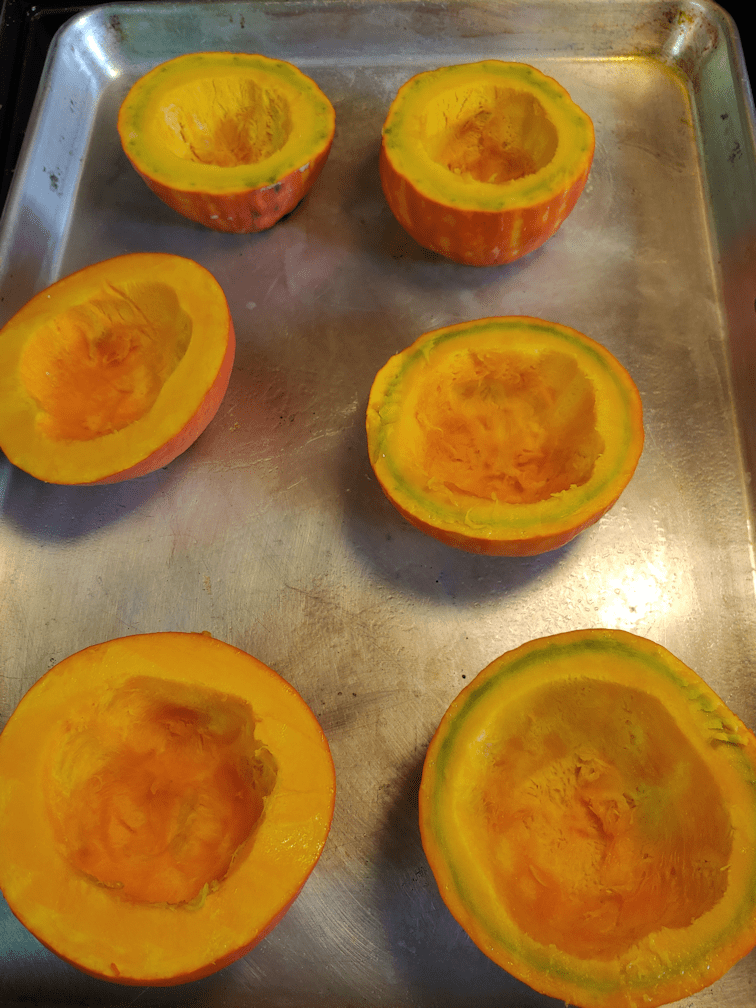
The two furthest halves in the photo are the mutant. This is the one that had a different shape, and was a mottled green and orange, rather than a deep, reddish orange. It also has the most flesh to cavity ratio.
The two halves on the bottom and middle right, with the ring of green near the rind, is the one that was less mature, while the ones on the bottom and middle left are from the squash that matured the earliest and had the most time to ripen.
I added some butter and brown sugar to each one, and roasted them at 350F, with a bit of water in the bottom of the pan, until fork tender. The butter and sugar pooled on the bottom of each, so we could taste them all on their own, then again with the butter and sugar.
Once roasted, I split them up between the four of us, so that we had a piece from each of the three squash.
I didn’t even think to take a picture until we’d eaten them, though! Oops!
The results?
My husband didn’t like any of them. He doesn’t like squash.
As for our daughters and I…
The mutant: we all found it very dry compared to the others. Not a good flavour. My younger daughter couldn’t finish her piece. I was okay with it enough to finish her piece off. The seeds went into the compost bucket.
The ripest one: This one had a nice texture to it, and the flavour was good. Better with the butter and brown sugar, though.
The slightly under ripe one: this one had the best flavour of all! With or without the butter and brown sugar, it was quit enjoyable.
I’m pretty sure we didn’t plant all the seeds that came with the packet, but I now have seeds from the non-mutant squash drying. There is a possibility of cross-pollination with the Teddy squash beside them, so we might get something different next year… or not. They didn’t really bloom at the same time, much, so the chances of cross pollination is rather low.
Just a bit of catching up on how things went yesterday.
The short version: Long.
It went long. Very long!
For me, it was working on pickling beets using the water bath canner. Until now, we have only done refrigerator canning, and my only experience with water bath canning was helping my mother, as a child. This is the first time I’ve done it myself, from start to finish.
It took WAY longer than I expected!
I have a Ball cookbook of canning recipes. The pickled beets recipe was for a half dozen 500ml jars. They had the basic pickle recipe, but also variations. After looking over our quantities of beets, I figured I could do two batches, with one batch being a “sweet pickle” using cloves and cinnamon sticks instead of the pickling spice mix of the basic recipe.
One batch called for 10 cups of beets. I decided to use up as much of the little beets as I could. Since they would be blanched and trimmed, and their small size would pack tighter than cubed larger beets, I made sure to grab more than 10 cups. I figured, if there was extra, we could just include them with supper or something.
While the first batch was blanching, which filled the blanching pot I found stored in a barely accessible space in the kitchen, I prepped a second batch to blanch. At the same time, I cooked the liquid with the pickling spice bag, and had everything ready to do the sweet spice version.
I was all ready to can the first batch, when I realized I had a problem.
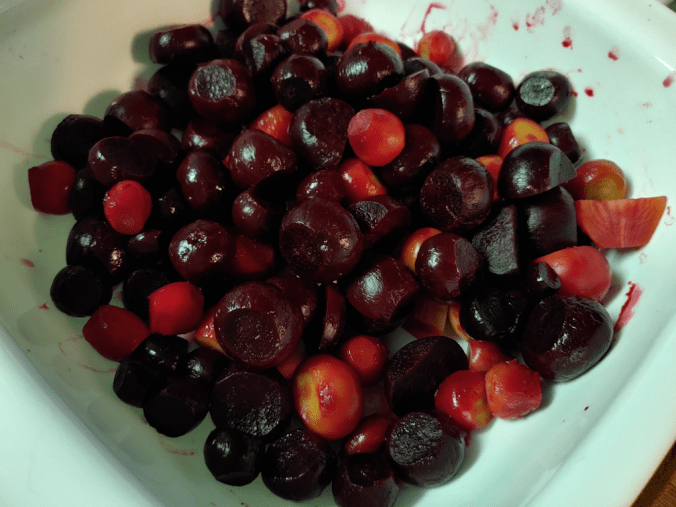
These are the first batch of fully prepared beets.
I doubt I could have filled three jars with that, never mind six!
So I added the second batch.
I still wasn’t sure there would be enough to fill the six jars I had prepped in the canner!
The next step was to put them into the pickling liquid and bring it to a boil, then start filling the jars. After my first jar, I realized I would likely have another problem. Not enough liquid! So I started the spiced version going and continued. I ended up being able to do only four jars with the basic pickling liquid, and the last two got the sweet spice version.
I started working on this before my daughters headed out to work in the garden. They came back four hours later, and I was JUST reaching the point where I actually start putting beets into jar. Most of that time was spent scrubbing beets, blanching beets, removing the outer skins, trimming the tops and tails, and waiting for water to boil.
I know “a watched pot never boils”, but my goodness, it takes a long time for large amounts of water to come to a boil!
But, if finally got done! Our first time canning AND our first time canning our own produce!
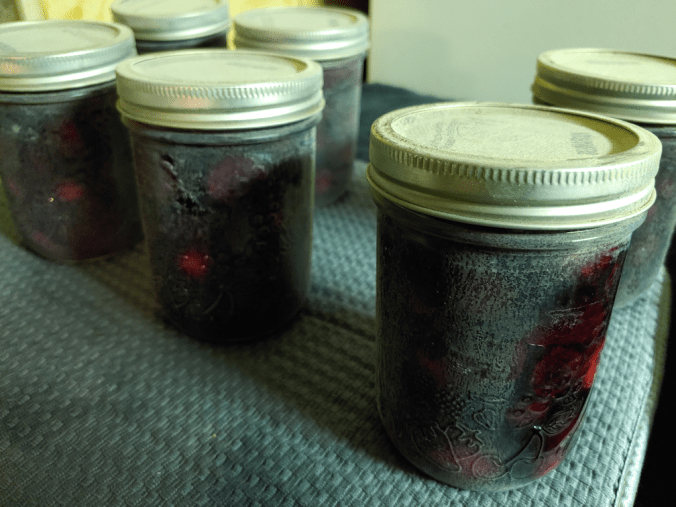
Pulling my first jar out of the water, though, was a bit of a surprise.
I mean, I know our water is hard, but wow! For the jars to come out with a layer of scale like this is crazy! You can see on the jar on the far right, where I wiped some of it with a paper towel. They’re going to need to be washed!
I finally had a chance to remove the rings and check the seals, just a little while ago, and they all came out fine! I made sure to keep track of which ones had the different pickling liquid, for when the scale gets washed off and they can be labelled.
Except the jars we open to taste test! :-D
By the time I was done, it was full dark, so it wasn’t until this morning that I could get a photo of the girls’ hard work outside.
They got three of the four remaining beds in the main garden area done – and most of that time was spent on just one of them! The first two weren’t too bad, but the third one was filled with crab grass, and it took them ages to get as many of the rhizomes out as they could!
I am amused by all the cat footprints in the loose soil! :-D
I’m glad they were able to get these done. Today turned out to be a write-off for outside work, but I will cover that in my next post. :-)
While I was outside, using the wood chipper, my daughter was busy dealing with our last summer squash!
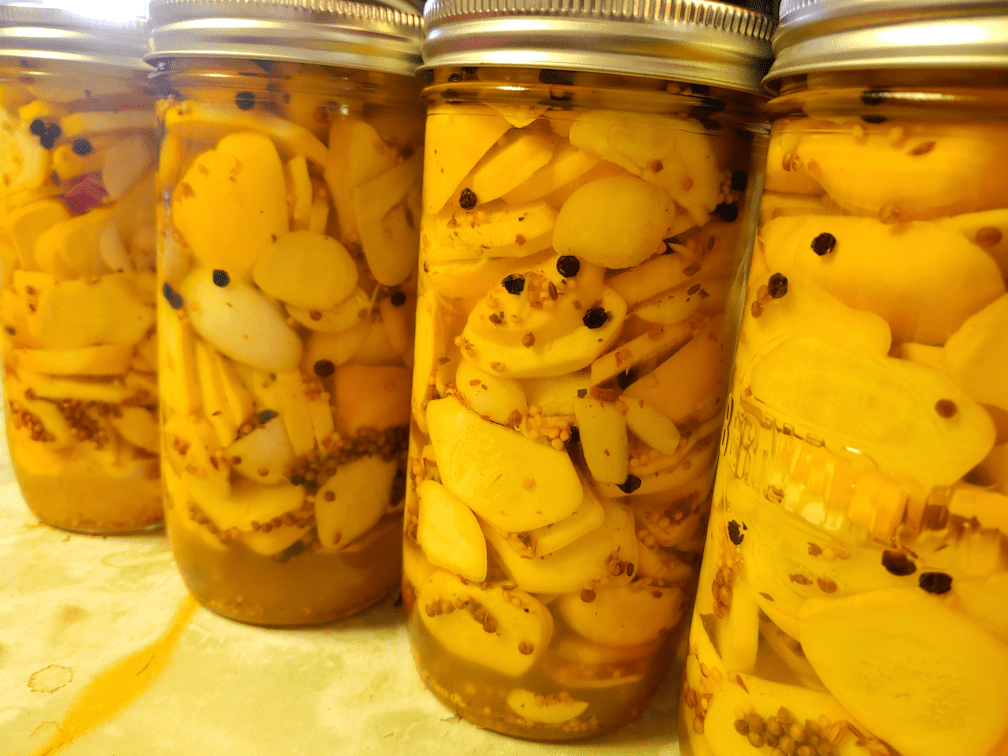
She made four 750ml jars of refrigerator pickles with most of them.
The rest went into a summer squash and tomato soup. I think she actually used canned soup as a base, with the summer squash and the teeny tomatoes we’d harvested recently, plus our own onions and garlic, added in, then whizzed with the immersion blender when they were cooked.
Thanks to my wonderful daughter taking over for me, yesterday, we had a couple of fresh loaves of bread to try this morning.
I’d started by having the dough baby soak overnight, then added flour to make a sponge. After several hours, this is what the sponge looked like.
My daughter set aside half of this, then used the remaining sponge to make our basic bread. Instead of using loaf pans, she made two big, flat loaves on a baking tray. Here is what I used for breakfast, this morning! :-)
The bread had a very mild sourdough flavour. For all the months the dough baby sat in the flour, it did not get any stronger in flavour. It was mild enough that I could put them with slices of brie under the broiler, and the flavour of the bread did not overpower the flavour of the cheese. The bread had a very nice texture to it, too.
As for the sponge that had been set aside; my daughter had used the flour from the dough baby’s canister in the bread, but there was still some left. I kneaded some into the sponge to make a stiffer dough, then refilled the canister half way with fresh flour, added the bough baby, then topped it with more flour. The canister is semi-transparent, so when I checked on it an hour or so later, I could see the dough baby had risen enough to work its way through the flour, so I gave the canister enough of a shake to cover it up again. With our temperatures slowly cooling (though I saw a 30C day in the forecast!!), we’ll be using this more often, which should further develop the flavour.
As someone who has never managed to keep a sourdough going for more than a couple of years, I really appreciate how low maintenance the old dough method is. If we can’t going to bake as often, it’ll just stay in its flour bed and dry up. It doesn’t need to be constantly used, fed, stirred, or kept warm. I think this will work out really well for us!
With how hot it’s been all summer, we’ve done no baking at all. It was simply too hot in the house to do baking and heat it up even more! Only recently did my daughter finally start baking some bread again.
Which means that our dough baby has been sitting in its flour, unused, for several months. That’s one beauty of using this type of dough starter; it doesn’t need to be regularly used and fed, the way a wet sourdough starter needs to be, and will just go dormant.
Last night, I woke it up! :-D
It really doesn’t look any different, once it was dug out of the flour.
The flour it was in, however, did look a bit different.
The dough baby has its own canister of flour, which had started to form a sort of shell around the dough. When I opened it, I could really get that sourdough smell, and it was as much in the flour as from the dough baby. I will be using this flour when doing the bread baking, as it is probably infused with yeast, too.
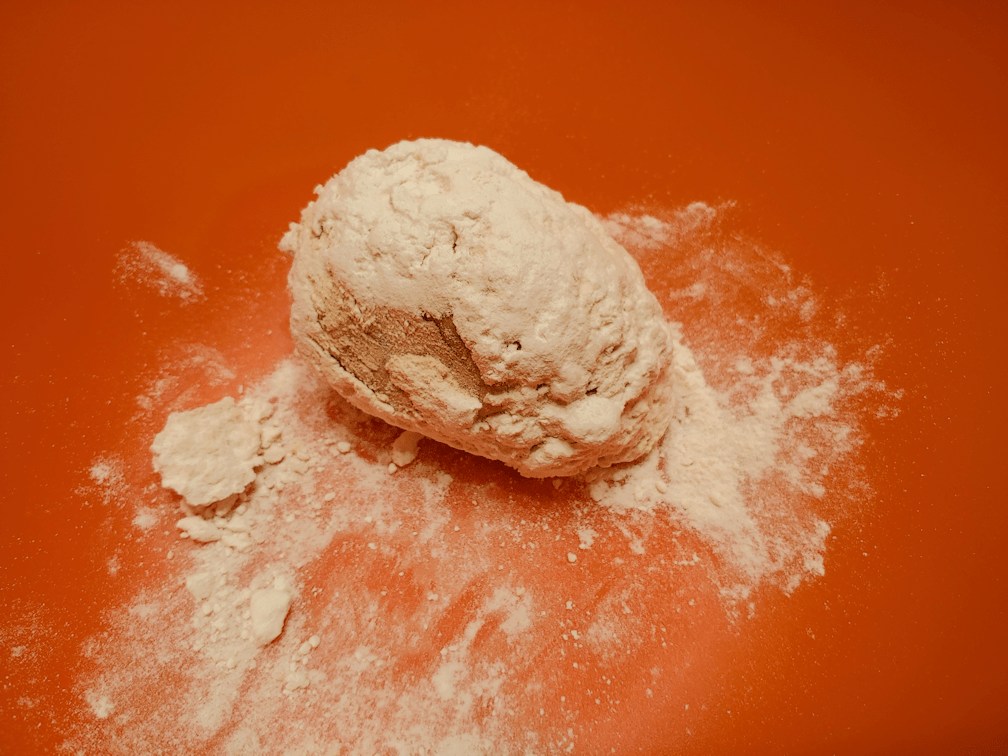
As dry as it was, the dough baby had lots of air pockets in it, making it easy to crumble apart.
I stirred in 2 cups of very warm water, then set it in a warm oven overnight, lightly covered. After a few hours, I checked it and decided to go ahead and cheat by sprinkling a bit of traditional yeast (not the fast acting type) and a bit of sugar into it as well, then swirling it about.
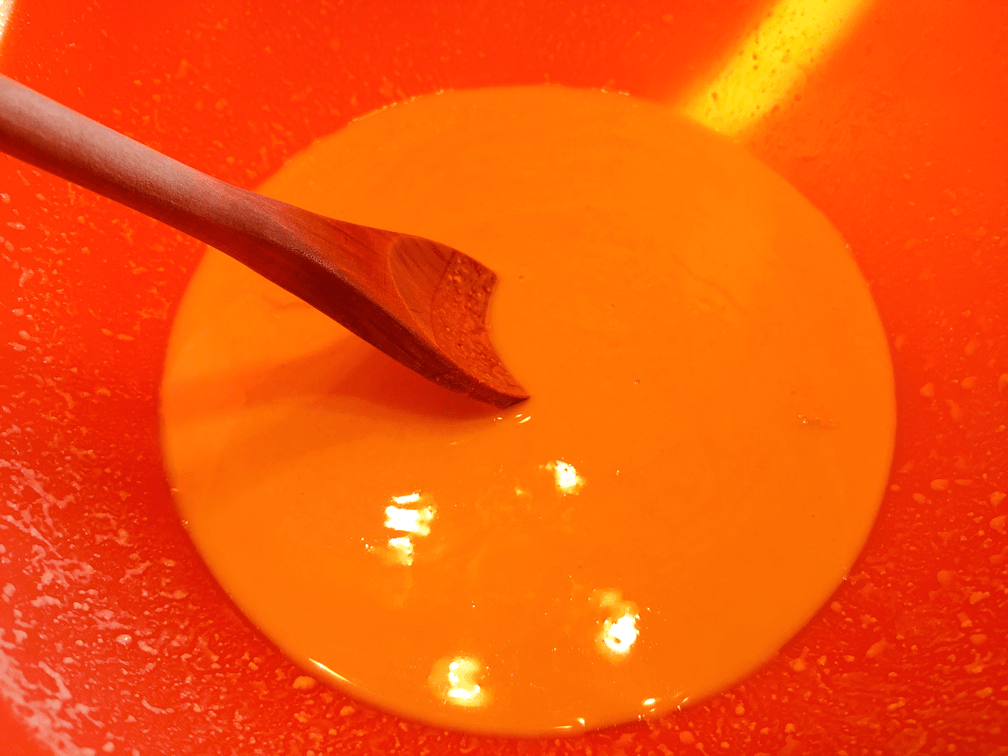
This is how it looked in the morning, after being stirred again.
That orange bowl really messed with the colour!
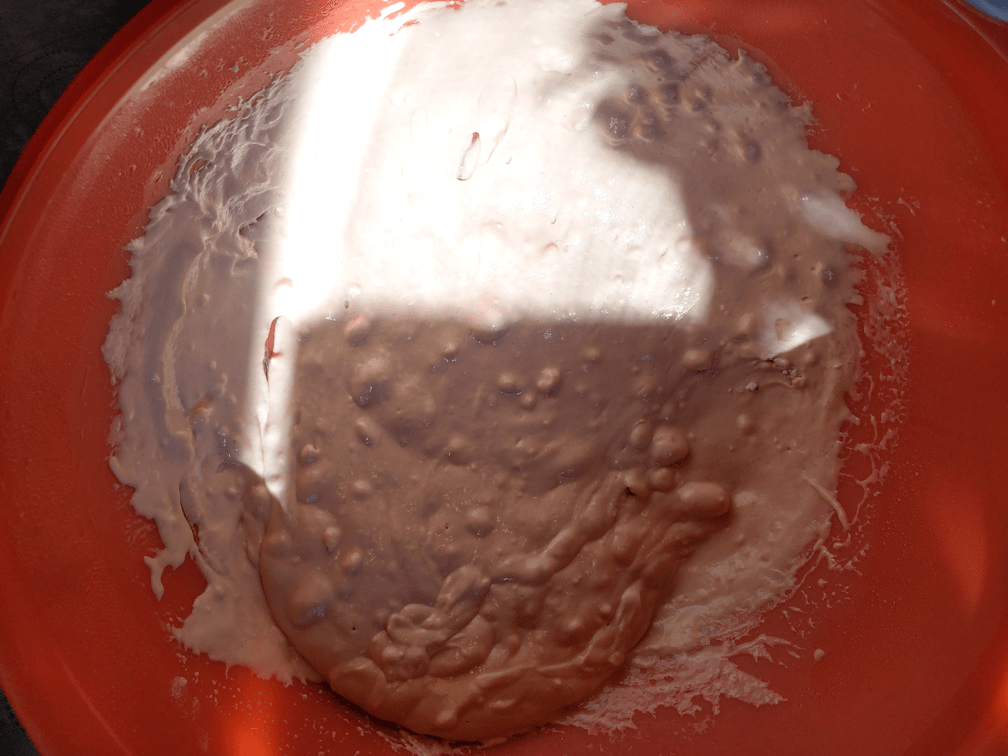
Anyhow, it was lightly bubbly by morning. After stirring it down, I added some of the flour from the dough baby canister.
I tried to get some natural light on there, so you can see the proper colour!
I broke up the flour as much as I could, but I’m not too worried about the lumps at this point. I added maybe a cup and a half of flour to get it to the consistency of a thick batter. It then went back into the warm oven for the sponge to develop.
It will take a long time for the sponge to develop without adding more commercial yeast, so bread baking with it is going to be an all day process, today! It’ll be checked regularly, but for this sponge stage, I figure it will take a few hours before I continue with the bread baking. :-)
Last night, for the first time in about two years, we actually used our fire pit and had a cookout!
We even used the new fire grill my brother and his wife bought for us, for the first time. <3
It was spur of the moment, so all we had on hand was hot dogs – I missed getting a photo of toasting the half-frozen buns around the edge of the fire grill. I’d finally burned away the vines and whatnot that had been sitting in the pit for many months, then decided to go ahead and build up a cooking fire, using apple wood we’d pruned a couple of years ago.
I think we did actually light a fire once last year, to burn off the invasive weeds that could not go into the compost that were in there, but that was it. Even in previous years, when we used the fire pit, we had the hose going constantly spraying water around the pit, just to be on the safe side. The only time we didn’t need to do that was when we had a cookout in the winter, and there was two feet of snow. We’ve had enough rain in the last while, there was no need to do that. We just had the hose nearby for dousing the fire later.
It was an absolutely gorgeous evening for the fire pit. So very relaxing.























 The Re-Farmer