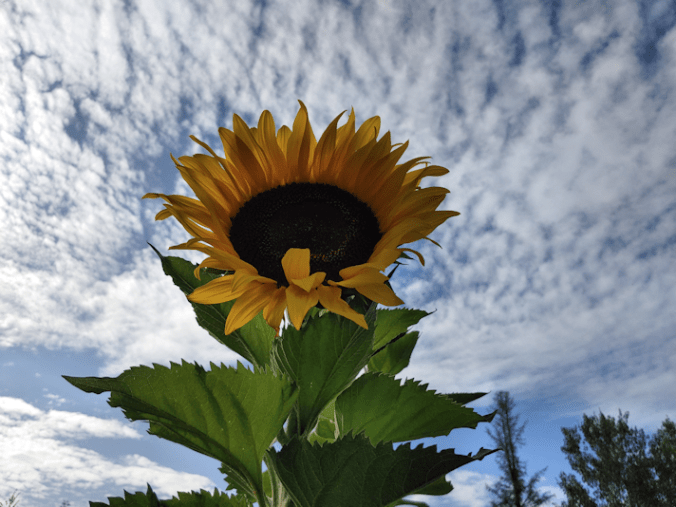
I’m happy to say that last night’s frost seems to have had no effect on the sunflowers at all.
The only leaves with frost damage that I saw were leaves that had first been broken by the high winds we had a few days ago.
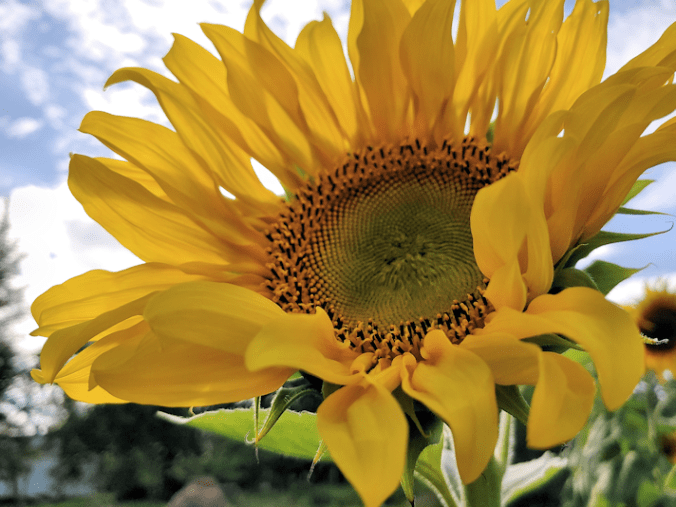
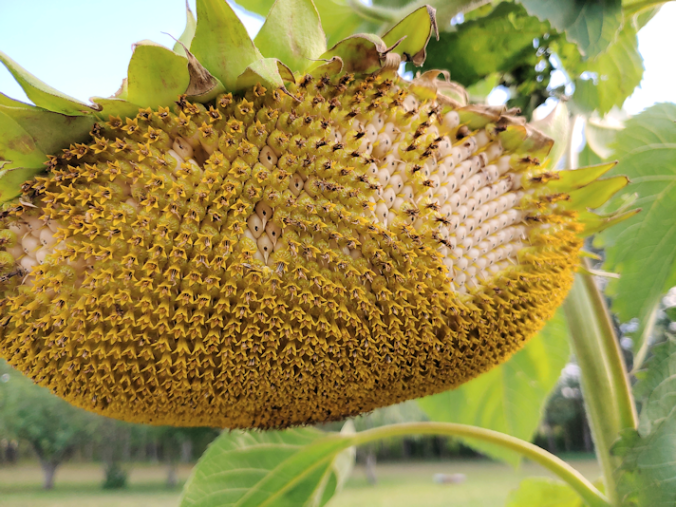
Right now, we’ve got seed heads at pretty much all stages of opening and ripening!
The birds seem to have finally discovered this one. Based on what I researched, I should be able to cut this seed head off and set it up to dry, but in the video I saw that demonstrated this, the guy was able to easily brush off the flower heads from the seeds. That isn’t happening on this seed head at all! The ones that haven’t already fallen off on their own are still attached quite well.
The girls and I will be heading into the city tomorrow, but I might harvest this seed head after we come back. If not then, then the day after. I’m planning to dig up the potato beds as well. We’ll see how the timing of things goes.
Hopefully, tomorrow’s trip to the city will be more productive than today’s – but that will get it’s own post later!
My husband has an appointment at the heart clinic in the city today, so I was out a bit earlier to do my rounds this morning.
As I write this, it’s still only 1C (33F), with a “real feel” that has warmed up to -2C (28F) since I last checked. Our high today is supposed to reach 15C (59F), which is warmer than the last few days. We’re then supposed to go above 20C (68F) for a couple of days, before dropping back to the mid-teens, which is more typical for this time of year.
We don’t have what we need to be able to cover plants as large as our squash right now, so this morning was more about surveying the damage.
I will check them again, after we get back from the city. Some look like they’re completely killed off, but others might still make it through the rest of the season.
I’m pretty sure the pumpkins are a total loss, though.
This is the largest of them, and you can see where the frost was on the pumpkin itself.
This pumpkin hill is the one that’s the furthest South – which means that it gets more shade from the trees than the others. It isn’t much, but as you can see by the plant, it doesn’t take much, either. This plant still had visible frost on it.
The other two hills were pretty much clear of frost. The developing pumpkins don’t show signs of direct frost on them – but from the state of the plants, I think they’re likely complete losses, too. We shall see.
Remember this little birdhouse gourd, bravely blooming just yesterday?
This is how it looked this morning.
*sigh*
Well, this year was our year to figure things out, and we’ve learned a lot.
We will have to work on finding different ways to cover and protect our plants from late and early frosts. Especially since we do want to keep growing squash, which are more easily damaged by the cold. The beets, carrots and parsley are just fine. Even the cucamelons showed less frost damage than the squash, which surprised me.
Altogether, though, we did far better with our gardening this year than I expected. It really has been a successful year, for the circumstances!
You’d think, having grown up here and helped my mother with the gardening for my entire childhood, I would already know what is needed, but everything is really quite different than the garden of my childhood. Especially with my parents planting or allowing so many trees to encroach into the garden.
While we will continue to have garden plots in this area, my mind is already starting to look at the outer yard, towards the barn, for possible raised beds, polytunnels or greenhouses for vegetable gardening.
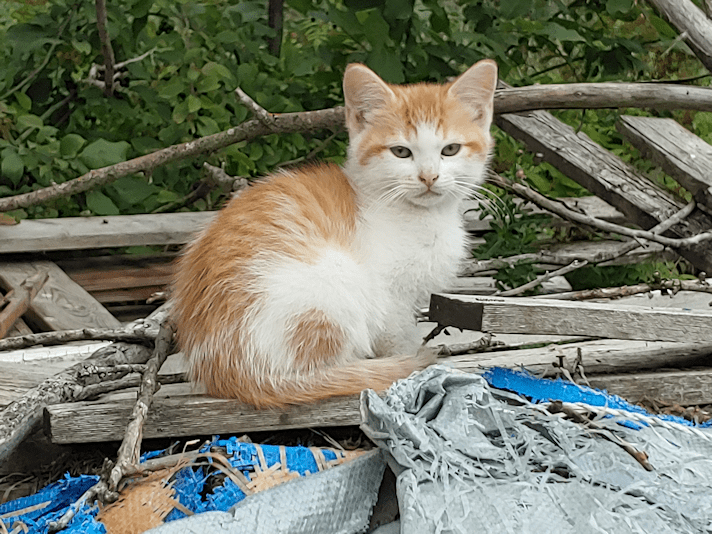
For a few times now, when going about the yard, I would see a cat among the trees. First glance, and I would think it was Junk Pile cat, only to realize that this cat looked slightly different. More white in the fur, and more the size of her own kittens – though they are almost as big as she is, now!
Last night, all possible doubt about whether or not this cat was really Junk Pile cat were cast away. While walking around the house, I startled a cat away from the food bowls by the sun room. It dashed off towards the storage house and disappeared under the lilacs at one corner – just as Junk Pile and two of her kittens came out from under the spirea at the other corner.
This morning, I finally got photographic proof of our cryptic cat’s existence. :-)
I stayed well back and zoomed in as much as I could, so this was the best my phone’s camera could do.
The kitten on the steps is Junk Pile cat’s tabby kitten, and they are very much the same size. Another kitten – possibly Junk Pile’s third kitten that is so very shy – had already run off.
This mystery kitten is most likely one of Rosencrantz’ kittens, but I honestly don’t know where it is from.
I’m glad that the shy ones are at least getting some food.
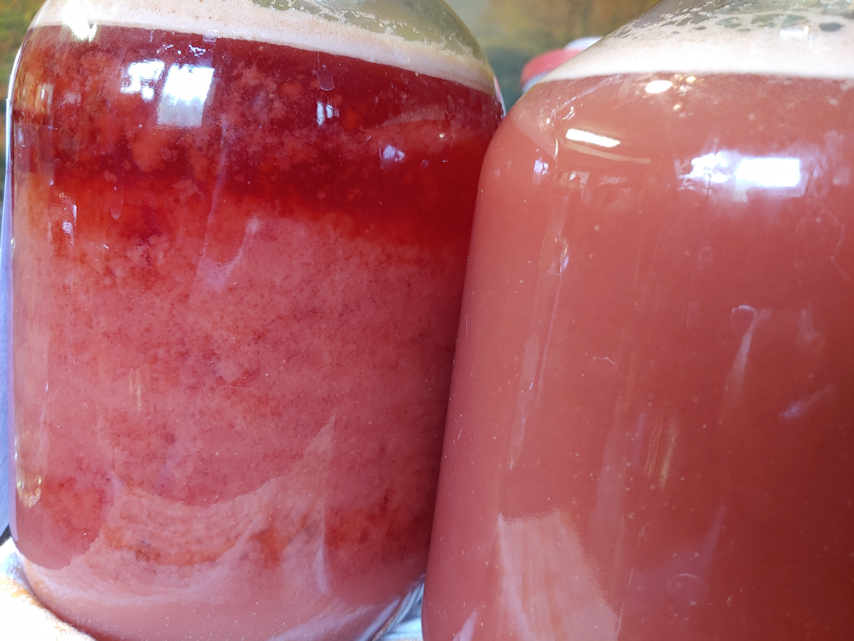
This is how the crab apple juice looked, right after we got finished setting up the fermentation.
This is how they looked this morning.
The photo does not do justice to how bright the colour is!
When I was checking these last night, the tops were full of dense foam, which has mostly collapsed, but you can certainly see how high it got.
Their temperatures seem to be holding at between 18 and 19C, and – most importantly! – we are seeing activity in the airlocks. Not a lot, but it’s definitely started to bubble!
Today, for the first time since we had produce we could harvest from the garden this summer, I collected nothing at all this morning.
Normally, I would have at least collected a few sunburst squash. With the cooler temperatures, though, the many little squashes out there are growing a lot more slowly. I like to pick them, and the zucchini, while they are still quite small, but not that small!
Amazingly, even though we dipped to almost freezing last night, one of the bottleneck gourds has started to bloom! This is one of the last ones that got transplanted. Of the tray of seed starts, a few germinated well after the others had already been transplanted, so I planted them, even though it was so late in the season.
I suppose I could have harvested some carrots and beets this morning, but they do better in the ground until we’re ready to use them. The potatoes are ready to be dug up, but it’s going to warm up a bit over the next few days, so I might wait a day or two.
I’m really hoping this little cool down is an aberration, and we’ll have a long, mild fall. If the pattern of that last couple of years continues, though, we should have a blizzard right around Thanksgiving in October! :-D
Today was our first attempt at making hard apple cider. We are using the remaining apples from the one crab apple tree we have that produces the most amazing, sweet, delicious little apples, after using some of them to start an apple cider vinegar.
When we first moved here and saw how many crab apple trees we had around the property, we looked into what was needed to make hard apple cider. At first, we didn’t think it would be anything we could do, or at least not anytime soon. Making hard apple cider, we found, required using a large press to crush whole apples, then sealing up the resulting juice to ferment a few months.
We didn’t have a press, and with so many other things on the go, we were not about to build or buy one, either.
They started making hard apple cider, using store bought juice. Sometimes, right in the container it was packaged in!
We could make hard apple cider without having a press, after all!
One of the things we found when cleaning up this place after moving in, was a juicer exactly like the one we had to leave behind when we moved. I think one of my siblings bought it for my mother, but she hardly used it. Everything was still in its original packaging, even!
We decided to try making hard cider using our own juice.
Now, making it using store bought juice in the bottle they were sold in works, because everything comes pasteurized and sanitized off the shelf. Basically, enough juice needs to be poured off to make room for the sugar and yeast, an airlock gets put on, and you can leave it to ferment to get a very basic hard apple cider.
Of course, doing it the traditional way, with a press, the juice didn’t get pasteurized or filtered or anything.
We decided to try making our own hard crab apple cider with raw, unpasteurized, unfiltered juice. The juice would be going straight from the juicer to the sanitized gallon jugs, so the chance for contamination would be very lower.
Lower than trying to do it the old fashioned way, that’s for sure!
The first step was to clean the apples and de-stem them. They didn’t have to be cored, but the stems would cause problems with the juicer.
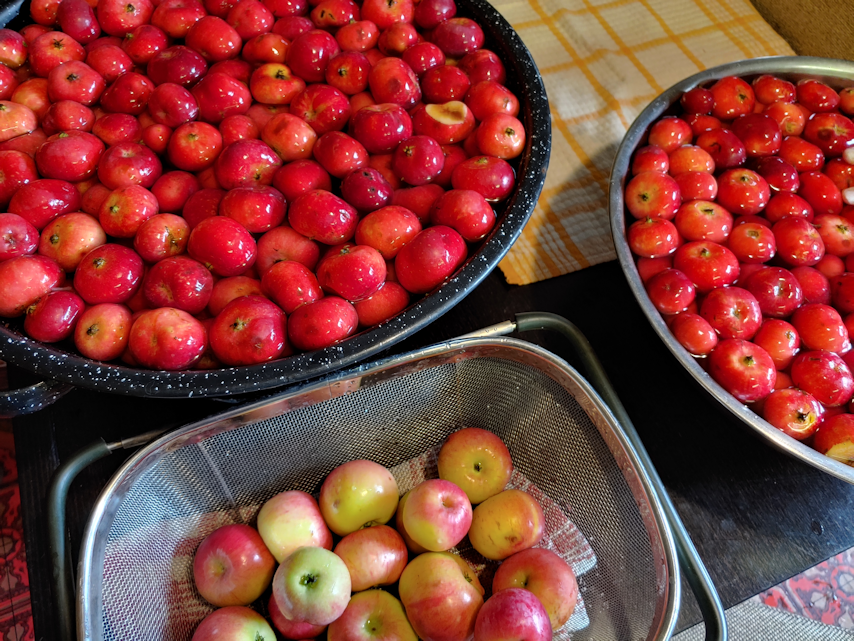
The crab apples from the one tree completely filled my two largest bowls. Though I cut away some obvious nasty bit, I wasn’t worried about light bruising. I also have the not-quite ripe apples from the tree that broke in the wind storm.
It’s a good thing we had so many of these apples this year, since I had to toss the cider vinegar, and start over again.
Juicing the apples turned out to be more difficult than expected. It was made slightly easier when we found a way to raise the juicer high enough that a 1L pitcher could fit under the spout. We had 2 one gallon jugs, and a gallon is about 4L, so I could use the pitcher to loosely measure how much juice I was putting in. However, these little apples don’t have a lot of juice in them, and their pulp kept jamming the machine. My daughter kept having to stop the juicer, open it up and peel away the pulp that accumulated on the perforated metal cone inside, instead of going out the back. The pulp was so dry, it could be taken off in ribbons!
Using information I got from one of the hard cider making videos, I used 2 cups of sugar per gallon. Each got 2L of juice before I put in a bung and shook the heck out of them to dissolve the sugar.
Look how pink that is!!
Also, you might notice the liquid is not at the same level. Though these are both 1 gallon jugs, one is actually bigger than the other. They are 1 gallon at about the “shoulder”, which leaves space for the fermenting liquid to bubble up a bit.
I also used the same wine yeast we’ve been using for everything else; I don’t know the specific strain of yeast, but it’s basically what is available for a non-sparkling wine from the local brewing supply store. Again, following what I saw in the video, I dissolved about a tsp of yeast in a bit of juice, then added it to the full jugs, after getting a hydrometer reading.
After the yeast was added, they got another thorough shaking, then the airlocks were put in place.
I’m also trying to be more diligent about recording everything. I have to admit, I still don’t understand the hydrometer information, so I wrote down all three readings. It has a “potential alcohol by volume” measure right on there, but I keep reading that it isn’t any good, and that it’s better to use the specific gravity reading. It doesn’t help that I can barely see the tiny numbers and lines in the first place!
I found it interesting that the readings for the 2 jugs that were made up identically, are slightly different. It’s possible that the different sized jugs means that one does have slightly more juice in it than the other, and that could explain the difference.
The juice is not only incredibly pink, but incredibly cloudy! They were, of course, just shaken when this photo was taken. You can tell which one got finished first, as the cloudiness is already starting to settle.
We have set the jugs up on a side table in the dining room for now. It’s not a particularly bright room, it’s warmer than the old kitchen, and we can keep an eye on them. I just took a look at them, after they’ve had several hours to settle. I will have to take a photo of them during the day. They look very different right now! The sediment has settled to the bottom, and the clear juice in the middle is looking a deep, deep pink – but there is a significant layer of lighter pink foam at the top! I used the temperature gun on them, and got different readings, depending on where I aimed it. The top, where the foam is, was fluctuating between 19C and 20C (66-68F). The middle was around 17-18C (62-64F), while the bottom, where the sediment has settled, is 17C (62F). Which I think is good.
Also, I’ve turned the thermostat up for the house. It was set just below 15C/59F when the furnace turned on earlier today, so I’ve upped it a few degrees! So the ambient temperature will not be too cold, either.
I have no idea how this will turn out. Will the fact that we used raw, unfiltered juice be a benefit, or a disaster? Will we get something that tastes horrific, or wonderful? Considering how great the apples themselves taste, I would hope the resulting hard cider would be its match. I have no idea. This is a total experiment for us!
As for the remaining apples, it took so long to juice enough to fill the jugs that we didn’t juice the rest of them. I had started cutting them up to cook them into a dessert, but realized I didn’t have the energy for that left, so they ended up in the freezer! Meanwhile, my poor daughter had been standing at the juicer for so long, her back was starting to give out on her! We couldn’t even plug it in somewhere where she could sit down, since there are so few outlets in this house.
Today, the girls and I worked on juicing apples and getting some hard crab apple cider started (which I will post about next). While I was de-stemming the crab apples and cutting off any nasty bits, they took care of sanitizing the gallon jugs and the various items that would be needed.
They usually did the sanitizing part during our few beginner attempts at making alcoholic drinks.
That’s my excuse!
You see, when I used sanitizer to start the crab apple cider vinegar a couple of nights ago, I made a mistake. A silly, forgetful mistake. A laughable mistake, even.
But for the cider vinegar, it was a deadly, disastrous mistake.
As I listened to the girls chatting while using the sanitation solution, then rinsing everything off and setting it aside on a towel to drip dry, I suddenly realized my horrible mistake.
When I sanitized everything for the vinegar, I set everything out to drip dry – but forgot to give them a final rinse, first. Which means, when I made the vinegar, everything had dried sanitizing solution on them.
There’s no way they’d be able to ferment at all!
Later, while my younger daughter and I were juicing apples, I mentioned it to her. Oh, my, the look on her face!
Sweetheart that she is, she took over the juicing while I went and got the jars.
There was, of course, no sign of bubbling in the air lock, but after only 2 days, would there have been any? I don’t know. However, when I opened them up, I could see they were already a loss. There may not have been any fermentation happening, but decomposition had already started at the very top. :-(
Thankfully, since I had prepped all the other apples for juicing, I was able to wash, sanitize and RINSE THE HECK OUT OF everything, then quickly chop apples into pieces for a new batch.
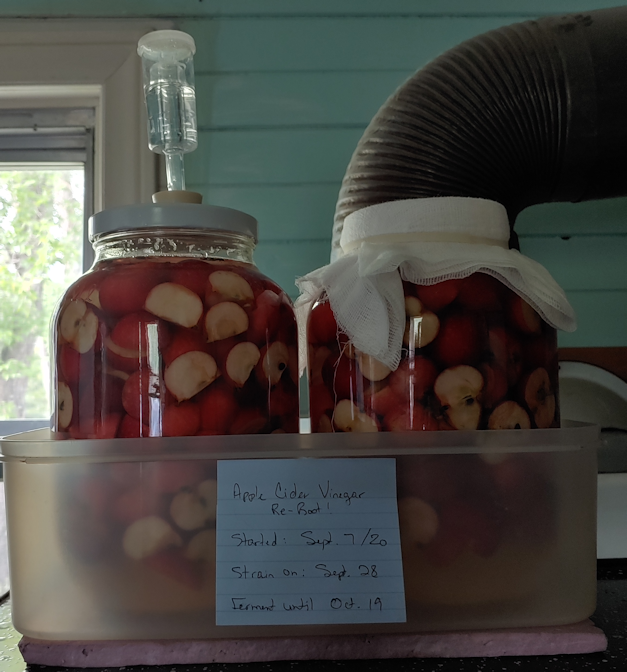
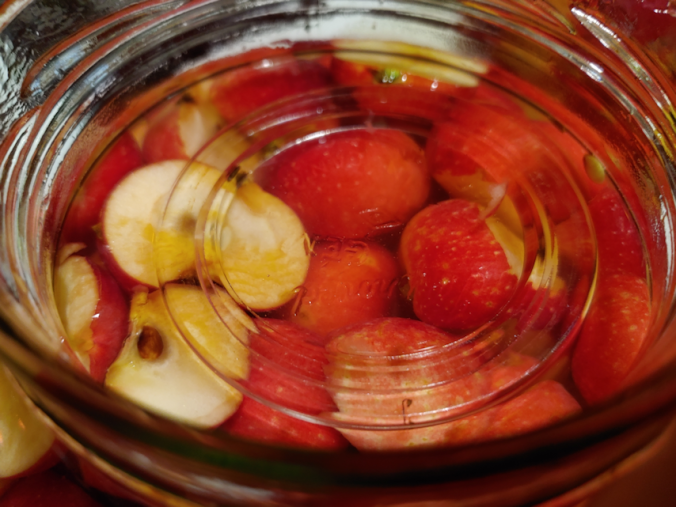
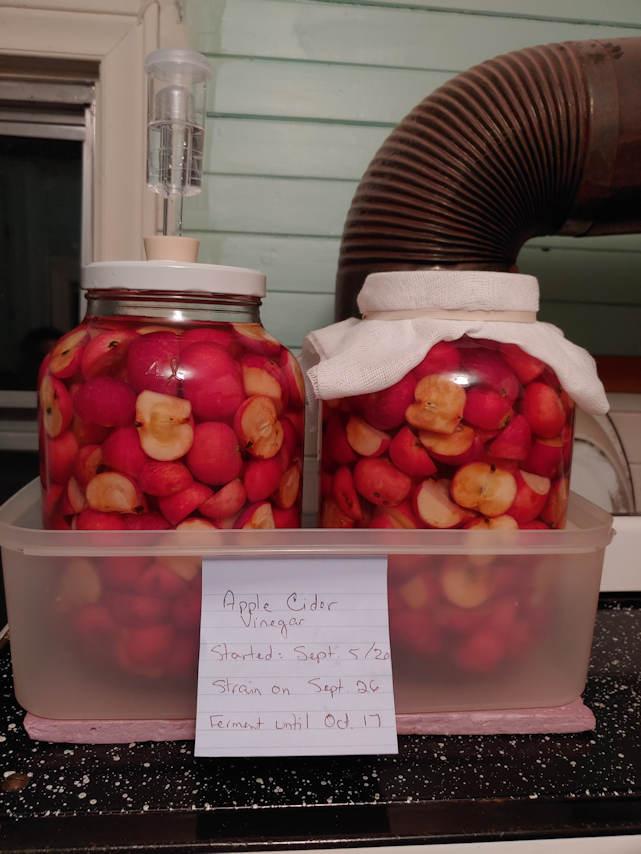
The only thing different from last time, aside from actually rinsing everything after sanitization, was to not fill the jars as much as I had before. The recipe had said to fill the jars 3/4 full. I think I was still over that, but the first batch was full almost to the top. Here, you can sort of see through the container they are in, that there is a fair bit of space under the floating apple pieces.
I foresee only one problem right now.
These are in the old kitchen and, right now, it’s pretty cold. It was cold enough today that the furnace actually turned on – and the thermostat was dropped quite low over the summer! As I write this, it’s already dropped to 4C (39F), and we have frost warnings for tonight. Amazingly, we’re supposed to go above 20C (68F) in a couple of days, but for now, it’s downright chilly! The old kitchen doesn’t have any heat going into it. Back in the day, with the wood stove going, it was a source of heat for the rest of the house, not the other way around! I don’t even know what the old kitchen has for insulation, if anything. It stays cools in the summer, and in the winter, it gets pretty close to freezing in there. We can actually use the room as an extra refrigerator in the winter.
The cider vinegar should be done well before we reach those sorts of temperatures all the time, but the next couple of days might slow things down a bit!
We shall see how it goes.
I still can’t believe I made such a silly mistake!
Yesterday’s high winds knocked quite a few branches down.
This one would have landed on the tent, if it had still been there.
We haven’t figured out what to do with the tent yet (other than keep the canvas parts). You can see two of the metal pieces that broke. On the table is the hub they had been attached to. It has no damage to it. :-/
We didn’t lose any trees this time, but we did lose part of one.
This is the apple tree at the very end of the row. In the spring, we had cut away the dead part in the middle, but the saplings that sprouted out the base looked healthy. They don’t have a lot of apples on them, but the ones they do have are larger than any of the other trees, so these young trees were already drooping from the weight.
This one simply broke away from the trunk of the original tree.
When I came back this morning, I was intending to pick the apples off, then cut away the broken tree.
Once I got a better look at it, however, I realized it was still quite attached to the roots. It just wasn’t attached to the dead tree trunk. Even after a chilly night, there wasn’t even any wilting at all.
In fact, it might actually be salvageable.
So instead of cutting it away, I took advantage of the remains of the dead tree, and tied it upright again.
If I can keep it supported upright long, as the tree grows, it should be able to old its own without the support of the trunk. It might take a few years, but that’s okay.
If it survives at all. If it doesn’t, I’ll cut it away then.
Check out the size of this apple!
It would have gotten larger, too, as it ripened. They probably could have used 2 or 3 more weeks.
These are all the apples from that one branch, including a few that had fallen to the ground.
I will be including them with my juicing, today. I’ll start off with just the sweet ones I used to make the crab apple cider vinegar; I’m hoping to get enough to do two gallons of hard apple cider. As the jugs will need room for the sugar, it’ll get less than 2 gallons of juice needed, but still pretty close. Once I get that, I don’t mind mixing different types of apples. Any remaining juice will be for drinking. :-)
The juicer is out of storage, and now I need to get off the computer, get everything prepped and start juicing! :-)
Last night, I procrastinated cleaning the dining room by starting the apple cider vinegar! :-D
I slightly modified the recipe I used last year, which you can find here. (Link will open in a new tab.)
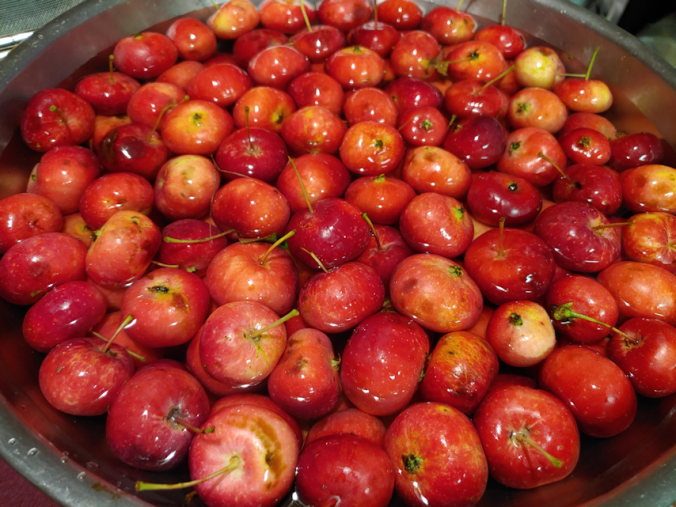
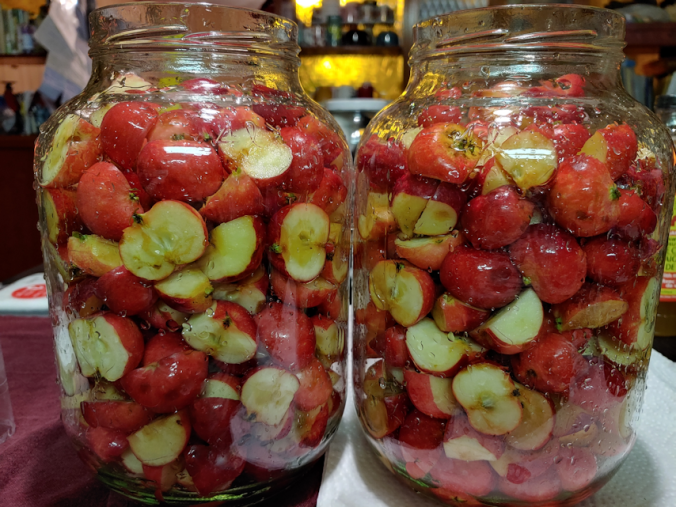
I started off by using one of my gallon jars to measure out apples from one of the 5 gallon buckets. As the apples would be cut into pieces that would fit more tightly, plus I would expect to cut away nasty bits, or even toss entire apples, I filled the jar to the top twice, then added a few extra. I have a large enough bowl to be able to give them a bit of a wash, then leave them to soak while I prepped other things.
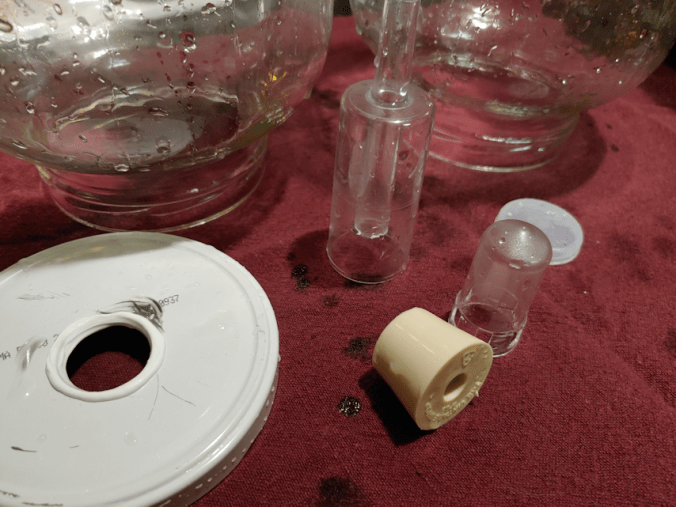
Last year, I sterilized things with boiling hot water. Since then, we have started brewing, so along with extra airlocks, we also have sanitizing solution. So one of the changes this year is to use that to sanitize everything, instead of scalding them.
Since I was doing a lot more crab apples this year, I put the cut pieces into water with a bit of lemon juice as I worked. Last time, for the amount of apples I can, there was no need for anything to keep them from browning until I was done. I cut them all into halves or quarters, depending on the size of the apple – or used what was left after cutting off any nasty bits! As expected, there were some losses, but not all that much. In fact, I could have done with fewer apples for the jars!
The recipe said to fill the jar 3/4s full, and I ended up with almost full jars! Even after shaking down, they were still full to the shoulder.
The recipe called for 2 Tbsp of sugar for a 1 quart jar, so for these, I used 8 Tbsp of sugar per jar. The recipe calls for filtered water. Last year, I happened to have some water bottles I could use, instead of our very hard, iron rich, well water. We currently buy refills of water for drinking that is first filtered, then treated with UV light and reverse osmosis. That is what I used to dissolve the sugar in, first.
The next change from last year was the use of a “starter.”
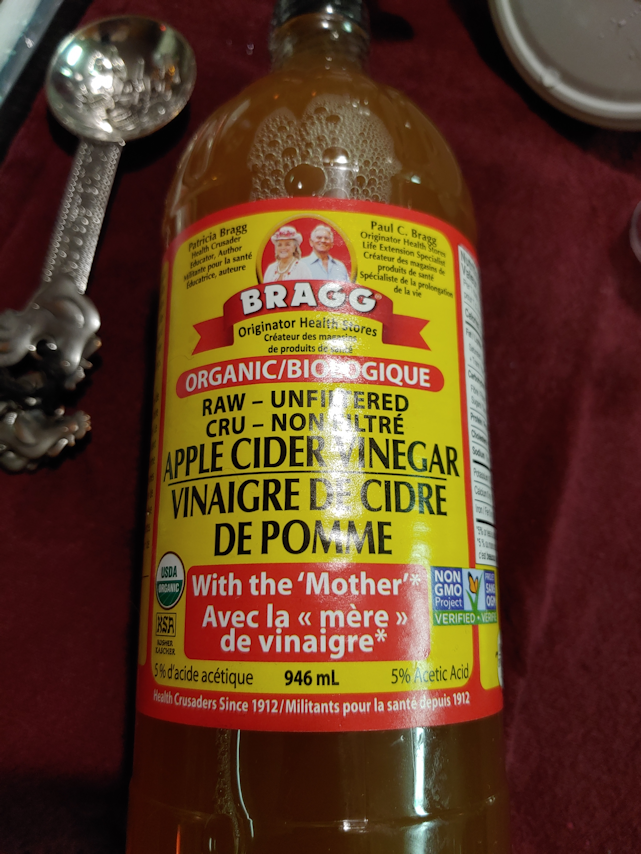
I’ll admit that when I normally buy apple cider vinegar, I buy whatever is cheapest. It gets used as an ingredient in cooking, so I don’t feel the need to anything fancy or expensive. When making the cider vinegar last year, it relied on the water, sugar, apples and whatever natural bacteria in the air “contaminated” it. Since I plan to use an airlock this year, and everything has been well sanitized, it’s not going to get that exposure. So I picked up a bottle of Bragg raw, organic, unpasteurized ACV, with the “mother”, to use as a starter and introduce the little critters needed for fermentation.
In doing my research, I found one person who used this same brand as a starter in his own ACV. He was using a large crock and just sloshed a bunch in, with no measuring, so I was left with no real idea of how much to use. I decided that 2 Tbsp per gallon out be enough. To make sure I got some of the “mother” that had settled on the bottom, I gently turned the bottle back and forth and upside down a few times first.
Once the starter was added, I filled the jars the rest of the way, with about an inch of headspace, with the filtered water.
When doing this last year, I didn’t have any fermentation weights and made do with some small jars. I still don’t have fermentation weights, but with the nice, wide openings in these jars, I had something else I could use.
When I was a kid helping my mother with canning, snap lids wasn’t a thing, yet. She used either wax or glass lids with rubber rings to seal. In cleaning up the basements and the old kitchen, I’ve been finding lots of these glass lids. I cleaned and sanitized a couple of them, and they look like they’re just the right size to keep the apple pieces submerged! :-)
Now comes the experimental part.
The two jars were made in exactly the same way. One of them now has the airlock cap, while the other is covered with layers of cheesecloth, held in place with an elastic band. They are not sitting on top of the warming shelf of the old wood cookstove in the old kitchen. I placed a small piece of foam insulation down, first. The old kitchen stays quite cool throughout the summer, and is even cooler now, so the metal would be quite cold. During fermentation, there will be bubbling and foaming, and a possibility that the liquid might reach the cheesecloth, or even overflow, so they are in the plastic container to protect the top of the stove from any drips.
Now, it sits for three weeks. During this time, we’ll be checking them daily. I look forward to seeing what differences there might be, between the two methods, as well as comparing to how it turned out last year.
Hopefully, no fruit flies will be attracted to the one with the cheesecloth! We have a fruit fly problem in the kitchen right now, but so far, they haven’t been found in the old kitchen.
I still have about 7 or 8 gallons of apples left, even after my mother took some home. Tomorrow, I plan to juice them and start making some hard crab apple cider! The traditional way to do it is to use a press to smush the whole apples, then leave the juice to ferment on its own. We don’t have a press, but we do have a juicer, so I’ll be using that, plus some of the yeast we picked up to use for mead making. We have four 1 gallon jugs, plus a half gallon jug, to use for fermentation, so there’s plenty to be able to do both. :-)
This should be fun!! :-)
The Re-Farmer
Update: Sept 7, 2020 – I goofed! But you won’t spot my mistake here. Visit this follow up post to see what I did wrong, and how I fixed it.












 The Re-Farmer