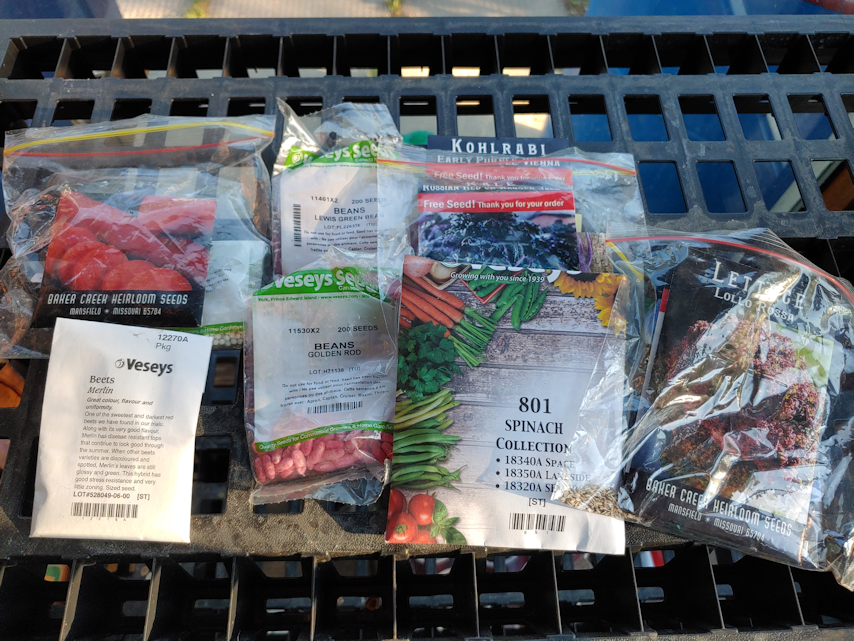
Before heading out to do the watering, I went through our remaining seed packets to do a bit of planning.
First, there’s what’s left of things we planted in the spring.
To the right, we have the two types of carrots in pelleted seeds. I keep reading that we can still plant carrots this late in the season, and I had debated with myself about replanting the carrots decimated by the woodchuck, but really… what’s the point? It seems to have a special love for carrot greens, and until we get rid of the woodchuck, there will be no new plantings of carrots!
To figure out what we can plant for a fall harvest, I looked up our first frost date, which is Sept. 10, and worked out how much of a growing season we have left. Then I checked out the germination and days to maturity to see what we can plant now, and what will wait until later. We could plant the remaining Merlin beets, but we have so many beets planted, there is no need. The two types of beans could also be planted, but again, there is no need. Not in the photo are the remaining green peas, which apparently can also be planted this late in the season, but we won’t. If we wanted to, we could plant any of the summer squash, too, if we wanted to. All the seeds we will not be using this year got set aside for next year.
We had received the purple kale and purple kohlrabi as free seeds with each of our orders from Baker Creek. We ended up with two packs of kohlrabi seeds, but still have seeds in the one we did open. There are still kale seeds, too. These are both cool weather crops, and the kale can hand frost. While I plan to try kohlrabi again next year by starting them indoors, I’d forgotten we still had seeds. I’ve decided I will go ahead and plant the rest of the open packets of seeds, in hopefully better conditions, and actually get some growing!
The 3 types of spinach adn 4 types of lettuces will be planted, but not until the end of July.
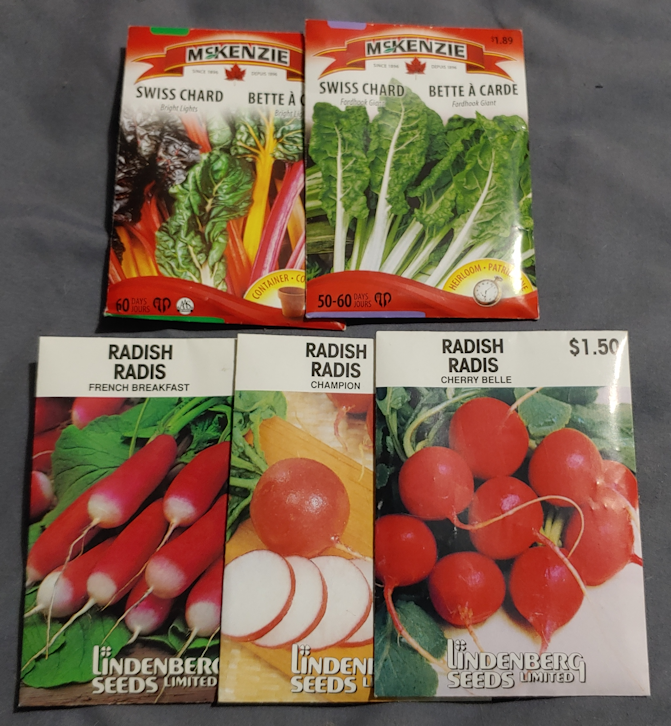
Then there are these.
I’d picked up the radish seeds when I was last helping my mother with her grocery shopping. I intend to plant those as soon as possible; just a few of each. From what I’ve read, I should not expect to get bulbs developing in the heat of summer, and will be growing them for their pods.
The chard was something I picked up a few days ago. While waiting in line at the grocery store, I found myself next to a couple of boxes of seed packets, all jumbled together, instead of in their display cases. I rifled through them and found the two types of chard, which will be planted right away, too. I’ve read that they are tolerant of summer heat.
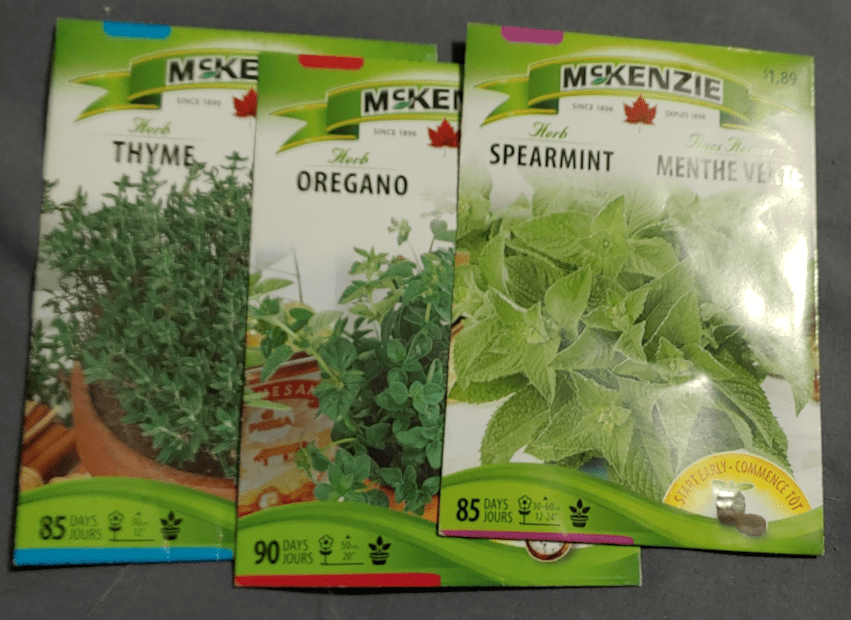
While going through the seed packets, I also picked these up.
Little by little, we intend to have an herb garden, likely in the old kitchen garden, so these are seeds for next year. Unless we want to try growing them in pots indoors, but I don’t imagine they’d survive the cats.
So we now have our first herb seeds, and more seeds to join the Yellow Pear tomatoes I picked up earlier.
The 5 day forecast has us back to around average temperatures for July, which means we should be able to catch up on things we’ve set aside because of the heat. But then, the forecasts have been so off for the past couple of weeks, I wouldn’t be surprised if the forecasts were completely off! Still, those empty beds need to have something planted in them, and it needs to be done soon!
I went out to do the evening watering this evening, after trying to wait until things cooled down. When we were still above 30C/86F by 7:30pm, I headed out anyway, so I could be done before dark.
I started in the old kitchen garden, and this should have been my first warning.
When I had gone out earlier to apply the spray repellent, I made a point of spraying the edges of the beds and into the paths, where it would not be washed away by watering as quickly.
Nutmeg is sprawled right on top of where I’d sprayed. Clearly, he is not the least bit bothered by the repellent!
If you look to the bed on the right, you can see the stems of our nibbled on carrots. They were like that this morning, before I did the spraying. In fact, they were why I made a point os going out to apply the repellent when we were nearly at the hotted part of the day!
Meanwhile…
As I was finishing up in the old kitchen garden, I picked our first rhubarb of the season.
We could have picked rhubarb long ago, but we were thinking to do a crumple or a crisp with them, and no one wants to bake in this heat. However, I had other reasons to pick them.
We planted poppies in the new bed next to one of the rhubarb bunches. The only seeds that germinated are all near the rhubarb. While I was trying to weed them, I discovered there was more than we thought.
The rhubarb leaves were covering them, and preventing them from getting any sunlight.
So I uncovered them by picking rhubarb. :-D We’ll see if they recover, now that they are getting light.
After I was done watering the more southerly beds, I headed over to the main garden beds and started watering. When I had been there earlier, spraying around the carrot bed, I was noticing that they looked to be recovering quite well, with lots of new fronds. I made sure to spray a wide swath all around them, on them, and even on the wire mesh cover.
As you can probably imagine, I was must unhappy when I came back to this.
The entire bed is once again decimated. All of it, from end to end. Apparently, when I sprayed the repellent, all I did was season the fronds for the woodchuck!
I am so frustrated!!
I’ll be taking the wire mesh cover off. All it’s really doing is preventing me from weeding. Though I suppose there’s no point in weeding it anymore. I will, anyhow, but the chances of the carrots recovering just dropped substantially. We knew it couldn’t stop a woodchuck, but I thought it might not want to be under something, and potentially trapped, and at least the carrots in the middle would be ignored. Nope. Apparently, this furry beast had no problem being under a wire net for so long!
This was not our only loss.
The greedy guts even eat the mystery squash seedlings in the old compost heap!
Obviously, I hadn’t sprayed the compost heap, but still… they weren’t exactly easy access in there, and were surrounded by all sorts of things the woodchuck never tries to eat, like the self-seeded raspberries that are also growing out of the pile.
I was really hoping to find out if they were from last year’s pumpkins.
Thankfully, nothing else was nibbled on, but this is damage enough!!
Apparently, we got rain while I would outside, watering the garden, too.
That would have been nice, but all we had was hot, muggy, thick air.
*sigh*
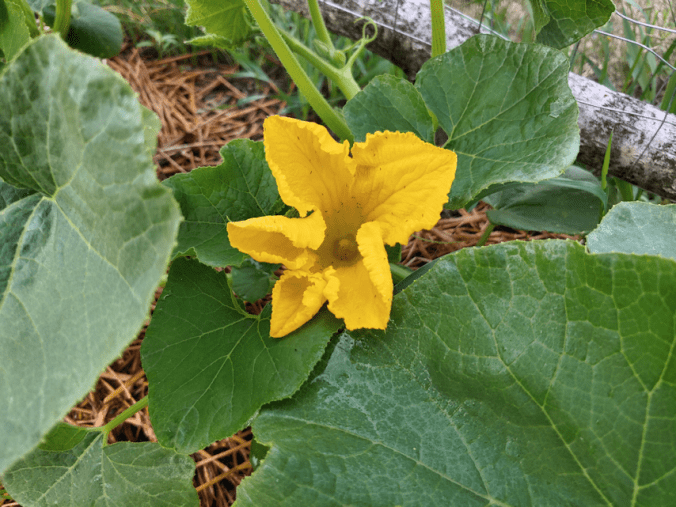
One of the awesome things about gardening is how fast things can grow. We’ve got a whole bunch more summer squash blossoms, more squash growing (still no yellow zucchini, though), and the squash that started earlier could probably be picked right now. I’m going to wait until they’re a bit bigger, though.
I was very excited to see our very first WINTER squash blossom! Those are starting to get quite big. As we are able, we’re moving them to train them up the trellis, and some are sending out tendrils and looking almost ready to be climbing on their own, as are more of the melons. We’re going to have to go back with some twine to string between the sections of mesh and fill in the gaps a bit for the few plants that are under them. I had remembered to look for twine when I was last in the city, and found a huge roll of it. It should last us until next year! :-D
I am absolutely thrilled by the Montana Morado corn. This is the stalk that we are seeing silk on already. Pretty soon, it will have pollen, too! A few of the others are starting to show the little red bits, but they do not yet show corn silk.
We’re going to have to go in between these and “hill” the corn. With having to water so often, and not having a mulch, the water is eroding the soil at the base of the corn a bit. A couple were starting to fall over, so last night I worked the soil around their bases and secured them upright with it, but I want to do that with all of them. The ground here is so soft, though, we don’t walk in here at all unless we absolutely have to. I’d hoped to be able to add grass clippings for mulch, but with the heat and lack of rain, the grass hasn’t been growing.
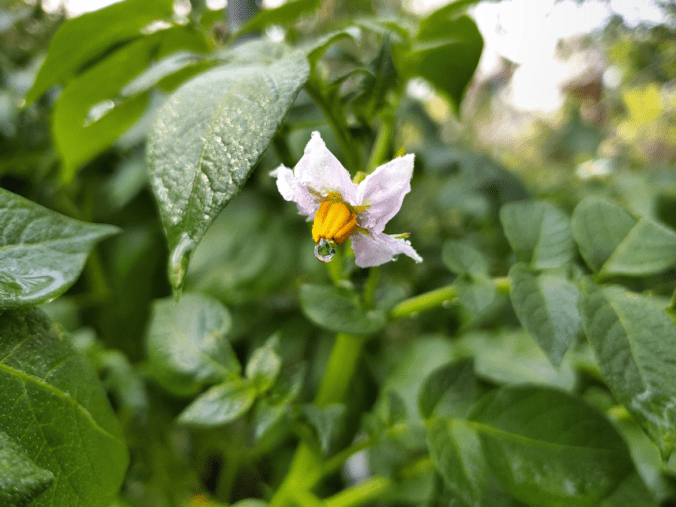
There are just a few potato blossoms that are fully open right now, but I am seeing many, many buds!
Of course, I’m always second guessing myself about deciding not to “hill” the potatoes more. As determinate type potatoes, it won’t result in more potatoes, but the plants have gotten so tall, it feels like they should be hilled! :-D
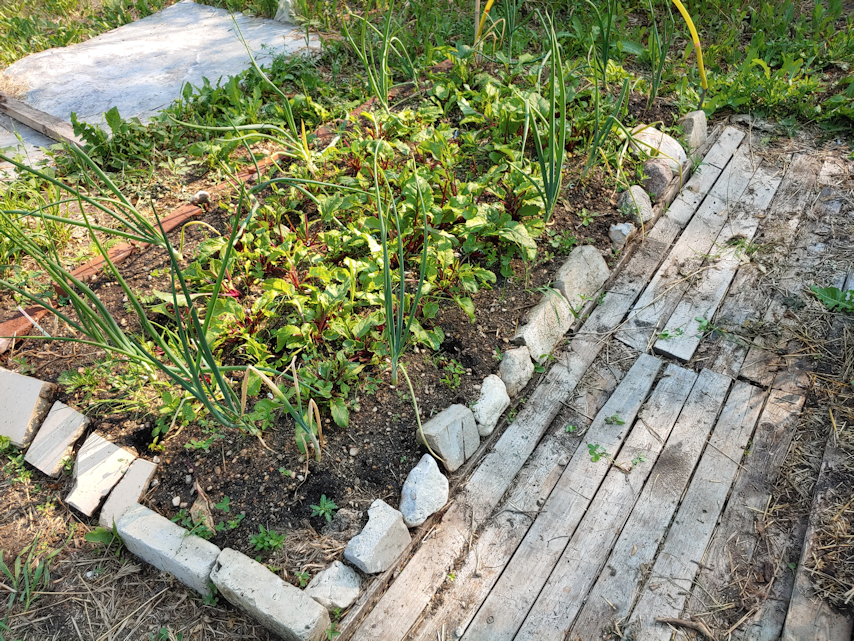
When I got to the old kitchen garden, I found the end of the L shaped beet bed was nibbled on.
I did see the woodchuck run under the garden shed this morning, but I’m not sure it is responsible for this. I think the carrots in this garden were nibbled on more, but I’m not sure. The motion sensor light would cover that carrot bed and the section of this beet bed next to it, and should be startling off any critters, but the section in the photo has a lilac bush between it and the light, so it wouldn’t be triggered by anything nibbling on the beets here.
I did see a deer going by the garden cam when I checked the files this morning. They seem to be just walking through, and not even going very close to the garden, now that I’ve put up the stakes and twine around the corn, and rope along the back of the Dorinny corn and the pea beds. I find myself wondering if a deer might have nibbled on the beets, since the woodchuck doesn’t seem to like beet greens, but that would mean the deer coming right up to the house, and pushing its way through the asparagus ferns and rhubarb, and I just don’t see that.
The beet beds in the old kitchen garden did get the Critter Ridder granules, but I was finishing off the container in the area in the photo, so there wasn’t as much there. It obviously doesn’t work to stop cats, since yesterday evening, we saw Junkpile and her kittens in the beets by the retaining wall. :-D
I still have to use the new spray we got, but it’s supposed to be applied on dry surfaces, so I’ll have to wait until later in the day.
Or until tomorrow, if we actually get the predicted storm!
With today’s expected heat, I was out in the garden by 6am, and ended up staying out there for almost 3 hours, watering and weeding. The watering was started after replacing the connectors on three hoses.
I’m a goof, but it did work.
When I bought the connector repair sets, I got what was left on the display, and didn’t even think to look at the sizes. They are for 1/2 inch hoses.
We have 3/4 in hoses.
No matter. The clamps they came with could tighten enough to properly seal them. They will do while I am on the lookout for the right size connectors.
The little flexible piece I got for the tap, to prevent kinking, leaks. In several places! I guess I got a cheap one, though there wasn’t much choice. It still leaks less than it did before. One of the leaks is at the tap itself. Every single hose we’ve ever hooked up to that tap, leaks there. I plan to replace the tap itself, eventually. Meanwhile, there is some very luscious growth happening around the blocks we have under the tap. :-D
When I headed out again this evening, I got to break in the new action hoe.
What a fantastic tool!
I first tried it in one of the onion beds. It did well, but the onions are planted in a three row grid, and it just didn’t fit in between them, so there wasn’t a lot I could do with it, there. Mostly, I used it in the space in the middle, where the purple kohlrabi failed to grow.
It was at the Mongolian Giant sunflowers that it really did the job!
The soil here has always been rock hard, and baked bone dry. Right now, the only soft soil is the layer we put down for each row, and that was just a few inches deep. That anything we’ve planted here is growing at all is pretty remarkable. This thing worked like a dream!
Now, don’t get me wrong: it was still really hard to work around the sunflowers.The soil in between the rows is even harder now, as we walk between the rows to water things. It wasn’t just the hard soil, but also the very fibrous roots from the plants that were already growing here, and now enjoying regular watering for a change. This hoe was able to cut through those roots, and the rock hard soil at the edges of the paths. I was then able to pull out the cut weeds and their roots, before hilling the loose soil around the sunflowers a bit.
I am very impressed with this thing! The tool I was using around the corn before worked well; better than a regular hoe, but not as good as the action hoe. It was one of the unusual tools we’ve found around the place. The head of it is shaped almost like a mattock, except… not. LOL The “hoe” part of it is longer and narrower than a regular hoe, and it has a two pronged spike on the other side that I believe is a weeding tool. I’ve never tried to use that end, yet. It works really well at cutting into the hard soil. Better than a regular hoe, as least. Unfortunately, it’s quite old, and the head sometimes pops off the shaft.
I was doing one last row with the action hoe in the next corn bed, when my daughters came out to do the evening watering. My older daughter had finished watering the beds closer to the house with the hose, and when she came to continue watering where I was working, she told me about something awesome she found in the Montana Morado corn.
Silk!
Our very first corn to start showing silk!
If these are going to be maturing so unevenly, we may need to hand pollinate the silk, just to make sure they do get thoroughly pollinated. It would be pretty hit and miss to rely on the wind to pollinate the corn, when there might be only one or two corn plants ready to be pollinated at a time.
I am so happy that this corn seems to be working out so well!!
Today is supposed to be the last day of our heat wave. After this, we are dropping to more average temperatures. The expected high had been 38C/100C for a while, then it went down a few times. By morning, we were forecasted to hit 34C/93F, which we did hit. I don’t know what the humidex was. The forecasts for thundershowers tomorrow have shown up, disappeared, then showed up again, several times today! As I write this, it’s past 11pm, and we’re still at 28C/82F. The overnight low is expected to be not much cooler, but we are also supposed to get some rain, too.
I’ll believe that when I see it. From the looks of the weather radar, any rain or storms sweeping through are going to go right past us, and hit the city. But if we get even a little bit of rain, I will be happy. Even with all the watering we’ve been doing, twice a day, things are still really dry. I could really see that while weeding. Even at the start of the day, which the ground still looked damp from the previous evening’s watering. While hand weeding among the beets in the old kitchen garden, I had the hose set to mist, so the water would make it easier to pull the weeds out by the roots. I’d already watered the bed before I started weeding, yet when I pulled up the weeds, I could see how dry the soil still was.
When we build our permanent beds, having some sort of watering system would be very useful. We do have sprinklers we can use, but I’d rather have something less wasteful, like a drip system.
But that is something to figure out later. For now, we make do with what we have, and right now, that means watering twice a day with roughly 300 feet of garden hose and watering cans! :-D
It occurred to me that, while I’ve been posting lots of pictures of our garden, some areas get focused on more than others. As we are now in July, I figured it would be a good time to do a “tour” of all the garden, and review how things are doing so far.
This is going to be a very photo heavy post! :-D Which is probably silly of me, as our internet connection is horrible right now, so it will probably take me at least a couple of hours to get it done! :-D
Let’s get started!
Asparagus bed with onions
Our first photo shows both success and failure.
In the foreground is the asparagus bed. We planted 6 crowns of Purple Passion Asparagus. The crowns came in at the same time as our Mulberry sapling. I didn’t get a photo of that. It did not survive that one unusually cold night in late may. :-( But the asparagus did emerge, and we are very happy with them!
Along two sides of the asparagus bed are some tiny onions. These were some last minute Norstar onions we started indoors after having so many of the other onions seeds we started get destroyed, one way or another. They are incredibly tiny, and yet they are forming bulbs!
In the other bed is where we planted the Strawberry Spinach. That is a total loss. We have no idea what happened to them after they sprouted. I do want to try them again, next year, though. These are both intended to be permanent beds.
Royal Burgundy
Lewis Green
Golden Rod
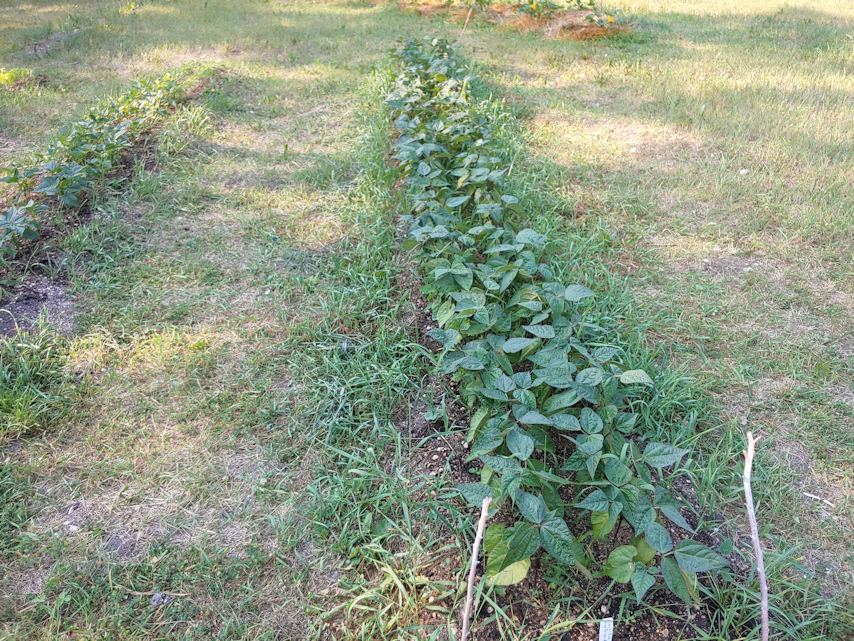
Here we have our three bush bean beds, planted in a temporary garden location. The photo on the left has the Royal Burgundy beans. We are totally amazed by how vigorously they are growing! The middle photo shows the Lewis Green beans, and the final photo shows the yellow Golden Rod beans. It’s interesting to see how the colours of the leaves show differently with the different coloured beans!
I would call all of these a success, so far. Aside from the odd deer walking through them, or a cat rolling around in them, they have not had any external issues, and they seem to be growing very well. I’m really looking forward to eating fresh beans! We pretty much never buy them at the grocery store, as they never look good, so these will be a real treat. :-)
Robin beets with onions
This is the new bed in the old wood pile area, built this spring. It was seeded with Robin beets, a new variety we got along with some Merlin beets, which we tried last year. Later, when we planted onion sets, some were planted around the beets to act as a deer deterrent.
It didn’t work.
Need more onions.
The beets do seem to be recovering, though. A while back, shredded Irish Spring soap was scattered in the bed, and this morning I added the Critter Ridder granules, so hopefully, it will not be a deer buffet again!
This bed, and the two others near it, are intended to be permanent beds, and we will eventually build boxes around them, and figure something better out for the paths in between.
Beets and lettuce beds
Mixed beets bed
These are the rest of the beets, in the old kitchen garden. They have not been nibbled on by critters, thankfully.
The beets planted along the retaining wall blocks are of the Merlin seeds we got this year, plus seeds from last year, which was a collection of Merlin, Boldor and Chioggia. The girls planted them in blocks. There were still seeds left, and when we finished planting in the other beds, I went ahead and mixed all the remaining beet seeds together and planted them in the L shaped bed, so that is a beet surprise!
All of the beets here are looking to be quite a success. Mostly because the deer haven’t gone into the garden, and apparently our woodchuck doesn’t like beet greens.
We planted 4 types of lettuce in the retaining wall blocks, alternating with Lunix, Merlot, Lollo Rossa and Buttercrunch. We added the mosquito netting wall later, as a deer deterrent. The Lollo Rossa seemed to struggle, but the others were doing okay.
Right up until the woodchuck ate them all.
We will be planting more lettuce later this month, well after the current heat wave is over. The seed packets were together in a slide lock bag that got knocked about, and there was spillage, so they’re all mixed up now, so we’ll have lettuce surprise! :-D
Napoli and Kyoto Red carrots
Deep Purple and Longe Rouge Sang carrots
Here we have our carrot beds. The large bed has two types of carrots; Kyoto Red, at the far end, and Napoli. These were pelleted seeds, which made it much easier to plant them without having to thin them later. We also had plenty of seeds left over for next year.
They had been doing so well, until the woodchuck ate all the greens! The wire cover isn’t going to stop a woodchuck, but will hopefully at least slow it down or discourage it. I’m still holding out hope that they will recover, and will be spraying around them with repellent soon.
In the old kitchen garden, we have two other varieties of carrots. Deep Purple and Longe Rouge Sang. There were far fewer seeds in these packets. I’d made a cornstarch gel to make planting them easier, which we did last year successfully, even though the gel was way too thin. This year, however, I made the gel too thick. When my daughters planted them, it came out unevenly, but it still worked out. These have, unfortunately, also been nibbled on, but not decimated like the others were. At the moment, we have a motion sensor light set up that will hopefully startle critters away, and this morning, I sprinkled Critter Ridder granules around this bed, and the beet beds nearby.
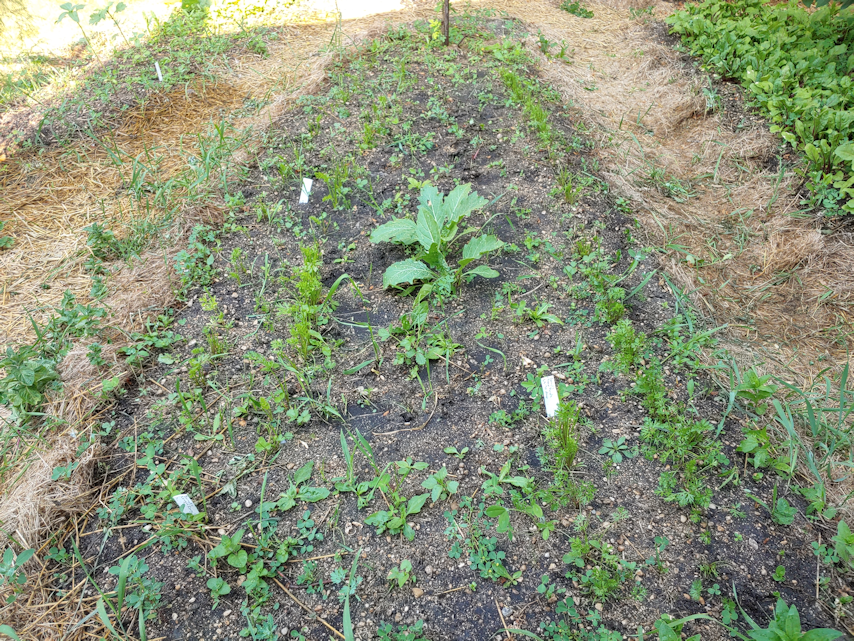
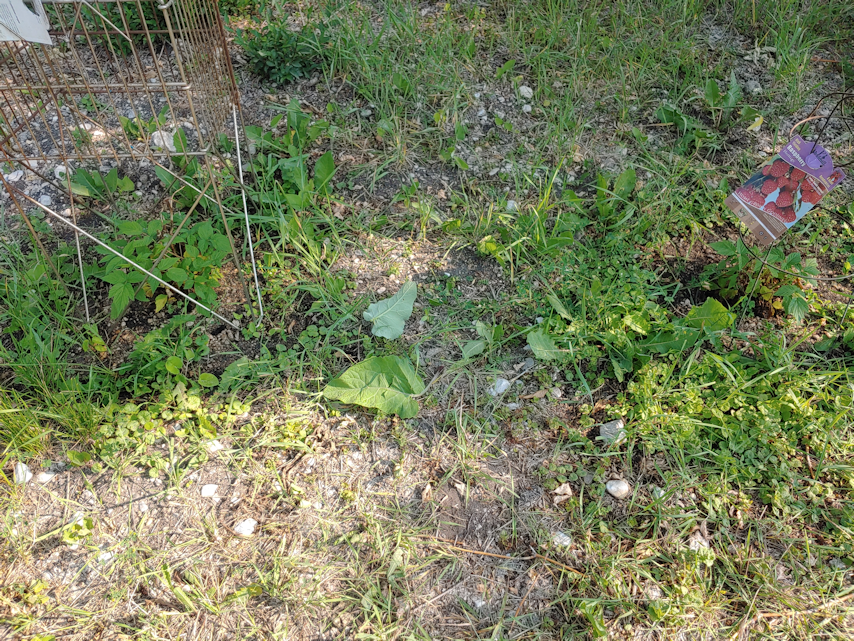
The two leafy things in the triangular bed are, I hope, white kohlrabi. These were seeds left over from last year, which had failed so spectacularly. Thankfully, we have seen no flea beetles this year. Still, I’m not even sure these plants are kohlrabi at all! I would call them a definite fail, unfortunately.
Next year, I want to try kohlrabi again, but will start them indoors. They are supposed to be good to sow directly before last frost, but they just don’t seem to do well that way.
Cucamelon
Here we have our cucamelon transplants. We did these last year and, in spite of a poor location, they did really well. This is where we had intended to plant them last year, in the rest of the chimney blocks we have left over after using some for the retaining wall. I am hoping the increased sunlight in this location, plus the chain link fence to climb, will lead to an even better crop than last year. :-)
Montana Morado corn
Dorinny corn
Here we have our two experimental corn blocks!
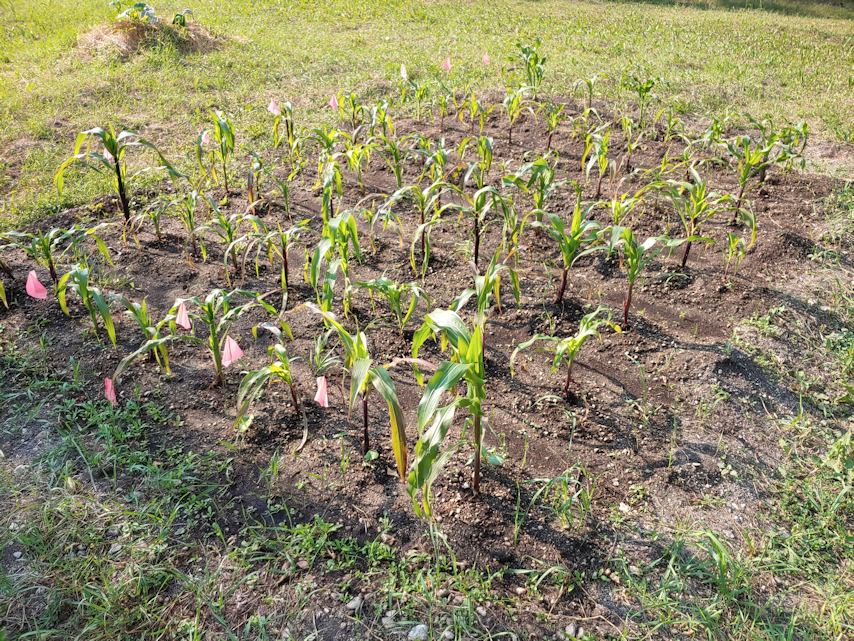
The purple Montana Morado corn (the photo on the left) were started indoors and transplanted, and so far they seem to be a success. A few of them don’t seem to be thriving at all, but most of them look like they are doing just great.
The Dorinny corn were planted before last frost, and you can see the remnants in the photo on the right. Though they are a cold hardy hybrid that would have been able to handle a normal frost, it turned out they couldn’t handle the -8C/18F night we had in late May. The seeds that had germinated before then did look like they survived, but after a few days, they were gone. Thankfully, more germinated later, and of those, they are doing quite well. As long as more don’t get eaten by the deer! The ones that did get nibbled on seem to be recovering, but I doubt we’ll get any corn on those ones.
Just yesterday, I used one of the empty rows in the Dorinny corn block to transplant some Hopi Black Dye seedlings. I’ll talk about those more, later. I also transplanted the few, spindly pink celery seedlings. I don’t expect those to survive. They should have been started indoors much, much earlier. I want to try them again, next year.
Where the Dorinny corn is planted is temporary. Where the Montana Morado corn is planted will probably become a permanent part of our garden. I was really surprised by how much better the soil was in this location, compared to other parts of the old garden area.
Porcelain Music
Purple Stripe
Racombole
Racombole
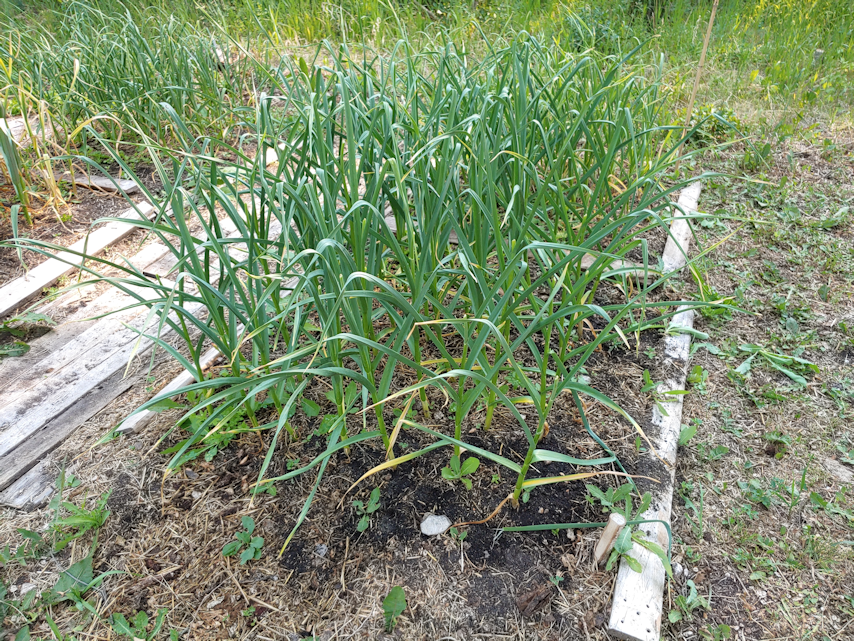
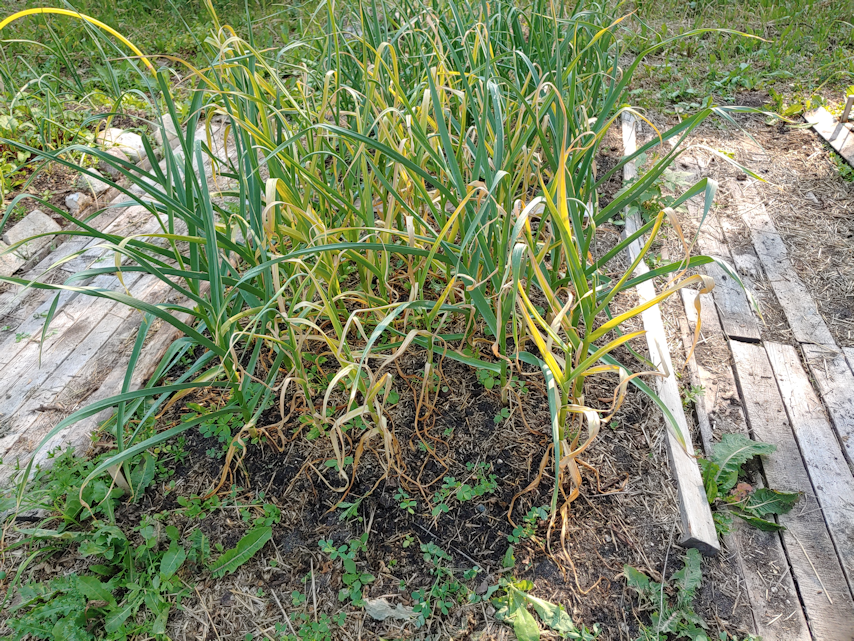
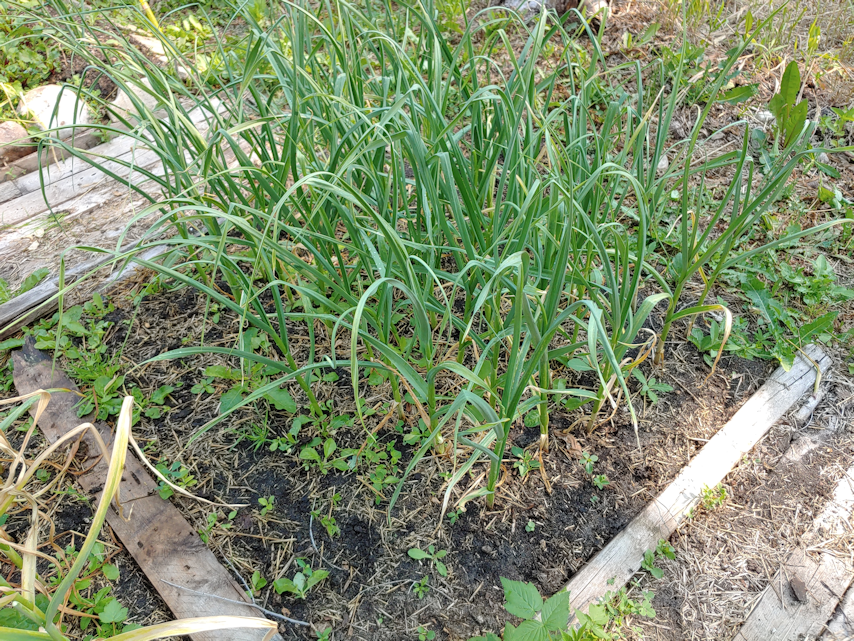
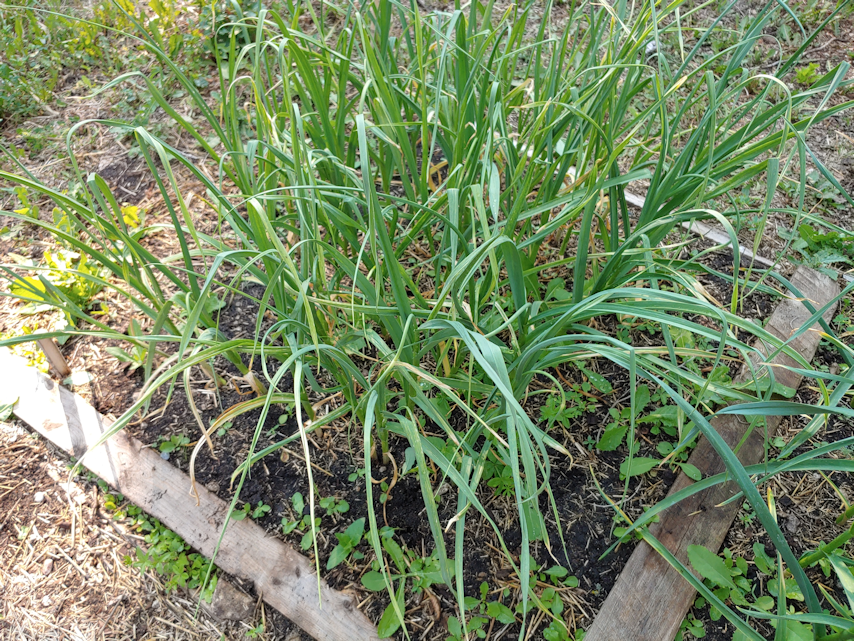
Here we have our hard neck garlic beds, which were planted last fall.
The Porcelain Music is looking amazing! Big, strong plants. They started showing scapes first. As I write this, we’ve gathered scapes from all these plants.
The Purple Stripe is looking like they will be ready to harvest soon – but they are still producing scapes! I’m not sure if this is a problem, or if this is normal for the variety!
The Racombole got split between the two beds. They came up later than the others, and the plants are smaller and slighter. They were also the last to start producing scapes. I don’t know if that’s normal or not for this variety. It’s possible, being on the East ends of the beds, they had slightly less sunlight than the others.
So far, these are looking like a fabulous success.
Now, we move on to the gourds. :-)
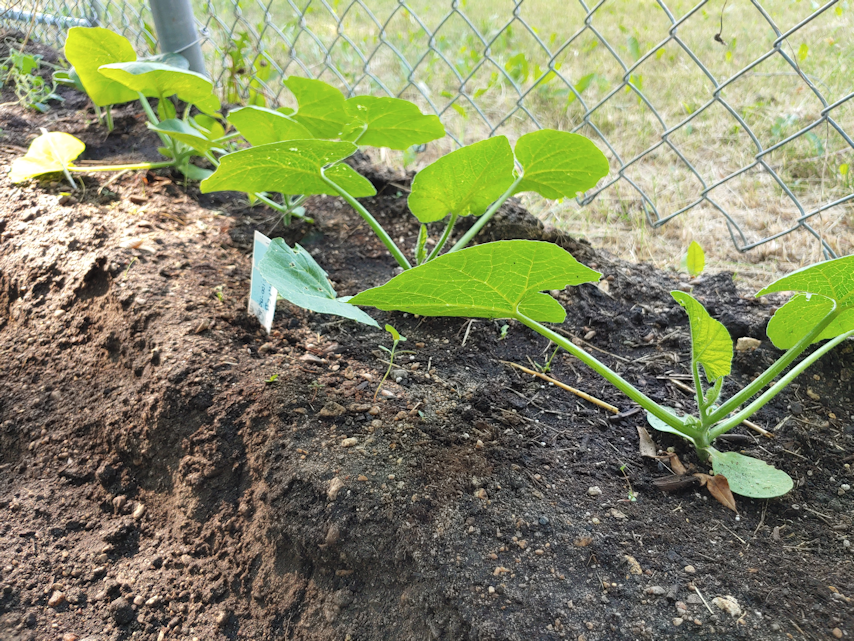
I honestly didn’t expect to have gourds this year. We started them indoors early, yet they didn’t germinate until much later.
These first ones are next to the cucamelons, in an area that will be a permanent bed.
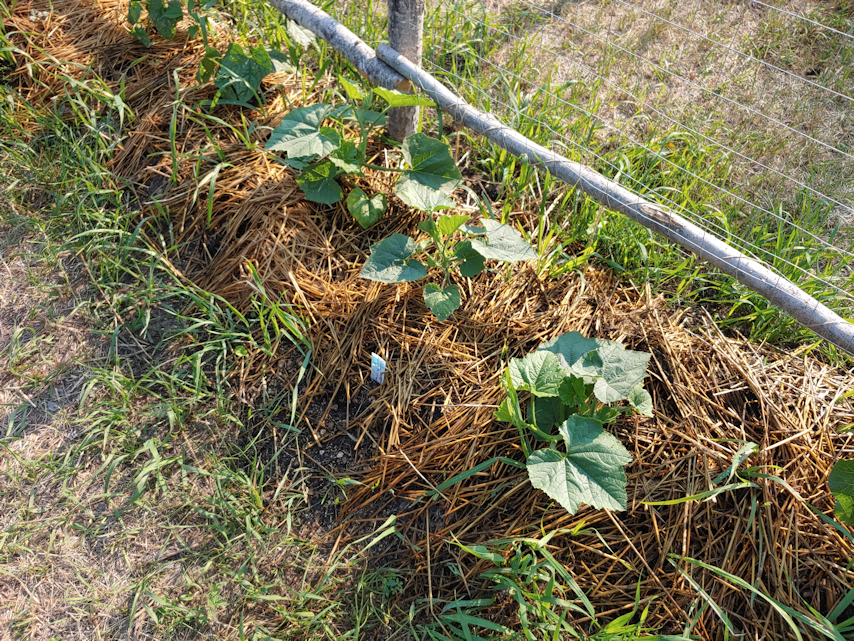
Ozark Nest Egg gourd
Ozark Nest Egg gourd
These ones are the Ozark Nest Egg gourds. These had one plant germinated per pot, even though several seeds were in each. This morning, I noticed one of those seeds had germinated!
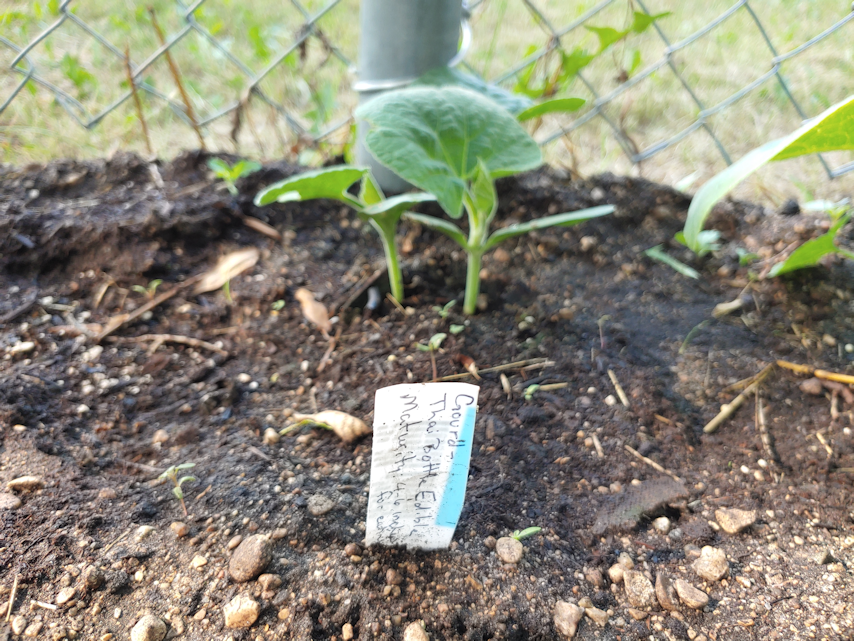
Thai Bottle Edible Gourd
Last time I posted about these, I mistakenly referred to them as the Tennessee Dancing gourd. Silly me. These are the Thai Bottle Gourds. There’s just the two of them.
Tennessee Dancing Gourd
Luffa Gourd
The Tennessee Dancing Gourd were among the first to germinate, and we got quite a few of them! If they are as prolific as I’ve read in reviews, we’ll be up to our eyeballs with them. :-D
It’s the luffa I am most eager to see how they turn out. They also germinated faster, though that’s not saying much, considering how long it took for the other gourds to germinate!
This area is temporary, even though we built a squash tunnel for them to climb. We intend to plant trees in this far-flung area, but this area, and the squash tunnel, might see another year of use. I’m pretty sure there is a telephone line buried under here, so we will probably not be planting trees exactly here.
As late as they all started, they all seem to be doing surprisingly well! They are really loving this heat wave. I’m looking forward to seeing how they climb the structure!
Here we have our grapes. There are two vines. We did not plant these. My mother did, but she does not remember what variety they are. I was talking to my mother today, and she worked out how long ago she planted them here, and figures it was about 12 years ago. !!! They had been completely engulfed by spirea when we first moved here, and we’ve been slowly working at getting them strong and healthy again. They are producing tiny clusters of grapes right now, and I look forward to seeing if they grow bigger this year, than last year. :-)
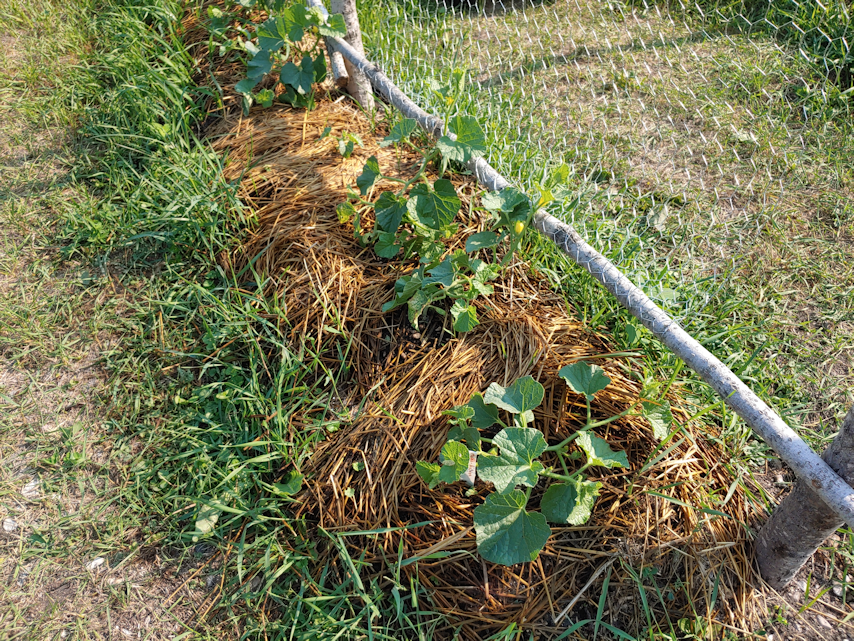
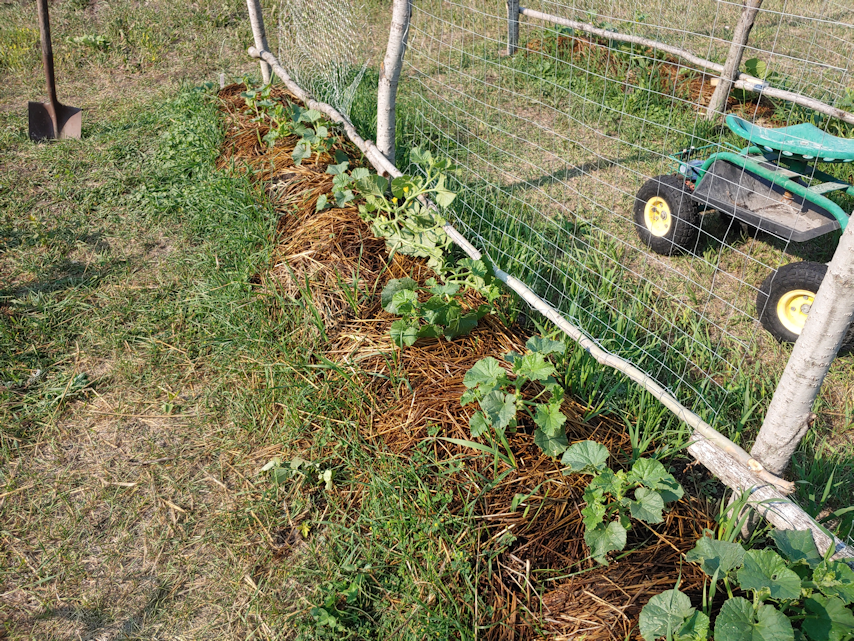
Halona Melons
Pixie Melons
I am really excited at how the melons are doing! We stared them indoors at the same time as we started with summer squash, but everything took a long time to germinate. That we ended up with so many is totally bonus. I love melons and really look forward to how these do! They are currently blooming, and starting to get big enough to train up the mesh, so I hope that means they’ll have a good summer’s growth.
Norstar and Red Karmen onions
Shallots and Stuttgarter onions
Here we have more successes and failures.
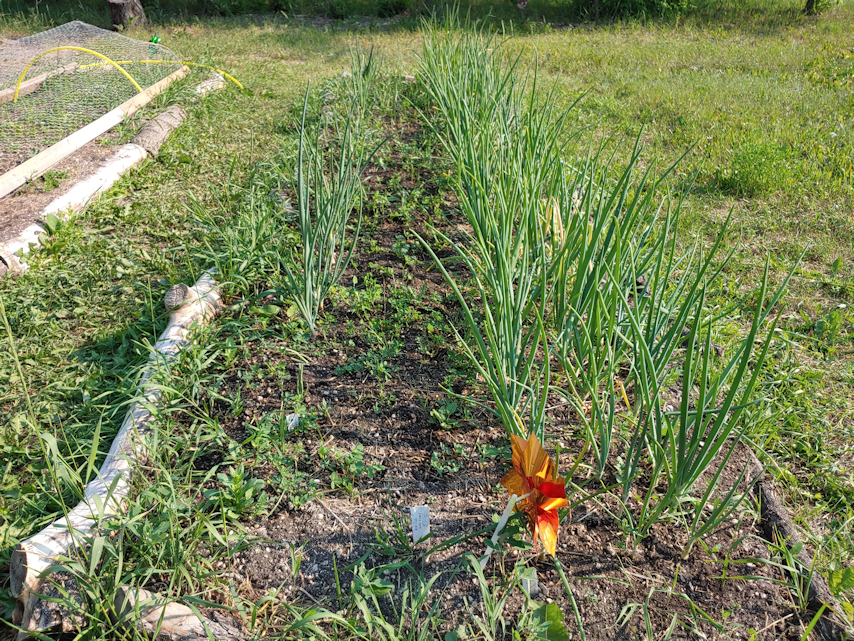
The Norstar onions were started from seed, and they are growing nice big bulbs right now! They may have been small when they were transplanted, but they easily match the Red Karmen sets they share a bed with.
What you don’t see is what should be growing in that gap in the middle. The very first seeds we planted outdoors was purple kale; seeds we got for free with one of our Baker Creek orders. If they ever germinated, we never saw them.
Because the bunching onions and shallots we tried to start from seed died a glorious, cat induced death, we ended up buying sets. Unsure if the Norstar seedlings would survive, I picked up some onions sets when they came out in the stores. When I found shallots as sets, too, I grabbed a couple of bags. They both seem to be doing well.
However, they too should have a neighbor.
In the middle, our purple kohlrabi was planted. Like the kale, if anything sprouted, we never saw them.
I do want to try the purple kohlrabi again, but will start them indoors next time.
Dalvay green peas
King Tut purple peas
Here we have our peas. We planted all of the purple peas in the one row, while there were so many of the green peas, we were able to replant in spaces where peas did not germinate, and still have some left over!
They are currently blooming and growing pods, but I am not sure if they are actually doing well. They aren’t very big! It could be because of the poor soil in this temporary location. Quite a lot of whatever was trying to grow here before is now making its way through the straw and garden soil we added, quite enjoying the watering and feeding the peas are getting!
We shall see how they do over the next few weeks.
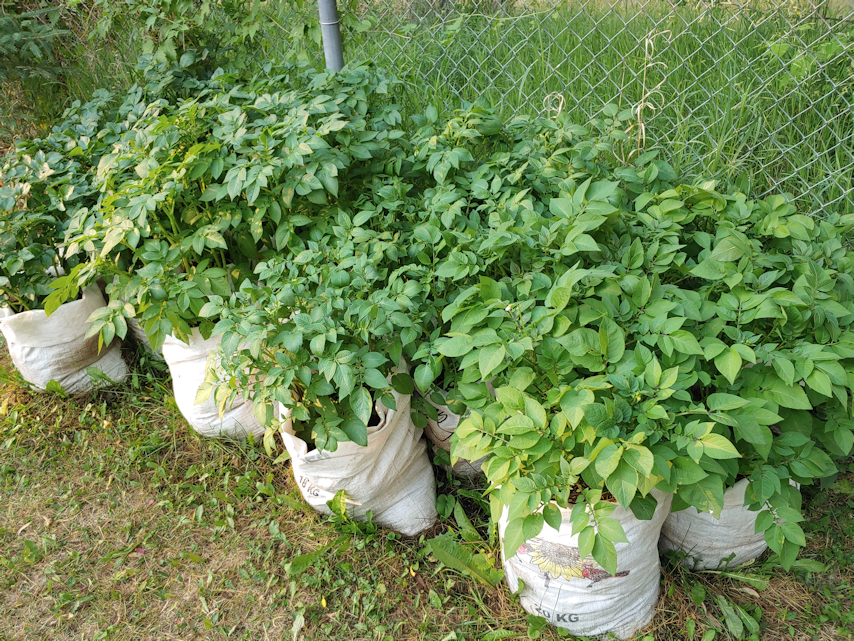
Here we have before and after pictures of our potatoes.
The first picture was taken four days after they were “hilled”. The other was taken 10 days later.
I can’t believe how huge they are! All four varieties are just thriving in these home made grow bags.
And now for something a bit different.
Heritage raspberries
Unknown raspberry variety
Raspberry bushes.
We bought raspberries for the first time this year, as a birthday gift for my daughter. She chose the Heritage variety. They were doing great after transplanting – until they got nibbled on by deer, and then hit by that late May frost.
They won’t do very well this year, but they will survive, and should be fine, next year.
The others are a combination of raspberries my mother transplanted many years ago, and other self-seeded plants we transplanted when we mulched the area that now has our main garden beds in it. They, too, were hit hard, not just by that one bitter night, but also the Polar Vortex we got hit with in February. Yet, they survived, and we will probably get raspberries from them this summer!
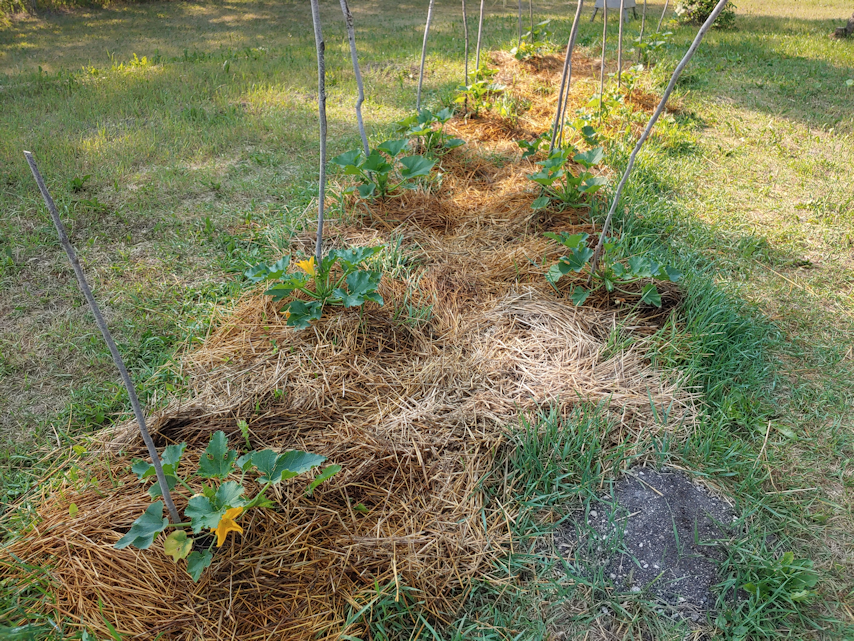
Crespo Squash
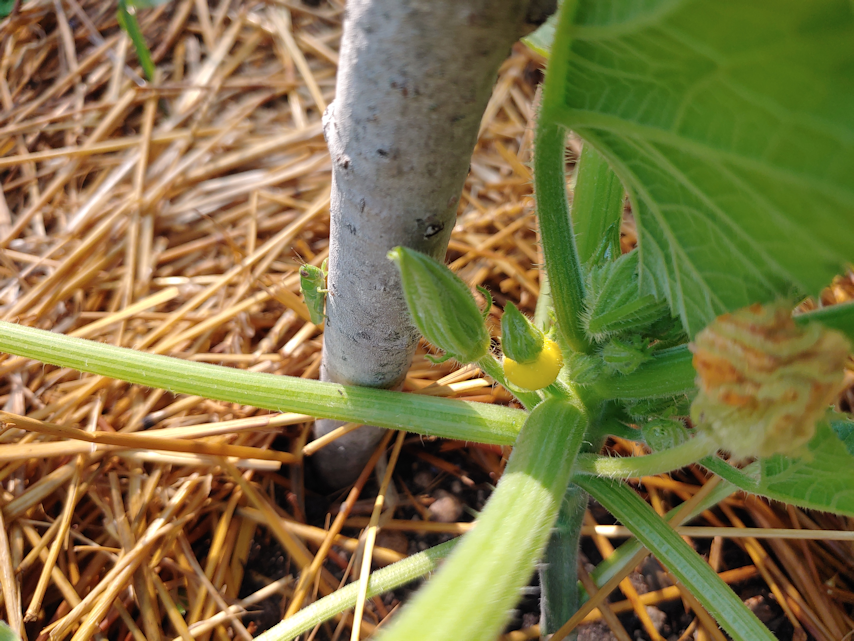
Crespo Squash blossom
Here we have our Crespo squash. This is another one we weren’t sure would work – and I’m still not sure we have a long enough growing season for them, even with starting them indoors. They seem to be doing very well, though, and one of them is starting to bloom quite nicely!
and now, the summer squash!
Summer Squash
Magda
Endeavor Zucchini
Sunburst pattypan squash
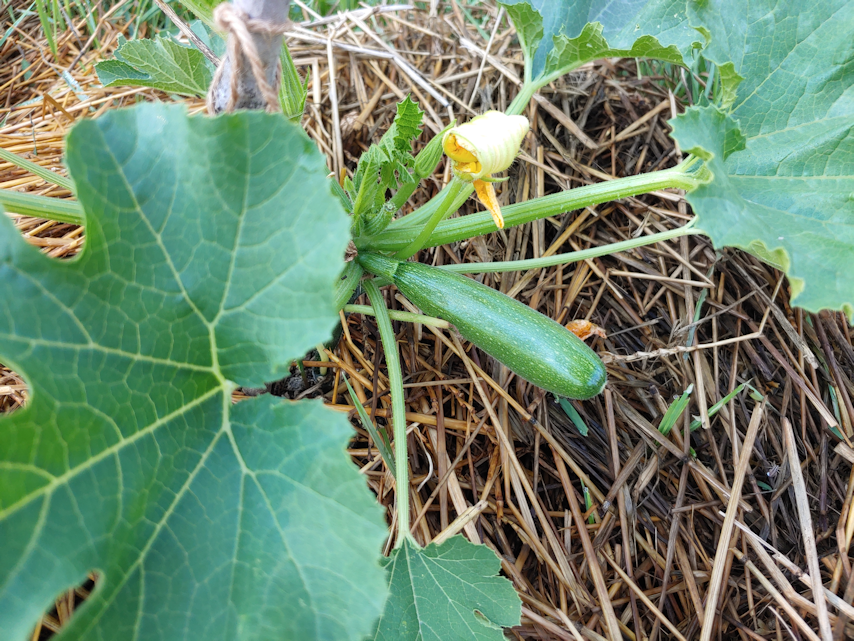
This morning, I finally saw some little Sunburst squash! They were our favourite, last year. We are also seeing the green Endeavor zucchini, and the lighter green Magda squash. Still no sign of the yellow Goldy zucchini.
This year, we are trying to grow them vertically, but not all of them are big enough to tie to the stakes yet. But we’ve already got squash forming on those little plants! I am so excited by these! :-D
Winter Squash
Here we have our two varieties of winter squash, Little Gem and Teddy, both chosen for their shorter growing season and smaller size. They look like they are doing very well in this heat wave, too! They’re not big enough to train up the mesh, yet, but I do see some tendrils forming on some of them.
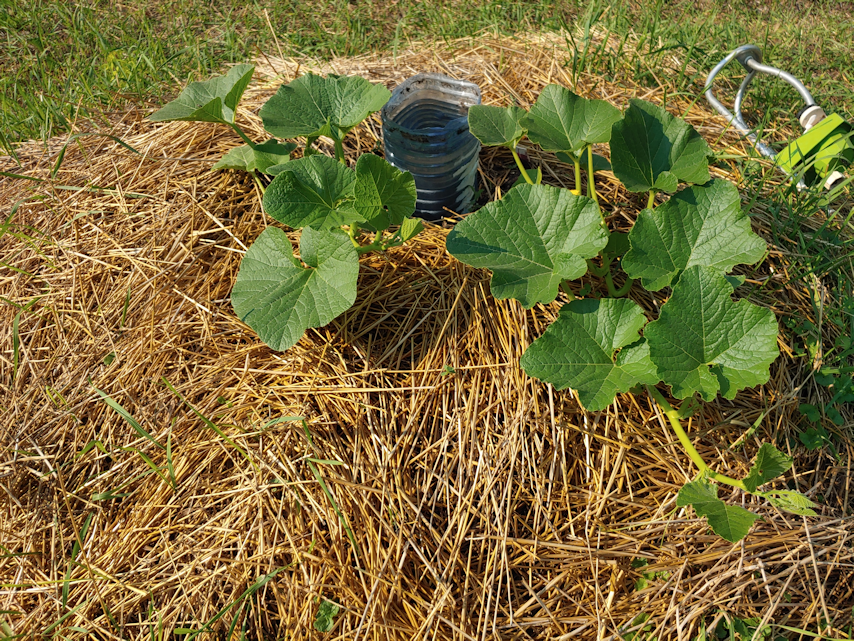
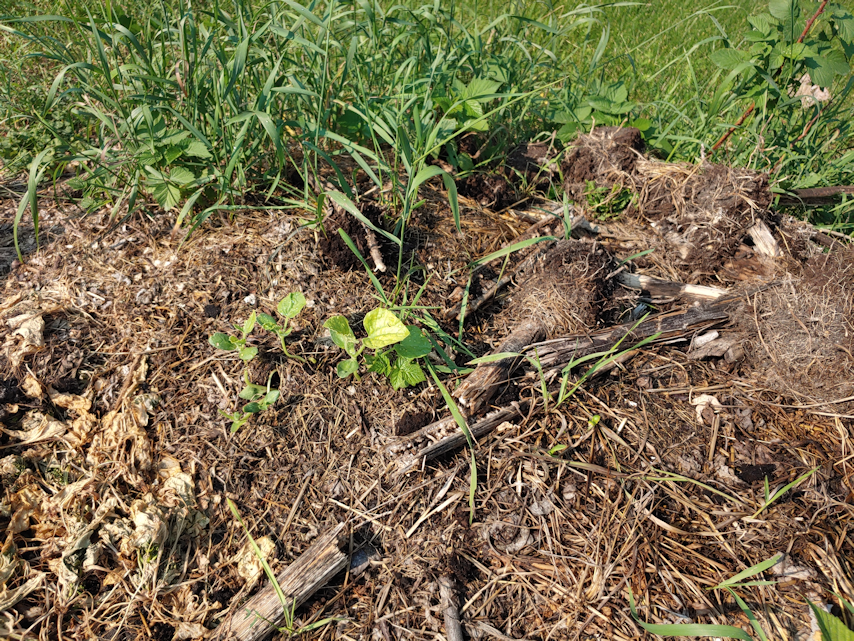
Mystery squash
Then there are these mystery squash, growing out of the old compost pile. We think they might be from the pumpkins we tried to grow last year. Hopefully, they’ll grow well enough that we’ll find out!
Mongolian Giant sunflowers
Hopi Black Dye and Mongolian Giant sunflowers
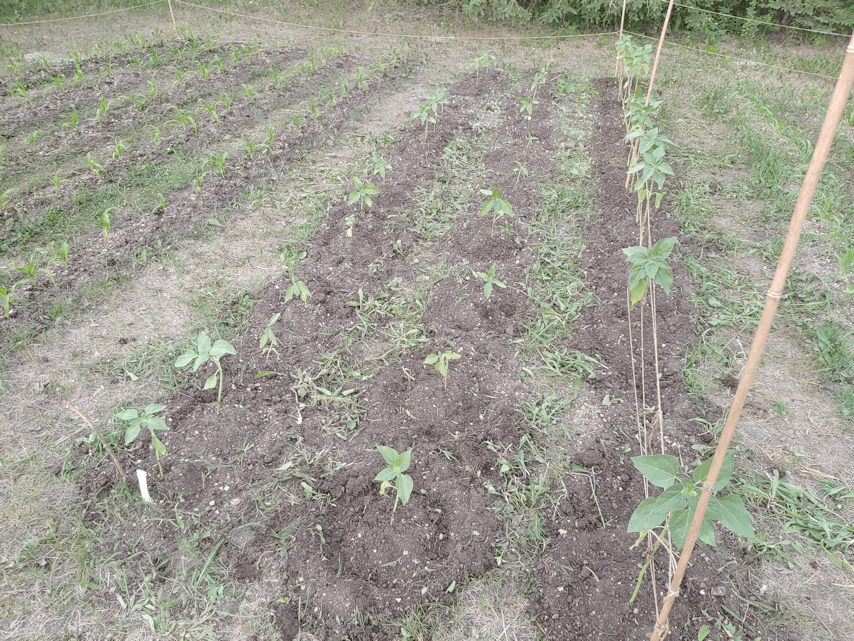
Here we have our sunflowers, in between blocks of corn. The corn are from a collection that included, Early Eh, Montauk and Sweetness. I didn’t bother taking separate photos of them. They are doing remarkably well, considering the poor conditions in this temporary location.
The sunflowers that are supported by twine are the Mongolian Giant sunflowers we started indoors, then transplanted. None of the Hopi Black Dye we started indoors had germinated… until they finally did! Long after these were done, which is why they are now planted near the Dorinny corn. Aside from losing a few to deer, I think they are doing well. At least as well as can be, in these conditions, and surrounded by weeds! Last year, none of our giant sunflowers reached full maturity before the first frost hit. I’m hoping at least the transplanted ones will have the time they need. If not… well, they make a good privacy screen.
If all goes well, we will be planting our first nut trees in the area next year.
Mosaic Mix cherry and grape tomatoes
Spoon tomatoes
Here are our wee little tomatoes! The teeny Spoon tomatoes have fruit developing already, while the Mosaic Mix is still just blooming.
In front of the Spoon tomatoes, you can see tiny wisps of onions. Those are the Red Baron bunching onions, from a very late start with the last of the seeds, indoors. In front of the Mosaic Mix, we have little Norstar bunching onions, again a late planting of the last seeds indoors. Starting these were a bit of a Hail Mary, and I doubt much will come of them, but hwo knows? :-D
Here we have a bit of a mish mash.
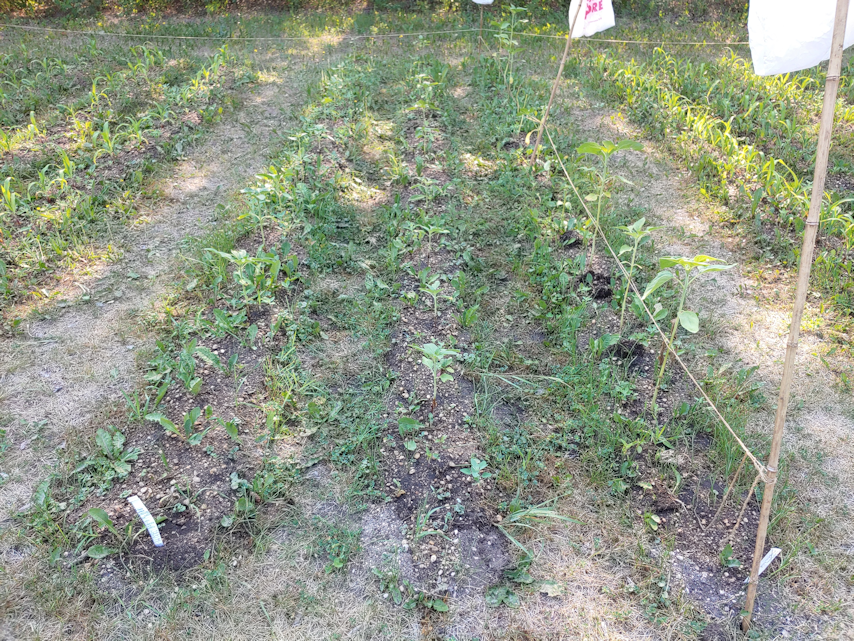
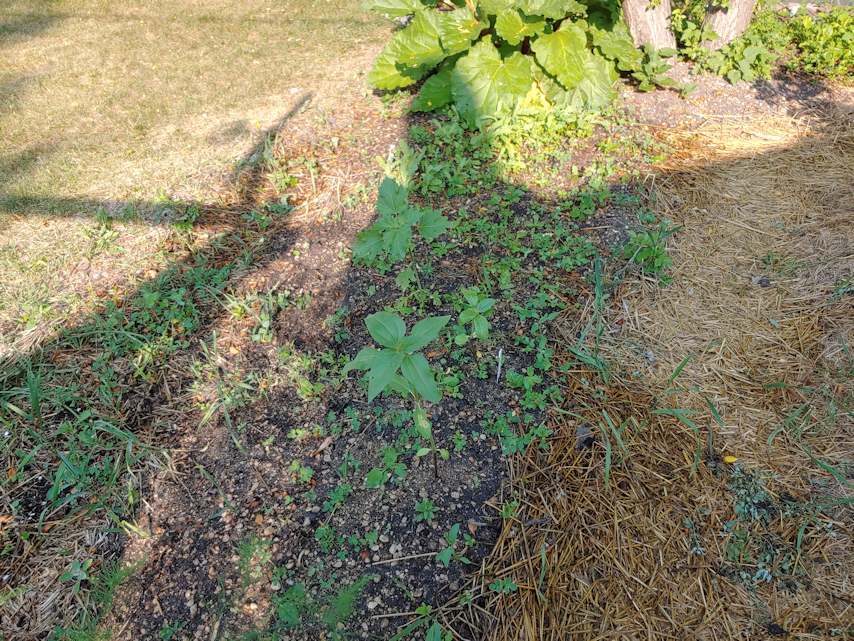
The photo on the left is where we seeded the Giant Rattle poppies. They came up in patches, mostly beside the rhubarb in the background (which predates us living here!). At the tip of this triangular bed, my daughter planted an iris that was shipped for spring planting – only to get hit by that late May frost, which killed it off. Other irises were planted in a trench along the south side of the old kitchen garden. One type has come up. They are hard to see, but several are by the laundry platform in the middle photo, with a few along the edge in the left photo. The ones planted in the trench towards the rhubarb never came up at all.
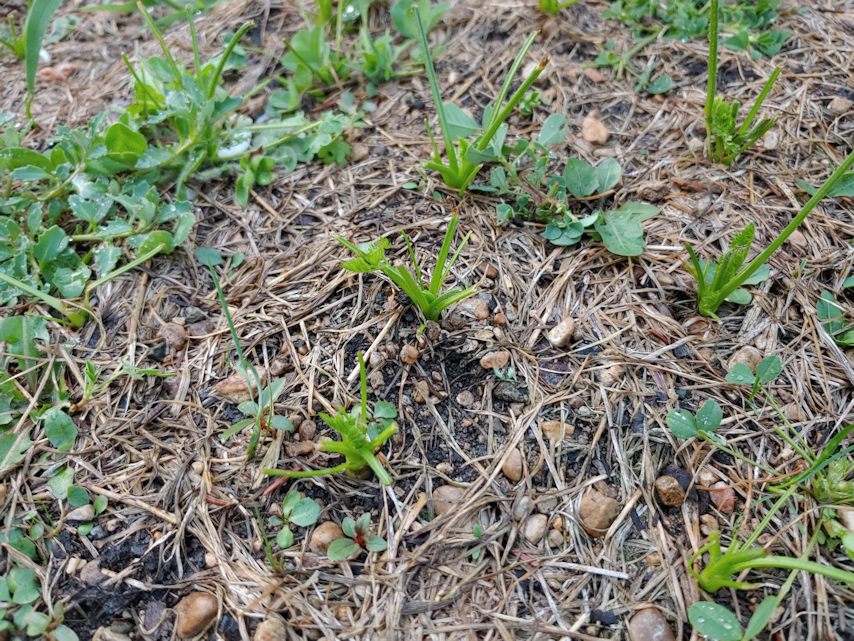
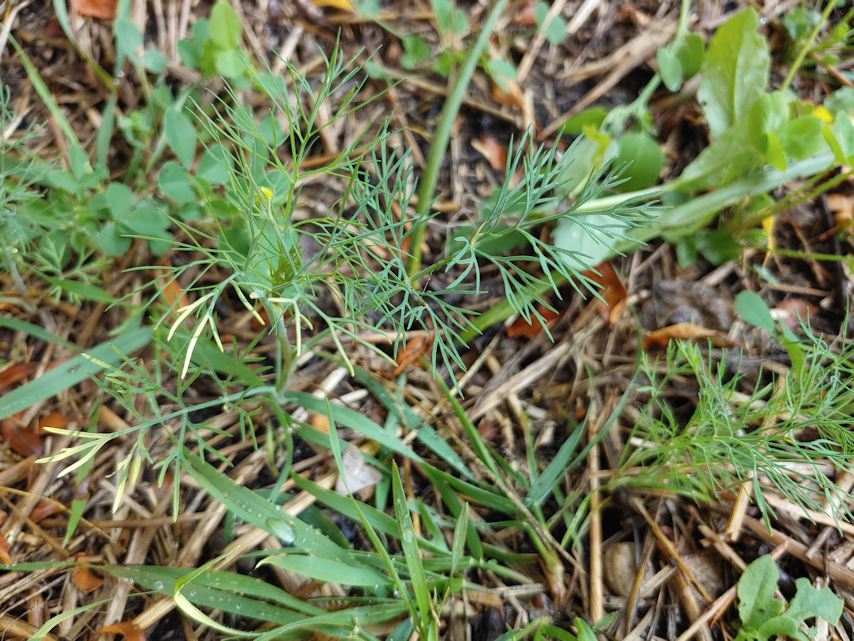
However, while trying to weed the area, I noticed something. You can barely see one in the photo on the right.
Dill!
All in a row, along the edge of where the trench to plant the irises last fall was dug!
We did not plant any dill. In fact, we have not seen any dill coming up since we moved here!
My guess is that, in digging the trench to plant the bulbs last fall, any dill seeds in the ground were brought closer to the surface, and this year, they could germinate.
I’m letting them be. We were intending to plant dill eventually, anyhow! :-D
Not pictured: our spinach beds. Because they’re all harvested and the beds are empty right now. The three varieties of spinach were a huge success, even with loosing some to deer. We will be sowing more in late July, for a fall crop. :-)
Also not pictured are our little pumpkins, Baby Pam. None germinated. We have seeds left over, though, so we can try again next year.
Also, also not pictures. The radishes we interplanted with the Peaches ‘n Cream corn blocks. They germinated, then disappeared, and we have no idea what happened!
That is finally it!
And now I hope I can actually publish this. I’ve lost internet over and over while trying to write this, almost lost the entire post while the editor was stuck on “autosaving” – and now it’s stuck there again!
I might have to do some browser magic to save this post and finally get it published… more than 4 hours after I started!
If you’re reading this now, I succeeded, and didn’t give up in a fit of rage. LOL
We managed to get a few things taken care of in the garden, once things started cooling down.
But first, kittens!
I wasn’t able to get pictures of all four of them, but these two seem to be a bit braver. :-) I also saw Rosencrantz and her two babies. It looks like they are actually living in that junk pile now.
I also saw the woodchuck again, this time diving under the garden shed. I don’t know if it was just trying to hide from me, or if that’s where it’s new den is.
One of the things that finally got done today was transplanting of the Hopi Black Dye sunflower seedlings that we’d tried starting indoors so long ago. There was a total of 8 to transplant. I also transplanted the few pink celery seedlings. I don’t expect them to grow, but I figured I’d give them a chance.
While I was refilling the watering can for the transplants, something caught my eye among the green peas.
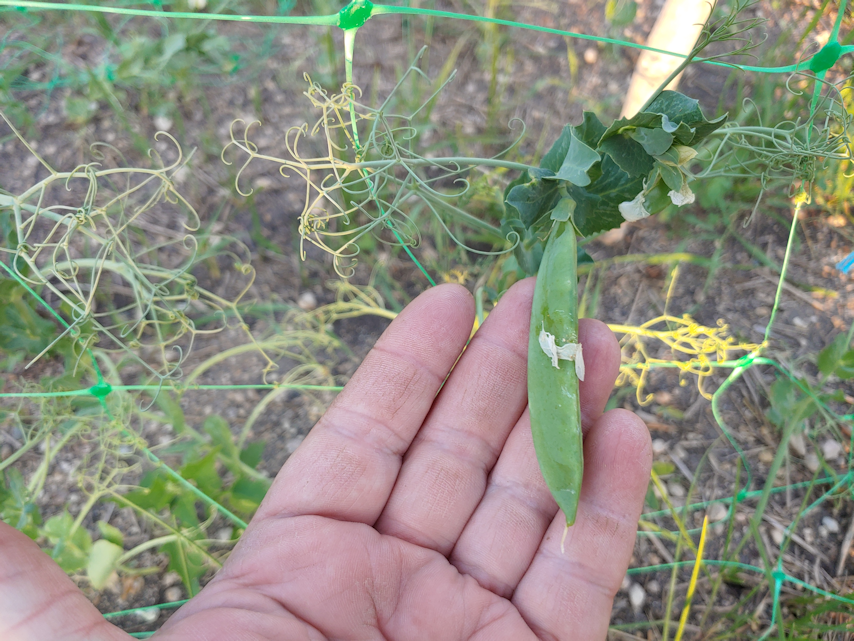
Our first pea pods are developing!
The green pea pods are surprisingly large, for the size of the plants. There turned out to be quite a few of them we found as we watered. I didn’t see them this morning, but I may have missed them.
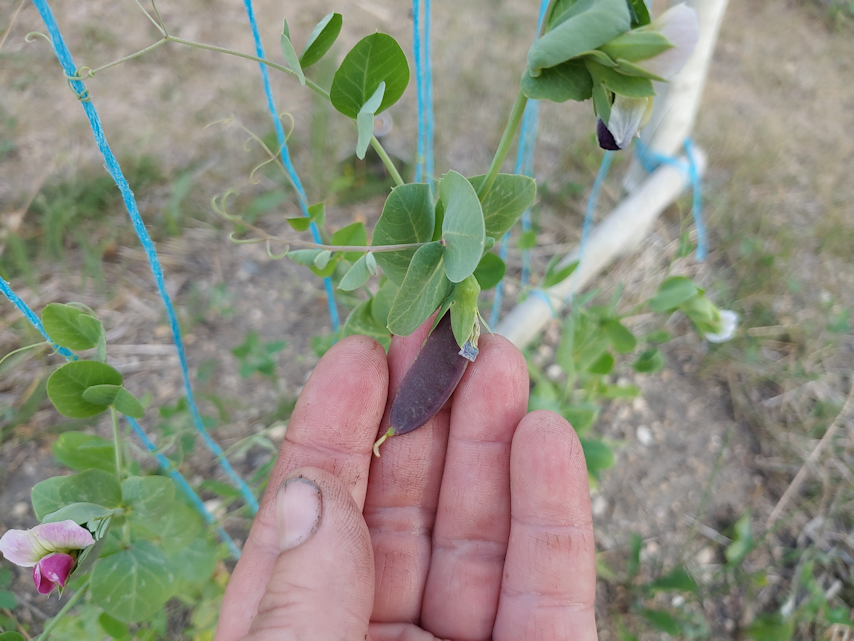
There was no missing these ones, though!
These pods are SO purple! I love them! :-D Among the purple peas, we only found two pods, so far.
Oh, I am so excited. :-D
Before I transplanted the sunflowers, which you can see in the row in the foreground, I hoed around the remaining Dorinny corn. Of the 7 rows we planted in this block, there are 4 rows left, and all of them have gaps. I did transplant about 5 corn plants from the other three rows into the larger gaps. They seem to have handled the disturbance well. Even the corn plants that got munched on seem to be recovering!
It’s hard to see, but after the watering was done, the girls put up the wire mesh on the last section of the squash tunnel. My younger daughter has been diligent in getting the winter squash, gourds, melons and peas trained to climb their various structures.
While they were putting up the wire mesh, I got another corn block hoed.
Even though we had already watered everything, I was finding the soil so dry, I watered all the sweet corn and sunflower beds, over again. Little by little, I’ll be hoeing all the blocks. Since these rows were just new garden soil placed directly on the ground, with no cardboard layer, nor any sort of organic matter underneath, what few plants that were growing here are working their way through. As this corner gets so baked in the sun, what little had been growing here can handle drought conditions. Their roots are incredibly tough and hard to pull. Now that the area is being watered for the first time, these plants are growing like I’ve never seen them before. I don’t want them choking out our corn and sunflowers, but my goodness, they are hard to dig up!
With these beds being so far from the house, we’re doing a lot of dragging of hoses around. Today, a pair of hoses gave out. The joined connectors both started to break, spraying water with remarkable pressure. So tomorrow, I’ll have to head into town to find both male and female connectors to replace the broken ones. Both of these hoses were purchased last year, but considering what we’re putting them through, I am not at all surprised that they would break where they did.
Oh, my daughter tells me that the potatoes are blooming now, too. When I watered them this morning, they still just had buds.
So much growth is happening right now!! :-)
On a completely different note, my husband got a notification email. Our StarLink kit is on its way. Our area should get coverage by mid to late this year – and we’re already midway through the year. I’m really hoping this new service works out, even though we would still be in Beta. Our satellite internet bill keeps going up, while the quality of our connection keeps going down. That is annoying enough in general, but I’m finding the WordPress editor seems to need higher connectivity than pretty much anything else. The editor simply won’t finish loading in any browser but Chrome and Tor. While everything loads much faster in Tor than on any other browser, the block editor does not work well if I have to go back and edit or adjust things, because blocks end up overlapping each other. Today, Chrome stopped working, too. Nothing will load except the tool bar across the top, and the question more icon in the bottom corner. The rest is blank. And sometimes, I don’t even get that much. Instead, WordPress just keeps timing out and I get error messages, instead.
So I’m using Tor right now, and am hoping that I can eventually load WordPress in one of my other browsers enough to open the draft and fix any weird formatting that might happen.
Hopefully, once we’re on StarLink, we’ll have a more stable connection. We’ll also have unlimited data, so we won’t need to have two accounts anymore. Switching could save us a couple hundred dollars a month, possibly more. Well worth the initial expense of setting up, which is pretty high, but doesn’t get billed all at once. For now, we’ll just be charged for the kit that’s being mailed out to us, which includes the dish, router, tripod and all the cables, parts and pieces needed to install it. My brother knows quite a few people already on the service, and they are really, really happy with it.
For now, though, I have to keep juggling browsers, just to be able to keep posting on this blog. I suppose I could use my phone, but I really need the big monitor and full size, ergonomic keyboard! That and the editing software I use to resize any photos I include, so they take up less storage space in WordPress.
So we’re getting a little bit of technical progress to go with our garden progress. :-)
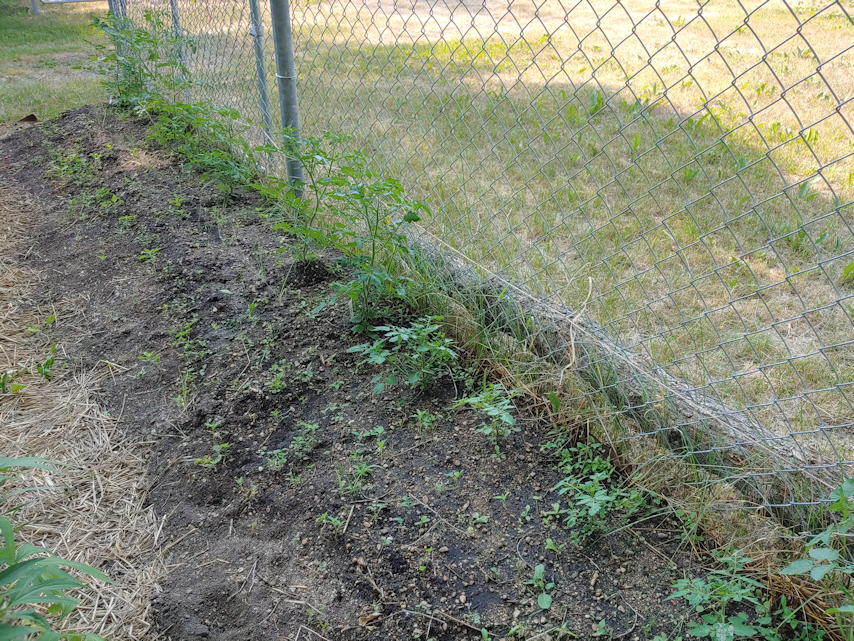
These are the miniscule Spoon tomatoes! Several plants are now showing baby tomatoes, and they are so tiny and green, the only reason we could see them was because we were wrapping twine around stalks to the chain link fence to support them. Only now have enough of them gotten big enough to do that.
While watering the Montana Morado corn this evening, my daughter called me over to see some new growth.
Most of these handled their transplanting well, and the larger ones almost all now show these developing spikes. I somehow didn’t expect them to show up until the corn was taller, but we’ll see.
Now for the unhappy stuff.
While watering the corn and sunflower beds, I made a point of checking more closely where I saw the deer in the trail cam. Sure enough, a couple of corn had been nibbled on. I also found some Mongolian Giant sunflowers had been nibbled on. None of the larger, transplanted ones.
Then I saw this, while watering the Dorinny corn. The surviving plants are much larger – almost as large as the transplanted Montano Morado corn. Now, we’re down even more!
Three of the largest corn plants were chomped right down. :-(
While I was watering, my daughter came over from watering the old kitchen garden to ask me if I’d harvested the lettuces.
No. No I hadn’t.
Almost every single block with lettuce in it was eaten.
It was the groundhog.
I had hoped we’d driven it away, as it doesn’t seem to be using the den we’d found, anymore. We’re still spraying water in it, and this evening I left the hose running into it long enough to flood it. Wherever it’s gone to make a new den, it didn’t go far. This afternoon, while I was putting the DSLR on its tripod back at the living room window after vacuuming, I happened to see it just outside, with what looked like a dandelion leaf in its mouth. I called the girls over and it heard me, running off behind the house. The girls went outside to chase it off, but either it was already too late, or it came back.
Interestingly, it didn’t touch the beet greens.
I am not happy.
In watching the deer on the trail cam, they seem to be just nibbling as they go by. So after I finished watering, I took some bamboo stakes and set them up around the corn and sunflower beds, then used twine to join them, and the stakes that were already there, at two heights, around three sides. I ran out of twine just as I was finishing, so only a small section has one string instead of two. It won’t stop the deer, but if they’re just passing through, it’ll sort of guide them away.
After running out of twine, I used the last of our yellow rope and strung it from one of the support posts of the squash tunnel, through the pea trellis supports, and joining it to one of the new stakes I put in around the Peaches ‘n Cream collection corn blocks. I then stole another bamboo stake and used it to put a second, higher line at the Dorinny corn.
This leaves the beds in that corner with either twine or rope along the north sides of the Dorinny corn, the pea beds and the northernmost Peaches ‘n Cream corn block, all along the east side of the corn and sunflower beds, and the south side of the southernmost corn block.
Later, we will be stringing the aluminum tart tins I picked up to flash and spin in the wind.
Once we get more twine and/or rope, we’ll put up more to guide the deer away from the garden beds.
I also want to put a barrier and distractions around the Montana Morado corn. So far, they have been untouched, but I would rather lose any of the other corn completely, then this variety.
I also moved the garden cam and hopefully it will cover more of the garden beds.
There are lots of things we can do about the deer, even though we can’t put up anything permanent, like fencing, right now. The groundhog, on the other hand, is a different issue. It can get through or under most things, and now that it’s eaten all the lettuce, there is nothing to stop it from going after the beets. Unless it just doesn’t like beets.
With the heat we’ve been having, and a heat wave hitting us starting today, it’s been hard on a lot of the garden. Not everything, though. The squash and gourds are just loving it! As long as we can keep up with the watering, of course.
It was while watering the summer squash last night that I spotted the first bebby.
Yay!!!!!
I got this next photo this morning.
Several plants have little green bebby squashes growing. We have two types of green zucchini, and it looks like we have both starting. So far, no yellow zucchini and no pattypans. When my daughter transplanted these, she forgot to keep track of the different types, so they are all mixed up. It’ll be a surprise, every time we see new ones!
I noticed that some of the summer squash had gotten to the point where they could use support, so I gently tied a few of them to their stakes this morning.
When it got dark enough last night, I did make sure to head back into the garden to test the new motion sensor light. It has an on/off switch, but without being charged yet, and too much light, there was no way to know if it was actually going to work. It did at least get enough time in the sun to charge before dark.
It was indeed on, and working!
But was it doing its job?
I don’t know. I just checked the garden cam and saw a single deer go by in a couple of files. The first one stopped and snuffled at the edge of the corn block, but did not nibble anything. Then it kept going, walking right through a bean bed! The second deer didn’t stop to snuffle anything, but also walked right through the bean bed.
*sigh*
If either of them triggered the light, it was after the camera stopped its 15 second recording.
Unless we happen to be looking out a window when something triggers the camera, we just won’t know.
I might shift the garden cam’s stand a bit, to cover that area.
Meanwhile…
Check out those potatoes!!!
They are just loving these grow bags.
When we did these bags, the idea was to keep filling the bags as the potatoes grew, to have more potatoes in the bag. However, it turns out that potatoes, like tomatoes, come in “determinate” and “indeterminate” types.
Determinate types grow their tubers all in one layer. They need to be hilled to protect the tubers from the sun, but there is no benefit to keep hilling them higher and higher in a tower or grow bag.
Indeterminate types, on the other hand, will keep producing tubers up their stems if they get buried. So adding more soil or mulch and increasing the height will increase the yield.
Which meant I needed to figure out which we had. Seeing how tall the Norland potatoes are, I thought they might be indeterminate, but nope.
All of these types are determinate. Adding more to the bags will not mean more potatoes, and will not help the plants themselves. Hilling them as we already have is enough.
Well, that saves us a bit of work.
Also…
They are starting to develop flower buds!
Both types of fingerling potatoes have plenty of buds on them. One plant of the Norland potatoes has buds. So far, nothing on the Yukon Gem. Which is good. The fingerlings were chosen for their shorter growing season, and short term storage and eating, while the Norland and Yukon Gem are both types that mature later and can be stored longer. Not that I expect we’ll have enough to last us the winter, but we’ll at least be able to have them for a while after harvesting.
This year’s garden seems to be one of extremes: things are either doing really, really well, or not at all! :-D
I went out to do the evening watering, and also add some shredded Irish Spring soap to the decimated beet bed, in hopes the deer will leave it alone and it can recover.
While weeding in the carrot bed in the main garden area, I noticed some greens had been nibbled on. It was only at one corner, so I figured it might have been a deer, though I didn’t think deer liked carrot greens. With discovering the groundhog had made a den in the nearby pruned branch pile, I looked it up, and it turns out they will eat carrot greens. So I figured I would add some of the soap shavings to the carrot bed, too.
I was too late.
The entire bed was decimated this afternoon!
All of it.
The bed was split between two types of carrots. They were pelleted seeds, so we were able to space them as we planted them, and they were doing really well. No thinning needed. Now, they’re all gone.
I am pretty sure that, if we can deep the deer away, the beets will be able to at least somewhat recover, but will carrots? I have no idea. We do have left over seed for both types, and I considered using one of the empty spinach beds to plant more, but we’re at the end of June. We don’t have enough of a growing season left to start over.
We do have two other types of carrots in the old kitchen garden, but these were specialty carrots, and had a lot less seed in the packets. They were also planted later, so they were not as far along as these ones.
I added the soap shavings to the bed anyhow, and the girls have covered it with one of the covers we used on the spinach beds. Not that these can stop a ground hog, but still.
Meanwhile, we’ve been trying to encourage the groundhog to move on. We don’t have a live trap, and even if we did, where would we release it? We are surrounded by farms. I don’t want to pass the problem on to someone else!
Anyhow.
One of my daughters came out while I was watering and went to the branch pile to see the den, only to see the groundhog looking back at her! She started to tear apart the pile, and then I passed the hose to her so she could start spraying water into the den. The groundhog came out and hid the branches. They never saw it go away, though.
While they were doing that, I continued watering from the water barrel by the peas and corn. I was afraid of what I would find when I got there, but these far flung beds were unharmed.
Moving that branch pile is going to be a priority, and we’ll continue to convince the groundhog to move on, on its own. Depending on how things go, and if we can figure out where we can release it, I might be able to borrow a live trap from my brother. When I told him about the groundhogs I saw in the outer yard, he told me about catching and releasing one from their own property, so I know he’s gone one large enough. The groundhog in the garden is bigger than the two in the outer yard.
When doing my rounds this morning, I gathered more garlic scapes and did some weeding in the beet bed next to the garlic. They were doing very well, and I was planning on gathering some beet greens later in the day, to include in a salad or something.
This afternoon, I made a quick trip into town, then drove into the yard to unload the van. As I was unloading, something about the beet bed across the yard looked… off. So I made a point of checking it after putting the van away.
No wonder it looked off, even from a distance!
It’s been decimated.
And yes, those are deep hoof prints in the soil.
Planting the onions around the beets wasn’t enough to keep a deer out.
The crazy thing is that this happened during the day. We were indoors, but we were still moving about and near windows. The girls can see this bed from their windows upstairs, and they saw nothing. In the summer months, we never see deer in the yard. At most we see them on the trail cam going through the gate, and I haven’t even been seeing them on the garden cam at all, and even then, we only see them at night, or very early in the morning.
The beets might recover, though I’ll have to find a way to cover it again. The mosquito netting on the hoops kept blowing off. I’ll see if I can make a cover for it using the chicken wire we got for the squash tunnel. It’s a 50′ roll, so there will be more than enough to spare.
I’m not sure when I’ll be able to do it. We’ve been hearing thunder for a while now, and my desktop weather app just popped up with a severe thunderstorm warning. Because of the thunder I was hearing, I had checked it before starting this post, and it was still saying only 60% chance of rain, so something changed in just the past few minutes! From the looks of the trees outside, I might be shutting down my computer soon!
Well, at least the weather will keep animals sheltering themselves, instead of eating our garden! It’s a good thing we planted so many beets in the old kitchen garden, too. Even if this bed doesn’t recover, we will still have lots of beets.
































 The Re-Farmer