Our 2021 garden: planting day, indoors – and that didn’t work!

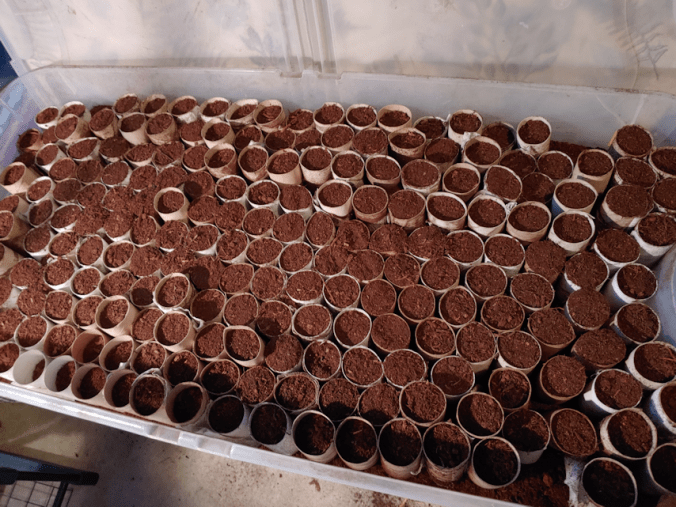
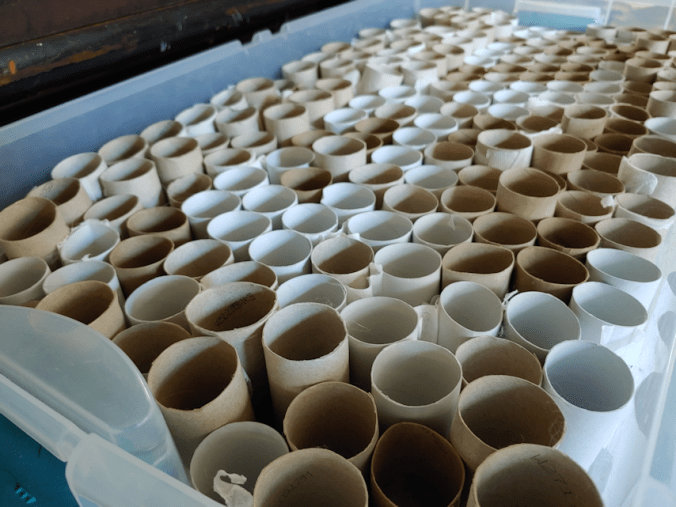
Today’s priority was to start the last of the seeds indoors. I’d been preparing a bin with toilet paper tubes, as something that would allow the least root disruption when transplanting (at least, so I’ve read). After a couple of days, it was time to start planting the Montana Morado corn!!
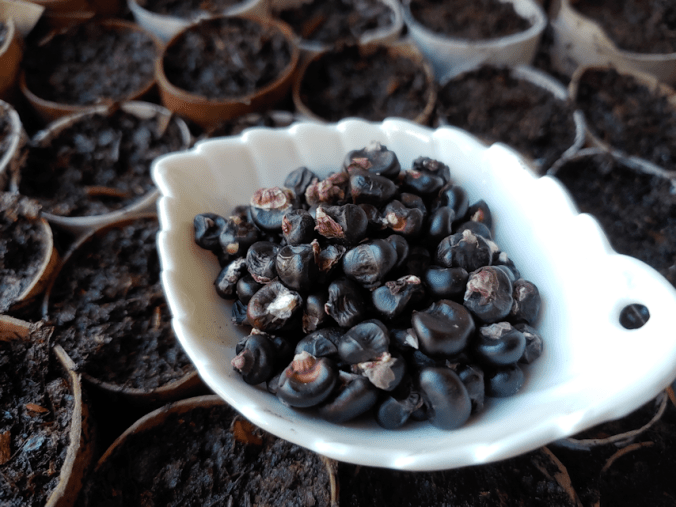
Aren’t they gorgeous?

The seed packet said “at least 75 seeds”. That’s a lot more than 75!

I started puttering with the peat filled tubes in preparation of planting in them, but something felt wrong. Ever after a couple of days, some of the tubes were still floating on a layer of water, and as I made holes in the medium, it seemed really dry below the very top.

I didn’t want to take a chance, and decided to crack open one of the tubes.

I am very glad I did.
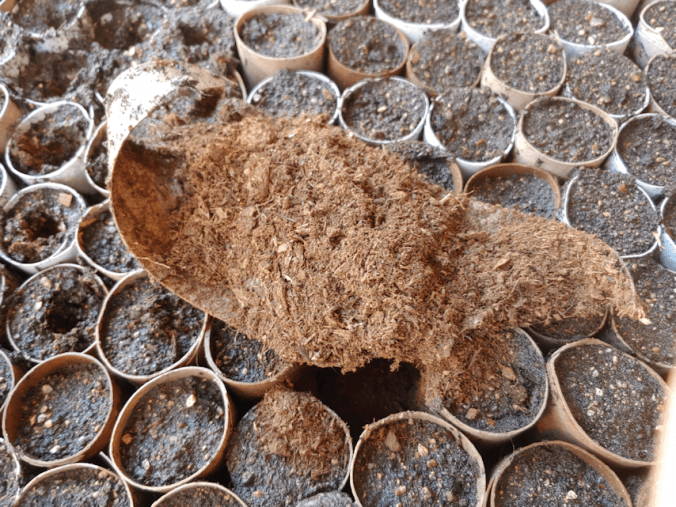
It was completely dry inside!

Well, so much for that idea. If the peat didn’t absorb the water after all this time, it wasn’t going to happen.

For the next while, I opened every one of those tubes to empty them.
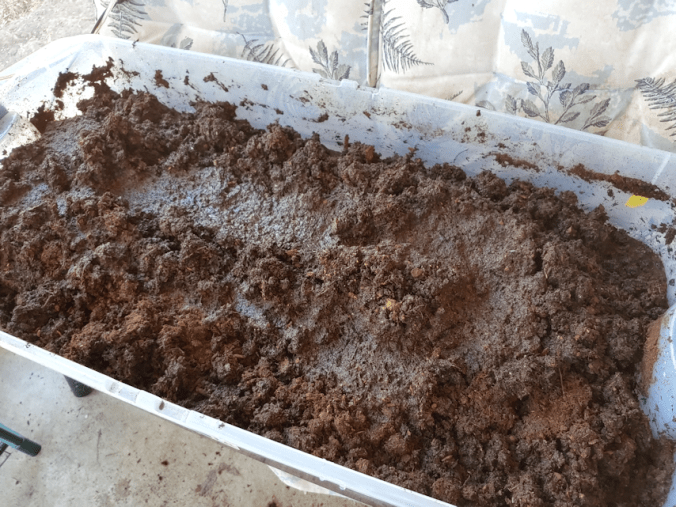
Once that was done, I kneaded it like bread dough, to work in the water. Then added more water and kept working the mixture until it was completely wet.

I should have done that right from the start!

I did work in the last of the sifted garden soil, too. The soil absorbs the moisture faster than the peat, so I thought that might help. The amount was quite small, compared to the quantity of peat!

As for the toilet rolls, they will not go to waste. These were dumped into the old kitchen garden, where they be composted directly into the garden, as we add soil.

The bin is still being used, though.
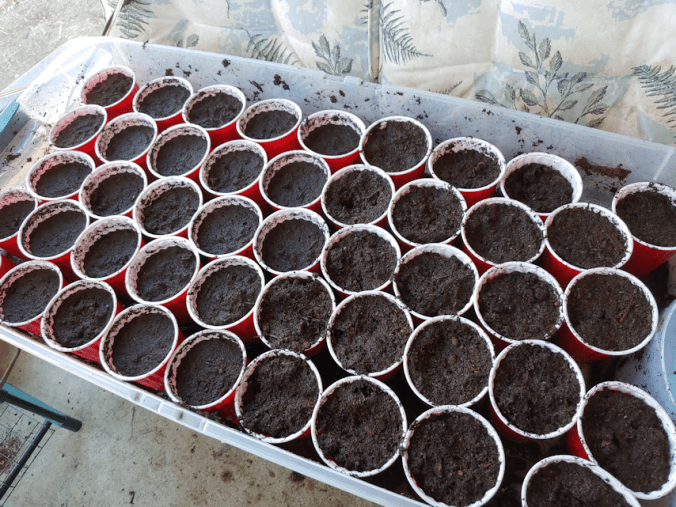
After punching holes into the bottoms of more cups and filling them, I ended up quite quite a bit of unused peat mix.

I made sure to water them from the top again, just to be sure, and left them to drain for a while.

For small seeds, I like to use a bamboo skewer to handle the seeds, but for larger seeds like this, I find a straw works great. It’s just the right size to push holes into the medium, and is perfect for pushing the seeds down to the right depth.

I knew I wouldn’t use up all the cups, so I didn’t cover up the seeds until they were all done, so I could easily see which cups were planted, and which were not.

Then I used some twine to wrap around and between the cups, to mark between the planted and unplanted cups.

I ended up with 33 cups with corn in them; 31 with 4 seeds each, and 2 with 3 seeds each.

I have some concerns about doing it this way, but starting corn indoors has been an active topic of discussion on several cold climate gardening groups I’m on. Most of the experienced Zone 3 gardeners say all corn should be started indoors (my mother never did; I would say the varieties make a difference!). Some insist that corn is too tender for transplanting, but the few who say that usually have many others commenting, saying they start their corn indoors all the time, and have never had issues with transplant shock.

So I’m hoping this works out. I really want to successfully grow this variety here!!

The remaining cups were planted with Mongolian Giant sunflowers. There isn’t a lot in the package, but the remaining 13 cups all got 2 or 3 seeds in them. I think there was a total of 33 seeds in the packet.

They all gone one last watering when all the planting was done.
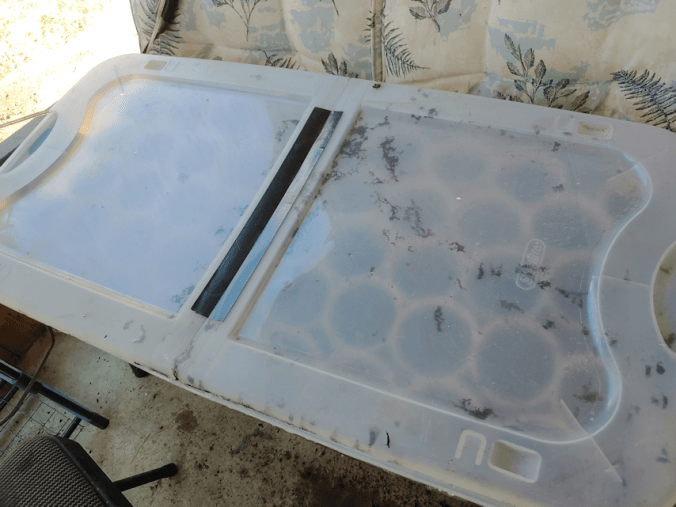
The cover can be placed over the bin to help keep the moisture and warmth, if necessary. I think it should be fine, without, but we’ll see.
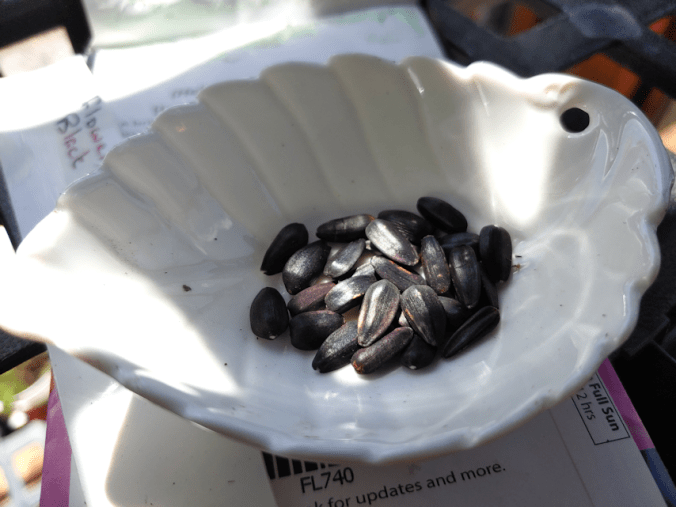
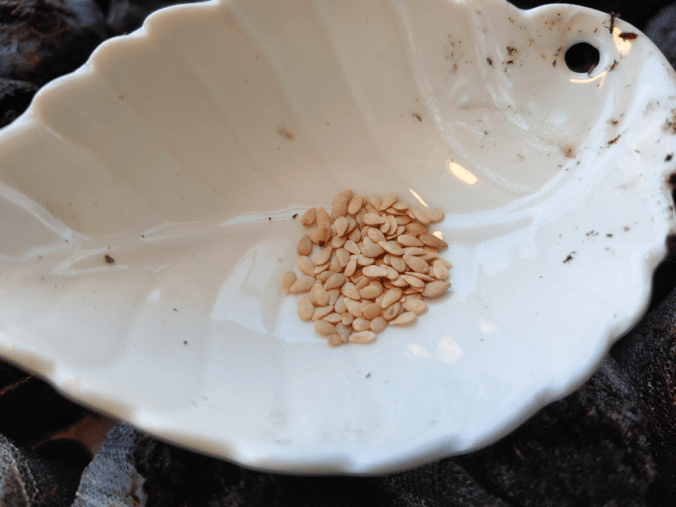
That done, it was time to plant the Hopi Black Dye sunflower seeds, and the cucamelons.

Again, there weren’t a lot of sunflower seeds in the packet. I’d forgotten how small the cucamelon seeds are! :-D

Since these were going into Jiffy pellets, the sunflower seeds each got their own pellet. It still filled less than half of the tray. There were 28 seeds in the pack, and I used the twine to mark between the two seeds. The cucamelons each got several seeds per pellet. I didn’t keep track of those. We still have the tubers from last year’s cucamelons, so it should be interesting to see which do better after they are planted out in June.

After these were done, we did the onions outside, which freed up shelves in the sun room. All the remaining seeds in the aquarium greenhouses are now in the sun room. I’m starting to be a bit concerned. Not a single squash or gourd has sprouted since the one Crespo squash germinated. That one is doing well (as are the dancing grouds), at least. I know gourds take a long time to germinate, but I would have at least expected more Crespo squash to germinate by now. I’m hoping the warmth of the sun room will be what they finally need to get them going. We shall see!

Starting the seeds indoors – and having to change plans on how to do some of them – took a lot longer than expected.

So did planting outdoors. Because, of course, things got changed up there, too!

You can read about that in my next post! :-)

The Re-Farmer

Our 2021 garden: an experiment, plus the jiggler is in!

Today I took my mother to her doctor’s appointment, so I got very little garden stuff done today. Last night, however, I was able to start prepping the toilet paper tubes we’ll be using to start the Montana Morado corn in.

I picked up this coolant funnel long ago, because it’s perfect for jobs like this! :-D

I neglected to take photo of the next step. After filling all the tubes with peat, I used the 1/4″ hardware cloth I still have a piece of, laid it over the bin, then sifted peat over everything. Aside from topping up the tubes, I wanted it to get in between the tubes and fill the gaps to hold them in place. Especially in the spots where the wheels of the bin are, with a “fender” on the inside that I couldn’t put tubes on because it was too uneven.

After that, a whole lot of water was poured over all the tubes using a watering can. It would have been much easier to use a hose on “mist”, but by then it was night and too cold to use the hose.

The sun room was nice and warm still, though!

Adding the water had two unexpected effects.

The first was, the tubes started to float! I should have expected that. The problem was, you can’t actually see that it was floating. I’d added another watering can of water before I reached out to even the tops of some tubes, and the whole thing sank!

The peat may have been all light and floating, and it takes a long time to absorb moisture, but the tubes are a different story! They not only quickly absorbed water, but some of them started to come apart at the seams. Thankfully, they’re packed tightly enough to hold each other in place.

It did make be wonder if this would work at all.

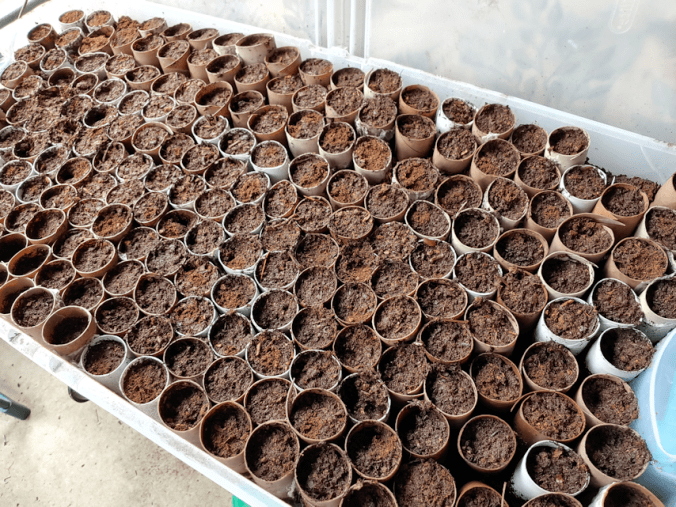
I think it will. Here is how it looked this morning.

The cardboard actually seems to be helping the peat absorb more moisture. I went over the surface with a spray bottle. You can see in the photo that some of them still have dry areas. This is all being absorbed from bottom, though, so they should have been mostly moistened through. Normally, I would have premoistened the peat, but there was just too much needed for this job.

I’ll check it again tonight and see if I can start planting the corn, or if it will wait until tomorrow. There is still enough water in there that the tubes in the middle are still floating a bit, as the bottom of the bin is sagging from the weight of the water in that area.

After I got home from helping my mother, I made a quick run into town and made a special trip to a dollar store. I picked up some hula hoops. We haven’t been able to find row cover supports, so my daughter thought of cutting hula hoops and using those. If it works out, we can get more later.

I also cleaned the store out of pinwheels (they only had 6 left), plus I got some spinners and wind vines. When I did my rounds this morning, I found birds digging in the dirt in the bed we planted carrots in. :-( All those beds now have shiny metallic pinwheels in them. I’ve set up wind vines at the strawberry spinach, and as close to the garlic beds as I could. I put spinners in the ornamental apple trees over where the spinach was planted. We still have a few more of those, but we’ll save them for later. I will probably get more pinwheels after the store restocks. It would be good if we could replace the plastic grocery bags on the pea trellises with things like that. I noticed there was a solar motion sensor floodlight that would be good for startling deer, but it was out of budget. :-/

The girls and I were quick about putting the bird scarers out. I had hoped to cover the beds with plastic, but it was just too windy. So I watered the beds again. The water will help regulate the temperature in the soil as temperatures dip overnight. At least, that’s what I’ve read! I didn’t get any photos because, to be frank, I just wanted to get back inside again! When I checked the weather once I was inside, it said we were at 2C/32F – but the windchill was -6C/21F! It certainly felt like it was below freezing. Meanwhile, the thermometer in the sun room was reading about 28C/82F.

One of the things I made sure to do before I went to my mother’s was to get the mail. The last of our onion sets were in, but so was another pleasant surprise!

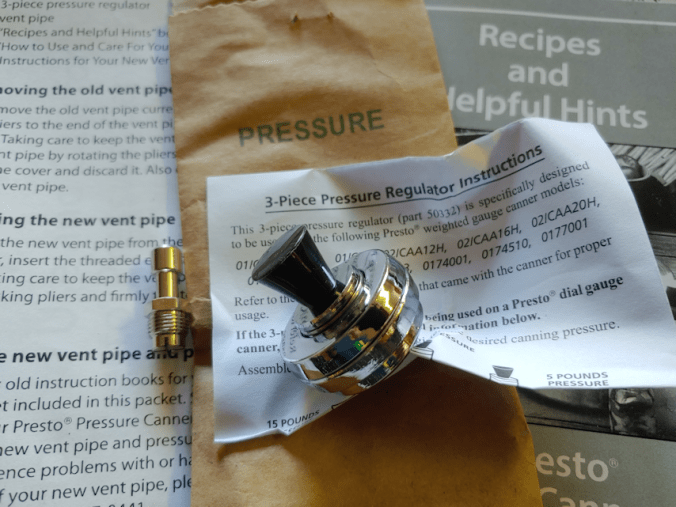
The kit to convert our pressure canner to use a weighted gauge (aka: jiggler) is in!!!

I can hardly wait until we can test it out!

That might be a while, though. We’ve got lots of outside stuff that needs to get done, and we won’t be in a position to continually monitor the canner while it’s being tested.

I’m really looking forward to it! :-)

The Re-Farmer
Our 2021 garden: planting day!

We had another change in plans, today.

I was supposed to take my mother to a doctor’s appointment, but the clinic called and it got rescheduled to tomorrow.

Which meant I could change into my grubbies and go play in the dirt! :-D

Today, we finally got most of our cold hardy seeds in the ground. :-) The first to go in were the lettuces.

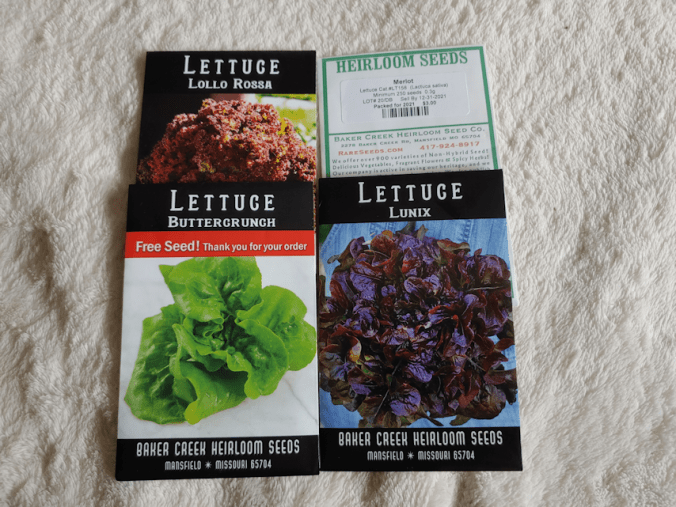
We’ve got 4 types of lettuce; three are dark reds/purples that we ordered, plus a packet of buttercrunch that we got as free seeds. :-) These were alternately planted in the chimney block retaining wall.

Also, the plastic containers from things like sour cream and cottage cheese make excellent label markers! :-)

We’ll sow more in a couple of weeks somewhere else. We haven’t decided where, yet.

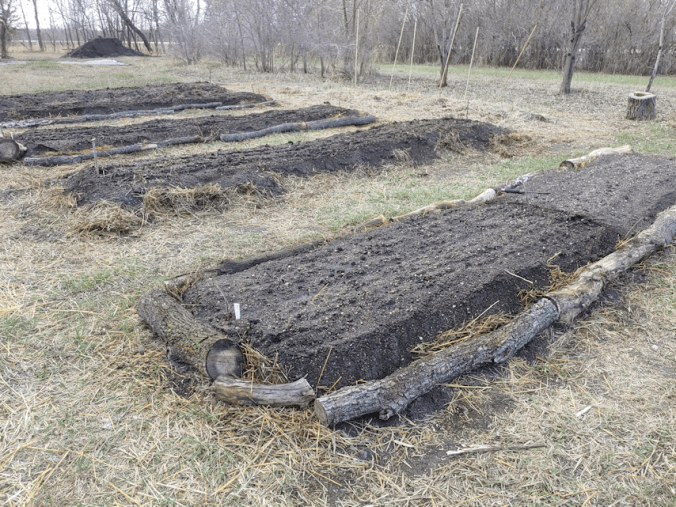
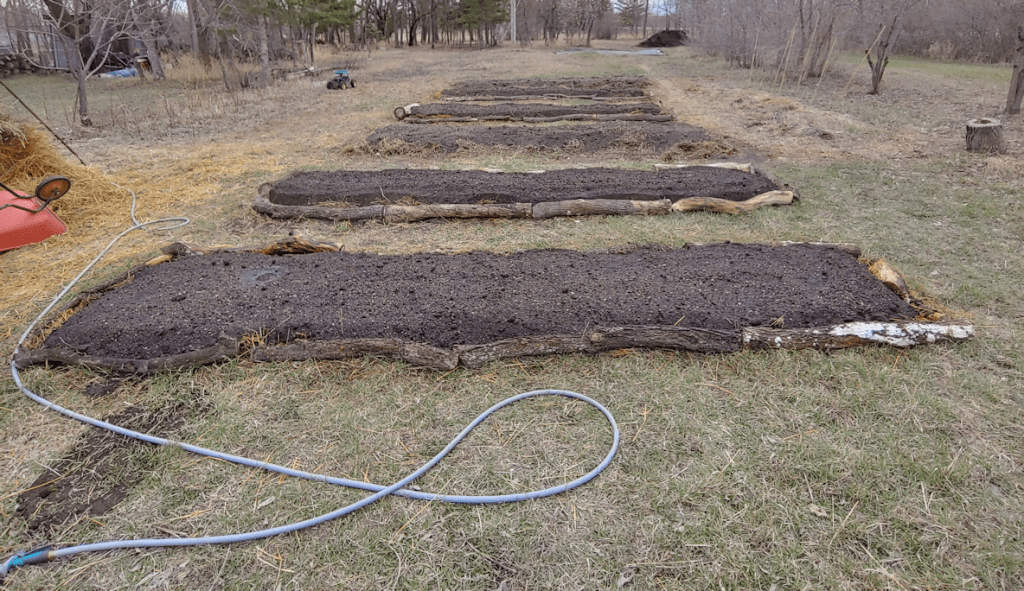
Then it was off to the newly finished garden beds.

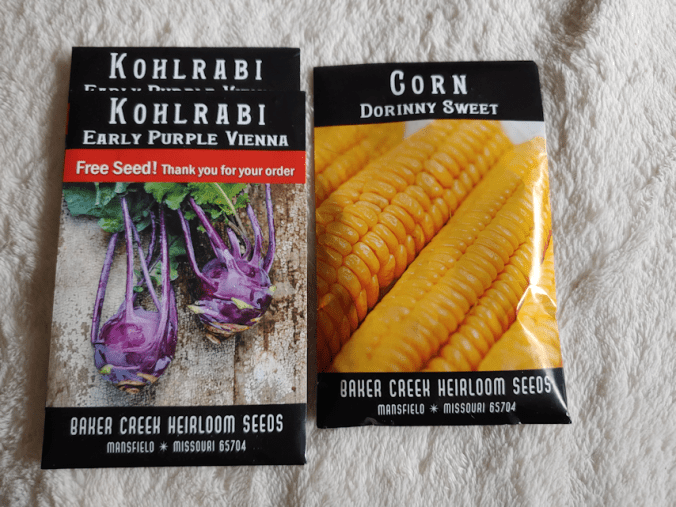
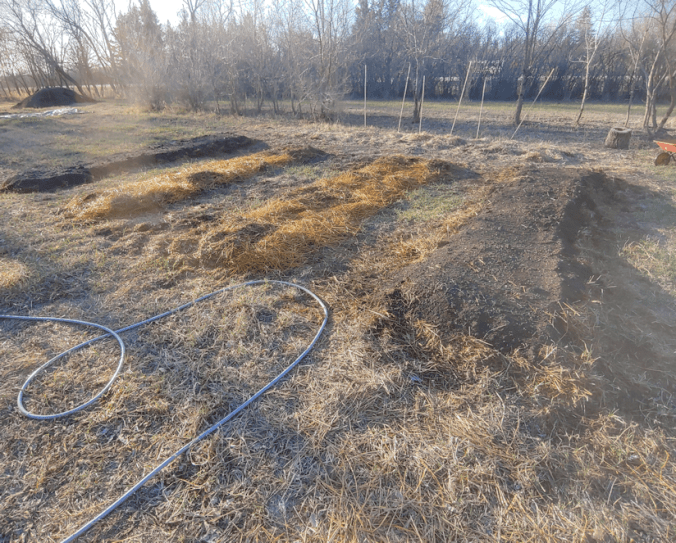
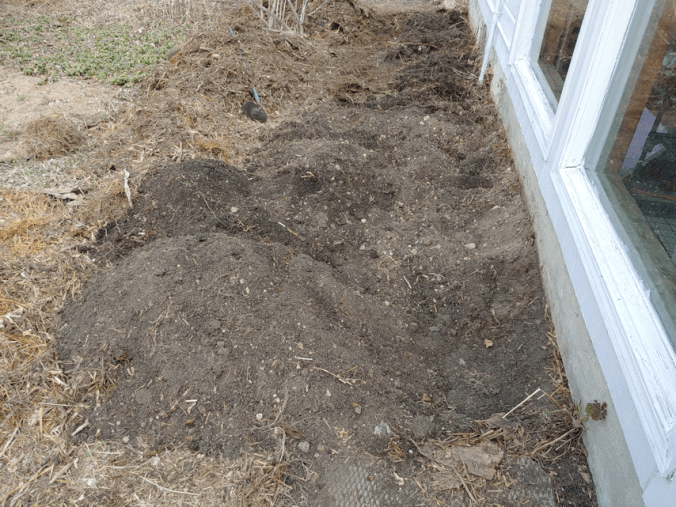
The bed on the far left of the first picture has a single row of purple kale down the middle. These were other free seeds from Baker Creek that we got. :-) Later, that bed will have onions planted on either side.

The three middle beds each have a double row of spinach in the middle. In a couple of weeks, we’ll sow more along the sides.

The last bed, that is half watered, has carrots in it. We got one kind as pelleted seeds, which made it very easy to plant and space them properly. They’re supposed to be 1 1/2 – 3 inches apart, and they’re planted in roughly a 3 inch grid. Sort of like square foot gardening, but without bothering to mark out square foot plots. We’ll plant the other three varieties in similar density.

I have to say, by the time my daughter and I finished planting these, I was really, really looking forward to when we have the accessible raised beds! My knees are shot, so I can’t squat like my daughter could, so I was bending from the waist. Not only did that get painful after a while, but I was getting head rushes every time I straightened!! Meanwhile, my daughter has a bum knee, and a messed up shoulder, so she kept having to alternate positions to be able to reach, too. We really need to find materials to build the raised beds. We’re hoping to make a trip to a salvage yard this summer, so hopefully we’ll be able to find some good materials there.

Meanwhile, I’ve now got shipping confirmations for several other items from Veseys, including the mulberry tree! Which means we need to find some way to take down several dead trees in the area it will be planted in. We might have to just do it manually. :-/

The only thing we don’t have shipping confirmation for yet are the potatoes. It might be another couple of weeks before those get shipped.

The onion sets we ordered from Veseys should arrive in the mail tomorrow. Hopefully, I’ll get a chance to pick that up, depending on how things go with driving my mother around. Which means we should be able to start planting onions the day after, including our surviving transplants. It should be interesting to see the difference between onions from sets, and from seed.

We’re going to need to pick up netting to protect the beds from birds and deer. Even for the garlic beds. The birds are digging around in the dirt, like they dig around in the leaf litter in the trees. I don’t know what’s in there that they’re after. They’re not going for the garlic, but they’re messing up the soil enough that some get partially uncovered, and kicking it up far enough that it’s covering up the paths!

We also need to get more seeds started indoors over the next few days. These will be the last ones to start indoors.

We saved up just enough toilet paper tubes to fill the under-bed storage bin. Once they’re filled, we’ll start the Montana Morado corn. Then, with whatever’s left, we’ll start sunflower seeds until they’re all filled, then move on to the Jiffy pellets. Then there are the cucamelons. If there is enough room left in the Jiffy pellet tray, they’ll go in there. Otherwise, we’ll do the double cup method for them.

Once the onions are planted out, we should be able to move all our starts to the sun room. It’s much warmer in there than the aquarium green houses right now. In fact, I’m considering moving some of them over, now. We can move the lights over, later, though I’m not sure how we would set them up. The ones for the big tank are quite long. I might set them up vertically. We’ll see. The other gourds in particular have not sprouted yet, and neither have any more Crespo squash (the one that did is already in the sun room, along with the dancing gourds). I think they really need that warmth.

It feels so good to be planting outside!

The Re-Farmer

Soil tests three and four

Well, I finally got around to doing two more soil tests.

You can read how the first two tests went, here, here, here and here. (Links will open in new tabs)

One of the areas I tested was the soil under where we planted potatoes last year. The other sample was from the northwest corner of the garden area, where we will be planting blocks of corn and sunflowers, and where no one has ever tried to grow anything before.

Here is the potato bed soil. We tried the Ruth Stout method of simply putting the potatoes on the ground and topping it with a thick layer of mulch. Straw mulch, in our case, because that’s what we had. In the fall, I had removed the mulch to find the potatoes, turning the soil a bit in the process, then put the mulch back again. Though I’d done nothing to the ground other than put mulch on it, the soil was quite soft and easy to dig into to get the potatoes. It was still very soft when I dug down to get my sample.

As with the other tests, the soil is very alkaline. That green is darker than the darkest green on the scale, which is a pH of 7.5. Like all the other soil samples, our pH is probably 8.

The orange is potash (potassium), and the blue is phosphorus. Both tested at about the medium range; almost, but not quite dark enough to rate a “high”.

The purple is nitrogen, which is as low as it goes!!

Now for the soil that has had no amendments of any kind.

This area gets very hot, with only a couple of hours of shade at sunrise. There is more grass and green at the south end of this area, but in the north corner, even weeds have a hard time growing.

I think we can see why!

As with the other samples, the soil is very alkaline. There is some potash (the colours appear darker in the photo than in real life), but basically nothing for phosphorus (blue cap) and nitrogen (purple cap)! And we’re going to be growing corn there!

Have I mentioned how glad I am we were able to buy so much garden soil?

I think I’ll be mentioning it more than a few times, over the summer! :-D

The Re-Farmer

Our 2021 garden: old kitchen garden, part one

A change in plans.

Today, I wanted to get started on the old kitchen garden, where we intend to plant the poppies.

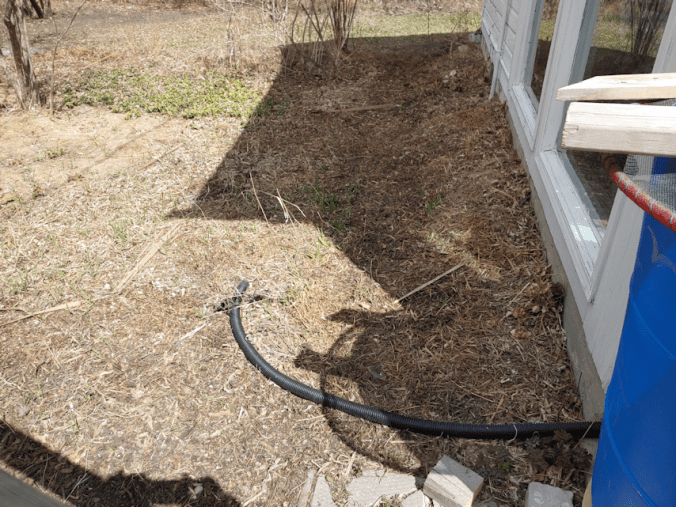
This is how it looked at the start.

The hose is from the sump pump in the old basement.

It has not turned on in ages. It’s simply been too dry.

You can see a path has started to form, a couple of feet from the wall. This is mostly from the cats crossing the garden, though we sometimes walk through there, too. The plan was to add new soil against the wall, to plant the poppies, and put in a stepping stone sort of path where one naturally formed. We found some concrete blocks out near the barn that we decided to use for the paths.

But first, it needed to be cleared.

Our first summer here, we did a major clean up of this old garden, removing a fence, cleaning it out as best we could, laying down cardboard, then covering it with straw, grass clippings, kitchen waste, and any soil from various places that we could get it. You can read about the clean up we did here, here, here and here. Yeah. It took a while! (all links will open in new tabs)

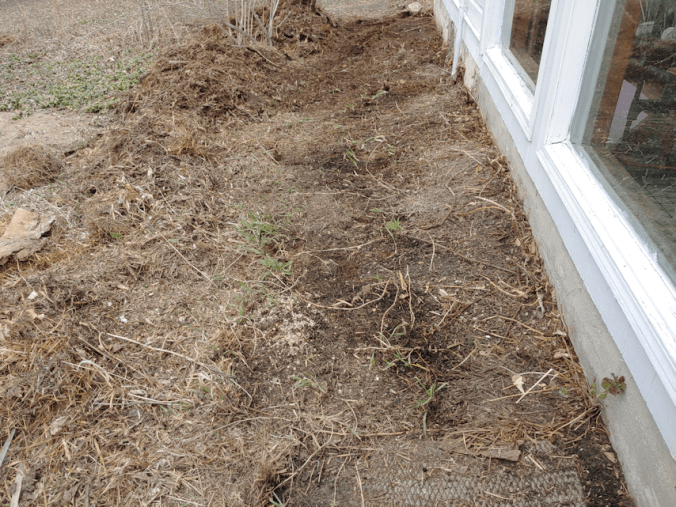
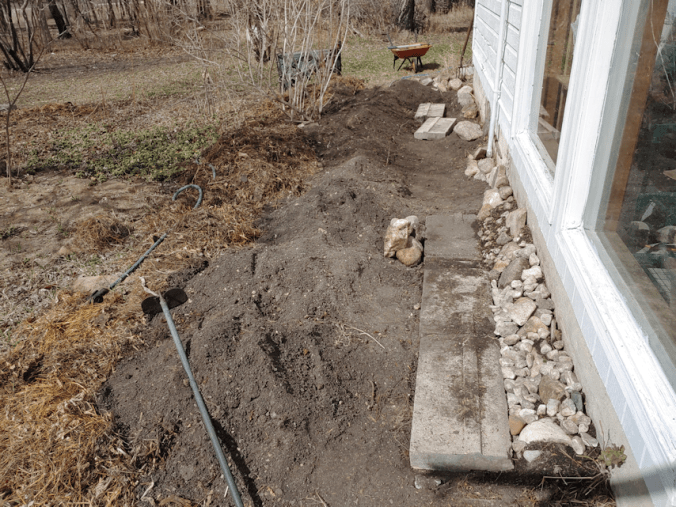
My mother had flowers growing here, and quite a few of them made their way through the layers. So did the crab grass and a vine we’ve been fighting continually since moving here. So the first thing I had to do was rake away the mulch, down to what was left of the cardboard layer. You can see lots of roots that were uncovered!!

Most of the biggest ones were from that invasive vine. It used to cover the entire wall until my brother and his wife pulled it down while painting the house, the summer before we arrived. They were causing damage, so we don’t want them growing back.

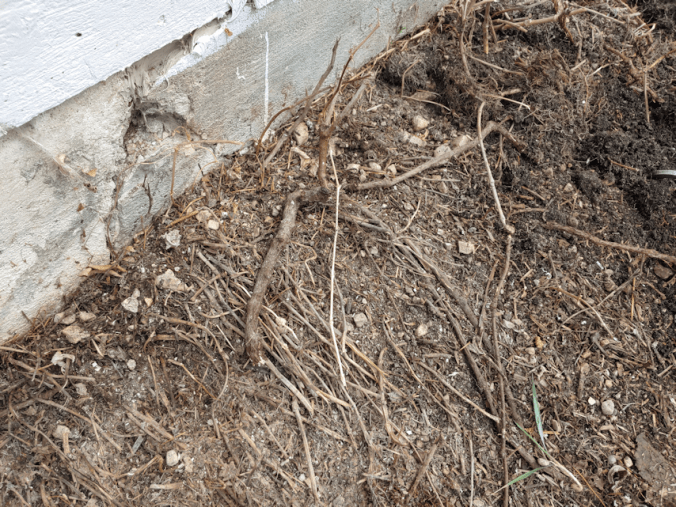
Speaking of damage, that crack is in the foundation under the old kitchen, which was tacked on to the log cabin portion of the house at some point. There’s a crawl space under there.

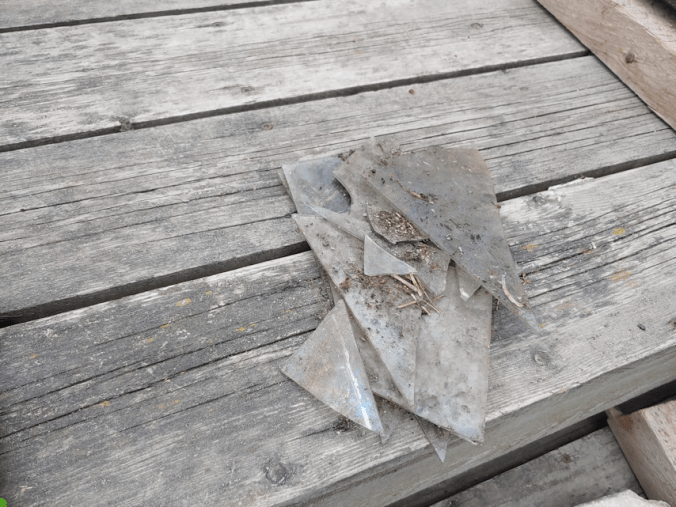
My brother told me about fixing the broken attic window above the old kitchen. It never occurred to me that the glass would still be on the ground! We’d laid cardboard over it, and never new it!

Finding glass from a broken window, I can understand. But this?

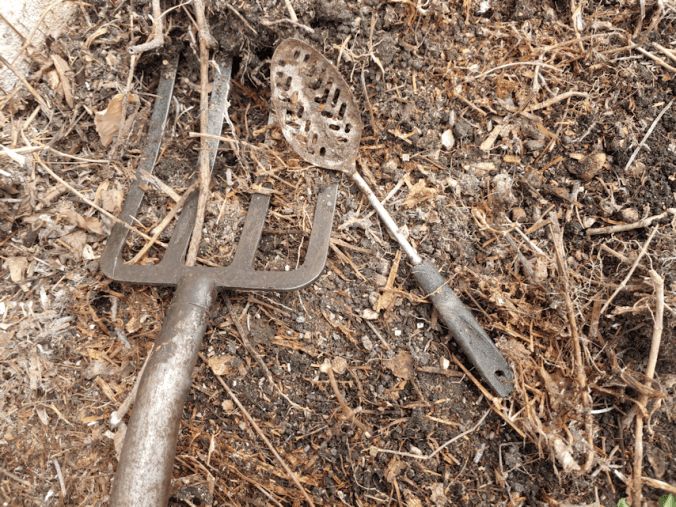
Why a spoon?

At this point, I was breaking up the soil with the fork and pulling out lots of roots.

Lots of roots.

So many roots.

Which created a problem I did not expect.

I was pulling roots out from under the old kitchen foundation, and the concrete floor of the sun room. In the process, soil started falling out from underneath.

No wonder the windows in the sun room are cracking as it shifts!!!

This required a change in plans. There was no way I was going to turn this into a garden bed, where watering it might continue to undermine the concrete. I needed to get those roots out, then shore up the sides.

It’s a good thing we have a nice big rock pile over by the power pole. We also had piles of smaller rocks we’d gathered from the garden, though not very many.

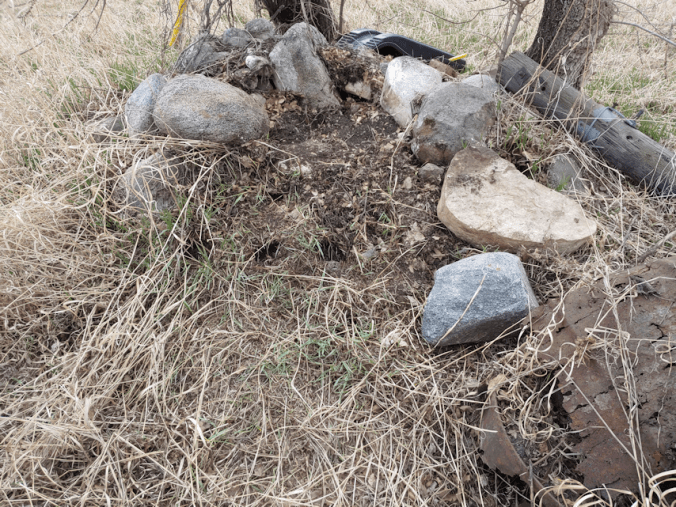
Large rocks were placed against the wall, soil put back to fill gaps and support the rocks, smaller rocks are added on top, and the concrete blocks were placed to begin the path.

We brought those blocks over in the wagon, which is rated to 300 pounds. I don’t know how much they weight, but with three blocks, the wagon didn’t want to roll. My daughter pushed while I pulled. After that, I only put in two blocks at a time.

The wagon was used to bring rocks over, too.

After a while, it started to get hard to find smaller rocks. There is decades of detritus that has decomposed on them, with a very strong layer of crab grass rhizomes!

As we worked our way down, still clearing away roots, we got hung up by an old rose bush. It took a while, but I finally got it out!

That is one weird looking root clump!!

My daughter was just coming back from a break (we were very careful not to overdo it; the last thing we need is to injure ourselves!!) as I put it in the wheelbarrow with all the other roots. She was checking it out when she suddenly dropped it in alarm.

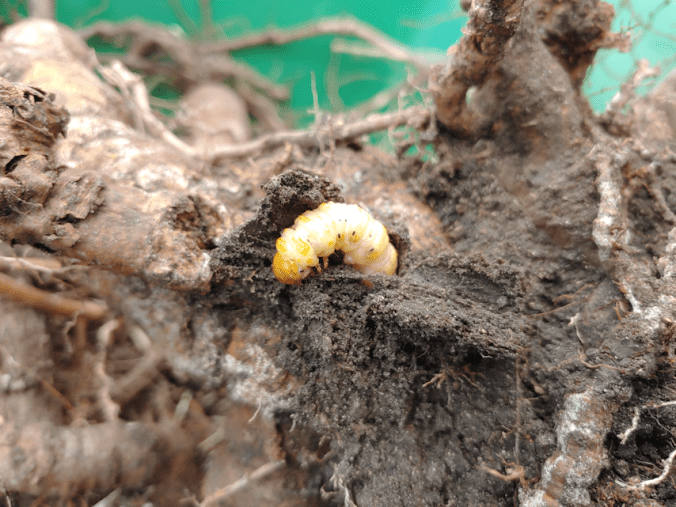
This thing had been exposed and wriggled at her!!

I don’t know what this grub is, but considering it was burrowing in the rose roots, I’d say it’s not a beneficial creature to have in the garden. :-/

This is where we stopped for a longer break. Sustenance was needed!

There are enough larger rocks to line the wall. My daughter used some to make a little wall around the power cables that run under the old kitchen. We also found a cable running along the wall to the corner, which is going to be carefully covered with rocks.

There are two more of those blocks in the wagon. They will be spaced out from one end to the other, and the gaps filled with soil and rocks.

As for the poppies, they will now be planted on the other side of the path!

Meanwhile, as I’ve been working on this post, the girls have gone back outside and are planting the Strawberry Spinach. :-)

The Re-Farmer

Our 2021 garden: got them done, thanks to a new “toy”

I was going to have to head into town this afternoon, so I made sure to get out and continue working on the garden beds as early as I could.

I didn’t think to take a picture until after I’d hauled loads of soil onto one of the beds. Before I started on the soil, I made sure to soak down all the straw again.

Note the pile of soil in the background for later. ;-)

After leveling the soil and wetting it down, I decided to go through the piles of wood from when we had the power lines and roof cleared and lay the thinner pieces I could find around the bed. We weren’t going to do that originally, but we paid for that soil; I didn’t want to end up walking on it, and it was starting to run down the sides with the watering.

Filling this bed took at least a dozen wheelbarrow loads of soil, and it took me all morning. Which is when I threw in the towel. There was no way we could keep this up. We would just have to bite the bullet, go through the budget, and see what we could afford for a new wheelbarrow. I checked online and a local hardware store had two options in our budget in stock. So one of my daughters and I headed into town and made our first stop at the hardware store.

When I came in, I went straight to a clerk. When I told them I’d looked online and found something it said they had in stock, the clerks just started shaking their heads, saying that didn’t mean they actually did! LOL I had the link on my phone and read off about the one I hoped to get. Again, I just got head shaking! They had no wheelbarrows at all. Then they suggested I go to the place were I got my baby chainsaw. The two businesses are linked. The hardware store’s building is just too small to have much inventory, so for a lot of the bigger things, it’s all at this other place.

So we went there, and they had only 3 wheelbarrows in stock, in 2 sizes! I got the bigger one, at 5 cubic feet. It was smaller than the one I hoped to get, but it was still bigger than what we had, and 2/3rds the price of what I had in mind, so I wasn’t going to complain!

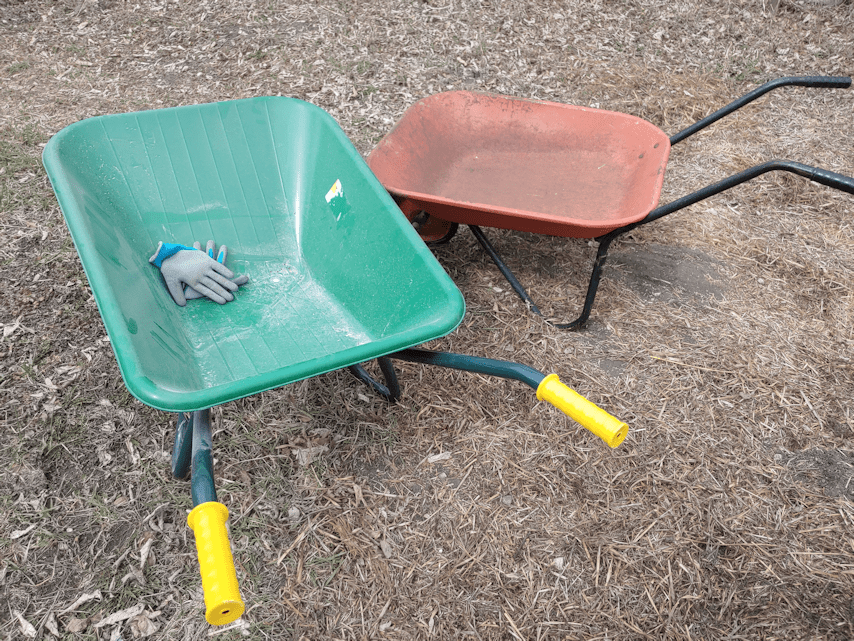
Here’s our new toy, next to the little wheelbarrow we’ve been using the most.

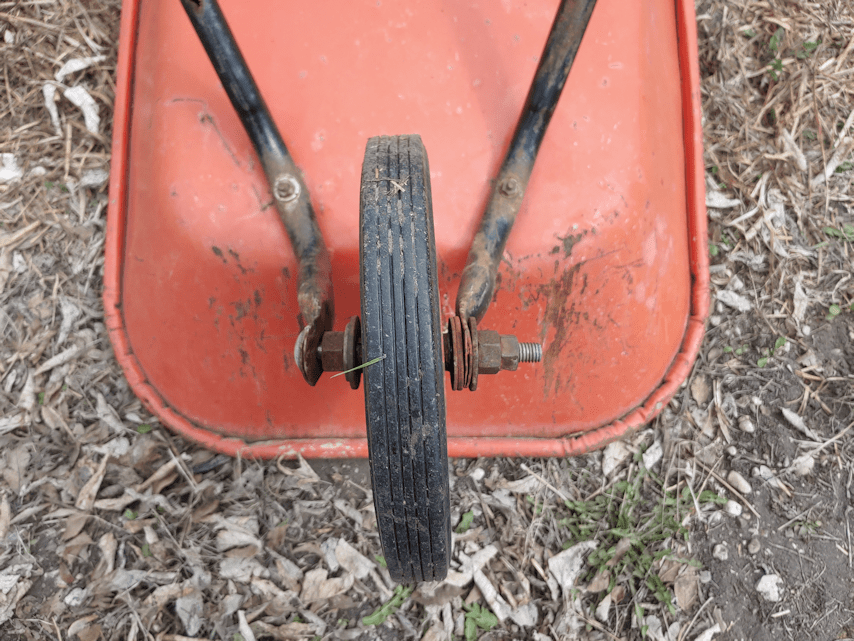
When we moved here, we found two wheelbarrows kicking around. This is the problem with the little red one we’ve been using the most.

It looks like someone jerry rigged a wheel that’s the wrong size. The axle is bent. It continually loosens, but if it’s tightened too much, it doesn’t turn as well because of the bent axle. Basically, it makes hauling the soil much, much more strenuous than it should be!

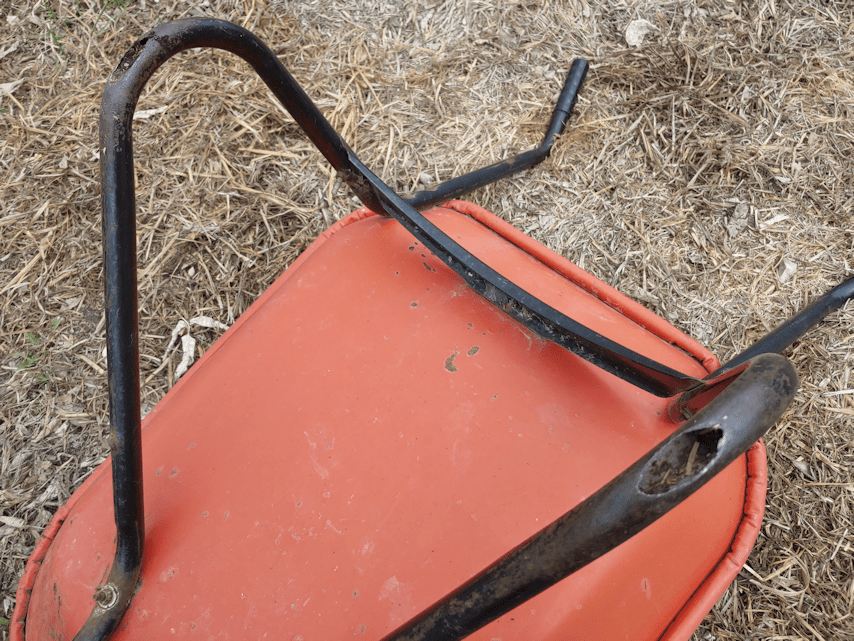
It’s been used so much, the bottoms of the legs are worn away!

It’s still sound, overall, so I’m thinking we could probably replace the wheel assembly and get more use out of it.

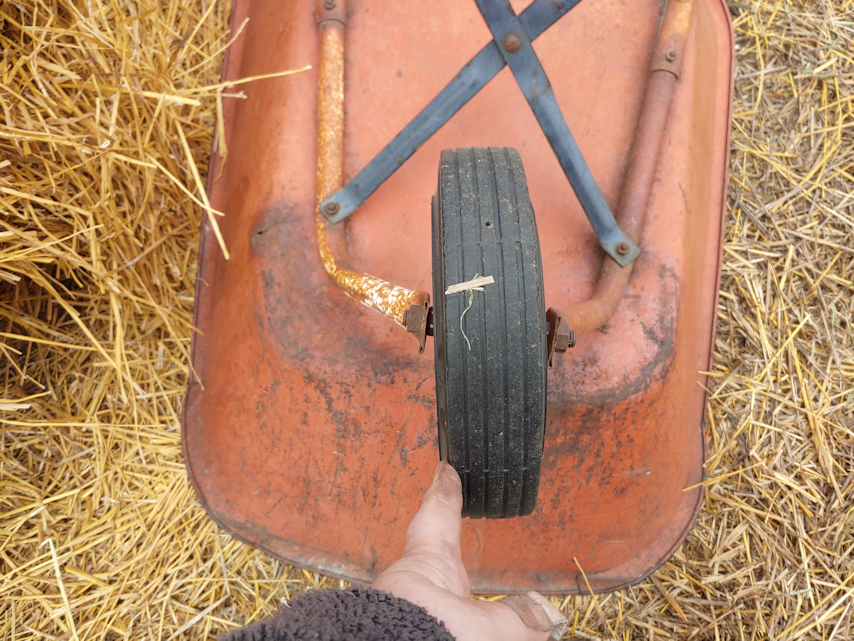
The other, larger wheelbarrow is not worth fixing.

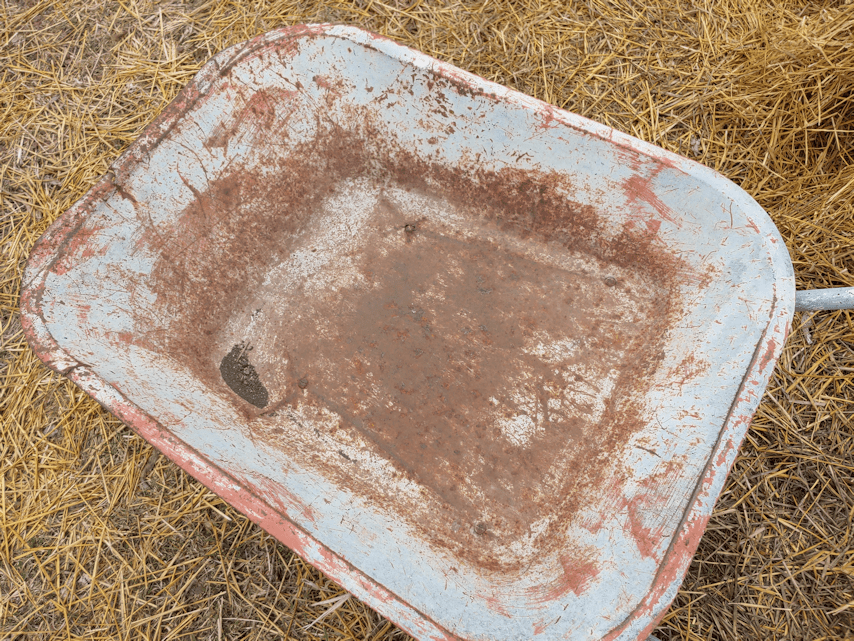
The barrow has holes in the bottom, and the end is bent up. The metal is very thin, too. Though larger, it can’t handle as much soil as the little one.

You can see one of the holes in this picture, too! :-D I haven’t been able to tighten this wheel, as it’s too rusted. I have a spray I can use to loosen it up, but it’s really not worthy the time and effort. Structurally, the frame on this one is a lot weaker, too. It’s fine if we want to use it to haul straw or something, but using it to haul soil was really pushing it’s capabilities!

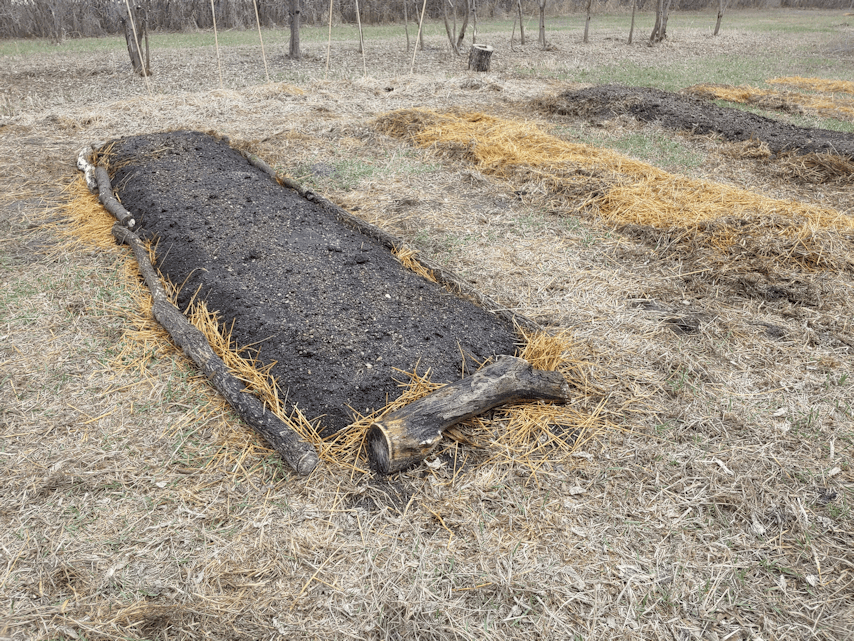
In starting the next bed, I put logs around the sides before I started hauling soil. It made it more awkward to dump the soil, but it worked out better. Here is how it looked when done, but before being wet down.

I was having a hard time finding shorter logs for the ends, and ended up using the comically large piece of maple. :-D

Finishing this bed went SO much faster than the one next to it! What a difference it made to have a wheelbarrow with a good wheel on it! :-D Though I didn’t fill it completely with each load, it still took fewer trips to fill the bed.

That done, we put logs around the last two beds that needed soil. By then, we were rifling through 3 different piles of logs, trying to find suitable pieces. Most were cut to about the same length, but we were running out of the thinner ones. Finding short ones for the ends took a bit of creativity. We do actually have a whole stack of shorter ones, but they are all way too big around.

Once we managed to find enough logs to frame the beds, we started adding the soil.

And they’re done!!! Six beds, ready for planting!

We’ll probably add logs around the first two, at some point.

Notice the pile of soil in the background?

We haven’t used half the pile yet, but we’re pretty close! I’m rather please with how much is left!

Now that these beds are done, there are no others that need to have such a deep layer of soil added over such a wide area. I did measure the beds, and they are roughly 3 – 3 1/2 ft wide by about 15 ft long. (About 1m x 4.5m) Plus the width of the logs, which is variable. When we build our high raised beds, Hugelkultur style, those logs will be on the bottom of the beds. :-) With the dimensions we have now, the permanent beds will be pretty much exactly where the current beds are.

The weather forecasts have been changing pretty much every day, with the predicted warm days being pushed further and further back. We should still be able to plant something in these beds right away, though.

Our onion starts are still in the process of hardening off.

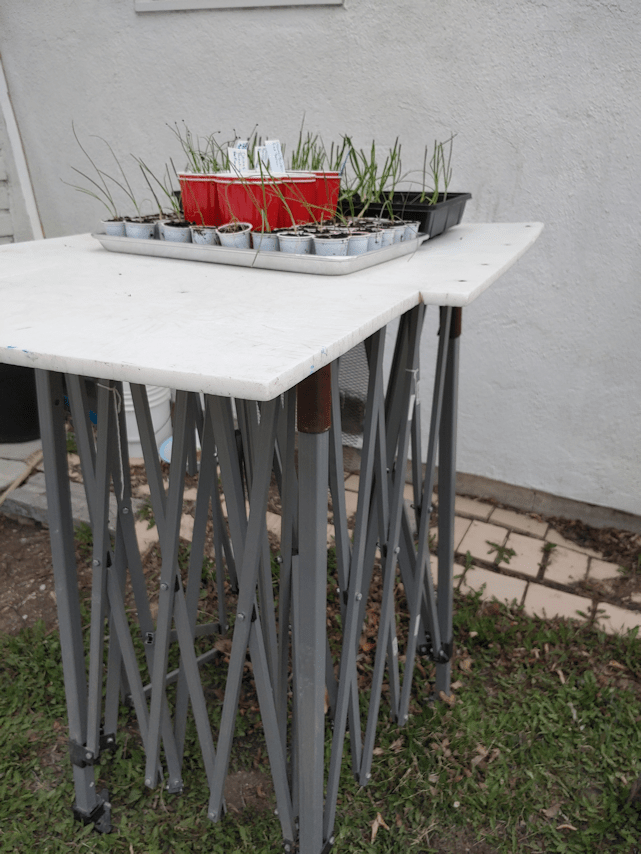
I found a way to keep them away from the cats. We still have the broken frame of my daughter’s market tent (if we could replace the piece that broke, I would be very happy, as it was a very excellent tent), so I used that to hold the puck board cut to cover the old basement window over the winter. The outside cats have shown no interest in the set up.

Those are the last of the onions we grew from seed; I’m hoping we’ll still have some salvageable red bunching onions. While in town today, I noticed onion sets and checked them out, and was very happy to find sets for shallots! It’s only a dozen per pack (I got 2 packs), but that’s okay.

Along with the transplants, we now have sets for the shallots and yellow onions, with sets for red onions to arrive in the mail this week. Once they’re in, the transplants should be hardened off enough, and we can plant all our onions.

Now that these beds are done, the only area we need to work on for things that need to be planted right away is the old kitchen garden. We’ll be using the soil from the other pile. While the one in the old garden area is closer, it would require going over the roughest part of the crappy plow job, and through the maple grove. The distance to the other pile is all nice and flat, with only a gate to go through. I’ll take a longer, smooth trip over a shorter, bumpy one, any day!

But that is a job for tomorrow!

The Re-Farmer

Our 2021 garden: seed planning, a furry mushroom, and oops!

After hauling to many loads of soil over the rough, rough ground, none of us were up to doing it again today.

So our Sunday remained a day of rest!

We did still go out to soak down the beds we are working on, though, along with other watering and checking of things. There is fresh new growth on the grapes, which was good to see. I wasn’t sure they’d survived February’s deep freeze. We’ve got rhubarb coming up, and the one haskap is leafing out nicely. The other is still struggling. :-( The garlic is looking awesome. Unfortunately, the birds are digging into the soil, as they have been digging into all the leaves on the ground all over the place. They’re not after the garlic, but they’re scatting soil all over, and some are getting partially uncovered in the process. We’re going to have to come up with a way to cover those!

While checking out the snow crocuses and grape hyacinths (so many are coming up now!), we found a strange, furry, orange mushroom in a tree.

Rolando Moon found a perfect spot to settle down and groom herself! :-)

The girls and I talked about where we are going to plant things; the space we have to work with is turning out very different than we expected while working with the satellite image, and we’re going to have open spaces where we had expected to have garden beds.

Which is okay. Nothing is written in stone, and most of the beds are going to be temporary.

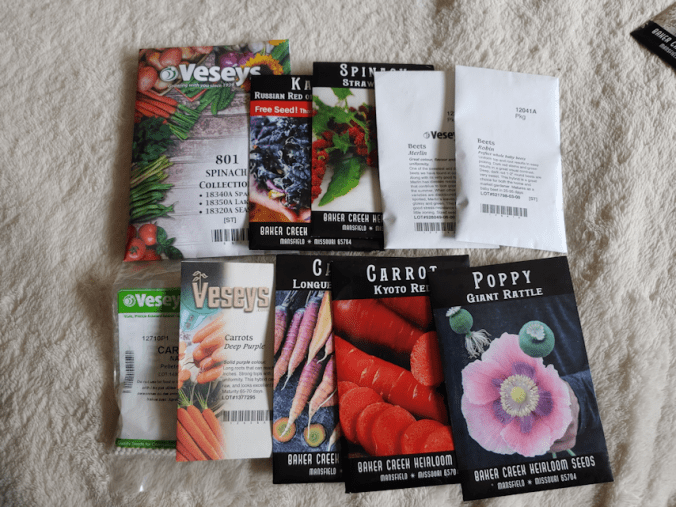
We then went through our seed packets, sorting out the ones that need to be planted before the last frost date.

There are a lot of things that should have been planted “as soon as the ground can be worked”, but we aren’t ready for all of them.

These are the ones that should be in the ground right now.

Two of the three beds for the spinach collection are not ready yet. The kale will be interplanted with onions, and one of those beds is ready. The bed for the strawberry spinach is ready. The beets will be going into the new bed beside the garlic, and that one’s not quite ready. It’s a small bed, so we will probably be planting one type there, and another somewhere else. The poppies will be going in the old kitchen garden, which also is not ready yet.

We still aren’t sure where the carrots will go. They need deep soft soil, so I think they will be going where the potato beds were last year. We are making those longer, so only the part that was used last year will have the soft soil needed. Some might end up in the old kitchen garden, too.

Then there is the next batch.

We can start planting lettuces now, with successive sowing every couple of weeks until about the middle of June, before it gets too hot. These will go in the old kitchen garden, with some of them going into the retaining wall blocks, which are ready now, and others further into the garden, once we’ve worked out where the paths will go and add more soil.

These can be planted in the middle of May. It’s a bit surprising for a corn to be planted before first frost. Once we’re done with the beds that need to be direct sown right away, I’ll be marking off the block the corn will be planted in. At the same time these are being direct sown, I will be starting the Montana Morado corn indoors, along with half of the sunflowers.

The kohlrabi will be interplanted with onions. Onions are supposed to repel those beetles we had issue with last year.

While going through the seed packets, we discovered an oops.

The pink celery should have been started 8-12 weeks before last frost!!

So we quickly planted them now.

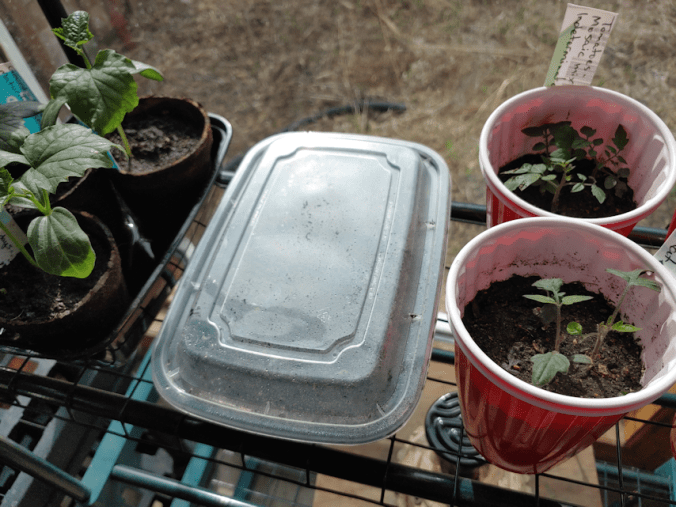
The seeds are absolutely minuscule! They are surface sown, so they just needed to be scattered on the soil and pressed down, so we used a take-out container as a mini-greenhouse. The sun room is warmer than the house, and there’s no room in the aquarium greenhouses, so we set it up with the tomatoes and luffa. We still use the ceramic heater bulb at night, but according to the thermometer in the sun room, it reached almost 30C/86F in there today!

They’re getting less than half the time to start than they should, but we’ll see how it goes. Who knows? We might have a long summer this year.

Everything else that needs to be direct sown has to wait until after our lost frost date. Especially the Peaches ‘n Cream corn collection. The radishes (two varieties) will be interplanted with some of them, to help break up the soil. They mature very quickly, so being overshadowed by the corn will not be an issue. The sunflowers will be a mix of transplants and direct sowing, to see which works better. And finally, there are the three varieties of bush beans.

If all goes well, we’ll be transplanting all the squash, gourds, cucamelons and tomatoes at about the same time. The potatoes and asparagus should be in and ready to plant by then, too.

The first few weeks of June are going to be very busy, and we’ve got a lot of manual labour to get done ahead of that!

The Re-Farmer

Our 2021 garden: peas are in, and other progress

Our first direct sown seeds are in!

This morning, I got the peas planted in their new beds.

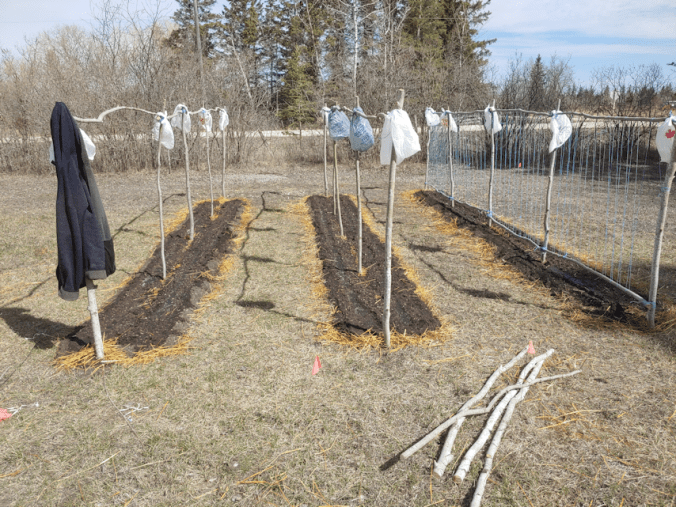
I also added our first line of defense against birds and deer: flappy, noisy grocery bags.

As soon as we can, those will be replaced with whirligigs, wind chimes, flags, flashy things – whatever we can find that will startle critters, but not act as potential sails and pull the trellises down!

While covering up the seeds, I made a point of pressing down little trenches on either side of the seeds, where water can collect and soak in, rather than flow off the soil. I made slightly deeper trenches on the insides. The more water gets through the soil to the straw and old soil below, the better for the ground to soften up and encourage worm activity. That was one thing I noticed when digging the post holes. I think I saw only one worm, and I’m not even sure if I’m remembered that correctly or not. :-/

Everything else being planted in this area has to wait until after the last frost date, so when I was back from helping my mother with her grocery shopping (I showed her pictures of what we’ve done so far. She had nothing positive to say, of course. ;-) ), then making a dump run, the girls and I moved on to where we will be planting things that can go in before our last frost date.

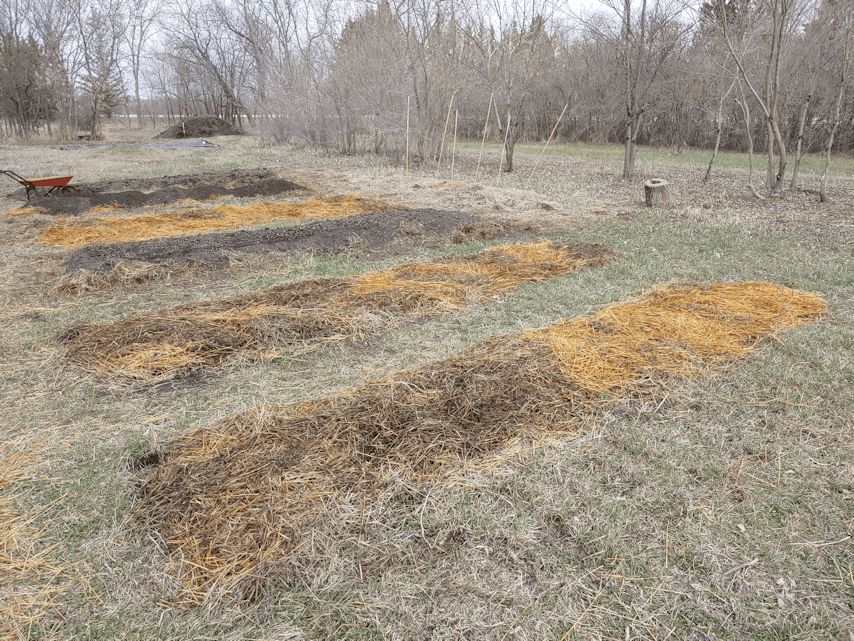
The two beds now covered in soil had looked like the long bed with the bamboo poles, before. Aside from raking around the edges to clean them up, adding the raked up material onto the beds, all we did was cover them with several inches of new soil.

The straw layered beds were rakes around the edges and evened out to more or less match the first two in size, then got thoroughly soaked. Then the soil beds got soaked, too.

Tomorrow, they will all get another soak, and then the straw will be covered with soil. After that, the two short beds that are off frame will be lengthened to match these ones in size, then they’ll be soaked, topped with soil and soaked again. Meanwhile, our onion seedlings are being hardened off for transplanting. Until they’re ready, we will continue to soak down the beds to get them thoroughly, deeply moist. This area had a summer under mulch and black plastic before we planted in it last year, so the soil is decently soft. We mostly want to encourage the break down of the straw.

Once these beds are ready, plus a couple in other areas we will be planting cold-hardy seeds, we will be able to move back to where the peas are and continue marking off and preparing beds for what will be planted there in June, after the last frost date.

I am so glad we were able to get that soil!! It’s going to make such a difference.

The Re-Farmer

Our 2021 garden: Crespo squash, and pea beds ready!

Oh, I’m going to be in for a world of hurt, tomorrow.

It’s going to be worth every bit of it! :-D

But first, I have to show off the little Crespo squash baby!

I got this photo last night.

This is how it looked, less than 24 hours later.

Then I checked it this morning, the leaves hadn’t broken free of the soil yet. Every time I look at it, it’s noticeably bigger! It’s still the only one of the Crespo squash that has sprouted. Hopefully more will emerge, soon. :-)

Today, the priority was to get the pea beds ready, and that took me pretty much all day! Thankfully, the girls were able to come out and help quite a bit, which made some jobs faster.

The first thing that needed to be done was to dig post holes and set up the uprights for the new pea trellises.

That… got interesting. The posts could not be buried at all the same depth, that’s for sure.

My apologies for the out of focus photo, but you can still see the bottom of this post hole. Yeah, that’s a rock. A rock big enough I couldn’t dig around it to pull it out!

Others were more like this one.

What I ended up having to do was to start with a spade to remove the sod on top. Then I used a trowel to pull out the bigger rocks or find and remove pieces of roots. Then I would use the post hold digger until I hit more rocks it couldn’t get through. If I needed to go deeper, I’d use the trowel again to get the rocks out, then use the post hole digger again.

I set the posts at each end first, between the flags marking the width, then strung a cord between them to make sure the other posts were in a straight line. Every 5 feet was marked with the post that would be going there.

Then the holes got dug, and the line put back across again, and I’d double check the distance for each pole before setting it.

With the girls helping, tying the cross pieces in place was much, much easier and faster!

I tried the cordless drill to see if I could drill pilot holes and place at least one screw at each pole of the first trellis we did. The batteries couldn’t hold enough charge to finish drilling a hole. I had a hard time just to reverse the drill back out again! So that jobs is going to have to wait.

We put all our hoses together, and it wasn’t enough to reach all the way, so we moved the rain barrel to a new spot. For the first bed, we had shredded paper that we soaked on the mesh top of the rain barrel, then placed along the row before topping it with straw. We were able to wet the straw down, before taking a break for lunch, and my older daughter went back to working on commissions.

Then my younger daughter and I continued preparing the beds. These are now ready for planting! The new trellises are not done yet, though. The first trellis will have a single row of peas in the middle, with the seeds planted alternately on either side of the bottom cross pieces.. The other two will have double rows, planted about 2 ft apart. After the peas are planted, the trellises will get A frame supports at each upright, with cross pieces at the bottom, and then they will be strung similar to the first one. Once the top cross pieces were in place, I got the measurement I needed. To finish this, I’m going to need 20 poles at about 5 1/2 ft long, plus another 12 poles at 5 ft long for the bottom cross pieces. My husband went ahead and ordered some more cord that I can use to string supports for the peas, sweetheart that he is. :-)

We made quite the dent in the pile of soil! :-)

Before we finished for the day, the girls started laying down straw for a pair of re-oriented beds, then hosing them down.

The three, small beds in the middle that ran East/West are being turned into two longer beds oriented North/South. For the peas, we could get away with laying down the soil in narrow rows where the peas will be planted, rather than the entire space. These beds are going to be intensely planted with onions, spinach, purple kohlrabi and purple kale, at the very least. There are two more smaller, former potato beds that are going to be lengthened to match these ones, and they will be intensely planted, too, similar to Square Foot gardening. So these beds are going to need a whole lot of soil added all over. Thankfully, these beds are much closer to the pile of soil!

By this time of the day, the winds had picked up significantly, so wetting the straw was needed as much to keep it from blowing away as for preparing it to have the soil added on top. I’m going to see if I’ve got anything else I can layer on there before adding the soil. I tried digging into the old compost pile yesterday, and the first thing I hit was the remains of some Styrofoam packaging, of the sort you might buy meat in. Plus a hard plastic lily, which was actually kind of pretty. I know my mother would never had thrown things like that into the compost pile, which means that someone else was using it for garbage, after she’d moved to her apartment. *sigh*

I might not be able to work on this area tomorrow, as I’ll be helping my mother with her grocery shopping in the afternoon, but I hope to at least get the peas planted in the morning. We’re supposed to get very warm tomorrow afternoon, so it would be good to get them in early.

I’m pretty excited about finally getting our first seeds into the ground! :-)

The Re-Farmer

Our 2021 garden: quick finish on the unplanned bed

A while back, the girls and I decided to create a bed in an unplanned area. Today, things got pleasant enough outside that I quickly finished part of it.

This is the side that will have the Strawberry Spinach planted. These can be successively sown every two weeks, starting before the last frost date, so I wanted to get it finished.

It’s warm enough to have the garden hoses out, though we still have to be careful to make sure they don’t have water in them overnight. This meant I was able to give the cardboard layer a solid soak, first. Before we lay the cardboard down, the dead grass and leaves had been raked away, and that got put back on top of the cardboard, followed by another soak, a layer of straw, another soak, then a layer of garden soil, followed by a final soak. Over the next while, weather willing, I want to continue to soak the new garden beds as often as I can before planting, to get them damp through the layers (at least those we can reach with hoses!). That will help the layers break down faster, plus they will act as a sort of sponge, so the beds will need less watering later.
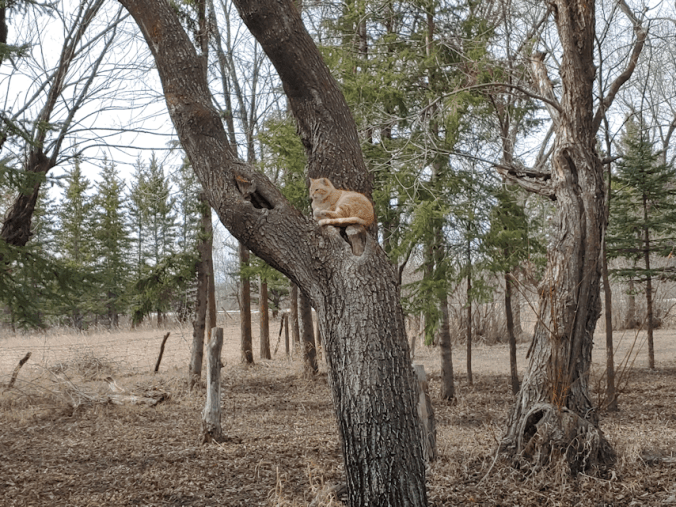
At least, that’s the theory!

The rest of this area still has just the cardboard, which also got a thorough soaking, to kill off the grass and soften the soil a bit until we get the asparagus crowns that will be going there.

At least I got one area done today! The winds had picked up quite a bit, but this corner seems to be more sheltered. That should be good for the plants!

The Re-Farmer