Since we ordered SO many things for this year, and expanded how much space we were gardening in, I decided to go over groups of things in separate posts, in no particular order and spread over the next few days.
Let’s take a look at how our garlic, onions and shallots went.
Let’s start with the garlic, since hard neck garlic is a fall planted crop, and our garlic for next year is already in the ground.
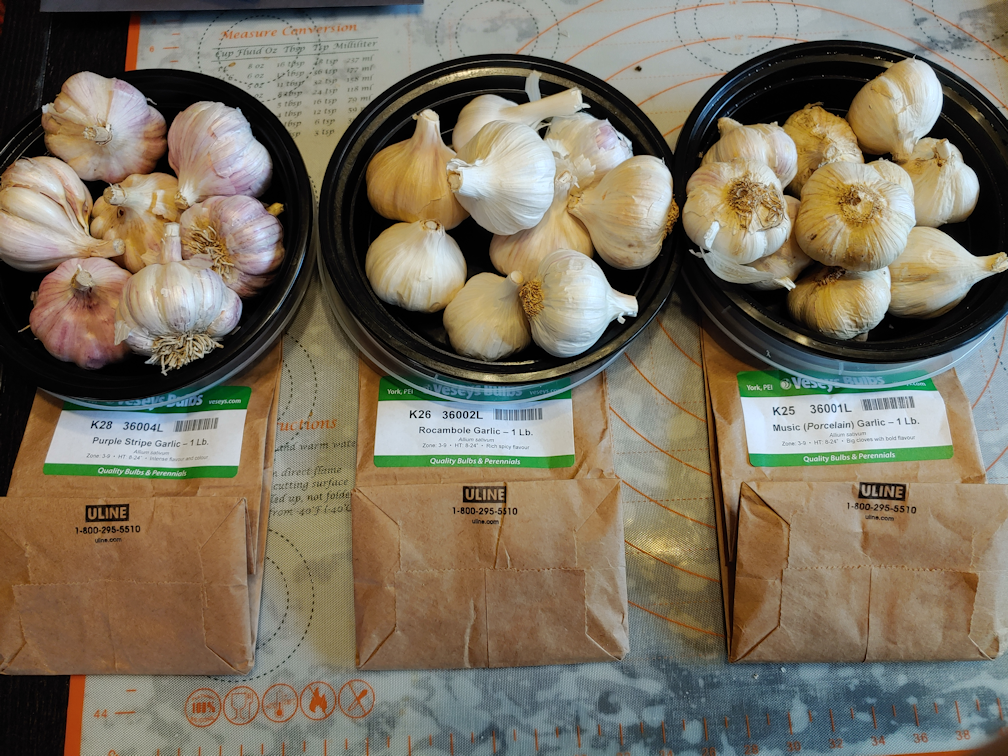
We are growing the same three varieties as we did last year, each in one pound bags. We had considered doubling how many we are growing, but decided against it at the last minute. If we grew the number of onions and garlic we use throughout the year, we would probably fill most of the beds and not have room for anything else!
Overall, the garlic did rather well. They were all smaller than they should have been, but that’s true of just about everything we grew, mostly due to weather conditions. We much prefer the flavour of these hard neck varieties over the soft neck garlic that is available in the grocery stores. We especially enjoyed having garlic scapes to harvest, making this a dual crop. These are a big win, and I can see us growing this year after year. Hopefully, we will have better growing conditions for next year’s garden, and will have large bulbs that are worth saving to plant in the fall. Otherwise, we are more than happy to buy these from Veseys.
The onions and shallots were a much bigger challange.
The varieties we got as seeds were:
Red Baron (a bunching onion) Norstar Onion (a yellow bunching onion noted as good for storage) Conservor Organic Shallot
Plus we ordered Red Carmen Onion as sets, which did not get shipped until our zone was ready for spring planting. All of these were from Veseys.
The seed onions and shallots were started indoors, using our aquariums as mini greenhouses to protect them from the cats. The smaller tank had problems right away, as the cats could still reach down to the growing trays and very determinedly destroyed them. Also, there was very little air circulation with the lid, and the soil started to mold. We eventually found a window screen we could use as a lid, but it was too late for the shallots.
For the Red Baron onions, we use the flats from egg trays to start them in, which turned out to be a bad choice. The carboard just sucked the moisture out of the growing medium and we ended up losing the seedlings.
The Norstar, in peat pellets and repurposed K-cups, did much better and we were able to transplant them. We used extra seeds to try growing more, using red Solo cups to start them in. The Red Baron onions sprouted, but that’s about it. We transplanted them anyhow, but they didn’t take, though I did find a single one when I redid the tomato bed, so I planted it right back again.
I ended up buying onion and shallot sets, later in the spring. Between those, the surviving Norstar seedlings and the Red Carmen sets, we found ourselves with a decent onion harvest that we are still enjoying now, though we quickly ran out of shallots. We also harvested green onion tops, freezing some and dehydrating others.
Of course, like everything else affected by the drought and heat, the onions and shallots did not reach their full potential in size, but they did quite well and are very delicious.
Final Analysis
Onions and Shallots: For all the struggles we had, ultimately, we did well with onions. While sets are easier, I’ve decided to go with seeds for next year’s garden. There is more choice in variety, and you can get a lot more seeds in a packet than sets in a bag. Especially with the shallots.
I have since bought more onion seeds. We will be trying the Conservor Shallots and Red Baron bunching onions again. For a yellow bulb onion, this time we will be trying a type called Oneida, again because it was noted as good for storage. We will also be growing a red onion, but I will be trying a different variety, with a very different shape, from another company.
The problem will be with starting them indoors. They need to be started very early, in our zone, with people in my gardening groups starting them as early as January! The big aquarium is currently holding house plants to protect them from the cats that keep wanting to dig in the soil, so we’re going to have to figure something out.
Over time, we plan to have a plolytunnel and maybe even a greenhouse. That will solve some of our problems, when it comes to starting seeds and protecting them from the cats, but it will be some time before we reach that point. Until then, we will just have to made do with what we have, and find the space we need to start all those seeds! When it comes to long term storage of bulb onions and shallots, we want to be growing a lot more that we did this year. Something we will build up to, as we expand our garden.
Hard neck Garlic: These are just a win, all around. It was the first time we got to try scapes, and we all love them. They are also really easy and low maintenance. Being able to plant outdoors in the fall is a major advantage. The bulbs certainly could have been bigger, but there was no loss when it came to flavour. Over time, we will be increasing how much garlic we plant, too.
Since we ordered SO many things for this year, and expanded how much space we were gardening in, I decided to go over groups of things in separate posts, in no particular order and spread over the next few days.
To start, let’s take a look at our peas and beans.
I had wanted to order a three bush bean collection, but they were out of stock, so I ordered different coloured beans to make my own collection. These were the Lewis bean (green), Golden Rod bean (yellow) and the Royal Burgundy bean, all from Veseys.
Also from Veseys, I ordered the Dalvay pea (a green pea), while ordering the King Tut Purple Pea (purple pods, green peas), from Baker Creek.
These were planted in new beds that were little more than layers of organic material and new garden soil, directly on the ground. Which means that, right from the beginning, we knew it would be rough growing for them.
Then the drought hit.
Then the deer and groundhogs showed up.
The grasshoppers seemed to leave them alone, though.
In spite of all that, the bush beans did remarkably well. The yellow bean plants were the most stunted in growth, but they were the first producers, and even produced a second crop later in the season. The green beans did quite well, both the plants and the yield, but it was the purple beans that were the most amazing. They handled the drought conditions the best, with the plants growing the strongest and densest of all, even with a few deer nibbles along the way, while producing a steady amount of beans right up until they finally got killed by frost.
Between all three varieties, we not only had enough for fresh eating, but were even able to freeze a few bags of them, too. I had hoped to have enough to do some canning, and if we had had an average year for rainfall and temperatures, I have no doubt these hardy and prolific beans would have just exploded in growth and yield, even with the relatively poor soil conditions, and we would have had plenty to make it worth breaking out the canning equipment.
We will not, however, be growing these again next year, though I would certainly grow them again in the future. For 2022, we will be growing pole beans, and possibly drying beans as well.
I would definitely recommend these varieties of bush beans from Veseys, though.
Then there were the peas.
They did not do well this year at all, but we did have some surprises.
The King Tut peas from Baker Creek were just a small package with barely enough seeds to fill one trellised row. The Dalvay peas from Veseys, on the other hand, were packaged by weight, and there was a lot of them! We planted enough to fill two double rows with trellises, and had lots left over.
The peas all started out well enough. The Dalvay peas had some gaps in germination that I later planted with more peas, but there were no extra seeds to do the same with the King Tut peas.
Then things turned for the worse.
With all our watering, I don’t know if the drought was the main problem. Peas don’t like to be over watered, and they don’t like heat. I don’t think I watered them too much, and it was likely the excessive heat that did them in.
Then the Dalvay peas basically disappeared, withered away. The King Tut peas got a bit bigger before they dried up.
When we saw signs of critter damage in the gardens, I set up a trail cam to confirm what critters were doing the damage. I did catch deer, but it was a groundhog I saw among the peas, so it wasn’t just the heat that was killing off our green peas! They didn’t seem to go for the purple peas, though.
In spite of looking so dead, the purple peas kept trying to produce, and I even had a few pods to taste while doing my morning rounds, and a few that I let dry on the vine to collect for seeds. I think I have maybe 6 of 7 seeds. Given the growing conditions, I doubt they tasted the way they were supposed, so I’ll just say they tasted just fine and leave it at that.
I will not be buying the King Tut peas again for next year, but I do want to try them again, and hopefully the few seeds I saved will germinated. If they are still available, I wouldn’t mind getting fresh seeds again in a year or two and trying again.
As for the Dalvay peas, I had so many left over that, when temperatures finally cooled down, I interplanted them with all the varieties of corn, for their nitrogen fixing qualities. They did a lot better than the first planting, and I even got to pick a few pods before they were killed off by the first, very late, frost.
I think these would be worth growing again, though I plan to try other varieties. It was just a terrible year for peas, so there will be no way to do a proper comparison.
Final analysis:
Bush beans: did surprisingly well under terrible growing conditions. Though we will be trying pole beans in next year’s garden, all three bush bean varieties are well worth growing again. Especially the Royal Burgundy. As we develop more garden space in the future, we will likely be growing both pole and bush bean varieties.
Peas: did not do well at all. The drought and heat (and groundhog!) were just too much for them. I’d be willing to try both varieties again in the future. For our upcoming growing year, we will be buying other varieties to try.
With snow on the ground and temperatures dropping, this is the perfect time to look at how our gardens did this past year, compare it to the year before where we can, re-examine our goals, make some adjustments, and use that information to plan on what we will do next year.
Because we went from a pretty small garden the year before, to a much larger – and spread out – garden this year, I will go through things in more detail in later posts. For now, I just want to do an overview.
When we first moved out here, we worked out a multi-year plan. The first summer would focus on clearing and cleaning up the inner yard. The second year, we’d continue working on cleaning up the spruce grove and start working on the outer yard while maintaining what we cleaned up in the inner yard. The outer yard, we figured would take another 2 or 3 years.
With this plan, we would have been ready to start gardening around year five. Which would have made it next summer. Instead, we started our first small (ish) gardens in 2020. We had a few beds in the old garden area, and planted in the newly uncovered, soft soil found under the old wood pile. We were not very ready for gardening at all, but really – if we only ever did things when we are “ready” to do them, nothing would ever get done! ;-)
This past year, we kept our main goals, and added some new ones. The main goals have stayed the same. Ultimately, we want to be as self-sufficient as possible. That means growing as much of our own food as we can, in quantities sufficient to store or preserve enough food to last us through to the next garden season. So, not just through the winter, but until we can start harvesting fresh food from our garden again. (Animals will be part of the picture, too, but for now I will focus on plants.)
While we certainly didn’t meet that goal this year (nor did we expect to, yet), we did make progress. And I must say, I love being in a position to start working on a meal, realizing we’re out of onions or garlic in the kitchen, and simply popping into the root cellar to grab a bunch.
We didn’t plant anywhere near enough onions for our needs, but that’s part of figuring things out!
When it comes to planting things, whether it is our garden or trees or bushes, we try to meet multiple goals. In our long term goals, we want to have fruit and nut trees. Mid term includes certain types of berry bushes. Growing vegetables are part of our short term goals, simply because they are mostly annuals.
After being here a few years, we have identified gaps in the shelter belt we need to fill, as well as the need to increase privacy screening and dust protection from the surprisingly busy main gravel road that runs past one side of the property. With the aim of meeting multiple goals, any trees or bushes we plant will be chosen not only to meet those needs, but also provide food – and if they can provide enough for ourselves and for birds and wildlife, that’s just bonus. Soil testing has also helped us focus on what we can reasonably expect to grow here at all.
In trying to meet these multiple goals, we did things that would normally be gardening no-nos, like planting as far from the house as we could, and still be in the yard, breaking new ground that will later have things planted permanently. Choosing what to grow was based on things like short growing seasons, high yields and long term storage capabilities.
One thing we have is the luxury of space. That means that we have room to experiment and try new things to see how they do in our zone and growing conditions.
Some things, of course, end up being completely out of our control. Drought conditions being the main issue we had to deal with, this past summer. A plague of grasshoppers certainly didn’t help, either. Then there was the critter damage. That combination of things, plus the far-flung garden beds, made things considerably more difficult than it should have been.
Looking at things from a very broad perspective, though, we had more success than failure. Under the conditions we had, that’s pretty amazing!
I will talk about more specific things later but, in general, here is how we hope to progress next year, which will help us decide where our monthly “seed” budget will go.
The main thing we really need to focus on is trees. These can take years before they will start producing fruits or nuts, so we need to get those going as soon as we can. We’ve identified areas where we can plant things that will need more protection from the elements, and we’re looking at varieties that can handle our climate zone, as well as our nutrient depleted soil. Some of the varieties of nut trees we want to get cannot be planted in the inner yard, though, so we will still have to hold off on those until we can prepare areas in the outer yard. The renter is planning to rebuild the fence around the outer yard, and if he is able to do that next year, that means his cows won’t be able to get through anymore. We won’t have to worry about cows damaging seedlings; just deer! We will also be able to start taking out some of the old fencing around the inner yard, which will make it easier to tend to anything we plant in the outer yard.
We do not have the funds to get everything at once, so we have to focus on getting what will provide the most benefit in the shortest time frame. We will be able to get a few of the slower growing/producing trees, little by little, but will need to focus on faster growing/producing trees and bushes first, even though logically, it’s the trees that need the most time to mature that we should be getting first.
With that in mind, we will be ordering shelter belt berry bushes as soon as we can. Unfortunately, the varieties we had decided on are currently not available, but they might be available for ordering in December or January. Our first layer of “defense” will be to plant Bison Berry (if we can get them) along the East property line, to create a privacy screen. Sea Buckthorn is another one we are looking at, for another area, and we’re also looking at the Rugosa Rose. These will not only provide privacy screens, but will act as dust protection and deer barriers. The berry bushes are also nitrogen fixers. Once mature, they are supposed to be very prolific producers. What we don’t use ourselves will provide food for birds and other wildlife. The Rugosa Rose produces unusually large hips, and the flowers are also edible. (This will be on top of the wild roses we already have growing here.) These are more short to mid term items, as they should be able to start producing in just a few years. It will also take a few years for them to get big enough to form privacy and dust screens, and probably longer before they are dense enough to be a barrier to deer.
For long term, we are looking to order a bunch of Korean Pine Nut trees, if they are available. They require shade for their first few years, and we have the perfect spot to plant a row of them, though they will still need extra shade (and deer!) protection, at first. They are hardy to zone 2, and with 3 yr old saplings, it will still be at least 7 years before they start producing pine nuts. These will be the first nut trees we plan to get.
In the row of crab apple trees that we currently have, we will need to get rid of most of them, due to disease. I’m hoping we can save two of them that produce the best fruit. Crab apples are good for pollinating other apple varieties, so it’ll be important to keep at least a couple of healthy and strong trees.
What we are currently looking at are different cold-hardy apple varieties. I hope to get at least a couple varieties ordered this winter. We are looking for apples that are good for fresh eating, good for storage, and suitable for making cider, as well. Over time, we will be adding pears and plums as well, with the same requirements. These are more mid to long term goal plantings. They will need several years before they start producing, but nowhere near as long as the nut trees we are looking at. Once they do start producing, they are prolific, so we shouldn’t need a lot of trees to meet our needs.
Speaking of prolific, I found a source for a cold hardy variety of ever bearing, white mulberry that we plan to get. A single tree should be enough to provide for our needs, with plenty to spare for the birds as well. I even found a source for zone 3 paw paws! Given the rarity of those, I think we will put a priority of ordering them before they are sold out. Which means that is likely where our upcoming seed budget will be spent.
For short term, we need to start on our raspberries. This past year, the bushes my mother had planted did not produce at all, and the new ones we planted had to struggle with deer damage as well as the drought. We want to get several varieties of raspberries, in different colours and maturity rates. We all love raspberries, so the goal is to eventually have quite a lot of them.
We have found several bushes that appear to be black currants. There are two fairly large bushes, but they are completely shaded and barely productive. I plan to transplant those into sunny areas. I’m also looking to pick up some gooseberry and/or josta berry bushes as well, though probably not for 2022. We shall see.
The main focus with all of these is that they are perennial and, once established, should provide food for many years, so the sooner we can get them growing, the better.
For short term food growing, our original plans have changed a bit. Where the main garden area is, we will be building high raised beds to replace the current low beds, using logs from dead spruces in the spruce grove. Now that I have a chain saw that works, we should be able to clear the dead trees out much more quickly, and have logs cut to size ready and waiting to build high raised beds in the fall. Clearing out those dead trees will open up the spruce grove a lot. While we will be planting more spruces in the spruce grove (there are many little spruces we can transplant from elsewhere), we will also plant food producing trees that can use the extra protection the spruces provide.
The high raised beds we will be building in the main garden area will also serve multiple purposes. A primary one is accessibility, so we can continue to garden even as we get older and more broken. Filling them hugelkultur style should reduce how much water they need, even as high as they will be. This garden area has some shade issues, due to the tall trees my parents planted along the south side, and the beds will be high enough that they should even get more sun.
We will need a LOT more garden space to grow food in the quantities we need, however, and for that, we will be making garden beds in the outer yard, where they will get full sun, too. We won’t have enough dead spruces to use as materials for high raised beds there, as well as the main garden beds, but hopefully by the time we need to build them, we’ll have the funds to buy materials.
Looking at our long term plans, however, we are going to need to expand beyond growing vegetables for ourselves, too. We plan to get a hand mill. Among things I want to grow will be varieties of corn that can be ground into flour, and even different varieties of grains. I am hoping to at least get seeds this year, even if we can’t plant them right away.
As we start to include animals, I want to be able to grow as much of their food, as well as our own, as possible, which means forage crops. I’m even looking at plants that we can use to make our own sugar or syrup (yes, sugar maples are on our list, but there are other possibilities, too).
While some of these things may not be started this year, or even next year, we can still keep the plans in mind as we work on things this coming summer, to prepare. There is a rather massive amount of clean up needed in the outer yard, to have room for all this, as well as for the larger trees we intend to plant. Especially since some of those trees will need to be planted a minimum 30 feet apart, or cannot be planted near food crops because of the chemicals their roots release. Between that and the extra space needed between the raised beds, for accessibility purposes, things will be very spread out.
This past summer was a very difficult growing year. While I will go over specific things later, in general, I consider it a successful year. Remarkably successful, under the circumstances! Even some of our failures where still successes, since we had multiple purposes in mind. Some things we will do again, others will be dropped, if only temporarily, and new things will be tried. We learned a lot in the process, too, making everything a step forward to our ultimate goals.
I was happy to find a small package waiting for me at the post office, today. Our replacement seeds from Veseys had come in!
Ginger REALLY wanted to be in the picture! :-D
You can read about our first seed order for 2022, and why we chose what we did, in this post.
This image from the Veseys website is what the mature Winter Sweet squash is supposed to look like. I am really happy with Veseys, and their excellent customer service when we found we got a patty pan squash by mistake.
We will be placing another order at the end of the month or beginning of December. For the next few months, seed orders are part of our budget. With what I’m seeing at various sites right now, I think I will be making a point of ordering seed potatoes from the one place I’ve found where they actually have some in stock again. Everywhere else I’ve looked, potatoes are still marked as sold out. There are a couple of Canadian seed sites and nurseries we’ve never ordered from before that I want to try this year. We really need to be ordering fruit and nut trees and berry bushes this year, as those can take years before they start producing.
The girls and I will have to set ourselves down, go over our plans, see if anything needs to be changed, and make some decisions. :-)
Our first order of seeds from Veseys arrived in the mail today!
You can read about why I ordered what I did in this post.
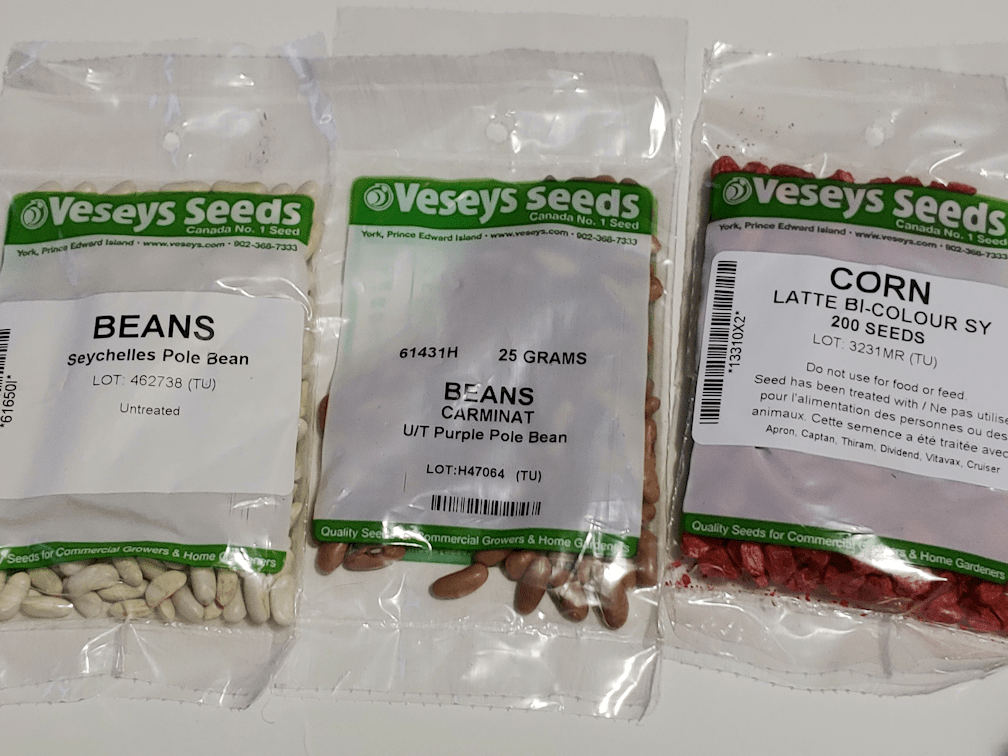
We got our two types of pole beans and the corn in baggies. There are quite a lot of seeds in each, which is pretty awesome. After this past summer’s gardening, I’ve decided there is no such thing as planting “too many” of anything! The pole beans will be planted at the squash tunnel, and will probably take up the whole thing.
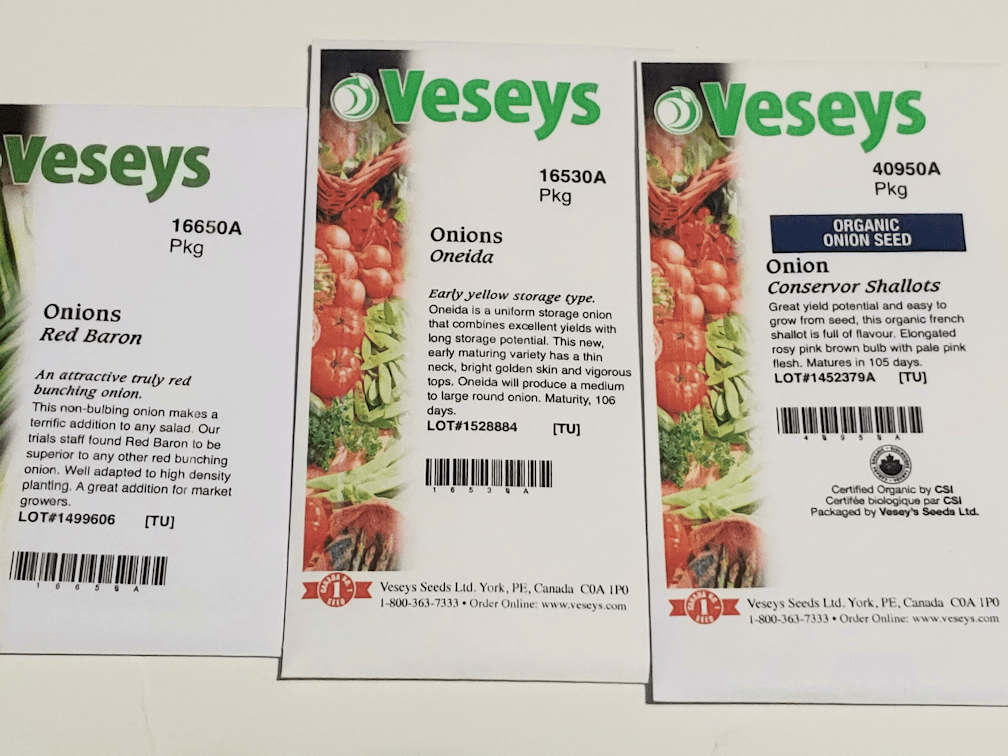
Bulb onions, bunching onions and shallots. I plan to order a variety of red onions I have my eye on, when we place another order next month. For this year’s garden, I plan to start the onions indoors much earlier. In the local gardening groups. many start their onions from see in January!
I’m not sure what happened here. We were supposed to get two varieties of winter squash; the candy roaster, and Winter Sweet Organic squash, not a summer squash! I ordered 40566A, not 40556A.
I will have to contact them about it. The squash I got is a pattypan squash, so I’m actually happy with this, but I do want my Winter Sweet!
We’ve got our two types of turnip to try. I’ve never grown turnip before, nor do I remember my mother ever growing them, either.
And finally, the beets, ground cherry and cucumber.
I’m really looking forward to growing the ground cherry!
Since I also plan to order more peas, and dry bean varieties, on top of the pole beans, cucumbers, and vining squash, we are going to need to build more climbing structures for next year’s garden!
These are still from the 2021 catalogue. A lot of seed companies don’t have their 2022 inventory available yet. I may be jumping the gun, but I’d rather order early. There’s a lot of talk about food shortages coming up and, while that is for the next few months, it is just more incentive to plan ahead for next year, and growing as much of our own food as possible.
With today looking to be our last warm day before winter, we wanted to get as much done outside as we could. This time, our focus was on the pea trellises, as they will be used again next year.
This is how it looked before we started. My older daughter isn’t working on commissions for the weekend, so she was able to come out and help, while her sister did bread baking.
I hate to think how long it would have taken me, if I didn’t have the help! My goodness, there were a lot of roots to dig up!
It took us a couple of hours, but we got it done! There was one five foot section that was so filled with crab grass and creeping charlie, it took me longer to do that one spot than it did to do several other sections, together!
Later, we will cover all the beds with a straw mulch.
It was so pleasant to be working outside. The high predicted for today was 8C/46F on one app, or 12C/54F on another. By the time we came inside, the temperature had reached 15C/59F! In fact, the last few days all turned out at least a few degrees warming that predicted. If that keeps up, it’ll make continuing the work over the next couple of days much more pleasant. Tomorrow is supposed to be a very decent 9C/48F, then a couple of days at 8C/47F, all with overnight lows above freezing, before things are supposed to get colder. There is much work to do, as long as the weather holds, and cooler weather is just fine when doing manual labour. The more we can get done now, the less we have to do in the spring!
Speaking of which, my first seed order should arrive by the end of the week, and I’m just itching to make my next order, in next month’s budget! Hopefully, by then, inventory for 2022 will start to become available, and I won’t be seeing so many “sold out” notices.
While it was a warm day today, it wasn’t quite warm enough to work on garden beds, so once the outhouse floor was done, I focused on doing a number of small jobs around the yard.
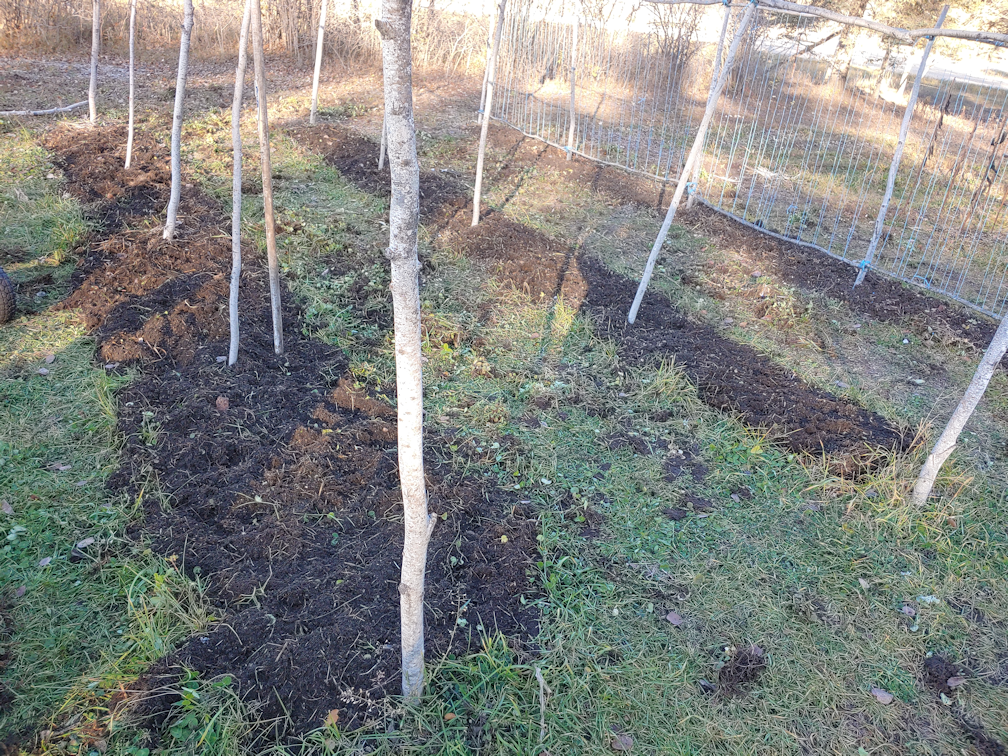
One of them was to replace the grass mulch on the garlic beds with a thick layer of straw. The grass mulch went into the newly framed bed, which has a trench in the soil for now. We’ll toss our kitchen scraps for the compost into the trench as well, before it all gets buried in fresh garden soil.
While I was getting ready to roll up the garden hoses at the back of the house, the cats were prowling all around me! It seems like, everywhere I turned, there was a cat, circling around me.
Except for Tuxedo Mask. The cheeky bugger planted his butt in a plant pot! The flowers in there are one of things my mother planted that turned out to be invasive. After telling me there was nothing in the old kitchen garden she wanted me to save, and I cleaned out and covered it all with layers of cardboard and mulch, she changed her mind and wanted me to keep them. They pushed their way through the layers of mulch, anyhow, so I transplanted some into this pot while preparing beds to plant in this spring. They’ve still managed to take over a section of the old kitchen garden, but it’s an area that is overshadowed by lilacs, honeysuckle and roses, so it’s not likely we’ll ever plant anything else in there. We’ll just have to keep them out of where we have built new beds, which looks like it’s going to be a challenge!
These flowers, which look a lot like periwinkle, are very hardy. They won’t have any problem recovering from a cat sitting on them, so I didn’t bother chasing Tuxedo Mask off!
I probably should have waited for a warmer day to put away the hoses, but it’s done now, except for one hose in the front of the house that I left for a bit longer. From the long range forecast, this weekend will be the last warm days, then the day time highs will slowly drop. Even so, we’re not expected to have highs at or just below freezing until past the middle of November.
I’m good with that!
After doing some other clean up around the yard, I got the burn barrel going for a while, then headed inside before the light failed. At the last minute, I decided to top up the cat kibble, which had been gotten into by that big skunk again. Of course, as soon as I came out of the sun room with the container of kibble, I had cats prowling all around me, crying like they were starving to death.
Including… hold on…
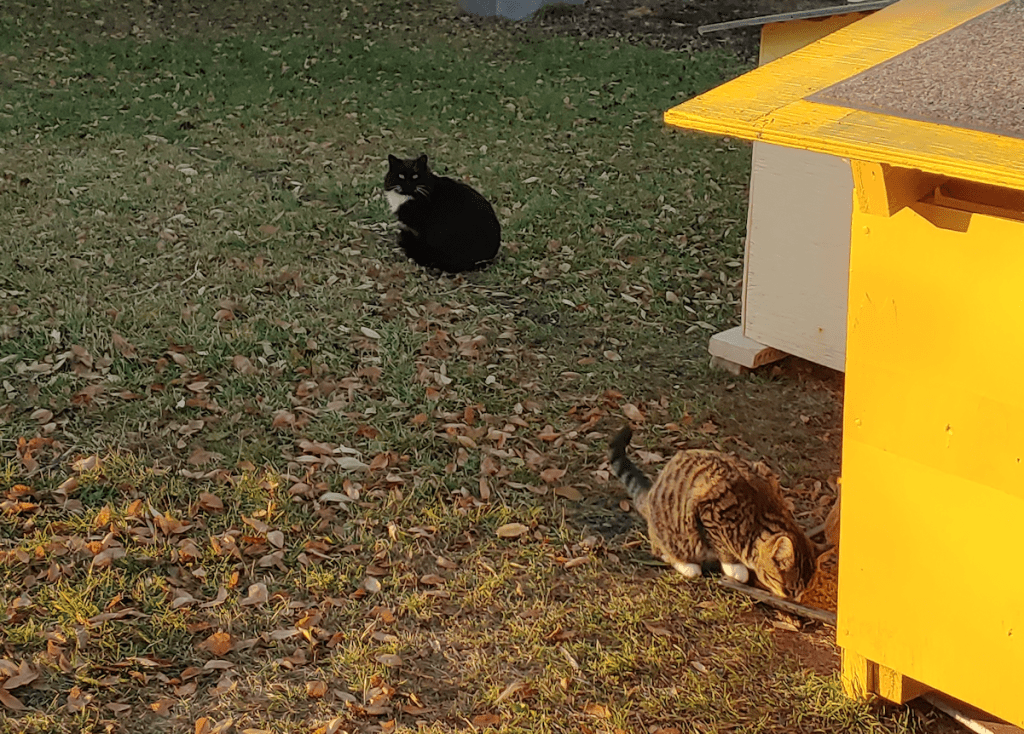
That wasn’t Tuxedo Mask over on the sidewalk. He’s busy trying to trip me on the way to the kibble house.
We had a stranger in our midst!!
After refilling the kibble trays, I was able to try and get photos.
What a handsome stranger!
The other cats didn’t seem the least bit bothered by his presence, either. I saw the kittens act more skittish around Creamsicle Baby than this guy!
He moved away from the food while I was trying to get a photo, prowling around the cat’s house and kibble shelter, and making his way back to the sidewalk, but he never ran away.
Even when my older daughter came out to see him, he stuck around. I went inside to let my younger daughter know. She was in between batches of bread baking, so she was able to come out, too. He did eventually start eating while my daughter was just a few feet away.
I wonder where he came from? This is the first time we’ve had a long haired cat come by, and the first time we’ve seen another tuxedo.
As long as the cats get along, he is more than welcome!
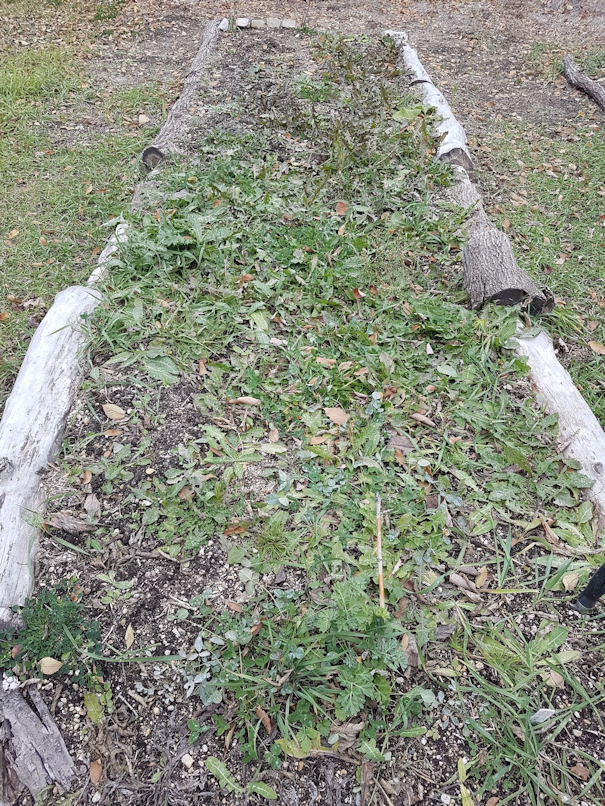
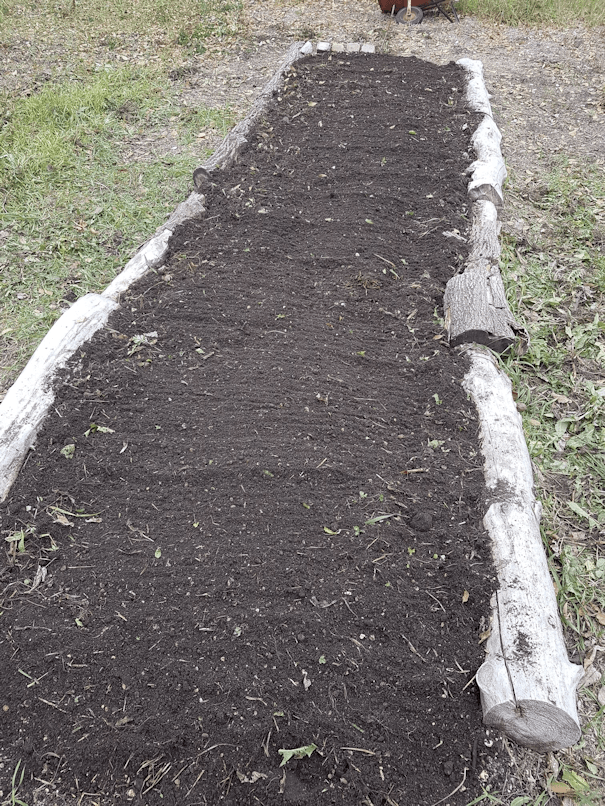
A while ago, my daughters cleaned up the beds in the main garden area while I worked elsewhere. I’d asked for photos, but thought they’d forgotten to take any. One of them, however, did remember to get before and after pictures, and recently passed them on to me.
So here is some of the cleanup done by my daughters, almost a week ago.
This first bed had two types of onions in it; the yellow onions we stared from seed that actually survived the cats, and red onion sets. Before those were planted, a row of… Hmm. I’ll have to check back. I believe it was the purple kale that we got as free seeds from Baker Creek that got planted down the middle. If anything germinated, something got to them before we ever saw them.
As the onions got harvested later, the bed was left empty when they were done. It had been weeded as much as I could, between the onions, while the onions were growing. This turned out to be one of the easiest beds to clean up and took them very little time.
This is one of the three beds that started out with spinach. After the spinach was harvested, they sat empty until the heat waves finally passed. On the left of this bed, I planted radishes and … gosh, I can’t remember, but it was another cool weather crop. Neither survived the grasshoppers. Eventually, we planted some lettuce seeds that had spilled out of their envelopes and got mixed up. They turned out to be mostly one type; Merlot, I believe they were called, with a couple of buttercrunch that we got as free seeds from Baker Creek. We were able to add a mesh layer over the chicken wire cover on this bed, so they survived. Unfortunately, after a while, the lettuce leaves got very bitter and nasty tasting. I don’t know why. It’s not like they were bolting, and we weren’t getting anymore heat waves, but it got so bad, we just couldn’t eat them anymore. It’s a shame, because they handled the frosts we got extremely well. They didn’t go to waste, though, and are now adding nutrients to the high raised bed. :-)
This was another bed that started out with spinach. Believe it or not, this bed got weeded quite thoroughly before I planted different radishes and one of the chard varieties. You can see the one chard that survived, surrounded by wire, in the background. Closer to the front you can see some bricks and stones that are surrounding the last couple of radishes that survived. This bed turned out to be very difficult to clean up and was thoroughly filled with rhizomes. It took so long to clean up, this was where they had to stop for the day.
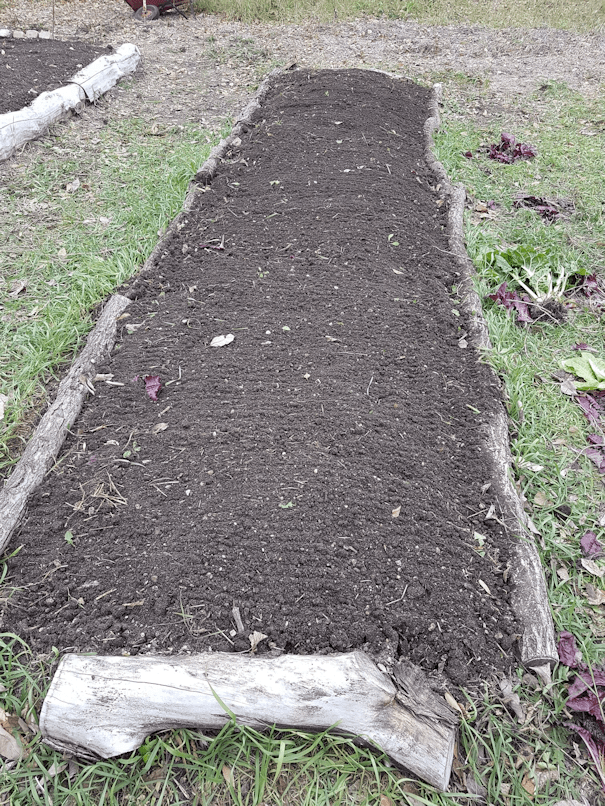
Before they left, though, my daughter had gotten a before picture of this last bed. It was the third bed with spinach in it, then it got planted with the Bright Lights chard and French Breakfast radishes. The chard did well until it got hit repeatedly with frost. It handled a couple of frosts very well before finally freezing beyond recovery. There were only a couple of the radishes that never quite recovered from the grasshoppers. Like the lettuce, they got pulled and composted into the high raised bed. My older daughters were able to come back to finish cleaning this bed a couple of days ago, and it was much faster and easier than the last one they did!
Over time, each of these beds will be replaced as high raised beds. They are about 14-15 feet long, but will be reduced to 9 ft, so it will be easier to build frames for protective covers that can be easily moved by one person. We will keep using the dead trees we clean up from the spruce grove to build the beds for as long as we have enough of them. That should be enough to do the remaining five beds. That will leave us room to do a second row of high raised beds, if we choose, but by then, I think we will no longer have enough wood from dead spruce trees to use. We shall see. It’s a big job that is going to take a while to do. In the spring, we will plant into these beds as they are, but now that we have a chain saw, I expect to be able to cut down the dead trees and cut the lengths we need in advance, so that in the fall, we will just need to assemble them.
To get the height of our first high raised bed, we used eight 9ft logs and eight 4 ft logs. With five more beds to build, that means 45 nine ft logs and 20 four ft logs. It took us most of four trees (including one that was smaller than the three we cut from the spruce grove) to make this one bed. The remaining trees that need to be cut are all quite large, but if we assume four trees per bed, that means we’ll need 20 more trees to do the remaining beds.
We have more than that many dead trees to cut. It will only be a question of how solid they are, or if they have rot or ant damage to the trunks. A few of them are so big that I would want to split the logs cut from the bases of the trunks, lengthwise, and use them at the very bottom of the beds, so they’re not too thick. If the wood on all the remaining trees is sound enough, given their size, I am thinking we will probably need closer to 15 trees to finish the beds rather than 20. Considering we have probably another 24 dead trees to cut, that just means more beds we can build!
Just thinking of having a whole row of high raised beds here makes me very happy. I can hardly wait!
While we have already been picking up some seeds here and there for next year’s garden, still have some from this past year, and even have some seeds we have saved, last night I placed our first online seed order. We will have a “seed” budget over the next few months that will also include, hopefully, fruit trees and berry bushes as well.
A lot of stuff is still listed as out of stock. This is most likely because the sites are at the end of the 2021 catalogue year, and their 2022 products are not ready yet. Still, it meant a few things on my wish list did not get ordered, and I found alternatives, instead.
This order was with Veseys. I have been very happy with what I’ve had from them – even the stuff that ended up failing, like the mulberry tree, since they had no control over it getting hit with that one bitterly cold night that killed it off! :-D There are several other places we will be ordering from, month by month, but this is what I ordered last night, with why they were chosen.
All photos belong to Veseys, and I will link to their individual listings. (For future readers, if the links are dead, it’s likely because they no longer carry the item anymore.) All links will open in a new tab, so you don’t lose your place.
This past summer was a hard one for the winter squash. We did not get enough winter squash for storage, and that’s the main reason we were growing them at all. While we still have Red Kuri and Teddy squash seeds we can grow next year, I like variety. Hopefully, between them all, we’ll have at least something for the root cellar!
This is the long squash in the photo. I have heard from quite a few different places about how delicious these squash are, so I want to give them a try.
Another good storage squash that I chose specifically because the listing says they are best for eating several months after being picked. So this one is for the long haul!
We’ve tried different varieties of beets, and grew lots of them this year, but with the growing conditions, we got remarkably few beet roots out of it. I don’t know that we will order other varieties as well, but I don’t expect we will plant as many as we did, this past summer. The listing specifies that this variety is a good storage beet, so that’s a big selling feature for me. Pickled beets are fine and dandy, but having some for fresh eating will also be good.
I’ve been wanting to grow these for a while! Before our move, we did grow these in our balcony garden with success, and I just love them. Which is odd, as they are in the tomato family, and I can’t eat tomatoes unless they’re processed. One of the cold climate gardening sites I follow listed these as something they regret planting, as they became invasive, and they didn’t like how they tasted. It seems these can self sow and are hard to get rid of, once established. With I see as a bonus! These will be planted in a location that can be permanent, so they can self-sow as much as they want.
We will be trying these again! I really enjoyed the shallots we bought as sets, to replace what we tried to grow from seed, but they were used up very quickly. We need more for our household, and the sets only had 25 per bag! I want to try and grow from seed again. This time, we have what we need to ensure the cats’ won’t be able to get at them and destroy them again!
Another one we will be trying again. When we started these seeds for our 2021 garden, I had used an cardboard egg tray for the “pot”. The cardboard just sucked the moisture right out of the growing medium.
We did plant the last of our seeds in Solo cups, though it was incredibly late in the season. What we did get got transplanted near our tomatoes. It didn’t really work, but while I was working on that bed yesterday, I found a single Red Baron onion in the ground, with just a hint of green on it. So I planted it back into the ground! Onions go to seed in their second year, so it should overwinter just fine under the mulch. We shall see! Even if it doesn’t, though, I look forward to trying to grow these bunching onions from see again.
Of course, we must have regular cooking onions, too! This is a variety I chose for its storage potential. I was happy with the yellow onions we grew from seed compared to the ones we grew from sets. We go through a lot of onions in this household, so I will probably be ordering other varieties as well – as long as we can find the room for all the growing trays when we start them indoors! At the very least, I want to get a variety of red onions I have my eye on, in another site.
We got a bush bean collection last year that did surprisingly well under difficult growing conditions. This year, I wanted to try a pole bean collection, but it was out of stock, so I found individual ones to try. We may still get bush beans as well. I am also interested in getting beans for drying. We shall see.
Since everything purple seemed to do much better than other stuff in our garden this year, I figured a purple pole bean would be worth a try! They are supposed to be a high yield bean that stays tender even as they get larger.
This pole been variety was new for Veseys for 2021. They are supposed to produce for a very long time. As they are also expected to grow up to nine feet tall, these, and the Carminat bean, should be great to grow on the squash tunnel.
This past summer, we had a sweet corn collection with three different varieties. This year, I decided to get just the one – and we will be planting them closer to the house in next year’s garden! These are an early variety that can handle colder soil, which will be important for spring sowing. Also, they were on sale. ;-)
I plan to get a couple other varieties of corn from elsewhere as well, so we should still have three or four different kinds of corn next year. We shall see.
I decided to try turnips this upcoming year. A couple of varieties caught my eye.
These are a fast maturing summer turnip that are also supposed to be harvested at a smaller size. The greens are also good for eating, so they are another dual purpose crop.
And finally, we have these cucumbers! I chose this variety for its dual purpose as well. Harvested at smaller sizes, they are a good pickling cucumber. Leave them to grow larger, and they are good for fresh eating, too.
So this is our start! Along with the garden beds we used this past summer, we will need to expand our garden even more for next year. We will likely need to build more trellises as well.
One thing we learned from this past year’s garden is, if we want to meet our goal of growing enough food to preserve through the winter for the four of us, we need a much bigger garden! Partly, we need to plant more of some things, because who knows how much will actually survive? Plus, a few packets I’d ordered turned out to have fewer seeds in them than I expected. As I place our orders, I’ll need to keep an eye on the quantities and decide; do I order more packets, or order more varieties?
Hopefully, we will not get another year of severe heat and drought conditions. Nor another year with a plague of grasshoppers. And be able to keep the critters out… There are so many things that can affect yield. Someone on one of the gardening groups I’m on, posted this little rhyme.
One for the rook One for the crow One to rot and One to grow
Planting four times more than we think we will need seems a bit much, but after how things went this past year, there are some things it really does seem appropriate for! And that’s just food for us. When we get chickens and possibly goats, we will want to grow as much feed as we can. Plus, I want to eventually grow flour corn and things like wheat, chickpeas and flax. I’m even looking at getting sugar beets, and my daughters are interesting in growing hops for beer making. By the time we’re doing that, however, we’ll be growing in the outer yard!
Today, I took advantage of the lovely, warmer than forecast weather we are having, to clean up and redo the tomato bed.
Here is how it looked when I started. This is a new bed, built this spring, and I was very happy to see how deep and strong the roots on the tomato plants where, when I pulled them. I also saw the biggest, fattest worms I’ve seen this year!!
There were two goals to redoing this bed. One was to make sure the soil didn’t go through the chain link fence. When the bed was build, we laid cardboard down on the grass first, with the flaps up against the fence. That cardboard is pretty broken down now. We had to top up the soil part way through the year, and boards I’d scavenged from the barn were used to keep it from going through the fence. The other goal was to use the bricks to create a little retaining wall around the bed. When watering the tomatoes, no matter how gentle we tried to be, soil eroded into the path, exposing roots. Especially at the end by the vehicle gate, which got even more soil added to try and combat the erosion.
The first thing to do was move the soil away from the fence and pull up the boards. Then I went back along the fence with a hoe to make it as even as I could.
The boards were then put back, this time to fit in between the fence posts. Each section got one full length board, plus another cut to about 3/4 length. I snagged an extra board from the where the cucamelons were planted, on the other side of the people gate, to have enough.
The chain link fence is kind of wobbly, so I used the left over sections of board and placed them at the “seams” between each pair of boards, to support them from the weight of the soil.
Then, in a couple of sections, I also hammered pegs into the ground on the outside of the fence, for extra support.
That done, it was time to start working on the bricks.
First, I had a decision to make.
Should I make the bed two, or three, bricks wide?
I decided on two and a half!
This way, not only would the bed be a comfortable width, but there would be no corner to catch a foot on. Because I just know that I’d be doing that, constantly! :-D
Once that was decided, the soil was moved out of the way and the space where the bricks would go, leveled as well as I could with a hoe. Then the bricks were spread out along the length of the bed.
Would I have enough? It did look like it, but I wasn’t completely sure.
The next job was to use a garden claw to loosen the soil where the bricks would go, so I could push them down a bit. Not too far, though, because I didn’t want to lose any height.
By the time I reached the end, there was a gap of about two inches, so I just moved the bricks at the end to fill it!
Then is was time to level off the soil. This was also the time to pick out any remaining weeds and roots.
Then I went over it with a hose to wash the soil against the bricks and boards a bit more, and clean off any soil that got on top.
The final touch was to mulch the whole thing with leaf litter.
This bed is now ready for next year!
The tomatoes did so well here, we might use it for tomatoes again next year!
The boards and bricks around this bed are temporary. The wood will rot away, and there bricks are just sitting on the ground. At some point, we plan to get to the salvage place and see what sort of bricks and blocks we can find. Maybe even some paving stones. Once we have the materials, the path will be laid with bricks or paving stones, and the bed itself well get framed in a more permanent way. Until we are able to do that, though, this will be enough to keep the soil in this bed from washing away when we water it.
I was pretty much done when the girls finished their stuff inside, and came out to work on the last bed in the main garden area that needed to be cleaned up.
Since we have the straw bale now – and the chipper/shredder – I am thinking of running some straw through the shredder and using that to mulch the top of these beds over the winter.
Aside from that, these beds in the main garden area are now all done and ready for next year.












 The Re-Farmer