Can we? Should we?

Well, I’m back home now, and am really wrestling with myself.

I went to the old church again to see what was left. I saw a few things moved around, and a shelf in the entry that had been in the choir loft. Someone shattered a fluorescent light bulb, so there was new glass all over one area.

Someone managed to remove and entire window. They had simple stained glass panels in them; squares for the most part, with triangles to fit the semi circle tops.

Unfortunately, that leaves a big hole in the wall. It’s unlikely anyone will make any effort to board it up, since the entire building is going to be torn down.

Much to my surprise, the pair of candle sticks with red glass globe shaped tops were still there.

I decided to take them.

I went into the priest’s room and found the closet doors in there open, and vestments still hanging. The doors protected them, and they are not damaged by fire at all.

There’s a solid wooden shelf opposite the closet. I went through more of the drawers this time. They were a bit janky, trying to open them with one hand while using my phone as a flashlight with the other. Still, I hope someone takes the shelf. It’s big, heavy and incredibly solid. There is only smoke residue on it.

The drawers were for things like altar cloths, other cloths, and I even found the curtains that had been used as doors for these two tiny rooms on either side of the altar. At a bottom drawer, I found a cloth that looked very clean and picked it up. I am sure it is actual linen, not the usual cotton.

I decided to take it.

There were a number of glass items that I was very tempted by, but I left those for now. Instead, I grabbed the candles sticks and headed out.

My conundrum.

Should I take a pew? Plus a bench or two?

Five of them have already been taken. There are still eight left, plus a couple of benches. If no one takes these, they will be burned.

They are really solid. Even the ones in front seem to have only smoke damage, not flame damage. The benches in the back have the least damage of all.

They are all pretty long. Possibly longer than our truck box, though that is not a concern. I could just secure them with the tailgate down and put a red flag on the back.

With various projects we have in mind around the property, I can see being able to use these.

The problem is, where to keep them until then?

Ideally, we’d take them into the new part basement, where they could be cleaned over the rest of the winter. With how long they are, though, we couldn’t get them down the stairs. For the new part basement, we simply wouldn’t be able to maneuver them through the doors and down the stairs. Then, once at the bottom of the stairs, they would be too long to turn at the bottom. There’s a hand rail attached to a support pillar in the way.

Theoretically, we could take them straight through the house and to the old part basement doors, but we’d have the same problem at the bottom of the stairs. The space around those stairs is even tighter.

There are a few other things still there that I’m tempted to take but, again, where would I put them until we can use them?

After I was done going through the church, I went to the store the post office is in. Still no regular mail, but my daughters’ Christmas gift that I was expecting was there. The product packaging was wrapped in semi-transparent plastic, though, you could see exactly what was in it!

My daughter had sent me some funds and a request for some Crown Royal for the eggnog. Her sister had already picked up some booze when we were doing errands a couple of days ago, but she picked such good ones, they didn’t want to “waste” it on eggnog. 😄 The general store and post office has a booze section, too. After looking at the options, I chose a Salted Caramel.

It was that or “regular”, blackberry or peach.

As I was paying for our stuff, I asked the owner of the store if she knew when the church was going to be torn down. She didn’t know, but her husband happened to walk in while we were talking, and she sent me his way, as he was more involved with all the meetings and stuff.

It turns out he didn’t know, either, as that decision hasn’t been made yet. He thinks it would be in the spring, too. It just doesn’t make sense to do it in the winter.

We spoke for quite a while. He had been in the church this morning, while I had been there within maybe 15 minutes, and there were already some changes from between our visits. He himself had taken a couple of pews. I brought up the shelf in the priest’s room, with the janky drawers. He just laughed and said, they have always been like that! He agreed, though, that it is really solid, and hoped that someone could take it. It would not be easy to get out of there, but it would be worth it!

So we will have time to decide.

When I got home and brought things in, my older daughter met me at the door to help me come in.

Well, since she was going to see it anyhow, I handed her the box and told her, Merry Christmas!

We got them an Instant Pot.

My daughters had been talking about getting a rice cooker, and in my conversation with them, I suggested getting an Instant Pot, since it can do that, as well as being a slow cooker and a pressure cooker, among other things. We’re down to one slow cooker, so a second with be handy, and it would have more control than our little pressure cooker.

I got a positive response to the suggestion, so when we had the chance, I ordered one as a gift for them. We are a family that quite appreciates useful gifts like this!

So they got their gift early. I’m sure they’ll get good use out of it!

Then she helped me carefully take the candlesticks and their glass covers, which I had already taken off, to the cat free zone to join the other mementos. As she was going through the doorway into the living room, though, something fell and hit the floor.

Hard.

It was the insert from one of the candlesticks. The insert it meant to hold a long, straight candle and has a spring on the bottom so that, as the candle burns away at the top, it slowly pushes the rest of the candle up.

It still had most of the length of a candle in it!

After everything was put away, we started talking about what I found at the church and I told them about wanting to take a pew, and maybe a bench or two. They agreed that these were things we could definitely make use of but, again, where do we store them until then?

One possibility mentioned is the storage house, in the inner yard. That would be a good place where they would be protected from the elements, but there is already so much stuff in there, I don’t know that there is room for even a bench, never mind a pew.

Ideally, we could put it in the storage warehouse, which used to be my late brother’s workshop. That, unfortunately, is so full of stuff from my parents, there’s barely space to walk around.

A lot of what’s taking up space in there is bags and bags and bags of old clothing, bed pads and other fabric items. The clothing, at the very least, should be taken to the dump as far as I’m concerned. My mother, however is still very attached to her material goods and still frets over whether the door is locked, because someone might steel her stuff.

*sigh*

That building is the most structurally sound one in the outer yard, and we can’t even use it.

Either way, it would mean we couldn’t start to clean them until spring, at the earliest.

So … can we take a pew and some benches?

I think we could make it work. In fact, if we could find the space, I would take several pews. It would be a massive shame for them to be destroyed. They don’t make them solid like this, anymore!

Which leads me to our next question.

Should we?

The Re-Farmer

Making hard crab apple cider: racking day – what happened? (updated: I found out!)

This morning, after doing my morning rounds, I gave the sun room door frame a second coat of paint. Tomorrow, we hang the door back up.

I had an audience. :-D

Also, while I was painting, I found that Nostrildamus has figured out to jump over the threshold after it’s been painted! :-D

Meanwhile…

Today was finally racking day for our first attempt at making hard apple cider, using our own crab apples. For new visitors, you can read up about that here and here. (links will open in new tabs)

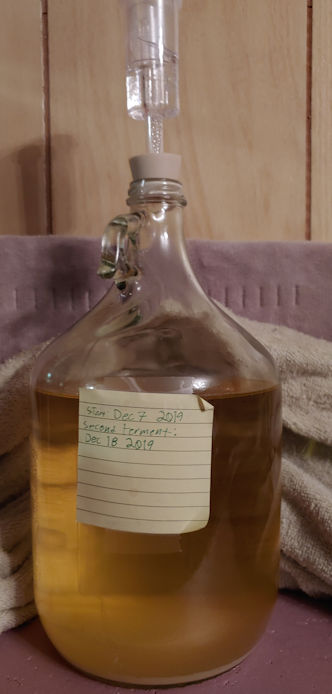
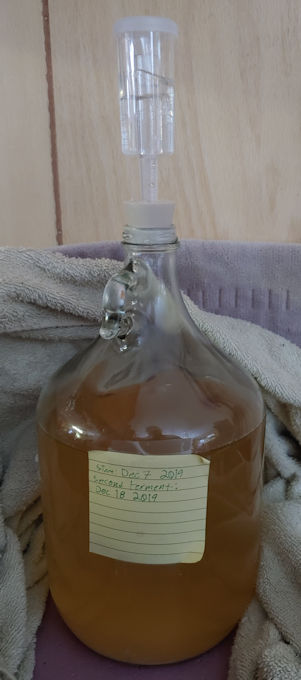
Here is how the gallon carboys looked before I started. As expected, there was a LOT of sediment at the bottom. It’s not just the lees from the yeast, but the sediment from the raw, unfiltered juice.

We had some concerns with the fermentation. Activity in the airlock stopped a while ago. I think the room temperature became a problem. While they were actively bubbling, their temperatures tended towards 18C/64F, though we did also keep them wrapped in a towel and, every now and then, I’d heat up a rice-filled warming pad in the microwave and stick it between them to help keep them warm. We had used an electric heating pad, when making mead, but where these were sitting, there is nowhere to plug it in.

Racking from a 4L to a 3L carboy meant a lot of sediment heavy liquid left behind. Though I tried to hold the racking cane well above the sediment as long as I could, I could still see wisps of it being pulled up the siphon.

As I racked each jug, I made sure to get a hydrometer reading.

I just don’t know what to make of it.

For one of them, the hydrometer pretty much sank to the bottom. I had to add cider almost to the top for it to float enough to get a reading. The other was only slightly better. When they were first tested, it floated quite handily.

Unfortunately, I just can’t get it straight on how to read the specific gravity on that thing. So I write down all three readings.

The readings still don’t make any sense to me. Why would the numbers all drop so much? From what I can figure out, this is basically telling me there’s no alcohol in one, and almost no alcohol in the other.

I did taste test it, of course, and they both have a VERY sour apple taste. It also does taste alcoholic, but that is almost overwhelmed by the sour apple taste. Which is interesting, since the apples we used are actually quite sweet, and there was quite a bit of sugar added to the juice, too.

As for the hydrometer reading this time around, the only thing I can think of that might be affecting it (besides something going weird with the cider itself) is the temperature. Both carboys had a temperature reading of 16C/60F. The ambient temperature in the room is 15C/59C. From what I’ve been reading, newer hydrometers are calibrated for about 20C/68F. I’ve found a site that will calculate the adjustment for temperature, but there is virtually no change in the reading. So what gives?

I have no idea.

Considering that the traditional way of making hard apple cider is to press whole apples into a barrel, set it aside for a few months and BOOM, you’ve got booze, I didn’t expect this to be so complicated.

Anyhow. The 3L carboys are now set up with their airlocks for a second fermentation. As for the liquid left behind with the lees, I ended up straining much of it, and we now have about half a liter of filtered baby hard apple cider.

Hmmm… I wonder how it will go with the ham I will be roasting today?

The Re-Farmer

Update: When I started the hard apple cider, I did it based on this video from CS Mead and More.

There is a reason I included them among my Recommended sites!

I went ahead and contacted them about my readings, and got a very prompt response, and I am very happy!

It turns out, everything is working fine. My problem is with reading the hydrometer, then figuring out what it’s telling me! :-D

And now I know what to do with the information I’m getting off the hydrometer. I may not be using the AVB or Brix to work it out, but I’m writing them down anyway, because I can see those readings better. I can then use the printed out chart that came with the hydrometer to see where that lines up with the Specific Gravity and actually read that number on paper, instead of trying to see it in the liquid. When I take pictures and upload them to my desktop, I can usually zoom in and read it, but sometimes I find the hydrometer moved as I was taking the picture and I still can’t read it. :-/

The formula I was given to calculate the alcohol percentage is to subtract the new reading from the first reading, then multiply the answer by 135. So for one of my ciders it’s:

1.100 – 1.020 = 0.08
0.08 x 135 = 10.8% ABV

For the other one it’s:

1.090 – 1.009 = 0.081
0.081 x 135 = 10.9% ABV

We definitely have booze. :-)

Mead Baby 2.0: bottling day!

Today, we finally bottled our second attempt at making mead!

I last wrote about it here, and you can follow links to the whole process we went through, here. (Links will open in new tabs.)

Here is how it looked, after unwrapping the carboy from its towel (which served to insulate, as well as keep light out).

Continue reading

Mead Baby 2.0: third ferment

Time for an update on our mead making!

The last time I posted about it, we had added a few raisins to the mead to boost fermentation.

Yesterday, my daughter was a sweetheart and racked it to another 1 gallon carboy.

It is now back in its little corner, all swaddled like a baby.

The mead was very clear before it got racked, but between the raisins floating on top and the sediment on the bottom, a fair bit was lost in the process. The jug wasn’t full anymore, already, and now it’s about 2/3rds full.

We’re still going to keep it in the 16C – 20C range, though I’ve read that cooler temperatures are just find by this point. We really could have bottled it, but we will leave it to ferment with an air lock for a while longer.

Now that it’s separated from the sediment, it should not develop any off tastes. At least according to what I’ve been reading. Any fermentation that continues at this point will be very slow.

I figure a couple more weeks, maybe a month, we’ll bottle it and do another test with the hydrometer to check the alcohol level. Given how much was lost to racking away from the sediment, I’m hoping we get 2 full bottles, plus a some left over to test and taste. :-)

The Re-Farmer

Mead Baby 2.0: boosting fermentation

For those who have recently started to follow this blog (welcome!), here are the previous posts about our second attempt to make mead. All links should open in new tabs, so you won’t lose track of this page. :-)

Mead Baby, redux (includes links to our first attempt)
Mead Baby 2.0:
active fermentation
it’s a temperature thing
temperature success
overnight temperature status
second fermentation

Since then, we have been monitoring the Baby closely. While there has been virtually no visible activity in the air lock, when we looked at the liquid itself, we could see that it was clearing up, and there was a steady stream of tiny bubbles of carbonation moving upward. If the temperature dropped to 16C, we would turn on the warming pad, which would typically bring it up to about 18-19C.

Recently, its temperature would drop to 16C a lot faster, and we could no longer see the carbonation. It was looking a lot clearer, and we could see a fair bit of sedimentation at the bottom.

However, it was less than 2 weeks since we started the second fermentation. While I’ve read a mead can be ready in that time, most videos and websites I’ve been looking at showed active fermentation for about a month, and gave advice on how to reactivate fermentation if it stopped to early.

Since that was the problem we had with our first attempt, we debated. Is it done and time to bottle it? Should we rack it into another bottle to get it away from the sediment and leave it longer? Do we add something to boost the fermentation?

I’ve read various ways to boost fermentation in mead, including those that recommend adding a chemical that is used in wine making.

Or we could just add some raisins.

So that’s what we decided to do.

With a 1 gallon carboy – and it’s not full – not a lot of raisins would be needed.

We added three.

Here are photos, taken a day apart, showing before and after we added the raisins.

As you can see in the photo on the left, the mead had gotten quite clear, and there’s a pretty thick layer of sediment on the bottom. It’s hard to tell with the reflections, but in the second photo, you can actually see a couple of the raisins floating at the top. The mead is cloudier, but when we shine a light into it, we can once again see that steady stream of bubbles going up to the top.

We’ve been checking its temperature regularly and, aside from an initial warm up after adding the raisins, it’s been keeping its own temperature at 19C.

Right now, the plan is to leave it until we can no longer see those bubbles, rack it into another carboy to get it way from the sediment, then leave it for a while longer before bottling it.

A lot of the information about mead making I’m finding is conflicting, but one thing that all our sources agree on is, the longer the mead sits after bottling, the better it tastes. Most recommend at least a year.

I doubt we’ll wait that long, but with bottles at 750ml, even with having less than a gallon in the carboy (and I expect we’ll lose more after racking it again), we should still be able to get 3 – 4 full bottles out of it, so we can have one right away, then try the others at different ages.

So if we want to start a malomel (mead made with fruit) as we planned, we should pick up another air lock and two, so we can have multiple batches going at once.

You know, for someone who doesn’t actually like alcohol all that much, I find the process of making it quite enjoyable!

:-D

The Re-Farmer

Making mead, part 2; give it a stir

Using a set of instructions we found, the must is to be stirred basically once every 12 hours, for the first 48 hours.

This is what the must looked like after the first 12 or so, and before I started stirring.

I have no idea if this is what it’s supposed to look like at this point. Of the various instructions and recipes I found that included pictures, I never saw one that included pictures at this stage.

I expected more of a yeasty smell, but there is barely any smell at all at this point.

After about a minute of stirring (the instructions said stir for 2 minutes, but I didn’t want to have the bucket open for that long), I popped the lid back on top. Then I made sure to write on a sticky note that the first stir is complete and left that on the lid, so no one else would accidentally pop it open and stir it again.

I’m really looking forward to seeing how this works!

The Re-Farmer

How Sweet it is! Making Mead, part 1

Today, we started up a batch of mead, using the wine kit we recently acquired.

Here are the contents of the kit, plus a 5 kilo bucket of my cousin’s liquid gold!

Looking up how to make mead had us all over the place. At its simplest, you can mix honey, water and yeast into a sanitized glass jug. Stick a balloon over the opening to allow the gasses to expand, tuck it in a cool dark place and forget about it for a few weeks.

Other sources had elaborate recipes with multiple steps and finicky measurements every step of the way.

We’re going to be doing something in between.

Continue reading